CSEIT1833315 | Received : 15 March 2018 | Accepted : 29 March 2018 | March-April-2018 [ (3 ) 3 : 937-942 ]
© 2018 IJSRCSEIT | Volume 3 | Issue 3 | ISSN : 2456-3307
937
Security Issues In Mobile Computing
A. Helinamercy, S. Agalya, L. Udhaya, S. Gowsalya
MCA, Anjalai Ammal Mahalingam Engineering College, Kovilveni, Tamil Nadu, India
ABSTRACT
As more and more persons take pleasure in the various brought by movable computing, it is becoming a global trend in today’s world. During the last decade in the size of computing machinery, attached with the rise in their compute power has to lend to the development of the concept of mobile computing. It allows mobile users adaptable communication with other people and expedient notification of important events, much more elasticity them with cellular phones.
Keywords :Mobile Computing, Adaptable Communication, PDA, IEEE
I.
INTRODUCTION
Mobile plans (e.g., Smartphone, tablet pcs, tablet etc) are all the instance more becoming an essential part of human life as the most efficient and suitable message tools not bounded by time and place. The fast development of mobile computing (MC) becomes a commanding tendency in the development of IT technology as well as trade and industry fields. Wireless communication takes place through the radio signals, it is easier to capture or eavesdrop on the communication channels. Therefore, it is important to provide security for all these threats. There are different kinds of issues within security like privacy, truth, accessibility, legality, and responsibility that needs to be individually taken care off.
II.
MOBILE COMPUTING
Mobile computing is the ability of a computer and communication, where its plans are not controlled to a single place, depends on the attendance of an appropriate distributed systems communications. In simple, mobile computing it's all about moveable and small computers with enlarging in computing power or defined as computing capability which may be used while they are being moved.
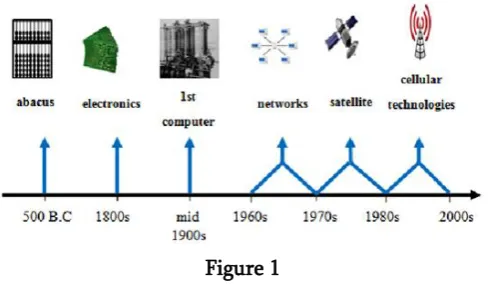
The primary computing, namely abacus, was used in 500 B.C which may believe as a mobile computing because abacus has a little size, it can be moveable, and the scheming in order is one part of computing. In the 1800s the advent of electronics and it was the first mobile storage space systems can be traced back to that period. The first computer was back in the mid-1900s, and then the concept of network has appeared during the period 1960-1970, wired and then wireless. In 1970-1980, it was the appearance and use of settlement and then followed by use of cellular technologies in the period 1980-2000.
drawback is a safety issue, where it has to introduce different new security challenges which were imaginary in the conventional computing.
Figure 1
III.
HISTORY OF DEVELOPMENT OF MOBILE
COMPUTING
CLASSIFICATION:
Mobile computing is classified into the following categories:
PERSONAL DIGITAL ASSISTANT (PDA):
The main reason for this device is to act as an electronic manager or day planner that is portable, easy to use and capable of contribution information with your processor systems.
PDA is an additional room of the PC, not a substitute. These systems are able of sharing in order with a processor system through a procedure or service known as management.
With PDA devices, a user can look through the internet, listen to audio clips, watch video clips, edit and change office travel permit, and many more forces.
SMARTPHONES:
These kinds of phone combine the nature of a PDA with that of a variable phone or camera phone. These phones include high-resolution touchscreens, web browsers that can right of entry and properly display the model web page. The universal mobile functioning system (OS) used by present elegant phone has Google's automaton, Apple's iOS, Nokia's
Symbian, RIM's BlackBerry OS, Samsung's Bada, Microsoft's window Phone.
TABLET PC AND IPADS :
This movable device is well-built than a portable phone or a PDA and join together and is operated. They are often unnatural by a pen or by the touch of a finger. They are commonly in slate form and are light in weight. Users can edit and modify essay files, access high-speed internet, stream video and audio data, take delivery of and send e-mails, attend/give lectures and presentation among its very many other functions. They have excellent screen motion and clarity.
Figure 2 ADVANTAGES:
Mobile computing has distorted the entire outlook of our everyday life. Following are the main compensate of Mobile compute :
Location plasticity:
This has enabled users to work from somewhere as extensive as there is a correlation recognized. A user can work exclusive of being in a static point. Their mobility ensures that they are able to carry out normal responsibilities at the equivalent time and perform their fixed job.
Save Time:
documents and files over a secure channel or portal and labor as if they were on their processor. It has better telecommuting in many corporations. It has also solid out of work incur expenses.
Enhanced Efficiency:
The consumer can service expertly and productively from either position they find secure. This, in turn, enhances their excellent association stage.
Ease of Research:
Learn has been complete easier since users preceding were obligatory to go to the ground and discover for corroboration and encourage them to invalidate into the construction. It has also made it easier for field officer and researchers to collect and nosh data from wherever they are exclusive of creation out of work trip to and from the establishment to the ground.
Entertainment:
Video and audio-video recording can now be violent flow on-the-go using movable subtract. It's straightforward to admittance a wide assortment of the show, educational and instructive material. With the development and ease of high quickness data relations at widespread cost, one is able to get all the movement they want as they look during the internet for stream data. One is able to observe news, show, and documentaries amongst another movement offer over the internet. This was not credible before handy compute dawn on the analyze globe.
Streamlining of Business Processes:
Construction processes are now just accessible through protected relatives. Looking into defense issues, the adequate method has been put in place to certify corroboration and authorization of the user admittance the martial. LANs are inexpensive but have incomplete range. 2. Security Standards: When operational mobile, one is dependent relative on public networks, require the watchful use of Virtual Private Network (VPN). Security is a most important anxiety while relating to the mobile computing standards on the fleet. One can easily attack the VPN through a huge number of networks consistent through the line.
3. Power consumption: When a pre-eminence outlet or transferable producer is not accessible, the mobile computer must rely exclusively on sequence power. Combined with the compact size of many mobile phone devices, this often means the extraordinarily high-priced battery is used to obtain the required battery life.
4. Transmission interferences: Weather, ground, and the range from the nearest signal point can all impede with signal reception.
5. Human interface with the device: Screens and keyboards tend to be small, which may make them hard to use. Alternate input method such as speech or calligraphy recognition requires training.
V.
ISSUES IN MOBILE COMPUTING
1. SECURITY ISSUES
Confidentiality: Prevent illegal users from gain access to exacting information of any particular user.
Integrity: Ensures unauthorized modification, elimination or creation of information cannot take place.
Availability: Provide authorized users getting the right of entry they require.
Accountability: Providing that the users are held answerable for there security-related activities
2. BANDWIDTH:
Bandwidth utilization can be better by logging (bulk operations against short requests) and compression of data before transmission. Additionally, lazy write back and file perfecting can help the network in times of peak burden. Lazy write back is very helpful in the sense that the data to be written may undergo added modification. The technique of caching recurrently access data items can play an important role in reducing disputation in narrow bandwidth wireless networks. The cached data can help improve query response time.
3. LOCATION INTELLIGENCE:
As the mobile computers move they encounter networks with different features. A mobile computer must be able to switch from infrared mode to radio mode as it moves from indoors to outdoors. Security Risks of Infrastructure-Based WLANs
TOP 10 TRENDS IN MOBILE COMPUTING:
1. Increase in Demand for Enterprise Business
Intelligence (BI) Mobile Apps
2. More Emphasis on Mobile User Experience
3. Apple and IBM Partnership
4. Android for Enterprise
5. Development of the Mobile Wallet
6. Google Algorithm-Wise Computing
7. Mobile SEO Activities
8. Ingress Protection for Mobile Phones
9. Larger Displays on Smartphones
4. 10.Non-Removable Battery and Memory
CURRENT STATE OF MOBILE COMPUTING Mobile computers are one of the fastest flourishing sectors of the PC market Short-range wireless networks (Bluetooth) available from IBM, Toshiba, HP…High-speed (11 Mbps) wireless LAN products are now easily and cheaply available (IEEE a, IEEE b)Low speed (currently 128 Kbps) Metropolitan Area
Wireless Network services are available in some cities and spreading.
THE FUTURE
With the fast technological improvement in AI, Integrated Circuitry and increases in CPU speeds, the future of MC looks increasingly exciting. With the persistence increasingly on compact, small mobile computers, it may also be possible to have all the common sense of a mobile computer in the size of a handheld controller. This can then be checked by the individual to plan his day.
The working lifestyle will change, with the majority of people working from home, rather than commuting. This may be beneficial to the environment as less transportation will be utilized. This flexibility aspect may be carried more in that, even in social spheres, people will interact via mobile stations, cancel the need to endeavor outside of the house.
This frightening concept of a world full of lifeless zombies sitting, locked to their mobile stations, accessing every ball of their lives via the computer screen become ever more real as expertise, especially in the field of mobile data communications, rapidly improve and trends are very much towards universal or mobile computing.
CRYPTOGRAPHIC ALGORITHMS:
cryptographic technique are symmetric and asymmetric.
SYMMETRIC ALGORITHM:
In symmetric algorithm the same covert key is worn at the transmit and delivery conclusion. As the secret type requirements to be disclosed at the reception conclusion and need to be a covert it is also known as Private-key algorithm. The AES, RC6 and Blowfish symmetric algorithms use obstruct symbols. A block cipher divide data into chunk, pad the last chunk if essential, and then encrypts each chunk in its revolve. The RC4 algorithm uses the flow Cipher. A stream cipher uses a sequence of accidental numbers seed with a symbols solution to encrypt a flow of bits.
ASYMMETRIC ALGORITHM:
In asymmetric algorithm the secret type at the transmit end is unlike from the covert key at the receipt end. This algorithm uses a key pair-one public key and one confidential type. The personal and the community key are needed for encryption and decryption. RSA, DSA, ELGAMAL. Symmetric algorithms use equal type for encryption and decryption whereas the asymmetric algorithms use transformed key for encryption and decryption.
Figure 3
VI.
BIO-CENTRIC ALGORITHMS
1. FINGERPRINT RECOGNITION ALGORITHMS: A template of the manipulate produce of the possessor is saved in the transportable receiver and
when the consumer put his handle on the transportable the respect algorithm try to equal the live identify produce with the pattern save in the receiver. If it is coordinated then the portable is prepared for use. The finer points, ridge and valley are exclusive to each creature person and and so the safety level is successfully excellent.
2. VOICE RECOGNITION ALGORITHM:
These algorithms recognize the influence tone of a individual and try to counterpart with the voice sample which is rerecorded and save in the itinerant by the proprietor. If the two match then the mobile is authentic for use. Hence there is a very smallest quantity defence risk.
3. FACE RECOGNITION ALGORITHM:
As almost all portable phones are able to with a camera, face acknowledgment can be used for protection. A snap can be captured and saved in the portable and whenever the user shows his face on the mobile, the algorithm will try to match it with the capture representation. Only, if a just right contest is found among the two metaphors the transportable will be above-board for utilize.
4. IRIS RECOGNITION ALGORITHM
Located at the reverse of the cornea, wrapper the beginner, Iris is a part in the eye which is colour. The expertise using Iris appreciation is entered approximately iris’s exceptionality. Level in the case of twin which are equal, the irises are exclusively various. While scan, a still depiction of the eye and the live eye can be differentiated by the current technology. The ‘Iris Code’ image is stored in an image database with the user’s approval. Under the verification process, the iris code stored in the record and the user’s iris are scan again and compare. An inequality of together irises will lead to protection unease in the portable receiver.
VII.
CONCLUSION
considered equipment that improve information excellence and convenience, increase functioning good organization, and enhance management efficiency.
VIII.
REFERENCES
[1]. Chang-Seop Park, " On Certificate-Based Security Protocols for Wireless Mobile Communication Systems."IEEE Network 1997 [2]. Vipul Gupta and Sumit Gupta "Securing the
Wireless Internet" IEEE Communications 2001. [3]. S.K Miller, "Facing the Challenges of Wireless
Security", IEEE Computer,2001.
[4]. Gopal Racherla, Debashis Saha,"Security and Privacy issues in Wireless and Mobile Computing " IEEE Proceedings, 2001.
[5]. Jun-Zhao Sun, Douglas Howie, Antti Koivisto, Jaakko Sauvola," A Hierarchical Framework Model of Mobile Security", IEEE 2001. 14 [6]. Subramanyam, Anupam Joshi, " Security in
Mobile Systems", IEEE Proceedings 1998. [7]. Asokan, "Security Issues in Mobile
Computing," Univ. of Waterloo, Dept. of Computer Science, Technical Report CS690B, Apr. 1995.
[8]. Charlie Perkins, " Mobile IP and Security Issue: An Overview".
[9]. Mavridis Pangalos, "Security Issues in a Mobile Computing Paradigm."
[10]. Sandro Rafaeli, "Survey of key management for