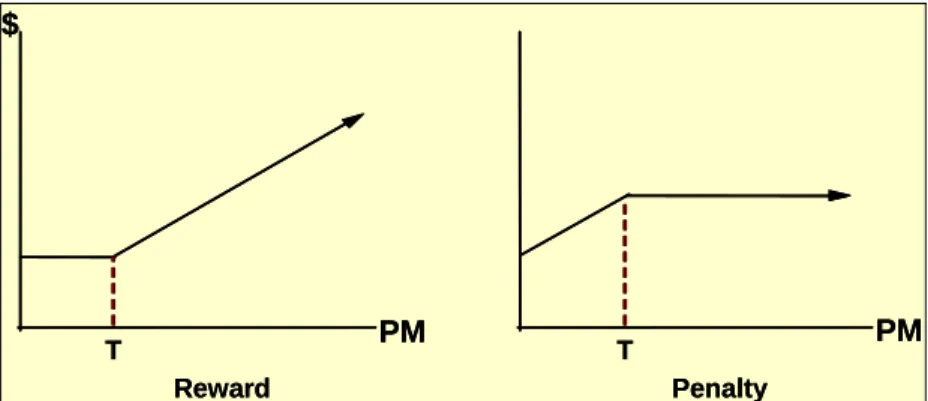
III. Paying for Performance
An important consideration in Chapter 7 was intrinsic motivation. We also saw in Chapter 5 that if employees are given decision rights, aligning their motivation with organizational objectives is essential. In the next few chapters, we build on these ideas by considering pay for performance or “extrinsic” motivation. Chapter 9 covers what is usually the most difficult issue confronting any incentive system: How is performance measured? In Chap-ter 10 we ask, what should we do with the performance evaluation (how should it be tied to rewards)? Chapters 11-12 cover special topics: incentives from promotions, employee stock options, and executive pay. Before we begin, it is useful to provide an introduction to the overall topic. First, let’s think about why it is important to study pay for performance. First, the evidence is clear: employees tend to respond very strongly to incentives. This means that if an incentive plan is designed well, it can be an important source of value creation; but if it is designed poorly, it can be an important source of value destruction. Second, incentives may play an important role even if an employee has strong intrinsic motivation, because the motivation may not be adequately aligned with organizational ob-jectives. For example, two groups that tend to have very high intrinsic motivation are re-searchers working in corporate R&D laboratories, and medical doctors. In both cases, the employer may have to resort to incentives to redirect their motivation appropriately. A firm may need to motivate R&D researchers to focus on innovations that can be sold profitably, rather than ones that involve cutting edge research. A health care provider may need to motivate doctors to focus more on the difficult tradeoff between quality of care and cost. Third, it is easy to underestimate the importance of incentives. Psychologists say that people tend to make a “fundamental attribution error” in evaluating human behavior. That is, they tend to over-attribute behavior to a person’s psychology makeup, and underesti-mate the extent to which the behavior is caused by the environment –constraints, rewards, and group influences. In other words, people tend to underestimate the extent to which in-centives (broadly construed) cause behavior. In many cases, subtle inin-centives drive what may at first seem to be puzzling actions by an employee.
From the perspective of motivating employees, this is even more important. Roughly speaking, there are two factors that drive worker behavior: psychology and incentives. The psychology of your workforce is, generally, quite difficult to change. Some change can be affected through recruiting and job design, but largely speaking the psychology of your employees is hard to alter, at least in ways that are easy to direct and control. By contrast, incentives are relatively easy to alter. Thus, pay for performance and other forms of extrin-sic rewards are the most important motivational levers that a manager can pull.
Fourth, rewarding performance improves many human resource objectives for the firm. We have seen this several times in earlier chapters. For example, deferred pay based on performance can improve self-selection in recruiting. Similarly, performance pay may in-crease the return on investments in human capital, motivating greater investments in skills. Better incentives can improve decision-making, encouraging employees to use their knowledge in the firm’s interests. Most human resource policies involve some form of in-centive scheme (though many are subtle). More broadly, inin-centives are what drive modern economies. Understanding basic incentive theory provides you with intuition that is useful in many business contexts.1
We now sketch out the way that economists formalize their thinking about incentive prob-lems. When you read the discussion of pay for performance, think about “pay” metaphori-cally. We are not referring solely to monetary compensation. Rather, we are thinking ab-stractly about any rewards the firm can vary with employee performance. Of course, monetary rewards such as bonuses or stock options are the most important in practice, but firms use many rewards (some implicit). For example, good performance might be re-warded with a better office, more flexible work hours, more interesting job assignments, or a promotion. To the extent that these are rewarded based on performance, they are a form of extrinsic incentive, and the principals described in these chapters apply.
The Principal-Agent Problem
In economics, the basic framework for analyzing most incentive problems is called the
Principal-Agent problem. This literature can often be highly technical. Here we provide a brief sketch to help sharpen your intuition, but our interests are more practical. We will ex-press the ideas in equations, but no advanced mathematical techniques are needed. The equations help force us to make our ideas and intuition more rigorous.
Incentive problems arise when an agent (in our context, an employee) acts on behalf of a
principal (the firm’s owners), but has objectives that are different than the principal’s. Con-sider an entrepreneur. In this case, the agent is the principal, so there is no conflict of in-terest and no incentive problem. However, modern corporations usually involve separation of ownership and control – managers are hired to run the firm on behalf of the owners. (This may be so that owners can diversity their investment portfolios to reduce risk, or be-cause owners delegate to managers who have skills that the owners do not.) This sug-gests that incentive problems for top management are an important concern; we cover that topic in Chapter 12.
3
In the previous section of the book we discussed multitasking as a feature of job design. Multitasking would imply that there is more than one type of effort. We will discuss some implications of multitasking for incentive systems later in this section of the book. For now, though, suppose that there is only one dimension to the employee’s job, so that the firm wants to motivate the employee to provide a single type of effort e.
The employee’s overall contribution to firm value Q depends on the employee’s effort, Q = Q(e). Q is not the firm’s total profit, but is the discounted present value of the profit created by this employee, ignoring the employee’s pay. Thus, the firm’s profit attributable to this employee equals Q(e) – Pay.
There is a conflict of interest only to the extent that the employee has too little, or too much, intrinsic motivation to provide various kinds of effort. The most typical case is where intrinsic motivation is too low – the firm would like the employee to work harder, or more diligently. A way to formalize this is to assume that such actions are costly to the employee in some way: they would prefer to work more slowly, less carefully, etc. In this sense, you can think of the employee as incurring a psychological cost if they provide more effort. This cost is called the disutility of effort. Let us refer to this as C(e). Remember that it is a psy-chic cost to the employee, not a monetary one.2 However, even non-monetary concepts can be scaled in monetary terms. For example, we might be able to quantify an em-ployee’s cost of effort by the increase in pay that they demand when asked to work harder. The employee’s pay only provides incentives if it depends on performance. Suppose that the firm has a performance measure PM that estimates the employee’s contribution Q. If performance can be measured perfectly, PM = Q, but generally this is not the case. Then, pay is some function of PM: Pay = Pay(PM). If the measure is imperfect, we might model this as PM = Q + ε, where ε is a random variable.
Pay for performance is risky because performance can almost never be measured with perfect accuracy. People are generally risk averse, so there is an additional cost to the employee from working at the firm: the cost of the riskiness of pay. Let us call this cost R•σPay, where we assume that the appropriate measure of riskiness is the standard
devia-tion. R is a parameter that reflects the extent to which an employee is risk averse. Some-one who is less risk averse would have a smaller R, while someSome-one who is more risk averse would have a larger R. Putting this all together, the employee’s net value from working for the firm is: Pay(PM) – C(e) – R•σ.
As mentioned above, the firm’s value from the employee equals Q(e) – Pay. The firm chooses the compensation plan Pay(PM) to maximize this net profit from the employee. The firm is constrained by the fact that total pay must be at or above the employee’s labor market value. For this reason, the firm must also compensate the employee for effort cost C, and risk cost R, generated by the incentive system the firm implements.
What Does the Employee’s Incentive Depend On?
What drives the employee’s incentive? As in all of economics, decisions are made by bal-ancing the marginal benefits of changing one’s behavior against the marginal costs. In this case, the question is whether the employee should work a little harder or not. The
2
Typically it is assumed that C(e) rises at an increasing rate as e rises. This captures the idea that effort is costly to the employee, and that the harder they work, the more costly additional effort becomes.
ginal cost is the extra disutility from working harder, ∆C/∆e, where ∆ is notation denoting an incremental change in a variable:3
Employee’s marginal cost from working harder . e C ∆ ∆ =
Since pay depends on the performance measure, and the performance measure depends on effort, the marginal benefit from working harder on some dimension of the job is:
Employee’s marginal benefit from working harder .
e PM PM Pay e Pay ∆ ∆ ⋅ ∆ ∆ = ∆ ∆ =
Since the employee balances the marginal costs and benefits, anything that increases the marginal benefit will increase the employee’s effort. The second equation tells us that we need to focus on two things. First, how does the performance measure vary with effort? If it reflects the employee’s effort well, it will improve incentives, and vice versa. Second, how does pay vary with estimated performance? If it does so strongly, incentives will be stronger, and vice versa. These two factors are the focus of each of the next two chapters in turn; they form the heart of this section of the text. Chapter 9 analyzes how the firm can measure the employee’s contribution to firm value. Chapter 10 then analyzes how the firm can relate this evaluation to rewards.
Now let us consider the source of the conflict of interest between the worker and the firm. Recall that C and R•σ are costs that must be borne by the firm, implicitly. They reduce the value of the job to the employee, so the employee will require higher total compensation if C or R•σ are higher, and vice versa. In this sense, the costs of the incentive system, C and R, do not create a conflict of interest between the firm and the employee. They are a cost of doing business, just like the cost of any inputs to production. If a stronger incentive mo-tivates the employee to work harder, C(e) rises, but the firm will have to compensate the employee for this. In other words,
Firm’s marginal cost from the employee working harder . e C ∆ ∆ =
Thus, the firm and its employee have the same total costs from the employee working on the job, C(e) + R•σ, and the same marginal costs. The real source of the conflict is be-cause the employee’s benefit (Pay) is generally not identical to the firm’s benefit (Q). More formally,
Performance Evaluation
“When you cannot measure, your knowledge is meager and unsatisfactory.” (Lord Kelvin, as carved in stone on the Social Sciences Building, University of Chicago)
“Measure anyway!” (Frank Knight, noticing the carving on returning from lunch at the fac-ulty club one day – as told by George Stigler.)
Introduction
The most difficult part of any incentive scheme is performance evaluation. Imagine that you are a manager, and you want to measure – quantify – the individual contributions of each of your employees to firm value. How can you do so accurately? Employees may work together in groups, so that it is hard to disentangle who is responsible and who is not. Some employees might free ride off of the work of others; other employees might be very cooperative, but you do not always see this since you cannot observe everything they do on the job. In addition, an employee’s performance may be partly due to luck. An em-ployee might be in the right place at the right time, and land a large sales contract when a new customer calls. Or, an employee might lose sales because a key client goes out of business unexpectedly. Finally, some contributions are quite difficult to quantify. How do you measure the employee’s effects on group norms, mentoring of junior staff, or cus-tomer satisfaction?
Not only is performance evaluation quite difficult to do effectively, but also the stakes are high. Evaluation can be quite costly. Subjective evaluations generally take a large fraction of managerial time. Collecting accurate performance metrics (including those generated as part of the accounting system) can take substantial resources.
If the evaluation does not accurately reflect the employee’s contributions, it may cause several negative outcomes. The employee might find that the link between performance and pay is uncertain, and require compensation for risk, thus raising costs. The employee might be poorly motivated. Perhaps worse, the employee might be strongly motivated, but to do the wrong things, thus destroying value. Thus, even though evaluations are difficult and costly to do, they are a necessary component of a good reward system, and it is im-portant for firms to strive for effective performance evaluation methods and procedures. In this chapter, we discuss important issues that arise when evaluating performance.
Purposes of Performance Evaluation
Employee performance depends on, among other factors: innate abilities, accumulated skills or human capital, and efforts. Based on our sketch of the principle-agent problem above, for a simple model we might say that Q depends on ability A, accumulated human capital H, and efforts ei: Q = Q(A, H, e1 … ek).
Chapter
This suggests that evaluations might emphasize measuring innate abilities A, skills H, or effort ei depending on what the evaluation is used for. We will return to this issue below.
For most of this chapter, we focus on the use of evaluations to measure and motivate greater effort.
Ways to Evaluate Performance
Modeling the employee’s contribution to firm value as Q = Q(e1 … ek) suggests several
approaches to measuring performance. First, we might estimate Q overall (what we will call a very “broad” measure). One example that is important for executives in publicly traded firms is the stock price. Second, we might estimate different dimensions of per-formance (what we will call a “narrower” measure). In a manufacturing setting, one com-mon performance measure is the quantity a worker produces. Another is the quality (e.g., number of defective parts produced). Third, we might combine several measures of vari-ous dimensions of performance. For example, a plant manager might be measured on revenue, or costs, or profits (revenue minus costs).
Notice that all of these approaches are output based performance measures, in that they attempted to measure components of Q. An alternative, narrower approach is to measure the employee’s inputs ei, such as hours worked or number of routines or tasks
accom-plished.
Finally, the evaluation might be quantitative or qualitative. We next discuss quantitative performance measurement. In the section that follows we discuss subjective evaluation.
Quantitative Performance Measurement
Organizations often go to great lengths to try to quantify an employee’s contribution to firm value. Quantitative measures have several advantages. Because they are numeric, they can be tied to compensation more easily (e.g., by computing a bonus using a formula). In addition, many performance metrics are readily available through the normal course of business. Accounting systems, for example, are large-scale performance measurement systems. Where the accounting numbers accord well with an employee’s contribution, they are often used for computing bonuses, as input into promotion decisions, etc. Firms may also use hours worked, customer satisfaction, and other quantitative information as inputs in evaluations.
7 Performance Measure Scope
To evaluate the employee for incentives, an ideal performance measure should reflect the employee’s total impact on firm value, and nothing else. Accounting texts often say that a performance measure should include whatever is “controllable” by the employee, but ex-clude whatever is “uncontrollable.” As we will see, the definition of controllable and uncon-trollable is subtler than it seems. For now, let’s think about these issues in the context of the right performance measure for two employees in the same firm: the CEO, and the cus-todian.
The most common performance measure for CEO compensation (in a publicly traded firm) is the firm’s stock price (or stock value, which is the stock price times the number of shares outstanding).1 By definition, this is firm value. Thus, this measure does capture all of the things that are controllable by the CEO: if there is anything that the CEO can do to improve or reduce firm value, it will be reflected in this performance measure. In this sense it would seem to be a perfect measure.
However, there are also many things that affect the firm’s stock price that are beyond the control of the CEO: actions of competitors, macroeconomic factors, currency fluctuations, and so on. For this reason, the performance measure is also risky for the CEO. Perform-ance measurement error is caused by uncontrollables.
Now consider the custodian; the same logic applies. Stock price is a good measure in the sense that it includes the effects on firm value of anything that is controllable by the custo-dian. However, it includes much that is uncontrollable. In fact, it would be ridiculous to use stock price as a performance measure for the custodian because the uncontrollables so outweigh the controllables. Doing so would essentially make compensation into a lottery ticket. Because the custodian is risk averse, this would be an expensive way to compen-sate, as the firm would have to pay a substantial risk premium to the custodian.
If stock price is a ridiculous measure for the custodian, what metric might we choose in-stead? We might measure cleanliness of floors, or pounds of trash hauled away per shift. We think of such measures because they are closer to the custodian’s job – they focus more on things that the employee can control, and filter out more things that are uncontrol-lable. In doing so, we reduce the risk of the performance measure. Similarly, for the CEO we might choose accounting earnings as the measure. It is one of the better proxies for profit that an accounting system generates,2 so it is a good starting place for trying to quantify the CEO’s contribution. Moreover, it is much less risky, since it is relatively more affected by things the CEO can control than by uncontrollables.
Unfortunately, more focused measures cause a new problem – they distort incentives. In the case of the custodian, measuring cleanliness of floors does not motivate the custodian to be cost conscious. Measuring pounds of trash hauled away may motivate the custodian to throw away too many things, or only heavy items. Evaluating the CEO on accounting earnings is likely to cause the CEO to take too much of a short-term focus, as earnings is based on performance in only a single period.
1
Notice that the stock market is, in effect, a large-scale performance measurement system, for top management. This is one of the most important roles of equity markets (though not the only role), and is the basis for much of the analysis in modern corporate finance.
2
Of course, it does not measure true economic profit, since accounting numbers are imperfect proxies for eco-nomic concepts. There are much more elaborate methods that try to adjust accounting numbers to better reflect economic reality, such as EVA (Economic Value Added).
These examples highlight a common tradeoff that firms usually face in choosing most quantitative performance measures: the scope of the measure (Figure 9.1). A broader
measure is one that includes more aspects of performance. In a publicly traded firm, stock price is the broadest possible measure, since it is firm value. The advantage of broad measures is that they tend to distort incentives less. They distort less because broader measures include more dimensions of the employee’s job in the evaluation (more control-lables). However, at the same time they also tend to include more uncontrollables, which causes measurement error and makes the incentive scheme riskier.
Narrow Broad
(fewer factors) (more factors)
High Distortion Low Distortion
Low Risk High Risk
Narrow Broad
(fewer factors) (more factors)
High Distortion Low Distortion
Low Risk High Risk
Tradeoff Between Broad or Narrow Performance Measurement
Figure 9.1
A natural way to reduce risk is to use a narrower performance measure, such as account-ing earnaccount-ings instead of stock price. Narrower measures may be chosen because they are easier to measure. Another important reason that narrower measures are often chosen is because they filter out many of the uncontrollables, reducing employee risk. But it is virtu-ally impossible to filter out all that is uncontrollable without simultaneously filtering out some things that are controllable by the employee. Thus, narrower measures tend to be less risky, but distort incentives more.
We thus see two important things to consider in any numeric measure. First, how risky is the measure (how important is measurement error)? Second, how does the measure dis-tort incentives? Virtually any performance measure will have both problems. Sometimes the distortions can be subtle, so it is worth thinking carefully about them before putting too much weight on a measure for incentives.
Since there are several dimensions to most jobs, and to what affects overall firm value, this tradeoff between risk and distortion can play out in multiple ways. Table 9.1 provides examples of performance dimensions and the kinds of distortions that tend to result from using a metric that is narrower on each dimension.
9 Dimensions of Performance to
Consider in an Evaluation Example
Which tasks to include or exclude? quantity v. quality Use available metrics or incorporate
qualitative information?
accounting numbers tend to ignore intangibles or opportunity costs How large a unit should be
measured?
individual v. team v. unit v. division v. firmwide performance measures What time horizon should be used? last year's sales v. customer
retention / growth
Dimensions Along Which Performance Measures May be Broader or Narrower
Table 9.1
Common Distortions in Performance Measures
Intangibles
By definition, intangibles are difficult to quantify. Quality is a classic example, since any centive based on a quantity measure (like piece rates in manufacturing jobs) distorts in-centives away from quality. But there are many dimensions of jobs that are difficult to quantify. In service jobs, customer satisfaction usually can only be gauged imperfectly through methods like customer surveys. Similarly, professional service firms can easily calculate revenues and profits from specific client engagements, but cannot always tell how well satisfied the client is.
Opportunity Costs
An important problem with standard accounting numbers is that they do not reflect oppor-tunity costs – the costs of foregoing other alternatives. For example, if a company owns a factory, and it has been fully depreciated for accounting purposes, it may show up on ac-counting statements as having no value. Or, it may be listed at book value, which is a measure of the costs of constructing the building at the time. The true value of the building is how much the company could sell the building for to someone else. If the company de-cides to use the building, they are giving up this value. Thus, decisions about asset use can be severely distorted unless some adjustment to accounting numbers is made. A similar issue arises when a company requires departments to obtain services only from an internal department. Since the department is granted a monopoly, it can be difficult to estimate the true performance of the department. If the firm allows purchasing from out-side vendors, it not only provides some competition (which should motivate better per-formance by the internal supplier) but also provides an important perper-formance metric – the market price of the service.
Group Size
Firms always face a choice over the group size to use for the evaluation. Since employees are interdependent in production a narrow measure like individual performance will tend to distort incentives. There will be less incentive to cooperate with colleagues. Unfortunately, using a broad measure like group or business unit performance makes the measure much
less controllable, and much more risky. For example, basing an individual’s incentives on group performance means that the employee is accountable for actions taken by col-leagues, which are not fully controllable. (However, they are partly controllable, as dis-cussed below.) The broader the group used for performance measurement, all the way up to the entire firm, the more will the employee take into account how his or her work affects others in the firm, but the riskier will the measure be. We discuss this further under the topic of employee profit sharing plans below.
Time Horizon
Most performance measures are backward looking: they measure what just happened. This tends to mean that they distort incentives for actions that have long-term conse-quences. Generally these are various forms of investments; e.g., in new technology, brand name, or employee training. One approach that is sometimes used for these problems is to defer giving the reward for some period of time. This allows the firm to wait and see what long term performance is. A clear problem with this approach is that this is risky in a different way for the employee, who may quit the firm before the reward can be given.
Performance Measure Scope & Job Design
Ideally, the scope of an employee’s performance measure should be closely related to the employee’s job design. Consider possible performance measures for a divisional manager in Table 9.2.3 The first column shows the performance measure, the second shows typical constraints placed on the manager’s decision making, and the third shows typical decision rights given to the manager. The first two measures, cost and revenue, are relatively nar-row. The next, profit, is broader – it literally combines the first two measures. For this rea-son, it reflects all of the controllables reflected in revenue and costs separately. It also re-flects all of the uncontrollables from both.
11 Performance
Measure Typical Constraints Typical Decision Rights Cost
Center
output or costs, quality, delivery, product mix & specifications, capital expenditures, “customers”
input mix, sourcing, scheduling, production techniques, personnel
Revenue Center
price, selling costs, product mix & specificiations, non-sales support, delivery, capital expenditures
sales effort, selling techniques, personnel
Profit Center
capital expenditures, basic business activity, capacity, corporate policies
all of the above + quality, quantity, product mix, product specifications, capacity, price, sales resources
Investment Center
scale of investment, basic business activity, corporate policies
all of the above + major asset purchases & sales
Franchise
franchise contract,
particularly actions affecting brand name
all of the above at local level + ability to sell business subject to ratification by franchiser
Ownership none all
← Bro a d e r … N a rro w e r Eval uat io n → ← L ess … Mo re D ece nt ralized →
Matching of Job Design to Performance Measurement: Divisional Managers
Table 9.2
An investment center uses a broader concept of accounting profit (such as EVA, Eco-nomic Value Added) that attempts to include measures of the opportunity cost of assets (which may be ignored in standard accounting numbers). In addition, while profit meas-ures short-term contributions to firm value, an investment center uses a performance measure that attempts to calculate some version of discounted present value of profits. The next row, franchise, uses an even broader performance measure, since the franchi-see’s primary objective is to maximize the resale value of the franchise. The final row, ownership, uses the broadest possible performance measure, firm value.
The important point to note in the table is how the constraints and decision rights change, when moving from narrower to broader measures. Moving down in the rows after the first two narrow measures, decision rights tend to include all of those in the prior row, plus some new decision rights. Similarly, as the performance measure becomes broader, there are fewer constraints. Simply put, a narrower job design (in the sense of both tasks and decision rights) is associated with a narrower performance measure and vice versa. This makes perfect sense. If an employee is given more tasks or authority, a narrow per-formance measure will cause greater distortions. Thus, the balance between distortions and risk will be struck by using a broader measure that incorporates some of the additional dimensions of the job, even though this may mean that the measure is riskier.
Indeed, the matching of performance evaluation and job design will tend to happen auto-matically. Suppose that an employee is evaluated on a very broad performance measure, but given little discretion. This tends to mean that there are many uncontrollables in the performance measure. In order to reduce risk, the employee will request, or simply start taking on, additional responsibilities, in order to avoid being punished for things outside of the employee’s control.
Finally, an employee’s job tends to evolve over time (typically toward a broader job with more discretion, as the employee’s skills increase). For this reason, the evaluation should usually broaden with job tenure. Often this occurs by gradually holding the employee ac-countable for more and more factors through subjective evaluations.
Manipulation
A final problem with quantitative performance measures is that they may be manipulated or “gamed.” Consider again our example of the custodian evaluated on pounds of trash hauled away. This might motivate the custodian to bring trash to work, because this would improve the performance measure – but it would not benefit firm value.4
Of course, either side might manipulate the measure. Imagine a joint venture between two firms, in which one is to provide a service to the other, and compensated with a share of the profits from the venture. In such a case, the second firm may be tempted to allocate too many of its costs to the joint venture, resulted in understated profits. In fact, this situa-tion occurred with the movie Forest Gump. Writer Howard Groom sued the studio when the wildly successful movie was said by the studio to be a money loser. Groom had been promised a share of the profits. If the contract had been based on revenue, this conflict would have been less likely, since costs are easier to manipulate than revenue in this case.
Manipulation is similar to the issue of distortion in incentives, but is somewhat different. The problem of distortion is that different aspects of the job are given inappropriate relative weights (possibly zero) in the incentive plan, causing the employee to emphasize some things too much, and others too little. Manipulation occurs because the employee or em-ployer has specific knowledge of time and place. This knowledge may be used strategi-cally, after the performance metric is chosen, to improve the evaluation even when such actions do not improve firm value.
The concept of manipulation is related to our notion of performance measure scope de-scribed above. As with distortions, manipulation is more likely to occur with a narrower
per-13
correlated usefully with firm value, so it decides to give the employee a bonus based on the measure. The employee now has an incentive to increase the measure’s value, possi-bly in part through manipulative behavior. If there is manipulation, this will tend to reduce the measure’s correlation with firm value – making it a less useful performance measure! The longer the employee has had a bonus based on the measure, and the greater the in-centive placed on the measure, the more likely is this phenomenon to be a problem. Thus, the firm may find that it ultimately has to choose a different performance measure, which itself may gradually degrade, and so on.
Subjective Evaluation
We have discussed quantitative performance measures and their limitations. We now consider the benefits and limitations of subjective performance evaluation.
Perhaps the most painful job for a manager is giving and receiving subjective performance evaluations. In many jobs, employees receive a subjective rating once or twice a year (of-ten on a scale of 1-5 or A-E). Figure 9.2 below shows the actual distribution of such ratings given to employees in Acme Incorporated (1 is the best rating, and 5 is the worst). The dis-tribution is quite typical of what is seen in most firms, and exhibits several traits that often raise concerns. There is grade inflation: the average rating is well above the middle score. Similarly, managers are very reluctant to give the lowest ratings: only about 1% of employ-ees received either of the worst two ratings. There is very little feedback in the ratings: al-most 30% receive the best rating, while another 50% receive the second best. If the goal of ratings is to distinguish performance, and to highlight the best and worst performers, these kinds of rating distributions do not seem very effective.
Typical P erformance Appr aisal Dist r ibut ion
0% 10% 20% 30% 40% 50% 1 2 3 4-5
Typical P erformance Appr aisal Dist r ibut ion
0% 10% 20% 30% 40% 50% 1 2 3 4-5 Source: Gibbs (1995)
Performance Rating Distribution at Acme, Incorporated
Figure 9.2
When asked why they are reluctant to give negative feedback or poor performance ap-praisals, managers often say that they are worried that this would reduce employee moti-vation. This seems hard to understand, since a good incentive system should provide both positive and negative feedback. We will provide one explanation for this phenomenon in Chapter 11 when we discuss promotion-based incentives.
Managers are reluctant to give poor ratings partly because it is no fun to give someone bad news. Thus, there may be leniency bias, helping explain why so few poor ratings are given. Moreover, employees may pressure managers to change the rating, which is un-pleasant for the manager.
Of course, employees dislike subjective evaluations too. A chief concern is that they are more subjective than numeric evaluations (though as noted above, those are often not en-tirely objective either). They may worry that the evaluation reflects the supervisor’s per-sonal opinions and biases, and that the supervisor is playing favorites. Of course, this will reduce incentives, since the perceived link between effort and reward is weakened. Despite all of these flaws, essentially every job uses subjective evaluations in important ways. Subjectivity is often necessary in hiring, promotion, and termination decisions. For middle managers doing qualitative knowledge work, good quantitative measures of per-formance may not exist, so that raises and bonuses are usually based on subjective ap-praisals. Subjectivity may play an important role even for salespeople, where performance is often easiest to quantify. For example, sales prospects or training opportunities may be allocated subjectively. Finally, one of the most important roles for a Board of Directors is subjective evaluation of the CEO’s performance.
Why Use Subjective Evaluations?
Consider a manager who runs a factory. The manager’s annual bonus, which averages about 40% of salary, is calculated as a percentage of the factory’s annual profits (that is, the plant is a profit center). The factory is 40 years old, with a sheet metal roof. One day, a sudden tornado rushes through town, and tears the roof off.5 Because of the substantial damage, the factory cannot return to operation for quite some time, and there is a loss rather than a profit for the year. If you were the plant manager’s boss, when you arrived at the plant the day after the tornado, how would you evaluate her performance?
One common reaction to this story is that a tornado is uncontrollable, as it is an act of na-ture, and thus the manager should not be punished at all. However, another common re-action is that the manager should be severely punished, if not fired, because she has ulti-mate responsibility for the plant. Which view is right? Without more information, it is difficult to say. Either view could be justified under some circumstances.
For example, if this was the first tornado in the area in 50 years, or if the manager was very new to the plant, it is more likely to make sense to not punish the manager. On the other hand, tornados might occur often in the region, and the manager may have worked
15
Finally, even if the manager had no way to foresee this event, we may still need to punish her for not reacting properly to the event. We want to motivate the manager to address immediate safety issues, obtain second-sourcing for production, and get the plant up and running again as soon as possible.
This discussion illustrates a couple of points:
What Do “Controllable” and “Uncontrollable” Mean?
In this example, there are many cases in which we might punish the manager for an act of nature, because the manager could have taken actions before, during, or after the event to reduce the damage to the firm. Thus, whether an event is random or not is not a useful definition of what is controllable or uncontrollable. A better way to think about it is:
An event is at least partially controllable if the employee can have some effect on the impact of the event on firm value. In the case of adverse events, the em-ployee can prevent or mitigate some of the damage. In the case of positive events, the employee can prepare for or exploit the opportunity.
Given this definition, very few events are completely uncontrollable by an employee. There may be many circumstances in which we want to punish – or reward – an employee for things that were not the employee’s “fault.”
When Should an Employee Be Held “Responsible”?
Even if the manager did not have formal responsibility for roof maintenance, the manager may have had some specific knowledge about the roof’s condition. As we saw when we discussed decentralization, when an employee has specific knowledge, we may want to give him some decision rights (responsibility) so that such information can be acted upon, and some incentives to act upon that knowledge. Thus, much of what we are doing with a careful subjective performance evaluation is defining what the employee is, and is not, re-sponsible for. We should consider holding the employee at least partially rere-sponsible for events any time that they are partially controllable by the employee, because the ployee has some relevant specific knowledge of the situation. As we’ve seen, the em-ployee might have this information before, during, or after an event. If so, the emem-ployee should be given some responsibility for foreseeing events and making contingency plan-ning; for reacting to events in real time; and for following up events after the fact. This is what we mean when we say that we want to motivate the employee to take initiative.
How Do You Conduct a Subjective Evaluation?
This discussion also gives us a useful way to think about how to evaluate employees. Suppose that you are evaluating a subordinate in order to give a year-end performance rating. As in the example above, it is natural to begin by thinking retrospectively: looking back on what the employee did and what happened over the last year.
When you do so, it is important to avoid what psychologists call “hindsight bias.” You are likely to know more after events have unfolded than the employee did when they occurred. In our example, we now know that the tornado occurred and the roof was weak. However, did the employee know these things at the time? Thus, a typical first step is to figure out, along the lines of the famous question by U.S. Senator Howard Baker about President Richard Nixon during the Watergate Hearings, “What did he know, and when did he know
it?” You do this to decide whether the employee’s actions were appropriate given the cir-cumstances.
This will tend to lead into a broader analysis of the extent to which events were foresee-able or not. It is important to evaluate employees on whether they planned for foreseeable events – and also, to a reasonable extent, whether they developed contingency plans and procedures for unforeseeable events.
So far, the evaluation has focused on the past, and what that means for the employee’s rewards (rating, bonus, raise, promotion, firing, etc.). However, unless the employee will be fired, the most important outcome of a good subjective evaluation comes from thinking
prospectively. The process of discussing with the employee what happened, what they did and why they did it, and what they should have done instead is a way of communicating what the employee’s responsibilities are in the future. The evaluation in effect defines the job, and sets precedents about what will be rewarded and punished in the future. In com-plex work environments, it is usually difficult if not impossible to completely define an em-ployee’s responsibilities in writing. Discussions about subjective evaluations are an impor-tant time to clarify them. The benefits include better decision making, and better alignment of the employee’s incentives with firm objectives.
Finally, a good evaluation will move from the “here’s your performance rating” stage to a constructive discussion of the future. The manager should clarify what the employee is expected to focus on, what he is supposed to be responsible for (and not). It is an excel-lent chance to think about any skills the employee lacks but needs to perform the job well, thus leading to new training. Similarly, the debriefing about last year’s performance may suggest additional information or resources that the employee might need in order to per-form the job effectively.
How Do You Receive a Subjective Evaluation?
It is also useful to briefly think about how you can best receive an evaluation from your su-pervisor. First, bosses hate to hear the phrase, “It’s not my fault.” That is tantamount to saying, “The event was uncontrollable” (though using less academic jargon), and as we saw above few events are completely uncontrollable. Instead, your boss is looking for you to take initiative. Consider discussing your mistakes and setbacks. Admit them, and de-scribe to your boss what you have learned from them and how you will change your future work as a result. Your boss is likely to be relieved that someone is taking responsibility for them self!
17
tion is wrong, or both. The only way to fix this is to introduce discretion into the incentive system in some way.
We now return to our question above about why subjective evaluations are so important, despite the many difficulties that they cause. The discussion of the tornado example sug-gests that if done well, a subjective evaluation can have many benefits:
Improve on Quantitative Performance Measures
Subjective evaluations may be used to avoid the typical flaws in quantitative measures. Not only does a careful subjective evaluation result in the manager being held accountable for controllables, properly defined. It also can filter out uncontrollables, lowering the risk to the manager. In the tornado example, good judgment can remove from the plant man-ager’s evaluation the effects of things that were truly unforeseeable and not the manman-ager’s appropriate responsibility. In this sense, performance measure error may be lower than by sticking with quantitative metrics.
Similarly, subjective evaluations can reduce distortions in incentives. Some dimensions of the job are hard to quantify. Giving those dimensions adequate emphasis during perform-ance appraisals can motivate such tasks. A classic example is where jobs involve quality, creativity, or other intangibles. These are usually difficult to put into numbers, so in order to motivate them, such tasks generally must be evaluated and rewarded using judgment. Finally, subjectivity may be able to reduce manipulation of the incentive system. If an em-ployee games the quantitative metrics, the manager may detect this ex post (or at least have strong suspicions of such behavior). Subjectivity allows the manager to adjust for this. To the extent that this might be anticipated, the employee will be deterred from too aggressively manipulating the numbers.
Improve Incentives for Risk Taking
As just noted, a good subjective appraisal can reduce risk by filtering out true uncontrolla-bles from the employee’s overall evaluation. It can also improve incentives for risk taking, since it makes it easier for the manager to reward good results without simultaneously punishing mistakes. In effect, it gives the manage greater flexibility to reward the upside without punishing the downside.
Give the Incentive System More Flexibility
Incentive plans that are put in place at the beginning of the year may no longer be ideal if circumstances change. When this occurs, the firm can change the incentive plan. How-ever, when it does so it runs the risk of this being perceived as unfair (like the “Rachet Ef-fect” we discuss in the next chapter). Effective use of subjectivity means that changes to incentives are more likely to be accepted, since the employee already expects judgment from the supervisor. This makes it easier for the manager to tell the employee to change emphasis during the middle of the year, in effect changing incentives.
Improve Decision Making
As we saw, it often makes sense to at least partially reward or punish employees for ran-dom events. This is important because it motivates the employee to use (and even to de-velop) specific knowledge of time and place. There are three ways that this motivates bet-ter employee decision making: more effective preparation, real time response, and ex post reaction after the event is over.
Expand Communication
If you go back and reread the discussion about how to give a subjective evaluation, you will realize that what it describes is simply good day-to-day management. The best subjec-tive evaluations occur implicitly every day, as the manager works with the employee. The manager monitors what the employee does and why, makes adjustments, and suggests improvements. Instead of waiting until the end of the year to do the evaluation, having these conversations all year long will improve the employee’s effectiveness, and the work-ing relationship with the supervisor. It will also clarify the terms of the implicit contract. Moreover, clear communication makes it more likely that employees will trust subjective evaluations, making them more effective.
Improve Training
A manager can use a thoughtful subjective evaluation to provide lessons for the employee from the manager’s experience. If done well and regularly, it can be an excellent form of day-to-day training.
It is clear that there are many benefits to subjective evaluations if they are done properly. These are many of the benefits to effective day-to-day management as well. Given these benefits, it is not surprising that subjectivity is so important in practice, despite the many difficulties that it raises, and costs that it implies.
Sweating the Details on Evaluations
Lincoln Electric Co. in Cleveland, Ohio in the U.S. has perhaps the most famous in-centive schemes in business history. One important component is an annual profit sharing bonus paid out to all employees. While profit sharing schemes usually do not motivate well, Lincoln Electric’s does, for two reasons. First, the stakes are very high – the bonus can double an employee’s pay in a typical year – reducing the “free rider” problem. Second, the bonus is based on a measure of individual per-formance, rather than the more typical (and essentially uncontrollable) firm-wide measures that most profit sharing plans use.
The performance measure for this plan is a subjective performance rating. Lincoln views its incentive system as the key to its success, and the subjective performance rating as one of the crucial components. Every rating is checked by one of the firm’s top executives, so managers take them very seriously. The ratings are given twice per year, and according to the company a typical manager spends about three
19
firm can open itself up to risks of legal liability, since subjectivity makes favoritism and dis-crimination more likely. Despite these problems, evaluations are not centralized to control the risks. The reason is simple: evaluations are an example of subjective, experiential knowledge that is very costly to communicate to others. In order to make use of this knowledge, most evaluations – especially in complex work environments where good nu-meric performance metrics are unavailable – are inevitably decentralized to the direct su-pervisor.
Some firms make use of “360-degree” evaluations. This practice involves the subordinates in evaluating and giving feedback to the supervisor. What is the purpose of this practice? In theory, it can improve management, since the recipients of the manager’s treatment are giving feedback. However, there are clear problems, since the subordinates face a good possibility of retribution if they criticize their boss.
For this reason, 360-degree evaluations are almost always done in secret; the names of employees who make specific comments are not told to the supervisor. While this can help, in small work groups the supervisor can often guess who gave which particular feed-back. Thus, the effectiveness of 360-degree evaluations can be quite limited. Even so, many firms do use them as one tool to improve supervision, communication, and the gen-eral work environment. They are more likely to be effective in organizations that have cul-tural norms and job designs that emphasize open communication and employee participa-tion in decision making (what we called decision management).
Fairness, Bias & Influence Costs
Subjectivity makes it easier for a manager to discriminate, play favorites, and generally be biased in allocating rewards. Of course, this reduces incentives, since it means that factors other than performance affect rewards, and can impart a subtle form of risk into the evaluation. Another way to put this is that there is an additional layer of incentive problem when subjectivity is involved: the firm has to worry about the incentives for the manager to implement the system in accord with the firm’s interests instead of his own.
This suggests immediately that if the supervisor’s incentives are well designed, we should expect fewer problems at lower levels. In addition, constraints might be placed on the evaluator. For example, some firms impose various types of “forced curves” on evaluators. We will discuss these systems under the topic of relative performance evaluation in Chap-ter 11.
An obvious point is that the greater the trust that the employee has of the evaluator, the more effective will subjectivity be as part of the incentive system. Thus trust considerations play a key role.
The manager’s reputation can have a substantial impact on how incentives play out in practice. A manager who is capricious or biased will induce certain behavior, and certain types of employees who want to work for him. If a manager has a reputation for fairness and careful evaluation, subjectivity will be easier to use effectively, improving the reward system in the ways described above. Thus, in jobs where such judgment is important, a manager can try to invest in a strong reputation as an effective manager. Similarly, the firm should attempt to put “judicious” managers into positions where these considerations play a major role.
In addition, organizations usually put in place formal policies to try to establish a greater degree of fairness in the evaluation system. For example, employees usually have the
right to ask to be re-evaluated if they disagree with their evaluation. In some firms, the su-pervisor’s boss checks evaluations. The purpose of such oversight is to provide some in-centives for the supervisor to do appraisals fairly. In some cases, it is possible to have mul-tiple evaluators of an employee; this will usually reduce the likelihood that the ultimate evaluation is biased, since different managers tend to have different biases.
Of course, how such policies are implemented in practice determines whether they are ef-fective or just “window dressing,” so there is an important element of corporate culture here as well.
Supervisor judgment can also distort employee incentives. Employees will have some in-centive to try to improve their evaluation not through effort, but through influencing the su-pervisor in other ways. For example, they might spend time and resources trying to lobby their boss for a larger raise, more resources, and so on. They might flatter their boss, take up similar outside interests, and so on. To the extent that such activities are engaged in in-stead of productive effort, and to the extent that the change the evaluation, they impose in-fluence costs on the organization. What are the costs? Reduced or distorted incentives, and promotions that are based less on ability than is desirable.
A more subtle cost of bias and influence activities is that it may distort decision making. When a manager’s opinion affects a worker’s reward, the worker may distort what he says to the manager. Thus, the quality of information on the job will suffer. In principle, a good manager will want to hear the truth from subordinates, and will attempt to establish a cor-porate culture in which this occurs. For example, the manager might establish cultural rules that encourage employees to speak freely, and perhaps even reward subordinates for criticizing the manager’s analyses.
While this can help, it is unlikely to completely alleviate the problem. Suppose that a man-ager is presented with an opinion from a subordinate that differs from his own. Either the new opinion is correct, or the manager is correct (or neither). As a statistical matter, the manager should place some weight on each possibility. But workers realize this. Because there is some chance that a worker’s dissenting opinion will be viewed as a mistake, even if correct, workers have some incentive to shade their reports in the direction of the man-ager’s initial opinion. This creates a “Yes Men” phenomenon. This highlights the impor-tance, and complexity, of proper analysis and decision-making procedures. Such proce-dures need to take into account (and be co-designed with, to the extent possible) the cor-porate culture and explicit incentives of analysts and decision makers.
21
are being considered. Of course, accumulated skills H will also be relevant for such deci-sions.
Poor evaluations are more likely to be taken seriously for sorting in earlier periods. This is because there is little information at first, so each evaluation is more informative. As more data is accumulated about the worker, new evaluations are less informative.6 By the same token, however, probationary evaluations should last longer when the value of small differ-ences in ability is more important to the job, and when the job is more complex and difficult to evaluate. Thus, probation for secretarial jobs may be very short, but for professional jobs may be very long indeed. For example, in professional service firms and universities, the first up-or-out promotion may only come after several years of work, and partnership and tenure decisions can take six years or more.
A second purpose of evaluations is to measure the extent to which the employee improves human capital. Especially early in the career, supervisors often provide extensive training to subordinates. In such cases, they may emphasize changes in human capital (the rate of growth in H) in performance evaluations.
A third purpose of evaluations is to motivate employees to work harder. When this is the case, the evaluator will want to try to measure how much effort of various types the em-ployee put forth on the job, not how much talent the emem-ployee has.
In some cases, different goals of evaluations can conflict. For example, feedback about current performance may give the employee clues about their long-term prospects for ad-vancement, which may actually reduce motivation (see Chapter 11). To avoid this, many firms attempt to separate out evaluations for current rewards from those for “coaching and development,” for example by giving two different types of evaluations at six month inter-vals. However, in practice it is always difficult to separate the two.
How Frequently Should Evaluations Be Made?
An additional purpose of an evaluation is to measure the employee’s value to the firm in order to decide the amount that the firm is willing to pay as compensation. This is useful for deciding whether to match outside offers, for example. Suppose that a worker is worth $1000 per week to the firm, but is only paid $800. He is worth $900 at another firm, which offers $875. If the current firm offers him $900, both the firm and the employee are better off than if he quit. The general rule is that the firm should offer enough to encourage the worker to stay, if the worker’s productivity is highest at the current firm.
Which workers are more likely to have productivity at the current firm that exceeds their values elsewhere? Those with more firm-specific human capital. For this reason, evalua-tions are less likely to produce information that will result in a separation when the worker has more firm-specific human capital. This implies that costly evaluations should occur less frequently when firm-specific human capital is more important.
The frequency of the evaluation should also decline with the worker’s experience in both the firm and in the current job, for two reasons. One is the effect of sorting. The longer that a worker has been with a firm (and similarly in a specific position), the better informed are both the worker and the firm about whether the worker is a good match for the job. Thus, the less likely is an evaluation to lead to a change in position. The second effect is that the
6
Statistically, the firm updates its priors with each new observation about performance, but gives increasing weight to prior performance as data accumulates.
feedback and training aspect of an evaluation becomes less important, the longer the worker has been with the firm and in the current job.
Summary
Performance evaluation is the most difficult, and probably the most important, part of a well-designed incentive plan. Quantitative performance measures such as accounting numbers are an important component of evaluations. An equally important component is subjective evaluations.
An ideal performance evaluation for incentive purposes is one that captures all of the ef-fects of an employee’s actions on firm value, but nothing else. These are often called “con-trollables” and uncontrollables,” but the concepts are rarely defined carefully. A good way to rigorously think about the terms is to say that something is at least partially controllable if the employee can affect the event’s impact on firm value. Thus, even purely random events are often controllable to some extent; most events are partly controllable and partly uncontrollable.
A basic tradeoff that is often faced with quantitative performance measures is the scope of the measure. Broader, more inclusive measures tend to include more that is controllable, and more that is uncontrollable; narrower, more focused measures tend to have the oppo-site properties. The first effect means that broader measures usually distort incentives less because they ignore less. However, it also means that broader measures are riskier as they have more measurement error. Risk is costly to an incentive scheme, because em-ployees are risk averse.
Because of the riskiness of very broad measures like stock price, most performance measures used in practice are much narrower. Performance measure choice involves a careful balancing of risk against distortion. This virtually guarantees that any measure will distort incentives in some way. Thus, an important consideration in managing an incentive system is to carefully watch for distortions (and the related problem of manipulation of measures), and use additional incentives or discretion to reduce such problems.
Performance measures and subjective evaluations should be chosen to match the em-ployee’s job design as closely as possible. This makes it more likely that the measure cap-tures the most important controllable dimensions of the job, reducing the distortion prob-lem. Subjective evaluations can be viewed as a way to define the employee’s job and re-sponsibilities.
23
Review Questions
1. In macroeconomics, there is a debate over “rules versus discretion.” The debate in-volves the extent to which monetary policy should be governed by the discretion of the head of the central bank (e.g., the Chairman of the Federal Reserve), or by relatively fixed rules that cannot be altered. Using the concepts from this chapter, can you pro-vide an argument for each approach? Can you name other situations in business where there is a similar dilemma?
2. In law firms, litigation work is done mostly by lawyers who work independently, and who become famous for their work. By contrast, corporate law is usually done by teams of lawyers with different specialties, and the law firm develops a brand name. What conflicts do you see in having litigators and corporate lawyers in the same firm? Does your analysis suggest anything about the relationship between the quality of a performance evaluation and a firm’s organizational structure?
3. Many business experts advocate systems such as “Management by Objective” (MBO) for managing employee incentives. Under MBO, the supervisor negotiates a set of mutually agreed upon objectives for the employee to work on during the year. At the end of the year, rewards are based on the extent to which the objectives were successfully achieved or not. What costs and benefits do you see in “negotiating” ob-jectives with your subordinate?
4. Still other firms use “360° (Degree) Evaluations.” Under this system, the firm asks a manager’s subordinates, colleagues, and customers for feedback on the manager’s performance. What advantages do you see to such a system? Do you see any disad-vantages? What other policies might make such an approach less prone to the prob-lems that you see? What kind of culture would be necessary for 360° appraisals to work?
References
Baker, George (2002). “Distortion and Risk in Optimal Incentive Contracts.” Journal of Human Resources 37(4): 696-727.
Berg, Norman & Norman Fast (1975). “Lincoln Electric Co.” Harvard Business School
case #376028.
Gibbs, Michael, Kenneth Merchant, Wim Van der Stede & Mark Vargus (2004). ”Determi-nants and Effects of Subjectivity in Incentives.” The Accounting Review 79(2): 409-436. Gibbs, Michael (1995). “Incentive Compensation in a Corporate Hierarchy.” Journal of Ac-counting & Economics / Journal of Labor Economics joint issue, 19(2-3): 247-277.
Jensen, Michael & William Meckling (1998), “Divisional Performance Measurement.” In
Foundations of Organizational Strategy, ed. Michael Jensen, Boston: Harvard University Press.
Lazear, Edward (1990). “The Timing of Raises and Other Payments.” Carnegie-Rochester Conference Series on Public Policy 33: 13-48.
Lazear, Edward (2000). “Performance Pay and Productivity.” American Economic Review
90(5): 1346-1361.
Milgrom, Paul (1988). “Employment Contracts, Influence Activities, and Efficient Organiza-tional Design.” Journal of Political Economy 96: 42-60.
Murphy, Kevin J. (1993). “Performance Measurement and Appraisal: Motivating Managers to Identify and Reward Performance.” In Performance Measurement, Evaluation, and In-centives, ed. William Bruns. Boston: Harvard Business School Press.
Murphy, Kevin J. & Paul Oyer (2005). “Discretion in Executive Incentive Contracts.” Work-ing paper, USC Marshall School of Business.
Prendergast, Canice (1993). “A Theory of ‘Yes Men’.” American Economic Review 83: 757-770.
Prendergast, Canice & Robert Topel (1996). “Favoritism in Organizations.” Journal of Po-litical Economy 104: 958-978.
Rewarding Performance
“Without merit there should be no reward.” (Chinese proverb)
Introduction
Now that we have discussed performance evaluation, we consider the next logical ques-tion: how should the firm use the evaluation to motivate the employee?
Before we consider that, however, we mentioned earlier that pay for performance helps an organization improve many human resource objectives, not just motivation. This idea is so important that it is worth illustrating before we turn to motivating effort. Therefore, for now assume that there is no motivation problem for employees. Is there still any benefit from tying pay to performance?
In fact, we already saw that there is. In Chapter 2, we analyzed sorting of workers. We ar-gued that some form of probationary or deferred pay, based on performance, might im-prove the firm’s ability to recruit a better workforce. The more general idea is easy to illus-trate formally. Suppose that the firm bases pay in some abstract way on performance, not necessarily through some kind of deferred pay or probationary period. It should still expect to improve recruiting – and investments in skills.
Assume that potential employees differ in their ability A or accumulated human capital H, and that performance (and the performance measure PM) are a function of both, PM = PM(A, H). If pay is a function of performance, then it is also a function of ability and human capital. Those with higher ability or skills can expect to earn more, while those with less can expect to earn less:
. 0 H PM PM Pay H Pay ; 0 A PM PM Pay A Pay = ⋅ > = ⋅ > ∆ ∆ ∆ ∆ ∆ ∆ ∆ ∆ ∆ ∆ ∆ ∆
Clearly, those who believe that they will be most productive at the firm are more likely to apply for or stay at a job there. The probation / deferred pay example discussed earlier is a special case of this more abstract idea. Similarly, it is easy to see that employees will have greater motivation to invest in skills, since the return on skills will be higher if their perform-ance is tired more strongly to pay.
Piece Rate Pay and Sorting at Safelite Glass Corporation
Safelite Glass Corporation is the world’s largest installer of automobile glass (re-placement windshields). In 1994, CEO Garen Staglin and President John Barlow changed the compensation scheme for glass installers. Prior to the change, in-stallers were paid an hourly rate. The pay scheme was changed to a piece rate –
Chapter
installers were paid a fixed amount for each windshield that they installed. After the change, output per worker rose by about 36 percent. How much of this was be-cause installers worked harder? Was any of the increase due to better sorting? These two effects can be estimated in a relatively straightforward manner. The effort effect can be estimated by taking a given worker and calculating the amount by which output rose after the change in the pay scheme. This incentive effect was es-timated to be about 20 percent.
The remaining 16 percent increase in productivity was due to sorting. Safelite was able to retain its high-quality workers, and recruit other high-quality employees, be-cause these employees were paid more (even for the same effort). Indeed, turnover rates fell for the most productive workers, and rose for the least productive.
Source: Lazear (2000)
The importance of incentives cannot be overstated. Modern market-based economies work so effectively because they provide generally good incentives for owners to make use of their assets, run their firms, innovate, etc. In other words, incentives are at the heart of effective economies, as well as effective organizations.
Of course, the most important reason to tie pay to performance is to increase employee ef-fort, and better align it with firm interests, and that is the focus here. The introduction to this section of the text argued that we care about how the employee’s evaluation varies with effort, and how pay varies with the evaluation. How should the firm vary pay with the per-formance evaluation? To analyze this, we first consider a very common form of pay for performance: the worker earns a base salary, a, plus a bonus. The bonus is calculated by multiplying a “commission” rate b times the performance measure. Thus, Pay = a + b•PM. Consider Figure 10.1 below. It shows two pay plans that have the same commission rate b, but different base salaries a. Which provides stronger incentives? The answer may not be obvious to you at first glance – to a first approximation, both pay plans should provide the same incentives and thus the same performance, even though one pays a higher base salary. To see this, consider the question in a different way. If the employee workers a little harder, increasing the performance measure a little (say, installing 1 more wind-shield for Safelite Auto Glass), what is the reward? It is the same for both plans: the worker gets $b of additional bonus for each extra unit produced. In other words, the most impor-tant issue is how pay varies with performance, not the total level of pay.