LH*
RS– A Highly-Available Scalable Distributed
Data Structure
WITOLD LITWIN, RIM MOUSSA U. Paris Dauphine and THOMAS SCHWARZ, S.J., Santa Clara University1________________________________________________________________________
LH*RS is a high-availability scalable distributed data structure (SDDS). An LH*RS file is hash partitioned over the distributed RAM of a multicomputer, e.g., a network of PCs, and supports the unavailability of any k≥ 1 of its server nodes. The value of k transparently grows with the file to offset the reliability decline. Only the number of the storage nodes potentially limits the file growth. The high-availability management uses a novel parity calculus that we have developed, based on Reed-Salomon erasure correcting coding. The resulting parity storage overhead is about the lowest possible. The parity encoding and decoding are faster than for any other candidate coding we are aware of. We present our scheme and its performance analysis, including experiments with a prototype implementation on Wintel PCs. The capabilities of LH*RS offer new perspectives to data intensive applications, including the emerging ones of grids and of P2P computing.
Categories and Subject Descriptors: E.1 [Distributed data structures]: D.4.3 Distributed file systems, D.4.5 Reliability: Fault-tolerance, H.2.2 [Physical Design]: Access methods,Recovery and restart
General Terms: Scalable Distributed Data Structure, Linear Hashing, High-Availability, Physical Database Design, P2P, Grid Computing
________________________________________________________________________
Motto:Here is Edward Bear, coming downstairs now, bump, bump, bump, on the back of his head, behind Christopher Robin. It is, as far as he knows, the only way of coming downstairs, but sometimes he feels that there really is another way, if only he could stop bumping for a moment and think of it. And then he feels that perhaps there isn't. Winnie-the-Pooh. By A. A. Milne, with decorations by E. H. Shepard. Methuen & Co, London (publ.)
1 INTRODUCTION
Shared–nothing configurations of computers connected by a high-speed link, often-called multicomputers, allow for high aggregate performance. These systems gained in
1 This research was supported partially by a generous gift from Microsoft Research, Europe and EEC-ICONS project no. IST-2001-32429.
Authors' addresses: Witold Litwin, Rim Moussa,Université Paris 9 (Dauphine), Pl. du Mal. de Lattre, Paris 75016, France, [email protected], [email protected]; Thomas J.E. Schwarz, S.J., Department of Computer Engineering, Santa Clara University, Santa Clara, [email protected].
Permission to make digital/hard copy of part of this work for personal or classroom use is granted without fee provided that the copies are not made or distributed for profit or commercial advantage, the copyright notice, the title of the publication, and its date of appear, and notice is given that copying is by permission of the ACM, Inc. To copy otherwise, to republish, to post on servers, or to redistribute to lists, requires prior specific permission and/or a fee.
popularity with the emergence of grid computing and P2P applications. They need new data structures that scale well with the number of components [CACM97]. Scalable Distributed Data Structures (SDDS) aim to fulfill this need [LNS93], [SDDS]. An SDDS file is stored at multiple nodes provided by SDDS servers. As the file grows, so does the number of servers on which it resides. The SDDS addressing scheme has no centralized components. This allows for operation speeds independent of the file size. They provide for hash, range or m-d partitioned files of records identified by a primary or by multiple keys. See [SDDS] for a partial list of references. A prototype system, SDDS 2000, for Wintel PCs, is freely available for a non-commercial use [CERIA].
Among the best-known SDDS schemes is the LH* scheme [LNS93, LNS96, KLR96, BVW96, B99a, K98v3, R98]. LH* creates scalable, distributed, hash-partitioned files. Each server stores the records in a bucket. The buckets split when the file grows. The splits follow the linear hashing (LH) principles [L80a, L80b]. Buckets are stored for fast access in distributed RAM, otherwise they can be on disks. Only the maximum possible number of server nodes limits the file size. A search or an insert of a record in an LH* file can be hundreds times faster than a disk access [BDNL00, B02].
At times, an LH* server can become unavailable. It may fail as the result of a software or hardware failure. It may also stop the service for good or an unacceptably long time, a frequent case in P2P applications. Either way, access to data becomes impossible. The situation may not be acceptable for an application, limiting the utility of the LH* scheme. Data unavailability can be very costly, [CRP06]. An unavailable financial database may easily cost the owner $10K-$27K per minute, [B99].
A file might suffer from the unavailability of several of its servers. We say that it is k-available, if all data remain available despite the unavailability of any k servers. The information-theoretical minimum storage overhead for k-availability of m data servers is k/m [H&al94]. It requires k additional, so-called parity symbols (records, buckets…) per m data symbols (records, buckets…). Decoding k unavailable symbols requires access to m available symbols of the total of m + k. Large values for m seem impractical. A reasonable approach to limit m is to partition a data file into groups consisting of at most m nodes (buckets) per group, with independent parity calculus.
For files on a few servers, 1-availability usually suffices. The parity calculus can be then the fastest known, using only XORing, as in RAID-5. The probability of a server unavailability increases however with the file size. The file reliability, which is the probability that all the data are available for the application, declines necessarily. At one point we need the 2-availability despite the increased storage overhead. Likewise, as the
file continues to grow, at some point we need 3-availability, despite further increase to the storage overhead. In fact, for any fixed k, the probability of k-unavailability increases with the file size. For largely scaling files, we need the scalable availability, adjusting k to the file size [LMR98].
Below, we present an efficient scalable availability scheme we called LH*RS. It structures the LH* data buckets into groups of size m, providing each with K ≥ 1 parity buckets. The values of m and of K are file parameters that can be adjusted dynamically. We call K the intended availability level. A group is typically K-available. Some can be (K-1)-available with respect to the current K if the file just increased it by one. The new level diffuses to the groups progressively with the splits. Changes to K value are transparent for the application.
The scheme’s theory originates in [LS00]. Since then, we have sped up the parity calculus, without compromising the storage overhead. We also have progressively optimized implementation issues, especially the efficiency of the communication architecture. We have realized a prototype for the multi-computer of Wintel PCs on a typical LAN [LMS04]. We have analytically and experimentally determined various performance factors. The work has validated our design choices. Below we report on all these issues.
Our current parity calculus is a novel erasure correction scheme, using Reed-Solomon (RS) coding. Our storage overhead for k-availability is close to the optimal one of k/m. To our best knowledge, our schemes offer the fastest parity generation (encoding) for our needs. We have also optimized the erasure correction (decoding), although with a lesser priority, expecting it much less frequent, hopefully.
More specifically, we recall that an RS code uses a Galois Field (GF). The addition in a GF amounts to XORing only. Multiplication is necessarily slower [MS97]. In departure from [LS00], we determined the GF(216) and GF(28) more appropriate. Our scheme uses now only XORing to generate the first parity symbol (record, bucket, …). We also only need XORing for the recovery of a single data bucket. In addition, changes to a data record in the first bucket of any group result in XORing only at the parity buckets, further speeding up 1/m of our encoding operations. Moreover, we have accelerated the k-parity encoding and decoding, by introducing the logarithmic parity and decoding matrices. All this makes our parity encoding scheme the fastest known, under the minimal group storage overhead constraint, to our best knowledge of the k-erasure correction codes. Besides, our high-availability features are transparent to the application
and do not affect the speed of searches and scans in LH*RS file. These perform as well as in an LH* file with the same data records and bucket size.
LH*RS is the only high-availability SDDS scheme prototyped to the extend we present. However, it is not the only one known. Some proposals use mirroring to achieve availability [LN96, BV98, VBW98]. Two schemes use only XORing to provide 1-availability [L&al97, LR01, L97]. Another XORing-only scheme LH*SA was the first to offer scalable availability [LMRS99]. It can generate parity faster than LH*RS, but has sometimes greater storage overhead. We compare various schemes in the related work section.
To address the overall utility of the LH*RS scheme, we recall that the existing hash file schemes store files on local disk(s), or statically partition (parallelize) them over a cluster of nodes. The latter approach provides for larger files or better efficiency of the (non-key) scans. As we have mentioned, the disks may use underneath a hardware or software RAID scheme, 1-available RAID5 typically. This one may adversely affect a record access performance, e.g., by segmenting some records, or manipulating blocs much larger than records, as it works independently of the hash scheme. Partitioned files are sometimes replicated, for 1-availability typically given the incurred storage overhead cost.
The LH*RS scheme is “plug compatible” with such schemes. It offers the same functional capabilities: the key search, a scan, a record insert, update and delete. The access performance should in contrast typically improve by orders of magnitude. Especially for files that can now entirely fit for processing into potentially unlimited (distributed) RAM of a multicomputer, while they could not at a single node or a cluster. Our experiments with LH*RS files in distributed RAM showed the individual key search about 30 faster than a single access to a local disk. A bulk search speeds up 200 times. Experiments with inserts lead to similar figures, for up to 3-available file. The application may accelerate thus the query processing from, - let’s say - 30 minutes or 3 hours to a single minute.
Likewise, as we said, the administrator may choose the availability level “on-demand” or may let it to autonomously adjust to the file size. The storage overhead is always about the minimal possible. Both properties are uniquely attractive at present for larger and very large (Pbyte) files. Records are never segmented and data transfers from the storage are not bigger, as the high-availability is designed to work in accordance with the hash scheme in this way. Our experiments showed furthermore that the recovery from a k-unavailability should be fast. For instance, about 1.5 sec sufficed to recover more
than 10MB of data (100 000 records) within three unavailable data buckets. Next, the file may become very large, spreading dynamically over theoretically any number of nodes. The scaling transparency frees finally the application administrator from the periodical file restructuring. Some already eagerly wait for the perspective to materialize, [BM03].
Hash files are ubiquitous. Legions of their applications could benefit from the new capabilities of LH*RS. This is particularly true for numerous applications of major DBMSs. DB2 and Oracle use single site or parallel hash files, and Postgres DBMS uses the (single site) linear hash files. Other applications affected by the current technology include video servers, Web servers, high performance file servers, or dedicated mission-critical servers. In the latter category, the rapidly and constantly growing data of a well-known large-scale search engine may allegedly already need about 54.000 nodes, [E03].
The unrivaled at present scalability of LH*RS files should also serve the emerging needs of data grids and of P2P applications, as we discuss more in Section 6. In particular, a number of new applications target there files larger than anything operationally workable till now, e.g., the SkyServer project to cite just one, [G02]. On a different tune, the sheer access speed to data in an LH*RS file together with its ability to quickly scale, makes it an attractive tool for stream analysis, In this increasingly popular domain, streams often come simultaneously from multiple sensors, needing the storage at the generation speed. Incidentally, the problem of collection of such streams from an airplane engine, at Santa Clara University mechanical lab, triggered the original LH* scheme idea.
Below, we describe the general structure of an LH*RS file in Section 2. Section 3 presents the parity calculus. We explain the LH*RS file manipulations in Section 4. Section 5 deals with the performance analysis. Section 6 discusses the related work. Section 7 concludes the study and proposes directions for the future work. Appendix A shows our parity matrices for GF(216) and GF(28). Appendix B sums up our terminology. We give additional details in Appendix C (on-line) regarding the parity calculus, file operations, performance analysis and variants of the basic scheme, including the discussion of alternative erasure correcting codes.
2 FILE STRUCTURE
LH*RS provides high availability to the LH* scheme [LNS93, LNS96, KLR96, LMRS99]. LH* itself is the scalable distributed generalization of Linear Hashing (LH) [L80a, L80b]. An LH*RS file stores data records in data buckets, numbered 0,1,2… and parity records in separate parity buckets. Data records contain the application data. A data bucket has the capacity of b >> 1 primary records. Additional records become
overflow records. The application interacts with the data records as in an LH* file. Parity records only provide the high availability and are invisible to the application.
We store the data and parity buckets at the LH*RS server nodes. There is basically one bucket per server. The application does not address any server directly. It calls an LH*RS client component, usually at the application node. The clients address the servers for data search or storage over the network, transparently for the applications.
An LH*RS operation is in normal mode as long as it does not encounter an unavailable bucket. If it does, then it enters degraded mode. Below, we assume the normal mode unless otherwise stated. We first present the storage and addressing of the data records. We introduce the parity management afterwards.
2.1 Data Records
The storage and addressing of data records in an LH*RS file is the same as in an LH*LH file, [KLR96]. We thus only briefly recall the related principles. Details are in [KLR96], as well as in [LNS96], [BDNL00], [B02]. We follow up with the description of the LH*RS specific rules for misdirected requests.
2.1.1 Storage
A data record structure consists of a key identifying it and of other, non-key, data. Figure 2a, shows the record structure, with c denoting the key and D the non-key field, usually much longer than the key field. The key determines the record location (the bucket number a) through the LH-function [L80a]:
(LH) a := hi (c); if a < n then a := hi + 1 (c).
Here, hi stands for a family of hash functions with specific properties. Usually, one uses
hi = c mod 2i. The variables (i, n) are the file state, where i = 0, 1… stands for the file
level and n = 0,1… is the split pointer. The state, hence the LH-function itself, dynamically adjusts to the file size. The state determines the number N of data buckets in the file as N = 2i+n. We call N file extent. Vice versa, the extent determines the file state. For every N, 2i is the largest power of 2 smaller or equal to N.
The initial file state is (0,0) for the file extent N =1. Every record hashes then to bucket 0. LH* file adjusts to the scale-up by bucket splits. A low ratio of overflows result from typically and good access performance. If the file shrinks, buckets can merge, to prevent an under-load. It appears that merges are not used in practice for file systems. Therefore, we forego further discussion.
An LH*RS component called the coordinator manages the splits (and merges). It may reside anywhere, but it should be practical to locate it at the node of bucket 02. Both components remain then however distinct, i.e., the unavailability of bucket 0 does not imply that of the coordinator and vice versa. The coordinator can be k-replicated for its own k-availability, having very little data on its own, as it will appear. When an insert causes an overflow, the bucket informs the coordinator. The coordinator sends the split request to bucket n. It also appends to the file bucket N = 2i+n, allotted at some server, according to some allocation scheme, [LNS96]. Bucket n readdress (rehashes) every record in it using hi + 1. A crucial property of LH-functions is that hi + 1 only maps each key to n or to 2i+n. The records mapped to n, half of those in the bucket on the average, remain. The others move to new bucket. Both buckets retain the value i + 1 as the bucket level. The initial level of bucket 0 is zero.
Each split increases n to n + 1. The resulting (LH) calculus with the new state conveniently takes the new bucket into account. The buckets split in this way in numerical (linear) order, until all the buckets in the file reach the level i + 1. This occurs when all the buckets 0 to 2i−1 have split using hi + 1. The coordinator increases then the file level to i := i + 1 and moves the split pointer back to n := 0. The splitting process uses from now on the new hi + 1.
The internal structure of an LH*RS data bucket is that of an LH*LH bucket. Each bucket is basically a RAM LH file, as in [L80a]. The internal buckets called pages are the chains of records, the overflow records are those beyond the b-th element. The result provides for efficient page splitting and fast local access. Perhaps more surprisingly, it also accelerates the LH*RS splits, with respect to their naïve processing.
Example 1
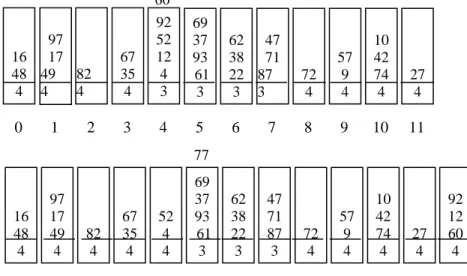
Consider the LH*RS data buckets at Figure 1a. The split pointer is n = 4, the file level is i = 3, the file extent is N = 12 = 23 + 4 buckets. The header of each bucket shows its level j. We only show the key fields c, assumed to be integers. The bucket capacity is b = 4. Bucket 4 has an overflow record. Its insertions triggered one of the previous splits. Most likely, - one of those using h4 that processed the file up to bucket 3 till now. We now insert record 77. According to (LH) it enters bucket 5. The bucket reports an overflow to the coordinator. This one creates bucket N =12, Figure 1b, and requests bucket 4 to split. Bucket 4 has level j = 3, hence rehashes all its records using h4. The new address for a record can be only either 4 or 12. The bucket keeps every record hashed to 4. It sends
2
For LH*, there are also variants without the coordinator, [LNS96], but we are not aware of attempts to make them highly-available.
every other record to bucket 12. In our case, two records remain, while three move. Both buckets get level j = 4. Bucket 4 reports the end of the split to the coordinator that finally moves the split pointer n to n + 1 = 5. Now, bucket 4 no longer overflows, but even has room for three more primary records. Likewise, there is room for two more inserts in new bucket 12. The overflow at bucket 5 remains though, despite being at the origin of the split. Its resolution waits for coming splits. In our case, the next one is in fact at bucket 5 and will indeed resolve the overflow.
2.1.2 Addressing
As in LH* file, each LH*RS client caches its private image of the file state, and applies (LH) to it. The coordinator would indeed become a hot spot if the clients should access it for the addressing. The coordinator does not push every file state update to the clients nor even to the servers for the same reason. A split makes therefore every existing image outdated. The initial image of a new client is (0,0). A client with an outdated image may direct a key-based request towards an incorrect address, i.e., not the correct one given by (LH) for the request. The addressee recognizes its status from the received key c and from its bucket level j. The correct address must indeed be equal to hj (c) that is its own.
The incorrectly addressed bucket should forward the request to the bucket that is possibly the correct one for c, and within the shortest extent N that could exist in the situation. This guarantees that the hop does exceed any current extent. The guess can be based solely on j and the bucket’s own address. Indeed, only the coordinator knows n. The first guess must be bucket hj -1 (c). This address must be under 2j – 1, hence the guess is always safe, as the extent of the file with at least one bucket of level j must be beyond that bound. If this address is not that of the guessing bucket itself, then it cannot verify whether the level of the addressee is actually j – 1 or j. Hence, it has to resend the request there. Otherwise, the guess does not lead to any actual forwarding. The only remaining choice is hj(c). This must be the correct address. If the request is resent to bucket hj -1 (c), and the address happens to be also incorrect, then the bucket level was indeed equal to j. The same calculus there resends then the request to the correct bucket hj (c).
An incorrect bucket receiving the request from the client resends it accordingly to the above reasoning. It executes the resulting LH*RS Forwarding Algorithm shown in Section 8 in Appendix C. The addressee may resend it once more, using the same algorithm. This must be the last hop. In other words, any client’s request dealt with in this way must reach its correct bucket in at most two hops. This property is independent of the file extent. It is unique to LH* based schemes up to now, and comparatively, among SDDSs, the most efficient known at present. Besides, the performance analysis for LH*
has shown that most of the key based addressing requests in fact do not encounter any forwarding in practice, i.e., for a reasonable large bucket capacity b3.
The correct bucket sends an Image Adjustment Message (IAM) to the client. It contains essentially the bucket level and the address of the latest resending bucket4. The client updates its image on this basis. It guesses the shortest file extent and the related state that could lead to the data it got. The algorithm avoids the same addressing error twice. It also makes the client’s image of the extent closer to the actual one. Numerically, see Section 8 of Appendix C, if j is the received level, and A is the address, the image evaluates to (i’ = j –1, n’ = A + 1), unless n’ turns out then to 2i’. The file state reevaluates then instead to (i’ = j, n’ = 0). The rationale for the calculus is largely similar to that already outlined for the forwarding calculus at the bucket.
j
(a)j
60 16 48 4 97 17 49 4 67 35 4 82 4 92 52 12 4 3 62 38 22 3 47 71 87 3 69 37 93 61 3 72 4 57 9 4 10 42 74 4 27 4 16 48 4 97 17 49 4 67 35 4 82 4 52 4 4 62 38 22 3 47 71 87 3 69 37 93 61 3 72 4 57 9 4 10 42 74 4 27 4 0 1 2 3 4 5 6 7 8 9 10 11 92 12 60 4 77 (b) 1 2 4 5 7 8 9 11 12 0 3 6 10Figure 1: An LH*RS file data buckets, before (a) and after (b) the insert of record 77
The IAMs may also refresh the client’s image of the physical addresses of the servers. Each IAM brings to the client then the addresses of all the buckets stretching between the one initially addressed by the client and the correct one. A specific IAM we describe later refreshes also the client when the recovery displaces a bucket.
Example 2
In the file at Figure 1a, the key c = 60 is in bucket 4 according to (LH). Now, a client with the file state image equal to (0,0), hence with the file extent image equal to N’ = 1,
3
Incidentally, these properties nicely fit D. Knuth’s comments about amazing efficiency of randomized algorithms in Lecture 2 of “Things a Computer Scientist Rarely Talks About”, CSLI Publications, Stanford, 2001.
4
This choice is actually a novelty for LH* based schemes. They used up to now the one in [LNS96]. The new approach improves the image adequacy in many cases.
searches for this key. The client sends the request to bucket 0, according to its execution of (LH). Bucket 0 verifies whether it could be the correct bucket for record 60. Its bucket level is 4, hence we have h4 (60) ≠ 0. The bucket is not the correct one, hence needs to forward the request. The bucket guesses the new address as h3 (60) = 4. It is safely in the existing file extent, as the file with bucket 0 of level 4 must have at least 9 buckets, while h3 may only address buckets 0…7. The forwarding address does not point to bucket 0 itself, hence the bucket forwards the request to bucket 4. It includes in the message its own bucket level j = 4. The calculus at bucket 4 yields h3 (60) = 4. Hence it is the correct bucket. It responds therefore to the client with record 60 (if the request was a key search). It piggy-backs the IAM containing the address 0 and the received level j = 4. The client updates the file state image to (3,1). This amounts to a new extent image of N’ = 9. This value is much closer to the actual one of N = 12 than the initial N’ = 1. If the client repeats the search, it sends the request directly to bucket 4, avoiding the previous error. Moreover, initially any request from the client for any but the two records in bucket 0 would require the forwarding. Now, only the requests for the six records in buckets 9-11 would require it.
Consider now another client with image of N = 1 sending the request for record 60 to the file at Figure 1b. Bucket 0 again forwards the request, and its bucket level, to bucket 4. The calculus at bucket 4 now yields h4 (60) = 12. The request cannot be resent to bucket h3 (60) since it is bucket 4 itself. Hence the bucket uses the guess of h4 (60) and resends the request accordingly, with its own bucket level to bucket 12. This has to be the correct address. Bucket 12 handles the request and sends the IAM that the level of bucket 4 is 4. The client’s new image is (3,5) hence it amount to the image N’ = 13. It is the perfect guess. An access to any record by our client arrives now directly at the correct bucket, until next split.
2.1.3 Misdirected Requests
LH*RS restores an unavailable bucket on a spare server. It is typically a different server than the one with the unavailable bucket. Only the client and the buckets involved in the recovery are aware of the new location. Any other client or bucket can misdirect a request to the former server. A misdirected request could also follow a bucket merge. The LH*RS file processes the misdirected requests basically as follows.
Any request to a data bucket carries the number of its intended bucket. A node that a request reaches is supposed basically to be an SDDS server. Other nodes are not supposed to react in any way. Like, ipso facto, an unavailable server. The request without reply enters the degraded mode that we discuss in Section 4. The server getting a request
verifies that it carries the intended bucket. If so, it acts as described above. Otherwise, it forwards the request to the coordinator. This one resends the request to the correct bucket. An IAM informs the sender of the location change.
The scheme is valid provided that a misdirected request never finds the bucket at former location available despite its recovery elsewhere. If it could happen, the client could unknowingly get not up-to-date data. The assumptions for LH*RS design we outline now prevent this eventuality. They root in the popular fail-stop model and fit well the local network environment we target mainly.
We presume thus basically that when a client or server finds a bucket unavailable, the unavailability is permanent and of the entire bucket, Next, we suppose the communications (fully) reliable. Finally, we presume the server (definitively) unavailable when it does not react to the requests from the coordinator. The basic recovery policy for LH*RS is furthermore that (i) only the coordinator initiates a recovery, when a bucket does not react to the request from, and that (ii) the first action of any server upon its local start-up or restart is to report to the coordinator. The bucket waits then for the reply before providing any services, even if it finds its bucket intact.
Reliable communications and (i) prohibit then any server from the recovery while available. This excludes one possibility of the “bad” case. Next, the server restarting on its own could have its bucket already recovered by the coordinator, in the meantime, or not, if its unavailability remained unspotted. The coordinator systematically instructs any restarting server with the recovered bucket to become a spare. This precludes the bad case as well. If the unavailability remained unspotted, and the bucket is intact, the coordinator allows the bucket to serve. Otherwise, finally it initiates the recovery. The restarting server may eventually get the bucket back. Whatever is the issue, the bad case cannot happen.
The scheme can be extended beyond the basic model. Especially, to the case of unreliable communications that could temporarily or partly isolate a data bucket. The bucket could then become inaccessible to a client and the coordinator, while other clients could possibly continue accessing it. The coordinator would start the recovery that if successful, could ultimately lead the clients using the former location to get stale data. To prevent this from happening, it suffices that any data server pings (scrubs) any of the parity buckets of its group at the interval shorter than a minimal bucket recovery time. In practice, as Section 5.7 shows, it should lead to a negligible overhead, e.g., a ping per little bit more than second in our experiments. If the server does not receive the reply, it alerts the coordinator, while probing possibly another parity bucket.
As it will appear, every parity bucket knows the valid location of all the data buckets in its group, or knows about any recovery of a data bucket in its group in progress. In response to the ping, the available parity bucket should thus either confirm to the sender that it is still the available data bucket, or make it aware of the recovery in progress. Accordingly, the bucket should process any request coming afterwards, or during the ping, or should become a spare, only forwarding the misdirected requests to the coordinator. Notice that if the request is an insert, delete or update, it must update all k parity buckets, as it will appear. These would redirect any such request to the valid bucket, if a, necessarily unfinished, recovery had started since the latest ping. The misdirected key search, processed in contrast by the (invalid) data bucket alone, as any key search by any data bucket, cannot lead to an incorrect (stale) reply in this case either. No update could indeed perform at the valid bucket yet, at least till next ping.
2.2 Parity Records
The LH*RS parity records let the application to get the values of data records stored on any unavailable servers, up to k ≥ 1. We call k the availability level and the file k-available. The actual level depends on the intended availability level K ≥ 1 that is a file parameter. The K value adjusts dynamically to the file size, (Section 2.2.3). Typically, k = K, sometimes k = K–1, after an increase of K. We now present how LH*RS manages the parity records.
D
c r C P
(a) (b)
Figure 2: LH*RS record structure: (a) data record, (b) parity record
2.2.1 Record Grouping
LH*RS parity records belong to the specific structure, invisible to the application. It consists of bucket groups and record groups. A bucket group contains m consecutive buckets with possibly less buckets in the last group. Formally, bucket group g consists of all buckets a such that ⎣a/m⎦ = g. Here, m is a file parameter that is a power of 2. Bucket group 0 consists of buckets 0…m−1, bucket group 1 of buckets m… 2m−1, etc. We limited our implementation to m ≤ 128, since larger choices look of little use at present. Every data record in a bucket gets a unique rank r = 1,2…. when it enters the bucket because of an insert, split, or merge. Ranks are handed out basically successively, although the ranks of deleted records can get reused. The up to m data records sharing the same rank r in a bucket group g form a record group (g,r). Each record group has k ≥ 1 parity records stored respectively at different parity bucket P0, ... Pk-1. The value of k is
the same for every record group in a bucket group and follows that of K as we have mentioned and describe in depth in Section 2.2.3.
2.2.2 Record Structure
Figure 2b shows the structure of a parity record. Field r contains the rank and serves as the key. Field C encodes the record group structure. It contains m placeholders c0, c1…cm-1 for the keys of the data records in the group. If the ith-bucket in the group contains a data record with rank r and key c, then ci = c otherwise ci is null. All k parity
records in a record group share the value of r and of C. The final field is the parity field P, different for each parity record of a group. We generate it by encoding the D-fields in the record group using our Erasure Correcting Code (ECC) (Section 3). The ECC allows to decode any unavailable (hence assumed erased) s ≤ k D-fields in the group from any of s ≤ k parity records and the remaining m−s D-fields. We can recover the unavailable s keys from the C-field of any parity record in the group. These properties are our basis for the k-availability.
In [LS00], the actual keys for C formed a variable length list. The fixed structure above, proved more efficient, [Lj00]. It typically needs slightly less storage. In addition, the position i of c in the C-field directly identifies the data bucket with c as the ith in its bucket group. This facilitates the search for data record c, that needed the LH* addressing, with the image management at the parity bucket and possibly the forwarding.
77 52 4 4 2 38 22 3 47 7 71 87 3 69 37 93 61 3 [5,(--,77,--,--)] [4,(--,69,--,47)] [3,(--,37, 2, 7)] [2,(52,93,38,71)] [1,( 4,61,22,87)] 2,0 [5,(--,77,--,--)] [4,(--,69,--,47)] [3,(--,37, 2, 7)] [2,(52,93,38,71)] [1,( 4,61,22,87)] 2,1 6 4 5 7 P0 P1
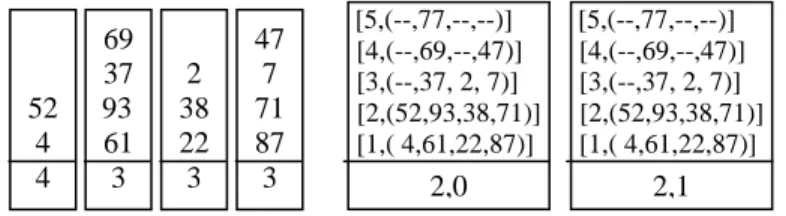
Figure 3: LH*RS Record group structure with k = 2 parity buckets Example 3
We continue with our running example at Figure 1. We assume now that the bucket group size is m = 4. The file at Figure 1b has then four bucket groups {0,1,2,3}, {4,5,6,7}, {8,9,10,11}, and {12}. Figure 3 shows the 2nd group that is group 1, with k=2 parity buckets. These are named P0 and P1. We only show the keys in the data buckets, the ranks and the C-fields in the parity buckets. Notice that the latter are identical for
both buckets, but that the P-fields would differ. The hyphens symbolize the null values. The header of a parity bucket only shows its bucket group number and the offset of the bucket in the group. The figure shows that the record group with rank 1 consists of m data records 4, 61, 22, and 87. The group of rank 3 contains only three records at present, in buckets 5,6,7. The next insert to bucket 3 will add a new member to this group, and will update all the C and P fields. If bucket 6 is unavailable, the data records in buckets 4,5,7 together with any of the parity buckets suffice to correct the erasure of the D fields in this bucket. The missing keys are in the C fields at the offset i = 3. To access record 93, among those necessary for the erasure correction calculus within its record group (1,2), one may directly address bucket 5. Since 93 = c1 in its C-field, we calculate 1*4 +1. A 2-unavailability involving buckets 6,7, requires the use of data buckets 4,5 and of both parity buckets. A 3-unavailability is unrecoverable (catastrophic) here. We need at least k = 3 parity buckets to keep away from such a bad luck.
2.2.3 Scalable Availability
The cost of storing and manipulating parity records increases with k. The storage overhead is at least k/m. We also need the access to all the k parity records whenever we insert, update, or delete a data record. A multiple unavailability becomes also more likely in a larger file, hence the probability of the catastrophic case for any given k rises as well, [H&a94]. In response, the LH*RS scheme provides scalable availability, [LMR98]. At certain file sizes, the current availability levels increase by one for every group.
In more detail, we maintain a file parameter called the intended availability level K. Initially, K = 1. The coordinator increases K by 1, at the first split making the file extent N to exceed some NK data buckets, K ≥ 2. Each NK should be a power of 2 and a multiple
of m. The former requirement makes K changing only for the split of bucket 0. One choice for the latter requirement is NK= N1K, with N1 = m, [LMR98].
Consider now that the coordinator is at the point of increasing K since the file undergoes the split of bucket 0 making N exceeding some NK. At this moment, all bucket
groups yet contain k = K−1 parity buckets. Now, whenever the first bucket in a bucket group splits, its group gets one more parity bucket, i.e., the K-th one. From now on, every new split within the group updates this bucket as well. If the freshly appended bucket initiates a new group, then it gets K parity buckets from the start. Until the file reaches N = 2NK buckets, we have thus in the file some groups which are K-available while others
are still (K-1)-available. The file is still (K-1)-available. Only when N reaches 2NK will all
There is a subtle consequence for the transitional group that contains the current bucket n beyond its first bucket. Not all the buckets of the transitional group have yet split using hi+1. Its K-th parity bucket only encodes therefore the data buckets in the group up to bucket n-1. LH*RS recovery cannot use it in conjunction with the data buckets in the group that have not yet split. The group remains (K – 1)-available despite K parity buckets. It reaches K-availability when the last bucket splits.
Example 4
We continue with m = 4. The file creation with K = 1 leads to data bucket 0 and one parity bucket for group 0, i.e., with buckets 0…3 as m = 4. The split creating bucket 4 initialize the first parity bucket for group 1, named P0 upon Figure 3 and Figure 5 and named P0 formally. Until the file reaches N = 16, every group has one parity bucket (P0), and the file is 1-available. The creation of bucket 16, by the split of bucket 0, appends P1 to group 0, and provides group 4 initiated by bucket 16, with P0 and P1 from the start. Group 0 remains transitional and 1-available, despite its two parity buckets. This lasts until bucket 3 splits. The new group 4 is however 2-available immediately.
Next, the eventual split of bucket 4 appends P2 to group 1, and starts group 5. Group 1 is transitional in turn. When bucket 15 splits, hence n returns to 0 and the file reaches N = 32 buckets, all the groups are 2-available. They remain so until the file reaches N3 = 64 buckets. Next split, of bucket 0 necessarily, increases K to 3, adds P3 to group 0, makes the group transitional again, etc. The file reaches 3-availability when it attains 128 data buckets. And so on.
3 PARITY CALCULUS
3.1 Overview
We first defined the parity calculus for LH*RS in [LS00] for our Erasure Correcting Code (ECC) derived from a classical Reed-Solomon code [MS97]. We recall that an ECC encodes a vector a of m data symbols into a code word of m + k + k’ code symbols such that any m + k’ of the code symbols suffice to recalculate a. Our ECC was Maximum Distance Separable (MDS). Hence k’ = 0 and m code symbols suffice to recalculate a. This is the theoretical minimum, so we minimize parity storage overhead for any availability level k within a record group. Next, our ECC was systematic. Thus, our encoding concatenates a vector b of k parity symbols to a to form the code word (a|b). Finally, our code was linear. Thus, we calculate b as b = a · P with a parity matrix P.
Our initial proposal was theoretical. Since then, we worked on the implementation. Our primary goal was fast processing of changes to data buckets. The result was an improved ECC that we introduce now. We changed from symbols in the Galois field
GF(24) to GF(28) or GF(216). We based our latest prototype, [LMS04], on the latter as measurements favored it. We also refined the parity matrix P. Our new P has a row and a column of ones. As a consequence of the latter, updating parity bucket P0 involves only bit-wise XOR operations. In addition, the recovery of a single data bucket involves only the XOR operations as well. Our EEC calculus is thus in this case as simple and fast as that of the popular 1-available RAID schemes. The 1-unavailability is likely to be the most frequent case for our prospective applications. When we need to go beyond, the row of ones makes the inserting, deleting, or updating the first data record in a record group, to involve only XOR-operations at all parity records. Creation and maintenance of all other parity records involves symbol-wise GF-multiplication. It is mathematically impossible to find a parity matrix for an MDS code with more ones in it, so that our code is optimal in that regard. Our new parity matrix is new for ECC theory, to the best of our knowledge.
We continue to implement our GF-multiplication using logarithms and antilogarithms, [MS97, Ch. 3, §4]. We take further advantage of this approach by directly applying to the parity (P-fields) generation the logarithms of the entries in P, insteadof the entries themselves. The latter is the usual practice and as we did so ourselves as well previously. The result speeds up the calculus, as we will show. Finally, we introduce the concept of a generic parity matrix. This matrix contains parity matrices P for a variety of numbers m of data records and k of parity records.
We now describe our present calculus in more depth. We only sketch aspects that our earlier publications already covered. See in particular [LMS04b] for more details. We give some details also in Appendix C.
3.2 Generic Parity Matrix
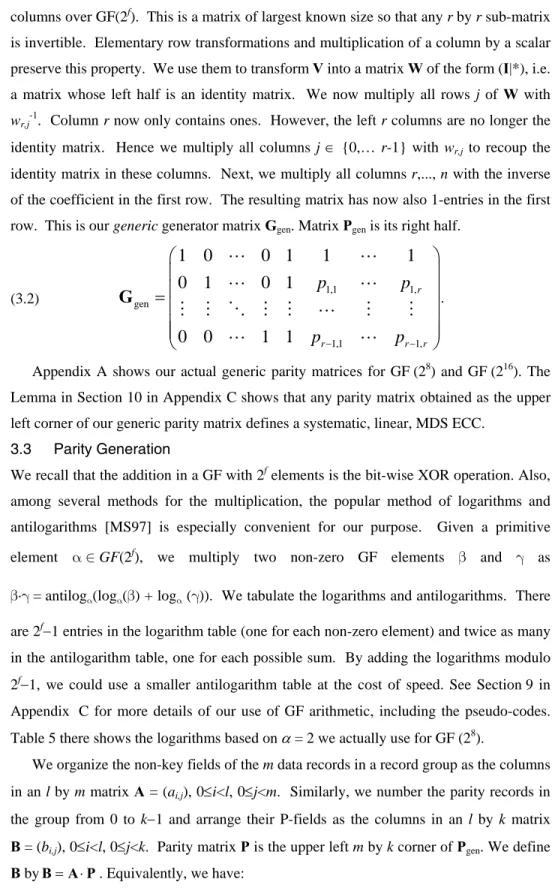
Our symbols are the 2f bit strings of length f, f = 8, 16. We treat them as elements of GF(2f). The generic parity matrix Pgen is the 2f-1 by 2f-1+1 matrix of the form:
1 1 1 1,1 1,2 gen 2 1,1 2 1,2
1
1
1
1
1
f f fp
p
p
p
− −− −−⎛
⎞
⎜
⎟
⎜
⎟
= ⎜
⎟
⎜
⎟
⎜
⎟
⎝
⎠
P
"
"
#
#
%
#
"
(3.1) 1 f−With this choice of size Pgen can accommodate a maximum of 2f-1 data records and 2f-1+1 parity records in a group. We could have chosen other maxima within the bounds of a total of 2f+1 data and parity records in a group. We now sketch how to obtain Pgen. We start with an extended Vandermonde matrix V with r = 2f-1 rows and n = 2f+1
columns over GF(2f). This is a matrix of largest known size so that any r by r sub-matrix is invertible. Elementary row transformations and multiplication of a column by a scalar preserve this property. We use them to transform V into a matrix W of the form (I|*), i.e. a matrix whose left half is an identity matrix. We now multiply all rows j of W with wr,j-1. Column r now only contains ones. However, the left r columns are no longer the
identity matrix. Hence we multiply all columns j ∈ {0,… r-1} with wr,j to recoup the
identity matrix in these columns. Next, we multiply all columns r,..., n with the inverse of the coefficient in the first row. The resulting matrix has now also 1-entries in the first row. This is our generic generator matrix Ggen. Matrix Pgenis its right half.
. 1,1 1, gen 1,1 1,
1
0
0 1
1
1
0
1
0 1
0
0
1 1
r r rp
p
p
−p
−⎛
⎞
⎜
⎟
⎜
⎟
=
⎜
⎟
⎜
⎟
⎜
⎟
⎝
⎠
G
"
"
"
"
# # % # #
"
#
#
"
"
(3.2) rAppendix A shows our actual generic parity matrices for GF (28) and GF (216). The Lemma in Section 10 in Appendix C shows that any parity matrix obtained as the upper left corner of our generic parity matrix defines a systematic, linear, MDS ECC.
3.3 Parity Generation
We recall that the addition in a GF with 2f elements is the bit-wise XOR operation. Also, among several methods for the multiplication, the popular method of logarithms and antilogarithms [MS97] is especially convenient for our purpose. Given a primitive element α∈ GF(2f), we multiply two non-zero GF elements β and γ as
β·γ = antilogα(logα(β) + logα (γ)). We tabulate the logarithms and antilogarithms. There are 2f−1 entries in the logarithm table (one for each non-zero element) and twice as many in the antilogarithm table, one for each possible sum. By adding the logarithms modulo 2f−1, we could use a smaller antilogarithm table at the cost of speed. See Section 9 in Appendix C for more details of our use of GF arithmetic, including the pseudo-codes. Table 5 there shows the logarithms based on α = 2 we actually use for GF (28).
We organize the non-key fields of the m data records in a record group as the columns in an l by m matrix A = (ai,j), 0≤i<l, 0≤j<m. Similarly, we number the parity records in
the group from 0 to k−1 and arrange their P-fields as the columns in an l by k matrix
B = (bi,j), 0≤i<l, 0≤j<k. Parity matrix P is the upper left m by k corner of Pgen. We define
1 , , 0 m i j i j b a pν ν, ν − = = ⊕ . (3.3)
Formula (3.3) defines the P-field of the parity records for a record group. We calculate this field operationally, when we change a data record in the record group. This happens when an application inserts, deletes, or modifies a data record, or when a split or merge occurs. We implemented the latter as bulk inserts and deletes. For the parity calculus, inserts and deletions are special cases of updates. A missing data record has a non-key field consisting of zeroes. An insert changes this field from the zero string and a delete changes it to the zero string.
We now explain an update to data record j in a record group. Let
( )
old , 0i j i l a
≤ < be the
non-key field of the record before and
( )
new , 0i j i l a
≤ < the one after the update. The delta field
(∆-field)is
( )
(
new old, 0 , , 0 j i j i l ai j ai j i l δ ≤ < ≤ < = = ⊕ ∆
)
, ,. It is the bit-wise XOR of the before and the
after image of the non-key field. For an insert or a delete, the ∆-field is thus simply the actual non-key field. As in [LS00], we calculate the P-field of parity record s as:
(3.4) new old
, , ,
i s i s i s j s
b =b ⊕δ ⋅p .
Parity bucket s only uses column s of P. However, we do not use the parity matrix P directly. Rather, we store the logarithms qj,s = logα(pj,s) of the entries of P in a
logarithmic parity matrix Q and use the formula
(3.5) bi snew, =bi sold, ⊕ antilog (log (α α δi s, )+qj s, )
where the plus sign is the integer addition and the ⊕ the bitwise XOR operation. Our use of Q avoids half the look-ups to the logarithm table. Parity bucket s only needs the first m coefficients from column s of Q and only these are stored there. Parity bucket 0 does not need to store anything, since it simply updates according to
(3.6) bi snew, =bi sold, ⊕ δi s. 1 1 1 0 0 0 1 1a 1c 0 105 200 1 3b 37 0 120 185 1 ff fd 0 175 80 ⎛ ⎞ ⎛ ⎜ ⎟ ⎜ ⎜ ⎟ ⎜ = = ⎜ ⎟ ⎜ ⎜ ⎟ ⎜ ⎜ ⎟ ⎜ ⎝ ⎠ ⎝ P Q ⎞ ⎟ ⎟ ⎟ ⎟⎟ ⎠ Figure 4: P and Q for 3-available record group of size four data record.
Appendix A shows our actual matrices Q for GF (28) and GF (216). At the implementation level, a data bucket calculates the ∆-field for each update and sends it together with the rank to each parity bucket. Each parity bucket then updates the P-field
of the parity record in the record group given by the rank according to (3.5) or to (3.6) if it is the first parity bucket.
Example 5
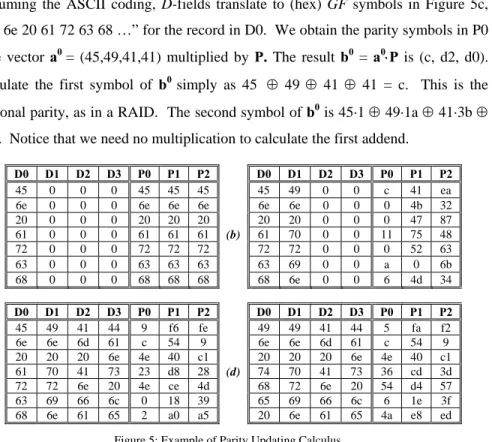
We use 1B symbols as elements of GF(28) and write them as hexadecimal numbers. We continue with m = 4 and we choose k = 3. We cut the parity matrix P and a logarithmic parity matrix Q in Figure 4 from our generic parity matrix in Appendix A. We number the data buckets in a bucket group D0…D3 and consider three parity buckets, Figure 5. We have one data record per bucket. The record in D0 has the D-field: “En arche en o logos …”. The other D-fields are “In the beginning was the word …” in D1, “Au commencement était le mot …” in D2, and “Am Anfang war das Wort…” in D3. Assuming the ASCII coding, D-fields translate to (hex) GF symbols in Figure 5c, e.g., “45 6e 20 61 72 63 68 …” for the record in D0. We obtain the parity symbols in P0 from the vector a0= (45,49,41,41) multiplied by P. The result b0 = a0⋅P is (c, d2, d0). We calculate the first symbol of b0 simply as 45 ⊕ 49 ⊕ 41 ⊕ 41 = c. This is the conventional parity, as in a RAID. The second symbol of b0is 45·1 ⊕ 49·1a ⊕ 41·3b ⊕ 41·ff etc. Notice that we need no multiplication to calculate the first addend.
D0 D1 D2 D3 P0 P1 P2 D0 D1 D2 D3 P0 P1 P2 45 0 0 0 45 45 45 45 49 0 0 c 41 ea 6e 0 0 0 6e 6e 6e 6e 6e 0 0 0 4b 32 20 0 0 0 20 20 20 20 20 0 0 0 47 87 (a) 61 0 0 0 61 61 61 (b) 61 70 0 0 11 75 48 72 0 0 0 72 72 72 72 72 0 0 0 52 63 63 0 0 0 63 63 63 63 69 0 0 a 0 6b 68 0 0 0 68 68 68 68 6e 0 0 6 4d 34 D0 D1 D2 D3 P0 P1 P2 D0 D1 D2 D3 P0 P1 P2 45 49 41 44 9 f6 fe 49 49 41 44 5 fa f2 6e 6e 6d 61 c 54 9 6e 6e 6d 61 c 54 9 20 20 20 6e 4e 40 c1 20 20 20 6e 4e 40 c1 (c) 61 70 41 73 23 d8 28 (d) 74 70 41 73 36 cd 3d 72 72 6e 20 4e ce 4d 68 72 6e 20 54 d4 57 63 69 66 6c 0 18 39 65 69 66 6c 6 1e 3f 68 6e 61 65 2 a0 a5 20 6e 61 65 4a e8 ed
Figure 5: Example of Parity Updating Calculus.
We now insert these records one by one. Figure 5a shows the result of inserting the first record into D0. The record is in fact replicated at all parity buckets, since updates to the first bucket translate to XOR operations at the parity buckets, and there are not yet the other data records. Inserting the second record into D1 at Figure 5b still leads to an XOR operation only at P0, but involves GF-multiplications using the respective P columns at the other parity buckets. Notice that, in the latter case, we operationally use in fact Q columns only. Figure 5c shows the insert of the last two records. Finally, Figure 5d
shows the result of changing the first record to “In the beginning was …”. Operationally, we first calculate the ∆-field at D0: (45⊕49, 6e⊕6e, 20⊕20, 61⊕74, …) = (c, 0, 0, 15, …) and then forward it to all the parity buckets. Since this is an update to the first data bucket, we update the P-fields of all parity records by only XORing the ∆-field to the current contents.
3.4 Erasure Correction
Our ECC calculates a code word (a|b) as (a|b) = a·G with a generator matrix
G = (I|P) [MS97, Ch. 1, §2] obtained by the concatenation of the m by m identity matrix
I and the parity matrix P. We recall that we organized the non-key fields of the data records in an l by m matrix A and similarly the P-fields of the parity records in a matrix
B = A·P. Assume that we have m columns of (A|B) left, corresponding to m surviving
records. We collect the corresponding columns of G in an m by m sub-matrix H. Here, the data buckets implicitly correspond to columns in the identity matrix. The columns of
P are reconstructed as the coordinate-wise antilogarithms of the columns in Q at the parity buckets. We form an l by m matrix S containing the m available data and parity records. We have A·H = S. Hence A = S⋅H-1 and we recover all data records with one single matrix inversion (in our experiments, the classical Gaussian inversion appeared to be the fastest, and we actually use log2(H-1)to speed up the multiplication). If there are unavailable parity records, then we recover the data records first and then regenerate the erased P-fields by calculating B = A·P for the lacking columns of B.
Alternatively, we can decode all the erased data and parity values in a single pass. We form the recovery matrix R = H-1⋅G. Since S = A⋅H, we have A = S⋅H-1, hence
(A|B) = A⋅G = S⋅H-1⋅G = S⋅R. We apply however only the first approach up to now.
Computing R is longer, while we expect primarily the recovery of the data bucket only.
0 1 1 1 1 a7 a7 1 0 1 1a 1c -1 46 7a 3d 0 H H = 0 1 3b 37 91 c8 59 0 1 1 ff fd d6 b2 64 0 ⎛ ⎞ ⎛ ⎜ ⎟ ⎜ ⎜ ⎟ ⎜ = ⎜ ⎟ ⎜ ⎜ ⎟ ⎜ ⎜ ⎟ ⎜ ⎝ ⎠ ⎝ ⎞ ⎟ ⎟ ⎟ ⎟⎟ ⎠
Figure 6: Matrices for correcting erasure of buckets D0, D1, D2 Example 6
Assume that the data buckets D0, D1, and D2 in Figure 5 are unavailable. Assume that we want to read our record in D0. We collect the columns of G corresponding to the available buckets D3, P0, P1, and P2 in Figure 5 in matrix H,Figure 6. We invert H. The last column of H-1 is a unit vector since the fourth data record is among the available ones. To reconstruct the first symbol in each data bucket simultaneously, we form a
vector s from the first symbols in the available records of D3, P0, P1, and P2: s = (44, 5, fa, f2). This vector is the first row of S. To recover the first symbol in D0, we multiply s by the first column of H-1 and obtain 49 = 1*44 + 46*5 + 91*FA + d6*f2. Notice again that actually we use the matrix log2(H-1). We iterate over the other rows of S to obtain the other symbols in D0. If we were to read our record in D1, we would use S with the second column of H-1.
4 LH*RS FILE MANIPULATION
An application manipulates an LH*RS file as an LH* file. The coordinator manages high-availability invisibly to the application. We assume that the coordinator can diagnose any bucket unavailability by probing through reliable communications. Available buckets respond to the probing as expected, by definition. Internally, each manipulation starts in normal mode. It remains so as long as it does not run into an unavailable bucket. That one does not respond at all (our basic case) or more generally does not behave as it should. A manipulation that encounters an unavailable bucket enters degraded mode. The node handling the manipulation forwards it to the coordinator. The coordinator initiates the bucket recovery, unless it is already in progress. It considers the bucket content erased and calls upon our erasure correction calculus. The recovery restores simultaneously all unavailable buckets found in the group when the operation starts, up to k, as we discussed. More than k unavailable buckets make the unavailability catastrophic. For a key search of a record in an unavailable bucket, the coordinator starts also the record recovery. This operation recovers only the record, or finds its key not in the file. It should be usually much faster than waiting for the bucket recovery to complete, which also recovers the record. Once the bucket recovery, or only the record recovery for the key search, has terminated, the coordinator completes the original manipulation and returns the result and the control to the requestor.
We first present the recovery operations. Next, we describe the record insert, update and bucket split operations. We focus on the parity coding, as Section 2 already largely covered the related data record manipulations. We have left the description of file creation and removal, of key search, and of non-key search (scan) to Appendix C, Section 11. These manipulations do not involve parity coding and perform almost as for LH*, except for the degraded mode. Likewise, we relegated the deletion and bucket merge to Appendix C. Deletions are rare (except those internal to the split operation we describe in Section 4.5), while merges are hardly ever implemented.
4.1 Bucket Recovery
the bucket group for availability. We usually have k = K, or we have k = K - 1 if the group is not aware yet of the current K or is the transitional one.. The probing should localize m available buckets, excluding the last parity bucket in a transitional group. The un availability is catastrophic otherwise. The coordinator reports the gloomy fact to the client, for the application, and stops the processing. It may still be possible to recover some records, but this is beyond the basic scheme.
The probing localizes also the unavailable buckets that should be therefore k at most, including the originally reported bucket and without the last bucket of the transitional group5. If k > 1, then prior to the erasure correction, the coordinator may need to verify whether all the available parity buckets processed the last ∆-record or even simply got it. It may not be the case, as we show in Section 4.3 and Section 4.4. If ∆-record could update some but not all parity buckets, the erasure correction result could be gibberish, corrupting the data. The coordinator terminates the update of the parity buckets in the need. Next, the coordinator establishes the list LA of m available buckets. LA possibly includes bucket P0. The coordinator establishes also the list LS of tuples: (unavailable bucket, replacing spare). The coordinator chooses one spare as the recovery manager. It passes the task to it. If there is any parity bucket in LS, it also passes its Q column. The handover prevents the coordinator from becoming a hot spot.
The manager first creates the empty, structure of the bucket to recover at each spare. Next, if there is only one unavailable (data) bucket, and P0∈ LA, then the manager applies the XOR-only erasure correction. Otherwise, it creates matrix H using the columns of Q at the parity buckets in LA. If the bucket group is the last one and some data buckets have not yet been created, then the calculus considers these bucketsas virtual ones with records having zero D-fields. In both cases, the manager calculates then the matrix log2(H-1), using the primitive element α = 2 and the Gaussian inversion to produce
H-1
, as we said in Section 3.4. Next, it starts looping over all the parity records in a parity bucket in LA. It requests the successive records and for each record received, it performs the record group recovery producing all the unavailable records of one group.
Record group recovery explores the C-fields, Figure 2a. For every key ci∈ C, it
requests the data record ci from the ith bucket in the group, provided it is in LA. The manager decodes the (erased) D-fields of unavailable data records in the group. It uses the XOR-only or log2(H-1). It also reconstructs the keys from C. If there are also
5
In the basic scheme, we exclude the case of the probing finding a bucket reported to be unavailable to be nevertheless available, because for example only the reporting client had problems communicating with the bucket.
unavailable parity buckets in LS, then the manager generates their records from the m data records. The procedure varies slightly for the last parity bucket in a transitional group. The recovery of this bucket uses only the data buckets among the m up to bucket n (non-included). Finally, the manager sends the recovered records to the spares.
Once the bucket group recovery ends, the manager sends the addresses of the recovered buckets to the remaining buckets in the group. These update the location tables. The manager finally returns the control to the coordinator. The coordinator updates its server addresses as well. Clients and servers get the new addresses when they misdirect the requests.
It is perhaps worth recalling furthermore that the erasure correction used for each record group recovery could reconstruct the data and parity buckets simultaneously, except for the last bucket of the transitional group. It could use the alternate erasure correction calculus discussed in Section 3.4. The unavailability involving only the data buckets may be expected however more frequent than that of both types together. Our current erasure correction is then faster.
While the bucket group recovery loops over the individual record recovery, the actual records sent among the data buckets, the parity buckets and the spare move in bulks. At present, we use the TCP/IP in passive mode, Section 5.1. This turns out to be by far more effective than our previous choice of UDP with a record per datagram.
4.2 Record Recovery
A record recovery results from a key search in an unavailable correct bucket a. It decodes only the requested record or finds that the key is not in the file. This suffices for completing the search and should be typically much faster than delaying the key search till the sufficient completion of the bucket recovery, (Section 5.7 and Section 5.8). The coordinator starts the record recovery in parallel to a bucket recovery, provided the unavailability is recoverable of course. It hands the control to the record recovery manager at an available parity bucket in the group. It transmits c, a, LA. The manager
first searches the C-fields in the bucket for the existence of a parity record with rank r and the searched key c in C(r). Since one cannot infer r from c, it basically scans the bucket. It visits in each record only the C-field value at the offset of the unavailable bucket in the group. An index at the parity bucket, giving the ranks of the keys in the C-fields, could obviously avoid the scan, at the additional storage and processing cost. Such index is not part of the basic scheme.
If the manager does not find the parity record, it informs the coordinator that the search is unsuccessful. Otherwise, the recovery manager uses the erasure correction on
the record group r to recover the searched D-field. As discussed already, the calculus uses possibly XOR only or H-1 otherwise. Unlike for the record group recovery within the bucket recovery, the record recovery manager restores only the requested record, even if there are more unavailable data records in the group. Finally, it sends the record to the coordinator that forwards it to the client.
4.3 Insert
In normal mode, an LH*RS client performs an insert like an LH* client. The client addresses then the insert to the bucket determined by the data record key c and the client’s image. It keeps the copy of the record and waits for an acknowledgement. If it does not come within a timeout, the client sends the insert to the coordinator. The operation enters the degraded mode. We have already presented the bucket recovery that it starts. Later in this section we address the aspects of the degraded mode specific to the insert. The client waits for the final acknowledgment to discard its copy of the record. The policy for its acknowledgements to the application is implementation dependent and is not within our basic scheme. Our prototype uses its flow control algorithm.
The bucket receiving the request eventually forwards it as described before. Once the correct data bucket receives the insert, it stores the record as for an LH* file. If the data bucket overflows, the bucket informs the coordinator. In addition, it assigns a rank r to the record. Next, it sends the ∆-record (with key) c and r to the k parity buckets. Recall that the ∆-field is the D-field of the inserted record. The data bucket then commits (acknowledges) the insert to the client and waits, internally, for the k acknowledgements from all parity buckets. The client discards its copy of the record.
The policy provides the k-availability under reliable messaging and our other basic assumptions, provided that all the availableparity buckets perform the required update, as detailed below. The data bucket will report indeed any unavailability and will still have the ∆-record. If the probing during the recovery finds any l≤ k parity buckets available, all l will be updated with the ∆-record. If the probing shows also at most l data bucket unavailable, then our basic erasure correction calculus recovers first all of them and next the unavailable parity buckets. This, even if the probing even finds the original data bucket among theunavailable ones, as it could become unavailable in the meantime.
To update its content upon the message from the data bucket, each parity bucket creates the parity record r, if it does not exist already, and inserts c into C-field. It also encodes the ∆-field of ∆-record c through the update of P-field of record r. It first conceptually multiplies the ∆-field symbol-wise with the correct coefficient of matrix P.
The actual calculus does not use the multiplication for the first column as it has 1’s only, and uses the symbols in Q for k > 1. It either XORs the result to the P-field already in record r or stores it as the new P-field of new record r.
If k = 1, the send-out of the ∆-record amounts in our scheme to 1PC. That is, the parity bucket creates or updates the parity record r, acknowledges the operation and does not keep any other traces of it. The data bucket erases any traces as well after the acknowledgement to the client. That one does the same, perhaps after forwarding the acknowledgement to the application in turn. The server or the client enters the degraded mode when any of the expected messages does not arrive in time.
The approach does not suffice in contrast to provide k-availability for k > 1. For instance, assume that k = 2 and that both the data bucket and the client become unavailable, while the data bucket was sending the messages to the parity buckets. The unavailability of the data bucket can then be discovered only later on. It may happen then that the bucket could send the message only to one of the parity buckets that performed the creation/update of record r consequently. Consider that the probing finds yet another data bucket unavailable. The erasure correction calculus obviously cannot recover the group anymore, leading to the data corruption in the case of such an attempt. This includes the inserted record itself that, besides, is nowhere around anymore. In any case, the group, hence the file, is not k-available anymore, despite the k parity buckets in the group. Notice that for an update the case could occur even if only the data bucket became unavailable during the send-out. Unlike for an insert or delete, the C-field of a parity bucket does not suffice anymore to know whether it dealt with the ∆-record or not.
The general rule for k > 1 that follows from is that a change, whether insert, update or delete, should commit at all or none parity buckets. Our basic scheme uses the following simple variant of 2PC for any of these operations. The data bucket sends the ∆-record c and its r to all k parity buckets. It does it in the order of the column index in P, i.e., p0, p1…pk. Each parity bucket starts the commit process by acknowledging the reception of
the message. The confirmation constitutes the “ready-to-commit” message. Each parity bucket encodes the record as usual into parity record r. But it retains the ∆-record in a differential file (buffer) for a possible rollback. If the data bucket gets all k “ready-to-commit” messages, it sends out the ““ready-to-commit” message to the k buckets, in the same order. Each bucket that receives the message discards the ∆-record. All available buckets should receive it under our general assumptions.
Degraded mode starts when any of the buckets involved cannot get a response it expects. The operation at the data bucket enters degraded mode if it lacks any of the
acknowledgments from the parity buckets. It alerts the coordinator, transmitting the ∆ -record, r and as usual the number p of the unavailable parity bucket. Within the bucket recovery process as described above, the coordinator requests each available bucket to complete the update from the differential file or by using the ∆-record it sends out otherwise. The recovery process proceeds then further as already presented.
Another degraded case occurs when parity bucket pl does not receive a message from
the data bucket. The data bucket must then just have failed and bucket pl must be in the
“Ready-to-Commit” state and must still have the ∆-record. It alerts the coordinator, sending out the ∆-record, and r. The coordinator probes the parity buckets in the above order. Any bucket up to pl either has committed or still has the ∆-record. Any other
bucket either still has the ∆-record or did not get it at all. The coordinator sends the ∆ -record where needed and requests the update at all the available parity buckets accordingly. Again, the recovery process continues then as already presented.
Next, the client lacking the acknowledgement from the data bucket reports it as unavailable. The client also acknowledges the operation to the application, to avoid further waiting. The coordinator performs the delivery to the correct bucket if the unavailable one wasn’t. This may generate a split processed then as usual. The coordinator may also find that the correct bucket it found on its own is unavailable as well. This may trigger a separate recovery if the bucket is in a different bucket group than the one reported by the client. Next, the coordinator determines the availability of buckets in the group, and verifies the synchronization of the parity buckets as just described. It may find that the data bucket never sent any messages to parity buckets. Alternatively, it may find an alert also from a parity bucket about the data bucket’s unavailability. It may further find some parity buckets still in wait for the commit from the data bucket and some perhaps without any message from. In all cases, the coordinator can determine the state of each available parity bucket and synchronize all of them as above. Afterwards the recovery proceeds as described.
Finally, as we said, it may happen that the client and the data bucket become simultaneously unavailable during the insert. If the update was in progress, an available parity bucket would alert the coordinator as described. Alternatively, it may only be that no (available) parity bucket has received the ∆-record or all have nicely committed. Only a later application operation will discover the data bucket unavailability. It will be recovered accordingly with or without the inserted record.
An insert in a degraded mode to the unavailable correct data bucket may generate an overflow