Space Environment Technologies (SET)
QUALITY ASSURANCE PROGRAM
Command Media
Approved by:
Approved by:
Approved by:
___________________
____________________
____________________
1-1
SECTION 1 - QUALITY POLICY & ADMINISTRATION
Scope
This document is the Quality Assurance Program Command Media. It is a dynamic
document (i.e., a living document) that describes the company-wide quality assurance
(QA) policies, processes, and management systems that are applied throughout the life
cycle of all SET products and services. The requirements stated herein are grouped
according to the unit-value criticality of the SET product or service that they are applied
to. These requirements and their enabling activities are purposely described in general
terms, highlighting the key QA activities and associated artifacts. A detailed description
of how the QA requirements and objectives of a particular SET project are met is found
in the QA Program Plan of that project. Suggestions for improving this document should
be brought to the attention of the SET President.
Purpose
The purpose of the SET QA Program is to identify the activities required to assure all
product qualification requirements are met during design, manufacturing, and assembly.
This document identifies the QA activities that should be done and describes how they
should be done. The QA Program Plan (QAPP) is intended to be a living document that
is updated as needed. Each project’s Lead QA Engineer is responsible for developing a
QAPP that will achieve the project’s QA requirements and objectives in a cost-effective
manner. Cumulatively, the tasks described in the QAPP form a structured quality system.
However, the QAPP is not intended to stifle opportunities to adopt improvements in the
quality system that is already in place. Long-term efforts to continuously improve
product or process quality are documented in the SET Quality Improvement Plan.
Document Organization
This command media is organized in eight sections:
1.
Quality Assurance Policy and Administration
2. Overview of SET Operations
3 Product Design Management
4 Supplier Quality Assurance
5 Production Quality Control
6 Customer Contact and Field Performance
7 Closed Loop Corrective Action
8 Employee Management, Training, etc
These eight sections represent the collective goals and objectives for quality assurance by
our management team. They represent the essence of our past successful performance
and our future expectations. While some changes are inevitable, we expect to continue to
implement quality assurance in a cost-effective manner that is commensurate with the
unit-value criticality of the product that it is applied to.
1-2
SET Quality Assurance Policy
Our entire management team is committed to SET’s long-standing policy to deliver
products and services that conform to their documented specifications at minimum cost.
This policy fosters a company-wide philosophy of “high-quality at low-cost” among our
managers, staff, and subcontractors. Each person and organization is responsible for
establishing and maintaining high standard in their work, with emphasis on doing it right
the first time.
When required by a project, SET will allocate resources to establish a process to
continuously improve our capability to prevent defects from occurring. This process will
be implemented in accordance with a Quality Improvement Plan, which will be a living
document that is updated on a regular basis. The primary focus of this plan is to improve
root cause identification and corrective action implementation. The ancillary focus of
this plan is to reduce costs. This dual-focus approach to QA planning facilitates SET
maintaining its competitive edge in the space weather marketplace’s by providing
cost-effective benefits to our customers over the long term.
Responsibilities /Accountabilities for Quality Assurance
The achievement of our corporate objectives depends on clearly defined responsibilities
and accountabilities. In all aspects of SET’s business, the management team is
responsible for defining and documenting specific responsibilities. The corporate
hierarchy of responsibility is provided in Table 1.
Paul Plumb 12/30/10 9:38 AM
1-3
Table 1. Quality Assurance Responsibilities/Accountabilities
Position
Responsibility
Company
President
Establish and meet corporate quality policies. Provide the resources and
commitment to implement quality improvement opportunities identified
by managers, staff, subcontractors, and customers.
Lead Quality
Engineer
Define quality requirements and objectives. Maintain quality manuals
and develop quality improvement plans for implementation by systems
engineering functions. Develop quality measuring and reporting
systems. See that goals are met and develop corrective action plans.
Develop QA checklists and distribute them to quality assurance
stake-holders. Provide QA training to QA stake-stake-holders.
Project
Managers
Meet QA requirements and objectives by actively managing the QA
Program Plan tasks that fall within their area of responsibility. Establish
quality goals for their area. Initiate action to correct unfavorable quality
variances, assuring that the root cause of the variance is identified and
eliminated. If required, provide resources to the personnel in their area
to focus on quality improvement and cost reduction efforts that will
provide customers with long term benefits.
Establish personal expectations for high-quality work standards.
Perform job responsibilities with a conscience effort to do the job right
the first time.
Initiate action to correct unfavorable quality variance. Accept full
accountability for the quality of his or her work.
All
Employees
If required, provide inputs to the management team for developing the
Quality Improvement Plan. Be creative in identifying process
improvement opportunities that will reduce costs and increase the level
of quality.
Systems Engineering Artifacts
Systems engineering artifacts will be collected or developed, and maintained to document
the quality assurance efforts of SET and its subcontractors. The artifacts listed below are
of various types, and include the documents that SET is required to develop in
accordance with the Statement of Work:
1.
Contractor’s Internal QA Program Command Media.
2.
Contractor’s proposal.
3.
Customer’s Statement of Work.
4.
Contractor’s subcontractor RFP/SOW
5.
Military and Commercial Standards and Guides
a.
MIL-STD-45662A
b.
MIL-STD-882C
c.
MIL-STD-1629A
d.
SMC Standard SMC-S-003T
1-4
f.
TBS Decision Analysis Guide (Similar to Quality Function Deployment
Method) (Ref: SOW Section 3.12 DECISION ANALYSIS)
6.
Work Breakdown Structure (WBS)
7.
Systems Engineering Management Plan (SEMP)
8.
Integrate Master Plan (IMP)
9.
Integrated Master Schedule (IMS)
10.
QA Program Budget Plan
11.
QA Program Budget Report
12.
Individual Systems Engineering Discipline Plans/Charters
a.
Risk Management Plan (Ref: SOW Section 3.10 RISK/OPPORTUNITY
MANAGEMENT)
b.
System Safety Program Plan (SSPP)
i.
Capability-based System Safety Process Description
(a)
Hazard Analysis
(b)
Product Safety Testing
(c)
Subcontractor/Supplier System Safety Program
Management (Ref: SOW Section 3.8 SUPPLIER
MANAGEMEN)
ii.
System Safety Program Technical Performance Metrics (Ref:
SOW Section 3.10.1 Technical Performance Measurement)
(a)
System Safety Program Inspection/Audit Criteria
c.
Reliability, Maintainability, Availability and Dependability (RMAD)
Program Plan
i.
Capability-based RMAD Process Description
(a)
Product FMECA
(b)
System Reliability Modeling
(c)
Component Reliability Predictions
a.
Software Component Reliability Predictions
(d)
Maintainability Predictions
(e)
Finite Element Analysis
a.
Circuit Structural Stress Analysis
b.
Circuit Thermal Stress Analysis
(f)
Worst Case Analysis
(g)
Reliability Development/Growth Testing
(h)
Reliability Life Testing
(i)
Subcontract/Supplier RMAD Program Management (Ref:
SOW Section 3.8 SUPPLIER MANAGEMEN)
ii.
RMAD Program Technical Performance Metrics (Ref: SOW
Section 3.10.1 Technical Performance Measurement)
(a)
RMAD Program Inspection/Audit Criteria
d.
Quality Assurance Program Plan (QAPP) (Ref: SOW Section 3.9
QUALITY)
i.
Capability-based Quality Assurance Process Description
(a)
Quality Assurance
1-5
(c)
Configuration/Data Management (Ref: SOW Section
3.10.2 CONFIGURATION/DATA MANAGEMENT
(CM/DM))
a.
Configuration Control Board (CCB)
b.
Configuration Control Database
(d)
Failure Reporting, Analysis, and Corrective Action System
(FRACAS)
(e)
Failure Review Board (FRB)
(f)
Statistical Process Control (SPC)
(g)
Critical Item Risk Management(CIRM)
(h)
Component Engineering
a.
Preferred Parts List (PPL)
b.
Parts Stress Derating Analysis
(i)
Environmental Stress Screening (ESS)
(j)
Subcontract/Supplier QA Program Management (Ref:
SOW Section 3.8 SUPPLIER MANAGEMEN)
ii.
QA Program Technical Performance Metrics (Ref: SOW Section
3.10.1 Technical Performance Measurement)
(a)
QA Program Inspection/Audit Criteria
e.
Quality Improvement Plan
f.
System Safety Working Group (SSWG) Charter
g.
Reliability and Maintainability Working Group (RMWG) Charter
h.
QA Working (QAWG) Group Charter
i.
Failure Review Board Charter
j.
Configuration Control Board (CCB) Charter
k.
Lessons Learned Approval Process Plan
l.
Lessons Learned Review Committee (LLRC) Charter
m.
Requirements Verification Plan (RVP) (Ref: SOW Section 3.19
VERIFICATION)
i.
Software Requirements Verification Plan (RVP) (Ref: SOW
Section 3.18 CODE & UNIT TEST)
13.
Systems Engineering Discipline Management Reports
a.
Lessons Learned Review Committee (LLRC) Meeting Minutes
b.
Lessons Learned Database Report
c.
Risk Submittal
d.
Risk Management Database Report
e.
System Safety Working Group (SSWG) Meeting Minutes Report
f.
System Safety Program Inspection/Audit Report
g.
Reliability and Maintainability Working Group (RMWG) Meeting
Minutes Report
h.
RMAD Program Inspection/Audit Report
i.
QA Working Group (QAWG) Meeting Minutes Report
j.
QA Program Inspection/Audit Report
k.
Production/Build Records
l.
Failure/Discrepancy Report (FR/DR)
1-6
n.
Engineering Change Proposal (ECP)
o.
Configuration Control Board (CCB) Meeting Minutes Report
p.
Configuration Control Database Report
q.
Comment Resolution Matrix (CRM)
r.
Waiver Request
s.
Approved Waiver Report
t.
Shipment Records
u.
Training Materials
i.
System Safety Training Materials
ii.
RMAD Training Materials
iii.
QA Training Materials
14.
Systems Engineering Discipline Engineering and Evaluation Reports
a.
Mission Critical Events Analysis Report (Ref: SOW Section 3.13
MISSION ANALYSIS)
b.
Hazard Analysis Reports
i.
System Requirements Hazard Analysis Report (Ref: SOW Section
3.14 SYSTEM REQUIREMENTS ANALYSIS)
(a)
Software Requirements Hazard Analysis Report (Ref:
SOW Section 3.16 SOFTWARE REQUIREMENTS
ANALYSIS)
ii.
Preliminary Hazard Analysis
iii.
Subsystem Hazard Analysis
iv.
System Hazard Analysis
v.
Operating and Support Hazard Analysis
vi.
Health Hazard Assessment
c.
System Architecture Design Trade Study Report (Ref: SOW Section 3.15
ARCHITECTURE DESIGN)
i.
Software Architecture Design Trade Study Report (Ref: SOW
Section 3.17 SOFTWARE DESIGN)
d.
Failure Mode, Effects and Criticality Analysis (FMECA) Report
e.
Reliability Prediction Report
f.
Hazard Reports
g.
Worst Case Analysis Report
h.
Defect Avoidance Checklists
i.
Design Safety Checklist
ii.
Design Reliability Checklist
iii.
QA Checklist
i.
Fishbone Analysis Report
j.
Failure Analysis Report
k.
Part Stress Derating Analysis Report
l.
Process FMECA Report
m.
Approved Parts List (APL) Report
n.
Preferred Parts List (PPL) Report
o.
Critical Items List (CIL) Report
p.
Statistical Process Control (SPC) Report
q.
Waiver Report
1-7
15.
Systems Engineering Discipline Test Reports
a.
Environmental Stress Screening (ESS) Report
b.
Reliability Development/Growth Testing Report
c.
Reliability Life Testing Report
16.
Product Specifications. Documents that contain detailed descriptions and
drawings that specify the key requirements of each major item produced.
17.
Calibration Standards. Documents that define the test equipment calibration
requirements and the criteria for interpreting product outputs observed during
testing.
18.
Production/Build Procedures. Documents that identify the individual process
steps for producing/building each product and or class of products.
a.
Physical Layout Drawings
b.
Bill of Materials (BOM)
c.
Manufacturing Work Instructions
d.
Computer Program Logic Flow Diagrams
e.
Computer Program Source Code
19.
Inspection Procedure. A document that covers procedures for inspecting
individual products and or class of products.
20.
End of Life Plan (EOLP)
Structure of SET Quality Assurance Program
Many aspects of quality assurance are hard to define because the word
quality
has several
meanings depending on usage. At SET,
quality
is defined as follows:
1.
Quality means meeting the expectations of our customers. This means following
through to determine what our customers require and then meeting those
requirements in every aspect of our business.
2.
Quality means conformance to specifications. This means developing meaningful
specifications for products and services. Then putting forth maximum effort by
each employee to meet those specifications.
3.
Quality also includes reduced loss of data with an increased effort by every
member of the team to do it right the first time.
4.
Quality of grade defines the degree of excellence. At SET, this means a
collaborative effort to achieve a product quality level that is commensurate with
the unit-value criticality of the product that it is applied to.
The SET QA Program structure is divided into the following seven program areas:
1.
Authorization
2.
Requirements Definition
3.
Planning
4.
Coordination
5.
Engineering and Evaluation
6.
Risk Assessment and Tracking
7.
Requirements Verification
1-8
Table 2 provides a comparison of the Quality Assurance Program Area Objectives versus
ii
INTRODUCTION
The SET Quality Assurance Program Command Media is based on the QA Program defined in
the AIAA Standard S-102.0.1. The SET QA program is managed independently of the
acquisition or service project’s management chain. The lead Quality Engineer is assigned the
responsibility and authority to ensure all quality assurance requirements are met across the
product life cycle. The QA Program for all high unit-value or above products are required to
effectively avoid anticipated processing faults during the design, manufacturing, testing,
transportation, integration, and operations phases. This is a mandatory requirement that is
implemented through either a contract vehicle or this command media. If QA activities are
omitted in a portion of the life cycle of a high unit-value or above product, then the lead Quality
Engineer is responsible for providing artifacts that verify only negligible or non-credible
processing faults are applicable for the portion of life cycle when QA is omitted.
The Space Environment Technologies (SET) policy is to provide products and services of
optimum value to our customers. At the foundation of our quality assurance programs is our
management team’s commitment to identify and achieve all of the customer’s requirements and
all of our self-imposed objectives. We also assist our customers in defining or redefining their
requirements when the need arises.
The Quality Assurance Program Command Media is a living document that applies to the entire
life cycle of every product and service that SET provides. Its main purpose is to provide a major
part of the capability-based mission assurance framework that SET has adopted to maintain its
competitive edge in the space weather marketplace. The other major parts of our mission
assurance framework are provided by the System Safety Program Command Media, and the
Reliability, Maintainability, Availability and Dependability (RMAD) Program Command Media.
This document describes the structure, key activities, and artifacts of SET’s quality assurance
programs. It is a living document that is intended to be followed by the entire team of every
project. It is supplemented by training courses that are made available to all employees,
subcontractors, partners, and customers. Our goal is to make the capability-based mission
assurance philosophy an integral part of our corporate culture. The principles described herein
represent the cumulative knowledge of many highly-experienced quality assurance experts
through industry. This cumulative knowledge allows us to maintain our competitive advantage
by providing a disciplined approach to optimize our quality assurance efforts.
The continued success of SET depends on our ability to consistently deliver products and
services that meet all of our customer’s requirements and all of our self-imposed objectives, the
first time and on time. As a result, we are committed to finding efficient ways to fully engaging
our employees, subcontractors, partners, and customers, in collaborative efforts to achieve the
optimum balance between cost and mission assurance, which includes our quality assurance
efforts. Each of our mangers has been assigned specific responsibilities for assuring success in
this endeavor, and their performance is evaluated accordingly.
SET has earned many industry-recognized certifications and awards over the years. These
certifications and awards have become the cornerstones of our corporate pride. Among our
Valued Acer Customer 12/6/10 9:33 PM
Comment: The term “optimal value” means that the customer’s costs are optimally balanced against the product’s safety, reliability, and quality assurance (SR&QA) attributes. It does not mean that the product’s SR&QA attributes are maximized.
iii
recent certifications is the Capability Level IV rating we earned for our enterprise level mission
assurance program. This certification is significant because it also applies to our enterprise level
system safety program, RMAD program, and quality assurance program. We earned this
certification through our affiliation with the S-102 Missions Assurance Standards Working
Group.
iv
Table of Contents
Section
Title
Page
1.
Quality Policy and Administration
1.1
2.
Overview of SET Operations
2.1
3.
Product Design Management
3.1
4.
Supplier Quality Assurance
4.1
5.
Production Quality Control
5.1
6.
Customer Contact and Field Performance
6.1
7.
Closed Loop Corrective Action
7.1
8.
Employee Management, Training, etc
8.1
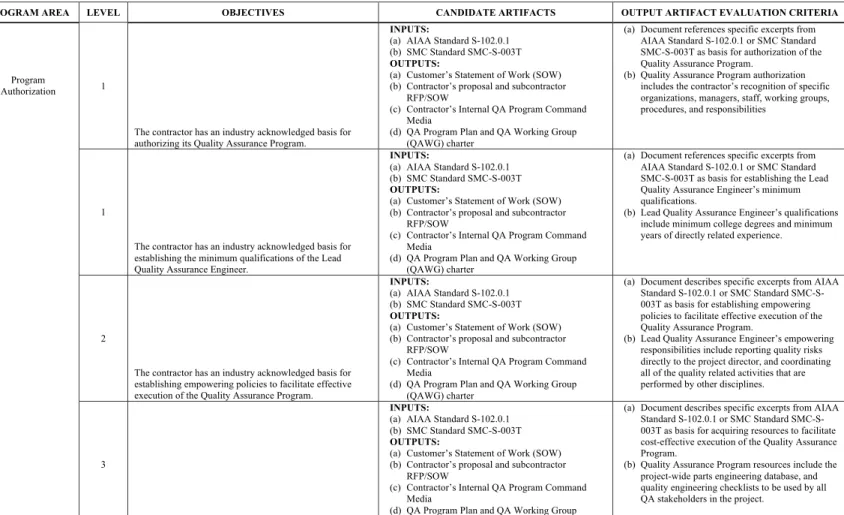
Table 2: Quality Assurance Program Objectives versus Systems Engineering Artifacts Matrix.
PROGRAM AREA LEVEL OBJECTIVES CANDIDATE ARTIFACTS OUTPUT ARTIFACT EVALUATION CRITERIA
1
The contractor has an industry acknowledged basis for authorizing its Quality Assurance Program.
INPUTS:
(a)AIAA Standard S-102.0.1 (b)SMC Standard SMC-S-003T OUTPUTS:
(a)Customer’s Statement of Work (SOW) (b)Contractor’s proposal and subcontractor
RFP/SOW
(c)Contractor’s Internal QA Program Command Media
(d)QA Program Plan and QA Working Group (QAWG) charter
(a)Document references specific excerpts from AIAA Standard S-102.0.1 or SMC Standard SMC-S-003T as basis for authorization of the Quality Assurance Program.
(b)Quality Assurance Program authorization includes the contractor’s recognition of specific organizations, managers, staff, working groups, procedures, and responsibilities
1
The contractor has an industry acknowledged basis for establishing the minimum qualifications of the Lead Quality Assurance Engineer.
INPUTS:
(a)AIAA Standard S-102.0.1 (b)SMC Standard SMC-S-003T OUTPUTS:
(a)Customer’s Statement of Work (SOW) (b)Contractor’s proposal and subcontractor
RFP/SOW
(c)Contractor’s Internal QA Program Command Media
(d)QA Program Plan and QA Working Group (QAWG) charter
(a)Document references specific excerpts from AIAA Standard S-102.0.1 or SMC Standard SMC-S-003T as basis for establishing the Lead Quality Assurance Engineer’s minimum qualifications.
(b)Lead Quality Assurance Engineer’s qualifications include minimum college degrees and minimum years of directly related experience.
2
The contractor has an industry acknowledged basis for establishing empowering policies to facilitate effective execution of the Quality Assurance Program.
INPUTS:
(a)AIAA Standard S-102.0.1 (b)SMC Standard SMC-S-003T OUTPUTS:
(a)Customer’s Statement of Work (SOW) (b)Contractor’s proposal and subcontractor
RFP/SOW
(c)Contractor’s Internal QA Program Command Media
(d)QA Program Plan and QA Working Group (QAWG) charter
(a)Document describes specific excerpts from AIAA Standard S-102.0.1 or SMC Standard SMC-S-003T as basis for establishing empowering policies to facilitate effective execution of the Quality Assurance Program.
(b)Lead Quality Assurance Engineer’s empowering responsibilities include reporting quality risks directly to the project director, and coordinating all of the quality related activities that are performed by other disciplines. Program
Authorization
3
The contractor has an industry acknowledged basis for acquiring resources to facilitate cost-effective execution of
INPUTS:
(a)AIAA Standard S-102.0.1 (b)SMC Standard SMC-S-003T OUTPUTS:
(a)Customer’s Statement of Work (SOW) (b)Contractor’s proposal and subcontractor
RFP/SOW
(c)Contractor’s Internal QA Program Command Media
(d)QA Program Plan and QA Working Group
(a)Document describes specific excerpts from AIAA Standard S-102.0.1 or SMC Standard SMC-S-003T as basis for acquiring resources to facilitate cost-effective execution of the Quality Assurance Program.
(b)Quality Assurance Program resources include the project-wide parts engineering database, and quality engineering checklists to be used by all QA stakeholders in the project.
PROGRAM AREA LEVEL OBJECTIVES CANDIDATE ARTIFACTS OUTPUT ARTIFACT EVALUATION CRITERIA (QAWG) charter
4 The contractor has an industry acknowledged basis for interfacing with outside industry organizations and working groups whose charter/goal is to maximize the effectiveness and minimize the risk of industry acknowledged quality assurance methods.
INPUT:
(a)AIAA Standard S-102.0.1 OUTPUT:
(a)Contractor’s Internal QA Program Command Media
(a)Document describes specific excerpts from AIAA Standard S-102.0.1 as basis for interfacing with outside industry organizations and working groups whose charter/goal is to maximize the effectiveness and minimize the risk of industry recognized quality engineering methods. (b)The types of information to be exchanged with
outside industry organizations include non-proprietary lessons learned, part reliability models, and open source computerized tools.
1
All of the applicable systems engineering requirements (including quality and certification requirements) and self-imposed objectives are identified by the lead of each systems engineering discipline using System Requirements Analysis and Software Requirements Analysis methods.
INPUTS:
(c)AIAA Standard S-102.0.1 (a)SMC Standard SMC-S-003T (b)Customer’s Statement of Work (SOW) (c)Contractor’s proposal and subcontractor
RFP/SOW
(d)Contractor’s Internal QA Program Command Media
OUTPUT:
(e)QA Program Plan and QA Working Group (QAWG) charter
(a)All of the quality requirements and their sources are identified in the Requirements vs. Tasks Matrix in the QAPP.
(b)Each discipline is supposed to have a similar matrix in their respective Plan to identify the tasks that will be performed to achieve their particular systems engineering requirements.
1
All implemented systems engineering processes are required to be actively controlled.
INPUTS:
(a)Customer’s Statement of Work (SOW) (b)Contractor’s proposal and subcontractor
RFP/SOW
(c)Contractor’s Internal QA Program Command Media
(d)Systems Engineering Management Plan (e)Integrated Master Plan
OUTPUT:
(a)Work Breakdown Structure
(a)The contractor’s WBS establishes active control over all implemented systems engineering processes.
Requirements Definition
1
The applicable quality requirements (including quality certification requirements and specified configuration requirements) are incorporated in all program documents
INPUTS:
(a)AIAA Standard S-102.0.1 (b)SMC Standard SMC-S-003T (c)Customer’s Statement of Work (SOW) (d)Contractor’s proposal and subcontractor
RFP/SOW
(e)Contractor’s Internal QA Program Command Media
OUTPUTS:
(a)All of the quality requirements and their sources are identified in the Requirements vs. Tasks Matrix in the QAPP.
(b)QAPP includes a requirement versus responsible discipline matrix that identifies all of the QA requirements that other disciplines in Systems Engineering have. Each discipline is supposed to have a similar matrix in their respective Plan. The Plan is supposed to identify the tasks that will be
PROGRAM AREA LEVEL OBJECTIVES CANDIDATE ARTIFACTS OUTPUT ARTIFACT EVALUATION CRITERIA (a)QA Program Plan and QA Working Group
(QAWG) charter
(b)Individual Systems Engineering Discipline Plans (c)Product specifications
performed to achieve the quality requirements.
1
All of the required deliverables are identified, along with the required reporting format for each one.
INPUTS:
(a)AIAA Standard S-102.0.1 (b)SMC Standard SMC-S-003T (c)Customer’s Statement of Work (SOW) (d)Contractor’s proposal and subcontractor
RFP/SOW OUTPUTS:
(a)QA Program Plan and QA Working Group (QAWG) charter
(b)Individual Systems Engineering Discipline Plans
(a)The customer’s Statement of Work (SOW) and the contractor’s subcontractor RFP/SOW identifies the required deliverables, along with their required reporting formats.
(b)The SOW may call out deliverables identified in AIAA Standard S-102.0.1 or SMC Standard SMC-S-003T.
(c)All of the quality requirements and their sources are identified in the Requirements vs. Tasks Matrix in the QAPP.
(d)QAPP includes a requirement versus responsible discipline matrix that identifies all of the QA requirements that other disciplines in Systems Engineering have. Each discipline is supposed to have a similar matrix in their respective Plan that identifies the tasks they will perform to achieve their quality requirements.
2
All applicable quality requirements are flowed down to internal stakeholder and subcontractors.
INPUTS:
(a)AIAA Standard S-102.0.1 (b)SMC Standard SMC-S-003T (c)Customer’s Statement of Work (SOW) (d)Contractor’s proposal and subcontractor
RFP/SOW
(e)Contractor’s Internal QA Program Command Media
OUTPUTS:
(a)QA Program Plan and QA Working Group (QAWG) charter
(b)Individual Systems Engineering Discipline Plans (c) Subcontractor SOW
(d)Subcontractor QAPP
(a)All of the internal QA stakeholders and subcontractors are identified in the QAPP, along with their flowed down QA requirements. (b)The subcontractor SOW identifies the flowed
down QA requirements.
(c)Each subcontractor’s QAPP identifies the tasks to achieve their flowed down QA requirements.
3
The use of industry acknowledged analytical methods is required of all systems engineering disciplines.
INPUTS:
(a)AIAA Standard S-102.0.1 (b)SMC Standard SMC-S-003T
(c)Contractor’s Internal QA Program Command Media
OUTPUTS:
(a)Individual Systems Engineering Discipline Plans (b)Systems Engineering Discipline Engineering and
Evaluation Reports
(a)Contractor’s Internal QA Program Command Media requires all systems engineering disciplines to use industry acknowledged analytical methods.
(b)The QAPP and Systems Engineering Discipline Plans and Reports should identify their analytical methods and the references to industry acknowledgements.
PROGRAM AREA LEVEL OBJECTIVES CANDIDATE ARTIFACTS OUTPUT ARTIFACT EVALUATION CRITERIA
3 Overlooked, unnecessary, or incorrect quality requirements are identified by using Decision Analysis, Mission Analysis, and Requirements Hazard Analysis, or equivalent methods.
INPUTS:
(a)Decision Analysis Report (b)Mission Analysis Report
(c)Requirements Hazard Analysis Report OUTPUT:
(d)Risk Management Database Report
(a)Contractor’s Risk Management Database Report identifies overlooked, unnecessary, or incorrect quality requirements.
3
Approved waivers are provided for all unmet contract-specified functional performance requirements, and approved exceptions are provided for all unmet contractor-specified configuration requirements.
INPUTS: (a)SEMP (b)IMP
(c)Systems Engineering Discipline Engineering and Evaluation Reports
(d)Requirement Verification Report OUTPUTS:
(a)Risk Management Database Report (b)Approved Waiver Report
(a)The requirement for an approved waiver to be provided for all unmet contract-specified functional performance requirements should be called out in the SEMP and the IMP. (b)Collectively, the Systems Engineering Discipline
Engineering and Evaluation Reports should identify all unmet requirements. (c)Approved Waiver Reports document the
contractors rational for not meeting a significant requirement.
4
Criteria and frequency for self-inspections, and subcontractor proposal evaluations and audits are established.
INPUTS:
(a)AIAA Standard S-102.0.1 (b)SMC Standard SMC-S-003T OUTPUT:
(a)Contractor’s Internal QA Program Command Media
(c)AIAA Standard S-102.0.1and SMC Standard SMC-S-003T provides guidance for self-inspections.
(a)Contractor’s internal QA Program Command Media defines the criteria and frequency for self-inspections, subcontractor proposal evaluations, and subcontractor audits.
4
The identification of analytical assumptions is required of all systems engineering disciplines.
INPUTS:
(a)AIAA Standard S-102.0.1
(b)Contractor’s Internal QA Program Command Media
OUTPUTS:
(a)QA Program Plan and QA Working Group (QAWG) charter
(b)Individual Systems Engineering Discipline Plans
(a)Contractor’s Internal QA Program Command Media requires all systems engineering disciplines to identify their analytical assumptions (b)Systems engineering disciplines should include in their respective plans the requirement to identify their analytical assumptions
4
Quality assurance defines the standardized formats for exchanging systems engineering data, including subcontract quality assurance data deliverables.
INPUT:
(a)AIAA Standard S-102.0.1 OUTPUT:
(a)Contractor’s Internal QA Program Command Media
(a)AIAA Standard S-102.0.1and SMC Standard SMC-S-003T provides guidance for standardized formats used to exchange systems engineering data,.
(b)Contractor’s Internal QA Program Command Media defines the required formats for exchanging systems engineering data, including subcontract quality assurance data deliverables. Planning
(Including Test Plans) 1
All applicable quality requirements and self-imposed objectives that QA must meet are identified in the Quality Assurance Program Plan (QAPP).
INPUTS:
(a)AIAA Standard S-102.0.1 (b)SMC Standard SMC-S-003T (c)Customer’s Statement of Work (SOW) (d)Contractor’s proposal and subcontractor
(a)QAPP includes a requirement versus task matrix that identifies all of the tasks that QA will perform to achieve their quality requirements. (b)Each discipline is supposed to have a matrix in
PROGRAM AREA LEVEL OBJECTIVES CANDIDATE ARTIFACTS OUTPUT ARTIFACT EVALUATION CRITERIA RFP/SOW
(e)Contractor’s Internal QA Program Command Media
OUTPUTS:
(a)QA Program Plan and QA Working Group (QAWG) charter
(b)Individual Systems Engineering Discipline Plans
will perform to achieve their quality requirements.
1
All applicable quality requirements (including quality certifications) and self-imposed objectives that other Systems Engineering disciplines must meet are identified in the respective plan of each responsible discipline and in the QAPP. (These plans would include the Systems Engineering Management Plan, the Integrate Master Plan, and the Risk Management Plan.)
INPUTS:
(a)AIAA Standard S-102.0.1 (b)SMC Standard SMC-S-003T (c)Customer’s Statement of Work (SOW) (d)Contractor’s proposal and subcontractor
RFP/SOW
(e)Contractor’s Internal QA Program Command Media
OUTPUTS:
(a)QA Program Plan and QA Working Group (QAWG) charter
(b)Systems Engineering Management Plan (SEMP) (c)Integrate Master Plan (IMP)
(d)Risk Management Plan (e)Quality Improvement Plan (f) System Safety Program Plan (g)RMAD Program Plan (h)End of Life Plan (EOLP)
(a)QAPP includes a requirement versus task matrix that identifies all of the tasks that QA will perform to achieve their quality requirements. (b)QAPP also includes a requirement versus
responsible discipline matrix that identifies all of the QA requirements that other disciplines in Systems Engineering have.
(c)Each discipline is supposed to have a similar matrix in their respective Plan to identify the tasks that they will be perform to achieve their quality requirements.
2
The selection of the measureable and level-of-effort (LOE) quality assurance tasks are based on: (1) comprehensive coverage of the quality requirements and self-imposed objectives, (2) optimized balance among quality assurance costs, schedules, and risk factors, and (3) the applicable system life cycle phases.
INPUTS:
(a)AIAA Standard S-102.0.1 (b)SMC Standard SMC-S-003T (c)Work Breakdown Structure (WBS) (d)Customer’s Statement of Work (SOW) (e)Contractor’s proposal and subcontractor
RFP/SOW
(f) Contractor’s Internal QA Program Command Media
OUTPUTS:
(a)QA Program Plan and QA Working Group (QAWG) charter
(b)Integrated Master Plane (IMP) (c)Integrated Master Schedule (IMS) (d)QA Program Budget Plan
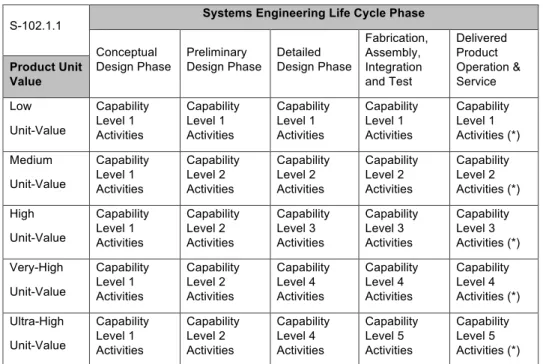
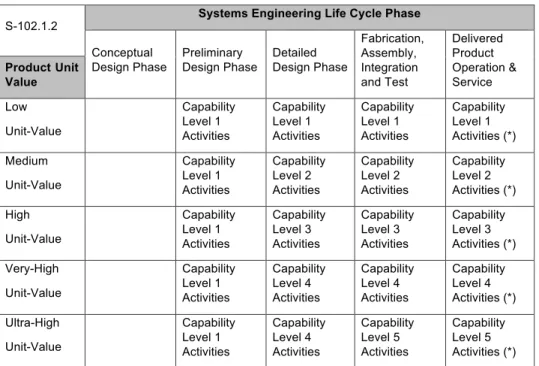
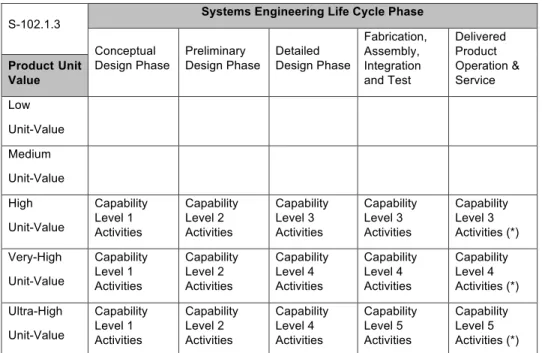
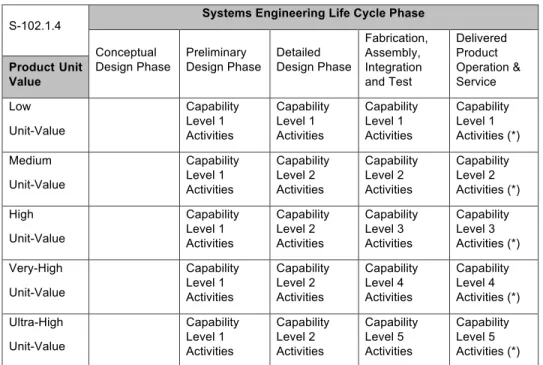
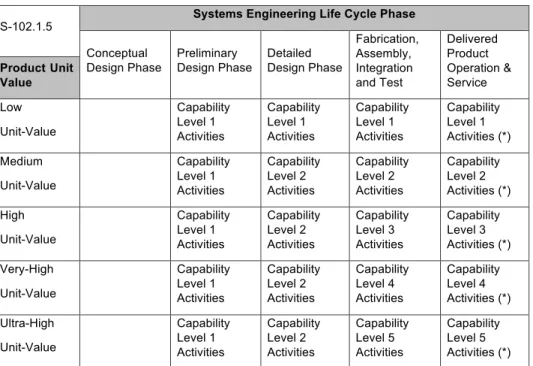
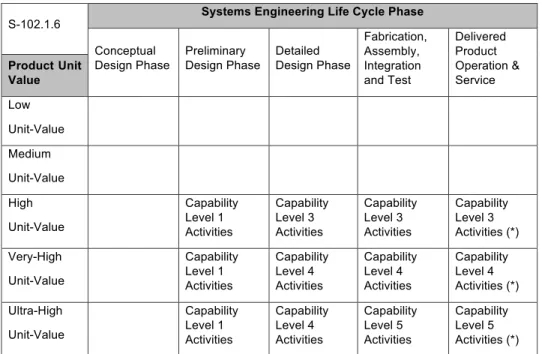
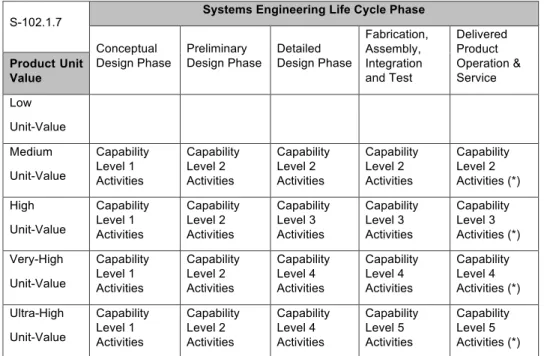
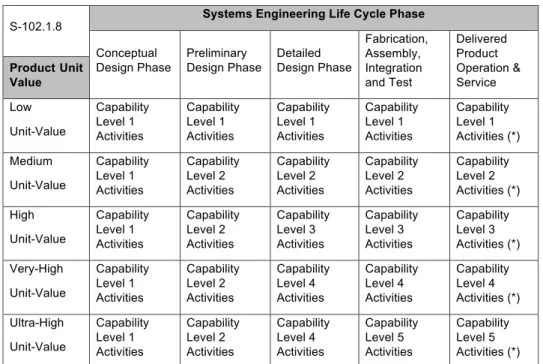
(a) The contractor’s internal QA Program Command Media should include a product unit-value criticality versus QA Program capability level matrix.
(b)The contractor’s internal QA Program Command Media also should include a product life cycle versus QA Program capability level activities matrix.
(c) All QA activities that can be “notionally” scheduled should be included in the Integrated Master Schedule (IMS). The rest of the activities should be allocated a fixed number of hours (i.e., Level of Effort) based on “estimated/anticipated” project support needs.
2
All subcontractor key quality assurance data products/deliverables are identified in the QAPP.
INPUTS:
(a)AIAA Standard S-102.0.1 (b)SMC Standard SMC-S-003T (c)Customer’s Statement of Work (SOW)
(a) The QAPP identifies the subcontractor‘s quality assurance data products/deliverables and their respective required delivery dates. (b)The SEMP and IMP also identify the
PROGRAM AREA LEVEL OBJECTIVES CANDIDATE ARTIFACTS OUTPUT ARTIFACT EVALUATION CRITERIA (d)Contractor’s proposal and subcontractor
RFP/SOW
(e)Contractor’s Internal QA Program Command Media
OUTPUTS:
(a)QA Program Plan and QA Working Group (QAWG) charter
(b)SEMP (c)IMP
(d) Integrated Master Schedule (IMS)
subcontractor‘s quality assurance data products/deliverables
(c) The IMS also identifies the respective required delivery dates.
2
All planned and LOE quality assurance tasks are adequately funded.
INPUTS:
(a)Contractor’s Internal QA Program Command Media
(b)QA Program Plan and QA Working Group (QAWG) charter
(c)Individual Systems Engineering Discipline Plans OUTPUTS:
(a)Integrated Master Schedule (IMS) (b)QA Program Budget Plan
(a)The QAPP identifies all scheduled and LOE quality assurance tasks.
(b)The hours for the scheduled tasks are identified in the IMS.
(c)The rationale for the fixed hours for each LOE task is documented in the QA Program Budget Plan.
(d)The QA Program Budget Plan shows adequate funding for all of the QA tasks.
3
The use of validated analytical methods is planned for all systems engineering disciplines.
INPUTS:
(a)Military and Commercial Standards and Guides (b)Contractor’s Internal QA Program Command
Media OUTPUTS:
(a)QA Program Plan and QA Working Group (QAWG) charter
(c)Individual Systems Engineering Discipline Plans
(c)Contractor’s Internal QA Program Command Media requires all systems engineering disciplines to use validated analytical methods (d)Systems engineering disciplines should include in
their respective plans the intent to use only validated analytical methods
(e)Systems engineering disciplines identify all key assumptions in their analytical reports.
3
Plans are developed for safe disposal of hazardous materials and of the system itself during the post operational mission.
INPUTS:
(a)Customer’s Statement of Work (SOW) (b)Contractor’s proposal and subcontractor
RFP/SOW
(c)Contractor’s Internal QA Program Command Media
OUTPUTS:
(a)QA Program Plan and QA Working Group (QAWG) charter
(b)System Safety Program Plan (SSPP) and System Safety Working Group (SSWG) charter (c)End of Life Plan (EOLP)
(a)The QAPP identifies the system’s post-mission end of life (EOL) requirements that impact quality assurance
(b)The QAPP also identifies system safety as the coordinator of the development of the End of Life Plan (EOLP)
(c)The EOLP should comply with its required format and address all of the EOL requirements
4
A plan is developed and implemented to improve quality of the operational system over time.
INPUTS:
(a)Customer’s Statement of Work (SOW) (b)Contractor’s proposal and subcontractor
RFP/SOW
(c)Contractor’s Internal QA Program Command
(a)The QAPP identifies the system’s quality improvement requirements.
(b)The QAPP also identifies the Project Quality Improvement Plan development and implementation tasks.
PROGRAM AREA LEVEL OBJECTIVES CANDIDATE ARTIFACTS OUTPUT ARTIFACT EVALUATION CRITERIA Media
(d)QA Program Plan and QA Working Group (QAWG) charter
OUTPUTS:
(a)Project Quality Improvement Plan (b)Integrated Master Schedule (IMS) (c)FRACAS Plan
(d)FRB Charter
(c)The Project Quality Improvement Plan should comply with its required format and address all of the quality improvement requirements. (d)The schedule for implementing the Project
Quality Improvement Plan should be identified in the IMS.
(e)The FRACAS and the FRB play crucial in roles in identifying and mitigating inherent quality defects. Those roles should be defined in the FRACAS Plan and FRB Charter.
1
Quality assurance participates in all program meetings/reviews that are run by other disciplines that make decisions which impact product quality. (NOTE: This objective includes Failure Review Board (FRB) and Configuration Control Board (CCB) meetings)
INPUTS:
(a)AIAA Standard S-102.0.1 (b)SMC Standard SMC-S-003T (c)Customer’s Statement of Work (SOW) (d)Contractor’s proposal and subcontractor
RFP/SOW
(e)Contractor’s Internal QA Program Command Media
OUTPUTS:
(a)QA Program Plan and QA Working Group (QAWG) charter
(b)Individual Systems Engineering Discipline Plans
(a)All of the quality requirements and their sources are identified in the Requirements vs. Tasks Matrix in the QAPP.
(b)QAPP includes a requirement versus responsible discipline matrix that identifies all of the QA requirements that other disciplines in Systems Engineering have. Each discipline is supposed to have a similar matrix in their respective Plan. The Plan is supposed to identify the tasks that will be performed to achieve the quality requirements, and the intent to invite QA to all meetings involving product quality.
1
Quality assurance coordinates the documentation and maintenance of the as-built configurations of all major components
INPUTS:
(a)Contractor’s Internal QA Program Command Media
(b)QA Program Plan and QA Working Group (QAWG) charter
(c)System drawings and schematics OUTPUTS:
(a)Configuration Control Board (CCB) Database Report
(a)The QAPP describes the process for coordinating the documentation and maintenance of the as-built configurations of all major components. (b)All of the versions of the system drawings and
schematics are maintained in the Configuration Control Database.
Program Coordination
1
Quality assurance coordinates the systems engineering activities that must be performed to obtain the applicable product quality certifications.
INPUTS:
(a)AIAA Standard S-102.0.1 (b)SMC Standard SMC-S-003T (c)Military and Commercial QA Standards (d)Customer’s Statement of Work (SOW) (e)Contractor’s proposal and subcontractor
RFP/SOW
(f) Contractor’s Internal QA Program Command Media
(g)QA Program Plan and QA Working Group (QAWG) charter
OUTPUTS:
(a)Individual Systems Engineering Discipline Plans
(a)The QAPP identifies each quality certification requirement and all of the disciplines that participate in obtaining each one. (b)The Lead Quality Engineer ensures the quality
certification requirements are included in the Plan of each participating discipline.
(c)The Lead Quality Engineer periodically convenes QA Working Group (QAWG) meetings to ensure that a collaborative effort is implemented to obtain the required quality certifications.
PROGRAM AREA LEVEL OBJECTIVES CANDIDATE ARTIFACTS OUTPUT ARTIFACT EVALUATION CRITERIA (b)QA Working Group (QAWG) Meeting Minutes
2
The Lead Quality Engineer tracks the status of tasks and customer deliverables that are shared with other Systems Engineering disciplines.
INPUTS:
(a)AIAA Standard S-102.0.1 (b)SMC Standard SMC-S-003T (c)Customer’s Statement of Work (SOW) (d)Contractor’s proposal and subcontractor
RFP/SOW
(e)Contractor’s Internal QA Program Command Media
(f) QA Program Plan and QA Working Group (QAWG) charter
(g)Individual Systems Engineering Discipline Plans OUTPUTS:
(a) QA Working Group (QAWG) Meeting Minutes
(a)All of the quality requirements and their sources are identified in the Requirements vs. Tasks Matrix in the QAPP.
(b)QAPP includes a requirement versus responsible discipline matrix that identifies all of the QA requirements that other disciplines in Systems Engineering have. Each discipline is supposed to have a similar matrix in their respective Plan. (c)The Lead Quality Engineer periodically convenes
QA Working Group (QAWG) meetings to ensure that a collaborative effort is implemented to complete tasks and customer deliverables that are shared with other disciplines.
2
Quality assurance inputs to key project documents are properly reviewed, coordinated, and approved.
INPUTS:
(a)Contractor’s Internal QA Program Command Media
(b)QA Program Plan and QA Working Group (QAWG) charter
OUTPUTS:
(a) Product Specifications (b) Calibration Standards (c) Production Procedures (d) Inspection Procedures
(a)All key project documents that require QA inputs are identified in the QAPP
(b)Each project document for which quality assurance provides a significant input is supposed to have an approval page with a signature line for the Lead Quality Engineer on.
2
The Lead Quality Engineer monitors the QA activities of subcontractors during product design, manufacture, assembly, test, inspection, shipping, and operations.
INPUTS:
(a)Contractor’s proposal and subcontractor RFP/SOW
(b)Contractor’s Internal QA Program Command Media
(c)QA Program Plan and QA Working Group (QAWG) charter
OUTPUTS:
(a)QA Working Group (QAWG) Meeting Minutes
(a)All of the subcontractor quality requirements and their sources are identified in the QAPP. (b)The Lead Quality Engineer periodically convenes
QA Working Group (QAWG) meetings to ensure that subcontractors are properly implementing their required QA tasks.
2
Quality assurance coordinates the documentation and maintenance of the functional test history of all major components.
INPUTS:
(a)Contractor’s Internal QA Program Command Media
(b)QA Program Plan and QA Working Group (QAWG) charter
(c)Test Reports
(a)The QAPP describes the process for coordinating the documentation and maintenance of the functional test history of all major components.. (b)The Test Records are entered and maintained in the project-wide Systems Engineering Database.
PROGRAM AREA LEVEL OBJECTIVES CANDIDATE ARTIFACTS OUTPUT ARTIFACT EVALUATION CRITERIA OUTPUTS:
(a)Project-wide Systems Engineering Database
3
Quality assurance coordinates the documentation and maintenance of the complete build history of all major components
INPUTS:
(d)Contractor’s Internal QA Program Command Media
(e)QA Program Plan and QA Working Group (QAWG) charter
(f) Production/Build Records OUTPUTS:
(a) Configuration Control Board (CCB) Database Report
(b)The QAPP describes the process for coordinating the documentation and maintenance of the as-built configurations of all major components. (c)All of the Production/Build Records are entered
and maintained in the Configuration Control Database.
3
All quality assurance stake-holders are identified and provided with Defect Avoidance Checklists that enhance defect avoidance.
INPUTS:
(a) Contractor’s Internal QA Program Command Media
(b) QA Program Plan and QA Working Group (QAWG) charter
OUTPUTS:
(a) Defect Avoidance Checklists
(a) The QAPP identifies all of the Systems Engineering disciplines that have quality assurance responsibilities.
(b) The QAPP identifies the development and distribution of QA checklists as tasks. (c) The Lead QA Engineer coordinates the
documentation, approval, and distribution of defect avoidance checklists.
3
The contractor establishes and maintains a program-wide Systems Engineering Database.
INPUTS: (a) SEMP (b) IMP
(c) Contractor’s Internal QA Program Command Media
(d) QA Program Plan and QA Working Group (QAWG) charter
(e) Individual Systems Engineering Discipline Plans
OUTPUTS:
(a) Systems Engineering Database
(a) The SEMP, IMP, and QAPP define the program-wide quality assurance database structure and data fields.
(b) The Systems Engineering Discipline Plans collectively identify the required data fields in the Systems Engineering Database
3 Quality assurance collects, reviews, and utilizes QA lessons learned, as applicable, and ensures that other disciplines also collect and utilize QA lessons learned to help identify existing and potential quality defects early. NOTE: These lessons learned include design, test, and operating guidelines.
INPUTS:
(a) Contractor’s Internal QA Program Command Media
(b) QA Program Plan and QA Working Group (QAWG) charter
(c) Individual Systems Engineering Discipline Plans
OUTPUTS:
(a) Lessons Learned Review Committee (LLRC) Meeting Minutes
(b) Lessons Learned Database Report
(a) The SEMP, IMP, and QAPP describe the program-wide Lessons Learned Database structure
(b) The Lessons Learned Database Report describes the contents of the Lessons Learned Database (c) Quality assurance is the administrator of the
program-wide Lessons Learned Database
3
Quality assurance evaluates all aspects of the Mission Assurance Program to identify and approve new candidate quality assurance lessons learned, and ensures that other
INPUTS:
(a) Contractor’s Internal QA Program Command Media
(a) The SEMP, IMP, and QAPP describe the program-wide Lessons Learned Database structure
PROGRAM AREA LEVEL OBJECTIVES CANDIDATE ARTIFACTS OUTPUT ARTIFACT EVALUATION CRITERIA disciplines do the same. NOTE: This objective includes
evaluating customer reported failures and in-house subcontractor Failure Reports .
(b) QA Program Plan and QA Working Group (QAWG) charter
(c) Individual Systems Engineering Discipline Plans
(d) Failure Reports (e) FRB Meeting Minutes
OUTPUTS:
(a) Lessons Learned Review Committee (LLRC) Meeting Minutes
(b) Lessons Learned Database Report
(b) The QAPP and individual Systems Engineering Discipline Plans call out lesson learned identification as a key task
(c) Quality assurance and the other systems engineering disciplines submit new lessons learned to the Lessons Learned Review Committee (LLRC) for approval
3
Quality assurance coordinates the documentation and maintenance of the complete rework history of all major components.
INPUTS:
(a)Contractor’s Internal QA Program Command Media
(b)QA Program Plan and QA Working Group (QAWG) charter
(c)Production/Build Records OUTPUTS:
(a) Configuration Control Board (CCB) Database Report
(a)The QAPP describes the process for coordinating the documentation and maintenance of the rework history of all major components.
(b)All of the Rework Records are entered and maintained in the Configuration Control Database.
4
Quality assurance coordinates the documentation and maintenance of the complete storage history of all major components.
INPUTS:
(a)Contractor’s Internal QA Program Command Media
(b)QA Program Plan and QA Working Group (QAWG) charter
OUTPUTS: (a)Shipment Records
(b)Project-wide Systems Engineering Database
(a)The QAPP describes the process for coordinating the documentation and maintenance of the storage history of all major components.
(b)The Shipment Records documents the storage history of all major components.
(c)The Shipment Records are entered and maintained in the project-wide Systems Engineering Database.
4
Quality assurance coordinates the documentation and maintenance of the traceability of lower level parts and materials in all safety-critical and mission-critical components.
INPUTS:
(a)Contractor’s Internal QA Program Command Media
(b)QA Program Plan and QA Working Group (QAWG) charter
(c)FMECA OUTPUTS:
(a)Critical Items List (CIL)
(b)Project-wide Systems Engineering Database
(a)The QAPP describes the process for coordinating the documentation and maintenance of the traceability history of lower level parts and materials in all safety-critical and mission-critical components
(b)The FMECA identifies the critical items (c)The Critical Items List (CIL) documents the
traceability history of lower level parts and materials in all safety-critical and mission-critical components
(d)The CIL is entered and maintained in the project-wide Systems Engineering Database 4
Quality assurance coordinates the documentation and maintenance of the complete test and inspection history of lower level parts and materials in all safety-critical and
INPUTS:
(a)Contractor’s Internal QA Program Command Media
(a)The QAPP describes the process for coordinating the documentation and maintenance of the complete test and inspection history of lower
PROGRAM AREA LEVEL OBJECTIVES CANDIDATE ARTIFACTS OUTPUT ARTIFACT EVALUATION CRITERIA mission-critical components. (b)QA Program Plan and QA Working Group
(QAWG) charter (c)FMECA OUTPUTS:
(a)Critical Items List (CIL)
(b)Project-wide Systems Engineering Database
level parts and materials in all safety-critical and mission-critical components
(b)The FMECA identifies the critical items (c)The Critical Items List (CIL) documents the
complete test and inspection history of lower level parts and materials in all safety-critical and mission-critical components.
(d)The complete test and inspection history of lower level parts and materials are entered and maintained in the project-wide Systems Engineering Database.
4
Quality assurance coordinates the documentation and maintenance of the physical and chemical analysis history of lower level materials in all safety-critical and mission-critical components.
INPUTS:
(a)Contractor’s Internal QA Program Command Media
(b)QA Program Plan and QA Working Group (QAWG) charter
(c)FMECA OUTPUTS:
(a)Critical Items List (CIL)
(b)Project-wide Systems Engineering Database
(a)The QAPP describes the process for coordinating the documentation and maintenance of the physical and chemical analysis history of lower level parts and materials in all safety-critical and mission-critical components.
(b)The FMECA identifies the critical items (c)The Critical Items List (CIL) documents the
physical and chemical analysis history of lower level parts and materials in all safety-critical and mission-critical components.
(d)The physical and chemical analysis history of lower level materials is entered and maintained in the project-wide Systems Engineering Database.
4
Quality assurance ensures stake-holders are trained to properly utilize the Defect Avoidance Checklists and computer-aided tools that they are provided with.
INPUTS:
(a)AIAA Standard S-102.0.1
(b)Contractor’s Internal QA Program Command Media
(c) QA Program Plan and QA Working Group (QAWG) charter
(d) Individual Systems Engineering Discipline Plans OUTPUTS:
(a)QA Training Materials
(a)All of the quality assurance tasks are identified in the QAPP and Systems Engineering Discipline Plans.
(b)The guidance for performing all of the quality assurance tasks is provided in the QA Training Materials.
1 Detailed and comprehensive (a) Statistical Process Control (SPC) Reports, (b) Failure/Discrepancy Reports (FRs/DRs), (c) Fishbone Analysis Reports, (d) Failure Analysis Reports, (e) Part Stress Derating Analysis Report, and the (f) Environmental Stress Screening (ESS) Report are reviewed by quality assurance.
INPUTS:
(a) Statistical Process Control (SPC) Reports (b) Failure/Discrepancy Reports (FRs/DRs) (c) Fishbone Analysis Reports
(d) Failure Analysis Reports
(e) Part Stress Derating Analysis Reports (f) Environmental Stress Screening (ESS) Reports OUTPUT:
(a) Engineering Report Comment Resolution Matrix (CRM)
Quality assurance completes a Comment Resolution Matrix (CRM) for each engineering report that is reviewed.
Engineering & Evaluation
1
The Preferred Parts List (PPL) is developed and
PROGRAM AREA LEVEL OBJECTIVES CANDIDATE ARTIFACTS OUTPUT ARTIFACT EVALUATION CRITERIA maintained. (a) Approved Parts List (APL)
(b) Product Specifications OUTPUT:
(a) Preferred Parts List (PPL)
Specifications.
(b)The PPL is documented, approved, maintained, and updated as needed.
1
The Critical Items List (CIL) is developed and maintained.
INPUTS: (a) FMECA
(b) Hazard Analysis Reports OUTPUT:
(a) Critical Items List (CIL)
(a) The CIL is developed from the FMECA and Hazard Analysis Reports.
(b)The CIL is documented, approved, maintained, and updated as needed.
2 Safety, Reliability, and Quality Assurance (SR&QA) identify, evaluate, and resolve all differences between (1) the build-to and as-built configurations of major components, and (2) the qualification test and acceptance test of major components.
INPUTS:
(a)Engineering Change Proposal (ECP) OUTPUT:
(a)Risk Submittal
(a)Safety, Reliability, and Quality Assurance (SR&QA) review ECP for major components to identify and evaluate possible differences between (1) their build-to and as-built configurations, and (2) their qualification test and acceptance test.
(b)Significant differences that affect the product’s form, fit, or function are documented as risk submittals
2 Product Failure Mode, Effects and Criticality Analysis (FMECA) and Reliability Predictions are performed for all major components, and these analyses correctly represent the product’s design and operation.
INPUTS:
(a)Mission Critical Events Analysis Report (b)Product Specifications
OUTPUTS:
(a)Failure Mode, Effects and Criticality Analysis (FMECA) Report
(b)Reliability Prediction Report
(a)FMECA and Reliability Prediction Report are based on accurate functional diagram models and product descriptions.
(b)FMECA includes identification of both safety-critical and mission-safety-critical functions.
3
Industry acknowledged analytical methods are utilized by all systems engineering disciplines.
INPUTS:
(a)AIAA Standard S-102.0.1
(b)Contractor’s Internal QA Program Command Media
(c)Individual Systems Engineering Discipline Plans OUTPUT:
(a)Systems Engineering Discipline Analytical Reports
(a)Contractor’s QA Program Command Media requires all systems engineering disciplines to use industry acknowledged analytical methods for high unit-value criticality products. (b)The analytical reports of the various systems
engineering disciplines should include references to verify each analytical method is acknowledged by industry.
4
The input data and assumptions that are utilized in all key engineering and analytical methods are evaluated with regard to their maturity.
INPUTS:
(a)AIAA Standard S-102.0.1
(b)Contractor’s Internal QA Program Command Media
(c)Individual Systems Engineering Discipline Plans OUTPUT:
(a) Systems Engineering Discipline Analytical Reports
(a)Contractor’s QA Program Command Media requires all systems engineering disciplines to evaluate the maturity of the input data and assumptions that are utilized in all key engineering and analytical methods for high unit-value criticality products.
(b)The analytical reports of the various systems engineering disciplines should identify the maturity of the input data and assumptions used for each analytical method.
PROGRAM AREA LEVEL OBJECTIVES CANDIDATE ARTIFACTS OUTPUT ARTIFACT EVALUATION CRITERIA engineering disciplines should also identify any uncertainties associated with the input data.
4
Quality assurance ensures that validated computer-aided mission assurance tools are acquired and integrated to the greatest extent practical to form a comprehensive mission assurance toolset.
INPUTS:
(a)AIAA Standard S-102.0.1
(b)Contractor’s Internal QA Program Command Media
(c)Individual Systems Engineering Discipline Plans OUTPUT:
(a)Systems Engineering Discipline Analytical Reports
(a)Contractor’s QA Program Command Media requires that validated computer-aided mission assurance tools are acquired and integrated to the greatest extent practical to form a comprehensive mission assurance toolset for very-high unit-value criticality products.
(b)The analytical reports of the various systems engineering disciplines should identify the validated computer-aided mission assurance tools that were used.
1
The defect risk mitigation/control order of precedence is defined and enforced across the systems engineering process.
INPUTS:
(d)AIAA Standard S-102.0.1 (a)MIL-STD-882D (b)AFI 91-202 AFSPC SUP1 (c)AFI 91-217
(d)Contractor’s Internal QA Program Command Media
OUTPUTS:
(a)QA Program Plan and QA Working Group (QAWG) charter
(b)Risk Management Plan (RMP) (c)Failure Review Board (FRB) Charter (d)Configuration Control Board (CCB) Charter
(a)Contractor’s internal QA Program Command Media requires using the risk and problem mitigation order of precedence that is consistent with AIAA Standard S-102.0.1, MIL-STD-882D, AFI 91-202 AFSPC SUP1, and AFI 91-217. (b)The contractor’s QAPP, Risk Management Plan
(RMP), FRB charter, and CCB charter should all define a risk and problem mitigation order of precedence that is consistent with AIAA Standard S-102.0.1 and MIL-STD-882D.
1
All concerns that are identified by FMECA, Worst Case Analysis, Parts Stress Derating Analysis, Circuit Thermal Stress Analysis, and Circuit Structural Stress Analysis are tracked and resolved appropriately.
INPUTS:
(a)QA Program Plan and QA Working Group (QAWG) charter
(b)Risk Management Plan (RMP) (c)Failure Review Board (FRB) Charter (d)Configuration Control Board (CCB) Charter (e)FMECA Report
(f) Worst Case Analysis Report (g)Parts Stress Derating Analysis Report (h)Circuit Thermal Stress Analysis Report (i) Circuit Structural Stress Analysis Report OUTPUTS:
(a)Risk Management Database Report (b)Hazard Database Report
(a)The contractor’s QAPP, QAWG Charter, Risk Management Plan, and other Plans, should describe the process for tracking and resolving concerns that are identified in analytical reports. (b)The contractor’s Risk Management Database
Report and the Hazard Database Report identify the concerns that are being tracked. Risk Assessment &
Tracking
1
All high and serious defect risks are identified, documented, and appropriately adjudicated.
INPUTS:
(a)Contractor’s Internal QA Program Command Media
(b)Individual Systems Engineering Discipline Plans
(a)The contractor’s internal QA Program Command Media includes a requirement to identify all high and serious defect risks.
PROGRAM AREA LEVEL OBJECTIVES CANDIDATE ARTIFACTS OUTPUT ARTIFACT EVALUATION CRITERIA (c)QA Program Plan and QA Working Group
(QAWG) charter
(d)Risk Management Plan (RMP) (e)Failure Review Board (FRB) Charter (f) Configuration Control Board (CCB) Charter OUTPUTS:
(a)Risk Management Database Report (b)Hazard Database Report
Plan (RMP) also should include a requirement to identify all high and serious defect risks. (c)The identified high and serious risks are identified
in the Risk Management Database Report and the Hazard Database Report.
1
The implementation of defect risk mitigations/controls that are chosen are all tracked to closure.
INPUTS:
(a)QA Program Plan and QA Working Group (QAWG) charter
(b)Risk Management Plan (RMP) (c)Failure Review Board (FRB) Charter (d)Configuration Control Board (CCB) Charter OUTPUTS:
(a)Risk Management Database Report (b)Hazard Database Report
(a)The contractor’s QAPP defines the risk and problem mitigation order of precedence that is consistent with AIAA Standard S-102.0.and MIL-STD-882D.
(b)The contractor’s Risk Management Plan (RMP), FRB charter, and CCB charter also should define the risk and problem mitigation order of precedence that is consistent with AIAA Standard S-102.0.and MIL-STD-882D.
(c)The contractor’s Risk Management Database Report and the Hazard Database Report identify the defect risk mitigations/controls that are being tracked.
2
The defect risk metrics that are selected fully comply with the system safety risk metrics and the reliability risk metrics, in that order of precedence.
INPUTS:
(a)AIAA Standard S-102.0.1 (b)SMC Standard SMC-S-003T (c)Customer’s Statement of Work (SOW) (d)Contractor’s proposal and subcontractor
RFP/SOW
(e) Contractor’s Internal QA Program Command Media
OUTPUTS:
(a)QA Program Plan and QA Working Group (QAWG) charter
(b)System safety Program Plan (SSPP) (c)RMAD Program Plan
(d)Risk Management Plan (RMP)
(a)The SOW, contractor’s QA Program Command Media, QAPP, SSPP, RMAD Program Plan, and Risk Management Plan all should define the defect risk metrics.
(b)The system safety risk metrics should take precedence over the reliability risk metrics if they are different.
3 The Lead Quality Engineer convenes quality assurance working group (QAWG) meetings with peers on a regular basis to identify and mitigate or control quality assurance risks/problems.
INPUT:
(a) QA Program Plan and QA Working Group (QAWG) charter
OUTPUT:
(a) QA Working Group Meeting Minutes
(a)The QAWG Charter should call for the Lead Quality Engineer to convene QAWG meetings with peers on a regular basis to mitigate or control quality assurance risks and correct problems. (b)The QAWG meeting minutes should verify the
authority to convene QAWG meetings was exercised.
3
The contractor reports high and serious risks to the appropriate approval authority.
INPUTS:
(a)AIAA Standard S-102.0.1
(a)The SOW and contractor’s internal QA Program Command Media include requirements to report
PROGRAM AREA LEVEL OBJECTIVES CANDIDATE ARTIFACTS OUTPUT ARTIFACT EVALUATION CRITERIA (b)SMC Standard SMC-S-003T
(c)Customer’s Statement of Work (SOW) (d)Contractor’s proposal and subcontractor
RFP/SOW
(e)Contractor’s Internal QA Program Command Media
OUTPUTS:
(a)QA Program Plan and QA Working Group (QAWG) charter
(b)Risk Management Plan (RMP) (c)Risk Management Database Report (d)Hazard Database Report
high and serious defect risks to the appropriate approval authority.
(b)The contractor’s QAPP and Risk Management Plan (RMP) also should include a requirement to report high and serious defect risks to the appropriate approval authority.
(c)The Risk Management Database Report and Hazard Database Report identify the approval authority for each risk submittal.
3
Quality assurance ensures that each requests for a requirement waiver involves a system deficiency that has an acceptable level of risk.
INPUTS:
(a)AIAA Standard S-102.0.1 (b)SMC Standard SMC-S-003T (c)Customer’s Statement of Work (SOW) (d)Contractor’s Internal QA Program Command
Media
(e)System Safety Program Plan (SSPP) (f) RMAD Program Plan
(g)QA Program Plan and QA Working Group (QAWG) charter
(h)Risk Management Plan (i) Waiver Request OUTPUTS: (a)Risk Submittal
(a)The contractor’s internal QA Program Command Media includes a requirement to ensure that each requests for a requirement waiver involves a system deficiency that has an acceptable level of risk.
(b)The acceptable risk criteria are identified in the SSPP, RMAD Program Plan, QAPP, and Risk Management Plan.
(c)Quality assurance evaluates the Waiver Request and generates a Risk Submittal.
(d)The Risk Submittal identifies the residual risk associated with the Waiver Request for a system deficiency.
4
Quality assurance periodically inspects/audits various systems engineering disciplines to identify and mitigate latent process risks early.
INPUTS:
(j) AIAA Standard S-102.0.1 (k)SMC Standard SMC-S-003T (l) Customer’s Statement of Work (SOW) (m)Contractor’s Internal QA Program Command
Media
(n)QA Program Plan and QA Working Group (QAWG) charter
OUTPUTS:
(a)QA Program Inspection/Audit Report
(e)The contractor’s internal QA Program Command Media includes a requirement to periodically audit various systems engineering disciplines. (f) The QA inspection/audit criteria are identified in
<