Theme:
Open Learning for Development: Towards Empowerment and Transformation
Title:
Designing TVET Courses for the first time at the University of the South Pacific
Proposer:
Dr Theresa Koroivulaono (Instructional designer)
Shashi Kerishma Seth (Education Technologist)
Section:
Centre for Flexible Learning
Organisation:
The University of the South Pacific
Country:
Fiji
Type of Contribution:
Present a formal paper
Aspects of the themes:
Skills Development
Abstract:
“Throughout the world, governments are renewing efforts to promote technical and vocational education and training (TVET) with the belief that skill formation enhances productivity and sustains competitiveness in the global economy”. (Dasmant, A, 2011)
The design, development and integration of TVET courses by the University of the South Pacific (USP) poses several core challenges in terms of designing the course package to be published as an Open Education Resource (OER), up-skilling the Instructional designers to design
competency-based distance TVET courses and effectively incorporating it in a higher education institution. While USP’s Strategic Plan 2013-2018 emphatically supports TVET, the process of operationalising the objectives has exposed several problem areas.
Four modes of delivery are available at USP: Face-to-face, Print, Blended and Online learning.
http://www.usp.ac.fj/index.php?id=7700&type=98. The University of the South Pacific operates and owns its own satellite network, USPNet, which provides Internet, phone and data links, video and audio conferencing, and video broadcasting to students and staff in our 12 member countries. To meet the demands of the students in the region, the TVET programme that is currently being designed consists of print, online (through Moodle) and multimedia components such as DVDs. The conferencing component will be made available through our video-conferencing platform: REACT (Remote Education and Conferencing Tool).
http://www.darwinnt.biz/Documentation.aspx
This paper focuses specifically on the challenges of designing and delivering competency-based, distance, TVET materials to USP’s regional students spread over an area of 33,000,000 km2 of ocean. Prominent among these challenges are the infancy of TVET design knowledge at a higher education institution like USP, over 200 active, indigenous language communities learning in one language (English), limited ICT infrastructure and hugely diverse social and economic backgrounds.
This paper provides a snapshot of my experiences and challenges as an Instructional designer in developing a TVET course to be published as an OER. Some of the important dimensions of OER that will be addressed in the paper are:
∑ Design Issues of a distance technical and vocational course development ∑ Online Assessment process of a technical and vocational course
∑ Technological innovation in Open, Distance and Flexible Learning (ODFL) in skills development
∑ Technical and vocational skills development through Open, Distance and Flexible Learning (ODFL).
http://www.col.org/progServ/panComm/Pages/pcf.aspxfor OER
Keywords
Competency based TVET courses, OER, Learning management system (LMS), Moodle.
Reference
Dasmani, A. (2011), Challenges facing technical institute graduates in practical skills acquisition in the Upper East Region of Ghana. Asia-Pacific Journal of Cooperative Education, 12(2), 67-77. http://www.apjce.org/files/APJCE_12_2_67_77.pdf
Pan-Commonwealth Forum on Open Learning
INTRODUCTION
The process of converting a traditional classroom TVET course into a course taught through other mediums such as print, multimedia or the internet involves many issues and challenges. I was involved in converting a community development, face-to-face TVET course into flexible delivery. According to Schmidt and Gallegos (2001, p2), factors necessary during conversion of courses are:
∑ Principle student group or audience ∑ learning outcomes for students
∑ Reasons for student enrolling in the course ∑ Type of distance delivery method
∑ Effectiveness in providing equal or better learning outcomes than that of a traditional delivery method
From a pedagogical perspective, flexible delivery of formal TVET programs aims to give
learners a greater choice over when, where and how they learn, and include strategies such as distance education, online learning, mixed mode delivery, self-paced learning and self directed learning (Stehilk, T, 2001, p.1). This paper focuses on the challenges in the design and delivery of competency based, distance TVET materials to the regional students of the University of the South Pacific (USP). In particular, focus will be centred on the lack of TVET design knowledge, language differences, communication difficulties, variant levels of ICT infrastructure and different backgrounds socially, economically, and also in terms of knowledge and skills.
The Centre for Flexible Learning at the University of the South Pacific
The University of the South Pacific (USP) came into operation in 1969 serving 12
member countries across the North and South Pacific. They are the Cook Islands, Fiji, Kiribati, the Marshall Islands, Nauru, Niue, Samoa, the Solomon Islands, Tokelau, Tonga, Tuvalu, and Vanuatu. Distance education at USP began in 1971 offering teacher training diploma courses from the School of Education. After two years the distance education programme became an independent unit of USP known as the University Extension Services which is now called the Centre for Flexible Learning (CFL).
Distance education courses at USP in the 1970s were offered through print materials and supported by audio teleconferencing. At the time this was a pioneering educational application of technology (Evans, 2002, p.454). Current FL courses use a range of media including print materials, online learning management systems (MOODLE), audio conferencing and video conferencing via Remote Education and Conferencing Tool (REACT), audio/video tapes, CDROMs and DVDs.
Community Development TVET Course
Community Development is currently being offered by the Community Education and Training Centre (CETC) of the Secretariat of the Pacific Community (SPC). The focus of the course is to gain an understanding of communities, gain the skills of solving issues and carry out community development projects. The course will be offered in a distance mode for the first time which means that the students will be able to study in their own home country. The course will be offered for the first time at USP by the Regional Centre for Continuing and Community Education (RCCCE).
RCCCE provides vocational & professional programs and short courses at USP. The vocational programs are suitable for post-secondary and mature students to build their careers in a
discipline. Professional programs and short courses target people in the workforce for up skilling, re-skilling and multi-skilling for continuous professional development. The professional programs and short courses can be conducted in house for organisations with more than 15 participants (The University of the South Pacific Handbook & Calendar, 2013)
http://www.usp.ac.fj/index.php?id=3034.
The distance version of the course is comprised of the print materials which consist of an Introduction booklet, Study Guide, a DVD and online support (MOODLE).
Design and Delivery of Community Development TVET Course:
My Experience
Curriculum development is described as the process of defining, organizing, combining and co-coordinating content so that it leads learners to the acquisition of knowledge, skills and
attitudes. Designing curriculum requires a team approach comprised of content specialists, instructional designers and other support such as multi-media specialists. Collaboration amongst skilled personal in the instructional design process is essential to the success of course development projects. (SIMS & Jones, 2002)
The Instructional design process began with establishing learner profiles. In this case the learners were social workers, community workers, school leavers, and adult learners who were from different backgrounds socially, economically, technologically and also in terms of
knowledge and skills. Based on the information collected in the analysis phase, it was necessary to identify the types of instructional materials to be developed.
The Introduction and Assignmentbooklet developed for the courses included the information about the course coordinator, overall learning outcomes of the course, summary of the course content, list of course materials, semester schedule, description of the forms of assessment used, details of tests and assignments and the semester calendar.
A second component, theStudy guidecontained the content to be studied, self-assessment exercises, case studies and readings. Case studies and readings addressed issues such as
differences in selected communities, for example, conflicts within communities and so on.
The DVD contained the Community Outreach field trips of the Face-to-Face students, what they did while on the field trip and how they carried out the different assessment tasks.
Mishra (2001) observed that video is useful to show practical and real life activities for repeated use. Tooth (2000) also observed that video resources are expensive to produce but are very useful where practical demonstrations of skills are required. The multimedia team from CFL went out to the different villages to record the videos of the community outreach field trips. The decision to use a video in the form of a DVD adds variety and clarity to the instructional process, motivates the learner and guides them on what is required for assessment. It is assumed that the learners will access the DVDs using computers or VCD players at home or at the regional campuses.
Moodle is USP’s learning management system and is a very useful learning space for the students in terms of added support to the course. The next phase of development was the development of learning outcomes for each learning task and assessment.
Employers have increasingly stressed the need for essential skills, also known as employability skills, in the TVET curriculum (Dunbar, K, 1987). They are important elements in helping people adapt to workplace changes and provide them with a foundation to learn other skills. They are not technical skills, but rather the skills people use to carry out a wide variety of everyday life and occupational tasks. For example, a community worker will require communication and writing skills. In aligning with USP’s graduate attributes this particular learning outcome mapped directly to Priority area 1 of USP’s Strategic Plan which states that “the University will deliver relevant and high – quality flexible programmes that contribute towards inculcating and developing the skills, knowledge, competencies and attributes articulated for all its graduates, as future drivers of building knowledge societies and economies.” Moreover, the graduate attribute embedded in this instance required “demonstrated oral and written proficiency in the English language.” (The University of the South Pacific Strategic Plan, 2013-2018)
Learning Activities and Assessment Plan
Competence is a crucial component of work in a TVET course. Expressing performance through competencies equates with learning outcomes in a degree program. With its practice firmly set in worker performance, TVET programme development is a natural fit for an outcome-based approach to curriculum development. Due to the the course being competency based, learning outcomes had to be very carefully constructed. With the help of the content specialist,
performance-based, learning outcomes were created.
For the course to be more effective, it was designed and developed in a way that encouraged students and teachers to engage in discussions on important issues that led to both the
acquisition of deep intellectual knowledge and practical skills to apply that knowledge to solving problems in the real world (Child, 2004).
The problem-based learning (PBL) approach was used to design the learning activities and assessment to enhance students’ problem solving skills. Problem solving requires students to apply critical and creative thinking in decision-making and at the same time to implement skills needed in real life situations such as leadership, communication skills, and teamwork.
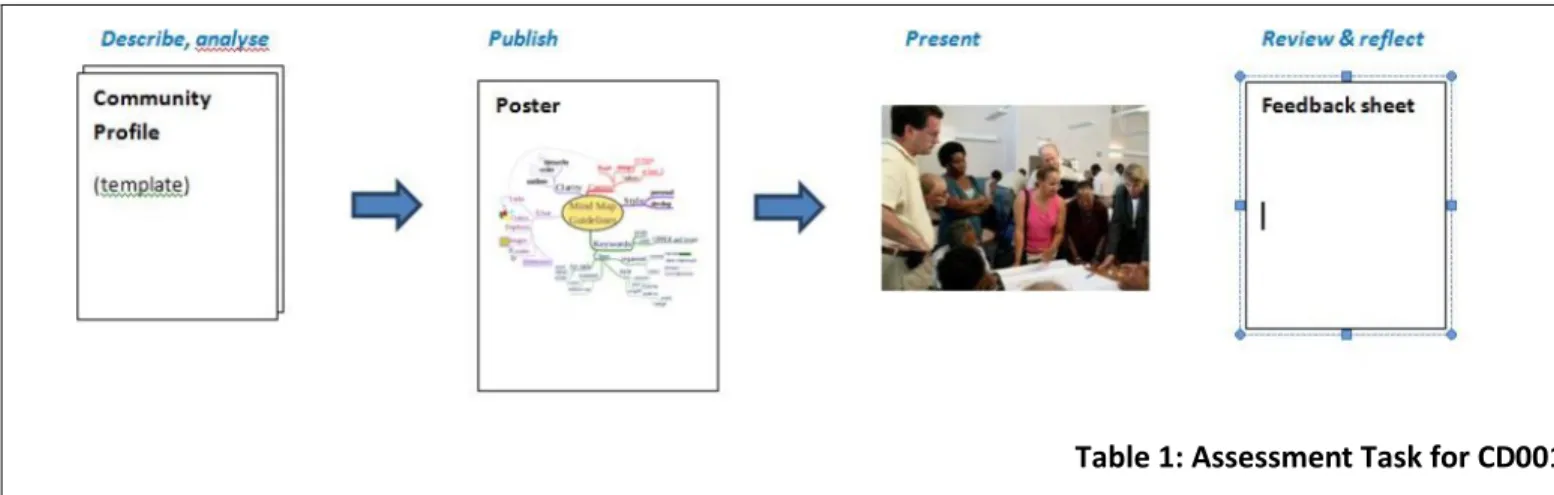
To prepare the learners for the real world a structure of the assessment tasks was prepared that involved fieldwork aligned to the course learning outcomes. (See the diagram below).
Table 1: Assessment Task for CD001
As illustrated, students are required to write a community profile for the first assessment task followed by the creation of a poster of the community and to deliver a presentation. These assessment tasks were designed to encourage learners to become familiar with the community development skills hence the requirement to conduct interviews and explore the community. In doing so the learners will acquire skills such as work ethics, communications, teamwork, decision makes and leadership enhancing employability among graduates.
Now the question is how will the students submit the assignments? As mentioned earlier the course will have an online learning environment (MOODLE) which will be used by students to upload their assignments. Various options will be given to students. They can either upload the assessment on Moodle or hand deliver to the local tutors; for example, a word document for the Community profile, a photographed image for the poster, a video or audio recording for the community presentation and so on. Students will also be encouraged to use the chat rooms, blog and forums in Moodle to discuss issues and concerns related to the course. An alternative assessment method that will be used is the eportfolio where the students will be required to display the skills that they have acquired. Bailey (1998) defined portfolios as “a purposeful collection of student work that exhibits the student’s efforts, progress, and achievements in one or more areas” (p.14).
With USP already integrating m-learning with the learning management system, the course will also use mobile phones as a means of communication between lecturers and students. The strength of using mobile technologies is that they offer learning that is intimate, spontaneous, pervasive and versatile.
Mobile learning “provides an enhanced cognitive environment in which distance learners can interact with their instructors, their course materials, their physical and the virtual environment” (Koole, 2009, p.38). Mobile learning provides students with opportunities to engage in authentic activities. In this context, students are able to explore, share and interact with each other as they try to learn together in their real life learning environments. Assignment reminders and important course announcements will be messaged to students on their mobiles.
“The use of online social networks in educational endeavors has been supported by numerous educational technology researchers, who have highlighted the benefits of participatory
technologies in formal learning contexts in K-12 (Barbour & Plough, 2009; Greenhow et al., 2009) and higher education settings (DeSchryver et al., 2009; Veletsianos, 2011; Webb, 2009). Social networking technologies have been viewed as tools that enable the use of participatory pedagogies able to address the problems that have traditionally plagued distance education: creating a sense of presence, community-building, and learner participation in interactive discussions (Brady et al., 2010; Lee & McLoughlin, 2010; Naveh et al., 2010).”
http://www.irrodl.org/index.php/irrodl/article/view/1078/2077.
Social sites such as Facebook and Twitter will be an alternative option that will be used in the course for students to interact and post queries. The plan is that the students will be asked to create a profile on Facebook, share photographs of themselves, post information on their studies and interests, and view one another’s profiles. This activity is aimed at introducing students to one another and to the instructor, to explore common interests, and to establish social presence.
Challenges
“The processes of developing TVET curriculum have not radically changed, even with technological advances. Individual or group processes are two ways of looking at developing curriculum. A single subject matter expert (SME) can take his or her experiences and put them on paper in an organised display of content. The SME will rely on past experience and
knowledge to achieve this result. A small group of subject matter experts could also perform the same task. Working together they may be able to identify areas that might be missed by an expert working alone (Dunbar, k, 1987, p.34).” With very little knowledge of TVET learning design, my initial confusion and uncertainty at the start of the design process was overcome with the support given to me by the COL consultant. One of the most important factors in designing TVET curriculum is the support received from collaborating with recognized experts. Although there are many opportunities associated with ICT-enhanced education, there are also many challenges associated with it. One of the most important realities when using technology at USP is the issue of student access. Access to the internet is highly limited in remote areas, and relatively poor infrastructure in developing nations such as a regular supply of electricity accentuates the problem (Gulati, 2008). Yet distance education, particularly via asynchronous online delivery, can help increase access to learning opportunities by loosening rigid constraints
of time and place, allowing flexible delivery methods, and using adaptive technologies to meet the needs of learners in remote locations, those with disabilities and literacy needs, and women with family responsibilities (Kearns, 2000).
In an online learning environment, there are students who feel isolated and it is a barrier which is caused by lack of interaction or online collaboration with fellow students and teachers. Online collaboration and interaction requires students to have skills to be able to use computers and the Internet and the Learning Management System (Moodle). Whelen (2008) in his study
indicated that the USP’s regional students are mostly adults and unemployed mothers who have no ICT knowledge. Thus, is it clearly indicated that while USP is moving towards ICT in
education, Pacific people still need to develop their ICT skills.
While distance learners in higher education learn mostly from self-instructional packages, TVET learners require field experience for acquiring practical skills and experience. Therefore, they will need the support of tutors. A considerable portion of USP flexible learning students still face difficulties accessing course materials and securing a regular means of transport to attend audio/video conference tutorials at our regional campuses. Evans (2006) stated that a local tutor for student support is necessary. Keeping this in mind, the community development course team has decided to have local tutors based in the region. These local tutors are alumni who are now working for NGOs and religious organisations.
Audio and video conferencing tutorials (through REACT) will be scheduled for the regional students. The main USP Campus is in Suva, Fiji where the connectivity and speed are
comparable to Australia and New Zealand. There are times when connectivity will be poor in the regions because of delayed reception, faults in satellite equipment, and power failure. To ensure that the students are not disadvantaged a back up of every session will be forwarded to the regional campuses so that students miss tutorials will have the recorded sessions.
Research says that very early in the development of a TVET course, it is essential for institutions to establish partnerships with business, commercial bodies, NGOs, governments and social work departments to ensure work placements or field works for students. Such relationships help students to do voluntary work which would add to experimental learning and these opportunities for collaborative partnerships between USP and NGOs will need to be established and sustained.
The Community Development programme which is still under development has no assigned teaching staff. My concern is that the teaching staff employed should have teaching
background, know how to deal with distance students in an online environment which will include online facilitation, replying to students emails, attending to student queries in the discussion forums. Appropriately trained teaching staff in TVET programmes and distance and online learning will provide the best support and facilitation for our TVET students.
Finally, there were unexpected programme approval issues which arose in the course of the development process. These have threatened to derail the process but consultation with senior managers has provided some potential resolutions.
Conclusion
This paper has documented and analysed the development of a Community Development programme. Learning design has focussed on learning activities, assessment and some online support to introduce students to the effectiveness of utilising community development skills and processes.
TVET plays a major role in providing training opportunities and career advancement avenues for increasing numbers of school-leavers. In the USP region, the critical role that TVET plays in providing skilled manpower that is needed at all levels of the economy, cannot be emphasised enough. Therefore, it is imperative that higher education institutions in the USP region improve the availability, access and quality of lifelong learning through TVET. Well designed TVET programmes can allow these same institutions to reach new potential students, particularly mature students, students in employment and remote students.
Moreover, the online environment is also a powerful tool in terms of programme delivery since ICT is expanding day by day which will increase the performance of the students in terms of interaction, problem solving and also prepares the students for careers in the twenty-first century.
Finally, since this is the first offering of a Community Development TVET programme by USP, thorough training needs analysis and a comprehensive design and development plan were critical to its successful implementation. The programme will be revised after its first offering, to complete the evaluation and improvement cycle required to enhance the relevant quality standards.
References
Bailey, K. M. (1998). Learning about language assessment: dilemmas, decisionjs, and directions.
Child, D. (2004). Psychology and the Teacher, 7th edition, Suffolk UK: Continuum. Dunbar, K.(1987). The Curriculum Retrieved from
http://www.col.org/SiteCollectionDocuments/Skills_Chapter04.pdf
Evans, J. (2002). Learning from our experiences? Audio and audiographic tutorials at the University of the South Pacific’ in Rust, C. (ed.) Improving Student Learning 9: Improving Student Learning Using Learning Technology , OCSLD, Oxford Brookes University, Oxford, 453-462.
Evans, J. (2006). Hard digital realities: Teaching with technology in the Pacific Islands, Proceedings of the fourth Pan Commonwealth Forum on Open Learning,
Commonwealth of Learning, Jamaica. Retrieved from
http://pcf4.dec.uwi.edu/viewpaper.php?=193
George Veletsianos, G., & Navarrete, C. (2012). Online Social Networks as Formal Learning Environments: Learner Experiences and Activities, University of Texas at Austin, USA. Gulati, S. (2008). Technology-enhanced learning in developing nations: A review, International Review of Research in Open and Distance Learning, 9(1), Retrieved from,
http://www.distanceandaccesstoeducation.org/contents/IRRODL-Gulati.pdf
Kearns, P. ‘Flexible Delivery of Training: Review of Research’, Leabrook, Australia: National Centre for Vocational Education Research, 2000. (ED 434 257)
Koole, M.L. (2009). A model for framing mobile learning, In: M. Ally (ed) Mobile Learning: Transforming the Delivery of Education and Training, Athabasca University: AU Press: 25-47.
Mishra, S. (2001). Designing online learning.Vancouver, Canada: Commonwealth of Learning. Retrieved from http://www.col.org/SiteCollectionDocuments/KS2001-02_online.pdf
Modes of DFL - Centre for Flexible Learning (CFL) Retrieved from
http://www.usp.ac.fj/index.php?id=7700&type=98
Remote Education And Conferencing Tool. Retrieved from
http://www.darwinnt.biz/Documentation.aspx
Regional Centre for Continuing and Community Education Retrieved from
http://www.usp.ac.fj/index.php?id=3034
Schmidt, E, K., & Ana Gallegos, A. (2001). Distance Learning: Issues and Concerns of Distance Learners(Vol.17). National Association of Industrial Technology
Sims, R., & Jones, D. (2002). Continuous improvement through shared understanding:
Reconceptualising instructional design for online learning. In A. Williamson, C. Gunn, A. Young, & T. Clear (Eds.), Winds of change in the sea of learning. Proceedings of the 19th Annual Conference of the Australian Society for Computers in Learning in Tertiary Education. Auckland, NZ: UNITEC Institute of Technology.
Stehlik, T. (2001, p.1) Professional development in online learning and flexible delivery in the VET sector - issues for assessment and evaluation. University of South Australia, Australia The University of the South Pacific 2013 Handbook & Calendar, Retrieved from
http://www.usp.ac.fj/index.php?id=3034
The University of the South Pacific Strategic Plan 2013 – 2018 Retrieved from
http://www.usp.ac.fj/index.php?id=12556
Tooth, T. (2000). The use of multi media in distance education. Vancouver, Canada: Commonwealth of Learning. Retrieved from
http://www.col.org/SiteCollectionDocuments/KS2000%20multimedia.pdf
Whelan, R. (2008). Use of ICT in education and training in the South Pacific. Distance Education, 29 (1), 53-70.