IntroductionIntroductionIntroductionIntroductionIntroduction
Inventory – MeaningInventory – MeaningInventory – MeaningInventory – MeaningInventory – Meaning
Objectives of InventoryObjectives of InventoryObjectives of InventoryObjectives of InventoryObjectives of Inventory
Receipt and Issue of Materials – DocumentationReceipt and Issue of Materials – DocumentationReceipt and Issue of Materials – DocumentationReceipt and Issue of Materials – DocumentationReceipt and Issue of Materials – Documentation
Records in StoresRecords in StoresRecords in StoresRecords in StoresRecords in Stores
Conditions – Good Method for VConditions – Good Method for VConditions – Good Method for VConditions – Good Method for VConditions – Good Method for Valuing Issuesaluing Issuesaluing Issuesaluing Issuesaluing Issues
Methods of pricing Material IssuesMethods of pricing Material IssuesMethods of pricing Material IssuesMethods of pricing Material IssuesMethods of pricing Material Issues z
zz
zz First in First outFirst in First outFirst in First outFirst in First outFirst in First out z
zz
zz Last in First outLast in First outLast in First outLast in First outLast in First out z
zz
zz Average CostAverage CostAverage CostAverage CostAverage Cost z
zz
zz Specific PriceSpecific PriceSpecific PriceSpecific PriceSpecific Price z
zz
zz Base StockBase StockBase StockBase StockBase Stock z
zz
zz Inflated PriceInflated PriceInflated PriceInflated PriceInflated Price
Inventory SystemsInventory SystemsInventory SystemsInventory SystemsInventory Systems z
zz
zz PPPPPerpetual Inventory Systemerpetual Inventory Systemerpetual Inventory Systemerpetual Inventory Systemerpetual Inventory System z
zz
zz PPPPPeriodic Inventory Systemeriodic Inventory Systemeriodic Inventory Systemeriodic Inventory Systemeriodic Inventory System
VVVVValuation of Inventory for Balance Sheetaluation of Inventory for Balance Sheetaluation of Inventory for Balance Sheetaluation of Inventory for Balance Sheetaluation of Inventory for Balance Sheet
TTTTTrue or Frue or Frue or Frue or Falserue or Falsealsealsealse
Pick up the Most AppropriatePick up the Most AppropriatePick up the Most AppropriatePick up the Most AppropriatePick up the Most Appropriate
Descriptive QuestionsDescriptive QuestionsDescriptive QuestionsDescriptive QuestionsDescriptive Questions
Interview QuestionsInterview QuestionsInterview QuestionsInterview QuestionsInterview Questions
Inventory Valuation
Inventory Valuation
CHAPTER
6
6
6.1 INTRODUCTION
Inventory occupies a greater part in the composition of total current assets. Inventory is needed for production as well as sale. Inventory control is the core of materials management. Inventory valuation, greatly, influences the profitability of the firm.
6.2 INVENTORY – MEANING
Inventory is tangible property. Inventory would include items which are held for sale in the ordinary course of business (Finished goods) or which are in the process of production for the purpose of sale (Work-in-Process), or which are to be used in the production of goods or services, which will be for sale (Raw Materials).
The institute of Chartered Accountants of India defines inventory as “Tangible property held for sale in the ordinary course of business or in the process of production for sale or consumption in the production of goods or services for sale, including maintenance supplies and consumables and other machinery spares”.
In a trading firm, goods purchased are sold in the same form. Stock is inventory to a trading firm. A manufacturing firm purchases raw materials and converts them into finished product. So, inventory may be in the form of raw materials, work-in-process and finished goods for a manufacturing firm. Stores and supplies are common to both the categories.
Classification of inventory: Inventory can be classified as under
(A) Raw materials: Raw materials are, directly, used in manufacturing a product. (B) Work-in-process: Work-in-process is partly finished goods. They are in the process
of conversion from the stage of raw materials to finished goods. Work-in-process is neither raw materials nor finished goods, they are in between.
(C) Finished goods: Finished goods are those goods, which are completely ready for sale. Finished goods of one firm can become the raw materials to another firm.
(D) Stores and Supplies: Stores and Supplies do not enter into production, directly. However, in their absence, entire production would be affected and at times, even, come to a halt. Normally, their value is very small in the total inventory. Examples are grease, oil, bulbs, brooms etc.
In a trading firm, there is no manufacturing process and so the goods purchased are, directly, sold. 6.3 OBJECTIVES OF INVENTORY
Inventory is held for
z Smooth production process for making finished goods, meant for sale.
z Sale of finished goods for sale in the ordinary course of business.
6.4 RECEIPTS AND ISSUE OF MATERIALS — DOCUMENTATION
For inventory control, documentation is important from the stage of initiation of purchase, receipt, storage and issue to production.
Bill of Materials: As and when an order is received, the engineering or planning department prepares ‘Bill of Materials’. Bill of Materials is a comprehensive list of materials required for executing the order, with details of specification for each material, code, quantity etc. Bill of Materials is prepared for new orders that were not executed by the firm, earlier. Those materials that are included in the Bill of Materials are purchased. In other words, Bill of Materials approved gives authority for purchase of materials, along with their quantity for execution of a specific order. Purchase Requisition (Materials Requisition Slip): Bill of Materials is the first step for initiating the purchase of materials. In case, material is already in use and requires replenishment (refill), stores department sends the request to the purchase department, preparing ‘Purchase Requisition’. Based on purchase requisition, purchase department initiates purchase of materials. Goods Received Note: Based on the purchase order, concerned supplier would supply the materials. Once material is received, necessary inspection is made at the stores to ensure that the quality received is as per the specification of the order placed. After inspection and satisfying that the supply is in total conformity of the purchase order, stores department issues ‘Goods Received Note’ which is sent to the purchase department, accounts department, production department and costing department. Goods received note is, popularly, called GRN.
Once Goods Received Note is issued, it is an indication that the goods have been, physically, received at the godown, in total conformity of the terms of Purchase Order, in respect of quantity and quality. Goods Received Note is an important document to the Accounts Department to verify and process the bill for release of payment.
Goods Received Note CHERRY LTD.
Name & Address of Supplier _______________ G.R.N. No.: ____________ Name of Carrier: _____________ Date: _______
Purchase Order No.: ____________ Date of Delivery:____________ Delivery Note or Challan No.: ______ q¤¨ ©>l¬L> b¤®¢¨¯¨¬«> k ¯¤¨ ©> a¬£¤>l¬L>> o° «¯¨¯´>> b ¯¤>> ¥¯¤>¤«¯´>>` © «¢¤> ¨«>`¨«>a £> p¤ª ®> > > > > > > > Received by _______________ Inspected by ________________ Storekeeper _______________ Approved by _________________ Stores Ledger posted by _________ Costed by _____________
Stores Requisition Note: Material is issued by the stores department on the basis of ‘Stores Requisition Note / Material Requisition Slip from the user department. Material is equal to money.
So, materials are to be issued on the strength of the Material Requisition Note, signed by the proper person, authorized to draw the materials.
STORES REQUISTION NOTE CHERRY LTD.
Production Order No. ________________ SR No. __________
Job No. ____________________ Date _____________
d¬>¬¥¥¨¢¤>°®¤> b¤®¢¨¯¨¬«>> k ¯¤¨ ©> a¬£¤>l¬L> s«¨¯>> o° «¯¨¯´>>g®®°¤£> p ¯¤>p®L> _ª¬°«¯> p®L> ` © «¢¤> ¥¯¤>¤«¯´> ¨«>`¨«>a £> > > > > > > > _°¯§¬¨µ¤£> ¡´X> g®®°¤£>¡´X> p¤¢¤¨±¤£>¡´X> `¨«>¢ £>l¬L> j¤£¦¤>q¯¬¤®> d¬©¨¬> > a¬®¯>m¥¥¨¢¤> p¤¥L>n¨¢¤£> ¡´X> > > > > > > > 6.5 RECORDS IN STORES
Bin Card: Bin card is a record of the receipt and issue of materials, kept for each item in the stores. The bin card shows the balance of stock of the item concerned, at any time. This record is of immense help to the storekeeper in controlling the stock position.
A bin card is attached to the bin, drawer or any other container in which the material is stored. All the entries made therein are to be supported by proper documents. Goods received note supports the receipts and materials requisition note supports the issues.
Balance in Bin card has to tally with the balance in the account of the concerned item in the stores ledger. When physical verification is made, physical quantity would be reconciled with the quantity shown in the bin card as well as the concerned account for the materials in the stores ledger.
Bin Card CHERRY LTD.
Bin No.: _________________ Maximum level: ____________ Description: _____________ Minimum level: ____________
Grade: __________________ Ordering level: _____________ Material Code No.: _________ Ordering quantity: __________
Location: _______________ Unit: __________ p¤¢¤¨¯> g®®°¤®>
b ¯¤>
epl>l¬L> o¯´L> qpl>l¬L> o¯´L> ` © «¢¤>¬¥>q¯¬¢>o¯´L> b ¯¤>¬¥>n§´®¨¢ ©>t¤¨¥¨¢ ¯¨¬«>>
> > > > > > >
6.6 CONDITIONS — GOOD METHOD FOR VALUING ISSUES
Cost of the production is dependant on the method used for issue of materials. A very careful choice has to be made of the method of valuing the material issues because it influences the cost of the jobs and the value of the closing stock.
A good method of valuing material issues should satisfy the following conditions:
1. Recovery of total cost: The issue price should recover the cost price of materials, fully. 2. Issue price must be nearer to the market price: The issue price must be nearer to the market price so that the effect of current market prices is revealed in the cost of issues. In consequence, cost of production reflects the current market price and, in return, the selling price quoted by the firm would be competitive.
3. No significant variation in cost of jobs: The issue price should not lead to any significant variation in cost of similar jobs, during the same period, so far as materials are concerned, otherwise comparison of similar jobs will become difficult.
4. No major adjustment in valuation of materials at the end of year: The issue price should not necessitate heavy adjustments in values of stock of materials in the ledger at the end of the year. Otherwise, making stores ledger becomes complicated.
6.7 METHODS OF PRICING MATERIAL ISSUES
There are many methods of pricing material issues, the most important are (i) First in First out
(ii) Last in First out (iii) Average Cost (iv) Base Stock
(v) Inflated Price (vi) Specific Price
Different pricing methods are followed for pricing the issues of raw materials. 6.8 FIRST IN FIRST OUT (COMMONLY CALLED FIFO)
In this method, the assumption is that the materials received first are issued first. Once the first batch of materials is over, the next batch of materials would be issued. This is the assumption for the purpose of recording the issues. Physically also, normally, materials first received are used first. The materials issued are priced at the oldest cost price listed in the stores ledger account and thus materials on hand are valued at the price of the last purchase.
This method is most suitable in times of falling prices because the issue price of materials to jobs or works order will be high as earliest receipts are at high price. But, in case of rising prices, this method is not suitable because the issue price of materials to production will be low. Advantages: The advantages are as under:
(1) Simple to operate: The main advantage of FIFO method is that it is simple to understand and easy to operate.
(2) Logical method: It is a logical method because it takes into consideration the normal procedure of utilizing first those materials, which are received first.
(3) Actual profit: No unrealized profit/ loss arises from the operation of this method as materials are issued at actual cost.
(4) Proper closing stock valuation: Valuation of closing inventory is at cost as well as at the latest price paid. So, closing stock valuation reflects the latest market price.
(5) No fluctuations in price: This method is also useful when transactions are fairly steady. Disadvantages
1. Cost of production does not reflect current market prices in times of rising prices: Imagine a situation when the prices are rising, a picture of inflation. As materials are charged to production at the old prices, the cost of production may lag behind the current economic values. In other words, prices quoted by the firm on the basis of cost plus margin may be low. Charge to production is low and in consequence, firm may be showing more profits, which may not sustain, later.
2. No comparison with similar jobs: This method does not permit comparison of the costs of similar jobs or cost units because similar jobs, simultaneously, started may be charged materials at different prices.
3. Cumbersome with frequent changes in prices: This method increases the possibility of clerical errors, if consignments are received, frequently, at fluctuating prices. Every time, an issue of material is made, the store ledger clerk will have to go through his record to ascertain the price to be charged.
4. Major fluctuations in cost of production: In case of fluctuations in prices of materials, comparison between one job and the other job becomes different. One job started a few minutes, later than another of the same nature, may be issued materials at different prices, merely because the earlier job exhausted the supply of the lower priced materials, in stock. 5. Different Rates for pricing one issue: For pricing one issue of materials, more than one
price has, often, to be taken.
Impact during rising prices/falling prices:
In periods of rising prices, the FIFO method produces higher profits and results in higher tax liability because lower cost is charged to production and higher valuation of closing stock at
the new rates. There would be a double effect on profits, resulting in higher tax liability. Conversely, in periods of falling prices, the FIFO method produces lower profits and results lower taxes because they are derived from a higher cost of goods sold.
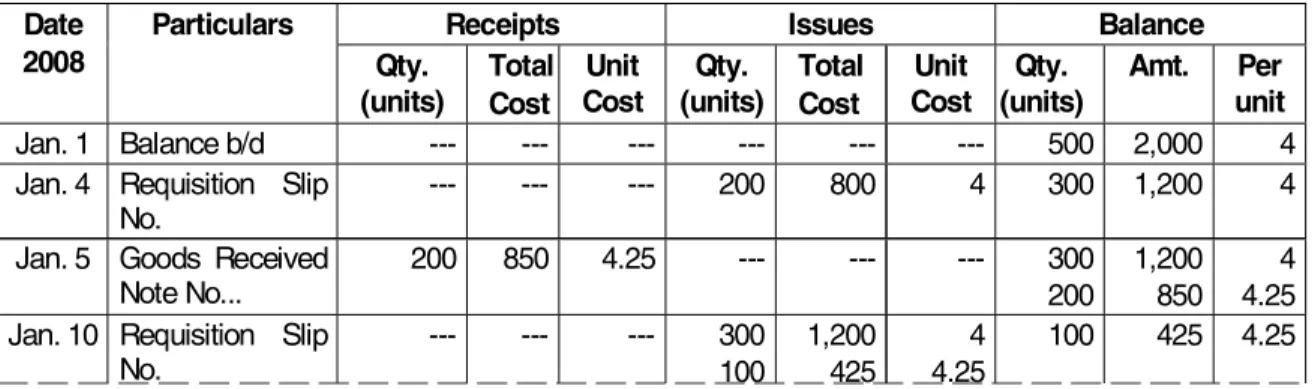
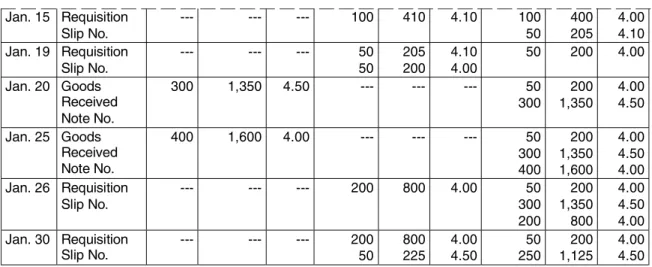
The following example will illustrate how issue of materials is valued under this method. Illustration No.1
Stores Ledger Account of Kanthi & Co. shows the following particulars: 2008
Jan. 1 Opening Balance: 500 units @ Rs. 4 Jan. 5 Received from vendor: 200 units @ Rs. 4.25 Jan. 12 Received from vendor: 150 units @ Rs. 4.10 Jan. 20 Received from vendor: 300 units @ Rs. 4.50 Jan. 25 Received from vendor: 400 units @ Rs. 4 Materials were issued as follows:
2008 Jan. 4 – 200 units Jan. 10 – 400 units Jan. 15 – 100 units Jan. 19 – 100 units Jan. 26 – 200 units Jan. 30 – 250 units
Issue is to be priced on the principle of ‘First in First out’. Write out the Stores Ledger Account in respect of the materials for the month of January, 2008.
Solution:
Stores Ledger Account of Kanthi & Co (Under FIFO)
Amount in Rs. p¤¢¤¨¯®>> g®®°¤®> ` © «¢¤> b ¯¤>
PNNV> n ¯¨¢°© ®> o¯´L>
F°«¨¯®G> r¬¯ ©>a¬®¯>> a¬®¯>>s«¨¯> F°«¨¯®G>o¯´L> a¬®¯>>r¬¯ ©>> a¬®¯>s«¨¯> F°«¨¯®G>o¯´L> _ª¯L>>> °«¨¯>>n¤> h «L>O> ` © «¢¤>¡M£> KKK> KKK> KKK> KKK> KKK> KKK> SNN> PJNNN> R> h «L>R> p¤4°¨®¨¯¨¬«> q©¨> l¬L> KKK> KKK> KKK> PNN> VNN> R> QNN> OJPNN> R> h «L>S> e¬¬£®> p¤¢¤¨±¤£> l¬¯¤>l¬LLL> PNN> VSN> RLPS> KKK> KKK> KKK> QNN>PNN> OJPNN>VSN> RLPS>R> h «L>ON> p¤4°¨®¨¯¨¬«> q©¨>
h «L>OP> e¬¬£®> p¤¢¤¨±¤£>
l¬¯¤>l¬L> OSN> TOS> RLON> KKK> KKK> KKK> ONN>OSN> RPS>TOS> RLPS>RLON> h «L>OS> p¤4°¨®¨¯¨¬«> q©¨>
l¬L> KKK> KKK> KKK> ONN> RPS> RLPS> OSN> TOS> RLON> h «L>OW> p¤4°¨®¨¯¨¬«> q©¨>
l¬L> KKK> KKK> KKK> ONN> RON> RLON> SN> PNS> RLON> h «L>PN> e¬¬£®> p¤¢¤¨±¤£>
l¬¯¤>l¬L> QNN> OJQSN> RLSN> KKK> KKK> KKK> QNN>SN> OJQSN>PNS> RLON>RLSN> h «L>PS> e¬¬£®> p¤¢¤¨±¤£> l¬¯¤>l¬L> RNN> OJTNN> RLNN> KKK> KKK> KKK> QNN>SN> RNN> PNS> OJQSN> OJTNN> RLON> RLSN> RLNN> h «L>PT> p¤4°¨®¨¯¨¬«> q©¨>
l¬L> KKK> KKK> KKK> OSN>SN> PNS>TUS> RLON>RLSN> OSN>RNN> OJTNN>TUS> RLSN>RLNN> h «L>QN> p¤4°¨®¨¯¨¬«> q©¨>
l¬L> KKK> KKK> KKK> OSN>ONN> TUS>RNN> RLSN>RLNN> QNN> OJPNN> RLNN> Value of Closing Stock under LIFO is Rs. 1,200
6.9 LAST IN FIRST OUT (COMMONLY CALLED LIFO)
This method operates in just reverse order of FIFO method. As against the First in First Out method, the issues under this method are priced in the reverse order of purchase i.e., the price of the latest available consignment is taken first. Thus, the price of the last batch of materials purchased is used for all issues until all units from this batch have been issued. Later, the price of the previous batch received is used. It should be noted that physical flow of materials may not conform to LIFO assumption.
This method is suitable in times of rising prices because material will be issued from the latest consignment at a price, which is closely related to current price levels, as far possible.
Three points should be noted regarding this method: (a) Materials issues are priced at actual cost.
(b) Charge to production for material cost is at the latest prices paid.
(c) Closing stock valuation is at the oldest prices paid and is completely out of line with the current prices.
Advantages:
(1) Easy to operate: Like FIFO method, this is simple to operate and is useful when transactions are not too many and the prices are fairly steady.
(2) No unrealized profit: Under this method, actual cost of materials is charged to production. So, this method, like FIFO, does not result in any unrealized profit or loss.
(3) Prices reflect current market prices: Materials are charged to production at the latest prices paid. Thus, effect of current market prices of materials is reflected in the cost of sales, provided the materials are recently purchased. In times of rising prices, quotation of prices for company’s products will be competitive and profitable.
Disadvantages
This method suffers from the following disadvantages:
1. Unrealistic method: This method is not realistic as it does not conform to the physical flow of materials. In physical flow of materials, first in first out method is followed. 2. Lacks comparison: Like FIFO, comparison between one job and the other job will become
difficult because one job started a few minutes after another of the same type may bear different cost of materials. Similar jobs may differ because materials were issued from different lots and thus at different prices.
3. Valuation of closing stock: The closing stock is valued at the old prices and does not represent the current economic values. Consequently, closing stock will be understated in the Balance Sheet.
4. Cumbersome calculation: This method is cumbersome when prices are subject to frequent fluctuations. Like FIFO, this method may lead to clerical errors. Every time an issue is made, the store ledger clerk will have to go through his record to ascertain the price to be charged. 5. More than one price: For pricing a single issue, more than one price has often to be adopted. Impact during rising prices/falling prices:
Under the LIFO method, in times of rising prices, profits and taxes would be lower than under FIFO method. In periods of falling prices, the closing stock would be valued at higher price and thus the profits and taxes would also be higher.
It is difficult to generalize about the superiority of any method, be it LIFO or FIFO. Each issue method has its own advantages as well as disadvantages. The actual utility of the method depends upon the prevailing circumstances.
Illustration No. 2
With the data contained in Illustration No. 1, prepare the stores ledger under FIFO method. Solution:
STORES LEDGER ACCOUNT of Kanthi & Co (Under LIFO)
Amount in Rs.
p¤¢¤¨¯®> g®®°¤®> ` © «¢¤>
b ¯¤>
PNNV> n ¯¨¢°© ®> o¯´L>
F°«¨¯®G> r¬¯ ©>a¬®¯> a¬®¯L>s«¨¯> F°«¨¯®G>o¯´L> r¬¯ ©>a¬®¯> a¬®¯L>s«¨¯> F°«¨¯®G>o¯´L> _ª¯L>> °«¨¯>n¤> h «L>O> ` © «¢¤>¡M£> KKK> KKK> KKK> KKK> KKK> KKK> SNN> PJNNN> RLNN> h «L>R> p¤4°¨®¨¯¨¬«>> q©¨>l¬L> KKK> KKK> KKK> PNN> VNN> RLNN> QNN> OJPNN> RLNN> h «L>S> e¬¬£®> p¤¢¤¨±¤£>> l¬¯¤>l¬L> PNN> VSN> RLPS> KKK> KKK> KKK> QNN> PNN> OJPNN>VSN> RLNN>RLPS> h «L>ON> p¤4°¨®¨¯¨¬«> >q©¨>l¬L> KKK> KKK> KKK> PNN>PNN> VSN>VNN> RLPS>RLNN> ONN> RNN> RLNN> h «L>OP> e¬¬£®> p¤¢¤¨±¤£>> l¬¯¤>l¬L>
OSN> TOS> RLON> KKK> KKK> KKK> ONN>
h «L>OS> p¤4°¨®¨¯¨¬«>>
q©¨>l¬L> KKK> KKK> KKK> ONN> RON> RLON> ONN>SN> RNN>PNS> RLNN>RLON> h «L>OW> p¤4°¨®¨¯¨¬«>> q©¨>l¬L> KKK> KKK> KKK> SN>SN> PNS>PNN> RLON>RLNN> SN> PNN>> RLNN> h «L>PN> e¬¬£®> p¤¢¤¨±¤£>> l¬¯¤>l¬L> QNN> OJQSN> RLSN> KKK> KKK> KKK> SN> QNN> OJQSN>PNN> RLNN>RLSN> h «L>PS> e¬¬£®> p¤¢¤¨±¤£>> l¬¯¤>l¬L> RNN> OJTNN> RLNN> KKK> KKK> KKK> SN> QNN> RNN> PNN> OJQSN> OJTNN> RLNN> RLSN> RLNN> h «L>PT> p¤4°¨®¨¯¨¬«>> q©¨>l¬L> KKK> KKK> KKK> PNN> VNN> RLNN> QNN>SN> PNN> PNN> OJQSN> VNN> RLNN> RLSN> RLNN> h «L>QN> p¤4°¨®¨¯¨¬«> q©¨>l¬L> KKK> KKK> KKK> PNN>SN> VNN>PPS> RLNN>RLSN> PSN>SN> OJOPS>PNN> RLNN>RLSN> Value of Closing Stock Under FIFO is Rs. 1,325.
Illustration No. 3
From the following transactions of Anisha & Co., prepare the stores ledger account for the firm, using LIFO method:
2007
1 July Opening stock 500 units @ Rs. 20 each 4 July Purchased GRN 174 400 units @ Rs. 21 each 6 July Issued SRN 151 600 units
8 July Purchased GRN 178 800 units @ Rs.24 each
9 July Issued SRN 158 500
13 July Issued SRN 162 300
24 July Purchased GRN 184 500 units @ Rs. 25 each 28 July Issued SRN 169 400 units
Solution:
STORES LEDGER ACCOUNT (under LIFO)
(in Rs.) p¤¢¤¨¯®> g®®°¤®> ` © «¢¤> b ¯¤> PNNU> p¤¥L> o¯´L> p ¯¤> p®L> _ª¯L> p¤¥L> o¯´L> p ¯¤L> _ª¯L> o¯´L> p ¯¤L> _ª¯L> O>h°©´> KKK> KKK> KKK> KKK> KKK> KKK> KKK> KKK> SNN> PN> ONJNNN> R>h°©´> epl>
OUR> RNN> PO> VJRNN> KKK> KKK> KKK> KKK> SNN>RNN> PN>PO> ONJNNN>VJRNN> T>h°©´> KKK> KKK> KKK> KKK> qpl>
V>h°©´> epl>
OUV> VNN> PR> OWJPNN> KKK> KKK> KKK> KKK> QNN>VNN> PN>PR> OWJPNN>TJNNN> W>h°©´> KKK> KKK> KKK> KKK> qpl>
OSV> SNN> PR> OPJNNN> QNN>QNN> PN>PR> TJNNN>UJPNN> OQ>h°©´> KKK> KKK> KKK> KKK> qpl>
OTP> QNN> PR> UJPNN> QNN> PN> TJNNN> PR>h°©´> epl>
OVR> SNN> PS> OPJSNN> KKK> KKK> KKK> KKK> QNN>SNN> PN>PS> OPJSNN>TJNNN> PV>h°©´> KKK> KKK> KKK> KKK> qpl>
OTW> RNN> PS> ONJNNN> QNN>ONN> PN>PS> TJNNN>PJSNN> Closing Stock is 300 Units @ 20 = Rs. 6,000 + 100 Units @ 25 = Rs. 2,500.
Value of total closing stock is Rs. 8,500 6.10 AVERAGE COST
In stores, material is always mixed up. The principal on which the average cost method is based is that all of the materials in store is so mixed up that an issue cannot be made from any particular lot of purchases. Therefore, it is proper, if the materials are issued at the average cost of materials in store. Average may be of two types:
(i) Simple Arithmetic Average. (ii) Weighted Arithmetic Average. Simple Average Cost
Simple average price is calculated by dividing the total of unit purchase prices of different lots in stock on the date of issue by the number of prices used in the calculation. Quantity of different lots is ignored. Suppose, following are three different lots of materials in stock when the materials is to be issued:
1,000, units purchased @Rs.10 2,000, units purchased @Rs.11 3,000, units purchased @Rs.12
In this example, simple average price will be Rs. 11 calculated as below:-10 11 12
Rs. 11 3
+ + =
Simple average price ignores the quantities for calculating the issue price.
Does not recover full cost: Simple average price is not to be followed because this method of calculating issue price does not recover the full cost price of the materials. In the above example, the purchase price of the material in stock is Rs. 68,000 (1,000 × 10 + 2,000 × 11 +
3,000 × 12) whereas the recovery from the production according to simple average price method will be Rs. 66,000 (quantity 6,000 units issued @ Rs. 11 per unit). Thus, there is under recovery of Rs. 2,000 (Rs. 68,000 – Rs. 66,000).
Simple average price is not a proper method for issuing the prices as this method does not recover the full costs, which is the primary requirement of a good pricing method.
Weighted Average Cost
The weighted average price takes into account the price and quantity of the materials in store. In the above example, the weighted average price is Rs. 11.33 per unit calculated as follows:
1,000 × 10 + 2,000 × 11 + 3,000 × 12
Rs. 11.33 1,000 + 2,000 + 3, 000 =
It is better to issue the material at weighted average price method. This method recovers the full cost price of the materials from production. In the above example, the total purchase price of the materials in stock is Rs. 68,000 and the charge to jobs or work orders is also Rs. 68,000 (6,000 units@ Rs. 11.33).
In periods of heavy fluctuations in the prices of materials, the weighted average cost method gives better results because it evens out fluctuations in price by taking the average of prices of various lots in stock.
Advantages
(1) Best method even when prices fluctuate: Weighted Average price method is considered to be the best method when prices fluctuate, considerably, because this method tends to smooth out fluctuation prices.
(2) Simple calculation: Issue prices are not to be calculated each time issues are made. Issue prices are changed only when new lot of materials is received.
(3) Full recovery of cost: This method recovers the cost of materials from production. (4) Issue prices near to market prices: This method maintains the issue prices as near to
the market price as possible.
(5) No adjustments in stock ledger: This method eliminates the necessity for adjustments in stock valuation.
Disadvantages
(1) New calculation with every receipt: The greatest disadvantage of this method is that a fresh rate calculation has to be made as soon as a new lot of materials is purchased which may involve tedious calculations. Thus, there are chances of clerical errors.
Weighted average cost method is used by most organizations because it satisfies most of the conditions of a good method of valuing material issues.
6.11 BASE STOCK
Each concern always maintains a minimum quantity of material in stock. This minimum quantity is known as safety or base stock and this should be used only when an emergency arises. The base stock is created out of the first lot of the material purchased and therefore, it is always valued at the cost price of the first lot and is carried forward as a fixed asset.
This method works with some other method and is generally used with FIFO or LIFO method. Therefore, the advantages and disadvantages of the method, with which the Base stock method is used, will arise. Any quantity over and above the base stock is issued in accordance with the other method, which is used in conjunction with this method. The objective of this method is to issue the material according to the current prices. This objective will be achieved only when the LIFO method is used together with the Base Stock method.
Base Stock Method is always used in conjunction with FIFO or LIFO method. So, Base Stock Method would have the same advantages and disadvantages of the combined method — FIFO or LIFO method.
6.12 INFLATED PRICE METHOD
There are some materials, which are subject to natural wastage. Examples are: (1) Coal lost due to loading and unloading and
(2) Timber lost due to seasoning. In such cases, the materials are issued at an inflated price (a price higher than the actual cost) so as to recover the cost of natural wastage of materials from the production. In this way, the total cost of the material is recovered from the production. For example, if 1,000 tons of coal are purchased at Rs. 75 per ton and if it is expected that 5 tons of coal will be lost due to loading and unloading, the inflated issue price in this case will be
1,000 × 75
Rs.75.37
995 = per ton
With the actual issue of 995 tons of coal, the actual cost of Rs. 75,000 (1,000 tons purchased @Rs.75 per ton) will be recovered from production (995 tons @Rs. 75.37).
6.13 SPECIFIC PRICE
When materials are purchased for specific job or work order, they should be issued to that specific job or work order at their actual cost. This method is used, where job costing is in operation and the actual material issued can be identified.
6.14 INVENTORY SYSTEMS
Inventory records relating to quantity and value can be maintained according to any of the following systems:
1. Periodic Inventory System 2. Perpetual Inventory System
6.14.1 Periodic Inventory System
Periodic Inventory System is a method of ascertaining inventory by taking an actual physical count (or measure or weight) of all the inventory items on hand at a particular date on which information about inventory is required. The cost of goods sold is calculated as a residual figure. In the course of operations, there may be theft pilferage. As cost of goods sold is calculated as a residual figure, it includes lost goods also. Cost of Goods Sold is calculated as under:
Cost of Goods Sold = Opening Inventory + Purchases – Closing Inventory 6.14.2 Perpetual Inventory System
Perpetual Inventory System is a method of recording inventory balances after each receipt and issue. In order to ensure accuracy of perpetual inventory records, physical stocks should be checked and compared with recorded balances. The discrepancies, if any, should be investigated and adjusted in the accounts, properly. The closing inventory is calculated as a residual figure (which includes lost goods also) as under:
Closing Inventory = Opening Inventory + Purchases – Cost of Goods Sold Characteristics of Perpetual Inventory: The two main characteristics of perpetual inventory system is:
1. In perpetual inventory system, stores balances are recorded after each receipt and issue. Stores balances are always updated in the Bin Card.
2. This facilitates regular checking of stock verification, physically, which obviates the stopping of the work for stock taking. There will not be stoppage of production, in the case of continuous physical stock verification.
In perpetual inventory, the experienced and dedicated staff, throughout the year, does stock-taking, continuously. All the items of stock are covered in a phased manner. The greatest advantage is this process does not disturb the business operations.
Method of perpetual inventory: This continuous physical verification of stock is an essential feature of the perpetual inventory system. Certain number of items should be counted, weighted or measured, daily, and compared with the Bin Card balances. For example, an organization is
possessing 30,000 items of stores. In a year of 300 working days, 100 items are verified physically, once in a year and compared with the Bin Card balances. The programme for physical stock verification covers counting, weighing or measuring daily so that all 30,000 items are verified, physically. The stock verifiers take up the different sections of the store, in rotation. All the items should be completely verified in a year so each item is covered once in a year under the physical stock verification programme and the results of stock verification should be recorded, suitably.
Advantage of the Perpetual Inventory System
1. A detailed and reliable check on the materials in the stores is obtained. 2. It is not necessary to stop production.
3. No stock-taking at the year end.
4. Periodical and annual accounts can be prepared, easily, as per the balances in the stores ledger.
5. Experienced men can be employed to check the Stores at regular intervals. 6. Discrepancies are, readily, discovered and corrected.
7. Staff will be more vigilant and the system serves as a deterrent to dishonesty.
8. Facilitates fixation of the maximum and minimum levels and comparison with the actual physical balances.
9. The storekeeper’s duty, attending to replenishments, is facilitated.
10. The disadvantages of excessive stocks are avoided so capital investment in stocks is kept under control.
11. Correct stock figures are, readily, available for insurance purposes.
12. It reveals the existence of slow-moving, non-moving and obsolete stores etc.
13. A system of internal check would be readily available because the bin cards and stores ledger are cross-checked, periodically.
6.14.3 Perpetual Inventory is Better than Periodic Inventory
Periodic inventory is done, normally, at the end of the year, closing business operations, at least for a few days. In perpetual inventory, the experienced and dedicated staff does stock-taking throughout the year. All the items of stock are covered in a phased manner. The greatest advantage with perpetual inventory is this process of stock –taking does not disturb the business operations as it is done throughout the year, continuously, in a planned manner, throughout the year.
Method of Pricing issues and system of inventory influence cost of production and valuation of closing stock. In consequence, profitability of the firm depends upon the method of issues as well as system of inventory.
Illustration No. 4
Satya Rani & Co. provides you with the following information:
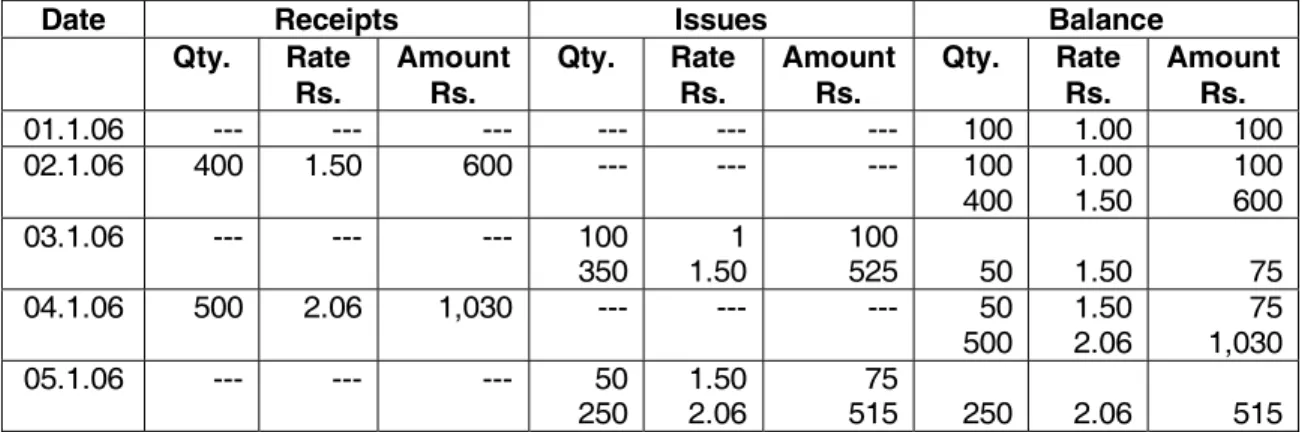
1.1.2006 Opening Stock 100 units @ Rs. 1.00; 2.1.06. Purchased 400 units @ Rs. 1.50; 3.1.06. Issued 450 units; 4.1.06. Purchased 500 units @Rs. 2.06; 5.1.06 Issued 300 units.
Compute the Value of Inventory and Cost of Goods Sold as on 5.1.06 assuming
(a) Perpetual System under FIFO Method.
(b) Periodic Inventory System under FIFO Method. (c) Perpetual System under LIFO Method.
(d) Periodic Inventory System under LIFO Method. (e) Weighted Average Method under Perpetual System
(f) Weighted Average Method under Periodic Inventory System
Solution:
(a) Stock Ledger under FIFO Method (Using Perpetual System)
Date Receipts Issues Balance
Qty. Rate
Rs. Amount Rs. Qty. Rate Rs. Amount Rs. Qty. Rate Rs. Amount Rs.
01.1.06 --- --- --- --- --- --- 100 1.00 100 02.1.06 400 1.50 600 --- --- --- 100 400 1.00 1.50 100 600 03.1.06 --- --- --- 100 350 1.50 1 100 525 50 1.50 75 04.1.06 500 2.06 1,030 --- --- --- 50 500 1.50 2.06 1,030 75 05.1.06 --- --- --- 50 250 1.50 2.06 515 75 250 2.06 515 A Opening Inventory 100 B Add: Purchases (Rs. 600 + Rs. 1,030) 1,630
C Less: Cost of Goods Sold (Rs. 100 + Rs. 525 + Rs.75 + Rs. 515) 1,215
D Closing Inventory (A + B – C) 515
(b) Statement showing the Value of Inventory and Cost of Goods Sold under FIFO Method (under Periodic Inventory System)
A. Opening Inventory 100
B. Add: Purchases (Rs. 600 + Rs. 1,030) 1,630
C. Less: Closing Inventory (250 × 2.06) 515
D. Cost of Goods Sold (A + B – C) 1,215
In perpetual Inventory System, stock records show closing stock value, while value is to be assigned to closing stock to arrive at cost of production in
periodic Inventory System. Though method of issue (FIFO or LIFO as the may be) is same in both the systems, still, value of closing stock may differ in both the systems.
(c) Perpetual System under LIFO Method (Using Perpetual System) Stock Ledger under LIFO Method (Using Perpetual System)
b ¯¤> p¤¢¤¨¯®>> g®®°¤®> ` © «¢¤>
> o¯´L>> p ¯¤>
p®L> _ª¯L>p®L> o¯´L> p ¯¤>p®L> _ª¯L>p®L> o¯´L>> p ¯¤>p®L> _ª¯L>p®L> NOLOLNT> KKK> KKK> KKK> KKK> KKK> KKK> ONN> OLNN> ONN> NPLOLNT> RNN> OLSN> TNN> KKK> KKK> KKK> ONN>
RNN> OLNN>OLSN> ONN>TNN> NQLOLNT> KKK> KKK> KKK> RNN>
SN> OLSN>OLNN> TNN>SN> SN>KKK> OLNN>KKK> SN>KKK> NRLONT> SNN> PLNT> OJNQN> KKK> KKK> KKK> SN> SNN> OLNN>PLNT> OJNQN>SN> NSLONT> KKK> KKK> KKK> QNN> PLNT> TOV> SN> PNN> OLNN>PLNT> ROP>SN> A. Opening Inventory. 100 B. Add: Purchases (Rs. 600 + Rs. 1,030) 1,630
C. Less: Cost of Goods Sold (Rs. 600 + Rs. 50 + Rs. 618) 1,268
D. Closing Inventory (A + B – C) 462
(d) Statement showing the Value of Inventory and Cost of Goods Sold under LIFO Method (under Periodic Inventory System)
A. Opening Inventory. 100
B. Add: Purchases (Rs. 600 + Rs. 1,030) 1,630
C. Less: Closing Inventory [( 100 × Rs. 1) + (150 × Rs. 1.50) ] 325
D. Cost of Goods Sold (A + B – C) 1,405
(e) Statement showing the Value of Inventory and Cost of Goods Sold under Weighted Average Method under Perpetual System
Stock Ledger under Weighted Average Method (Using Perpetual System)
b ¯¤> p¤¢¤¨¯®>> g®®°¤®> ` © «¢¤>
> o¯´L>> p ¯¤>
p®L> _ª¬°«¯>p®L> o¯´L> p ¯¤>p®L> _ª¬°«¯>p®L> o¯´L>> p ¯¤>p®L> _ª¬°«¯>p®L> NOLOLNT> KKK> KKK> KKK> KKK> KKK> KKK> ONN> OLNN> ONN> NPLOLNT> RNN> OLSN> TNN> KKK> KKK> KKK> SNN> OLRN> UNN> NQLOLNT> KKK> KKK> KKK> RSN> OLRN> TQN> SN> OLRN> UN> NRLOLNT> SNN> PLNT> OJNQN> KKK> KKK> KKK> SSN> PLNN> OJONN> NSLOLNT> KKK> KKK> KKK> QNN> PLNN> TNN> PSN> PLNN> SNN>
A. Opening Inventory 100
B. Add: Purchases (Rs. 600 + Rs. 1,030) 1,630
C. Less: Cost of Goods Sold (Rs. 630 + Rs. 600) 1,230
D. Closing Inventory (A + B – C) 500
(f) Statement showing the Weighted Average Cost per unit under Weighted Average Method under Periodic Inventory System
b ¯¤> o° «¯¨¯´> p ¯¤>Fp®LG> r¬¯ ©>a¬®¯>Fp®LG>
h «L>O> ONN> OLNN> ONN>
h «L>P> RNN> OLSN> TNN>
h «L>R> SNN> PLNT> OJNQN>
> OJNNN> > OJUQN>
Weighted Average Cost per unit = Rs. 1,730/1,000 = Rs. 1.73
Statement showing the Value of Inventory and Cost of Goods Sold under Weighted Average Method under Periodic Inventory System
_L> m¤«¨«¦>g«±¤«¯¬´L> >>>>>>>>>>>>>>>>>>>>>ONNLNN> `L> _££>X>n°¢§ ®¤®>Fp®L>TNN>I>p®L>OJNQNG> OLTQNLNN> aL> j¤®®X>a©¬®¨«¦>g«±¤«¯¬´>FPSN>ü>OLUQG>> RQPLSN> bL> a©¬®¨«¦>g«±¤«¯¬´>F_>I>`> >aG> OJPWULSN> 6.15 VALUATION OF INVENTORY FOR BALANCE SHEET PURPOSES
The most generally accepted accounting principle for valuation of inventory is that stock should be valued at cost or market price, whichever is lower. This flows from the Accounting Principle of ‘Conservatism’. As per the principle of conservatism, recognise all possible losses and anticipate no profit.
Inventory should be valued at cost or market price (net realisable value), whichever is lower. Recognise all possible losses in respect of transactions and events that have happened. Do not recognize anticipated profits, however certain they are, till they are realized.
Cost: Cost is the expenditure incurred for bringing the inventory to the place and condition in which the goods concerned are to be sold. So, it is not only the purchase price, but also cost of conversion and other costs incurred in bringing the inventories to the present location and condition. Examples to the later category are wages or manufacturing expenses incurred for converting raw materials into finished goods, transportation costs, duties paid and insurance, etc. However, selling expenses and storage expenses are to be excluded.
Market Price: Market price means ‘net realizable value’, in case of finished goods and replacement price, in case of raw materials and chief stores. The net realisable value is to be calculated after considering all the expenses, which might have to be incurred for making sales. For example, if the seller has to pay commission of 10% of sales, the net realisable value of an article having a selling price of Rs. 100 is to be taken as Rs. 90.
As per International Accounting Standard (IAS) No. 2, cost or market price method is to be followed for each item or group of homogeneous items of inventory.
State whether the following statements are True or False
1. Bill of Materials is a comprehensive list of materials required for executing the order with details of material specification, code, quantity etc.
2. For executing a new order, purchase department places the order on the strength of Bill of Materials.
3. Goods Received Note is a basic document for the accounts department to release payment to the supplier.
4. Stores department verifies whether the rate in the bill is as per the terms of the purchase order.
5. Goods Received Note is an important document that authorizes the accounts department to process for payment.
6. Bin card is a record of the receipt and issue of materials, kept for each item in the stores. 7. Cost of production is same, whatever is the method adopted for valuing the issues. 8. Periodic inventory does not involve closing the business for stock taking.
9. LIFO method operates in just reverse order of FIFO method.
10. Weighted average cost method is used by most organizations because it satisfies most of the conditions of a good method of valuing material issues.
11. Periodic inventory system and perpetual inventory system are the different systems for maintaining inventory records.
12. Inventory should be valued at cost or net realisable value, whichever is lower.
Answers
1. True 2. True 3. True 4. False 5. True 6. True 7. False 8. False 9. True 10. True 11. True 12. True
Pick up the most appropriate
1. The following document is essential for the accounts department to make the payment: (a) Bill of Materials (b) Purchase Requisition
2. In times of rising prices, the following method is most suitable for valuing the issues that would reflect the cost of production to reflect the current market prices:
(a) First in First out (b) Last in First out. (c) Average Cost. (d) Base Stock.
3. In times of falling prices, the following method would reflect the valuation of closing stock to reflect the current market prices:
(a) Last in First out. (b) First in First out (c) Average Cost. (d) Base Stock.
4. In the following method of pricing the issues, price quoted by the firm on the basis of cost plus margin may not be competitive, when the prices of inputs are falling:
(a) Last in First out. (b) Base Stock. (c) Average Cost. (d) First in First out 5. The greatest advantage with perpetual inventory is
(a) No disturbance to business, while (b) Stock records are always updated stock-taking
(c) Both (a) and (b) (d) None of the above 6. Physical issue of goods follows this method
(a) First in First out (b) Base Stock (c) Average Cost. (d) Last in First out
7. The following method is used by most organizations because it satisfies most of the conditions of a good method of valuing material issues.
(a) First in First out (b) Base Stock (c) Weighted average Cost. (d) Last in First out
8. Inventory is valued at cost or market price, whichever is lower for the following accounting principle:
(a) Conservatism (b) Consistency
(c) Realisation (d) Money measurement value
9. The following system gives a continuous information about the quantum and value of inventory:
(a) Periodic stock-taking (b) Perpetual inventory (c) Continuous stock-taking (d) None
Answers
1. (c) 2. (b) 3. (b) 4. (d) 5. (c) 6. (a) 7. (c) 8 (a) 9. (b) Descriptive Questions
1. Explain the meaning of the term ‘Inventory’? What are the objectives of inventory? (6.2 and 6.3)
2. Name the conditions of a Good Method of Valuing Issues? Which method would satisfy all the requirements? (6.6 and 6.10)
3. Write short notes on the following:
(E) Goods Receipt Note (6.4)
(F) Materials Requisition Slip (6.4)
(G) Bin Card (6.5)
(H) Bill of Materials (6.4)
4. Give a detailed account on ‘FIFO’ and ‘LIFO’ methods of valuing the issues and state their merits and demerits of each method? (6.7, 6.8 and 6.9)
5. When prices are rising, which method of pricing the issues is recommended? Justify the reasons for recommendation? (6.9)
6. ‘Average cost method is used by most organizations because it satisfies most of the conditions of a good method of valuing material issues’ – Discuss? (6.6 and 6.10)
7. Name the different methods of valuing the issues and discuss any two methods, when the prices are rising and falling? (6.7, 6.8 and 6.9)
8. Write a detailed note on the inventory systems and which system of inventory taking is recommended? (6.14, 6.14.1, 6.14.2 and 6.14.3)
9. What is perpetual inventory and mention their advantages? (6.14.2)
10. Explain the method of valuation of raw materials and finished goods for the purpose of balance sheet? (6.15)
Interview Questions
Q.1. What are ‘FIFO’ and LIFO’?
Ans. ‘FIFO’ stands for ‘First in First out’. ‘LIFO’ stands for ‘Last in First out’. They are the different methods of valuing the issues.
Q.2. When the prices are rising, which method of valuing the issues is preferred by most of the firms?
Ans. The objective of every firm is to maintain profits, if not improve. In a scenario of rising prices, input costs would be going up. Recovery of total cost is one of the primary requirements of a good method of pricing the issues. ‘LIFO’ method satisfies this requirement, in the scenario of rising prices. This method is preferred by most of the firms as the issues would be charged at the current market prices.
Q.3. What is perpetual inventory? Why this method is preferred to periodical Inventory?
Ans. Perpetual inventory is a system of recording inventory balances, after each receipt and issue. So, quantity and value of stock records are always updated. In perpetual inventory, the experienced and dedicated staff does stock-taking, throughout the year. All the items of stock are covered in a phased manner. Periodical inventory is done, normally, at the end of the year, closing business operations, at least for a few days. The greatest advantage with perpetual inventory, in comparison to periodic inventory, is this process of stock-taking does not disturb the business operations as it is done throughout the year, continuously,
in a planned manner, throughout the year. Perpetual inventory facilitates detection of discrepancies and shortages, in an earlier manner. Perpetual inventory acts a deterrent to staff from indulging in dishonest activities.
Q.4. How finished goods are valued for the purpose of balance sheet?
Ans. Finished goods are to be valued at cost or net realizable value (market price), whichever is lower. Cost means not only purchase price but also includes conversion costs to bring the goods into that condition and location such as transportation costs, duties and manufacturing expenses etc. However, selling and advertisement costs do not form part of cost. Expenses to be incurred for making a sale like commission are to be deducted from the selling price to arrive at market price. Method of valuation has to be followed, normally, consistently.
Q.5. Why inventory is to be valued at cost or market price, whichever is lower?
Ans. According to the principle of ‘Conservatism’, all possible losses have to be recognised and no anticipated profit is to be accounted for, till profit is realised. Following this principle, inventory is to be valued at cost or market price, whichever is lower.