DATE REVISION xxxBYxxx
2/28/06 Draft EA Team
3/21/2006 Draft EA Team
3/26/2006 Draft EA Team
3/30/2006 Final EA Team
Electronic Document and Records
Management
Segment Blueprint
PAGE: ii DATE: 3/30/2006
Electronic Document and Records Management Segment Architecture
This document has been developed in support of the Enterprise Architecture. Sections of this document may be updated as the project continues through the Enterprise Life Cycle. Iterations of the document and its subsections will be retained for historical purposes.
Revision History Revision
Number Description Change Date of Inserted By
V0.1 Draft 2/28/06 EA Team
V0.3 Draft 3/21/2006 EA Team
V0.4 Draft 3/26/2006 EA Team
PAGE: iii DATE: 3/30/2006
Electronic Document and Records Management Segment Architecture
Table of Contents
1 Introduction... 1 1.1 Purpose... 1 1.2 Benefits ... 1 1.3 Legislative Background... 2 1.4 eGovernment Progress ... 31.5 HUD IT Life cycle ... 4
1.6 EA Alignment ... 4
2 Segment Architecture... 5
3 HUD EDRM Scope ... 7
3.1 EDRM as a HUD core IT service... 7
3.2 Requirements... 8
4 Business Profile ... 9
5 Service Profile ...12
6 Performance Indicators...13
7 Conceptual Technology Architecture ...14
7.1 Directives ...14
7.2 HUD EDRM Conceptual Technical View ...14
7.3 Relevant Standards...16
7.4 HUD Technical Reference Model ...16
8 Implementation Considerations...16
PAGE: iv DATE: 3/30/2006
Electronic Document and Records Management Segment Architecture
Executive Summary
HUD is undertaking an Electronic Document and Record Management (EDRM) initiative to modernization its document and records management capabilities. This document is intended to be HUD’s enterprise-wide blueprint for EDRM services. It defines the future architecture to fulfill HUD’s business and information requirements and outlines a systems development and implementation strategy to support HUD’s line of business organizations.
This initiative is one of HUD’s core IT services and is fully aligned with the Federal Enterprise Architecture (FEA) and HUD’s enterprise architecture. As a core IT service, EDRM will support the full life cycle of document management activities and
correspondence management. This includes the creation and processing of documents and records, document and record review, document publication, and record archiving activities. EDRM will also support online collaboration between HUD business offices, Government partners, and external partners and clients.
The OCIO, in collaboration with the Executive Secretariat and General Counsel, is currently in the process of implementing the enterprise Electronic Document and Records Management Segment Architecture as the new Correspondence Tracking System (CTS). CTS is a suite of tools that provide enterprise document management, record management and archive management. In addition, it will also satisfy the requirements of the core IT service of Tracking and Workflow.
Recommended next steps are provided to mitigate the risks of moving forward and serve as the model for future implementations of HUD Segment Architectures.
PAGE: A-1 DATE: 3/26/06
Electronic Document and Records Management Segment Architecture
1
Introduction
HUD is undertaking an initiative to modernization its electronic document and records management capabilities. This modernization effort includes allowing the Department to fully meet several Congressional mandates including the:
• Government Paperwork Elimination Act (GPEA),
• Electronic Signature (E-Sign) initiative
• Government Performance and Results Act (GPRA).
1.1 Purpose
The purpose of this Segment Blueprint is to establish a basis by which HUD programs can incorporate and implement records management requirements and functionality into all areas of business operations by:
• Promoting a standard means of implementing records management at HUD
• Identifying records management requirements and link them to services, technologies and business processes
• Defining records management requirements and standards to enhance capital planning, business process design, and the systems development life cycle
• Establishing a concise and coherent body of records management resources within the agency
1.2 Benefits
The approach to business problem definition, exploration, and solutions results in the following outcomes:
• Reduced IT Diversity and Complexity – simplifies HUD’s IT environment by promoting standards and the sharing and reuse of common technologies
• Improved Interoperability - enacts enterprise-wide standards that enable greater interoperability across disparate applications, both internal and external, and promotes platform and vendor independence where appropriate
• Improved Utilization of Resources – reduces system development time and operations and maintenance costs by eliminating duplicative investments,
PAGE: A-2 DATE: 3/26/06
Electronic Document and Records Management Segment Architecture
• Accelerated System Implementation – equips the Department’s system
developers and architects with a source of component-based services from which to choose that provide well-defined functionality, thus maximizing reuse and portability of previously developed processes, components, code, etc.
1.3 Legislative Background
In the pursuit of HUD’s business objectives, the OCIO has defined a single enterprise architecture to ensure the definition, control and optimization of HUD’s business processes, information requirements and services. In accordance with OMB Circular A-130, HUD’s enterprise architecture is a roadmap for the transition to HUD’s single target enterprise architecture.
There is a sufficient body of existing legislation that supports the development of an Electronic Document and Records management service. Specifically, the following legislative initiatives indicate the need for an enterprise approach to document and records management for HUD:
eGovernment Act of 2002: The goal of the eGovernment Act of 2002 is to enhance the management and promotion of electronic Government services and processes. It establishes a broad framework of measures that require using Internet-based information technology to enhance citizen access to Government information and services.
Federal Enterprise Architecture (FEA): The FEA is a business-driven framework designed to facilitate government-wide improvement. It provides a framework to categorize and classify IT investments to support the identification and discovery of re-usable assets. The five FEA reference models (BRM, SCRM, DRM, PRM, TRM) directly support the development of a service-oriented architecture.
Presidents Management Agenda (PMA): The President’s e-Government Strategy has identified several high-return, government-wide initiatives to integrate agency
operations and information technology investments. The goal of these initiatives is to eliminate redundant systems and significantly improve the government’s quality of service.
Government Paperwork Elimination Act: Requires that, when practicable, Federal agencies use electronic forms, electronic filing, and electronic signatures to conduct official business with the public.
PAGE: A-3 DATE: 3/26/06
Electronic Document and Records Management Segment Architecture
Freedom of Information Act (FOIA): Requires agencies to locate, retrieve, screen, and respond with documents deemed to be legally releasable at any point in the
document/record life cycle.
Electronic Freedom of Information Act (E-FOIA) Amendments of 1996: Requires agencies to provide documents in electronic format when requested.
Federal Records Act (FRA): Requires Federal agencies to make and preserve records that document the actions of the Federal government. Generally, records are those
documents, regardless of media, that record agency functions, policies, decisions, procedures and essential transactions. The mandates of the FRA require Federal agencies to have the capabilities to create and maintain trustworthy records. Trustworthy records not only help preserve the rights of the government and its citizens but also promote quality decision making and efficient business practices.
The Privacy Act (PA) of 1974: Requires that Federal agencies properly create, maintain, use, disseminate, and document the disposition authority for records maintained about individuals (either citizens or aliens legally admitted to the United States).
1.4 eGovernment Progress
In 2003, the InterAgency Committee on Government Information (ICGI) formed under section 207 of the eGovernment Act of 2002 with a mandate to recommend policies and processes to improve the management of Government information and records to the Director of OMB and the Archivist of the United States.
The Electronic Records Management Initiative is one of 24 initiatives under
E-Government. The Electronic Records Management Initiative will provide the tools that agencies will need to manage their records in electronic form, addressing specific areas of electronic records management where agencies are having major difficulties. This project will provide guidance on electronic records management applicable
government-wide and will enable agencies to transfer electronic records to NARA in a variety of data types and formats so that they may be preserved for future use by the government and citizens.
The ICGI has established a records management profile in the Federal Enterprise
Architecture that provides a framework for embedding common and consistent records management processes and procedures into Agency business processes. Specifically, the Federal Enterprise Architecture Records Management Profile provides guidance that:
PAGE: A-4 DATE: 3/26/06
Electronic Document and Records Management Segment Architecture
• Defines records management requirements, standard operating models, and business rules for each stage of the records life cycle and the system development life cycle.
• Applies records management policies and procedures consistently across an enterprise, regardless of the format or media of the records, processes or project scope, technology or applications.
Currently, the records management profile documents a high-level framework for records management. There are no current efforts to develop a comparable FEA profile for document management.
1.5 HUD IT Life cycle
This segment architecture for EDRM is intended to be HUD’s enterprise-wide blueprint for electronic document and records management services. It defines the future
architecture to fulfill HUD’s business and information requirements and outlines a systems development and implementation strategy to support HUD’s line of business organizations. Segment architecture products describe the scope, workflow and functional and informational requirements for specific business processes.
Like all segment architectures, this document is dynamic and will evolve along with HUD’s business requirements, organization changes and changes to technology and available implementation options. New and revised blueprints are submitted to the enterprise architecture life cycle process for review and approval.
1.6 EA Alignment
The Electronic Document and Records Management Segment Blueprint reflects HUD’s EA principles. This set of foundation values supplies a uniform definition of high-level boundaries and opportunities for modernization ensuring that EA supports HUD’s business and technology requirements. They also help establish a common vision to ensure that strategic objectives are not compromised by tactical decision-making. Another principle inherent in this architecture is that compliance with HUD’s EA is a prerequisite for IT investment.
The following EA principles are directly related to this segment:
• HUD’s EA is implemented through segment architectures
• HUD’s EA seeks to employ current technologies in creating solutions for its
PAGE: A-5 DATE: 3/26/06
Electronic Document and Records Management Segment Architecture
• HUD’s EA promotes sharing, reuse and common solutions
• HUD’s EA reduces complexity through the use of enterprise standards
• Security and privacy are integrated into all architectural layers.
Business goals and objectives outlined in HUD’s Strategic Plan (FY 2003-2008) drove the formulation of HUD’s IT Strategic Plan (FY 2005-2010). HUD's IT goals and objectives are in direct alignment with the Department’s Strategic Plan. The goals and objectives related directly to the Electronic Document and Records Management Segment
Blueprint are summarized below:
• Improve service delivery
• Improve ability for integration across HUD
• Increase business capabilities
• Increase use of reusable components and services
• Increase use of Commercial Off-the-Shelf (COTS) and Government Off-the-Shelf (GOTS) products
• Improve alignment of IT to Business needs.
HUD’s Architectural Drivers included in the Target Architecture that are directly applicable to Electronic Document and Records Management include:
• Improve services to business partners
• Respond to increased demand for HUD services amid reduced budgetary resources
• Enhance flexibility in responding to changing customer demographics
• Respond to, and proactively participate in, the government-wide drive for collaboration
The Common Requirements Vision (CRV) is a set of target architectural requirements that are applicable across HUD. The CRV begins the translation of HUD’s strategic direction and drivers into a set of common services that are required in the target environment. Enterprise Electronic Document and Records Management directly supports the common requirements that apply to the Electronic Document and Records Management Segment Architecture and indirectly supports all other requirements.
2
Segment Architecture
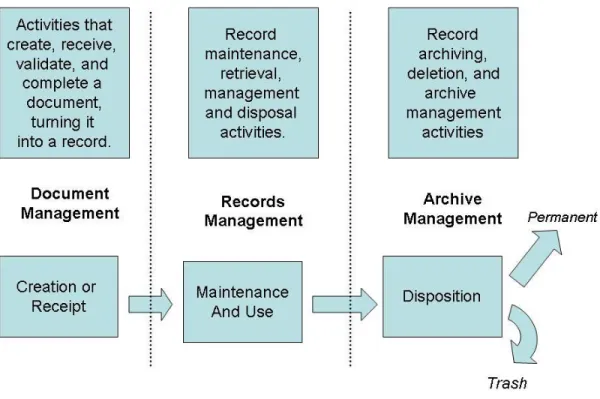
To properly provide services to HUD, the EDRM segment architecture should address three distinct functional sub-areas: document management, records management and archive management. These three sub-areas and their relationships are illustrated in Figure 1.
PAGE: A-6 DATE: 3/26/06
Electronic Document and Records Management Segment Architecture
Figure 1 - Relationship between Document Management, Records Management and Archive Management.
Document Management is the capture and management of documents within an
organization. From the FEA, document management includes the following functional areas:
• Document Imaging and OCR
• Document Referencing
• Document Revisions
• Library and Storage
• Document Review and Approval
• Document Conversion
• Indexing
PAGE: A-7 DATE: 3/26/06
Electronic Document and Records Management Segment Architecture Document management systems (DMS) are designed to assist organizations with the management, creation and processing of documents through the provision of a centralized repository and a workflow process that encapsulates business rules and metadata. The focus of a DMS is primarily on the storage and retrieval of self-contained electronic resources in their native (original) format.
Records Management is the planning, controlling, directing, organizing, training, promoting, and other managerial activities involved in records creation, maintenance and use, and disposition in order to achieve adequate and proper documentation of the policies and transactions of the Federal Government and effective and economical management of agency operations (44 U.S.C. 2901).
Records management addresses the life cycle of records, i.e., the period of time that records are in the custody of Federal agencies. The life cycle usually consists of three stages:
• Creation or receipt
• Maintenance and use
• Disposition
Tools for maintaining and using records include file plans, indexes, controlled vocabularies, taxonomies, data dictionaries, and access and security procedures. The main tool used to manage the disposition of records is the records schedule.
For HUD, archive management is concerned with the evaluation and identification of records and documents that have long term value and should be preserved, the arrangement and description of records identified for archive, and the transfer of information with NARA and their Electronic Records Archive (ERA).
3
HUD EDRM Scope
The scope of the HUD ERDM Segment Architecture is to provide the capability to meet HUD’s business requirements in all three areas of document management, records management and archive management.
3.1 EDRM as a HUD core IT service
HUD’s EDRM service is not directly aligned with one of HUD’s seven lines of business. Rather, EDRM is a core IT service that can be used to meet the electronics document
PAGE: A-8 DATE: 3/26/06
Electronic Document and Records Management Segment Architecture and records management needs across all of the HUD’s business areas. Core IT Services are activities associated with identifying, selecting, planning for, and implementing IT services that can be shared across HUD’s LOBs and business functions. The implementation of HUD’s EDRM as a core IT service provides
advantages in terms of enhanced functionality, component reuse, information sharing, and end user training. A complete list of core IT services is documented in the HUD Enterprise Architecture Transition Plan.
While HUD’s target enterprise architecture suggests an eventual migration to a single enterprise EDRM solution, there may be requirements unique to a particular HUD line of business that may require EDRM capability and implementation other than those provided by the proposed HUD EDRM core IT service. In such cases, a business case will need to be provided and approved by the Office of the CIO to justify such an investment.
3.2 Requirements
NARA has defined a set of requirements for an enterprise records management system (http://jitc.fhu.disa.mil/recmgt/p50152s2.doc). As a minimum, the HUD EDRM core IT service will need to provide these services in addition to requirements for document and archive management. For NARA, ERM is defined to include functionality
supporting records collection, organization, categorization, storage, metadata capture, physical record tracking, retrieval, use, and disposition. At a high level, the NARA mandatory requirements for enterprise Records Management Applications (RMAs) are summarized as:
• Managing Records
• Accommodating Dates and Date Logic
• Implementing Standard Data
• Backward Compatibility
• Accessibility
In addition, HUD has the following additional high-level requirements for an enterprise electronic document and records management solution:
• Must be able to manage case information for HUD business lines
• Must be able to support standard data exchange with other government agencies There are also high-level document management requirements that the HUD EDRM core IT service must fully address:
PAGE: A-9 DATE: 3/26/06
Electronic Document and Records Management Segment Architecture
• Must support correspondence management
• Must provide an integrated solution for HUD headquarters and its field offices
• Must provide for the management of electronic files, folders, and cases including document-level version control
The high-level archive management requirements that the HUD EDRM core IT service must address includes the identification and evaluation of records and the transmission of records to NARA’s Electronic Records Management System. In addition, it must provide support for FOIA request management.
Finally, the following are specific high-level integration and technical requirements that the HUD EDRM must support:
• Any service must be integrated with the Tracking and Workflow core IT service and provide the ability to include HUD documents and records in workflow and tracking services.
• Any system must be capable of meeting all requirements necessary for FISMA compliance including maintaining access controls, audit trails, and other security best practices.
• Must be integrated with the technology and infrastructure platform provided by the Vision 2010 initiative.
4
Business Profile
The FEA BRM has identified two groups of business requirements that directly define the needs of specific agencies:
• Federal statutes and regulations
• Agency-specific requirements
NARA, OMB, and the Federal CIO Council believe that the BRM can be improved to adequately capture the full life cycle of records management activities. Currently, the identified area of records retention is only one of many document and records
management activities agencies perform.
Records Management is addressed in two Business Areas in the FEA BRM:
• Support Delivery of Services Business Area -> General Government Lines of Business ->Central Records and Statistics Management Sub Function
PAGE: A-10
DATE: 3/26/06
Electronic Document and Records Management Segment Architecture
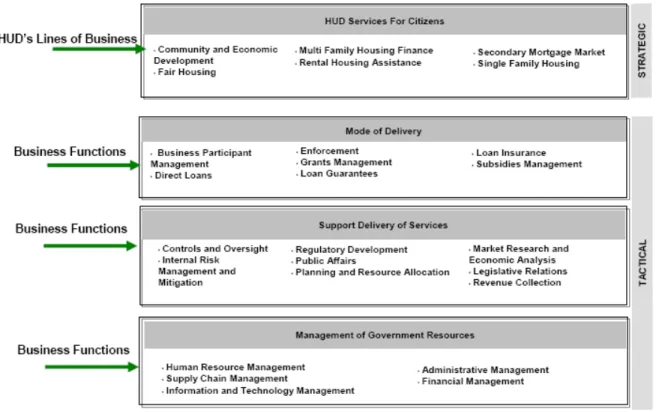
• Management of Government Resources Business Area-> Information and Technical Management Lines of Business-> Records Retention Sub Function Within HUD’s BRM (Figure 2), EDRM is a horizontal service supporting HUD’s business functions. Specifically, EDRM has a major role in supporting the Support Delivery of Services, Mode of Delivery and the Management of Government Resources business functions. Specific Lines of Business will need to define the specific
requirements to leverage the desired capabilities from the EDRM core IT service.
Figure 2 – HUD Business Reference Model
There are several HUD strategic business objectives (Figure 3) that are addressed by the EDRM core IT service. Appendix C contains a description of three specific HUD
systems that are likely to leverage the EDRM core IT service. HUD has incorporated specific business objectives related to EDRM, along with performance improvement targets, outcomes, and milestones into its EA transition plan:
PAGE: A-11
DATE: 3/26/06
Electronic Document and Records Management Segment Architecture
Business Need
Performance
Improvement
Outcomes
FY2007
Milestones
Collaborate among
program offices Improve internal efficiencies Improve accountability and customer service Enable electronic submission of mortgage case binders Need electronic signatures
Simplify procedures Improve management controls
Reduce mailing and storage costs Consolidate six legacy systems Streamline correspondence tasks Simplify processing procedures and record deposition Decrease O&M costs
Fully comply with
GPEA and GPRA Meet statutory requirements Increase access to documents for historic research Increase the electronic submissions Provide robust enterprise records management Minimize retrieval
costs for FOIA inquiries
Increase mortgage insurance
applications
Figure 3 –Strategic Business Needs Addressed by EDRM
There are additional HUD business activities and requirements that impact the functionality required from the EDRM core IT service:
• Secretary and Congressional Correspondence
• Interagency Correspondence
• FHA Case Folders
• Grants
• Contracts
• Legal Cases
From these activities and functional business areas, there are specific business drivers that provide additional justification for the HUD EDRM core IT service including:
• Excessive costs associated with the existing systems
• Lack of automated tools to audit NARA charges
• Multiple processes, mixed with manual, telephone, faxed, and system requests
• Different support technologies, such as barcodes and data entry techniques
PAGE: A-12
DATE: 3/26/06
Electronic Document and Records Management Segment Architecture
• Many local independent record-keeping applications using spreadsheets, MS Access databases, and written logs
5
Service Profile
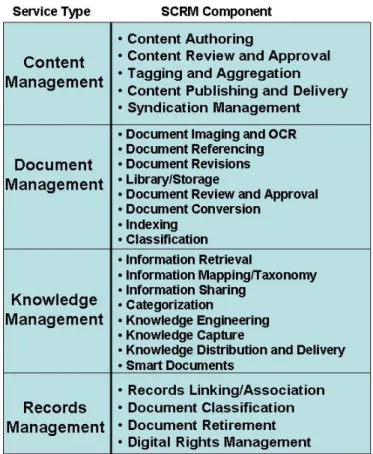
The Service Component Reference Model (SCRM) categorizes components with respect to how they support business and/or performance objectives. Within the SCRM, the HUD EDRM core IT service is directly aligned with the Digital Asset Services Domain. The Digital Asset Services Domain consists of the capabilities to support the generation, management, and distribution of intellectual property and electronic media across the business and extended enterprise. All of the Domain Service Types will be addressed by the HUD EDRM. Specifically, the Digital Asset Services include content
management, document management, knowledge management, and records
management (Figure 4). Document and records management comprise the core of the HUD EDRM and must be capable of providing support for content management and knowledge management capabilities required by HUD’s business areas.
Figure 4 – HUD EDRM Service Component Reference Model Mapping
The following table (Figure 5) provides a list of the SCRM service components that may be applicable to the functionality that will be supported by the HUD EDRM. See the FEA SCRM for a detailed description of the capabilities described by each of the service component listed.
PAGE: A-13
DATE: 3/26/06
Electronic Document and Records Management Segment Architecture
Figure 5 – HUD EDRM to SCRM Service Components
In addition, NARA has defined specific Records Management activities than can potentially be supported by service components. These activities and corresponding service components were identified by the NARA Records Management Program Requirements Development Project. NARA considers these to represent the minimum functional requirements for the development of Records Management Service
Components for each identified activity. A description of the NARA requirements and their associated activities are located in Appendix D.
6
Performance Indicators
To be effective, HUD must determine what data is essential for documentation, to ensure that such data is created, and make it easy for users to access that information regardless of where it is, or where they are, for as long as needed. HUD must also find technologies, techniques, and partners that can help improve service and hold down
PAGE: A-14
DATE: 3/26/06
Electronic Document and Records Management Segment Architecture costs, and help staff members continuously expand their capability to make the changes necessary to realize the HUD’s strategic goals.
In addition to listing performance goals and measures for evaluating performance, HUD will need to describe the processes, skills, and technologies, and the human, capital, and informational resources needed to meet performance goals.
Examples of potential performance measures that HUD can further define, capture and track include the following:
• % of requests answered within 10 business days
• % of FOIA requests completed within 20 working days
• % of customers with appointments for which records are waiting at the scheduled time
• Number of completed business area applications submitted
• Number of completed business area applications accepted/processed
7
Conceptual Technology Architecture
7.1 Directives
The development of an EDRM core IT service is a HUD Secretarial priority. EDRM will support the full life cycle of document management activities and correspondence management, including the creation and processing of records, the collaboration between program offices plus review, final publication, and archiving activities. In addition, EDRM will support online collaboration between program offices and HUD business offices and clients.
The outcomes of providing EDRM include:
• Improved Customer Service
• Improved Data Quality and Access
• Increased Collaboration
• Increased Responsiveness
7.2 HUD EDRM Conceptual Technical View
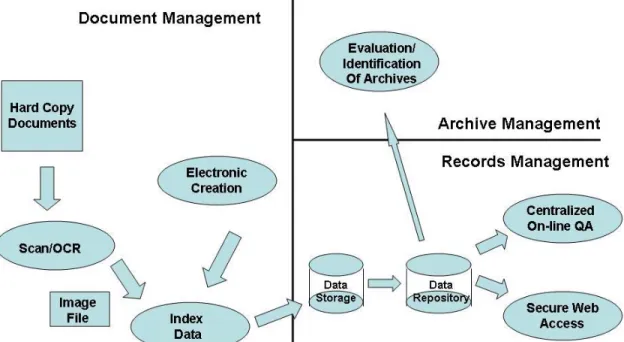
Figure 7 shows a conceptual architecture for the implementation of electronic document and records management at HUD. It shows the division of activities between document
PAGE: A-15
DATE: 3/26/06
Electronic Document and Records Management Segment Architecture management, records management and archive management in the life cycle of a typical document in a HUD business workflow.
Figure 7 – Conceptual Functional View of Electronic Document and Records Management at HUD
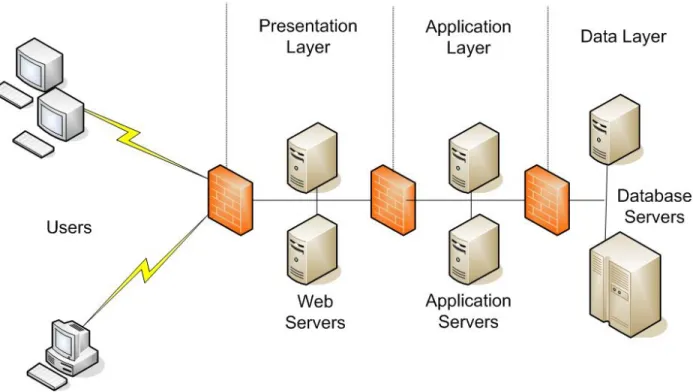
Functionally, the processes that provide EDRM will be implemented in the common technical architecture described in Vision 2010. Specifically, the records will be stored in an enterprise data layer. Application components for managing the records and provide the core EDRM functionality will be located in the application tier and the presentation layer will provide the document management operations for accepting information from users and generating documents from HUD’s enterprise information stores (Figure 8).
PAGE: A-16
DATE: 3/26/06
Electronic Document and Records Management Segment Architecture
Figure 8 – Conceptual Technical View of HUD Vision 2010 Services 7.3 Relevant Standards
The technical implementation of EDRM must be capable of supporting the existing data formats in use within HUD as well as support for Internet-friendly formats including PDF, XML (including HTML), and open document formats.
7.4 HUD Technical Reference Model
HUD’s TRM describes the standards, specifications and products that support the secure management and delivery of business (or service) components.
8
Implementation Considerations
The OCIO, in collaboration with the Executive Secretariat and General Counsel, is currently in the process of implementing the enterprise Electronic Document and Records Management Segment Architecture as the new Correspondence Tracking System (CTS) (Appendix B). CTS will integrate a suite of tools that will provide
enterprise document management, records management and archive management. In addition, it will also satisfy the requirements of the tracking and workflow core IT service.
PAGE: A-17
DATE: 3/26/06
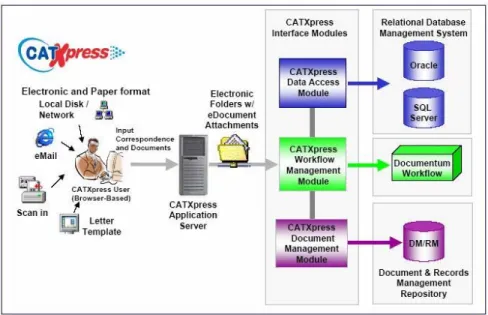
Electronic Document and Records Management Segment Architecture The CTS implementation will combine the CATXpress suite of tools including the enterprise CATXpress product, FOIAXpress, SCANXpress, REDACTXpress, and
Documentum for additional enterprise workflow and content management capabilities (Figure 9). The CATXpress suite of products is designed to integrate with
Documentum. Together, CATX will be a state-of-the-art enterprise information management system that will optimize all of HUD’s management and tracking of HUD’s correspondence in the Headquarters and Field Offices. The solution will fully implement two of HUD’s Vision 2010 core IT services: Electronic Document and Records Management Service and the Tracking and Workflow service.
What is CTS?
CTS is HUD's new Correspondence Tracking System that offers a secured and intuitive Web-based solution for the full-range of the Department's automated correspondence management and document and records capture and retrieval, routing and tracking, processing, reporting, and archiving requirements. CTS will optimize HUD's correspondence management and Freedom of Information Act (FOIA) business processes. It will also reduce manual and paper-intensive activities by providing Headquarter and Field staff with a browser-based user interface, electronic folders, flexible workflows, and other innovative features available in enterprise information management systems.
The FOIA component of CTS will provide automated FOIA processing, management and invoicing. This component will allow FOIA Liaisons to perform automated redaction of sensitive data while maintaining the original document. The redacted data can then be replaced with on-line references to specific
regulations, which authorize the redaction of the sensitive data.
CTS is being built on an integrated suite of industry-leading software products that will reduce HUD's software maintenance costs by replacing old technology, manual and paper-based processes, and redundant systems. The primary components of CTS include:
• CATXpress for full enterprise correspondence management and tracking; • FOIAXpress for FOIA management and tracking;
• SCANXpress for automated document scanning; and
PAGE: A-18
DATE: 3/26/06
Electronic Document and Records Management Segment Architecture
Figure 9 - HUD’s Correspondence Tracking System Architecture Design
CTS will provide HUD with a single source for correspondence management services and allow the Department to retire its legacy Automated Correspondence On-Line Response Network System (ACORN), Correspondence Management System (CMS), and FOIA Management System (FMS).
CTS was piloted at Headquarters in the Office of the Executive Secretariat. The pilot will provide HUD with the opportunity to begin processing and tracking a
representative sample of correspondence. This pilot will extend through the end of March 2006 and will be expanded during this period to include HUD headquarters, regional offices, and field offices.
Upon the successful completion of the pilot, CTS will be deployed to all correspondence units and coordinators throughout headquarters and the field offices to accommodate the entire management and tracking of all HUD correspondence. The full migration of HUD's correspondence tracking from the legacy systems to CTS will be completed by the first quarter of FY 2007.
PAGE: A-19
DATE: 3/26/06
Electronic Document and Records Management Segment Architecture The following tasks are recommended to support HUD’s Target Architecture, including the implementation of an enterprise EDRM solution:
• Validate Interoperability
For each line of business, the implementation and integration of EDRM must include validation of interfaces with existing data sources, processes and applications within each business area and interfaces between existing and planned business area partners and stakeholders.
• Conduct Stakeholder Analysis and Communications
For significant business process and system changes, it is important to conduct stakeholder analysis. This consists of identifying the people (staff, partners,
management) affected by the change, prioritizing their concerns, understanding their needs, and developing a plan to communicate the change management strategy.
• Update Business Case
The execution of initial or pilot deployments provides an opportunity to further refine the business case for the core IT service and any affected Business Area investments. The EDRM deployment should produce data that adds value to IT investment business case including details such as actual cost and realized benefits.
• Conduct Process Analysis
HUD’s lines of business may conduct business process re-engineering to identify opportunities to implement the EDRM core IT service to achieve performance improvement.
• Define Opportunities for Service Component Sharing and Reuse
HUD has adopted a service-oriented, component-based approach to architecture that seeks to “build once, use often.” As new services such as EDRM are developed and deployed, it is necessary to assess whether there are additional opportunities for the sharing and reuse of the core IT service to achieve performance improvements.
• Develop Metrics of Success
For each of the business areas, specific performance metrics will have to be established to define what constitutes a successful integration of EDRM with a specific Business Area. These performance measures should be related directly to the contribution EDRM makes to the business outcomes of the Business Area. For example, the integration of EDRM
PAGE: A-20
DATE: 3/26/06
Electronic Document and Records Management Segment Architecture with the Grants Management Business Area should result in developing performance measures related to the number of Grant applications processed, and the response time to the applicants.
PAGE: A-21
DATE: 3/26/06
Electronic Document and Records Management Segment Architecture
Appendix A – References
Department of Defense, “STD-5015.2: Design Criteria Standard for Electronic Records
Management Software Applications”, June 19, 2002. Available at:
http://jitc.fhu.disa.mil/recmgt/standards.html
Department of Housing and Urban Development, HUD Target Enterprise Architecture, February 2006.
Federal Enterprise Architecture Program Management Office, “FEA Consolidated
Reference Model Document” (May 2005). Available at:
http://www.whitehouse.gov/omb/egov/documents/CRM.PDF
Federal Enterprise Architecture Program Management Office, “Federal Enterprise Architecture, Records Management Profile, Version 1.0” (December 15, 2005). Available at: http://www.cio.gov/documents/RM_Profile_v1.pdf
National Archives and Records Administration, “Guidance for Coordinating the
Evaluation of Capital Planning and Investment Control (CPIC) Proposals for ERM Applications”, June 2003.
Available at: http://www.archives.gov/records-mgmt/policy/cpic-guidance.html
National Archives and Records Administration, “NARA's Strategic Directions for
Federal Records Management”, July 31, 2003. Available at:
http://www.archives.gov/records- mgmt/initiatives/strategic-directions.html
National Archives and Records Administration, “Records Management Service
Components Requirement Development Project,” Final Report, March 31, 2005.
PAGE: A-22
DATE: 3/26/06
Electronic Document and Records Management Segment Architecture
Appendix B – Message from HUD CIO on CTS Implementation
The Offices of the Chief Information Officer's (OCIO), in collaboration with the Executive Secretariat andGeneral Counsel, is pleased to announce HUD's new Correspondence Tracking System (CTS). CTS is an enterprise information management system that will optimize the Department's management and tracking of all HUD's correspondence in the Headquarters and the Field Offices. It is one of the first state-of-the-art systems to be implemented across HUD as part of VISION 2010: HUD's Information Technology Modernization Strategy. What is Vision 2010?
CTS is one of the innovative technology solutions planned for HUD's new multi-year business transformation and Information Technology (IT) modernization initiative - VISION 2010. VISION 2010 will focus on replacing HUD's aging hardware and systems with modern technology solutions. This initiative will strive to closely align HUD's technology with existing and emerging Headquarter and Field Office business strategies and processes and will simplify access to HUD's services and information for both internal and external stakeholders. Additional details regarding VISION 2010 will be communicated over the next couple of months as the strategic requirements and plan are completed.
What is CTS?
CTS is HUD's new Correspondence Tracking System that offers a secured and intuitive Web-based solution for the full-range of the Department's automated correspondence management and document and record capture and retrieval, routing and tracking, processing, reporting, and archiving requirements. CTS will optimize HUD's
correspondence management and Freedom of Information Act (FOIA) business processes. It will also reduce manual and paper-intensive activities by providing Headquarter and Field staff with a browser-based user interface,
electronic folders, flexible workflows, and other innovative features available in enterprise information management systems.
The FOIA component of CTS will provide automated FOIA processing, management and invoicing. This component will allow FOIA Liaisons to perform automated redaction of sensitive data while maintaining the original document. The redacted data can then be replaced with on-line references to specific regulations, which authorize the redaction of the sensitive data.
CTS is being built on an integrated suite of industry-leading software products that will reduce HUD's software maintenance costs by replacing old technology, manual and paper-based processes, and redundant systems. The primary components of CTS include:
• CATXpress for full enterprise correspondence management and tracking; • FOIAXpress for FOIA management and tracking;
• SCANXpress for automated document scanning; and
• REDACTXpress for automated on-line redaction of sensitive data.
CTS will provide HUD with a single-source for correspondence management services and allow the Department to retire its legacy Automated Correspondence On-Line Response Network System (ACORN), Correspondence Management System (CMS), and FOIA Management System (FMS). Additional information regarding the capabilities and features of the system components that comprise CTS can be viewed by visiting the following Web site: http://www.catxpress.com
What does CTS mean for Correspondence Coordinators across the Department?
The new capabilities and features of HUD's CTS will be introduced initially by a pilot and deployed incrementally across the Department over the next several months. Just-in-time training for new business processes and system
PAGE: A-23
DATE: 3/26/06
Electronic Document and Records Management Segment Architecture functionality will be provided via a combination of classroom and Web-based delivery strategies to ensure a smooth transition to the new system. Likewise, the local IT staff will be available to assist the Field Offices in the transition activities required for moving from the legacy systems to CTS.
CTS will be piloted beginning next week at Headquarters in the Office of the Executive Secretariat. The pilot will provide HUD with the opportunity to begin processing and tracking a representative sample of correspondence. This pilot will extend through the end of March and will be expanded during this period to include Headquarters'
Program Offices, Regional Offices, and Field Offices.
Upon the successful completion of the pilot, CTS will be deployed to all Correspondence units and coordinators throughout Headquarters and the Field Offices to accommodate the entire management and tracking of all HUD correspondence. The full migration of HUD's correspondence tracking from the legacy systems to CTS will be completed by the first quarter of Fiscal Year (FY) 2007.
What does CTS mean for FOIA Liaisons across the Department?
Beginning in March 2006, the new capabilities and features of the FOIA component of CTS will be introduced initially by a pilot at Headquarters in the FOIA Division of the Office of General Counsel and deployed incrementally to the FOIA Liaisons throughout Headquarters and the Regional and Field Offices. Upon successful completion of the pilot within the Headquarters FOIA Division in the Office of General
Counsel, CTS will be deployed to all FOIA Liaisons throughout Headquarters and the Field Offices for the complete management and tracking of all FOIA requests. Full migration of HUD's FOIA management and tracking from our legacy systems to CTS will be completed by the fourth quarter of FY 2006.
CTS Training and Transition Support
Just-in-time training for new business processes and system functionality will be provided via a combination of classroom and Web-based delivery strategies to ensure a smooth transition to the new system. Likewise, the local IT staff will be available to assist the Field Offices in the transition activities required for migrating from ACORN, Correspondence Management System, and FOIA Management System to CTS. HUD is currently coordinating with the Office of Labor Relations relative to the implementation of CTS.
We are excited about working with your staff in planning HUD's business transformation and IT modernization initiative VISION 2010 and deploying the new CTS enterprise solution for optimizing the Department's management and tracking of all HUD correspondence.
Please contact me at (202) 708-1008 (extension 8503) if you would like additional information regarding CTS or VISION 2010.
PAGE: A-24
DATE: 3/26/06
Electronic Document and Records Management Segment Architecture
Appendix C – Survey of three HUD systems
The Enterprise Electronic Document and Records Management (EDRM) Core IT Service enables HUD to effectively manage all of its documents and records in a consistent, legal, and logical manner, from creation to final disposition, using a common set of tools, standards and policies. It has high potential for both positive business and financial impact, enabling improved execution of mission, especially enhanced partner and inter-agency communications through digitization of HUD knowledge, automation of manual processes, and elimination of paper handling costs. The following three systems are candidates to benefit from HUD’s EDRM:
TEAPOTS
TEAPOTS is an automated case management system that processes housing discrimination inquires and complaints. It is used to develop, manage, track and report on inquires and complaints filed under Title VIII of the Civil Rights act of 1968, as amended by the Fair Housing Act of 1998, and other enforcement laws and processes. The key business function supported is the FHEO investigations (complaints and compliance reviews) processes. It consolidated several systems and incorporated most FHEO
enforcement authorities into one automated management process system, for use by all HUD and FHEO business partner impacted activities and agencies. It provides universal user web access to all authorized users, and a structured step by step investigation and management assistance process that will end in a virtually paperless process.
Single Family Mortgage Insurance Claims
The Single Family Mortgage Insurance Claims Subsystem, also know as the "the A43C system," was implemented in 1985 to support the Department's Claim payment process. The system validates and pays claim for Single Family Mortgage Insurance Benefits submitted by servicing mortgagees. The system receives, edits, monitors, controls, and pays more than $9 billions in mortgage insurance claims benefits annually. The prompt, efficient settlement of mortgage insurance claims produces the cash flow and confidence in FHA's single family insurance program, enabling more families to become homeowners.
Home Equity Conversion Mortgage
Currently, lenders submit paper HECM claims which are processed manually because there is ni automated HECM claim processing application. This initiative will allow lenders to submit HECM claims via the FHA Connection and bring this claim business process in line with HUD’s EA by using the latest technology to do business with our partners. This system will allow lenders to obtain vase
information in a timely manner and provide seamless integration of systems for greater technical support of the streamlined mortgage origination process. This project will help HUD embrace high standards of ethics, management and accountability. The new system will provide comprehensive and accurate business data and low-cost, almost instantaneous, response to our business partners’ requests for information.
PAGE: A-25
DATE: 3/26/06
Electronic Document and Records Management Segment Architecture
Appendix D – NARA Records Management System Requirements
The Records Management Service Components (RMSC) Program RequirementsDevelopment Project conducted collaborative sessions with records management and enterprise information architecture stakeholders, representing 18 agencies across the Federal government. Participants were charged with identifying records management activities that could be supported with software service components within the Federal Enterprise Architecture (FEA). Participants were well aware that many activities and business processes essential to records management had to be excluded because they could not be supported directly by a single service component. Thus activities such as create record, security classification and declassification, were excluded from
consideration.
Based upon its review of the NARA SME and industry/academia recommendations and detailed discussions, the working group finalized a total of eight RMSC activities along with 21 supporting functional requirements. Additionally, the working group defined 33 attributes related to the functional requirements. The requirements should be considered as baseline requirements for the acquisition of one or more records management components.
The following table represents the minimum functional requirements for development of Records Management Service Components for each activity identified by the NARA Records Management Program Requirements Development Project.
Table 1 - Attribute Matrix
PAGE: A-26
DATE: 3/26/06
Electronic Document and Records Management Segment Architecture
Activity Requirements Functional Attributes
Capture Record Capture information with associated attributes in an electronic system
1.1 The Capture Record Component shall provide the capability to assign Descriptor attributes in a consistent format to the incoming record creating a Controlled Agency Information Resource.
Descriptor - Descriptors are information describing the record. Descriptors may take the form of attributes populated by the record creator, administrator, etc.
extracted from sources such as templates used in creating or transmitting the record, or generated by intelligent agents. Descriptors would ideally include such things as key words identified by taxonomies. Some Descriptor attributes may have one or more instance associated to a record.
Controlled Agency Information Resource - The Controlled Agency Information Resource is an electronic object that includes the original record, information describing the record, data
regarding the origin and use of the record, and authorities and
requirements that apply to the control and administration of the record.
PAGE: A-27
DATE: 3/26/06
Electronic Document and Records Management Segment Architecture
Activity Requirements Functional Attributes
1.2 The Capture Record
Component shall populate a Legal Custodian Attribute of the Record when it is captured
Record - Record is the original electronic object captured in the system in accordance with agency business rules.
Legal Custodian - Legal custodian is the entity with the responsibility to ensure service and maintenance of a record at a given point in the life cycle of the record. There may be successive, but not simultaneous, legal custodians throughout the life cycle of the record. There may be multiple offices with authority to access, manage, and use the record, without legal custody. Custodian2 may be the entities such as the creating office, the consolidated enterprise records administrator, or the agency responsible for storing the record. This attribute can be populated with one or more instance. Assign Disposition Using an established disposition authority, assign the disposition schedule, item number, and disposition instructions to the record
2.1 The Assign Disposition Component shall provide the capability to accept a Categorized Record and, using an Approved Record Schedule, populate
attributes (e.g. schedule number, schedule item number, disposition act, disposition date, review date, name of scheduler, date of
scheduling) for the record, producing a Scheduled Record.
Scheduled Record - A scheduled record is a Record with its
Approved Record Disposition attributes populated from an approved Records Schedule.
Approved Record Schedule - An approved record schedule is an authorized disposition approved by the appropriate oversight or
PAGE: A-28
DATE: 3/26/06
Electronic Document and Records Management Segment Architecture
Activity Requirements Functional Attributes
3.1 The Categorize Record Component shall provide the capability to allow Authorized Users (e.g. individuals,
organizations, or applications) to categorize a Record to produce a Categorized Record.
Authorized Users - Individuals, offices, organizations, records management and other
applications, and other users that have been granted authority to categorize or re-categorize records.
Categorized Record - A
categorized record is a Captured Record that has one or more Categorization Attributes populated in accordance with business rules. This attribute can be populated with one or more instance. Categorize Record Utilizing agency business rules, assign an appropriate descriptive label to the records to facilitate management in an electronic system
3.2 The Categorize Record Component shall provide the capability to allow Authorized Users (e.g. individuals,
organizations, or applications) to re-categorize a previous
Categorized Record to produce a Re-categorized Record.
Re-categorized Record - A Re-categorized Record is a previously Categorized Record where one or more categorization attribute values have been modified. This attribute can be populated with one or more instance.
PAGE: A-29
DATE: 3/26/06
Electronic Document and Records Management Segment Architecture
Activity Requirements Functional Attributes
3.3 The Categorize Record Component shall provide the capability to apply the Authorized Categorization Schema to an Uncategorized Record to produce a Categorized or Re-categorized record with populated attributes such as; category, name of categorizer, and categorization date.
Authorized Categorization Schema - An Authorized Categorization Schema is
definitive, organizationally shared framework for associating records with each other, or from each other. The framework may be based on organizational component responsible for creating or maintaining the records, subject matter of the records, source of records, or other method. Note: The schema may be alphabetical, numeric, alpha-numeric, descriptive, or a combination.
Uncategorized Record - An Uncategorized Record is a Captured Record whose
Categorized Record attributes have null values.
3.4 The Categorize Record Component shall provide the capability to apply the related Business Rules to an
Uncategorized Record to produce a Categorized or Re-categorized Record with added Categorization attributes (to include category, name of categorizer, and categorization date).
Business Rules - A business rule is guidance specifying an
obligation concerning conduct, action, practice, or procedure within a particular activity or control of information. Business rules originate in processes or procedures that were devised by human agents, but may have appropriately been enabled by system logic that enforces their application. Two important characteristics of a business rule are: there ought to be an explicit motivation for it and it should have an enforcement regime stating what the consequences would be if the rule were broken.
PAGE: A-30
DATE: 3/26/06
Electronic Document and Records Management Segment Architecture
Activity Requirements Functional Attributes
Search Repository Query all or selected system repositories of records (transitory, temporary, and permanent) across the enterprise for content and/or attributes, in order to determine the existence and location of matching records
4.1 The Search Repository Component shall provide the capability to accept a User Query, apply the Query Criteria to the universe of available records, producing a List of Matching Records.
User Query - A request by a person or system specifying query criteria.
Query Criteria - Search
parameters (e.g. data, key words, descriptors, text) that are used to identify the responsive records.
List of Matching Records - List of records responsive
(satisfy/meet) to the query criteria (the list may be null).
Retrieve Record Using the search results, allow for the selective display of the full record and/or associated attributes for an authorized purpose.
5.1 The Retrieve Record Component shall provide the capability to use a Records Retrieval Tool to provide the Records and/or associated
authorized attributes identified by the Search Repository Component consistent with access
authorization.
Records Retrieval Tool - A finding/search aid.
6.1 The Ensure Authenticity Component shall populate an Original Authenticity Indicator attribute for a newly Captured Record.
Original Authenticity indicator -
The attribute(s) initially associated with the record upon its capture that establishes record authenticity. Ensure Authenticity Ensure the acceptability of a record as genuine, based on its characteristics such as structure, content, and context
6.2 The Ensure Authenticity Component shall compare the Original Authenticity Indicator with the Current Authenticity Indicator attribute each time a record is accessed and, when there is a discrepancy, produce a
Discrepancy attribute.
Current Authenticity Indicator -
the most recent attribute(s) associated with the record establishing authenticity.
Discrepancy - The delta
(difference) between the original and current attributes of the record.
PAGE: A-31
DATE: 3/26/06
Electronic Document and Records Management Segment Architecture
Activity Requirements Functional Attributes
Associate Record Provide the capability to associate a record to one or more other records through a Record Association attribute
7.1 The Associate Record Component shall provide the capability to associate a Record with another Record by populating a Record Association attribute creating a record association.
Existing Record - A previously captured record.
Associated Record - A record captured by the system that has a relationship to an existing record.
Record Association - Indicators of a relationship between one record and another record based on content, context, or provenance. This attribute can be populated with one or more instance.
8.1 The Execute Disposition Component shall provide the capability to populate Successor Legal Custodian attribute(s) of the Categorized Record when a Legal Custodian transfer occurs. (NOTE: A record can have more than one Successor Legal Custodian
attributes).
A Successor Legal Custodian - Is the entity serving after a prior legal custodian with the responsibility for ensuring the service and maintenance of a record at a given point in the life cycle of the record. This attribute can be populated with one or more instance. Execute Disposition Implement destruction, transfer, or continued retention of a record in accordance with the established disposition authority. After validation that the disposition action is valid, execute the disposition action, and record the transaction
8.2 The Execute Disposition Component will populate the Suspend Disposition attribute when a Suspend Disposition Intervention occurs. (NOTE: A record can have one or more Suspend Disposition attributes).
Suspend Disposition - A populated Suspend Disposition attribute sets aside the existing disposition schedule. This attribute can be populated with one or more instance.
Suspend Disposition
Intervention - The authority by which the Suspend Disposition Attribute is populated such as legal and/or judicial order(s). This attribute can be populated with one or more instance.
PAGE: A-32
DATE: 3/26/06
Electronic Document and Records Management Segment Architecture
Activity Requirements Functional Attributes
8.3 The Execute Disposition Component will provide the capability to assign a "null value" to the Suspend Disposition attribute to allow the assigned disposition to be carried out on the Categorized Record.
(Previously defined)
8.4 The Execute Disposition Component shall validate the Disposition Action, Disposition Date, and Suspend Disposition attributes using the Approved Disposition Schedule and populate a Validated Disposition attribute.
Disposition Action - The
destruction, transfer or continued retention of a record.
Disposition Date - The scheduled date for the disposition action.
Validated Disposition - After comparing the Disposition Action and the Disposition Date with the approved records schedule and checking the status of the Suspend Disposition attribute(s) the
validated Disposition attribute is assigned a "yes" or "no" value as appropriate.
8.5 The Execute Disposition Component shall provide the capability to locate a Scheduled Record and its attributes approved for destruction using the populated Validated Disposition attribute producing an Identified Disposable Record.
Identified Disposable Record - A record that has been validated for final disposition.
8.6 The Execute Disposition Component will take a Scheduled Record approved for destruction and destroy the record, populating the Disposition Complete attribute.
Disposition Complete - Is a date value that indicates that the correct disposition instructions have been executed.
PAGE: A-33
DATE: 3/26/06
Electronic Document and Records Management Segment Architecture
Activity Requirements Functional Attributes
8.7 The Execute Disposition Component shall provide the capability to locate a record and its attributes approved for transfer using the populated Validated Disposition attribute producing an Identified Transferable Record.
Identified Transferable Record -
A record that has been approved for transfer.
8.8 The Execute Disposition Component will take a Scheduled Record approved for transfer and transfers the record, populating Disposition Complete attribute.
(Previously defined)
8.9 The Execute Disposition Component shall provide the capability to populate the
Disposition Action History attribute that produces Evidence of
Disposition when the Disposition Complete attribute is populated.
Disposition Action History - The list of disposition action attributes associated with a record over time, e.g. date of disposition,
authorizing individual. This
attribute can be populated with one or more instance.
Evidence of Disposition - A population of the disposition complete attribute(s).
Global Requirement:
The Records Management Service Components shall make available all data resident in their attributes for output. (This requirement will support printing, viewing, saving, report writing, audit, etc.).