Function-Based Classification from 3D Data via Generic and Symbolic Models
Mich ael P ech uk , O ctavian Soldea, and E h ud R ivlin
Technion - Israel Institute of Technology
C om p uter S cience D ep artm ent, A rtificial Intelligence L ab oratory H aifa, Israel 3 2 0 0 0
e-m ail:{m p echuk ,octav ian,ehud r}@ cs.technion.ac.il
A bstract
W e p rop ose a nov el schem e for function-b ased clas-sification of ob jects in 3 D im ages. The clasclas-sification p rocess calls for constructing a generic m ulti-lev el hi-erarchical d escrip tion of ob ject classes in term s of func-tional com p onents. F uncfunc-tionality is d eriv ed from a large set of geom etric attrib utes and relationship s b etw een ob ject p arts. Initially, the inp ut range d ata d escrib ing each ob ject instance is segm ented , each ob ject p art is lab eled as one of a few p ossib le p rim itiv es, and each group of p rim itiv e p arts is tagged b y a functional sym -b ol. C onnections -b etw een p rim itiv e p arts and functional p arts at the sam e lev el in the hierarchy are lab eled as w ell. Then, the generic m ultilev el hierarchical d escrip -tion of ob ject classes is b uilt using the func-tionalities of a num b er of ob ject instances. D uring classification, a search through a finite grap h using a p rob ab ilistic fit-ness m easure is p erform ed to find the b est assignm ent of ob ject p arts to the functional structures of each class. A n ob ject is assigned to a class p rov id ing the highest fit-ness v alue. The schem e d oes not req uire a-p riori k now l-ed ge ab out any class. W e testl-ed the p rop osl-ed schem e on a d atab ase of ab out one thousand d ifferent 3 D ob jects. The results show high accuracy in classification.
I ntroduction
The p rob lem of ob ject classification from sensory d ata is d e-fined , in the literature, as the association of v isual inp ut to a nam e or a sym b ol. A lthough m uch research on the top ic has b een p ub lished , the com m unity still lack s usab le v ision sys-tem s that can classify a large num b er of ob jects (natural or m an-m ad e). W e p rop ose a new schem e that is ab le to clas-sify ob jects from range im ages.
There is a p lethora of ob ject recognition ap p roaches. The first ap p roaches d ealt w ith single ob ject m od els in the in-p ut. They w ere b ased on geom etric m od elling. L ater on, the p aram eteriz ed geom etric m od elling w as introd uced (U llm an 1 9 9 5 ). A fund am entally d ifferent ap p roach w as introd uced b y G ib son (G ib son 1 9 7 9 ), w ho consid ered that the hum an m ind classifies ob jects accord ing to usage, i.e., b y the func-tions that an ob ject m ay fulfil.
The first system s using function-b ased classification w ere (W instonet al.1 9 8 3 ) and (D iM anz oet al.1 9 8 9 ). A n im p
res-C op yright c°2 0 0 5 , A m erican A ssociation for A rtificial
Intelli-gence (w w w .aaai.org). A ll rights reserv ed .
siv e num b er of results in the function-b ased classification field w ere d em onstrated w ith the G R U F F and O M L E T sys-tem s (S tark & B ow yer 1 9 9 4 ; S utton, S tark , & B ow yer 1 9 9 4 ; W ood s et al.1 9 9 5 ). The follow ing issues w ere ad d ressed : reuse of a lim ited set of k now led ge p rim itiv es in d efining an ex p and ed d om ain of com p etence, com p uting an association m easure for the ap p rop riateness of a shap e that can b e com -p ared across categories so that d ifferent inter-p retations of a shap e can b e rank ord ered , and learning m em b ership func-tions from 3 D ob jects. The learning p hase aim s augm enting functions that are d efined in a hum an-d riv en p rep rocessing. To the b est of our k now led ge, G R U F F and O M L E T w ere tested on raw im ages that includ ed chairs that w ere artifi-cially b uilt from b ox es.
In (R iv lin, D ick inson, & R osenfeld 1 9 9 5 ), the authors p resented a theory of function-b ased recognition that is a natural ex tension of the p artb ased shap e recognition ap -p roach. F ollow ing (R iv lin, D ick inson, &am-p; R osenfeld 1 9 9 5 ), in (F roim ov ich, R iv lin, & S him shoni 2 0 0 2 ), the authors p ro-p osed a system for function-b ased classification. The classi-fication ap p roach, p erform ed on range im ages of real 3 D ob jects, assum es a-p riori k now led ge of the ob jects.
W e p rop ose a nov el schem e for function-b ased classifica-tion of ob jects using 3 D im ages. The classificaclassifica-tion p rocess calls for constructing a generic m ulti-lev el hierarchical d e-scrip tion of ob ject classes in term s of functional com p o-nents. The m ulti-lev el hierarchy p rov id es a nesting m ech-anism for functional p arts and has unb ound ed d ep th. In this contex t, the construction of the generic m ulti-lev el hierarchy can b e thought of as a learning p hase.
In the learning p hase the inp ut range d ata d escrib ing each ob ject instance is segm ented , each ob ject p art is lab eled as one of a few p ossib le p rim itiv es, and each group of p rim i-tiv e p arts is tagged b y a functional sym b ol. C onnections b e-tw een p rim itiv e p arts and functional p arts at the sam e lev el in the hierarchy are lab eled as w ell. Then, the m ulti-lev el hierarchy, w hich is a p rob ab ilistic m od el of an ob ject class, is d efined using histogram s b uilt from the functionalities of a num b er of ob ject instances. O ur schem e is ab le to auto-m atically b uild the d escrip tion of any new ob ject class froauto-m lab eled ex am p les.
D uring classification, a search through a finite grap h using a p rob ab ilistic fitness m easure is p erform ed to find the b est assignm ent of p arts of an ob ject to the functional structures
of each class. An object is assigned to a class providing the highest fi tness value.
Function-based approaches offer the advantage of granu-lar learning. This means that functional parts that have the same geometry and are shared between different classes do not have to be learnt with each new class. This fact enables marked acceleration of the learning phase. To the best of our knowledge, no such sharing was used nor described in exis-tent systems.
We tested the proposed scheme on a database of about one thousand different 3D objects. As far as we have been able to determine, no other classifi cation(or recognition)scheme
has yet been tested on hundreds of range images of real ob-jects captured in range images. In so far as we know, this is the fi rst scheme that performs function-based classifi cation that involves a learning phase and does not require a-priori knowledge about any class.
Learning and Classifying Functionalities
The proposed scheme consists of two phases: a learning phase and a classifi cation phase. Each of these phases re-ceives as input segmented images. The objects are seg-mented and labeled into constituents: primitive and func-tional parts. The primitive parts(also known in the literatureas geons (Biderman 1987), (Dickinsonet al.1997))that we consider are sticks, plates, and blobs. A functional part is de-fi ned as an object part that could provide a certain function, and usually comprises several primitive parts; for example, a ground support of a chair consists of four parallel stick primitive parts. N ote that (Biderman 1987) and (Dickinson et al.1997) stated that thousands of objects can be mapped to a low number of primitive parts. The immense number of objects in nature is the result of the combinatorial number of interrelationships between the primitive parts.
In the learning phase, several instances (objects) of a
class are input. The learning phase computes the values of the geometric attributes of the constituents and the relation-ships between them. Once the learning phase is fi nished, the generic representation has accumulated enough information for classifi cation - the next phase.
Segmentation
The learning as well as the classifi cation phases receive as input primitive parts as detected from a segmentation algo-rithm, which is a variation on UE (Hooveret al.1996 ). The segmentation provides representation models for the primi-tive parts. We do not elaborate on the details of the imple-mented segmentation technique due to space limitations.
Multi-Level H ierarchy Functional Structure
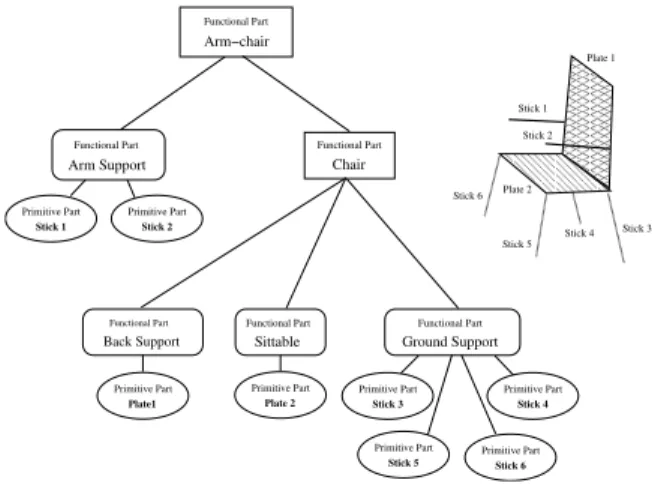
The classifi cation process comprises an analysis both of the detected primitive parts and the relationships that ex-ist among them. We call the relationships between primi-tive parts primiprimi-tive-to-primiprimi-tive connections. We have gen-eralized the mechanism of decomposition into parts and primitive-to-primitive connections into a multi-level ap-proach in the following sense. Each primitive part or group of primitive parts and the primitive-to-primitive connectionsFunctional Part Back Support Functional Part Arm Support Functional Part Stick 1
Primitive Part Primitive Part
Stick 2 Arm−chair Functional Part Chair Functional Part Sittable Functional Part Primitive Part Plate1 Plate 2 Primitive Part Stick 3 Primitive Part Stick 4 Primitive Part Stick 5 Primitive Part Stick 6 Primitive Part Ground Support Plate 2 Plate 1 Stick 1 Stick 2 Stick 3 Stick 4 Stick 5 Stick 6
Figure 1: The multi-level hierarchy functional structure.
F(Arm-chair) = {Arm Support,Chair}. The arms represent a
simple functional part with the functionality of supporting the arms, while the chair is a high level functional part due to the fact that it describes a more complex functionality.
among them that can fulfi l a certain functional task are clas-sifi ed as a functional part. Further, several functional parts and the relationships among them can defi ne a functional task and can form a higher level functional part. The pro-posed hierarchy can be as complex as one wishes. This ap-proach is known in the literature as recognition/classifi cation by functional parts.
A relationship between a pair of functional parts is called a functional-to-functional connection. Whenever it is clear from the context, we use the term connection to denote a primitive-to-primitive or functional-to-functional connec-tion. Each level in the functional hierarchy has a clique struc-ture and each pair of functional parts(in the clique)are char-acterized by a relationship expressed in terms of geomet-ric attributes. For example, in Fig. 1, each pair of functional parts ”Back Support”, ”Sittable”, and ”Ground Support” are connected, thus forming a clique. N ote that these three nodes have the common ancestor ”Chair”.
The multi-level hierarchy functional structure of an ob-ject class is implemented by a layered tree structure. For any functional partf,defi neP(f)andF(f)the set of imme-diate primitive or functional constituents off andC(f)the
set of connections between the elements ofP(f)SF(f) ;
see Fig. 1. N ote that only one ofP(f)orF(f)is not empty for any functionalityf.
For any symbolic primitive part, functional part, or connection a, we associate G P(a), a set of geomet-ric attributes. If a is a primitive or a functional part then G P(a) includes, among other properties, inertia moments, stability, and regularity. If a is a connec-tion, G P(a) includes, among other properties, ratio
of volumes and context-based stability. (We defi ne the context-based stability attribute of a connection being the stability of the ensemble of the parts related to this connection.)The full description of the geometric attributes
we have considered is relatively large and can be found at www.cs.technion.ac.il/∼mpechuk/P rojectOCLS/index.html.
of measured values. The histograms are built employing B-spline functions (Farin 1996) (we use uniform knot se-quences and employ cubic B-splines in this work).These B-spline functions allow the computation of hypotheses with relationship information about the primitive/functional parts. The multi-level hierarchy of each learnt class is stored in a database.
Consider a multi-level hierarchy and let P and F be the set of all the symbolic primitives and func-tional parts, respectively, the hierarchy includes. De-fi ne A = {(a, g)|a∈FS
P, g∈GP(a)} and B = S
f∈F{(c, g)|c∈C(f), g∈GP(c)}. Then, the multi-level hierarchy of a functionalityf induces a functionHf : AS
B → H,where H = {h|h:R→[0..1]} is the set of all(normalized)histograms that can be implemented as B-spline functions(see next section).
Learning Functionalities
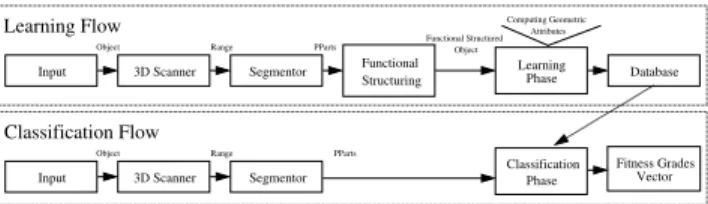
Fig. 2(upper part)shows the flow of the learning phase of our scheme. The input of the learning phase is a set of func-tional labeled objects. Each funcfunc-tional and primitive part is labeled with a symbol or a generic name. Examples of functional and primitive part symbols are ” ground support” and ” stick” , respectively. For each input object, the proposed scheme calculates the values for all the pre-defi ned geomet-rical attributes. Further, these attributes are subject to an RBF-like (radial-based function)learning (Mitchell 1997). We mention that, unlike (Mitchell 1997), we chosen to im-plement histograms via B-spline functions and not Gaussian ones due to a slightly better accuracy offered by B-spline functions. The accuracy issue was tested on some prelimi-nary experiments that we do not provide here due to space limitations.
In the learning phase, the scheme builds histograms for geometric properties of the functional parts as well as for the connections between the functional parts. The contin-uous domain of measured values for geometric properties is approximated by discrete accumulation values which are provided as the coeffi cients to B-spline functions that imple-ment the histograms. The scalar coeffi cients are normalized such that the maximum coeffi cient equals1.0.Note that this process is automatic, does not require other operator inter-vention but labeling.
Once the geometric properties of the primitive parts are pre-evaluated, the reasoning is conducted via histograms based grades, to be defi ned in the next section. For each functional part, the set of histograms of its constituents, functional(sub)-parts and connections, represents the sig-nature of the functional part.
Function-based approaches offer the advantage of gran-ular learning, that is, functional parts that have the same geometry and are shared between different classes do not have to be learnt with each new class. We exploit this advan-tage in speeding up the scheme for learning new objects; that is, we design the learning sequences from objects with func-tional parts having different geometry. Repetition of geomet-rically similar functional parts is not necessary. Neverthe-less, it can be used to dictate a bias in classifi cation.
Phase Classification Vector Fitness Grades Segmentor 3D Scanner Input Database Learning Phase Functional Structuring Segmentor 3D Scanner Input PParts Range Object Computing Geometric Attributes Functional Structured Object PParts Range Object Learning Flow Classification Flow
Figure 2: Learning and classifi cation flows.
Classification
Fig. 2(lower part)shows the flow of the classifi cation phase of our scheme. In the classifi cation mode, the input consists of a set of primitive parts, the connections between them, and the multi-level hierarchy provided by the learning phase. The classifi cation phase computes a vector of grades that de-scribes how an object offers class functionalities. Each ele-ment of the vector represents a grade relative to one class.
The class with the highest fi tness grade is chosen as the best match found by our scheme. For each one of the learnt classes the scheme tries to fi nd the best realization for the multi-level hierarchy functional structure out of the given set of primitive parts and the connections between them. (By re-alization we mean a partition for which we have evaluated its grades’ vector of fi tness.) A fi tness grade is then computed for each such realization. Thus, we reduce the problem of classifying a new object to the problem of fi nding the multi-level hierarchy functional structure realization with the high-est fi tness grade, which in fact relies on computing a parti-tion. More specifi cally, we defi ne a partition as a set of prim-itive parts sub-sets, each set representing a functional ele-ment in the multi-level hierarchy. The following subsections describe the fi tness grade computation process and several partitioning algorithms.
Fitness Grades Comp utation Assume we want to evalu-ate the fi tness grade for functionalityf andF H is a multi-level hierarchy computed forf.LetPin an input set of prim-itive parts which are to be partitioned in the functional parts of F H in order to recover f. LetP be the set of all hy-pothetic partitions of Pin in a F H structure and for any s ∈ F(f)S
P(f)let p(s)be the sub-set of the partition prelative tos.Defi ne grade(f, p) = X g∈G P(f) Hf(f, g) (p) Y s∈¡F(f)SC(f)¢ grade(s, p(s)) ifP(f)is empty and grade(f, p) = X g∈G P(f) Hf(f, g) (p) X s∈¡P(f)SC(f)¢ w(s, g)grade(s, p(s))
otherwise. Here,w(s, g)is a weight function that is pro-portional with the standard deviation (K enney & K eep-ing 1962) of the histogram function itself correspond-ing tosandg(not the histogram’s range)andHf(s, g) (p)
means the value of the geometric property histogram for s implemented following partition p. If p is a
primitive part then the fi tness grade grad e(p, p(p)) =
P
g∈G P(p)Hf(f, g) (p(p)).Ifcis a connection, then
grad e(c, p) = X
g∈G P(c)
w(c, g)Hf(c, g) (p). Moreover, for any functionality f, the fi tness grade is
de-fi ned as
grad e(f) = m a x
p∈P
grad e(f, p).
The weights are used to emphasize the geometric at-tributes that have a higher potential to characterize a specifi c class. We assume that this potential is higher in geometric attributes that have histograms with peaks than in ones that have constant value. In order to determine the best geomet-ric attributes we compute the weights as standard deviations (Kenney & Keeping 1962) of the histograms values. Note that the weights mechanism can eliminate unnecessary con-nections in cliques.
The classifi cation phase is a search and validation like al-gorithm over a fi nite graph of partitions. The main diffi culty in the classifi cation phase is to effi ciently select the best par-titions of the input objects’ primitive parts into functional parts. We focus on the question ” What function could this part fulfi l? ” For example, if we take a chair, several plates could serve as its seat, its back support, and one of its legs
(as part of its ground support).This motivates our interest
in designing algorithms for partitioning.
Matching Partitions to Functionalities We defi ne the matching of partitions to functionalities as a search in a fi -nite graph problem. The nodes and edges of the search graph are described below.
A function that associates a list of primitive parts to each functional part defi nes a partition. In addition, we defi ne a ” non-partitioned” set that contains all not matched primitive parts. Each node of the graph contains the above sets. We assume that the input 3D model consists ofnprimitive parts
whereas the analyzed class consists of mfunctional parts.
The search space is a graph with(m+ 1)nnodes. The fi rst
state of the graph is always the ” empty” state, i.e., all the primitive parts are located in the ” non-partitioned” section. The children’s generation function takes a state of levelk−1
in the graph and generates all possible realizations for thek
-th functional part from -the ” non-partitioned” primitive parts set. It assumes that the previousk−1functional parts are al-ready realized. Thus, the last level contains all possible par-titions of the object. The goal is to fi nd the state with the highest fi tness grade.
We used a heuristic search with a pruning branch-and-bound approach. Defi ne the partial fi tness grade of a primi-tive part, a functional part, or connectionarelative to
parti-tionpbe
partial(f, n) =
½
grad e(f, p) iff is assigned
1 otherwise , (1)
where nis a node in the search graph. For searching
pur-poses we use partial fi tness grades. From(1),it follows that
when the search reaches a leaf, the partial grade equals the fi tness grade.
Following (Grimson 1991), the algorithm searches the states’ graph starting from the ” empty” state. The algorithm searches for the partition that has the highest fi tness grade, which represents the classifi cation result. We have, however, changed the identifi cation of primitive parts into comparing signatures of functional parts with geometrical attributes of the functional part candidates.
In our tests we used an exhaustive search algorithm as well as a genetic search algorithm. Although the genetic al-gorithm erred in10% of the classifi cations, it has the advan-tage that is time bounded.
Ex periments
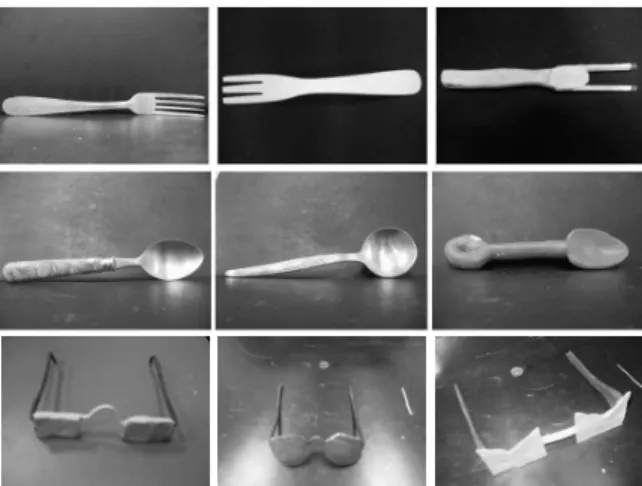
We tested our scheme on a database comprising synthetic models of2 00forks,2 16 spoons,2 00stools, and2 00 spec-tacles. We also tested our scheme on a database comprising
100forks,100spoons,9 7 chairs, and100spectacles, of real range images. Partial sets of the forks, spoons, chairs and the spectacles, that we used in experiments, are shown in Fig. 5 and 6. The objects in the range images were captured with a Cyberware range scanner(http://www.cyberware.com).
We performed four types of experiments aiming to check model strength, cross validation, receiver operating charac-teristic(ROC)and accuracy, and classifi cation in cluttered
scenes. In all the tests, the learning phase was performed on images that contain only one object. In model strength checking, cross validation, and ROC and accuracy tests, we used the proposed scheme to classify objects from 3D im-ages that contain only one object. In the cluttered scene tests, partial views of several objects were used.
Model Strength Checking In the model strength check-ing experiment, two sets of objects were used: a learncheck-ing set and a test set. The graph in Fig. 3(a)shows the test set
aver-age grades as a function of the size of the training set. Here, the lowest curve represents the average of the grades of the classifi ed objects and the higher curve shows the percentage of the test set’s average grade from the maximal grades in the test set. In the experiment shown in Fig. 3(a)the
learn-ing sets consisted of real scanned objects. The set used for classifi cation is constant per experiment and comprised all the scanned objects.
Cross V alidation We employ the whole data base in cross validation experiments. The learning(training)group repre-sented8 0% of the object class set whereas the classifi cation (or testing)group consists of the rest of the data base. The result of the classifi cation consists of computing grades: the classifi ed objects are evaluated as fork, mug, spoon, stool, and spectacles. The grades are averaged and presented as textured bars in a graph, that is shown in Fig. 3 (b). The
graph comprises fi ve groups of fi ve object class grades. For example, the fi rst group relates to forks that were classifi ed as forks, mugs, spoons, stools, or spectacles in this order. In Fig. 3(b), the forks, the spoons, and the spectacles were
range images. The tests on real data revealed that, although we can differentiate between forks and spoons, the degree
(a) (b) 0 0.2 0.4 0.6 0.8 1 0 0.1 0.2 0.3 0.4 0.5 0.6 0.7 0.8 0.9 1 0 0.2 0.4 0.6 0.8 1 0.2 0.3 0.4 0.5 0.6 0.7 0.8 0.9 1 Stools accuracy 0 0.2 0.4 0.6 0.8 1 0 0.1 0.2 0.3 0.4 0.5 0.6 0.7 0.8 0.9 1 Overall accuracy (c) (d) (e)
Figure 3: Experiments: (a) Learning and classifying real spoons. (b) Cross validation on the whole data base, which includes forks, mugs, spoons, stools, and spectacles. (c) A ROC on the whole data base for stools (the uppermost curve), forks, and spectacles (the lowest curve). (d) The accuracy of stools versus the rest of the data base.(e)Overall accuracy.
of differentiation is quite low. This is mainly due to the fact that spoons and forks have similar dimensions, forms, and functionality(both have handles and are graspable).
ROC and Accuracy Consider classifi ers that work on components of the vector fi tness grades(the classifi ers do not perform maximum on components).In Fig. 3(c),we show the ROC superimposed curves of stools, forks, and spoons. In Fig. 3(d),we show the accuracy of the classi-fi er of stools versus the data base. In Fig. 3 (e),unlike in Fig. 3 (c)and(d),we show the accuracy of the classifi er that performs maximum on vector grades, targeting all fi ve tested classes and the whole data base.
Cluttered Scenes In the cluttered scene tests, the learn-ing phase consisted of images that included only one chair. In the classifi cation phase we tested our scheme using two types of 3D images. The fi rst type of images included a chair and a table in a room while the second one included chairs and spoons(see Fig. 4 for examples of fi rst type of images). We tested our scheme on six images of the fi rst type and thirty images of the second type. In fi ve of the images from
(a) (b)
(c) (d)
(e) (f)
Figure 4: Two cluttered scenes of a chair and a table in a room.(a)and(b)represent two examples of the fi rst type of image. Fig.(c)and(d)represent results of segmentation of the scenes in(a)and(b),respectively. The primitive parts sticks and plates are shown as they are detected and mod-elled in the segmentation phase. Fig.(e)and(f)represent results of classifi cations of the scenes in(a)and(b), respec-tively.(e)and(f)show the resulting functional parts – the back support, seat, and the ground support – with different textures.
Figure 5: Images of some chairs used in the experiments. the fi rst type and in all the images of the second type, our system correctly classifi ed a valid chair.
Conclusions
In this work, we have presented a novel function-based scheme for classifi cation of 3D objects. The input objects
Figure 6: Images of some forks, spoons, and spectacles used in our experiments.
are full 3D descriptions of objects. The proposed scheme employs an object functional structure, consisting of a multi-level hierarchy of functional parts. The multi-multi-level approach offers a higher degree of freedom for real object modelling as compared to classical systems and can be seen as a learn-ing phase. The learnlearn-ing phase builds the multi-level hier-archy by analyzing primitive parts in the input images and their geometric attributes.
Our approach was tested on a database of about one thousand different 3D objects employing several algorithms for searching and pruning. To the best of our knowledge, no other classifi cation (or recognition)scheme was tested on hundreds of range images of real objects captured in range images. The graphs show the quality achieved by our scheme. They also provide an insight into the dimensions of the learning sets that are required so as to reach a certain degree of classifi cation accuracy. Our work appears to be the fi rst scheme that performs function-based classifi cation that involves a learning phase and does not require a-priori knowledge about any class.
Automatic segmentation usually suffers from over-segmentation. This phenomenon does not infl uence the ac-curacy of the proposed solution, however, it could produce an increase of the time complexity of the searching phase. The proposed solution is clearly parallelizable. We believe that employing concurrent or parallel variants of the al-gorithms, and/or implementing the classifi cation evaluation schemes on dedicated hardware, could greatly speed up the classifi cation process.
Part of our future work consists of enlarging the data base of the testing objects. Specifi cally, we intend to introduce more categories of objects captured in range images in the experiments. In addition, we are going to use more expres-sive approximation models for primitive parts. The more exact the approximation models are, the more accurate the classifi cation is expected to be.
Acknowledgments
The authors thank Nela Gurevich, Lev Ferdinskoif, Ohad Serfaty, V itali Greenberg, Artyom Sharov, Y anai Shpinner,
Fady Massarwi, Ebraheem Kassem, Leonid Raskin, Adir Abraham, Ronen Keidar, and Y ekutiel Pekar for their sup-port.
References
Biderman, I. 1987.Recognition by Components: A Theory of H u man Image U nd erstand ing. MIT Press.
Dickinson, S.; Bergevin, R.; Biederman, I.; Eklundh, J .; Munck-Fairwood, R.; J ain, A.; and Pentland, A. 1997. Panel report: The potential of geons for generic 3-d object recognition.IV C15(4):277– 292.
DiManzo, M.; Trucco, E.; Giunchiglia, F.; and Ricci, F. 1989. Fur: Understanding functional reasoning. Interna-tional J ou rnal of Intelligent S ystems4:431– 457.
Farin, G. 1996.Cu rv es and S u rfaces for CAG D - A P racti-cal G u id e. F ou rth E d ition. Academic Press Inc., Publishers
New Y ork.
Froimovich, G.; Rivlin, E.; and Shimshoni, I. 2002. Object classifi cation by functional parts. P roceed ings of the F irst International S ymposiu m on 3 D D ata P rocessing V isu al-iz ation and Transmission - 3 D P V T’0 2 648– 655.
Gibson, J . 1979. The E cological Approach to V isu al P er-ception. Houghton Miffi n, Boston.
Grimson, W. E. L. 1991. The combinatorics of heuristic search termination for object recognition in cluttered envi-ronments.IE E E P AM I 13(9):383– 397.
Hoover, A.; J ean-Baptiste, G.; J iang, X .; Flynn, P. J .; Bunke, H.; Goldgof, D. B.; Bowyer, K.; Eggert, D. W.; Fitzgibbon, A.; and Fisher, R. B. 1996. An experimental comparison of range image segmentation algorithms.IE E E P AM I18(7):673– 688.
Kenney, J . F., and Keeping, E. S. 1962. M athematics of S tatistics, P t. 1 , 3 rd ed .Princeton, NJ : V an Nostrand.
Mitchell, T. M. 1997. M achine L earning. McGraw-Hill
Companies.
Rivlin, E.; Dickinson, S.; and Rosenfeld, A. 1995. Recog-nition by functional parts.CV IU 62(2):164– 176.
Stark, L., and Bowyer, K. 1994. Function-based generic recognition for multiple object categories. CV G IP : Image U nd erstand ing59(1):1– 21.
Sutton, M. A.; Stark, L.; and Bowyer, K. 1994. Gruff-3: Generalizing the domain of a function-based recognition system.P attern Recognition27(12):1743– 1766.
Ullman, S. 1995. H igh-L ev el V ision, O bject Recognition and V isu al Cognition. The MIT Press, Cambridge,
Massa-chusetts, London, England.
Winston, P. H.; Binford, T. O.; Katz, B.; and Lowry, M. 1983. Learning physical descriptions from functional de-scriptions.AAAI-8 3 433– 439.
Woods, K.; Cook, D.; Hall, L.; Bowyer, K.; and Stark, L. 1995. Learning membership functions in a function-based object recognition system.J ou rnal of Artifi cial Intelligence Research3:177– 222.