1 23
Automated Software Engineering
An International Journal
ISSN 0928-8910
Volume 23
Number 3
Autom Softw Eng (2016) 23:305-359
DOI 10.1007/s10515-014-0168-9
Practical verification of decision-making in
agent-based autonomous systems
Louise A. Dennis, Michael Fisher,
Nicholas K. Lincoln, Alexei Lisitsa &
Sandor M. Veres
1 23
Commons Attribution license which allows
users to read, copy, distribute and make
derivative works, as long as the author of
the original work is cited. You may
self-archive this article on your own website, an
institutional repository or funder’s repository
and make it publicly available immediately.
DOI 10.1007/s10515-014-0168-9
Practical verification of decision-making in agent-based
autonomous systems
Louise A. Dennis · Michael Fisher · Nicholas K. Lincoln · Alexei Lisitsa · Sandor M. Veres
Received: 26 September 2013 / Accepted: 16 August 2014 / Published online: 6 September 2014 © The Author(s) 2014. This article is published with open access at Springerlink.com
Abstract We present a verification methodology for analysing the decision-making component in agent-based hybrid systems. Traditionally hybrid automata have been used to both implement and verify such systems, but hybrid automata based modelling, programming and verification techniques scale poorly as the complexity of discrete decision-making increases making them unattractive in situations where complex log-ical reasoning is required. In the programming of complex systems it has, therefore, become common to separate out logical decision-making into a separate, discrete, component. However, verification techniques have failed to keep pace with this devel-opment. We are exploring agent-based logical components and have developed a model checking technique for such components which can then be composed with a sepa-rate analysis of the continuous part of the hybrid system. Among other things this allowsprogrammodel checkers to be used to verify the actual implementation of the decision-making in hybrid autonomous systems.
Keywords Hybrid systems·Model checking·Agent architectures 1 Introduction
Autonomous systems are moving beyond industrial and military contexts, and are now being deployed in the home, in health-care scenarios, and in automated vehicles.
L. A. Dennis(
B
)·M. Fisher·A. LisitsaDepartment of Computer Science, University of Liverpool, Liverpool, UK e-mail: [email protected]
S. M. Veres
Department of Automatic Control and Systems Engineering, University of Sheffield, Sheffield, UK N. K. Lincoln
In many cases there may be a human operator who directs the autonomous system, but increasingly the system must work on its own for long periods without such interventions. These systems must essentiallydecide for themselveswhat to do and when to do it. This might seem fraught with danger, but there is a clear need for such systems, particularly:
– when deployed inremoteordangerousenvironments where direct and local human control is infeasible; or
– when thecomplexityorspeed of the environmental interactions is too high for a human to handle.
Examples of the former include deep sea exploration, space probes, and contami-nated area cleanup; examples of the latter include automated stock trading systems, robot swarms, and unmanned air vehicle collision avoidance. In addition to the above reasons, autonomous systems are becoming popular as they can sometimes be much
cheaperto develop and deploy than manned systems.
1.1 Hybrid autonomous systems
Autonomous systems, such as we are discussing, are constructed in a component-based fashion with an agent-component-based decision maker and a continuous control system. This means they have a natural decomposition at design time. In many cases the agent-based decision maker is viewed as the replacement for a human pilot or operator who would, otherwise, interact with the control system.
Systems that combine continuous control algorithms with any kind of discrete behaviour that forms jumps between different continuous states are called hybrid control systems. When the discrete component includes behaviour we would recognise as autonomous we refer to the system as ahybrid autonomous system. Traditionally, such hybrid autonomous systems have been engineered using the concept of ahybrid automaton(in which continuous aspects are encapsulated within a single state of an automaton while discrete jumps are represented as transitions between these states— see Sect.2.4for a more detailed description). However, as these systems have become more complex, combining discrete decision-making and continuous control within a hybrid automaton has faced challenges. It is difficult to separate the two concerns (decision-making and continuous control) when designing and implementing a system in this fashion—this has an impact on the understandability and reuse of both design and code. Furthermore many autonomous systems operate in environments where the users wish to access some high level account forwhya decision was taken by the system (Fisher et al. 2013). Such an account can be difficult to extract from a hybrid automaton. As a result, the practice developed of separating decision-making components from the underlying control system, often using the popular agent paradigm (Wooldridge 2002). A drawback of this approach, however, is that it is generally non-trivial to transform such a system back into a hybrid automaton based model and so well-developed techniques for verifying hybrid automata by model checking (Henzinger et al. 1997;Frehse 2005) become difficult to apply to these new systems. Moreover, verification of hybrid automaton based systems tends to scale badly as the reasoning
processes become more complex. Since autonomous systems are frequently safety or mission critical this verification gap is a significant concern.
1.2 A methodology for verifying autonomous choices
InFisher et al.(2013) we proposed a methodology for the verification of decision-making components in hybrid autonomous systems, where such a decision-decision-making component is implemented as a rational agent. In this paper, we give a more detailed and technical explanation of the methodology and apply the approach to verify the implementation of agent-based decision-making in a variety of complex autonomous systems (see Sects.3,4,5). We argue that one of the most crucial aspect of verifying complex decision-making algorithms for autonomous systems, for example concern-ing safety, is to identify that the controllconcern-ing agentneverdeliberately makes a choice itbelievesto be unsafe.1In particular this is important in answering questions about whether a decision-making agent will make the same decisions as a human operator given the same information from its sensors.
How might weguaranteebehaviour within such an autonomous system embedded in the real world? Following a decompositional approach we neednot(and, indeed we argue that we can not) ensure that an autonomous system willcertainlylead to a change in the real world.
Thus, rather than verifying agent behaviour within a detailed model of the system’s environment, we now verify the choices the agent makes given the beliefs it has. This approach is clearly simpler than monolithic approaches as we can state properties that only concern the agent’s internal decisions and beliefs, and so verification can be carried out without modelling the “real world”. At a logical level, the verification of
safetyproperties changes from the checking of2
¬bad
i.e., nothing bad can ever happen which involves verifying the state of the external world, to checking3
Bagent¬bad
i.e., the agent never believes that something bad happens which involves only checking the internal state of the agent. Similarly,livenessproperties change from checking
♦good(eventually something good happens) to checking♦Bagentgood(eventually the agent believes something good has happened). Thus, we verify the (finite)choices
the agent has, rather than all the (typically infinite) “real world” effects of those choices. Specifically, we proposemodel checking(and themodel checking of programs, if possible) as an appropriate tool for demonstrating that the core rational agent always endeavours to act in line with our requirements and neverdeliberatelychooses options that lead internally to bad states (e.g., ones where the agent believes something is 1 Further discussion of this aspect is provided inFisher et al.(2013).
2 ‘’ and ‘♦’ are temporal logic operators meaning “at all future moments” and “in some future moment”,
respectively, while ‘Bagent’ is a logical operator describing the beliefs the agent has.
3 Alternatively:B
unsafe). Since we are verifying only the core agent part we can use model checking approaches that do not consider the continuous behaviour of the system. These are easier to use in a modular/compositional fashion than approaches designed to cope with the continuous and real world aspects. Thus, we do not verify all the “real world” outcomes of the agent’s choices (but assume that analysis of the underlying control system has provided us with theorems about the outcomes of actions etc.), but do verify that it always tries to achieve its goals/targets to the best of its knowledge/beliefs/ability. Thus, the agentbelievesit will achieve good situations andbelievesit will avoid bad situations. Consequently, any guarantees here are about the autonomous system’s decisions, not about its external effects.
Efforts to model the entire system and its interaction with the real world with any degree of accuracy necessarily involve complex abstractions together with a num-ber of assumptions. These abstractions and assumptions are embedded deep within an executable model and may not be explicit to end users, or even to the modellers. There-fore if we provide a guarantee, for example, that the autonomous system can definitely achieve or avoid something, there will be a number of pre-conditions (that the real world will behave in some particular way) to that guarantee that may be hard to extract. One of the aims of our approach is that the assumptions embedded in the modelling of the real world should be as explicit as possible to the end users of a verification attempt. Obviously, some parts of an agent’s reasoning are triggered by the arrival of infor-mation from the real world and we must deal with this appropriately. So, we first analyse the agent’s program to assess what these incomingperceptionscan be, and then explore, via the model checker, all possible combinations of these. This allows us to be agnostic about how the real world might actually behave and simply verify how the agent behavesno matter whatinformation it receives. Furthermore, this allows us to use hypotheses that explicitly describe how patterns of perceptions might occur. Taking such an approach clearly gives rise to a large state space because we explore all possible combinations of inputs to a particular agent. However it also allows us to investigate a multi-agent system in a compositional way. Using standardassume-guarantee(or rely-guarantee) approaches (Misra and Chandy 1981;Jones 1983,1986;Manna and Pnueli 1992;Lamport 2003), we need only check the internal operation of a single agent at a time and can then combine the results from the model checking using deductive meth-ods to prove theorems about the system as a whole. Abstracting away from the contin-uous parts of the system allows us to use model checking in a compositional fashion. It should be noted that, in many ways, our approach is the complement of the typical approach employed in the verification of hybrid automata and hybrid programs. We are primarily concerned with the correctness of the discrete algorithms and are happy to abstract away from the underlying continuous system, while the other approaches are more concerned with the verification of the continuous control and are happy to abstract away from the discrete decision-making algorithms.
1.3 Overview
In summary, we had two main aims in developing our verification methodology: to maintain the natural decomposition of the system design in the verification, allowing us to verify the symbolic (i.e., logical decision based) and non-symbolic (continuous)
aspects separately; and to make any assumptions about the continuous/real world environment as explicit as possible. It is preferable to treat the verification and analysis in a compositional fashion, if at all possible, for a variety of reasons. It simplifies the verification task, encourages reuse, and allows appropriate domain specific analysis tools to be used. Compositional verification has its roots in the use of lemmas in the construction of proofs both by hand and, more recently, with mechanized theorem proving tools. In model checking settings care sometimes has to be taken to use sound composition rules, especially in cases where the reasoning contains circular elements (e.g., system A requires system B to be correct as an assumption while sub-system B requires sub-sub-system A to be correct as a an assumption) (McMillan 1999;
Barringer and Giannakopoulou 2003).
In many of the situations we are interested in, the control systemistrusted and the primary concern is the extent to which the decision-making component conforms to the expectations about the behaviour of a human operator. This provides an additional motivation to verify the symbolic reasoning in detail and in isolation.
Thus, in summary, our overall approach (Fisher et al. 2013) involves:
1. modelling/implementing the agent behaviour and describing the interface (input/ output) to the agent;
2. model checking the decision-making agent within a coarse over-approximation of the environment derived from the analysis of agent inputs (this will establish some property,ϕ);
3. if available, utilizing environmental hypotheses/assumptions, in the form of logical statements, to derive further properties of the system;
4. if the agent is refined, then modify (1) while if environmental properties are clarified, modify (3); and
5. deducing properties of multi-agent systems by model checking the behaviour of individual agents in a component-wise fashion and then combining the results deductively to infer properties of the whole system.
We will later examine three very different scenarios in order to exemplify the key features of the methodology.
Previous work (Fisher et al. 2013) presents a high level overview of the work described here. It concentrates primarily on outlining the methodology without any discussion of or comparison to alternative approaches. Two of the case studies (the Search and Rescue scenario and the Satellite example) are also presented in brief but without presentation of the actual code, any details on how the verification is set up, how the environmental assumptions are obtained, nor discussion of performance issues. The chief contributions of this paper are:
– Extended and more detailed versions of the first two case studies,
– Positioning our technique properly within the wider field of the verification of hybrid systems,
– The new case study on adaptive cruise control.
These provide technical detail on how the methodology actually works, how it inte-grates with other systems, and where it exists in the field of the verification of hybrid
systems. We believe this detail to be important to understanding the methodology and, critically, to any attempt to implement it.
The satellite system presented in our second case study has also been presented inLincoln et al.(2013). This makes no reference to the verification at all and instead focuses on the implementation issues with considerable attention paid to the continu-ous control and the link between the agent and the control system.
2 Background and related work
The verification of making in hybrid agent systems, where that decision-making takes place as part of a separate agent-based component, draws upon back-ground and research from a range of areas, namely hybrid control systems, agent-based programming and verification approaches to hybrid systems and rational agents. 2.1 Hybrid control systems
A fundamental component of low-level control systems technology is thefeedback controller. This measures, or estimates, the current state of a system through a dynamic model and produces subsequent feedback/feed-forward control signals. In many cases, difference equations can be used to elegantly manage the process. These equations of complex dynamics not only make changes to the input values of sub-systems and monitor the outcomes on various sensors, but also allow deeper understanding of system behaviour via analytical mathematical techniques.
As we move to autonomous systems, such controllers are increasingly required to work in situations where there are areas of discontinuity, where a distinct change in behaviour is required and where control needs to switch to the use of an alternative model and alternative control equations. This kind of control system often requires some decision-making system to be integrated with the feedback controller (Branicky et al. 1998;Varaiya 1999;Goebel et al. 2009). It may also be necessary for a system to take actions such as detecting that a fuel line has ruptured and switching valves to bring an alternative online: this falls outside the scope of monitoring and adjusting input and output values, and involves detecting that thresholds have been exceeded or making large changes to the system.
It is possible to encode all these choices in, often hierarchical, hybrid automata but this creates several problems from a software engineering perspective. Firstly, it does not allow a naturalseparation of concernsbetween the algorithms and procedures being designed or implemented for making decisions, and those which are being designed and implemented for continuous control, this reduces theunderstandability
of the resulting code and therefore increases the risk of errors and bugs being present in the code. It can often also make the underlying code, particularly that of decision-making algorithms, harder to reusesince it becomes more difficult to identify the generic aspects of any decision algorithm from those that are specific to the continuous control. There is also evidence (Damm et al. 2007;Dennis et al. 2010b) that hybrid automata based implementations scale poorly with the complexity of decision-making when compared to agent-based control. This again impacts upon understandability.
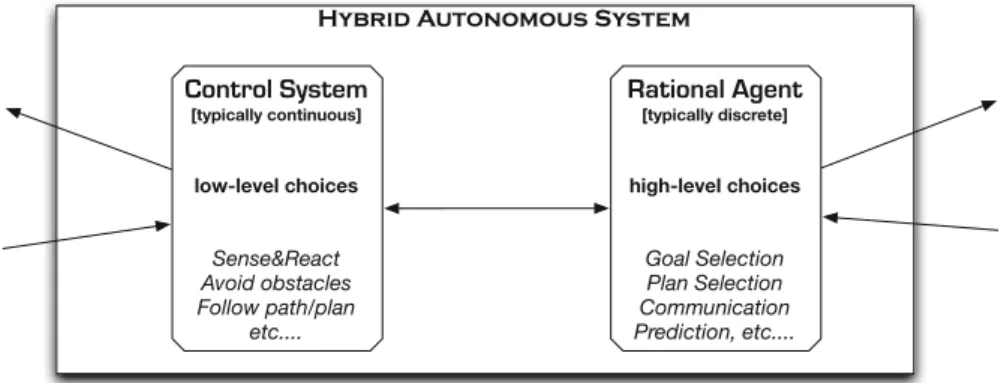
Fig. 1 The typical structure of a hybrid autonomous system. Low level choices (e.g., tight sense-react loops) are governed by the control system while high-level choices (e.g., managing long term goals) are governed by a rational agent
In the autonomous systems we consider here, the control system usually fol-lows fairly well defined functions, while the discrete decision-making process must make appropriate choices, often without human intervention; see Fig.1. Increasingly, this discrete decision-making process will be a rational agent, able to make justi-fiable decisions, to reason about those decisions, and dynamically modify its strat-egy (Wooldridge and Rao 1999).
2.2 Agents and rational agents
At its most general, anagent is an abstract concept that represents anautonomous
computational entity that makes its own decisions (Wooldridge 2002). Since its intro-duction in the 1980s, the agent abstraction has become very influential in practical situations involving complex flexible, autonomous, and distributed components (Bond
and Gasser 1988;Bratman et al. 1988;Davis and Smith 1983;Cohen and Levesque
1990;Durfee et al. 1989;Shoham 1993).
A general agent is simply the encapsulation of some distributed computational component within a larger system. However, in many settings, something more is needed. Rather than just having a system which makes its own decisions in an opaque way, it is increasingly important for the agent to have explicitreasons(that it could explain, if necessary) for making one choice over another.
In the setting of autonomous systems, explicit reasoning assists acceptance. When queried about its choices an autonomous system should be able to explain them, thus allowing users to convince themselves over time that the system is reasoning competently. More importantly, where an autonomous system is likely to be the subject of certification, it may need to fulfill obligations to do with reporting, particularly in instances where an accident or “near miss” has occurred. It is desirable for such reporting to be presented at a high level which explains its choices in terms of what information it had, and what it was trying to achieve.
Rationalagents (Bratman 1987;Rao and Georgeff 1992;Wooldridge and Rao 1999) enable the representation of this kind of reasoning. Such an agent has explicit reasons
for making the choices it does. We often describe a rational agent’sbeliefsandgoals, which in turn determine the agent’sintentions. Such agents make decisions about what action to perform, given their current beliefs, goals and intentions.
The predominant view of rational agency is that encapsulated within the BDI model (Rao and Georgeff 1991,1992,1995). Here, ‘BDI’ stands forBeliefs,Desires, andIntentions. Beliefs represent the agent’s (possibly incomplete, possibly incorrect) information about itself, other agents, and its environment, desires represent the agent’s long-term goals while intentions represent the goals that the agent is actively pursuing. There aremanydifferent agent programming languages and agent platforms based, at least in part, on the BDI approach. Particular languages developed for programming
rationalagents in a BDI-like way includeAgentSpeak(Rao 1996),Jason(Bordini et al. 2005, 2007),3APL(Hindriks et al. 1999;Dastani et al. 2005),Jadex(Pokahr et
al. 2005),Brahms(Sierhuis 2001),GOAL (Hindriks et al. 2001;Boer et al. 2007), andGwendolen(Dennis and Farwer 2008). Agents programmed in these languages commonly contain a set ofbeliefs, a set ofgoals, and a set ofplans. Plans determine how an agent acts based on its beliefs and goals and form the basis forpractical reasoning (i.e., reasoning about actions) in such agents. As a result of executing a plan, the beliefs and goals of an agent may change as the agent performs actions in its environment.
Agent based control of decision-making in hybrid systems has been an area of research since at least the 1990s. Kohn and Nerode’s MAHCA system (Kohn and
Nerode 1992) uses multiple knowledge-based agents as planners which generate
the actions performed by the underlying control system. While these agents are not based on the BDI paradigm, which was only in its infancy when MAHCA was orig-inally developed, the approach is motivated by a desire to represent logical decision-making in a high-level declarative fashion. More recently agent based approaches have been explored in the control of spacecraft (Muscettola et al. 1998), Unmanned Aircraft (Karim and Heinze 2005;Webster et al. 2011;Patchett and Ansell 2010), and robotics (Wei and Hindriks 2013). Many of these approaches are explicitly BDI based and are motivated by the desire to separate the symbolic and non-symbolic reasoning and model the mission designer’sintent.
Generating appropriate abstractions to mediate between continuous and discrete parts of a system is the key to any link between a control system and a reasoning system. Abstractions allow concepts to be translated from the quantitative data derived from sensors (and necessary to actually run the underlying system) to the qualitative data needed for reasoning. For instance a control system may sense and store precise location coordinates, represented as real numbers, while the reasoning system may only be interested in whether a vehicle is within reasonable bounds of its desired position.
We have been exploring an architecture (Dennis et al. 2010a) in which the rational agents are partnered with anabstraction enginethat discretizes the continuous infor-mation in an explicit fashion which we are able to use in verification. Currently the abstraction engine is implemented as a distinct rational agent, though we intend to move to a stream processing model in future. We describe this technique further in Sect.4.
2.3 Formal verification and model checking
Formal verification is essentially the process of assessing whether a specification given in formal logic is satisfied on a particular formal description of the system in question. For a specific logical property,ϕ, there are many different approaches to this (Fetzer 1988; DeMillo et al. 1979; Boyer and Moore 1981), ranging from deductive verification against a logical description of the systemψS(i.e.,ψS⇒ϕ) to the algorithmic verification of the property against a model of the system,M(i.e.,
M |ϕ). The latter has been extremely successful in Computer Science and Artificial Intelligence, primarily through themodel checkingapproach (Clarke et al. 1999). This takes an executable model of the system in question, defining all the model’s possible executions, and then checks a logical property against this model (and, hence, against all possible executions).
Whereas model checking involves assessing a logical specification against all exe-cutions of amodelof the system, an alternative approach is to check a logical property directly against allactualexecutions of the system. This is termed themodel checking of programs(Visser et al. 2003) and crucially depends on being able to determine all executions of the actual program. In the case of Java, this is feasible since a modified virtual machine can be used to manipulate the program executions. The Java Pathfinder (JPF) system (Visser et al. 2003) carries out formal verification ofJava programs in this way by analysing all the possible execution paths. This avoids the need for an extra level of abstraction and ensures that verification truly occurs on the real system.
All model-checking techniques have to deal with issues of scalability. In essence they all involve exhaustive search over all executions of a system and so, as the system increases in size, they run into combinatorial explosion. Many advanced techniques have been developed to combat these issues including checking for loops, limiting search branching in ways that do not compromise the result ( par-tial order reduction), and abstracting the system in systematic ways, again to limit the number of states and branch points. Program model checking is typicallymuch
slower even than standard model checking because actual programs tend to con-tain more instructions, at a lower level (and hence involves either more branch points or more computation to generate each state of the system), than models of programs.
2.4 Verifying hybrid systems
Both theorem proving and model checking techniques have been applied to the verifi-cation of hybrid systems and there are several mature tools available (e.g., KeYmaera (theorem proving),HyTechandPHAVer(both model checking)).
As mentioned above, there are two major approaches to constructing hybrid sys-tems. We have followed the methodology of providing two components, a decision making system that interacts with an underlying control system. The other major approach is that of hybrid automata and it is on that approach that most of the verifi-cation efforts have been focused.
An automaton consists of a set of states with transitions between them. Traditionally automata states are static but, in hybrid automata, the states are governed by differential inclusions which control the behaviour of the overall system while the automata is in that state. Each state therefore contains (state)variableswhose value may evolve and change in a continuous fashion while the automata is in that state. Key aspects of a hybrid automaton state are theflow conditions; equations which express the evolution of continuous variables while in that state, andinvariant conditions; a predicate over the state variables which must be satisfied in that state. If the invariant conditions are violated then the state is forced to transition to another. When a transition occurs,jump conditionsdetermine the initial values of the state variables in the next state.
The model checking of hybrid automata involves first composing the implemented system with a model of the real world, also expressed as a hybrid automaton. Then the model checker explorestrajectorieswithin each automata state. Given (a set of) starting values for the variables in the state the system attempts to determine a bounded sub-region ofRnwhich contains all possible values of the variables that can be reached within that state before it transitions to another. The possible values of the variables at the point of transition, together with the jump conditions, will form the starting values for the variables in the next state, and so on until all possible states of the system have been explored. (SeeHenzinger 1996;Alur et al. 2000;Henzinger et al. 1997for detailed descriptions of the model checking of hybrid automata based systems.)
Since the real world can not be modelled in its full complexity, modelling it as a hybrid automaton requires some kind of abstraction. Abstraction has a long history in the formal modelling of “real world” phenomena for verification (Clarke et al. 1994) and abstractions for model checking hybrid systems have been extensively studied (Alur et al. 1995;Henzinger et al. 1997;Tiwari 2008;Tabuada 2009). Since the “real world” is inherently complex, often involving control systems, physical processes and human interactions, even defining appropriate abstractions is difficult. Often we either take a verycoarseabstraction, which risks being very far away from a real system, or a verydetailedabstraction leading to complex structures such as stochastic, hybrid automata (which are, themselves, often very hard to deal with (Bujorianu 2012)). We also face this problem in our agent-based approach which favours acoarse
abstraction.
From our perspective: the verification of decision making code in agent-based hybrid control systems, with a particular interest in the verification of implementations of decision-making algorithms, the hybrid automata approach has several drawbacks, as follows.
1. As noted earlier, it is difficult to decompose a hybrid automaton with a complex decision-making process into sub-systems (though approaches using concurrent automata are possible). However, even after such a decomposition, the model checking problem can not be easily decomposed to consider only some sub-set of the states of the system (e.g., just those involved with control algorithms). The calculation of a bounded region that limits the trajectories within a state is dependent upon the possible values of the variables on entering the state and these, in turn, depend upon the values of those variables in the previous state and the jump conditions. Therefore the region of possible trajectories may vary each
time a state is visited. As a result, the algorithm needs to calculate all the potential sets of starting values for each state. It is not, in general, possible to determine in advance what the entry constraints will be for some sub-set of the automaton states without exploring the whole automaton. As a result the whole system must often be treated as a unit. This not only makes the model checking problem harder but also limits the reuse of results when changes are made to the system. Section2.4.1
surveys some recent work to overcome this problem.
2. The classes of hybrid automata that have decidable model checking problems are limited. While there are several possible decidable fragments, linear hybrid automata are most frequently used. The main restrictions on linear hybrid automata are that the formulæ describing the evolution of dynamic variables, their con-straints, and the evolution to new discrete states must be finite conjunctions of linear inequalities, and the flow conditions may refer only to derivatives of state variables and not to the variables themselves. From the perspective of complex decision-making the restriction to conjunctions of inequalities, rather than more expressive formulæ forces logical reasoning to be modelled using sequences of discrete transitions where intuitively only one transition should take place. 3. This in turn means that tools such as HyTech (Henzinger et al. 1997), and
PHAVer(Frehse 2005) implemented for the model checking of linear hybrid automata also do not scale well in the presence of large discrete state spaces (Damm et al. 2007). Not only do complex logical computations have to be modelled as a set of states with the same continuous dynamics, but also the process of determining trajectories through individual discrete states tends to create multiple states in the model checking algorithm for each state in the hybrid automata (i.e., a state for each possible region of trajectories through the state).
4. As noted above, a hybrid automaton models the behaviour of an entire system; both the computational and the real world parts. As a result, in general, hybrid automata do not provide a suitable implementation language for a programmer wishing to create the computational parts of some larger system. Consequently, hybrid automata model checking operates much like standard model checking, i.e., it verifies amodelof the implemented system, rather than the system itself. Particularly in certification contexts and especially when introducing a novel com-ponent such as an autonomous decision-maker, there is a need to verify theactual
implemented system (or at least the implementation of the novel part). In these cases it is necessary to somehow compile the implemented system, together with a model of its environment, into an explicit hybrid automaton before analysis.
2.4.1 Solutions to compositionality and expressivity
In recent years there has been considerable work on overcoming the problems outlined in the previous section. In particular the issue of compositionality and abstraction has been tackled in a number of ways.
PHAVer(Frehse 2005) is a model-checking system for linear hybrid automata that uses assume-guarantee style reasoning to allow the model checking to be approached in a compositional fashion (Frehse et al. 2004). The approach takes a hybrid automaton that has been constructed from the parallel composition of smaller sub-systems (e.g.,
a physical system with its continuous dynamics, and a software controller). During model checking, these sub-systems can be replaced by abstractions which have certain features that retain the soundness of the approach. So a physical system can be model checked, composed with an abstraction of a software controller and vice versa. The more abstract systems constitute an over-approximation of the original sub-system and therefore it is possible for the verification process to return false negatives (i.e., it may disprove a conjecture that is actually true). The underlying verification continues to use hybrid automata based model checking and so remains constrained by many of the considerations above (e.g.,PHAVeris restricted to linear hybrid automata). However the basic approach, abstracting away one sub-system, is substantially similar to the one we adopt here.
Platzer has developed a theorem proving approach for verifying hybrid automata which is implemented in the KeYmaera system (Platzer 2010). This benefits from many of the advantages of theorem proving including a naturally compositional approach to proof. Theorem proving also produces stronger, more general, results than model checking but has its disadvantages. Producing such verifications is generally time-consuming and requires highly skilled users although KeYmaera is linked to a number of automated systems for solving sub-problems.
KeYmaera verifies hybrid systems which are represented ashybrid programs writ-ten in a dedicated while-style programming language. There is a direct embedding of hybrid automata into hybrid programs. Howeverhybrid programsare more expres-sive than, for instance, linear hybrid automata, and it is possible to represent com-plex logical formulæ as invariants on states. Unfortunately, the language remains at a low level, meaning that the implementation of complex decision-making is quite cumbersome.
2.4.2 Solutions to the modeling problem
While it is theoretically possible to represent all hybrid systems as hybrid automata or hybrid programs, it is time consuming to do so. In particular, as noted above, it is difficult to represent complex computations occurring at the discrete decision-making level in a compact fashion. As a result, where complex decision-making takes place the hybrid automaton (or hybrid program) that models the system for verification frequently abstracts away from the process and, instead, just represents all possible outcomes of the decision-making as non-deterministic choices.
There have been several attempts to produce systems that will compile higher level programming languages into hybrid automata for verification—thus allowing the full complexity of decision-making to be represented. These systems can also, potentially, employ abstraction techniques during the compilation process in order to reduce the search space. Such approaches have focused on synchronous languages such asLustre(Briand and Jeannet 2009), and Quartz (Bauer 2012).
The agent paradigm, in particular, has been developed to address distributed asyn-chronous situations which makes it attractive in situations where a synasyn-chronous model of time is unhelpful. However, as yet, no system has been created to compile agent-based control into hybrid automata.
2.5 Model checking agent programs
There are a number of approaches to model checking and verifying multi-agent sys-tems (Alechina et al. 2010;Lomuscio et al. 2009;Gammie et al. 2004). Most of these are not specifically geared towards BDI-style rational agents but provide more general tools for the analysis of agents. In general these have not been applied to the prob-lem of hybrid systems although MCMAS has been used in the verification of hybrid automata (Ezekiel et al. 2011).
There are four systems that focus specifically on the model checking of BDI pro-grams.Jongmans et al.(2010) describe a program model checker tailored specifically towards theGOALprogramming language. BothHunter et al.(2013) andStocker et
al.(2012) have investigated the model checking ofBrahms(Sierhuis 2001) programs using SPIN (Holzmann 2004). Both systems re-implementBrahmsinJavaand then either export directly into SPIN (Stocker et al. 2012) or use Java Pathfinder (JPF) to generate a model which is then exported to SPIN (Hunter et al. 2013). Bordini et al.
(2006) explores the model checking ofAgentSpeakprograms in both SPINand JPF but, as far as we aware, the system is no longer maintained.
The MCAPL framework (Dennis et al. 2012) (described in more detail below) provides access to model checking facilities to programs written in a wide range of BDI-style agent programming languages so long as those languages have a Java-based program interpreter. We chose to use the MCAPL framework in this work.
2.5.1 The MCAPL framework
In the examples discussed later in this paper we use the MCAPL framework which includes a model checker built on top of JPF. We do not consider the framework to be integral to our approach to the verification of agent-based decision-making in autonomous systems, though some general background on the system will be use-ful when reading the later examples. The framework is described in detail in Den-nis et al.(2012), we therefore provide only a brief overview here. It has two main sub-components: the AIL-toolkit for implementing interpreters for rational agent pro-gramming languages and the AJPF model checker.
Interpreters for BDI languages are programmed by instantiating theJava-based
AIL toolkit(Dennis et al. 2008). An agent system can be programmed in the normal way for a language but runs in the AIL interpreter which in turn runs on the Java Pathfinder (JPF) virtual machine. This is aJavavirtual machine specially designed to maintain backtrack points and explore, for instance, all possible thread scheduling options (that can affect the result of the verification) (Visser et al. 2003).
Agent JPF (AJPF) is a customisation of JPF that is optimised for AIL-based lan-guage interpreters. Agents programmed in lanlan-guages that are implemented using the AIL-toolkit can thus be model checked in AJPF. Furthermore if they run in an envi-ronment programmed inJava, then the whole agent system can be model checked. Common to all language interpreters implemented using the AIL are the AIL-agent data structures forbeliefs,intentions,goals, etc., which are subsequently accessed by the model checker and on which the modalities of a property specification language are defined. Since we will be using this AJPFproperty specification language(PSL)
extensively later in this paper, we here describe its syntax and semantics (fromDennis et al. 2012).
2.5.2 Temporal and modal logics and the MCAPL property specification language
In standard model checking, the logical formulæ are typically from some variety of
temporal logic, such as PLTL (propositional linear temporal logic). Underlying this particular logic is a model of time based upon the natural numbers. Non-temporal formulæ are evaluated at a single moment in time. Thus, some proposition ‘raining’ might be true at the current moment in time but false in the next moment. Temporal operators then allow us to move between moments in time within our formulæ. In PLTL, such operators are typically of the form ‘’ (at all future moments), ‘♦’ (at some future moment), ‘ g’ (at the next moment), etc. Thus
♦raining ⇒ gget_umbrella
means that if, at some moment in the future it will be raining, then at the next moment in time we should get our umbrella. Such a logical base provides well-understood and unambiguous formalism for describing the basic system dynamics (Fisher 2011). (Note that we do not define ♦,, etc, directly but give the semantics of the more expressive temporal operators U andR, and then derive other temporal operators from these as needed.)
However, in order to describe the behaviour of, and requirements within, rational agents, we often need additional logical dimensions (Kurucz 2006). Thus we combine our basic temporal logic with logical modalities for describing beliefs (that represent the agent’s knowledge about its situation) and motivations (that represent the agent’s reasons for making choices).
As an example, consider the following formula, a variation of which we will use later:
Bfound_human ⇒ ♦(Bis_free ∨ Imake_free)
meaning that if a robot believes it has found a trapped human then eventually either it believes the human is free or it intends to make the human free. Notice how this formula combines temporal operators with the belief operator,B, and the intention operator,I.
The AJPF property specification language is thus formally defined as follows:
PSL syntax The syntax for property formulæϕis as follows, whereagis an “agent constant” referring to a specific agent in the system, and f is a ground first-order atomic formula:
ϕ: : = Bag f |Gagf |Aagf |Iagf |P(f)|ϕ∨ϕ| ¬ϕ |ϕU ϕ|ϕRϕ
Here, Bag f is true if ag believes f to be true, Gagf is true if ag has a goal to make f true, and so on withArepresenting actions,Irepresenting intentions, andP
representing percepts, i.e., properties that are true in the external environment (e.g., a simulation of the real world) in which the agent operates.
PSL semantics We next examine the specific semantics of our property formulæ. Consider a program, P, describing a multi-agent system and letMASbe the state of the multi-agent system at one point in the run ofP.MASis a tuple consisting of the local states of the individual agents and of the environment. Letag ∈ MAS be the state of an agent in theMAStuple at this point in the program execution. Then
MAS|MC Bag f iffag| f
where|is logical consequence as implemented by the agent programming language.4 The interpretation ofGagf is given as:
MAS|MC Gagf iff f ∈agG
whereagG is the set of agent goals (as implemented by the agent programming lan-guage).5The interpretation ofAagf is:
MAS|MCAagf
if, and only if, the last action changing the environment was action f taken by agent
ag. Similarly, the interpretation ofIagf is given as:
MAS|MC Iagf
if, and only if, f ∈agGand there is anintended meansfor f (in AIL this is interpreted as having selected some plan that can achieve f). Finally, the interpretation ofP(f)
is given as:
MAS|MC P(f)
if, and only if, f is a percept that holds true in the environment.
The other operators in the AJPF property specification language have standard PLTL semantics (Emerson 1990) and are implemented as Büchi Automata as described inGerth et al.(1996),Courcoubetis et al.(1992)). Thus, the classical logic operators are defined by:
4 Some agent languages may draw on more than just the belief base when determining logical consequence.
Hence this is written asag| f notagB | f. This does not mean that an agent can believe one of its goals is true (when it is not true but is simply a goal), but does mean that the agent can believe that it has some goal.
5 In some languages agents may deduce the existence of implicit goals they possess, based on the explicit
goals in the Goal Base. At present the PSL semantics do not support verification of the existence of implicit goals, but it is an extension that we intend to consider. Our thanks go to the anonymous referee who raised this issue.
MAS|MC ϕ∨ψiffMAS|MCϕorMAS|MC ψ
MAS|MC ¬ϕ iffMAS|MC ϕ.
The temporal formulæ apply to runs of the programs in the JPF model checker. A run consists of a (possibly infinite) sequence of program statesMASi,i≥0 whereMAS0 is the initial state of the program (note, however, that for model checking the number ofdifferentstates in any run is assumed to be finite). LetPbe a multi-agent program, then
MAS|MC ϕU ψiff in all runs ofPthere exists a stateMASj such thatMASi |MC ϕfor all 0≤i < j and
MASj |MC ψ
MAS|MC ϕRψiff eitherMASi |MC ϕfor alli or there existsMASj such thatMASi |MC ϕfor alli ∈ {0, . . . ,j}and
MASj |MC ϕ∧ψ
The common temporal operators♦(eventually) and(always) are, in turn, derivable fromU andRin the usual way (Emerson 1990).
For the future, we hope to incorporate modalities for knowledge (for describing information evolution) and coalitions (for describing cooperative systems) ( Black-burn et al. 2006) as well as extending some or all of these modalities to a full logic. Investigating alternative logics for model checking autonomous systems is also the subject of further work.
In this section we have examined the history of agent-based control of hybrid sys-tems and the separate strands of research into the verification in hybrid syssys-tems and verification of agent programs. We next begin to tackle a series of example systems, defining the controlling agent(s), describing the environmental assumptions and car-rying out formal verification.
3 Scenario: urban search and rescue
Consider a (simplified) example based on theRoboCup Rescue, or “urban search and rescue”, scenario (Kitano and Tadokoro 2001). This is a widely used test scenario for autonomous mobile robots, providing not only a variety of environmental abstractions but also the potential for both individual and cooperative behaviours. A natural dis-aster (e.g., an earthquake) has caused buildings to collapse. Autonomous robots are searching for survivors buried in the rubble. There may be many of these robots, each with sensors for detecting buried humans. Let us model this scenario on a simple grid. A robot can move around spaces on the grid and at most one human is placed randomly on the grid. The robot’s sensors are such that a robot ‘detects’ a human if the human is in the same grid square.6
6 Relevant code for all the examples in this paper can be found in the examples package of the MCAPL
Project, available at sourceforge:http://mcapl.sourceforge.netor can be supplied on request by the first author.
3.1 Implementation
Listing 1 shows part of the agent code for a simple search robot written using the BDI-style agent programming language,Gwendolen(Dennis and Farwer 2008). The robot has the goal of reaching a state where it can leave the area. It can only achieve this goal if either it believes it has found the human or believes that the area is actually empty.
Listing 1 Simple rescue robot
Syntax. Gwendolenuses many syntactic conventions from BDI agent languages: +!g indicates the addition of the goal g; +b indicates the addition of the belief b; while
−b indicates the removal of the belief. Plans then consist of three parts, with the pattern The ‘trigger’ is typically the addition of a goal or a belief (beliefs may be acquired thanks to the operation of perception and as a result of internal deliberation); the ‘guard’ states conditions about the agent’s beliefs (and, potentially, goals) which must be true before the plan can become active; and the ‘body’ is a stack of ‘deeds’ the agent performs in order to execute the plan. These deeds typically involve the addition and deletion of goals and beliefs as well asactions (e.g., move_to(X1,Y1)) which refer to code that is delegated to non-rational parts of the systems (in this case, motor systems). In the above,Prologconventions are used, and so capitalised names inside terms indicate free variables which are instantiated by unification (typically against the agent’s beliefs). Programs may also perform deductive reasoning on their atomic beliefs as described in theirreasoning rules. For instance
indicates that the agent deduces that the whole area is empty if it is not the case (i.e.,∼) that there is some square that is empty (the “closed world assumption” is used
to deduce that the agent does not believe something). When asked to check B area_empty then the agent will use the reasoning rule to deduce new beliefs based on predicates in its belief base. Reasoning rules can also be used to deduce new goals but this feature is not used in the work described here.
In Listing 1, the goal, +!leave[achieve], represents anachievement goal(Riemsdijk et al. 2009) meaning that the agent must continue attempting the plans associated with the goal (if they are applicable) until it has acquired the belief ‘leave’ (i.e., it wishes to achieve a state of the world in which it believes it can leave the area). Note that, in the above program, the agent cannot directly deduce “B human”, i.e., there is a human at the current position, as it requires its sensors to tell it if it canseea human. The underlying language interpreter polls the sensors for belief changes associated with perception once each reasoning cycle. The belief that the agent can see a human is not parameterised by the robot’s location because the sensors are presumed to simply register the presence or absence of a human in the robot’s immediate location, it then subsequently deduces the location of the human from its own current location.
In Listing 1 the agent picks an unchecked square in the grid to explore. It continues to do this until either its sensors tell it that it can see a human or until it believes the area is empty.
In this example the agent handles information about its location internally, i.e., it does not perceive its location by checking the environment but adds and removes beliefs about its location based on where it is in the execution (lines 9, 15 and 16 in Listing 1). This was adequate for the example here, and allowed us to minimize interaction with the environment in order to simplify the explanations of our methodology. Obviously, in practice, it would be dangerous to handle beliefs about location in this way and, in particular, to update such beliefsbeforeany move action had taken place. A more complex example, which introduced more events for the agent to handle (which could potentially occur during movement and which required accurate location information) would have revealed the limitations of this implementation during verification (if not before).
3.2 Verification
Now, we wish to verify the robot’s reasoning is correct, independenteither of the modelling of other parts of the system or any detail of its environment. So, we might wish to verify that
if the searching robot, s, believes it can leave the area, then it either believes the human is found or it believes the area is empty.
(Bsleave⇒(Bsfound ∨ Bsarea_empty)) (1) An abstract model for the incoming perceptions must be provided, otherwise we would only be able to check the robot’s behaviour when it does not believe it can see a human (since that belief arises from perception alone). Whenever the agent requests some perceptions we supply, randomly, all relevant inputs to the robot. In this case it either sees a human or does not see a human.
The choice of which perceptions to supply to the agent and the times at which these perceptions may change obviously represent anabstract model of the real world. However we believe that these are decisions that can be made explicit, avoiding the need for someone to inspect the code of the model in order to determine precisely what has been proved. Moreover it is a model that is extremely conservative in its assumptions about the real world.
Using this model of the environment we were successfully able to verify (1) auto-matically in AJPF. Similarly we also verified other parts of the agent reasoning for instance,
if the searching robot, s, never believes it sees the human then that means that eventually it will believe it has visited all squares in the grid.
¬Bshuman ⇒ ∀square(X,Y)∈Grid.♦Bsat(X,Y) (2) NB. the AJPF property specification language is propositional and so the use of uni-versal (∀) quantifiers in these examples is just a shorthand for an enumeration over all possible values. In this case we used a 3×3 grid so the actual property checked was
⎛ ⎝¬Bshuman ⇒ ⎛ ⎝♦♦BsBsatat((01,,00))∧∧ ♦♦BsBsatat((01,,11))∧∧ ♦♦BsBsatat((10,,22))∧∧ ♦Bsat(2,0)∧ ♦Bsat(2,1)∧ ♦Bsat(2,2) ⎞ ⎠ ⎞ ⎠
Use of quantifiers in other AJPF property specification language expressions through-out the paper should be understood in a similar way.
3.2.1 Deduction using environmental assumptions
There is a great deal we can formally verify about an agent’s behaviourwithout refer-ence to the agent’s environment. However there are still things we might reasonably wish to prove given simple assumptions about the behaviour of the real world. Thus, once we have shownSystem | ϕ, for some relevant propertyϕ, then we can use the fact that the environment satisfiesψto establishSystem|(ψ∧ϕ)and hence (if
(ψ∧ϕ)⇒ξ) thatSystem|ξ. For instance, we might want to assume that the robot’s sensors accurately detect the human,7and that its motor control operates correctly. If we know these facts then we can prove a stronger property that the agent willactually
find the human as well as believing it has found the human. Let us define ‘found_human’ as the property that
7 It should be noted that this includes a wider assumption that the programming of the language interpreter
correctly adds information from sensors as beliefs at suitable times in the agent’s reasoning cycle. It would be possible to use theP(φ)modality in the PSL to push these kinds of properties out to the java layer, i.e., to model check that if the percept was available in the software system then the agent together with the interpreter behaves appropriately and indeed we have used this technique in employing probabilistic reasoning about unreliable sensors (Dennis et al. 2013b). A similar technique would also be needed to verify that sensors were polled at appropriate points in languages which give the programmer control over such things. This technique requires an analysis of the larger software system beyond just the agent program in order to determine which percepts should be supplied at random.
the robot and the human are in the same grid square and the robot believes it can see the human.
found_human ≡ Bshuman∧(∃square(X,Y)∈Grid.at(human,X,Y)
∧at(robot,X,Y)) (3) We can characterisecorrect_sensorsas:
the robot believes it can see a human if, and only if, it is in the same square as the human.
correct_sensors≡(Bshuman ⇐⇒ (∃square(X,Y)∈Grid.at(human,X,Y)
∧at(robot,X,Y))) (4) Similarly, we need to state, as an assumption, that the robot’s motors are working correctly.
the robot believes it has reached a grid square if, and only if, it is actually in that grid square.
correct_movement≡ ∀square(X,Y)∈Grid.(Bsat(X,Y)
⇐⇒ at(robot,X,Y)) (5) Given this framework we might want to show that
if the robot’s sensors and motors are working correctly and if a human is sta-tionary on the grid then eventually the robot will find the human.
correct_sensors ∧ correct_movement∧
∃square(X,Y)∈ Grid.at(human,X,Y)
⇒ ♦found_human (6) We have already verified the agent’s internal reasoning by model checking to give us the property in (2) which tells us that either the robot believes it sees the human or it visits every square. From this (6) can easily be proved. This can be done by hand, or by using a suitable temporal/modal logic prover (Fisher 2011)—for instance we were easily able to prove this theorem on a three by three grid automatically in the online Logics Workbench (Heuerding et al. 1996) (see Appendix3for the input commands).
A key aspect here is that this ‘proof’ that the robot will find the humanonlyworks if the human does not move and, indeed, we have had to state that explicitly (via
at(human,X,Y))! Without this assumption the proof fails since there will be no way to prove that, eventually, the robot and human will be in the same square at the same time.
3.2.2 Multi-agent systems
In more sophisticated scenarios we not only want to check properties of single agents but of groups of agents working together. Thus, imagine that we now have another robot, capable of ‘lifting’ rubble. The aim is for the two robots to work as a team: the ‘searching’ robot, ‘s’, will find the human, then the ‘lifting’ robot, ‘l’, will come and remove the rubble. We will refer to the beliefs of the lifting robot asBl. Ideally, if these two work together as expected then we would like to show that eventually the lifter believes the human is free:
♦Blfree(human) (7) However, this depends on several things, for example that any communication between the robots will actually succeed. We can adopt our previous approach and analyse each robot independently based on random perceptions and, in this case, messages being received from the environment. So we can establish that (we have slightly simplified the properties for presentational purposes):
the searcher will send a message to the lifter if it finds a human.
(Bsfound⇒♦Bssent(lifter,human(SomeX,SomeY))) (8) and
the lifter will free the human if it receives such a message
(Blrec(searcher,human(X,Y)))⇒♦Blfree(human)) (9) We can also express the assumption that messages sent by the searcher will always be received by the lifter and then use the model checker to prove properties of the combined system, e.g:
if messages sent by the searcher are always received by the lifter then if the searcher believes it has found a human, eventually the lifter will believe the human is free.
(Bssent(lifter,human(X,Y))⇒♦Blrec(searcher,human(X,Y)))
⇒ (Bsfound⇒♦Blfree(human)) (10)
Potentially, using reasoning such as this, two autonomous robots could believe that they will together achieve a required situation given some joint beliefs about the envi-ronment. However if we reason about each agent separately to deduce properties (8) and (9) we reduce both the size of the automaton to be checked and the size of the search space. We can then combine these component properties with an appropriate statement about communication, i.e.
in order to reach the conclusion of (10) deductively.8 This demonstrates one of the advantages of a compositional approach—namely that the complexity of model check-ing tasks can be kept to a minimum.
3.2.3 Goals and intentions
We have been verifying the beliefs agents acquire about their environment in lieu
of verifying actualfacts about the environment. However, we are also interested in verifying the choices that agents make. Suppose that our lifting agent doesnotdeduce that the human is free (because it has moved some rubble), but continues to lift rubble out of the way until its sensors tell it the area is clear (see Listing 2). We cannot verify that the robot will eventually believe the human is free since we can not be sure that it will ever believe that the human is actually clear of rubble. However, we can establish (and have verified) that
if the lifting agent believes the human to be at position(X,Y)then eventually it will form an intention to free the human.
Blhuman(X,Y)⇒♦(Ilfree(human)∨Blfree(human)) (11) As above, we can derive further properties under assumptions about the way perception behaves:
assuming that, whenever the lifter forms an intention to free the human it will eventually believe the rubble is clear, then receipt of a message from the searcher will eventually result in the lifter believing the human is free.
(Ilfree(human)⇒♦Blclear)⇒(Blrec(searcher,found)
⇒♦Blfree(human)) (12)
3.2.4 Performance
In this section we briefly outline performance results for the Robot Rescue Scenario. Performance issues will be discussed more fully in our next example. The verifica-8 Logics Workbench Commands, again in Appendix3.
Table 1 Performance results for the verification of Theorem1
as the size of the grid increases
Grid size States Time (min:s)
3×3 52 0:31
4×4 87 1:38
5×5 132 4:48
6×6 187 14:06
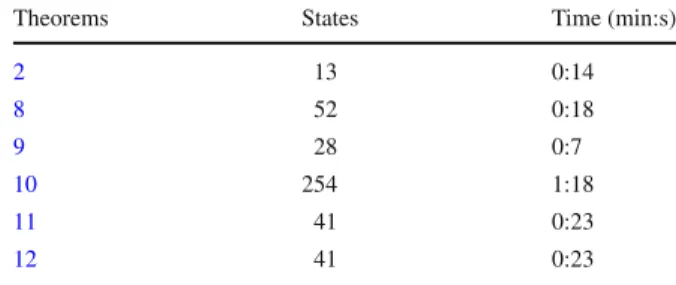
Table 2 Performance results of the verification of
Theorems2,8,9,10,11and12
on a 3×3 grid
Theorems States Time (min:s)
2 13 0:14 8 52 0:18 9 28 0:7 10 254 1:18 11 41 0:23 12 41 0:23
tion was performed on a dual core 2.8 GHz Macbook with 8 GB of memory running MacOS×10.9.2.
Table1shows the time taken and number of states generated when verifying the-orem1. In this instance we show performance for a 3×3,4×4,5×5 and 6×6 grid. While the number of states explored increases roughly linearly with the number of squares in the grid the time increase is much more severe. This is because of the time taken to execute the Prolog-style rules for area_empty and unchecked. This is indicative of inefficiency in the implementation ofGwendolentherefore, rather than in AJPF itself.
Table2shows the number of verification states and time taken for the other theorems discussed in this section on the 3×3 grid.
While much simplification has occurred here, it is clear how we can carry out compositional verification, mixing agent model checking and temporal/modal proof, and how the environmental abstractions we use can be refined in many ways to provide increasingly refined abstractions of the “real world”. Crucially, however, we can assess the choices the agent makes based on its beliefs about its environment and not what actually happens in its environment.
4 Scenario: rational hybrid agents for autonomous satellites
The previous example involved simple code developed to illustrate our methodology. We now turn to look at code developed as part of a project to investigate agent based control of satellite systems (Lincoln et al. 2013). The code was not initially developed with verification in mind.
Traditionally, a satellite is a large and very expensive piece of equipment, tightly controlled by a ground team with little scope for autonomy. Recently, however, the space industry has sought to abandon large monolithic platforms in favour of multiple,
smaller, more autonomous, satellites working in teams to accomplish the task of a larger vehicle through distributed methods.
The nature of these satellite systems, having a genuine need for co-operation and autonomy, mission critical aspects and interaction with the real world in an environ-ment that is, in many respects, simpler than a terrestrial one, makes them a good test-bed for our approach to analysing autonomous systems.
4.1 System architecture
We have built a hybrid system embedding existing technology for generating feedback controllers and configuring satellite systems within a decision-making part based upon a high-level agent program. The decision-making relies ondiscreteinformation (e.g., “a thruster is broken”) while system control tends to rely oncontinuousinformation (e.g., “thruster fuel pressure is 65.3”). Thus, it is vital to be able toabstract from the dynamic system properties and provide discrete abstractions for use by the agent program. It is for this reason that, as mentioned earlier, we have an explicitabstraction layerwithin our architecture that translates between the two information styles as data flows around the system.
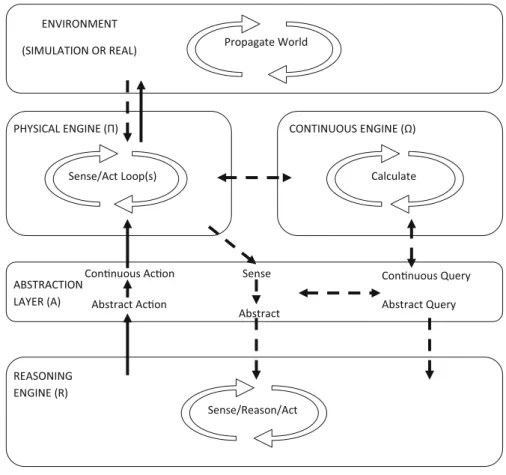
Figure2 shows the full architecture for our system (Dennis et al. 2010). R is a traditional BDI system dealing with discrete information, Π andΩ are traditional control systems, typically generated by MatLab/Simulink, while A provides the vital “glue” between all these parts. We will not discuss the implementation ofΠ and
Ωin any detail; our concern is primarily withRand its interaction withA.
The agent programming language used to implement R (again, Gwendolen) encourages an engineer to express decisions in terms of the beliefs an agent has, what it wants to achieve, and how it will cope with any unusual events. This reduces code size so an engineer need not explicitly describe how the satellite should behave in each possible configuration of the system, but can instead focus on describing the factors relevant to particular decisions (Dennis et al. 2010b). The key aspect of delib-erationwithin agent programs allows the decision-making part to adapt intelligently to changing dynamic situations, changing priorities, and uncertain sensors.
4.1.1 Semantics of interaction
We developed a semantics for interaction between the components of the architec-ture (Dennis et al. 2010a) which operates via shared sets of which, for our purposes, the most interesting is the set ofshared beliefs,, used by bothAandRto describe their shared, discrete, understanding of the world. R may also make specific requests for calculations to be performed byΩor actions to be performed byΠ. These requests are sent viaA. Among other things,Atakes any (potentially continuous) results returned byΩand discretizes these as a shared belief forR. Overall, the role ofAis to interface between Rand the other engines. This helps avoid data overload by replacing large ‘chunks’ of incoming data with key discrete predicates (Dennis et al. 2010a).
In this semantics all perceptions that arrive via sensors from the real world are filtered through A, which converts them into discrete shared beliefs,. Therefore,
Fig. 2 Hybrid agent architecture. Real time control of the satellite is governed by a traditional feedback controller drawing its sensory input from the environment. This forms aPhysical Engine(Π). This engine communicates with an agent architecture consisting of anAbstraction Engine(A) that filters and discretizes information. To do thisAmay use aContinuous Engine(Ω) to make calculations. Finally, theReasoning Engine(R) contains a “Sense-Reason-Act” loop captured as a rational agent. Actions involve either calls to the Continuous Engine,Ω, to calculate new controllers (for instance) or instructions to the Physical Engine,Π, to change these controllers. These instructions are passed through the Abstraction Engine,A, for reification
from a model checking perspective, if we are interested in how the external world can affect the internal beliefs of the Reasoning Engine,R, then we are primarily interested in the possible compositions of.
4.1.2 System implementation
This architecture and interaction semantics have been implemented within a simulation environment, where the Physical and Continuous engines (ΠandΩ) are implemented