CONCEPTUAL DECLARATIVE PROBLEM SPECIFICATION
AND SOLVING IN DATA INTENSIVE DOMAINS
∗L. Kalinichenko
1, S. Stupnikov
2, A. Vovchenko
3, and D. Kovalev
4Abstract: Various notations aimed at defining the semantics of a computation in terms of the application domains have been experienced for conceptual modeling. For example, entity-relationship (ER) approach and UML (Unified Modeling Language) diagrams allow one to specify the semantics informally. Ontology languages based on description logic (DL) have been developed to formalize the semantics of data. However, it is now generally acknowledged that data semantics alone are insufficient and still representation of data analysis algorithms is necessary to specify data and behavior semantics in one paradigm. Moreover, the curse of ever increasing diversity of multistructured data models gave rise to a need for their unified, integrated abstraction to make specifications independent of real data in data intensive domains (DID). To overcome these disadvantages, a novel approach for applying a combination of the semantically different declarative rule-based languages (dialects) for interoperable conceptual specifications over various rule-based systems (RSs) relying on the logic program transformation technique recommended by the W3C (World Wide Web Consortium) Rule Interchange Format (RIF) has been investigated. Such approach is coherently combined with the specification facilities aimed at the semantic rule-based mediation intended for the heterogeneous data base integration. The infrastructure implementing the multidialect conceptual specifications by the interoperable RSs and mediating systems (MSs) is introduced. The proof-of-concept prototype of the infrastructure based on the SYNTHESIS MS and RIF standard is presented. The approach for multidialect conceptualization of a problem domain, rule delegation, rule-based programs and mediators interoperability is explained in detail and illustrated on a real nondeterministic polynomial time (NP) complete use-case in the finance domain. The research results are promising for the usability of the approach and of the infrastructure for conceptual, declarative, resource independent and reusable data analysis in various application domains.
Keywords:conceptual specification; W3C RIF; logic rule languages; SYNTHESIS; database integration; mediators; RIF-BLD; RIF-CASPD; multidialect infrastructure; rule delegation
DOI: 10.14357/19922264130412
1 Introduction
For decades, informatics is investigating proper facilities for conceptualization of the diverse application domains, descriptive and predictive data analysis to extract infor-mation from data, decision making, and generally, for the problem solving based on such insight. Many times a point was reached when the level of maturity of the con-ceptual modeling techniques could have been evaluated as satisfactory from the theoretical and practical points of view. But every time new technological developments and research results disproved such optimistic opinions. Now, in the epoch of the data intensive research5 and
system development, a lack of the proper declarative
conceptual modeling facilities is felt again. For instance, the call for such facilities has been expressed in the ACM (Association for Computing Machinery) publica-tion “Challenges and Opportunities with Big Data” [2]. In particular, the call considers important to examine a combination including
– facilities for support of variety of data (heterogeneity of data types, representation, and semantic inter-pretation) and semantic data integration; and
– declarative specifications required to meet the pro-grammability and composition of complex analyt-ical pipelines in an understandable form applying appropriate high-level languages to express the an-alytics.
∗This research has been done under the support of the RFBR (project 11-07-00402-а) and the Program for Basic Research of the Presidium of the Russian Academy of Sciences.
1Institute of Informatics Problems, Russian Academy of Sciences, Moscow, Russia, [email protected] 2Institute of Informatics Problems, Russian Academy of Sciences, Moscow, Russia, [email protected]
3Institute of Informatics Problems, Russian Academy of Sciences, Moscow, Russia, [email protected] 4Institute of Informatics Problems, Russian Academy of Sciences, Moscow, Russia, [email protected]
5Data Intensive Research (DIR) has emerged as a new paradigm for inferring information from data (known as the 4th paradigm for scientific domains [1]) emphasizing the increasing value of observational, experimental, and computer-generated data in virtually all domains. Similarly, “Big Data” is developing as a recognition of the increasing significance of massive multistructured data in almost each area of the human activity.
This paper is related to such statements investigat-ing a novel methodology and infrastructure supportinvestigat-ing conceptually-driven problem specifications and solving in the DID. This research is motivated by aiming at the specification reusability in various domains over differ-ent sets of information resources (IRs), widely diverse data, and knowledge semantic integration capability as well as at the accumulation of reproducible data analy-sis and problem solving methods, related specifications, and experience in various DID.
One of the intended outcomes of the work is to expose current practically reachable limit of declara-tive conceptual specification construction applying the wealth of various available facilities of logic program-ming, knowledge representation, semantic Web, and heterogeneous database mediation in a coherent, coop-erative way.
Conceptual specifications should be expressed in terms of an application domain independently of de-sign and implementation concerns. Usually, the domain specification understandable and acceptable in the re-spective community includes a set of coherently tied ontologies together with a conceptual schema of the domain defined on the basis of such ontologies. Con-ceptual specifications of the applications in this domain are defined in terms of the conceptual schema to express abstract representations of information structures and algorithms of their analysis for the application problem solving.
This research reflects an intention to define and implement facilities for conceptually-driven problems specification and solving in DID to create the perspec-tives ensuring the following capabilities for expressing the specifications:
– declarative nature of the language facilities involved;
– an ability to provide complete and precise specifi-cation of the abstract structure and behavior of the domain entities, their consistency, relationship, and interaction;
– well-grounded diversity of semantics of the
mod-eling facilities providing for proper expressiveness, compactness, and precision of the definition of be-havior of the domain entities and problem solving algorithm specifications;
– arrangements for the probable extensions of the modeling facilities for conceptual specifications sat-isfying the changing technological and practical needs;
– provisions for specification independence from im-plementation languages and systems;
– provisions for specification independence from spe-cific IRs combined with facilities for their semantic
integration and interoperability coping with the in-creasing diversity of the techniques used for imple-mentation of programs, databases, services, ontolo-gies, and other resources;
– built-in methodologies for creation of unifying spec-ification languages providing for construction of semantic preserving mappings of conceptual speci-fications into their implementations in specific lan-guages and systems; and
– combination of ease of a human perception with a sufficient efficiency and expressiveness of the imple-mentation for publication in communities intended for specification reuse.
The brief vision of the state-of-the-art in conceptual modeling (not claimed to be exhaustive) is as follows. Various notations aimed at defining the semantics of a computation in terms of the application problems to be solved have been experienced for conceptual modeling for many years. Structured and object-oriented speci-fication notations for conceptual modeling in graphical (diagram) form dominate. Entity-relationship approach models the domain in terms of entities, attributes, and relationships, extended sometimes with cardinality con-straints, aggregation, sets, temporality, taxonomic struc-tures. Many parts of UML are the diagrams for specific purposes (e. g., class diagrams, activity diagrams, use cases, state charts, object interaction diagrams) used for the domain modeling and the design phase in software engineering. Such notations often allow one to specify the semantics informally, in terms of natural language; or the semantics is hard-coded using the tools supporting the notation [3]. Various logic specification languages, such as ontology languages based on DL, have been de-veloped to describe the semantics of data. With certain limitations, the ontology languages allow one to define formal models of domain concepts, their taxonomic relations, and constraints over them. They facilitate automated reasoning (inference) over taxonomic struc-tures. However, it is now generally acknowledged that data semantics alone are insufficient and representation of behavior is necessary to specify data and behavior semantics, algorithms for data analysis in one paradigm. This is just what paper is focused on, emphasizing the importance of declarative nature of the specifica-tion facilities. In particular, the approach proposed is aimed at conceptual modeling related to DID applying rule-based declarative languages possessing different, complementary semantics and capabilities combined with the methods for heterogeneous data mediation and integration.
In the work presented, the issues of interoperability of declarative programs defined in the languages having different semantics combined with an ability to integrate various IRs (such as data and knowledge bases, software
services, ontologies) for problem solving are investigated on the basis of two fundamental techniques:
(1) constructing of the unifying extensible language providing for semantic preserving representation in it of various IR specification languages (e. g., such as data definition (DDL) and manipulation (DML) languages for databases); and
(2) creation of the unified extensible family of rule-based languages (dialects) and a model of interop-erability of the programs expressed in such dialects with different semantics.
The first technique is based on the experience ob-tained in course of the SYNTHESIS language develop-ment [4, 5] accompanied by the methods and facilities for constructing its extensions. The kernel of the SYNTHE-SIS language is based on the object-frame data model used together with the declarative rule-based facilities in the logic language similar to a stratified Datalog with functions and negation. The extensions of the SYN-THESIS kernel are constructed in such a way that each extension together with the kernel is a result of semantic preserving mapping of some IR language (mainly, a data model language considered to be a combination of the respective DDL and DML) into the SYNTHESIS [6, 7]. The canonical information model (CIM) is constructed as a union of the kernel with such extensions construct-ed for various IR languages. Canonical information model is used for development of mediators positioned between the users, conceptually formulating problems in terms of the mediators, and various distributed IRs (such as databases and services) needed for a specific application. A schema of a subject mediator for a class of problems includes the specification of the domain concepts defined by the respective ontologies.
Another, multidialect technique for rule-based pro-grams interoperability applied in the current work is based on the RIF standard [8] of W3C. Rule inter-change format introduces a unified family of rule-based languages (dialects) together with a methodology for constructing semantic preserving mappings of specific languages used in various RSs1 into such dialects.
Be-sides, a methodology for extension of the family with the definition of new dialects is also defined as a part of RIF. From the RIF point of view, an IR is a program developed in a specific language of some RS. For the logic dialects, the RIF family should include declara-tive, high-level languages reflecting in a systematic way the basic semantics of rule-based languages of various existing logic-based RSs. These RSs and their
declara-tive rule-based languages form now a mature technology with decades of theoretical development, practical and commercial use based on logic programming and non-monotonic reasoning.
The approach proposed here is built on the tech-niques briefly introduced above aiming at construction of declarative specifications containing definitions of the concepts and their relationships in the DID area (conceptual schema), conceptual definitions of prob-lems, and their respective algorithms in declarative form simplifying their reuse. Theconceptually-drivenproblem specifications of an application can be defined applying advanced declarative languages, modularization, and composition facilities. Thus, the problem specifica-tions can be considered also as domain-driven, that is, they are defined in terms of the domain independently of IRs (databases, services, workflows, mediators) and implementation notations.
The paper presents the results obtained including the description of an approach and an infrastructure supporting:
– application domain conceptual specification and problem solving algorithms2 definitions based on
the combination of the heterogeneous database me-diation technique and rule-based multidialect facil-ities;
– interoperability of distributed multidialect rule-based programs and mediators integrating hetero-geneous databases; and
– rule delegation approach for the peer interactions in the multidialect environment.
The proof-of-concept prototype of the infrastruc-ture based on the SYNTHESIS environment and RIF standards has been implemented. The approach for multidialect conceptualization of a problem domain, rule delegation, rule-based programs, and mediators in-teroperability is explained in detail and illustrated on a real NP-complete use-case in the finance domain. For the conceptual definition of the use-case problem, Web Ontology Language (OWL) is used for the domain con-cepts definition and programs in two dialects RIF-BLD (Basic Logic Dialect) and RIF-CASPD (Core Answer Set Programming Dialect [9]) mapped into the SYN-THESIS formula language and answer set programming (ASP) based DLV [10] language, respectively.
The paper3 is structured as follows. After
intro-duction, the sections containing an overview of the ap-proach and an infrastructure for distributed multidialect rule-based programs support are given. In section 4, 1Examples of RSs include SILK, OntoBroker, DLV, IBM ILOG, IRIS, etc. More examples can be found athttp://www.w3.org/ 2005/rules/wiki/Implementations.
2In the approach proposed, the logic programming model of computation is assumed.
3The approach presented in this paper has been reported for the first time at the ADBIS’2013 conference and annotated in a short publication [9].
the lessons learned during the use-case specification and implementation are summarized. A related work section, the future plans section that outlines the inten-tions for the future research, and the conclusion which summarizes the results end the paper. The detailed de-scription of the use-case and its implementation is given in an appendix. Such detailed exposition of the results is justified by the novelty of the approach and a necessity to show and make readable all the steps required for the specification and implementation of the use-case applying the languages and the infrastructure proposed.
2 An Approach for Conceptual
Problem Specification and Solving
Based on the Techniques
for Heterogeneous Database
Mediation and Multidialect
Program Interoperability
According to the above, the problems of integra-tion of various IRs and interoperability of rule-based programs arising during application development are proposed to be resolved on the combination of two techniques:
(1) construction of the unifying extensible language providing for representation in it of various IR lan-guages preserving their semantics and for creation of mediators for integration of heterogeneous IRs; and
(2) creation of the unified family of languages (di-alects) for expressing the problem solving algo-rithms and the model of interoperability of pro-grams represented in such dialects.
2.1 Heterogeneous Database Mediation
In this research, the first technique is based on the results of the SYNTHESIS language project [4] including the methods and means for the development of this language extensions and for its use for database integration.TheUnifier of information models [11] is the main facility created for the development of the SYNTHESIS language extensions and the mappings of specific data models into such extensions. Preserving semantics of a specific data model by its mapping into SYNTHESIS in the Unifier is based on the specification refinement principle (it is said that specificationArefines specifi-cationB if it is possible to useAinstead ofBso that a user ofB does not notice such substitution) developed by Abrial [12]. Thus, it is possible to construct provably correct extensions of the SYNTHESIS language and mappings of specific languages into them based on the
proof of refinement. Such methodology has been ap-plied for mapping into SYNTHESIS of diverse database languages, service and process specification languages, ontological languages [5–7, 11]. Now, a possibility of mapping into SYNTHESIS of various multistructured data models typical for the Big Data epoch (such as, e. g., various NoSQL models [13], graph-based models [14], triplet data model [15], and array data model [16]) is studied.
The main characteristic properties of the SYNTHE-SIS language use as the kernel of the extensible language are as follows:
(1) the merge of the kernel extensions constructed for diverse data models is treated as a single language known as the CIM; and
(2) CIM is considered as a basis for the development of mediators positioned between the programs pro-viding for problem solving in terms of mediators (the application domain terms) and specific dis-tributed IRs (such as database, services) selected for the problem solving. The mediator specifica-tion for a class of problems includes definispecifica-tions of the application domain concepts expressed by the respective declarative specifications, specifications of the classes of the domain entities, specifications of types of the instances of the classes mentioned and of their methods, and specification of func-tions.
A mediator in SYNTHESIS can be defined as a triple (T,S,M) whereT is the mediator (target) schema;S is the IR schema; andM is the set of assertions (rules) relating elements of the target schema with elements of the resource schema. It is assumed that IR data model (that is, the respective DDL and DML) has been mapped into the canonical one; thus, both resource and target schemas are defined in the canonical data model. Both resource and canonical data models may allow for the expression of various constraints›. In this generality, a data integration setting is (S,T,›r,›rt, ›t) in whichSand›rconstitute the IR schema,Tand ›tform the target schema, and the resource-to-target
dependencies included into›rtare the assertions of the schema mappings in the mediator. ›rt should be de-fined as a set of assertions of weakly-acyclic class [7, 17]. Note that›rincludes not only data dependencies
corre-sponding to the IR database in the original data model, but also the dependencies generated in accordance with the extension of the kernel of the canonical data mod-el determining an information-preserving mapping of the resource data model into the canonical one (some categories of such dependencies are shown in [6, 7]).
Specifications of mediators are expressed in CIM. Generally, a specification ofMin the approach oriented on the definition of the mediator schema T in terms
of the application domain independently of schemas of IRs involved is based on the GLAV (Global and Lo-cal As View) [18, 19] schema mapping technique. In GLAV, two schema mapping techniques are combined: LAV (Local as View) according to which a schema of IR is defined as a view over the mediator schema and GAV (Global as View) according to which the mediator schema is defined as a global view over the IRs schemas. In LAV, the schemas of IR classes are considered as materialized views over the virtual classes of the medi-ator. Usually, GAV views are used for resolving various conflicts between the specifications of IRs and of the mediator. In such cases, the GAVs provide the rules for transformation of the results of a query over IRs to their representation in the mediator. The GLAV technique provides for stability of the mediator specification in time of the specific IRs change or the change of the actual IR presence (remove of an IR, adding of new re-sources, and so on). Also, the GLAV technique provides for scalability of mediators with respect to the number of IRs involved in them. It worth mentioning that the mediators, in their turn, can play the role of IRs towards the mediators of the higher level.
The following characterization of the GLAV setting is applied in the SYNTHESIS project. The sound GLAVs are assumed [18]. The GLAV mapping is constructed as a composition of two schema mappings — GAV mapping Mrg = (Sr, Sg,›rg) (from resource schemas to GAV schema) and LAV mappingMgt= (Sg, Trt,›gt)(from GAV schema to mediator (target) schema). GLAV is formed by a definition of the compositionMrg◦Mgtby means of the GAV and LAV dependencies (›rgand›gt, respectively). The GLAV mappings are formed showing how two parts of the schema (resource and target) are linked together by the›rtdependencies.
Queries and programs over the mediator are ex-pressed declaratively in the SYNTHESIS formula lan-guage (resembling Datalog) in terms of the mediator schema T [4]. An example of the mediator defini-tion can be found in appendix (see subsecdefini-tions A3.1 and A3.2).
2.2 Diverse Rule-Based Programs
Interoperability
Another fundamental principle used in this research is based on a multidialect technique intended for providing diverse rule-based programs interoperability and known as the W3C RIF standard [8]. The range of intended applications of the RIF standard (besides the Semantic Web) includes also development of the intelligent in-formation systems as well as knowledge representation in various application domains. The family of dialects proposed in RIF has a common core (theCore dialect)
and an ensemble of the dialects extending the core and forming the directed acyclic graph. An arc of the graph is directed from the dialect being extended to the dialect extending it.
According to RIF, any specific RS can act in two independent roles — the role ofproviderand the role of consumer. The first one indicates that RS is capable to transform its native rule-based programs into the pro-grams in the respective dialect; the second one indicates that RS is capable to accept a program defined in a proper dialect and transform it into the program in the native RS language. Thus, to include any rule-based language into the family of interoperable dialects, it is required to provide the respective RS with two semantic preserving transformers — from its own language into the proper dialect (the role of provider) and from the proper dialect into its own language (the role of consumer). In contrast to the development of the SYNTHESIS lan-guage extensions, each dialect extending other dialects may have its own, different of others, semantics. For example, for logic rule-based languages, each dialect can use its own semantics (e. g., the classic first-order semantics), well-founded semantics, stable model se-mantics, etc. [14]. Unlike the SYNTHESIS language, in which for development of the language extensions and respective semantic preserving language mappings, it is required to establish the refinement relation between the specifications, in RIF for the logic rule-based languages, it is required to establish theentailmentrelation between the specifications. The entailment relation between for-mulasf andg,f|=g(f entailsg) is valid if and only if gis true for all models wherefis true.
In the RIF standard, only the basic, simple dialects have been fixed. Thus, RIF-BLD [20] corresponds to Horn logic with various syntactic and semantic ex-tensions. RIF-PRD (Production Rules Dialect) [21] specifies a production rules dialect to enable the in-terchange of production rules. RIF-PRD captures the main aspects of various production rule systems. Pro-duction rules are defined using ad hoc computational mechanisms, which are not based on a logic. The con-dition language of RIF-PRD is defined as a common subset of RIF-BLD and RIF-PRD. RIF-Core (Core Dialect) is a subset of both RIF-BLD and RIF-PRD thus enabling limited rule exchange between logic rule dialects and production rules.
Significant contribution of RIF consists in inclusion into the standard of the Framework for Logic Dialects RIF-FLD [22]. RIF-FLD represents quite general logic language including the broad set of syntactic and se-mantic constructs frequently used in logic. On the basis of the framework, concrete dialects having specific se-mantics can be defined. Definitions of all dialects in the standard are strictly formalized. Rule interchange format defines the general conception of the unified
language construction as a family of dialects intended for provision of the interoperability of the numerous RSs. On the basis of the RIF-FLD framework, several dialects have been designed in the world. They need still to pass through the procedure of approval by W3C. Among these dialects are the following. RIF-CLPWD (Core Logic Programming Well-founded Dialect [23]) uses WFS [24] with the default negation and functions. RIF-CASPD [25] uses the semantics of ASP, known also as the stable model semantics [26]. Difference of semantics and application areas of WFS and ASP is a typical example showing different capabilities of the rule-based programs expressible in the languages with such semantics. The WFS and ASP language classes correspond to two philosophically different approaches in logic programming: WFS keeps the idea of defin-ing a sdefin-ingle (well-founded) model for a program while ASP provides for the computation of the set of preferred models that is more than query answering. Thus, the ASP-based systems are specifically oriented on solving the complex, combinatorial (NP-complete) problems. The ASP application areas include: diagnosis, informa-tion integrainforma-tion, constraint satisfacinforma-tion, reasoning about actions (including planning), routing, and scheduling, health care, biomedicine and biology, text mining and classification, question answering, etc. In contrast to the ASP systems, the WFS-based systems incorporate three-valued logic are computationally complete and can be used as the universal logic programming facili-ties. The joint usage of programs with different semantics for problem solving is obviously reasonable.
The RIF standard has also defined the necessary concepts to ensure compatibility of RIF with resource description framework (RDF) and OWL [27], in spite of dissimilarity of their syntaxes and semantics. Rule in-terchange format uses its frame syntax to communicate with RDF/OWL. These frames are mapped onto RDF triples and a joint semantics is defined for the combi-nation. The basic idea is that rules and OWL will view each other as “black boxes” with well-defined interfaces through exported predicates. The OWL-based ontolo-gies will export some of their classes and properties, while rule-based knowledge bases will export some of the predicates that they define. Each type of the knowl-edge base will be able to refer to the predicates defined in the other knowledge bases and treat them extensionally as collections of facts. Ontologies are assumed to provide commonly shared conceptualization of a domain. There may be different application-specific rule programs for different applications in the domain.
In the use-case considered in the paper, the fol-lowing languages for conceptual specifications are used: OWL 2, RIF-BLD and RIF-CASPD (the examples of specifications in these languages can be found in the appendix, section A2).
2.3 Basic Ideas of the Conceptual Problem
Solving Approach Built on the Symbiosis
of the Above
The idea of the conceptual problem solving approach considered in the paper consists in developing a modu-lar infrastructure in which alongside with the mediators integrating data and services in the SYNTHESIS-like setting, the modules representing knowledge and declar-ative rule-based programs over various resources will be introduced. The infrastructure is based on the following principles:
– the multidialect construction of the conceptually-driven problem specifications combining the SYN-THESIS and RIF approaches.The specifications are represented as a functional composition of declar-ative modules, each based on its own language (dialect) with an appropriate semantics. Semantics of a conceptual definition in such setting becomes a multidialect one. To the SYNTHESIS language, one of the existing RIF dialects (or a new, specific di-alect) should be put into correspondence (currently, OWL is used for the conceptual schema specifica-tion together with the RIF-BLD for the mediator rules to be interpreted in SYNTHESIS);
– the specification modules are treated as peers. Rule-based program modules are included into the spec-ification alongside with the mediators that can be supported by various MSs. Interoperability of such combination of modules is based on P2P (peer-to-peer) and W3C RIF interoperability techniques;
– combination of integration and interoperability. The IR integration can be provided in the scope of individual mediator modules. Interoperability is provided between the modules supporting different dialects according to the RIF methodology; and
– rule-based specifications on different levels of the in-frastructure. Rule-based, inference providing mod-ules can be used for declarative programming over the mediators. In this case, the mediators support schema mapping for semantic integration of the IRs supported by various MSs.
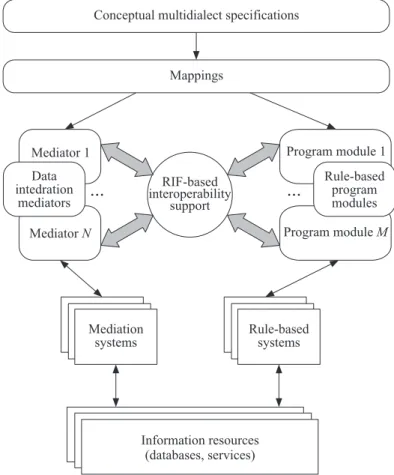
In the paper, the ideas of construction of the infras-tructure providing for conceptual declarative program-ming and heterogeneous IR mediation interoperating in the multidialect environment are presented.
The infrastructure generally outlined in Fig. 1 pro-vides for implementation of conceptual specifications on the basis of the CIM-like kernel and its extensions used in the mediators combined with declarative languages of the rule-based programming systems possessing diverse se-mantics and capabilities. Such environment provides for
Figure 1 Infrastructure for conceptual problem solving
programming over heterogeneous resources (e. g., over databases and services) accessed through the mapping of specific resource schemas into the target schemas of the mediators. Multidialect program is implemented by means of transformation of conceptual specifications into modular, component-based P2P program repre-sented on the languages of the mediation and rule-based systems. Interaction of components of such distribut-ed program is carridistribut-ed out by means of the delegation technique (see subsection 3.3).
An approach for transformation of conceptual spec-ifications into the distributed mediators and modules interpreted in RSs with different semantics interoper-ating in P2P style by the rule delegation in the mul-tidialect W3C RIF-based environment is presented in section 3.
Practical value of the results obtained is demonstrat-ed with a use-case in the finance domain. The important result of the research conducted consists also in accu-mulation of the experience of usage of the multidialect specification facilities for conceptually-driven problem specifications in specific domains and implementation of such specifications in the prototype that has been developed.
3 Infrastructure of the Multidialect
Environment for Distributed
Rule-based Programs
and Mediators Interoperability
3.1 Conceptual Programming
over the Conceptual Schema
The aim of the novel infrastructure proposed is a concep-tual programming of problems in the RIF dialects and an implementation of conceptual specifications using declarative languages of the RSs and MSs. Conceptual multidialect logic programs specify the algorithms for problem solving in a subject domain. They are im-plemented using their transformation into RS or MS programs.
Conceptual specification of a problem(class of prob-lems) is defined in the context of a subject domain and consists of a set ofRIF-documents (document is a specification unit of RIF). Each document contains the groups of rules. Conceptual specification of a problem is an abstract program of a problem solving.
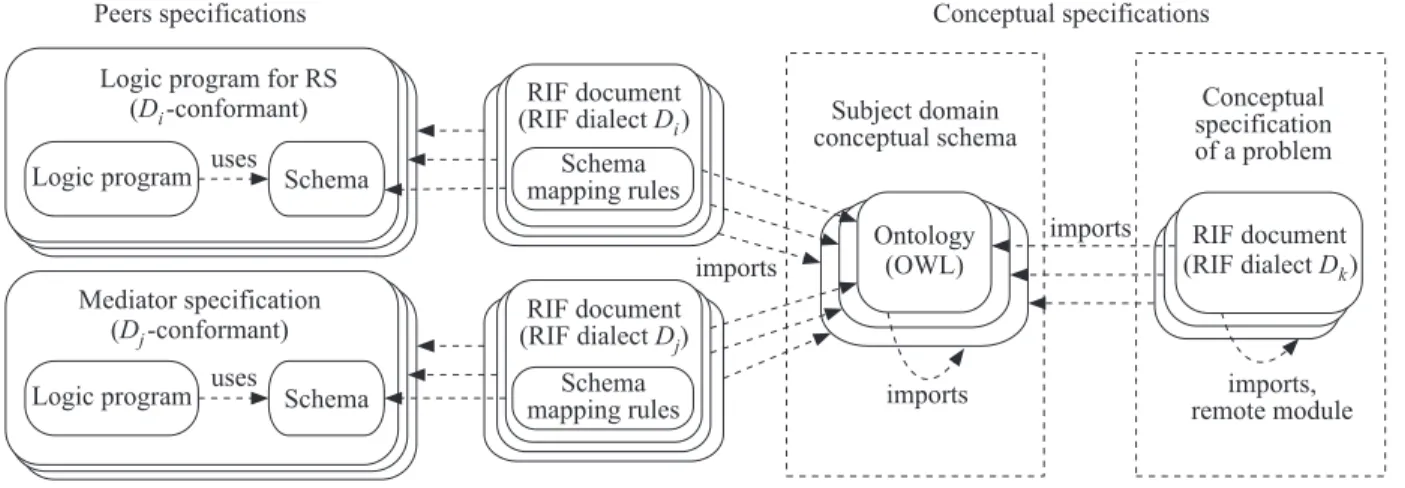
The subject domain conceptualization is performed using OWL 2 [28] ontologies containing entities of the domain and their relationships (Fig. 2, right-hand part). Thus, the conceptual schema of the domain can be formed. Conceptual specification is defined over con-ceptual schema: names of the entities (classes and at-tribites) and only they are used in the rules of the RIF-documents as extensional predicates.
Ontologies are imported into the RIF-documents specifying an import profile, for instance,OWL Direct. A profile defines a semantics of an OWL. The profiles are formally defined in [27].
Modular construction of the conceptual specifica-tion is based on the techniques of document import and link. Each RIF-document is defined using a di-alect which is a specialization of the RIF Framework for Logic Dialects (RIF-FLD) [22]. Documentsimport other documents having the same semantics (theImport directive) orlinkdocuments defined using other dialects and having different semantics (remote module directive Module).
Documents refer to predicates from imported doc-uments (using the name of an imported module ule:predicate) as well as to predicates from remote mod-ules usingremote terms f@r[22]. Here,f means a term andrmeans a reference to a remote module.
Retrieving results of problem solving is performed by querying the virtual knowledge/database formed by combined infrastructure of mediators and rule-based systems.
Queries are formulated in terms of the conceptual schema and the intentional predicates of the conceptual specification of a problem. The result is a Boolean value (if the formula is closed) or a collection of tuples of values of free variables of the formula.
3.2 Mapping of the Peer Schemas
into the Conceptual Specification
In the proposed infrastructure, (1) the logic pro-grams implementing RIF-documents of the conceptual schema in specific RSs and (2) the mediators supporting virtual collections of facts as the result of heterogeneous databases integration are considered as peers.
A schemaSR of a peerRis a set of entities
(class-es or relations and their attribut(class-es) corr(class-esponding to extensional and intensional predicates of the resources.
The RS or the MS of each peerRshould be a con-formantDR consumer whereDR is the respective RIF
dialect (Fig. 2, left-hand part). Conformance is for-mally defined using formula entailment and language mappings [22].
The peerRisrelevantto a RIF-documentdof a con-ceptual specification of a problem (see Fig. 2, right-hand part) if:
– DRis a subdialect of the documentddialect; and
– entities of the peer schemaSR (if they exist) are
ontologically relevant1 to entities of the conceptu-al schema the names of which are used in d for extensional predicates.
The schema of a relevant peer is mapped into the conceptual schema. The mapping establishes the cor-respondence of the conceptual entities referenced in the documentdto their expressions in terms of entities of the schemaSR using logic rules of theDR dialect.
These schema mapping rules constitute separate RIF-document (Fig. 2, middle part). An example of mapping is given in appendix (see subsection A3.1).
Figure 2 Conceptual and peer specifications
3.3 Implementation of the Conceptual
Specification
Programs defined in the conceptual specification are implemented in P2P environment formed by relevant peers which are related to conceptual specification by mapping rules (see Fig. 2, middle part).
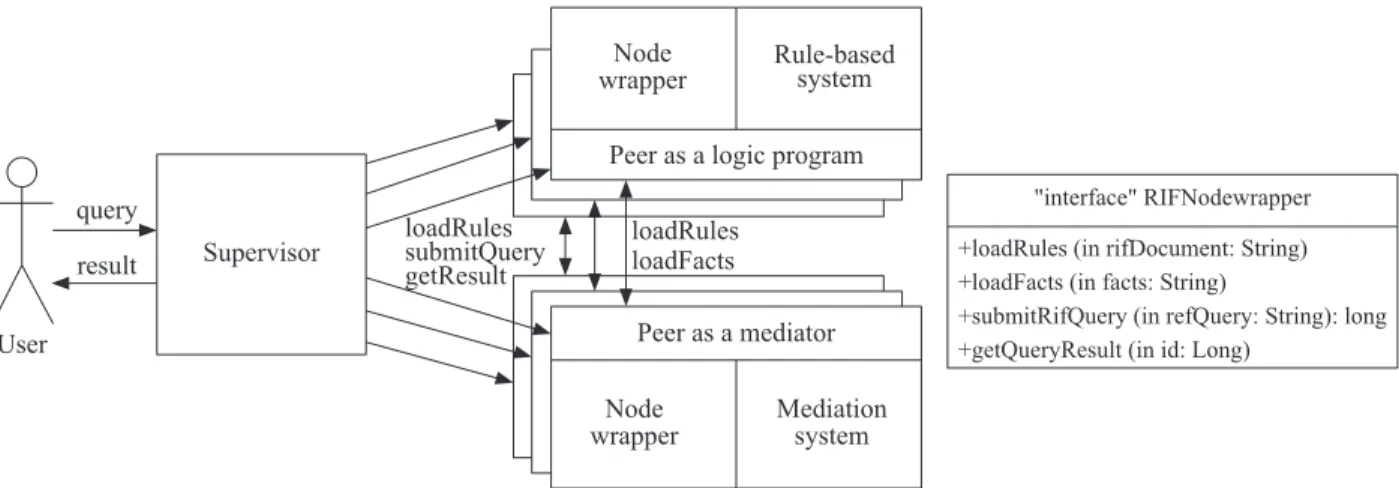
Peers communicate using a technique for distributed execution of the logic programs. The basic notion of the technique isdelegation— transferring facts and rules from one peer to another. A peer is installed on anodeof the multidialect infrastructure. A node is a combination of a wrapper, an RS or an MS, and a peer (Fig. 3). A wrapper transforms programs and facts from the spe-cific RIF dialect into the language of the RS or MS and vice versa. A wrapper also implements the delegation mechanism. A definition of the delegation is given in the latter part of this subsection. Transferring facts and rules among peers is performed in RIF dialects. The wrappers implement an interfaceRIFNodeWrapper(see Fig. 3).
A special component (Supervisor) of the proposed ar-chitecture stores shared information of the environment, i. e., conceptual specifications related to the domain and to the problem, a list of the relevant resources, RIF-documents combining logic rules for the conceptual specification, and a resource schema mapping.
Implementation of the conceptual specification in-cludes the following steps:
– rewriting the conceptual documents into the RIF-programs of the peers performed by theSupervisor. A rewriting includes also (1) replacing the docu-ment identifiers (used to mark predicates) by peer identifiers; and (2) adding schema mapping rules to programs (see Fig. 2, middle part);
– a transfer of the rewritten programs to nodes con-taining peers relevant to the respective conceptual documents. The transfer is performed by the
Su-pervisor by calling the method loadRules of the respective node wrappers;
– a transformation of the RIF-programs into the con-crete RS or MS languages. The transformation is performed by theNodeWrapperor by the RS or MS itself (if the RS or MS supports the respective RIF dialect); and
– an execution of the produced programs in P2P en-vironment.
During the process of rewriting the conceptual schema into the resource programs, the relationships between RIF-documents of the conceptual schema de-fined by remote or imported terms are replaced by relationships between peers also defined by remote or imported terms. To implement remote and imported terms, arule delegationmechanism is used — transfer-ring facts and rules from one peer to another. The details of rule delegation approach implemented in the current prototype of the multidialect infrastructure are provided below.
In general case, the programs transferred to some peer may include nonlocal rules. These rules contain remote or imported terms. On the contrary,localrules do not contain such terms. For simplicity, only remote terms are mentioned in the latter part of this subsection. To make possible an execution of a program on a node, the program should benormalized, i. e., transformed in-to an equivalent program including only local rules and delegation rules. There are two kinds of delegation rules for a peern:
(1) fact delegation rulelikep@m(X) :-q@n(X)where p and q are the predicate names; X is the vari-able list; andmis the peer different fromn. The rule means that all the facts turning q into true have to be transferred to the peermas facts turn-ingpintotrue. A fact is a termp(v1, . . . , vn)such
thatp(v1, . . . , vn) =truewherev1, . . . , vnare the
values of variablesX =x1, . . . , xn; and
(2) delegation rulelikeq@n(X) :-p@m(X). The rule has to be transferred to the peermwhere it becomes a fact delegation rule.
The procedure ofnormalization(Algorithm 1) of a programpron a peernis as follows. For each occur-rence of a remote term in a ruler, a fact delegation rule is added topr aimed at importing facts from another peer to the peernor at exporting facts fromnto another peer. The rule includes a new local predicate created for storing imported or exported facts. Each occurrence of a remote term in a ruleris replaced by an occurrence of the respective local predicate. In that way, the ruleris transformed into a local rule.
Algorithm 1.N ormalization(pr, n)
Input:pris a program — a set of rules;nis a peer name
Output:normalized programpr
for eachruler∈prlikehead(r) :-body(r).do ifthehead(r)ofris a remote termp@m(X)then
// removerfrompr pr←pr\{r}
// add new fact delegation rule, // here,p mis a new local predicate pr←pr∪ {p@m(X) :-pm(X).}
// add new local rule
pr←pr∪ {p m(X) :-body(r)}
elseifthehead(r)is a local predicateand
thebody(r)contains an occurrence of a remote termq@l(Y)
then
for eachremote termq@l(Y)contained in the body(r)do
// add new fact delegation rule // here,q lis a new local predicate pr←pr∪ {q l(Y) :-q@l(Y).}
// replace the occurrence of the remote term inr // by a local termq l(Y) r←head(r) :-body(r)[q@l(Y)→q l(Y)]. end for endif end for returnpr
The algorithm of execution of a program on a node containing a peernlooks as follows (Algorithm 2). The program stored on the peer is normalized. Delegation rules produced during normalization are transferred to the respective peers. After that, the algorithm waits for the facts from all the peers to which the delegation rules were transferred. During waiting, some delegation rules can be obtained from other peers (no mutual recursion between programs sent to different peers is presumed). When all facts are got, they become a part of the peer.
Then, local RIF-rules of the peer are transformed into the RS or MS rule language and executed in the RS or MS. The last step consists in transferring the re-quired facts to other peers in accordance with the fact delegation rules.
Algorithm 2.Execute(n)
Input:nis a peer name;
prog(n)is a program stored atnat the moment (additional rules can be loaded intoprog(n) during execution ofExecute)
Output:result— a set of tuples which are the result of the executing program
Local variables
prn— a variable to store a normalized program pre— a variable to store local normalized rules pre1— a variable to store a program transformed into the RS or MS rule language
prn←N ormalization(prog(n), n)
for eachfact delegation ruler∈prn likeq l(Y) :-q@l(Y)
// transfer ruleq l@n(Y) :-q(Y)to peerl l.loadRule(“q l@n(Y) :-q(Y)”)
pre←pre\{r}
end for
wait untilfor all fact delegation rules,r∈prnlike q l(Y) :-q@l(Y)
a respective peerlhas transferred facts like q(v1, . . . vn)to peernas facts like
q l(v1, . . . vn)
for each fact delegation rule, r ∈ prn like q l(Y) :-q@l(Y)
loadfacts from predicateq linto the peern
end for
// put all normalized local rules intopre pre← {r|r∈prn∨ris local}
transf ormthe programpreinto the resource rule language programpre1
result←executethe programpre1on the resource (mediator or RS) connected ton
for eachfact delegation ruler∈prog(n)like p@m(X) :-q(X)
// transfer facts from local predicateqinto remote // predicatepat the peerm
m.loadF acts({p(x)|x∈q(x)})
end for returnresult
A rule delegation mechanism described in this sec-tion resembles one proposed in WebdamLog [30].
4 Lessons Learned During the Use
Case Implementation
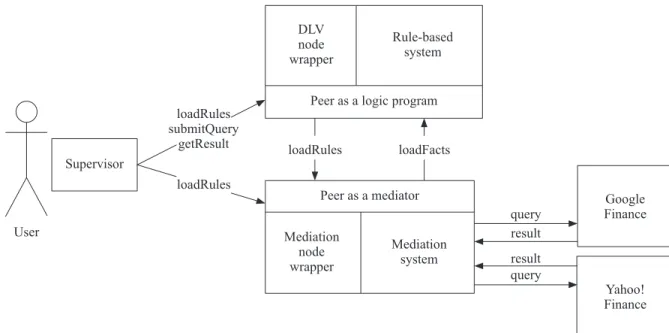
To provide a proof of the multidialect infrastructure concept, a use case in the financial domain has been implemented. The problem to be solved in the use case is calledinvestment portfolio diversification problem. The detailed description of the use case is included in the appendix. In this section, the important lessons learned during the implementation of the use case are summarized.
During the implementation of theinvestment portfolio use case in the multidialect infrastructure, the concep-tual specifications were defined: a concepconcep-tual schema of the financial domain (using OWL 2) and conceptual specifications of the problem (using RIF dialects BLD and CASPD). Conceptual specification was defined over conceptual schema: names of the entities (classes and attributes) of conceptual schema and only they were used in the rules of the conceptual specification as extensional predicates. Conceptual specifications were implement-ed using a multidialect infrastructure which includes a mediation system integrating the financial data and an ASP [26] RS.
Application specification in the multidialect infras-tructure is started with the informal definition of a problem (see appendix, section A1). Then, a conceptual schema of a subject domain is defined using OWL 2 (see section A2). Due to the fact that OWL 2 does not provide facilities to specify functions, it is necessary to model the functions related to the collections of facts of the domain as OWL classes (e. g.,correlation):
Class(correlation) DataProperty(series1 domain(correlation) range(DatedValue)) DataProperty(series2 domain(correlation) range(DatedValue)) DataProperty(corr domain(correlation) range(xsd:double))
Input and output parameters of the functions are modeled as data or object properties of the respective classes (for instance, series1, series2, and corr). The types of the parameters are modeled as range of the respective properties.
Lesson 1.Functions related to the collections of facts in conceptual schema of the domain have to be modeled as OWL classes.
The classes of the conceptual schema are used as predicates in rules which constitute documents of the conceptual specification of the problem. Logic rules over taxonomic structures of the schema may require existential quantifier in their heads (see section A2):
Exists ?ts( And(?ts#gex:tickers ?ts[symbol->?symbol]) ):-And(?t#srt:stockRates ?t[ticker->?symbol] ?t[isInTop500->?inTop500] External(pred:boolean-equal(?inTop500 true)) )
The rule states that for each object?tofstockRates class there exists an object?tsof a classtickers. A pred-icate e#s denotes that the element e belongs to the sets.
Built-in predicates (like Boolean equality pred: boolean-equal) and functions are used asexternal terms of RIF. The symbol External indicates that an atomic formula or a function term is defined externally (neither in the current document nor in the remote RIF-document). Built-in predicates are defined in a special part of the RIF standard.
Lesson 2. Conceptual specification of a problem using RIF logic rules over taxonomic structures may require existential quantifier in the rule heads. The RIF-BLD dialect intended for serving as the basic logic dialect does not provide such facility. Respective extension of RIF-BLD is suggested.
Lesson 3. Conceptual specification of a problem often requires usage of built-in predicates and functions as external terms.
During the application of the RIF-CASPD di-alect [31] for conceptual specification, it was found out that the ASP programs require a specific facility — so-calledweak constraints[10]. Such constraints should be satisfied if it is possible, but their violation does not invalidate the models. For instance, a weak constraint used in the specification of the portfolio problem looks as follows (see section A2):
Forall ?X( :“ prt:nonPortfolio(?X))
The rule states that only such stable models that minimize the truth set of the predicatenonPortfolioare considered as a result of the logic program (that includes the mentioned rule). The difference of the rule with a strong constraintlike
Forall ?X( :- prt:nonPortfolio(?X))
consists in that in a program with the strong constraint the predicatenonPortfolio(?X)has to be turned tofalse for all?X. Weak constraint requires the set of all possible values of?Xthat turnsnonPortfolio(?X)intotrueto be of minimum size.
Lesson 4. Conceptual specification using ASP-like di-alects requires a specific kind of logic rules — weak constraint. The RIF-CASPD dialect intended for serv-ing as the dialect supportserv-ing ASP does not provide such facility. Respective extension of RIF-CASPD is sug-gested.
To implement the conceptual schema, a mediator intended to provide the collection of facts implied by the schema was created. The mediator integrates the re-spective financial data. The schema of the mediator (see subsection A3.2) was created by mapping the conceptual schema into the CIM (the SYNTHESIS language [32]). The classes of the conceptual schema were mapped into types and/or classes of the mediator schema, including their attributes. It appeared that some of the attributes (e. g.,isInTop500) of the conceptual schema taking into account implementation reasons better to interpret by the methods of the mediator schema. It appeared also that the definition of isInTop500 as a method on the mediator layer made it simpler to establish semantic mappings (GLAV views) between the mediator and the resources.
Another peculiarity of the conceptual schema imple-mentation worth mentioning here is that the classes of the conceptual schema (namely,correlation, mentioned earlier in this section) can be mapped into a function of the mediator schema:
{ correlation; in: function;
params: {+s1/{set; type_of_element: DatedValue;},
+s2/{set; type_of_element: DatedValue;}, -corr/real }; };
Lesson 5. The attributes of the conceptual schema can be mapped into attributes or functions of the schemas of the mediators implementing the conceptual specifi-cations. The classes of the conceptual schema can be mapped into functions of the schemas of the mediators. The mapping of conceptual schema into the media-tor schema is formally specified using schema mapping rules constituting a separate RIF-document as shown in Fig. 3, middle part. These rules are similar to GAV views which represent classes of the conceptual schema as views over the mediator schema. This allows one to consider the schema mapping rules just as a consistent part of the logic program that have to be executed in a peer (e. g., in a mediator).
The document containing schema mapping rules refers to the conceptual schema and to the mediator schema. Both schemas are identified by URIs:
Import(<http://synthesis.ipi.ac.ru/ optimalSecurityPortfolio> <http://www.w3.org/ns/entailment/ OWL-Direct>) Prefix(srt <http://synthesis.ipi.ac.ru/ optimalSecurityPortfolio#>) Prefix(fs <http://synthesis.ipi.ac.ru/ FinanceServices#>)
Entities of the mediator schema are referred in the schema mapping rules using external terms of the RIF, for instance, External(?t#fs:stockRates) (see subsec-tion A3.1). This means that the mediator schema is neither OWL-ontology or RDF-document nor RIF-document and possesses its own semantics.
Mapping of the correlationclass of the conceptual schema into the correlation function of the mediator schema is defined using a rule with a frame predicate in the head and functional predicate in the body (see subsection A3.1):
And(?c#correlation
?c[?series1->series1 ?series2->series2 ?corr->corr])
:-External(pred:numeric-equal(
fs:correlation(?series1 ?series2) ?corr))
Lesson 6.Entities of the peer (mediator) schemas have to be referred in schema mapping rules using external terms of the RIF.
Lesson 7. Logic programs defined in the native lan-guages of RS or MS look more elegant and concise than the respective programs defined using RIF-dialects. The present authors consider this as a price paid for provid-ing the interoperability of multidialect programs with different semantics. More elegant notation to apply RIF for conceptual specifications should be investigated.
It appeared that the mediation system used does not support all the features of the RIF-BLD (terms with named arguments, conjunctions of atoms in the head of a rule, and some others). DLV system also does not sup-port all the features of the CASPD dialect (terms with named arguments, conjunctions of atoms in the head of a rule, frame terms, subclass terms, membership terms, and some others). These systems can be the consumers only for the subsets of the respective dialects.
Lesson 8. According to RIF, one could have expected that the rule-based programs represented in a specific RIF-dialect should be independent on the RS (or MS) consumer languages at least in the class of RSs (or MSs) conforming to this dialect. For instance, any consumer in the class of the ASP systems should be considered as conformant to the CASPD dialect. Noncompliance with such condition makes the conceptual modeling in the RIF dialects difficult: it is required to choose a specific RS (or MS) in advance and to adjust the dialect to be used appropriately (as it was shown in Lessons 2 and 4 or in the observation above showing that it is un-likely that an RS or MS would support all the features of some standard dialect). Practically, it means that at least the RIF-dialect standards should include instructions for the dialect adjustment making possible to produce appropriate subdialects or superdialects at the early stage of the conceptual design.
5 Related Work
Among various future research issues predicted in [33] to obtain reasonable solutions in the next decades, the conceptual modeling has been positioned as the basis for interoperability and for shareable information ser-vices. The solution proposed in the present paper is tightly related to the issues listed in [33].
Ambiguity and incompleteness of structured and object-oriented notations for conceptual modeling in graphical form causes the unceasing process of gener-ating various contributions suggesting formal meaning to the diverse graphical constructions, enhancing their expressiveness, e. g., as in several recent papers [34–36]. The present paper suggests more radical formalization decisions.
Diverse ontology centered conceptual modeling tools have been developed. Just a couple of them to mention.
KAON21 is an infrastructure for managing
OWL-DL, SWRL (Semantic Web Rule Language), and F-Logic ontologies. Its main feature is its own in-ference engine. KAON2 supports the SHIQ(D) subset of OWL-DL, DL-safe subset of the SWRL, making rea-soning decidable [32], as well as the function-free subset of F-Logic. This approach is related to the multidialect architecture considered here due to a provision of using several different languages treated as ontological nota-tions. ICOM 3.0 tool [37] for conceptual modeling is aimed at the support of the design of multiple extended ER or UML diagrams with inter- and intramodel con-straints. Reasoning support via DL to help validate the models is provided. The system is helpful for validating integrated models (support for the integration of mod-els organized in several ontologies is provided). But it is difficult to improve such notations as ER or UML completely; they allow only to specify the semantics in-formally, in terms of natural language; or the semantics are hard-coded using the tools supporting the notation.
Rule-based modeling is applied in various DIS. For example, in biology, rule-based modeling has increas-ingly attracted attention due to enabling a concise and compact description of biochemical systems. Proteins, individual cells, and cell populations denote different levels of an organizational hierarchy, each of them with its own dynamics. Multilevel modeling is concerned with describing a system at these different levels and re-lating their dynamics. The approach proposed facilitates developing and maintaining multilevel models that, for instance, interrelate intracellular and intercellular dy-namics [38].
The idea used in the infrastructure prototype for ontology-based access (using OWL 2) to the media-tors integrating heterogeneous databases resembles the
idea of the MASTRO-I system [39] in which QuOnto engine supporting inference in the DL-Lite ontologies and conjunctive query answering is positioned above the federated database. The latter is the result of relational databases integration.
The rule exchange using RIF-PRD is discussed in [40, 41]. In such case, the production rule systems share the same operational semantics opposed to the present approach studying the problem of rule exchange between systems with different semantics.
Several papers on the use of database query lan-guages for specifying declarative distributed programs and managing data in distributed environment have been published [30, 42–44]. In contrast to multidialect approach, a single declarative language is used in each of the proposed systems. Usually, it is a conventional Datalog extended with the notion of localization and possibly other nondatalog constructs [42]. In the multi-dialect approach, localization is specified with the RIF remote and imported terms.
Conceptual notion of delegation applied in the present approach is similar to the notion of delegation in Webdamlog defined as the “possibility of installing a rule at another peer. In its simplest form, delegation is essentially a remote materialized view. In its general form, it allows peers to exchange rules, i. e., knowledge beyond simple facts, and thereby provides the means for a peer to delegate work to other peers” [16]. Actual-ly, the current implementation supports delegation as a remote materialized view. Extending the approach for delegation of knowledge is a future work. The idea of program normalization is similar to the rule localization rewriting the step described in [42].
6 Future Plans
A number of related issues remain open. Some of them that are planned to be investigated are listed below.
Conceptual specification of processes. How to de-fine compositions of algorithmic modules in a process structure (like Petri nets, UML activity diagrams, the Business Process Modeling) can be found in [45] where process modeling semantics, service discovery, media-tion, and composition are considered. Such notations as WSDL-S, SAWSDL, OWL-S, and WSMO (Web Ser-vice Modeling Ontology) can be applied for that. For example, OWL-S is a semantic web service descrip-tion language that borrows ontological operators from OWL and provides a service upper ontology to de-scribe web services and service processes in a standard manner. The WSMO and the combination of UML 1http://kaon2.semanticweb.org/.
and Object Constraints Language (OCL) are viewed as promising alternatives to OWL-S. Notation WSMO, like OWL, is also based on the first-order logic but employs an object-oriented style of modeling based on frames. Unlike OWL-S, WSMO includes service and ontolo-gy specification formalisms with well-defined formal semantics, whereas OWL-S relies on OWL for ontolo-gy specifications and on languages such as SWRL and KIF (Knowledge Interchange Format) for formal se-mantics. The present authors plan to investigate an approach for reusable process specifications in con-ceptual terms compliant with the infrastructure pro-posed.
Multiple layers of specifications. Metamodel-ing as a kind of modelMetamodel-ing across multiple layers uses an “instance-of” relationships between layers. UML/MOF/MDA by OMG is an example of a strict metamodeling hierarchy in which metamodels intro-duce higher levels of abstractions for specification and language concepts. Similar hierarchy can be intro-duced also in ontologies (e. g., upper ontologies above the domain ontologies in one and the same language). The models can be used in a descriptive or prescriptive manner [46]. In this paper, the metamodeling issues are not considered though in future plans, the authors are closer to the Ontology-based software Development Environment (ODE) approach of [47].
Hybrid specifications. Conceptual modeling should likely explicitly involve hybrid aspects of information (i. e., the coexistence of formal reasoning and “informal” human interactions). Correspondingly, “hybrid ontolo-gies” will need to be modeled and deployed within their supporting social implementation environments [48].
Modeling hypotheses in the DIS experiments. Evalu-ating the conceptual model and infrastructure proposed in the paper, the following far-reaching DIS related ideas are planned to be taken into account [49]. As the DIS research evolves, references to previous results and specifications are needed as a source of provenance data. In-silico1experiments must be supported by a hypotheses model that describes the elements involved in a scien-tific exploration and supports hypotheses assessment. Adopting a conceptual specification perspective to rep-resent hypotheses would allow high-level references to experiments and provides support for hypotheses evolu-tion. Such hypotheses model would support scientists in describing, running simulations and interpreting their results [49]. In conjunction with an axiom set specified as rules that model known facts over the same universe and experimental data, the knowledge base may contra-dict or validate some of the sentences in the hypotheses.
In the case of contradictions, the rules that caused the problems must be identified and eliminated from the theory formed by the hypotheses [50]. The conceptual specification model proposed in the present paper looks suitable to such intention providing for a possibility of hypotheses representation as a set of first-order predi-cate calculus sentences applying the multiplicity of the dialects required.
7 Concluding Remarks
The approach presented is an attempt of introducing the multidialect interoperable conceptual programming over various semantically different rule-based program-ming systems relying on the logic program transforma-tion technique recommended by W3C RIF. It is also shown how to coherently combine such approach with the heterogeneous data bases integration applying the semantic mediation. Thus, the data independence of conceptual specifications is provided. The results ob-tained so far are quite encouraging for future work aimed at reaching the conceptual specifications reusability in various applications over different sets of data, as well as for sharing and accumulation of reproducible data analysis and problem solving methods and experience in various DID. At the same time, the RIF-dialect stan-dards are suggested to be made more flexible including into them the instructions for the dialect adjustment. This makes possible to produce appropriate subdialects or superdialects at the early stage of the conceptual design (see section 4, Lesson 8).
APPENDIX A
The Use-case for the Multidialect
Infrastructure
A1 Investment Portfolio Diversification
Problem
The capabilities of the multidialect architecture are illustrat-ed with the solution of theinvestment portfolio diversification problem[51]. The portfolio is a collection of securities (such as equities or bonds) of companies, and its size is the number of securities in the portfolio. The task is to build a diversified portfolio of maximum size. Diversification means that the prices of the securities in portfolio should be almost indepen-dent of each other. If the price of one security falls, it will not significantly affect the prices of other. Thus, the risk of a portfolio sharp decrease is significantly reduced.
1In silicois an expression used to mean “performed on computer or via computer simulation.” The phrase was coined in 1989 as an analogy to the Latin phrasesin vivo,in vitro, andin situ, which are commonly used in biology and refer to experiments done in living organisms, outside of living organisms, and where they are found in nature, respectively (refer: Differences betweenin vitro.in vivo, andin silicostudies. 2013. Available at:http://mpkb.org/home/patients/assesing literature/in vitro studies(accessed December 2, 2013)).
The input data for the problem is a set of securities and respective time series of indicators of the security price for each security. Time series for each security is a set of pairs(d, v)
wheredis a date andvis an indicator of the security price (for instance, closing price).
For a pair of time seriesX={(d1, x1), . . . ,(dn, xn)}and Y ={(d1, y1), . . . ,(dn, yn)}, theircorrelation(a measure of
similarity) can be calculated. The Pearson correlation1
rX Y
was used betweenXandY
rX Y = n X i=1 (xi−x) (yi−y) v u u t n X i=1 (xi−x)2 n X i=1 (yi−y)2
wherexandyare the means ofx1, . . . , xnandy1, . . . , yn.
For the diversified portfolio, the securities which time series are noncorrelated should be used. Noncorrelation of the time series means that their correlation is less than some predetermined price correlation value. This predetermined value is a parameter of the portfolio problem. The lower is the correlation — the lower is the risk measure of a sharp decrease of the portfolio value.
So, the predetermined correlation serves as the maximum risk measure. In practice, specified correlation may differ for various types of securities.
The output data for the problem is a subset of securities of the maximum size, for which the pairwise correlation will be less than the predetermined one.
The problem is divided into the following tasks:
(1) computation of the security pairwise correlations (for specified dates); and
(2) calculation of the maximum satisfying subset of securi-ties.
To solve the first task, the financial servicesGoogle Finance2
andYahoo! Finance3are considered, both of which provide
current and historical information about various securities: stock prices, currencies, bonds, stock indexes, etc. In par-ticular, the information provided includes various indicators of the security price for all trading days of last decades. The mediation system is used to solve the problem of resource integration [5].
The second task can be formulated as follows. LetGbe a graph where the vertices are the securities, and an edge between two securities exists if absolute value of their correlation is less than a specified number. So, any two securities connected by an edge are considered as noncorrelated. In that case, the problem of finding the portfolio of the maximum size is exactly the problem of finding a maximum clique in an undirected graph. Indeed, a clique in a graph is a subset of its vertices such that every two vertices in the subset are connected by an edge. All the vertices (securities) in a clique are connected by edges (noncorrelated) and any clique is a candidate for a portfolio. A maximal clique is a maximal portfolio.
Finding a maximum clique in an undirected graph is a well-known NP-complete problem4.
DLV [10] is one of the ASP logic programming systems well-suited for solving such problems [31]. Answer set pro-gramming is based on the stable model (answer set) semantics of logic programming [26]. In ASP, the search problems are reduced to computing stable models, andanswer set solvers— programs for generating stable models — are used to perform search. With regard to solving the maximum clique prob-lem, ASP methods are applicable nowadays for graphs with thousands of vertices.
A2 Conceptual Specification
of the Application Domain and the Problem
Conceptual schema (ontology) of the application domain of historical prices of securities is written in the simplified5OWL functional syntax [28]:Ontology(<http://synthesis.ipi.ac.ru/optimalSecurityPortfolio> Class(stockRates)
DataProperty(ticker domain(stockRates) range(xsd:string)) DataExactCardinality(1 ticker stockRates)
ObjectProperty(rates domain(stockRates) range(DatedValue)) DataProperty(isInTop500 domain(stockRates) range(xsd:boolean)) DataExactCardinality(1 isInTop500 stockRates)
Class(DatedValue)
DataProperty(value domain(DatedValue) range(value xsd:double)) DataExactCardinality(1 value DatedValue)
DataProperty(date domain(DatedValue) range(xsd:date)) DataExactCardinality(1 date DatedValue)
1Refer: De Smith, M. J. 2013. Statistical analysis handbook. Avalable at: http://www.statsref.com/HTML/pearson product moment correla.html(accessed December 2, 2013).
2https://www.google.com/¦nance 3http://¦nance.yahoo.com/
4Refer: Cormen, T. H., T. Leisercon, R. L. Rivest, and C. Stein. 2009. NP-complete problems.Introduction to algorithms. 3rd ed. Cambridge: The MIT Press. 1292 p.
Class(correlation)
DataProperty(series1 domain(correlation) range(DatedValue)) DataProperty(series2 domain(correlation) range(DatedValue)) DataProperty(corr domain(correlation) range(xsd:double)) DataExactCardinality(1 corr correlation)
)
ThestockRatesclass is used to denote securities, which are characterized by: – identifier (attributeticker);
– time series of historical prices (attributerates);
– belonging to S&P 500 list of companies (attributeisInTop500).
The S&P 500 is a stock market index maintained by the Standard & Poor’s, comprising 500 large-cap American companies. Thecorrelationclass is the correlation of time series pairs. For each class instance, the value ofcorrattribute equals to the correlation of its attributesseries1andseries2(time series).
The conceptual specification of the problem includes two RIF documents that correspond to the specified tasks. The first of the documents (namegexis the local prefix of the document) contains a program that calculates the correlation graph of securities (predicatenoncorrelated) based on the prices in a given period of time. For each pair of securities, a correlation of their time series (defined in section A1) of historical prices is calculated that is why the graph is called “correlation graph.” But as the candidates for the elements of the portfolio, only noncorrelated securities (which correlation is lower than a predefined value) are considered. That is why the predicate is called “noncorrelated.” The document is defined in the RIF-BLD1dialect [20]: Document( Dialect(RIF-BLD) Import(<http://synthesis.ipi.ac.ru/optimalSecurityPortfolio> <http://www.w3.org/ns/entailment/OWL-Direct>) Prefix(srt <http://synthesis.ipi.ac.ru/optimalSecurityPortfolio#>) Prefix(gex <http://synthesis.ipi.ac.ru/graphExtraction#>) Group(
Forall ?t ?symbol ?ticker ?inTop500(
Exists ?ts( And(?ts#gex:tickers ?ts[symbol -> ?symbol]) ):-And(?t#srt:stockRates ?t[ticker->?symbol]
?t[isInTop500->?inTop500]
External(pred:boolean-equal(?inTop500 true)) )
)
Forall ?m ?n ?Ó ?ticker1 ?ticker2 ?start ?end ?rates1 ?rates2 ?top1 ?top2 ?dv1 ?dv2 ?date1 ?date2 ?series1 ?series2 ?corr ( Exists ?e (
And(?e#gex:noncorrelated ?e[start->?ticker1 end->?ticker2])):-?m#srt:stockRates ?n#srt:stockRates
?m[ticker->?ticker1 rates->?rates1 isInTop500->?top1] ?n[ticker->?ticker2 rates->?rates2 isInTop500->?top2] ?dv1#?rates1 ?dv1[date -> ?date1]
?dv2#?rates2 ?dv2[date -> ?date2]
External(pred:date-greater-than-or-equal(?date1 2012-01-01)) External(pred:date-less-than-or-equal(?date1 2012-12-31)) External(pred:date-greater-than-or-equal(?date2 2012-01-01)) External(pred:date-less-than-or-equal(?date2 2012-12-31)) ?c#srt:correlation ?c[corr->?corr series1->?rates1 series2->?rates2] External(pred:numeric-greater-than(?corr -0.25) External(pred:numeric-less-than(?corr 0.25)) External(pred:boolean-equal(?top1 true)) External(pred:boolean-equal(?top1 true)) External(pred:string-less-then(?ticker1 ?ticker2)) )) ) )