M
ANUS
C
R
IP
T
AC
C
EP
TE
D
Analysis of SPME or SBSE extracted volatile compounds from cooked cured
pork ham differing in intramuscular fat profiles.
Iu Benet
a,c, Maria Dolors Guàrdia
b,Carles Ibañez
c, Josep Solà
c, Jacint Arnau
b,
Eugeni Roura
a*a
Centre for Nutrition and Food Sciences, Queensland Alliance for Agriculture and Food Innovation, The University of Queensland, Australia
b
IRTA, Finca Camps i Armet, Monells (Girona), E-17121 Spain
cLUCTA SA, Montornès del Vallès 08170 (Barcelona) Spain
*Corresponding author.
Tel.: +61 7 3365 2526; fax: +61 7 3365 1188.
E-mail address: [email protected]
Abstract
We studied the influence of the IMF content (high –HI- vs. low –LI-) and the fatty acid saturation profile on cooked cured pork ham volatiles. LI hams had higher PUFA and lower MUFA contents than HI hams. Using SPME we identified 29 compounds novel to cooked cured pork ham profiles, mostly lipid derivatives. Group differences were related to the PUFA/MUFA contents but not to the IMF content. Differences were also identified in amino acid breakdown derivatives with potential aroma implications. The SBSE method, a novelty in pork meat science, revealed differences which included board taint-related volatiles,
M
ANUS
C
R
IP
T
AC
C
EP
TE
D
terpenes and 36 novel compounds; 14 of these compounds were only found by the SBSE method.
M
ANUS
C
R
IP
T
AC
C
EP
TE
D
1Analysis of SPME or SBSE extracted volatile compounds from cooked
1cured pork ham differing in intramuscular fat profiles.
2Iu Benet
a,c, Maria Dolors Guàrdia
b,Carles Ibañez
c, Josep Solà
c, Jacint
3
Arnau
b, Eugeni Roura
a*4
a
Centre for Nutrition and Food Sciences, Queensland Alliance for Agriculture and Food 5
Innovation, The University of Queensland, Australia 6
b
IRTA, Finca Camps i Armet, Monells (Girona), E-17121 Spain 7
c
LUCTA SA, Montornès del Vallès 08170 (Barcelona) Spain 8
*Corresponding author. 9
Tel.: +61 7 3365 2526; fax: +61 7 3365 1188. 10
E-mail address: [email protected] 11
12
1. Introduction 13
Cooked cured pork ham (hereinafter referred to as cooked ham) is one of the most 14
highly consumed, ready-to-eat meat products worldwide. The aroma of cooked ham 15
seems to be one of the main drivers of consumer choice (Morrissey, Sheehy, Galvin, 16
Kerry, & Buckley, 1998). The development of cooked ham aroma arises mainly during 17
the cooking process. For example, fatty acid oxidation results in the release of 18
aldehydes, alcohols, ketones and medium chain fatty acids which, in turn, can react 19
with Maillard reaction and Thiamine degradation compounds (Thomas, Mercier, 20
Tournayre, Martin, & Berdagué, 2013). Intramuscular fat (IMF) appears to be the most 21
M
ANUS
C
R
IP
T
AC
C
EP
TE
D
2 important source for volatiles (Mottram, Edwards, & Macfie, 1982). High levels of 22polyunsaturated fatty acids (PUFA) in IMF, which are extremely sensitive to oxidative 23
deterioration, have been related to the rapid propagation of rancid notes (Carrapiso & 24
García, 2004). In addition, health concerns such as cholesterol related cardiovascular 25
pathologies have contributed to increase the public attention towards dietary fats. As 26
a consequence, monounsaturated fatty acids (MUFA) have become regarded as 27
healthier than polyunsaturated (PUFA) or saturated fats (Rebollo, et al., 1998). 28
Solid phase microextraction (SPME) has been demonstrated to be a useful method 29
to analyze the effect of lipid oxidation on pork aroma (Barba, Santa-María, Herraiz, & 30
Calvo, 2012). Complementary to SPME, solid stir bar sorptive extraction (SBSE) allows 31
improved accuracy in the extraction of volatile and semi-volatile compounds in 32
aqueous systems (Guerrero, Marín, Mejías, & Barroso, 2006). However, the use of 33
SBSE in meat studies has been very limited and no research has been reported in 34
cooked ham. 35
This study aims to compare the volatile compounds present in cooked ham from 36
two commercial ham samples with differing amounts of IMF (LI compared to HI) and 37
differing ratios of MUFA to PUFA, using two non-invasive micro extraction techniques: 38
SPME and SBSE, both being coupled to a GC-MS setup. 39
2. Material and methods 40
2.1. Sample selection and preparation.
41
Five pork ham samples from two genetic backgrounds, a commercial crossbreed 42
Large White x Landrace (LwL), widely used by the pig industry, and a crossbreed 43
M
ANUS
C
R
IP
T
AC
C
EP
TE
D
3 Iberian x Duroc (IbD), were selected based on different IMF contents and composition. 44The LwL ham had relatively low IMF (LI) contents and low levels of the MUFA oleic acid 45
(C18:1, n-9) together with high levels of PUFA, in particular linoleic acid (C18:2) 46
(Pugliese & Sirtori, 2012). In contrast, IbD ham had a characteristically high 47
intramuscular fat (HI) content and was rich in oleic and low in linoleic acids (Pugliese & 48
Sirtori, 2012). All hams were from left-side gilt carcasses. Post-mortem pH was checked 49
to meet quality standards (pH in the Semimembranosus muscle at 45 min post mortem
50
was above 6.0 and at 24 h (pH24) was lower than 6.2. Ten whole-leg green hams were
51
deboned and trimmed of subcutaneous intermuscular fat, connective tissue and rind. 52
Brine was injected into the meat to increase their weight by 21% reaching 0.3% 53
pentasodium tripolyphosphate, 0.05% sodium ascorbate, 1.8% NaCl and 0.01% sodium 54
nitrite after injection (Sárraga, Guàrdia, Díaz, Guerrero, García-Regueiro, Arnau; 2007). 55
Hams were then individually placed in a vacuum tumbler at 4 °C at a pressure of 200 56
mbar. The tumbling schedule was set for the ham to rotate a total of 2000 times at 14 57
rpm. Then, the hams were packed in bags (CN330, Sealed Air, Italy), matured at 2 °C±1 58
°C for 8 days, moulded in stainless steel moulds, placed in a steam oven and cooked to 59
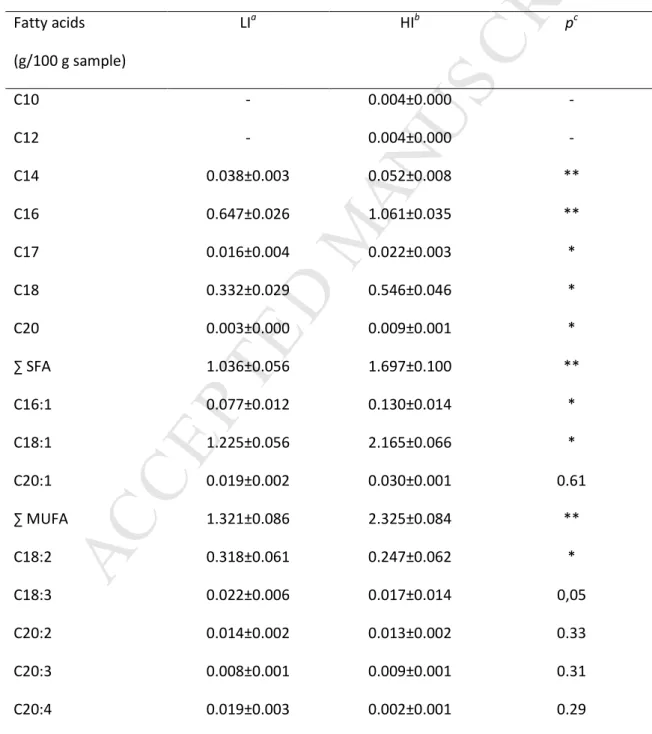
an internal temperature of 68 °C using an external temperature of 70 °C. The cooked 60
hams were then refrigerated at 2 °C±1 °C for 48 h and vacuum-packaged individually in 61
PA/PE sealed bags and stored at 0 °C±1 °C until required for analysis (3 days later). 62
Before analysis, each cooked ham was entirely ground and mixed and then two 63
homogeneous subsamples were taken. 64
2.2. Moisture content and Intramuscular fat (IMF) content.
M
ANUS
C
R
IP
T
AC
C
EP
TE
D
4 Moisture was determined according to the AOAC method (AOAC, 1984). The 66intramuscular fat content (expressed on wet base) was determined according to the 67
AOAC (2006) method using the Foss Soxcap 2047 for the hydrolysis and the Soxtec 68
Extraction 2055 system for the extraction with hexane (Foss analytical, Denmark). 69
2.3. Fatty acid profile.
70
Fat was extracted using the chloroform–methanol procedure of Folch, Lees, and 71
Stanley (1957). After evaporation of the extract, fatty acids were converted to fatty 72
acid methyl esters (FAME) following the method ISO 5509-1978 (E) by using 14% BF3 in 73
methanol, and analyzed by gas chromatography (GC Agilent 6890). Individual fatty 74
acids were identified by retention time with reference to a standard solution (FA 75
methyl ester mixture 189-19; Sigma-Aldrich, Madrid, Spain). The separation of FAMES 76
was carried out with a capillary column coated with polyethyleneglycol-TPA modified 77
(SUPELCO SP-2380) (60 m long, 0.25 mm internal diameter and 0.20 µm film 78
thickness). The injector and detector temperature were 280 °C and the oven was 79
programmed from 120 °C to 220 °C by using a linear gradient of 4 °C /min. The carrier 80
gas was helium (He) at a split ratio of 1:50 and 0.5 µl of sample solution was injected. 81
Results were expressed as g of fatty acid per 100 g of sample. 82
2.4. Crude protein content.
83
Total nitrogen content (TN, % w/w) was measured by the Kjeldahl method (ISO 937, 84
1978) and the protein content was estimated by multiplying the TN by 6.25. 85
2.5. SPME extraction.
M
ANUS
C
R
IP
T
AC
C
EP
TE
D
5 Two-gram subsamples from the previously homogenized samples described in 87section “Sample selection and preparation” were placed into a 20 mL glass vial and 88
capped with a Silicone-PTFE septum. The vial was transferred into a CTC SPME 89
AutoSampler (CTC Analytics AG, Zwingen, Switzerland). The SPME fiber used was a 90
30/50 µm Carboxen/PDB/DVB fibers (Supelco, Bellefonte, PA). The fibers were 91
exposed to the headspace of the vial for 30 min at 40 °C and the volatiles were 92
desorbed in the injection port of the chromatograph for 10 min at 250 °C in split-less 93
mode. An empty vial was used as a blank sampler to clean the column and the fiber 94
before each sample run. 95
2.6. SBSE extraction.
96
Post-cooking exudate samples of 5 mL were collected immediately after unsealing 97
and stored in 50 ml vials. SBSE extraction and injection parameters were performed 98
according to Ibáñez and Solá (2006). Volatile compound extraction of each sample was 99
performed for 90 min at 1400 rpm using 10 mm x 0.5 mm PDMS phase thickness stir 100
bars (Twister®, GERSTEL GmbH & Co.KG, Mülheiman der Ruhr, Germany). Afterwards, 101
the stir bars were rinsed with distilled water, dried with a clean tissue and transferred 102
to desorption tubes in the MPS2 Gerstel Autosampler System. The Agilent 6890 GC 103
(Agilent Technologies, Palo Alto, California, USA) was equipped with a Multipurpose 104
Automatic Sampler (MPS2), a thermal desorption unit (TDU) and a cooled injection 105
system (CIS4) by Gerstel (Gerstel, Mülheiman der Ruhr, Germany). For the injection of 106
the volatiles absorbed on the stir bars into the GC, the TDU was held at 30 °C for 1 min, 107
raised to 250 °C at a rate of 90 °C/min and then held at this temperature for 10 min. 108
The split 1:15 was used for TDU injection during thermal desorption. The desorption 109
M
ANUS
C
R
IP
T
AC
C
EP
TE
D
6 flow was kept to 50 mL/min at 103 kPa, while the injection port was maintained at -110110 °C (liquid N2 cooled). After total desorption of volatiles, the CIS4 was ramped at a 111
rate of 12 °C/s from -110 °C to 250 °C and held at this temperature for 3 min. 112
2.7. Gas Chromatography and Mass Spectrometry (GC-MS) analysis.
113
All analyses were performed with an Agilent 6890 gas chromatograph coupled to a 114
5973N mass selective detector from Agilent (Agilent, Palo Alto, USA). The separation of 115
volatiles was performed using a Supelcowax 10 (30m x 0.25 mm x 0.25 µm) capillary 116
column and helium was used as the carrier gas. The oven program includes an initial 117
temperature of 60 °C, and a program rate of 4 °C/min up to 230 °C and was held at this 118
temperature for 15 min. The mass spectrometer (MS) transfer line temperature was 119
held at 250 °C. Electronic impact at 70eV was used to obtain the mass spectra. The MS 120
scanned from 35 m/z to 300 m/z keeping the ion source temperature at 230 °C and the 121
quadrupole temperature at 150 °C. Volatile compounds were identified comparing 122
their mass spectra with those of authentic standards and with references from several 123
commercial libraries databases NIST 08 library (NIST 08, version 2.0, Gaithersburg, 124
USA) and Wiley (Willey & Sons Inc., Germany). The volatile standards used were from 125
Sigma Aldrich (St Louis, USA). Each compound was further confirmed by comparing its 126
linear retention index with those obtained from the standards and/or from literature 127
sources. Identification of volatiles was done using AMDIS deconvolution software (NIST 128
08, Gaithersburg, USA) to clean chromatographic peaks from interferences in the 129
studied matrices. If the standards were unavailable, the identification of some volatile 130
compounds was performed by comparing their mass spectra with NIST and Wiley 131
database resulting in tentatively identified compounds. Results from the GC-MS 132
M
ANUS
C
R
IP
T
AC
C
EP
TE
D
7 analysis were expressed in area units (AU x 10-6). Each value in Table 2, Table 3 and 133Table 4 is the mean of five measurements. 134
2.8. Data analysis.
135
The effect of the IMF profile (LI and HI) on the proportion of identified volatiles was 136
determined by the analysis of variance (GLM) procedure (SAS, 2007). The Tukey test 137
was used for mean comparisons. Statistical significance was set at p<0.05. 138
3. Results and discussion 139
3.1. Moisture content, Intramuscular fat content, crude protein and fatty acids.
140
No significant differences regarding moisture content were obtained between LI 141
and HI samples (73.95±0.104% vs 73.49±0.142%, respectively). Consistent with 142
available literature (Arce, et al., 2009; Pugliese & Sirtori, 2012) the LI samples had 143
significantly lower IMF (2.74±0.18%) than HI (4.33±0.31%) and higher crude protein 144
(23.23±0.09%) than HI (20.72±0.04%). In addition, Table 1 shows the fatty acid 145
composition for each sample (g of fatty acid/100 g of sample). HI hams contained 146
2.165±0.066 g oleic acid/100 g, 0.247±0.0624 g linoleic acid/100 g while the IMF from 147
the LI hams had lower contents of oleic acid (1.225±0.056 g/100 g) and higher content 148
of linoleic (0.022±0.006 g/100 g) acids. Consequently, samples of HI compared to the LI 149
had lower levels of PUFA (0.307 g/100 g vs. 0.3836 g/100 g, respectively) and higher 150
levels of MUFA (2.325 g vs. 1.321 g/100 g, respectively). 151
3.2. Volatile profile of HI and LI cooked ham following SPME extraction.
152
A list of the HI and the LI cooked ham volatiles identified in our study by GC-MS 153
following SPME extraction is shown in Table 2 (volatiles derived from lipid oxidation) 154
M
ANUS
C
R
IP
T
AC
C
EP
TE
D
8 and Table 3 (non-lipid derived volatiles). Overall, our study reveals 100 volatile 155compounds in cooked ham using SPME. Aldehydes, acids, ketones and alcohols, which 156
are mainly derived from lipid oxidation, were the predominant compounds in both the 157
LI and the HI groups, confirming that lipid composition plays a crucial role in the 158
formation of cooked ham flavour (Elmore, Mottram, & Hierro, 2001). A higher number 159
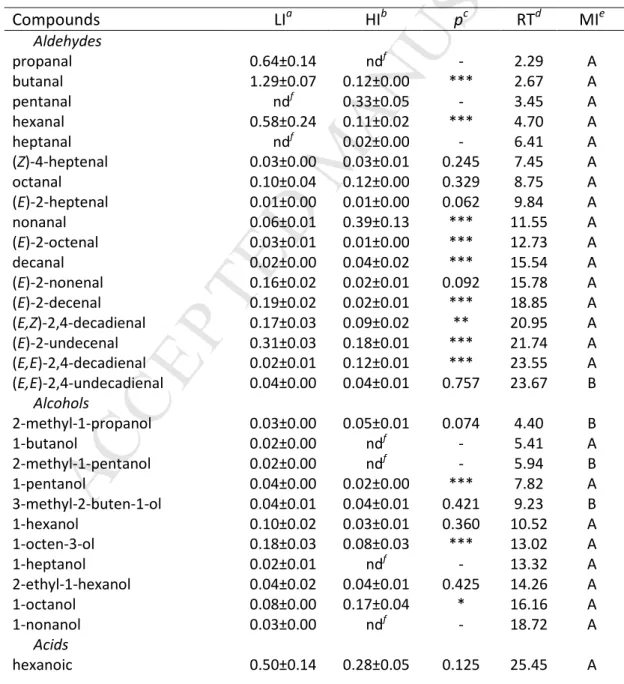
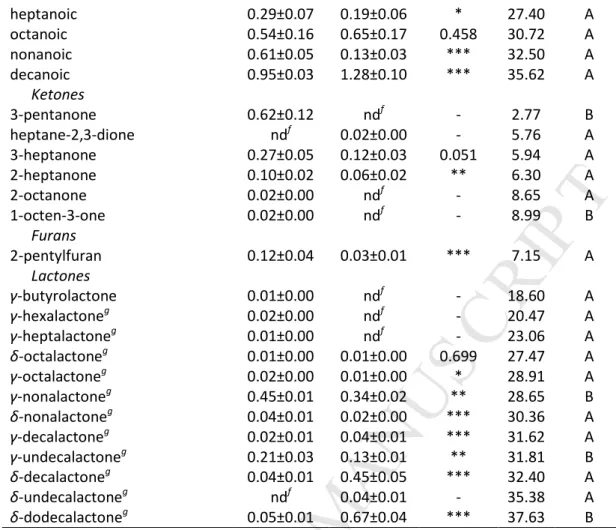
of lipid-derived volatiles were identified in the LI compared to the HI samples (47 160
compared to 40, respectively) (Table 2).These results are in agreement with those of 161
Machiels and Istasse (2003) in cooked uncured beef and Estévez, Morcuende, 162
Ventanas, and Cava (2003) in cooked pork, who obtained higher number of volatiles 163
from low fat meats when compared to those with higher fat contents. Consequently, 164
the number of lipid-derived volatiles identified does not reflect the IMF content in the 165
two groups. It might be speculated that the higher content of polyunsaturated fatty 166
acids in the LI samples, which are more susceptible to oxidation, may explain the 167
formation of a higher number of lipid-derived volatile compounds (Estévez, et al., 168
2003). 169
Twenty nine volatile compounds, 11 lactones, 1 alcohol, 5 esters, 1 furan, 10 170
terpenes and one miscellaneous compound were identified for the first time in cooked 171
ham aroma. Lactones are compounds that originate from fatty acid oxidation 172
contributing to the fatty, creamy, fruity and coconut-like nuances associated with 173
cooked meat (Leroy, Vasilopoulos, Van Hemelryck, Falony, & De Vuyst, 2009). 174
The comparison of the HI with the LI hams in our SPME extraction resulted in 22 175
lipid oxidation compounds significantly (p<0.05) affected by the IMF profile: 9 176
aldehydes, 6 lactones, 2 acids, 3 alcohols, 1 ketone and 1 furan (Table 2). Aldehydes 177
M
ANUS
C
R
IP
T
AC
C
EP
TE
D
9 are the most important lipid-derived volatiles that contribute to the cooked ham 178aroma due to their low odour threshold. Significant differences (p<0.01) between the 179
HI and the LI samples (Table 2) were observed for hexanal, butanal, nonanal, decanal, 180
(E)-2-octenal, (E)-2-decenal, (E)-2-undecenal, (E,Z)-2,4-decadienal and (E,E )-2,4-181
decadienal levels. The presence of oleic acid-derived aldehydes such as octanal and 182
nonanal has been related to pleasant meaty notes (Muriel, Antequera, Petrón, Andrés, 183
& Ruiz, 2004). In our study, the levels of nonanal (p<0.01) were higher in the HI than in 184
the LI. 185
On the other hand, linoleic related compounds such as (E)-2-octenaland and (E )-2-186
decenal were significantly higher in the LI than in the HI ham while (E,E)-2,4-decadienal 187
showed the opposite trend. The presence of volatile compounds derived in general 188
from PUFA and particularly from linoleic acid, has been related to off-flavours as well 189
as with grass-like and rancid attributes (Estévez, et al., 2003). Hexanal, the most 190
prominent volatile compound related to linoleic acid and a good indicator of lipid 191
oxidation in pork (Ruiz, Garcı ́a, Muriel, Andrés, & Ventanas, 2002) seems to have a 192
significant impact on pig meat aroma. More precisely, high hexanal levels may confer 193
an unpleasant rancid flavour whilst lower levels seem to contribute to a pleasing odour 194
in meat products (Sánchez-Peña, Luna, García-González, & Aparicio, 2005). 195
The IMF profile (p<0.01) significantly affected several of the alcohols identified such 196
as 1-pentanol, 1-octen-3-ol and (p<0.05) 1-octanol. This compound, which arises from 197
oleic acid oxidation, was higher in the HI hams compared to LI hams and may 198
contribute to cooked ham flavour with green, woody and fatty sensory attributes 199
(Timón, Ventanas, Carrapiso, Jurado, & Garcı ́a, 2001). 200
M
ANUS
C
R
IP
T
AC
C
EP
TE
D
10 Our study reports six ketones involved in lipid metabolism with different levels in 201the HI compared to the LI samples. For example, 2-heptanone, a ketone produced 202
during linoleic acid oxidation, which confers blue cheese flavour attributes (St. Angelo, 203
Legendre, & Dupuy, 1980) was higher in the LI than in the HI hams. 204
Another volatile compound derived from linoleic acid oxidation, 2-pentylfuran 205
(Table 2), showed significantly (p<0.01) higher levels in the LI, compared the HI 206
samples. It is responsible for roasted nuances on meat aroma and may significantly 207
contribute to the overall aroma of cooked ham (MacLeod, Seyyedain-Ardebili, & 208
Chang, 1981). 209
Volatile compounds derived from other (non-lipid) reactions such as Maillard, 210
amino acid breakdown or Thiamine degradation, are in Table 3. We found that 3-211
methyl-butanal, a volatile aldehyde derived from amino acid breakdown (Pastorelli, et 212
al., 2003), was significantly (p<0.01) higher in the HI, compared to the LI ham (Table 3). 213
The 3-methyl-butanal compound has been related to a fruity, acorn-like, salty and 214
cheesy aroma of high consumer acceptance (Muriel, et al., 2004; Pastorelli, et al., 215
2003). The combination of a lower concentrations of hexanal together with a high 216
concentration of 3-methyl-butanal seems to significantly contribute to the 217
characteristic flavour of Iberian meat products (Timón, et al., 2001). 218
All the five volatile sulphur and nitrogen compounds from amino acid breakdown 219
identified in our analysis, methanethiol, dimethyl sulfide, dimethyl disulfide, pyridine 220
and methional were significantly (p<0.01) higher in the LI than the HI (Table 3). 221
Nuances of hydrogen sulfide, cauliflower, onion, garlic and dirty socks are related to 222
sulphur-containing compounds and their pleasing/unpleasing contribution depends on 223
M
ANUS
C
R
IP
T
AC
C
EP
TE
D
11 the relative content (Machiels & Istasse, 2003). The balance between these sulphur 224and nitrogen compounds and the volatiles from lipid oxidation characterize the overall 225
cooked ham aroma. The LI samples presented a higher number of lipid-derived 226
volatiles from linoleic acid oxidation related to off-flavours than the HI samples. These 227
off-flavours may partially mask the ‘meaty character’ from sulphur compounds and 228
result in a decrease of the cooked ham aroma intensity (Thomas, Mercier, Tournayre, 229
Martin, & Berdagué, 2013). The HI meats showed a rich lipid volatile profile related to 230
oleic acid derivatives, which together with the short branched aldehyde 3-methyl-231
butanal may confer essential aroma traits such as ‘acorn’ nuances. 232
3.3. Volatile profile of HI and LI cooked ham using SBSE extraction.
233
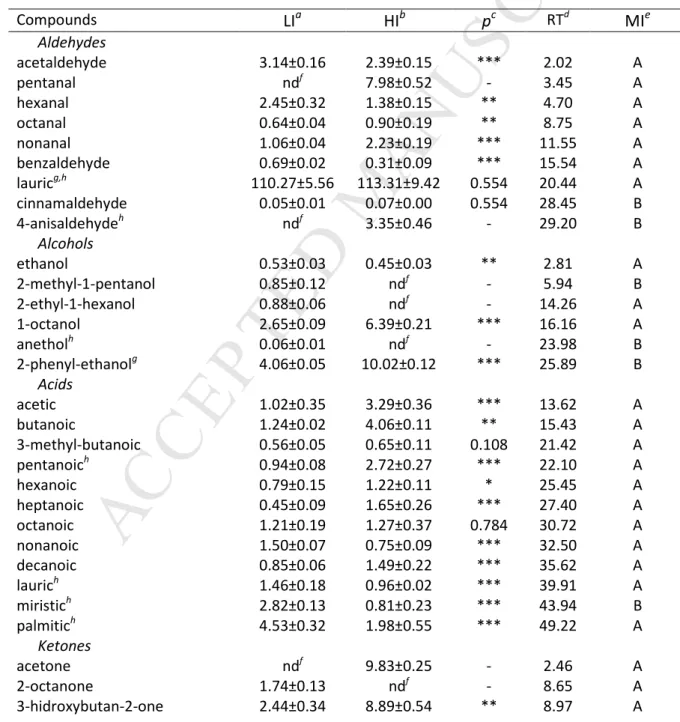
The SBSE analysis (hereinafter SBSE) resulted in 81 volatile compounds identified 234
between the two IMF profiles, 17 unique to the HI and 15 to the LI hams (Table 4). 235
SBSE allowed identification of peaks with longer retention times and therefore the 236
evaluation of compounds with higher molecular weights and polar compounds, such as 237
medium-chain fatty acids (Horák, Čulík, Jurková, Čejka, & Kellner, 2008). In our study, 238
lauric, miristic and palmitic acid were only identified by SBSE. In addition, it has been 239
demonstrated that SBSE is a useful tool to analyze apolar compounds such as terpenes 240
and derivatives (hereinafter terpenes) in a polar matrix (Jelén, et al., 2012). 241
Consequently, most of the compounds identified by SBSE which were not identified by 242
SPME belonged to that chemical group. Overall 11 terpenes, 4 acids, 2 aldehydes and 2 243
alcohols, 2 nitrogen/sulphur compounds and 2 compounds of other chemical groups 244
were identified by SBSE but not SPME. Moreover, 40 of the compounds identified by 245
SBSE (5 aldehydes, 3 alcohols, 10 acids, 1 ketone, 3 esters, 11 terpenes, 2 lactones, 1 246
M
ANUS
C
R
IP
T
AC
C
EP
TE
D
12 nitrogen/sulphur and 3 miscellaneous compounds) differed significantly (p < 0.05) 247between the two IMF profiles (Table 4). 248
By using the SBSE technique, 35 volatile compounds were identified for the first 249
time in cooked ham volatile extraction. Within these compounds, 14 were only 250
identified by SBSE: 1 aldehyde, 1 nitrogen/sulphur compound and 12 terpenes. Thus, 251
to our knowledge 22 of the 26 terpenes found in our study (Table 4) have not been 252
previously reported in cooked ham literature. The terpenes identified in our ham 253
samples may have a high odour threshold and a low impact on the aroma (Timón, et 254
al., 2001). It has been argued that the accumulation of some terpenes in fat, such as 255
dihydromircenol and linalool may reflect diet composition (Muriel, et al., 2004). In our 256
study, both compounds were higher in the HI than in the LI hams (Table 4). 257
Within the group of carboxylic acids, Ruiz, Ventanas, Cava, Andrés, and García 258
(1999) observed an increase in odd-numbered medium chain fatty acids (e.g. 259
pentanoic, heptanoic, nonanoic) in dry-cured Iberian hams compared to other 260
commercial breeds. Our SBSE results are consistent with the previous findings, 261
showing higher (p < 0.01) values of odd-chained pentanoic and heptanoic acids in the 262
HI compared to the LI meats. 263
Indole and skatole are related to animal and fecal odours and, together with 264
androstenone, might be responsible for boar taint odour. These compounds have low 265
odour thresholds and result in a deep undesirable impact on the overall flavour, 266
affecting consumer choice. In our study indole and skatole were detected only after 267
SBSE extraction. In particular, the abundance of indole was higher (p<0.01) in the LI 268
than in the HI ham while the opposite was true for skatole. Our data agrees with the 269
M
ANUS
C
R
IP
T
AC
C
EP
TE
D
13 findings by Rius and García-Regueiro (2001) showing that skatole was higher in pig 270breeds with higher fat content. 271
4. Conclusions 272
The comparison of cooked cured ham volatiles from two sets of ham samples 273
selected based on content and profile of IMF showed lower number of volatiles for the 274
HI group than the LI group. However, the LI group appeared to have higher 275
abundances of rancid nuances arising from the oxidation of linoleic acid (PUFA) and 276
components from amino acid breakdown than HI hams. Also, HI samples showed 277
higher terpenes and the components from oleic acid oxidation. Finally, our results 278
show that SBSE extraction is a useful tool to identify volatile compounds of different 279
polarities such as medium chain fatty acids, terpenes and related compounds (such as 280
board taint related indole and skatole) in cooked ham samples. 281
5. Acknowledgments 282
The authors gratefully acknowledge LUCTA S.A. for the sponsorship and technical 283
guidance in the analytical procedures of this work.
284
6. References 285
AOAC (2006). Official methods for analysis (17th ed.) 24010:432. Association of Official 286
Analytical Chemistry, Washington D.C. 287
Arce, L., Domínguez-Vidal, A., Rodríguez-Estévez, V., López-Vidal, S., Ayora-Cañada, M. 288
J., & Valcárcel, M. (2009). Feasibility study on the use of infrared spectroscopy for the 289
direct authentication of Iberian pig fattening diet. Analytica Chimica Acta, 636(2), 183-290
189. 291
Barba, C., Santa-María, G., Herraiz, M., & Calvo, M. M. (2012). Rapid detection of 292
radiation-induced hydrocarbons in cooked ham. Meat Science, 90(3), 697-700. 293
M
ANUS
C
R
IP
T
AC
C
EP
TE
D
14 Burdock, G. (2004). Fenaroli's Handbook of Flavor Ingredients, Fifth Edition. In 294Fenaroli's Handbook of Flavor Ingredients, Fifth Edition: CRC Press. 295
Carrapiso, A. I., & García, C. (2004). Iberian ham headspace: odorants of intermuscular 296
fat and differences with lean. Journal of the Science of Food and Agriculture, 84(15), 297
2047-2051. 298
Elmore, J. S., Mottram, D. S., & Hierro, E. (2001). Two-fibre solid-phase microextraction 299
combined with gas chromatography–mass spectrometry for the analysis of volatile 300
aroma compounds in cooked pork. Journal of Chromatography A, 905(1–2), 233-240. 301
Estévez, M., Morcuende, D., Ventanas, S., & Cava, R. (2003). Analysis of Volatiles in 302
Meat from Iberian Pigs and Lean Pigs after Refrigeration and Cooking by Using SPME-303
GC-MS. Journal of Agricultural and Food Chemistry, 51(11), 3429-3435. 304
Folch, J., Lees, M., & Stanley, G. H. S. (1957). A simple method for the isolation and 305
purification of total lipids from animal tissues. Journal of Biological Chemistry, 226(1), 306
497-509. 307
Guerrero, E. D., Marín, R. N., Mejías, R. C., & Barroso, C. G. (2006). Optimisation of stir 308
bar sorptive extraction applied to the determination of volatile compounds in vinegars. 309
Journal of Chromatography A, 1104(1–2), 47-53. 310
Horák, T., Čulík, J., Jurková, M., Čejka, P., & Kellner, V. (2008). Determination of free 311
medium-chain fatty acids in beer by stir bar sorptive extraction. Journal of
312
Chromatography A, 1196–1197(0), 96-99. 313
Ibáñez, C., & Solá, J. (2006). Optimisation of stir bar sorptive extraction (SBSE) for 314
flavour analysis. In L. P. B. Wender& P. Mikael Agerlin (Eds.), Developments in Food
315
Science,43(0) 577-580. 316
ISO 937 (1978). Meat and meat products. Determination of nitrogen content.
317
ISO 5509 (1978). Animal and vegetable fats and oils. Preparation of methyl esters of
318
fatty acids.
319
Jelén, H. H., Majcher, M., & Dziadas, M. (2012). Microextraction techniques in the 320
analysis of food flavor compounds: A review. Analytica Chimica Acta, 738, 13-26. 321
Leroy, F., Vasilopoulos, C., Van Hemelryck, S., Falony, G., & De Vuyst, L. (2009). Volatile 322
analysis of spoiled, artisan-type, modified-atmosphere-packaged cooked ham stored 323
under different temperatures. Food Microbiology, 26(1), 94-102. 324
MacLeod, G., Seyyedain-Ardebili, M., & Chang, S. S. (1981). Natural and simulated 325
meat flavors (with particular reference to beef). C R C Critical Reviews in Food Science
326
and Nutrition, 14(4), 309-437. 327
M
ANUS
C
R
IP
T
AC
C
EP
TE
D
15 Machiels, D., & Istasse, L. (2003). Evaluation of two commercial solid-phase 328microextraction fibres for the analysis of target aroma compounds in cooked beef 329
meat. Talanta, 61(4), 529-537. 330
Mottram, D. S., Edwards, R. A., & Macfie, J. H. H. (1982). A comparison of the flavour 331
volatiles from cooked beef and pork meat systems. Journal of the Science of Food and
332
Agriculture, 33(9), 934-944. 333
Morrissey, P. A., Sheehy, P. J. A., Galvin, K., Kerry, J. P., & Buckley, D. J. (1998). Lipid 334
stability in meat and meat products. Meat Science, 49(0), S73-S86. 335
Muriel, E., Antequera, T., Petrón, M. J., Andrés, A. I., & Ruiz, J. (2004). Volatile 336
compounds in Iberian dry-cured loin. Meat Science, 68(3), 391-400. 337
Pastorelli, G., Magni, S., Rossi, R., Pagliarini, E., Baldini, P., Dirinck, P., Van Opstaele, F., 338
& Corino, C. (2003). Influence of dietary fat, on fatty acid composition and sensory 339
properties of dry-cured Parma ham. Meat Science, 65(1), 571-580. 340
Pugliese, C., & Sirtori, F. (2012). Quality of meat and meat products produced from 341
southern European pig breeds. Meat Science, 90(3), 511-518. 342
Rebollo, A. J. G., Botejara, E. M., Cansado, A. O., Morales, P. J., Bellido, M. M., Sánchez, 343
A. F., Arias, P. M., & Alvarez, J. E. C. (1998). Effects of consumption of meat product 344
rich in monounsaturated fatty acids (the ham from the Iberian pig) on plasma lipids. 345
Nutrition Research, 18(4), 743-750. 346
Rius, M. A., & García-Regueiro, J. A. (2001). Skatole and indole concentrations in 347
Longissimus dorsi and fat samples of pigs. Meat Science, 59(3), 285-291. 348
Ruiz, J., García, C., Muriel, E., Andrés, A. I., & Ventanas, J. (2002). Influence of sensory 349
characteristics on the acceptability of dry-cured ham. Meat Science, 61(4), 347-354. 350
Ruiz, J., Ventanas, J., Cava, R., Andrés, A., & García, C. (1999). Volatile compounds of 351
dry-cured Iberian ham as affected by the length of the curing process. Meat Science,
352
52(1), 19-27. 353
Sant Angelo, A. J., Legendre, M. G., & Dupuy, H. P. (1980). Identification of 354
lipoxygenase-linoleate decomposition products by direct gas chromatography-mass 355
spectrometry. Lipids, 15(1), 45-49. 356
Sárraga, C., Guàrdia, M.D., Díaz, I., Guerrero, L., García-Regueiro, J.A., & Arnau, J. 357
(2007). Nutritional and sensory quality of porcine raw meat, cooked ham and dry-358
cured shoulder as affected by dietary enrichment with docosahexaenoic acid (DHA) 359
and α-tocopheryl acetate. Meat Science, 76(2), 377-384. 360
M
ANUS
C
R
IP
T
AC
C
EP
TE
D
16 Thomas, C., Mercier, F., Tournayre, P., Martin, J.L., & Berdagué, J.L. (2013). Effect of 361nitrite on the odourant volatile fraction of cooked ham. Food Chemistry, 139(1–4), 432-362
438. 363
Timón, M. L., Ventanas, J., Carrapiso, A. I., Jurado, A., & García, C. (2001). 364
Subcutaneous and intermuscular fat characterisation of dry-cured Iberian hams. Meat
365
Science, 58(1), 85-91. 366
367
Table 1. Fatty acid profile (mean ± standard deviation) of the intramuscular fat of 368
cooked cured pork ham samples with low (LI)a or high (HI)b intramuscular fat content. 369 Fatty acids (g/100 g sample) LIa HIb pc C10 - 0.004±0.000 - C12 - 0.004±0.000 - C14 0.038±0.003 0.052±0.008 ** C16 0.647±0.026 1.061±0.035 ** C17 0.016±0.004 0.022±0.003 * C18 0.332±0.029 0.546±0.046 * C20 0.003±0.000 0.009±0.001 * ∑ SFA 1.036±0.056 1.697±0.100 ** C16:1 0.077±0.012 0.130±0.014 * C18:1 1.225±0.056 2.165±0.066 * C20:1 0.019±0.002 0.030±0.001 0.61 ∑ MUFA 1.321±0.086 2.325±0.084 ** C18:2 0.318±0.061 0.247±0.062 * C18:3 0.022±0.006 0.017±0.014 0,05 C20:2 0.014±0.002 0.013±0.002 0.33 C20:3 0.008±0.001 0.009±0.001 0.31 C20:4 0.019±0.003 0.002±0.001 0.29
M
ANUS
C
R
IP
T
AC
C
EP
TE
D
17 C22:5 0.003±0.001 0.004±0.001 0.29 ∑PUFA 0.384±0.082 0.307±0.080 **aLI: Low intramuscular fat ham samples from Large White x Landrace pigs. bHI: High
370
intramuscular fat ham samples from Iberian x Duroc (IbD) pigs . cp: Statistical significance 371
between the two means in the same row. Non-significant differences are given as exact P 372
values whereas significant differences are expressed with asterisks: * when P < 0.05, ** when 373
P < 0.01 and *** when P < 0.001. SFA: saturated fatty acids, MUFA: monounsaturated fatty 374
acids, PUFA: polyunsaturated fatty acids. 375
376
Table 2.Comparative profiles of volatile compounds from lipid oxidation identified in 377
cooked cured pork ham samples with low (LI)a or high (HI)b intramuscular fats using 378 SPME. 379 Compounds LIa HIb pc RTd MIe Aldehydes propanal 0.64±0.14 ndf - 2.29 A butanal 1.29±0.07 0.12±0.00 *** 2.67 A pentanal ndf 0.33±0.05 - 3.45 A hexanal 0.58±0.24 0.11±0.02 *** 4.70 A heptanal ndf 0.02±0.00 - 6.41 A (Z)-4-heptenal 0.03±0.00 0.03±0.01 0.245 7.45 A octanal 0.10±0.04 0.12±0.00 0.329 8.75 A (E)-2-heptenal 0.01±0.00 0.01±0.00 0.062 9.84 A nonanal 0.06±0.01 0.39±0.13 *** 11.55 A (E)-2-octenal 0.03±0.01 0.01±0.00 *** 12.73 A decanal 0.02±0.00 0.04±0.02 *** 15.54 A (E)-2-nonenal 0.16±0.02 0.02±0.01 0.092 15.78 A (E)-2-decenal 0.19±0.02 0.02±0.01 *** 18.85 A (E,Z)-2,4-decadienal 0.17±0.03 0.09±0.02 ** 20.95 A (E)-2-undecenal 0.31±0.03 0.18±0.01 *** 21.74 A (E,E)-2,4-decadienal 0.02±0.01 0.12±0.01 *** 23.55 A (E,E)-2,4-undecadienal 0.04±0.00 0.04±0.01 0.757 23.67 B Alcohols 2-methyl-1-propanol 0.03±0.00 0.05±0.01 0.074 4.40 B 1-butanol 0.02±0.00 ndf - 5.41 A 2-methyl-1-pentanol 0.02±0.00 ndf - 5.94 B 1-pentanol 0.04±0.00 0.02±0.00 *** 7.82 A 3-methyl-2-buten-1-ol 0.04±0.01 0.04±0.01 0.421 9.23 B 1-hexanol 0.10±0.02 0.03±0.01 0.360 10.52 A 1-octen-3-ol 0.18±0.03 0.08±0.03 *** 13.02 A 1-heptanol 0.02±0.01 ndf - 13.32 A 2-ethyl-1-hexanol 0.04±0.02 0.04±0.01 0.425 14.26 A 1-octanol 0.08±0.00 0.17±0.04 * 16.16 A 1-nonanol 0.03±0.00 ndf - 18.72 A Acids hexanoic 0.50±0.14 0.28±0.05 0.125 25.45 A
M
ANUS
C
R
IP
T
AC
C
EP
TE
D
18 heptanoic 0.29±0.07 0.19±0.06 * 27.40 A octanoic 0.54±0.16 0.65±0.17 0.458 30.72 A nonanoic 0.61±0.05 0.13±0.03 *** 32.50 A decanoic 0.95±0.03 1.28±0.10 *** 35.62 A Ketones 3-pentanone 0.62±0.12 ndf - 2.77 B heptane-2,3-dione ndf 0.02±0.00 - 5.76 A 3-heptanone 0.27±0.05 0.12±0.03 0.051 5.94 A 2-heptanone 0.10±0.02 0.06±0.02 ** 6.30 A 2-octanone 0.02±0.00 ndf - 8.65 A 1-octen-3-one 0.02±0.00 ndf - 8.99 B Furans 2-pentylfuran 0.12±0.04 0.03±0.01 *** 7.15 A Lactones γ-butyrolactone 0.01±0.00 ndf - 18.60 A γ-hexalactoneg 0.02±0.00 ndf - 20.47 A γ-heptalactoneg 0.01±0.00 ndf - 23.06 A δ-octalactoneg 0.01±0.00 0.01±0.00 0.699 27.47 A γ-octalactoneg 0.02±0.00 0.01±0.00 * 28.91 A γ-nonalactoneg 0.45±0.01 0.34±0.02 ** 28.65 B δ-nonalactoneg 0.04±0.01 0.02±0.00 *** 30.36 A γ-decalactoneg 0.02±0.01 0.04±0.01 *** 31.62 A γ-undecalactoneg 0.21±0.03 0.13±0.01 ** 31.81 B δ-decalactoneg 0.04±0.01 0.45±0.05 *** 32.40 A δ-undecalactoneg ndf 0.04±0.01 - 35.38 A δ-dodecalactoneg 0.05±0.01 0.67±0.04 *** 37.63 B aLI: Low intramuscular fat ham samples from Large White x Landrace pigs. bHI: High
380
intramuscular fat ham samples from Iberian x Duroc (IbD) pigs . cp: Statistical significance of 381
the difference between the two means in the same row due to IMF profile. Non-significant 382
differences are given as exact P values whereas significant differences are expressed with 383
asterisks: * when P < 0.05, ** when P < 0.01 and *** when P < 0.001. dRT: retention time. eMI, 384
method of identification: A, volatile compound identified by comparison of the retention time 385
and the mass spectrum of volatile standards. B, volatile compound tentatively identified by 386
comparison of the mass spectrum in NIST 98 and Wiley libraries. fnd: not detected. g Volatile 387
compounds with the superindex have not been reported before in cooked pork ham literature. 388
389
Table 3.Comparative profiles of volatile compounds from non-lipid oxidation identified 390
in cooked cured pork ham samples with low (LI)a or high HIb intramuscular fats using 391 SPME. 392 Compounds LIa HIb pc RTd MIe Aldehydes acetaldehyde 3.74±0.12 4.76±0.11 *** 2.02 A 2-methyl-butanal 0.33±0.05 0.35±0.08 0.597 2.82 A 3-methyl-butanal 0.21±0.09 2.33±0.26 *** 2.97 A benzaldehyde 0.15±0.05 0.11±0.02 0.215 15.54 A cinnamaldehyde 0.06±0.01 0.02±0.00 *** 28.45 B Alcohols ethanol 0.18±0.06 ndf - 2.81 B
M
ANUS
C
R
IP
T
AC
C
EP
TE
D
19 3-methyl-1-butanol ndf 0.17±0.07 - 4.31 A 2-methyl-1-butanol 0.02±0.00 ndf - 6.51 B 2-phenyl-ethanolg 0.09±0.02 ndf - 25.89 B Acids acetic 0.17±0.02 0.05±0.00 *** 13.62 A butanoic 0.29±0.13 0.45±0.10 0.071 15.43 A 3-methyl-butanoic 0.97±0.12 0.94±0.11 0.637 21.42 A Ketones acetone 0.73±0.13 0.37±0.07 ** 2.35 A 2-butanone 0.17±0.07 0.22±0.05 0.215 2.75 A butane-2,3-dione 0.10±0.03 1.24±0.24 *** 3.23 A pentane-2,3-dione ndf 0.02±0.00 - 4.23 A 3-hidroxybutan-2-one 0.78±0.19 1.20±0.15 ** 8.97 A Esters ethyl acetateg 0.16±0.05 0.14±0.02 0.464 2.71 B ethyl butanoate 1.07±0.04 0.59±0.01 *** 3.96 A ethyl-2-methyl butanoateg 0.03±0.01 0.04±0.00 0.672 4.14 A isoamyl acetate 0.13±0.06 0.16±0.01 0.348 5.29 A 2-methylpropyl-3-methyl butanoate 0.03±0.01 ndf - 6.74 B ethyl caproate 0.02±0.00 0.01±0.00 * 7.47 A prenyl acetateg ndf 0.02±0.00 - 7.75 A hexyl acetateg 0.05±0.01 0.02±0.00 *** 8.09 A isoamyl butanoate 0.04±0.01 0.02±0.01 ** 8.16 A benzyl acetateg ndf 0.29±0.03 - 21.06 B Furans tetrahidrofurang ndf 0.01±0.00 - 2.55 B furfural 0.02±0.01 0.02±0.01 0.371 13.77 ATerpenes and derivates
α-pineneg 0.10±0.03 0.07±0.01 0.071 3.75 A β-pineneg 0.03±0.01 0.02±0.01 0.383 4.85 A sabineneg 0.02±0.01 0.02±0.01 0.071 4.91 B myrceneg 0.02±0.01 0.01±0.01 * 5.73 B δ-3-careneg 0.03±0.01 ndf - 5.75 B 1,4-cineoleg ndf 0.26±0.17 - 6.07 B limonene 0.45±0.05 0.59±0.07 0.127 6.74 A α-phellandreneg ndf 0.07±0.01 - 6.86 B 1,8-cineole ndf 0.12±0.01 - 7.06 A terpinoleneg ndf 0.02±0.00 - 8.23 A p-cymeneg 0.09±0.01 0.05±0.00 0.052 8.51 A linalool 0.45±0.02 0.50±0.05 * 15.8 A linalool acetateg 0.04±0.01 ndf - 15.99 B
Nitrogen and sulphur compounds methanethiol 0.05±0.01 0.02±0.01 *** 1.92 A dimethyl sulfide 0.04±0.01 0.01±0.00 ** 2.12 B dimethyl disulfide 0.04±0.01 ndf - 4.35 A pyridine 0.03±0.00 0.02±0.00 ** 4.41 A methional 0.13±0.03 0.05±0.01 *** 13.42 A Miscellaneous ethoxyethaneg 0.01±0.00 ndf - 1.89 B
M
ANUS
C
R
IP
T
AC
C
EP
TE
D
20 benzene 0.07±0.01 nd - 3.05 B toluene 0.79±0.04 0.43±0.02 * 4.17 AaLI: Low intramuscular fat ham samples from Large White x Landrace pigs. bHI: High
393
intramuscular fat ham samples from Iberian x Duroc(IbD) pigs. cp: Statistical significance of the
394
difference between the two means in the same row due to IMF profile. Non-significant 395
differences are given as exact P values whereas significant differences are expressed with 396
asterisks: * when P < 0.05, ** when P < 0.01 and *** when P < 0.001. dRT: retention time. eMI, 397
method of identification: method of identification: A, volatile compound identified by 398
comparison of the retention time and the mass spectrum of volatile standards. B, volatile 399
compound tentatively identified by comparison of the mass spectrum in NIST 98 and Wiley 400
libraries. fnd: not detected. gVolatile compounds with the superindex have not been reported
401
before in cooked pork ham literature. 402
403
Table 4.Comparative profiles of volatile compounds identified in cooked cured pork 404
ham samples with low (LI)aor high (HI)b intramuscular fats using SBSE. 405 Compounds LIa HIb pc RTd MIe Aldehydes acetaldehyde 3.14±0.16 2.39±0.15 *** 2.02 A pentanal ndf 7.98±0.52 - 3.45 A hexanal 2.45±0.32 1.38±0.15 ** 4.70 A octanal 0.64±0.04 0.90±0.19 ** 8.75 A nonanal 1.06±0.04 2.23±0.19 *** 11.55 A benzaldehyde 0.69±0.02 0.31±0.09 *** 15.54 A lauricg,h 110.27±5.56 113.31±9.42 0.554 20.44 A cinnamaldehyde 0.05±0.01 0.07±0.00 0.554 28.45 B 4-anisaldehydeh ndf 3.35±0.46 - 29.20 B Alcohols ethanol 0.53±0.03 0.45±0.03 ** 2.81 A 2-methyl-1-pentanol 0.85±0.12 ndf - 5.94 B 2-ethyl-1-hexanol 0.88±0.06 ndf - 14.26 A 1-octanol 2.65±0.09 6.39±0.21 *** 16.16 A anetholh 0.06±0.01 ndf - 23.98 B 2-phenyl-ethanolg 4.06±0.05 10.02±0.12 *** 25.89 B Acids acetic 1.02±0.35 3.29±0.36 *** 13.62 A butanoic 1.24±0.02 4.06±0.11 ** 15.43 A 3-methyl-butanoic 0.56±0.05 0.65±0.11 0.108 21.42 A pentanoich 0.94±0.08 2.72±0.27 *** 22.10 A hexanoic 0.79±0.15 1.22±0.11 * 25.45 A heptanoic 0.45±0.09 1.65±0.26 *** 27.40 A octanoic 1.21±0.19 1.27±0.37 0.784 30.72 A nonanoic 1.50±0.07 0.75±0.09 *** 32.50 A decanoic 0.85±0.06 1.49±0.22 *** 35.62 A laurich 1.46±0.18 0.96±0.02 *** 39.91 A miristich 2.82±0.13 0.81±0.23 *** 43.94 B palmitich 4.53±0.32 1.98±0.55 *** 49.22 A Ketones acetone ndf 9.83±0.25 - 2.46 A 2-octanone 1.74±0.13 ndf - 8.65 A 3-hidroxybutan-2-one 2.44±0.34 8.89±0.54 ** 8.97 A
M
ANUS
C
R
IP
T
AC
C
EP
TE
D
21 2-nonanone 1.29±0.06 ndf - 11.46 A Esters ethyl acetateg 8.97±0.09 3.79±0.11 *** 2.71 A ethyl butanoate 0.09±0.01 0.03±0.01 *** 3.96 A isoamyl acetate 4.55±0.10 9.03±0.17 *** 5.29 A hexyl acetateg n.d.f 6.29±0.43 - 8.09 A isoamyl butanoate ndf 1.75±0.16 - 8.16 A benzyl acetateg ndf 2.10±0.25 - 21.06 B Furans 2-pentylfuran 4.27±0.12 ndf - 7.15 ATerpenes and derivates
α-pineneg 0.45±0.04 0.55±0.13 0.065 3.75 A β-pineneg 2.70±0.11 6.85±0.08 *** 4.85 A sabineneg 0.32±0.03 0.96±0.32 *** 4.92 B myrceneg 0.07±0.02 0.06±0.05 0.232 5.73 B δ-3-careneg 0.06±0.03 0.08±0.04 *** 5.75 A α-terpineneg,h ndf 0.23±0.12 - 6.12 A limonene 26.76±1.37 29.63±1.25 0.868 6.74 A α–phellandreneg 0.13±0.01 0.15±0.01 0.176 6.86 B 1,8-cineole 0.33±0.06 0.19±0.05 0.188 7.06 A γ-terpineneg 0.11±0.02 0.60±0.04 *** 7.47 A terpinoleneg 0.03±0.01 0.05±0.01 *** 8.23 A p-cymeneg 1.93±0.23 0.26±0.03 *** 8.51 A linalool oxideg,h ndf 0.08±0.01 - 12.66 A dihydromyrcenolg,h 1.54±0.21 5.22±0.09 *** 13.58 A menthoneg,h ndf 0.05±0.02 - 13.67 A iso-menthoneg,h ndf 0.07±0.03 - 14.40 B linalool 0.08±0.01 0.13±0.03 ** 15.80 A bornyl acetateg,h 0.07±0.01 0.27±0.04 *** 16.69 A isoborny lacetateg,h 0.09±0.02 ndf - 16.94 A β-caryophylleneg,h 0.16±0.05 0.14±0.03 * 17.20 A terpenyl acetateg,h 0.08±0.02 ndf - 20.29 A γ-terpineolg ndf 0.19±0.04 - 20.45 B citronelolg,h ndf 10.03±0.24 - 22.10 B nerolg,h ndf 0.16±0.02 - 22.80 B geraniolg,h ndf 6.80±0.34 - 24.00 B thymol 0.12±0.04 0.20±0.02 * 32.40 B Lactones γ-butyrolactone ndf 4.77±0.35 - 18.60 A δ-octalactoneg 1.08±0.26 ndf - 27.47 A γ- octalactoneg 0.76±0.12 1.53±0.09 *** 28.65 B γ-nonalactoneg 0.44±0.08 0.69±0.13 *** 28.91 A γ-undecalactoneg 0.65±0.04 0.66±0.05 0.486 31.81 A δ-undecalactoneg ndf 0.54±0.05 - 35.38 A δ-dodecalactoneg 0.85±0.09 ndf - 37.63 B
Nitrogen and sulphur compounds
methanethiol 0.77±0.22 ndf - 1.92 A
dimethyl disulfide 0.02±0.00 ndf - 4.41 A
octanenitrileg,h ndf 2.57±0.14 - 9.18 B
M
ANUS
C
R
IP
T
AC
C
EP
TE
D
22 Miscellaneous ethoxyethaneg 0.05±0.01 ndf - 1.89 B benzene 0.02±0.00 0.01±0.01 *** 3.05 B toluene 12.06±0.67 ndf - 4.17 A indoleh 0.04±0.01 0.02±0.00 ** 37.75 A skatoleh 0.01±0.00 0.05±0.01 *** 38.94 A aLI: Low intramuscular fat ham samples from Large White x Landrace pigs. bHI: High
406
intramuscular fat samples from Iberian x Duroc(IbD) pigs. cp: Statistical significance of the 407
difference between the two means in the same row due to IMF profile. Non-significant 408
differences are given as exact P values whereas significant differences are expressed with 409
asterisks: * when P < 0.05, ** when P < 0.01 and *** when P < 0.001. dRT: retention time. eMI, 410
method of identification: A, volatile compound identified by comparison of the retention time 411
and the mass spectrum of volatile standards. B, volatile compound tentatively identified by 412
comparison of the mass spectrum in NIST 98 and Wiley libraries. fnd: not detected. gVolatile 413
compounds with the superindex have not been reported before in cooked pork ham literature. 414
h
Identified only by SBSE analysis. 415
M
ANUS
C
R
IP
T
AC
C
EP
TE
D
HIGHLIGHTSVolatiles of pork cooked ham were evaluated comparing high and low IM fat hams. The majority of volatiles in both breeds were derived from lipid oxidation.
We identified 42 novel volatiles never reported before in cooked cured pork ham. Low IMF hams had high PUFA and elevated volatiles conferring rancid notes. Novel SBSE application showed high sensitivity for fatty acids and terpenes.