0802F—04/22/05
Functionality
Recommended Application:
AMD K8 System Clock with AMD, VIA or ALI Chipset
Output Features:
•
2 - Differential pair push-pull CPU clocks @
3.3V
•
9 - PCICLK (Including 1 free running) @ 3.3V
•
3 - Selectable PCICLK/HTTCLK @ 3.3V
•
1 - HTTCLK @ 3.3V
•
1 - 48MHz @ 3.3V fixed.
•
1 - 24/48MHz @ 3.3V
•
3 - REF @ 3.3V, 14.318MHz.
CPU HTT PCI MHz MHz MHz 0 0 0 0 100.90 67.27 33.63 0 0 0 1 133.90 66.95 33.48 0 0 1 0 168.00 67.20 33.60 0 0 1 1 202.00 67.33 33.67 0 1 0 0 100.20 66.80 33.40 0 1 0 1 133.50 66.75 33.38 0 1 1 0 166.70 66.68 33.34 0 1 1 1 200.40 66.80 33.40 1 0 0 0 150.00 60.00 30.00 1 0 0 1 180.00 60.00 30.00 1 0 1 0 210.00 70.00 35.00 1 0 1 1 240.00 60.00 30.00 1 1 0 0 270.00 67.50 33.75 1 1 0 1 233.33 66.67 33.33 1 1 1 0 266.67 66.67 33.33 1 1 1 1 300.00 75.00 37.50 FS0 FS3 FS2 FS1Pin Configuration
*FS0/REF0 1 48 REF1/FS1* VDDHTT 2 47 GND X1 3 46 VDDREF X2 4 45 REF2/FS2* GND 5 44 Reset# *ModeA/HTTCLK0 6 43 VDDA *ModeB/PCICLK8/HTTCLK1 7 42 GND PCICLK9/HTTCLK2 8 41 CPUCLK8T0 VDDPCI 9 40 CPUCLK8C0 GND 10 39 GND PCICLK11/HTTCLK3 11 38 VDDCPU PCICLK10 12 37 CPUCLK8T1 PCICLK0 13 36 CPUCLK8C1 PCICLK1 14 35 VDDCPU GND 15 34 GND VDDPCI 16 33 GND PCICLK2 17 32 PD#* PCICLK3 18 31 48MHz/FS3** VDDPCI 19 30 GND GND 20 29 AVDD48 2X PCICLK4 21 28 24_48MHz/Sel24_48#* 2X PCICLK5 22 27 GND 2X PCICLK6 23 26 SDATA 2X PCICLK7 24 25 SCLK48-SSOP
* Internal Pull-Up Resistor
IC
S9
50
405
2X
This Output has 2X Default Drive and can be programmaed lower via IIC
Features:
•
Programmable output frequency.
•
Programmable output divider ratios.
•
Programmable output rise/fall time.
•
Programmable output skew.
•
Programmable spread percentage for EMI control.
•
Watchdog timer technology and RESET# output to
reset system
if system malfunctions.
•
Programmable watch dog safe frequency.
•
Support I
2C Index read/write and block read/write
operations.
•
Uses external 14.318MHz crystal.
Pin Descriptions
PIN # PIN NAME PIN
TYPE DESCRIPTION
1 *FS0/REF0 I/O Frequency select latch input pin / 14.318 MHz reference clock.
2 VDDHTT PWR Supply for HTT clocks, nominal 3.3V.
3 X1 IN Crystal input, Nominally 14.318MHz.
4 X2 OUT Crystal output, Nominally 14.318MHz
5 GND PWR Ground pin.
6 *ModeA/HTTCLK0 I/O Mode selection latch input pin / Hyper Transport output.
7 *ModeB/PCICLK8/HTTCLK1 I/O Mode selection latch input pin / PCI clock output / Hyper Transport output. 8 PCICLK9/HTTCLK2 OUT PCI clock output / Hyper Transport output.
9 VDDPCI PWR Power supply for PCI clocks, nominal 3.3V
10 GND PWR Ground pin.
11 PCICLK11/HTTCLK3 I/O PCI clock output / Hyper Transport output.
12 PCICLK10 OUT PCI clock output.
13 PCICLK0 OUT PCI clock output.
14 PCICLK1 OUT PCI clock output.
15 GND PWR Ground pin.
16 VDDPCI PWR Power supply for PCI clocks, nominal 3.3V
17 PCICLK2 OUT PCI clock output.
18 PCICLK3 OUT PCI clock output.
19 VDDPCI PWR Power supply for PCI clocks, nominal 3.3V
20 GND PWR Ground pin.
21
2XPCICLK4 OUT
PCI clock output. This output is default @ 2X drive and can be programmed to lower drive via IIC.
22
2XPCICLK5 OUT
PCI clock output. This output is default @ 2X drive and can be programmed to lower drive via IIC.
23 2XPCICLK6 OUT PCI clock output. This output is default @ 2X drive and can be programmed to lower drive via IIC.
24 2XPCICLK7 OUT PCI clock output. This output is default @ 2X drive and can be programmed to lower drive via IIC.
25 SCLK IN Clock pin of I2C circuitry 5V tolerant
26 SDATA I/O Data pin for I2C circuitry 5V tolerant
27 GND PWR Ground pin.
28 24_48MHz/Sel24_48#* I/O 24/48MHz clock output / Latched select input for 24/48MHz output. 0=48MHz, 1 = 24MHz.
29 AVDD48 PWR Power for 24/48MHz outputs and fixed PLL core, nominal 3.3V
30 GND PWR Ground pin.
31 48MHz/FS3** I/O Fixed 48MHz clock output. 3.3V / 'Frequency select latch input pin
32 PD#* IN Asynchronous active low input pin used to power down the device into a low power state. The internal clocks are disabled and the VCO and the crystal are stopped.
33 GND PWR Ground pin.
34 GND PWR Ground pin.
35 VDDCPU PWR Supply for CPU clocks, 3.3V nominal
36 CPUCLK8C1 OUT Complimentary clock of differential 3.3V push-pull K8 pair. 37 CPUCLK8T1 OUT True clock of differential 3.3V push-pull K8 pair.
38 VDDCPU PWR Supply for CPU clocks, 3.3V nominal
39 GND PWR Ground pin.
40 CPUCLK8C0 OUT Complimentary clock of differential 3.3V push-pull K8 pair. 41 CPUCLK8T0 OUT True clock of differential 3.3V push-pull K8 pair.
42 GND PWR Ground pin.
43 VDDA PWR 3.3V power for the PLL core.
44 Reset# OUT Real time system reset signal for frequency gear ratio change or watchdog timer timeout. This signal is active low.
45 REF2/FS2* I/O 14.318 MHz reference clock / Frequency select latch input pin.
46 VDDREF PWR Ref, XTAL power supply, nominal 3.3V
47 GND PWR Ground pin.
0802F—04/22/05
The
ICS950405
is a main system clock solution for desktop designs using the AMD K8 CPU. It provides all necessary
clock signals for Clawhammer and Sledgehammer with AMD, VIA or ALI systems.
The
ICS950405
is part of a whole new line of ICS clock generators and buffers called TCH™ (Timing Control Hub). This
part incorporates ICS's newest clock technology which offers more robust features and functionality. Employing the
use of a serially programmable I
2C interface, this device can adjust the output clocks by configuring the frequency
setting, the output divider ratios, selecting the ideal spread percentage, the output skew, the output strength, and
enabling/disabling each individual output clock. M/N control can configure output frequency with resolution up to
0.1MHz increment.
Block Diagram
PLL2
PLL1
Spread
Spectrum
PCICLK (7:0, 10)
CPUCLKT (1:0)
CPUCLKC (1:0)
X1
X2
XTAL
OSC
CPU DIVDER PCI DIVDER HTT DIVDERSDATA
SCLK
PD#
FS (3:0)
SEL24_48#
MODE (A,B)
Control
Logic
REF (2:0)
48MHz
24_48MHz
/ 2
PCICLK(11,9,8)/HTTCLK (3:1)
HTTCLK0
Config.
Reg.
Power Groups
VDD GND 2 5 Xtal, POR 9 10 PCICLK, HTTCLK O/p 16,19 15,20 PCICLK Outputs 29 27,30,33 48 MHz, Fix Analog 35,38 34,39 CPU Outputs 43 42 Analog, CPU PLL, MCLK46 47 REF, Digital Core
Pin Number
Description
Mode Functionality Tables
ModeA ModeB Pin7 Pin8 Pin11
0 0 HTTCLK1 HTTCLK2 PCICLK11
0 1 HTTCLK1 HTTCLK2 HTTCLK3
1 0 PCICLK8 PCICLK9 PCICLK11
1 1 HTTCLK1 PCICLK9 PCICLK11
Table1: Frequency Selection Table
Bit3 Bit2 Bit1 Bit0 CPU HTT PCI
FS3 FS2 FS1 FS0 MHz MHz MHz 0 0 0 0 100.90 67.27 33.63 0 0 0 1 133.90 66.95 33.48 0 0 1 0 168.00 67.20 33.60 0 0 1 1 202.00 67.33 33.67 0 1 0 0 100.20 66.80 33.40 0 1 0 1 133.50 66.75 33.38 0 1 1 0 166.70 66.68 33.34 0 1 1 1 200.40 66.80 33.40 1 0 0 0 150.00 60.00 30.00 1 0 0 1 180.00 60.00 30.00 1 0 1 0 210.00 70.00 35.00 1 0 1 1 240.00 60.00 30.00 1 1 0 0 270.00 67.50 33.75 1 1 0 1 233.33 66.67 33.33 1 1 1 0 266.67 66.67 33.33 1 1 1 1 300.00 75.00 37.50
0802F—04/22/05
General I
C serial interface information
How to Write:
•
Controller (host) sends a start bit.
• Controller (host) sends the write address D2
(H)• ICS clock will
acknowledge
• Controller (host) sends the begining byte location = N
• ICS clock will
acknowledge
• Controller (host) sends the data byte count = X
• ICS clock will
acknowledge
• Controller (host) starts sending
Byte N through
Byte N + X -1
(see Note 2)
• ICS clock will
acknowledge
each byte
one at a time
• Controller (host) sends a Stop bit
How to Read:
• Controller (host) will send start bit.
• Controller (host) sends the write address D2
(H)• ICS clock will
acknowledge
• Controller (host) sends the begining byte
location = N
• ICS clock will
acknowledge
• Controller (host) will send a separate start bit.
• Controller (host) sends the read address D3
(H)• ICS clock will
acknowledge
• ICS clock will send the data byte count = X
• ICS clock sends
Byte N + X -1
• ICS clock sends
Byte 0 through byte X (if X
(H)was written to byte 8)
.
• Controller (host) will need to acknowledge each byte
• Controllor (host) will send a not acknowledge bit
• Controller (host) will send a stop bit
ICS (Slave/Receiver)
T
WR
ACK
ACK
ACK
ACK
ACK
P
stoP bit
X Byt
e
Index Block Write Operation
Slave Address D2
(H)Beginning Byte = N
WRite
starT bit
Controller (Host)
Byte N + X - 1
Data Byte Count = X
Beginning Byte N
T
starT bit
WR
WRite
RT
Repeat starT
RD
ReaD
Beginning Byte N
Byte N + X - 1
N
Not acknowledge
P
stoP bit
Slave Address D3
(H)Index Block Read Operation
Slave Address D2
(H)Beginning Byte = N
ACK
ACK
Data Byte Count = X
ACK
ICS (Slave/Receiver)
Controller (Host)
X Byt
e
ACK
ACK
I
2C Table: Frequency Select Register
Bit 7 SS_EN Spread Enable RW 1
Bit 6 SEL24_48MHz Output Select RW Latch
Bit 5 Reserved Reserved RW X
Bit 4 Reserved Reserved RW X
Bit 3 FS3 Freq Select Bit 3 RW Latch
Bit 2 FS2 Freq Select Bit 2 RW Latch
Bit 1 FS1 Freq Select Bit 1 RW Latch
Bit 0 FS0 Freq Select Bit 0 RW Latch
I
2C Table: Output Control Register
Bit 7 REF0 Output Control RW 1
Bit 6 HTTCLK0 Output Control RW 1
Bit 5 PCICLK8/HTTCLK1 Output Control RW 1
Bit 4 PCICLK9/HTTCLK2 Output Control RW 1
Bit 3 PCICLK11/HTTCLK3 Output Control RW 1
Bit 2 PCICLK10 Output Control RW 1
Bit 1 PCICLK0 Output Control RW 1
Bit 0 PCICLK1 Output Control RW 1
I
2C Table: Output Control Register
Bit 7 PCICLK2 Output Control RW 1
Bit 6 PCICLK3 Output Control RW 1
Bit 5 PCICLK4 Output Control RW 1
Bit 4 PCICLK5 Output Control RW 1
Bit 3 PCICLK6 Output Control RW 1
Bit 2 PCICLK7 Output Control RW 1
Bit 1 24_48MHz Output Control RW 1
Bit 0 48MHz Output Control RW 1
I
2C Table: Output Control Register
Bit 7 CPUCLK8T/C_1 Output Control RW 1
Bit 6 CPUCLK8T/C_0 Output Control RW 1
Bit 5 REF2 Output Control RW 1
Bit 4 REF1 Output Control RW 1
Bit 3 PCI_Str1 RW 0 Bit 2 PCI_Str0 RW 1 Bit 1 PCI_Str1 RW 0 Bit 0 PCI_Str0 RW 1 PCI9,8 Strength Control only PCI11 Strength Control
only - 00: 0.5X Drive 10: 1.5X Drive - 01: 1.0X Drive 11: 2.0X Drive - 00: 0.5X Drive 10: 1.5X Drive - 01: 1.0X Drive 11: 2.0X Drive 45 Disable Enable 48 Disable Enable 37,36 Disable Enable 41,40 Disable Enable Type 0 1 PWD
Byte 3 Pin # Name Control Function
28 Disable Enable 31 Disable Enable 23 Disable Enable 24 Disable Enable 21 Disable Enable 22 Disable Enable 17 Disable Enable 18 Disable Enable Type 0 1 PWD
Byte 2 Pin # Name Control Function
13 Disable Enable 14 Disable Enable 11 Disable Enable 12 Disable Enable 7 Disable Enable 8 Disable Enable 1 Disable Enable 6 Disable Enable Type 0 1 PWD
Byte 1 Pin # Name Control Function
-- Reserved Reserved
- Reserved Reserved
See Table1: Frequency Selection Table -Type 0 1 - OFF ON - 48MHz 24MHz PWD
0802F—04/22/05
I
2C Table: Output Control Register
Bit 7 PCIStr1 RW 0 Bit 6 PCIStr0 RW 1 Bit 5 PCIStr1 RW 1 Bit 4 PCIStr0 RW 1 Bit 3 PCIStr1 RW 1 Bit 2 PCIStr0 RW 1 Bit 1 PCIStr1 RW 1 Bit 0 PCIStr0 RW 1
I
2C Table: Reserved Register
Bit 7 Reserved Reserved RW X
Bit 6 Reserved Reserved RW X
Bit 5 Reserved Reserved RW X
Bit 4 Reserved Reserved RW X
Bit 3 Reserved Reserved RW X
Bit 2 Reserved Reserved RW X
Bit 1 Reserved Reserved RW X
Bit 0 Reserved Reserved RW X
I
2C Table: Byte Count Register
Bit 7 BC7 RW 0 Bit 6 BC6 RW 0 Bit 5 BC5 RW 0 Bit 4 BC4 RW 0 Bit 3 BC3 RW 0 Bit 2 BC2 RW 1 Bit 1 BC1 RW 1 Bit 0 BC0 RW 0
I
2C Table: Byte Count and Vendor ID Register
Bit 7 REV_ID3 RW 0 Bit 6 REV_ID2 RW 0 Bit 5 REV_ID1 RW 0 Bit 4 REV_ID0 RW 0 Bit 3 Vendor_ID3 RW 0 Bit 2 Vendor_ID2 RW 0 Bit 1 Vendor_ID1 RW 0 Bit 0 Vendor_ID0 RW 1 PCICLK (5) Strength Control PCICLK (4) Strength Control Byte Count Programming b(7:0)
Writing to this register will configure how many bytes will be read back, default is
06 = 6 bytes. Reserved
Reserved Reserved
Reserved All other PCICLK
Strength Control PCICLK (7:6) Strength Control Reserved Reserved Reserved Type 0 1 Reserved Reserved Reserved Reserved Reserved Reserved Reserved - - -- - -Vendor ID - - -- - -- - -- - -Revision ID - - -- - -Type 0 1 PWD
Byte 7 Pin # Name Control Function
-Reserved Reserved -Type 0 1 PWD
Byte 6 Pin # Name Control Function
-PWD
Byte 5 Pin # Name Control Function
-Type 0 1 PWD
Byte 4 Pin # Name Control Function
00: 0.5X Drive 10: 1.5X Drive 01: 1.0X Drive 11: 2.0X Drive 00: 0.5X Drive 10: 1.5X Drive 01: 1.0X Drive 11: 2.0X Drive 00: 0.5X Drive 01: 1.0X Drive 11: 2.0X Drive 10: 1.5X Drive 01: 1.0X Drive 11: 2.0X Drive 00: 0.5X Drive 10: 1.5X Drive
I
2C Table: Skew Control Register
Bit 7 PCI/HTTSkw3 RW 0000:0 0100:150 1000:300 1100:450 1
Bit 6 PCI/HTTSkw2 RW 0001:N/A 0101:N/A 1001:N/A 1101:600 1
Bit 5 PCI/HTTSkw1 RW 0010:N/A 0110:N/A 1010:N/A 1110:750 0
Bit 4 PCI/HTTSkw0 RW 0011:N/A 0111:N/A 1011:N/A 1111:900 0
Bit 3 PCISkw3 RW 0000:0 0100:150 1000:300 1100:450 1
Bit 2 PCISkw2 RW 0001:N/A 0101:N/A 1001:N/A 1101:600 1
Bit 1 PCISkw1 RW 0010:N/A 0110:N/A 1010:N/A 1110:750 0
Bit 0 PCISkw0 RW 0011:N/A 0111:N/A 1011:N/A 1111:900 0
I
2C Table: WD Time Control & Async Frequency Selection Register
Bit 7 ASEL Async Frequency
Select RW 0
Bit 6 AEN AGP/PCI/ Freq Source
Select RW 1
Bit 5 Reserved Reserved RW X
Bit 4 Reserved Reserved RW X
Bit 3 WDTCtrl Watch Dog Time base
Control RW 0
Bit 2 WD2 WD Timer Bit 2 RW 1
Bit 1 WD1 WD Timer Bit 1 RW 1
Bit 0 WD0 WD Timer Bit 0 RW 1
I
2C Table: VCO Control Select Bit & WD Timer Control Register
Bit 7 M/NEN M/N Programming
Enable RW 0
Bit 6 WDEN Watchdog Enable RW 0
Bit 5 WDStatus WD Alarm Status R 0
Bit 4 WD SF4 RW 0
Bit 3 WD SF3 RW 0
Bit 2 WD SF2 RW 0
Bit 1 WD SF1 RW 0
Bit 0 WD SF0 RW 0
I
2C Table: VCO Frequency Control Register
Bit 7 N Div8 N Divider Prog bit 8 RW X
Bit 6 N Div9 N Divider Prog bit 9 RW X
Bit 5 M Div5 RW X Bit 4 M Div4 RW X Bit 3 M Div3 RW X Bit 2 M Div2 RW X Bit 1 M Div1 RW X Bit 0 M Div0 RW X CPU-PCI/HTT 7 Step Skew Control (ps)
CPU-PCI 7 Step Skew Control (ps)
M Divider Programming bits (5:0)
The decimal representation of M and N Divier in Byte 11 and 12 will configure the
VCO frequency. Default at power up = latch-in or Byte 0 Rom table. VCO Frequency = 14.318 x [NDiv(9:0)+8]
/ [MDiv(5:0)+2]
The decimal representation of N Divider in Byte 11 and 12 Type 0 1 -PWD
Byte 11 Pin # Name Control Function
- Normal Alarm
-Watch Dog Safe Freq Programming bits
Writing to these bit will configure the safe frequency as Byte0 bit (4:0). -- Disable Enable - Disable Enable 1 PWD
Byte 10 Pin # Name Control Function Type 0
- These bits represent X*290ms (or 1.16S)
the watchdog timer waits before it goes to alarm mode. Default is 7 X 290ms = 2s. -- - -- 290ms Base 1160ms Base -66MHz 75.4MHz FIX PLL CPU PLL - -Type 0 1 PWD
Byte 9 Pin # Name Control Function
-Type 0 1 PWD
0802F—04/22/05
I
2C Table: VCO Frequency Control Register
Bit 7 N Div7 RW X Bit 6 N Div6 RW X Bit 5 N Div5 RW X Bit 4 N Div4 RW X Bit 3 N Div3 RW X Bit 2 N Div2 RW X Bit 1 N Div1 RW X Bit 0 N Div0 RW X
I
2C Table: Spread Spectrum Control Register
Bit 7 SSP7 RW X Bit 6 SSP6 RW X Bit 5 SSP5 RW X Bit 4 SSP4 RW X Bit 3 SSP3 RW X Bit 2 SSP2 RW X Bit 1 SSP1 RW X Bit 0 SSP0 RW X
I
2C Table: Spread Spectrum Control Register
Bit 7 Reserved Reserved R 0
Bit 6 SSP14 RW X Bit 5 SSP13 RW X Bit 4 SSP12 RW X Bit 3 SSP11 RW X Bit 2 SSP10 RW X Bit 1 SSP9 RW X Bit 0 SSP8 RW X PWD
Byte 12 Pin # Name Control Function
-N Divider Programming bit (7:0)
The decimal representation of M and N Divier in Byte 11 and 12 will configure the
VCO frequency. Default at power up = latch-in or Byte 0 Rom table. VCO Frequency = 14.318 x [NDiv(9:0)+8]
/ [MDiv(5:0)+2] -PWD
Byte 13 Pin # Name Control Function
PWD
Byte 14 Pin # Name Control Function
-0 -Type 0 1 -Spread Spectrum Programming b(7:0)
These Spread Spectrum bits in Byte 13 and 14 will program the spread pecentage. It is recommended to use
ICS Spread % table for spread programming. -1 Type 0 1 -Spread Spectrum Programming b(14:8)
These Spread Spectrum bits in Byte 13 and 14 will program the spread pecentage. It is recommended to use
ICS Spread % table for spread programming. -- -Type
-Absolute Maximum Ratings
Supply Voltage . . . 3.8V
Logic Inputs . . . GND –0.5 V to V
DD+3.8 V
Ambient Operating Temperature . . . 0°C to +70°C
Storage Temperature . . . –65°C to +150°C
ESD Protection . . . Input ESD protection usung human body model > 1KV
Stresses above those listed under Absolute Maximum Ratings may cause permanent damage to the device. These
ratings are stress specifications only and functional operation of the device at these or any other conditions above those
listed in the operational sections of the specifications is not implied. Exposure to absolute maximum rating conditions
for extended periods may affect product reliability.
Electrical Characteristics - Input/Supply/Common Output Parameters
T
A= 0 - 70°C; Supply Voltage V
DD= 3.3 V +/-5% (unless otherwise stated)
PARAMETER
SYMBOL
CONDITIONS
MIN
TYP
MAX
UNITS
Input High Voltage
V
IH2
V
DD+ 0.3
V
Input Low Voltage
V
ILV
SS- 0.3
0.8
V
Input High Current
I
IHV
IN= V
DD5
mA
Input Low Current
I
IL1V
IN= 0 V; Inputs with no pull-up resistors
-5
mA
Input Low Current
I
IL2V
IN= 0 V; Inputs with pull-up resistors
-200
mA
Operating Supply
Current
I
DD(op)C
L= 0 pF; Select @ 100MHz
180
mA
Power Down Supply
Current
I
DDPDC
L= 0 pF; With input address to Vdd or
GND
40
mA
Input frequency
F
iV
DD= 3.3 V;
11
16
MHz
C
INLogic Inputs
5
pF
C
INXX1 & X2 pins
27
45
pF
Transition Time
1T
transTo 1st crossing of target Freq.
3
ms
Clk Stabilization
1T
STABFrom V
DD= 3.3 V to 1% target Freq.
3
ms
Skew
1T
CPU-PCIV
T= 1.5 V
1.5
4
ns
1
Guaranteed by design, not 100% tested in production.
Input Capacitance
10802F—04/22/05
Electrical Characteristics - K8 Push Pull Differential Pair
T
A= 0 - 70°C; V
DD= 3.3 V +/-5%; C
L=AMD64 Processor Test Load
PARAMETER
SYMBOL
CONDITIONS
MIN
TYP MAX UNITS NOTES
Rising Edge Rate
δ
V
/δ
t
2
10
V/ns
1
Falling Edge Rate
δ
V
/δ
t
2
10
V/ns
1
Differential Voltage
V
DIFF0.4
2.3
V
1
Change in V
DIFF_DCMagnitude
∆
V
DIFF-150
150
mV
1
Common Mode Voltage
V
CM1.05
1.45
V
1
Change in Common
Mode Voltage
∆
V
CM-200
200
mV
1
Jitter, Cycle to cycle
t
jcyc-cycMeasurement from differential
wavefrom. Maximum difference of cycle
time between 2 adjacent cycles.
0
200
ps
1
Jitter, Accumulated
t
jaMeasured using the JIT2 software
package with a Tek 7404 scope.
TIE (Time Interval Error) measurement
technique:
Sample resolution = 50 ps,
Sample Duration = 10 µs
-1000
1000
1,2,3
Duty Cycle
d
t3Measurement from differential
wavefrom
45
53
%
1
Output Impedance
R
ONAverage value during switching
transition. Used for determining series
termination value.
15
55
Ω
1
Group Skew
t
src-skewMeasurement from differential
wavefrom
250
ps
1
1
Guaranteed by design and characterization, not 100% tested in production.
2
All accumulated jitter specifications are guaranteed assuming that REF is at 14.31818MHz
3
Spread Spectrum is off
Measured at the AMD64 processor's
test load. 0 V +/- 400 mV (differential
Measured at the AMD64 processor's
test load. (single-ended measurement)
Electrical Characteristics - ZCLK
T
A= 0 - 70°C; VDD=3.3V +/-5%; C
L= 10-30 pF (unless otherwise specified)
PARAMETER
SYMBOL
CONDITIONS
MIN
TYP
MAX
UNITS
Output Frequency
F
O1MHz
Output Impedance
R
DSP1 1V
O= V
DD*(0.5)
12
55
Ω
Output High Voltage
V
OH 1I
OH= -1 mA
2.4
V
Output Low Voltage
V
OL 1I
OL= 1 mA
0.55
V
Output High Current
I
OH1
V
OH@MIN
= 1.0 V, V
OH@MAX= 3.135 V
-33
-33
mA
Output Low Current
I
OL 1V
OL @MIN= 1.95 V, V
OL @MAX= 0.4 V
30
38
mA
Rise Time
t
r1 1V
OL= 0.4 V, V
OH= 2.4 V
0.5
2
ns
Fall Time
t
f1 1V
OH= 2.4 V, V
OL= 0.4 V
0.5
2
ns
Duty Cycle
d
t1 1V
T= 1.5 V
45
55
%
Skew t
sk1 1V
T= 1.5 V
250
ps
Jitter
t
jcyc-cyc 1V
T= 1.5 V 3V66
250
ps
Electrical Characteristics - PCICLK
T
A= 0 - 70°C; V
DD= 3.3 V,+/-5%; C
L= 30 pF
PARAMETER
SYMBOL
CONDITIONS
MIN
TYP
MAX
UNITS
Output High Voltage
V
OH1I
OH= -18 mA
2.1
V
Output Low Voltage
V
OL1I
OL= 9.4 mA
0.4
V
Output High Current
I
OH1V
OH= 2.0 V
-22
mA
Output Low Current
I
OL1V
OL= 0.8 V
16
57
mA
Rise Time
1t
r1V
OL= 0.4 V, V
OH= 2.4 V
2
ns
Fall Time
1t
f1V
OH= 2.4 V, V
OL= 0.4 V
2
ns
Duty Cycle
1d
t1V
T= 1.5 V
45
55
%
Skew
1t
sk1V
T= 1.5 V
500
ps
t
jcyc-cyc 1V
T= 1.5 V
500
ps
t
jabs1V
T= 1.5 V
500
ps
1Guaranteed by design, not 100% tested in production.
Jitter
0802F—04/22/05
Electrical Characteristics - REF
T
A= 0 - 70°C; V
DD= 3.3 V , +/-5%; C
L= 10 - 20 pF (unless otherwise stated)
PARAMETER
SYMBOL
CONDITIONS
MIN
TYP
MAX
UNITS
Output High Voltage
V
OH5I
OH= -12 mA
2.6
V
Output Low Voltage
V
OL5I
OL= 9 mA
0.4
V
Output High Current
I
OH5V
OH= 2.0 V
-22
mA
Output Low Current
I
OL5V
OL= 0.8 V
16
mA
Rise Time
1t
r5V
OL= 0.4 V, V
OH= 2.4 V
4
ns
Fall Time
1t
f5V
OH= 2.4 V, V
OL= 0.4 V
4
ns
Duty Cycle
1d
t5V
T= 1.5 V
45
55
%
t
jcyc-cyc5V
T= 1.5 V
1000
ps
t
jabs5V
T= 1.5 V
800
ps
Jitter
1Electrical Characteristics - AGPCLK
T
A= 0 - 70°C; VDD=3.3V +/-5%; C
L= 10-30 pF (unless otherwise specified)
PARAMETER
SYMBOL
CONDITIONS
MIN
TYP
MAX
UNITS
Output Frequency
F
O1MHz
Output Impedance
R
DSP1 1V
O= V
DD*(0.5)
12
55
Ω
Output High Voltage
V
OH 1I
OH= -1 mA
2.4
V
Output Low Voltage
V
OL 1I
OL= 1 mA
0.55
V
Output High Current
I
OH1
V
OH@MIN
= 1.0 V, V
OH@MAX= 3.135 V
-33
-33
mA
Output Low Current
I
OL 1V
OL @MIN= 1.95 V, V
OL @MAX= 0.4 V
30
38
mA
Rise Time
t
r1 1V
OL= 0.4 V, V
OH= 2.4 V
0.5
2
ns
Fall Time
t
f1 1V
OH= 2.4 V, V
OL= 0.4 V
0.5
2
ns
Duty Cycle
d
t1 1V
T= 1.5 V
45
55
%
Skew t
sk1 1V
T= 1.5 V
250
ps
Jitter
t
jcyc-cyc 1V
T= 1.5 V 3V66
250
ps
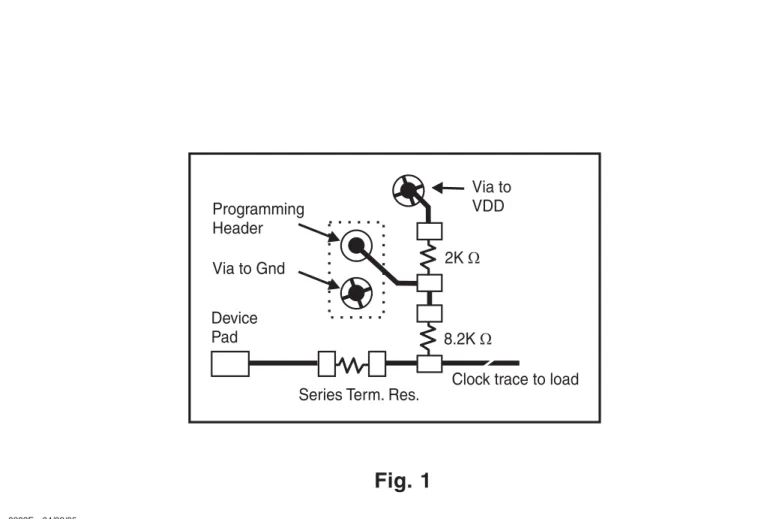
Fig. 1
Shared Pin Operation
-Input/Output Pins
The I/O pins designated by (input/output) on the ICS950405
serve as dual signal functions to the device. During initial
power-up, they act as input pins. The logic level (voltage)
that is present on these pins at this time is read and
stored into a 5-bit internal data latch. At the end of
Power-On reset, (see AC characteristics for timing values), the
device changes the mode of operations for these pins to
an output function. In this mode the pins produce the
specified buffered clocks to external loads.
To program (load) the internal configuration register for
these pins, a resistor is connected to either the VDD
(logic 1) power supply or the GND (logic 0) voltage
potential. A 10 Kilohm (10K) resistor is used to provide
both the solid CMOS programming voltage needed during
the power-up programming period and to provide an
insignificant load on the output clock during the subsequent
operating period.
Via to
VDD
Clock trace to load
Series Term. Res.
Programming
Header
Via to Gnd
Device
Pad
2K
W
8.2K
W
Figure 1 shows a means of implementing this function
when a switch or 2 pin header is used. With no jumper is
installed the pin will be pulled high. With the jumper in
place the pin will be pulled low. If programmability is not
necessary, than only a single resistor is necessary. The
programming resistors should be located close to the
series termination resistor to minimize the current loop
area. It is more important to locate the series termination
resistor close to the driver than the programming resistor.
0802F—04/22/05
Ordering Information
ICS950405
y
FLF-T
Example:
INDEX AREA INDEX AREA 1 2 1 2 N D h x 45°h x 45° E1 E a SEATING PLANE SEATING PLANE A1 A e C C -b .10 (.004) C .10 (.004) C c L300 mil SSOP Package
MIN MAX MIN MAX
A 2.41 2.80 .095 .110 A1 0.20 0.40 .008 .016 b 0.20 0.34 .008 .0135 c 0.13 0.25 .005 .010 D E 10.03 10.68 .395 .420 E1 7.40 7.60 .291 .299 e h 0.38 0.64 .015 .025 L 0.50 1.02 .020 .040 N α 0° 8° 0° 8°
MIN MAX MIN MAX
48 15.75 16.00 .620 .630
10-0034
Reference Doc.: JEDEC Publication 95, MO-118
VARIATIONS
SEE VARIATIONS SEE VARIATIONS
N D mm. D (inch)
SEE VARIATIONS SEE VARIATIONS
0.635 BASIC 0.025 BASIC
SYMBOL
In Millimeters In Inches
COMMON DIMENSIONS COMMON DIMENSIONS