26
455
Developmental Dyscalculia
Brian Butterworth
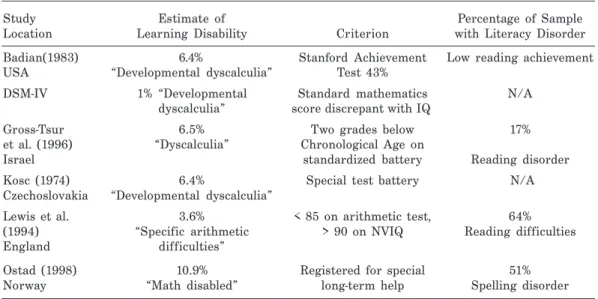
Severe difficulties in learning about numbers and arithmetic are probably as widespread as disorders of literacy development (dyslexia). The best prevalence estimates for each lie between 3.6% and 6.5% (see Table 26.1). Studies in the U.K. have revealed that poor mathematical skills are more of a handicap in the workplace than poor literacy skills (Bynner & Parsons, 1997). However, there has been much less research on dyscalculia than on dyslexia, and it is a much less widely recognized type of learning disability. In the U.K., its existence was first recognized by the Department of Education in 2001 (DfES, 2001).
In this chapter, I argue for a highly selective and specific deficit of a very basic capacity for understanding numbers, which leads to a range of difficulties in learning about number and arithmetic. This proposal is based on the idea that we are born with a capacity specialized for recognizing and mentally manipulating numerosities (cardinal values) and that this capacity is likely to be embodied in specialized neural circuits. Recent findings show that infants, even in the first week of life, are sensitive to the numorosity of a visual display (see below for further details). This capacity functions as a kind of starter kit for understanding numbers and arithmetic. Selective deficits will arise, on this view, when the specialized capacity, or “number module” (Butterworth, 1999), fails to develop normally. I shall call this “the defective number module hypothesis.”
However, many researchers, as will be discussed, argue that difficulties in learning math-ematics are due to a single impairment or combination of impairments in more general or more basic cognitive systems, and, as can be seen in chapters 8 and 25 in this volume, there is an alternative view about the basis of numerical abilities. According to some students of infant capacities (e.g., Carey & Spelke, in press; Gallistel & Gelman, 2000) and of functional neuroimaging (e.g., Dehaene, Spelke, Pinel, Stanescu, & Tsivkin, 1999), we are born not with a capacity for recognizing and mentally manipulating discrete numerosities but, rather, with a capacity for representing continuous quantities plus knowledge of the “integer list” (number words) which enables the development of representations for discrete numerosities above four. According to this view, linguistic disturbances can be critical for the development of numeracy, whereas in the first view, understanding numerosities and language are quite independent.
Some support for the defective number module hypothesis comes from studies of neurologi-cal patients who can show a sharp dissociation between those with severe aneurologi-calculia but spared language and those with severely defective language but spared calculation. An example of
spared language is the patient CG, who performed normally on all language tests (though she could no longer read) but was able to count only to four and was quite unable to handle any task at all involving numbers larger than four (Cipolotti, Butterworth, & Denes, 1991). It is much rarer to see patients with calculation selectively spared despite defective language, but patient IH was able to carry out single and multidigit calculations almost flawlessly while performing at chance at spoken word comprehension and close to zero on most tests of naming (Cappelletti, Butterworth, & Kopelman, 2001; Cappelletti, Kopelman, & Butterworth, 2002). This dissociation suggests that the language and the number circuits in the adult brain are distinct. However, it may still be the case that to develop a sense of numbers, including its recursive character, requires learning the integer list in the first place.
It is worth noting at the outset that there are several problems in studying this topic. First, there are many reasons for being bad at mathematics, including inappropriate teaching, behav-ioral problems, anxiety, and missing lessons. This makes identifying a specific endogenous condition difficult. Second, many educational authorities, many parents, and many children believe that difficulty in acquiring the basic skills is due to stupidity or laziness. This is reminiscent of the way in which difficulties in learning to read were treated 20 or 30 years ago. Third, there is a striking comorbidity with deficits in literacy. Table 26.1 shows that this comorbidity occurs across languages (Norwegian, Hebrew, and English) and orthographies. This has led several authors and dyslexia organizations to attribute dyscalculia, or at least some of its symptoms, to the dyslexic condition itself, as will be discussed below. Of course, language difficulties will affect learning of all kinds, and no doubt the child with problems understanding what the teacher says will be at a disadvantage.
Finally, mathematics, even in the early grades of schooling, comprise a wide variety of skills, including counting, estimating, retrieving arithmetical facts (number bonds, multiplication tables), understanding arithmetical laws such as commutativity of addition and multiplication (but not subtraction and division), knowing the procedures for carrying and borrowing in multidigit tasks, being able to solve novel word problems, and so on. Perhaps as a consequence, even standardized tests of arithmetical abilities show wide differences in the mathematics that compose the tests.
It is therefore perhaps unsurprising that there are no agreed-upon criteria for diagnosing
T T T T
Table 26.1able 26.1able 26.1able 26.1able 26.1
Prevalence Estimates and Co-Occurrence with Literacy Disorder
Study Estimate of Percentage of Sample
Location Learning Disability Criterion with Literacy Disorder Badian(1983) 6.4% Stanford Achievement Low reading achievement USA “Developmental dyscalculia” Test 43%
DSM-IV 1% “Developmental Standard mathematics N/A dyscalculia” score discrepant with IQ
Gross-Tsur 6.5% Two grades below 17%
et al. (1996) “Dyscalculia” Chronological Age on
Israel standardized battery Reading disorder
Kosc (1974) 6.4% Special test battery N/A
Czechoslovakia “Developmental dyscalculia”
Lewis et al. 3.6% < 85 on arithmetic test, 64% (1994) “Specific arithmetic > 90 on NVIQ Reading difficulties England difficulties”
Ostad (1998) 10.9% Registered for special 51%
the deficit. This is apparent from the prevalence studies listed in Table 26.1.
One problem about using standardized tests of arithmetic attainment is that poor perfor-mance can, of course, have many causes. If a subject cannot solve a multiplication is this because he has a poor capacity for learning multiplication, or that his teacher failed to explain it properly, or even that the child was ill during the weeks when the fundamentals of multipli-cation were first taught and he still has not caught up? It seems to me vital to distinguish tests of attainment from tests of capacity. In general, without the capacity, high levels of attainment will not be achievable, but even with the capacity, attainment can depend on many factors. If one is interested in the capacity to learn arithmetic, his use of attainment tests will inevitably lead to an overestimation of rates of dyscalculia.
DEFINING DYSCALCULIA
The first systematic study of specific deficits in learning about numbers and arithmetic was published by Czechoslovakian psychologist Ladislav Kosc (1974), who introduced the term “developmental dyscalculia.” This is also the term used by Shalev and colleagues, to distinguish it from the acquired kind, in many papers (Tsur, Manor, & Shalev, 1996; Shalev & Gross-Tsur, 1993, 2001; Shalev, Manor, & Gross-Gross-Tsur, 1997; Shalev et al., 2001). In this chapter, I shall use the term developmental dyscalculia, abbreviated to DD. However, other studies of selective deficits in numeracy acquisition have used other terminology. For example, Koontz and Berch (1996) prefer “arithmetic learning disabilities,” whereas Hitch and colleagues use both “specific arithmetic difficulties” (Lewis et al., 1994) and “specific arithmetic learning difficulties” (McLean & Hitch, 1999).
Studies of DD need to be distinguished from experimental studies of the causes of difficulties with learning mathematics. As can be seen from Table 26.2, some studies use 20th, 25th, 30th, or even the 35th percentiles of standardized math attainment tests, whereas prevalence esti-mates suggest that only the lowest 5–7% of children should be so classified. By taking one quarter to one third of a cohort, these studies are likely to include children whose mathemat-ics difficulties are caused by a very wide range of factors. Since these authors use similar terminology to those listed above, this can lead to confusion. For example, Geary and colleagues refer to “mathematical disabilities” (Geary, 1993; Geary et al., 1999, 2000) and, in a recent paper, to “arithmetic deficits”; Jordan and colleagues use the term “mathematics difficulties” (Jordan, Kaplan, & Hanich, 2002).
These differences in terminology are compounded by differences in criteria for assigning children to the category. Traditional definitions (e.g., DSM-IV) state that the child must sub-stantially underachieve on a standardized test relative to the level expected given age, education, and intelligence and must experience disruption to academic achievement or daily living. Most of the studies have used this kind of discrepancy criterion or at least set lower bounds on intelligence and literacy before assignment. In Table 26.2, I list some of the many criteria that have been used.
However, standardized math tests are not sufficient for prevalence studies, as any a priori criterion will simply define a particular proportion of the population as DDs if the criterial dimension is normally distributed. Thus, a criterion of one standard deviation below the population mean (which is equivalent to a standard score of less than 85) entails that approxi-mately 16% of those tested will be classified as DD. When a minimum IQ level is used to create a discrepancy criterion, for example, 90 or above, this means that about 12% of those tested will meet the criterion. (Notice that these are the criteria used by Lewis et al. (1994), and, strangely, they found not 12% of their cohort with “specific arithmetical difficulties” but only 3.4%.). Therefore, a different approach needs to be found.
An alternative approach is to take a qualitative criterion, which is the approach taken by the U.K. Department for Education and Skills. It defines dyscalculia as:
A condition that affects the ability to acquire arithmetical skills. Dyscalculic learners may have difficulty understanding simple number concepts, lack an intuitive grasp of numbers, and have prob-lems learning number facts and procedures. Even if they produce a correct answer or use a correct method, they may do so mechanically and without confidence. (DfES, 2001, p. 2)
Using a qualitative approach, the problem becomes one of trying to operationalize the criterion, which will depend on the core characteristics of DD as discovered empirically.
CHARACTERISTICS OF DYSCALCULIA
Whereas researchers have adopted a variety of terms and criteria for DD, there is a consensus about the basic behavioral characteristics for DD. It is generally agreed that children with dyscalculia have difficulty in learning and remembering arithmetic facts (Geary, 1993; Geary & Hoard, 2001; Ginsburg, 1997; N. Jordan & Montani, 1997; Kirby & Becker, 1988; Russell &
T TT T
Table 26.2able 26.2able 26.2able 26.2able 26.2 Criteria for Dyscalculia
N
Study Name Test Criteria Exclusions Age (+RD)
Butterworth, Dyscalculia Item-timed tests of Bottom 2 6–14
2003 enumeration and stanines
number comparison
Geary et al., Mathematical Woodcock Johnson 30th IQ < 80 1st 15 1999 disabilities (MD) Mathematics Reasoning percentile grade, (25)
6;10 Geary et al., Mathematical Woodcock Johnson 35th 1st and 12 2000 disabilities (MD) Mathematics Reasoning percentile 2nd (16)
grades Jordan et al., Mathematics Woodcock Johnson 35th 2nd 46 2002; difficulties (MD) Broad Mathematics percentile grade (42)
Jordan et al., Composite
2003a,b
Koontz & Arithmetic Iowa Tests of Basic 25th Below 10;4 32
Berch, 1996 learning Skills percentile 30th yrs.
disabilities percentile
on reading or below normal IQ
Landerl et al., Developmental Item-timed arithmetic 3 SD 50th + 8–9 10 in press dyscalculia and teacher’s below percentile yrs. (10)
classification mean IQ
McLean & Specific Graded 25th Mid-50% 9 12
Hitch, 1999 arithmetic Arithmetic- percentile on Primary yrs.
learning Mathematics Reading
difficulties Test Test
Shalev et al., Developmental Standardized 2 grades IQ < 80 5th 104 1997 dyscalculia arithmetic battery below CA grade (35) Temple & Number fact WOND numerical 12 mths 11–12 10
Sherwood, disorder operations below CA yrs.
2002
Note: N means the number classified as DD in the sample. (RD) is the number of those found to have a literacy difficulty also.
5
Ginsburg, 1984; Shalev & Gross-Tsur, 2001) and in executing calculation procedures. Landerl, Bevan, and Butterworth (2004), in a study of ten 9-year-old DDs and 18 matched controls, found that the DDs were less accurate in single-digit subtraction and multiplication than controls and also significantly slower on addition, subtraction, and multiplication.
DDs also depend much more on “immature strategies,” such as counting on their fingers to solve problems (Butterworth, 1999; Ostad, 1999). Generally, one can fail to diagnose dyscalculia when only accuracy is considered, since percent correct will not reveal whether the subject is using immature strategies like counting in addition, whereas normal children will simply retrieve the answer from memory (Jordan & Montani, 1997).
The majority of DD children have problems with both knowledge of facts and knowledge of arithmetical procedures (Russell and Ginsburg, 1984), although Temple (1991) has demonstrated, using case studies, that knowledge of facts and grasp of procedures and strategies are dissociable in developmental dyscalculia (Temple, 1991; Temple & Sherwood, 2002).
Difficulty with basic arithmetic is a common characteristic, but dyscalculics appear to have a more fundamental problem in that they perform poorly on tasks requiring an understanding of basic numerical concepts, especially the concept of numerosity. This affects even very simple tasks such as counting or comparing numerical magnitudes. Koontz & Berch (1996) found that dyscalculic children appeared to be counting to three rather than subitizing in a dot-matching task, suggesting that this very fundamental capacity could be tied to the child’s understanding of numerosity. Certainly, it has been argued that it underpins the acquisition of counting skills (Fuson, 1988). Geary, Hamson, and Hoard (2000) found small but systematic group differences between first-grade dyscalculic children and controls in magnitude comparison. One recent study showed reliable reaction time differences between dyscalculic children and math-normal children (including a group with dyslexia) on tests of dot counting and of number magnitude comparison (Landerl et al., in press). In extreme cases such as “Charles” (Butterworth, 1999), DDs can show a reverse distance effect. That is, it takes them longer to decide that 9 is larger than 2 than that 9 is larger than 8. This seems to be due to some kind of counting strategy in which it takes longer to count from 2 to 9 than from 8 to 9.
Tasks such as dot counting and number comparison depend very little on experience of formal education, as children are able to do them even before they begin school (Fuson, 1988; Gelman & Gallistel, 1978). This suggests that poor performance is unlikely to be due to those exogenous factors that are known to affect school attainment, including inappropriate teaching, missing lessons, and lack of motivation and attention. They are more likely to be due to weak intuitive grasp of numbers and difficulties with understanding basic numerical concepts. Indeed, this is how DD children describe their difficulties. In a focus group study by Bevan and Butterworth, (forthcoming), 9-year-old DD children consistently reported that they did not understand what the teacher was saying.
Child 5: Oh, there’s this really hard thing, about when you’re doing times—Miss S______ says you can’t take away this number, but I keep on taking away, I don’t understand one single bit of it.
Child 2: I sometimes don’t understand whatever she (the teacher) says.
Child 2: I don’t forget it, I don’t even know what she’s saying.
Even when they think they understand something, the slightest distraction causes them to lose track:
Child 3: When you listen to the teacher, then you turn your head and you don’t know nothing . . . If I remember something, and then the teacher says “stop for a second, just listen to me” then as soon as she talks, yeah, and we come back, we do work, and I say “what do I have to do?” I always forget.
According to the defective number module hypothesis, the other problems faced by dyscalculic learners stem from the lack of an intuitive grasp of number. Thus, poor memory for arithmetical facts and the use of incorrect, immature, or inefficient calculation procedures may all be due to poor understanding of the basic ideas of the cardinality of sets, or what Butterworth (1999) has termed “numerosity.”
IS DYSCALCULIA SECONDARY TO MORE GENERAL
OR BASIC COGNITIVE DEFICITS?
Many researchers suggest that dyscalculia is secondary to more general or more basic cognitive abilities. The critical issue in this area, put crudely, is this: is dyscalculia a due to a defective number module, or is it the consequence of deficits in domain-general cognitive abilities, such as memory, reasoning, or spatial abilities?
Perhaps the most influential answer to this question comes from a review by Geary (1993). In this paper, Geary notes that DD “children show two basic functional, or phenotypic, numerical deficits”:
1. “The use of developmentally immature arithmetical procedures and a high frequency of procedural errors” (p. 346)
2. “Difficulty in the representation and retrieval of arithmetic facts from long-term semantic memory” (p. 346)
Geary assembles evidence to demonstrate that the causes are deficits in long-term semantic memory and in two aspects of working memory, speed of processing and rate of decay of items being retained.
The role of long-term semantic memory is premised on the idea that there is a developmental progression from calculation strategies, such as counting on, to established associations be-tween problems and their solutions (e.g., Siegler, 1988; Siegler & Shrager, 1984). “Mastery of elementary arithmetic is achieved when all basic facts can be retrieved from long-term memory without error . . . [which in turn] appears to facilitate the acquisition of more complex math-ematical skills” (Geary, 1993, p. 347). According to Geary, laying down these associations in long-term memory depends on maintaining the problem elements (for example, two addends, intermediate results, and solution) in working memory. Additionally, the use of immature or inefficient calculation strategies will risk decay of crucial information in working memory.
Memory span in children with “mathematical disability” (MD; lowest 25–33% of the age group in the following studies) is one digit fewer than controls, and their span is negatively correlated with calculation errors. MD children also seem to count more slowly when carrying out calculation procedures (see Geary, 1993, for review). The implication is that MD children will put a greater load on an already somewhat defective working memory, and this, in turn, will impair long-term storage of basic arithmetical facts. In a more recent study, Koontz and Berch (1996) tested children with and without dyscalculia (more strictly defined) using both digit and letter span (the latter being a measure of phonological working memory capacity which is not confounded with numerical processing). This study found that dyscalculic children performed below average on both span tasks, though IQ was not controlled.
However, the evidence is by no means unequivocal about the role of working memory in learning arithmetic. McLean and Hitch (1999) found no difference on a non-numerical task testing phonological working memory (non–word repetition), suggesting that dyscalculic chil-dren do not have reduced phonological working memory capacity in general, although they may have a specific difficulty with working memory for numerical information. Temple and Sherwood (2002) found no differences between groups on any of the working memory mea-sures (forward and backward digit span, word span, and the Corsi blocks) and no correlation
between the working memory measures and measures of arithmetic ability. Thus, although various forms of working memory difficulty may well co-occur with math difficulties, there is no convincing evidence implicating any form of working memory as a causal feature in dyscalculia. Landerl, Bevan, and Butterworth (in press) found no difference on forward or backward digit span between DD children and matched controls, though dyslexic children were significantly affected on this task.
Rourke (1993) has argued that DD is essentially due to a defective representation of space. More specifically, Geary (1993) noted that “a disruption of the ability to spatially represent numerical information . . . appears to affect both functional skills (e.g., columnar alignment in complex arithmetic problems) and the conceptual understanding of the representations (e.g., place value)” (p. 346). The idea that space and number are cognitively related has had many supporters, and the role of the parietal lobes in both space and number has been noted by researchers since Gerstmann (1940).
The representation of numerical magnitudes spatially as a kind of a mental number line has frequently been proposed (e.g., Dehaene, Piazza, Pinel, & Cohen, 2003; Fias, Lammertyn, Reynvoet, Dupont, & Orban, 2003; Seron, Pesenti, Noël, Deloche, & Cornet, 1992; Spalding & Zangwill, 1950), and it would seem plausible that deficits in spatial representation ability could affect a sense of numerical magnitude (but see Zorzi, Priftis, & Umiltà, 2002). However, there is no convincing evidence to show that spatial deficits in themselves lead to DD. Being able to maintain mental representations of multidigit numbers in the correct columns has been suggested as another potential contribution of spatial abilities to arithmetic (Dehaene & Cohen, 1995; Hécaen, Angelergues, & Houillier, 1961). In fact, Hécaen et al. (1961) proposed a special category of acquired secondary acalculia they term “spatial acalculia.” Such a condition has been rarely, if ever, reported as a pure symptom and does not appear to affect the grasp of basic numerical concepts.
Finally, it is clear that DD is a persistent condition for many and perhaps all of its sufferers. “Charles,” an intelligent and industrious graduate, was 30 years old when we first tested him, but despite his best efforts, he was several times slower than controls on single-digit addition and subtraction, was quite unable to do multiplications involving numbers above 5, could not do two-digit subtraction at all, and was severely disabled on dot counting and number comparison. Like other dyscalculics, Charles relied very heavily on finger counting to solve even very simple problems (Butterworth, 1999). We have since tested several other intelligent and well-educated adults who show similar disabilities. Ostad (1999) also notes the persistence of this condition. However, longitudinal studies have not yet been carried out to characterize the long-term development of DD.
THE PROBLEM OF COMORBIDITY
Although there is a high comorbidity between numeracy and literacy disabilities (see Table 26.2), it is unclear why this should be. One possible line of argument here is that there will be a range of numerical and arithmetical tasks that depend on language, and that dyslexia is usually a deficit in language abilities that affects phonological processing (Paulesu et al., 1996), which is known to reduce working memory capacity (Nation, Adams, Bowyer-Crane, & Snowling, 1999), which in turn may affect lexical learning as well (Gathercole, 1995). These consider-ations imply that dyslexics should have difficulty with fact retrieval, if these are stored in verbal form, and with multidigit arithmetic with high working memory load. The problem with this line of argument, as discussed above, is that, as we have seen, dyscalculics do not have reduced working memory span. Moreover, Shalev, Manor, and Gross-Tsur (1997) found no qualitative difference between children with both reading and math disability and children with math disability only. No quantitative differences on tests of arithmetic, or on simple number tasks such as counting and magnitude comparison, were found between dyscalculic
children and those with both dyslexia and dyscalculia when the groups were matched for IQ (Landerl et al., in press).
Rourke (1993) has suggested that those suffering a double deficit will have a left hemisphere problem associated with the linguistic deficit in dyslexia, whereas the pure dyscalculics will have a right hemisphere abnormality affecting spatial abilities, which he believes lies at the root of dyscalculia. However, evidence reviewed here does not support this suggestion.
Other conditions that have been associated with DD are ADHD (Badian, 1983; Rosenberg, 1989; Shalev et al. 2001), poor hand–eye coordination (Siegel & Ryan, 1989), and poor memory for nonverbal material. Shalev and Gross-Tsur (1993) examined a group of seven children with developmental dyscalculia who were not responding to intervention. All seven were suffering from additional neurological conditions, ranging from petit mal seizures through dyslexia for numbers, attention deficit disorder, and developmental Gerstmann’s syndrome, in which dyscalculia goes along with finger agnosia, agraphia, and left–right disorientation. However, it is clear from these studies that the majority of DDs do not have comorbid cognitive, physical, or affective problems.
In summary, although it is clearly the case that dyscalculia is frequently comorbid with other disabilities, causal relationships between the disorders have not been proven. In addi-tion, the utility of subtyping dyscalculics according to neuropsychological or cognitive corre-lates will not be clear until it has been shown that the different subtypes display qualitatively different patterns of numerical deficit.
THE ORIGINS OF NUMERICAL ABILITIES
Psychologists from Piaget (1952) to Gelman and Gallistel (1978), who traced the ontogeny of numerical concepts, have stressed the child’s increasing understanding of why two sets have the same numerosity—one-to-one correspondence between set members—and the kinds of manipu-lation that will and will not affect numerosity (Piaget’s “conservation” experiments). It is also important for the child to understand how to map the set of objects to be counted one to one with the counting words (Gelman & Gallistel, 1978). There is evidence that infants in the first six months of life have an ability to discriminate between sets of visible, even moving, objects on the basis of numerosity (Antell & Keating, 1983; Starkey & Cooper, 1980; Van Loosbroek & Smitsman, 1990) and can mentally represent and manipulate objects no longer visible (Wynn, 1992). This may form the innate basis of a sense of numerosity, which in dyscalculics may be defective.
If this proposal is correct, then there is no reason why dyscalculic children should not be able to learn aspects of mathematics that do not depend crucially on a sense of numerosity, such as geometry, topology, or algebra.
IS THERE A SPECIFIC NEUROANATOMICAL SYSTEM?
The defective number module hypothesis suggests, though it does not entail, that there should be an anatomically discernible system in the brain, which is abnormal in DDs. There is some evidence for a specialized number-processing network in the brain. Functional neuroimaging reveals that the parietal lobes–especially the intraparietal sulci (IPS)—are active in numerical processing and arithmetic (Dehaene et al., 2003); and studies of brain-lesioned patients (Cipolotti & van Harskamp, 2001) have identified the left IPS and the angular gyrus as critical to normal arithmetical performance. Simpler numerical capacities, such as the ability to estimate the numerosity of small sets, appear to be specialized in the right IPS (Piazza, Giacomini, Le Bihan, & Dehaene, 2003; Piazza, Mechelli, Butterworth, & Price, 2002).
To date, it is not known whether the intraparietal sulci underpin infant capacities; hence, their role in subsequent development is far from clear. However, a recent voxel-based
morpho-metric study of the brains of adolescents with poor arithmetic presents intriguing evidence. Isaacs, Edmonds, Lucas, and Gadian (2001) studied two groups of adolescents with very low birth-weight. One group was cognitively normal, whereas the second had a deficit just on the numerical operations subtest of the Wechsler Objective Numerical DImensions (WOND; Wechsler, 1996). When the brains of these two groups were compared, those with arithmetical impair-ment had less grey matter in the left IPS.
Another source of evidence comes from reports of a developmental version of Gerstmann’s Syndrome (e.g., Kinsbourne & Warrington, 1963). Gerstmann’s Syndrome combines the symptom of acquired dyscalculia with finger agnosia (a disability in mental representation of fingers), dysgraphia and left-right disorientation (Gerstmann, 1940). This condition arises following damage to the left angular gyrus, which suggests, on analogy with the acquired version, that some cases of DD may be due damage to the left angular gyrus.
Is There a Specific Genetic Basis?
The defective number module hypothesis suggests that there should be a genetic basis to DD. (Kosc, 1974), in one of the earliest systematic studies of DD, proposed a role for heredity. A recent twin study showed that for DD probands, 58% of monozygotic co-twins and 39% of dizygotic co-twins were also DD and that the concordance rates were 0.73 and 0.56, respectively (Alarcon, Defries, Gillis Light, & Pennington, 1997). In a family study, Shalev et al. (2001) found that approximately half of all siblings of children with DD are also dyscalculic, with a 5– 10-times greater risk than for the general population.
Children with Williams Syndrome, who have relatively spared language abilities despite severely impaired cognitive abilities, show abnormalities on simple numerosity tasks such as number comparison and are also much worse on simple numerical tasks such as seriation, counting, and single-digit arithmetic than chronological-age- and mental-age-matched controls and children with Down’s Syndrome (Paterson, Girelli, Butterworth, & Karmiloff-Smith, submitted).
Some abnormalities of the X chromosome appear to affect numerical capacities more severely than other cognitive abilities. This is particularly clear in Turner’s Syndrome, in which sub-jects can be at a normal or superior level on tests of IQ, language, and reading, but are severely disabled in arithmetic (Butterworth et al., 1999; Rovet, Szekely, & Hockenberry, 1994; Temple & Carney, 1993; Temple & Marriott, 1998).
However, this is not to rule out the possibility that dyscalculia can also arise through environmental disturbances of neural growth.
Math Anxiety and Dyscalculia
It is now well established that mathematical activities can cause anxiety (Ashcraft, 1995; Hembree, 1990; Richardson & Suinn, 1972) and that these are specific to mathematics and not just to any difficult task (Faust et al., 1996). Anxiety itself is known to have effects on a wide range of cognitive functions, including those that may affect mathematics performance, such as working memory (Eysenck & Calvo, 1992). However, the emotional effects, both long term and short term, of struggling with mathematics tasks that your peers find very easy are, as yet, unknown. A recent focus group study of 9-year-old children (Bevan & Butterworth, forth-coming) revealed that 9-year-old DDs suffered considerable anguish during the daily math-ematics lesson:
Focus group 1
Child 5: It makes me feel left out, sometimes.
Child 5: When I like—when I don’t know something, I wish that I was like a clever person and I blame it on myself—
Child 4: I would cry and I wish I was at home with my mum and it would be—I won’t have to do any maths.
Focus group 2
Moderator: How does it make people feel in a math lesson when they lose track?
Child 1: Horrible.
Moderator: Horrible? . . . Why’s that?
Child 1: I don’t know.
Child 3 (whispers): He does know.
Moderator: Just a guess.
Child 1: You feel stupid.
More able children, of course, are well aware of this and often tease or stigmatize DD classmates:
Child 1: She’s like—she’s like all upset and miserable, and she don’t like being teased.
Child 4: Yeah, and then she goes hide in the corner—nobody knows where she is and she’s crying there.
There is no evidence currently, however, that anxiety is causal in DD, though anxiety in math classes is unlikely to lead to improved learning; but it is clear that DD causes considerable anguish to its young sufferers.
CONCLUSIONS
Developmental dyscalculia is a condition with an estimated prevalence similar to dyslexia and which adversely affects school and working life.
DDs show strikingly poor performance on very simple tasks such as number comparison and counting small numbers of dots. It is likely that this is a symptom of a deficit in the capacity to represent and process numerosities. Indeed, young DDs report great difficulty in understanding basic number concepts and quickly find themselves losing track in daily math lessons.
DD does not seem to be a consequence of impairments to domain-general or more basic cognitive abilities such as semantic memory, working memory, spatial abilities, or linguistic abilities. There is well-established evidence for specialized neural circuits for numerical processing in the parietal lobes of the brain, especially the left and right intraparietal sulci and the left angular gyrus, and these areas are neuroanatomically distinct from the regions subserving these other functions. There is some evidence also that adolescents with poor basic numbers skills (possibly DD, though this was not explicitly tested) have reduced grey matter (or increased white matter) in the left IPS (Isaacs et al., 2001).
Dyscalculia appears to be heritable, on the basis of twin studies, and studies of genetically abnormal populations have suggested a possible locus on the X chromosome, though this does not mean that all cases of dyscalculia are inherited.
This combination of highly selective deficits to basic capacities, identifiable specialized neural circuitry, and likely heritability is consistent with the “defective number module hypoth-esis.” A dyscalculia screener has been developed based on this hypothesis, which uses reaction time tasks of counting dots and magnitude comparison to measure basic numerical capacities. It is standardized for U.K. children from 6 to 14 years (Butterworth, 2003).
Compared with dyslexia, DD has been the focus of relatively little research. For dyslexia there is now widespread agreement about criteria, good evidence about the brain systems implicated (Paulesu et al., 1996; Paulesu et al., 2001), and indications of the genes that might be involved (Fisher & DeFries, 2002). For a comparable understanding of DD, we need to establish agreed upon diagnostic criteria, to discover differences in the structure and function of DD brains, and to identify genes that could lead to these differences.
Unlike dyslexia, DD is not widely recognized by governments or by educators. It is still confused, as dyslexia used to be, with stupidity. Using agreed criteria will help with recognition, and also with establishing reliable prevalence estimates that are needed for a proper needs analysis.
Finally, only with better understanding of the nature of developmental dyscalculia can we devise effective ways of helping the millions of our fellow citizens whose lives are blighted by it.
ACKNOWLEDGMENTS
My research into dyscalculia has been supported by the European Union and the U.K. Depart-ment of Education and Skills. I am grateful to Anna Bevan, Fulvia Castelli, Eva Ebner, Cres Fernandes of Nelson; Alessia Granà, Karin Landerl, and Lindsay Peer of the British Dyslexia Association; Manuela Piazza, David Skuse, and Dorian Yeo, my collaborators in dyscalculia research. Jamie Campbell was lavish with wise and detailed advice on this chapter: many thanks to him.
REFERENCES
Alarcon, M., Defries, J., Gillis Light, J., & Pennington, B. (1997). A twin study of mathematics disability.
Journal of Learning Disabilities, 30, 617–623. Antell, S. E., & Keating, D. P. (1983). Perception of
numerical invariance in neonates. Child Development, 54, 695–701.
Ashcraft, M. (1995). Cognitive psychology and simple arithmetic: A review and summary of new directions.
Mathematical Cognition, 1, 3–34.
Badian, N. A. (1983). Arithmetic and nonverbal learn-ing. In H. R. Myklebust (Ed.), Progress in learning disabilities (Vol. 5, pp. 235–264). New York: Grune and Stratton.
Bevan, A., & Butterworth, B. (forthcoming). Fractions or friction? The responses of students and teachers to maths disabilities within the National Numeracy Strategy.
Butterworth, B. (1999). The mathematical brain. Lon-don: Macmillan.
Butterworth, B. (2003). Dyscalculia Screener. London: Nelson Publishing Company Ltd.
Butterworth, B., Granà, A., Piazza, M., Girelli, L., Price, C., & Skuse, D. (1999). Language and the origins of number skills: karyotypic differences in Turner’s syndrome. Brain & Language, 69, 486–488. Bynner, J., & Parsons, S. (1997). Does numeracy matter?
London: The Basic Skills Agency.
Cappelletti, M., Butterworth, B., & Kopelman, M. (2001). Spared numerical abilities in a case of semantic de-mentia. Neuropsychologia, 39, 1224–1239.
Cappelletti, M., Kopelman, M., & Butterworth, B. (2002). Why semantic dementia drives you the dogs (but not to the horses): A theoretical account. Cognitive Neu-ropsychology, 19(6), 483–503.
Carey, S., & Spelke, E. (in press). Bootstrapping the
integer list: Representations of number. In J. Mehler & L. Bonatti (Eds.), Developmental cognitive science. Cambridge, MA: MIT Press.
Cipolotti, L., Butterworth, B., & Denes, G. (1991). A specific deficit for numbers in a case of dense acal-culia. Brain, 114, 2619–2637.
Cipolotti, L., & van Harskamp, N. (2001). Disturbances of number processing and calculation. In R. S. Berndt (Ed.), Handbook of neuropsychology (2nd. ed., Vol. 3). Amsterdam: Elsevier Science.
Dehaene, S., & Cohen, L. (1995). Towards an anatomi-cal and functional model of number processing. Math-ematical Cognition, 1, 83–120.
Dehaene, S., Piazza, M., Pinel, P., & Cohen, L. (2003). Three parietal circuits for number processing. Cog-nitive Neuropsychology, 20, 487–506.
Dehaene, S., Spelke, E., Pinel, P., Stanescu, R., & Tsivkin, S. (1999). Sources of mathematical thinking: Behav-ioral and brain-imaging evidence. Science, 284(5416), 970–974.
DfES. (2001). Guidance to support pupils with dyslexia and dyscalculia (No. DfES 0512/2001). London: De-partment of Education and Skills.
Eysenck, M. W., & Calvo, M. G. (1992). Anxiety and performance - the processing efficiency theory. Cog-nition & Emotion, 6(6), 409–434.
Faust, M. W., Ashcraft, M. H., & Fleck, D. E. (1996). Mathematics anxiety effects in simple and complex addition. Mathematical Cognition, 2(1), 25–62. Fias, W., Lammertyn, J., Reynvoet, B., Dupont, P., &
Orban, G. A. (2003). Parietal representation of sym-bolic and nonsymsym-bolic magnitude. Journal of Cogni-tive Neuroscience, 15, 47–56.
Fisher, S., & DeFries, J. (2002). Developmental dyslexia: Genetic dissection of a complex cognitive trait. Na-ture Review of Neuroscience, 767-780.
stimuli in learning disabled subgroups: Analysis by selective reminding. Journal of Experimental Child Psychology, 40, 244–259.
Gallistel, C. R., & Gelman, R. (2000). Non-verbal nu-merical cognition: From reals to integers. Trends in Cognitive Sciences, 4(2), 59–65.
Gathercole, S. (1995). Nonword repetition: More than just a phonological output task. Cognitive Neuropsy-chology, 12(8), 857–861.
Geary, D. C. (1993). Mathematical disabilities: Cognition, neuropsychological and genetic components. Psycho-logical Bulletin, 114, 345–362.
Geary, D. C., Hamson, C. O., & Hoard, M. K. (2000). Numerical and arithmetical cognition: A longitudi-nal study of process and concept deficits in children with learning disability. Journal of Experimental Child Psychology, 77, 236–263.
Geary, D. C., & Hoard, M. K. (2001). Numerical and arithmetical deficits in learning-disabled children: Relation to dyscalculia and dyslexia. Aphasiology, 15(7), 635–647.
Gelman, R., & Gallistel, C. R. (1978). The child’s under-standing of number (1986 ed.). Cambridge, MA: Harvard University Press.
Gerstmann, J. (1940). Syndrome of Finger Agnosia: disorientation for right and left, agraphia and acal-culia. Archives of Neurology and Psychiatry, 44, 398– 408.
Ginsburg, H. P. (1997). Mathematics learning disabili-ties: A view from developmental psychology. Journal of Learning Disabilities, 30, 20–33.
Gross-Tsur, V., Manor, O., & Shalev, R. S. (1996). Devel-opment dyscalculia: Prevalence and demographic fea-tures. Developmental Medicine and Child Neurology, 38, 25–33.
Hécaen, H., Angelergues, R., & Houillier, S. (1961). Les variétés cliniques des acalculies au cours des lésions rétro-rolandiques: Approche statistique du problème.
Revue Neurologique, 105, 85–103.
Hembree, R. (1990). The nature, effects and relief of mathematics anxiety. Journal for Research in Math-ematics Education, 21(1), 33–46.
Isaacs, E. B., Edmonds, C. J., Lucas, A., & Gadian, D. G. (2001). Calculation difficulties in children of very low birthweight: A neural correlate. Brain, 124, 1701– 1707.
Jordan, N. C., Kaplan, D., & Hanich, L. B. (2002). Achieve-ment growth in children with learning difficulties in mathematics: Findings of a two-year longitudinal study. Journal of Educational Psychology, 96, 586– 597.
Jordan, N., & Montani, T. (1997). Cognitive arithmetic and problem solving: A comparison of children with specific and general mathematics difficulties. Jour-nal of Learning Disabilities, 30(6), 624–634. Jordan, N. C., Kaplan, D., & Hanich, L. B. (2002).
Achieve-ment growth in children with learning difficulties in mathematics: Findings of a two-year longitudinal study. Journal of Educational Psychology, 96, 586– 597.
Kinsbourne, M., & Warrington, E. K. (1963). The devel-opmental Gerstmann Syndrome. Annals of Neurol-ogy, 8, 490-501.
Kirby, J. R., & Becker, L. D. (1988). Cognitive compo-nents of learning problems in arithmetic. Remedial and Special Education, 9, 7–16.
Koontz, K. L., & Berch, D. B. (1996). Identifying simple numerical stimuli: processing inefficiencies exhibited
by arithmetic learning disabled children. Mathemati-cal Cognition, 2(1), 1–23.
Kosc, L. (1974). Developmental dyscalculia. Journal of Learning Disabilities, 7, 159–162.
Landerl, K., Bevan, A., & Butterworth, B. (in press) Developmental dyscalculia and basic numerical ca-pacities. A study of 8-9 year old students. Cognition
Lewis, C., Hitch, G., & Walker, P. (1994). The preva-lence of specific arithmetic difficulties and specific reading difficulties in 9- and 10-year-old boys and girls. Journal of Child Psychology and Psychiatry, 35,
283–292.
McLean, J. F., & Hitch, G. J. (1999). Working memory impairments in children with specific arithmetical difficulties. Journal of Experimental Child Psychol-ogy, 74,, 240–260.
Nation, K., Adams, J. W., Bowyer-Crane, C. A., & Snowling, M. J. (1999). Working memory deficits in poor comprehenders ref lect underlying language impairments. Journal of Experimental Child Psychol-ogy, 73(2), 139–158.
Ostad, S. E. (1999). Developmental progression of sub-traction studies: a comparison of mathematically normal and mathematically disabled childre. Euro-pean Journal of Special Needs Education, 14(1), 21– 36.
Paterson, S. J., Girelli, L., Butterworth, B., & Karmiloff-Smith, A. Are numerical impairments syndrome spe-cific? Evidence from Williams Syndrome and Down’s Syndrome. Manuscript submitted for publication. Paulesu, E., Démonet, J.-F., Fazio, F., McCrory, E.,
Chanoine, V., Brunswick, N., et al. (2001). Dyslexia: Cultural diversity and biological unity. Science, 291(5511), 2165.
Paulesu, E., Frith, U., Snowling, M., Gallagher, A., Morton, J., Frackowiak, R., et al. (1996). Is develop-mental dyslexia a disconnection syndrome? Evidence from PET scanning. Brain, 119(1), 143–157. Piaget, J. (1952). The child’s conception of number.
Lon-don: Routledge & Kegan Paul.
Piazza, M., Giacomini, E., Le Bihan, D., & Dehaene, S. (2003). Single-trial classification of parallel pre-at-tentive and serial atpre-at-tentive processes using functional magnetic resonance imaging. Proceedings of the Royal Society B, 270(1521), 1237–1245.
Piazza, M., Mechelli, A., Butterworth, B., & Price, C. (2002). re subitizing and counting: Implemented as separate or functionally overlapping processes?
NeuroImage, 15(2), 435–446.
Richardson, F. C., & Suinn, R. M. (1972). The Math-ematics Anxiety Rating Scale. Journal of Counseling Psychology, 19, 551–554.
Rosenberg, P. B. (1989). Perceptual-motor and attentional correlates of developmental dyscalculia. Annals of Neurology, 26, 216–220.
Rourke, B. P. (1993). Arithmetic disabilities, specific and otherwise: A neuropsychological perspective. Jour-nal of Learning Disabilities, 26, 214–226.
Rovet, J., Szekely, C., & Hockenberry, M.-N. (1994). Spe-cific arithmetic calculation deficits in children with Turner Syndrome. Journal of Clinical and Experi-mental Neuropsychology, 16, 820–839.
Russell, R. L., & Ginsburg, H. P. (1984). Cognitive analysis of children’s mathematical difficulties. Cognition & Instruction, 1, 217–244.
Seron, X., Pesenti, M., Noël, M.-P., Deloche, G., & Cor-net, J.-A. (1992). Images of numbers, or “When 98 is upper left and 6 sky blue.” Cognition, 44, 159–196.
Shalev, R. S., & Gross-Tsur, V. (1993). Developmental dyscalculia and medical assessment. Journal of Learn-ing Disabilities, 26, 134–137.
Shalev, R. S., & Gross-Tsur, V. (2001). Developmental dyscalculia. Review article. Pediatric Neurology, 24, 337–342.
Shalev, R. S., Manor, O., & Gross-Tsur, V. (1997). Neu-ropsychological aspects of developmental dyscalculia.
Mathematical Cognition, 3(2), 105–120.
Shalev, R. S., Manor, O., Kerem, B., Ayali, M., Badichi, N., Friedlander, Y., et al. (2001). Developmental dyscalculia is a family learning disability. Journal of Learning Disabilities, 34(1), 59–65.
Siegel, L. S., & Ryan, E. B. (1989). The development of working memory in normally achieving and subtypes of learning disabled children. Child Development, 60, 973–980.
Siegler, R. S. (1988). Strategy choice procedures and the development of multiplication skill. Journal of Experimental Psychology: General, 117, 258–275. Siegler, R. S., & Shrager, J. (1984). Strategy choices in
addition and subtraction: How do children know what to do? In C. Sophian (Ed.), Origins of Cognitive Skills. Hillsdale, NJ: Erlbaum.
Spalding, J. M. K., & Zangwill, O. L. (1950). Distur-bance of number-form in a case of brain injury. Jour-nal of Neurology, Neurosurgery and Psychiatry, 13, 24–29.
Starkey, P., & Cooper, R. G., Jr. (1980). Perception of numbers by human infants. Science, 210, 1033–1035. Temple, C. M. (1991). Procedural dyscalculia and num-ber fact dyscalculia: Double dissociation in develop-mental dyscalculia. Cognitive Neuropsychology, 8, 155–176.
Temple, C. M., & Carney, R. A. (1993). Intellectual func-tioning in children with Turner’s syndrome: A com-parison of behavioural phenotypes. Developmental Medicine and Child Neurology, 35, 691–698. Temple, C. M., & Marriott, A. J. (1998). Arithmetical
ability and disability in Turner’s syndrome: A cogni-tive neuropsychological analysis. Developmental Neu-ropsychology, 14, 47–67.
Temple, C. M., & Sherwood, S. (2002). Representation and retrieval of arithmetical facts: Developmental difficulties. Quarterly Journal of Experimental Psy-chology, 55A, 733–752.
Van Loosbroek, E., & Smitsman, A. W. (1990). Visual perception of numerosity in infancy. Developmental Psychology, 26, 916–922.
Wechsler, D. (1996). Wechsler Objective Numerical Di-mensions (WOND). London: The Psychological Cor-poration.
Wynn, K. (1992). Addition and subtraction by human infants. Nature, 358, 749–751.
Zorzi, M., Priftis, K., & Umilta, C. (2002). Brain dam-age: Neglect disrupts the mental number line. Na-ture, 417(6885) 138–139.