Diet Composition of Little Owl (Athene noctua
Scopoli, 1769) in Turkey
Ali Kayahan and Mehmet Ali Tabur*
Süleyman Demirel University, Faculty of Arts and Science, Department of Biology, 32260-Isparta, Turkey
A B S T R A C T
Diet composition of birds is important to determine nutritional performance in their living areas. In this study, nutrional properties of the diet of little owl (Athene noctua) controlling the proliferation of some animal populations were investigated in Isparta centrum and its surroundings during the period December 2012 to November 2013. The analysis of identification of 2336 prey items in 378 pellets collected shows that the species feeds on mainly invertabrates of the orders Insecta (92%), Pulmonata (1%), Haplotaxida (1%) and Scolopendromorpha (0.1%) and partly on vertebrates of the orders Rodentia (4%), Insectivora (1.3%) and Passeriformes (0.6%). Vertebrate prey items were generally observed in the bigger pellets while invertebrates were dominant in the smaller ones. The ratio of insects in the diet significantly increased during summer months. The determination of diet features of this species would be important to control some species considered harmful in agricultural areas and to provide fundamental base for biological control programmes.
INTRODUCTION
T
urkey has different biodiversity from other neighbouring countries due to its geographical location and confluence of the Mediterrenean, Euro-Siberian and Irano- Turanian phytogeographical zones. Therefore, this extraordinary ecosystem and habitat diversity exhibits considerable species diversity. In addition, two of the most important bird migration routes viz., Northwest-South route (from Thrace to Anatolia) and Northeast-South route (from Eastern Black Sea region to Eastern Anatolia region) pass through Turkey. As Turkey serves an important foraging and breeding area BirdLife International (2015) has identified 178 important bird areas in Turkey both for native and migratory birds. Having different and important features, Turkey has 437 regular and 65 passage migrant bird species (Kiziroğlu, 2008).The ecological continuity of animal species and populations greatly depends on food acquisition and spatio-temporal variations in quality and quantity of food. For this reason, researches on food composition may play a vital role in determining conditions of foraging habitats and in threatened species restoration (Festa-Bianchet and Apollonio, 2003; Khalil et al., 2016). Birds with different types of feed play different important roles in the ecosystem. For example while some bird species feeding on fruits and nectars play a significant role in the ___________________________________
* Corresponding author: [email protected] 0030-9923/2016/0004-0943 $ 8.00/0
Copyright 2016 Zoological Society of Pakistan
distribution of plants, the others feeding on carrion have an important role in the recycling of organic matters (Del Hoyo et al., 1999). Various methods are used to study diet of birds e.g. analysis of stomach contents, analysis of adult pellets or chick regurgitations, examination of faecal rejections, investigation of prey remains, and direct observations as well as serological techniques and radio-isotope-based approaches (Duffy and Jackson, 1986; Newsome et al., 2007). However, pellet analysis is the most frequent method used to identify bird diets (mostly hawks and owls) because most of pellet components are easily identifiable (Terry, 2007; Chenchouni, 2014).
Owls are represented with 10 species belonging to two families in Turkey. These species are Aegolius funereus, Asio flammeus, A. otus, Athene noctua, Bubo bubo, Ketupa zeylonensis, Otus brucei, O. scops, Strix aluco, from Strigidae and Tyto alba from Tytonidae
(Kiziroğlu, 2009). The little owl (Athene noctua), the subject of our study, is a native species in Turkey. However, the biological significance of this species, especially in Turkey is not yet known.
The identification of variations in diet composition of birds plays a key role in the understanding of trophic levels. For example, Chenchouni (2014) stated that small mammal preys provide a rich source of energy when other kinds of prey are not available due to cold conditions.
In the present work, we describe the diet spectrum of the species, assess the composition and diversity of the diet, investigate temporal variation in prey categories identified by analysing pellets and describe the metric characteristics of pellets.
Article Information Received 22 July 2015 Revised 20 December 2015 Accepted 22 December 2015 Available online 1 June 2016 Authors’ Contribution
MAT designed the work and wrote the article. AK and MAT performed experimental work and and analyzed data.
Key words
Athene noctua, diet spectrum, species biology.
MATERIALS AND METHODS
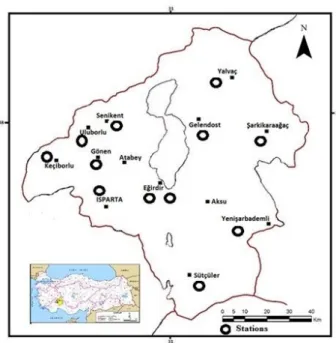
The study was carried out in Isparta and its suburbs located in the south of Turkey, from November 2012 to November 2013. The birds were observed in their roosts. Periodic field studies were conducted at 12 locations identified after continuous observations mainly on farmlands, fruit gardens and abandoned settlements (Fig.1). Two binoculars (Nikon: 12x50 mm and 10x50 mm), camera (Canon 1100D), digital video camera (DCR-Trv 270), GPS (Magellan Explorist 210) were used to record observations and the field data.
Fig. 1. Geographic locations of the study site used for pellet collection.
Pellet collection, measurement and analysis
The roosting sites of little owl were located in Centrum and 10 counties (Gönen, Keçiborlu, Uluborlu, Senirkent, Şarkikaraağaç, Yalvaç, Yenişarbademli, Eğirdir, Sütçüler and Gelendost) of Isparta.
Primarily, the location of pellets was determined at twilight and dusk when the birds were the most active. Pellets from the nests were collected when the little owl was not in the area in order to avoid their reaction that could have been dangerous. Pellets were collected every week of the month in the study year. The pellets were put into nylon bags recording the date, time, place of collection, habitat, coordinates and altitude and taken to the laboratory for their analysis.
In the laboratory, the lenght and widthof pellets were measured to the nearest values using electronic
calliper. Also, their dry weights were recorded using an electronic balance (± 0.1g) after 24 hours of dehydration at 120°C.
All the pellets were dissected using standard methods (Yalden, 1977), the material was preserved in Süleyman Demirel University, Department of Biology. In addition, these data were loaded into computer with Microsoft Excel program for statistical analyses.
Statistical analyses
The mean and standart deviation values for length and width (at two ends Width 1 and Width 2) of pellets were determined. The pellets were dissected to separate the prey items that were identified by the use of identification keys. The data were analysed separately for pellets collected from each location.
The data were transformed using the formula:
( ).
X is each data in transformation (Zar, 2010). One way analysis of variance (One-way ANOVA) and T Test were performed on length, width 1 and width 2 measurements. The difference among the averages was determined for vertebrate and invertebrate prey items and the total number of individuals.
Analysis of variance and t Test were used to determine the difference between the means of length and width. Tukey Test was also used to determine differences among means of groups. In addition, two way tables were created according to the number of taxa and the lenght/width measurements of pellets.
RESULTS
Fifteen little owl were observed during the study from November 2012 to November 2013. From five locations 378 pellets were collected (60 from Sütçüler, 28 fromYalvaç, 74 from Keçiborlu I, 14 from Keçiborlu II and 202 from Keçiborlu III).
In all 2336 prey items were observed that belonged to Coleoptera (1067), Orthoptera (581), Dermaptera (549), Pulmonata (28), Scolopendromorpha (1), Rodentia (98), Insectivora (9) and Passeriformes (3) in the 378 pellets.
Measurement of pellets
Sütçüler: Sixty pellets were measured. Length of the pellets ranged between 58.29 and 15.50 mm, width 1 between 19.22–9.26 mm, and width 2 between 19.10 and 7.18 mm. Pellet weight ranged between 152.2 and 728.5 g. Average values of total 60 pellets: length 29.4, width 113.9, width 2 11.8 mm (Table I).
Table I.- Average values of pellets collected (p < 0.05). Length (mm) Width 1 (mm) Width 2 (mm) Sütçüler 29.4±10.04 13.9±2.09 11.8±2.64 Yalvaç 26.9±8.13 13.8±1.57 12.8±2.60 Keçiborlu-I 30.6±9.26 14.3±2.03 12.3±2.15 Keçiborlu-II 29.8±6.30 14.2±2.17 11.9±1.96 Keçiborlu-III 27.7±7.95 12.6±1.71 10.5±1.71
Yalvaç: Twenty eight pellets were measured. Length, 17.01 and 45.63 mm, width 1 16.98–10.81 mm; width 2 16.36–9.16 mm, Pellets weight 211.8–1922.6 g. Average values of total 28 pellets: length 26.9, width 1 13.8, width 2 12.8 mm (Table I).
Keçiborlu I: Seventy four pellets were measured. Length, 57.13–14.24 mm, width 1 20.38–9.35 mm, width 2 17.61–7.92 mm, weight 4654.1–312.4g. Average values of total 74 pellets: length 30.6, width 1 14.3, width 2 12.3 mm (Table I).
Keçiborlu II: Fourteen pellets were measured. Length 19.65–39.94 mm, width 1 9.18–17.81 mm, width 2 8.23–14.73 mm, weight 340.8–4078.9 g. Average values of total 14 pellets: length 29.8, width 1 14.2, width 2 11.9 mm (Table I).
Keçiborlu III: Two hundred two pellets were measured. Length 13.22–65.96 mm, width 1 8.63–19.61 mm, width 2 between 6.54–18.85 mm. Pellet weight 186.1–2594.9 g. Average values of total 202 pellets: length 27.7, width 1 12.6, width 2 10.5 mm (Table I). The number of individuals of taxa in the pellets
In our study, we determined 2336 prey items in 378 pellets. The difference among the average of the lengths was significant in terms of number of invertebrate and vertebrate preys. Statistically, the difference among length of pellets including invertebrates was found between 20-30 mm and 30-40 mm (p < 0.05). And when statistical data were analyzed in terms of length of pellets including vertebrates, the difference was determined between 20-30 mm and larger then 40 mm (p < 0.05) (Table II).
Difference between the means of width 1 was statistically significant in terms of number of invertebrate individuals (p < 0.05). Vertebrates were more within the largest pellets while invertebrates were dominant in the small pellets (Table II).
Difference between the means of width 2 was not statistically significant in terms of number of invertebrate individuals however differences were significant in terms of number of vertebrate individuals (p < 0.05) (Table II).
Prey items determined in 378 pellets, collected from Isparta, numbered 2336 that belonged to both the
invertebrates (orders Coleoptera 29%, Orthoptera 32%, Dermaptera 31% and Pulmonata 1%, Haplotaxida 1% and Scolopendromorpha 0.1%(; and vertebrates (orders Rodentia 4%, Insectivora 1.3% and Passeriformes 0.6%). Some sand particles were also recovered from the pellets collected during spring months.
DISCUSSION
From 10 counties in Isparta, southern Turkey 378 little owl pellets were collected during the period November 2012 to November 2013; 2336 prey items were identified. The little owl mainly fed on three Insect orders (32% Orthoptera, 29% Coleoptera and 31% Dermaptera), vertebrate orders Rodentia (4%) and Insectivora (1.3%).
Five percent mammal species identified in the pellets included Cricetulus migratorius 3.4%, Microtus hartingi, Meriones tristrami and Crocidura suaveolens 1.6% each. Only bird species identified in the diet belonged to Passeriformes to an extent of only 0.6%. Grasshoppers and beetles were the main invertebrate forms identified in the pellets. It is visualized that the prey items in the diet depended on the availability in the habitat however the status of prey items in the area was not determined.
Some sand particles identified in the diet in this study has also been reported by Finck (1989). He also reported the occurrence of remains of earthworms in the diet. The study documented 6.16 prey species per pellet whereas Moschetti and Mancini (1993) reported an average of 10.5 species per pellet thereby suggesting that little owl could be highly selective in their diets in the study area.
In the literature however different food items have been reported to varying degrees of preference. Al-Melhim et al. (1997) and Kitowski and Pawlega (2010) stated that little owl usually preferred mammals to feed on. Laiu and Murariu (2000) identified 10 rodent species in little owl pellets. Zhao et al. (2011) determined that little owls fed on invertebrates (42%) and rodents (56%). Salek et al. (2010) determined that little owl usually preferred insects (particularly Carabidae) and rodents. Tome et al. (2008) reported that little owl in Portugal steppes usually preferred invertebrate orders (Coleoptera, Orthoptera, Dermaptera and Hymenoptera) and vertebrate species (Mus species and Apodemus sylvaticus). Scott et al. (2005) determined that mammals comprised 40% and invertabrates 35% of the diet of little owl. Grzywaczewski et al. (2006), Bon et al. (2001) and Fattorini et al. (2000) reported that little owl generally fed on insects belonging to orders Coleoptara, Staphylinidae, Tenebrionidae, Scarabaeidae, Dermaptera,
Table II.- The number of prey items (Mean±SEM) associated with the length range of measurement of invertebrate and vertebrate, width 1 and width 2 (mm).
Length range N Invertebrate Vertebrate Total
≤20 50 5.02 ±0.60*ab 0.22±0.06 b 5.24±0.58ab 20- 30 191 6.65±0.40a 0.24±0.03 b 6.89±0.39a 30- 40 102 5.00±0.52b 0.32±0.05 ab 5.32±0.52b >40 36 5.42±1.31ab 0.55±0.09 a 5.97±1.33 ab <13 169 6.50±0.41*a 0.18±0.03 b 6.68±0.41 a >13 210 5.36±0.39 b 0.38±0.03 a 5.74±0.39 a <11 193 5.93±0.37*a 0.23±0.033 b 6.17±0.37a >11 186 5.81±0.44 a 0.34±0.038a 6.16±0.44 a
* The difference between values with the same letter in each column is not significant at the level 0.05 (±SD).
Mantodea, Orthoptera, Homoptera, and Hymenoptera (class Insecta).
Zhao et al. (2008) determined that little owls fed on beetles (46.9%) and mammals (51%). Haunsome et al. (2004) determined that pellets (total 39 pellets) contained five different prey categories viz., Annelids, Coleopteran, Mollusks and small mammals besides Microchiroptera and birds. Shao and Liu (2008) identified 1409 individuals from pellets; 53.9% of them were mammals, 27.4% beetles, 18% reptiles and 0.6% birds. Charter et al. (2006) reported that little owl preferred more birds and grasshoppers than mammals, reptiles and beetles.
Thus it seems difficult to say with certainty about a universal choice of feed items. This is however clear that the choice varies in different habitats. Availability of prey items could again be the deciding factor in the choice of prey; more the availability of prey higher the choice. The researches however have not addressed this factor.
According to the data obtained for the present work, diet preference of little owl consisted of 92% Hexapoda (orders Coleoptera, Orthoptera and Dermaptera), 4% Rodentia, 2% Pulmonata, 1.3% Insectivora, 0.6% Passeriformes and 0.1% Scolopendromorpha. We conclude that the species mainly prefer to feed on insects in summer season and rodents in winter season.
Gorzel and Grzywaczewski (2003) concluded that little owl prefered invertebrates (62.3%) more than vertebrates (37.7%). The results obtained from our study are similar to their findings. However, we found that the owl consumed 95% invertebrates and 5% vertebrates. All these differences must have resulted from climatic factor, temporal variation, geographical features and the extent of biodiversity (Chenchouni, 2014) in the habitat.
Framis et al. (2011) determined that numbers of little owl are continuously decreasing; its status (IUCN
Red List of Threatened Species) is however “Least Concern”. The number of little owl is also gradually decreasing in Turkey and the species has been categorized locally as A.2 (endangered, 22-50 individuals) with only 22-50 individuals in the country
(Kiziroğlu, 2008).
Bock et al. (2013) determined that little owl mostly live sparsely in wooded, agricultural and rural areas and prefer insects, rodents, earthworms and reptiles as prey. Results of our study demonstrated that little owl generally lived in similar habitats and preferred food such as insects and rodents. Thus our findings partly corresponds to the information reported in literature.
According to the interviews with local people, the number of little owl in the area has been fast decreasing. The reasons for this could be habitat degredation, insecticides/herbicides being used on farmlands, epidemics and malnutrition. Habitat degredation or fragmentation is one of the most important negative impacts affecting the biological activities of birds. Little owl has also suffered from malnutrition arising from recent decrease in the number of invertebrates and rodents (Duhaime-Ross, 2014; Lawes et al., 2015). The owls have also been killed because they inflict damage to the poultry.
The little owl is economically important because it keeps under control the population of harmful animals (rodents, insects, birds etc.) on farmlands.
The results of this study will be helpful for studying the diet preferences of the species and will be useful both for farmers and conservation of species. Researches on the availability of different prey species in different habitats would also be helpful in determining the choice of the prey by the little owl in a certain habitat.
ACKNOWLEDGMENTS
The authors thank the Department of Scientific Research Project Management of Suleyman Demirel University (SDUBAP) for the financial support of the project SDUBAP (3358-YL2-12). We also gratefully acknowledge the valuable help of Assistant Professor Dr.
Özgür Koşkan at Süleyman Demirel University in Isparta
in the conduct of statistical analysis of results. REFERENCES
Al-Melhım, W.N., Amr, Z.S., Dısı, A.M. and Katbeh-Bader, A.,
1997. On the diet of the little owl, Athene noctua, in the Safawi area, eastern Jordan. Zool. Middle East, 15: 19-28.
Bırdlıfe Internatıonal, 2015. http://www.birdlife.org/datazone/
country/turkey/ibas. Access year :10.10.2015.
Bock, A., Naef-daenzer, B., Keıl, H., Korner-Nıevergelt, F., Perrıg, M. and Grüebler, M.U., 2013. Roost site selection
by little owls Athene noctua in relation to environmental conditions and life-history stages. Ibis, 155: 847-856.
Bon, M., Rattı, E. and Sartor, A., 2001. Variazione stagionale
della dietta della Civetta Athene noctua (Scopoli, 1769) in una localita agricola della gronda lagunare Venezia. Boll. Mus. Civ. Stor. Nat. Venezia, 52: 193-212.
Charter, M., Leshem, Y., Izhakı, I., Guershon, M. and Kıat, Y.,
2006. The diet of the little owl Athene noctua in Israel.
Zool. Middle East, 39: 31-40.
Chenchounı, H., 2014. Diet of the little owl (Athene noctua)
during the pre-reproductive period in a semi-arid Mediterranean region. Zool. Ecol., 24: 314-323.
Del-Hoyo, J., Ellıot, A. and Sartagal, J., 1999. Handbook of the
birds of the world, Vol. 8. Broad bills to Tapaculs. Edicines Lynx, Barselona, Spain, pp.845.
Duffy, D.C. and Jackson, S., 1986. Diet studies of seabirds: A review of methods. Colon. Waterbird, 9: 1-17.
Duhaıme-Ross, A., 2014. http://www.theverge.com/2014/7/24/
5933303/invertebrate-populations-have-dropped-by-45-percent-in-the-last-four. Access year : 22.10.2015.
Fattorını, S., Mangarano, A., Ranazzı, L., Cento, M. and
Salvatı, L., 2000. Insect predation by little owl, Athene
noctua, in different habitats of Central Italy. Riv. Ital. Ornithol., 70: 139-142.
Festa-bıanchet, M. and Apollonıo, M., 2003. Animal behavior and wildlife conservation. Island Press., Washington, pp. 394.
Fınck, P.,1989. Variabilität des Territorialverhaltens beim
Steinkauz (Athene noctua). Inaugural-Dissertation zur Erlangungdes Doktorgrades der Mathematisch-Natur wissen schftlichen Fakultat der Universitat zu Köln. “Quote”Van Nieuwenhuyse D., Génot J.-C. & Johnson D.H., 2008. The little owl–Conservation, ecology and behaviour of Athene noctua. Cambridge University Press, New York, pp. 574.
Framıs, H., Holroyd, G.L. and Mañosa, S., 2011. Home range
and habitat use of little owl (Athene noctua) in an agricultural landscape in coastal Catalonia, Spain. Anim. Biodivers. Conserv., 34: 369-378.
Gorzel, M. and Grzywaczewskı, G., 2003. Feed of little owl
(Athene noctua Scop., 1769) in agricultural landscape of the Lublin Area. Acta Agrophys., 1: 433-440.
Grzywaczewskı, G., Kıtowskı, I. and Scıbıor, R., 2006. Diet of
little owl Athene noctua during breeding in the central part of Lublin region (SE Poland). Acta Zool. Sin., 52: 1155-1161.
Haunsome, T., O’Mahony, D. and Delahay, R., 2004. The diet of little owls Athene noctua in Gloucestershire, England. British Trust for Ornithology. Bird Study, 51: 282-284. Khalil, S., Anwar, M. and Hussain, I., 2016. Breeding biology
of grey francolin (Francolinus pondicerianus) in salt range, Pakistan. Pakistan J. Zool., 48: 115-123.
Kıtowskı, I. and Pawlega, K., 2010. Food composition of the
little owl Athene noctua in farmland areas of South East Poland. Belg. J. Zool., 140: 203-211.
Kiziroğlu, İ., 2008. Red list of Turkey birds. Desen Press,
Ankara, 148 pp.
Kiziroğlu, İ., 2009. The pocked book of Turkey birds. Ankamat
Press, Ankara, pp. 564.
Laıu, L. and Murarıu, D., 2000. Food of the little owl (Athene
noctua Scop, 1769) (Aves: Strigiformes) in the Surroundings of Bucharest (Romania). Trav. Mus. Natl. Hist. Nat. Grigore Antipa, 42: 185-193.Lawes, M.J.,
Fısher, D.O., Johnson, C.N., Blomberg, S.P., Frank,
A.S.K., Frıtz, S.A., McCallum, H., Vanderwal, J., Abbott,
B.N., Legge, S., Letnıc, M., Thomas, C.R., Thurgate, N.,
Fisher, A., Gordon, I.J. and Kutt, A., 2015. Correlates of recent declines of rodents in Northern and Southern Australia: Habitat structure is critical. Plos One, 1-17.
Moschettı, G. and Mancını, D., 1993. Diet of the Little Owl
(Athene noctua) and its seasonal variations in a Mediterranean environment in urban park. Gli Uccelli Ital., 28: 3-12.
Newsome, S.D., Martınez Del Rıo, C., Bearhop, S. and Phılıps,
D.L., 2007. A niche for isotopic ecology. Front. Ecol. Environ., 5: 429-436.
Salek, M., Rıegert, J. and Krıvan, V., 2010. The impact of
vegetation characteristics and prey availability on breeding habitat use and diet of little owls Athene noctua
in Central European farmlands. Bird Study, 57: 495-503.
Scott, D.M., Gladwın, K. and Barton, N., 2005. Comparison of
the diet of two desert-living owls, the long-eared owl (Asio otus) and little owl (Athene noctua) from southern Mongolia. Mong.J. Biol. Sci., 3: 31-37.
Shao, M. and Lıu, N., 2008. The diet of the little owl (Athene
noctua) in the desert habitats of Northwestern China. J. Raptor Res., 42: 61-64.
Terry, R.C., 2007. Inferring predator identity from skeletal damage of small-mammal prey remains. Evol. Ecol. Res.,
Tome, R., Catry, P., Bloıse, C. and Korpımakı, E., 2008.
Breeding density andsuccess, and diet composition of little owls Athene noctua in steppe-like habitats in Portugal. Ornis Fenn., 85: 22-32.
Yalden, D., 1977. The identification of remains in owl pellets. Mammal Society, London.
Zar, J. H., 2010. Biostatistical analysis. Pearson Education Inc.,
New Jersey, pp. 960.
Zhao, W., Song, S., Shao, M.Q. and Lıu, N.F., 2008. Diets of
little owls and long-eared owls in Northwestern China.
Anim. Biol., 58: 211-219.
Zhao, W., Song, S., Shao, M.Q. and Lıu, N.F., 2011. Niche
Separation of twosympatric owls in the desert of Northwestern China. J. Raptor Res., 45: 174-179.