Theses & Dissertations Graduate Studies Spring 5-7-2016
Using Homeland Security Exercise Evaluation Program to Execute
Using Homeland Security Exercise Evaluation Program to Execute
a Mass Prophylaxis Exercise in a Rural Community.
a Mass Prophylaxis Exercise in a Rural Community.
Brian K. Smith
University of Nebraska Medical Center
Follow this and additional works at: https://digitalcommons.unmc.edu/etd
Part of the Other Public Health Commons Recommended Citation
Recommended Citation
Smith, Brian K., "Using Homeland Security Exercise Evaluation Program to Execute a Mass Prophylaxis Exercise in a Rural Community." (2016). Theses & Dissertations. 85.
https://digitalcommons.unmc.edu/etd/85
This Thesis is brought to you for free and open access by the Graduate Studies at DigitalCommons@UNMC. It has been accepted for inclusion in Theses & Dissertations by an authorized administrator of DigitalCommons@UNMC. For more information, please contact [email protected].
Mass Prophylaxis Exercise in a Rural Community.
Brian Smith, MS candidate
All Correspondence regarding this article should be sent to: Brian Smith
University of Nebraska Medical Center
Introduction:
Novel emerging infectious diseases pose a serious threat to the security of our nation and our communities. Often, these diseases are difficult to detect and treat. Furthermore, some pathogens such as anthrax may be easily developed into a weaponized form. On October 9th, 2001 five envelopes containing live anthrax were
mailed to two U.S. Senators and media organizations in New York and Florida. The attacks resulted in the death of five individuals and the infection of seventeen more. (United States Department of Justice. 2010).
On October 9th the New York City Department of Health received notification
of a possible anthrax infection at a local media corporation. The infection was confirmed on October 12th and the city’s response plan was initiated. The response
plan included standing orders for the distribution of prophylactic medication, training materials for medical staff, and fact sheets for the general public (Blank, S., Moskin, L. C., & Zucker, J. R. 2003). In 1999, New York City began developing plans for the mass distribution of prophylactic medications. The city planned to have the capability to provide these medications to more than eight million residents in a 48 hour period (Blank, S., Moskin, L. C., & Zucker, J. R. 2003)
Following the confirmation of the anthrax, the New York City Emergency Management office began the distribution of prophylactic medications at the affected media site. The site was not well equipped to accommodate large numbers of individuals, however in a 42 hour time period this prophylactic point of
distribution (POD) was able to screen, brief, and provide medication to more than 1,300 staff members (Blank, S., Moskin, L. C., & Zucker, J. R. 2003 )
The New York City PODs in 2001 were unique because they were initiated before the extent of infection was known. Each POD was set up to address a specific location believed to be at risk. For this reason, skilled healthcare workers staffed the PODs. All patients were extensively screened and their information charted (Blank, S., Moskin, L. C., & Zucker, J. R. 2003). This type of screening and charting is labor intensive, time consuming, and not properly aligned with the goal of mass
prophylactic distribution to an entire community. Still, the preparedness efforts initiated in 1999 by the New York City Department of Health facilitated the rapid execution of each POD location in the 2001 anthrax attacks.
Literature Review
While there are many instances of a novel agent or disease causing wide spread outbreak, the focus of this paper will be on those instances when the
outbreak of a novel agent was the result of intentional release or spread by humans. In April 1979 in Sverdlovsk, Russia, in a sudden outbreak of anthrax resulted
in the death of 42 individuals. To date this incident is the only population level aerosol anthrax exposure in history (Hupert, N. 2009). The incident is largely believed to the result of a release from a military facility nearby. The high rate of mortality associated with this incident can be attributed three factors; exposure to
aerosol anthrax, poor prophylaxis strategy, and ineffective prophylaxis (Abramova, F. A., Grinberg, L. M., Yampolskaya, O. V., & Walker, D. H. 1993).
In 1984 more than 700 residents of The Dalles Oregon were diagnosed with Salmonella gastroenteritis. Through investigation, it was later determined that the outbreak was the result of intentional contamination of local salad bars. A religious cult called the Rajneesh was found guilty of contaminating the salad bars (Török, T. J et. al 1997 ).
Bioterrorism and emerging infectious diseases pose a continued and growing threat to the residents of the United States. The Centers for Disease Control and Prevention list several critical agents that have the potential to cause widespread mortality. Some of the agents are endemic, meaning they occur in nature and
therefore may become an emerging infectious disease. Each agent however, also has the potential to be utilized as a biological weapon. These critical agents listed by the Centers for Disease Control and Prevention are: anthrax, viral hemorrhagic fever, smallpox, botulism, plague, and tularemia. (Chang, M. H., Glynn, M. K., &
Groseclose, S. L. 2003).
In 2001, one of these agents, anthrax, was utilized in a series of bioterrorist attacks here in the United States. Recognizing the need for mass medication distribution capabilities, in 2004 the Centers for Disease Control and Prevention began funding preparedness efforts in major metropolitan areas. The
funding was intended to further develop a metropolitan area’s ability to provide medication to a majority of its inhabitants within a 48 hour window (Centers for Disease Control and Prevention 2010). Initially, the CDC selected 21 Metropolitan Statistical Areas (MSAs) to receive funding and assistance. A Metropolitan Statistical Area is defined as a metropolitan area with a core population greater than 50,000 (United States Census Bureau. 2013) These MSAs were selected based on their population and on their vulnerability to terrorist attacks. Within two years, the CDC was funding preparedness efforts in 72 metropolitan statistical areas (Centers for Disease Control and Prevention 2010).
The effectiveness of prophylaxis programs is determined by two factors: the time to response or “first pill” and the amount of prophylaxis required for each individual or time to “last pill” (Hupert, N. 2009). Effective prophylaxis strategies require a rapid response and strict adherence to the medications dispensed. It is important to note that in some cases, such as an act of bioterrorism in which aerosolized anthrax is released, we may not be aware of the incident until an individual becomes symptomatic or evidence of the release is uncovered. Anthrax has a median latency period of 8-14 days. During this time the exposed individual may not exhibit symptoms (Hupert, N. 2009). This latency period is the time in which rapid prophylaxis is most important. We have learned from the incident in Sverdlosk, Russia that the delay between exposure and prophylaxis impacts the probability of mortality in those exposed (Hupert, N. 2009). In a 2009 study, using a computer based predictive model and the data from the Sverdlosk release,
Nathanial Hubert, was able to predict the outcomes of various response timelines. He began with a two-day delay in response, with prophylaxis response beginning on the second day, and treatment medication distribution completed within the 48 hour goal previously established by the Cities Readiness Initiative. He determined that if exposure was identified after a delay of two days, and medication dispensed within the CRI goal, 87% of the exposed population would be inoculated from illness (Hupert, N. 2009). Furthermore, Hubert, determined that if prophylaxis onset was delayed by one week, only 39-49% of the exposed population would be inoculated from illness (Hupert, N. 2009).
Increased local dispensing capacity greatly reduces mortality associated with outbreaks of novel pathogens. Two factors determine dispensing capabilities: the number of dispensing sites available, and the number of individuals that can be served at each dispensing site (Bravata, D. M., Zaric, G. S., Holty, J. C., Brandeau, M. L., Wilhelm, E. R., McDonald, K. M., et al. 2006).
Rural communities face unique challenges when developing effective POD plans. Rural communities are more likely to experience shortages in medical providers, lower education levels of residents, lack of public transportation, and isolation from larger metropolitan areas either due to geographic location or to extreme conditions such as weather. Residents of rural communities are also less likely than metropolitan residents to seek medical attention (O’Farrell, D., & Larsen Aubrey, D. 2010).
A 2010 study by Denise O’Farrell and Debra Larsen Aubrey, examined the challenges to rural public health response in portions of Idaho not otherwise
incorporated into metropolitan areas. The study outlines a three-pronged approach called the “Rural Collaborative Model.” This collaborative model outlines three strategies to increase a rural community’s ability to execute large-scale public health response. The three landmarks of the Rural Collaborative Model are:
Community feedback about implications of an outbreak in the region, development of collaborative plans for mass dispensing, and finally evaluation of response
capabilities through table top and full scale exercises (O’Farrell, D., & Larsen Aubrey, D. 2010).
Tabletop exercises and full-scale exercises allow responders to practice their response ahead of time, promoting efficient response when a real life event occurs. Disaster exercises provide local jurisdictions a unique opportunity to train and evaluate their preparedness strategies. Tabletop exercises allow responders to talk through a response to a given scenario. A full-scale exercise allows responders to actually physically respond, utilizing tools and staff required for response to an actual event. In essence, a tabletop is a “talk through” exercise, while a full-scale is an actual “walk through”.
Recognizing the need for a standard format for exercise evaluation, The United States Department of Homeland Security, created the Homeland Security Exercise Evaluation Program or HSEEP. This program aimed to create standard language, methodology, and policy for the design and evaluation of disaster
exercises. Standardizing the language, methods, and policies of exercise design ensures exercises are accomplishing a specific goal or objective, increasing a
community’s preparedness. These standards also allow for effective evaluation of an exercise. Disaster exercises do not provide the instantaneous feedback that real world events do. With a real world event, if a community’s response is lacking or failing in one area, the effects will be immediately evident. However, with exercises, shortcomings may not be as easily identified. Effective evaluation of disaster
exercises promotes continuous improvement of preparedness plans (Renger, R., MEP, J. B., Jansen, A., & Peacock, E, Ny.) This project aimed to identify shortcomings in the Harrison County POD plan by executing a table top exercise where
participants explain their responses to a proposed scenario, and a full scale exercise, where participants actually respond to a proposed scenario.
To aid communities in the development of effective preparedness exercises, the National Exercise Division of the Federal Emergency Management Agency (FEMA), housed within the Department of Homeland Security (DHS), developed the HSEEP toolkit. This toolkit is comprised of several online tools intended to aid in the development, scheduling, planning, and evaluation of exercises (John, C. J.,
Pancerella, C. M., Yang, L., Mahrous, K., Elkin, G. R., Norige, A. S., et al. 2011). Exercise design was conducted around 15 base scenarios, which FEMA and the DHS have identified as having high probabilities within the United States. During the development of the exercise, FEMA and the DHS have also identified 36 target capabilities for a community. These capabilities include: urban search and rescue,
critical infrastructure protection, criminal investigation, medical surge, and mass prophylaxis and vaccination to name a few (Renger, R., MEP, J. B., Jansen, A., & Peacock, E, Ny). These capabilities provide a standard goal when developing an exercise around a given scenario. To further promote preparedness improvement the HSEEP includes methods for evaluating the exercise upon completion.
Prior to the development of the HSEEP program, exercises would be completed and would be immediately followed by “lessons learned.” The lessons learned portion of disaster exercises was intended to foster process improvement. However, the same shortcomings identified by disaster exercises, continued to be identified in subsequent exercises, meaning that process improvement had not taken place (Savoia, E., Agboola, F., & Biddinger, P. D. 2012). To remedy this, the HSEEP program aimed to promote a standard evaluation and process improvement process following an exercise. This standard format was intended to promote health system level learning (Savoia, E., Agboola, F., & Biddinger, P. D. 2012). A recent study of the HSEEP After Action Report (AAR), synonymous with lessons learned, aimed to explore the effectiveness of the AAR. The study found that the jurisdictions that utilized the HSEEP AAR were able to identify trends in their preparedness shortcomings. With the identification of these trends, local jurisdictions saw improvement of their Multi-Year Training and Exercise Programs (MYTEP). Furthermore, because the HSEEP AAR is a standard format document, the AARs from various communities could be uploaded to a national database. This database proved to be a valuable resource for communities writing their MYTEP. A
Community could access this database and identify the trends of shortcomings in similar communities, thus allowing for adjustment and improvement in the MYTEP development (Savoia, E., Agboola, F., & Biddinger, P. D. 2012). An Internet search of lessons learned for the state of Iowa produced two separate HSEEP AARs for two separate disasters. Both AARs identified the same area for improvement,
communication and coordination among stakeholders. (Mansheim, A., Randazzo, R., Halbrook, J. 2010)( Hempen, D 2011). Utilizing the HSEEP with careful review of AARs, exercise planners can address areas of key concern and foster actual
improvement for preparedness and response (Savoia, E., Agboola, F., & Biddinger, P. D. 2012).
Recognizing a need for national preparedness geared toward emerging infectious diseases and bioterrorism, in 2004 the Centers for Disease Control began providing funding for mass prophylaxis preparedness efforts. This funding program was titled the Cities Readiness Initiative and was intended to supplement
preparedness efforts for major metropolitan areas. The Office of Management and Budget defines a metropolitan area as a metro area that contains a core population of at least 50,000 (The United States Census Bureau. 2013).
The goal of the Cities Readiness initiative was to assist large metropolitan areas in developing the capability to provide mass prophylaxis to its residents within a 48 hour time period. Through the Cities Readiness initiative, The Centers for Disease Control and Prevention (CDC) also provides technical assistance,
meaning guidance in plan development and assessment of a community`s capabilities (Centers For Disease Control and Prevention, 2010).
According to The Centers for Disease Control and Prevention, preparedness efforts geared towards bioterrorism and wide spread infection of novel agents is a key component of the United States public health infrastructure. Proper
preparedness efforts include: education on bioterrorism related agents, training in bioterrorism response, and communication or dissemination of vital information to both the public and first responders (MMWR Workgroup, P. 2000).
Disaster exercises provide an excellent opportunity for local health
departments to receive preparedness training and education. Disaster exercises are an essential part of preparedness planning. These exercises provide local health departments with an opportunity to simulate actual events, and to measure their response capabilities. However, proper exercise planning and evaluation is required to gain valuable information from exercise execution. Without proper exercise development and evaluation, local health departments may be at risk of developing a false sense of security and preparedness undermining their actual response capabilities (Gebbie, K. M., Valas, J., Merrill, J., & Morse, S. 2006).
Project Outline
This Project focused on the design of a full-scale POD exercise based on an anthrax release scenario. The project aimed to provide Harrison County with a tabletop exercise, a full scale exercise, and an after action report based on an
evaluation of the exercise. The table top, full scale exercise, and After Action
documents were developed and written by the primary project author, Brian Smith. Pursuant to the Centers for Disease Control’s recommendations for public health preparedness, Harrison County Public Health Department has developed a comprehensive POD plan that outlines response procedures during a novel
outbreak or bioterrorist attack. Harrison County is a rural county with a population of roughly 16,000 located in West Central Iowa see figure1.
Figure 1 (image retrieved from worldatlas.com)
Harrison County contains ten incorporated towns: Dunlap, Little Sioux, Logan, Magnolia, Missouri Valley, Mondamin, Persia, Pisgah, and Woodbine (Harrison County, 2015) The county’s emergency preparedness agency as well as public health agency are located in the town of Logan.
Despite having official public health and emergency preparedness agencies and preparedness plans, the staff at Harrison County Public Health Department had
never had the opportunity to exercise these plans. Also, as the result of a high turnover rate in staff, many members of Harrison County Public Health Department had not received adequate training on bioterrorism or the counties mass
prophylaxis plans. Without proper exercise development and execution, Harrison County Public Health Department was unable to accurately evaluate its mass
prophylactic distribution plans. This project sought to provide both POD training to Harrison County staff as well as to test the existing Harrison County POD plan.
Metropolitan Statistical Areas that receive technical assistance from the CDC are required to drill and prove their response capabilities. Harrison County and the incorporated towns within the county are considered part of the Omaha
Metropolitan Statistical Area. This means that preparedness efforts and exercises conducted by the city of Omaha located nearly fifty miles south satisfy the
preparedness requirements for Harrison County set forth by the Centers for Disease Control and Prevention. This is important to note because exercises conducted in Omaha may not include or benefit residents of Harrison County. The Centers for Disease Control and Prevention provides technical assistance to evaluate the ability of an MSA to respond to a novel outbreak. A Metropolitan area is considered
capable of responding if it received a Technical Assistance Readiness score (TAR) of 69 or more. However, as mentioned above, smaller counties contained within the MSA, however geographically distant from the metropolitan area, do not necessarily benefit from this kind of evaluation. Some counties may be included as a part of an MSA, however, the score given for a specific MSA may not be representative of the
local county or jurisdiction. This is the case with Harrison County, which is counted as a member of the larger Omaha-Council Bluffs MSA. Yet, Harrison County is approximately forty-five minutes outside the Omaha area. A passing TAR score for the Omaha MSA is not necessarily representative of Harrison County’s response capabilities. Therefore, a full-scale exercise and evaluation of Harrison County’s existing plans was conducted to determine the level of preparedness of Harrison County Home and Public Health.
Review of Existing Harrison County POD Plan:
The existing mass prophylaxis plan for Harrison County identifies the Logan-Magnolia School located at 1200 North 2nd Avenue in Logan Iowa as the primary
dispensing site. The existing plan identifies back up or secondary dispensing site as the Rand Community Center at 100 South 4th Street in Missouri Valley Iowa. The
exercise utilized the primary location of the Logan-Magnolia School.
According to the existing Harrison County POD plan, POD staff will receive an orientation by the incident commander prior to POD operations beginning. The orientation includes assignment of staff leaders and the distribution of Job Action Sheets to both staff leaders and volunteers serving in POD operating positions. Staff Leads are Harrison County Home and Public Health staff and Harrison County Emergency Management staff.
The Existing Harrison County POD plan calls for the following positions at a minimum:
1. POD Management 2. IT/Communications 3. Safety Officer
4. Public Information Officer 5. Logistics Officer
6. Greeting/triage 7. Dispensing 8. Inventory
9. Runners/floaters
The existing plan calls for staff leads to be individuals who are familiar with the duties within his/her respective department. If there are not enough Harrison County staff to fill all positions, the Incident Commander can select and assign volunteers to positions. The Incident Commander or Logistics Lead is required to maintain a “staff sign in sheet” which includes emergency contact information. The existing plan also recommended a command staff board. A command staff board identifies which POD staff members are in which command positions.
The existing plan contains Job Action Sheets. The Job Action Sheets are handed out to volunteers or staff at the POD who have not been previously trained on the POD operations. This is known as “Just in Time Training.”
Each shift of staff will have had an Incident Action Plan. An Incident Action Plan details incidents from the previous shift and outlines the goals of the current shift (if multiple shifts are utilized).
During dispensing activities all patients receiving medications will receive a medication information form. This form provides the medication recipient with information such as side effects about the medication he or she received.
POD Set Up
The Harrison County POD plan calls for information dissemination to POD visitors via electronic kiosks, signs, and floaters. The Harrison County plan states areas such as the entrance; exit, dispensing, triage, restrooms, and parking are clearly designated with signage.
The POD plan calls for a triage/assessment station, a dispensing station, and a station for special needs individuals. The Harrison County plan states Harrison County staff members will be available throughout the POD to provide visitors with information and direction.
The Harrison County Mass Prophylaxis exercises were carried out in HSEEP style. Exercise organizers met with Dr. Pat Hart, Harrison County Home and Public Health Administrator, and the acting administrator for the Logan-Magnolia School, as well as Larry Oliver, Harrison County Emergency Management. This meeting did not involve all stakeholders on the same date. There were several challenges while conducting these exercises. One such challenge was the coordination of all
stakeholders. It was extremely difficult to establish meeting dates that fit within the planning time frame of the exercise and worked for all stakeholders. Therefore correspondence was conducted through email.
Initial planning meetings were held with Harrison County Home and Public Health in October 2015. Additional planning meetings involving Logan Magnolia Schools did not occur until January 2016. These meetings established the dates for both the Tabletop exercise and the Full-scale exercise. During these planning meetings it was decided that students from the Logan Magnolia School would serve as our patients and that due to the size of the POD we would not require volunteer assistance.
Step 1: Table Top
Prior to the execution of the full-scale exercise, a tabletop exercise was carried out with pertinent stakeholders. Pertinent stakeholders included Larry Oliver, Harrison County Emergency Management, Harrison County Home and Public
Health, and CHI Health Missouri Valley. Unfortunately, not all stakeholders were present; the acting administrator for Logan Magnolia schools was not in attendance.
During the tabletop exercise, a brief training on the existing Harrison County POD plan was provided. The training oriented the 12 Harrison County staff
members with to the tabletop exercise as well as their role within the exercise. The training and tabletop took approximately one hour on March 18, 2016. Scenario injects (events) for the tabletop were mirrored from the Master Scenario Event List of the full-scale exercise. The After Action Reports located in Appendix 1 and
Appendix 2 were produced for both the tabletop exercise and the full scale exercise. The exercise was based on a scenario of a possible anthrax release from packages containing a suspicious white substance opened in the local grocery store in the area with an unknown number of exposed individuals. Participants were instructed to talk through the POD activation following notification of the anthrax release via phone call from the affected grocery store. At this point, the expectation was that Harrison County Home and Public Health would begin the POD setup process including the activation of the existing call tree and coordination with the Logan Magnolia School to set up the POD. The Master Scenario Event List included incident changes such as media inquiry requiring the establishment of a Public Information Officer and non-English speaking POD visitors. Additional incident variables included medical asset attainment from CHI Health Missouri Valley. The exercise came to completion following discussion of the complete set up and operation of the theoretical POD.
During the tabletop exercise, participants gathered in a large conference room at Harrison County Home and Public Health. The tabletop exercise was facilitated by providing modules which included scenario injects and questions to prompt discussion. The following is an example of a module inject, “Patients begin arriving at the POD. There is a large quantity, some are concerned they were exposed but are unsure. Some do not speak English. Media is inquiring about the activities at the POD location.” Shorty after providing staff with the module inject I provided questions to prompt discussion. The following is an example of a question provided, ”What is communicated with the media and by who?” Upon completion of the tabletop modules I facilitated a Hotwash. A hotwash is a period at the end of the exercise where participants are encouraged to provide feedback and ask questions about the exercise. Facilitation of the hotwash for this exercises proved to be challenging. Many of the Harrison County staff had never participated in a tabletop or other drill and therefore had no expectations regarding the exercise. Many staff members had no frame of reference to form an opinion regarding the exercise. I had to facilitate discussion by asking specific questions such as “Do you feel this exercise highlighted strengths and weaknesses within the department and what were those weaknesses?” Dr. Pat Harris further assisted in facilitating the hotwash by beginning a discussion on the needs of the department, which were identified through the drill. These needs included updated drawings of the Logan Magnolia School, signage in multiple languages, and clear designation of who was responsible for retrieval of POD supplies.
After the Hotwash, participants were provided the HSEEP standard Participant Feedback Form. I explained that this form was used to critique the exercise from their perspective. This form became a challenge. Halfway through the form several staff members admitted they had been using the form to evaluate my performance as a facilitator rather than to evaluate the department’s performance through out the exercise. While reviewing the feedback forms after the exercise this became evident. The forms however, did provide useful to me as an exercise
planner. While evaluating the forms after the exercise, it became clear through participant responses that most of the staff did not fully understand what a tabletop was or why they were conducting one. For example, one participant would have liked to have been provided scenarios, specifically multiple scenarios. Another participant wrote that the facilitator should have advised the department on what to do. After identifying this lack of understanding I began to increase communication of expectations for the full scale exercise. Finally, an After Action Report was drafted in HSEEP style and is attached in Appendix 1.
Step 2: Full Scale Exercise
The full scale exercise required the Harrison County Health Department to physically respond to a given scenario. The full scale POD exercise occurred Friday April 1, 2016. The Logan-Magnolia school was in session and students were used as participants. It was determined through planning meetings and email
the exercise would begin at 10:30 AM. The Logan Magnolia School stated students grades 5-12 could walk through the POD from 11:00 AM to approximately 12:00 PM. One week before the exercise date, Logan-Magnolia School stated students would only be available from 10:30 AM to 11:10 AM. This proved to be a challenge as the Master Scenario Event List had to be adjusted to compensate for POD set up time. During the week leading up to April 1,, I was in constant communication with
Harrison County Public health regarding the feasibility of set up and execution during the time given. During this communication it was decided that the exercise would commence at 09:45 AM. Pat Hart, Harrison County Administrator was informed that on Friday April 1st, the department would receive a phone call
initiating the exercise. Dr. Hart and the department were not provided any additional information. It was also clarified that the department should conduct “business as usual” until the initiation of the exercise via phone call.
The evening before the exercise Dr. Hart, Harrison County Administrator, through email expressed concerns that the entirety of the Harrison County POD plan could not feasibly be executed in the time frame given. It became evident that the scope of the exercise was not clear to the key stakeholders. I had to thoroughly explain that the scope of this exercise was narrow and would not test every aspect of the existing POD plan, however, it would test critical tasks such as retrieval of supplies. I had to explain that each task promoted an overarching target capability such as “set up POD.” I had to be very careful in my explanations to not divulge the scenario of injects for the exercise.
On the morning of April 1st, I arrived at Harrison County Home and Public
health with three exercise evaluators. We arrived at approximately 09:20 AM and observed the 12 Harrison County staff members packing POD supplies into vehicles. When I asked staff where the administrator was, they stated he had already
departed to the POD location. It was apparent that the department had not
conducted business as usual. Immediately I asked two evaluators to go to the POD site to ensure we could observe the staff as the exercise began.
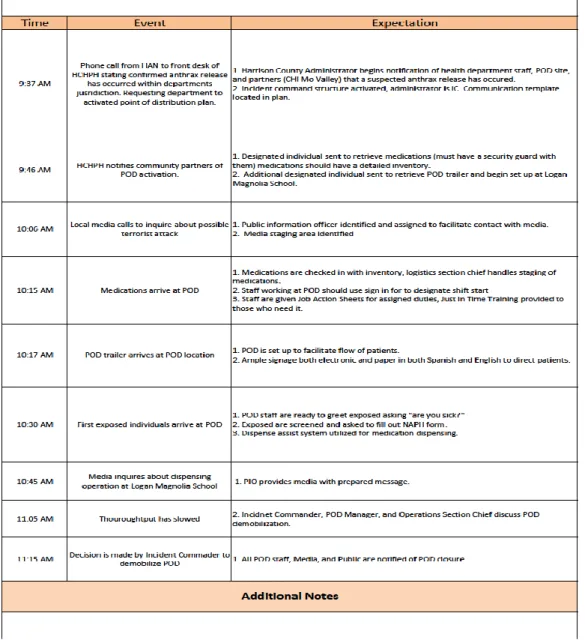
I made the decision to begin the exercise as soon as possible so that the evaluators could follow the appropriate staff and accurately measure the time between actions ( See figure 3 for detailed timeline). At 09:37 I called Harrison County Public Health and stated, “This is a drill. This is a Health Alert Notification advising you a confirmed anthrax release has occurred within your jurisdiction. Please activate your Point of Distribution Plan.” The Harrison County staff member who received the call then notified the Liaison Officer who then notified Logan-Magnolia School that the POD was being activated. At 09:46 AM the Liaison Officer notified CHI Missouri Valley that medical assets would be needed and staff would be coming to retrieve them.
Following these notifications the remaining staff members of Harrison County Public health departed for the POD site at Logan Magnolia School.
I arrived at the Logan Magnolia School at 09:54 AM. The exercise evaluators observed Harrison County staff setting up tables and signs. It was noted that many signs were simply arrows, making them understandable in any language. However,
there were no signs posted in alternate languages or electronic signage. At 10:06 AM I simulated a media inquiry by placing a phone call to Harrison County Public
Health. A Public Information Officer was immediately identified and connected with me. I attempted to get information by asking for confirmation that a terrorist event had occurred and stating I thought the school may have been impacted. Ms. Davis, the PIO, stated appropriately that this information was unavailable at this time and that she would contact me once information had been confirmed. My evaluators stated Ms. Davis was not expecting this phone call and had drafted a press release containing information she believed would be true prior to the exercise. This unexpected media inquiry forced Ms. Davis to discard her previously drafted press release and consult the incident commander on what information was known and what should be disseminated. At 10:31 AM I placed another phone call to Ms. Davis acting as the press. Ms. Davis stated the health department had been asked to activate a point of dispensing site in response to a confirmed anthrax release. I asked if it was terrorists to which Ms. Davis stated this was unknown at this time. Ms. Davis acting as PIO, then stated the health department was asking Harrison County residents to come to the Logan Magnolia School to receive medications. Ms. Davis advised residents would need to go to dispenseassist.org to fill out a dispense assist form and that residents could collect medications for family members as long as a completed form was available. The information Ms. Davis provided was
At 10:17 AM Harrison County Staff donned Incident Command Vests. Until this point it was difficult to identify which staff members were playing specific command roles. Once vests had been donned the Denise, the Operations Section Chief, conducted a POD briefing. She distributed Job Action Sheets and educated staff on indented flow of POD, time expectations, and answered questions from staff.
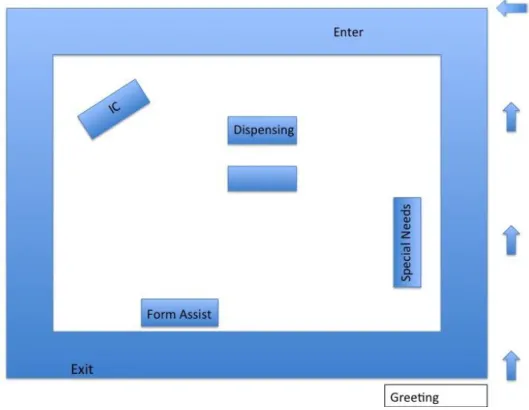
Figure 2: POD arrangement on day of exercise.
Prior to arrival of the students evaluators surveyed the lay out of the POD site. POD staff had established a greeting station outside the POD, a dispensing station, a special needs station, and a form assistance station for individuals with incomplete or incorrect forms.
Figure 3: Timeline of actual events on day of exercise.
For this exercise, we used green mints to represent Ciprofloxacin and red mints to represent Doxycycline. When the medications arrived at the POD they were quickly checked in at the dispensing table. One evaluator noted however, the mints were placed on the table rather than secured in a separate area. Once students arrived and began simulating visitors, a need for medication security became evident, as some students would simply grab mints from the bags as they walked through.
At 10:40 AM students arrived at the greeting table to begin walking through the POD. POD staff used prefilled Dispense assist forms to facilitate the exercise. However, some students volunteered to role-play as confused individuals without
the correct forms. POD staff then had to escort these students to the Form Assist table. This posed a challenge to POD staff as only two staff members were assigned to the greeting table. When a student required escort to either the Special Needs table or the Form Assist table, the line to the greeting table slowed and backed up.
The exercise evaluators began timing students as they walked through the POD from entrance to exit. At the onset of the exercise it took students
approximately 3 minutes and 30 seconds to receive medications and exit the POD. As the exercise developed and students began role-playing as individuals without forms or with special needs POD staff experienced some difficulty maintain a rapid throughput. At 10:45 AM, five minutes after the arrival of students, the surge slowed the throughput of the POD to 6 minutes and 30 seconds for a student from entrance to exit.
I found it challenging to refrain from providing advice to POD staff. On some occasions staff asked if they should be performing a specific task or where they should get a piece of information. I had to remind the staff that I was unable to provide guidance on the expected duties of their plan.
Evaluators also timed students’ role-playing as individuals without the correct forms. Students at this table took up to 11 minutes to complete dispense assist forms and receive their medications. The last student received medications at 11:10 AM as planned. The POD was able to distribute two forms of medication to 350 students in approximately 30 minutes. This was a good throughput and
challenged Harrison County staff. Following the exercise a Hotwash was completed and staff were asked to fill out Participant feedback forms.
Overall the exercise with Harrison County Home and Public health was a success. The department utilized the incident command structure to operate their response to a vague anthrax release scenario. The department worked to achieve the target capability of
protecting the health of the population through the administration of critical interventions in response to a public health emergency in order to prevent the development of disease among those who are exposed or are potentially exposed to public health threats. The department rapidly established a POD location with medical assets. Following set up the POD was able to handle a simulated throughput of 350 visitors.
The Health department also achieved its second target capability of managing risk communication to address the concerns of the public. The Public Information Officer was careful to seek and compile accurate information for
dissemination to both the public and media. The exercise identified strengths within the department. Strengths included the POD staff’s ability to communicate amongst each other, the use of incident command, and rapid set up. The exercise also
identified areas for improvement. Areas for improvement included use of signage for non-English speaking residents, arrangement of POD, and a lack of staff, which could be remedied with access to a volunteer pool.
Hotwash
The hotwash provided Harrison County staff with the opportunity to voice their opinions regarding the exercise, what went well, and what needed
improvement. I facilitated discussion by providing some broad questions such as “what do you believe you did well?” Harrison County staff stated they believed one strength of theirs during the exercise was that they all worked well together. They stated a weakness as needing more volunteers to assist with escorting students and directing POD flow.
Staff did state a weakness of the exercise was the lack of information they received ahead of the exercise. The health department staff stated in a large scale release scenario such as this they believed they would receive several days’
notification from the Iowa Department of Public Health as well as large amounts of information regarding the substance or disease.
One staff member stated she was happy to have proper forms such as the “Incident Action Plan” at her table. She stated one student believed this was a real event and had to be reassured that this was an exercise. The Harrison County Staffer stated she was able to document this incident on the Incident Action Plan form to ensure the Incident Commander was notified.
At the end of the discussion, I distributed the Participant Feedback Forms. The previous tabletop with Harrison County highlighted a need for more clear direction on filling out participant forms. For this exercise I provided a more clear explanation that this form was intended to evaluate the exercise as well as the
department’s performance during the exercise from the perspective of department staff.
When I reviewed the participant feedback forms from the full scale exercise I found that staff had more appropriately completed the form. Rather than critiquing my performance as an evaluator Harrison County staff appropriately critiqued their performance during the drill as well as the drills value to the department. The forms identified strengths as teamwork and communication. The forms identified
weaknesses as low number of staff and lack of department education about the existing plan. Evaluators also completed participant feedback forms. Evaluators identified strengths as the use of Incident Command and Communication.
Evaluators Identified weaknesses as POD layout and low number of staff.
Recommendations
Harrison County should practice the set up of the electronic signage and translation devices they have in their inventory. Harrison County officials need to be familiar with how to communicate with residents that do not speak English.
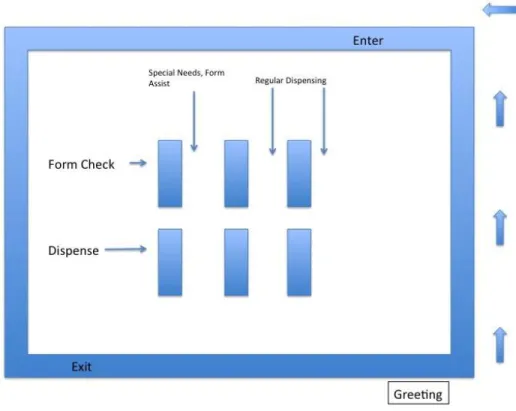
To improve the flow of the POD I would recommend an overhaul of the POD layout. The POD should be arranged in several “rows” of dispensing rather than a central table. This would allow patients/students to be separated and would allow
for signage to serve in lieu of staff escorts.
Figure 4: Recommended POD arrangement.
Additionally, the Harrison County Home and Public Health Department should establish a pool of engaged volunteers to assist the department in response activities.
These recommendations are reflected in After Action Report attached as Appendix 2. Additionally, the After Action Reports detail the strengths of the department and identify areas for improvement for future exercises or actual events. These documents are of value to the continued preparedness efforts of this rural community. Rural communities must conduct exercises and training sessions to educate both their staff and their citizens on the response capabilities of their community, lest a false sense of security create vulnerability.
References
Abramova, F. A., Grinberg, L. M., Yampolskaya, O. V., & Walker, D. H. (1993).
Pathology of Inhalational Anthrax in 42 Cases from the Sverdlovsk Outbreak of 1979. Proceedings of the National Academy of Sciences of the United States of
America, 90(6), 2291-2294.
Blank, S., Moskin, L. C., & Zucker, J. R. (2003). An Ounce of Prevention is a Ton of Work: Mass Antibiotic Prophylaxis for Anthrax, New York City, 2001. Emerging
Infectious Diseases, 9(6), 615-622.
Bravata, D. M., Zaric, G. S., Holty, J. C., Brandeau, M. L., Wilhelm, E. R., McDonald, K. M., et al. (2006). Reducing mortality from anthrax bioterrorism: Strategies for Stockpiling and Dispensing Medical and Pharmaceutical Supplies. Biosecurity
and Bioterrorism: Biodefense Strategy, Practice, and Science, 4(3), 244-262.
Centers for Disease Control and Prevention. (2010). Cities Readiness Initiative. Centers for Disease Control and Prevention. (2015). Office of Public Health
Preparedness and Response.
Chang, M. H., Glynn, M. K., & Groseclose, S. L. (2003). Endemic, Notifiable Bioterrorism-Related Diseases, United States, 1992–1999. Emerging Infectious Diseases, 9(5), 556.
Gebbie, K. M., Valas, J., Merrill, J., & Morse, S. (2006). Role of Exercises and Drills in The Evaluation of Public Health in Emergency Response. Prehospital and
Disaster Medicine,21(03), 173-182.
Harrison County Iowa. (2015). Welcome to Harrison County Iowa. Hempen, D. (2011). Iowa 2011 Missouri River Floods after action report.
Hupert, N., Wattson, D., Cuomo, J., Hollingsworth, E., Neukermans, K., & Xiong, W. (2009). Predicting Hospital Surge After a Large-Scale Anthrax Attack: A Model-Based Analysis of CDC's Cities Readiness Initiative Prophylaxis
Recommendations. Medical Decision Making : An International Journal of the
Society for Medical Decision Making, 29(4), 424-437.
John, C. J., Pancerella, C. M., Yang, L., Mahrous, K., Elkin, G. R., Norige, A. S., et al. (2011). New Technologies and Processes for the Homeland Security Exercise and Evaluation Program Toolkit. Technologies for Homeland Security (HST),
2011 IEEE International Conference on, pp. 446-450.
Mansheim, A., Randazzo, R., Halbrook, J. (2010). Iowa Disaster Recovery Tabletop Exercise After Action Report/Improvement plan.
O’Farrell, D., & Larsen Aubrey, D. (2010). Rural responses to H1N1: A Flexible Model for Community Collaboration. Rural Society, 20(1), 76-84.
Renger, R., MEP, J. B., Jansen, A., & Peacock, E. Using Evaluation Theory to Analyze the Homeland Security Exercise and Evaluation Program (HSEEP).
Savoia, E., Agboola, F., & Biddinger, P. D. (2012). Use of After Action Reports (AARs) to Promote Organizational and Systems Learning in Emergency
Preparedness. International Journal of Environmental Research and Public
Health, 9(8), 2949-2963.
The United States Census Bureau (2013). Metropolitan and Metropolitan Statistical Areas Main. Retrieved 11-18-2015 from:
http://www.census.gov/population/metro/
The United Stated Department of Justice. (2010). Amerithrax Investigative Summary.
Török, T. J., Tauxe, R. V., Wise, R. P., Livengood, J. R., Sokolow, R., Mauvais, S., ... & Foster, L. R. (1997). A Large Community Outbreak of Salmonellosis Caused by Intentional Contamination of Restaurant Salad Bars. Jama, 278(5), 389-395.
United States Census Bureau. (2013). Retrieved from:
http://www.census.gov/population/metro/ on April 15, 16.
Workgroup, P. (2000). Biological and Chemical Terrorism: Strategic Plan for Preparedness and Response. MMWR, 49, 1-14.
Appendix 1
Harrison County Tabletop
03/18/2016
A
FTER
A
CTION
R
EPORT
/I
MPROVEMENT
P
LAN
Handling Instructions
1
A
DMINISTRATIVE
H
ANDLING
I
NSTRUCTIONS
1. The title of this document is Harrison County Tabletop After Action Report.
2. The information gathered in this AAR/IP is classified as [For Official Use Only (FOUO)] and should be handled as sensitive information not to be disclosed. This document should be safeguarded, handled, transmitted, and stored in accordance with appropriate security directives. Reproduction of this document, in whole or in part, without prior approval from
Harrison County/Author is prohibited.
3. At a minimum, the attached materials will be disseminated only on a need-to-know basis and when unattended, will be stored in a locked container or area offering sufficient protection against theft, compromise, inadvertent access, and unauthorized disclosure.
4. Points of Contact:
Harrison County Point of Contact: Dr. Pat Hart
Administrator
Harrison County Home and Public Health 116 N 2nd Ave, Logan IA 51546 712-644-2220 (office) [email protected] Exercise Director: Brian Smith Masters Candidate
University of Nebraska Medical Center 42nd and Emile Street
Omaha, NE 68198 402-709-6584 (cell) [email protected]
Handling Instructions
2
Contents
3
C
ONTENTS
ADMINISTRATIVE HANDLING INSTRUCTIONS ...1
CONTENTS ...3
EXECUTIVE SUMMARY ...5
SECTION 1:EXERCISE OVERVIEW ...8
SECTION 2:EXERCISE DESIGN SUMMARY ... 10
SECTION 3:ANALYSIS OF CAPABILITIES ... 12
SECTION 4:CONCLUSION ... 18
APPENDIX A:IMPROVEMENT PLAN ... 19
APPENDIX B:PARTICIPANT FEEDBACK SUMMARY ... 22
APPENDIX C:EXERCISE EVENTS SUMMARY TABLE ... 22
APPENDIX D:PERFORMANCE RATING ... 23
Contents
4
Executive Summary
5
E
XECUTIVE
S
UMMARY
During the tabletop exercise, brief training on the existing Harrison County POD plan was presented. The training provided the 12 Harrison County staff members with a brief explanation of the tabletop exercise as well as their role within the exercise. This training was necessary as many of the Harrison County Public Health staff were unaware of their roles or the actions outlined within the existing POD plan. The training and tabletop took approximately one hour and took place March 18, 2016.
The exercise was based on a scenario of a possible anthrax release from packages containing a suspicious white substance opened in the local grocery store in the area with an unknown number of exposed individuals. Participants were instructed to talk through the POD activation following notification of the anthrax release via phone call from the affected grocery store. At this point, the expectation is that Harrison County Home and Public Health would begin the POD setup process including the activation of the existing call tree and coordination with the Logan Magnolia School to set up the POD. The exercise included incident changes such as media inquiry requiring the establishment of a Public Information Officer and non-English speaking POD visitors. Additional incident variables included medical asset attainment from CHI Health Missouri Valley and POD asset retrieval.
During the tabletop exercise, participants gathered in a large conference room at Harrison County Home and Public Health. An exercise controller facilitated the tabletop exercise by providing modules which included scenario injects and questions to prompt discussion. The following is an example of a module inject, “Patients begin arriving at the POD. There is a large quantity, some are concerned they were exposed but are unsure. Some do not speak English. Media is inquiring about the activities at the POD location.” Shorty after providing staff with the module inject the exercise controller provided questions to prompt discussion.
The following is an example of a question provided, ”What is communicated with the media and by who?” Overall the staff of Harrison County Home and public health had some difficulty engaging in meaningful discussion during the tabletop. However, staff with leadership positions were engaged and participated in the exercise.
Upon completion of the tabletop modules a hotwash was facilitated. A hotwash is a period at the end of the exercise where participants are encouraged to provide feedback and ask questions about exercise. Facilitation of the hotwash for this exercises proved to be challenging. Many of the Harrison County Staff had never participated in a tabletop or other drill and
therefore had no expectations regarding the exercise. Many staff members had no frame of reference to form an opinion regarding the exercise. Discussion had to be facilitated by asking specific questions such as “Do you feel this exercise highlighted strengths and weaknesses within the department and what were those weaknesses?” Dr. Pat Harris further assisted in facilitating the hotwash by beginning a discussion on the needs of the department, which were identified through the drill Needs such as updated drawings of the Logan Magnolia School, Signage in multiple languages, and clear designation of who was responsible for retrieval of POD supplies.
After the Hotwash, participants were provided the HSEEP standard Participant Feedback Form. I explained that this form was used to critique the exercise from their perspective. This form became a challenge. While reviewing the feedback forms after the exercise it became
Executive Summary
6
evident that many staff did not follow instructions on the form or did not understand the purpose of both the exercise and the form. While evaluating the forms after the exercise, it became clear through participant responses that most of the staff did not fully understand what a tabletop was or why they were conducting one. For example, one participant wrote they would have liked to have been provided multiple scenarios. Another participant wrote they thought the facilitator should have advised the department on what to do.
The [Harrison County Home and Public Health Anthrax release tabletop exercise was developed to test Harrison County Home and Public Health’s ability to provide lifesaving medical treatment via emergency medical services and related operations and avoid additional disease and injury by providing targeted public health and medical support and products to all people in need within the affected area. The exercise also aimed to test Harrison County’s ability to manage Risk Communication to address concerns of the public. The exercise planning team was composed of numerous and diverse agencies, including Harrison County Home and Public Health, Brian Smith, and the Logan Magnolia School. The exercise planning team discussed the main objective of the exercise, which was to outline the response steps required to establish a POD site and manage communication with the public.
Based on the exercise planning team’s deliberations, the following objectives were developed for the Harrison County Tabletop:
Objective 1: Provide life saving medical treatment via emergency medical services to prevent disease in exposed or potentially exposed individuals by
establishing a point of dispensing.
Objective 2: Manage risk communication to address the concerns of the public.
The purpose of this report is to analyze exercise results, identify strengths to be maintained and built upon, identify potential areas for further improvement, and support development of corrective actions.
Major Strengths
The major strengths identified during this exercise are as follows:
Exercise introduced staff to previously unknown plans and procedures.
Clarified use of response tools such as Job Action Sheets, Sign in Sheets, and Incident Command.
Executive Summary
7
Primary Areas for Improvement
Throughout the exercise, several opportunities for improvement in Harrison County’s ability to respond to the incident were identified. The primary areas for improvement, including recommendations, are as follows:
Use of Signage. Signage for non-English speakers should be made available as well as translation services.
Drawing of POD layout. Staff should obtain updated drawings of POD site to plan POD layout.
Job responsibilities. Staff should familiarize themselves with their job responsibilities during incident response.
Overall the exercise was successful in identifying needs and weaknesses within the department. Although some staff members did not understand either the purpose or execution of a tabletop exercise, the exercise was of extreme value in identifying a gap in knowledge. Leadership staff within the department was knowledgeable in department responsibilities during incident response. Overall, the largest gap identified by the exercise was knowledge of specific portions of the existing POD plan such as mental health resources, translation services, and community partnerships.
Section 1: Exercise Overview
8
S
ECTION
1:
E
XERCISE
O
VERVIEW
Exercise Details
Exercise NameHarrison County Tabletop
Type of Exercise
Tabletop
Exercise Start Date
03-18-2016
Exercise End Date
03-18-2016
Duration
1 hour 30 minutes
Location
Harrison County Home and Public Health annex conference room, 116 N 2nd Ave, Logan IA 51546
Sponsor
Harrison County Home and Public Health
Mission
Response
Capabilities
1. Provide lifesaving medical treatment via emergency medical services and
related operations and avoid additional disease and injury by providing targeted public health and medical support and products to all people in need within the affected area.
2. Risk Communication to address concerns of the public.
Scenario Type
Anthrax release.
Exercise Planning Team Leadership
Brian Smith, Exercise Author; Dr. Pat Hart, Harrison County Administrator; Tabby Melby, Harrison County staff.
Section 1: Exercise Overview
9
Participating Organizations
Harrison County Home and Public Health, Logan Magnolia Schools, CHI Missouri Valley.
Number of Participants Players: 14 Controllers: 1 Evaluators: 1 Facilitators: 1 Observers: 0
Section 2: Exercise Design
Summary 10
S
ECTION
2:
E
XERCISE
D
ESIGN
S
UMMARY
Exercise Purpose and Design
Many staff at Harrison County Home and Public health have not had to opportunity to participate in disaster response drills. Furthermore, Harrison County staff have experienced a high rate of turnover in recent years lending itself to a low level of
knowledge of specific aspects of the departments emergency response plans. This exercise was developed to provide Harrison County staff with the opportunity to both participate in a disaster response drill and to familiarize themselves with de department current point of distribution plans. This exercise included a brief training session provided to Harrison County Home and Public Health to educate staff on the existing point of distribution plan.
Exercise Objectives, Capabilities, and Activities
Capabilities-based planning allows for exercise planning teams to develop exercise objectives and observe exercise outcomes through a framework of specific action items that were derived from the Target Capabilities List (TCL). The capabilities listed below form the foundation for the organization of all objectives and observations in this exercise. Additionally, each capability is linked to several corresponding activities and tasks to provide additional detail.
Based upon the identified exercise objectives below, the exercise planning team has decided to demonstrate the following capabilities during this exercise:
3. Objective 1: Provide lifesaving medical treatment via emergency medical
services and related operations and avoid additional disease and injury by providing targeted public health and medical support and products to all people in need within the affected area.
- Activate incident Command: Notify Community Partners of POD
activation; Retrieve POD assets both medical and physical; and establish POD site and begin dispensing.
4. Objective 2: Manage risk communication to address concerns of the public.
- Establish Public Information Officer; Communicate with incident
command to obtain and clarify information; and disseminate pertinent information to appropriate venues..
Scenario Summary
It is Friday, April 1st. Harrison County Home and Public health receives a phone call from local business owner stating a package had been opened in the middle of the very public
Section 2: Exercise Design
Summary 11
business. The business owner stated upon opening the package a large quantity of
suspicious white substance was released into the air. The business owner sounds panicked and assures HCPH staff this is not a hoax. Upon receiving phone calls from citizens at the business, the media begins calling HCHPH regarding the incident.
Section 3: Analysis of Capabilities
12
S
ECTION
3:
A
NALYSIS OF
C
APABILITIES
This section of the report reviews the performance of the exercised capabilities, activities, and tasks. In this section, observations are organized by capability and associated activities. The capabilities linked to the exercise objectives of the Harrison County Table top exercise are listed below, followed by corresponding activities. Each activity is followed by related observations, which include references, analysis, and recommendations.
Capability 1: [Capability Name]
Capability Summary:Provide lifesaving medical treatment via emergency medical
services and related operations and avoid additional disease and injury by providing targeted public health and medical support and products to all people in need within the affected area
Activity 1.1: Identify threat and initiate response by contacting acting administrator and
assigning incident commander
Observation 1.1:[Strength] Harrison County staff activated call tree to establish incident command positions upon notification of anthrax release.
Activity 1.2: Incident commander contacts POD stakeholders to establish POD. Observation 1.2: [Strength] Harrison County staff were able to identify partners
requiring notification.
Activity 1.3: [weakness] Department staff set up POD in under 30 minutes with required
supplies (job action sheet, sign in and out sheet, signage in multiple languages, check in station, signage for flow of pod.)
Observation 1.3: Although staff did not physically set up a POD, staff identified tools
and supplies they would require for POD operation. Staff did not consider non-English speaking patients. Staff also stated they did not have a drawing of the POD location to plan set up of stations.
Activity 1.4: [Strength] Staff assumes appropriate jobs responsibilities at POD; Screener,
Triage, Dispensing should be mandatory minimum.
Observation 1.4: Incident command leadership were aware of their roles and
responsibilities.
Analysis: Harrison County Public Health benefited from the training prior to the
Section 3: Analysis of Capabilities
13
also identified a need for department staff to become more familiar with the nuances of the existing POD plan. The exercise however, should have included a more in depth explanation of what a tabletop was and how the staff were expected to respond.
Department engagement for this exercise was low save for the staff members who held incident command leadership positions.
Recommendations:
1. Familiarize staff with existing disaster response plans
2. Familiarize staff with translation or language services assets such as electronic kiosks and Marti.
3. Continue to conduct tabletop exercises to ensure staff are familiar with exercise procedures.
Section 4: Conclusion
14
S
ECTION
4:
C
ONCLUSION
Overall the exercise was successful in identifying needs and weaknesses within the department. Although some staff members did not understand either the purpose or execution of a tabletop exercise, the exercise was of extreme value in identifying a gap in knowledge.
Leadership staff within the department was knowledgeable in department responsibilities during incident response. Overall, the largest gap identified by the exercise was knowledge of specific portions of the existing POD plan such as mental health resources, translation services, and community partnerships. Future tabletop exercises should include a more thorough description of activities and expectations of staff during the exercise.
Appendix A: Improvement Plan
15
A
PPENDIX
A:
I
MPROVEMENT
P
LAN
This IP has been developed specifically for Harrison County Home and Public Health as a result of the Harrison County tabletop conducted on March 18, 2016. These recommendations draw on both the After Action Report and the After Action Conference.
Table A.1: Improvement Plan Matrix
Capability Observation Title Recommendation Corrective Action Description Capability Element Primary Responsible Agency Agency
POC Start Date
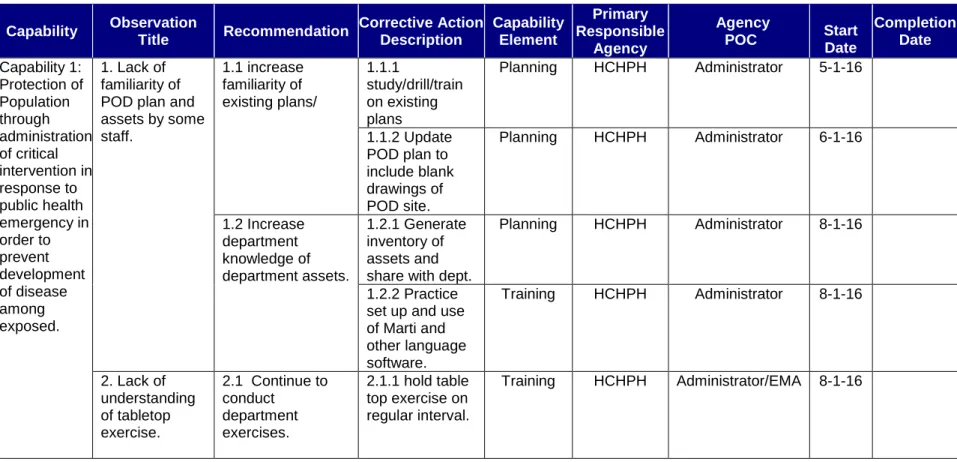
Completion Date Capability 1: Protection of Population through administration of critical intervention in response to public health emergency in order to prevent development of disease among exposed. 1. Lack of familiarity of POD plan and assets by some staff. 1.1 increase familiarity of existing plans/ 1.1.1 study/drill/train on existing plans Planning HCHPH Administrator 5-1-16 1.1.2 Update POD plan to include blank drawings of POD site. Planning HCHPH Administrator 6-1-16 1.2 Increase department knowledge of department assets. 1.2.1 Generate inventory of assets and share with dept.
Planning HCHPH Administrator 8-1-16
1.2.2 Practice set up and use of Marti and other language software. Training HCHPH Administrator 8-1-16 2. Lack of understanding of tabletop exercise. 2.1 Continue to conduct department exercises. 2.1.1 hold table top exercise on regular interval. Training HCHPH Administrator/EMA 8-1-16
16
Appendix B:
Participant Feedback Form 17
A
PPENDIX
B:
P
ARTICIPANT
F
EEDBACK
S
UMMARY
Participants generally rated the exercise as valuable. Many participants stated they believed the department was better prepared as a result of the exercise. However, many participant feedback forms also identified a misunderstanding of the participant feedback form. Many forms evaluated the controller performance rather than the exercise or the department’s performance of the exercise. Many sections of the participant feedback forms were left blank. Continued exercises should include more in-depth instruction on the participant feedback form completion.
Appendix C:
Exercise Events Summary Table 18
A
PPENDIX
C:
E
XERCISE
E
VENTS
S
UMMARY
T
ABLE
Appendix D:
Performance Rating 19
A
PPENDIX
D:
P
ERFORMANCE
R
ATING
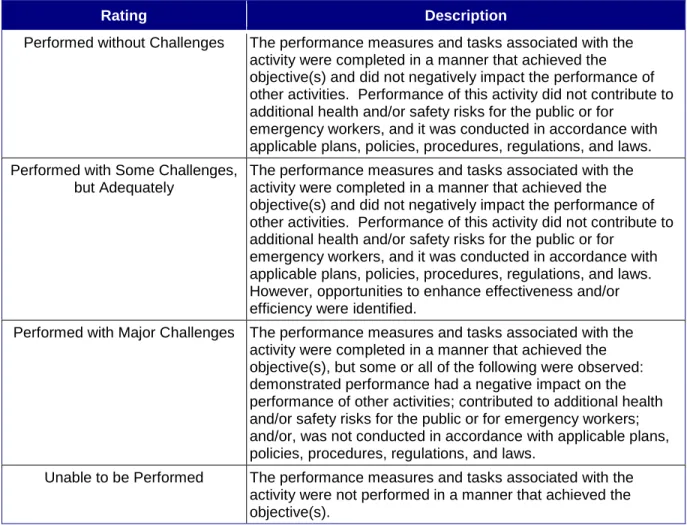
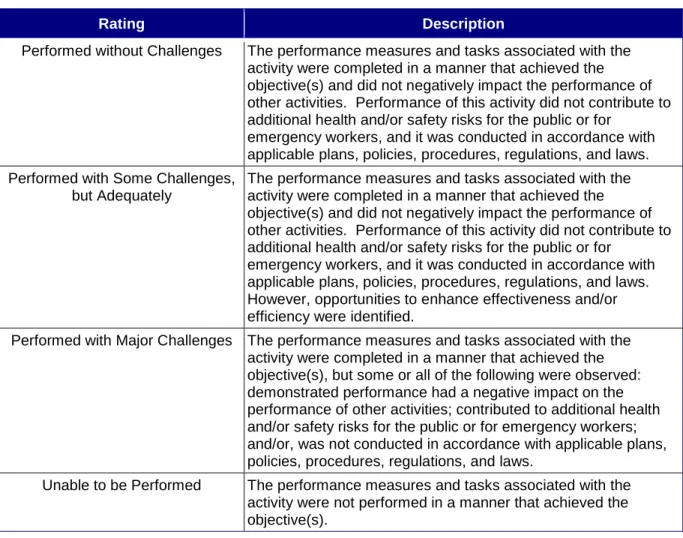
During this exercise Harrison County Home and Public Health received a score of “Performed with some Major Challenges.” This score was given based on player participation, knowledge of department assets, and knowledge of department plans by all staff.
The performance rating categories refer to how well each activity was performed during the exercise and are detailed in the table below.
Table E.1: Performance Ratings
Rating Description
Performed without Challenges The performance measures and tasks associated with the activity were completed in a manner that achieved the objective(s) and did not negatively impact the performance of other activities. Performance of this activity did not contribute to additional health and/or safety risks for the public or for
emergency workers, and it was conducted in accordance with applicable plans, policies, procedures, regulations, and laws. Performed with Some Challenges,
but Adequately
The performance measures and tasks associated with the activity were completed in a manner that achieved the objective(s) and did not negatively impact the performance of other activities. Performance of this activity did not contribute to additional health and/or safety risks for the public or for
emergency workers, and it was conducted in accordance with applicable plans, policies, procedures, regulations, and laws. However, opportunities to enhance effectiveness and/or efficiency were identified.
Performed with Major Challenges The performance measures and tasks associated with the activity were completed in a manner that achieved the objective(s), but some or all of the following were observed: demonstrated performance had a negative impact on the performance of other activities; contributed to additional health and/or safety risks for the public or for emergency workers; and/or, was not conducted in accordance with applicable plans, policies, procedures, regulations, and laws.
Unable to be Performed The performance measures and tasks associated with the activity were not performed in a manner that achieved the objective(s).
A
PPENDIX
E:
A
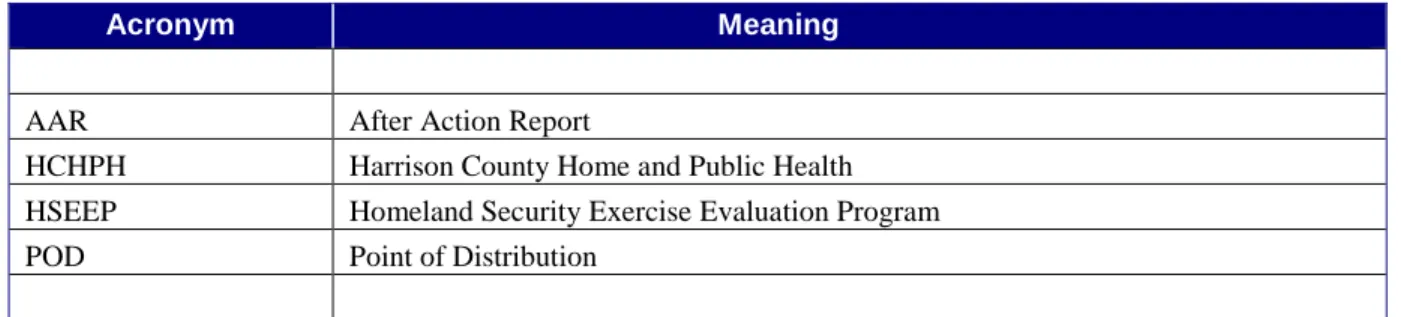
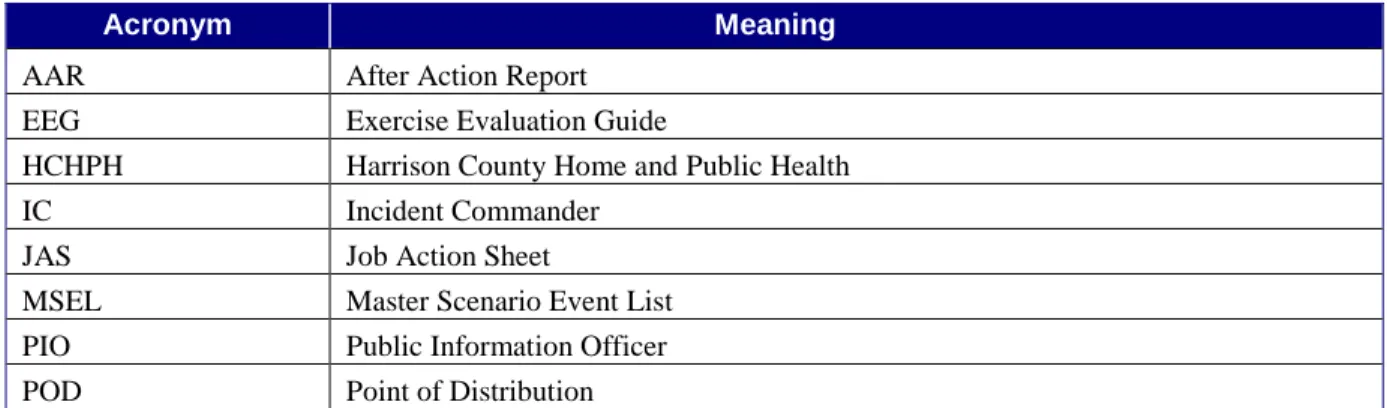
CRONYMS
Table F.1: Acronyms
Acronym Meaning
AAR After Action Report
HCHPH Harrison County Home and Public Health HSEEP Homeland Security Exercise Evaluation Program POD Point of Distribution