Volume 7, Number 3 Lantern (2) August, 2014
Virtual Worlds
Enabling Distributed Collaboration
Marko Hakonen
BIT Reserach Centre, Aalto University, Finland Petra M. Bosch-‐Sijtsema
Chalmers University of Technology, Sweden
Abstract
Despite the growing prevalence of distributed work as an organizational form, the virtual world literature has largely neglected to consider the potentials of this new media in distributed collaboration. In the present study, we studied how virtual worlds (VWs) are used in professional distributed work and how they influence new forms of collaboration in distributed work settings. The study is based on a partially grounded theory analysis method of 47 semi-structured interviews. The interviews revealed several new collaboration potentials of virtual worlds in distributed work, like new forms of training and learning, as well as enabling small group meetings and large events. Based on the interview findings we developed a conceptual model in which psychological processes supported by the VW enable distributed collaboration in terms of immersion, engagement, social presence, and trust. Furthermore, technological features of the VW, like the use of avatars, import of 3D objects, and use of physical clues, enable distributed collaboration. The psychological processes and technological features’ new forms of collaboration are largely interdependent. In sum, our results indicate that virtual worlds provide many opportunities for innovative collaboration in distributed work.
Lantern (2) / Aug. 2014 Journal of Virtual Worlds Research Vol. 7, No. 3
1.
Introduction
During the last two decades, the global reach of organizations has grown to encompass the whole world. Globalization of businesses, the need to recruit experts from all over the world near customers, and requirements to cut travel costs have made distributed work the de facto mode of work for many organizations (Gibson & Gibbs, 2006). In distributed work people collaborate with their remote colleagues, either while traveling, from home, from another office, or from a customer’s site. The essential features of all distributed work are that employees are mainly dependent on computer-mediated communication (CMC) and that they work over geographical boundaries in order to achieve a common goal (O’Leary & Cummings, 2007). Research on distributed work often discusses the impact of crossing geographical boundaries in terms of collaboration, culture, and team dynamics (Armstrong & Cole, 2002; Hertel, Geister, & Konradt, 2005; Martins, Gilson, & Maynard, 2004; Maznevski & Chudoba, 2000). Furthermore, a vast amount of literature has discussed different types of communication technologies and their impact on distributed work (e.g., Majchrzak, Rice, Malhotra, King, & Ba 2000; Townsend, DeMarie, & Hendrickson, 1998).
Over time, technological development has created a multitude of CMC technologies for distributed collaboration ranging from improvements in mobile technologies to virtual worlds (VWs). The pros, cons and effects of more conventional technologies for distributed work have been studied to some extent and the results are somewhat mixed (see Axtell, Fleck, & Turner, 2004 for a review). Some studies suggest that computer-mediated tools filter out essential social cues in distributed collaboration (e.g., Sproull & Kiesler, 1986), whereas others argue that people are very adaptive and that mediated collaboration may, for example, shift the attention from ethnic differences and hence be beneficial for globally distributed teams (e.g., Lea & Spears, 1991). However, none of these studies has considered the use of VWs. Therefore, in this paper we primarily focus on professional 3D virtual worlds that are used for distributed work.
3D VWs are communication systems in which multiple interactants share the same three-dimensional digital space despite occupying remote physical locations and can navigate, manipulate objects, and interact with one another, usually via avatars (Yee & Bailenson, 2007). Avatars are flexible and easily transformed digital self-representations in a graphic 3D form. By professional VWs we mean such applications that are targeted to or can be used in work rather than just in socializing or gaming. Such VWs have gained some popularity during the past decade (e.g., Gillath, McCall, Shaver, & Blascovich, 2008). However, most of the current discussions in VW literature have not explicitly underlined the media’s usefulness for distributed work. Still, the notion of VWs’ ability to get their users engaged to many kinds of activities over geographical boundaries is clearly embedded in much of the reasoning in VW literature (e.g., Pollit, 2007; Reeves & Read, 2009). A large amount of VW literature has a strong focus on technology, but few studies directly approach the question on how this new technology might be applicable for distributed work (Sivunen & Hakonen, 2011; for exceptions see Bosch-Sijtsema & Sivunen, 2013; Davis et al., 2009; Lantz, 2001). This article addresses this gap and studies the intuitively appealing idea that many VWs have vast potential to be collaboration media for distributed work.
The difficulties presented in earlier research on distributed work like the crossing of geographical boundaries, lack of face-to-face contact, difficulties in trust and engagement (Armstrong & Cole, 2002; Hertel et al., 2005; Martins et al., 2004) might be overcome by VWs.
1. How can VWs enable collaboration in distributed work?
2. What forms of collaboration are found in VW-based distributed work and which of these can be considered new or even innovative?
The structure of this article is as follows: we first discuss literature concerning virtual worlds. Second, we present the methodology of this paper. Third, we discuss the findings from the qualitative interview study. Finally, in the discussion section, we relate literature with our interview results in order to find matches and gaps in literature in order to develop a conceptual model and propositions. Moreover, we discuss critically the limitations and implications of this article.
2.
Virtual World Literature
VW literature often discusses a number of processes that are associated with successful VW collaboration (see Nowak & Biocca, 2003). These processes are (a) a sense of immersion, which is the feeling that the user is inside the media; (b) social presence as an active perception of each other; and (c) engagement, an intense absorption to the task (Helms, Giovacchini, Teigland, & Kohler, 2010; Nowak & Biocca, 2003; Reeves & Read, 2009; Sallnäs, 2005). These processes are suggested to be stronger than in other collaboration media. Especially in terms of distributed work, the VW has been suggested as a suitable collaboration tool because of the processes it supports. Moreover, trust is one of the main elements for successful collaboration in distributed work (Jarvenpaa & Leidner, 1999) and some scholars have considered that presence in the VW increases trust, which, in turn, might have positive effects on collaboration in VWs (Bente, Rüggenberg, Krämer, & Eschenburg, 2008). One important element that is supported by VWs is the use of avatars. The use of avatars has been studied from many different perspectives in terms of behavior as well as a technological feature. Many studies have found that the use of avatars in VWs can affect the attitudes of VW users. The avatar-based interaction has been noted to be useful in cross-cultural understanding (Diehl & Prins, 2008), affect sexism (Fox & Bailenson, 2009) and racism (Peña, Hancock, & Merola, 2009). Some of these attitudes may remain affected even after VW usage. Finally, an increased acceptance of persuasive communication from similar avatars has been found (Guadagno, Blascovich, Bailenson, & McCall, 2007). Antonijevic (2008) studied nonverbal communication in VW and found that user-defined non-verbal communication had a strong potential to enhance interaction in multi-user, 3D virtual environments. Other researchers found that VW users react similarly to avatar proximity as they do in real life (Bailenson, Blascovich, & Guadagno, 2008; Dotsch & Wigboldus, 2008; Gillath et al., 2008; Yee, Bailenson, Urbanek, Chang, & Merget, 2007).
Other literature describes the use of avatar as a technical feature and studies the modification and representation of avatars within the VW. Teigland, Kohler, Helms and Giovacchini (2011) proposed that the more the appearance of the avatars in a VW is aligned with the purpose of the VW and co-creation session, the greater the quality of knowledge externalization and consequent co-creation. Ward and Sonneborn (2009) claim, that avatar manipulation has positive effects on creativity. Moreover, the current VW literature has found some rather clear results on what kind of avatars are appreciated. People tend to like avatars that are similar to their own avatar (Bailenson et al., 2008) or mimic one’s avatar or real-life self (Bailenson & Yee, 2005), are of a similar gender (Nowak & Rauh, 2005), and are perceived to be attractive or tall (Yee & Bailenson, 2007; Yee & Bailenson, 2009; Yee, Bailenson, & Duchenaut, 2009). Furthermore, some studies (e.g., Feldon & Kafai, 2008; Talamo & Ligorio, 2001) have investigated the identity construction in avatar-based interaction. The results point largely to the same direction. The most common way of shaping one’s virtual identity was customizing the avatar appearance.
Lantern (2) / Aug. 2014 Journal of Virtual Worlds Research Vol. 7, No. 3
Next to the use of avatar, other research discusses the possibilities of users to modify features in the VW environment and context, i.e., change the view, brightness etc. These opportunities of modification of ones’ own world do not necessarily affect the experience of others but might make their own experience more satisfying or engaging (Larach & Cabra, 2010; Ward & Sonneborn, 2009).
The VWs have been suggested to support collaboration by many authors. One of these forms of collaboration is the support of co-creation. Co-creation and its enablers are a rather common theme in VW literature and the reasoning on these aspects draws largely on the general ideas of co-creation and open innovation literature (Prahalad & Ramaswamy, 2004; Von Hippel, 2005). Co-creation in VWs has also been labeled ‘avatar-based’ innovation and current results suggest that VWs can offer new and rich ways to interact with customers and environments during a co-creation process (Kohler, Matzler, & Füller, 2009).
One of the main drivers for adopting VWs in organizations has been their potential as training tools (Pollitt, 2007). Heinrichs, Youndblood, Harter and Cev (2008) found that VW simulations were useful in training of acute-care medical teams. These kind of simulations have also been called Serious Games and used in teaching and training wide range of skills from medicine to history (Protopsaltis, Panzoli, Dunwell, & de Freitas, 2010) and cultural skills (Zielke et al., 2009). Going briefly beyond professional VWs, many scholars (O’Connor & Menaker, 2008; Reeves, Malone, & O’Driscoll, 2008; Reeves & Read, 2009) argue strongly for the value of 3D multiplayer games in learning business skills. It is argued that the aspects like feedback, transparency and multiple connections can be learnt in 3D games and that they can be implemented in effective collaboration and leadership in real-life business.
VW literature presents a number of topics that can support collaboration. However, few of these studies discuss explicitly how VWs are used in distributed work in firms, and how VWs can enable forms of collaboration in distributed work settings. Below, after the methods section, we present the results of an explorative interview study.
3.
Methods
Sivunen and Hakonen (2011) found that only few studies discuss VWs in relation to professional distributed work. Therefore, we conducted 47 semi-structured interviews with VW users from industry on how VWs are currently applied for distributed work and whether they support new forms of collaboration. The experiences of using VWs in distributed work were gathered by interviews as follows. The interviews were either one-on-one interviews in person or on the phone, or group interviews (with groups of maximum three people). We chose to have most interviews not in the virtual worlds since the interviewees worked with many different types of virtual worlds to which we could not have access. However, during the interviews, several interviewees showed us their virtual world, their avatar, and how they worked with the virtual world. In total three researchers held 47 interviews based on a similar interview guideline. Of the 47 interviews we held five interviews with vendors of well-known virtual worlds like Second Life, ProtonMedia, Wonderland, TelePlace and Digitell in order to gain an insight in the current market of virtual world platforms and their possibilities. Furthermore, we held two interviews with experts who specialize in virtual world research and consulting. We held 40 interviews with managers of 12 different global (Fortune 100 and 500) and US companies who all had experience in using professional virtual worlds in their company. The companies were mainly selected because they presented their VW experiences externally (outside the company) in articles, blogs, or on conference presentations, and some were selected based on vendor contacts.
The interviews were structured according to a number of topics: (1) general questions on the function, role, and particular experience of the interviewee in using professional VWs. (2) The topic of benefits and challenges of VWs focused on how the interviewees used VWs for distributed work and for what kind of activities, as well as benefits and challenges of working with VWs. (3) Media related questions focused on the type of VWs the interviewees were using, why they had chosen this particular VW, what technological features it had, and how interoperable it was with other systems. (4) Innovativeness took up questions on creativity and how VWs were used to support innovation and creativity. (5) Social processes questions focused primarily on the use of avatars, appearance of avatars and interviewees’ identification with their avatars. The interview guide was developed, checked, and tested iteratively in a larger and multi-disciplinary research group of five people. In order to obtain a common interview technique, many of the interviews were held by two interviewees. The interviews were between 1-2 hours and all interviews were recorded and transcribed. All interviewees read through their transcript interview and confirmed the material.
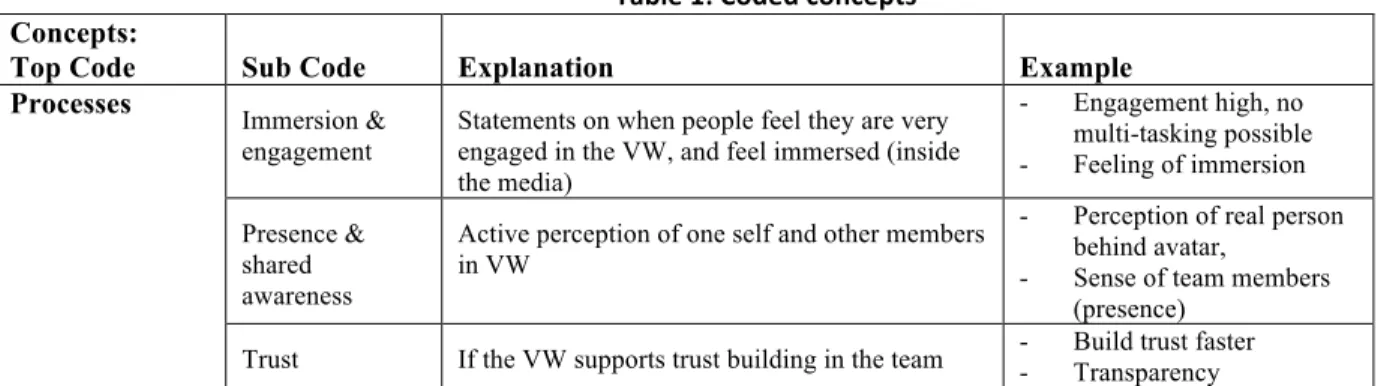
The transcriptions were coded, categorized and analyzed based on the research question on how a VW can enable collaboration in distributed work and what forms of VW-based collaboration were found. In several iterations the researchers discussed, compared, and sometimes re-coded the data through systematic stages (Locke, 2001). We used a qualitative approach based on the methodology of grounded theory that was influenced mainly by Lincoln and Guba (1985). Their analysis method is based on Glaser and Strauss (1967), but limits the scope to the data processing aspects rather than theory development as in grounded theory (Lincoln & Guba, 1985). Our data analysis was performed in a three-step process (Locke, 2001). The first step was data reduction in which we applied open coding of all the data to tease out dominant themes. From the data we found two main categories 1) VW features enabling distributed collaboration and 2) forms of distributed collaboration. Next to these two categories we also identified the main benefits mentioned by interviewees from companies using VWs in distributed work. The second step applied focused coding in these themes to extract passages related to these two main themes. Within the two top-categories we defined a number of sub-categories that focus on specific areas relevant to this article. The third step was data display in which we made lists and tables of emerging themes and monitored the internal cohesion of the codes. The coding of the interviews was an iterative process between the interviewers in order to increase validation. An additional researcher was involved in a later stage and performed an additional coding procedure on all 47 interviews, based on the codebook that was developed by the interviewers. The codes were then compared to the codes performed by the interviewers. Only a few discrepancies were found during this coding process between the different researchers, which were then discussed and unified. Furthermore, the conclusions drawn from the codes were presented to some of the companies involved in the study. In table 1 we present a selection of the code book that has been used during the data analysis.
Table 1: Coded concepts Concepts:
Top Code Sub Code Explanation Example
Processes Immersion &
engagement
Statements on when people feel they are very engaged in the VW, and feel immersed (inside the media) - Engagement high, no multi-tasking possible - Feeling of immersion Presence & shared awareness
Active perception of one self and other members in VW
- Perception of real person behind avatar,
- Sense of team members (presence)
Lantern (2) / Aug. 2014 Journal of Virtual Worlds Research Vol. 7, No. 3
Concepts:
Top Code Sub Code Explanation Example
Features
Avatars Avatar related comments on the use of avatars and implications of avatar use for work
- Self-representation - Identification - Appearance Visualization The ability to visualize aspects that are often
difficult within remote work with traditional communication media.
- 3D view of world - Visualization of data and
3D models Physical clues Features related to physical clues supporting
collaboration
- Team space development - Space modification - Authentication and
security
- Knowledge repository
Distributed
collaboration Co-creation Co-create, build together: possibility to create things together remotely, build things together.
- Co-creation
- Build together in VW Learning and
training
Ways of using the VW for sharing knowledge, learning, and training
- Role-plays - Training (rehearsal,
hands-on)
- Learning, knowledge sharing
Other use Different ways of how the VW is used for distributed work
- Small team meetings - Large events, conferences - Community, social
network building
3.1 Interview Findings
Of the 47 interviews, we found many statements about general benefits of VWs for distributed work, however, these statements were specifically pointing towards the value of VWs in terms of rich interaction and the possibilities to have geographically dispersed events without limitations of time-zones, geographical boundaries, or burdens and costs of traveling. These experiences supported our initial belief in the potential of VWs in distributed work.
Below we use the terms psychological processes, technological features, and forms of distributed collaboration to make a distinction for the sake of clarity. Yet, it becomes clear in reading the results that technology often triggers or is based on psychological processes and vice versa. Moreover, the forms of distributed collaboration are closely related to both technology and psychology. This point will be elaborated in the discussion section.
3.2 Psychological Processes
From the interviews we found a number of psychological processes that were clearly related to the use of VW. These processes stimulated and contributed to new forms of collaboration in distributed work settings.
Interviewees mentioned that people are very engaged and immersed in VWs. Several interviewees discussed the positive aspects of immersion, for instance, that it is very difficult to multi-task when participating in a session in the VW. People pay more attention to the sessions and since it is visible what they do or when they are not actively involved or multi-tasking (their avatar falls over), people are more engaged. Immersion and engagement were described in many ways and one example is stated below:
So what we do see is that people can actually stay engaged and focused on a topic longer in a virtual environment than with, say, audio conferencing and web conferencing. I think it’s because you have
control over the environment. In a typical virtual environment, you can walk around; you can choose a viewpoint. There’s more than one thing happening at the same time and you’re able to do more kinds of work. So for example, with web conferencing, you're mostly limited to someone presenting and you’re listening. Whereas, in a VW, I can listen to someone present, but we could also be running breakout sessions or brainstorming sessions.
Next to immersion and engagement, interviewees also mentioned that the VW enhanced (in theoretical terms) social presence of the distributed team. Interviewees felt that with the VW the presence of distant team members was enabled in a different way compared to other types of media used for collaboration in a distributed work setting. An example is mentioned below:
They actually feel that they’re in a room with the other individuals, with seeing expressions that give them a sense that they are being listened to, that other people are listening as well.
Another element that was discussed during the interviews was the possibility of VWs to build and sustain trust within a distributed team. Interviewees mentioned that due to visibility of actions performed in a VW, trust could be supported in a distributed team. One interviewee explained this in more detail:
You can build trust faster than a telephone call and in part, that’s because each of us can see the actions of each other. In a virtual environment, we have avatars, which we drive around and I can watch you work, which is not true with other technologies. So we have a highly immersive but also highly shared environment where I can watch your keystrokes, I can watch your mouse movements and you can watch mine. It’s symmetric in that we can see each other so if we were talking about something and you took an action item and you could say, "Well, John, I’m going to get started right away on helping you with that," I could literally, if I chose to - I may not choose to - but I could watch you working.
3.3 Technological Features
Avatars. In the interviews the use of avatars was mentioned as important. Several interviewees noted that the importance and use of an avatar is dependent on the task that is performed:
So for business, so a virtual business meeting, people try to dress their avatar according to the type of situations. So if it is a very formal meeting or whatever, people will try to dress nicely, like in formal real meetings. So people care about their appearance.
Primarily the vendors talk about the importance of rich avatars, even though this appeared to be less important for the users of the VW. Most interviewees discussed the importance of having an avatar that was similar to their real-life self, in terms of appearance. Some members preferred a tailor made avatar in which the avatar was made to look like the real person. This was especially found in some of the high-tech companies who felt that this would support the use of VWs in their work. One interviewee mentioned the following:
I prefer the usage of avatars; it helps in like giving a more friendly kind of approach to the whole thing. And I think the more professional the avatar looks, the better, … and more realistic it looks to what you actually look like in real life, the better it is.
Yet, some perceived avatar appearance as unimportant and mentioned that the focus on avatar appearance and modification took away the attention of the content: “Sometimes the avatar is completely irrelevant. Because all you want is for people to get into that environment and to interact
Lantern (2) / Aug. 2014 Journal of Virtual Worlds Research Vol. 7, No. 3
with a lab facility 1000 miles away.”Furthermore, many interviewees noted that they perceived their avatar as representing a part of their identity. One interviewee mentioned:
So there’s a funny story about me showing up and it was in fact the company magazine, and I started showing up in the very first iterations of me, I was in a kilt. I have a Celtic heritage. I wanted to kind of display my Celtic heritage a little bit. But the avatar still looked a lot like me, everybody knew it was me. But I also was wearing some of my culture on my sleeve, if you will. And everybody seemed to like that. And so anyway, the picture shows up of me on a full page of the company magazine in my kilt. And so our CEO and chairman learned of me as the man in the kilt.
Another aspect discussed during the interviews was that it became clear that the VW environment and people being represented by avatars lowered barriers for people to talk to strangers or executives also in such events they would otherwise not talk to. The avatars provided people with some sense of empowerment, as well as psychological safety, kind of a mask to hide behind. Examples were mentioned that people could communicate over hierarchy (i.e., with the CEO), as well as that shy people felt safer and more comfortable to interact in larger groups.
Import of 3D objects. An important feature of the VW, which was mentioned by several companies, was the fact that the VW environment can help to visualize models, drawings, objects, and data in 3D format that is more difficult to do when using more traditional media for distributed work. A citation from the oil industry highlights the importance of 3D modeling in high-risk distributed work:
And the oil industry, you have a lot of data. They do geophysical, seismic, and all the exploring to get data. Tons of data coming up and they're trying to figure out where's the oil and where's the reservoir and what does the reservoir look like and where should we drill? When they drill, that's a multimillion-dollar decision. And so you have this 3D object in a way, this pool of oil down in the ground and you have to decide … and it's a very complex kind of a thing. So the data comes up and first of all, oil companies have these very expensive top-notch people. It all comes to that people, they're experts all over the world. You can't fly them in for a meeting just to say: where do we drill because this is a new field. If you can meet virtually, you pipe the data in and you visualize it. You create this 3D representation of the data and then you walk around and then you have the team of experts, their avatars are there and then they walk around the 3D image and they say, what is this over here…
Although many interviewees mentioned the importance of importing 3D models and objects, few firms used this feature often in their work. The firms that worked with 3D modeling and data visualization often focused on product and software development, prototyping, design, or worked in the oil and gas industry.
Physical clues. In the interviews it became clear that people felt that physical clues were important for their work. According to the interviewees there were a number of physical clues that were applied in using the VW for distributed work. One of the physical clues was the development of a specific space for the team, in order to support collaboration, engagement and effectiveness. Several interviewees discussed the fact that they had developed a specific space in the VW for their team – a team room, in which they could collaborate, but also leave their material behind once they left the room in the VW. An example is the following:
We have a group of engineers. They are one of the top-performing engineering groups as far as delivering things on time. And a lot of these things they are collaboratively working on. What they actually do is that they – they're constantly sitting in Second Life. They've translated that into a virtual
world so they’re sitting in there. That's pretty powerful and their efficiency has increased because of that. Now, they're in an oilrig and whether or not that benefits anything, I mean, who knows? As far as the ability for them to have an environment that for an engineer can be something that's really cool – something that increases their enjoyment at work. It increases their type of engagement because they got – they're at a refinery.
Another type of physical clue that was developed in the VW supported security and authentication of people within the VW. The support of these clues was perceived as necessary in order to work together in a distributed work setting. A sort of modification of individualized collaboration was described at one company as they meet another employee from the same company they can see a tag attached to the avatar. Others discuss that behind avatars you can find a social profile with competencies and background of an employee in order to develop a long-term connection for collaboration. An example is mentioned below:
More importantly, behind that avatar, we could fill out a complete profile. And so there was as an importance for them because that the avatar was in front of them as closely resemble the individual as possible. Well, they have a limited avatar set, but behind the avatar they have a whole profile page. So there’s a whole social networking site behind [name of the firm’s network]. It runs alongside it, where you can enter in your knowledge and experience, photographs, video, anything to describe yourself and you can even write a blog if you want to.
A further crucial point mentioned by many interviewees was the fact that the VW provides a knowledge and data repository of for example conference sessions, discussion sessions, and project work. The knowledge repository is important for the company in order to find, get back to and learn from earlier work performed. It was important for companies to capture, access, and extract data and information when needed:
And then all of the content that’s been created during that session can be exported into a CSV formatted file. So, I can do the work in this space, but I can still take the content – the results of that out into an executable form, so I can do something with it outside of the virtual space.
3.4 Forms of Distributed Collaboration
Co-creation. One of the aspects perceived as important and new for people using VWs was the possibility of distributed collaboration and co-creation. From the interviewees it was found that in a VW, distributed team members can build together, have the possibility to collaborate remotely, and co-create simultaneously.
One interviewee mentioned that it is possible that one avatar picks up a beam, and someone else picks up another beam and you can place them on each other in the virtual space despite geographical boundaries and time-zone differences. Several interviewees discussed the process of joint new idea generation in role-plays, simulations, and brainstorm sessions either synchronously or asynchronously. One interviewee mentioned the following:
The first one is co-creation. So teams create things, and they’ll often create things and leave them, and then expect them to be modified by the next team who’s going to come along and modify them and play with them and leave them. This is a new team practice of build, code, modify code, play with it and so on, and iterate on other people’s ideas. And it works particularly well across time zones. So, I can draw
Lantern (2) / Aug. 2014 Journal of Virtual Worlds Research Vol. 7, No. 3 something in a space, and fully expect to wake up the next morning and see that about 15 people have played with it. This is a teaming element that isn’t really always available.
Many interviewees viewed that the fact that the visualization of concepts and data in a VW as important. Being able to visualize ideas and physical data in a shared place helps sharing ideas and creativity for example in brainstorm sessions:
I think it’s an important element to foster the creativity and extend the brainstorming. Because often times what may happen is that your colleague might write something down that you see on the board that gets you thinking about something else that you haven’t thought about. So, now you’re scribbling a new idea, you put that up. And somebody else sees that and it takes them in a slightly different direction. So that concurrent activity allows people to feed off of each other. And that’s really where the productivity – or the creativity in a brainstorming session comes from.
Several interviewees discussed the possibilities to collaborate in a different way with each other either with help of a virtually created setting, which was in reality not possible. Interviewees mentioned possibilities to use the VW to train teams into thinking in a different way. One example was a team that needed to build a bridge that could be built in several ways, which were physically impossible. The exercise helped the team members in learning how to communicate, collaborate and think “outside the box” on different ways to finalize a project.
Another finding mentioned in the interviews was that the VW could support the development of a community of experts who could also meeting in the VW to share ideas and develop connections. The ability to co-create, import your own models and collaborate with geographically dispersed colleagues or peers was discussed in the interviews, as supporting to build up a community or network as well as deal with diversity within the team. One example discusses the following:
In a 3D virtual platform, you definitely get that ability to develop your community and network with your peers so that you can strike up conversations with people who are at [firm name], maybe they’re peers of other companies, and you can ask them questions and kind of how they solved a problem and how that might help you.
Training and learning. The VW was used often for training sessions to gain experience and knowledge in particular fields. Interviewees mentioned that VWs were especially well suited for training that is difficult to perform in the real world. Many scenarios and hands-on training sessions are either dangerous or very expensive to execute in real life and therefore the VW was used to train people. Especially for distributed work, these training sessions could become very expensive when all geographically distributed people need to travel to a training session. One example of this kind of training was mentioned by an oil company that performed training of what to do when an oil platform explodes. Another interviewee discussed simulations for hands-on medical training in which a VW was used for training aspects that are difficult or impossible to train in real life:
We have our patient who is pregnant and bleeding because she was in an auto accident and so a trauma affecting the pregnancy [can be trained]… it is hard to get those data [in real life for training]. We don’t have a lot of photographs of authentic bleeding people.
One of the interviewee companies had good experiences in VW-based cultural intelligence training in order to create more awareness of different cultures that are present in global distributed teams. The VW could bring avatars to different cultures supporting training of cultural awareness.
Another type of training that was mentioned during the interviews was leadership training. One firm used the VW to train inclusive leadership, in which leaders were trained to work with disabled people:
So what are the methods and approaches we can bring these people together? And again, we physically have to bring them together from all over the world to be able to learn about what it’s like to work with a disability. But we also wanted to immerse in scenarios, make them understand and feel what it was like to be that person.
A theme that was noted as important in the interviews was the possibility to transfer information and to share knowledge and expertise. Several interviewees perceived the learning and sharing of knowledge as an important aspect within a VW that supported their distributed collaboration. The VW provided the opportunity to train for example presentation skills for which otherwise was very little funding and time:
The learning circles, really helping workers – not just get presented on what a new skill is but to now go out and practice that, especially in a team context. So it's not just me doing my job but maybe I have to interact with other colleagues in a work environment. So if you bring them together and then role-play that work environment across different scenarios, that is a very compelling feature that is in the learning and training area very, very critical.
Others used the VW for teaching skills of senior employees to junior ones and some companies applied VWs in order to meet with mentors.
Supporting different types of groups. In the interviews we found a number of uses and benefits of the VWs that were applied for distributed collaboration. Many interviewees mentioned that the VWs were used in small group meetings, with either ad hoc groups or long-standing groups. VWs were seen to be better in comparison to other meeting tools for distributed work due to increased engagement, focus and productivity. One example was the following;
I’ve been organizing weekly virtual meetings with my team. So, in fact, it was replacing the weekly staff meetings, which at [firm name] I’ve gone mostly using traditional audio conferences. So yes, I’ve run from a virtual place perspective those meetings. And the people were very happy and more active, more productive than using audio conference. People were not sleeping… The meetings I’ve been running where done outdoors where it’s totally – it was a choice to have this outdoors with some trees, where you can see the mountains, the sky and it was more interesting.
Another use that was mentioned by several interviewees and companies was the possibility to have large events in a VW. These events in VWs were initially triggered by cutting travel cost and conference costs, but in many companies the large events held in VW were so successful that these firms continued to have their large events in VWs not solely to because of cost savings. In addition, VWs provided possibilities to cross geographical and time boundaries, and to record all the conference content that could be accessed after the event.
4.
Discussion
From the interviews we found that VW collaboration within a geographically distributed work setting or team was enabled by two elements provided by the VW, i.e., psychological processes and technical features. Further, these enablers are intertwined with each other and with (innovative) forms of VW-based distributed collaboration. Below we discuss these points and provide answers to our research
Lantern (2) / Aug. 2014 Journal of Virtual Worlds Research Vol. 7, No. 3
questions, make propositions, and develop a conceptual model (Figure 1) to be tested by other scholars. Finally, we discuss the limitations of this study, propose further directions for research, and present conclusions.
4.1 Psychological Processes as Enablers of Distributed Collaboration
From the interviews we found that a number of psychological processes are supported by VWs and are perceived to be important for collaboration in distributed work. Of the psychological processes we found, immersion, social presence and engagement, which are well documented in VW literature (e.g., Helms et al., 2010; Nowak & Biocca, 2003; Reeves & Read, 2009; Sallnäs, 2005). Immersion, social presence and engagement were highlighted in terms of staying focused to the task at hand as well as having the feeling of team members’ presence. In distributed work members often work on multiple teams with multiple tasks and communicating with CMC media makes it sometimes difficult to feel part of a team or to prioritize a particular task.
Within distributed work literature the concept of trust is important for collaboration (Jarvenpaa & Leidner, 1999). Our interviewees highlighted with the use of VW that transparency, i.e., seeing each other’s actions builds trust in the team, and that this is a VW specific benefit for distributed collaboration. This enhancement of trust through VW is not much discussed in VW literature and studies only present rather weak evidence suggesting that VWs enhance trust (Bente et al., 2008). Although several studies mention the importance of VW for collaboration, only few studies (e.g., Bosch-Sijtsema & Sivunen, 2013; Davis et al., 2009) look into the use of VW supporting psychological processes that could be beneficial in a distributed work settings.
The importance and dynamics of trust, which is enabled through transparency in the VW, is a contribution to VW literature from the viewpoint of distributed work. In sum, based on the interview material we propose that psychological processes found in VW-based interaction enable distributed collaboration.
4.2 Technological Features as Enablers of Distributed Collaboration
From the interviews we found a number of technological features that enabled collaboration for distributed work. These technological features were the use of avatars, the possibility to import 3D models, and VWs have the possibility to use physical cues like developing a particular space or add security and authentication to the VW. The interviews confirm several findings presented in VW literature about the impact of avatars as representations of VW users (Bailenson et al., 2008; Bailenson & Yee, 2005). Most of the literature concerning avatars and avatar modification is based on all types of VW, but neglects the use of avatars in more professional types of VW, like the ones we discuss in this article. The avatars used for professional work in distributed settings could often not be modified much and were designed to fit the professional purpose. While VW literature focuses on modification of avatars in relation to creativity (Teigland, et al., 2011; Ward & Sonnenborn, 2009), the studies neglect the use of VWs for professional and distributed work. The findings support also to some extent the notion of avatars as help in constructing an (virtual) identity (e.g., Talamo & Ligorio, 2001). Yet, some of the respondents felt that avatars were completely irrelevant for distributed collaboration in a business context, because they took away the attention of the task. Therefore, the literature in this field needs to be extended with avatar use for professional purposes in order to study the influence and need for avatar use for distributed work settings.
Another important technical feature found from the study is the possibility to import, modify and interact with 3D objects. Although many suggestions are discussed in literature on the import of 3D objects in VW only few empirical studies have been conducted to assess the impact of this feature on distributed collaboration. Gu and Tsai (2010) imported and demonstrated the usefulness of an interactive graphical tool for collaborative architectural design in VWs. These kinds of features become increasingly important as more and more VWs allow 3D model import and interaction with them.
In the interviews we also found the use of a number of physical clues within the VW that supported the collaboration of distributed work. Although VW literature discusses the importance of physical clues, the clues described by the interviewees had a slightly different emphasis. Larach and Cabra (2010) found that VWs enable flexible means of providing clues of the intended behavior for participants by seating (e.g., teamwork vs. lecture), information sharing (e.g., what is important) and colors (e.g., role in exercise). Ward and Sonneborn (2009) introduced the construct of individualized collaboration that is the notion on users’ ability to manipulate not only their avatars but also the conditions under which collaboration takes place. Unlike in real-life, VWs have properties that make it possible for individuals to personalize their group work experience (Ward & Sonneborn, 2009). This, in turn, was argued to positively affect the group members’ creativity. In VW the focus has been on the benefits of physical clues either in the environment, colors, or individualized collaboration (Larach & Cabra, 2010; Ward & Sonneborn, 2009). From the interviews, the development of a team space can be considered as a physical clue, and is related to customizing the group work experience and in line with literature (Ward & Sonneborn, 2009).
The other type of physical clue that was developed in the professional VW was the use of authentication and security. This type of physical clue has not been described or studied earlier, but is rather important for distributed collaboration for a professional purpose. The use of authentication and security in VWs used for distributed work is important for building up an atmosphere and environment in which team members can collaborate. Although no explicit stories were presented regarding the increase of creativity due to the use of these physical clues, many interviewees discussed the new forms of collaboration with help of VWs. Two interesting benefits and in VW literature rather neglected were mentioned. First, the notion was that some company avatars could automatically recognize their colleagues in a VW and see a wide spectrum of information about them, thus helping intra-company networking. Second, the possibility of saving the VW for further use and using the VW as a knowledge repository was an interesting notion on the potential of VWs in distributed settings.
Our findings contribute to VW literature in terms of the use of avatars in professional distributed work, the possibility to use the VW to authenticate and add information concerning the affiliation distributed members, and utilizing the VW as a knowledge repository. In conclusion, based on our findings we propose that the technological features of VWs enable distributed collaboration.
4.3 Forms of Innovative Distributed Collaboration
From the interviews we found that members working with VW perceived that the VW supported innovative forms of distributed collaboration. We use the term innovative not in terms of innovation research but simply as new or improved ways of collaboration for distributed work as compared to other media. The innovative aspect came largely from the notion that using VWs as collaboration media the transmission of different social cues was relatively easy (cf. Lea & Spears, 1991). The affordances of VWs, enabled especially good opportunities for activities where complex social cues were needed, such as for co-creation, training and learning sessions in the VW, as well as support for small group meetings and large events.
Lantern (2) / Aug. 2014 Journal of Virtual Worlds Research Vol. 7, No. 3
The increased number of visual, auditory and haptic cues and better social presence in VWs have been argued to improve VWs as platforms of co-creation as compared to other, more traditional CMC tools process (Kohler et al., 2009). Moreover, the playful elements of VWs are considered to contribute to creativity (Reeves & Read, 2009). Specifically, when co-creation is experienced to be inspiring, intrinsically motivating, involving and fun it leads to intensified participation in co-creation (Kohler, Füller, Stieger, & Matzler, 2010). This, in turn, is related to the notion of flow, which is defined as a highly enjoyable and rewarding experience (Csikszentmihalyi, 1975). Flow is suggested to contribute to the level on which users produce innovation relevant knowledge during a co-creation process (Helms et al., 2010). Building on another co-creation research tradition, Larach and Cabra (2010) found similar results. Their participants experienced creative group problem solving in a VW as engaging and immersing and consequently successful. Regarding the forms of innovative collaboration for distributed work the interviewees recognized the benefits in co-creation, which VW literature also emphasizes (e.g., Kohler et al., 2009). One of the key mechanisms and success factors of enhancing distributed, professional co-creation was visualization, which was prominent in interviews. Interestingly, co-creation has been primarily discussed as a synchronous process in VW literature (e.g., Teigland et al., 2011). However, the interviewees noted the benefits of asynchronous co-creation due to their context: distributed work is often conducted globally over many time-zones. Moreover, co-creation in VWs was seen to provide opportunities for learning new ways of thinking and for networking.
As has been discussed in literature, many of the interviewees perceived especially training in hazardous situations (e.g., Protposaltis et al., 2010) and cultural training (e.g., Zielke et al., 2009) as important and beneficial uses of VWs. One theme that was noted as important in the interviews, and which has only slightly been touched upon in literature was the possibility of transferring information and sharing knowledge and expertise (see Prasolova-Førland, 2008 for exception). In distributed work, the sharing of knowledge and expertise is an important aspect that is often hindered by geographical distance.
The users who collaborated in a professional and a geographically distributed setting pointed out that small meetings and large events are important forms of collaboration in VWs. However, the VW literature is relatively silent on these VW uses. The interviews revealed that the potentials of having meetings and events in VWs reside in increased productivity and intensified attention as compared to other collaboration tools. An interesting perceived advantage of having large events in VWs was seen in the possibility to record them and return to them later.
Many of the findings are discussed in VW literature, but the findings concerning asynchronous co-creation, using the VW as a tool to share knowledge, and the utilization of the VW for small, distributed team meetings as well as for large global events and conferences are new in the context of professional VWs for distributed work.
Figure 1: The conceptual model based on this study
Based on the interviews we developed a conceptual model of innovative distributed collaboration (see Figure 1). The model consists of psychological processes, technological features and innovative forms of collaboration all of which are prevalent in distributed collaboration using VW as a media. A key point in our conceptual model is to understand the fundamentally intertwined nature of its parts. For example, psychological safety was seen to be enabled by avatars and those were found to be beneficial in training sessions. Moreover, engagement and immersion were seen as beneficial in preventing multitasking, a major challenge in technology-mediated global meetings. Similarly, the asynchronous co-creation was emphasized due to time zone demands in distributed work. For instance, one team in Europe can start the co-creative process and other team in Asia can continue it as they come to work.
The above reasoning leads to our final proposition: In order to find new and innovative ways for distributed collaboration in VWs one must consider simultaneously psychology, VW technology, and the special collaboration requirements of the distributed work itself.
4.4 Limitations and Further Research
Even though our interview data is rather covering, it is mainly gathered from US-based companies. It seems that the first adopters of this relatively new collaboration media are in the US. This may affect the results because of relative homogeneity of national and company cultures. Some aspects that might become more apparent in, for instance, a European context may remain hidden in the US-based companies. On the other hand, the interviewees often discussed the global use of VWs in distributed work and hence reflected a wider cultural context.
In general, considering and studying VWs in the context of distributed work is still in its infancy. Even though this idea is embedded in much VW literature, its explication, as we have done in this article, should be replicated for validation of our results. VW literature would certainly benefit from cross-fertilization with distributed work and team literature. The novel findings in our study, like on trust formation, on the importance of avatars in business context, on added information of same affiliation avatars, on using VW as a knowledge repository, on asynchronous co-creation, on VWs as knowledge sharing tool, and on such forms of collaboration as small meetings and large events call for further research.
5.
Conclusion
In this article we addressed the gap of especially VW literature in considering the innovative potentials of VWs in distributed collaborative work. We performed an explorative interview study of 47
Lantern (2) / Aug. 2014 Journal of Virtual Worlds Research Vol. 7, No. 3
interviews. The fact that the interviewees had real experience in using VWs in distributed work brought a new view to VW literature. Our findings confirm but also refine part of the current VW literature especially in terms of psychological processes highlighted in VWs. These processes are important enablers of VW-based distributed collaboration. Moreover, the findings also provide new insights in terms of new technological enablers and new ways of how the VW is used innovatively for distributed work. Based on the interview findings we have developed a conceptual model, which provides fresh views on the innovative collaboration potential of VWs in a relatively new organizational form, that is, distributed work, which has grown in importance for over two decades. The findings of our study concerning VW enabling distributed collaboration provide many openings for further research and interesting insights on, yet somewhat underused potentials of VWs as collaboration media for distributed work.
References
Antonijevic, S. (2008). From text to gesture online: A microethnographic analysis of nonverbal communication in the Second Life virtual environment. Information, Communication & Society, 11, 221–238.
Armstrong, D., & Cole, P. (2002). Managing distances and differences in geographically distributed work groups. In P. Hinds, & S. Kiesler (Eds.), Distributed work (pp. 167-186), Cambridge, MA: MIT Press.
Axtell, C. M., Fleck, S. J., & Turner, N. (2004). Virtual teams: Collaborating across distance. In C. L. Cooper & I. T. Robertson (Eds.), International Review of Industrial and Organizational
Psychology, Vol. 19(pp. 205-248). Chichester, England: John Wiley.
Bailenson, J. N., Blascovich, J., Beall, A. C., & Loomis, J. M. (2003). Interpersonal distance in immersive virtual environments. Personality and Social Psychology Bulletin, 29, 819–833. Bailenson, J. N., Blascovich, J., & Guadagno, R. E. (2008). Self-representations in immersive virtual
environments. Journal of Applied Social Psychology, 38, 2673–2690.
Bailenson, J. N., & Yee, N. (2005). Digital chameleons: Automatic assimilation of nonverbal gestures in immersive virtual environments. Psychological Science, 16, 814-819.
Bente, G., Rüggenberg, S., Krämer, N. C., & Eschenburg, F. (2008). Avatar-mediated networking: Increasing social presence and interpersonal trust in net-based collaborations. Human
Communication Research, 34, 287-318.
Bosch-Sijtsema, P.M., Sivunen, A. (2013). Professional Virtual Worlds supporting computer-mediated communication, collaboration, and learning in geographically distributed contexts. IEEE
Transactions on Professional Communication, 56, 160-175.
Csikszentmihalyi, M. (1975). Beyond boredom and anxiety: Experiencing flow in work and play. San Francisco, CA: Jossey-Bass.
Davis, A., Murphy, J., Owens, D., Khazanchi, D., & Zigurs, I. (2009). Avatars, people, and virtual environments: Foundations for research in metaverses. Journal of the Association of Information Systems,10(2), 90-117.
Diehl, W. C., & Prins, E. (2008). Unintended outcomes in Second Life: Intercultural literacy and cultural identity in a virtual world. Language & Intercultural Communication, 8, 101–118.
Dotsch, R., & Wigboldus, D. H. J. (2008). Virtual prejudice. Journal of Experimental Social Psychology, 44, 1194–1198.
Feldon, D. F., & Kafai, Y. B. (2008). Mixed methods for mixed reality: Understanding users’ avatar activities in virtual worlds. Educational Technology Research and Development, 56, 575–593. Fox, J,. & Bailenson, J. N. (2009). Virtual virgins and vamps: The effects of exposure to female
characters’ sexualized appearance and gaze in an immersive virtual environment. Sex Roles, 61, 147–157.
Gibson, C. B., & Gibbs, J. L. (2006). Unpacking the concept of virtuality: The effects of geographic dispersion, electronic dependence, dynamic structure, and national diversity on team innovation. Administrative Science Quarterly, 51(3), 451-495.
Gillath, O., McCall, C., Shaver, P., & Blascovich, J. (2008). What can virtual reality teach us about prosocial tendencies in real and virtual environments? Media Psychology, 11, 259–282. Glaser, B. G., & Strauss, A. L. (1967). The Discovery of Grounded Theory, Chicago, IL: Aldine. Gu, N., & Tsai, J. (2010). Interactive graphical representation for collaborative 3D virtual worlds.
Computer-Aided Civil and Infrastructure Engineering, 25, 55-68.
Guadagno, R. E., Blascovich, J., Bailenson, J. N., & McCall, C. (2007). Virtual humans and persuasion: The effects of agency and behavioral realism. Media Psychology, 10, 1–22.
Heinrichs, W. L., Youngblood, P, Harter, P. M., & Dev, P. (2008). Simulation for team training and assessment: case studies of online training with virtual worlds. World Journal of Surgery, 32, 161-170.
Helms, R., Giovacchini, E., Teigland, R., & Kohler, T. (2010). A design research approach to
developing user innovation workshops in Second Life. Journal of Virtual Worlds Research, 3(1). Retrieved from https://journals.tdl.org/jvwr/article/view/819/878
Hertel, G., Geister, S., & Konradt, U. (2005). Managing virtual teams: A review of current empirical research. Human Resource Management Review, 15, 69–95.
Jarvenpaa, S.L., Leidner, D.E. (1999). Communication and trust in global virtual teams. Organization Science, 10, 791-815.
Kohler, T., Fueller, J., Stieger, D., & Matzler, K. (2010). Avatar-based innovation: Consequences of the virtual co-creation experience. Computers in Human Behavior, 27, 160-168.
Kohler, T., Matzler, K., & Fueller, J. (2009). Avatar-based innovation: Using virtual worlds for real-world innovation. Technovation, 29, 395-407.
Lantz, A. (2001). Meetings in a distributed group of experts: Comparing face-to-face, chat and collaborative virtual environments. Behaviour & Information Technology, 20, 111–117. Larach, D. and J. Cabra (2010). Creative problem solving in Second Life: An action research study.
Creativity and Innovation Management, 19, 167-179.
Lea, M., & Spears, L. (1991). Computer-mediated communication, de-individuation and group decision-making. International Journal of Man-Machine Studies, 34, 283–301.
Lincoln, Y. S., & Guba, E. G. (1985). Naturalistic Inquiry, Beverly Hills: Sage. Locke, K. (2001). Grounded theory in management research, London: Sage.
Lantern (2) / Aug. 2014 Journal of Virtual Worlds Research Vol. 7, No. 3
Majchrzak, M., Rice, R. E., Malhotra, A., King, N., & Ba, S. (2000). Technology adaptation: The case of a computer-supported inter-organizational virtual team. MIS Quarterly, 24(4), 569-600.
Martins, L. L., Gilson, L. L., & Maynard, M. T. (2004). Virtual Teams: What do we know and where do we go from here? Journal of Management, 30, 805–835.
Maznevski, M.L., Chudoba, K.M. (2000). Bridging space over time: global virtual team dynamics and effectiveness. Organization Science, 11, 473-492.
Nowak, K. L., & Biocca, F. (2003). The effect of the agency and anthropomorphism on users’ sense of telepresence, copresence, and social presence in virtual environments. Presence, 12, 481–494. Nowak, K. L., and Rauh, C. (2005). The influence of the avatar on online perceptions
of anthropomorphism, androgyny, credibility, homophily, and attraction. Journal of Computer-Mediated Communication, 11(1). Retrieved from http://jcmc.indiana.edu/vol11/issue1/nowak.html O'Connor, D. L., & Menaker, E. S. (2008). Can massively multiplayer online gaming environments
support team training? Performance Improvement Quarterly, 21, 23-41.
O’Leary, M. B., & Cummings, J. N. (2007). The spatial, temporal, and configurational characteristics of geographic dispersion in teams. MIS Quarterly, 31(3), 433-452.
Peña, J., Hancock, J. T., & Merola, N. A. (2009). The priming effects of avatars in virtual settings.
Communication Research, 36, 838-856.
Pollitt, D. (2007). Learn-while-you-play program get IBM recruits up to speed. Human Resource Management International Digest, 15, 14-15.
Prahalad, C., & Ramaswamy, V. (2004). Co-creating unique value with customers. Strategy & Leadership, 32(3), 4-9.
Prasolova-Førland, E. (2008). Analyzing place metaphors in 3D educational collaborative virtual environments. Computers in Human Behavior, 24, 185-204.
Protopsaltis, A., Panzoli, D., Dunwell, I., & de Freitas, S. (2010). Repurposing serious games in healthcare education. A paper presented at the meeting of MEDICON, Chalkidiki, Greece. Reeves, B., Malone, T, & Driscoll T. O. (2008). Leadership's online labs. Harvard Business Review,
86(5), 59-66. Retrieved from http://hbr.org/2008/05/leaderships-online-labs/ar/1
Reeves, B., & Read, J. L. (2009). Total engagement: Using games and virtual worlds to change the way people work and businesses compete. Boston, MA: Harvard Business Press.
Sallnäs, E.-L. (2005). Effects of communication mode on social presence, virtual presence, and performance in collaborative virtual environments. Presence, 14, 434–449.
Sivunen, A., & Hakonen, M. (2009). When attitudes and actions collide: Perceptions of CMC and actual CMC behavior in virtual teams. A paper presented at the 95th Annual Conference of the National Communication Association, Chicago, IL, USA.
Sivunen, A., & Hakonen, M. (2011). Review of virtual environment studies on social and group phenomena. Small Group Research, 42, 405-457.
Sproull, L., & Kielser, S. (1986). Reducing social context cues: Electronic mail in organizational communications. Management Science, 32(11), 1492-1512.
Talamo, A., & Ligorio, B. (2001). Strategic identities in cyberspace. CyberPsychology & Behavior, 4, 109–122.
Teigland, R., Kohler, T., Helms, R., Giovacchini, E. (2011). Stepping into the internet: Leveraging the affordances of virtual worlds for innovation. A paper presented at the Faculty Seminar of
Amsterdam Business Research Institute, Amsterdam, The Netherlands.
Townsend, A., DeMarie, S., Hendrickson, A. (1998). Virtual teams: Technology and the workplace of the future. Academy of Management Executive, 12(3), 17-29.
Von Hippel, E. (2005). Democratizing innovation. Cambridge, MA: MIT Press.
Ward, T. and M. Sonneborn (2009). Creative expression in virtual worlds: Imitation, imagination, and individualized collaboration. Psychology of Aesthetics, Creativity, and the Arts, 3(4), 211-221. Yee, N., & Bailenson, J. (2007). The Proteus effect: The effect of transformed self-representation on
behavior. Human Communication Research, 33, 271-290.
Yee, N., & Bailenson, J. N. (2009). The difference between being and seeing: The relative contribution of self-perception and priming to behavioral changes via digital self-representation. Media Psychology, 12, 195–209.
Yee, N., Bailenson, J. N., & Ducheneaut, N. (2009). The proteus effect: Implications of transformed digital self-representation on online and offline behavior. Communication Research, 36, 285–312. Yee, N., Bailenson, J., Urbanek, M., Chang, F., & Merget, D. (2007). The unbearable likeness of being
digital: The persistence of nonverbal social norms in online virtual environments.
CyberPsychology & Behavior, 10, 115-121.
Zielke, M., Evans, M. J., Dufour, F., Christopher, T. J., Donahue, J. K., Johnson, P., Jennings, E. B., Friedman, B. S., Ounekeo, P. L., & Flores, R. (2009). Serious games for immersive cultural training: Creating a living world. Computer Graphics and Applications, 29(2), 49-60.