An approach to preventing spam
using Access Codes with a
combination of anti-spam
mechanisms
By
Akhtar Hussain Khalil
A doctoral thesis submitted in partial fulfilment of the
requirements for the award of Doctor of Philosophy of
Loughborough University
March 2009
Dedicated to
Acknowledgment
First of all I am highly grateful to Almighty God who provided me not only the opportunity but also the knowledge, skills and abilities for the successful completion of my project.
I have a very long list to offer my gratitude, but if I spell out all, this page of "Acknowledgements" would become a thick "Who's Who". Thanks to all those who made this project a success.
I begin with the name of my Project Supervisor, Prof. David J. Parish for giving me directions, motivation and advice every time I needed. You are not only a very good supervisor but a very good human too who is always kind to others and understands the problems or limitations of the students. It is only with your support and suggestions that I achieved fruitful results in time.
I will fail my duty if I do not thank my research colleagues in the High Speed Networks (HSN) group for their support and for sharing their knowledge. These include Dr. Mark Withall, Dr. MarceIIine Shirantha de Silva, John Whitley, Xiaoming Wang, Shah and Jin Fan.
Last but not the least I would like to extend my special thanks to my close friends Yaqoob Juma Yaqoob Al-Raisi, Konstantinos Kyriakopoulos and Ghulam Mujtaba for being with me during some tough periods. I will cherish the sweet memories with you.
rr.,j[.ji;~;:;~~I;r;~~hl
'(,BY
University
i-_....;.Pilkin~,i.on LibT~.:-:::: ... _
Dote CIi, \ \ 0
Abstract
Spam is becoming a more and more severe problem for individuals, networks, organisations and businesses. The losses caused by spam are billions of dollars every year. Research shows that spam contributes more than 80% of e-mails with an increased in its growth rate every year. Spam is not limited to emails; it has started affecting other technologies like VoIP, cellular and traditional telephony, and instant messaging services. None of the approaches (including legislative, collaborative, social awareness and technological) separately or in combination with other approaches, can prevent sufficient of the spam to be deemed a solution to the spam problem.
The severity of the spam problem and the limitations of the state-of-the-Art solutions create a strong need for an efficient anti-spam mechanism that can prevent significant volumes of spam without showing any false positives. This can be achieved by an efficient anti-spam mechanism such as the proposed anti-sparn mechanism known as "Sparn Prevention using Access Codes", SP AC. SP AC targets spam from two angles i.e. to preventlblock sparn and to discourage spammers by making the infrastructure environment very unpleasant for them.
In addition to the idea of Access Codes, SPAC combines the ideas behind some of the key current technological anti-spam measures to increase effectiveness. The difference in this work is that SPAC uses those ideas effectively and combines them in a unique way which enables SPAC to acquire the good features of a number of technological anti-spam approaches without showing any of the drawbacks of these approaches. Sybil attacks, Dictionary attacks and address spoofing have no impact on the performance of SPAC. In
fact SP AC functions in a similar way (i.e. as for unknown persons) for these sorts of attacks.
An application known as the "SP AC application" has been developed to test the performance of the SP AC mechanism. The results obtained from various tests on the SPAC application show that SPAC has a clear edge over the existing anti-spam technological approaches.
SPAC
VoIP
IP
SPIT
RFCQoS
TCP
CIA
DoS
DDos
URL
HTTP
MTM
TPL
BPL
NPL
SPIM
CAPTCHA
IM
SMS
OECD
ITU
UCE
CEAS
FTC
CAN-SPAM
Abbreviations and Acronyms
Spam Prevention using Access Code (The proposed mechanism)
Voice over
IP
Internetwork Protocol
Spam over Internet Telephony Request For Comments
Quality of Service
Transport Control Protocol
Confidentiality, Integrity and Availability Denial of Service
Distributed Denial of Service Universal Resource Locator Hypertext Transfer Protocol Man-in-the-Middle
Trusted Persons List Blocked Persons List New Persons List
Spam over Instant Messaging
Completely Automated Public Turing Test To Tell Computers and Humans Apart
Instant Messaging . Short Messaging Service
Organisation for Economic Co-operation and Development International Telecommunication Union
Unsolicited Conunercial Emails Conference on Email and Anti-Spam Federal Trade Commission
ESP SpotSpam MoU EU
EC
SMTP MTA DNS URI MX Marketing (Act) Email Service ProviderSelf-regulatory Plan on Tackling Spam (project) Memorandum of Understanding
European Union European Commission
Simple Mail Transfer Protocol Mail Transfer Agent
Domain Name System Uniform resource Identifier Mail Exchanger
Publications based on part of this thesis
Akhtar H Khalil and David J. Parish, "SPAM Prevention using Access Code (Ac;J", Proceedings of Post Graduate Network, PG Net 2007, Liverpool John Moores UniversIty, Liverpool, June 2007, pp 154-158, ISBN 1-9025-6016-7.
Akhtar H. Khalil, David J. Parish, "SPIT Prevention Using the Concept of Access Number", Proceedings of the Fourth IASTED International Conference on Communication, Network and Information Security, CNIS 2007, Berkeley, California, USA, September 2007, pp 71-76, ISBN 978-0-88986-697-3
Akhtar H Khalil and David J. Parish, "Spam Prevention using Access Code (AC)", Multi Service Network, MSN 2008 Coseners, Abingdon, July 2008
Table of Contents
1 Introduction ... 1
1.1 Introduction ... 1
1.2 Importance of Network Communication ... 1
1.3 Security ... 2
1.3.1 Network Infrastructure security ... 2
1.3.2' Content security ... 3
1.4 Teclmiques used by attackers ... 3
1.5 The CIA triad ... 3
1.5.1 Confidentiality ... 4
1.5.2 Integrity ... 4
1.5.3 Availability ... 4
1.5.4 Non-repudiation ... 5
1.6 Network Threats and Attacks ... 5
1.6.1 Denial of Service (DoS) ... 5
1.6.2 Distributive Denial of Service (DDoS) Attacks ... 6
1.6.3 Man-in-the-Middle ... 7 1.6.4 Theft of service ... 7 1.6.5 Eavesdropping ... 8 1.6.6 Impersonation ... 8 1.6.7 SPAM ... 8 1.7 Research Problem ... 9 1.8 Research Questions ... 1 0 1.9 Contributions ... 1 0 1.10 Thesis Overview ... 13 1.11 Surnmary ... 14 2 Spam ... 15 2.1 Introduction ... 15 2.2 History of spam ... 17 2.3 Causes of spamrning ... 18 2.4 Statistics ofspam ... 19
2.5 Problems Caused by Spam ... 20
2.5.1 ProblemslLosses to business communication ... 20
2.5.2 Exposure to Malicious contents ... 21
2.5.3 Phishing ... 22
2.5.4 Opportunity Cost [23] ... 26
2.5.5 Loss of Corporate Assets ... 27
2.5.6 Effects on the Network Resources ... 27
2.5.7 Spam contents - Annoying and offensive ... 27
2.5.8 The Legal Risk of Spam ... 28
2.5.9 Impact on Internet Usability ... 28
2.6 SPIT (Spam over Internet Telephony) ... 29
2.8 Summary ... 31
3 State-of-the-Art Anti-spam Mechanisms ... 32
3.1 Introduction ... 32
3.2 Anti-Spam Legislations: ... 32
3.3 Social Awareness ... 36
3.4 Collaborative Approaches ... 37
3.5 Anti-spam Technological approaches ... 38
3.5.1 Payments ... 38
3.5.2 White and Black Lists ... 39
3.5.3 Grey Listing ... 40
3.5.4 Sender Verification (Challenge/Response) ... .41
3.5.5 Cryptographic puzzles ... : ... 43
3.5.6 Reputation Systems ... 43
3.5.7 Modifying Transmission Protocols ... .44
3.5.8 Content Filtering ... 44
3.6 Summary ... 53
4 Spam Prevention using Access Code, SP AC ... 54
4.1 Introduction to the SP AC mechanism ... 54
4.1.1 Identity (ID) ... 55
4.1.2 Access Code (AC) ... 55
4.2 Spammer Vs Legitimate Client ... 56
4.3 Data Base of a User on the Server ... 57
4.3.1 Trusted Persons List (TPL) ... 58
4.3.2 Blocked Persons List (BPL) ... 58
4.3.3 New Persons List (NPL) ... 59
4.4 Working of the System ... 59
4.5 Accessing the Access Code (AC) from the server ... 63
4.6 Different Case Studies ... 64
4.7 Charging Mechanism ... 75
4.8 Summary ... 76
5 The SP AC Application ... 77
5.1 Introduction ... 77
5.2 Flow Chart ... 78
5.3 The SPAC Application ... 79
5.3.1 Accessing the SPAC home page: ... 79
5.3.2 Register ... 80
5.3.3 Login ... 81
5.3.4 Extension for Third Party Application / View Request... ... 91
5.3.5 Off SPAC Messages ... 93
5.3.6 Auto Spam Test ... 95
5.4 Summary ... 96
6 Experiments and Results ... 98
6.1 Introduction ... " ... 98
6.2 Number of free tokens ... 99
6.3 Results of different tests ... 1 00 6.4 Third party application (E-commerce websites) ... 109
6.5 Summary ... 110
7 Performance Comparison ... 112
7.1 Introduction ... 112
7.2 Comparison with the state-of-the-art anti-spam technological approaches ... 1 12 7.2.1 Payment ... 112
7.2.2 White and black lists ... 114
7.2.3 Greylisting ... 116 7.2.4 Challenge/response ... 117 7.2.5 Cryptographic puzzles ... 118 7.2.6 Reputation Mechanisms ... 118 7.2.7 Content Filtering ... 119 7.3 Summary ... 122 8 Conclusion ... 123 8.1 Conclusion ... 123 8.2 Areas of Application ... 124 8.3 Future Work ... 125 Appendix A - Dreamweaver ... 133
Appendix B - PHP (Hypertext Preprocessor [83] ... 134 Appendix C - M ySQ L ... 13 7
1
Introduction
1.1 Introduction
This thesis is about the prevention of spam in emails and spam in Voice over IP (VoIP) also referred to as SPIT (Spam over Internet Telephony). There are other types of spam as well which are related to short messaging service (SMS), Instant Messaging (IM), blogs etc. This thesis considers two fOTIns of spam in a single research solution (i.e. spam in email and spam in VoIP). The thesis proposes a mechanism called SPAC (Spam Prevention using Access Codes) for prevention of email spam and SPIT. However, SPAC can be applied to prevent other fOTIns of spam as well. To avoid the complexity, however this thesis limits itself to only spam email and SPIT. In the following paragraphs, the importance of network communication is discussed followed by network security issues and threats with particular focus on spam. The last sections discuss the research problem, question and contribution of the thesis.
1.2 Importance
of Network
Communication
. The Internet is an essential part of our life. Network communication is affecting the way we live. These days Internet is being used as an essential part in every field of life e.g. surveys, research, innovations, businesses, education, government, updating individuals and tackling emergencies to name a few. However, the open access of the Internet opens
users, companies and organisations to malicious threats and attacks which threaten the confidentiality, integrity and accessibility of their valuable data and resources [I].
1.3 Security
There is a range of product services and data resources that the Internet offers. As the world becomes more firmly interconnected, the need for improving network security increases. Not only are the financial effects of loss greater than ever, systems are now more exposed to a wider variety of threats and in particular to risks caused by the greater access to systems offered by the Internet. The fast expansion in communication areas and the failure of current network architectures to deliver the desired security and privacy increase the need to research and embed security into the network architecture [2]. The number of books and research in network security is increasing as are the number of attacks on networks.
The data on which businesses depend comprises vital private and business assets. This includes personal, financial information, business secrets, business strategies, innovative ideas, designs, orders and plans. Loss through malicious attack or an accident could have severe business and financial consequences. A lack of public trust in a business's privacy, confidentiality, and integrity levels may lead to loss of customers and eventually can threaten the survival of an organisation/company.
Network security concerns are of two types [2]: • Network infrastructure security
• Content security
1.3.1 Network Infrastrncture security
Network infrastructure security comprises securing of the physical devices that provide network connectivity and prevent unauthorized access to the management software and applications that reside on them.
1.3.2 Content security
Content security involves protecting information. This information may be in the form of packets being transmitted over the network or it may be stored on network attached devices. To secure the contents during transmission, different tools must be implemented on top of the underlying protocols which manage how packets are formatted, addressed and delivered. In addition security tools and protocols should be employed on the end systems as well.
1.4 Techniques used
by
attackers
In order to achieve their objectives, attackers normally create malicious programs and . methods. Essential information in a computer network may also be collected before launching an attack. The following two methods are normally used in information gathering:
• Port Scanning: A port scanner program is used by an attacker to automatically detect any open port in a remote system. This enables him to take control of the machine. Its analogy is a thief looking for an unlocked door or window ·of a house. Scanners are normally TCP port scanners that attack TCP/IP ports and services (Telnet or FTP, for example), and record the response from the target. • Packet SnijJing: A packet sniffer is software that captures 'packets' travelling
across a network. By looking into the contents of the packets, hackers try to achieve valuable information like usemames, passwords, addresses, card numbers or the contents of e-mails.
1.5 The CIA triad
In this section we discuss a few topics related to security and the main threats to network security. The three key aspects of information security are referred to as the CIA triad: confidentiality, integrity and availability. Some additional aspects of security e.g.,
non-repudiation or accounting have not been included in the CIA triad. In short we can say that network security provides four services: confidentiality (privacy), integrity, availability and non-repudiation [3].
1.5.1 Confidentiality
Confidentiality means that the transmitted message/information must not be revealed to unauthorized persons or subjects. It must make sense only to the intended and authorized recipients. These recipients may be individuals, processes or devices. The data must be unintelligible to all others. Physical protection and encryption is normally used to ensure the privacy of a message. Strong user authentication systems and difficult to guess passwords help restrict access to unauthorised communications and data.
1.5.2 Integrity
Integrity has been categorised into two categories: (1) data integrity and (2) source integrity. Data integrity is maintained by not allowing any changes in the data (either accidental or malicious) throughout its transmission, from origin to destination. Data integrity certifies that the information has not been corrupted (intentionally or unintentionally) before its reception by the intended recipient. Source integrity means that a pretender (imposter) has not sent the message. The receiver needs to confirm the sender's identity. Digital signatures can give message integrity in a secure communication.
1.5.3 Availability
Availability promises that the services are available and accessible (at a rate fast enough for a system to perform its tasks) when needed by legitimate users. In the absence of service availability confidentiality and integrity are irrelevant. Service availability attacks have direct impacts on businesses and customers. In addition to the opportunity cost related to service unavailability, it results in loss of revenue and profit, system downtime
and loss of productivity. Due to these reasons service availability attacks are considered as the most damaging to networks. A Denial of Service (DoS) attack or the spread of a computer virus can cause service unavailability.
1.5.4 Non-repUdiation
It means that a receiver must be able to prove the true sender of a received message. In other words the sender must not be able to deny sending a message that he/she did send. Digital signature can provide non-repudiation.
1.6 Network Threats and Attacks
Threat and vulnerability are used interchangeably for issues related to network security. However there is a difference between the terms threat, attack, and vulnerability [4]. According to Webster's dictionary threat is defined as, "The expression of an intention to inflict evil or injury on another; the declaration of an evil, loss, or pain to come." The actual attempt to impact the network and its assets is referred to as attack. Vulnerability is defined by (Request for Comments) RFC 3067 [5] as, "A flaw or weakness in a system's design, implementation, or operation and management that could be exploited to violate the system's security policy." In this section we discuss some common network threats which are encountered on the Internet for almost any application including VoIP.
1.6.1 Denial of Service (DoS)
The purpose of a denial of service attack (DOS) is the unavailability of the services of the targeted machine (host, switch, router, server etc) or application. In such an attack, the under attacked machine ceases or slows down its operation due to lack of allocated resources (memory, processing or communication) or by a system crash. These attacks are the most harmful to networks due to its direct impacts to business resulting in loss of customers, revenue and profit, system downtime and loss of productivity. Services like E-911 (Emergency Response Service E-911 on VoIP), are susceptible to such attacks and can result in catastrophic damage. Encryption and firewall can protect VoIP networks, but
they also introduce significant delay. Above all due to the VoIP's real-time nature, data is never stored in a VoIP scenario and any packet loss is not retransmitted like ordinary data networks. Due to the small size of voice packets in voice networks loss of some packets doesn't affect the voice transmission. "Packet losses as low as one percent can make a call unintelligible, depending on the compression scheme used. A five percent loss is catastrophic, no matter how good the codec" [6]. It means that VoIP networks can easily be targeted by computer worms because the loss of bandwidth could knock out the network. There are two main classes of DoS attacks: flooding and exploitation [7]
DoS Flooding Attacks
In this attack large volumes of traffic are targeted at a system to exhaust its resources like bandwidth, CPU processing, memory or even storage. The flow of traffic exceeds the capacity of the host, server, application or circuit and exceeds the resource's capacity to operate. "A DoS flooding attack can be directed at different levels of the TCP/IP protocol stack" [7].
Exploitation DoS
Here the attacker discovers some implementation flaw which can cause a target to fail. As a result of a successful attack the targeted resource is incapable to offer services. Attackers commonly abuse URL encoding in HTTP or HTTPS requests. By doing so the attackers force a web application into doing something the designers didn't predict. Exploitation attacks are also known as implementation DoS attacks [7]. These attacks are not limited to web applications. "An attacker can send malformed SIP, H.323 and RTP packets to VoIP servers to exploit protocol implementation vulnerability, force a failure condition, and ideally, "get root" privileges (e.g. system administrator level access)" [7].
1.6.2 Distributive Denial of Service (DDoS) Attacks
In a DDoS attack, a huge number of compromised systems attack a single target. An attacker delivers virus or worm to a large number of hosts and installs a Trojan program
on these hosts. This gives him control of these hosts. The attacker then uses the resources of all these hosts and targets a system. The flood of incoming messages from the compromised systems causes denial of service for users of the targeted system. The attacker exploits vulnerability in one computer system and makes it the DDoS "master". The master program then directs Trojan programs (referred to as zombies) or multiple compromised systems. In this way, the attacker uses the resources of all these compromised systems and instructs all the machines to concurrently launch an attack against a target. Apart from the focus on the targeted host there are many victims (the compromised systems) in a DDoS attack.
1.6.3 Man-in-the-Middle
In this attack, the attacker can examine and capture messages between the two hosts by inserting himself in between them. In a successful attack, the attacker is able to read, introduce and change messages between the two hosts. In addition to that the attacker can also prevent the packets destined for a recipient. MITM attack may include eavesdropping, replay attacks, phishing etc. "MITM is typically used to refer to active manipulation of the messages, rather than passively eavesdropping" [8].
In such an attack the attacker either impersonates (pretending to be the authorised user) or spoofs the address of a legitimate client [8]. The attack can be executed at many levels of the TCP/IP architecture. It can also be executed at the application layer [7].
1.6.4 Theft of service
In theft of service attacks, the attacker obtains valuable services without paying for them. This is achieved by illegal means such as by stealing shared secret keys, private keys or the credentials of some legitimate client. A redirection attack is one of the worst cases of theft of service. In such an attack the service or contents (e.g. a voice message) requested by an authorized host or party can be redirected to an unauthorized host.
1.6.5 Eavesdropping
As we discussed, privacy and confidentiality are the key aspects of security. Eavesdropping is actually the attempt to collect information or in other words to leak out privacy and confidentiality. In such an attack the attacker copies or listens to communication between the two hosts. It can be passive (i.e, collect, store and analyse the data) or active (i.e. decodingltranslation of packets). As a result of a successful attack, an eavesdropper can discover credentials, calling pattems or other sensitive information. The captured data (audio, video, or text messaging) can be replayed or rebroadcast. [7]
1.6.6 Impersonation
Here an attacker pretends to be another user or host, especially one that the intended victim trusts. For example, in phishing attacks [9] an attacker sends an email to a user and pretends to be from a trust worthy organisation (like bank, university etc). In such attacks, the attacker also directs the user to his own web site instead of the user's online banking site. The misleading web site is very similar to the user's actual online banking site. If the victim fall a prey then the attacker gets his banking andlor his other sensitive information. "Address spoofing is a common form of impersonation attack" [7].
1.6.7 SPAM
Unsolicited bulk messages are informally known as spam. Spam is one of the biggest threats to the intemet and it costs billions of dollars every year. The impacts of spam range from loss of productivity to theft of personal information, legal and social issues to exploitation of the precious Internet and computer resources. One of the main reasons of sending spam is that it is extremely cheap for a spannner. Network maintainers, recipients (legitimate customers, companies/organisations etc) have to pay the costs of spamming. There is no state-of-art mechanism which can prevent sufficient spam and proves to be a magic bullet for the spam problem. This research focuses on spam prevention. Spam is discussed in detail in the next chapter with particular focus on the problems/losses caused by it. The inefficiency of the existing anti-spam techniques, the extent of the losses
caused by spam and high demand for an anti-spam mechanism provides motivation for research in this area.
1.7 Research Problem
Most of the Internet users receive unwanted messages in the fOITn advertisements, winning notifications, fraudulent emails and malicious executable codes. The Internet resources are badly exploited by spammers for the distribution of information and for achieving financial gains. The problem is that we cannot differentiate (with full confidence) between a spammer and a legitimate client based on the contents of a header or a message. This is due to the anonymity that is inherent to the email and VoIP infrastructure. The spammer always pretends to be a legitimate client. Above all the spammers spoof addresses and pes of innocent remote users can be easily controlled to fulfil the job of a sparnmer by sending auto-generated messages (bots). Various mechanisms have been proposed for spam prevention but all of these methods have a number of limitations with the likelihood of false positives and false negatives. Spam causes many problems including employee productivity loss, expenses on anti-spam measures and IT staff, exposure to viruses, spyware, adware, loss of corporate assets, misuse of network resources etc. The total world wide financial losses caused by spam are estimated at several billion USD per year [10] and [11]. This scenario forced the related authorities to combat spam with a number of approaches including legislative and technological solutions to name a few. As far as the legislative approaches are concerned so far they have shown very limited effectiveness due to the problem that the sparnmers spoof addresses of innocent users and senders of spam can not be traced back with sufficient reliability. In addition, state-of-the-art anti-spam technological measures have a number of limitations and negative impacts on the distribution oflegitimate messages. As discussed in [12], the current filtering mechanisms are heuristic approaches, even with the best filters that are the most deployed type of technological anti-spam measures, these anti-spam measures sometimes misclassify legitimate email as spam. Another problem is that with the state-of-the-art anti-spam measures, the legitimate users of the Internet or Network have to pay the cost of fighting spam as these measures allocate the resources of
the recipients of emails. In cases like VoIP where we deal with real-time audio, the problem becomes even more severe because filtering and/or other security processes can affect the voice quality. Because of this reason most of the techniques that work (up to some extent) for spam prevention, fail completely in the scenario of SPIT (so called spam over internet telephony, SPIT).
1.8 Research Questions
In order to solve the above research problem, the research needs to answer the following research questions:
• How to develop a mechanism which can filter messages of spamrners from those ofIegitimate clients?
• How to design a mechanism which is equally efficient for preventing text spam messages (emaiI) and for preventing SPIT (Spam over Internet Telephony)?
• How to develop a mechanism which has no negative impacts of the state-of-the-art techniques (especially of false positive, false negative and inconvenience)?
• How to develop an infrastructure so unpleasant for the spammer that he gives up and goes away?
1.9 Contributions
1. The major contribution of the thesis is that it provides an anti-spam mechanism which prevents uses Access Codes to prevent the different spam attacks including spoofing attacks, sybil attacks (attacks in which the spammers change their identity or make new accounts), dictionary attacks, auto-spam (bots) etc.
2. The second contribution of the thesis is that it provides an integrated framework by combining a number of existing anti-spam techniques to achieve better results. This is done with the use of Access Codes.
3. The third contribution of the thesis is related to the unique feature of SPAG which does not show any false positive. As discussed in section 3.5.8, the existing approaches for preventing sparn come with a likelihood of false positive and false negative. The results shown in chapter 6 shows that there are no false positive related to SPAC
4. The fourth contribution of the thesis is in developing a mechanism which is effective for preventing SPIT (sparn over internet telephony) without affecting the voice quality. The reason is that the sparnmers are filtered out in the connection establishment phase. Current state-of-the-art anti-spam techniques fail in the scenario of VolP or they provide inconvenience specially related to the Quality of Service (QoS) which is not acceptable in VoIP.
5. This work proposes a mechanism which considers not only sparn email but also spam in VoIP referred to as SPIT. Sparn email and spit have the same goals. However, the technical differences in these different forms of sparn make the problem of spam too complex if it is considered in general in a single overview [13]. The mechanism proposed (SPAC) in this thesis is applicable for preventing spam in its different forms (such as spam email, SPIT).
6. SPAC takes into account the effectiveness from the user perspective but also takes into account the prevention of the consumption of precious Internet resources which is not possible with the existing content filtering techniques. As mentioned by Enrico Blanzieri and Anton Bryl [13], filtering on the destination point solves the problems caused by spam only partially. This prevents end-users from wasting their time on junk messages but since all the messages are delivered nevertheless, this mechanism does not prevent resource misuse. In addition existing content filtering mechanisms do a lot of processing on the contents of the message. This uses the network resources and adds to the carbon foot print of IT. Above all the network gets congested due to the huge amount of spam data. As opposed to this mechanism, SP AC does not allow sparn traffic (data) to use the network resources. In fact a sparnmer, (who is not and
who can not be in the Trusted Persons List, TPL list discussed later) can not get even a connection which is required before sending the data. So, the spam traffic (data) does not access the network which saves internet resources in addition to preventing end users from the nuisance of spam.
7. The SPAC mechanism provides an alternative solution for the problems caused by the lack of technical definition of spam as discussed in section 3.5.8. Messages related to jokes, legitimate marketing or political messages might be spam for most of us but many would still like to receive them. This problem can not be solved by existing spam filters. SPAC solves this problem by providing a SPAC enable and SPAC disable feature as discussed in chapter 6 (section 5.3.2). Also as discussed by Andy Walker [14] in the existing mechanisms, during registration, if a user agrees to receive email from an organisation (opt-in) then the email that the organisation sends is not considered as spam. This happens with a lot of users. In order to stop such emails the user needs to go back to the company's website and find out how to opt-out (unsubscribe). Most reputable companies have a mechanism for unsubscribing but not every company does have. It means that the control is with the company. A similar incident was mentioned by Andy Walker [14] in his book where he mentions, "Out of curiosity, I bought a list of 10 million Canadian email addresses for $49. The company claimed they were all opt-in ernail addresses, meaning that the owners of the addresses had agreed to be put on the list. I found one of my addresses that was used for inbound mail only, however. It was never used to opt into anything". The author didn't opt-in for the emails but the company claimed that all these users including the author did. SP AC gives this control to the user. At the same time to know about the mechanism of unsubscribing is difficult because it is different for each company. This also adds to the inconvenience of the existing mechanism. As discussed in section 5.3.2, instead of going through the opt-out mechanism of each company individually, a SP AC user can enable or disable such messages (from all the companies) with a single setting in his own account.
8. Since SPAC prevents spam on the connection establishment phase so it can prevent spam in various forms (such as voice, audio, text and image) without affecting their quality. This means that SPAC can be applied to a number of other technologies such as cellular telephony, traditional telephony and instant messaging service.
9. SP AC targets spam from two angles i.e. to preventlblock spam and to discourage spammers by making the infrastructure environment very unpleasant for them.
1.10
Thesis Overview
The thesis is organized in the following way:
Chapter I (this chapter) gives an insight into the research work. It discusses the importance of network communication and the network security threats and issues. It also discusses the research problem, the questions to be addressed by the thesis and the
contribution of the thesis. •
Chapter 2 is dedicated to spam. It reviews the definition, history, aims and problems caused by spam. This chapter also introduces spam in VoIP (referred to as SPIT). The differences between spam email and SPIT is also presented in this chapter. The chapter reveals that spam is a major threat to the most attractive applications of Internet like email and VoIP and expresses the extreme need for an anti-spam solution.
Chapter 3 explores the state-of-the-art approaches for preventing spam. The chapter discusses the legislative, social, collaborative and technological anti-spam approaches and shows the inefficiency of these state-of-the-art approaches and legislations. The outcomes of the detailed discussion in this chapter generate a number of research questions and areas which need to be addressed in the war against spam.
Chapter 4 of the thesis proposes a novel anti-spam mechanism which is called "Spam Prevention using Access Code", SP AC. The chapter discusses the detailed
working of the mechanism and analyses the system in different case studies. The last section of the chapter is a brief glance on the novelty verification of the mechanism.
Chapter 5 overviews the SP AC application which has been used to perform different tests and experiments. It shows how to· use the SP AC application and gives results and screen shots of some practical experiments.
Chapter 6 provides the different results obtained from different tests and experiments.
Chapter 7 compares the performance of SP AC with state-of-the-art mechanisms and mentions the other areas of its applications.
Chapter 8 summarises the conclusion and gives a glance of the future research work.
1.11
Summary
Network communications are an integral part of our daily routines and affect the way we live. The open access of the Internet opens individual users and companies to malicious threats and attacks which threaten the confidentiality, integrity and accessibility of their valuable data, resources and businesses. The three key aspects of information security are referred to as the CIA triad: confidentiality, integrity and availability. Unsolicited bulk messages are informally known as spam. Spam is one of the biggest threats to the internet and it costs billions of dollars every year. The objective of this research work is to develop an efficient anti-spam mechanism which can stop enough amount of spam. The thesis makes significant contributions to this particular research area.
2
Spam
2.1 Introduction
As discussed in [15], the word Spam originally referred to "a canned meat product" (shown in the following figure) sold by the Hormel Foods Corporation.
Fig 1, SPAM family of products [16]
The word spam was later adopted by the Monty Python commedy team in their SP AM song whic.h was a comedy sketch set in a restaurant where every dish contained spam, the canned meat product [15]. Since then, many other uses of the term have emerged. Most later uses of "spam" refer to undesirable repetition. In technology's literature the word
spam appears for unsolicited or unwanted bulk messages (e.g. emails, mobile phone calls, sms, blogs, VoIP, instant messaging etc). The use of the word spam for unwanted messages in electronics is named after the Monty Python sketch [15]. Besides the literal meaning of spam, there is no single agreed technical definition of spam. [11], [22] However, "unsolicited bulk messages" are informally referred to as spam. Sometimes spam is also called junk mail [17], [18]. One of the widely accepted defmition of spam is, "Internet spam is one or more unsolicited messages, sent or posted as part of a larger collection of messages, all having substantially identical content" [19]. According to TREC Spam Track, spam is "unsolicited, unwanted email that was sent indiscriminately, directly or indirectly, by a sender having no current relationship with the user" [20]. ORGANISATION FOR ECONOMIC CO-OPERATION AND DEVELOPMENT [11] has classified the characteristics of spam. According to ORGANISATION FOR ECONOMIC CO-OPERATION AND DEVELOPMENT the primary characteristics of spam include: unsolicited, electronic message, sent in bulk and commercial. There are some arguments about the commercial characteristics of spam [13]. The remaining characteristics as recognized in many definitions are the secondary characteristics. These characteristics have been given in the following table:
Primary characteristics Electronic message Sent In bulk Unsolicited Commercial Secondary characteristics
Uses addresses collected without prior consent or knowledge Unwanted
Repetitive
Untargeted and Indiscriminate Unstoppable
Anonymous and/or disguised Illegal or offensive content Deceptive or fraudulent content
Table 1: Primary and secondary characteristics of spam [11]
Despite the lack of a single definition, the widely accepted and agreed upon general characteristics of spam are [21]: Electronic messagel, unsolicited message and message
in large volumes.
All these defmitions convey the message that spam is unsolicited and sent in bulk. The problem is that solicitation can not be confirmed because opinions about a message can be divided. As discussed in section 3.5.8, a message can be unwanted (unsolicited) for most of us but some of us would like to receive it. So far there is no precise definition that can be used by servers to filter spam from legitimate messages (also known as non-spam, genuine message or ham) [22]. It should be noticed that the term spam is normally used to refer to spam in email. However, the word spam can be used for spam in other applications such as in VoIP, sms, blogs, mobile phone calls and IM etc. In VoIP, spam is also called SPIT (Spam over Internet Telephony) and spam in instant messaging is also called SPIM (spam in instant messaging). The work of this thesis focuses on spam prevention in email and spam in VolP (SPIT). So, in this thesis we will use the word spam for both types of spam messages (spam email and spit). However, where necessary we would be using the particular tenninology. The following section reviews a brief . history of spam. The chapter presents a summary of the problems caused by spam. We will also discuss SPIT and the differences between email and voice spam in this chapter.
2.2 History of spam
According to Guido Schryen [23], spam was first considered a problem in an RFC in 1975 [24] and it first appeared in the publications of ACM in 1982 [25]. Michael Specter [26] and Templeton [27] have discussed the story of the first spam message which was sent by a marketing representative named Gary Thuerk from Digital Equipment Corporation (DEC) in the spring of 1978. He wanted to inform people about a powerful new computer system to be introduced by his company (DEC). He decided that the best way to introduce the product was to send a message to every Arpanet (the predecessor of the Internet) address. A very interesting story about this first spam is discussed in detail in [26] and [27]. With the push of the send button Thuerk became the father of spam. The reaction to the first spam sent by Thuerk was instant and completely aggressive. One of the recipients wrote, "This was a flagrant violation of the Arpanet". Thuerk was harshly scolded. However DEC sold more than twenty of the computer systems for a million
dollars each. Selling this number of computers was a great achievement for DEC in tenus of profit. However, even at that time serveral viewed the network as a rising symbol of intellectual freedom and did not see any harm in such actions. The Internet pioneer Richard Stall man was in favour of the action by Thuerk. After a few days of the DEC email, he wrote, "The amount of hanu done by any of the cited unfair things the net has been used for is clearly very small". He was among those people who were in the favour of the openness that defines the web and opposed any action that places limits to the exploitation of this powerful new tool. According to him, the network provided a unique opportunity to advertise jobs and an entirely new way to sell products. He added: "Would a dating service on the net be frowned upon .... ? I hope not. But even if it is, don't let that stop you from notifying me via net mail if you start one." This historic story also reveals a number of facts about spam including the different reactions and its benefits (to the sparnmer) to name a few. It also shows that (like today) opinions about a spam message were divided. It was unsolicited for some but not for others like Richard Stallman, the Internet pioneer. Michael Specter [26] says that he has no idea whether anyone on the Arpanet tried to help Stallman find a date, but thousands of people have tried to help him (Michael Specter). He claims that he receives dozens of email from dating and adult sites today. Specter means to say that the problem of spam which was underestimated for many years has become a looming problem these days. Some interesting examples of early spam attacks are given by Templeton [28].
2.3 Causes of spamming
Sparnmers send spams because they want to make quick money. The price of spamming is only a fraction of the cost of other marketing and delivery methods with which a merchant can reach thousands and millions of potential customers. Very small percentages of the recipients of spam emails click the offers in a spam email and buy the advertised product. [29]. However, this small percentage of a huge number (some million) of recipients makes spamming more cost-effective then any other advertising method. Bekman [30] has discussed the following findings. Sparnmers can send a very large amount of spam emails at the cost of a few hundred dollars. Assuming a profit of
$25 from each sale, a spammer can make an immediate profit of $10K by sending slightly more than 2 million spam emails which is not a difficult job for bots. A study by ORGANISATION FOR ECONOMIC CO-OPERATION AND DEVELOPMENT [11], in 2003, reveals that the accumulated economic impact of phishing attacks (see section 2.5.3) was estimated at USD 222 billion. In addition a phisher gets an average profit of USD 5000 per successful transaction.
2.4 Statistics of spam
In their book on "Understanding Voice over IP Security", lohnston and Piscitello [7] mentioned that spam exceeds legitimate messages by 4 times. The following figure shows a dramatic increase in the percentage of spam from Dec 2001 to Nov 2005.
Most of the studies like [21] and [31] show that spam emails constitute 80% to 90% of the emails. The reason for the difference in different studies is that each study considers different definitions of spam and is conducted at different times. Some recent studies show that the percentage of spam emails has increased to more than 90%. Since the state-of-the-art technologies do not cope well with the spam problem, the growth rate is expected to increase in future.
2.5 Problems Caused by Spam
Spam is a nuisance that has its impacts not only on organisations but also on individuals. Looking through spam and sorting out emailswaste a significant amount of time. This in turn causes not only loss of work productivity but also irritates the users. The problems caused by spam have been discussed in detail in [32], [10], [33], [34]. In this section we discuss some major problems caused by spam.
2.5.1 ProblemslLosses to business communication
The frightening spam problem has been undervalued due to a lack of investigation of the economical impacts of spam. The damages estimated by Ferris Research [33] was 8.9 billion USD for U.S.-American companies and around 2.5 billion USD for European companies (in 2003). In terms of loss of productivity, Marten Nelson of Ferris Research found that damage caused by spam (for US-American companies) is up to 4 billion USD annual. The damage for U.S.-American and European ISPs (Internet Service Providers) is calculated to be around 500 million USD. Key fmdings of the Nucleus Research in 2003 [10] included the following:
"The average employee receives 13.3 spam messages per day.
Time spent per person managing spam ranges from 1 minute to 90 minutes per day, with an average of 6.5 minutes.
Average lost productivity per employee per year: 1.4% Calculation: 6.5 minutes/day divided by 480 total minutes/day
Average cost of spam per employee per year: $874
Calculation: 1.4% times 2080 hours at an average fully loaded cost of$30/hour
For every 690 employees, a full-time IT staff person will be needed just to manage spam."
Nucleus found that spam impacted the productivity of some employees to the extent that they invested in desktop filters and learned to use them to combat their spam problem. Even with desktop filters, these individuals still spent an average of 12.5 minuies per day - nearly twice the average - screening and managing incoming mail, at a cost of $1,625 per year in lost productivity. In addition the study by Nucleus revealed that apart from productivity and IT impact, many companies worry that even with filters; unsolicited e-mail sent to employees may provoke legal action
All the above figures are for 2003. Recent research shows far more losses than these. Ferris Research Analyzer Information Service [33J estimated that the total worldwide jinanciallosses caused by spam in 2005 were $50 billion
The Radicati Group estimated that 4.9 triIlion spam e-mails would be sent in 2003 with an increased growth rate in the future. [11]
The estimated numbers are different for different studies. The reason is that different studies considers different types of spam, harms and assumptions etc. However all studies reveal that the spam causes hundreds billion USD loss per annum with an increase in growth rate.
One of the most threatening malicious spam contents are viruses. Spams are sometimes used by spammers to carry hidden viruses that can get into a system and infect it. The infected system then impacts the entire network. "Spyware and adware are other problems created by spam that disrupt the flow of your business". [34] It is reported by Symantec's Threat Team in their biannual report on Internet Threat that more than 30,000 pcs per day were being recruited into secret networks to spread spam and viruses in the first 6 months of2004 [35].
2.5.3 Phishing
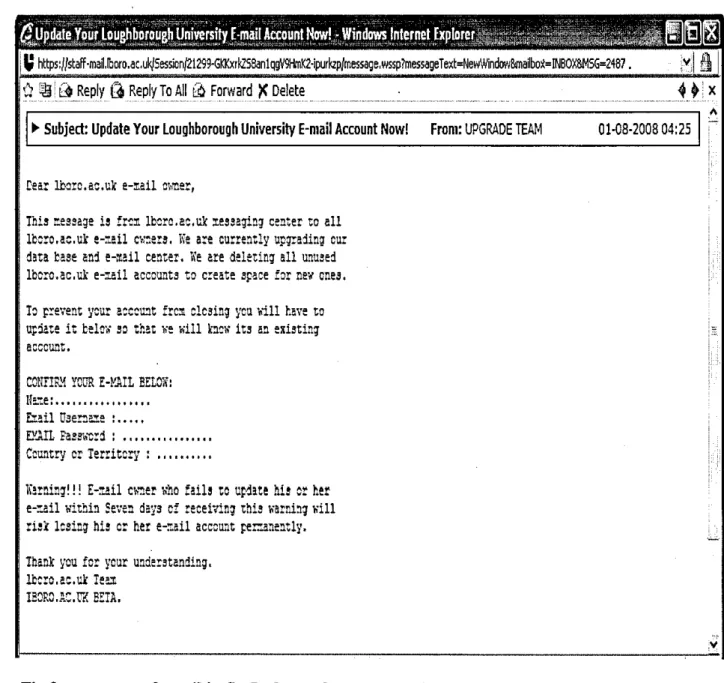
Phishing is one of the most irritating classes of spam which is used for online frauds. These fraudulent emails are also called "seam". Such emails misguide or lead to a deceptive activity on the part of sender. In a Phishing attack, a sparnmer accesses personal informati(:m of the victim (like credit/debit card details or other personal information). In a phishing attack, a sparnmer typically asks the victim to click on a hyperlink which takes them to a fake web site. These fake web sites are in the control of sparnmers. They do so by pretending to be from trust worthy institutions (such as a bank, your employer, university or server administration). This is also called "brand spoofing". While writing this section of the thesis, the author received a phishing email pretending to be from his university and which asks him for his usernameand password. This phishing email is as shown in the figure below:
ttps:iistaff 'mail,lboro, ac,u~Sessioni21299-GKKxrl:.ZS8anlqg\'lHmK2ipurkzpimessage ,wssp?message T ext=NewWindow&mailbox=INBOX1IMSG=2487
'8 (}
Reply (j Reply To All (?,) Forward )( Delete.. Subject: UpdHte Your Loughborough University E-mHiI Account Now! From: UPGRADE TEAt,'
Jear Ibc!c,ac.uk e-:.ail Ch;J.er,
I This !.e"sage is f:c~ Ib-cro.ac.uk :!ll2ssaqing center to all ! Ibc:o.ac.uk e-!r.ail O\,':1er". We are current1:l upqradinq our
data base and e-::.ail C€:lter. Ke are deleting all u:lU.3ed
lbcrc.ac.uk e-~ail acc~u~t3 to create space for new c~e3.
i Te prevent yeu: acc~unt fr:~ closin1 you will have to
update it below 30 that we will knOh' it3 an existing
acccu~t.
COI;:IR.~ YOUR E-Y.m
moo:
! lTa:::e:., •.•...•..•.••. ,Entail tTserna:r.€ : •••••
[;:AIL Passwc:d : " " " " " " " "
CC~1try er Territory: ••••••••••
h'arninq!!! E-:teil C"(I~er who :ail3 to update his or he:-€-ltail within Seven days cf receiving this wa:ninq iiill
!i~k lC3in1 hi3 or her e-~ail aCcD~t ~e:!a~ently.
Thank yeu fer y:ur U!l:ier!tan:iinq. Ibcro,ac,ui !ea=
!EORO,AC,UK EETA,
Fig 3, example of phishing email from the author's personal e-mail inbox
01-08-200804:25
In response to this phishing email, the email from the IT services department of my university (Loughborough) shows that most of the users did not respond to the message but it is amazing that many students of the university (who are mature and are in higher education) responded to these phishing emails, The email from the IT services is shown in the figure below, The highlighted text shows that several students replied to the email. This shows the severity of the phishing problem which is delivered as spam,
Delete
I> Subject: Emails asking for usernames and passwords From: "Graeme Fowler, IT Se... 03-08-2008 17:50
Dear Student IT User
Over the last fe\, ~C!lth3, ~a!ly
urt.
Universities have l:-een targete:1 byb:~3 1L'3~licitej ~ail ~eaaaqe3, requesting that the recipient3 dr;ulqe
their user na:::es and passwords by replying tc the e:!!ail. Ihere are
3c~eti=e3 referred tc as l~hishinql attacks.
Lcuqhbcrcuqh has largely filtered CU~ such targeted ~essage3 up to new,
but ever the la~t few days ''le have "een an increa~inq nu:r.ber ef attacks
take place targeted at students, an:! several have l!enage:! to p.ss through cur e~5il filtering sy3te~.
Flease note that we woul:! never ask users to divulge their user nal!es er passwords via e".il, so any such re~est is certainly bogus. Flease
ccntinue n~t to reply to such ::.essages, tout i!l.3teal icn,'ari the:tI to the IT Ser\~ce Desk ~~ailto:it.ser;[email protected]>, then delete the:!!. If in doubt, please contact the IT Service ,'esK (x2320).
Please als~ note that, :tc!e gene~'ally, to divulge your u~ema..1le !:ll password tc a~y third puty i3B breach ef the University's Acceptable Use Folicy and
ccul:i potentially result in further actic!'l.
It is i!l everyone 1 3 interest that you protect your user nue and pas.::nior:1. Thank ,'DU fer your continued co-operaticn in this l!etter.
Grae.e Fowler IT Serv"ice3
Fig. 4, email received from IT support in response to the phishing email in fig 3
• Filtering which is the most popular technique for spam prevention can not stop all spam.
• Even highly educated people fall a prey to phishing attacks
• Spam produces inconvenience not only for the immediate victims but also for other network users
• The second last paragraph discusses some policies which show that spam messages can result in legal issues
This is an example from a university but such attacks develop more severe problems and cause huge losses to big companies and organisations. In an email to the Loughborough email account users, the Director of IT, Loughborough University, revealed that 80% of the incoming emails to Loughborough University are filtered as spam and this figure continues to rise. Another example of such phishing attacks is shown in fig 5 where an attacker is interested in the details of the recipient.
Dear Friend,
I am W Peter Ruggiero, an internal auditor with Hsbc Bank Plc.
During our last auditing exercises, as the head of the team, I discovered a dormant account valued $19.8 ~1illion dollars. Further investigation about the account revealed that the account holder died since 2001. And up till date, nobody has come forward or put application for claim. During my private search for the relative recently your name and email contact was among the findings that matches the same surname as the decease name who died interstate with no Will or next of kin.
I am contacting you based on trust, to have you presented as the next of kin and the beneficiary of the deposit and I will take care of all necessary paper work to legally declare you the beneficiary of the funds.
If this interest you, kindly respond back immediately with the following details:reggieropeter©hotmail.com
1: Your full names and address.
2: Your direct cell phone and fax number. 3: Your age and occupation.
4: Give me a brief introduction about your self.
As soon as I received the above details, I will then provide you with full details of the transaction. Regards.
Peter Ruggiero
In such an attack the attacker would first like to gain the trust of the recipient. If the recipient replies then later on the attacker asks himlher for more and more confidential/personal information. Mostly these types of phishing attacks also contain a hyperlink and the recipient is asked to click on the hyperlink to access his or her online banking account. This leads the user to a web page that is similar to the web page of HSBC in design but is actually a fake web page under the control of the spammer. They promise money but first demand money from the users as a service charge to provide start up costs or some insurance. To convince the recipient, they make a very good story and ask himlher to keep it confidential. In addition spams pretend to be replies to inquiries to get people into opening these messages. Opening a mysterious email containing a virus puts the system, the entire network and customer information at risk. At the same time it is difficult to drop an email just on the basis of suspicions. In some Phishing attacks the attacker asks the victim to call a telephone number that is controlled by a phisher. Phishing is not restricted to emails; it also attacks the victim in instant messaging, sms messages and also on mobile or VoIP phones.
2.5.4 Opportunity Cost [23]
A massive spam attack may result in the break of an email system which can lead a company or an individual miss an important email.This will cause direct loss of revenue. In addition, the most popular anti-spam mechanisms like content filtering do not give 100% accurate results. Sometimes they result in false positives and false negatives. Classifying a legitimate message as a spam message (false positive) can block the ernail from a potential customer which can be potentially very costly for the companies and organisations (as discussed in section 2.5 of chapter 2). This may also result in the loss of existing customers and the opportunity to obtain new customers.
2.5.5 Loss of Corporate Assets
Inappropriate content is often leaked by spam into corporate email accounts. Much of the material in junk email is offensive and adult material. This can lead to disputes, costly ramifications as well as legal issues. Hwnan resource departments would surely like to avoid these problems [34].
2.5.6 Effects on the Network Resources
One of the major impacts of spam is the conswnption of computer and network resources. Spam exceeds the required amount of memory and computational power and conswnes a lot of network bandwidth. This reduces the amount of data that can be transmitted in a fixed amount of time. Organizations may experience storage loss through backing up emails that are spam [34]. The spam statistics in section 2.4 show that spam exceeds 4 times legitimate messages. This means that as compared to legitimate emails, our internet resources are used 4 times more by spam emails. At the same time this huge amount of spam causes additional traffic in the Internet which in turn produces the need for additional storage space and additional computational power [37]. All these loss of network resources increases the cost of operations which is also passed on to customers.
2.5.7 Spam contents - Annoying and offensive
The advertising messages in spam annoy the users. These advertising messages are mostly of no interest for the users. Especially in case of VoIP the repeating ringing tones of spam calls early in the morning (say at 2 AM) can be a major threat and fear not only for the recipient of a VoIP user but also for the people surrounding him. Sometimes the contents of spam are offensive and distasteful. It exposes adults and children to adult contents.
2.5.8 The Legal Risk of Spam
Spammers use adware and spyware to turn the computers of innocent persons into spam slaves which force their network to do the work of the spammer. If an individual or a company's computers become victims of such an attack, they can face a lot of problems due to the outgoing spam from their computers. Although many companies neglect this problem, however, if spam can be traced to their computer systems they can be totally banned by some email servers. This will prevent legitimate email from going through. At the same time these innocent persons can be involved legally for violation of the CAN-SPAM rules (discussed in section 3.2), even though their systems where just zombies, not willing participants" [34]. In case of successful phishing attacks, a recipient gives personal information or some confidential information to an attacker. This can lead to severe legal issues and can put himlher in risk of loosing a job or money (in case of credit/debit card details). The second last paragraph of fig 4 in section 2.5.3, states that divulging the usemame and password to any third party is a breach of the University's Acceptable Use Policy and could potentially result in further action. The same figure also shows that several users have responded to the phishing emails targeted at the university's email accounts. Apart from that there exist other legal problems associated with spam. These include problems related to advertising pornography, pyramid schemes etc [38].
2.5.9 Impact on Internet Usability
Some of the impacts of spam on Internet usability have been mentioned in [39]. By making the cost of using it prohibitively high, spam makes the Internet less capable of supplying information. A lot of time and money is spent on deleting and downloading spam. This makes the use of online information less effective. In places like the United States, phone service and Internet access is usually paid by monthly fee. In such places the issue becomes a matter of time rather than money. Even in such cases the cost increases for service providers and network maintainers. This affects the overall cost/fees. Statistics show that spam is increasing each year. If people are going to receive large amounts of spam, they may be forced to give up much of the Internet experience because
they must take so much time going through spam. By the time they go through the spam, they may not be able to afford to remain online any longer [39].
2.6 SPIT (Spam over Internet Telephony)
The problem of spam becomes even tougher when considering it in the case of VoIP. In
VolP spam calls are referred to as SPIT (spam over intemet telephony). SPIT is one of the two major threats to VolP and is expected to become a more sever and serious problem in the near future. The real challenge is to block a spam call before the telephone rings. Most of the antispam techniques which helped in limiting the amount of spam, fail totally in preventing SPIT because in VolP we deal with real time voice which doesn't accept the processing time without affecting the QoS [40]. Above all it is not a good idea to drop a call just on the basis of suspicion. This can drop important calls [40] which will be ofloss to the VolP user.
2.7 Differences between email and voice spam
SPIT is similar to email spam in many aspects. For example the causes/aims and impacts of spit and spam are similar. However, spam email deals with text while SPIT works with voice. Therefore, some of the popular techniques used for preventing spam emails fail in the scenario of SPIT due to the real time behaviour ofVolP. In addition, when compared to spam email the impacts of SPIT are more immediate and in most cases more severe.
Currently the rate of SPIT calls is very low when compare to the rate of spam emails. However, with the increase in the popularity ofVolP, it is expected that SPIT will occur with a frequency similar to email spam in the near future. Although email spam is a nuisance, the impacts of SPIT on a user are far more irritating than email spam. SPIT upsets instantly and a SPIT call will disturb not only you (the recipient) but also your colleagues surrounding you. Emails don't interrupt the users and can be checked at intervals. However phone calls are interrupting and they need attention. The recipient of a
call either answers it or at least checks to see who the caller is. This means that the reaction of users to phone calls is as soon as they receive it.
Deleting a spam email is quite simple when compared to dealing with SPIT calls especially when they are received at midnight or early in the morning. At the same time phone or VolP calls are more urgent, interrupting, and attention-getting than an email due to which we can not turn off our mobile phone. In cases where we want to convey urgent messages, we use telephony services so a VolP user will receive an immediate ring in the case of a SPIT call. Receiving a number of SPIT calls (say equal in number to the average number of spam emails a user receives) in the voice mail would be very annoying. Relative to email spam it takes more time to delete spit calls because in the later case the user would have to listen to every message (at least a portion of it) before deleting it. This means increased loss of productivity as compare to email spam. In addition the impact of SPIT on network resources is more severe when compared to email spam because it has the potential of clogging up the network [41] and consumes more bandwidth. This may also force the users to leave VoIP.
Another issue with SPIT is that we cannot perform filtering based on the contents of the call. Content filtering is the most popular approach for preventing spam but most of these antispam techniques which helped in limiting the amount of spam, failed totally while dealing with VoIP. As QoS is not an issue with email so an email is first received by a server that can apply many filtering strategies and then makes it available to be downloaded by the user. In contrast, VolP deals with voices rather than text. "To
recognize voices and to determine whether the message is a spit or not is still a very difficult task for a computer" [40].
Another reason which makes it hard or nearly impractical to use content filtering mechanisms for preventing SPIT calls is that in case of VolP a recipient finds out about the message (or contents of the call) when he or she has received the call and is listening to it. This means that content filtering techniques can be applied only after the user has received the call. That is by the time when the user is subjected to all the impacts of
spam. Also VoIP is very sensitive to delay and requires a certain degree of QoS. Using filtering techniques on the contents of voice could significantly degrade the quality of sound Also it is relatively very easy for the user to delete an email spam. However, receiving a SPIT call means the telephone rings and disturbs the users at any time of day. Also it is not good to drop a call just on the basis of doubt. This can drop important calls [40] which will be ofloss to the VoIP user. In cases where we want to convey urgent messages, we use telephony services. So in case ofVoIP phones we have to set our phone to ring mode for the unidentified persons and we will receive ring tones for regular calls and also for SPIT calls which will of course be unsatisfactory.
David Endler and Mark Collier [42] have expressed the severity of SPIT relative to email spam in the following phrase which shows the user reaction to SPIT:
"I don't know what is worse. Digging through my voicemail and deleting all the SP AM or getting 25 calls a day trying to sell me Viagra. I think I am going to just turn this stupid phone off'.
2.8 Summary
Spam is a major threat to the efficiency of the Internet. Spam emails are 4 times (80%) more frequent than ham emails. The lack of a single agreed definition of spam contributes to the inefficiency of the filtering mechanisms. Spam creates a lot of problems including impacts on businesses, phishing, loss of cOlporate assets, legal issues, impacts on network resources and exposure to viruses, spyware and Adware to name a few. The losses caused by sparn are billions of dollars every year. The growth rate of sparn is constantly increasing due to the inefficiency of the state-of-the-art antispam techniques. It is expected that spanuners will badly exploit the network resources if researchers don't come up with an efficient anti-spam mechanism. The huge increase in sparn is the cause for the unexpected overload in bandwidth, server storage capacity and loss of end-user productivity for email systems. The problem of SPIT is more severe than spam.
3
State-of-the-Art Anti-spam
Mechanisms
3.1 Introduction
A number of measures have been proposed and implemented to prevent spam but the fact is that none of the approaches has been able to prevent sufficient spam to solve the problem. To solve the problem the anti-spam approaches can be divided into four broad categories. These include legislative, technological, collaborative and social awareness. The legislative approaches make spam illegal whereas the social awareness (or educating users) aim at educating the users to leam about spam, its causes, proble
![Table 1: Primary and secondary characteristics of spam [11]](https://thumb-us.123doks.com/thumbv2/123dok_us/974062.2627738/27.847.115.776.692.881/table-primary-secondary-characteristics-spam.webp)