GREEN: Proactive Queue Management over a Best-Effort Network
Wu-chun Fengt, Apu Kapadiatt, Sunil Thulasidasant
f e n g @ l a n l . g o v , a k a p a d i a 9 u i u C . e d u . s u n i l @ l a n l . g o vt Computer & Computational Sciences Division Los Alamos National Laboratory
Los Alamos, NM 87545
t Department of Computer Science University of Illinois at Urbana-Champaign
1304 W. Springfield Ave. Urbana, IL 61801
Absunn- We present a pmaetiw queuemanagement (PQM) algorithm called GREEN that applies knowledge of the steady- state behavior of TCP connections to intelligently and proactively drop packets, thus preventing congestion from ever occurring and ensuring a higher degree of fairness between flows. This congestion-prevention approach is in contrast to the congestion- avoidance appmach of traditional active queuemanagement (AQM) schemes where congestion is actively detected early and then reacted to.
In addition to enhancing fairness, GREEN keeps packetqueue lengths relatively low and reduces bandwidth and latency jitter. These characteristics are particularly beneficial to real-time mul- timedia applications. Further, GREEN achieves the above while maintaining high link utilization and low packet loss.
I. INTRODUCTION
early before it becomes too problematic, GREEN prevents con- gestion from ever occuming, thus providing more stable QoS over a best-effort network. This congestion-prevention PQM scheme is based on a mathematical model of the steady-state behavior ofTCP [ 5 ] such that queue lengths can he kept at low levels while simultaneously maintaining high link utilization and low packet loss. These characteristics are particularly ben- eficial to multimedia applications. Further, GREEN can also he used to identify and police non-TCP-friendly flows. How- ever, we do not address this aspect of GREEN in this paper.
11. ALGORITHM
GREEN applies knowledge of the steady-state behavior of TCP connections at the router to intelligently drop (or mark) packets for congestion notification. By using such a mecha-
-
-
nism, a router can give each connection its fair share of band- width while the build-up ofThe throughput of a TCP connection depends, among other its nackets are dronned in the network. Snecificallv. Mathis et Because network congestion leads to lost packets, thus wast-
ing all the the packet consumed On its way schemes such as RED
['I
and BlueL21
have been proposedfrom Source to destination, active wue-management (AQM) factors, on its round trip time (RTT) and the probability that
shown to have direct applicability to improving the perfor- mance of multimedia applications by reducing packet loss rates and queueing delays to networked applications such as interac- tive audio and video [2].
Since our proposed GREEN (Generalized Random Early Evasion Network) router classifies and ensures fairness be- tween flows, we compare GREEN with two flow-based AQM schemes that are derivatives of RED and Blue - Flow-based RED (FRED) [3] and Stochastic Fair Blue (SFB) [4]. While FRED and SFB avoid congestion by reacting to congestion
M S S x c
RTT x ,@
BW
=where
BW
is the bandwidthkhroughput of the connection, MSS is the maximum segment size, RTT is its round trip time, and p is the packet loss probability. c is a constant that depends on the acknowledgement strategy that is used (e.g., delayed or every packet).as well as on whether packets are as- sumed to he lost periodically or at random.While this model may not he applicable to non-SACK TCP implementations, to very short connections that never reach This work was sumofled by the Dept. ofEnergy.s Laboratory.Dirmted steady state, or to connections whose window size are artifi- Research Y Development Program through LOS ~ l m o r National ~abora-
W-7405-ENG-36. APu KaPadia was funded in PaR Dept. of Energy's High-Performance Computer Science Fellowship through
hs A I ~ O E ~ a t i o ~ a i Labaratory, hwrence ~i~~~~~~ ~ ~Laboratory, ~ , ~ ~ ~ l and Sandia National hboratoly
cially limited by the receiver's flow-control window. These issues are generally not problems in properly configured long- lived connections such as in multimedia applications, e.g., video-on-demand (VoD) and hulk data transfers.
Now, let us consider a scenario where there are N active flows at a router on a particular outgoing link of capacity L .
GREEN considers a flow to be active if it has had at least one packet go through the router within a certain window of time. The fair-share throughput of each flow is L j N (assuming each source attempts to transmit at least at that rate). Substituting
L j N for BW in the above equation, we derive the following expression for loss probability p , i.e.,
By using this value of p as the dropping probability for con- gestion notification, GREEN “coerces” flows into sending at their fair rate. Because p depends on the number of flows and the round-trip time of each flow, congestion notification is more aggressive for large N and small RTT. And by in- cluding RTT as an inverse parameter in the equation, GREEN eliminates the bias of favoring TCP connections with smaller
RTTs with respect to throughput [6]. (Recall that TCP con- nections with smaller RTTs can increase their window size faster due to the smaller RTT, and are more aggressive. These flows are able to grab more than their fair share of bandwidth, which leads to this bias.)
End-to-end schemes have been proposed to correct for this bias by requiring TCP senders to increase their congestion win- dows by a constant proportional to RTT2 [7][8]. However these schemes rely on a window constant, which is hard to cal- culate and varies with the topology ofthe network. In contrast, not only can GREEN accurately calculate the drop prohahili- ties irrespective of the network topology, it also does not re- quire any end-to-end modifications. Hence, GREEN can be used at edge routers to ensure fairness between flows (without having to modify stock TCP implementations). For example, an organization could choose to implement GREEN at its edge router to ensure fairness between flows that begin or end within that organization.
The basic operation of GREEN does not require per-flow state information. N and MSS can be easily estimated, and in Section IV we discuss how the RTT for a flow can be inferred from the network. Hence GREEN has minimal state require- ment?,. FRED keeps per-flow state information for flows that have packets buffered at the link. SFB does not maintain per- flow state information, and instead employs a Bloom filter [9] to hash flows into L levels ofN bins. Each bin maintains queue occupancy statistics for flows that map into that bin and a cor- responding drop probability pm. Hence state is O ( N
*
L ) . A discussion on the selection of L and N is discussed in [4].111. EXPERIMENTS A N D EVALUATION We evaluate the performance of GREEN with respect to Flow-based RED (FRED) [3] and Stochastic Fair Blue
(SFB)
[4]. We compare GREEN to FRED and SFB since these active queue-management schemes are also flow-based. In contrast, while performing active queue-management, REDFTP
d”’
sovrccrFig. 1. Network Topalogy
and Blue do not differentiate between packets from different flows and mark packets with a global marking probability. We also include results for Drop Tail queueing to provide a base- line for assessing performance.
We assume that a router knows the bandwidth ( L ) of the attached outgoing link. N is the number of active flows, i.e., flows that have had at least one packet go through the router within a certain window of time. We discuss the estimation of
N in Section IV.
The MSS of a flow is estimated by the router by looking at the size of each packet. By doing this, we reduce the need for flow state to maintain information regarding packet sizes seen over an interval. In our experiments, we chose MSS to he I KB in all cases. The value ofc, in our“random dropping, delayed acknowledgment” model was fixed at 0.93
[SI.
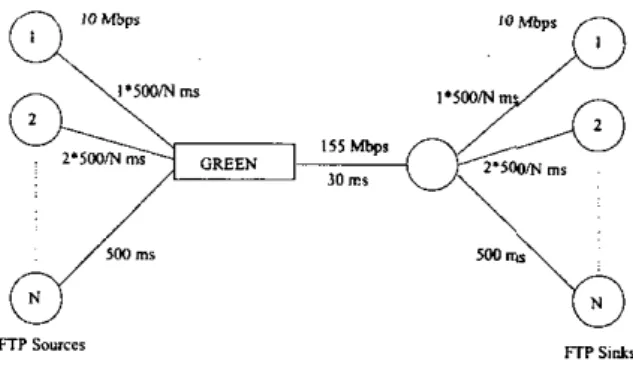
For the time being, we assume that the router has some mechanism for determining a flow’s RTT and briefly discuss how this p a m - eter can be estimated in Section IV.We used ns [I 01 to evaluate the performance ofGREEN over a network with the topology shown in Fig. I . N sources and
N sinks are connected to the routers over IO-Mbps links with propagation delays ranging from ms to 500 ms. We varied the number of flows, N from 50 to 500. The bottleneck link has a bandwidth of 155Mbps and a delay of 30 ms.
’
For our simulations, we started FTP connections from the leftmost nodes to the rightmost nodes within the first second of simulation and ran it for 180 seconds. GREEN is implemented at the gateway, which is the bottleneck router in our simulation. All of the metrics presented in this section - link utilization, fairness, packet loss, queue size -are measured at this gate- way. We present results for link utilization, fairness, and queue size, after the first 50 seconds to remove the startup transient effects and to study the steady-state behavior.
A. Fairness
GREEN attempts to limit all the TCP flows to their fair share ofthe outgoing link bandwidth. To assess GREEN’S ability to maintain equal bandwidths between TCP flows, we use lain’s ‘Since we simulate more than 50 Rows over IOAlbps link. the 155hfbpr
Fairness Index [I I]. We briefly describe how the fairness index is calculated and then present our results.
I) Join
S
Fairness Index: This fairness index quantifies the degree of similarity between all the flow bandwidths. Given the set of throughputs (21, z2,. . .
,
z,,), the fairness index is calculated as follows:The fairness index always lies between 0 and 1. Hence, a higher fairness index indicates better fairness between flows. The fairness index is 1 when all the throughputs are equal. When all the throughputs are not equal, the fairness index drops below 1.
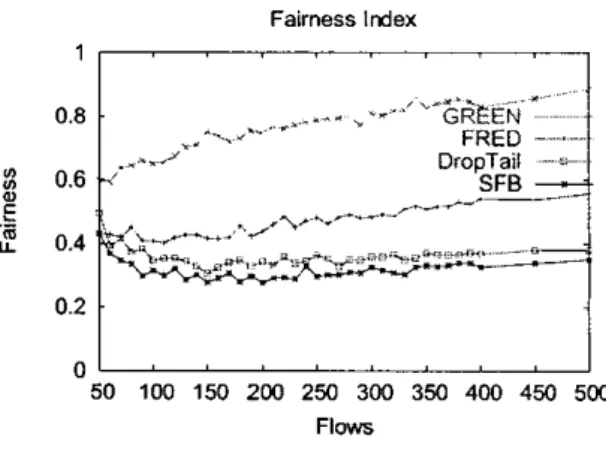
As shown in Fig. 2, GREEN provides sig- nificantly better bandwidth fairness than the other queue- management schemes. The curve for Drop Tail shows us the fairness that would be expected at most gateways in the Inter- net today. FRED outperforms Drop Tail and SFB because it queues at least two packets2 of a flow before marking
a
packet from that flow. This provides much better fairness as long as each flow maintains one to two outstanding packets at the gate- way. SFB exhibits poor fairness because it is sensitive to vary- ing RTTs between flows and breaks down under a large number of connections with varying RTTs [4].GREEN'S fairness index gradually rises. As the number of flows increases, we observe a lower fairness index for fewer flows because each flow has a higher share of bandwidth and flows with longer RTTs are unable to attain their steady state bandwidths in 180 seconds. Why? Even though GREEN can "slow down" flows with shorter RTTs (by dropping packets),
it cannot s p e e d up flows with longer RTIs. Better fairness for fewer flows is achieved by increasing the simulation time, al- lowing all flows to reach their steady state bandwidths. With a larger number of flows, the fair share of bandwidth is low enough so that all flows are able to attain close to their aver- age share of bandwidth. Longer simulations yield even better faimess curves for Green while showing linle improvement for Drop Tail, FRED, and SFB.
E. Link Ulilizafion calculated as follows:
2) Results:
At the end of each simulation, the overall link utilization is
total byte departures in t sec bandwidth x
t
utilization =
The numerator equals the total number ofbytes leaving the link during the interval o f t seconds, and the denominator equals the total possible bytes that could have left the link in the same interval.
Fig. 3(a) shows that as the number of flows increases, GREEN performs as well as SFB in terms of link utilization. Drop Tail achieves higher utilizations because the flows with
21n our experiments, we operate F a D under the "mmyJ70w" mode.
Fairness lrdex
1
I
0
50 1W 150 200 250 300 350 400 450 5W Flom
Fig. 2. Jain's F a h " Index VS. Number of Flows
shorter RTTs
are
allowed to be aggressive and no packets are voluntarily dropped early. While this yields better link utiliza- tions, it sacrifices fairness heavily and can lead to higher packet loss. GREEN outperfoms FRED with respect to fairness and link utilization because GREEN deterministically maintains the average bandwidths of all flows while FRED simply relies on queue occupancy statistics to regulate queue size.C. Packer Loss
As shown in Fig. 3(b), the packet loss percentage is roughly the same for all flows and stays below 0.5%. Equation ( I ) pro- vides good estimates f o r p
<
'1% [ 5 ] . Since tbe overall packet loss stays well below 1% in oursimulations, GREEN limits therates of Rows to their equal shares of bandwidth effectively.
D.
QueuesizeFig. 4(a) shows the queue sizes for Drop Tail for 100 flows and 500 flows. As we can see, as the number of flows increases, the average queue size for Drop Tail increases dramatically. In contrast, as seen in Fig. 4(b), 4(c) and 4(d), GREEN, FRED and SFB keep the average queue sizes low.
FRED keeps queue sizes low by marking packets beyond a certain threshold and limiting the amount of buffer space for each flow. SFB does so by increasing drop rates when there is packet loss and reducing drop rates when the link is under- utilized. Hence, FRED and SFB U y to dynamically converge to the correct "operating point" for low queue sizes. GREEN achieves its operating point by calculating drop probabilities for each flow based on their fair share of bandwidth. By en- suring that the aggregate bandwidth of the flows is equal to the available bandwidth at the link, there is no sustained buildup in queue length.
Iv. ESTIMATING FLOW PARAMETERS
Up until now, we assumed that routers had knowledge of the various flow parameters: N, MSS and
RTT.
N and M S SOverall Link Utilization Packet Loss (%)
100, , , 7 , I ,
,
z 1
, , , 1 I , , ,50 1W 150 200 250 300 350 400 450 5M) 50 100 150 200 250 300 350 400 450 500
Flows Flows
(a) Overall Link Utiliration vs. Number of Flows (b) Overall.Packe1 Loss vs. Number of Flows
Fig. 3. Link Utilization and Packet Loss statistics can be easily estimated. The M S S of a flow is estimated by the
router by looking at the s u e of each packet. One way that
N
can be estimated is by counting the number of flows that have had at least one packet go through the router within a certain
window of time. Long windows may cause GREEN to over- estimate the number of flows and reduce the overall link uti- lization. Short windows may cause GREEN to underestimate the number of flows, resulting in over-provisioning of the link bandwidth. In our experiments, we assumed FTP file trans- fers, and hence the number of flows was a constant. Stabilized RED
(SRED)
uses a statistical technique to estimate the num- ber of active flows[IZ].
SRED compares an arriving packet with a randomly chosen packet that was seen recently. Ifthese packets belong to the same flow, the authors call it a hit. Hit rates can be statistically analyzed to give a reasonable estimate of the number of active flows,N.
Hit rates can also be used to identify and limit non-responsive flows that use more than their fair share of bandwidth.The round trip time, RTT, is the most difficult parameter to estimate with any degree of accuracy. Below we briefly present two possible solutions to this. One solution makes use of the fact that the best estimates of RTT occurs at the TCP end host.
Using the IP options available, the sender can insert the RTT into a prespecified field in the IP header. This can then be utilized by routers along the way where GREEN is deployed. Another solution is to make use otlhe IDMaps service [13]. A GREEN gateway can also perform the duties of an IDMaps lracer and maintain a database of RTT estimates, which can be used for fast lookups based on source and destination IP addresses. IDMaps provides RTT estimates accurate to within twice the actual value. Such estimates could result in lower fairness, but is sufficient for GREEN to still outperform FRED, SFB and Drop Tail in terms of fairness. We leave further dis- cussion and analysis of the use of IDMaps for f'uture work.
V. CONCLUSION
In this paper, we have shown how applying the knowledge of the macroscopic behavior of the TCP congestion-avoidance algorithm at the routers can be used to almost completely elim- inate queueing delay. Queue lengths can be maintained at very low levels, which are desirable for multimedia applications. GREEN can achieve high throughput fairness among TCP flows, while maintaining high link utilization. GREEN relies on the knowledge of flow RTTs and the total number of active flows, and we briefly discussed how these metrics can be in- ferred by a GREEN router. Similar to FRED and SFB, GREEN requires very little state information for its operation. Future work will focus on ( I ) identifying and policing non-responsive flows such as misbehaving real-time multimedia traffic and de- nial of service attacks, (2) adding a Bloom filter (as in SFB) or a hit-rate module (as in S E D ) to identify and limit unrespon- sive flows, and (3) examining how GREEN behaves with short- lived connections (e.g., so-called "web mice") or with mixtures of different traffic types. The applications that stand to benefit the most from the "fixed low-latencyhigh throughput fairness property" of this algorithm are delay-sensitive traffic such as
streaming, real-time audio and video applications.
REFERENCES
[I] S. Floyd and V. Jacobson, "Random Early Detection Gateways for Con- gestion Avoidance:' IEEE/ACM Pamacliom on Nerworkinp. vol. I, no.
4, pp. 397-413, August 1993.
Queue size vs. Tine DmpTail. 500 Flows DropTail, 100 Flows "- ....-.. -. 35 40 35 30 25 20 15 10 5 0 GREEN, 500 Flows ~ GREEN, 100Flows ~ ~
L
I
40 35 60 80 1W 120 140 160 180 FRED, 500 Flows - FRED. 100 Flows - Time (a) Drop Tail @cue Size VS. Timea 30 -5 In 25
0'
1 5 - 02
2 0 - - -( c ) FWD. Queue Size YS. Time
1
2 0 1 I II
60 80 100 120 140 160 180
Time (b) GREEN: Queue Sire YS. Time
Queue size vs. T i m SFB. 500 Flows ~ SFB, 100 Flows 25
0'
152
20 Time(d) SFB: Queue Size vs. Time Fig. 4. Qmue Occupancy Statistics for Drop Tail, Green, FRED, and SFB
I61 T. Lakshman and U. Madhow. "The Pelromance of TCPIIP for Networks with High Bandwidth-Delay Products and Random Loss:' IEE.VACM Tronmcrionr on Neworking, vol. 5, no. 3, pp. 336-350, June
1997.
I71 S. Floyd, "Connections wilh Mulliple Congesled Gateways in Packet-
Switched Nelworks Pan I : One-way Traffic; ACM Computer Commu- nication Review, vol. 21, no. 5,pp. 30-47, Oct. 1991.
IS1 T. Henderson, E. Sahouk, S. McCanne. and R. KaV. "On Improving the Faimess ofTCP Congestion Avoidance," in Pmc. oflEEE Globecom,
November 1998.
[SI B. Blwm, "SpaceiTime Trade-offs in Hash Coding with Allowable Er- rors:' Communicorionr ofrheACM, vol. 13, no. 7, July 1970. L I01 nr, "Network Simulator," hnp:l/wvwisi.edu/nsna~"~.
[ 1 I 1 D. Chiu and R. Jain, "Analysis ofthe Increase and Decrease hlgonthms
for Congestion Avoidance in Commer Networks:' Comourer Network ondISfNSysmm,vol. 17,pp. l-i4, 1989.
[ 121 Teunis J. On, T. V. Lkhman, and Larry H. Wong, " S E D Stabilized
RED," in Proceedings ofINFOCOM, 1999, vol. 3 , pp. 13461355.
[I31 P. Francis, S. Jamin, C. Jin, Y. Jin, D. Raz, Y. Shavin, and L. Zhang,
"IDMms: A Global lntemet Host Distance Estimation Sewice?