Foresight Vehicle
Technology Roadmap
Technology and Research Directions
for Future Road Vehicles
1
Foresight Vehicle Technology Roadmap
Technology and research directions for future road vehicles
Contents
Page
Overview
1
1.
Introduction
3
2.
Trends
and
drivers
9
3.
Performance
measures
and
targets
15
4.
Technology
17
4.1
Engine
and
powertrain
19
4.2 Hybrid, electric and alternatively fuelled vehicles
23
4.3
Software,
sensors,
electronics
and
telematics
28
4.4
Structures
and
materials
31
4.5
Design
and
manufacturing
processes
35
5.
Summary
39
Appendices:
A.
Trends
and
drivers
43
-
Detailed roadmaps
(social, economic, environmental, technological, political and
infrastructural themes)
-
Prioritisation of trends and drivers
B.
Performance
measures
and
targets
49
-
Detailed roadmaps
(social, economic, environmental, technological, political and system themes)
-
Beacons
-
Targets for user requirements
C.
Technology
59
-
Engine and powertrain (E&PT)
-
Hybrid, electric and alternatively fuelled vehicles (HEV)
-
Advanced software, sensors, electronics and telematics (ASSET)
-
Advanced structures and materials (FASMAT)
-
Design and manufacturing processes (DMaP)
D.
Resources
69
1
Overview
Foresight Vehicle is a collaboration between industry, academia and Government to identify and
demonstrate technologies for sustainable road transport. Future products and technologies must meet
social, economic and environmental goals, satisfying market requirements for mobility, safety,
performance, cost and desirability, with the objectives of improving the quality of life and wealth
creation in the UK.
The Foresight Vehicle technology roadmap has been developed to identify technology and research
themes for road transport, aiming to support UK industry in the globally competitive market for
transport products and to provide sustainable mobility for UK citizens. The roadmapping process has
brought together more than 130 experts from across the road transport sector, from more than 60
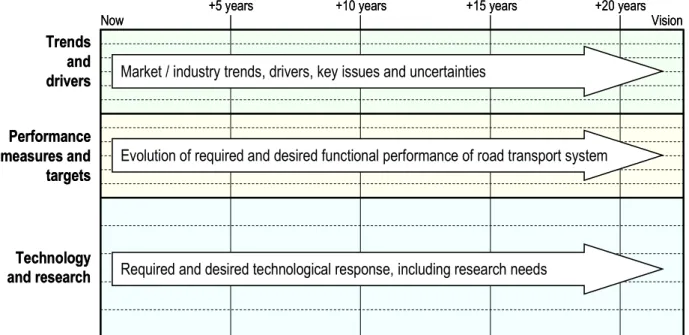
organisations. The goal was to use the roadmap structure (Fig. 1) to capture and share the rich set of
views about how road vehicle markets, products, systems and technologies will (and could) evolve in
the next 20 years.
Fig. 1 – Foresight Vehicle technology roadmap architecture
The scope of the Foresight Vehicle technology roadmap is broad, reflecting the complex nature of the
road transport system. The roadmap represents a ‘rich picture’, capturing the knowledge and thinking
from a wide range of perspectives within the automotive sector. Owing to the broad scope of the
roadmap, the inherent uncertainties associated with the 20-year time frame and the various interests of
a diverse set of stakeholders, it is not desirable to overly constrain the research agenda. Rather, the
roadmap is used to provide structure, context and broad direction. This structure enables a consistent
language and approach to be developed in terms of understanding the relationships between specific
technology areas, system performance and industry drivers.
Market / industry trends, drivers, key issues and uncertainties
Evolution of required and desired functional performance of road transport system
Required and desired technological response, including research needs
+5 years
Now
+10 years
+15 years
+20 years
Vision
Trends
and
drivers
Performance
measures and
targets
Technology
and research
Market / industry trends, drivers, key issues and uncertainties
Evolution of required and desired functional performance of road transport system
Required and desired technological response, including research needs
+5 years
Now
+10 years
+15 years
+20 years
Vision
Trends
and
drivers
Performance
measures and
targets
Technology
and research
2
Investment in road vehicle technology and research should be considered in terms of the contribution
(impact) that the investment is expected to make towards the primary social, economic and
environmental goals:
·
Socially
sustainable road transport system, providing equitable, safe and secure road transport that
meets the needs and aspirations of UK society.
·
Economically
sustainable road transport system, supported by a dynamic and successful UK
automotive industry.
·
Environmentally
sustainable road transport system, with a low environmental impact in terms of
energy consumption, global warming, waste and health.
The Foresight Vehicle programme is currently organised primarily around five technology areas. Each
of these has significant potential to deliver high impact technology solutions to meet the above social,
economic and environmental goals:
·
Engine and powertrain
technology development, leading to improved thermal and mechanical
efficiency, performance, drivability, reliability, durability and speed-to-market, together with
reduced emissions and cost.
·
Hybrid, electric and alternatively fuelled vehicle
technology development, leading to new fuel and
power systems, such as hydrogen, fuel cells and batteries, which satisfy future social, economic
and environmental goals.
·
Software, sensors, electronics and telematics
technology development, leading to improved
vehicle performance, control, adaptability, intelligence, mobility and security.
·
Structures and materials
technology development, leading to improved safety, performance and
product flexibility, together with reduced cost and environmental impact.
·
Design and manufacturing process
technology development, leading to improved industrial
performance, considering the full vehicle life cycle from ‘cradle to cradle’.
The Foresight Vehicle technology roadmap (version 1.0) represents a significant first step in terms of
capturing, sharing and structuring expert knowledge within the automotive sector, but greater benefits
can be obtained if the roadmap can be kept ‘alive’ on an ongoing basis. It is recommended that the
roadmap should be reviewed periodically to refine and update the content and structure, and to
enhance the strategic focus.
3
1. Introduction
The Foresight Vehicle technology roadmap is the result of a collaborative initiative that has brought
together more than 130 experts from across the UK road transport sector, from more than 60
organisations. The goal was to use the roadmap structure (Fig. 1) to capture and share the rich set of
views about how road vehicle markets, products, systems and technologies might evolve over the next
20 years.
It is important to note at the outset that the roadmap does not represent a prescriptive or linear view,
because the future is uncertain and the path forward depends both on the actions that we take and the
events that occur over time. For this reason a variety of information is included in the roadmap,
including expert opinion, published forecasts, trends and drivers, uncertainties, questions and
speculation. It is intended as a resource for thinking about the future, and a framework for supporting
collaboration, decision making and action within the road transport sector.
This is Version 1.0 of the roadmap, and it can be refined and improved as we move into the future.
Background to Foresight Vehicle
Foresight Vehicle is a collaboration between industry, academia and Government to identify and
demonstrate technologies for sustainable road transport. Future products and technologies must meet
social, economic and environmental goals, satisfying market requirements for mobility, safety,
performance, cost and desirability, with the objectives of improving the quality of life and wealth
creation in the UK.
·
Vision:
“A globally competitive UK industry that meets the aspirations of the customer and
society for mobility in the 21
stcentury”
·
Mission:
“To secure the vision by developing, demonstrating and promoting the adoption of
technology and by the pursuit of the knowledge to design, manufacture and deliver vehicles to the
market throughout the next 20 years”
The initiative has been running for more than five years and has emerged as the flagship UK
programme for road transport technology, supported by all the relevant Departments of Government.
The associated LINK R&D programme, supported by the Department of Trade and Industry (DTI) and
the Engineering and Physical Sciences Research Council (EPSRC), is now worth over £75 million and
involves more than 400 organisations.
The Foresight Vehicle technology roadmap has been developed to identify technology and research
themes for road transport, aiming to support UK industry in the globally competitive market for
transport products and to provide sustainable mobility for UK citizens. This requires an understanding
of the market and industry trends and drivers, together with the types of technology, products, services
and infrastructure that will be needed in the next 20 years.
4
Industrial context
The DTI Automotive Innovation and Growth Team (AIGT) has recently published a series of
reports
78-82that provide an assessment of the key issues that will shape the future of the automotive
sector, and how the UK can best respond to the competitive challenges which it will face. These
reports, which draw on the expertise of the major stakeholders in the sector, focus on four key areas:
technology; environment; design, development and manufacture; and distribution, competition and
consumer. The findings of this initiative are summarised below, to provide an overview of the
industrial context for the Foresight Vehicle technology roadmap.
Over 80% of world car production is accounted for by six major global groups, dominated by the USA and
Japan. Consolidation in the commercial vehicle sector has gone even further, with five major groups
dominating the global markets for trucks and buses. A similar process has occurred in the component
sector, which is increasingly dominated by large multinational firms, which seek to establish a leading
position in key technologies. Yet in all parts of the industry some smaller independent companies continue
to survive, and indeed thrive, in particular sectors of the market. The retail sector contrasts with this picture,
still largely organised along national lines. Retailers are also consolidating, fuelled by increased competitive
pressures resulting from new channels to market such as the internet and growth in imports.
The industry is technologically advanced, both in terms of manufacturing processes and in its products. It is
characterised by economics of scale and low unit costs, despite the increasing complexity of the
fundamental product. Manufacturers are seeking to differentiate their products through technology and
branding to restore margins, particularly by applying electronics to vehicles. The proportion of electronics in
the average vehicle may well double from the current level of around 20% over the next ten years,
particularly in the areas of management systems and telematics. The engine management system alone
can be at least 10% of the value of the vehicle. Suppliers are taking an increased responsibility for product
development, design and sub-assembly as the manufacturers focus on core capabilities. A key force
driving technological change and innovation is environmental legislation. The industry has made major
strides in the areas of emissions control and safety, but will face pressures for further development.
The automotive sector has provided a major contribution to the UK economy over the past 20 years, with
car production and sales reaching record levels (total UK car production in 2000 was 1,64 million units,
expected to rise to 1,87 million by 2004
62), supported by significant inward investment that has transferred
world best practice in manufacturing. UK automotive businesses are leaders in global best practice in many
areas of manufacturing, purchasing, product development and logistics, and the skills and knowledge of the
industry provide a key source for improvement throughout the whole manufacturing sector in the UK.
There is only one UK-owned volume car manufacturer, MG Rover, although the UK does provide a
manufacturing base for 7 of the world’s leading volume manufacturers, 9 commercial vehicle production
facilities, 17 of the world’s top tier one suppliers, and around 20 of the world’s leading independent
automotive design engineering firms. Turnover of the UK automotive sector as whole is £45bn, contributing
approximately 1.5% of GDP and employing some 715,000 people - both directly in vehicle manufacturing
and in the supply and distribution chains. About half of added value comes from manufacturing and
assembly, which represents about 15% of total UK manufacturing added value. Exports totalled nearly
£20bn in 2000, greater than any other manufacturing sector. The industry is highly globalised, with complex
supply chains (a total of 65% of UK automotive output is exported, while 75% of UK car registrations are
imports). An estimated 7,000 automotive component companies operate in the UK, 90% of which are
SMEs. Turnover in the UK components sector in 1999 was £12bn. The UK sector’s particular strengths
include design engineering, especially advanced technology in motorsport, with 80% of the world market.
Motorsport currently has a £5bn turnover (of which more than 50% is export sales), and the sector employs
over 40,000 people, of which 25,000 are highly trained engineers in more than 3,000 businesses. The UK
is also increasingly becoming a centre for engine production, and has a strong position in ‘premium’ cars.
The automotive industry suffers from global over-capacity and with manufacturing best practice rapidly
diffused around the world, the fight to build and retain market share is relentless and competition fierce.
Lean production is not enough, and companies are striving to improve profitability by building desirable
brands, through excellence in design, engineering and marketing. Over-capacity in Europe, the current
economic downturn and recent financial losses of vehicle manufacturers are resulting in plant closures and
other rationalisation programmes. The pressures on suppliers, which are already intense, are likely to
increase yet further.
The automotive industry in the UK faces significant challenges, with the majority of vehicle manufacturers,
including those with outstanding productivity records, making losses, with low returns on capital. The last
few years have seen decisions to close two major assembly plants and threats to the future of several
others. There has been a major switch to sourcing vehicles and parts from Western and Eastern Europe,
and further afield. It is estimated that UK based assemblers will soon be sourcing well under 50% of their
5
components in the UK. The fact that the headquarters of major vehicle manufacturers are not located in the
UK is a disadvantage, in that key decisions about technology, products and manufacturing are made
abroad.
Despite more than doubling output in the last 25 years, the UK tends to lag behind major car producing
countries in terms of productivity. In 1999 the relative output per hour worked in the motor vehicle
manufacturing sector was 11% higher in Germany, 50% higher in the USA, and 100% higher in France
64.
However, this situation is not universal; the two most productive car plants in Europe are located in the UK,
as well as the most productive truck plant. Industry is further hampered by a severe shortage of
engineering and science skills
77, together with exchange rate volatility, particularly with respect to the US
dollar, Euro and Yen. In the context of European industry and markets the recent strength of the pound has
resulted in business failures and job losses, together with reduced investment in UK plant, equipment,
research, product development and skills. Historically the UK has invested less in research and
development (about 80% of the international average), with a bias for quick results reducing the appetite for
strategic expenditure.
Future success of the automotive sector in the UK requires action by industry, universities and
Government, particularly in terms of encouraging innovation and adoption of best practice. Technological
capabilities are becoming increasingly important as a source of competitive advantage, with development
and integration of low carbon and fuel cell technologies, together with transport and telematics
technologies, identified as areas of particular priority.
Seven key recommendations are made by the AIGT:
1. The Society of Motor Manufacturers and Traders (SMMT) Industry Forum model should be extended to
create an Automotive Academy of international standing to provide a comprehensive range of support
to greatly enhance process improvement activities right across the industry.
2. DTI and Regional Development Agencies should put arrangements in place to fund Supply Chain
Groups extending across the UK.
3. The Foresight Vehicle programme should be refocused with a strong emphasis on the potential for
commercial exploitation (within the constraints of the State Aid rules). The objectives of programmes of
projects should be more closely defined and, whilst remaining pre-competitive, should demonstrate
good prospects of a commercial outcome in a realistic timeframe, perhaps through demonstrator
vehicles.
4. The UK should establish two Centres of Automotive Excellence and Development to take forward work
on Low Carbon and Fuel Cell technologies, and on Transport Telematics and Technologies for
sustainable mobility.
5. A Low Carbon Transport Partnership should be established as suggested by the Powering Future
Vehicles Consultation document
43.
6. A pilot mobility services project should be undertaken in London and one other city with the aims of
accelerating the adoption of low pollution vehicles and demonstrating new approaches to providing
mobility.
7. A Distribution, Competition and Consumer working group should be established to monitor
developments in this sector that will result from the recently published proposals from the European
Commision on the review of the Block Exemption, in order to maximise the benefits of change and
innovation to the UK as a whole.
The technology roadmap supports the AIGT recommended actions, in terms of providing a framework
for:
·
Enabling communication, discussion and action within industry collaborations and networks.
·
Encouraging technological innovation in road vehicle systems, in the short, medium and
long-term. The 20 year horizon provides a ‘radar’ to ensure that investment in technology and research
accounts for the trends and drivers that influence the road transport system in that time frame.
·
As well as low carbon, fuel cell and telematics technologies, the roadmap includes detailed
consideration of other important areas, including engines, powertrain, software, sensors,
structures, materials, design and manufacturing process technologies.
The technology roadmap is based on both expert knowledge drawn from the Foresight Vehicle
consortium and a range of published sources (see Appendix D), reflecting both industrial and
academic perspectives. A number of these are of particular significance in terms of context:
·
The Foresight Vehicle strategic plan
5and the associated collaborative research programmes.
·
The UK ten-year transport plan
30(see political trends and drivers, Appendix A), together with
other Government legislation, white papers and reports.
·
Previous and ongoing UK Foresight activities and reports
24together with other international
6
Aims and scope of roadmap
The overall goal of the technology roadmapping initiative has been to support the aims of the
Foresight Vehicle consortium, providing a framework for ongoing investment in UK research
partnerships, focused on achieving sustainable wealth creation and quality of life. This requires
identification of market and industry trends and drivers that impact future requirements for road
transport in the UK, and the associated technology needs and opportunities. The roadmapping process
encouraged communication and discussion within a creative workshop environment and the roadmap
will provide a framework for continuing this more broadly in the future.
The focus of the technology roadmap is the road transport vehicle of the future, linking current
research programmes and technology developments to innovative products and systems. The road
vehicle does not exist in isolation, and a systems-level view must be taken to understand the complex
interaction between the vehicle and its environment, particularly the infrastructure that must be
developed in parallel to vehicles. The scope of the roadmap is broad, reflecting the following elements
of the system:
·
Road vehicles:
cars, vans, trucks, buses, emergency and utility vehicles, motorcycles, bicycles,
taxis, trams, caravans, trailers and other road vehicle types.
·
Stakeholders:
-
Consumers:
owners and users of vehicles, including drivers and passengers of various vehicle
types (private, business and professional).
-
Other road users:
pedestrians, children and cyclists.
-
Industry:
manufacturers and the associated supply, distribution and service chains, covering
the full life cycle of vehicles from design to end-of-life, including both large and small
companies.
-
Research providers:
universities, research and technology organisations, government
laboratories and other non-corporate research providers.
-
Government:
various local, regional and national government departments and agencies that
are concerned directly or indirectly with road transport, such as the UK Department for
Transport, Highways Agency, Department of Trade and Industry, Department of Health,
Department of Education, Home Office, HM Treasury, Engineering and Physical Sciences
Research Council and public services.
-
Other stakeholders:
people living in and visiting the UK, non-governmental organisations and
businesses, and stakeholders in other countries with links to the UK.
·
Infrastructure:
-
Physical infrastructure:
city / urban, inter-city and rural road systems, motorways, bridges,
tunnels, parking, fuel stations, signage, barrier and lighting systems, utilities, earthworks and
interfaces with other transport modes.
-
Information and communications infrastructure:
sensors and cameras, communications,
processing and storage systems, utilities, traffic management and control, commercial and
public services.
·
Other transport systems:
rail, air and water transport modes, the interfaces between them, and
their interoperability (for example, alignment of schedules and through-ticketing).
·
Environment:
external trends and drivers that influence the utilisation and development of the road
transport system, including social, economic, environmental, technological, political and
infrastructural. The social, economic and environmental trends and drivers are considered to be the
primary motivations for change, as these are the three cornerstones of sustainable development.
The technological, political and infrastructural trends and drivers can either enable or constrain
progress towards the social, economic and environmental goals (see Fig. 3).
7
Technology roadmapping process
Technology roadmapping is a technique that is used widely in industry to support strategic planning.
Roadmaps generally take the form of multi-layered time-based charts, linking technology
developments to future product and market requirements. Companies such as Motorola
59and Philips
60have used the approach for many years. More recently roadmaps have been used for supporting
industry foresight initiatives, such as the Semiconductor Industry Association
58and Aluminum
Industry
9technology roadmaps in the USA.
Technology roadmapping is a flexible technique, and the roadmap architecture and process for
developing the roadmap must generally be customised to meeting the particular aims and context
61.
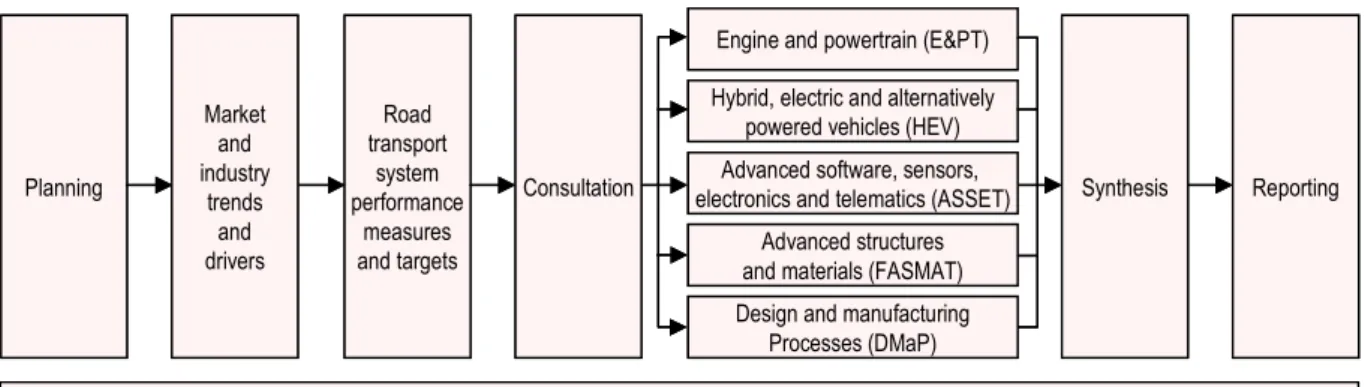
The process developed for Foresight Vehicle roadmapping is shown in Fig. 2. A series of ten
workshops has been used to collect, structure and share information and views, involving more than
130 experts from more than 60 organisations:
a)
Planning, to review scope and aims, and to support process design.
b)
Exploration of industry and market trends and drivers.
c)
Consideration of performance measures and targets for the road transport system.
d)
Consultation to solicit views from industry, academia and other organisations.
e)
Assessment of technology evolution and research requirements in the five areas of engine and
powertrain; hybrid, electric and alternatively fuelled vehicles; software, sensors, electronics and
telematics; structures and materials; and design and manufacturing processes.
f)
Synthesis and review.
Fig. 2 – Foresight Vehicle technology roadmapping process
The roadmap architecture is shown in Fig. 1, which is based on a timeframe of 20 years and the
following thematic layers:
·
Industry and market trends and drivers,
which define the strategic context in terms of overall
goals and requirements, together with enablers and constraints, in terms of the following
sub-themes are: society, economy, environment, technology, policy and infrastructure..
·
Road transport system performance measures and targets,
in response to the trends and drivers:
society, economy, environment, technology, policy and system.
·
Technology solutions and options
that can enable the performance targets to be achieved: engine
and powertrain; hybrid, electric and alternatively fuelled vehicles; software, sensors, electronics
and telematics; structures and materials; design and manufacturing processes.
Planning
Market
and
industry
trends
and
drivers
Road
transport
system
performance
measures
and targets
Consultation
Engine and powertrain (E&PT)
Hybrid, electric and alternatively
powered vehicles (HEV)
Advanced software, sensors,
electronics and telematics (ASSET)
Advanced structures
and materials (FASMAT)
Design and manufacturing
Processes (DMaP)
Synthesis
Reporting
Co-ordination, facilitation, data collection, analysis and structuring of information
Planning
Market
and
industry
trends
and
drivers
Road
transport
system
performance
measures
and targets
Consultation
Engine and powertrain (E&PT)
Hybrid, electric and alternatively
powered vehicles (HEV)
Advanced software, sensors,
electronics and telematics (ASSET)
Advanced structures
and materials (FASMAT)
Design and manufacturing
Processes (DMaP)
Synthesis
Reporting
8
The detailed roadmaps presented in this report (Appendices A to C) result largely from a creative
workshop process, and reflect the expert opinion of a wide range of participants involved with the road
transport sector. The information does not represent official company or Government policy, but
rather individual perspectives. The content of the top two layers (trends & drivers and performance
measures & targets) has been supplemented with reference to published sources (Appendix D).
9
2. Trends and drivers
The aim of the Foresight Vehicle technology roadmap is to relate technology and research
requirements to the trends and drivers that define the future needs of road transport in the UK, in the
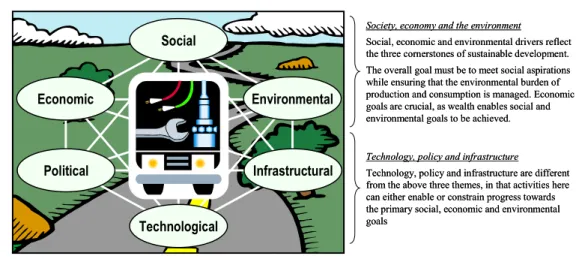
context of the broader integrated system of which it is a part. Six broad themes have been used to
structure the information contained in the roadmap, which is focused on the development of a
sustainable road transport system:
Fig. 3 – Trends and drivers that influence road transport system
1.
Social
trends and drivers relate to the social systems we live in, including demographics, life style
aspirations and choices, mobility requirements and behaviour, working patterns and desires for
health, safety and security.
2.
Economic
trends and drivers relate to the financial systems that affect our lives, including global,
national, corporate and personal economic considerations.
3.
Environmental
trends and drivers relate to the physical environment in which we live, including
energy production and consumption, waste, emissions and pollution, and the associated health
impacts.
4.
Technological
trends and drivers relate to how technology affects the way we live, including
development of new fuel and power systems, electronics and control technologies, structures and
materials, together with manufacturing and business processes.
5.
Political
trends and drivers relate to the systems that govern us, including policy, regulation and
legislation, together with the political processes that lead to them.
6.
Infrastructural
trends and drivers relate to the systems that support road transport, including the
physical roads and infrastructure, together with provision of associated services and information,
and the interfaces with other modes of transport.
These six themes are not independent, and there are many complex interdependencies between them.
For example, the related issues of vehicle fuel efficiency and CO
2emissions have significant
implications for society, economics, the environment, technology, politics and infrastructure.
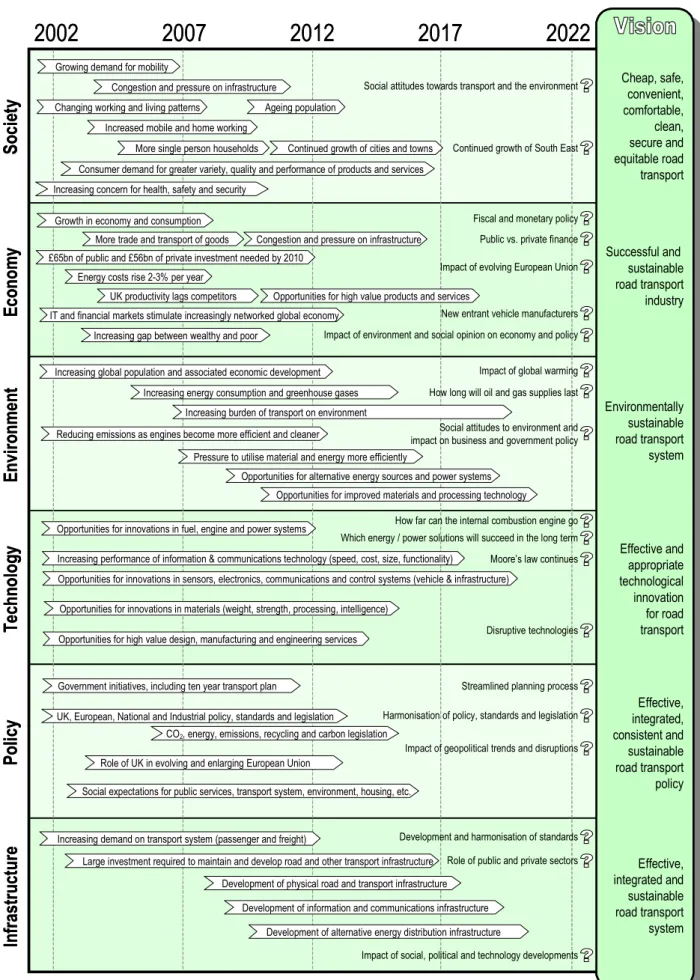
The detailed roadmap content is shown in Appendix A for each of these themes, summarised in this
section.
Social
Economic
Environmental
Technological
Political
Infrastructural
Society, economy and the environment
Social, economic and environmental drivers reflect the three cornerstones of sustainable development. The overall goal must be to meet social aspirations while ensuring that the environmental burden of production and consumption is managed. Economic goals are crucial, as wealth enables social and environmental goals to be achieved.
Technology, policy and infrastructure
Technology, policy and infrastructure are different from the above three themes, in that activities here can either enable or constrain progress towards the primary social, economic and environmental goals
Social
Economic
Environmental
Technological
Political
Infrastructural
Society, economy and the environment
Social, economic and environmental drivers reflect the three cornerstones of sustainable development. The overall goal must be to meet social aspirations while ensuring that the environmental burden of production and consumption is managed. Economic goals are crucial, as wealth enables social and environmental goals to be achieved.
Technology, policy and infrastructure
Technology, policy and infrastructure are different from the above three themes, in that activities here can either enable or constrain progress towards the primary social, economic and environmental goals
10
Fig. 4 – Industry and market trends and drivers
So
cie
ty
Ec
onom
y
En
viro
nmen
t
Te
ch
no
lo
gy
Po
lic
y
In
frastru
cture
2002 2007 2012 2017
2022
Cheap, safe,
convenient,
comfortable,
clean,
secure and
equitable road
transport
Ageing population Changing working and living patternsGrowing demand for mobility
Increasing concern for health, safety and security Congestion and pressure on infrastructure
Continued growth of cities and towns Consumer demand for greater variety, quality and performance of products and services
Growth in economy and consumption
Successful and
sustainable
road transport
industry
Increased mobile and home working More single person households
More trade and transport of goods
Social attitudes towards transport and the environment
£65bn of public and £56bn of private investment needed by 2010 Energy costs rise 2-3% per year
Congestion and pressure on infrastructure
Fiscal and monetary policy
UK productivity lags competitors Opportunities for high value products and services
New entrant vehicle manufacturers IT and financial markets stimulate increasingly networked global economy
Impact of environment and social opinion on economy and policy Increasing gap between wealthy and poor
Public vs. private finance Impact of evolving European Union
Increasing burden of transport on environment Increasing energy consumption and greenhouse gases
Pressure to utilise material and energy more efficiently Reducing emissions as engines become more efficient and cleaner
Impact of global warming
Environmentally
sustainable
road transport
system
How long will oil and gas supplies last Social attitudes to environment and impact on business and government policy Increasing global population and associated economic development
Opportunities for alternative energy sources and power systems
Effective and
appropriate
technological
innovation
for road
transport
Which energy / power solutions will succeed in the long term Opportunities for innovations in fuel, engine and power systems
Increasing performance of information & communications technology (speed, cost, size, functionality)
Opportunities for innovations in sensors, electronics, communications and control systems (vehicle & infrastructure) Opportunities for innovations in materials (weight, strength, processing, intelligence)
Disruptive technologies Opportunities for high value design, manufacturing and engineering services
Moore’s law continues How far can the internal combustion engine go
Effective,
integrated,
consistent and
sustainable
road transport
policy
Harmonisation of policy, standards and legislation Government initiatives, including ten year transport plan
Role of UK in evolving and enlarging European Union UK, European, National and Industrial policy, standards and legislation
CO2, energy, emissions, recycling and carbon legislation
Streamlined planning process
Impact of geopolitical trends and disruptions
Social expectations for public services, transport system, environment, housing, etc.
Increasing demand on transport system (passenger and freight) Development and harmonisation of standards
Effective,
integrated and
sustainable
road transport
system
Large investment required to maintain and develop road and other transport infrastructure Development of physical road and transport infrastructure
Development of information and communications infrastructure Development of alternative energy distribution infrastructure
Role of public and private sectors
Impact of social, political and technology developments Continued growth of South East
Opportunities for improved materials and processing technology
So
cie
ty
Ec
onom
y
En
viro
nmen
t
Te
ch
no
lo
gy
Po
lic
y
In
frastru
cture
2002 2007 2012 2017
2022
Cheap, safe,
convenient,
comfortable,
clean,
secure and
equitable road
transport
Ageing population Changing working and living patternsGrowing demand for mobility
Increasing concern for health, safety and security Congestion and pressure on infrastructure
Continued growth of cities and towns Consumer demand for greater variety, quality and performance of products and services
Growth in economy and consumption
Successful and
sustainable
road transport
industry
Increased mobile and home working More single person households
More trade and transport of goods
Social attitudes towards transport and the environment
£65bn of public and £56bn of private investment needed by 2010 Energy costs rise 2-3% per year
Congestion and pressure on infrastructure
Fiscal and monetary policy
UK productivity lags competitors Opportunities for high value products and services
New entrant vehicle manufacturers IT and financial markets stimulate increasingly networked global economy
Impact of environment and social opinion on economy and policy Increasing gap between wealthy and poor
Public vs. private finance Impact of evolving European Union
Increasing burden of transport on environment Increasing energy consumption and greenhouse gases
Pressure to utilise material and energy more efficiently Reducing emissions as engines become more efficient and cleaner
Impact of global warming
Environmentally
sustainable
road transport
system
How long will oil and gas supplies last Social attitudes to environment and impact on business and government policy Increasing global population and associated economic development
Opportunities for alternative energy sources and power systems
Effective and
appropriate
technological
innovation
for road
transport
Which energy / power solutions will succeed in the long term Opportunities for innovations in fuel, engine and power systems
Increasing performance of information & communications technology (speed, cost, size, functionality)
Opportunities for innovations in sensors, electronics, communications and control systems (vehicle & infrastructure) Opportunities for innovations in materials (weight, strength, processing, intelligence)
Disruptive technologies Opportunities for high value design, manufacturing and engineering services
Moore’s law continues How far can the internal combustion engine go
Effective,
integrated,
consistent and
sustainable
road transport
policy
Harmonisation of policy, standards and legislation Government initiatives, including ten year transport plan
Role of UK in evolving and enlarging European Union UK, European, National and Industrial policy, standards and legislation
CO2, energy, emissions, recycling and carbon legislation
Streamlined planning process
Impact of geopolitical trends and disruptions
Social expectations for public services, transport system, environment, housing, etc.
Increasing demand on transport system (passenger and freight) Development and harmonisation of standards
Effective,
integrated and
sustainable
road transport
system
Large investment required to maintain and develop road and other transport infrastructure Development of physical road and transport infrastructure
Development of information and communications infrastructure Development of alternative energy distribution infrastructure
Role of public and private sectors
Impact of social, political and technology developments Continued growth of South East
11
Social trends and drivers
Vision
Cheap, safe, convenient, comfortable, clean, secure and equitable road transport
Mobility and
congestion
There is a growing demand for mobility (passengers and goods), stimulated by economic
growth and development, together with changes in lifestyles and working patterns. The
road transport system plays a central role (80% of journeys are by car). With traffic
growth of 20-50% anticipated by 2010 for road, rail and air modes, there is a need for
massive investment in technology and infrastructure if current congestion trends are to be
countered and economic development assured.
Lifestyle and
attitudes
The road transport system must satisfy the needs of many parts of society, including
drivers, pedestrians, children, parents, employees and emergency services. The role of
business and government is to satisfy the needs and aspirations of these groups,
economically and with minimal impact on the environment. Living and working patterns
are expected to change, with increasing mobile and home working enabled by improved
information and communications.
Demographics
There is a need to anticipate and provide for demographic changes, such as an ageing
population and growth of industrial and urban areas. The demand for housing is
increasing, particularly in the South East, with 20% more houses required by 2020.
Approximately a quarter of the population will be of retired age by 2030. Global
population growth, combined with economic development, provides commercial
opportunities whilst posing a threat to the environment.
Health, safety
and security
There are about 3,500 road traffic deaths and 40,000 serious injuries in the UK each year,
with a significant social and economic impact (estimated to be 2% of GDP for Europe as
a whole). This, combined with the high level of vehicle crime in the UK, has resulted in
government and industry efforts to improve passenger and pedestrian safety and security.
Social demand for improved health will encourage continuing efforts to reduce emissions
and particulates.
Economic trends and drivers
Vision
Successful and sustainable road transport industry
National
economics
The transport / automotive sector represent a significant proportion of GDP (transport is
estimated to represent 10% of European GDP, with automotive accounting for 5.3% of
UK GDP, employing 700,000 and responsible for £20bn annual exports). The annual
cost of owning and running vehicles in the UK is £5bn, with an additional investment of
£2bn in road construction and £0.5bn in vehicle research and development. In addition,
congestion is estimated to cost the UK economy between £15-20bn each year.
Significant investment in infrastructure is required over the next 10 years (Government
10-year plan includes funding levels of £65bn from public and £56bn from private
sources). Government policy has an important role to play in changing industry and
consumer behaviour, with road usage likely to be increasingly taxed in order to tackle
congestion and environmental problems.
Freight
Up to 80% of domestic freight is carried by road, although estimates are lower for
Europe as a whole (44%). Increasing global production and trade mean that the demand
for freight carried by road, air and sea could double in the next 10 years.
Business
The UK has a vehicle manufacturing capacity of more than 1 million vehicles, and an
engine manufacturing capacity which will approach 4 million units by 2004.
Globalisation and consolidation trends continue, stimulated by financial markets and
improvements in information and communications technology. The competitive pressure
on volume and labour intensive manufacture will continue, with an increasing focus on
services and high-value engineering. Success in global markets will require continual
improvement to productivity and product development times for new vehicles, together
with the development of new and innovative high value technologies and products.
12
Consumer
Global population growth, combined with economic development, will provide both
commercial opportunities and pressure on political systems and the environment.
Increasing affluence, combined with new living and working patterns, will result in
demand for improved variety, performance and quality of goods and services. Social
disruption caused by an increasing wealth gap may have economic implications.
Environmental trends and drivers
Vision
Environmentally sustainable road transport system
Environmental
burden
Increasing road, rail, sea and air transport results in a greater burden on the environment,
in terms of greenhouse gas and other emissions, industrial and consumer waste, and
depletion of oil and other reserves. Road traffic in the UK is predicted to grow by 19%
by 2008, and by 50-160% over the next 20-30 years.
Global warming
Transport is responsible for 22% of UK greenhouse gas emissions, which may increase
by 25-50% over the next 10-20 years based on current trends, although government
policy aims for a 20% reduction in CO
2emissions by 2010. The global warming that
may be associated with greenhouse gas emissions could result in an average global
temperature rise of between 1.5 and 4.5
oC by 2050.
Pollution
Pollution causes around 24,000 premature deaths each year in the UK. Continuing
legislation, technological developments and progressive replacement of the vehicle fleet
by more modern vehicles will reduce vehicle emissions to less than 20% of their 1990
level by 2010, although increasing transport demand and congestion will have a counter
effect.
Energy
Fossil fuels supply 98% of transport energy demand, with world oil demand growing at
between 1.1 and 2.7% annually. It is predicted that conventional oil supply will peak
sometime between 2020 and 2040, after which demand will outstrip supply. The
environmental and commercial pressure for alternative energy systems will increase,
leading to a number of competing alternatives (for example, bio-fuels, electric motors
and batteries, hybrids, hydrogen internal combustion engines and hydrogen fuel cells).
Waste
End-of-life vehicles account for 1.8 million tonnes of waste in the UK each year. The
rising cost of landfill, together with European legislation on recycling will have an
impact on vehicle design, manufacturing, financing, maintenance and disposal.
Technological trends and drivers
Vision
Effective and appropriate technological innovation for road transport
Energy and
power
Currently road transport is heavily dependent on oil as a primary fuel source. However,
within the next 20 to 40 years the natural reserves of conventional oil may not be able to
keep up with an estimated 100% increase in demand. Activities are concentrating on
reducing fuel consumption of conventional vehicles, together with developing alternative
energy and power systems, such as hybrids, electric and alternatively fuelled vehicles.
Hydrogen and fuel cells are of particular importance, although it is likely to be 15-20
years before such systems become widely available. The large investment in fuel
distribution infrastructure required is a significant barrier to widespread adoption for
many alternative fuel solutions.
Electronics and
control
The performance of electronics and communications technology is rapidly advancing, in
terms of processing speed, miniaturisation, cost and functionality, driven by Moore’s law
(and the International Semiconductor Industry Roadmap). The value of electronics and
software in new vehicles will continue to increase, in areas such as control and
intelligence, telematics, information and service provision, entertainment and user
interfaces. Many of these functions will require parallel development of the infrastructure
to enable communications and system-level control. The development and agreement of
standards is a key enabler.
13
Structures and
materials
Developments in materials technology can provide a number of economic and
environmental benefits, in terms of reduced weight and material consumption, increased
strength, reduced energy consumption and increased vehicle performance. New materials
technologies of interest include lightweight alloys and polymers, fluids, coatings,
biotechnology and nanotechnology.
Processes and
systems
Effective manufacturing and management processes and systems are a key competitive
factor in the automotive sector, in terms of both efficiency and effectiveness. Of
particular importance are processes associated with research, design, new product
development, manufacturing and service provision. The UK has particular strengths in
design and value-added engineering services, although significant shortages in skilled
engineers, scientists and technologists are predicted.
Political trends and drivers
Vision
Effective, integrated, consistent and sustainable road transport policy
Transport
Significant government effort is directed towards transport, stimulated by the economic
and social impact of worsening congestion. The UK ten-year transport plan anticipates
£64.7bn public and £56.3bn private investment in urban and regional transport
infrastructure by 2010. Targets have been set for reductions in congestion; road widening
of 380 miles of the strategic road network; 80 trunk road schemes; 100 new bypasses;
130 major road improvement schemes; noise reduction; maintenance of roads, bridges
and lighting; improved information, booking and ticketing systems; 40% reduction in
deaths / serious injuries; accelerated take-up of cleaner vehicles. Bus, tram and light
railway solutions are planned for urban and regional development.
Energy and CO
2The need to use energy efficiently and reduce pollution, greenhouse gases and waste is
reflected in international agreements, European legislation and UK policy. Clear targets
are specified for improved fuel efficiency and the total level of CO
2and other
greenhouse gases produced as a by-product.
Waste
End-of-life vehicles account for 1% of Europe’s waste, with the UK producing 1.8
million tonnes each year. Reduced availability of landfill sites, together with taxation and
European end-of-life legislation may eventually lead to new forms of vehicle design,
manufacture and ownership. By 2015 it is expected that 95% of vehicles will be
recyclable, with only 5% destined for landfill (currently vehicles have one of the highest
recycling rates - more than 75%).
Health and
safety
The desire to reduce road deaths and serious injuries is emphasised in the UK ten-year
transport plan. Targets of 40% reductions in deaths and serious injuries, and 50% fewer
children killed or seriously injured have been set for 2010. This requires improvements
to infrastructure and vehicles, enabled by UK, European and Industry agreements and
standards and regulations. In addition there are European and UK targets for reductions
in emissions, particulates and pollutants.
Political system
UK and European political systems and processes underpin the delivery of an efficient
and effective road transport system, which requires a partnership between the private and
public sectors. The long-term capital investment associated with infrastructure requires
stable and integrated policies, while environmental targets require a willingness to
develop and abide by international agreements. Issues of particular importance in Europe
include the liberalisation of markets (for example, freight by 2008) and harmonisation of
legislation and standards.
14
Infrastructural trends and drivers
Vision
Effective, integrated and sustainable road transport system
Physical road
infrastructure
Significant efforts are needed to ensure that the physical road transport infrastructure is
maintained in good condition, and extended to accommodate future demand (which may
double by 2020). The UK ten-year plan includes substantial improvements to the urban
and regional road transport infrastructure. New road surfaces are being developed to
reduce noise and wear, with the long-term possibility of installing equipment to support
road trains (vehicle platooning).
Information and
communications
infrastructure
Rapid improvements in communications bandwidth and computer processing power
provide opportunities to improve the overall road transport system performance, in terms
of traffic management, reduced congestion, information services, improved safety and
security. The development of appropriate technical standards is important, particularly
when combined with new vehicle developments.
Energy
infrastructure
If alternative energy and power systems are to be developed and deployed widely in
vehicles, then appropriate fuel distribution networks will need to be established. It is
probable that a number of competing energy and power systems will be developed,
starting with LPG and battery / hybrid powered vehicles. However it is likely to be at
least 15 years or more before alternative energy sources such as hydrogen and bio-fuels
will be widely available.
Integrated
transport system
The effectiveness of the overall transport system demands that the links between the road
and other transport modes be considered. Inter-modal transport requires synchronisation
of timetables, integrated ticketing systems, together with accurate and up-to-date
information services for both passenger and freight.
15
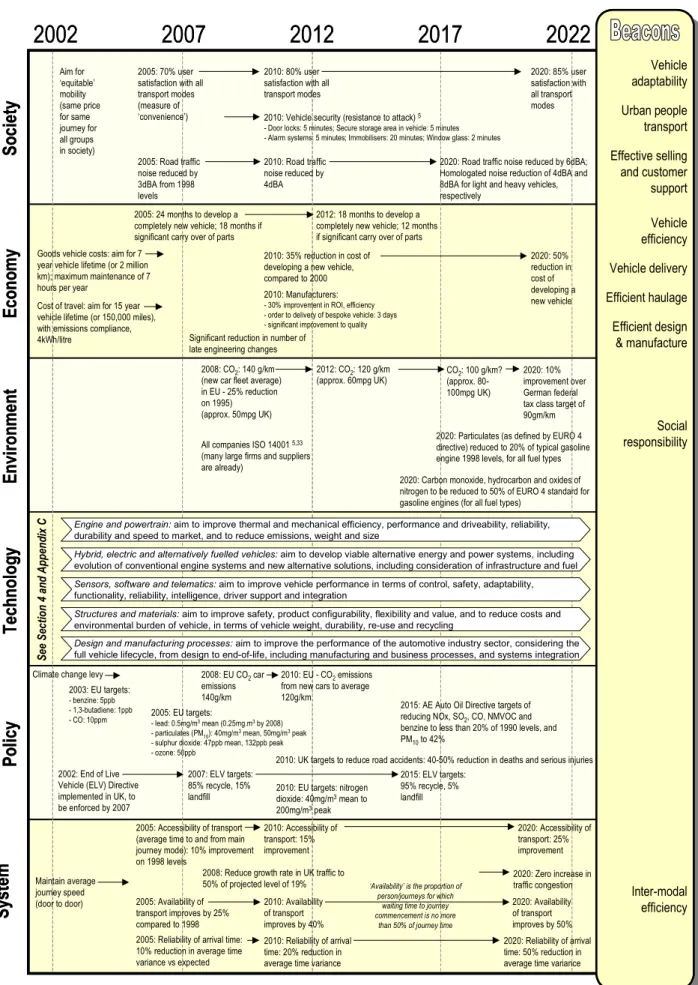
3. Performance measures and targets
The performance of the road transport system needs to improve if the desired social, economic and
environmental goals are to be achieved, enabled by technology, policies and infrastructure. Foresight
Vehicle is primarily concerned with supporting the development of innovative and appropriate
technologies that will lead to improvements in performance of the road transport system. The
relationship between technology developments, system performance and trends and drivers is a
fundamental aspect of the technology roadmap architecture (Fig. 1).
The performance measures and targets have been themed in a similar way to the trends and drivers:
1.
Social
performance measures and targets relate to mobility and congestion, lifestyle and attitudes,
together with health, safety and security.
2.
Economic
performance measures and targets relate to both business and consumer perspectives.
3.
Environmental
performance measures and targets relate to the overall environmental burden of
road transport, global warming, pollution, energy and material waste.
4.
Technological
performance measures and targets relate to energy and power, electronics and
control, materials and structures, together with the processes and systems that support
development of these technologies. This theme is different from the others, in that it directly
relates to the five technology areas considered in detail in Section 4.
5.
Political
performance measures and targets relate directly to Governmental policy, regulation,
legislation and action in the areas of energy and CO
2, health and safety, and waste management.
6.
System
performance measures and targets relate to the road transport system as a whole, which
includes consideration of the infrastructure and the level of system integration. It should be noted
that performance measures and targets for the infrastructure itself are not included in this roadmap,
as the focus in on road vehicles.
The technology roadmap builds on previous Foresight Vehicle work. The Strategic Plan
5defines a set
of nine visionary ‘Beacons’ that represent integrated aspects of the future system, encompassing
technology, product and market concepts, and these are described in detail in Appendix B. The
Beacons are related to road transport system performance measures and targets defined in the Strategic
Plan, summarised in Fig. 5 and presented in detail in Appendix B, which also includes additional
potential measures and issues identified during workshops.
16
Fig. 5 – Road transport system performance measures and targets
So
ciety
Ec
on
om
y
En
vi
ro
nm
en
t
Tech
no
log
y
Pol
ic
y
System
2002 2007 2012 2017
2022
Vehicle
adaptability
Urban people
transport
Effective selling
and customer
support
Vehicle
efficiency
Vehicle delivery
Efficient haulage
Efficient design
& manufacture
Social
responsibility
Inter-modal
efficiency
2005: 70% user satisfaction with all transport modes (measure of ‘convenience’)2010: 80% user satisfaction with all transport modes 2005: Road traffic noise reduced by 3dBA from 1998 levels 2010: Road traffic noise reduced by 4dBA 2020: 85% user satisfaction with all transport modes
2020: Road traffic noise reduced by 6dBA; Homologated noise reduction of 4dBA and 8dBA for light and heavy vehicles, respectively Aim for ‘equitable’ mobility (same price for same journey for all groups in society)
2010: Vehicle security (resistance to attack) 5
- Door locks: 5 minutes; Secure storage area in vehicle: 5 minutes - Alarm systems: 5 minutes; Immobilisers: 20 minutes; Window glass: 2 minutes
2020: 50% reduction in cost of developing a new vehicle 2010: Manufacturers:
- 30% improvement in ROI, efficiency - order to delivery of bespoke vehicle: 3 days - significant improvement to quality
Significant reduction in number of late engineering changes 2005: 24 months to develop a completely new vehicle; 18 months if significant carry over of parts
2010: 35% reduction in cost of developing a new vehicle, compared to 2000
Cost of travel: aim for 15 year vehicle lifetime (or 150,000 miles), with emissions compliance, 4kWh/litre
Goods vehicle costs: aim for 7 year vehicle lifetime (or 2 million km); maximum maintenance of 7 hours per year
2012: 18 months to develop a completely new vehicle; 12 months if significant carry over of parts
2008: CO2: 140 g/km (new car fleet average) in EU - 25% reduction on 1995) (approx. 50mpg UK)
All companies ISO 14001 5,33 (many large firms and suppliers are already)
2012: CO2: 120 g/km (approx. 60mpg UK)
2020: Particulates (as defined by EURO 4 directive) reduced to 20% of typical gasoline engine 1998 levels, for all fuel types 2020: Carbon monoxide, hydrocarbon and oxides of nitrogen to be reduced to 50% of EURO 4 standard for gasoline engines (for all fuel types)
2020: 10% improvement over German federal tax class target of 90gm/km CO2: 100 g/km? (approx. 80-100mpg UK) 2008: EU CO2car emissions 140g/km 2010: EU - CO2emissions from new cars to average 120g/km
2005: Reliability of arrival time: 10% reduction in average time variance vs expected
2010: Reliability of arrival time: 20% reduction in average time variance
2020: Reliability of arrival time: 50% reduction in average time variance 2010: Accessibility of transport: 15% improvement 2020: Accessibility of transport: 25% improvement 2005: Accessibility of transport
(average time to and from main journey mode): 10% improvement on 1998 levels 2005: Availability of transport improves by 25% compared to 1998 2010: Availability of transport improves by 40% 2020: Availability of transport improves by 50% Maintain average journey speed (door to door) 2020: Zero increase in traffic congestion 2008: Reduce growth rate in UK traffic to
50% of projected level of 19% ‘Availability’ is the proportion of person/journeys for which
waiting time to journey commencement is no more
than 50% of journey time
2002: End of Live Vehicle (ELV) Directive implemented in UK, to be enforced by 2007 2007: ELV targets: 85% recycle, 15% landfill 2015: ELV targets: 95% recycle, 5% landfill
2015: AE Auto Oil Directive targets of reducing NOx, SO2, CO, NMVOC and benzine to less than 20% of 1990 levels, and PM10to 42% 2010: EU targets: nitrogen dioxide: 40mg/m3mean to 200mg/m3peak 2003: EU targets: - benzine: 5ppb - 1,3-butadiene: 1ppb - CO: 10ppm
Climate change levy
2005: EU targets:
- lead: 0.5mg/m3mean (0.25mg.m3by 2008)
- particulates (PM10): 40mg/m3mean, 50mg/m3peak
- sulphur dioxide: 47ppb mean, 132ppb peak - ozone: 50ppb
2010: UK targets to reduce road accidents: 40-50% reduction in deaths and serious injuries
See Se
ct
ion 4 an
d Append
ix
C
Engine and powertrain:aim to improve thermal and mechanical efficiency, performance and driveability, reliability, durability and speed to market, and to reduce emissions, weight and sizeHybrid, electric and alternatively fuelled vehicles:aim to develop viable alternative energy and power systems, including evolution of conventional engine systems and new alternative solutions, including consideration of infrastructure and fuel
Sensors, software and telematics:aim to improve vehicle performance in terms of control, safety, adaptability, functionality, reliability, intelligence, driver support and integration
Structures and materials:aim to improve safety, product configurability, flexibility and value, and to reduce costs and environmental burden of vehicle, in terms of vehicle weight, durability, re-use and recycling
Design and manufacturing processes:aim to improve the performance of the automotive industry sector, considering the full vehicle lifecycle, from design to end-of-life, including manufacturing and business processes, and systems integration
So
ciety
Ec
on
om
y
En
vi
ro
nm
en
t
Tech
no
log
y
Pol
ic
y
System
2002 2007 2012 2017
2022
Vehicle
adaptability
Urban people
transport
Effective selling
and customer
support
Vehicle
efficiency
Vehicle delivery
Efficient haulage
Efficient design
& manufacture
Social
responsibility
Inter-modal
efficiency
2005: 70% user satisfaction with all transport modes (measure of ‘convenience’)2010: 80% user satisfaction with all transport modes 2005: Road traffic noise reduced by 3dBA from 1998 levels 2010: Road traffic noise reduced by 4dBA 2020: 85% user satisfaction with all transport modes
2020: Road traffic noise reduced by 6dBA; Homologated noise reduction of 4dBA and 8dBA for light and heavy vehicles, respectively Aim for ‘equitable’ mobility (same price for same journey for all groups in society)
2010: Vehicle security (resistance to attack) 5
- Door locks: 5 minutes; Secure storage area in vehicle: 5 minutes - Alarm systems: 5 minutes; Immobilisers: 20 minutes; Window glass: 2 minutes
2020: 50% reduction in cost of developing a new vehicle 2010: Manufacturers:
- 30% improvement in ROI, efficiency - order to delivery of bespoke vehicle: 3 days - significant improvement to quality
Significant reduction in number of late engineering changes 2005: 24 months to develop a completely new vehicle; 18 months if significant carry over of parts
2010: 35% reduction in cost of developing a new vehicle, compared to 2000
Cost of travel: aim for 15 year vehicle lifetime (or 150,000 miles), with emissions compliance, 4kWh/litre
Goods vehicle costs: aim for 7 year vehicle lifetime (or 2 million km); maximum maintenance of 7 hours per year
2012: 18 months to develop a completely new vehicle; 12 months if significant carry over of parts
2008: CO2: 140 g/km (new car fleet average) in EU - 25% reduction on 1995) (approx. 50mpg UK)
All companies ISO 14001 5,33 (many large firms and suppliers are already)
2012: CO2: 120 g/km (approx. 60mpg UK)
2020: Particulates (as defined by EURO 4 directive) reduced to 20% of typical gasoline engine 1998 levels, for all fuel types 2020: Carbon monoxide, hydrocarbon and oxides of nitrogen to be reduced to 50% of EURO 4 standard for gasoline engines (for all fuel types)
2020: 10% improvement over German federal tax class target of 90gm/km CO2: 100 g/km? (approx. 80-100mpg UK) 2008: EU CO2car emissions 140g/km 2010: EU - CO2emissions from new cars to average 120g/km
2005: Reliability of arrival time: 10% reduction in average time variance vs expected
2010: Reliability of arrival time: 20% reduction in average time variance
2020: Reliability of arrival time: 50% reduction in average time variance 2010: Accessibility of transport: 15% improvement 2020: Accessibility of transport: 25% improvement 2005: Accessibility of transport
(average time to and from main journey mode): 10% improvement on 1998 levels 2005: Availability of transport improves by 25% compared to 1998 2010: Availability of transport improves by 40% 2020: Availability of transport improves by 50% Maintain average journey speed (door to door) 2020: Zero increase in traffic congestion 2008: Reduce growth rate in UK traffic to
50% of projected level of 19% ‘Availability’ is the proportion of person/journeys for which
waiting time to journey commencement is no more
than 50% of journey time
2002: End of Live Vehicle (ELV) Directive implemented in UK, to be enforced by 2007 2007: ELV targets: 85% recycle, 15% landfill 2015: ELV targets: 95% recycle, 5% landfill
2015: AE Auto Oil Directive targets of reducing NOx, SO2, CO, NMVOC and benzine to less than 20% of 1990 levels, and PM10to 42% 2010: EU targets: nitrogen dioxide: 40mg/m3mean to 200mg/m3peak 2003: EU targets: - benzine: 5ppb - 1,3-butadiene: 1ppb - CO: 10ppm
Climate change levy
2005: EU targets:
- lead: 0.5mg/m3mean (0.25mg.m3by 2008)
- particulates (PM10): 40mg/m3mean, 50mg/m3peak
- sulphur dioxide: 47ppb mean, 132ppb peak - ozone: 50ppb
2010: UK targets to reduce road accidents: 40-50% reduction in deaths and serious injuries
See Se
ct
ion 4 an
d Append
ix
C
Engine and powertrain:aim to improve thermal and mechanical efficiency, performance and driveability, reliability, durability and speed to market, and to reduce emissions, weight and sizeHybrid, electric and alternatively fuelled vehicles:aim to develop viable alternative energy and power systems, including evolution of conventional engine systems and new alternative solutions, including consideration of infrastructure and fuel
Sensors, software and telematics:aim to improve vehicle performance in terms of control, safety, adaptability, functionality, reliability, intelligence, driver support and integration
Structures and materials:aim to improve safety, product configurability, flexibility and value, and to reduce costs and environmental burden of vehicle, in terms of vehicle weight, durability, re-use and recycling
Design and manufacturing processes:aim to improve the performance of the automotive industry sector, considering the full vehicle lifecycle, from design to end-of-life, including manufacturing and business processes, and systems integration
17
4. Technology
Technology provides the principle means by which the required improvements to the road transport
system will be achieved. The broad definition of technology as ‘know-how’ has been adopted, which
emphasises that technology concerns the application of knowledge. This includes ‘hard’ technology,
which is based on science and engineering principles, as well as ‘soft’ technology, which includes the
processes and organisation required to exploit science and engineering know-how effectively.
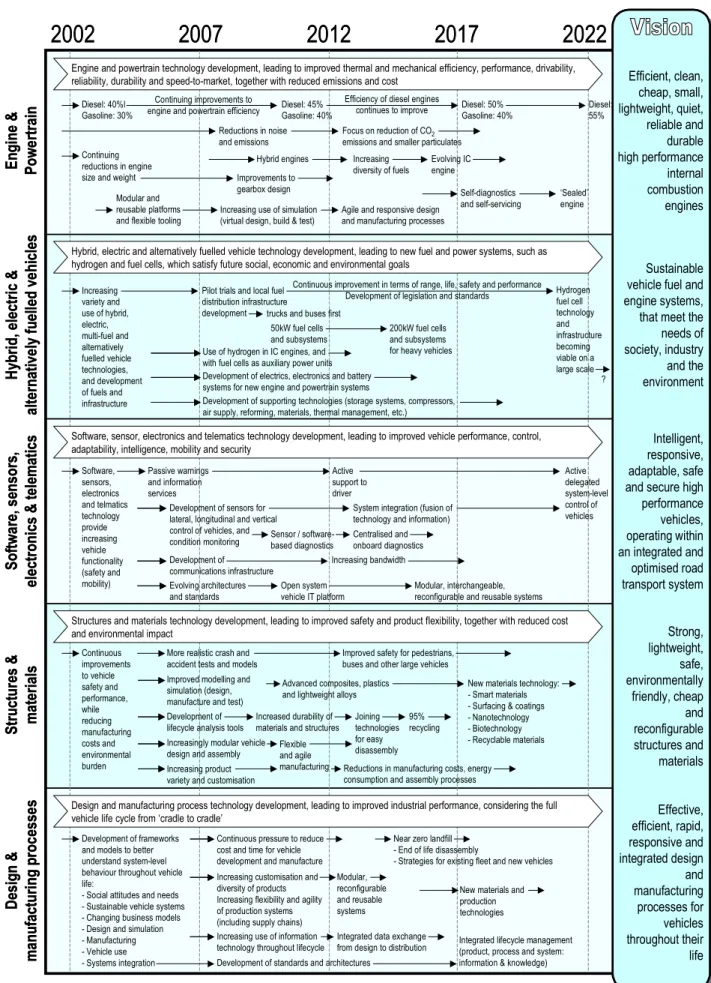
This section includes a summary of the outputs from five workshops (Appendix C), focusing on the
following technological areas, each of which represents a Foresight Vehicle Technology Group (TG).
Technology evolution is considered, together with research challenges.
1.
Engine and powertrain (E&PT)
·
Thermal and mechanical efficiency
·
Performance and drivability
·
Emissions (pollution and noise)
·
Reliability and durability
·
Speed to market and cost
·
Weight and size
2.
Hybrid, electric and alternatively fuelled vehicles (HEV)
·
Hydrogen and fuel cells
·
Hybrid and advanced internal combustion engines
·
Electrics and electronics for energy and drive systems
·
Conventional and alternative fuels
3.
Advanced software, sensors, electronics and telematics (ASSET)
·
Shift to software
·
Access and use of vehicles
·
Architectures and reliability
4.<