A Fundamental Study on Reinterpretation of Wisdom through Project Risk Management for Water Environment Partnership in Asia
Tsunemi Watanabe
Kochi University of Technology, Frontier Engineering Course Tosayamada, Kami-city, Kochi, 782-8502, Japan
Abstract
Asia has much wisdom for human beings to coexist with the environment. Therefore, its active utilization is useful for water environment management in the world, which faces a formidable challenge. In this paper, thus, an attempt is made to reinterpret some of the wisdom through project risk management. Wisdom and project risk management are different types of knowledge: tacit and formal knowledge, respectively. Project risk management is rapidly becoming popular in the world including Asia. Thus, such a reinterpretation would be easy for the western society to understand and accept the wisdom. It would be also easy for the Asian society to apply the wisdom with more confidence and transparency.
Introduction
Asia has much wisdom for human beings to coexist with the environment; therefore, its active utilization is useful for water environment management in the world, which faces a formidable challenge. In this paper, thus, an attempt is made to reinterpret some of the wisdom through project risk management. Wisdom and project risk management are different types of knowledge: tacit and formal knowledge, respectively. Project risk management is rapidly becoming popular in the world including Asia. Thus, such a reinterpretation would be easy for the western society to understand and accept the wisdom. It would be also easy for the Asian society to apply the wisdom with more confidence and transparency.
Overview of project risk management
Main elements of project risk management are to identify, structure and analyze, and respond to major risk factors. Risk management process is a tool for assisting a project manager to conduct the above whole series of sub-processes. Application results are often represented with the trade-off between return and risk. Here, return is usually defined as the expected value of what the manager will achieve as her/his objective, and risk is defined as the variance of what she/he will achieve as her/his objective. Measures bringing a situation with lower risk and higher return are desirable. If either is improved without sacrificing the other, that situation is said to be in “risk efficient”
A case study of an accident in a daycare center
Since results of case studies and views from different viewpoints are encouraged to discuss in this conference, the author would like to introduce a case study of an accident in a daycare center. This case study actually brings useful perspectives into water environment management.
Ageo-city in 2005. After the accident, there was a discussion that assuring safety is of course important but free nursing is also important. Nishikawa distinguishes between caring and nurturing and defines caring as “making a child stay away from any danger” and “nurturing as encouraging a child to live vividly at each moment by making a small failure and learning from it (Nishikawa, 2006) .”
Nishikawa further states that “discussions swings between caring and nursing. This swing is a proof of sound daycare center.” and that “nurturing becomes only possible by officially and unofficially embedding the opportunities in administration of the daycare center for sharing the above-mentioned swing, bringing up worries and problems associated with nurturing from the both staffs and parents, and discussing among parents how the nurturing should be. It is important for parents and staffs to stay close so that they can share a fear of incident.”
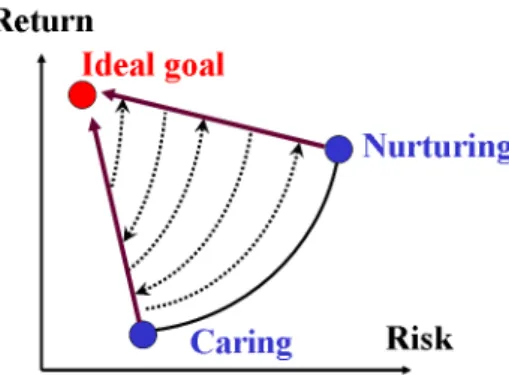
Significance of the swing from project risk management viewpoints is explained in Figure 1. Here return and risk are defined as the expected value and variance of what each child achieves as her/his objective, respectively. Then the caring is considered a low risk and low return task, and the nurturing may be perceived as a high risk and high return task. In principle the swing seems nothing more than consensus building steps towards ideal goals with lower risk and higher risk. The swing is an indispensable step towards a risk efficient solution.
Figure 1. Significance of the swing from project risk management viewpoints Multi-party risk efficiency
Yoshida points out that recent Japanese public works tend to be implemented on the adversarial axis between the public administration and residential people or citizens and that this axis should be redirected into dialogical axis to achieve consensus building. Major steps towards the consensus building include listening to each other, swinging, accepting each other, and creating responsibilities each other (Yoshida, 2006).
Yoshida’s views seem valid to projects other than recent Japanese public works. In practice, however, this mutual listening process is often “skipped.” As a result, some transaction does not necessarily put the all transacting parties in risk efficient conditions. Pippatanapiwon and Watanabe define multi-party risk efficiency as the situation in which all parties in the transaction are in risk efficient conditions. For successful project risk management, it is important to take risk management measures that are able to achieve the multi-party risk efficiency. In future water environmental management, its significance is considered the same.
For example, human beings take a significant amount of water for hydraulic power generation from many rivers. As a result, little water is left for underwater creatures. This water allocation enables only the human beings to enjoy “convenient” lives but often puts lives of underwater creatures in danger. This allocation apparently does not achieve the multi-party risk efficiency and is undesirable in developing water environment partnership.
Two components are important to achieve the multi-party risk efficiency: recalling a sense of shame through straightforward presentation for honest listening and reconsidering meaning of convenience. Each is discussed in the following sections.
Recalling a sense of shame through straightforward presentation
The first component is to recall a sense of shame of indifferent people through straightforward presentation. People belonging to an organization with a hierarchical structure often have a difficulty in listening to others honestly. They often act as components of their organizational system, that is, replaceable and invisible even though they do not want to do so. They can only speak “language prescribed by the system.” They have a difficulty in talking about not only other peoples’ feeling but also their own feeling. Especially many Japanese public administrators have this fate (Kato, 1997). For example, it is often said an administrative officer responsible for compensation negotiation associated with dam construction is discouraged to have a chat with residential people who are required to move out the dam site. Thus, it is often extremely difficult for such a replaceable and invisible component to do honest listening.
However, the honest listening may be possible by recalling a sense of shame through straightforward presentation. Monobe river flowing in Kochi in Japan is a good example of this. The river used to be known for a very clean stream but is now facing a critical situation of a sharp decrease in catches of sweetfish. Its annual catches were beyond 70 tons in the beginning of 1980s but became less than one ton in 2006. Though existence of sweetfish is considered a symbol of a clean stream, many farmers who have been enjoying a sufficient amount of water intake are indifferent to this sweetfish crisis.
When young staffs in the agricultural sector participated in a cleanup event of the river and found plastic bags and bottles farmers left, the staffs were shocked and shamed with their colleagues’ behaviour. This incident becomes one of turning points in attitudes of some people in the agricultural sector towards the river. Some cooperative activities are started by the agricultural sector and the inland water fishery sector in solving drought problem and agricultural muddy water problem to improve the river environment and to restore the sweetfish.
This story of Monobe river shows that recalling a sense of shame through straightforward presentation is a worth-while attempt for the honest listening.
Reconsidering meaning of convenience
The second component is reconsideration of meaning of convenience. Ohnishi (Ohnishi, 2006) successfully demonstrates this necessity through his interviewing people for years who have been living in old Tokuyama village, which went under water due to dam construction. An old man says, “We have to move with our legs to do our works, but we can do them in the
range where we can walk. Cars and trains were not really necessary before. We could manage without them. Living in the heart of the mountain is not as inconvenient as you imagine. We actually think it is convenient.”
Ohnishi then says, “Meanings of “convenience” are totally different in between the current generation and old generation. The old people never feels convenient in the world where everything can be operated with one switch. Jo-san, the name of an old lady, always says that living in a city is inconvenient. …The terra may have provided human beings with everything which are needed for them to be alive.” (Description with the underline was inserted by the author.)
Ohnishi also describes Jo-san as follows: “She is enjoying this earth very very much. She works very hard to eat, but she is never unhappy to do so. She seems to be telling me that her outlook on value of work is fundamentally different from our objective of work, that is, to eat.”
The author interprets the two meanings of convenience as follows. For people of the current generation, it is a possibility that they pursue return, that is, whatever they want to do without risk, that is, being worried about any life-threatening event. For the people in the old generation, it is enjoyment to be united with the nature, that is return, and assurance, that is opposite to risk, of living in the nature where they can well manage their lives for themselves most of the time.
It is never easy for them to survive in the heart of the mountain. They can only do so by carefully and more importantly enjoyably observing any change in the nature as well as acquiring and practicing wisdom which have been taking over from their ancestors over the generations. In this sense they always conduct risk management independently through avoiding and responding to factors to threaten their lives. Furthermore their pursuit of return and risk management are united and can not be separated. Independence and unification are the pillars of their convenience.
However, they are never overconfident. Ohnishi observes them and says, “They very often clasp their hands in prayer towards the gods of fire, water, ground, and light. The god lies in anything.” The author observes that this pray is practice of one of “the golden rules” in project risk management: minimize risks that you do not control (Kashiwagi, 2004). No matter how hard each party tries to manage risks, certain risks may be out of her/his control. In project management such risks may be transferred to other party through contract. The behaviour of the old peoples of appreciating for today’s happiness and peace, today’s return, and praying for tomorrow’s happiness and peace, reciprocal concept of tomorrow’s risk, is considered equivalent to behaviour of an excellent project manager of pursuing return while minimizing risks she/he does not control.
This independent and unified management by the old people is totally opposite to the people of the current generation. The current people pursue their return but hand most of “rights” of managing life-threatening events to other people such as government. Thus, the full dependency of risk management of one’s own life on others and separation between the return pursuit and the risk management are the pillars of their convenience.
of not a few Japanese is also seriously questioned. Under this situation, the full dependency and separation of the return pursuit and the risk management is not a wise idea. The current people should change their concept of convenience to more independency and unification of the return pursuit and the risk management.
References
Kashiwagi, D. (2004), Best Value Procurement, 2nd edition, Performance Based Studies Research Group, Arizona
Kato, T. (2002), Japanese for citizens, Hitsuji Shobo, Tokyo, Japan (in Japanese)
Nishikawa, T. (2006) My important place, Hands on Saitama, Saitama, Japan (in Japanese) Ohinishi, N. (2006) Treasures in my village, Information Center Pub. Tokyo, Japan (in Japanese)
Yoshida, R. (2006) Consensus building with listening to each other, presented at constr. mgt. committee of the JSCE, Tokyo, July 27, 2006 (in Japanese)