ALTERNATIVE METHODS AND FORUMS TO OPTIMIZE PUBLIC PARTICIPATION IN THE PLANNING PROCESS
A Thesis presented to
the Faculty of California Polytechnic State University, San Luis Obispo
In Partial Fulfillment
of the Requirements for the Degree Master of City and Regional Planning
by
Joseph James David April 2010
Guadalupe Community Workshop
2010
COMMITTEE MEMBERSHIP
TITLE: ALTERNATIVE METHODS AND FORUMS TO OPTIMIZE PUBLIC PARTICIPATION IN THE PLANNING PROCESS
AUTHOR: Joseph James David
DATE SUBMITTED: April 2010
COMMITTEE CHAIR: Umut Toker, Ph.D.
Cal Poly City and Regional Planning
COMMITTEE MEMBER: William Siembieda, Ph.D.
Cal Poly City and Regional Planning
COMMITTEE MEMBER: John Mandeville, Director
ABSTRACT
ALTERNATIVE METHODS AND FORUMS TO OPTIMIZE PUBLIC PARTICIPATION IN THE PLANNING PROCESS
Joseph James David
“Public participation” takes on various forms in the realm of local government planning. Many planners stand behind the ideal of involving community, but participation in practice often fails to achieve this objective. The primary vehicle for local government participation is the public hearing, which is a formalized process that often elicits one-way communication from planner to public. The nature of a hearing is to inform the public about development applications or policy changes, expose governing body decisions to the public, and elicit reactions from interested members of the public. Significant effort is taken daily by local planning departments to promote this transparent form of decision-making. The public can stay informed by reading legal ads in the newspaper, checking municipal websites, paying attention to public notice signs, attending hearings or simply receiving a hearing notice in their mailbox. However, staying informed and being involved are two completely different concepts. True involvement is two-way communication between public and planner. This study reports that the public hearing does not provide this necessary involvement. Alternative methods, such as workshops, are explored that break the formal mold of local government participation. Findings indicate that participation is more genuine in a loosely structured setting where face-to-face communication can occur between public and planner and among members of the public themselves. However, findings also suggest that genuine participation is not always appropriate given the intent of a public meeting. Many hearings are held at the end of the planning process for development applications requiring quasi-judicial decisions based on standards. The key is getting public input on earlier legislative decisions about policies that define the standards themselves. This study concludes with a toolkit of techniques practitioners can use to enhance public participation in planning, and observations about appropriate stages to implement those techniques in the planning process.
TABLE OF CONTENTS
Page
LIST OF TABLES ... viii
LIST OF FIGURES ...ix
1. INTRODUCTION ... 1
2. THE PROBLEM AND ITS SETTING ... 4
2.1 Participation in practice ... 4
2.2 Participation in existing literature... 5
3. REVIEW OF EXISTING LITERATURE ... 10
3.1 Genuine vs. pseudo participation ... 10
3.2 Participation methods... 12
A. Public hearing. ... 12
B. Community workshop. ... 14
C. Open house. ... 15
D. Stakeholder meetings/focus group... 16
E. Web-based participation. ... 16
4. METHODOLOGY ... 18
4.1 Research objectives ... 18
4.2 Methodology... 18
4.3 Methods and instrumentation ... 18
A. Case Studies... 18
4.5 Strategy for reporting findings ... 22
5. FINDINGS ... 23
5.1. Case studies ... 23
06/07/07 – Study Session: Santa Maria Planning Commission... 23
10/17/07 – SLO Planning Commission Special Workshop. ... 26
11/28/07 – San Luis Obispo Planning Commission Regular Meeting. ... 30
04/07/08 – SLO Architectural Review Commission Regular Meeting. ... 33
10/23/08 – Vision for Guadalupe 2030: Community Meeting One... 37
11/20/08 – Vision for Guadalupe 2030: Community Meeting Two... 41
02/05/09 – Vision for Guadalupe 2030: Community Meeting Three. ... 45
02/26/09 – Vision for Guadalupe 2030: Community Meeting Four. ... 47
03/12/09 – Vision for Guadalupe 2030: Community Meeting Five... 50
06/15/09 – San Luis Obispo County Budget Hearings. ... 54
06/16/09 – Atascadero City Council & Planning Commission. ... 56
08/18/09 – SLO Preservation and Design Review Workshop. ... 61
09/10/09 – City of San Luis Obispo Housing Element Workshop... 64
11/19/09 – SLO Climate Action Plan Community Workshop. ... 67
5.2. Interviews ... 72
6. DISCUSSION ... 77
6.1. Attendance and outreach ... 77
6.2. Project scope ... 80
6.3. Formalities... 82
6.4. Space planning ... 83
6.6. Group dynamics ... 91
6.7. Planner’s role ... 94
6.8. Technology... 96
7. CONCLUSIONS AND FUTURE IMPLICATIONS ... 100
7.1 Review of major observations ... 100
7.2 Measuring effectiveness in engaging the public ... 106
7.3 A participation toolkit for planning practitioners ... 107
BIBLIOGRAPHY... 116
APPENDIX A: Case Study Field Notes ... 119
LIST OF TABLES
Table Page
1. The shift from strictly instrumental to practical-communicative action...8
2. Case studies...21
3. Interviews with California planners... 22
4. Comparative summary of case study observations...78
5. Public hearing power structure... 88
6. Public workshop power structure... 89
7. Modified interpretation of Forester’s table... 96
8. Distinctions between participation methods...102
9. Practicality of scale...103
LIST OF FIGURES
Figure Page
1. Arnstein’s ladder of participation... 11
2. Role of participation in community design... 11
3. Picket sign in opposition to project... 35
4. Guadalupe massing model... 49
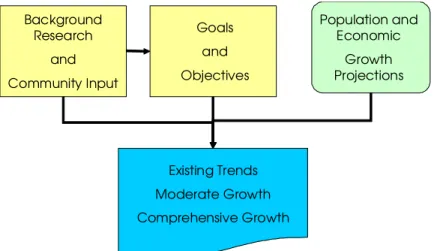
5. Flow chart of a community plan... 52
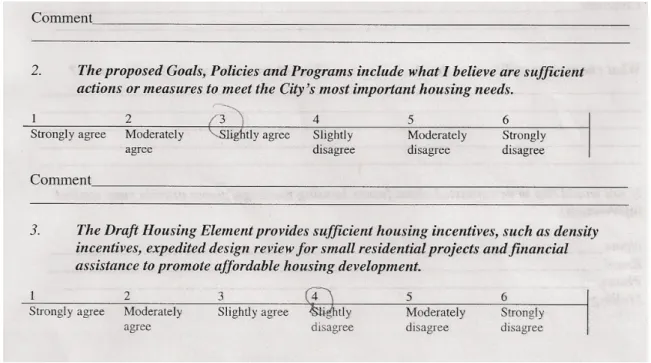
6. SLO Housing Element survey... 66
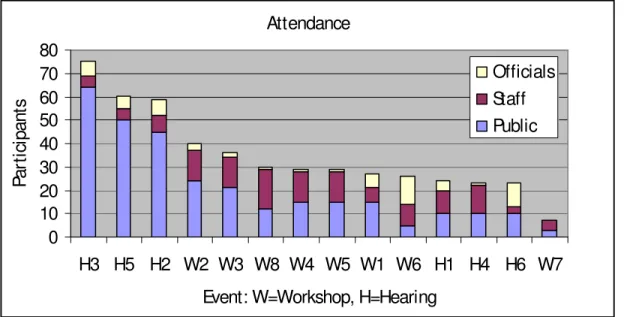
7. Total attendance by case study... 79
8. Lecture hall setup... 84
9. Roundtable setup... 85
10. Comparison of average speaking time by participant... 91
11. Best and worst cases of speaker duration... 92
12. Progression of visualization tools... 98
13. Measuring effectiveness in engaging the public...107
1. INTRODUCTION
Public participation should be a democratic process that informs decision makers about the objectives and concerns of the affected community (Brooks, 2002). Planners typically employ the existing standard – the public hearing – to achieve this objective.
The roots of public hearings stem from a desire for government “transparency”. Residents must be able to “see through” the workings of government to know exactly what goes on when public officials transact public business. Government that is not transparent is more prone to corruption and undue influence because there is no public oversight of decision making (Nadler, 2006). In California, the Ralph M. Brown Act (CA Gov. Code, § 54950) provides government transparency by requiring open meetings for local government bodies, including city councils, boards of supervisors, and district boards. The Brown Act requires adequate public notice prior to any meeting and that every agenda for a regular meeting provide an opportunity for members of the public to give testimony. As the courts have stated, the purpose of the Brown Act is to facilitate public participation in local government decisions and to curb misuse of the democratic process by secret legislation by public bodies (Cohan v. City of Thousand Oaks (1994) 30 Cal.App.4th 547, 555).
A significant point of concern is whether “public testimony” is adequate public participation. “Participation” implies a level of proportionate decision making power. Hearing attendees from the general public are given a set time limit to express their views about a particular agenda item. This window of opportunity is
usually at the end of the meeting, and largely at the end of the planning process when decisions have already been made.
This study investigates what levels of public participation occur in local government planning. The premise is that public participation is an essential component of modern planning, because educating the community and implementing public preferences in certain planning actions leads to successful policies, plans and projects. The objective is to develop a toolkit of techniques that planners and government officials can use to enhance public participation throughout all stages of the planning process.
Initially, a discussion of public participation in practice is carried out, followed by a review of participation theory as it pertains to planning decisions. Existing literature categorizes public involvement in planning into two general classifications: genuine participation versus pseudo participation. Different participation methods are identified that fit into these two categories.
The method for analysis is observation of multiple case studies, which inform findings about the practice of public participation in local government planning. Two primary methods are evaluated at different ends of the participation spectrum: the public hearing and public workshop. This cross-comparison approach helps establish what parameters of participation events elicit varying behaviors from the general public, and offers analysis of public behavior in meetings to determine when and where genuine participation can and should occur. Interviews with current practitioners are conducted that validate observations in the field and offer additional solutions for gathering public input.
This study concludes with a toolkit of techniques practitioners can use to enhance public participation in planning, and observations about appropriate stages to implement those techniques in the planning process.
2. THE PROBLEM AND ITS SETTING 2.1 Participation in practice
The goal of public participation is to educate and involve the affected community in every stage of planning decisions. Studies have shown that involving the public early and often in the planning process will increase the likelihood that the resulting plans, programs and public policy will be successfully implemented (So, et al., 2000). If local residents are directly involved in the planning process they will be able to identify with the reasons behind planning decisions and take ownership of implementing the objectives of the plan. There is no better watchdog than the eyes and ears of an involved constituency. Planning should be a dynamic and open process that welcomes community input at all levels of decision-making. The State of California recognizes this in planning and zoning legislation:
65033. Public participation
The Legislature recognizes the importance of public participation at every level of the planning process. It is therefore the policy of the state and the intent of the Legislature that each state, regional, and local agency concerned in the planning process involve the public through public hearings, informative meetings, publicity and other means available to them, and that at such hearings and other public forums, the public be afforded the opportunity to respond to clearly defined alternative objectives, policies, and actions (Planning and Zoning Law, State of California).
The Legislature leaves the public involvement process open to public hearings, informative meetings, and other public forums. Public hearings emerge from the list as the predominant vehicle for involving the public, especially because certain development actions legally require public hearings (Planning and Zoning Law, CA). In 2007, approximately 80 percent of the City of San Luis Obispo Planning Department’s public participation efforts were public hearings (City of San Luis
Obispo, 2007). This heavy reliance on public hearings is not uncommon for most planning departments. Local governments encourage private sector planners and developers to conduct informational meetings and outreach to those affected by their development projects, but workshops are usually limited to City-sponsored projects that occur sporadically throughout the year.
Many planners support the idea of public involvement in planning, but in practice there is a considerable amount of cynicism among planners about the benefits of citizen participation (Brooks, 2002). As a result, community participation in planning elicits mixed reviews from decision-makers. City managers and council members in many cities resist public involvement because of increased costs, time and effort (Fulton, 1999). Public workshops have a fiscal impact on declining local government resources, and managers see no problem with decision-making elite. Planners practice public participation because it aligns with their value systems, but they rarely expect it to achieve any measurable progress (Brooks, 2002).
2.2 Participation in existing literature
Civil movements of the 1960s propelled the whole nation towards active participation. Until that time, public input played a minority role in shaping the design of cities. Paul Davidoff (1965) pioneered new directions in advocacy planning, an attempt to decentralize the decision-making process and make it more representative of the entire community. Davidoff (1965) argued that planning is political, whereby different interest groups compete to influence policy based on their own social agenda. Competing interest groups have varying
degrees of power and representation, which creates inequalities among stakeholders in the planning process. Davidoff (1965) suggested that it is the role of planners to equalize the democratic playing field by representing the objectives of disadvantaged groups in planning practice. This will enable underrepresented residents to provide valuable input on the plans created for their community.
Michael Brooks (2002) stated that advocacy planning implies that “major decisions should be placed in the hands of the citizenry itself”. Emphasis is shifted from the technical expert to the diversity of competing interest groups within the community. However, the rational model remains the predominant mode for making planning decisions. Rationality is premised on finding the “correct answer”, and assumes that people will choose to maximize utility when faced with competing alternatives (Banfield, 1959). Advocacy planning simply increases the number of alternatives considered and expands the umbrella of individuals who will benefit from the rational planning process (Brooks, 2002).
Current participation advocates prescribe to communicative action theory, which evolved from Davidoff’s advocacy planning. Communicative action theorists concern themselves more with the process of arriving at planning decisions than the actual rationality of the decision itself. Postmodern planners that practice communicative action feel that planning should be highly interactive and include as many stakeholders as possible. The ultimate goal of communicative planning is to create collective meaning among differing interest groups, with the best-case scenario resulting in consensus (Innes, 1998).
Implicit in the communicative action approach is the idea that there are many types of embedded information that govern people’s behaviors (Innes, 1998). Planning is not simply “talk” or “effective communication skills”; all of the planner’s actions – behavioral cues, silence, acknowledgements, body language and verbal communication – shape the expectations and desires of participating stakeholders (Forester, 1993). It can be argued that this is true for all professions that practice in the public eye. Planners should be well aware that every public action shapes resident understanding, which has potentially serious affects.
Within the communicative action approach of consensus building, technical analysis from the expert planner is not the sole source of information that influences decisions; participant experience, personal stories, images and intuition are given equal weight (Innes, 1998). Technical information is not taken as fact, it is “discussed and validated within the consensus building process” (Innes, 1998).
Communicative action theory is a major departure from the “behind closed doors” method of the traditional rational paradigm. Communicative action theorists believe that planners should not consider alternatives privately and present the “correct answer” to the public; instead they should present all the information to the community – being well aware of the adverse reactions that can stem from communication – and foster creative collaboration among stakeholders in order to arrive at a plausible course of action defined by the community. Table 1 is adapted from Forester’s (1993) explanation of the major distinctions between the rational paradigm and communicative action theory. For
Table 1
The Shift from Strictly Instrumental to Practical-Communicative Action
INSTRUMENTAL TO PRACTICAL-COMMUNICATIVE
seeking detachment to further
objectivity to
seeking criticism to check bias and misrepresentation
treating participation as a source of
obstruction to
treating participation as an opportunity to improve analysis
informing decisions to organizing attention to formulate and clarify possibilities
reinforcing political dependency of
affected persons to
Fostering meaningful political participation and autonomy
passing on “solutions” to fostering policy and design criticism, argument, and political discourse
Note. Reprinted from “Planning Practice as Communicative Action,” by Forester, 1993.
the sake of brevity, only those sections of Forester’s table that are directly related to public participation are included. It is evident that the role of the planner shifts from expert decision-maker to cautious mediator within the context of communicative action theory (Forester, 1993). Mediated negotiation emerges as a viable skill that planners can use to facilitate community-based input in the planning process (Brooks, 2002). Communication becomes a two-way flow between mediator and public, instead of the one-way communication that dominates traditional planning practice.
The downside to communicative action theory is that building consensus in a politically charged community takes considerable time. Updating policies or designing a public plaza could turn into a seven-year long planning effort. It is difficult to appease competing interest groups on opposite sides of a political “hot
are determinations of consistency with adopted development standards. If consensus is necessary for making this type of determination the standard is inadequate. Consensus among stakeholders is an ideal to strive for when making policy decisions that affect the entire community, but does not serve a practical purpose for quasi-judicial actions taken by elected officials.
3. REVIEW OF EXISTING LITERATURE 3.1 Genuine vs. pseudo participation
Sanoff (2000) argued that public hearings are nonparticpatory. Deschler and Sock (1985) divided participation into two distinct types: genuine participation and pseudo participation. Pseudo participation is defined by two categories: domestication, which involves informing, therapy and manipulation, and assistencialism, which is placation and consultation (Sanoff, 2000). Genuine participation on the other hand is defined as cooperation – partnership and delegation of power – and citizen control which means empowerment (Sanoff, 2000). The public hearing and other participation processes that present information about what is being planned for the community are pseudo participation. Genuine participation occurs when the community is involved in the decision-making process (Sanoff, 2000).
These concepts are further illustrated in Figure 1, which is Arnstein’s (1969) ladder of differing degrees of participation and the corresponding levels of communication between the agency and the community. The labels on the left are added for clarification of which types of participation are considered genuine versus pseudo participation.
Ascending Arnstein’s ladder towards genuine participation reveals that communication moves from one-way communication (agency to participants) to two-way communication. The top of the ladder is complete citizen control, which could have serious repercussions. The technical complexities of development projects require professional assistance in the form of sound design and
implementation of good planning principles. A more pragmatic approach is to delegate power or to have planners serve as advocates for underrepresented segments of the community. Figure 2 offers an alternate interpretation of the levels of communication between planners and the affected constituency.
Continuum 1 delineates the role of the planner while Continuum 2 exemplifies the degree of involvement by the community. Representation, questionnaires and regionalism as a basis for making decisions is still largely one-way
Figure 1. Arnstein’s ladder of participation.
Note. Adapted from “A ladder of citizen participation” by Arnstein, 1969.
Figure 2. Role of participation in community design.
Note. Reprinted from “Recent trends in community design” by Z. Toker, 2007.
g e n u in e p a rti c ip a tio n I p s e u d o p a rti c ip a tio n
communication. The planner acts as an information gatherer. Community dialogue, alternatives, co-decision and self-decision transform the planner into facilitator instead of decision-maker. Finally, advocacy requires two-way communication up front, but elicits little public input at the decision-making level because the planner is representing community interests entirely. The role of the planner transitions from analyst to enabler, requiring a blend of technical expert and facilitator.
3.2 Participation methods
Traditional public participation methods such as public hearings that rely on government experts too often become battles among angry citizens, practitioners and elected officials (Booher and Innes, 2005). New perspectives suggest that “scientifically” developed knowledge by experts is not the only, or even the best, form of knowledge for public decisions (Booher and Innes, 2010). Many governmental agencies today see value in collaborative dialogue with the public. Participation techniques to achieve these purposes range from public agencies pulling together stakeholders for joint discussion to fully fledged consensus building efforts (Booher and Innes, 2010). The following sections review participation methods that are the most prevalent in local government planning.
A. Public hearing. Hearings and public scoping meetings are the traditional format for public participation. Most municipalities in California expose the public to quasi-judicial decisions via a public hearing. Upcoming hearings are usually announced in the local newspaper. Staff reports are available beforehand so the public can educate themselves and speak to the issues or alternatives at
the hearing. Public hearings are run by a Council, Board or planning staff and are largely informative. Staff presentations are given describing the proposed project, the Council conducts a question and answer period with staff and applicants, followed by an opportunity for public comment. Community members wishing to speak are given approximately three minutes to state their case and Council takes each public comment under advisement. Participants typically prepare their comments in advance (Personal observation, 2008).
The public hearing adheres to the rational planning paradigm because it is usually a quasi-judicial process. Expert knowledge is dominant when it comes to interpreting plans or policies, and lay knowledge is important only as it reveals general public preferences (Booher and Innes, 2010). Most public input is reaction from Not-In-My-Backyard (NIMBY) advocates and other individuals that are already invested in local politics. The structured formalized setting of a public hearing is not designed for representative public engagement.
Study sessions are a variation of public hearings where no final action is taken. They are less formal than a public hearing and more formal than a workshop. The focus is usually on legislative projects or planmaking. These open meetings are interactive questions and answer sessions between the public and officials. Residents are allowed to speak up repeatedly with no specified time limits for input. The input from study sessions can be used to create goals, objectives, policies and programs in community plans. Study sessions engage the community early in the process, which can mitigate some NIMBY reaction at implementation.
B. Community workshop. Workshops are an interactive forum that enables members of the public to directly influence the planning process. A presentation by planners is followed by group activities that promote discussion and interaction among community members. Community members are usually broken into small groups that are facilitated by staff. The product of group activities is then presented to all workshop attendants and planners use that input to craft goals, objectives, policies, programs and plans. Pioneered by Henry Sanoff, community workshops typically involve games or methods that focus on hands-on design activities like sketching development maps and determining where land uses shall be located (Sanoff, 2000).
Design charrettes are a form of community workshops that are also interactive. The idea behind a charrette is to graphically portray development concepts to participants in poster format and solicit public feedback. Sometimes the design charrette poster will be manipulated by the urban designer or planner as the public provides comment, allowing for additional comment on evolving design concepts. Design charrettes have become popularized in the planning ideals of New Urbanism (Talen, 1999).
Sanoff (2000) contends that the workshop is the best forum for public participation in community design because it enables every participant to have a voice. Structured workshops with small group activities give community members a chance to get their hands on a particular development problem in a less imposing environment than the public hearing. Small breakout tables elicit debate and eventual consensus-building among four to eight stakeholders. Those views
are than shared with the larger group and the visioning process begins to take hold. Information flow becomes a two way dialogue between residents and planners.
Government planners often use workshops to determine public preferences about specific questions that stem from a larger predetermined feasible framework. Workshop activity results are evaluated with respect to sound design and planning principles, and translated to decision-makers through policy alternatives based on workshop outcomes.
Many current practitioners of public workshops contend that technologies such as interactive “clicker” voting systems, participatory games, and visioning exercises help draw a representative sample of the targeted community, which strengthens overall public participation efforts (Al-Kodmany, 2002; Sanoff, 2000).
C. Open house. The open house or town hall meeting is a hybrid of workshop and hearing often utilized in the middle of the planning process. Drafts of a conceptual plan, three dimensional models or other proposed projects are displayed in a central location that is accessible to all community members. The open house hours are advertised in the local paper and other forms of media, and the general public is invited to view and comment on the proposed designs during that time period. The major distinction is that there are usually multiple stations set up to receive the public and ample time allotted for collaboration on design improvements between public and planner (Personal communication with D. Javid, 2007).
D. Stakeholder meetings/focus group. Stakeholder meetings are preliminary discussions among parties directly involved in the planning process. They usually involve planners, public officials, consultants, developers and affected community members. Focus group meetings are similar to stakeholder meetings because key individuals are selected for a presentation about proposed development. Both forums are usually set up in the early planning stages and are not open to the general public (Sanoff, 2000). Council-appointed citizen advisory committees are a special focus group of representatives from different interests selected to provide ongoing advice and recommendations to a government body (So, et al., 2000).
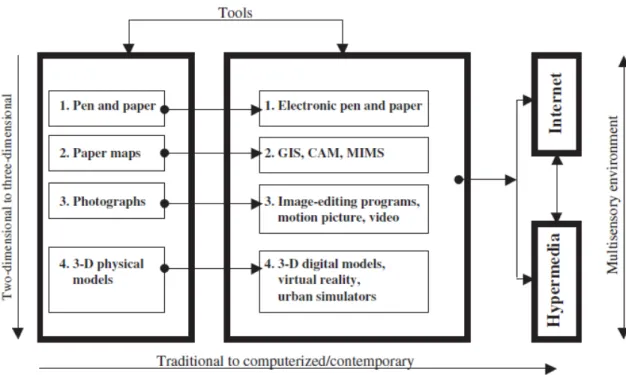
E. Web-based participation. Web-based forums focus on creating a two-way channel for communication between planner and public via the Internet. Maps, design proposals and surveys are posted on the Internet so community members can view and respond at their leisure. As access to the Internet is becoming more readily available many planners are switching to web-based participation to examine development preferences among the affected constituency (Al-Kodmany, 2005). Technology can significantly enhance existing public participation standards. Al-Kodmany (2002) suggested that computerized tools, such as web-based mapping and interactive GIS scenarios, enhance reactive public participation. Kobza (2005) argued that a web-based interface for public participation strengthens outreach efforts and improves the quality of public feedback.
The level and type of public input differs in each of the aforementioned participation methods. Moving from informal web forums to formal hearings, direct public participation decreases as the setting becomes more formal. Public participation in hearings and study sessions is regulated by defined rules of order that restrict public involvement to listening in the audience and limited testimony. Conversely, workshops, open houses, stakeholder meetings and web forums have loosely defined settings that encourage direct public input through open dialogue. There is an inverse relationship between formal settings and the degree of direct public participation. The key for practitioners is determining which setting is appropriate given the project and its corresponding decision-making process.
4. METHODOLOGY 4.1 Research objectives
The objective is to determine which public participation techniques are the most effective relative to the desired target. Comparison of different types of participation events indicates what techniques enhance public participation in planning, and when it is appropriate to use them depending on the practitioner’s desired outcome.
4.2 Methodology
Research was conducted on participation techniques and outcomes through a two-step process: case studies of participation events and interviews of public sector professionals. The first step was personal observation of different cases. The case study is preferred in examining contemporary events, especially when the investigator has little or no control over the behavioral events being studied (Yin, 2003). Interviews with professionals were the second step. This established an understanding of how practitioners view the efficacy of community participation in practice, and helped validate observations made in the field.
4.3 Methods and instrumentation
A. Case Studies. The primary research instrument for case studies was firsthand observation and categorized note-taking to gather data that informs comparative analysis across all cases. Observations about general data including methodology, location, date, time, duration, attendance, weather, and number of presenters were made for each participation event. Additional data was collected about meeting characteristics including: meeting purpose, level of
dialogue, speaker duration, visualization tools, structure, setting, stage in the planning process, method of interaction, and public notification method. Completed research instruments for each case study are included in Appendix A. The independent variable was the public participation method. Research and observations inform distinctions between different methods. The dependent variable was effectiveness of public participation. Qualitative criteria measuring how effective meetings were at engaging the public were: total attendance, breadth of attendance, opportunities to participate, level of active participation, resolution of apparent issues, public behavior/body language, clarity of presentation, communication to public, and implementation of community ideas. Each case study received a rating for each qualitative criterion based on a 5-point interval scale (1 – Poor 2 – Fair 3 – Good 4 – Very Good 5 – Excellent). Ratings are subjective based upon what is observed.
Geographic location was a controlled variable in case studies to strengthen the comparative analysis of participation techniques. The major confounding variable was the purpose of the public participation event. Certain events are strictly informational and others are designed to be interactive. In order to minimize the adverse affects of this confounding variable, case studies that have a similar planning-related purpose or focus were selected. The author’s bias due to present employment as Assistant Planner for the City of San Luis Obispo was diminished by relying on objective observation and ethnographic analysis.
B. Interviews. The secondary research instrument was interviews with planning professionals via telephone and in person. Appendix B contains
interview transcripts that provide anecdotal accounts of the public participation process from the viewpoint of selected interviewees.
Scope of a project was evaluated in interviews to determine what types of participation are appropriate for different desired outcomes. A workshop may be more effective for legislative decisions that have a broader impact, such as a General Plan, while a public hearing may be more suitable for quasi-judicial actions by a governing body.
The practicality of scale was also evaluated in interviews to determine which participation techniques are more effective for large groups. Since most case studies were in cities in San Luis Obispo County with relatively smaller populations, the majority of interviewees were selected from other larger California cities to evaluate how size of meetings affects participation in practice.
4.4 Sampling strategy
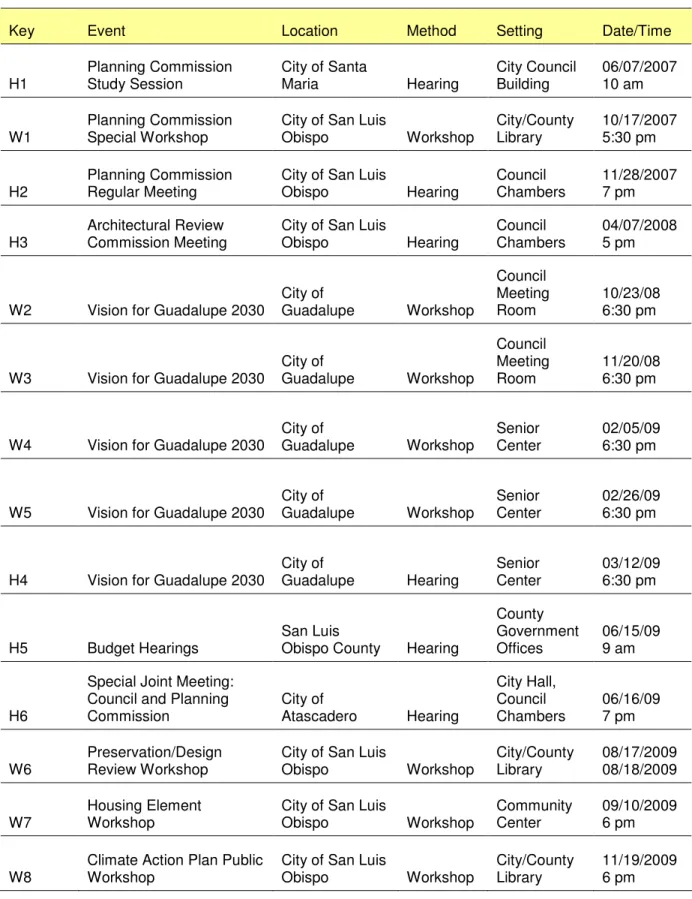
Multiple case studies were conducted of public meetings in San Luis Obispo and Santa Barbara Counties from June 2007 to November 2009. The sampling strategy was stratified purposeful sampling of different types of public participation events. Table 2 lists each case study, the location and type of participation event in chronological order.
Telephone and in-person interviews were conducted with California planners in March 2010. Interviewees were selected based on job title, geographic location and experience. Respondents are planning managers or directors in the cities listed in Table 3. Cities were selected with similar median household income and populations ranging from 45,000 to 4.1 million people.
Table 2 Case studies
Key Event Location Method Setting Date/Time
H1 Planning Commission Study Session City of Santa Maria Hearing City Council Building 06/07/2007 10 am W1 Planning Commission Special Workshop
City of San Luis
Obispo Workshop City/County Library 10/17/2007 5:30 pm H2 Planning Commission Regular Meeting
City of San Luis
Obispo Hearing Council Chambers 11/28/2007 7 pm H3 Architectural Review Commission Meeting
City of San Luis
Obispo Hearing
Council Chambers
04/07/2008 5 pm
W2 Vision for Guadalupe 2030
City of Guadalupe Workshop Council Meeting Room 10/23/08 6:30 pm
W3 Vision for Guadalupe 2030
City of Guadalupe Workshop Council Meeting Room 11/20/08 6:30 pm
W4 Vision for Guadalupe 2030
City of Guadalupe Workshop Senior Center 02/05/09 6:30 pm
W5 Vision for Guadalupe 2030
City of Guadalupe Workshop Senior Center 02/26/09 6:30 pm
H4 Vision for Guadalupe 2030
City of Guadalupe Hearing Senior Center 03/12/09 6:30 pm H5 Budget Hearings San Luis
Obispo County Hearing
County Government Offices 06/15/09 9 am H6
Special Joint Meeting: Council and Planning Commission City of Atascadero Hearing City Hall, Council Chambers 06/16/09 7 pm W6 Preservation/Design Review Workshop
City of San Luis
Obispo Workshop City/County Library 08/17/2009 08/18/2009 W7 Housing Element Workshop
City of San Luis
Obispo Workshop
Community Center
09/10/2009 6 pm Climate Action Plan Public City of San Luis City/County 11/19/2009
Table 3
Interviews with California planners
Interviewee City Population
Planner One Santa Barbara 90,000
Planner Two Sacramento 463,000
Planner Three Los Angeles 4,000,000
Planner Four San Diego 1,300,000
Planner Five San Luis Obispo 45,000 Note. Population Data from U.S. Census 2000
4.5 Strategy for reporting findings
Descriptive accounts of cases and interviews are provided in the following chapters. The outcome of this research is useful in determining what participation techniques are most effective and when to employ those techniques to expand community input on local government planning actions. Positive methods are isolated and used to inform a “toolkit” for effective public participation relative to the scale of government action, project or plan.
5. FINDINGS 5.1. Case studies
Six hearings and eight workshops were observed from June 2007 to November 2009, for a total of 14 case studies. Firsthand observations of cases describe meeting format, attendance, space planning, visualization tools, and public input opportunities. Analysis of each case is provided that identifies successful participation techniques and why they were effective given the desired outcome of the meeting. Overall impressions on what elements contributed to a meeting’s success or failure conclude each case description.
06/07/07 – Study Session: Santa Maria Planning Commission (H1). The City of Santa Maria held a morning Planning Commission study session in the City Council Building that was open to the public. The session was conducted exactly like a public hearing. The Chairperson opened the formal meeting with gavel in hand, and the public was given a window at the outset to address the Commission on any subject not on the morning agenda. The door remained open as late arrivals (staff and public) filtered into the meeting. Many people arrived minutes before their agenda item was heard and left immediately when discussion on the item ended. The major distinction between the study session and a public hearing was the absence of a formal motion being made by the Commission. The study session was meant to prepare the Commission for their regularly scheduled hearing on June 20, 2007, and also give staff an opportunity to gather early direction on projects.
There were a total of 13 items on the agenda. Items were spread between five different planners who presented each item and responded to questions from the Commission. Total attendance was good with 24 people filling the room. Participants consisted of 10 staff members, 4 Commissioners and 10 public participants. Breadth of attendance was poor however, with limited representation from minority groups. At the end of two and a half hours only six participants remained (2 of which were late arrivals).
The conference room in City Hall had approximately 35 seats. Commission and staff were seated at an L-shaped table up front, while public seats were relegated to the back of the room. Staff had their backs to the general public. The space felt too cramped for the amount of attendees. Significant traffic in and out from staff members and various side conversations were distracting.
Visualization tools varied from posters to PowerPoint. Staff relied on project specific documents such as site sections, aerials and site plans to illustrate talking points. PowerPoint was the tool of choice to visually portray these graphics. At times staff relied on printed maps laid out on the table in front of the Commission or posted on the wall.
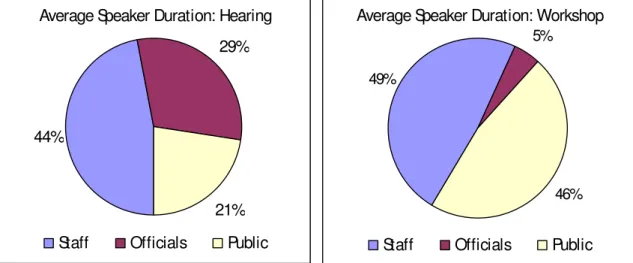
Dialogue was primarily between staff and Commissioners. Speaker duration was dominated by staff for 53 percent of the time, and the Commission who spoke 40 percent of the time. The public contributed seven percent of total dialogue. Opportunities to participate were few and the level of active participation suffered as a result. The meeting was conducted at a frenzied pace, which created visible stress for staff presenters. The public took a more
peripheral role as listeners and observers. Body language of public attendees was attentive at first, but interest began to wane after an hour as evidenced by eyes darting around the room and people shifting in their chairs.
Most members of the public were stakeholders from the development community with business interests in the projects being discussed. They provided detailed descriptions of project design features when prompted by the Commission. Most projects were already in progress. The hearing elicited limited (if any) public input on actual changes to the projects. Public was not allowed to comment as presentations proceeded. Commissioners glossed over public comment, attributing an air of unimportance. Commissioners were more concerned with asking questions of staff.
The language of the hearing was formal and a bit alienating. “Madame Chair” or “Members of the Commission” was heard at the outset, which set the tone of the meeting. These auditory cues are intimidating for participants not familiar with public hearings. It gives the sense of being in a courtroom. Planners used too much industry jargon, which can defeat the purpose of government transparency. The public cannot be involved in planning actions that they do not understand. The meeting may have been strengthened with more education about the planning concepts that informed each project.
The study session was not a good example of genuine participation. Residents assumed the role of attendees instead of participants. Discussion revolved around staff presentation and Commission reaction. Limited public input came from developers providing additional project information. The setting further
marginalized public participants because seats were arranged in the back of the room like a gallery, with main presenters turning their backs to the public.
One redeeming quality of the meeting was its stage in the planning process. The study session gave people an early opportunity to review and comment on projects before they reached the public hearing stage. The Commission could have suggested changes based upon this input, thereby providing instant gratification for community members. Unfortunately, Commissioners did not always realize this potential and instead rushed through public comments with a brief “thank you for your input”.
10/17/07 – SLO Planning Commission Special Workshop (W1). The City of San Luis Obispo long range planning staff organized a special workshop to respond to the initial draft of a specific area plan. The target area was the South Broad Street Corridor, which is located on the periphery of the downtown planning area. The City’s General Plan designated South Broad Street as an area of growth that should accommodate a diverse mix of housing types, offices, neighborhood commercial centers, parks and small manufacturing businesses. The South Broad Street Corridor Plan was developed to accommodate these General Plan policies, and implement form-based codes (FBC) for the area design. FBCs have never been used before in the City of San Luis Obispo.
The participation methodology used was a mixture of public hearing and community workshop. Fifty percent of the meeting was held in workshop format, with designated breakout tables and presentations from workshop participants. The other half of the meeting was formalized public discourse between Planning
Commissioners and City staff. This period resembled the traditional public hearing process.
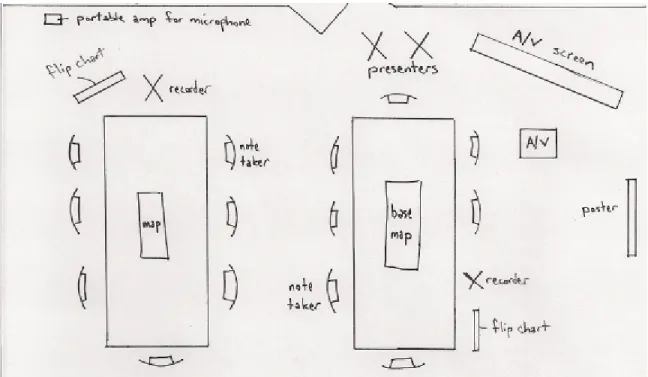
The location of the meeting was the City County Library Community Room, which provided ample space for conducting the workshop. Ten chairs were arranged around each of three breakout tables. An additional Commissioner table was set off to the side as a makeshift dais, and thirty-five gallery seats were available in the rear. The setting was flexible and all furniture was movable. Commissioners began the meeting at the dais, with staff centrally located and public in the gallery seats. All breakout tables were empty in the beginning, with the exception of staff facilitators. This arrangement clearly defined participant space and roles in the beginning of the meeting. These distinct boundaries began to blur as the meeting transitioned from public hearing to community workshop.
The approximate attendance reached thirty-two participants: six Commissioners, six City staff and twenty public participants. As the meeting progressed it became clear that the majority of public participants had a specific interest in the South Broad Street Corridor Plan because they were current residents or business owners in the target area. Many were members of a previous focus group on the development of the specific plan.
The Commissioners were the most vocal participants. They spoke sixty percent of the time in breakout groups, and forty percent of the time overall. The public spoke twenty percent of the time during breakout sessions, and fifteen percent overall. Both cohorts increased their participation once the meeting was
transformed into a community workshop. City staff reduced their amount of speaking as the breakout sessions commenced, and also changed their style of communication. In the initial meeting stages, the project planner assumed the role of educator, presenter and instructor. During the workshop period, the project planner was a silent listener and other City staff acted as facilitator and recorder. This modification of roles mid-meeting exemplified a conscious shift towards a more communicative action approach.
The community workshop was structured to focus on three emphasis areas of the South Broad Street Corridor Plan: land use, circulation and FBCs. Each breakout table was assigned one of these general topics and given talking points to address and report back on in forty-five minutes. Two commissioners were assigned to each breakout table.
The visualization tools used throughout the meeting were varied. Staff presented a PowerPoint slideshow that integrated text, maps, tables and 3D SketchUp massing models. Copies of the PowerPoint slides, agenda with staff report, and the South Broad Street Corridor Plan were available as handouts. Each breakout table had large conceptual area maps, examples of successful FBCs from other cities, flipcharts, markers, pencils and highlighters. This multimedia visualization approach was very successful. Graphic tables and models helped clarify aspects of the specific plan, and flipcharts, large-scale maps and writing implements allowed participants to get directly involved in sketching and outlining conceptual feedback.
BREAKOUT GROUP: LAND USE
The opening discussion of the group was about the value of FBCs. It was a heated discourse and the facilitator did not intervene. Talking points were outlined at the beginning but the group did not adhere to them.
Each group member established credibility early (i.e. professional planning experience, staff, SLO resident duration and proximity to development action). This was additional unsolicited information that was volunteered by each participant.
The first half of breakout time was dominated by argument between one Planning Commissioner and other group members. After all parties had aired out their grievances and complaints, consensus building could begin. The facilitator recognized the quiet person in the group and he got to speak his mind, which empowered his participation that was otherwise nonexistent up until this point. The most vocal participants were the commissioners, developer and affected resident.
The group agreed that FBCs were only appropriate for developing the “Main St” in the mixed-use core. Other generated group goals were general opinions on land use in the Broad Street area. Most talking points were not addressed. Rotating staff sat in at times to help steer the group back to the objective of identifying outcomes for the specific area. The facilitator was hands-off most of the time.
Recordation of group goals was on flipcharts at the last minute. General bullet points were created that encompassed agreed upon group feedback. At the end, the most vocal Planning Commissioner presented group results to the larger group.
Overall impressions of the Planning Commission Special Workshop were positive. There were ample opportunities to participate, the presentation was clear, communication between planner and public was strong, and community ideas were being implemented. City staff effectively utilized a mixed method approach that incorporated physical interaction, oratory, active dialogue and small group collaboration. The one major drawback was the exorbitant length of the participation event. The workshop duration was scheduled for three hours,
but the actual duration went well over four hours. Public body language implied a lack of interest in the lengthy staff presentation at the beginning, and the drawn-out formal response from the Commission at the end. The community workshop would have been enhanced without these two structured bookends. Momentum was highest at the end of the breakout sessions and considerably lower when the meeting was formally closed. Attendance was also at it lowest because approximately forty percent of all participants left early after the breakout sessions.
11/28/07 – San Luis Obispo Planning Commission Regular Meeting (H2).
The City of San Luis Obispo development review planning staff held the regular bi-weekly Planning Commission meeting to consider current development projects. The only item on the agenda was the updated design of the Chinatown mixed-use development project. City staff requested guidance from the Commission and members of the general public on the adequacy of the final environmental impact report (EIR). No action was taken by the Planning Commission.
The participation method used was a public hearing. After an initial presentation from City staff, contractors and architects, the general public was given a window of three minutes to speak out on the issues being discussed. No feedback was given from Commissioners or staff until after all public testimony was given.
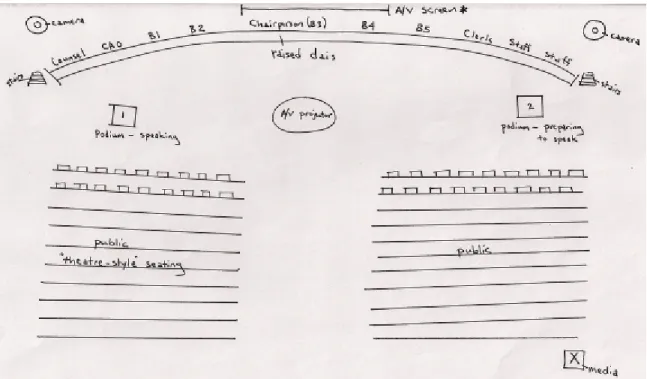
The location of the meeting was the City Hall Council Chambers, which provided ample space for conducting the hearing. The setting was a lecture hall
with fixed theatre seating. Commissioners were seated on a raised dais, which was the focal point of the entire room. City staff flanked the Commissioners facing inward towards the dais. The public was relegated to gallery seating that was below the decision-makers in the room. Power roles were apparent in the way the room was arranged; it was almost like the Commissioners were holding royal court over their subjects.
The approximate attendance reached fifty-nine participants; seven Commissioners, five City staff, two consultants and forty-five general public. This was a solid turnout largely because the Chinatown mixed-use development project is a highly contentious issue. It was clear that the majority of public comment was in protest against proposed demolitions associated with the project.
The Commissioners and staff were the most vocal participants. Both cohorts each spoke forty-two percent of the time. The public was the least involved,
PUBLIC TESTIMONY: SAVE THE HISTORIC BUILDINGS
There were no smiles in the Council Chambers. The mood was very dry and somber. The public waited 1 hour and 20 minutes before their voices could be heard.
Most of the public comment was pre-prepared and not specifically relevant to the stated purpose of the meeting. As comments proceeded, public testimonials got increasingly more emotional. All focus was on the proposed demolition of two historic buildings. The message was clear from the community participants: Preserve the Sauer Bakery and Blackstone Hotel buildings.
Long-time residents pleaded for the City to preserve the integrity, historical character, and legacy of their ancestors. The majority of public comment was negative reactionary testimonial from senior citizens. One gentleman commented that he did not “trust a simulation”.
speaking only seventeen percent of the time. The project planner assumed two roles: presenter and expert.
This public hearing happened in the middle of the planning process. There are still two more Planning Commission meetings to be held before the Chinatown project moves forward. Although the stated purpose was to gather feedback on the EIR, much of the public comment was negative reaction to an unrelated aspect of the proposed project.
The visualization tools were limited to PowerPoints and an agenda handout. Staff presented a PowerPoint slideshow of text and maps. The consultant PowerPoint incorporated text, maps, 3D Sketchup snapshots and a 3D flythrough animation of the proposed project. The 3D model was clearly the best method of visualizing the updated version of the Chinatown mixed-use development. However, one major drawback to using 3D graphic tools stems from the “digital divide”. Participants have varying levels of technological understanding, which may influence their view of the credibility of a digital representation.
Overall impressions of the Planning Commission Regular Meeting were negative. The only redeeming quality was the high attendance level. Opportunities to participate were sparse, the level of active participation was low, and the communication flow between decision-makers and the general public was always one-way. There was no resolution of apparent issues and residents left the meeting with the same level of uncertainty that they felt in the beginning of the meeting. Judging from the disinterested public body language – three people were sleeping – the staff and consultant presentations were too long. The
major flaw in the public hearing was that the objective was not achieved; the general public did not supply any input on the adequacy of the EIR.
The most interesting observation occurred during the break period immediately following public comment. This non-structured ten minute span turned out to be the best period of public exchange. Strangers engaged in discourse over community design, future visions for the community, and common historical connections. Major dissenters located one another to bolster emotions. Planners and decision-makers should have been privy to these informal discussions. Genuine participation occurred during the one portion of the meeting that was not “on the record”. This fact alone speaks to the need for a more casual participation forum that allows for the free flow of ideas.
04/07/08 – San Luis Obispo Architectural Review Commission Regular Meeting (H3). The City of San Luis Obispo (SLO) Architectural Review Commission (ARC) convened in the Council Chambers of City Hall on a cool night in April. The Chambers were packed with a total of 75 people comprised of 64 SLO residents, 6 Commissioners and 5 staff members. All age cohorts represented (except children). There was only one item on the agenda that was broiled in neighborhood controversy: a debate over whether to construct a parking lot in Mitchell Park.
A sense of importance was conveyed in the Council Chambers. Fixed rows of padded “theatre” seats for the public faced the front of the room where staff and Commissioners were seated. There was a slight rise in the floor moving towards the front. Staff was seated perpendicular to public, facing one another across the
room. The Commission was raised two steps up at front of room on dais facing public. This seating arrangement is symbolic of the division of power among individuals, and common to parliamentary chambers meant for decision-makers. There were windows on one side of the room, large double doors on the other, and a regular man-door in back. Three flags (Federal, State, local) adorned the corner directly behind the seated Commissioners.
Staff and Commissioners had computer screens embedded in glass topped desks, microphones, and nameplates. The computers were synched with the PowerPoint displayed on the audiovisual screen behind Commissioners facing the public. Good use of site photos, aerials, and overlays helped portray the extent of proposed parking lot improvements. Cameras placed around room were mounted to wall for local TV broadcast. Large-scale site plans posted on wall, agenda handouts, petitions and picket signs from public added project-specific information to the visualization tools at the hearing.
The chairperson opened the formal public hearing, governed by Robert’s Rules of Order, with the Pledge of Allegiance, followed by public comment about items not on the agenda. Staff presented a project overview and a recommendation for parking lot approval by the Commission. The ARC questioned staff and then opened the meeting up to a public hearing. Each person that wanted to comment submitted a speaker card earlier in the meeting and the Chairperson called them up my name. Residents stated name, address, and then concerns. The Chairperson thanked each one, which was all the response given from Commissioners. After public comments, Commissioners
Figure 3. Picket sign in opposition to project. deliberated and made a motion. The meeting ended with staff providing an “agenda forecast” of what is to be heard at the next regular meeting.
Dialogue was entirely directed to the advisory body members. Staff took up 20 percent of the time with the presentation, but participation was dominated by the Commissioners (40 percent) and numerous public comments (40 percent). There was substantial comment from residents for and against a new parking lot for the local Senior Center. Each side of the issue had one lead spokesperson (5 min), and everyone else was relegated to 3 minutes per person.
The Council Chambers were divided down the middle like two angry families at an ill-fated wedding. Participants representing opposition to the proposed parking lot outnumbered the senior residents who
supported plans to amend the Mitchell Park Master Plan to accommodate new parking facilities. The proposed 12 space lot would replace an underutilized shuffleboard court and barbecue area.
The opposition was well organized and even brought picket signs that read, “Say No to Mitchell Park-ing lot” (Figure 3) and “I Love Mitchell Park”.
They waved them in the audience when a resident would say something against the parking lot plans at the podium. A petition was signed by over 680 people opposing the parking lot plans. The seniors had their own petition with over 180 signatures in favor of the lot. They also provided emotional testimony about those
patrons of the Senior Center with mobility issues, and how a parking lot would alleviate their struggle.
Interestingly, no one denied there was a problem. According to public testimony, the surrounding blocks are always impacted with parked cars early in the day, rendering it very difficult for seniors to access the building because they usually arrived later. Major dissension was over the City’s solution to the problem. Many residents suggested alternatives such as Rideshare, parking districts, free bus passes, etc. It became clear as the hearing progressed that opposition was based on a fundamental belief that urban parks are precious and not a single foot should be paved over for automobiles. Idealism outshined realism as angry neighbors were quoting a Joni Mitchell song about “Paving Paradise” at the podium. For seniors, the lot was the most practical solution. They did not speak in favor of redeveloping parks or paving over the whole site. Instead they simply wanted a small area that was already underutilized to serve as exclusive parking for a public facility that has zero parking now.
Residents also spoke out about being informed too late in the process. The Parks and Recreation Department held a community meeting at the Senior Center over a year ago, yet many neighbors claimed no knowledge of it. It is apparent that some of the angst over the parking solution could have been avoided if better noticing and earlier meetings had taken place. There was little evidence community ideas were being implemented as the project seemed to already have been decided at this point. Construction of a parking lot was already identified as a “Major City Goal” in the City’s Fiscal Plan, which was
drafted a year ago. According to follow up staff interviews, the goal for a parking lot was adopted largely because the seniors came out in full force to previous hearings about what to include in the City’s Fiscal Plan. Contrary to the staff recommendation, the Commission voted against the parking lot plans. They made a motion to the Council to either relocate the Senior Center or consider parking alternatives.
This public hearing was the most emotionally charged public meeting observed thus far. When issues hit home in people’s neighborhoods, residents will go to great lengths to support or oppose the issue based on their personal interests. The neighbors opposing put together a website, www.savemitchellpark.org, and spoke with a unified voice at the hearing. Whether or not the Council hears this collective cry is yet to be seen.
Resolution of all apparent issues was not possible because the Council has the final call to be decided at a later date. This hearing was the second of five dealing with potential construction of a Senior Center parking lot. Level of active participation was high but coupled with public behavior and body language that portrayed anger and disappointment. The most interesting part of the whole public hearing was immediately after the formalities were over. Many residents that opposed the lot sought out seniors and tried to reason with them. Face to face communication occurred after the public participation event ended!
10/23/08 – Vision for Guadalupe 2030: Community Meeting One (W2).
California Polytechnic State University’s (Cal Poly) City and Regional Planning Master’s Department was hired by the City of Guadalupe as a consultant team
tasked with developing a community plan. The first public meeting in a series of five public meetings was held in the Council Meeting Room in Guadalupe’s City Hall. The purpose of the meeting was to learn community desires and educate the public about general plans.
A good turnout of 40 people attended the meeting comprised of 24 residents, 3 Council members, and 13 Cal Poly consultants. This may have been a result of extensive outreach: flyers were handed out in-person on the streets and at public schools, and included with prior month’s water bill. The meeting was also posted on the City’s website.
One moderator led the two-hour meeting with support from a translator for Spanish speaking participants. After a brief introductory presentation, the majority of the meeting was reserved for breakout tables where Cal Poly facilitators guided discussion of community interests amongst small groups of residents. Four large rectangular tables were arranged at the back of the Council Chambers, sectioned off from the dais by a movable wall. One discussion table was designated for Spanish speakers. Three Cal Poly consultants staffed each table (facilitator, recorder and note-taker).
Tables were self-selected and ended up slightly segregated. The Spanish-speaking table was mostly residents of Latino descent. The City Manager chose to sit with the two Council members and a consultant who works for the City. The other two tables were a good mix of ages and ethnicity. Every generation was represented from young adults to retired seniors. Varying classes of society
could be inferred by the different clothes people wore; service men mixed with executives through a common bond of citizenry.
There were multiple visualization tools including a portable digital projector, PowerPoint, flip-chart easels for group note-taking, aerial photos and maps on boards. Groups were encouraged to mark up posters with markers. Participation was guided by small group activities such as a “wish list” exercise and a “likes, dislikes, and changes” exercise.
The structure of the meeting was informal. The workshop was designed to get participants talking about their community. Each resident completed a wish list of ten or more things they want to see happen in Guadalupe. Small groups of six used these initial brainstorms in a subsequent three-part exercise:
1. What do you like about Guadalupe? 2. What do you dislike about Guadalupe?
3. What improvements would you like to see in your community?
Facilitators began breakout sessions with a round of introductions. This helped reduce the uneasy feeling of talking openly with strangers. People used personal stories to establish credibility when making claims. “I’ve lived in Guadalupe for 14 years, and I can remember when…” Discussion questions were posted on PowerPoint slides to remind people of the focus of the meeting. Laughter was evident when people talked about likes, and heated discussion was observed when talking about dislikes. Proposed improvements/solutions were similar to stated needs.