Original Research Paper
Microsponge based drug delivery system for
augmented gastroparesis therapy: Formulation
development and evaluation
Riyaz Ali M. Osmani
a,*
, Nagesh H. Aloorkar
b, Bharati U. Thaware
b,
Parthasarathi K. Kulkarni
a, Afrasim Moin
c, Umme Hani
a,
Atul Srivastava
a, Rohit R. Bhosale
aaDepartment of Pharmaceutics, JSS College of Pharmacy, JSS University, Mysuru 570 015, Karnataka, India bDepartment of Pharmaceutics, Satara College of Pharmacy, Satara 415 004, Maharashtra, India
cDepartment of Pharmaceutics, College of Pharmacy, Hail University, Hail 81442, Saudi Arabia
A R T I C L E I N F O Article history:
Received 11 April 2015
Received in revised form 13 June 2015
Accepted 14 June 2015 Available online 14 July 2015
A B S T R A C T
The intention behind the present work was to develop a microsponge based novel dosage form for sustained delivery of domperidone. Quasi-emulsion solvent diffusion method was employed using Eudragit RS-100 with various drug–polymer ratios for the preparation of microsponges. For optimization purposes, several factors which affect microparticles’ physi-cal properties were investigated. Characterization techniques followed for the formed microsponges were DSC, FTIR, SEM, XRD and particle size analysis, along with morphol-ogy, drug loading andin vitrodrug release. It was found that there were no chemical interactions between drugs and polymers used as per DSC and FTIR results. The drug– polymer ratio showed remarkable impact on drug content, encapsulation efficiency and particle size. SEM micrographs revealed that microsponges were spherical in shape with porous surface, and had 104±0.22µm mean particle size. The microsponges were then loaded in capsules followed by in vitrodrug release study; which depicted that microsponges with drug– polymer ratio of 1:2 were more proficient to give extended drug release of 76.38% at the end of 8 h, superior in contrast to conventional marketed formulation Domstal®, which got
exhausted incredibly earlier by releasing 82.57% drug at the end of1⁄2h only. Hence, the
developed microsponge based formulation of domperidone would be an expectant, prom-ising substitute to conventional therapy of gastroparesis, emesis and alike gastric ailments. © 2015 The Authors. Production and hosting by Elsevier B.V. on behalf of Shenyang Phar-maceutical University. This is an open access article under the CC BY-NC-ND license (http://creativecommons.org/licenses/by-nc-nd/4.0/). Keywords: Domperidone Drug delivery Gastroparesis Microsponges Sustained release
* Corresponding author.Department of Pharmaceutics, JSS College of Pharmacy, JSS University, S. S. Nagar, Mysuru 570 015, Karnataka, India. Tel.:+91 99703 66276; fax: 0821-2548359.
E-mail address:[email protected](R.A.M. Osmani).
Peer review under responsibility of Shenyang Pharmaceutical University. http://dx.doi.org/10.1016/j.ajps.2015.06.003
1818-0876/© 2015 The Authors. Production and hosting by Elsevier B.V. on behalf of Shenyang Pharmaceutical University. This is an open access article under the CC BY-NC-ND license (http://creativecommons.org/licenses/by-nc-nd/4.0/).
Available online at
www.sciencedirect.com
j o u r n a l h o m e p a g e : w w w. e l s e v i e r. c o m / l o c a t e / a j p s H O S T E D BY
1.
Introduction
The oral route of drug administration is known to be the most convenient and commonly employed route. Drugs that get easily absorbed in the gastrointestinal tract and having a short half-life get eliminated rapidly through blood circulation. To shun these problems, orally controlled release formulations have been developed, which release drug slowly into the gastrointesti-nal tract and help in keeping constant drug concentration in the serum for a longer period of time. Oral route of drug ad-ministration has broad acceptance. Up to 50–60% of oral solid dosage forms are well-liked because of usual, straightfor-ward and suitable administration with precise dosage, self-medication, pain evasion and most prominently patient compliance. The most admired solid dosage forms are tablets and capsules; these dosage forms may envelop wide range of applications in novel drug delivery systems such as nanoparticles, microparticles, microspheres, nanospheres and microsponges[1]. Microsponge Delivery System (MDS) is highly cross-linked, porous, polymeric microspheres that can entrap broad range of active ingredients and release them into the skin over an extended period of time and in response to triggers. This system was implied earlier for the enhancement of per-formance of drugs. It is a unique technology for the controlled release of drug, which consists of microporous beads loaded with active agents[2,3].
One of the major challenges faced by pharmaceutical sci-entists is to control the delivery rate of actives to a predetermined site in the body. The prime aim of any drug de-livery system is to provide therapeutic amount of drug to a proper site in the body, to punctually achieve and maintain the desired drug concentration. Most of these drug delivery systems include polymers which encapsulate drug. Oral drug delivery systems are used for enhancing therapeutic index of the drug and also for reducing side effects. Oral route is the chosen route for the administration of active and/or therapeutic agents owing to its low cost of therapy and ease of administration, which may lead to higher level of patient acquiescence. The effi-cient oral drug delivery may depend upon several factors like gastric emptying, gastrointestinal transit time of the drug or dosage form, drug release from designed dosage form and site of absorption of drug[4–7].
The microsponge technology was developed by Won in 1987, and the original patents were assigned to Advanced Polymer Systems, Inc. Microsponges are porous microspheres having myriad of interconnected voids of particle size ranging between 5 and 300µm. They are used as a carrier system since they have the capacity to entrap a wide range of actives in their non-collapsible structures with porous surface, through which active ingredients are released in a controlled manner[8]. Further these microsponges with actives can be incorporated into for-mulations such as tablets, capsules, creams, gel, lotions and powders and share a broad package of benefits[9–14]. The fun-damental appeal of the microsponge technology stems from the intricacy experienced with conventional formulations in releasing active ingredients over an extended period of time. Conventional formulations typically provide actives in rela-tively high concentrations but with a short duration of action; leading to a cycle of short-term overmedication followed by
long-term undermedication. In contrast, microsponges offer an advantage of programmable drug release and are biologi-cally harmless. This technology also offers entrapment of active pharmaceutical ingredients contributing toward improved sta-bility, increased elegance, enhanced formulation flexibility and reduced side effects[8].
Domperidone (DOM) is a synthetic benzimidazole compound, chemically known as 5-chloro-1-(1-[3-(2-oxo-2,3- dihydro-1H-benzo[d]imidazol-1-yl)propyl]piperidin-4-yl)-1H-benzo[d]imidazol-2(3H)-one[15,16]. It is known to have gastro prokinetic and anti-emetic activity and normally imple-mented for managing upper gastrointestinal tract motility as well as gastroparesis by blocking the Dopamine (D2) recep-tors at the chemoreceptor trigger zone (CTZ) in the area postrema and also at the gastric region[17]. It is rapidly ab-sorbed from the stomach and the upper part of the GIT by active transport, after oral administration, and few side effects have been reported. It is a weak base with good solubility in acidic pH, but in alkaline pH, the solubility is significantly reduced [16]. It is poorly water soluble (log P, 3.1) and has low absorb-ability after oral administration, and undergoes extensive first pass metabolism; leading to poor bioavailability of 15%[18]. Its onset of action is about 30 min when administered as con-ventional tablet or capsule dosage form and the effect lasts for nearly 4–7 h. It is not detectable in blood after a few hours of oral administration in healthy subjects as it gets elimi-nated in 5–7 h from the body[19]. Moreover, as it is supplied at low dose (10 mg) and has low molecular weight (425.9 gm/mol), it entails long term treatment and repetitive dosing, making DOM an appealing contender for develop-ment of a sustained release formulation[18].
Thus, the aim of our study was to prepare sustained release DOM microsponge based capsules using polymer like Eudragit RS 100, with reduced frequency and side effects, for effective gastroparesis, emesis and other such ailments therapy. A com-parative study of all the formulations prepared by quasi-emulsion solvent diffusion method was aimed and the effects of drug–polymer ratios and external phase compositions used on release kinetics have also been studied.
2.
Materials and methods
2.1. Materials
DOM was procured from Vasudha Pharma, Hyderabad, India. Eudragit RS 100 as a gift sample was provided by Evonik Pharma, Mumbai, India. Dichloromethane and dibutyl phthalate were purchased from Qualigens Fine Chemicals, Mumbai, India. Poly-vinyl alcohol (PVA) was procured from CDH Pvt. Ltd. Mumbai, India. All the other ingredients used were of analytical grade, and were used as procured.
2.2. Methods
2.2.1. Characterization of pure drug
2.2.1.1. Melting point. Melting point of DOM was determined by micro controlled based melting point apparatus (SMP10/1,
Stuart, UK). The sample was inserted in capillary tube having one end closed. Then the capillary tube was inserted in bath of silicone oil, which was heated in a controlled manner with the help of electrical heating coil. The temperature at which the drug sample started melting was noted as the melting point temperature. Average of triplicate readings was noted and com-pared with the literature value.
2.2.1.2. Differential scanning calorimetry (DSC). About 5 mg of the sample was sealed in the aluminum pans and heated at the rate of 10 °C/min, covering a temperature range of 40 °C to 300 °C under nitrogen atmosphere at flow rate of 100 ml/min, and DSC thermogram (Mettler-Toledo DSC 821e, Switzerland) for pure drug was obtained. Indium standard was implied for calibrating DSC enthalpy and temperature scale.
2.2.1.3. FTIR spectroscopy. FTIR spectra were recorded (FTIR, A-410, Jasco, Japan) over wavelength range of 4000 to 500 cm−1 at resolution of 4 cm−1[2,3,20–23]. Samples were dispersed in KBr and compressed in pellets by applying 5 tons pressure for 5 min using hydraulic press. Formed pellets were kept in light path and spectra were recorded.
2.2.1.4. UV spectroscopy. Calibration curve of DOM was plotted using 0.1 N HCl. The drug was analyzed spectrophotometri-cally (Pharmaspec 1700, Shimadzu, Japan) and curve was found to be linear in the range of 2–20µg/ml and regression coeffi-cient (r2) was found to be 0.998 at 283.5 nm.
2.2.2. Drug–excipient interaction study
Drug–excipient interactions were investigated by FTIR and DSC studies. IR spectra were recorded to check compatibility of drug with excipients, using FTIR spectrophotometer (FTIR, A-410, Jasco, Japan). DSC helps in assessing physical properties of the sample nature (crystalline or amorphous) and indicates any probable interaction among drug and excipients. DOM and physical mixture (DOM and Eudragit RS 100) were subjected to thermal analysis.
2.2.3. Preparation of DOM microsponges
The microsponges containing DOM were prepared by quasi-emulsion solvent diffusion method[2,3,24]using an internal phase that consisted of Eudragit RS-100 and dibutyl phthal-ate (1% w/v) dissolved in 5 ml of dichloromethane:ethanol (1:1). Dibutyl phthalate was added to enhance the plasticity of the polymer. This was followed by the addition of DOM dissolved under ultrasonication at 35 °C. The mixture was then poured into aqueous solution of PVA which served as the external phase with 60 min stirring at 400 rpm. The microsponges were formed
due to the removal of dichloromethane and ethanol from the system by evaporation. Prepared microsponges were then fil-tered, washed with distilled water and subjected to drying at 40 °C for 12 h in hot air oven. Lastly microsponges obtained were weighed to determine production yield. Various formu-lation batches were prepared as perTable 1.
2.2.4. Evaluation of DOM microsponges
2.2.4.1. Differential scanning calorimetry (DSC). Thermogram of DOM microsponge formulation was obtained using differ-ential scanning calorimeter (Mettler-Toledo) DSC 821eoutfitted with an intercooler.
2.2.4.2. Infrared spectroscopy. It was done using Fourier Trans-form Infrared Spectrophotometer (FTIR A-410, Jasco, Japan) using KBr pellet method. FTIR spectra of DOM, Eudragit RS 100, physi-cal mixtures of DOM and Eudragit RS 100, and microsponge formulation were recorded in the wavelength range of 4000 to 500 cm−1.
2.2.4.3. Production yield. Microsponges production yield was determined by the formula mentioned below[2,25]:
Production yield PY Practical mass of microsponges Theoret
( )
=iical mass polymer
(
+drug)
×100 (1)
2.2.4.4. Actual drug content and encapsulation efficiency. The weighed amount of drug loaded microsponges (100 mg) was kept in 100 ml 0.1 N HCl solution for 12 h with continuous stir-ring. Filtered samples (using 0.45µm membrane filter) were analyzed at 283.5 nm against blank using UV spectrophotom-eter (Pharmaspec 1700, Shimadzu, Japan). Estimation of drug content and encapsulation efficiency for all batches were done using the following expressions[3,20]:
Actual drug content M
M act ms %
( )
= ×100 (2) Encapsulation efficiency M M act the = ×100 (3)where Mact=actual DOM content in weighed quantity of microsponges, Mms=weighed quantity of microsponges and Mthe=theoretical DOM content in microsponges.
2.2.4.5. Scanning electron microscopy (SEM). For assessing mor-phology and surface topography, prepared microsponges were Table 1 – Composition of DOM microsponges.
Ingredients Formulation batches
M1 M2 M3 M4 M5 M6 M7 M8 M9 Domperidone:Eudragit RS 100 (mg) 1:1 1:2 1:3 1:4 1:5 1:3 1:3 1:3 1:3 Dichloromethane:Ethanol (1:1, ml) 5 5 5 5 5 5 5 5 5 Dibutyl phthalate (% w/v) 1 1 1 1 1 1 1 1 1 Polyvinyl alcohol (mg) 50 50 50 50 50 30 40 60 70 Water (ml) 100 100 100 100 100 100 100 100 100
examined under scanning electron microscope (LEO 440i, UK) operating at 5 kV. By means of double adhesive tape, samples were mounted on a metal stub and coating with platinum/ palladium alloy under vacuum was done[5].
2.2.4.6. Particle size analysis. Particle size analysis of pre-pared microsponges was carried by using Malvern Mastersizer (Hydro 2000 SM, Malvern Instruments, UK). Microsponges were dispersed in double distilled water before running sample in the instrument to ensure that the light scattering signal, as in-dicated by particles count per second, was within instrument’s sensitivity range. Analysis was carried out at room tempera-ture, keeping the angle of detection at 90°. The average particle size was expressed in terms ofd(0.9)µm[9].
2.2.4.7. X-ray diffraction study. X-ray powder diffraction (XRPD) patterns were recorded by using X-ray diffractometer (Siemens, Model D5000, Germany) with CuKαradiation of wavelength 1.5405 A° and a crystal monochromater. The instrument was operated at voltage 45 mV and current 20 A. Diffraction pat-terns were run at 5 to 10 °C/min in terms of 2θ; crystal and physical states of DOM were characterized.
2.2.5. Preparation of DOM microsponge capsules
For preparing microsponge based capsules, DOM microsponges containing drug equivalent to marketed formulation contain-ing unentrapped drug (DOMSTAL®) were accurately weighed and filled into hard gelatin capsules.
2.2.6. Evaluation of DOM microsponge capsules
2.2.6.1. In vitro drug release. Thein vitrodrug release from dif-ferent batches of microsponge filled capsules was evaluated (in triplicate) in 900 ml of 0.1 N HCl (pH 1.2) using USP type II
dissolution apparatus (TDT-08L, Electrolab, Mumbai, India) for 8 h under sink conditions with 50 rpm paddle rotation speed at 37±0.5 °C. Aliquots of 5 ml were withdrawn at different time intervals and replaced with the same volume of fresh dissolution medium. Filtered samples were assayed spectro-photometrically at 283.5 nm.
2.2.6.2. Stability study.Optimized capsule formulation was sub-jected to stability testing as per ICH norms. Capsules were blister packed and various replicates were kept at 40±2 °C and 75±5% RH in a humidity chamber. Capsules were assessed for change in appearance andin vitrorelease profile at an interval of 30, 60 and 90 ds.
3.
Results and discussion
3.1. Characterization of pure drug
3.1.1. Melting point
Melting point of DOM was found to be in the range of 241–243.9 °C (literature standard 242.5 °C). As experimental values were in good agreement with standard, procured drug was supposed to be pure.
3.1.2. Differential scanning calorimetry (DSC)
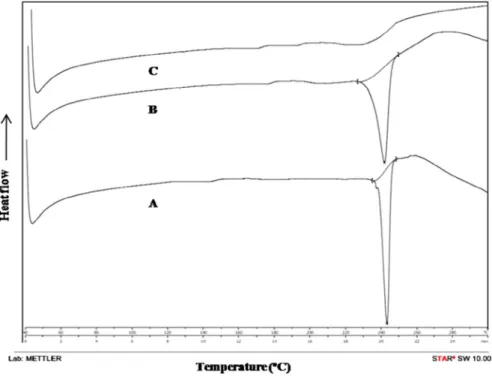
As reflected by DSC thermogram (Fig. 1A), a sharp endother-mic peak was observed at 243.83 °C corresponding to the melting point of drug in the crystalline form, reflecting drug purity.
3.1.3. FTIR spectroscopy
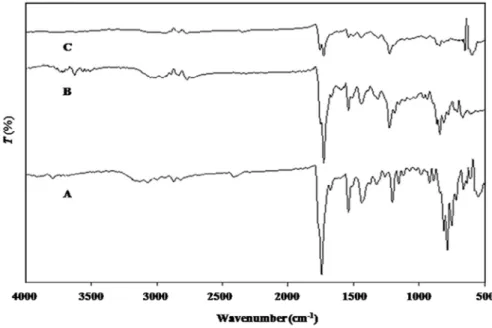
FTIR spectrum of procured DOM was recorded (Fig. 2A) and spectral interpretation was done. The characteristic IR
absorption peaks of DOM at 3020.41 cm−1(N—H stretching), 2817.80 cm−1(C—H stretching), 1689.67 cm−1(C=O stretch-ing), 1622.47 cm−1(C=C stretching), 1384.77 cm−1(C—H bending) and 834.22 cm−1(C—Cl bending) were reflected in the drug sample spectrum, which confirmed the purity of DOM. 3.2. Drug–excipient interaction study
Compatibility study was carried out using DSC and FTIR studies, to check for any possible interaction between the drug and the excipients used. In DSC studies, physical mixture showed similar thermal behavior to that of pure drug but with lower inten-sity (Fig. 1B). Pure DOM thermogram reflects an endothermic peak at 243.83 °C corresponding to its melting point (Fig. 1A). However, the melting endotherm of microsponge formula-tion was suppressed, corresponding to partial protecformula-tion of DOM since microsponge encapsulation (Fig. 1C). It was also ob-served that DOM crystallinity altered significantly in microsponge formulation, confirming its dispersion in the system.
FTIR spectroscopic study results discovered no any new peak appearance or disappearance of existing peaks, discarding any
chemical interaction probability among drug and polymer used. The characteristic ketone C=O stretching vibration at 1687.69 cm−1, C—H stretching at 2816.10 cm−1, C—H bending at 1375.77 cm−1, C—Cl stretch at 839.42 cm−1and N—H stretch-ing from 3019.28 to 3068.78 cm−1were recognized in all spectra (Fig. 2). All characteristic peaks of DOM were experiential in physical mixture and microsponge formulation spectrum (Fig. 2B and 2C). Thus, IR spectroscopy results depicted that DOM was compatible with selected polymer, excipients and possess good stability in all microsponge formulations.
3.3. Evaluation of DOM microsponges
3.3.1. Physical appearance
White to almost white, microsponge particles were obtained by quasi-emulsion solvent diffusion method. Flow properties of pure drug were noted to be poor, while it has been ob-served that microsponges of DOM were having good flow properties.
3.3.2. Production yield
The production yield of all batches was observed in the range of 31.78% to 79.45% (Table 2). It was found that production yield Fig. 2 – Overlain FTIR spectra of (A) DOM, (B) physical mixture and (C) optimized microsponge formulation.
Table 2 – Actual drug content, encapsulation efficiency, production yield and % CDR (n=3). Batches Drug: polymer ratio PVA concentration (mg) Theoretical drug content (%) Actual drug content (%) Encapsulation efficiency (%) Production yield (%) % CDR Flux (mg/cm2h) M1 1:1 50 50 46.07±0.21 92.20±0.43 31.78±0.58 85.74±0.11 0.3239 M2 1:2 50 33.33 29.00±0.23 87.01±0.70 48.54±0.38 76.38±0.10 0.2886 M3 1:3 50 25 21.22±0.17 84.90±0.68 55.52±0.31 67.19±0.09 0.2538 M4 1:4 50 20 16.25±0.08 81.25±0.44 73.02±0.73 55.45±0.16 0.2094 M5 1:5 50 16.66 12.15±0.17 72.52±0.49 79.45±0.62 44.13±0.10 0.1667 M6 1:3 30 25 19.05±0.05 76.20±0.2 35.90±0.48 70.51±0.05 0.2663 M7 1:3 40 25 19.98±0.05 79.96±0.02 48.98±0.06 68.39±0.14 0.2583 M8 1:3 60 25 22.24±0.01 88.98±0.04 60.48±0.39 65.38±0.06 0.2469 M9 1:3 70 25 22.57±0.05 90.29±0.02 68.22±0.22 63.49±0.22 0.2398
was greatly affected by drug:polymer ratio as well as by con-centration of polyvinyl alcohol. Moreover, increase in the drug:polymer ratio resulted into increased production yield. When drug:polymer ratio was 1:1 (M1), the production yield was very low, i.e. 31.78%, while for drug:polymer ratio 1:5 (M5) it was 79.45%. With the low concentration of polyvinyl alcohol (30 mg, M6), the production yield was quite low, i.e. 35.9%. As the concentration of polyvinyl alcohol was increased (from 30 to 70 mg), the production yield was also found to be increased. This was for the reason that the abridged dichloromethane diffusion rate from concentrated solutions to aqueous phase at higher drug:polymer concentrations pro-vides additional time for formation of droplet, thereby improving yield.
3.3.3. Actual drug content and encapsulation efficiency
At all ratios of drug:polymer employed, the mean amount of drug entrapped in the prepared microsponges was lower than the theoretical value, since the drug loading efficiency did not reach 100%. This could be attributed to dissolution of some drug in the solvent or aqueous phase employed. The results of en-capsulation efficiency showed that higher drug loading
efficiencies were attained at lower drug:polymer ratios. Use of the higher amounts of polyvinyl alcohol, while preparing microsponges at higher polymer:drug ratios caused slightly in-creased viscosity of the dispersed phase. When solvents were diffused out, nearly all of the dispersed phase was converted to solid microsponges and estranged particles emerged. The reason behind utmost drug loading efficiencies for these for-mulations was availability of maximum polymer amount to each drug unit in contrast to the rest of formulations. The en-trapment efficiency was noted in the range of 72.52–92.20% as shown inTable 2.
3.3.4. Scanning electron microscopy (SEM)
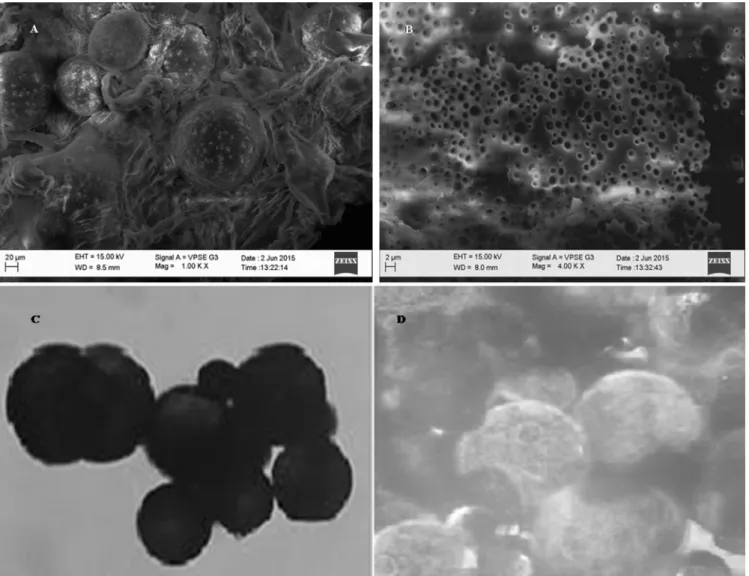
Morphology and surface topography of prepared microsponges were discovered by SEM analysis. The representative SEM images of microsponges are shown inFig. 3A and 3B. SEM results indicated that microsponges formed were highly porous, predominantly spherical and not much entire DOM crystals were observed visually. By diffusion of solvent from surface of microsponges, pores were induced. Moreover, it was exposed that the distinctive internal structure comprised spherical cavity enclosing a stiff shell assembly of drug and polymer. The
internal structure consisted of numerous annulled spaces and appearance of particles was such that they were perfect to be called microsponges.
The microsponges were also observed under binocular plane polarized light (PPL) microscope (Fig. 3C and 3D), which showed that formed microsponges were spherical in each single entity or in form of bunches and had porous nature.
3.3.5. Particle size analysis
The mean particle size of microsponge formulations should be in the range of 5–300µm. Visual inspection of all batches for particle size using optical microscope revealed that the par-ticle size was increased with increase in Eudragit RS 100 amount, i.e. with an increase of drug:polymer ratio. This might be due to the fact that polymer available at higher drug:polymer ratio was in greater amount thereby increasing polymer wall thickness, which consequently led to larger microsponges. In addition, with increasing amount of polyvinyl alcohol, par-ticle size was found to be increased, credited to the rise in apparent viscosity at increased stabilizer concentrations. It results in larger emulsion droplet formation and finally in greater microsponge size[4,5,9,25–28]. Optimized batch pos-sessed greater percentage of intact, uniform, spherical particles during optical microscopy, hence subjected to analysis using photon correlation spectroscopy (Malvern Mastersizer Hydro 2000 SM, Malvern, UK). The results indicated particle sized(0.9) corresponding to 104±0.22µm.
3.3.6. X-ray diffraction study
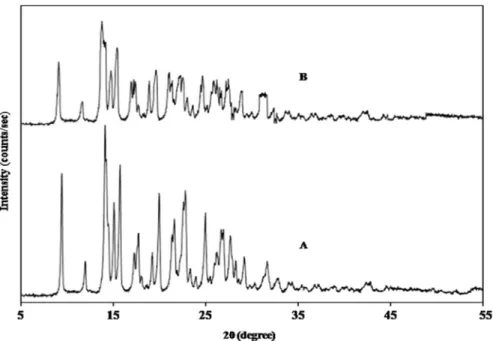
To evaluate physicochemical characteristics of prepared microsponges, XRPD method was implied. In X-ray diffractogram, sharp peaks at diffraction angle (2θ) 14° were obtained in both DOM and its microsponge formulation (Fig. 4A and 4B).
For determination of occurrence of crystal habit modifica-tions and polymorphs in drug crystals, XRPD is a valuable
technique. In general when diffraction patterns are identical for two forms of crystals, they are known to possess the same internal structures and when patterns are nonidenti-cal, crystals have diverse internal structures known as polymorphs. In the present study, samples depicted spectra with similar peak positions (2θ values). Consequently, no existence of polymorphs of DOM in these samples was verified.
Additionally, for crystallinity determination, a compari-son of some representative peak heights with those of a reference in diffraction patterns has been done. Final formu-lation of microsponges showed peaks at diffraction angle similar to that of XRD pattern of DOM but with some lower intensity, indicating its crystalline nature. The relative degree of crys-tallinity (RDC) value was found to be 1.47. So XRPD analysis revealed that the crystalline nature of drug was not com-pletely lost and was found to remain thermally stable in the final formulation as well.
3.4. Evaluation of DOM microsponge capsules
3.4.1. In vitro drug release
The drug release was observed to decline within range of 85.74% to 44.13% with respect to rise in drug:polymer ratio from 1:1 to 1:5. The reason behind this is as drug:polymer ratio has in-creased, in each microsponge, to encapsulate drug, the polymer amount available was greater. It led to thickening of the polymer matrix wall, thus extending diffusion path and ultimately less-ening drug release. The highest drug release, i.e. 85.74% was found for the formulation M1, while the lowest, 44.13%, was found for M5. Initial burst release observed in formulations of M1 and M2 can be allocated to the existence of non-encapsulated drug near the surface or on the exterior of microsponges. Graphical presentation for comparative drug release of all batches M1–M5 and M6–M9 are shown inFig. 5A and 5Brespectively.
It has been reported that for each formulation from M6 to M9, the drug release went on decreasing with increasing amount of PVA. This could be attributed to the fact that a polymer matrix releases drug after complete swelling of polymer and the time required for swelling of polymer is directly pro-portional to stabilizer concentration. The slight decrease in release rate with increased PVA amount was from 70.51% to 44.13% for formulations M6–M9.
3.4.2. Release profile of marketed formulation
The drug release study for conventional marketed formula-tion containing pure, unentrapped DOM was carried out; release profile obtained for was as depicted inFig. 5C. The conven-tional formulation released 82.57% drug at the end of1⁄2h only and got exhausted. In contrary microsponge based formula-tion, drug is released gradually up to 8 h, and thereby would be effective in minimizing gastric irritation, eczema, ulcers and other side effects. As M2 batch formulation exhibited drug release 76.38% after completion of 8 h, and was also found su-perior in terms of physiochemical characterization, production yield, actual drug content, entrapment efficiency, morphol-ogy, surface topography, particle size, percentage of intact porous
microsponges and other physical parameters, in addition to drug release, it is assumed to be the best and most efficient formulation to give an extended drug release among the all formulations[2,3,9].
3.4.3. In vitro drug release kinetic study
Thein vitrorelease data were subjected to various release models, namely, zero order, first order, Higuchi, Peppas, Hixson– Crowell and Korsmeyer–Peppas, and best fit model was decided by highest r2value. Thein vitrodrug release showed highest regression value for the Peppas model (0.997 for M5). On the basis of maximum regression value, Peppas model was found to be best fit for most of the formulations (Table 3). The drug release mechanism for all microsponge formulations was studied by putting release data in Korsmeyer equation. For for-mulations M1–M9,nvalues were found in the range 0.5614– 0.7278, while thenvalue for Korsmeyer–Peppas model was seen to be in the range 0.5–1, which indicates non-Fickian diffusion.
3.4.4. Effect of formulation variables on DOM microsponges 3.4.4.1. Effect of drug–polymer ratio. Increase in drug:polymer ratio (M1–M5) has been found to result from increase in Fig. 5 – Comparative drug release profiles of (A) M1–M5, (B) M6–M9 and (C) marketed formulation (n=3, mean±SD).
production yield, while drug content, encapsulation effi-ciency and percent drug release were found to be decreased (Table 2). The reason behind this is as drug:polymer ratio went on increasing, the polymer amount available for each microsponge to encapsulate the drug was greater, thus result-ing to risresult-ing polymer matrix wall thickness which led to extended diffusion path and ultimately to lesser drug release. Consequently the amount of drug diffused and flux of the for-mulations were decreased at higher drug:polymer ratio.
3.4.4.2. Effect of composition of external phase. Composition of external phase was altered for formulations M6–M9 by chang-ing the concentration of PVA from 30 to 70 mg. It has been observed that in increasing the amount of PVA, production yield, encapsulation efficiency and particle size were increased while slight decrease in drug release was noticed (Table 2).
3.4.5. Stability study
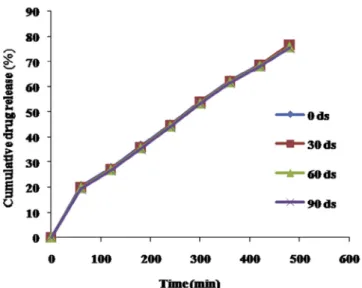
During stability studies formulation appearance was found to be similar to the time of blister packaging, with no signifi-cant brittleness and plasticity of shells. It was also noted from outcomes that there were no considerable changes in drug content as well as percentage of drug release. Therefore no evi-dence of degradation of drug was observed.
After comparison of drug release profiles of optimized for-mulation M2 before and after 3 months stability study, similarity factor (f2) was calculated (Fig. 6). It was found to bef2=86.60 (>50); similarity factor greater than 50 indicates good stabil-ity of the product. In view of this it was concluded that the formulation was stable over the period of 3 months.
4.
Conclusions
The present study reported development of DOM loaded microsponges using Eudragit RS 100 by quasi-emulsion solvent diffusion method. The aim behind developing an oral poly-meric microsponge delivery system was to deliver DOM in a sustained manner for an extended period of time, to reduce frequency of administration and to improve its bioavailability. The primary benefit of such formulations is more uniform maintenance of blood plasma level of therapeutic agent, which is useful to shun unwanted peak and trough patterns achieved
with multiple immediate release formulations. Therefore, in the present study, sustained release formulation of DOM was prepared by incorporating it in polymeric microsponges. Pre-pared microsponges were then incorporated in capsule dosage form. The quasi-emulsion solvent diffusion method imple-mented was found to be simple, reproducible and rapid. Formed microsponges were spherical in shape, have high porosity and good flow. Varied drug–polymer ratio reflected remarkable effect on particle size, drug content and encapsulation efficiency. The in vitrodrug release showed highest regression value for the Peppas model. Formulation with 1:2 drug:polymer ratio was found to be more efficient to give extended drug release (76.38% at 8 h). With respect to conventional formulation, these microsponges are expected to remain in the stomach for a longer time as buoyant, gradually releasing their contents over the time. Optimized formulation subjected to stability study showed no significant change in diverse parameters and hence indicated a stable formulation. Thus, DOM microsponges pre-pared in this study were found to be promising as newfangled delivery system offering prolonged release of DOM and hence would be more useful than conventional formulation therapy. Table 3 – Release kinetics data of microsponge formulations.
Batch code Zero order First order Higuchi Peppas Korsmeyer–Peppas parameters
Best fit model
n* k* M1 0.9567 0.9761 0.9873 0.9896 0.5614 2.468 Peppas M2 0.9679 0.9818 0.9782 0.9823 0.5810 1.9873 Peppas M3 0.9734 0.9860 0.9747 0.9861 0.5901 1.5951 Peppas M4 0.9832 0.9934 0.9722 0.9950 0.6614 0.8894 Peppas M5 0.9881 0.9961 0.9679 0.9970 0.7278 0.4876 Peppas M6 0.9711 0.9850 0.9766 0.9866 0.5881 1.7494 Peppas M7 0.9862 0.9850 0.9748 0.9856 0.5892 1.6435 Zero order M8 0.9727 0.9857 0.9726 0.9865 0.5892 1.5557 Peppas M9 0.9727 0.9843 0.9736 0.9865 0.5814 1.5814 Peppas
* n – kinetic constant, k – release rate constant.
Fig. 6 – Drug release profile of microsponge based formulation during stability study.
Acknowledgements
The authors express their heartfelt gratitude to Vasudha Pharma, Hyderabad, India, and Evonik Pharma, Mumbai, India, for providing DOM and Eudragit RS 100 respectively, as gift samples.
R E F E R E N C E S
[1] Sutradhar KB, Akhter DT, Uddin R. Formulation and evaluation of taste masked oral dispersible tablets of domperidone using sublimation method. Int J Pharm Pharm Sci 2012;4:727–732.
[2] Osmani RA, Aloorkar NH, Kulkarni AS, et al. Novel cream containing microsponges of anti-acne agent: formulation development and evaluation. Curr Drug Deliv 2015; doi:10.2174/1567201812666150212122421. [Epub ahead of print].
[3] Osmani RA, Aloorkar NH, Ingale DJ, et al. Microsponges based novel drug delivery system for augmented arthritis therapy. Saudi Pharm J 2015;<http://dx.doi.org/10.1016/ j.jsps.2015.02.020>; In press.
[4] Jelvehgari M, Siahi-Shadbad MR, Azarmi S, et al. The microsponge delivery system of benzoyl peroxide: preparation, characterization and release studies. Int J Pharm 2006;308:124–132.
[5] Nokhodchi A, Jelvehgari M, Reza SM, et al. Factors affecting the morphology of benzoyl peroxide microsponges. Micron 2007;38:834–840.
[6] Comoglu T, Gonul N, Baykara T. Preparation andin vitro evaluation of modified release ketoprofen microsponges. Farmaco 2003;58:101–106.
[7] Comoglu T, Savaser A, Ozkan Y, et al. Enhancement of ketoprofen bioavailability by formation of microsponge tablets. Pharmazie 2007;62:51–54.
[8] Osmani RA, Aloorkar NH, Kulkarni AS, et al. A new cornucopia in topical drug delivery: microsponge technology. Asian J Pharm Sci Technol 2014;4:48–60. [9] Pawar AP, Gholap AP, Kuchekar AB, et al. Formulation and
evaluation of optimized oxybenzone microsponge gel for topical delivery. J Drug Deliv 2015;2015:1–9. doi:10.1155/2015/ 261068.
[10]Bothiraja C, Gholap AD, Shaikh KS, et al. Investigation of ethyl cellulose microsponge gel for topical delivery of eberconazole nitrate for fungal therapy. Ther Deliv 2014;5:781–794.
[11]Li SS, Li GF, Liu L, et al. Evaluation of paeonol skin-target delivery from its microsponge formulation:in vitroskin permeation andin vivomicrodialysis. PLoS ONE 2013;8:e79881.
[12]Deshmukh K, Poddar SS. Tyrosinase inhibitor-loaded microsponge drug delivery system: new approach for
hyperpigmentation disorders. J Microencapsul 2012;29:559– 568.
[13]Jain V, Singh R. Design and characterization of colon-specific drug delivery system containing paracetamol microsponges. Arch Pharm Res 2011;34:733–740.
[14]Jain V, Jain D, Singh R. Factors affecting the morphology of Eudragit S-100 based microsponges bearing dicyclomine for colonic delivery. J Pharm Sci 2011;100:1545–1552.
[15]Arora G, Malik K, Rana V, et al. Gum ghatti – a
pharmaceutical excipient: development, evaluation and optimization of sustained release mucoadhesive matrix tablets of domperidone. Acta Pol Pharm 2012;69:725–737. [16]Arora G, Malik K, Singh I, et al. Formulation and evaluation
of controlled release matrix mucoadhesive tablets of domperidone usingSalvia plebeiangum. J Adv Pharm Technol Res 2011;2:163–169.
[17]Tonini M, Cipollina L, Poluzzi E. Clinical implications of enteric and central D-receptor 2 blockade by anti-dopaminergic gastrointestinal prokinetic. Aliment Pharmacol Ther 2004;19:379–390.
[18]Thatipamula RP, Palem CR, Gannu R, et al. Formulation and
in vitrocharacterization of domperidone loaded solid lipid
nanoparticles and nanostructured lipid carriers. Daru 2011;19:23–32.
[19]Nagarsenker MS, Garad SD, Ramprakash G. Design
optimization and evaluation of domperidone co-evaporates. J Control Release 2000;63:31–39.
[20]Orlu M, Cevher E, Araman A. Design and evaluation of colon specific drug delivery system containing flurbiprofen microsponges. Int J Pharm 2006;318:103–117. [21]Jain V, Singh R. Dicyclomine-loaded Eudragit®-based
microsponge with potential for colonic delivery: preparation and characterization. Trop J Pharm Res 2010;9:67–72. [22]Mishra MK, Shikhri M, Sharma R, et al. Optimization,
formulation development and characterization of Eudragit RS 100 loaded microsponges and subsequent colonic delivery. Int J Drug Discov Herb Res 2011;1:8–13.
[23]Bhimavarapu R, Chitra KP, Karunkiran P, et al. Itraconazole loaded microsponges – a novel carrier system. Int J Inv Pharm Sci 2011;1:67–76.
[24]Comuglu T, Gonul N, Baykara T. The effects of pressure and direct compression on tabletting of microsponges. Int J Pharm 2002;242:191–195.
[25]Kilicarslan M, Baykara T. The effect of the drug/polymer ratio on the properties of verapamil hydrochloride loaded microspheres. Int J Pharm 2003;252:99–109.
[26]Maiti S, Kaity S, Ray S, et al. Development and evaluation of xanthan gum-facilitated ethyl cellulose microsponges for controlled percutaneous delivery of diclofenac sodium. Acta Pharm 2011;61:257–270.
[27]Swetha A, Gopal Rao M, Ramana KV, et al. Formulation and
in vitroevaluation of etodolac entrapped in microsponge
based drug delivery system. Int J Pharm 2011;1:73–80. [28]Singh N. Effect of surfactants on PVA borax hydrogel
rheology and thermal aspects. Indian J Chem 2013;52A:879– 883.