Scalable push fi le
delivery with MBMS
MBMS push services give operators the ability to deliver multimedia content,
simultaneously, to all users in a specifi c location, without overloading a mobile network.
tent increase proportionally with the number of subscribers and the size of the transferred content.
The scalability problem can be solved by using broadcast technologies for pushing content in the form of fi les. Popular push services can use broad-cast distribution technology to com-plement existing unicast schemes. The resources needed to distribute a fi le are independent of the number of subscrib-ers, and the time needed to reach all subscribers depends only on fi le size. By defi ning separate broadcast chan-nels for different services, it is possi-ble to let users opt-in to the content of their choice. This provides a degree of personalization.
Multimedia broadcast/multicast ser-vice (MBMS) is the native broadcast tech-nology of third-generation mobile sys-tem (3G) networks.1 It offers two deliv-ery methods: streaming and download. Streaming is typically used for mobile TV services, while download (here called MBMS push fi le delivery service) is used for distributing content in fi les of any size and arbitrary format.
The use of MBMS for mobile TV has been described in a previous article.2 For the purpose of this article, we note that the MBMS push fi le delivery ser-vice is not orthogonal to mobile TV but rather it is a key enabler for the mass-market distribution of podcast TV as part of a rich mobile TV offering.
What makes MBMS particularly well suited for push services is an effective paging mechanism that can selectively wake up terminals when a transmission is about to start. This allows terminals to remain in standby mode (preserv-ing battery capacity) while wait(preserv-ing for a transmission. As well, MBMS allows precise control of the broadcast area of any transmission, from one cell up to the entire network.
T HOR ST E N L OH M A R , J UA N-A N TON IO I BA N E Z , AU R É L I E Z A N I N A N D M IGU E L BLOC K ST R A N D
Push services are popular on the internet and in mobile environ-ments. Internet push services often use podcast mechanisms, while mobile push services use SMS and WAP-push. Technical realizations today are based on dedicated point-to-point deliv-ery. This article presents MBMS push fi le services as a scalability extension to unicast services. MBMS is thus used as a “capac-ity booster” for distributing popular content services.
Push services, which provide content to mobile phones without direct user involvement, have long been of inter-est to mobile operators. The most
com-mon technologies used to realize push services in mobile networks are short message service (SMS) and wireless application protocol push (WAP-push). On the internet, the common technol-ogy is podcasting. Existing podcast ser-vices employ the really simple syndica-tion (RSS) protocol, and are actually a pseudo-push service — clients periodi-cally poll a server to check for updates and new content, which is then down-loaded to user devices. The rationale for periodic polling is that it works in the presence of fi rewalls and network address translators, which are common obstacles on today’s internet.
These point-to-point delivery tech-niques do not scale well, however. The resources needed to distribute the
BOX A Terms and abbreviations
3G Third-generation mobile system
ADP Associated delivery procedure description
API Application programming interface
BCAST Mobile broadcast
BM-SC Broadcast/multicast service center
C2P Content-to-person
CBS Cell broadcast service
ESG Electronic service guide
FD File delivery
FDT File delivery table
FLUTE File delivery over unidirectional transport
FR File repair
GPRS General packet radio service
HSPA High-speed packet access
HTTP Hypertext transfer protocol
MBMS Multimedia broadcast/multicast service
MBSFN Multimedia broadcast single frequency network
MCCH MBMS control channel
MICH MBMS indicator channel
MMS Multimedia messaging service
MTCH MBMS traffi c channel
OMA Open Mobile Alliance
PTP Point-to-point
RNC Radio network controller
RR Reception reporting
RSS Really simple syndication
SDP Session description protocol
SMS Short message service
TCP Transmission control protocol
TMGI Temporary mobile group identifi er
UDP User datagram protocol
USD User service description
WAP Wireless application protocol
Today’s consumers expect to access con-tent at will, wherever they are. Market research consistently shows that the adoption of new services is ruled by consumer convenience and value. Consumers want to stay informed and updated within their areas of interest, and they want immediate access to information of their choosing. Market studies show consumer willingness to pay a moderate fee for fast and easy access. Alternately, indirect payment, through the acceptance of advertise-ments, is already established in inter-net usage behaviors. Users accept adver-tisements if they are not intrusive or if users have an option to control how they are rendered.
The value of push services to users lies in their ability to receive any type of multimedia content, through a sim-ple interface with a single subscription. Ultimately, users will not care about how content reaches them as long as it is available when they want it, whether they are online or not.
Pushing content in the background according to user preference and stor-ing it in the terminal for later consump-tion signifi cantly reduces service start-up and content access times. In most cas-es the content is already available in the terminal when the user decides to con-sume it. Any missing content may still be fetched on demand.
Existing push services are rarely timely or simultaneous, since they rely on point-to-point transmissions that can only be parallelized to a limited extent and otherwise require sequential trans-mission of the same content. In addition, mobile operators are looking for ways to distribute more of their own content to subscribers without risking network overload. One solution is to broadcast popular services.
From a business perspective, the key questions that arise are what kind of con-tent is interesting to deliver, what costs are involved to deliver it, and how will revenues be generated?
The types of content and servic-es operators deliver will range from immediate real-time services, such as emergency alert messages, to less time-critical background delivery for later consumption, such as news and
weather updates, active wall papers, sport highlights, selected clips or tunes, and so forth. The content can also be for machine-to-machine communications, such as software updates, maps, or other kinds of sys-tem application data.
Business cases developed by Ericsson show that revenues as low as EUR 1 per user per month can motivate a complete investment in MBMS infrastructure at relatively small service penetration lev-els. Past that break even point, any addi-tional subscriber brings pure profi t. Moreover, operators can obtain this rev-enue either through subscription fees or from advertising. Typical advertis-ing models to mobile users include static or dynamic banners, (preload) content-related advertisement, or opt-in mod-els. MBMS fi le delivery can be used with all common advertisement models, and
it can be closely tied to the service and type of content.
MBMS push fi le delivery enabler
MBMS system and notifi cation mechanism
Essentially, MBMS offers a scalable mechanism for delivering multimedia content over 3G networks. The MBMS architecture is the same for the two supported delivery methods: stream-ing (used for mobile TV) and download (used for fi le delivery services). The gen-eral characteristics of MBMS have been described in an earlier article and still apply.3 Recent enhancements intro-duced in the MBMS standards, such as the support of single-frequency net-works (MBSFN), also apply to both deliv-ery methods.
There are, however, differences in how the MBMS features are used by
RNC receives session start Cyclic retransmission of control info MTCH access information MICH MCCH MTCH MBMS transmission session File 1 File 2 File N
RNC receives session stop Reception reporting Phase 2: Associated delivery procedures Phase 1: MBMS transmission session GGSN Mobile network PTP file-repair procedure Interactive bearers (PTP) BM-SC (FD sender) MBMS bearers (PTM) MBMS session start MBMS session stop File delivery table (FDT) instance
Object transmission via MBMS
BM-SC (RR) Random wait Random wait time BM-SC (FR)
forward error correction (FEC) code from Digital Fountain. For MBMS down-load, terminals must support Raptor FEC. The BM-SC decides on the usage and the coding rate.
The Raptor FEC code is a low-complexity code that allows entire fi les of up to several megabytes to be used as a single FEC source block. Raptor’s spe-cial property is the generation of a high number of independent FEC symbols from a single source block.
In addition to using FLUTE for MBMS transmission sessions, 3GPP has defi ned complementary procedures for service discovery, security, and associated deliv-ery procedures, all of which may use an interactive bearer.
Figure 2 schematically shows MBMS fi le delivery. It is assumed that the BM-SC hosts the content and commu-nicates to the mobile network through the gateway GPRS support node (GGSN). MBMS bearers are established, used, and released during phase 1 of the pro-cedure, while phase 2 shows the point-to-point (PTP) fi le repair and reception- reporting functions. Point-to-point fi le repair allows terminals to request miss-ing data (lost packets) usmiss-ing interactive bearers, for example, HSPA. The “ran-dom wait time” between phase 1 and phase 2 is introduced to avoid uplink congestion. The reception reporting function allows operators to monitor how many terminals have received the content.
the different types of services. For instance, live TV services produce a con-tinuous packet stream for typically a long period (several hours). File delivery services produce bursts of data, the size of a burst being determined by the fi le size and the selected bit rate. The radio resources are only reserved for the dura-tion of the burst and are then released and can be used by other services.
MBMS defi nes three MBMS-specifi c radio bearers:
MICH (MBMS indicator channel), used to notify terminals about the imminent start of an MBMS transmission session; MCCH (MBMS control channel), which carries control information about all on going MBMS transmission sessions; and
MTCH (MBMS traffi c channel), which carries the actual data of an MBMS transmission session.
Figure 1 illustrates the relationship between these channels. While in stand-by mode, the terminal monitors MICH during its regular paging occasions. MICH indicates upcoming changes in the MCCH for a particular service identi-fi ed by its temporary mobile group iden-tifi er (TMGI). Triggered by MICH, the terminal fully powers on its receiver and reads MCCH to fi nd detailed infor-mation about the session. The terminal then tunes to MTCH and starts receiv-ing data.
The MICH and MCCH channels are always active in a cell, whereas MTCH is set up only for the duration of an MBMS transmission session. Upon reception of the session-start message from the broad-cast/multicast service center (BM-SC), the radio network controller (RNC) trig-gers the notifi cation on MICH, estab-lishes the corresponding MTCH, and
updates MCCH with MTCH access infor-mation. The RNC releases the MTCH resources on reception of an MBMS session-stop message. MTCH is thus only active for the duration of the fi le transfer.
Pushing fi les over MBMS
Figure 2 depicts the general principle of an MBMS fi le-delivery session. It is assumed that the terminal has discov-ered the service and already activat-ed reception. Because TCP and HTTP do not support multicast/broadcast addressing and are bidirectional by nature, the 3GPP has selected the IETF FLUTE (fi le delivery over unidirection-al transport) protocol for transferring fi les over MBMS, which is unidirection-al. Files are fragmented and sent in UDP packets. Transmission robustness may be increased using the DF RaptorTM
BOX B Overall architecture
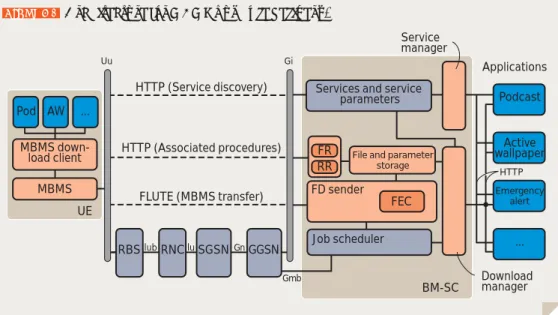
Figure 3 schematically depicts a possible MBMS push fi le delivery architecture. The BM-SC hides the transmission complexity by providing a web service API to application servers. The service and download managers handle the abstraction of internal mobile-network procedures to web service methods.
The service manager registers new applications and generates the corresponding service attri-butes and description fi les: user service description (USD), session description (SDP), and associated delivery procedure description (ADP).
The download manager handles transmission requests issued by the applications. Files and transmission parameters are locally stored for subsequent fi le repair (FR) actions. The fi le deliv-ery (FD) sender partitions the fi les to fi t into UDP packets. FEC redundancy is optionally added to in-crease transmission reliability. The “job” scheduler controls the transmission and uses the Gmb inter-face to establish and release the necessary MBMS bearers. The reception reporting (RR) function col-lects reception acknowledge ments.
Applications Service
manager
Download manager HTTP (Service discovery) Services and service
parameters
File and parameter storage Podcast Pod AW MBMS down-load client MBMS UE … FR FD sender Job scheduler BM-SC FEC RR RBS RNC SGSN GGSN Gmb Active wallpaper Emergency alert … HTTP (Associated procedures) HTTP FLUTE (MBMS transfer) Uu lub lu Gn Gi FIGURE 3 Architecture for MBMS push fi le delivery.
instance is delivered to the terminals, in-band with the actual content. This describes the fi les and associated trans-port parameters, which are provided dur-ing the MBMS transmission sessions.
Service discovery and service activation
Service discovery refers to methods that terminals use to obtain a list of available services along with informa-tion on those services.4 For example, a terminal may use the Open Mobile Alliance Mobile Broadcast (OMA BCAST) Electronic Service Guide (ESG), although not all parts are necessary for “unsched-uled” push services.5
The advantage of BCAST-ESG is that it allows seamless integration of uni-cast and broaduni-cast offerings by relating several access methods to the same ser-vice. Service identifi ers communicat-ed to the terminal during service dis-covery are independent of the actual access system.
Users can register to available servic-es once they have discovered them via the ESG. Registration has two objectives: it triggers activation of service reception in the terminal, and it measures the size of a service’s audience. Popular services should use MBMS; the rest should use OMA-push (unicast).
In the case of MBMS, service activa-tion means a terminal starts to mon-itor MICH/MCCH in anticipation of MBMS transmission sessions. In the context of OMA-push delivery, the ter-minal sends the service identifi ers to the BM-SC, which uses SMS techno-logy (that is, OMA-push) to inform the terminal about new content.6 The ter-minal then uses HTTP to retrieve the content.
Push fi le delivery systems
In the following example, we use a “Football Breaking News” video service to illustrate the pros and cons of techni-cal realizations of a push service. When a team scores, the service pushes a short video clip of the goal to interested fans. A 30-second video clip of reasonable quality can easily reach 500KB in size.
Multimedia messaging service (MMS) is often used for content-to-person (C2P) services. MMS uses SMS (OMA-push) to notify interested terminals about new content. A modern MMS instal-lation with a capacity of 200 messag-es per second can deliver a mmessag-essage to 100,000 terminals in less than 10 min-utes. However, being unicast, the deliv-ery duration is directly related to the size of the target group. Increasing the target group size to 200,000 terminals doubles the delivery duration.
Cell broadcast service (CBS) uses broadcast radio bearers, but it does not implement any notifi cation or paging mechanism. This typically means that battery drain is high. In addition, CBS only defi nes the delivery of short (text)
messages (up to a size of 1230 octets or 1.2KB). A typical ringtone, by compari-son, is about 150KB. In summary, CBS is not suitable for multimedia services.
Modern terminals are often shipped with podcast clients (unicast only). Podcast allows the distribution of multi-media clips. Since podcast push is real-ized by a periodic poll of the service sta-tus, the delivery delay depends on the polling interval. For example, to ensure that video events are delivered within ten minutes, the polling interval must be set to ten minutes or less. The high polling frequency affects the capacity of terminals, the radio network, and the service layer. In the terminal, the frequent establishment of a dedicated radio bearer for the short polling mes-sage drains the battery; and in the radio access network, resources must be allo-cated to terminals that are otherwise idle and can be released only after a pre-defi ned period of inactivity. In the ser-vice layer, servers must be able to han-dle a constant fl ow of polling messages from a large number of terminals.
MBMS is ideally suited to realize a mass-market video goal service. Interested ter-minals monitor MICH for the temporary mobile group identifi er (TMGI) of the vid-eo goal service. This approach does not consume dedicated radio resources nor does it increase battery consumption during idle mode. The duration of time needed to deliver the video clip when a team scores depends only on the size of the clip and the bit rate of the bear-er. Given a 64Kbps MBMS bearer, it typi-cally takes about 1.5 minutes (including notifi cation and bearer setup) to deliver a 500KB video clip regardless of the size of the target group.
BOX C Podcast on MBMS
Podcast is a popular enabler used by internet appli-cations. A podcast is an unscheduled push service — the internet itself does not offer any real push mechanisms. The push perception is realized by a continuous, periodic retrieval (polling) of an ex-tended markup language (XML) document from a server. RSS-formatted XML documents describe in a general section the nature of the podcast feed, followed by the description of one or more content items. Content items may describe video clips, MP3 fi les, or news headlines. The actual content is not
embedded in the XML document. Instead, an HTTP link is provided to, say, a video clip (or general en-closure).
In contrast, MBMS provides a real push mecha-nism. Terminals continuously monitor the paging channel for incoming transmissions. MBMS fi le delivery allows for the transmission of one or more fi les in a single transmission session. The transmis-sion sestransmis-sion may contain the descriptive XML docu-ment as well as content enclosures, such as video clips(Figure 4). RNC receives session start Cyclic retransmission of control info MICH MCCH MTCH
Podcast document and enclosures XML Video MP3 RNC receives session stop RNC receives session start Cyclic retransmission of control info MICH MCCH RNC receives session stop
Summary
This article presents the general con-cept of push fi le services and discusses the scalability issues of today’s realiza-tions. All realizations on the internet and in mobile environments use dedi-cated point-to-point (unicast) resources. This works fi ne, but resources must be provided for each user. If the popularity of such services increases, the resources must increase proportionally.
Pushing content to terminals in the form of fi les has several advantages:
The content is stored in the terminal’s memory giving end-users the percep-tion that service response time is fast. Operators may either decide to preload the terminals during non-busy hours and employ unused network resources or to use external events to trigger content push. Football highlights or stock mar-ket updates are examples of event-based services that have real-time deliv-ery requirements.
Operators can use MBMS push services to complement existing unicast servic-es. MBMS can be regarded as a capacity booster for popular services, while uni-cast serves the remainder. Service per-sonalization can be provided by map-ping each push service to a separate broadcast channel. Terminals monitor a set of broadcast channels to receive the wanted information. This way, each terminal receives its own, personal mix of content.
Because MBMS is based on broadcast transmissions in the network and over the air, transmission duration becomes inde-pendent of the size of the target group. This is particularly important in fulfi lling real-time delivery requirements.
Push services generally enable opera-tors to control when the content is dis-tributed. In this way, they can push non-time-critical content whenever resource usage is low (for example, at night), opti-mizing their use of the network.
MBMS features an effective paging mechanism that can selectively wake up terminals when a transmission is about to start. This makes it possible to have the MBMS push fi le delivery ser-vice continuously active in terminals without draining their batteries.
Juan-Antonio Ibanez
joined Ericsson Eurolab Germany in 1999 as sys-tem designer for the GPRS support nodes. He actively contributed to the standardization of the GPRS and UMTS packet-switched architecture in 3GPP before taking on the role of technical coordinator within the Network Integration and Verifi cation department. In 2006, he moved to Ericsson in Stockholm, Sweden, where he holds a senior specialist position in the area of mobile TV and broadcast system architecture at Business Unit Networks. Juan-Antonio holds an M.Sc. in communication systems from the Swiss Federal Institute of Technology in Lausanne, Switzerland.
Aurélie Zanin
joined Ericsson Sweden in 2005 to work with mo-bile TV prototyping at Ericsson Research. In 2006, she moved to the development unit in Shanghai, working on the Ericsson Content Delivery Sys-tem. At present, Aurélie serves as sys-tem manager in Shanghai where she coordinates several technical studies within the mobile TV area. She holds an M.Sc. in engineering from Ecole Nation-ale Supérieure de Physique de Stras-bourg, France.
Miguel Blockstrand
joined Ericsson in 1989 to work with integration and verifi cation — he has, among other things, been involved in the fi rst release and deploy-ment of GSM, the fi rst impledeploy-mentation of the PDC system, and the fi rst intro-duction of WCDMA, where he was re-sponsible for the implementation of a demonstration service layer for 3G ap-plications. Miguel has worked with mo-bile TV and broadcast technologies since early 2007, and is currently re-sponsible for Ericsson’s mobile TV and broadcast strategies within Business Unit Networks.
Thorsten Lohmar
received a diploma de-gree in electrical engineer-ing from the University of Aachen (RWTH) in 1997. In 1998, he joined the Mobile Multimedia Networks department of Ericsson Research in Germany, where he has worked on a variety of aspects relating to mobile communication systems, in-cluding quality of service, hybrid net-working, and integrating WLAN into cel-lular environments. In 2000, he turned his focus to mobile multicast and broad-cast services. Thorsten has led Ericsson’s MBMS standardization team since 2003 and the mobile multimedia delivery research project since 2007.
3G TS 23.246: Multimedia Broadcast/Multicast 1.
Service (MBMS): Architecture and functional description
Ibanez, J.-A., Lohmar, T., Turina, D. and Zanin, A.: 2.
Mobile TV over 3G networks — Service and enablers evolution. Ericsson Review, Vol. 85(2008):1, pp. 38-42
Bakhuizen, M. and Horn, U.: Mobile broadcast/ 3.
multicast in mobile networks. Ericsson Review,
Vol. 82(2005):1, pp. 6-13
3G TS 26.346: Multimedia Broadcast/Multicast 4.
Service (MBMS): Protocols and codecs BCAST-ESG: Service Guide for Mobile 5.
Broadcast Services. Open Mobile Alliance, OMA-TS-BCAST_Service-Guide-V1_0 OMA-push V2.2. www.openmobilealliance.org/ 6.
Technical/release_program/push_v2_2.aspx