MathMaker: Teaching Math through Game Design and Development
Lucien Vattel, GameDesk Institute, 2332 Cotner Ave. #203 Los Angeles, CA 90064, [email protected]
Michelle Riconscente, University of Southern California, Rossier School of Education, Los Angeles, CA 90089, [email protected]
Note: video of project at http://vimeo.com/28634159
Abstract: STEM education continues to suffer, especially among minority students attending urban schools. It’s becoming clear that to address these challenges we need to break away from traditional paradigms of instruction that stifle student interest and success. This paper presents research findings from one possible solution: MathMaker: a curriculum where students learn math concepts and procedures by designing and programming their own digital games. Developed through the mapping and integration of mathematics Common Core State Standards to a range of game design and development processes, the MathMaker curriculum comprises a series of activities that guide a student to a deeper conceptual and practical understanding of mathematical principles. MathMaker successfully improved the math scores of predominantly low income and minority students in Los Angeles. This game-making curriculum and software solution leverages mathematics as a central language for an authentic and meaningful practice.
Background
While media creation and games are engaging today’s young people in extraordinary numbers, disengagement is widespread in American schools. The national mathematics crisis is well documented in test scores, degree attainment, and economic indicators (National Academy of Sciences, National Academy of Engineering, & Institute of Medicine, 2007). The 2009 National Assessment of Educational Progress results show that only 1 in 3 eighth graders in the United States are proficient in mathematics, and one in every four is below basic. These low levels of achievement are matched by a profound lack of academic engagement among middle and high school students, particularly those living in urban areas where dropout rates surpass 50%. The situation is more pronounced among low-income minority youth, whose representation in STEM careers is markedly lower than that of their peers (Aud & Hannes, 2010; Vanneman, Hamilton, Baldwin Anderson, & Rahman, 2009).
Additionally, it is well documented that many aspects of math curriculum fall short of their mandate to support students in attaining deeper learning competencies. For instance, a recent article by Rohrer and Pashler (2010) noted, “Despite the empirical support for interleaving, virtually all mathematics textbooks rely primarily on blocked practice.” Under this approach students are not in a position to develop the ability to detect when a particular math procedure is appropriate for the problem at hand. Therefore, an alternative approach would be to reverse the “block learning” model by focusing on relevance, meaning, and authentic applications rather than de-contextualized procedures.
To address this challenge, the GameDesk Institute, in partnership with the University of Southern California, developed and studied a new curriculum called MathMaker. Since mathematics concepts and procedures are necessary for creating and programming fun and entertaining games, the MathMaker game-making curriculum was built to provide an authentic context within which students could foster a deep appreciation of mathematics as a tool for solving personally meaningful problems.
Rationale and Approach
This approach focuses on supporting students in developing an “understanding of mathematics … as an interconnected set of principles and procedures that have utility for conceptualizing and solving problems” (Linn, 2000). Applying mathematics in the context of game engineering tasks demands that students work with multiple representations of knowledge as a way to interact with mathematical concepts (Dede et al., 1996; Flores et al., 2002; Roschelle, Kaput, & DeLaura, 1996). Game development is ideal because it provides a variety of contexts to apply math, and offers immediate
feedback to learners, enabling them to continuously revise their understanding as they work. Moreover, game development affords students endless opportunities to customize and express themselves creatively within the constraints of specific mathematical demands.
In the MathMaker curriculum we created, students engage in a carefully structured series of activities that require them to grapple with and apply mathematics standards to a variety of game development based contexts. Students begin very simply by sizing their character and getting the character to move. From the start, students apply simple fractions and proportions to increase and decrease the rate of their moving character, and strategically control its size and relative proportion to the game environments’ fixed pixel resolution. In this way, students immediately begin to cultivate the meaning of fractions in a variety of different contexts and procedures.
With each new math concept and new game development technique the student has the opportunity to further expand his or her ability to create an ever more complex and satisfying experience. Therefore, the curriculum scaffolds students’ persistence by leveraging short-term successes to achieve long-term goals. The modules then progressively advance students’ mathematical and reasoning abilities by prompting them to identify recurring patterns of math use and then position them to recognize that pattern and use it to tackle a new problem. The goal is to not only create meaning around math use but also foster the students' sense of confidence as a more complex thinker and engineer of entertainment technology, leveraging math as a tool to realize their designs. Development of the iteration of the MathMaker program that was evaluated at Crenshaw High School in Los Angeles was implemented in two main stages:
Stage 1 Development: Modules are designed to equip students with core skills, a sense of confidence, to immediately engage and excite students in game building, and learn basic math skills in context of development. Each mathematical and/or computational step leads to a critical game procedure, behavior, or component that results in a rewarding game function, such as getting a player to move, having a collision trigger a sound, or adding a point to a player’s score. Each of these rewarding milestones is designed to build confidence through success and to spark the students’ creative capacity.
Stage 2 Development: The focus of the second stage modules are to have students apply, manipulate, and modify each math and/or computer science concept so that they gain a sense of control over the concept as a tool for multiple uses. Students are also placed in situations where they are purposely given the wrong instructions (e.g., skipping a step, inaccurate values, misdirection) or where the game “breaks,” forcing the student to troubleshoot their game and fix errors. They must logically deduce what is wrong and devise their own solutions. Additionally, they must learn to explain to their teacher and peers, in their own words, the steps for performing a task so that that they can identify where the game program went wrong. At these stages the student becomes increasingly reflective about what they are doing and more cognizant of the applicable value of the concepts they have learned.
Exemplar MathMaker Methods for Embedding Mathematics in Game-Creation
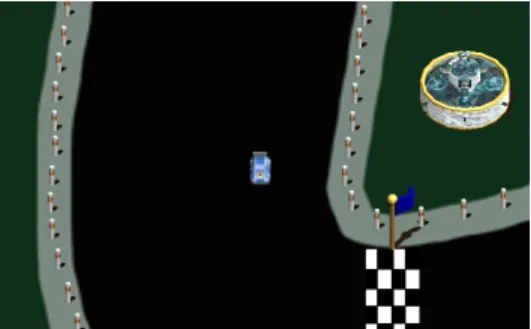
We offer the following exemplar methods from the MathMaker curriculum to articulate these concepts at work. We also offer snapshots of student-developed MathMaker games (Figures 1-4).
Converting game values for distance and rate: In certain instances, a math concept will be required to author certain values within the game. For example, ratios and conversions are used to go from a general value to a value that the game recognizes (e.g., second converted to pixels-per-step for rate of movement). Unit conversion is used for myriad design and development needs, such as setting characters to move at different speeds and “jump to” [GameMaker function] specific distances to create a relationship of movement between auxiliary characters, the environment and another player’s character.
Math as a game design mechanic: Math concepts are also essential for creating successful game designs. For example, in a game like Food Frenzy the player has to eat the right amount and type of food to progress to each level. Within this context, ratios become the core game balancing design practice in ensuring that all the food types and weights are proportional to the totals within the game. If the ratios are not properly configured, the game will become too easy, too difficult, or even impossible.
Figure 2: Screenshot of student game developed during MathMaker program.
Math explicitly used for programming: In later instances, a mathematical concept will be explicitly tied to the programming. For example, in one of our advanced pilots, students learned the quadratic formula in order to generate a parabola that defined the jump style of their playable character. The students used the quadratic equation to determine the vertex and overall form of the parabola within the Cartesian plane of the game environment.
Relative distance to optimize a global variable: Linear equations are used to create an optimization formula in a simple 2D airplane flyer game to determine the shortest distance across a set path for landing the plane for a refuel. In this process, the application of the mathematical concept is repeatedly facilitated as a programmed “global action” throughout a game level based on the airplane’s location and the island on which it is to land.
Figure 3: Screenshot of student game developed during MathMaker program.
Known technology language leveraged to reveal an essential math concept: To correctly configure a game for different devices (PC screen, plasma screen, the iPhone), the student must understand factoring, resolution and aspect ratio to calculate a game screen size that is compatible with different aspect ratios. Students come to a concrete realization that a ratio is a comparison of two numbers. They come to realize that certain resolutions share the same factors and can be reduced to the same ratio. The authentic context in this case naturally lends itself to variation in procedure, and our
research has leveraged that affordance to give students the opportunity to develop conceptual understanding in concert with practical skill.
Figure 4: Screenshot of student game developed during MathMaker program.
Extracting a general rule: Game authoring is an authentic context for recognizing and abstracting patterns. For example, when moving a character across the game environment using the “jump to position” command, the character moves at different fractions of distance across the screen. Given a certain fraction and room size (pixels of resolution) students must determine the proper x and y values to properly position the character. By varying the fraction and room resolution, students have opportunities to recognize and extract a general rule for calculating the jump distance. In this instance, the students make a series of calculations from which they extract a general pattern and then rule (in this case an equation).
The Study
The MathMaker project studied at Crenshaw consisted of a series of engaging game-creation curriculum units that were implemented to show that historically low-performing students could effectively learn and value mathematics through the MathMaker curriculum.The overarching goal of the program was to implement a successful after-school program serving low-income minority students attending schools challenged by high dropout rates and persistently low achievement (e.g., 1% school-wide proficiency in math). The program was additionally designed to create and foster students' identities as technology producers and engineers. In order to assure that the covered material was touching on core standards, students engaged in a carefully structured series of activities that required them to grapple with and apply 6th grade mathematics standards.
In the interest of measuring and evaluating the success of the program, we designed and administered formative and summative assessments on math learning linked with 6th grade standards. Mathematics proficiency was assessed with a set of adapted released items from the California Standards Test for 6th grade mathematics. Three measures were administered, each before and after sampled module chapters. Comparisons of the pre-test to post-test results were evaluated for evidence of improvement. Math interest was assessed with an eight-item 5-point Likert scale (portions were reverse-coded) and math self-efficacy and math class interest were measured using three items on a 5-point Likert scale (portions were reverse-coded). Constructed response post-test questions were administered to provide evidence of impact the program had on students' perceptions of themselves in mathematics and engineering.
Please note that t-tests were not involved in the evaluation due to a small sample size that would not register statistically significant and reportable results. As we expand the program, we will also expand our evaluation activities to document program impacts statistically, and in comparison to control groups.
Development Observations
To develop the MathMaker program, the GameDesk Institute created a game-learning curriculum development team bridging teachers from a network of schools, game developers, assessment specialists, and content experts in math and computer science. The team developed a curriculum development protocol for generating 6th-grade modules for the MathMaker project and intended outcomes. This protocol allowed the linking of each specific math process to a game development
process in GameMaker software, and to link those processes to an entire scope and sequence of engineering and math learning activities.
We believe that this particular collaborative expertise is remarkably unique in this field. To our knowledge, there is no prior literature describing any precedent for this type of development process or intellectual capacity. The team has developed a unique collaborative process and design protocol linking math common core standard to game development and design activities and an effective process for rapidly researching and developing math-driven game-authorship curriculum and game templates that are engaging, educational, and fun.
Implementation
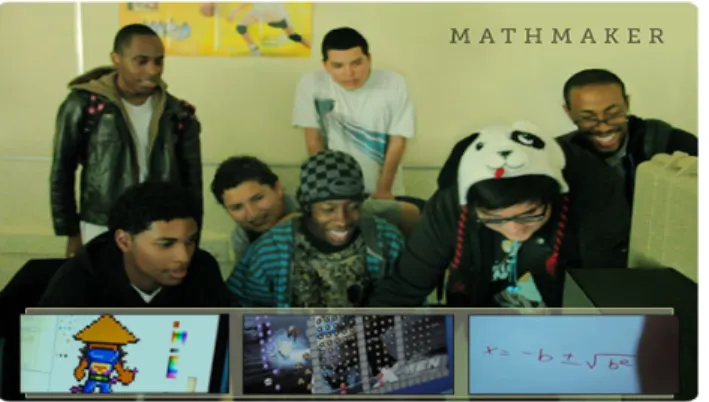
GameDesk implemented this curriculum at Crenshaw High School in spring 2011 as an after-school for-credit course (Figure 5). The class met four times a week for 10 weeks and was supported by an part-time art teacher and full-time math teacher from the high school.
Figure 5:Students at Crenshaw High School participating in MathMaker program.
The site where the program was implemented is a large urban high school. It enrolls over 2,000 students, of whom 64% are Black and 34% are Latino/a. Over three-fourths of the school's students come from low-income homes. Among the challenges faced at this site is 2% proficiency in general mathematics, based on the California Standards Test (CST) scores. The school's Academic Performance Index (API) hovers in the mid-500's (scores in the 800's are considered good), and fewer than 2 in 3 students graduate in four years. Within the program; a sample of ten of these students, approximately 60% were Black and 40% were Latino/a, were tracked and provided data for the measures administered.
An evaluation study was conducted to examine whether the pilot implementation offered evidence that the MathMaker curriculum met its goals of (1) improving students' mathematics proficiency; (2) increasing students' levels of mathematics interest, mathematics self-efficacy, and math class interest; and (3) positively impacting students' identities regarding mathematics and engineering. More importantly, the study sought to determine whether students' knowledge and motivation gains would transfer to traditional standardized tests and measures. All measures were chosen for their demonstrated validity and reliability metrics.
Program Goal 1: Mathematics Learning
In creating the game-making math curriculum, the GameDesk Institute aimed to increase students' proficiency in ten of the 6th grade California mathematics standards. These standards addressed concepts and procedures around number sense, fractions, ratios, and inequalities, and linear equations. Each standard was analyzed for linkages to game-making activities.
In the assessment component of this project, the Institute investigated whether students would be able to transfer the mathematics knowledge they gained in the game-making activities to state standardized tests. If so, this would provide compelling evidence that the MathMaker curriculum was meeting its mathematics learning objectives.
To ascertain whether students' mathematics proficiency improved by participating in the MathMaker program, a series of assessments were administered. The tests were administered twice, once before
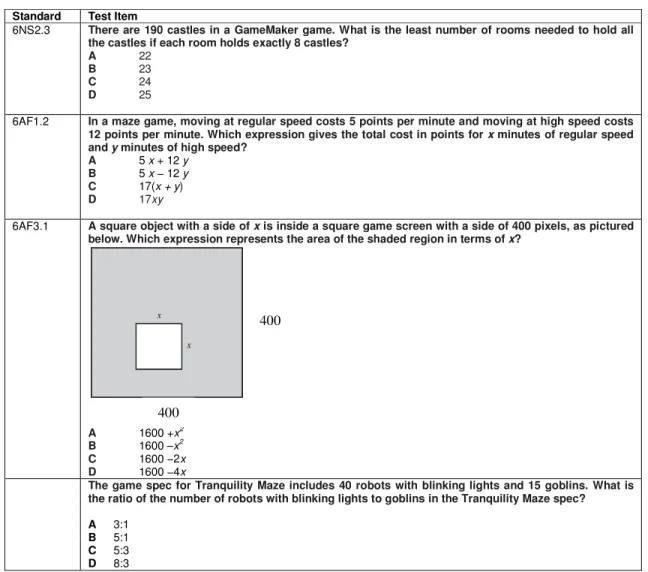
and once after the curriculum was implemented. The mathematics assessments administered in this evaluation study consisted of ten released test items from the California Standards Test (CST) in 6th grade Mathematics. Released items are test questions which have been administered on previous tests, and which are made available to the public. The state provides released test items for each of the state mathematics standards. The evaluation study was thus able to collect released test items associated with each of the standards targeted in the MathMaker curriculum. Some of the items were adapted to a game context. For example, one CST item asked, "The weekly milk order for the Tranquility Inn includes 40 gallons of low-fat milk and 15 gallons of chocolate milk. What is the ratio of the number of low-fat gallons to chocolate gallons in the Tranquility Inn's weekly milk order?" The adapted item read, "The game spec for Tranquility Maze includes 40 robots with blinking lights and 15 goblins. What is the ratio of the number of robots with blinking lights to goblins in the Tranquility Maze spec?” (Table 2)
Standard Test Item
6NS2.3 There are 190 castles in a GameMaker game. What is the least number of rooms needed to hold all the castles if each room holds exactly 8 castles?
A 22
B 23
C 24
D 25
6AF1.2 In a maze game, moving at regular speed costs 5 points per minute and moving at high speed costs 12 points per minute. Which expression gives the total cost in points for x minutes of regular speed and y minutes of high speed?
A 5 x + 12 y
B 5 x − 12 y
C 17(x + y)
D 17xy
6AF3.1 A square object with a side of x is inside a square game screen with a side of 400 pixels, as pictured below. Which expression represents the area of the shaded region in terms of x?
A 1600 +x2
B 1600 –x2
C 1600 −2x
D 1600 −4x
The game spec for Tranquility Maze includes 40 robots with blinking lights and 15 goblins. What is the ratio of the number of robots with blinking lights to goblins in the Tranquility Maze spec?
A 3:1
B 5:1
C 5:3
D 8:3
Table 1: Example Test Items
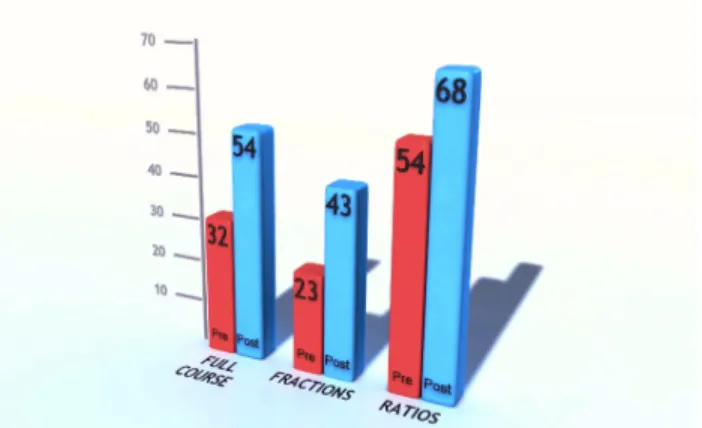
Results: The first test was administered the first week and last week of the program. At the start of the program, students scored an average of 32%. At the end of the course, the students' average was 54% on this test. Moreover, the great majority (80%) of students improved. This outcome shows clear learning gains over the course (Figure 6).
The second test targeted number sense and was designed to accompany a 1-week unit within the course on number sense in which students programmed characters to jump across the screen using distances equivalent to specific fractions of the screen width. On this test, the pretest average was 23% and the posttest average was 43%; over 80% of students improved from pre to post. Likewise,
400
the third test targeted ratios and accompanied a two-week unit within the game-making curriculum module. The average pretest score was 54%, and the average posttest score was 68%; over 70% of students improved from pretest to posttest.
Figure 6: Learning gains from MathMaker course.
Program Goal 2: Mathematics Self-Efficacy and Interest
The MathMaker program also aimed to (1) increase students' confidence in their mathematics ability, (2) increase students' interest in math, and (3) improve students' interest in math class. The first goal reflects the importance of self-efficacy, which refers to a person's confidence in their ability to complete a given task. Research has repeatedly shown that high levels of self-efficacy are associated with higher achievement. Students build their self-efficacy in mathematics through experiences of personal success, as well as by seeing their peers succeed. Because the mathematics in the MathMaker curriculum is so closely tied to a real-world context, and because the curriculum was created to offer students many opportunities to succeed, it was expected that students would gain confidence in their mathematics abilities.
There was also reason to expect students' math interest and math class interest to increase. The rationale for hypothesizing improved interest was that by learning and applying mathematics in a personally meaningful context (i.e. game making) students would see the utility of math for their own goals. In addition, the MathMaker curriculum is designed to help students deeply grasp the big ideas of mathematics, starting from real-world contexts. This approach was suggested to lead to better understanding, which in turn would foster the student’s continued interest.
Assessment Approach: Math Interest was assessed with an eight-item 5-point Likert scale that was previously validated by Riconscente (2010) (reverse-coded). Math Self-Efficacy was measured using three items on a 5-point Likert scale, based on Bandura (1997). To tap Math Class Interest, three items were administered on a 5-point Likert scale. This measure was adapted from Riconscente (2010).
Results: The mathematics interest, self-efficacy, and math class interest measures were administered at the start and end of the entire implementation. Average scores for all three measures increased from pretest to posttest. Mathematics interest went from 3.8 to 4.1, mathematics self-efficacy increased from 3.3 to 3.5, and students' average math class interest increased from 2.6 to 2.8. Self-efficacy and interest are considered relatively stable traits of individuals, not easily prone to change. The fact all three measures yielded increases after such a short implementation period demonstrates the ability of the program to positively impact students' motivation for mathematics.
Program Goal 3: STEM Confidence and Identity
The third goal of the MathMaker program pertained to students' senses of themselves as engineers and mathematicians. This outcome was investigated qualitatively, with the aim of capturing students' own perspectives on the ways that creating games helped them see their mathematics ability and engineering career opportunities in a different light. At the end of the course, students were asked to respond to several constructed-response questions, including "How did the GameDesk course change your ideas about being an engineer?" and "How did the GameDesk course change your self-confidence in math?"
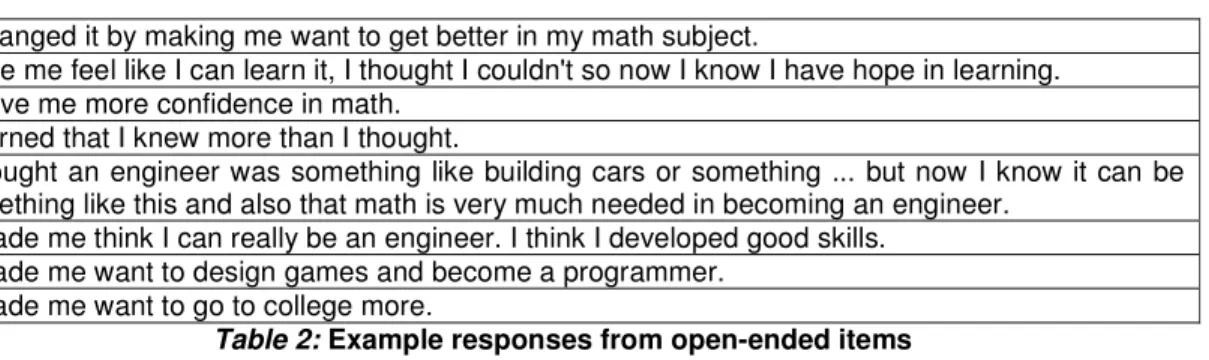
Results: The majority of students offered evidence that the course had a positive effect on their confidence in mathematics and in their identity as engineers. These results provide validation of the survey data that showed increased math self-efficacy (confidence) and personal relevance (interest). Specifically, students' constructed-response comments documented the positive impact the program had on their STEM persistence, confidence, ambitions, and career awareness (Table 2).
It changed it by making me want to get better in my math subject.
Made me feel like I can learn it, I thought I couldn't so now I know I have hope in learning. It gave me more confidence in math.
I learned that I knew more than I thought.
I thought an engineer was something like building cars or something ... but now I know it can be something like this and also that math is very much needed in becoming an engineer.
It made me think I can really be an engineer. I think I developed good skills. It made me want to design games and become a programmer.
It made me want to go to college more.
Table 2: Example responses from open-ended items
Moving Forward: Re-synthesizing Knowledge and Expanding the Creation Driven Model
The next stage of this project will be to design an individual culminating game that meets specific criteria by re-synthesizing previously constructed knowledge.
Students will be given examples of the how the final game should play and all of the functions that it has to perform. Our current design is to develop an Angry Birds clone that would have all math concepts previously demonstrated in preceding modules. For example, the parabola would be demonstrated in the grasshopper jumping action in the side-scroller module, etc. The goal will be to challenge the student to re-architect previous math knowledge in service of creating a game without any step-based prompting.
The MathMaker module has been designed to help students apply mathematics within an attractive and familiar real world context and thereby help them create meaning around math as a tool for development. Motivated by these challenges and this early promise in data, there's an implicit drive in the MathMaker program to embody, at the micro-level of the classroom module, what can be a macro-level transformation: schools becoming sites of experimentation, discovery and creation driven by student interest, grounded in educational standards, and facilitated by technology. It shows us a potential pathway to bridge existing gaps in student engagement and participation.
Summary
The purposes of the program and study were to examine whether the GameDesk developed MathMaker game-making curriculum modules could improve urban minority students' mathematics proficiency, interest, and confidence, and promote positive attitudes toward STEM careers. There was clear evidence of mathematics learning as assessed by state standardized test items. Moreover, quantitative survey results demonstrated a clear increase in students' attitudes toward math and their own ability to be successful in math and engineering. The results of the evaluation provide promising early evidence that MathMaker succeeded in improving students' math knowledge and motivation, even in a short-term implementation and an after-school context. Importantly, this project demonstrates the effectiveness of game-making for teaching and engaging students in STEM fields, and contributing to a necessary revision of our educational model. Having been successfully implemented in a predominantly African American and Latino/a classroom, MathMaker also demonstrates how this style of education can foster student excitement and achievement within historically disadvantaged communities severely underrepresented in STEM fields.
References
Aud, S., and Hannes, G. (Eds.) (2010). The condition of education 2010 in brief (NCES 2010-029). National Center for Education Statistics, Institute of Education Sciences, U.S. Department of
Education. Washington, DC. http://nces.ed.gov/pubs2010/2010029.pdf
Bandura, A. (1997). Self-efficacy: The exercise of control. New York: W.H. Freeman.
Dede, C., Salzman, M. C., & Loftin, R. B. (1996). The development of a virtual world for learning Newtonian mechanics. In P. Brusilovsky, P. Kommers, & N. Streitz (Eds.), Multimedia, hypermedia, and virtual reality: Models, systems, and applications (pp. 87–106). Berlin: Springer.
Flores, A., Knaupp, J., Middleton, J., & Staley, F. (2002). Integration of technology, science, and mathematics in the middle grades: A teacher preparation program. Contemporary Issues in Technology and Teacher Education [Online Serial], 2(1), 31–39.
“Game Developer Demographics: An Exploration of Workforce Diversity.” (2005). International Game Developers Association.
http://www.igda.org/sites/default/files/IGDA_DeveloperDemographics_Oct05.pdf Kuenzi, J. (2008). Science, technology, engineering, and mathematics (STEM) education:
Background, federal policy, and legislative action. Congressional Research Service Reports. Paper 35. http://digitalcommons.unl.edu/crsdocs/35
Linn, M. C. (2000). Designing the knowledge integration environment. International Journal of Science Education, 22, 781–796.
Riconscente, M. M., & Romeo, I. (2010). Technique for the measurement of attitudes, A (Likert). N. Salkind (Ed.), Encyclopedia of Research Design. Thousand Oaks, CA: Sage Publications Riconscente, M. M. (2010, September). Using latent profile analysis to evaluate the 4-Phase Model of
Interest Development. In M. Ainley (Chair) The next decade of interest research: Processes and measures. Symposium presented at the biannual International Conference on Motivation, Porto, Portugal.
Rising Above the Gathering Storm: Energizing and Employing America for a Brighter Economic Future (2007). Committee on Prospering in the Global Economy of the 21st Century: An Agenda for American Science and Technology. Committee on Science, Engineering, and Public Policy. National Academy of Sciences, National Academy of Engineering, and Institute of Medicine. Washington, DC: The National Academies Press.
Roschelle, J., Kaput, J., & DeLaura, R. (1996). Scriptable applications: Implementing open architectures in learning technology. Paper presented at the Ed-Media '96 World Conference on Educational Multimedia and Hypermedia, Charlottesville, VA.
Rohrer, D. & Pashler, H. (2010). Recent research on human learning challenges conventional instructional strategies. Educational Researcher. 39(5), 406-412.
Vanneman, A., Hamilton, L., Baldwin Anderson, J., and Rahman, T. (2009). Achievement gaps: How black and white students in public schools perform in mathematics and reading on the national assessment of educational progress, (NCES 2009-455). National Center for Education Statistics, Institute of Education Sciences, U.S. Department of Education. Washington, DC. http://nces.ed.gov/nationsreportcard/pdf/studies/2009455.pdf
Acknowledgments