Journal
of Energy
3-52 journal homepage: http://journalofenergy.com/Automatic Generation Control Application for Transmission and Generation Centres
K. VRDOLJAK*, B. KOPIĆ, M. GEC, J. KRSTULOVIĆ OPARA, S. SEKULIĆ Končar - Power Plant and Electric Traction Engineering Inc.
Croatia
SUMMARY
Recently, a new Emergency Control Centre for Albanian Transmission System Operator (TSO), which includes Supervisory control and data acquisition (SCADA) and Automatic Generation Control (AGC) applications, has been commissioned. Nowadays, an AGC application is being prepared for the biggest generation company in Croatia, as part of control centre for hydropower plants within western part of Croatia. Both of these implementations use the same AGC
application, which is presented in this paper.
Although AGC for TSO and AGC for Generation Centre (GC) have many similarities, their main goals are different. AGC for TSO must mainly regulate system’s frequency and area’s active power
interchange to their desired values, using only power plants engaged in load-frequency control (LFC). However, AGC for GC must ensure that power production of each power unit not engaged in LFC tracks its planned value, while also ensuring that centre’s share in LFC is being respected. Albeit the AGC is standalone application, in both afore-mentioned implementations it is affiliated with SCADA application, from which it obtains all required input measurements and indications and to which it delivers calculated setpoints. Additionally, all AGC pictures are integrated into SCADA pictures as well, in order to simplify operation and monitoring functionalities.
AGC for Albanian TSO controls active power generation of six hydro power plants engaged in LFC. AGC for GC West in Croatia controls active power generation of ten hydro power plants. In both implementations, communication with remote objects is done using IEC 60870-5-104
communication protocol, while communication with other control centres is done using ICCP communication protocol. Power production plans are sent to AGC either from Market Management Systems (in TSO case) or from scheduling and optimization application (in GC case).
KEYWORDS
Automatic Generation Control, Load-frequency control, Emergency Control Centre, Generation Centre, Transmission System Operator, SCADA.
2nd South East European Regional CIGRE Conference, Kyiv 2018
SEERC
VOLUME 67 Number 2 | 20181. INTRODUCTION
Since the beginning of 2018, a new Emergency Control Centre (ECC) for OST, Albanian Transmission System Operator (TSO), has been in operation. Besides, by the end of 2018, an Automatic Generation Control (AGC) application will be implemented in Generation Centre (GC) West of Croatian biggest generation company, HEP Generation.
For these two implementations the same AGC application is used, PROZA HAT AGC.
2. AGC HIERARCHY
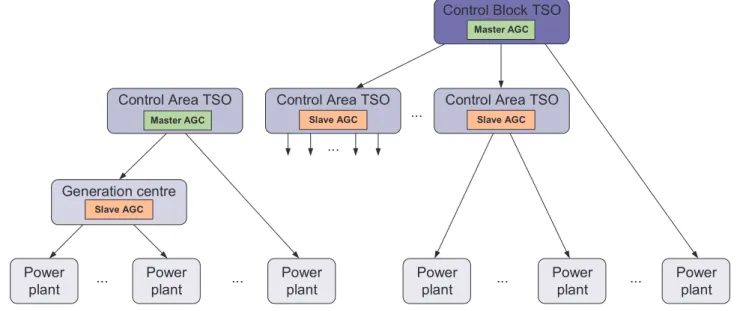
PROZA HAT AGC is an application that can be used both, for AGC at the highest level (in dispatching centre of master TSO) or at lower level (in dispatching centre of slave TSO or generation centre for several power plants). AGC levels are shown in Figure 1.
Control Block TSO
Control Area TSO Control Area TSO
Power
plant Power plant ...
...
... Power
plant ...
Control Area TSO
Power
plant ... Power plant ... Power plant Generation centre Master AGC Master AGC Slave AGC Slave AGC Slave AGC
Figure 1: AGC application hierarchy
Master AGC in TSO centre is independent of any other AGC/TSO and it is in charge of conducting load-frequency control (LFC) in its control area or for the entire control block (see Figure 1). At this level, TSO usually has two redundant centres: Main (or National) Control Centre (MCC or NCC) and Emergency Control Centre (ECC). Slave AGC in TSO’s centre or in GC receives its total share in LFC from the master AGC, which it has to redistribute to its AGC-units engaged in LFC. Besides, within GC implementation, automatic plan tracking is usually used for AGC-units not engaged in LFC. Generally, AGC-unit can be power unit, power plant or a group of power plants, depending on the implementation.
3. PROZA HAT AGC APPLICATION
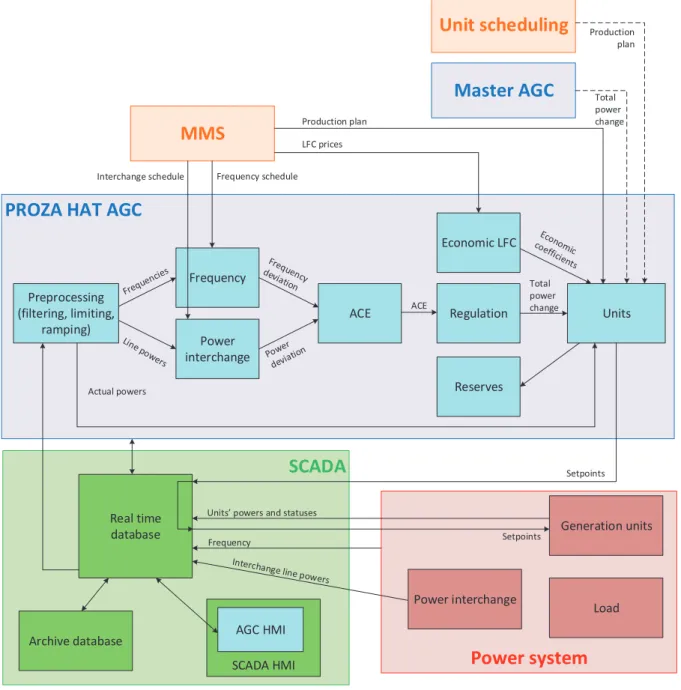
PROZA HAT AGC application consist of several modules, which are shown in Figure 2. Whether a module is used or not in an AGC implementation, depends on the AGC’s hierarchical role (master AGC or slave AGC). Master AGC uses all modules shown in Figure 2, with input measurements and indications arriving from SCADA and input plans from MMS system. Slave AGC uses only Units module, while Preprocessing module is not obligatory. In this case, inputs to
Units module are: total power change from master AGC, production plan from scheduling application and raw (or pre-processed) measurements of actual powers from SCADA.
MMS
SCADA
SCADA HMI
PROZA HAT AGC
Frequency
Power interchange
ACE Regulation Units
Reserves AGC HMI
Power system
Load Generation units Frequency schedule Interchange schedule ACE Total power change Actual powers Setpoints Frequency Production plan Archive database Real time databaseUnits powers and statuses
Power interchange Preprocessing (filtering, limiting, ramping) LFC prices Economic LFC
Master AGC
Total power changeUnit scheduling
Production planSetpoints
Figure 2: PROZA HAT AGC application modules
3.1 PROZA HAT AGC’s integration with SCADA
Although PROZA HAT AGC is a standalone application, in its current version it should be associated with an operating SCADA application to obtain its full functionalities regarding communication, visualisation, archiving and control.
From SCADA’s real time database PROZA HAT AGC obtains all required input measurements
and indications, which are gathered using SCADA’s communication with remote objects. To SCADA, it delivers calculated active power setpoints, which SCADA forwards to AGC-units. PROZA HAT AGC’s communication with SCADA is done through software communication gateway.
If input data cannot be obtained from inherent SCADA system, PROZA HAT AGC has its own IEC60870-5-104 and TASE.2 communication drivers, which can also be used for exchanging information with remote objects in the power system.
algorithm. During pre-processing, functions of limiting, ramping, filtering or dead zone can be applied to unlimited number of raw measurement inputs.
Additionally, PROZA HAT AGC doesn’t require its own HMI, since all AGC pictures can be drawn and integrated into related SCADA. This manner ensures that monitoring and control
functionalities are grouped at one place and thereby simplified for operator’s usage.
SCADA system also serves for archiving AGC data. For those purposes, all AGC data required for reporting or archiving purposes must be sent from AGC to SCADA.
PROZA HAT AGC has no limitations regarding the SCADA system it need to connects with. If chosen SCADA application doesn’t support connection with external applications through existing driver or software gateway, a communication between SCADA and PROZA HAT AGC using Inter-Control Centre Communications Protocol (ICCP) can be established for data exchange purposes.
3.2AGC for Transmission System Operator purpose
AGC is a function that TSO of a power system uses to control production of generating units in LFC in order to keep system’s frequency and interchange with neighboring areas at their desired values
and production of generating units not in LFC to track area’s production plan. PROZA HAT AGC functionalities that are used for implementation for TSO are:
data pre-processing
control area/control block support
priorities of measurement sources
calculation of area control error from frequency and interchange deviations
PI regulation algorithm
AGC prices included in total power distribution to AGC-units
merit order list in selection of AGC-units
sending planned or manual setpoints
monitoring of system reserves
simulation of anticipated AGC-unit’s response
Within AGC algorithm, firstly frequency and total active power interchange deviations are calculated. Each input measurement can be included or excluded from AGC algorithm. The
deviations are afterwards used to calculate area control error (ACE) signal. A proportional-integral (PI) regulator is used to calculate total desired active power of all AGC-units engaged in LFC in order to drive ACE to zero MW value.
Total power change is optimally (from TSO’s perspective) distributed to all power units engaged in LFC. If LFC market prices are present for the TSO, then minimum total price can be used as optimal criteria for the distribution of powers. Otherwise, the distribution can be done based on regulating ranges or on manually defined participation factors.
Secondary and tertiary reserves are calculated for all power units, power plants and the whole system. System reserves are monitored against their desired values.
AGC in master TSO can also regulate AGC-units not engaged in LFC. The can be regulated to manually set active power value or to its value obtained from the plan from Market Management System (MMS).
3.3AGC for Generation Centre purpose
AGC for GC must mainly ensure that power production of AGC-units not engaged in LFC tracks
desired plan, while also ensuring that centre’s share in LFC is being regulated to received value through AGC-units engaged in LFC.
PROZA HAT AGC functionalities that are used for implementation for GC are reduced to:
data pre-processing
planned or manual setpoints
merit order list in selection of AGC-units
monitoring of system reserves
simulation of anticipated AGC-unit’s response
Power production plans are sent to AGC from units’ scheduling application. Those plans should be calculated optimally based on defined/chosen criteria.
4. IMPLEMENTATIONS OF PROZA HAT AGC
4.1 Emergency Control Centre in Albania
Transmission System Operator in Albania is Operatori i Sistemit të Transmetimit (OST Sh.a.). OST had a NCC, but due to ENTSO-e requirements they also put into operation ECC in the beginning of 2018. ECC in Albania includes SCADA and AGC applications [1].
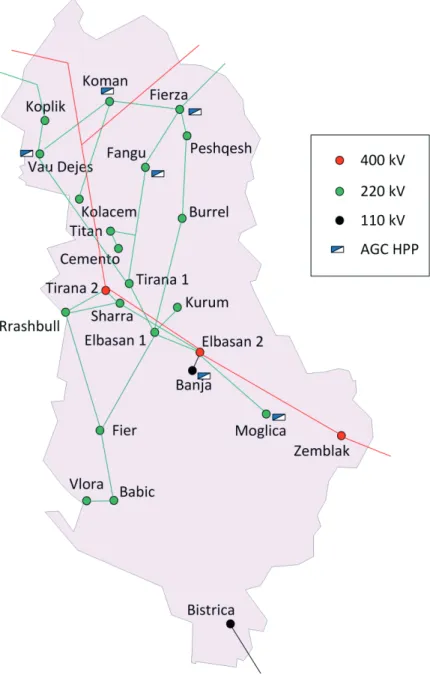
SCADA system in ECC is connected with 24 remote objects (transformer stations, HPPs or both). AGC for Albanian TSO controls active power generation of six hydro power plants (HPPs) engaged in LFC. Those are: HPP Fierza, HPP Koman, HPP Vau Dejes, HPP Fangu, HPP Banja and HPP Moglica. All remote object and their interconnected lines are shown in Figure 3.
PROZA HAT AGC in Albanian ECC is implemented in redundant configuration on two SCADA/AGC servers. It is connected with SCADA system PROZA NET, also in redundant configuration. Two additional servers are used for archive database.
AGC’s communications with HPPs is done through PROZA NET using IEC 60870-5-104
communication protocol. In each HPP, an additional communication gateway, named LKKU, is installed between ECC and local control system. It is used as network interface for communication between HPP and ECC and also for blocking unauthorised commands from ECC. Input data that AGC receives from HPPs are actual active power measurements and AGC-unit’s statuses.
AGC’s communications with transformer stations (TS) is also done through PROZA NET using
IEC 60870-5-104 communication protocol and through LKKU gateway. Input data that AGC receives from each border TS are actual interchange power measurements for all interconnection lines.
AGC’s communication with NCC is done using ICCP (TASE.2) communication protocol. The data
that is being exchanged between the centres is used for authority handling, since at the time only one centre can be allowed to send SCADA commands and AGC setpoints. However, centres can
monitor OST’s system simultaneously. Other data that is received from NCC are alternative
measurements of interchange power for interconnection lines between Albania and Greece and Albania and Montenegro. AGC sends to SCADA system calculated setpoints of AGC-units, for forwarding to AGC-units.
Figure 3: Remote objects within ECC in Albania
AGC’s communication with neighbour control area of Kosovo is also done using ICCP
communication protocol. In block operation mode, ECC exchanges with KOSTT (TSO in Kosovo) all data required for block control. In the block, OST is the block leader.
AGC in ECC receives AGC-unit’s regulation limits and Albania’s interchange schedule from OST’s
MMS system in form of standardized XML file format. After data from XML files are imported to PROZA HAT AGC, a CSV file is created as an interface for data visualization and manual
interventions. In case plans are not available or they are corrupt, manually entered values can be used instead.
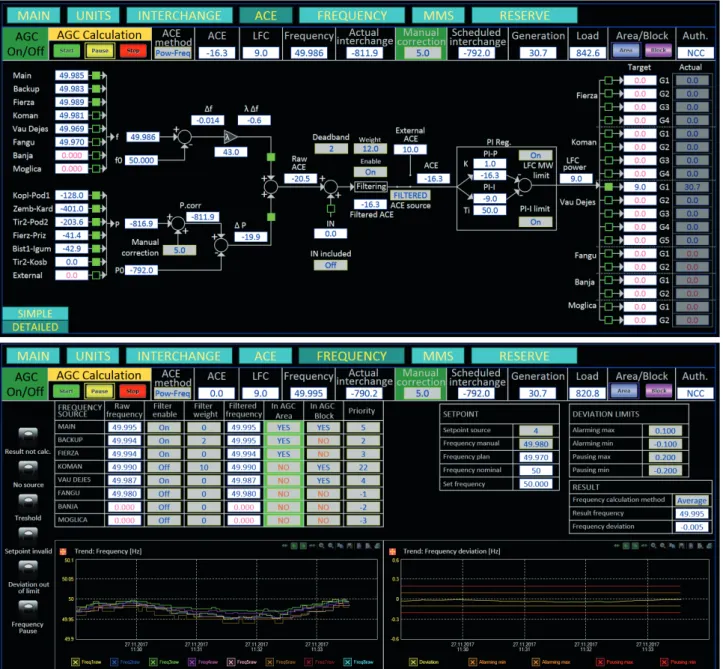
AGC pictures are divided into two categories: for operators and for administrator. Authority and
allowable action through pictures is defined with user’s role. Example AGC pictures of ECC system are shown in Figure 4.
Figure 4: Example AGC pictures in ECC in Albania
4.2 Generation Centre West in Croatia
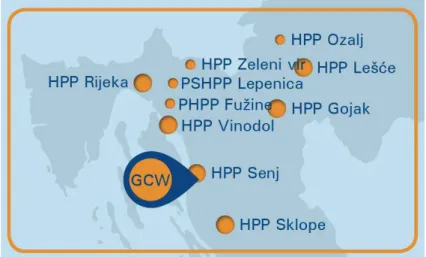
GC West in Croatia servers as monitoring and control centre for all (ten) hydropower plants of HEP Generation company in western part of Croatia, Hydro West [2]. Some of them are pump-storage (PSHPP) and some are just pump (PHPP) power plants. They are all located on four independent river catchments. All objects within area of Hydro West are shown in Figure 5.
Figure 5: Remote objects within GC West in Croatia
In Hydro West only HPPs Senj and Vinodol are engaged in LFC in Croatia. So far, they have been
receiving setpoints from Croatian TSO’s NCC (or ECC), but in the future it will be possible to insert
GC West into control path between NCC/ECC and HPPs. In NCC/ECC, GC West will be modelled as a single AGC-unit, while all distribution of its share in LFC to HPPs of Hydro West will be done within AGC application in GC West.
Additionally, AGC for GC West in Croatia must ensure that all power units not engaged in LFC follow defined plans that are provided to GC West by an external company, HEP Trade. Since in Croatian power system those plans are given for each power unit, in GC West’s AGC power units are modelled as AGC-units (instead of power plants in Albanian ECC).
AGC in GC West will be set in redundant configuration, on two SCADA/AGC servers. SCADA system in GC West will also be PROZA NET.
AGC in GC West will only communicate with HPPs in Hydro West area and with Croatian’s TSO
NCC/ECC. AGC’s communications with HPPs will be done using IEC 60870-5-104 communication protocol. In each HPP, a separate programmable logic controller (PLC) is in charge of LFC
functionality and it will receive setpoints from GC West. Input data that AGC will receive from HPP are actual active power measurements and statuses of AGC-units. Communication between AGC in GC West and HPP within Hydro West will not be direct, but will go through GC West’s
SCADA application.
AGC’s communication with NCC/ECC will be done using IEC 60870-5-104 and ICCP
communication protocols. The data that will be exchanged between the centres will be used for authority handling, since in migration period only one centre will be allowed to send AGC setpoints towards HPPs. AGC in GC West will forward to NCC/ECC all required data gathered from HPPs but also information about plans for units not engaged in LFC.
NCC/ECC in Croatian TSO will either consider power plants as AGC-units or the whole Hydro West area as a single AGC-unit. Since AGC-unit in Hydro West’s AGC is power unit, GC West will be in charge of distribution of signal(s) received from NCC/ECC to its power units engaged in LFC. For power units not engaged in LFC, AGC in GC West will receive units’ planned power schedule from external application Hydro Scheduling. Communication between these two applications will be
done through GC’s archive database. In case plans will not be available or will be corrupt, it will be possible to use manually entered values.
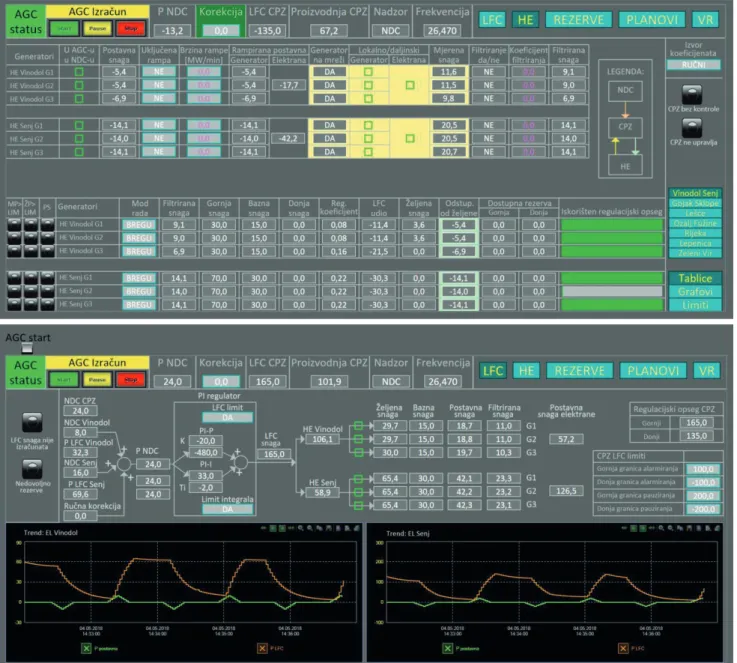
Figure 6: Example AGC pictures in GC West in Croatia
GC West will be put into operation by the end of 2018.
Besides GC West, there are two mode GC centres in Croatia: GC South [3] and GC North [4], which were put in operation in 2013 and 2016, respectively. The both have PROZA NET SCADA system, while AGC is only implemented in GC South, but in reduced scope, since there is only one power plant in LFC.
5. CONCLUSIONS
A combination of PROZA HAT AGC application and PROZA NET SCADA application has proven to be highly reliable and very flexible solution for both, AGC in TSO’s control centre and AGC in
generation centre. The basic application’s structure and functionality in both types of centre remains the same, only the selection of required modules and their parameters are adjusted according to implementation requirements. The AGC application can also connect to various external application and systems on higher or lower level of regulation and successfully exchange data with them.
REFERENCES
[1] K. Vrdoljak, M. Zrno, I. Krajnović, I. Pikula, A. Paci, R. Dhimo “Implementation of Emergency Control Center of Transmission System Operator in Albania” (13th HRO CIGRÉ Session, November 2017, Croatia)
[2] K. Vrdoljak, B. Horvat, V. Mustapić, B. Pavlović, M. Dabro, M. Kačić, G. Gašparović, A. Prpić
“Overview of Applications and Functions at Generation Center West” (13th HRO CIGRÉ Session, November 2017, Croatia) (in Croatian).
[3] B. Horvat, A. Martinić, M. Dabro, T. Blažević “The Cetina river catchment control centre:
combining commercial and tailor-made solutions” (The International Journal on Hydropower and Dams, Issue Six, 2012)
[4] K. Vrdoljak, B. Horvat, I. Strnad, Ž. Štefan “Integration of applications for revitalization of a remote