This project has received funding from the European Union’s Seventh Programme under Grant Agreement No 603939
Write-up from the GreenEcoNet Workshop
Role and challenges of SMEs in a green(er) economy –
barriers, needs and policy options
Friday 28 November 20149.30 Welcome and introduction to the GreenEcoNet project
Dr. Martin Hirschnitz-Garbers, Ecologic Institute Corrado Topi, SEI York
9.45 Role and challenges for SMEs in a green(er) economy
Sebastian Schmidt, VDI Resource Efficiency Centre
Andreas Kunsleben, Effizienz-Agentur NRW (online presentation)
10.30 Open exchange on networking, barriers and needs (working groups)
11.15 Coffee break
11.30 Rapport from exchange of experience
12.00 SME needs and strategies for supporting SMEs
Dr. Kai Morgenstern, RKW Kompetenzzentrum Dr. Alexander Van der Vooren, PBL
Q&A and discussion
12.50 Lunch
13.30 SME needs and strategies for supporting SMEs - continued
Robert Lorenz, Green Key Project
Nicole Meier, Energy efficiency+ Roundtable Dr. Daniel de Graaf, PRESOURCE project Jan Christian Polania Giese, Thema1
Q&A and discussion
15.45 Coffee break
16.00 Presenting the web platform
Oliver Greenfield and Chris Hopkins, Green Economy Coalition
16.45 Outlook and next steps
Dr. Martin Hirschnitz-Garbers, Ecologic Institute Corrado Topi, SEI York
17.00 End of Workshop
Venue: Ecologic Institute, Pfalzburger Str. 43-44, 10717 Berlin, Germany Project partners
Surname Name Institution Country
Claußnitzer Sylvi Verband Deutscher Maschinen- und Anlagenbau Germany
de Graaf Daniel Federal Environment Agency Germany
Echeverria Evelyn Project Management Juelich Germany
Greenfield Oliver Green Economy Coalition United Kingdom
Hirschnitz-Garbers Martin Ecologic Institute Germany
Hopkins Chris Green Economy Coalition United Kingdom
Kafyeke Terri Ecologic Institute Germany
Lorenz Robert German Foundation for Environmental Education (DGU) Germany
Meier Nicole Modell Hohenlohe e.V. Germany
Morgenstern Kai RKW Kompetenzzentrum Germany
Papadelis Sotiris University of Piraeus Research Center Greece
Polania Giese Jan Christian PEF World Forum Germany
Rinaldi Roberto Stockholm Environment Institute at York United Kingdom
Rizos Vasileios CEPS - Centre for European Policy Studies Belgium
Schmidt Sebastian VDI Centre for Resource Efficiency Germany
Topi Corrado Stockholm Environment Institute at York United Kingdom
van der Gaast Wytze JIN The Netherlands
van der Vooren Alexander PBL Netherlands Environmental Assessment Agency The Netherlands
This project has received funding from the European Union’s Seventh Programme under Grant Agreement No 603939
Working groups on networking, barriers and needseds
Working group 1: Networking – what role does online and offline networking play for SMEs? How best to network? What could be lessons learned?
Working group participants: Nicole Meier, Sylvi Claußnitzer, Daniel de Graaf, Oliver Greenfield, Corrado Topi, Terri Kafyeke
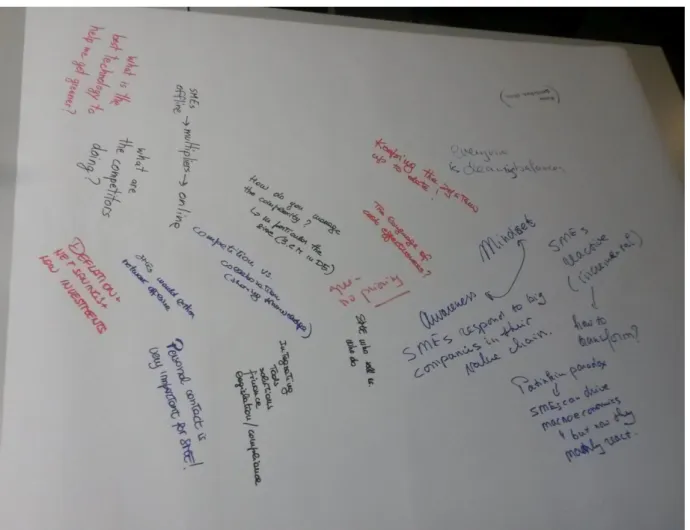
This working group focused on online and offline networking for SMEs. The group discussion revealed three main obstacles that might hinder SME’s likeliness to use the GreenEcoNet network: issues tied to sharing information, a lack of familiarity with green business opportunities and a preference for personal contact.
The issue of information sharing emerged early on in the discussion. Participants mentioned that many SMEs will be reticent to share their knowledge as it gives them a competitive advantage. The information can also be commercially sensitive. Of course, this varies from one SME to another. In some sectors, people are more willing to share than in others. Additionally, some SMEs which have greened their operations might want to share their case study in order to use it as a marketing instrument.
Nonetheless, the common understanding was that some efforts will be necessary to convince SMEs to share their case studies. In addition to competitiveness, reluctance to share might be tied to limited temporal resources and the need to build a trusting relationship before sharing information with others.
In fact, the preference for personal contact appears to be well accepted in the small business landscape. SMEs prefer personal contact with their sector organizations and multipliers. They are usually more familiar with offline networking based on trust. In addition, SMEs are not likely to look for the platform on their own (unlike multipliers). SMEs do not have time to look for the most relevant site on the internet. SMEs will rather go to multipliers, and these could direct them to the online platform if we are able to convince them of its usefulness. Therefore GreenEcoNet may be a platform for multipliers (to help multipliers filter information for SMEs) rather than for SMEs individually.
There is currently a huge offer of websites, and the added value of GreenEcoNet could be to help make order of the chaos. We need to have very relevant and up to date information in order to keep SMEs on the website. If they only see old publications, they will not come back. We could publish SME-relevant EU research results. Since SMEs do not have much time, the website must provide them with results quickly. They just want to find filtered solutions to their problems quickly. It was mentioned that the website could be a platform for national multipliers, as different countries have different compliances, but it was also said that there are many EU-wide rules. Feeding the inputs from the website back to policy-makers is also a good incentive to use the website.
Finally, SMEs often lack familiarity with green business opportunities in the first place. Many small businesses do not see “being green” as a priority. This does not mean that they are against greening their business, but rather that their main focus is on their core business operation. In other words, greening their operations becomes interesting when it supports their core business. It is consequently crucial to use the language of cost effectiveness when convincing SMEs to join the green economy. Some SMEs simply do not know that they have a problem or that changing the way they work into greener operations could be beneficial. Finance and compliance legislation
Furthermore, SMEs often simply respond to what is demanded by bigger companies in the value chain (for example, a car manufacturer that decides to only purchase parts if they were produced in a “green” way). SMEs tend to only be reactive in the economy, and that means that they implement incremental change rather than transformative change. It is acknowledged that SMEs can be key drivers of macroeconomic development towards a greener economy, but due to barriers and knowledge gaps, the micro level optimization behavior of SMEs often stands in the way of greener businesses (variant to Patinkin paradox about how optimized micro-level behavior differs from macro-level optimizations). Moreover, in these times, many public and private entities (including SMEs) are cleaning their balance, which leads to lower demand, including for greener products. We cannot ignore the current macroeconomic setting that SMEs are working in: deflation, net savings and low investments.
This project has received funding from the European Union’s Seventh Programme under Grant Agreement No 603939
Working group 2: Barriers and needs – what are relevant barriers facing SMEs in going green(er) in your experience? What support would SMEs need in order to overcome barriers to thriving in a green(er) economy? What support is offered? What should be offered?
Working group participants: Evelyn Echeverría, Tobias Zorn, Alexander van der Vooren, Sebastian Schmidt, Kai Morgenstern, Chris Hopkins, Vasileios Rizos, Martin Hirschnitz-Garbers
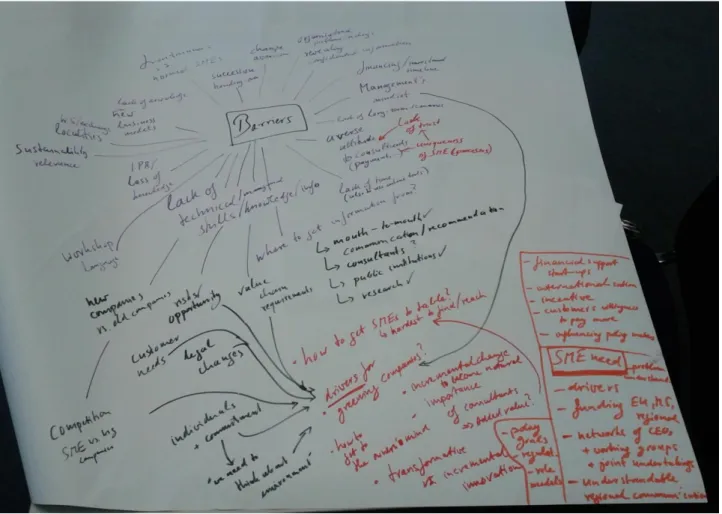
According to the group discussion, SMEs are facing a multitude of barriers that prevent or make it more difficult for SMEs to thrive in a green(er) economy (see Fig. below). One key barrier was found to be a lack of technical and managerial knowledge, skills and information, including on the usability of new business models. This limits the options for SMEs to adjust to a green(er) economy as new or adopted ways of doing business may not be known or staff may not be able to (easily) pursue new activities. In addition, a lack of long-term scenarios in the top management’s mind-set – which may result from a lack of time, lacking perception of the relevance of a green(er) economy and aversion to change – likely also hinders adjusting to a green(er) economy, including insufficient retirement planning for succession in business executives.
Furthermore, the organizational structure and culture of an SME may limit the exchange of information between different departments, e.g. between accounting, marketing and engineering. Thus, relevant opportunities may go untapped or the SMEs response mechanisms may be too slow to exploit opportunities. Another barrier relates to the question where to get information and advice from in order to become green(er). While it is mostly peer-to-peer communication from within the business community that is credible and relevant for SMEs, also external consultants provide advice for many SMEs. In both cases, the question of how confidential knowledge and intellectual property rights are treated in competitive settings in the process of consulting and exchange needs serious consideration. Furthermore, for external consulting, a lack of trust and a perception of costly services with unclear business benefits could compromise the degree to which SMEs want to make use of external consulting to get advice and information needed.
Finally, both the lacking access to funding and the issue of high up-front investments costs vs. long-term pay-back times puts a brake on SMEs’ ability to “greenovate”.
Then, the working group turned to identifying drivers for greening business activities and adjusting to a green(er) economy, highlighting that some of the barriers may also be drivers and that some of the drivers may also act as barriers. This was seen, for instance, for (a) changes in the regulatory framework, (b) for customer needs and (c) for the mind-set and commitment of individuals (whether employees or management), which could both hinder and enable SMEs going green(er). Another relevant driver discussed was competition between SMEs, mainly between existing and newly formed SMEs – where the newly formed ones may find adjusting to a green(er) economy much easier because they do not have to change pre-existing business patterns –, but also between SMEs and large companies may driver the greening of SMEs in order to increase competitiveness, finding new niches and new customer segments. However, in the context of interactions between SMEs and large companies, the requirements that larger companies may put on their SME suppliers (as in the automobile industry, for instance) may also green value-chains and hence drive supplying SMEs greening their processes. This indicates the occurrence of potential risks and potential opportunities is driving SMEs to become green(er) – and that this may similarly also hinder exactly that when acting as barriers.
Based on this exchange, the working group eventually discussed the needs that SMEs would have to becoming green(er) and to overcome (some of) the barriers discussed above. Providing financial support to existing SMEs and to start-ups (the latter were considered to be able to deliver more on transformative changes than existing SMEs), on EU, national, regional and local levels, ranked
border exchange and relations between SMEs or sectors. Therefore, policy makers are needed who (i) understand the problems and challenges facing SMEs, (ii) are able and (iii) willing to influence policy support towards providing solutions sought to SMEs. In addition, it also needs a clear and understandable (for SME management and employee) communication on the regional level so that SMEs know what challenges could be (if they do not know this all themselves already) and where to turn to solve these problems. This should include facilitating and encouraging SMEs to set up regional or local networks of SME CEOs and working groups that allow developing a joint problem understanding and exploiting joint opportunities for problem articulation and support for problem solving. While the previous aspects seem rather within reach of policy makers to implement, it was also highlighted that SMEs need customers to be willing to pay more for green(er) services and products – this can be facilitated by policy support (e.g. tax rebates for buying certain green services and products), but it also requires wider societal support.
This project has received funding from the European Union’s Seventh Programme under Grant Agreement No 603939
Group Picture
From left to right:
Wytze van der Gaast, Nicole Meier, Daniel de Graaf, Oliver Greenfield, Kai Morgensten, Evelyn Echeverría, Corrado Topi, Jan Christian Polania Giese, Martin Hirschnitz-Garbers, Vasileios Rizos, Tobias Zorn, Sylvi Claußnitzer, Sebastian Schmidt, Robert Lorenz, Chris Hopkins, Terri Kafyeke, Alexander van der Vooren.
Speakers
Sebastian Schmidt, VDI ZRE
VDI’s Centre for Resource Efficiency is the national competence centre to ensure resource efficiency improvements in German SME. Sebastian’s tasks as scientific officer include the analysis of studies, statistics and policy papers in the field of resource efficiency, environmental economics and sustainable development; the supervision of studies implemented by subcontractors in the field of resource efficiency; the support of the Federal Environment Ministry with expert input on various thematic aspects of resource efficiency as well as the support of the project PRESOURCE Promotion of Resource Efficiency in SMEs in Central Europe (EFRE, INTERREG, Central Europe 2007-2013).
He studied International Public Policy and Administration at the University of Potsdam from 2001 to 2007.
Dr. Kai Morgenstern, RKW Kompetenzzentrum
After studying Physic and completing a PhD in climatology in Göttingen (Germany) Kai Morgenstern moved to the University of British Columbia to do a postdoc. After leaving University he worked as an environmental consultant in Canada and Germany evaluating emissions and energy efficiency of mining projects as well as developing concepts for renewable energy supply for cities. Industrial energy generation, waste heat utilization and efficient heating of buildings were important topics in this work. Since 2012 Dr. Morgenstern has been the project director for the ENERGY EFFICIENCY – KICK-OFF CONSULTATION FOR SMALL AND MEDIUM ENTERPRISES project, funded by the German Federal Ministry of Business and Energy. Project staff visited more than 7,700 SME to highlight potentials for energy efficiency in the firm, suggest possible improvements and advise them of federally funded programs that support energy efficiency in SME.
Dr. Alexander Van der Vooren, PBL Netherlands Environmental Assessment Agency
Dr. Alexander van der Vooren is a policy researcher at PBL Netherlands Environmental Assessment Agency. His main research subject is greening the economy, with a focus on eco-innovation. He received his PhD in 2014 on ‘Accelerating Technological Change – Towards a more sustainable transport system’ at Utrecht University (NL).
This project has received funding from the European Union’s Seventh Programme under Grant Agreement No 603939
Nicole Meier, Model Hohenlohe e.V.
After studying process and environmental engineering at Fachhochschule Heilbronn, Nicole Meier worked as project engineer in the areas of project planning, waste management and energy efficiency. Since May 2013 she is CEO of Modell Hohenlohe e.V., where she is responsible for the thematic areas energy efficincy, energy management according to DIN ISO 50001, DIN 16247 as well as environmental management according to EMAS.
Dr. Daniel de Graaf, UBA
Daniel de Graaf studied biochemistry at the Free University of Berlin and earned his doctorate in 2009 from the Max Planck Institute for Infection Biology in Berlin. Since joining the Federal Environment Agency (Section III 1.4 Substance-related Product Issues) in 2008, he is concerned with fluorinated greenhouse gases which are mostly used as refrigerants in e.g. air conditioning and heat pump appliances. He coordinated the European Union (EU) INTERREG project SPIN (Sustainable Production through Innovation in small and medium-sized enterprises (SMEs)) from 2009 until 2011 which was co-financed by the Baltic Sea Region Programme. Since 2012, he is responsible for the EU INTERREG project PRESOURCE (Promotion of Resource Efficiency in SMEs in Central Europe) which deals with the improvement of resource efficiency in SMEs of the manufacturing sector. The project is co-financed by the Central Europe Programme.
Jan Christian Polania Giese,Thema1
A graduate in environmental engineering, Jan Christian Polania Giese is the programme director of the Product Environmental Footprint (PEF) World Forum. Through this position Jan Christian interacts with relevant experts from the main international initiatives in carbon and environmental footprinting, life cycle assessment (LCA) and product sustainability. In the working group for the development of PEF category rules for laundry detergents, he supports the development of effective communication vehicles within the EU PEF process. Furthermore, Jan Christian serves as technical expert and consultant at THEMA1 on climate change, LCA and sustainability hotspots. He is co-author of the comparative study “Defining Product Sustainability: Overview of Global Hotspot Initiatives” and contributes to several standardisation and harmonisation processes. Further, Jan Christian authored the Carbon Film Quote, a carbon tool for the advertisement sector and is project leader of the recently launched Green Pictures Group project, which aims at implementing and communicating carbon emission reductions in the filming sector.
Robert Lorenz, Green Key Project national coordinator
After studying obtaining his degree in history, political science and English Philology in 2000, Robert Lorenz became a member of the German Foundation for Environmental Education (DGU) and worked for the international umbrella organisation FEE - Foundation for Environmental Education. He then gained extensive experience as a teacher training regarding environmental education in international projects related to education for sustainable development. He became the national coordinator of Eco-Schools and got involved as research partner and member in Form-it and KidsINNscience (for FUB, international projects on science education, 2006 - 2013). Since 2011 he is the national coordinator of the Green Key project.