E. Schoitsch (Ed.): SAFECOMP 2010, LNCS 6351, pp. 431–451, 2010 © Springer-Verlag Berlin Heidelberg 2010
Andreas Eckel1, Paul Milbredt2, Zaid Al-Ars3, Stefan Schneele4, Bart Vermeulen5, György Csertán6, Christoph Scheerer7, Neeraj Suri8, Abdelmajid Khelil8,
Gerhard Fohler9, Roman Obermaisser10, and Christian Fidi11 1
TTTech, 2 Audi AG, 3 Delft University of Technology 4
EADS Deutschland GmbH, 5 NXP Semiconductors Netherlands B.V. 6
OptXware Research and Development Ltd., 7 Thales Rail Signalling Solutions GesmbH 8
Technical University of Darmstadt, 9 Technical University of Kaiserslautern, 10
Vienna University of Technology, 11 TTTech Computertechnik AG
Abstract. Embedded computing systems have become a pervasive aspect in virtually all application domains, such as industrial, mobile communication, transportation and medical. Due to increasing computational capabilities of mi-crocomputers and their decreasing cost, new functionality has been enabled (e.g., driver assistance systems) and cost savings have become possible, e.g., by the replacement of mechanical components by embedded computers.
Conventionally, each application domain tends to develop customized solu-tions, often re-inventing concepts that are already applied in other domains. It is therefore expedient to invest into a generic embedded system architecture that supports the development of dependable embedded applications in many differ-ent application domains, using the same hardware devices and software modules. INDEXYS targets to pave the way from the European Commission Frame-work 7 GENESYS Project reference computing architecture approach towards pilot applications in the automotive-, railway- and aerospace industrial domains. INDEXYS will follow-up GENESYS project results and will implement selected industrial-grade services of GENESYS architectural concepts.
The results of laying together GENESYS, INDEXYS and the new ARTEMIS project ACROSS, which will develop multi processor systems on a chip (MPSoC) using GENESYS reference architecture and services, will provide in-tegral cross-domain architecture and platform, design- and verification- tools, middleware and flexible FPGA- or chip- based devices lowering OEM cost of development and production at faster time-to market.n of COOPERS.
Keywords: Embedded computing systems, Embedded platform, INDEXYS, GENESYS reference architecture.
1 Introduction
The objective of INDEXYS (INDustrial EXploitation of the genesYS cross-domain architecture) is to tangibly realize industrial implementations of cross-domain
*
architectural concepts developed in the GENESYS project in three domains: automo-tive, aerospace and railway, thereby relating to ARTEMIS-JU Industrial Priority: “Reference designs and architectures”, see reference [1]. GENESYS (Generic Em-bedded System Platform) is developing a cross-domain architecture according to requirements of the ARTEMIS Strategic Research Agenda. The GENESYS architec-tural style supports a composable, robust, and comprehensible component-based framework with strict separation of computation from message-based communication. So components can be massively reused in differing contexts. In the GENESYS archi-tecture three integration levels of components are distinguished: chip-level, where IP cores communicate via a deterministic Network-on-a-Chip (NoC); device level, where chips communicate within a device and system level, where devices communi-cate in an open or closed environment. INDEXYS expands the GENESYS approach by implementing and integrating architectural services into prevailing (real-world) platform solutions. A key goal of INDEXYS is legacy integration, for platform pro-viders – by integrating new architectural services into legacy platforms – and for platform users – by supporting legacy applications. INDEXYS addresses robustness w.r.t. design faults and physical faults by diversity and component replication. IN-DEXYS targets ARTEMIS-JU Sub-Programme 5, see reference [1]: “Computing environments for embedded systems” by developing new concepts for composable component integration, re-usable dependability services, and a cross-domain tool-chain based on OMGs Model Driven Architecture. By fostering development of re-usable, dependable products and associated services, INDEXYS significantly contrib-utes to competitive advantages of European players in the transportation industries.
Proposed in the first call of the ARTEMIS Joint Undertaking, INDEXYS relates to the ARTEMIS SRA industrial priority “Reference Designs and Architectures” and aims at re-using concepts and designs in multiple industrial domains for different types of applications. INDEXYS is conducted by an international consortium of 10 partners, representing SME partners (2), industrial partners (4) and universities (4). The project is partly funded by the ARTEMIS Joint Undertaking and by national governmental funding agencies and the project partners. The effort required for IN-DEXYS amounts to 667 man months. ININ-DEXYS has started in April 2009 and will be completed in September 2011.
1.1 DECOS, GENESYS, INDEXYS, ACROSS – The Coherent R&D Program Chain
INDEXYS addresses actual instantiations of architectural cross-domain services which are defined through the GENESYS reference architecture template, and over ARTEMIS SRA’s (see reference [2]) requirements and constraints. INDEXYS is further based on results of the DECOS project – a predecessor project of GENESYS. DECOS focused at finding common composable design concepts across multiple application domains. With ARTEMIS as a basis, GENESYS extended the DECOS concepts by developing a cross-domain architectural reference template. INDEXYS builds on the DECOS / GENESYS foundation to realize these concepts by instantiat-ing architectural cross-domain services defined by the GENESYS reference architec-ture template. INDEXYS architectural service instantiations targets three domains: automotive, aerospace and railway, leading to domain specific upgrades of existing
architectural solutions. Legacy platforms, such as the TAS Control Platform (see reference [3]) in the railway domain or IMA (see reference [4]) in the aerospace do-main will serve as the basis for subsequent instantiation of GENESYS’ generic plat-form services.
Complementing and further enhancing the achievements from DECOS, GENESYS and INDEXYS, the ACROSS project has been submitted as a proposal in the AR-TEMIS second call in 2009. The project has been selected for funding and is due to start end of Q1/2010. It will develop a multiprocessor system on a chip (MPSoC) providing an on-chip network with flexible composition of components replying to the market’s requirement of composable, reliable, embedded networks. In addition, ACROSS will target the development of tailored middleware components and suit-able design, development and verification tools to generate a powerful cross-industry platform.
2 R&D Results from Previous Programs Establish
INDEXYS Basis
2.1 DECOS Paving the Way for Cross-Domain Architecture Reference Template
As a European Commission Framework 6 Integrated Platform Programme, DECOS (see reference [13]) targeted the development of fundamental technologies facilitating the paradigm shift from federated to integrated design of dependable real-time em-bedded systems. DECOS provided means for systematic design and development of integrated, electronic sub-systems in embedded applications by (a) cost reduction in electronic hardware, (b) by enhancing dependability by design, (c) by enabling modu-lar certification, (d) special diagnosis and maintenance support, (e) by offering indi-vidual intellectual property protection. Applications were deployed in automotive, aerospace and industrial control domains.
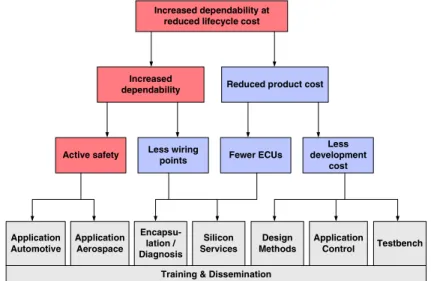
The DECOS results offered the first proof of concept for the GENESYS basic idea of developing a cross-domain architecture reference template. The DECOS results fundamentally enhanced the means for design, analysis and tools for integrated, de-pendable, real time embedded systems (see also Fig. 1).
2.2 Introduction on the GENESYS Project
Conventionally, each application domain tends to develop customized solutions, often re-inventing concepts that are already applied in other domains. It is therefore expedi-ent to invest into a generic embedded system architecture that supports the develop-ment of dependable embedded applications in many different application domains, using the same hardware devices and software modules. Furthermore, increasing capabilities of microcomputers and decreasing cost foster a change from mechanically to electronically controlled functions in all industrial domains.
Increased dependability at reduced lifecycle cost
Reduced product cost Increased
dependability
Less wiring
points Fewer ECUs
Less development cost Active safety Silicon Services Testbench Application Control Application Aerospace Design Methods Application Automotive Encapsu-lation / Diagnosis
Training & Dissemination
Fig. 1. DECOS Results
Legend:
ECU Electronic Control Unit
Detailed information is available in reference [13].
The world of embedded systems, in particular when respecting various industrial do-mains with its different application requirements, is broad and diverse. The technological situation is strongly fragmented and the expectations of the increasing number of users are permanently rising.
In order to take advantage of the economy of scale of the semiconductor industry, designing and developing a cross domain architecture reference template for embed-ded systems to be used in various industrial domains can easily be justified (this chap-ter frequently makes reference to [5]) due to faschap-ter time to market and reduced design and implementation cost resulting from re-using once developed approaches.
H. Kopetz and R. Obermaisser summarise GENESYS as follows (see refer-ence [5]): Mainly three challenges have driven the development of the GENESYS reference architecture: (a) Complexity Management, (b) Robustness, (c) Energy Efficiency.
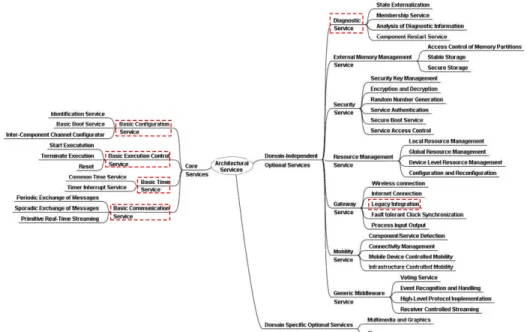
GENESYS established a platform architecture providing a minimal set of “core services” and a plurality of optional services (i.e. special communication services, diagnostic services, etc.) predominantly implemented as self-contained system com-ponents selected due to the industrial domain application requirements (see Fig. 2). 2.3 Results Used from the GENESYS Project
The GENESYS reference architecture template provides architectural services as a baseline for the development of applications. GENESYS distinguishes between core services and optional services.
Fig. 2. GENESYS Overview (see reference [9])
Legend:
OS Optional Services
The GENESYS reference architecture targeted to provide (a) a consolidated domain architectural style, (b) a reference architecture template, and (c) a cross-domain development methodology.
The GENESYS Reference Architecture has been described in detail by R. Ober-maisser and H. Kopetz, Vienna University of Technology, see reference [5]. The book is available free of charge for download from http://www.genesys-platform.eu/.
As illustrated in Fig. 3, the GENESYS reference architecture template provides specifications for a comprehensive set of platform services. These platform services can be partitioned into the following three service categories: core services, optional services and domain specific services.
2.4 Core Services
The core services are mandatory and thus part of any instantiation of the GENESYS architecture. The core services are minimal in the sense that only those services which are absolutely indispensable to build higher-level services or to maintain the desired properties of the architecture are included in the set of core services. In GENESYS the core services must be amenable to certification. For this reason they must be de-terministic and simple.
Fig. 3. Services of the Reference Architecture Template
2.5 Optional Services
The optional services are built on top of the core services. Optional services are an open set of services that can be extended as needed. All or only a subset of these op-tional services can be selected for any particular instantiation of the architecture. Most of the optional services are implemented in self contained system components that interact with the generic middleware (GEM) of the application components by the exchange of messages. In case an optional service is mature and stable, it can be plemented in the form of a hardware component, which leads to a significant im-provement in the energy efficiency.
2.5.1 Domain Specific Services
The domain specific services are a sub-set of the optional services and support spe-cific features required by the particular domain or application under consideration.
3 The INDEXYS Approach – A Reply to a Market Pull
Generally, market domains such as automotive, aerospace or railway use their specific processes, development technologies, development tools, verification and validation approaches and test methodologies. Various standards have been established and enormous budgets are required to permanently maintain and improve these technolo-gies with respect to their platform components and performance. Increasing cost pres-sure and the shortening of “time-to-market” requirements caused the large players in the various market domains to “look over the fence” and check whether processes,
methods and technologies from other market domains wouldn’t be suitable for their own field of application as well in order to make use of “economy of scale” and re-duce cost and time-to market appropriately for their own competitive advantage.
Thus the idea of establishing a cross domain data communication architecture tem-plate and a platform approach, such as offered by INDEXYS, definitely replies to market trends of many domains in parallel. INDEXYS shows the flexibility in inte-grating domain specific services in combination with template based core services allowing the use of “proven” and “existing” design building blocks and thus resulting in the targeted advantage of reducing cost and time to market by using once devel-oped, cross-industrial platform based technologies and proofs concept in their auto-motive, aerospace and railway domain demonstrators.
In addition, cross domain industrial use will foster permanent improvements and enhancements resulting from different area of application. Thus the potential commu-nity will benefit from a higher maturity of the platform in the long run compared to just developing, maintaining and improving such platform internal of one domain only. The likelihood for being confronted with system based errors is therefore re-duced to a minimum and the speed and efficiency of development is optimized. 3.1 Overview of the INDEXYS Project
The objective of INDEXYS is to enable industrial exploitation of GENESYS’ cross-domain architectural services, thereby particularly focusing on (but not restraining to) the domains: aerospace, automotive and railway.
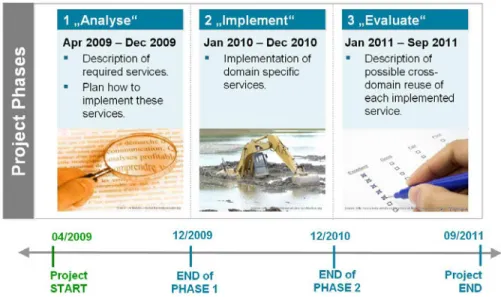
The overall strategy of the INDEXYS work plan is defined by three phases, namely Analyze, Implement, and Evaluate, detailed as (see Fig. 4):
Phase 1: “Analyse”: Analyze and prioritize GENESYS architectural services and create fundamental paradigms, methods and tools supporting embedded system de-sign for a broad range of applications. This phase will investigate on topics such as: general chain concepts, i.e., development of a comprehensive, customizable tool-chain based on OMG’s Model Driven Architecture (MDA), domain specific model-ling based on domain specific modelmodel-ling languages (DSL), support for advanced synthesis solutions based on COTS tools and configurable transformations, and on-line fault handling that copes with increasing transient fault rates in modern embed-ded devices. The “Analyse Phase” will evaluate the gap between existing, reusable technology and GENESYS architectural services deemed relevant within INDEXYS and summarize the results in an analysis. All required services will be specified and a plan will be developed how to implement them.
Phase 2: “Implement”: Based on the results of the first phase, three domain spe-cific applications (Aerospace, Automotive and Railway) will be developed. In each of the three domains, a certain set of architectural services will be instantiated. This instantiation will either be by reuse of existing technology or by new developments, where a strong focus will clearly be on reuse of existing components, methods and tools. At that point it should be mentioned that several project partners have closely cooperated in the DECOS project. It is thus planned to (re)use results, i.e., methods, tools and concepts of DECOS wherever appropriate. The “Implementation Phase” will investigate what is required to instantiate GENESYS architectural services so that these services can be exploited for concrete platforms in the automotive, aerospace and railway domains. As result, INDEXYS will develop the domain specific proto-type implementations of GENESYS architectural services.
Phase 3: “Evaluate”: As soon as prototype implementations of architectural ser-vices are available, an evaluation will take place to find out if the domain specific architectural service implementations can be reused across other domains targeted by INDEXYS. As it is a key objective of INDEXYS to maximize cross-domain reuse, the objective of this phase will be to enable reuse of as many architectural service implementations as possible. INDEXYS will define the required means for enabling reuse of INDEXYS’ architectural service implementations across further domains. The possible reuse of each service implemented during the second phase will be specified.
3.2 INDEXYS Builds on GENESYS and Enhances the Results Achieved
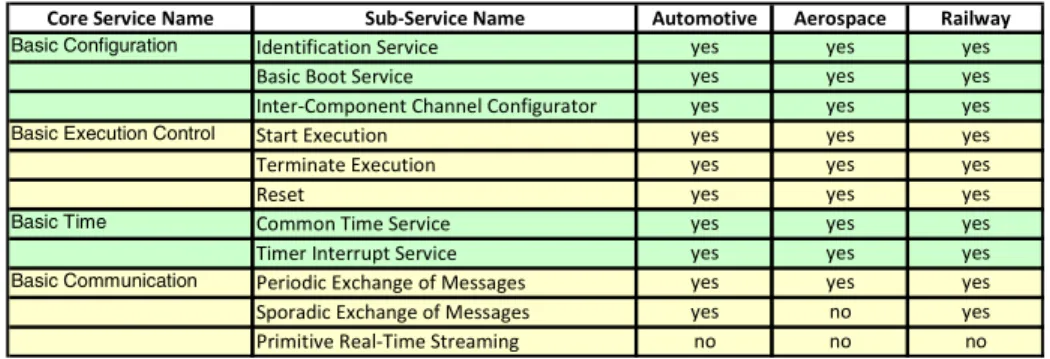
The reference architecture template generated in the course of the GENESYS project offers four core services summarized below (see Tab. 1). These services map to sev-eral of the domain specific requirements and features. The core services consist of a couple of sub-services. The INDEXYS Demonstrators make use of these services according to the Tab. 1 below. Please note that throughout all INDEXYS project aspects except the demonstrators all services as identified in the Tab. 1 are considered and supported.
The optional architectural services of the reference architecture template facilitate the establishment of the identified requirements and features are illustrated in Tab. 2 (Again, the table refers to the INDXEYS demonstrators while all optional services are considered and supported in all INDEXYS project aspects except the demonstrators).
Table 1. GENESYS Core Services in INDEXYS Demonstrators
Core Service Name Sub-Service Name Automotive Aerospace Railway
Basic Configuration Identification Service yes yes yes
Basic Boot Service yes yes yes
Inter-Component Channel Configurator yes yes yes
Basic Execution Control Start Execution yes yes yes
Terminate Execution yes yes yes
Reset yes yes yes
Basic Time Common Time Service yes yes yes
Timer Interrupt Service yes yes yes
Basic Communication Periodic Exchange of Messages yes yes yes
Sporadic Exchange of Messages yes no yes
Primitive Real-Time Streaming no no no
Table 2. GENESYS Optional Services in INDEXYS Demonstrators
Service Name Automotive Aerospace Railway
State Externalization no yes no
Membership Service yes yes yes
Analysis of Diagnostic Inform yes yes no
Component Restart Service yes yes yes
Access Control of Memory P no no no
Stable Storage no no no
Secure Storage no no no
Secure Key Management no no no
Encryption and Decryption no no yes
Random Number Generatio no no no
Service Authentication no no no
Secure Boot Service no no no
Service Access Control no no no
Local Resource Managemen yes yes yes
Global Resource Manageme no no no
Device Level Resource Mana no no no
Configuration and Reconfigu no no no
Wireless connection no no yes
Internet Connection no no yes
Legacy Integration yes yes yes
Fault-tolerant Clock Synchro yes yes yes
Process Input Output yes yes yes
Component/Service Detecti no no no
Connectivity Management no no no
Mobile Device Controlled M no no no
Infrastructure Controlled Mo no no no
Voting Service yes yes yes
Event Recognition and Hand yes yes yes
High-Level Protocol Implem no no yes
3.3 The INDEXYS Project Consortium
The ten member INDEXYS project consortium coordinated by TTTech Com-putertechnik AG is well balanced consisting of four industrial partners evaluating the developments in their demonstrators (Audi AG [automotive domain industrial part-ner], EADS Deutschland GmbH [aerospace domain industrial partpart-ner], NXP Semi-conductors & Thales Signalling Solutions GesmbH [railway domain industrial part-ner]), two SMEs providing the technical know-how as the market leaders in the spe-cific technological area (OptXware Research and Development Ltd. & TTTech Com-putertechnik AG) and four universities representing most relevant academia (Delft University of Technology, Technical University of Darmstadt, Technical University of Kaiserslautern & Vienna University of Technology). The Consortium combines technical excellence of four European countries, Austria, Germany, Hungary and The Netherlands.
3.4 The INDEXYS Project Goals – Progress beyond the State of the Art
Contrary to the approach of many present platform solutions, which are tailored to a specific domain, INDEXYS aims at the development of reusable architectural ser-vices that can be exploited across platforms of different domains. INDEXYS’ archi-tectural service implementations will support a gradual shift towards higher reusabil-ity of services across different domains (particularly across automotive, aerospace and railway domains) due to lower cost by availability of existing solutions, and by exist-ing experience with these solutions in the engineerexist-ing community, see reference [7].
INDEXYS will build on prevailing platform solutions such as AUTOSAR for automotive systems, IMA for aerospace systems (i.e. AFDX (see reference [9]), see also SPIDER project, see reference [10]), and TAS Control Platform (see reference [8]) for railway systems with the goal to implement selected GENESYS services within these platforms.
INDEXYS will further observe (and potentially take up) related technical ap-proaches of other domains such as telecommunication or consumer electronics. Technological Aspects
In line with the results of GENESYS, INDEXYS will implement architectural ser-vices according to GENESYS’ cross-domain architectural style. Thereby, the follow-ing technological aspects will be considered for complementing existing platform solutions (and thereby progressing beyond the state of the art): (a) Networking and Resource Management (i.e. development of scalable, deterministic communication and design methods), (b) Robustness, Diagnosis and Maintenance (i.e. architectural services ensuring the “capability of a system to deliver an acceptable level of service despite the occurrence of faults”), (c) Composability (i.e. architectural support of the constructive composition of large systems out of components and sub-systems with-out uncontrolled emerging behavior or side effects) and (d) Methodology and Tools (i.e. multi-paradigm tool/methodology approach based on the Model Driven Architec-ture (MDA) and on the Model Driven Development).
3.5 The INDEXYS Developments
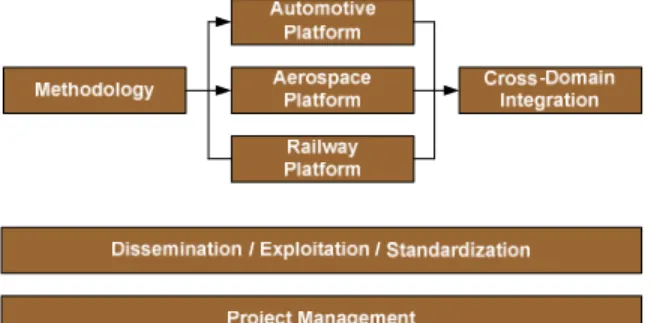
INDEXYS will first of all develop methodologies (tool chain, modelling, verification and validation, on-line fault handling and complexity management) and then focus on the industrial domains (Automotive, aerospace and railway) and conclude the project in a cross-domain integration phase. As usual in European Commission projects this is accompanied by a dissemination/exploitation and standardization work package and project management activities (see Fig. 5).
3.5.1 Methodology
The objectives within this INDEXYS topic will analyze and prioritize GENESYS architectural services and thereby create fundamental paradigms, methods and tools supporting embedded system design for a broad range of applications. Furthermore, an initial project alignment according to the final GENESYS results is performed. Analysis and implementation of exploitable cross-domain services is provided. IN-DEXYS Methodology covers (a) general tool-chain concepts, (b) domain specific modeling and synthesis support, (c) design time verification and validation, (d) on-line fault handling and (e) complexity management.
Fig. 5. INDEXYS Development and Work Plan Overview
3.5.2 Industrial Platforms
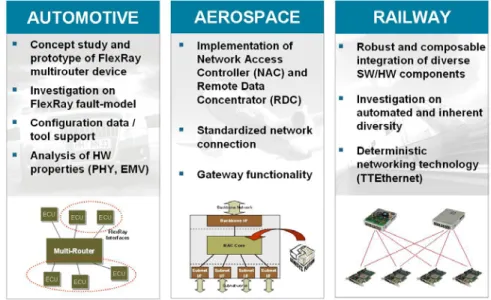
An overview on the three industrial domains and their innovation is provided in Fig. 6.
Automotive Platform
The objective of the automotive platform takes under consideration the increasing complexity of current and future automotive systems requiring composable subsystem integration. Composable subsystem integration guarantees that properties which have been established at subsystem level are not invalidated through the integration of these subsystems into a larger system. It is the objective of this work package to in-vestigate on and to enable composable integration of real-world in-vehicle network technology of prevailing automotive networks, such as CAN and FlexRay, also con-sidering Functional Safety. The prototype implementation will be validated also for their composability by thorough validation in a target vehicle network.
Fig. 6. INDEXYS Innovation per Domain
Legend:
ECU Electronic Control Unit I/F Interface
PHY Physical Laye EMV Electro Magnetic Compatibility RDC Remote Data Controller NAC Network Access Controller HW Hardware TTEthernet Time-Triggered Ethernet
With respect to multiple CAN networks required in automotive industry, IN-DEXYS will elaborate a completely new integration concept. This integration concept will be based on a GENESYS conformant composable CAN interconnect that sup-ports the legacy CAN interface of existing ECUs, increases the CAN network per-formance and will provide a programmable gateway service between different CAN networks.
In INDEXYS the concept of a FlexRay multi-switch will be investigated and pro-totypically implemented. A multi-switch device directly connects to FlexRay end-systems in a star topology and allows parallel transmission of messages from different senders at the same time (given that the receivers are disjunctive). The methodology for cross-domain reusable safety modules will be applied in selected areas on the prototypes. This means: (i) early definition and consideration of safety requirements, (ii) ongoing coaching of the development for functional safety needs, and (iii) evalua-tion of safety, including reachable Hardware Safety Integrity.
Demonstrator Automotive - FlexRay Multi-Switch
The FlexRay “multi-switch” is a cut-through switch for FlexRay networks. It switches a number of FlexRay branches according to a pre-defined static schedule. The com-munication elements are forwarded with minimal delay and are not stored and for-warded at a later point in time.
A FlexRay multi-switch is a device which is physically similar to the FlexRay Ac-tive Star device, but in contrast to the AcAc-tive Star, it implements a selecAc-tive switching
Fig. 7. Automotive Platform FlexRay Cluster with FlexRay Multi-Switch
of the communication paths according to a configured switching schedule. The multi-switch is able to provide additional functionality of complex data traffic paths and also isolation of branches Fig. 7.
Aerospace Platform
The objective of the Aerospace Platform deals with Integrated Modular Avionics (IMA), where distributed functional computations are centralized on a group of Cen-tral Processing Modules with powerful CPUs interfacing small, easy to maintain and reliable Remote Data Concentrators. This state-of-the-art platform concept is widely used for safety-critical control functions of the airplane, but currently not for cabin control applications. The objective is to extend the IMA approach due to enhance-ments of a Remote Data Concentrator and of a Network Access Controller (NAC) for cabin control applications.
INDEXYS will specify and develop a simple System-on-a-Chip solution of a Re-mote Data Concentrator for transducer interfacing in distributed aerospace applica-tions. The Remote Data Concentrator will offer a standardized network connection to a time-triggered field bus (e.g., TTP).
The task of Network Access Controller (NAC) is to provide Gateway functionality between a high-speed backbone (e.g., Ethernet) network and up to eight linear buses with several passenger oriented devices. A main focus within aircraft cabins is the development of a system wide cabin-communication architecture that incorporates all electronic cabin systems. Currently, there exist three separate cabin systems: CIDS (cabin interconnection data system), ALNA (airline network architecture), and IFE (in-flight entertainment).
A cabin backbone network (e.g., Fast Ethernet, TTEthernet) interconnects the vari-ous components of the cabin management system. The Network Access Controller (NAC) with smart wireless interfaces provides redundant and secure links. Moreover, the network must provide sufficient reliability, fault tolerance, guaranteed bandwidth, high-integrity, bounded latency and jitter, security, scalability, reconfigurability, and interoperability for various heterogeneous components. INDEXYS will specify and
develop a Network Access Controller based on architectural and modular principles. Thereby, the focus will be on device level integration.
Several GENESYS principles will be addressed such as complexity management (i.e., reduction of cognitive complexity is achieved through small and easily under-stood interfaces between core processing modules and associated transducers), com-ponent based design (i.e., separation of processing devices and input/output devices and communication over linking interfaces), hard and soft components (i.e., FPGA based implementation of Remote Data Concentrator), message passing (i.e., message based Remote Data Concentrator interface), composability (i.e., deterministic com-munication over time-triggered network) and the concept of a common time (i.e., global time which is shared across the network).
Demonstrator Aerospace - Network Access Controller (NAC)
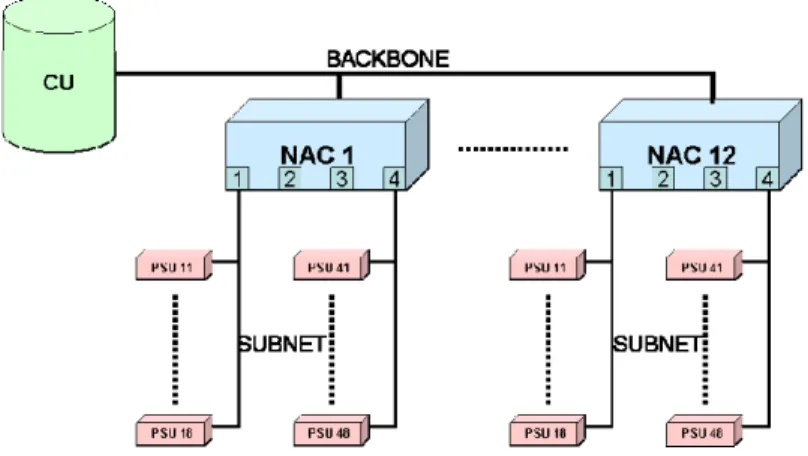
Fig. 8 shows the principle structure of a network architecture used to provide connec-tivity from a central unit like a server to passenger oriented devices like a PSU (Pas-senger Service Unit) in an aircraft cabin for cabin control applications. This cabin communication architecture should incorporate all electronic cabin systems.
The network consists of one or more Central Units (CU), Network Access Control-lers (NAC) and Passenger Service Units (PSU). A high data rate backbone connects up to 12 NACs with the CU. Each NAC provides at least four subnets for connecting to the network up to eight PSUs per subnet.
With this configuration it is possible to connect 32 passenger oriented devices to one NAC. In total up to 384 passengers oriented devices are possible with the use of 12 NACs.
Fig. 8. Cabin communication network architecture
Legend:
CU Central Unit PSU Passenger Service Unit NAC Network Access Controller
The NAC itself connects the high data rate backbone with the sub-networks. Fig. 9 shows the block diagram of a NAC. The NAC has a modular based structure with generalized interfaces to the backbone and to the sub-networks. The NAC Core Mod-ule provides gateway functionality between the backbone and the sub-networks. The backbone network is based on Ethernet communication protocol whereas the sub-networks can be implemented to handle protocols like CAN, Ethernet, etc.
Fig. 9. Block diagram of Network Access Controller (NAC)
Demonstrator Aerospace - Remote Data Concentrator (RDC)
The task of a Remote Data Concentrator (RDC) is to interface transducers (i.e., sen-sors and actuators) in the aircraft. Remote Data Concentrators are connected via communication systems to the Central Processing Modules. To achieve a highly de-terministic behavior for the RDC communication a time triggered communication protocol (TTP) has to be used.
In the past TTTech developed a table driven communication layer (TD-COM Layer, see Fig. 10) for TTP in software to make use of the reduced certification effort during reuse. The TD-COM Layer implements a high-performance communication layer between TTP networks and host applications. The TD-COM Layer can support up to two TTP networks, each being connected by a separate TTP controller.
For simple distributed communication nodes as Remote Data Concentrators are a solution with the TD-COM layer requires a lot of CPU power for executing the pack-ing and unpackpack-ing of messages. This hints to a TD-COM implementation based on a FPGA or moreover as ASIC.
Railway Platform
The majority of Thales Rail SIL4 signaling and train protection system products worldwide is based on a generic fault-tolerant computer platform (HW, OS, Middle-ware), which has been developed during the last decade by the competence centre of Thales Rail Signaling Solutions Austria (former Alcatel Transport Automation Solu-tion). After the successful rollout of the first generation of the system (called "TAS Control Platform") in more than 20 countries on 4 continents, the TAS Control Plat-form is now going for the second generation. Major items on the roadmap of TAS
Fig. 10. TD-COM Layer overview
Legend:
CNI Controller Network Interface TTP Time-Triggered Protocol
Control Platform 2.x is the architectural support for application binary diversification and the increasing use of COTS components.
INDEXYS will develop mitigation strategies to cope with unknown faults in re-used components to make the use of off-the-shelf components possible. The CENELEC standards highly recommend the use of diversity to mitigate the risk of undetected faults and to increase robustness in complex components, i.e., the imple-mentation of diverse hardware/software components. In addition, INDEXYS will develop a novel concept for the implementation of fault-containment regions as de-fined in GENESYS. Conventionally, fault-containment regions w.r.t random hard-ware faults are formed by active redundant hardhard-ware components. INDEXYS seeks to implement fault containment regions on a single hardware channel running diverse application software channels. These software channels are being deduced automati-cally from legacy source code. The motivation for this approach is to save hardware costs in high volume applications without having the burden of N-Version program-ming during development.
The integration of these diverse hardware/software components must be compos-able so that the properties of each independently developed component are not invali-dated by its integration into a larger system. The key pre-requisite for composability is deterministic system behavior.
TTEthernet is a novel communication protocol that has been designed with the re-quirements to provide temporal deterministic communication and to support standard Ethernet communication without the need to change or configure higher level com-munication protocols, like IP, TCP, UDP, FTP. A TTEthernet system consists of a set of computer nodes interconnected by a specific switch called TTEthernet switch. A
node can be either a standard Ethernet node or a TTEthernet node. A standard Ethernet node consists of a COTS Ethernet controller and a host computer. A TTEthernet node consists of a TTEthernet communication controller that executes the TTEthernet protocol and a host computer that executes the user application.
TTEthernet nodes (end systems) can be implemented either in hardware (FPGA based TTEthernet communication controller is available) or by using a COTS Ethernet controller and by implementation of the TTEthernet stack on top of a COTS Ethernet controller. In the INDEXYS project, it is planned to implement a SW based end system for TAS Control Platform hardware (Intel PC based).
Demonstrator Railway – TTEthernet Integration into TAS Platform
The TAS Control Platform is an open, scalable software architecture oriented towards established industrial computing standards. The communication system offers a num-ber of standard communication services, such as Internet Protocol (TCP/IP family), serial lines and field buses (CAN controller area network, TTP time triggered proto-col, PROFIBUS Process Filed Bus), as well as specific safe communication services conforming to European Committee for Electro technical Standardization (CENELEC) standards, see reference [12].
At the hardware level, the TAS Control Platform uses commercial off-the-shelf components, which are supplemented by added-value services for railway control systems.
Fig. 11 shows the component architecture of TAS Platform. A “Computing Node” (CN) is the logical target computer. It may consist of 1 up to 3 individual “Computing Elements” (CEs), depending on the application systems replication degree. A CE refers to a physical computer that is synchronized with other CEs of the same CN. A “Task Set” (TS) is a set of tasks forming a logical application software entity.
The synchronization medium serves inter replica synchronization and is imple-mented as point-to-point network based on Ethernet.
Platform SW Application. TSs CE Platform SW Application. TSs CE Platform SW Application. TSs CE CN Sync-Medium Sync -Medium Sync-Medium External LAN/WAN Field Busses
Fig. 11. TAS Platform Component/System Architecture Legend:
CE Computing Element CN Computing Node
Implementing the Software-based TTEthernet protocol into diverse computing elements of a computing node on TAS Platform will increase the deterministic behav-ior of the communication system with the advantages of a Time Triggered Communi-cation system.
The Software-based TTEthernet specifies a special implementation of TTEthernet which was created to make use of the time-triggered communication benefit imple-mented in software without the fault tolerant features of the hardware-based solution enabling also high throughputs for much lower costs. If the use case requires fault tolerance mechanisms then they have to be implemented in the application on top of the TTEthernet API Library.
Fig. 12 shows the layered structure of the software-based TTEthernet implementa-tion on a host without an operating system including the TTEthernet protocol core layer embedded between the hardware layer and the API library.
Fig. 12. Software-Based TTEthernet detailed architecture
Legend:
ET Event Triggered TT Time Triggered HW Hardware TTE Time Triggered Ethernet
Setting up an application with software-based TTEthernet on a platform with an operating system a driver has to be established on top of the TTEthernet core protocol to get access to the core functions (see Fig. 13).
3.5.3 Cross-Domain Integration
A key goal of INDEXYS is to enable cross-domain reusability of architectural service implementations which are instantiated for platforms in the automotive, aerospace and railway domains. Cross-domain reusability is the ability to reuse architectural service instantiation which have been implemented for one of the targeted domains (i.e., automotive, aerospace, railway) in other domains. Cross-Domain Integration will focus on analyzing, steering, and evaluating cross-domain reusability during the ac-tual project work. A particular focus will be the reusability within the other targeted domains of INDEXYS. However, reusability can also apply for domains which are not directly in the scope of INDEXYS such as consumer electronics or industrial control systems.
Reusability of safety-related modules across different domains will be supported by deriving a generic methodology for managing reuse of safety-related modules. The methodology shall be applied to one implementation to test its usability in real life. This will allow improvement of the concept. The so improved concept and the experi-ence gained from applications will be investigated with experts from other domains. If suitable the generic methodology can be published and brought into domain stan-dardization groups for further propagation. A good methodology for reuse will allow sustaining advantages from the considerable investments made by companies in de-veloping safety modules with the appropriate safety evidence. This enables a consid-erable competitive advantage for safety-related developments.
4 ACROSS – Closing the Gap
The objective of the ACROSS project to develop and implement an ARTEMIS cross-domain architecture for embedded MPSoCs based on the architecture blueprint devel-oped in the FP7 project GENESYS (Generic Embedded System Architecture). ACROSS will result in the design of a generic Multi-Processor Systems-on-a-Chip (MPSoC) and a first implementation in an FPGA. The ACROSS MPSoC will provide a stable set of core services as a foundation for the component-based development of embedded systems with short-time-to-market, low cost and high dependability. The ACROSS-MPSoC will be demonstrated as a universal platform for automotive, aero-space and industrial control systems in order to realize the benefits of the economies of scale of the semiconductor technology. Additionally, the ACROSS-MPSoC plat-form provides significant potential for being adopted by other industries with safety-critical data communication requirements such as applications in the medical-, power generation -, (i.e. atomic power plant control equipment), space- domains, to mention just a few. Using the core services of the ACROSS-MPSoC, a library of middleware services will be realized in the ACROSS project. Generic middleware will offer ser-vices to be used in multiple application domains (e.g., fault-tolerance, diagnosis, secu-rity), while domain-specific middleware will implement domain-specific services for specific domains (e.g., AUTOSAR services for the automotive domain, IMA services for the avionic domain). Another significant result of the project will be a general design methodology, supported by appropriate adaptable tools, for the implementation of ACROSS-based applications. The benefits of the cross-domain architecture will be
shown in demonstrators from the targeted application domains. It is planned to set up demonstrators for the automotive-, the aerospace- and the industrial control domains.
5 Conclusion
The introduced projects DECOS, GENESYS, INDEXYS and ACROSS do perfectly complement each other. Initially, the DECOS project demonstrated the advantages of the design, development and validation of an embedded platform for dependable, integrated systems.
The next step beyond was taken in GENESYS providing a flexible, cross domain reference architecture defining the fundamental architectural principles required. GENESYS specified, developed and designed the core services and a set of initial optional services allowing a start in applying the results in industry.
INDEXYS now provides the first implementation and proves the feasibility in es-tablishing demonstrators for the automotive-, the aerospace- and the railway sectors using the GENESYS reference architecture platform approach.
To finally provide means for industrial series production visions, ACROSS de-signs, develops and verifies a FPGA based device integrating a GENESYS architec-ture on one chip. This will bring development cost further down and will enable the large scale application of the technological step taken in GENESYS and INDEXSYS.
As a final step in a R&D project family industry will obtain all tools, methodolo-gies and embedded building blocks to efficiently and competitively implement sys-tems based on the GENESYS reference architecture. The fact that the entire platform is available will pave the way and significantly improve the chance that different industries will pick up the technology for some of their visionary projects in close future.
References
1. The ARTEMIS Joint Undertaking Annual Work Programme, ARTEMIS-PAB-17/08 (2008)
2. ARTEMIS Joint Undertaking Strategic Research Agenda, Reference Designs and Archi-tectures, Edition May 2006 (ARTEMIS SRA Working Group)
3. Kantz, H., König, N.: TAS Control Platform: A Vital Computer Platform for Railway Ap-plications. Technology White Paper (2004)
4. Aeronautical Radio Incorporated (ARINC), Annapolis, MD, USA. ARINC Specification 651: Design Guide for Integrated Modular Avionics (November 1991)
5. Obermaisser, R., Kopetz, H.: GENESYS: An ARTEMIS Cross-Domain Reference Archi-tecture for Embedded Systems. In: Südwestdeutscher Verlag für Hochschulschriften Akti-engesellschaft & Co.KG, Saarbrücken, Germany (2009) ISBN 978-8381-1040-0, The book can be downloaded free of charge: http://www.genesys-platform.eu/
6. Obermaisser, R.: Presentation on GENESYS, Vienna University of Technology
7. The information refers to the INDEXYS Description of Work (according to the contractual agreed content of project work)
8. Kantz, H., König, N.: As for AUTOSAR and IMA, summary descriptions are contained from the GENESYS description of work (DoW). The summary of the TAS platform is taken from the technology white paper: TAS Control Platform: A Vital Computer Platform for Railway Applications
9. Avionics Full-Duplex Switched Ethernet. Wikipedia, The Free Encyclopedia (October 22, 2008),
http://en.wikipedia.org/w/index.php?title=Avionics_
Full-Duplex_Switched_Ethernet&oldid=246938506
(Retrieved 13:13, November 10, 2008)
10. http://shemesh.larc.nasa.gov/fm/spider/
11. Atat, Y., Zergainoh, C.f.: Simulink-based MPSoC Design: New Approach to Bridge the Gap between Algorithm and Architecture Design. In: IEEE Computer Society Annual Symposium N.-E. VLSI, 2007. ISVLSI apos 2007, March 9-11 (2007)
12. Refer to the following homepage for further information about CENELEC and related standards: http://www.cenelec.eu
![Fig. 2. GENESYS Overview (see reference [9])](https://thumb-us.123doks.com/thumbv2/123dok_us/1665113.2728482/5.645.71.582.91.443/fig-genesys-overview-see-reference.webp)