An Integrated Framework for Parameter-based
Optimization of Scientific Workflows
∗Vijay S. Kumar,
P. Sadayappan
Department of Computer Science and Engineering Ohio State University Columbus, Ohio 43210{kumarvi,saday}
@cse.ohio-state.edu
Gaurang Mehta, Karan
Vahi, Ewa Deelman
Advanced Systems Division Information Sciences InstituteUniversity of Southern California
Marina del Rey, California 90292
{gmehta,vahi,deelman}
@isi.edu
Varun Ratnakar, Jihie
Kim, Yolanda Gil
Intelligent Systems Division Information Sciences InstituteUniversity of Southern California
Marina del Rey, California 90292
{varunr,jihie,gil}@isi.edu
Mary Hall
School of Computing University of Utah Salt Lake City, Utah 84112
Tahsin Kurc, Joel Saltz
Center for ComprehensiveInformatics Emory University Atlanta, Georgia 30307
{tkurc,jhsaltz}@emory.edu
ABSTRACT
Data analysis processes in scientific applications can be ex-pressed as coarse-grain workflows of complex data processing operations with data flow dependencies between them. Per-formance optimization of these workflows can be viewed as a search for a set of optimal values in a multi-dimensional parameter space. While some performance parameters such as grouping of workflow components and their mapping to machines do not affect the accuracy of the output, others may dictate trading the output quality of individual com-ponents (and of the whole workflow) for performance. This paper describes an integrated framework which is capable of supporting performance optimizations along multiple di-mensions of the parameter space. Using two real-world ap-plications in the spatial data analysis domain, we present an experimental evaluation of the proposed framework.
Categories and Subject Descriptors
H.3.4 [Information Storage and Retrieval]: Systems ∗
This research was supported in part by the National Science Foundation under Grants #CNS-0403342, #CNS-0426241, #CSR-0509517, #CSR-0615412, #ANI-0330612, #CCF-0342615, #CNS-0203846, #ACI-0130437, #CNS-0615155, #CNS-0406386, and Ohio Board of Regents BRTTC #BRTT02-0003 and AGMT TECH-04049 and NIH grants #R24 HL085343, #R01 LM009239, and #79077CBS10.
Permission to make digital or hard copies of all or part of this work for personal or classroom use is granted without fee provided that copies are not made or distributed for profit or commercial advantage and that copies bear this notice and the full citation on the first page. To copy otherwise, to republish, to post on servers or to redistribute to lists, requires prior specific permission and/or a fee.
HPDC’09, June 11–13, 2009, Munich, Germany.
Copyright 2009 ACM 978-1-60558-587-1/09/06 ...$5.00.
and Software—Distributed Systems, Performance evaluation
(efficiency and effectiveness); H.4 [Information Systems
Applications]: Workflow Management
General Terms
Performance, Design
Keywords
scientific workflow, performance parameters, semantic rep-resentations, Grid, application QoS
1.
INTRODUCTION
Advances in digital sensor technology and the complex nu-merical models of physical processes in many scientific do-mains are bringing about the acquisition of enormous vol-umes of data. For example, a dataset of high resolution image data obtained from digital microscopes or large scale sky telescopes can easily reach hundreds of Gigabytes, even multiple Terabytes in size1
. These large data volumes are transformed into meaningful information via data analysis processes. Analysis processes in scientific applications are expressed in the form of workflows or networks of compo-nents, where each component corresponds to an application-specific data processing operation. Image datasets, for in-stance, are analyzed by applying workflows consisting of filtering, data correction, segmentation, and classification steps. Due to the data and compute intensive nature of scientific data analysis applications, scalable solutions are required to achieve desirable performance. Software sys-tems supporting analysis of large datasets implement
sev-1
DMetrix array microscopes can scan a slide at 20x+ res-olution in less than a minute. The Large Synoptic Survey Telescope will be able to capture a 3.5 Gigapixel image every 6 seconds, when it is activated.
eral optimization mechanisms to reduce execution times. First, workflow management systems take advantage of dis-tributed computing resources in the Grid. The Grid environ-ment provides computation and storage resources; however, these resources are often located at disparate sites managed within different security and administrative domains. Work-flow systems support execution of workWork-flow components at different sites (Grid nodes) and reliable, efficient staging of data across the Grid nodes. A Grid node may itself be a cluster system or a potentially heterogeneous and dynamic collection of machines. Second, for each portion of a work-flow mapped to such cluster systems, they enable fine-grain mapping and scheduling of tasks onto such machines.
The performance of workflows is greatly affected by cer-tain parameters to the application that direct the amount of work to be performed on a node or the volume of data to be processed at a time. The optimal value of such pa-rameters can be highly dependent on the execution con-text. Therefore, performance optimization for workflows can be viewed as a search for a set of optimal values in a multi-dimensional parameter space, given a particular ex-ecution context. Workflow-level performance parameters in-clude grouping of data processing components comprising the workflow into meta-components, distribution of com-ponents across sites and machines within a site, and the number of instances of a component to be executed. These parameters impact computation, I/O, and communication overheads, and as a result, the total execution time. Another means of improving performance is by adjusting
component-level performance parameters in a workflow. An example
of such a parameter is the data chunk size in applications which analyze spatial datasets. Another example is the ver-sion of the algorithm employed by a component to process the data. Systems should provide support to improve per-formance through manipulation of such parameters along multiple dimensions of the parameter space.
In this work, we classify workflow-level and component-level performance parameters into two categories: (i)
Quality-preservingparameters (such as data chunk size) can affect
the performance of an operation without affecting the qual-ity of the analysis output, and (ii) Quality-trading param-eters can trade the quality of the output for performance gains, and vice-versa. An example of a quality-trading pa-rameter is the ‘resolution’ at which image data are pro-cessed. A classification algorithm might process low-resolution images quickly, but its classification accuracy would likely be lower compared to that for higher resolution images. When optimizations involve performance-quality trade-offs, users may supplement their queries with application-level quality-of-service (QoS) requirements that place constraints on the quality of output [14]. For instance, when images in a dataset are processed at different resolutions to speed up the classification process, the user may request that a certain minimum accuracy threshold be achieved.
In this paper, we describe the design and implementa-tion of a workflow system that supports applicaimplementa-tion execu-tion in a distributed environment and enables performance optimization via manipulation of quality-preserving and/or quality-trading parameters. The proposed system integrates four subsystems: WINGS [10] to facilitate high-level, seman-tic descriptions of workflows, and Pegasus [9], Condor [19], and DataCutter [1] to support scalable workflow execution across multiple institutions and on distributed clusters within
an institution. In our system, application developers and end-users can provide high-level, semantic descriptions of application structure and data characteristics. As our ini-tial focus is on optimizing spaini-tial data analysis applica-tions, we have developed extensions to the core ontologies in WINGS to describe spatial datasets and to enable auto-matic composition and validation of the corresponding work-flows. Once a workflow has been specified, users can ad-just workflow-level and component-level parameters based on their QoS requirements to enable performance optimiza-tions during execution. We have extended Condor’s default job-scheduling mechanism to support performance optimiza-tions stemming from performance-quality trade-offs. We show how parameter-based optimizations can be supported for real-world biomedical image analysis workflows using two cluster systems located at two different departments at the Ohio State University.
2.
RELATED WORK
Application configuration for performance improvements in scientific workflows has been examined to varying de-grees within different application domains. Grid workflow management systems like Taverna [18], Kepler [16] and Pe-gasus [9] seek to minimize the makespan by manipulating workflow-level parameters such as grouping and mapping of a workflow’s components. Our framework extends such support by providing the combined use of task- and data-parallelism and data streaming within each component and across multiple components in a workflow to fully exploit the capabilities of Grid sites that are high-end cluster sys-tems. Glatard et. al. [11] describe the combined use of data parallelism, services parallelism and job grouping for data-intensive application service-based workflows. Our work is in the context of task-based workflows and additionally addresses performance improvements by adjusting domain-specific component-level parameters.
The Common Component Architecture(CCA) forum2
ad-dresses domain-specific parameters for components and the efficient coupling of parallel scientific components. They seek to support performance improvements through the use of external tunability interfaces [3, 17]. Active Harmony [6, 7] is an automatic parameter tuning system that permits on-line rewriting of parameter values at run-time, and uses a simplex method to guide the search for optimal parame-ter values. Although we share similar motivations with the above works, we target data-intensive applications running on the Grid. We account for performance variations brought about by the characteristics of dataset instances within a do-main.
Our work also supports application-level QoS requirements by tuning quality-trading parameters in the workflows. The performance/quality trade-off problem and tuning of quality-trading parameters for workflows has been examined be-fore in service-based workflows [2] and component-based sys-tems [8]. But these works are geared towards system-level QoS and optimization of system-related metrics such as data transfer rates, throughput and service affinity etc. Application-level QoS for workflows has been addressed in [22, 4]. We support trade-offs based on quality of data output from the application components and integrate such parameter tun-ing with a standard job schedultun-ing system like Condor.
2
Supporting domain-specific parameter-based optimizations requires the representation of these parameters and their relations with various performance and quality metrics in a system-comprehensible manner. In [4], end-users are re-quired to provide performance and quality models of ex-pected application behavior to the system. Ontological rep-resentations of performance models have been investigated in the context of workflow composition in Askalon [20]. Lera et al. [15] proposed the idea of developing performance-related ontologies that can be queried and reasoned upon to analyze and improve performance of intelligent systems. Zhou et. al. [22] used rule-based systems to configure component-level parameters. While beyond the scope of this paper, we seek to complement our framework with such approaches in the near future.
3.
MOTIVATING APPLICATIONS
Our work is motivated by the requirements of applications that process multidimensional data. We use the following two application scenarios from the biomedical image analysis domain in our evaluation. Each application has different characteristics and end-user requirements.
Application 1: Pixel Intensity Quantification (PIQ):
Figure 1 shows a data analysis pipeline [5] (developed by neuroscientists at the National Center for Microscopy and Imaging Research) for images obtained from confocal mi-croscopes. This analysis pipeline quantifies pixel intensity within user-specified polygonal query regions of the images through a series of data correction steps as well as threshold-ing, tessellation, and prefix sum generation operations. This workflow is employed in studies that involve comparison of image regions obtained from different subjects as mapped to a canonical atlas (e.g., a brain atlas). From a computational point of view, the main end-user requirements are (1) to
min-imize the execution timeof the workflow whilepreserving the
highest output quality, and (2) to support the execution of
potentiallyterabyte-sized out-of-core image data.
Figure 1: PIQ workflow
Application 2: Neuroblastoma Classification (NB):
Figure 2 shows a multi-resolution based tumor prognosis pipeline [12] (developed by researchers at the Ohio State University) applied to images from high-power light microscopy scanners. This workflow is employed to classify image data into grades of neuroblastoma, a common childhood can-cer. Our primary goal is to optimally support user queries while simultaneously meeting a wide range of application-level QoS requirements. Examples of such queries include:
“Minimize the time taken to classify image regions with 60%
accuracy”or“Determine the most accurate classification of
an image region within 30 minutes, with greater importance
attached to feature-rich regions”. Here, accuracy of
clas-sification and richness of features are application domain-specific concepts and depend on the resolution at which the image is processed. In [14], we developed heuristics that exploit the multi-resolution processing capability and the inherent spatial locality of the image data features in order to provide improved responses to such queries.
Figure 2: NB workflow
These applications are different in terms of their their workflow structures and the operations they perform on the data: The NB workflow processes a portion or chunk of a single image at a time using a sequence of operations. The end-result for an image is an aggregate of results ob-tained from each independently processed chunk. PIQ, on the other hand, contains operations that are not pleasingly parallelizable and operate on entire images (with multiple fo-cal planes), hence requiring parallel algorithms for efficient processing of out-of-core data.
4.
PERFORMANCE OPTIMIZATIONS
In this section we discuss several techniques for improv-ing performance of workflows. Drawimprov-ing from the applica-tion scenarios, we also present parameters that impact the performance of applications in the spatial data analysis do-main. We classify these parameters into two main categories, quality-preserving parameters and quality-trading parame-ters, and explain how they can influence performance and/or output quality.4.1
Quality-preserving parameters
Chunking Strategy: Individual data elements (e.g. im-ages) in a spatial dataset may be larger than the physical memory space on a compute resource. Relying on virtual memory alone is likely to yield poor performance. In general, the processing of large, out-of-core spatial data is supported by partitioning it into a set of data chunks, each of which can fit in memory, and by modifying the analysis operations to operate on chunks of data at a time. Here, a data chunk provides a higher-level abstraction for data distribution and is the unit of disk I/O and data exchange between proces-sors. In the simplest case, we can have a uniform chunking strategy, i.e. every chunk has the same shape and size. For 2-D data, this parameter is represented by a pair [W,H], whereWandHrespectively represent the width and height of a chunk. In our work, we use this simplified strategy and refer to this parameter as chunksize. The chunksize pa-rameter can influence application execution in several ways. The larger a chunk is, the greater the amount of disk I/O and inter-processor communication for that chunk will likely
be, albeit the number of chunks will be smaller. The chunk-sizeaffects the number of disk blocks accessed and network packets transmitted during analysis. However, larger chunks imply a decreased number of such chunks to be processed, and this could in turn, decrease the job scheduling over-heads. Moreover, depending on the memory hierarchy and hardware architecture present on a compute resource, the
chunksizecan affect cache hits/misses for each component and thus, the overall execution time. For the PIQ workflow, we observed that varyingchunksizeresulted in differences in execution time. Moreover, the optimalchunksizefor one component may not be optimal for other components; some components prefer larger chunks, some prefer square-shaped chunks over thin-striped chunks, while others may function independent of thechunksize.
Component configuration: Components in a workflow could have many algorithmic variants. Traditionally, algo-rithmic variants are chosen based on thetype of the input data to the component. However, choosing an algorith-mic variant can affect the application performance based on resource conditions/availability and data characteristics, even when each variant performs the analysis differently but produces the same output and preserves the output qual-ity. In an earlier work [13], we developed three parallel-algorithmic variants for the warp component of the PIQ workflow. We observed that depending on the available re-sources – slow/fast processor/network/disk – each variant could outperform the other. No single variant performed best under all resource conditions.
Task Granularity and Execution Strategy: A work-flow may consist of many components. If a chunk-based processing of datasets is employed, creating multiple copies of a component instance may speed up the process through data parallelism. How components and component copies are scheduled, grouped, and mapped to machines in the en-vironment will affect the performance, in particular if the environment consists of a heterogeneous collection of com-putational resources. An approach could be to treat each (component instance, chunk) pair as a task and each ma-chine in the environment as a Grid site. This provides a uniform mechanism for execution within a Grid site as well as across Grid sites. It also enables maximum flexibility in using job scheduling systems such as Condor [19]. How-ever, if the number of component instances and chunks is large, then the scheduling and data staging overheads may assume significance. An alternative strategy is to group mul-tiple components intometa-componentsand map/schedule these components to groups of machines. Once a meta-component is mapped to a group of machines, a combined task- and data-parallelism approach with pipelined dataflow style execution can be adopted within the meta-component. When chunking is employed, the processing of chunks by successive components (such asthreshold and tessellate in the PIQ workflow) can be pipelined such that, when a com-ponent C1 is processing a chunk i, then the downstream componentC2 can concurrently operate on chunk i+ 1 of the same data element. A natural extension to pipelining is the ability to stream data between successive workflow components mapped to a single Grid site, so that the inter-mediate disk I/O overheads can be avoided.
4.2
Quality-trading parameters
Data resolution: Spatial data has an associated notion of quality. The resolution parameter for a data chunk takes values from 1 ton, wherenrepresents the chunk at its highest quality. In a multi-resolution processing approach, a chunk can be processed at multipleresolutions to produce output of varying quality. Execution time increases with
resolution because higher resolutions contain more data to be processed. In general, chunks need to be processed only at the lowest target resolution that can yield a result of adequate quality.
Processing order: The processing order parameter refers to the order in which data chunks are operated upon by the components in a workflow. Our previous work [14] with the NB workflow showed how out-of-order processing of chunks (selecting a subset of “favorable” chunks ahead of other chunks) in an image could yield improved responses (by a factor of 40%) to user queries with various quality-of-service requirements.
5.
WORKFLOW COMPOSITION AND
EX-ECUTION FRAMEWORK
In this section, we describe our framework to support specification and execution of data analysis workflows. The framework consists of three main modules. The
descrip-tion module implements support for high-level specification
of workflows. In this module, the application structure and data characteristics for the application domain are presented to the system. This representation is independent of ac-tual data instances used in the application and the com-pute resources on which the execution is eventually carried out. The execution module is responsible for workflow ex-ecution, given the high-level description of the workflow, datasets to be analyzed, a target distributed execution envi-ronment. Lastly, thetrade-off module, implements runtime mechanisms to enable performance-quality trade-offs based on user-specified QoS requirements and constraints. The architecture of the framework is illustrated in Figure 3.
5.1
Description Module (DM)
The Description Module (DM) is implemented using the WINGS (Workflow Instance Generation and Selection) sys-tem [10]. In the WINGS syssys-tem, the building blocks of a workflow are components and data types. Application domain-specific components are described in component li-braries. A component library specifies the input and output data types of each component and how metadata properties associated with the input data types relate to those associ-ated with the output for each component. The data types themselves are defined in a domain-specific data ontology. WINGS allows users to describe an application workflow using semantic metadata properties associated with work-flow components and data types at a high level of abstrac-tion. This abstraction is known as aworkflow template. The workflow template and the semantic properties of compo-nents and data types are expressed using the Web Ontol-ogy Language(OWL)3
. A template effectively specifies the application-specific workflow components, how these com-ponents are connected to each other to form the workflow
3
Figure 3: Framework architecture
graph, and the type of data exchanged between the compo-nents. The template is data instance independent; it speci-fies data types consumed and produced by the components but not particular datasets. WINGS can use the semantic descriptions to automatically validate a given workflow, i.e., if two components are connected in the workflow template, WINGS can check whether output data types of the first component are consistent with the input data types of the second component. Given a workflow template, the user can specify a data instance (e.g., an image) as input to the workflow and the input argument values to each component in the workflow. Using a workflow template and the input metadata, WINGS can automatically generate a detailed specification of the workflow components and data flow in the form of a DAG (also referred to as an expandedworkflow
instance) for execution.
The WINGS system provides “core” ontologies that can describe generic components and data types. For any new application domain, these core ontologies can be extended to capture domain-specific information. Semantic descriptions for new data types and components are stored in domain-specific ontologies. Workflow templates for applications within that domain are constructed using these ontologies. Next, we present the data ontology we have developed for our mo-tivating applications.
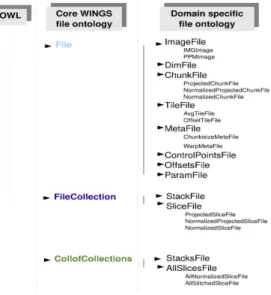
Domain-specific Data Ontology: The core data ontol-ogy in WINGS contains OWL-based hierarchical definitions for generic data entities such as a File, a Collection of
Files of the same type, andCollOfCollections. We have extended this core ontology as shown in Figure 4 to capture the data model commonly adopted in applications within the spatial data analysis domain. For instance, chunk-based analysis of out-of-core image data requires the expression of the data at various levels of abstraction: image, chunk, tile, slice, and stack. Our domain-specific data ontology defines
these concepts and how they relate to each other, and al-lows application data flow to be described in terms of these concepts. While this ontology is not exhaustive, it is generic enough to represent typical application instances such as the PIQ and NB workflows. It can also be extended to support a wider range of spatial data applications. The core com-ponent ontology in WINGS was also extended to represent sequential components, component collections (bag-of-tasks style operations), and complex parallel components in our workflows.
Figure 4: Extensions to core WINGS data ontology
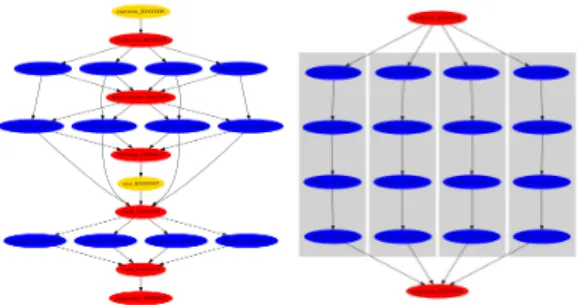
For component collections, multiple instances of a compo-nent can be dynamically created depending on the properties of the data, and tasks corresponding to these instances are scheduled independently for execution. This enables perfor-mance improvements by adjusting both the task- and data-parallelism parameter of the application workflow as well as application performance parameters such as chunksize. Thechunksizeparameter dictates the unrolling of compo-nent collections in a workflow template into a bag of tasks in the workflow instance for a given input. As an example as-sume thechunksizevalue chosen for an input image results in the image being partitioned into 4 chunks. The corre-sponding unrolled workflow instances for the PIQ and NB workflows are shown in Figure 5. The cases where multiple ‘ovals’ exist at the same horizontal level indicate component collections that have been automatically expanded, based on thechunksize, into multiple (in this case 4) component in-stances. Thus, changing thechunksizeparameter can lead to different workflow structures depending on the data.
In our current system, we also support the notion of meta-components or explicit component-grouping. A meta-component is a combination of components in a workflow. For example, the grey rectangles for the NB workflow in Figure 5 indi-cate that all steps have been fused into a meta-component. By coalescing components into meta-components, a higher-granularity template of the workflow can be created. The higher-granularity template and meta-components correspond to the adjustment of the task granularity parameter for per-formance optimization. During execution, all tasks within a meta-component are scheduled at once and mapped to the same resources.
Figure 5: Expanded workflow instance for PIQ and NB workflows (chunksize is chosen such that #chunks=4).
5.2
Execution Module (EM)
TheExecution Module (EM) consists of three subsystems
that work in an integrated fashion to execute workflows in a distributed environment and on cluster systems:
Pegasus Workflow Management System is used to reliably map and execute application workflows onto diverse computing resources in the Grid [9]. Pegasus takes resource-independent workflow descriptions (DAX) generated by the DM and produces concrete workflow instances with addi-tional directives for efficient data transfers between Grid sites. Portions of workflow instances are mapped onto dif-ferent sites, where each site could potentially be a hetero-geneous, cluster-style computing resource. Pegasus is used to manipulate the component config parameter, i.e. the component transformation catalog can be modified to select an appropriate mapping from components to analysis soft-ware for a given workflow instance. Pegasus also supports runtime job clustering to reduce scheduling overheads. Hor-izontal clustering groups together tasks at the same level of the workflow (e.g. the unrolled tasks from a component collection), while vertical clustering can group serial tasks from successive components. All tasks within a group are scheduled for execution on the same set of resources. How-ever, Pegasus does not currently support pipelined dataflow execution and data streaming between components. This support is provided by DataCutter [1] as explained later in this section.
Condor [19] is used to schedule tasks across machines. Pegasus submits tasks in the form of a DAG to Condor in-stances running locally at each Grid site.
DataCutter [1] is employed for pipelined dataflow exe-cution of portions of a workflow mapped to a Grid site con-sisting of cluster-style systems. A task mapped and sched-uled for execution by Condor on a set of resources may correspond to a meta-component. In that case, the exe-cution of the meta-component is carried out by DataCut-ter in order to enable the combined use of task- and data-parallelism and data streaming among components of the meta-component. DataCutter uses the filter-stream pro-gramming model, where component execution is broken down into a set offiltersthat communicate and exchange data via a stream abstraction. For each component, the analysis logic (expressed using high-level languages) is embedded into one or more filters in DataCutter. Each filter executes within a separate thread, allowing for CPU, I/O and communica-tion overlap. Multiple copies of a filter can be created for data parallelism within a component. A stream denotes a
unidirectional data flow from one filter (i.e., the producer) to another (i.e., the consumer). Data exchange among fil-ters on the same node is accomplished via pointer hand-off while message passing is used for filters on different nodes. In our framework, we employ a version of DataCutter that uses MPI for communication to exploit the use of high-speed interconnects.
5.3
Trade-off Module (TM)
When large datasets are analyzed using complex opera-tions, an analysis workflow may take too long to execute. In such cases, users may be willing to accept lower qual-ity output for reduced execution time, especially when there are constraints on resource availability. The user may, how-ever, desire that a certain application-level quality of ser-vice (QoS) be met. Examples of QoS requirements in image analysis include Maximize the average confidence in
classi-fication of image tiles withinttime unitsandMaximize the
number of image tiles, for which the confidence in
classifi-cation exceeds the user-defined threshold, within t units of
time [14]. We have investigated techniques which dynami-cally order the processing of data elements to speed up ap-plication execution while taking into account user-defined QoS requirements on output quality. TheTrade-off Module
(TM) draws from and implements the runtime support for these techniques so that quality of output can be traded for improved performance.
We provide generic support for such a reordering of data processing in our framework by extending Condor’s job schedul-ing component. When a batch of tasks (such as those pro-duced by expansion of component collections in a WINGS workflow instance) is submitted to Condor, it uses a default FIFO ordering of task execution. Condor allows users to set the relative priorities of jobs in the submission queue. How-ever, only a limited range (-20 to +20) of priorities are sup-ported by thecondor prioutility, while a typical batch could contain tasks corresponding to thousands of data chunks. Moreover,condor priodoes not prevent some tasks from be-ing submitted to the queue in the first place. In our frame-work, we override Condor’s default job scheduler by invoking a customized scheduling algorithm that executes as a regu-lar job within Condor’s “scheduler” universe and does not require any super-user privileges. The scheduling algorithm implements a priority queue based scheme [14] in a manner that is not tied to any particular application. It relies on the semantic representations of the data chunks being processed in a batch in order to map jobs to the spatial coordinates of the chunks. Using this association, the priority queue within the custom scheduler can decide which job to schedule next, based on the spatial coordinates of the chunk belonging to that job’s specification. The custom scheduler can be em-ployed for any application within the spatial data analysis domain. The priority queue insertion scheme can be manip-ulated for different QoS requirements such that jobs corre-sponding to the favorable data chunks are released ahead of other jobs. In this way, the customized scheduler helps ex-ercise control over theprocessing orderparameter. When there are no QoS requirements, our framework reverts to the default job scheduler within Condor.
5.4
Framework Application
Our current implementation of the proposed framework supports the performance optimization requirements
associ-ated chunk-based image/spatial data analysis applications. However, the framework can be employed in other data anal-ysis domains. The customized Condor scheduling module facilitates a mechanism for trading output accuracy for per-formance with user-defined quality of service requirements. For other types of performance optimization parameters, the current implementation of the framework provides support for users to specify and express the values of various per-formance parameters to improve perper-formance of the work-flow. We view this as a first step towards an implementation that can more automatically map user queries to appropri-ate parameter value settings. We target application scenar-ios where a given workflow is employed to process a large number of data elements (or a large dataset that can be partitioned into a set of data elements). In such cases, a subset of those data elements could be used to search for suitable parameter values (by applying sampling techniques to the parameter space) during workflow execution and sub-sequently refining the choice of parameter values based on feedback obtained from previous runs. Statistical modelling techniques similar to those used in the Network Weather Service [21] can be used to predict performance and qual-ity of future runs based on information gathered in previous runs.
6.
EXPERIMENTAL EVALUATION
In this section, we present an experimental evaluation of our proposed framework using the two real-world applica-tions, PIQ and NB, described in section 3. Our evaluation was carried out across two heterogeneous clusters hosted at different locations at the Ohio State University. The first one (referred to here as RII-MEMORY) consists of 64 dual-processor nodes equipped with 2.4 GHz AMD Opteron processors and 8 GB of memory, interconnected by a Gigabit Ethernet network. The storage system consists of 2x250GB SATA disks installed locally on each compute node, joined into a 437GB RAID0 volume. The second cluster, RII-COMPUTE, is a 32-node cluster consisting of faster dual-processor 3.6 GHz Intel Xeon nodes each with 2 GB of memory and only 10 GB of local disk space. This clus-ter is equipped with both an InfiniBand inclus-terconnect as well as a Gigabit Ethernet network. The RII-MEMORY and RII-COMPUTE clusters are connected by a 10-Gigabit wide-area network connection – each node is connected to the network via a Gigabit card; we observed about 8 Giga-bits/sec application level aggregate bandwidth between the two clusters. The head-node of the RII-MEMORY cluster also served as the master node of a Condor pool that spanned all nodes across both clusters. A Condor scheduler instance running on the head-node functioned both as an opportunis-tic scheduler (for “vanilla universe” jobs) and a dedicated scheduler (for parallel jobs). The “scheduler” universe jobs in Condor, including our customized scheduling algorithm, when applicable, run on the master node. All other nodes of the Condor pool were configured as worker nodes that wait for jobs from the master. DataCutter instances executing on the RII-COMPUTE cluster use the MVAPICH flavor4
of MPI for communication in order to exploit InfiniBand support.
In the following experiments, we evaluate the performance impact of a set of parameter choices on workflow execution
4
http://mvapich.cse.ohio-state.edu
time. First, a set of Quality-Preserving parameters are ex-plored, as we would initially like to tune the performance without modifying the results of the computation. We sub-sequently investigate the Quality-trading parameters. In our experiments, we treat different parameters independently, selecting a default value for one parameter while exploring another. The decision as to which parameter to explore first is one that can either be made by an application program-mer, or can be evaluated systematically by a set of measure-ments, such as the sensitivity analysis found in [7].
6.1
Quality-preserving Parameters
The basic template for the PIQ workflow is one where tasks corresponding to each component and component col-lection are mapped to target sites by Pegasus. Our earlier work [13] showed that components like normalize and
au-toalignexecute in less time on faster machines equipped with
high-speed interconnects. Based on these experiences, we adopted a specific component placement strategy to achi-eve improved performance. Components zproject,
prenor-malize, stitch, reorganize, warp and the preprocessing tasks
execute on the RII-MEMORY cluster, whilenormalize,
au-toalign andmstexecute on the faster processors of the
RII-COMPUTE cluster. This component placement strategy allows for maximum overlap between computation and data communication between sites for the PIQ workflow, in ad-dition to mapping compute-intensive tasks to faster sites.
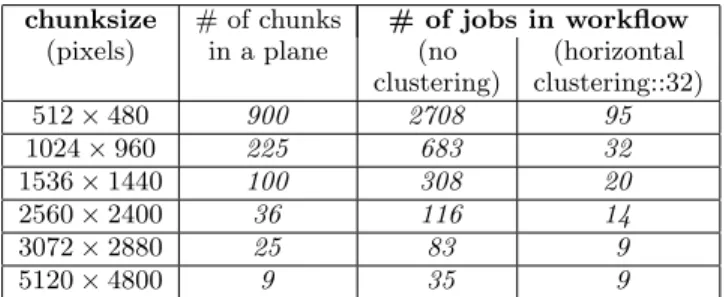
Effects of chunksize: For these experiments, we used a 5 GB image with 8 focal planes, where each plane has 15360×14000 pixels. Thechunksizeparameter determines the unrolling factor for component collections in the tem-plate. Different chunksize parameter values resulted in workflow instances with different structures with different number of tasks, as shown in table 1.
chunksize # of chunks # of jobs in workflow
(pixels) in a plane (no (horizontal clustering) clustering::32) 512×480 900 2708 95 1024×960 225 683 32 1536×1440 100 308 20 2560×2400 36 116 14 3072×2880 25 83 9 5120×4800 9 35 9
Table 1: Number of jobs in workflow instance for eachchunksize
The disparity among the number of resulting tasks for differentchunksizes will grow when we have larger images (leading to more chunksize values) and more component collections. Hence, job submission and scheduling overheads play a significant role in the overall execution times. To al-leviate these overheads, a possible runtime optimization is to use horizontal job clustering by Pegasus for every compo-nent collection. (The table also shows the total number of tasks for eachchunksizevalue when tasks from component collections in the PIQ workflow are grouped into bundles of 32 tasks each.)
Figure 6 shows the overall execution time for each work-flow instance corresponding to a differentchunksize, both with and without using horizontal job clustering by Pega-sus. This includes the time to stage-in and stage-out data
for each site, the execution times for tasks from each com-ponent, and the job submission and scheduling overheads. We observe that: (1) Values at both extremes of the chunk-sizerange do not yield good performance. The submission and scheduling of a large number of tasks causes poor per-formance when the smallest chunksizevalue is used. For the largest chunksizevalue, the number of chunks in an image place becomes less than the number of worker nodes available for execution. Since each task operates at the min-imum granularity of a chunk, this leads to under-utilization of resources and hence, higher execution times. (2) The in-termediate values forchunksizeyield more or less similar performance, except for an unexpected spike atchunksize
= 2560×2400. On further analysis of the individual com-ponent performance, we observed that the algorithm variant used for thewarpcomponent (which accounts for nearly 50% of the overall execution time of PIQ) performed poorly at thischunksizevalue. This shows that the chunking strat-egy can affect performance not only at the workflow level but also at the level of each component. (3) Horizontal job clustering improves performance when the unrolling factor for each component collection is large. For largerchunksize
values, this factor is not high enough to justify the overheads of job clustering. 0 500 1000 1500 2000 2500 3000 3500 4000 512x480 1024x960 1536x1440 2560x2400 3072x2880 5120x4800
Execution time (sec)
Chunksize (pixels) No job clustering with Pegasus horizontal clustering
Figure 6: Total workflow execution time for various
chunksizeparameter values
We observed similar trends for large images as well. Our experiments with 75 differentchunksizevalues for a 17 GB image (with 3 focal planes, each plane having 36864×48000 pixels) showed that very small or very large chunk sizes lead to poor performance owing to reasons outline above. We also observed thatchunksize values that resulted in long horizontal stripe chunks yielded optimal performance for this workflow and image class. This shows that most analy-sis operations in the PIQ workflow favor horizontal striped chunks. In future endeavors, our framework will seek to de-termine the best values of parameters likechunksizebased on trends generated from training data.
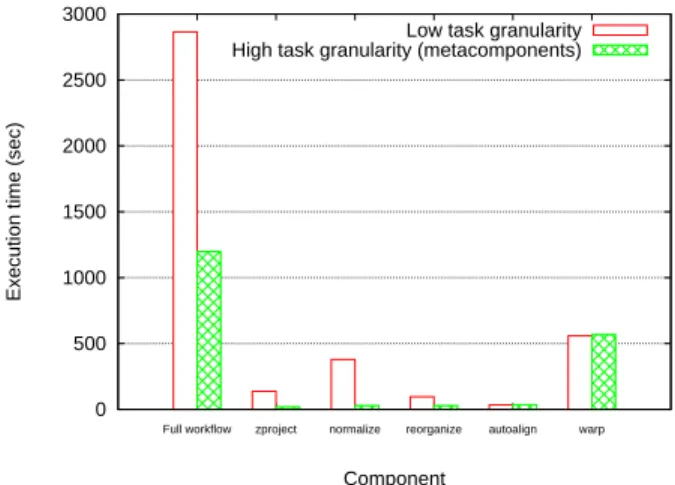
Effect of Task Granularity: In these experiments, we coalesced components of the PIQ workflow into meta-components to produce a workflow template with a coarser task granular-ity. In this case, tasks corresponding to a meta-component (and not a component), are submitted to the execution mod-ule. Here, thezprojectandprenormalizesteps from the orig-inal template are fused to formmetacomponent1,normalize,
autoalign, mstare collectivelymetacomponent2 whilestitch,
reorganize, warp form metacomponent3. Preprocessis the
fourth meta-component in the workflow template and in-cludes the threshold,tessellate andprefix sum components. By using this representation, our framework further reduces the number of tasks in a workflow instance. When compo-nent collections are embedded within a meta-compocompo-nent, they are not explicitly unrolled at the time of workflow instance generation. Instead, they are implicitly unrolled within a DataCutter instance. That is, thechunksizeinput parameter to a meta-component is propagated to the Data-Cutter filters set up for each component within that meta-component. Based on chunksize, DataCutter will create multiple copies of filters that handle the processing of com-ponent collection tasks. Each such filter copy or instance will operate on a single chunk. We also manipulated the execu-tion strategy within thepreprocess meta-component alone, such that data within this meta-component is pipelined and streamed between its components without any disk I/O dur-ing execution. 0 500 1000 1500 2000 2500 3000
Full workflow zproject normalize reorganize autoalign warp
Execution time (sec)
Component
Low task granularity High task granularity (metacomponents)
Figure 7: Execution time with different task granu-larity (5GB image, 40 nodes, chunksize=512×480)
Figure 7 shows that the overall execution time for the PIQ workflow improves by over 50% when we use the high-granularity workflow template for execution. The figure also shows the changes in execution times for individual compo-nents of the workflow. Embedding heterogeneous parallel components likeautoalign andwarp, as expected, makes no difference to their execution times. However, component col-lections likezproject,normalizeandreorganizebenefit from the high-granularity execution. This difference is attributed to the two contrasting styles of execution that our frame-work can offer by integrating Pegasus and DataCutter. Pe-gasus is a batch system where the execution of each task is treated independently. If startup costs (e.g. MATLAB invocation or JVM startup) are involved in the execution of a task within a component collection, such overheads are in-curred for each and every task in the collection. In contrast, DataCutter can function like a service-oriented system, in which filters are set up on each worker node. These filters perform the desired startup operations on each node and process multiple data instances, much like a service. The input data to a collection can be streamed through these filters. Thus, effectively, the startup overheads are incurred only once per worker. Depending on the nature of the tasks
within a collection, our framework can use explicit unrolling and execution via Pegasus, or implicit unrolling within a meta-component and execution via DataCutter.
6.2
Quality-trading Parameters
These experiments demonstrate performance gains obtained when one or more quality-trading parameters were changed in response to queries with QoS requirements. The opti-mizations in these experiments are derived from the custom scheduling approach described in section 5.3 that makes data chunk reordering decisions dynamically as and when jobs are completed. In all our experiments, we observed that the overall execution time using our custom scheduling al-gorithm within Condor is only marginally higher than that obtained from using the default scheduler, thereby show-ing that our approach introduces only negligible overheads. These experiments were carried out on the RII-MEMORY cluster5
with Condor’s master node running our customized scheduler. We carried out evaluations using multiple images (ranging in size from 12 GB to 21 GB) that are character-ized by differences in their data (feature) content. We target user queries with two kinds of QoS requirements: Require-ment 1: Maximize average confidence across all chunks in
an image within time t; Requirement 2: Given a
con-fidence in classification threshold, maximize the number of
finalized chunks for an image within time t. These
require-ments can be met by tuning combinations of one or more relevant quality-trading parameters.
Tuning both the resolution and processing order
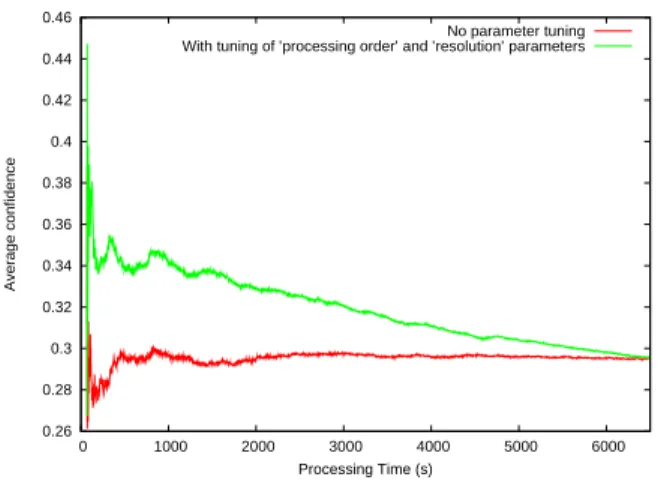
parameters for requirement 1: This is useful when chunks can be processed at lower resolutions so long as the result-ing confidence exceeds a user-specified threshold. Figure 8 shows how parameter tuning helps achieve higher average confidence at all points during the execution. Each chunk is iteratively processed until only that target resolution at which the confidence exceeds a threshold (set to 0.25 here). Our custom scheduler prioritizes chunks that are likely to yield output with higher (conf idence
time ) value at lower
resolu-tions.
Results obtained for other test images exhibited similar improvement trends and also showed that our customized scheduling extensions to Condor scale well with data size.
Tuning both the resolution and processing order
parameters for requirement 2: Here, the customized scheduler prioritizes jobs corresponding to chunks that are likely to get finalized at lower resolutions. Figure 9 shows how parameter tuning in our framework yields an increased number of finalized chunks at every point in time during the execution. The improvement for this particular case appears very slight because the confidence in classification threshold was set relatively high as compared to the average confidence values generated by theclassify component, and this gave our custom scheduler lesser optimization opportunities via reordering.
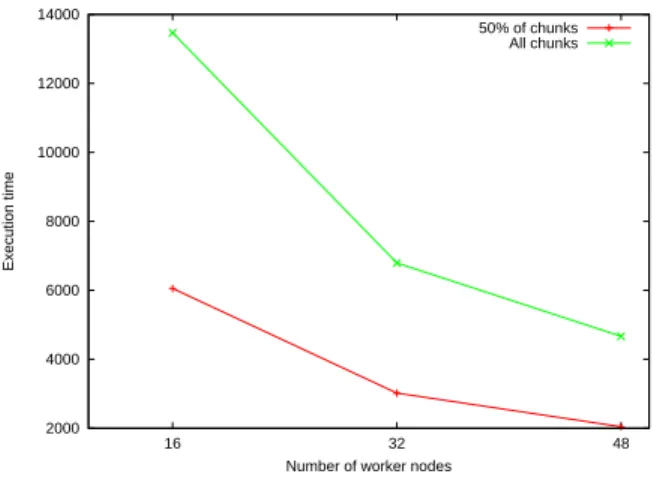
Scalability: In this set of experiments (carried out as part of requirement 2), we scaled the number of worker nodes in our Condor pool from 16 to 48. Our goal here was to determine if our custom scheduler could function
ef-5
Our goal here is only to demonstrate our framework’s abil-ity to exploit performance-qualabil-ity trade-offs, and not adapt-ability to heterogeneous sets of resources. We note that this experiment could also be carried out on the same testbed used for the PIQ application.
0.26 0.28 0.3 0.32 0.34 0.36 0.38 0.4 0.42 0.44 0.46 0 1000 2000 3000 4000 5000 6000 Average confidence Processing Time (s) No parameter tuning With tuning of ’processing order’ and ’resolution’ parameters
Figure 8: Quality improvement by tuning the
pro-cessing orderand resolutionparameters
0 2000 4000 6000 8000 10000 12000 0 1000 2000 3000 4000 5000 6000
Number of finalized chunks
Processing Time (s)
No parameter tuning With tuning of ’processing order’ and ’resolution’ parameters
Figure 9: Improvement in number of finalized tiles by tuning parameters
ficiently when more worker nodes are added to the system. Figure 10 shows how the time taken to process a certain number of chunks in an image halves as we double the num-ber of workers. Hence, the scheduler performance scales linearly when an increasing number of resources need to be managed.
7.
SUMMARY AND CONCLUSIONS
Many scientific workflow applications are data and/or compute-intensive. The performance of such applications can be im-proved by adjusting component-level parameters as well as by applying workflow-level optimizations. In some applica-tion scenarios, performance gains can be obtained by sac-rificing quality of output of the analysis, so long as some minimum quality requirements are met. Our work has in-troduced a framework that integrates a suite of workflow de-scription, mapping and scheduling, and distributed data pro-cessing subsystems in order to provide support for parameter-based performance optimizations along multiple dimensions of the parameter space.
Our current implementation of the proposed framework provides support for users to manually express the values of the various performance parameters in order to improve
2000 4000 6000 8000 10000 12000 14000 16 32 48 Execution time
Number of worker nodes
50% of chunks All chunks
Figure 10: Scalability with number of worker nodes
performance. We have customized the job scheduling mod-ule of the Condor system to enable support for trading off output quality for performance in our target class of ap-plications. The experimental evaluation of the proposed framework shows that adjustments of quality-preserving and quality-trading parameters lead to performance gains in two real applications. The framework also achieves improved re-sponses to queries involving quality of service requirements. As a future work, we will incorporate techniques to search the parameter space in a more automated manner. We tar-get application scenarios in which a large number of data elements or a large dataset that can be partitioned into a number of chunks are processed in a workflow. In such cases, a subset of the data elements could be used to search for suitable parameter values during workflow execution and subsequently refining the choice of parameter values based on feedback obtained from previous runs.
8.
REFERENCES
[1] M. D. Beynon, T. Kurc, U. Catalyurek, C. Chang, A. Sussman, and J. Saltz. Distributed processing of very large datasets with DataCutter.Parallel Computing, 27(11):1457–1478, November 2001.
[2] I. Brandic, S. Pllana, and S. Benkner. Specification, planning, and execution of QoS-aware Grid workflows within the Amadeus environment.Concurrency and Computation: Practice and Experience, 20(4):331–345, 2008.
[3] F. Chang and V. Karamcheti. Automatic configuration and run-time adaptation of distributed applications. InHigh Performance Distributed Computing, pages 11–20, 2000. [4] D. Chiu, S. Deshpande, G. Agrawal, and R. Li. Cost and
accuracy sensitive dynamic workflow composition over Grid environments.9th IEEE/ACM International Conference on Grid Computing, pages 9–16, Oct. 2008.
[5] S. K. Chow, H. Hakozaki, D. L. Price, N. A. B. MacLean, T. J. Deerinck, J. C. Bouwer, M. E. Martone, S. T. Peltier, and M. H. Ellisman. Automated microscopy system for mosaic acquisition and processing.Journal of Microscopy, 222(2):76–84, May 2006.
[6] I.-H. Chung and J. Hollingsworth. A case study using automatic performance tuning for large-scale scientific programs.15th IEEE International Symposium on High Performance Distributed Computing, pages 45–56, 2006. [7] I.-H. Chung and J. K. Hollingsworth. Using information from prior runs to improve automated tuning systems. In
SC ’04: Proceedings of the 2004 ACM/IEEE conference on
Supercomputing, page 30, Washington, DC, USA, 2004. IEEE Computer Society.
[8] V. Cortellessa, F. Marinelli, and P. Potena. Automated selection of software components based on cost/reliability tradeoff. InSoftware Architecture, Third European Workshop, EWSA 2006, volume 4344 ofLecture Notes in Computer Science. Springer, 2006.
[9] E. Deelman, J. Blythe, Y. Gil, C. Kesselman, G. Mehta, S. Patil, M.-H. Su, K. Vahi, and M. Livny. Pegasus: Mapping scientific workflows onto the Grid.Lecture Notes in Computer Science: Grid Computing, pages 11–20, 2004. [10] Y. Gil, V. Ratnakar, E. Deelman, G. Mehta, and J. Kim.
Wings for Pegasus: Creating large-scale scientific applications using semantic representations of computational workflows. InProceedings of the 19th Annual Conference on Innovative Applications of Artificial Intelligence (IAAI), July 2007.
[11] T. Glatard, J. Montagnat, and X. Pennec. Efficient services composition for Grid-enabled data-intensive applications. InProceedings of the IEEE International Symposium on High Performance Distributed Computing (HPDC’06), Paris, France, June 19, 2006.
[12] J. Kong, O. Sertel, H. Shimada, K. Boyer, J. Saltz, and M. Gurcan. Computer-aided grading of neuroblastic differentiation: Multi-resolution and multi-classifier approach.IEEE International Conference on Image Processing, ICIP 2007, 5:525–528, Oct. 2007. [13] V. Kumar, B. Rutt, T. Kurc, U. Catalyurek, T. Pan,
S. Chow, S. Lamont, M. Martone, and J. Saltz. Large-scale biomedical image analysis in Grid environments.IEEE Transactions on Information Technology in Biomedicine, 12(2):154–161, March 2008.
[14] V. S. Kumar, S. Narayanan, T. M. Kur¸c, J. Kong, M. N. Gurcan, and J. H. Saltz. Analysis and semantic querying in large biomedical image datasets.IEEE Computer,
41(4):52–59, 2008.
[15] I. Lera, C. Juiz, and R. Puigjaner. Performance-related ontologies and semantic web applications for on-line performance assessment intelligent systems.Sci. Comput. Program., 61(1):27–37, 2006.
[16] B. Lud¨ascher, I. Altintas, C. Berkley, D. Higgins, E. Jaeger, M. Jones, E. A. Lee, J. Tao, and Y. Zhao. Scientific workflow management and the Kepler system: Research articles.Concurr. Comput.: Pract. Exper.,
18(10):1039–1065, 2006.
[17] B. Norris, J. Ray, R. Armstrong, L. C. Mcinnes, and S. Shende. Computational quality of service for scientific components. InProceedings of the International Symposium on Component-based Software Engineering (CBSE7), pages 264–271. Springer, 2004.
[18] T. Oinn, M. Addis, J. Ferris, D. Marvin, M. Senger, M. Greenwood, T. Carver, K. Glover, M. R. Pocock, A. Wipat, and P. Li. Taverna: a tool for the composition and enactment of bioinformatics workflows.Bioinformatics, 20(17):3045–3054, 2004.
[19] D. Thain, T. Tannenbaum, and M. Livny. Distributed computing in practice: the Condor experience: Research articles.Concurr. Comput. : Pract. Exper.,
17(2-4):323–356, 2005.
[20] H.-L. Truong, S. Dustdar, and T. Fahringer. Performance metrics and ontologies for grid workflows.Future Generation Computer Systems, 23(6):760 – 772, 2007. [21] R. Wolski, N. Spring, and J. Hayes. The Network Weather
Service: A Distributed Resource Performance Forecasting Service for Metacomputing.Journal of Future Generation Computing Systems, 15:757–768, 1999.
[22] J. Zhou, K. Cooper, and I.-L. Yen. A rule-based component customization technique for QoS properties.Eighth IEEE International Symposium on High Assurance Systems Engineering, pages 302–303, March 2004.
![Figure 1 shows a data analysis pipeline [5] (developed by neuroscientists at the National Center for Microscopy and Imaging Research) for images obtained from confocal mi-croscopes](https://thumb-us.123doks.com/thumbv2/123dok_us/11982.2501054/3.918.476.833.208.390/analysis-pipeline-developed-neuroscientists-national-microscopy-research-croscopes.webp)