PRELIMINARY SURVEY REPORT:
PRE-INTERVENTION QUANTITATIVE RISK FACTOR ANALYSIS
FOR SHIP REPAIR PROCESSES
at
CONTINENTAL MARITIME OF SAN DIEGO, INC. SHIPYARD,
San Diego, California
REPORT WRITTEN BY: Stephen D. Hudock, Ph.D., CSP
Steven J. Wurzelbacher, M.S.
REPORT DATE: August 2001
REPORT NO. EPHB 229-16a
U.S. DEPARTMENT OF HEALTH AND HUMAN SERVICES Public Health Service
Centers for Disease Control and Prevention National Institute for Occupational Safety and Health
Division of Applied Research and Technology Engineering and Physical Hazards Branch
4676 Columbia Parkway, Mailstop R-5 Cincinnati, Ohio 45226
Approved for public release; distribution is unlimited Government Purpose Rights
PLANT SURVEYED: Continental Maritime of San Diego, Inc. shipyard, 1995 Bay Front Street, San Diego, California 92113-2122
SIC CODE: 3731
SURVEY DATE: June 7-8, 2000
SURVEY CONDUCTED BY: Stephen D. Hudock, NIOSH
Steven J. Wurzelbacher, NIOSH Karl V. Siegfried, MEMIC
EMPLOYER REPRESENTATIVES Lee Wilson, Executive Vice President
CONTACTED: David Harris, Safety Director
EMPLOYEE REPRESENTATIVES Not Applicable
DISCLAIMER
Mention of company names and/or products does not constitute endorsement by the Centers for Disease Control and Prevention (CDC) or NIOSH.
ABSTRACT
A pre-intervention quantitative risk factor analysis was performed at various shops and locations within Continental Maritime of San Diego, Inc. shipyard in San Diego, California as a method to identify and quantify risk factors that workers may be exposed to in the course of their normal work duties. This survey was conducted as part of a larger project, funded through Maritech Advanced Shipbuilding Enterprise and the U.S. Navy, to develop projects to enhance the commercial viability of domestic shipyards. Several operations were identified for further analysis including: deck scraping, deck fitting, duct installation and welding processes. The application of exposure assessment techniques provided a quantitative analysis of the risk factors associated with the individual tasks. Possible engineering interventions to address these risk factors for each task are briefly discussed.
I. INTRODUCTION
IA. BACKGROUND FOR CONTROL TECHNOLOGY STUDIES
The National Institute for Occupational Safety and Health (NIOSH) is the primary Federal agency in occupational safety and health research. Located in the Department of Health and Human Services, it was established by the Occupational Safety and Health Act of 1970. This legislation mandated NIOSH to conduct a number of research and education programs separate from the standard setting and enforcement functions carried out by the Occupational Safety and Health Administration (OSHA) in the Department of Labor. An important area of NIOSH research deals with methods for controlling occupational exposures to potential chemical and physical hazards.
Since 1976, NIOSH has conducted a number of assessments of health hazard control technology on the basis of industry, common industrial processes, or specific control techniques. Examples of the completed studies include the foundry industry; various chemical manufacturing or
processing operations; spray painting; and the recirculation of exhaust air. The objective of each of these studies had been to document and evaluate effective control techniques for potential health hazards in the industry or process of interest, and to create a greater general awareness of the need for or availability of an effective system of hazard control measures.
These studies involve a number of steps or phases. Initially, a series of walk-through surveys is conducted to select plants or processes with effective and potentially transferable control concepts or techniques. Next, in-depth surveys are conducted to determine both the control parameters and the effectiveness of these controls. The reports from these in-depth surveys are then used as a basis for preparing technical reports and journal articles on effective hazard control measures. Ultimately, the information from these research activities builds the data base of publicly available information on hazard control techniques for use by health professionals who are responsible for preventing occupational illness and injury.
IB. BACKGROUND FOR THIS STUDY
The domestic ship building, ship repair, and ship recycling industries have historically had much higher injury/illness incidence rates than those of general industry, manufacturing, or
construction. For 1998, the latest year available, the Bureau of Labor Statistics reported that shipbuilding and repair (SIC 3731) had a recordable injury/illness incidence rate of 22.4 per 100 full-time employees (FTE), up from 21.4 in 1997. By contrast, in 1998, the manufacturing sector reported a rate of 9.7 per 100 FTE, construction reported a rate of 8.8 per 100 FTE, and all
industries reported a rate of 6.7 injuries/illnesses per 100 FTE. When only lost workday cases for 1998 are considered, shipbuilding and repair had an incidence rate of 11.5 per 100 FTE,
compared to manufacturing at 4.7, construction at 4.0, and all industries at 3.1 lost workday injuries/illnesses per 100 FTE (see Figures 1 and 2).
Injury/Illness Total Recordable Incidence Rate 0 10 20 30 40 50 1990 1991 1992 1993 1994 1995 1996 1997 1998 Year C ases/ 100 F T E Private industry Construction Manufacturing Boat bldg/rpr Ship bldg/rpr
Injury/Illness Lost Workday Cases Incidence Rate 0 5 10 15 20 25 1990 1991 1992 1993 1994 1995 1996 1997 1998 Year Cases/100 F T E Private industry Construction Manufacturing Boat bldg/rpr Ship bldg/rpr
Figure 1. Injury/Illness Total Recordable Incidence Rate
Figure 2. Injury/Illness Lost Workday Cases Incidence Rate
When shipbuilding and repairing are compared to the manufacturing sector for injuries and illnesses to specific parts of the body that result in days away from work for the year 1997, shipbuilding is significantly higher in a number of instances. For injuries and illnesses to the trunk, including the back and shoulder, shipbuilding reported an incidence rate of 207.7 cases per 10,000 FTE, compared to manufacturing at 82.1 cases. For injuries and illnesses solely to the back, shipbuilding reported 111.1 cases per 10,000 FTE, compared to manufacturing’s incidence rate of 52.2 cases. For the lower extremity, shipbuilding reported 145.0 cases per 10,000 FTE compared to manufacturing at 40.8 cases. For upper extremity injuries and illnesses,
shipbuilding reported an incidence rate of 92.2 cases per 10,000 FTE while manufacturing reported 73.4 cases.
When shipbuilding and repairing are compared to the manufacturing sector, by nature of injury, for injuries and illnesses resulting in days away from work for the year 1997, shipbuilding is significantly higher in a number of categories. For sprains and strains, shipbuilding reported an incidence rate of 237.9 cases per 10,000 FTE, compared to manufacturing’s incidence rate of 91.0 cases. For fractures, shipbuilding reported 41.7 cases per 10,000 FTE, compared to manufacturing at 15.8 cases. For bruises, shipbuilding reported 61.3 cases per 10,000 FTE, compared to manufacturing at 21.5 cases. The median number of days away from work for shipbuilding and repairing is 12 days, compared to manufacturing and private industry’s median of 5 days.
Beginning in 1995 the National Shipbuilding Research Program began funding a project looking at the implementation of ergonomic interventions at a domestic shipyard as a way to reduce workers’ compensation costs and to improve productivity for targeted processes. That project came to the attention of the Maritime Advisory Committee for Occupational Safety and Health (MACOSH), a standing advisory committee to OSHA. NIOSH began an internally funded project in 1997 looking at ergonomic interventions in new ship construction facilities. In 1998, the U.S. Navy decided to fund a number of research projects looking to improve the commercial viability of domestic shipyards, including projects developing ergonomic interventions for various shipyard tasks or processes. Project personnel within NIOSH successfully competed in the project selection process. The Institute currently receives external project funding from the U.S. Navy through an organization called Maritech Advanced Shipbuilding Enterprise, a consortium of major domestic shipyards.
Shipyards that participated in the NIOSH project receive an analysis of their injury/illness data, have at least one ergonomic intervention implemented at their facility, and have access to a website documenting ergonomic solutions found throughout the domestic maritime industries. The implementation of ergonomic interventions in other industries has resulted in decreases in workers’ compensation costs and increases in productivity.
Researchers identified seven participating shipyards and analyzed individual shipyard recordable injury/illness databases. Ergonomic interventions were implemented in each of the shipyards and intervention follow-up analysis will be completed following a six- to nine-month period. A series of meetings and a workshop to document the ergonomic intervention program will be held by the end of March 2001.
IC. BACKGROUND FOR THIS SURVEY
The Continental Maritime facility was selected for a number of reasons. It was decided that the project should look at a variety of yards based on product, processes and location. Continental Maritime is one of the principal SRA (Selected Restricted Availability), or scheduled
maintenance, providers for the U.S. Navy. Continental Maritime is a certified Master Ship Repair Contractor (MSRC) with the U.S. Navy. Continental Maritime repairs and overhauls military vessels including aircraft carriers, cruisers, destroyers and frigates, numerous types of
amphibious and auxiliary ships, as well as commercial vessels. Continental Maritime is considered to be a small- to medium-size yard.
II PLANT AND PROCESS DESCRIPTION
IIA. INTRODUCTION
Plant Description: The Continental Maritime shipyard is located on San Diego Bay in southern San Diego, California. The shipyard consists of 14 acres of land and 18 acres of water.
Production, administration, and warehouse facilities exceed 300,000 square feet under roof in addition to outside steel fabrication and material storage areas. Continental Maritime operates six piers up to 700 feet in length with a berthing draft of about 35 feet.
Corporate Ties: Continental Maritime of San Diego, Inc. is a Newport News Shipbuilding Company, providing a West Coast facility for them, in addition to the Newport News Shipbuilding yard in Virginia.
Products: Continental Maritime has completed hundreds of ship repair contracts for the U.S. Navy including: Regular Overhaul (ROH), New Threat Upgrade (NTU), Selected Restricted Availability (SRA) and Drydock Selected Restricted Availability (DSRA). Repairs and
alterations have been completed on combatant systems, hull, mechanical, and electrical systems and habitability concerns. Most of these contracts allow only a very limited timeframe in which the work must be completed and the vessel returned to active duty.
Age of Plant: Approximate age of shipyard facilities is 25 years.
Number of Employees, etc: As of the date of the survey, based on the number of employee hours, Continental Maritime employed the equivalent of about 215 full-time production workers. However, due to the sporadic nature of repair work, the actual number of employees, including part-time and full-time, is closer to 400.
IIB. POTENTIAL HAZARDS
Major Hazards: Awkward postures, manual material handling, confined space entry, welding fumes, UV radiation from welding, paint fumes, hand/arm vibration from power tools.
III. METHODOLOGY
A variety of exposure assessment techniques were implemented where deemed appropriate to the job task being analyzed. The techniques used for analysis include 1) the Rapid Upper Limb Assessment (RULA); 2) the Strain Index; 3) a University of Michigan Checklist for Upper Extremity Cumulative Trauma Disorders; 4) the OVAKO Work Analysis System (OWAS); 5) the University of Michigan 3D Static Strength Prediction Model; and 6) the PLIBEL method.
The RULA (McAtamney and Corlett, 1993) is a survey method developed to assess the exposure of workers to risk factors associated with work-related upper limb disorders. On using RULA, the investigator identifies the posture of the upper and lower arm, neck, trunk, and legs. Considering muscle use and the force or load involved, the investigator identifies intermediate scores, which are cross-tabulated to determine the final RULA score. This final score identifies the level of action recommended to address the job task under consideration.
The Strain Index (Moore and Garg, 1995) provides a semiquantitative job analysis methodology, which appears to accurately identify jobs associated with distal upper extremity disorders versus other jobs. The Strain Index is based on ratings of intensity of exertion, duration of exertion, efforts per minute, hand and wrist posture, speed of work, and duration per day. Each of these ratings is translated into a multiplier. These multipliers are combined to create a single Strain Index score.
The University of Michigan Checklist for Upper Extremity Cumulative Trauma Disorders (Lifshitz and Armstrong, 1986) allows the investigator to survey a job task with regard to the physical stress and the forces involved, the upper limb posture, the suitability of the workstation and tools used, and the repetitiveness of a job task. Negative answers are indicative of conditions that are associated with the development of cumulative trauma disorders.
The OWAS (Louhevaara and Suurnäkki, 1992) was developed to assess the quality of postures taken in relation to manual materials handling tasks. Workers are observed repeatedly over the course of the day and postures and forces involved are documented. Work postures and forces involved are cross-tabulated to determine an action category that recommends if, or when, corrective measures should be taken.
The University of Michigan 3D Static Strength Prediction Program (University of Michigan, 1997) is a useful job design and evaluation tool for the analysis of slow movements used in heavy materials handling tasks. Such tasks can best be analyzed by describing the activity as a sequence of static postures. The program provides graphical representation of the worker
postures and the materials handling task. Program output includes the estimated compression on the L5/S1 vertebral disc and the percentage of population capable of the task with respect to limits at the elbow, shoulder, torso, hip, knee, and ankle.
The PLIBEL method (Kemmlert, 1995) is a checklist method that links questions concerning awkward work postures, work movements, and design of tools and the workplace to specific body regions. In addition, any stressful environmental or organizational conditions should be noted. In general, the PLIBEL method was designed as a standardized and practical assessment tool for the evaluation of ergonomic conditions in the workplace.
IIIA. ONBOARD DECK SCRAPING
IIIA1. Onboard Deck Scraping Process
When a vessel is in a yard for scheduled maintenance, often the exterior deck’s surface must be replaced with a new coating of high-friction anti-slip material. First the old coating must be removed. This is accomplished by using large machines, similar in size and function to
commercial floor sanders. However, there are usually numerous fixtures and encumbrances on the deck surface, such as ladders and machinery mounting brackets. Around these fixtures and in the area between the deck and the bulkheads, the old coating must be removed be using a variety of pneumatic tools including deck scalers, needle guns and scrapers. Common work postures for this task can be seen in Figures 3 - 15.
Figure 4. Deck Worker #1 Changing Tools
Figure 5. Deck Worker #1 Using a Deck Crawler
Figure 7. Deck Worker #1 Using Pneumatic Scraper
Figure 8. Deck Worker #2 Changing Tool
Figure 10. Deck Worker #2 Inspecting Work
Figure 11. Deck Worker #2 Using Needle Gun
Figure 13. Deck Worker #3 Inspecting Work
Figure 14. Deck Worker #3 Using Needle Gun
IIIA2. Deck Scraping Ergonomic Risk Factors
Since all this work is done at deck level, workers must squat, sit, kneel, crawl or lie down in order to reach all the areas that must be stripped of the old coating. Stresses to the lower extremities, neck and backcan be quite high depending on the worker posture, whether the posture is constrained, and the length of time the worker must assume that posture. Exposure to the vibration created from using pneumatic vibrating hand tools may lead to hand-arm vibration syndrome or carpal tunnel syndrome.
IIIA3. Ergonomic Analysis of Worker #1 Scraping Decks
Using several of the exposure assessment tools outlined above, an ergonomic analysis was
performed for three different workers scraping off the old anti-slip coating from the deck surface. The first worker would primarily squat or sit to perform the job tasks, the second would usually kneel, and the third would lay down to get to the work location. This section will present the findings for the first deck worker.
A Rapid Upper Limb Assessment was conducted for deck worker #1 (Table 1). Analyses of five sub-tasks with unique postures resulted in a variety of ratings. The sub-tasks of using the deck crawler, the needle gun, or the pneumatic scraper on the deck each resulted in a rating of 7, on a scale of 1 to 7. The sub-tasks of changing and oiling the tool resulted in a rating of 5 and 6, respectively, the second highest of four categories.
A Strain Index analysis was performed for deck worker #1 (Table 2) and found the following results:
1)The Intensity of Exertion was rated as “Hard” and given a multiplier score of 6.0 on a scale of 1 to 13.
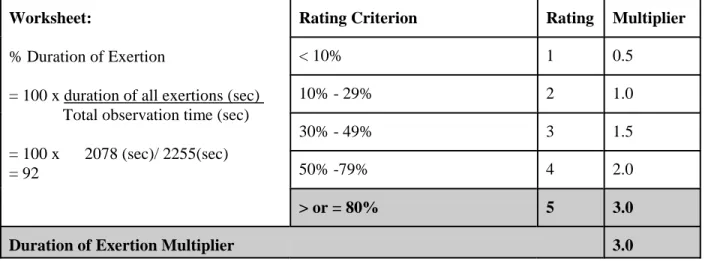
2) The Duration of Exertion of the task was rated as greater than or equal to 80 % of the task cycle, resulting in a multiplier of 3.0, on a scale of 0.5 to 3.0.
3) The Efforts per Minute were noted to be somewhat static, resulting in a multiplier of 1.5, on a scale of 0.5 to 3.0.
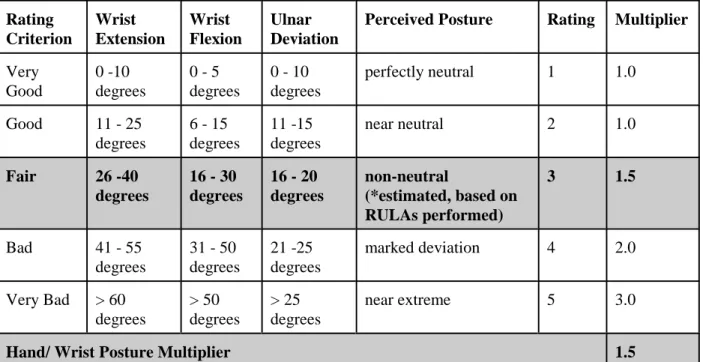
4) The Hand/Wrist Posture was rated as “Fair,” resulting in a multiplier of 1.5, on a scale of 1.0 to 3.0.
5) The Speed of Work was rated as “Fair,” resulting in a multiplier of 1.0, on a scale of 1.0 to 2.0.
6) The Duration of Task per Day was rated to be between 4 and 8 hours, resulting in a multiplier of 1.0, on a scale of 0.25 to 1.50.
The multiplier values for each segment are multiplied together resulting in a final Strain Index (SI) score. For this task the SI score was 40.5. An SI score between 31 and 60 is correlated to an incidence rate of about 106 distal upper extremity injuries per 100 FTE. Therefore, the SI
indicated that this task put the worker at an increased risk of developing a distal upper extremity injury.
In applying the University of Michigan Upper Extremity Cumulative Trauma Disorder Checklist to deck worker #1 (Table 3), of the 21 possible responses, 10 were negative and 11 were positive. Negative responses are indicative of conditions associated with the risk of developing cumulative trauma disorders.
When the OWAS technique was applied to deck worker #1 (Table 4), using the pneumatic scraper was rated a 4, on a scale from 1 to 4, the highest category. Using the needle gun rated a 3 on a scale of 1 to 4. The other three sub-tasks resulted in scores of 2 out of 4.
The PLIBEL checklist for deck worker #1 (Table 5) reported a high percentage of risk factors present for the elbows, forearms, and hands (72.7 %) and a moderate percentage (33.3 % - 46.1 %) of risk factors present for the neck, shoulder, upper back and lower back. Several
environmental and organizational modifying factors are present as well.
IIIA4. Ergonomic Analysis of Worker #2 Scraping Decks
A Rapid Upper Limb Assessment was conducted for deck worker #2 (Table 6). Analyses of four subtasks with unique postures resulted in a variety of ratings. The subtasks of using the deck crawler or the needle gun each resulted in a rating of 7, on a scale of 1 to 7. The subtask of changing the tool resulted in a rating of 6, the second highest of four categories. The remaining subtask, inspecting the work, rated a 3, on a scale of 1 to 7.
A SI analysis was performed for deck worker #2 (Table 7) and resulted in the following:
1) The Intensity of Exertion was rated as “Somewhat Hard” and given a multiplier score of 3.0, on a scale of 1 to 13.
2) The Duration of Exertion of the task was rated as greater than or equal to 80 % of the task cycle, resulting in a multiplier of 3.0, on a scale of 0.5 to 3.0.
3) The Efforts per Minute were noted to be somewhat static, resulting in a multiplier of 1.0, on a scale of 0.5 to 3.0.
4) The Hand/Wrist Posture was rated as “Fair,” resulting in a multiplier of 1.5, on a scale of 1.0 to 3.0.
5) The Speed of Work was rated as “Fair,” resulting in a multiplier of 1.0, on a scale of 1.0 to 2.0.
6) The Duration of Task per Day was rated to be between 4 and 8 hours, resulting in a multiplier of 1.0, on a scale of 0.25 to 1.50.
The multiplier values for each segment are multiplied together, resulting in a final SI score. For this task the SI score was 13.5. An SI score between 5 and 30 is correlated to an incidence rate of about 77 distal upper extremity injuries per 100 FTE. Therefore, the SI indicated that this task put the worker at an increased risk of developing a distal upper extremity injury.
In applying the University of Michigan Upper Extremity Cumulative Trauma Disorder Checklist to deck worker #2 (Table 8), of the 21 possible responses, 13 were negative and 8 were positive.
Negative responses are indicative of conditions associated with the risk of developing cumulative trauma disorders.
When the OWAS technique was applied to deck worker #2 (Table 9), all four subtasks rated a 2, on a scale from 1 to 4.
The PLIBEL checklist for deck worker #2 (Table 10) reported a high percentage of risk factors present for the elbows, forearms, and hands (63.6 %) and a moderate percentage (25 % - 34.6 %) of risk factors present for all other body regions. Several environmental and organizational modifying factors are present as well.
IIIA5. Ergonomic Analysis of Worker #3 Scraping Decks
A RULA was conducted for deck worker #3 (Table 11). Analyses of four subtasks with unique postures resulted in a variety of ratings. The subtasks of using the needle gun or the pneumatic scraper on the deck each resulted in a rating of 7, on a scale of 1 to 7. The subtask of changing the tool resulted in a rating of 6, the second highest of four categories. The final subtask, inspecting, rated a 4.
A SI analysis was performed for deck worker #3 (Table 12) and resulted in the following: 1) The Intensity of Exertion was rated as “Hard” and given a multiplier score of 6.0, on a
scale of 1 to 13.
2) Tthe Duration of Exertion in the task was rated as greater than or equal to 80 % of the task cycle, resulting in a multiplier of 3.0, on a scale of 0.5 to 3.0.
3) The Efforts per Minute were noted to be somewhat static, resulting in a multiplier of 1.0, on a scale of 0.5 to 3.0.
4) The Hand/Wrist Posture was rated as “Fair,” resulting in a multiplier of 1.5, on a scale of 1.0 to 3.0.
5) The Speed of Work was rated as “Fair,” resulting in a multiplier of 1.0, on a scale of 1.0 to 2.0.
6) The Duration of Task per Day was rated to be between 4 and 8 hours, resulting in a multiplier of 1.0, on a scale of 0.25 to 1.50.
The multiplier values for each segment are multiplied together resulting in a final SI score. For this task the SI score was 27. An SI score between 5 and 30 is correlated to an incidence rate of about 77 distal upper extremity injuries per 100 FTE. Therefore, the SI indicated that this task put the worker at an increased risk of developing a distal upper extremity injury.
In applying the University of Michigan Upper Extremity Cumulative Trauma Disorder Checklist to deck worker #3 (Table 3), of the 21 possible responses, 13 were negative and 8 were positive. Negative responses are indicative of conditions associated with the risk of developing cumulative trauma disorders.
When the OWAS technique was applied to deck worker #3 (Table 14), using the pneumatic scraper and changing the tool were rated a 3, on a scale from 1 to 4, the second-highest category. Using the needle gun and inspecting the work rated a 2 on a scale of 1 to 4.
The PLIBEL checklist for deck worker #3 (Table 15) reported a high percentage of risk factors present for the elbows, forearms, and hands (63.6 %) and a moderate percentage (50.0 %) of risk factors present for the neck, shoulder, and upper back. A lower percentage (23.8 %) of risk factors were present for the lower back. Several environmental and organizational modifying factors are present as well.
IIIB. ONBOARD DUCT INSTALLATION
IIIB1. Duct Installation Process
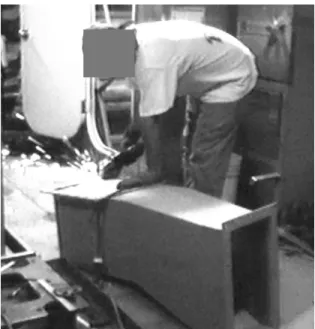
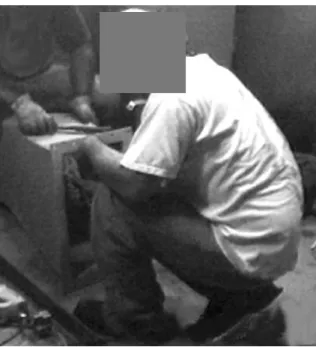
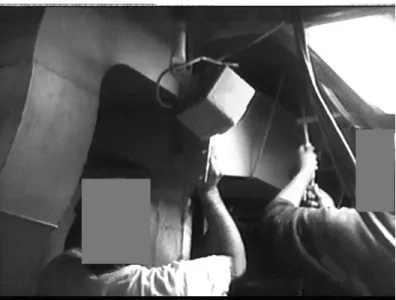
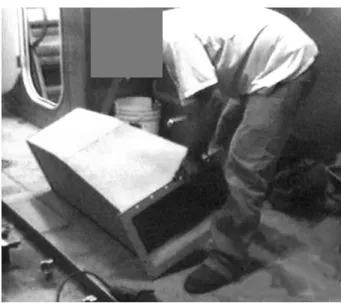
When a vessel is in the yard for scheduled maintenance, often work is done to the ventilation or exhaust systems onboard. Ductwork can be removed, replaced, or installed initially depending on the proposed work. Working with ductwork is most easily performed on the deck rather than overhead. Common work postures are shown in Figures 16-21.
Figure 17. Duct Worker Measuring Duct
Figure 19. Duct Worker Cutting Flange
Figure 21. Duct Worker Moving Piece of Ductwork
IIIB2. Ergonomic Risk Factors of Duct Installation
Duct installation or removal usually requires overhead work to place or remove the duct from its position. Static postures and overhead work may cause strain to the workers’ shoulders and neck. Once a piece of duct is on the deck, the worker usually bends over top of it to perform some part of the work process. The back flexion may result in some strain to the worker. The use of powered hand tools, such as grinders or reciprocating saws, exposes the worker to some amount of hand-arm, or segmental, vibration.
IIIB3. Ergonomic Analysis of Onboard Duct Installation
Using several of the exposure assessment tools outlined previously, an ergonomic analysis was performed for a worker performing common duct installation tasks. A RULA was conducted for the duct worker (Table 16). Analyses of six subtasks with unique postures resulted in a variety of ratings. The subtask of using the reciprocating saw on the duct at deck level resulted in a rating of 7, on a scale of 1 to 7. The subtasks of using an angle grinder and lowering the duct from the ceiling resulted in ratings of 6, in the second highest of four categories. The remaining three subtasks resulted in ratings of 3, in the second lowest of four categories.
A SI analysis was performed for the duct worker (Table 17) and resulted in the following: 1) The Intensity of Exertion was rated as “Somewhat Hard” and given a multiplier score
of 3.0, on a scale of 1 to 13.
2) The Duration of Exertion in the task was rated between 30% - 49%, resulting in a multiplier of 1.5, on a scale of 0.5 to 3.0.
1.0, on a scale of 0.5 to 3.0.
4) The Hand/Wrist Posture was rated as “Fair,” resulting in a multiplier of 1.5, on a scale of 1.0 to 3.0.
5) The Speed of Work was rated as “Fair,” resulting in a multiplier of 1.0, on a scale of 1.0 to 2.0.
6) The Duration of Task per Day was rated to be between 4 and 8 hours, resulting in a multiplier of 1.0, on a scale of 0.25 to 1.50.
The multiplier values for each segment are multiplied together resulting in a final SI score. For this task the SI score was 6.75. An SI score between 5 and 30 is correlated to an incidence rate of about 77 distal upper extremity injuries per 100 FTE. Therefore, the SI indicated that this task put the worker at an increased risk of developing a distal upper extremity injury.
In applying the University of Michigan Upper Extremity Cumulative Trauma Disorder Checklist to the duct worker (Table 18), of the 21 possible responses, 11 were negative and 10 were positive. Negative responses are indicative of conditions associated with the risk of developing cumulative trauma disorders.
When the OWAS technique was applied to duct worker (Table 19), five of six subtasks rated a 2, on a scale from 1 to 4, the second lowest category. The other subtask rated a 1, the lowest
category.
The University of Michigan 3-Dimensional Static Strength Prediction Program was applied to the subtask of moving the duct when it is on the deck (Table 20). The program calculated a disc compression at the L5/S1 disc of 787 pounds, slightly higher than the NIOSH Recommended Compression Limit of 770 pounds.
The PLIBEL checklist for duct worker (Table 21) reports moderate percentages of risk factors present for the upper extremities and back (42.9 % - 45.4 %) and a slightly lower percentage (25 %) of risk factors present for the lower extremities. A few environmental and organizational modifying factors are present as well.
IIIC. ONBOARD DECK FITTING AND WELDING IIIC1. Onboard Deck Fitting Process
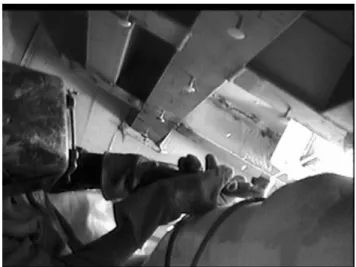
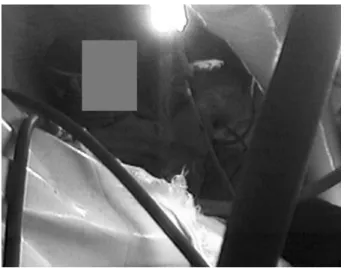
Often during scheduled maintenance activities, portions of the deck of a ship must be removed and refitted to allow access to the areas below for equipment that is being removed or added in the space below. This work requires workers to cut out the deck plate and then weld it back in place when the access hole is no longer required. This work may require workers to work
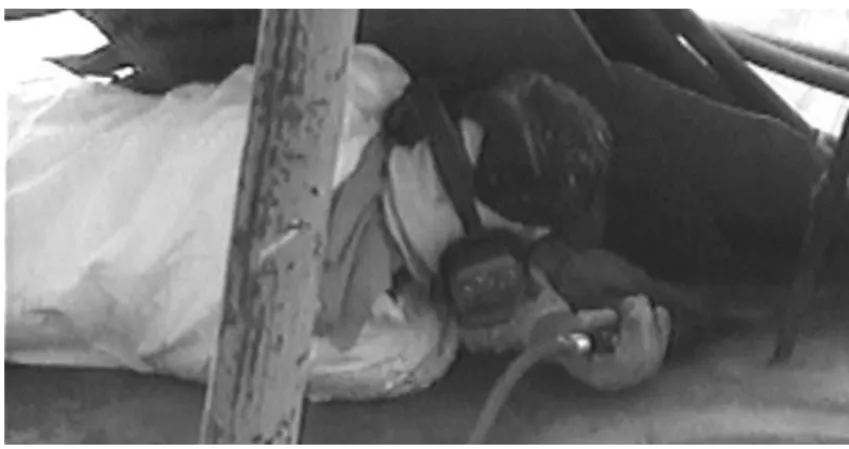
overhead from below the plate to weld or grind off the weld splatter. Examples of common work postures are shown in Figures 22 through 24.
Figure 22. Welder Stick Welding Overhead
Figure 24. Worker Setting Up to Weld Overhead
IIIC2. Ergonomic Risk Factors of Onboard Deck Fitting
The overhead work may place strain on the neck and shoulders of the worker. Welding also requires static and prolonged postures in occasionally awkward postures to complete the necessary weld. Exposure to welding fumes is another consideration.
IIIC3. Ergonomic Analysis of Onboard Deck Fitting
Using several of the exposure assessment tools outlined previously, an ergonomic analysis was performed for a worker performing common deck welding tasks. A RULA was conducted for the deck welder (Table 22). Analyses of five subtasks with unique postures resulted in a variety of ratings. The subtask of performing an overhead weld resulted in a rating of 7, on a scale of 1 to 7. The subtasks of changing the tool, inspecting the work, and deslagging with a needle gun each rated a 5, in the second highest of four categories. The remaining subtask, set-up, resulted in a rating of 4, in the second lowest of four categories.
A SI analysis was performed for the deck welder (Table 23) and resulted in the following: 1) The Intensity of Exertion was rated as “ Somewhat Hard” and given a multiplier score
of 3.0, on a scale of 1 to 13.
2) The Duration of Exertion in the task was rated to be greater than or equal to 80%, resulting in a multiplier of 3.0, on a scale of 0.5 to 3.0.
3) The Efforts per Minute were noted to be somewhat static, resulting in a multiplier of 1.5, on a scale of 0.5 to 3.0.
4) The Hand/Wrist Posture was rated as “Fair,” resulting in a multiplier of 1.5, on a scale of 1.0 to 3.0.
5) The Speed of Work was rated as “Fair,” resulting in a multiplier of 1.0, on a scale of 1.0 to 2.0.
6) The Duration of Task per Day was rated to be between 4 and 8 hours, resulting in a multiplier of 1.0, on a scale of 0.25 to 1.50.
The multiplier values for each segment are multiplied together resulting in a final SI score. For this task the SI score was 20.25. An SI score between 5 and 30 is correlated to an incidence rate of about 77 distal upper extremity injuries per 100 FTE. Therefore, the SI indicated that this task put the worker at an increased risk of developing a distal upper extremity injury.
In applying the University of Michigan Upper Extremity Cumulative Trauma Disorder Checklist to the deck welder (Table 24), of the 21 possible responses, 12 were negative and 9 were
positive. Negative responses are indicative of conditions associated with the risk of developing cumulative trauma disorders.
When the OWAS technique was applied to the deck welder (Table 25), three of the five subtasks rated a 2, on a scale from 1 to 4, the second lowest category. Changing the tool rated a 3 and welding overhead rated a 4, the highest category.
The PLIBEL checklist for duct worker (Table 26) reported moderate percentages of risk factors present for the upper extremities, lower extremities and upper back (45.4 % - 50.0 %) and a slightly lower percentage (33.3 %) of risk factors present for the lower back. A few
environmental and organizational modifying factors are present as well.
IIID. ONBOARD PIPE WELDING
IIID1. Onboard Pipe Welding Process
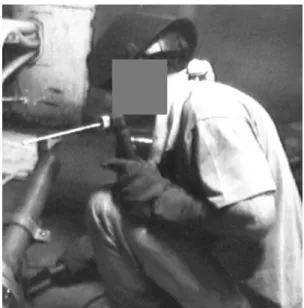
During scheduled maintenance activities, piping for the movement of liquids and steam, may have to be repaired or replaced. Often the piping is located against a bulkhead or the hull of the ship limiting access to the piping. Welders will often use stick welding equipment to complete the weld. Typical work postures are shown in Figures 25 - 27.
Figure 25. Worker Welding Pipe Onboard Vessel
Figure 27. Worker Using Hammer to Deslag Pipe Weld
IIID2. Ergonomic Risk Factors of Onboard Pipe Welding
Stick welding requires static and often awkward postures of the arms of the worker resulting in strain. The neck or back of the worker may be flexed to accommodate viewing the work task. The worker may have to kneel, squat or lay down in order to complete the task. Therefore, the lower extremities may be strained as well as the upper extremities. The possibility of working in confined spaces resulting in awkward postures is relatively high.
IIID3. Ergonomic Analysis of Onboard Pipe Welding
Using several of the exposure assessment tools outlined previously, an ergonomic analysis was performed for a worker performing common pipe welding tasks. A RULA was conducted for the pipe welder (Table 27). Analyses of four subtasks with unique postures resulted in a variety of ratings. The subtask of using stick welding equipment to weld while standing resulted in a rating of 7, on a scale of 1 to 7. The subtasks of changing the tool or deslagging while kneeling resulted in ratings of 3, in the second lowest of four categories. The remaining subtask,
deslagging while standing, resulted in a rating of 2, in the lowest of four categories.
A SI analysis was performed for the pipe welder (Table 28) and resulted in the following: 1) The Intensity of Exertion was rated as “ Somewhat Hard” and given a multiplier score
of 3.0, on a scale of 1 to 13.
2) The Duration of Exertion in the task was rated between 10 % - 29 %, resulting in a multiplier of 1.0, on a scale of 0.5 to 3.0.
3) The Efforts per Minute were noted to be somewhat static, resulting in a multiplier of 1.0, on a scale of 0.5 to 3.0.
4) The Hand/Wrist Posture was rated as “Bad,” resulting in a multiplier of 2.0, on a scale of 1.0 to 3.0.
5) The Speed of Work was rated as “Fair,” resulting in a multiplier of 1.0, on a scale of 1.0 to 2.0.
6) The Duration of Task per Day was rated to be between 4 and 8 hours, resulting in a multiplier of 1.0, on a scale of 0.25 to 1.50.
The multiplier values for each segment are multiplied together resulting in a final SI score. For this task the SI score was 6.0. An SI score between 5 and 30 is correlated to an incidence rate of about 77 distal upper extremity injuries per 100 FTE. Therefore, the SI indicated that this task put the worker at an increased risk of developing a distal upper extremity injury.
In applying the University of Michigan Upper Extremity Cumulative Trauma Disorder Checklist to the pipe welder (Table 29), of the 21 possible responses, 13 were negative and 8 were positive. Negative responses are indicative of conditions associated with the risk of developing cumulative trauma disorders.
When the OWAS technique was applied to pipe welder (Table 30), two of four subtasks rated a 2, on a scale from 1 to 4, the second lowest category. The other subtasks rated a 1, the lowest category.
The PLIBEL checklist for the pipe welder (Table 31) reported moderate percentages of risk factors present for the upper extremities and upper back (34.6 % - 45.4 %) and a slightly lower percentage (25 %) of risk factors present for the lower extremities. A few environmental and organizational modifying factors are present as well.
IV. CONTROL TECHNOLOGY
Possible interventions and control technologies are mentioned briefly here. A more detailed report of possible interventions is in preparation.
For the deck scraping work process, the most benefit would be derived from more complete removal of the deck surface by means other than by handheld power tools. Abrasive blasting or waterjet blasting may result in better deck surface removal than current methods. If areas still remain that must be removed by other means, tool handle extensions and wheeled stools would allow workers to sit upright rather than on the deck to perform the required work.
The use of portable work platforms, such as sawhorses, allows the duct installation and repair worker to place the duct to be worked on at a better work height, approximately waist level. Proper measurement and construction of the duct would minimize any subsequent alterations prior to installation, eliminating some power hand tool use.
Not all overhead work can be avoided for every situation. The use of proper ladders and elevated work platforms will raise the worker closer to the task, minimizing strains to the neck, shoulder and back.
Pipe welding of units that are in place onboard the ship is constrained by the access to the location that must be welded. The placement of critical junctions and connections should be considered by the naval architects in the initial design of the system for installation, maintenance, and operation issues prior to ship construction.
V. CONCLUSIONS AND RECOMMENDATIONS
Four work processes at Continental Maritime were surveyed to determine the presence of risk factors associated with musculoskeletal disorders. These processes included deck scraping, duct installation, deck fitting and welding, and pipe welding, all typical repair and maintenance tasks. In each process, certain work elements were found to be associated with one or more factors, including excessive force, constrained or awkward postures, contact stresses, vibration, and repetitive motions.
It is recommended that further action be taken to mitigate the exposure to musculoskeletal risk factors within each of the identified tasks. The implementation of ergonomic interventions has been found to reduce the amount and severity of musculoskeletal disorders within the working population in various industries. It is suggested that ergonomic interventions be implemented at Continental Maritime facilities to minimize hazards in the identified job tasks.
VI. REFERENCES
Kemmlert, K. A Method Assigned for the Identification of Ergonomic Hazards – PLIBEL.
Applied Ergonomics, 1995, 26(3):199-211.
Lifshitz, Y. and T. Armstrong. A Design Checklist for Control and Prediction of Cumulative Trauma Disorders in Hand Intensive Manual Jobs. Proceedings of the 30th Annual
Meeting of Human Factors Society,1986, 837-841.
Louhevaara, V. and T. Suurnäkki. OWAS: A Method for the Evaluation of Postural Load during Work. Training Publication No. 11, Institute of Occupational Health, Helsinki, Finland, 1992.
McAtamney, L. and E. N. Corlett. RULA: A Survey Method for the Investigation of Work-Related Upper Limb Disorders, Applied Ergonomics, 1993, 24(2):91-99.
Moore, J. S. and A. Garg. The Strain Index: A Proposed Method to Analyze Jobs for Risk of Distal Upper Extremity Disorders, American Industrial Hygiene Association Journal, 1995, 56:443-458.
University of Michigan Software, 3D Static Strength Prediction Program Version 4.0, 3003 State St., #2071, Ann Arbor, MI 48109-1280, Copyright 1997 The Regents of The University of Michigan.
APPENDIX
A1. DECK SCRAPING WORKER 1
Table 1. Deck Scraping1 RULA
Rapid Upper Limb Assessment (RULA) (Matamney and Corlett, 1993)
Date/ Time Facility Area/Shop Task
6/08/00 Continental Maritime Shipboard Deck Scraping1
RULA: Posture Sampling Results
RULA Component Frame # 660 Needlegun Frame # 6570 Change Tool Frame # 24490 Deck Crawler Frame # 37800 Apply Air Tool Oil Frame # 38280 Pneumatic Scraper Specific RULA Score Specific RULA Score Specific RULA Score Specific RULA Score Specific RULA Score
Shoulder Extension/ Flexion neut 1 sl flex 2 sl flex 2 sl flex 2 sl flex 2
Shoulder is Raised (+1) 1 0 1 1 0
Upper Arm Abducted (+1) 1 0 1 1 0
Arm supported, leaning (-1) 0 0 0 0 -1
Elbow Extension/ Flexion flex 2 ext 1 ext 1 flex 2 flex 2
Shoulder Abduction/ Adduction neut 0 neut 0 neut 0 neut 0 neut 0
Shoulder Lateral/ Medial 0 0 0 0 0
Wrist Extension/ Flexion ext 2 neut 1 neut 1 neut 1 neut 1
Wrist Deviation ulnar 1 neut 0 neut 0 neut 0 radial 1
Wrist Twist (1) In mid range
Or (2) End of range 1 1 1 2 1
Arm, Wrist Muscle Use Score If posture mainly static (I.e. held for longer than 10 minutes) or; If action repeatedly occurs 4 times per minute or more: (+ 1)
1 0 1 0 1
Arm and Wrist Force/Load Score: If load less than 2 kg (intermittent): (+0)
If 2-10 kg (intermittent):(+1) If 2kg to 10 kg (static or repeated): (+2)
If more than 10 kg load or repeated or shocks: (+3)
Table 1. Deck Scraping1 RULA (continued)
RULA Component Frame # 660 Needlegun Frame # 6570 Change Tool Frame # 24490 Deck Crawler Frame # 37800 Apply Air Tool Oil Frame # 38280 Pneumatic Scraper Specific RULA Score Specific RULA Score Specific RULA Score Specific RULA Score Specific RULA Score
Neck Extension/ Flexion sl flex 2 flex 3 flex 3 flex 3 flex 3
Neck Twist (+1) 0 1 1 1 1
Neck Side Bend (+1) 0 0 0 1 0
Trunk Extension/ Flexion hyp flx 4 flex 3 hyp flx 4 hyp flx 4 hyp flex 4
Trunk Twist (+1) 0 1 0 0 1
Trunk Side Bend (+1) 1 0 0 1 0
Legs
If legs and feet are supported and balanced: ( +1);
If not: (+2)
1 1 1 1 1
Neck, Trunk, and Leg Muscle Use Score
If posture mainly static (I.e. held for longer than 10 minutes) or; If action repeatedly occurs 4 times per minute or more: (+ 1)
1 1 1 0 1
Neck, Trunk, and Leg Force/ Load Score
If load less than 2 kg (intermittent): (+0)
If 2kg to 10 kg (intermittent): (+1)
If 2kg to 10 kg (static or repeated): (+2)
If more than 10 kg load or repeated or shocks: (+3)
1 1 1 0 1
Total RULA Score 7 5 7 6 7
1 or 2 = Acceptable 3 or 4 = Investigate Further
5 or 6 = Investigate Further and Change Soon 7 = Investigate and Change Immediately
Table 2. Deck Scraping1 Strain Index
Strain Index: Distal Upper Extremity Disorders Risk Assessment (Moore and Garg, 1995)
Date/ Time Facility Area/Shop Task
6/08/00 Continental Maritime Shipboard Deck Scraping1
1. Intensity of Exertion: An estimate of the strength required to perform the task one time. Mark the rating after using the guidelines below; then fill in the corresponding multiplier in the bottom far right box. Rating Criterion % MS (percentage of maximal strength) Borg Scale (Compare to Borg Cr-10 Scale)
Perceived Effort Rating Multiplier
Light < 10% < or = 2 barely noticeable or relaxed
effort
1 1.0
Somewhat Hard
10% - 29% 3 noticeable or definite effort 2 3.0
Hard 30% - 49% 4 - 5 obvious effort; unchanged
facial expression
3 6.0
Very Hard 50% - 79% 6 - 7 substantial effort; changes
to facial expression
4 9.0
Near Maximal
> or = 80% > 7 uses shoulder or trunk to generate force
5 13.0
Table 2. Deck Scraping1 Strain Index (continued)
2. Duration of Exertion (% of cycle): Calculated by measuring the duration of all exertions during an observation period, and then dividing the measured duration of exertion by the total observation time and multiplying by 100. Use the worksheet below and mark the appropriate rating according to the rating criterion, then fill in the corresponding multiplier in the bottom far right box.*NOTE: If duration of exertion is 100% (as with some static tasks), then efforts/ minute multiplier should be set to 3.0
Worksheet:
% Duration of Exertion
= 100 x duration of all exertions (sec) Total observation time (sec)
= 100 x 2078 (sec)/ 2255(sec) = 92
Rating Criterion Rating Multiplier
< 10% 1 0.5
10% - 29% 2 1.0
30% - 49% 3 1.5
50% -79% 4 2.0
> or = 80% 5 3.0
Duration of Exertion Multiplier 3.0
3. Efforts per Minute: Measured by counting the number of exertions that occur during an observation period, and then dividing the number of exertions by the duration of the observation period, measured in minutes. Use the worksheet below and mark the appropriate rating according to the rating criterion, and then fill in the corresponding multiplier in the bottom far right box. *NOTE: If duration of exertion is 100% (as with some static tasks), then efforts/ minute multiplier should be set to 3.0
Worksheet:
Efforts per Minute
= number of exertions total observation time (min)
= 25/37 = .67, but somewhat static tasks, set multiplier to 1.5
Rating Criterion Rating Multiplier
< 4 1 0.5
4 - 8 2 1.0
9 -14 3 1.5
15 -19 4 2.0
> or = 20 5 3.0
Table 2. Deck Scraping1 Strain Index (continued)
4.Hand/ Wrist Posture: An estimate of the position of the hand or wrist relative to neutral position. Mark the rating after using the guidelines below, and then fill in the corresponding multiplier in the bottom far right box.
Rating Criterion Wrist Extension Wrist Flexion Ulnar Deviation
Perceived Posture Rating Multiplier
Very Good 0 -10 degrees 0 - 5 degrees 0 - 10 degrees perfectly neutral 1 1.0 Good 11 - 25 degrees 6 - 15 degrees 11 -15 degrees near neutral 2 1.0 Fair 26 -40 degrees 16 - 30 degrees 16 - 20 degrees non-neutral (*estimated, based on RULAs performed) 3 1.5 Bad 41 - 55 degrees 31 - 50 degrees 21 -25 degrees marked deviation 4 2.0 Very Bad > 60 degrees > 50 degrees > 25 degrees near extreme 5 3.0
Hand/ Wrist PostureMultiplier 1.5
5. Speed of Work: An estimate of how fast the worker is working. Mark the rating on the far right after using the guidelines below; then fill in the corresponding multiplier in the bottom far right box.
Rating Criterion
Compared to MTM
(observed pace is divided by MTM’s predicted pace and expressed as %)
Perceived Speed Rating Multiplier
Very Slow < or = 80% extremely relaxed pace 1 1.0
Slow 81% - 90% “taking one’s own time” 2 1.0
Fair 91% -100% “normal” speed of motion 3 1.0
Fast 101%-115% rushed, but able to keep up 4 1.5
Very Fast > 115% rushed, barely or unable to keep up 5 2.0
Table 2. Deck Scraping1 Strain Index (continued)
6. Duration of Task per Day: Either measured or obtained from plant personnel. Mark the rating on the right after using the guidelines below; then fill in the corresponding multiplier in the bottom far right box.
Worksheet:
Duration of Task per Day (hrs)
= duration of task (hrs) + duration of task (hrs) + ....
= (estimate ~ 4-8 hrs)
Rating Criterion Rating Multiplier
< or = 1 hrs 1 0.25
1 - 2 hrs 2 0.50
2 - 4 hrs 3 0.75
4 - 8 hrs 4 1.00
> or = 8 hrs 5 1.50
Duration of Task per Day Multiplier 1.00
7. Calculate the Strain Index (SI) Score: Insert the multiplier values for each of the six task variables into the spaces below, then multiply them all together.
Intensity of Exertion 6.0 X Duration of Exertion 3.0 X Efforts per Minute 1.5 X Hand/ Wrist Posture 1.5 X Speed of Work 1.0 X Duration of Task 1.00 = SI SCORE 40.5
SI Scores are used to predict Incidence Rates of Distal Upper Extremity injuries per 100 FTE: - SI Score < 5 is correlated to an Incidence Rate of about 2 DUE injuries per 100 FTE;
- SI Score of between 5-30 is correlated to an Incidence Rate of about 77 DUE injuries per 100 FTE;
- SI Score of between 31-60 is correlated to an Incidence Rate of about 106 DUE injuries per 100 FTE;
Table 3. Deck Scraping1 UE CTD Checklist
Michigan Checklist for Upper Extremity Cumulative Trauma Disorders (Lifshitz and Armstrong, 1986)
Date/ Time Facility Area/Shop Task
6/08/00 Continental Maritime Shipboard Deck Scraping1
Risk Factors No Yes
1. Physical Stress
1.1 Can the job be done without hand/ wrist contact with sharp edges Y 1.2 Is the tool operating without vibration? N
1.3 Are the worker’s hands exposed to temperature >21degrees C (70 degrees F)? Y 1.4 Can the job be done without using gloves? N
2. Force
2.1 Does the job require exerting less than 4.5 kg (10lb) of force? Y 2.2 Can the job be done without using finger pinch grip? Y 3. Posture
3.1 Can the job be done without flexion or extension of the wrist? N 3.2 Can the tool be used without flexion or extension of the wrist? N 3.3 Can the job be done without deviating the wrist from side to side? N 3.4 Can the tool be used without deviating the wrist from side to side? N
3.5 Can the worker be seated while performing the job? Y 3.6 Can the job be done without “clothes wringing” motion? Y 4. Workstation Hardware
4.1 Can the orientation of the work surface be adjusted? N 4.2 Can the height of the work surface be adjusted? N
4.3 Can the location of the tool be adjusted? Y
5. Repetitiveness
5.1 Is the cycle time longer than 30 seconds? Y
6. Tool Design
6.1 Are the thumb and finger slightly overlapped in a closed grip? Y 6.2 Is the span of the tool’s handle between 5 and 7 cm (2-2 3/4 inches)? Y 6.3 Is the handle of the tool made from material other than metal? N
6.4 Is the weight of the tool below 4 kg (9lb)? Y
6.5 Is the tool suspended? N
TOTAL 10 (48%) 11 (52%)
Table 4. Deck Scraping1 OWAS
OWAS: OVAKO Work Analysis System Louhevaara and Suurnäkki (1992)
Date/ Time Facility Area/Shop Task
6/08/00 Continental Maritime Shipboard Deck Scraping1
Risk Factor Work
Phase1 Needlegun Work Phase 2 Change Tool Work Phase 3 Deck Crawler Work Phase 4 Apply Air Tool Oil Work Phase 5 Pneumatic Scraper TOTAL Combination Posture Score 3 2 2 2 4
Common Posture Combinations (collapsed across work phases)
Back 4 4 2 4
Arms 2 1 1 1
Legs 1 1 6 6
Posture Repetition (% of working time) 43 4 14.6 31
Back % of Working Time Score 3 1 1 3
Arms % of Working Time Score 2 1 1 1
Legs % of Working Time Score 1 1 1 2
ACTION CATEGORIES: 1 = no corrective measures
2 = corrective measures in the near future 3 = corrective measures as soon as possible 4 = corrective measures immediately
Table 4. Deck Scraping1 OWAS (continued)
Risk Factor Work
Phase1 Needlegun Work Phase 2 Change Tool Work Phase 3 Deck Crawler Work Phase 4 Apply Air Tool Oil Work Phase 5 Pneumatic Scraper Posture Back 1 = straight
2 = bent forward, backward 3 = twisted or bent sideways
4 = bent and twisted or bent forward and sideways
4 4 2 2 4
Arms
1 = both arms are below shoulder level 2 = one arm is at or above shoulder level 3 = both arms are at or above shoulder level
2 1 1 1 1
Legs 1 = sitting
2 = standing with both legs straight
3 = standing with the weight on one straight leg 4 = standing or squatting with both knees bent 5 = standing or squatting with one knee bent 6 = kneeling on one or both knees
7 = walking or moving
1 1 6 6 6
Load/ Use of Force
1 = weight or force needed is = or <10 kg (<22lb) 1 1 1 1 2
2 = weight or force > 10 but < 20kg (>22lb < 44 lb) 3 = weight or force > 20 kg
(>44 lb) Phase Repetition % of working time
Table 5. Deck Scraping1 PLIBEL
PLIBEL Checklist (Kemmlert, 1995)
Date/ Time Facility Area/Shop Task
6/08/00 Continental Maritime Shipboard Deck Scraping1 Section I: Musculoskeletal Risk Factors
Methods of Application:
1) Find the injured body region, answer yes or no to corresponding questions 2) Answer questions, score potential body regions for injury risk
Musculoskeletal Risk Factor Questions Body Regions
Neck, Shoulder, Upper Back Elbows, Forearms, Hands
Feet Knees and
Hips
Low Back
1: Is the walking surface uneven, sloping, slippery or nonresilient?
N N N
2: Is the space too limited for work movements or work materials?
N N N N N
3: Are tools and equipment unsuitably designed for the worker or the task?
Y Y Y Y Y
4: Is the working height incorrectly adjusted? Y Y 5: Is the working chair poorly designed or incorrectly adjusted? n/a n/a 6: If work performed standing, no possibility to sit and rest? N N N 7: Is fatiguing foot pedal work performed? N N
8: Is fatiguing leg work performed? e.g. ...
a) repeated stepping up on stool, step etc. N N N b) repeated jumps, prolonged squatting or kneeling? Y Y Y c) one leg being used more often in supporting the body? N N N 9: Is repeated or sustained work performed when back is:
a) mildly flexed forward? Y Y
b) severely flexed forward? Y Y
c) bent sideways or mildly twisted? Y Y
Table 5. Deck Scraping1 PLIBEL (continued)
10: Is repeated/sustained work performed with neck:
a) flexed forward? Y
b) bent sideways or mildly twisted? Y
c) severely twisted? N
d) extended backwards? N
11: Are loads lifted manually? Note important factors:
a) periods of repetitive lifting N N
b) weight of load N N
c) awkward grasping of load N N
d) awkward location of load at onset or end of lifting N N
e) handling beyond forearm length N N
f) handling below knee length N N
g) handling above shoulder height N N
12: Is repeated, sustained or uncomfortable carrying, pushing or pulling of loads performed?
Y Y Y
13: Is sustained work performed when one arm reaches forward or to the side without support?
N 14: Is there a repetition of:
a) similar work movements? Y Y
b) similar work movements beyond comfortable reaching distance? N N 15: Is repeated or sustained manual work performed?
a) weight of working materials or tools Y Y b) awkward grasping of working materials or tools Y Y 16: Are there high demands on visual capacity? Y
17: Is repeated work, with forearm and hand, performed with:
a) twisting movements? Y
b) forceful movements? Y
c) uncomfortable hand positions? Y
Table 5. Deck Scraping1 PLIBEL (continued)
Musculoskeletal Risk Factors Scores
Neck, Shoulder, Upper Back Elbows, Forearms Hands
Feet Knees and
Hips
Low Back
SUM 12 8 2 2 7
PERCENTAGE 46.1 72.7 25 25 33.3
Section II: Environmental / Organizational Risk Factors(Modifying)
Answer below questions, use to modify interpretation of musculoskeletal scores
18: Is there no possibility to take breaks and pauses? N
19: Is there no possibility to choose order and type of work tasks or pace of work?
N
20: Is the job performed under time demands or psychological stress?
N
21:Can the work have unusual or expected situations? N
22: Are the following present?
a) cold Y
b) heat Y
c) draft Y
d) noise Y
e) troublesome visual conditions N
f) jerks, shakes, or vibration Y
Environmental / Organizational Risk Factors Score
SUM 5
A2. DECK SCRAPING WORKER 2
Table 6. Deck Scraping 2 RULA Rapid Upper Limb Assessment (RULA)
(Matamney and Corlett, 1993)
Date/ Time Facility Area/Shop Task
6/08/00 Continental Maritime Shipboard Deck Scraping2 RULA: Posture Sampling Results
RULA Component Frame # 62310 Deck Crawler Frame # 68550 Inspect Frame # 68700 Change Tool Frame # 104130 Needlegun
Specific RULA Score Specific RULA Score Specific RULA Score Specific RULA Score
Shoulder Extension/ Flexion flex 3 flex 3 flex 3 mod flex 2
Shoulder is Raised (+1) 0 0 0 0
Upper Arm Abducted (+1) 0 0 0 0
Arm supported, leaning (-1) 0 -1 -1 0
Elbow Extension/ Flexion ext 1 ext 1 ext 1 ext 1
Shoulder Abduction/ Adduction neut 0 neut 0 neut 0 neut 0
Shoulder Lateral/ Medial 0 0 0 0
Wrist Extension/ Flexion neut 1 ext 2 neut 1 neut 1
Wrist Deviation ulnar 1 neut 0 neut 0 ulnar 1
Wrist Twist (1) In mid range
Or (2) End of range 1 1 1 1
Arm and Wrist Muscle Use Score
If posture mainly static (I.e. held for longer than 10 minutes) or; If action repeatedly occurs 4 times per minute or more: (+ 1)
1 0 0 1
Arm and Wrist Force/Load Score
If load less than 2 kg (intermittent): (+0) If 2kg to 10 kg (intermittent): (+1)
If 2kg to 10 kg (static or repeated): (+2)
If more than 10 kg load or repeated or shocks: (+3)
Table 6. Deck Scraping2 RULA (continued)
RULA Component Frame # 61679 Deck Crawler Frame # 68550 Inspect Frame # 68700 Change Tool Frame # 104130 Needlegun
Specific RULA Score Specific RULA Score Specific RULA Score Specific RULA Score
Neck Extension/ Flexion flex 3 sl flx 2 flex 3 flex 3
Neck Twist (+1) 0 0 0 0
Neck Side Bend (+1) 0 0 0 1
Trunk Extension/ Flexion hyp flex 4 hyp flex 4 hyp flx 4 hyp flx 4
Trunk Twist (+1) 0 0 0 1
Trunk Side Bend (+1) 0 0 0 0
Legs
If legs and feet are supported and balanced: ( +1); If not: (+2)
1 1 1 1
Neck, Trunk, and Leg Muscle Use Score
If posture mainly static (I.e. held for longer than 10 minutes) or; If action repeatedly occurs 4 times per minute or more: (+ 1)
1 0 1 1
Neck, Trunk, and Leg Force/ Load Score
If load less than 2 kg (intermittent): (+0)
If 2kg to 10 kg (intermittent): (+1)
If 2kg to 10 kg (static or repeated): (+2)
If more than 10 kg load or repeated or shocks: (+3)
1 0 2 2
Total RULA Score 7 3 6 7
1 or 2 = Acceptable 3 or 4 = Investigate Further
5 or 6 = Investigate Further and Change Soon 7 = Investigate and Change Immediately
Table 7. Deck Scraping 2 Strain Index
Strain Index: Distal Upper Extremity Disorders Risk Assessment (Moore and Garg, 1995)
Date/ Time Facility Area/Shop Task
6/08/00 Continental Maritime Shipboard Deck Scraping2
1. Intensity of Exertion: An estimate of the strength required to perform the task one time. Mark the rating after using the guidelines below; then fill in the corresponding multiplier in the bottom far right box. Rating Criterion % MS (percentage of maximal strength) Borg Scale (Compare to Borg Cr-10 Scale)
Perceived Effort Rating Multiplier
Light < 10% < or = 2 barely noticeable or relaxed effort 1 1.0
Somewhat Hard
10% - 29% 3 noticeable or definite effort 2 3.0
Hard 30% - 49% 4 - 5 obvious effort; unchanged facial expression
3 6.0
Very Hard 50% - 79% 6 - 7 substantial effort; changes to facial
expression 4 9.0
Near Maximal
> or = 80% > 7 uses shoulder or trunk to generate force
5 13.0
Table 7. Deck Scraping 2 Strain Index (continued)
2. Duration of Exertion (% of cycle): Calculated by measuring the duration of all exertions during an observation period; then dividing the measured duration of exertion by the total observation time and multiplying by 100. Use the worksheet below and mark the appropriate rating according to the rating criterion; then fill in the corresponding multiplier in the bottom far right box.*NOTE: If duration of exertion is 100% (as with some static tasks), then efforts/ minute multiplier should be set to 3.0
Worksheet:
% Duration of Exertion
= 100 x duration of all exertions (sec) Total observation time (sec)
= 100 x 661 (sec)/ 683 (sec) = 96.7%
Rating Criterion Rating Multiplier
< 10% 1 0.5
10% - 29% 2 1.0
30% - 49% 3 1.5
50% -79% 4 2.0
> or = 80% 5 3.0
Duration of Exertion Multiplier 3.0
3. Efforts per Minute: Measured by counting the number of exertions that occur during an
observation period; then dividing the number of exertions by the duration of the observation period, measured in minutes. Use the worksheet below and mark the appropriate rating according to the rating criterion, then fill in the corresponding multiplier in the bottom far right box. *NOTE: If duration of exertion is 100% (as with some static tasks), then efforts/ minute multiplier should be set to 3.0
Worksheet:
Efforts per Minute
= number of exertions total observation time (min)
= 7/683 = .01, but somewhat static tasks, set multiplier to 1.0
Rating Criterion Rating Multiplier
< 4 1 0.5
4 - 8 2 1.0
9 -14 3 1.5
15 -19 4 2.0
> or = 20 5 3.0
Table 7. Deck Scraping 2 Strain Index (continued)
4.Hand/ Wrist Posture: An estimate of the position of the hand or wrist relative to neutral position. Mark the rating after using the guidelines below; then fill in the corresponding multiplier in the bottom far right box.
Rating Criterion Wrist Extension Wrist Flexion Ulnar Deviation
Perceived Posture Rating Multiplier
Very Good 0 -10 degrees 0 - 5 degrees 0 - 10 degrees perfectly neutral 1 1.0 Good 11 - 25 degrees 6 - 15 degrees 11 -15 degrees near neutral 2 1.0 Fair 26 -40 degrees 16 - 30 degrees 16 - 20 degrees non-neutral (*estimated, based on RULAs performed) 3 1.5 Bad 41 - 55 degrees 31 - 50 degrees 21 -25 degrees marked deviation 4 2.0 Very Bad > 60 degrees > 50 degrees > 25 degrees near extreme 5 3.0
Hand/ Wrist PostureMultiplier 1.5
5. Speed of Work: An estimate of how fast the worker is working. Mark the rating on the far right after using the guidelines below; then fill in the corresponding multiplier in the bottom far right box.
Rating Criterion
Compared to MTM
(observed pace is divided by MTM’s predicted pace and expressed as %)
Perceived Speed Rating Multiplier
Very Slow < or = 80% extremely relaxed pace 1 1.0
Slow 81% - 90% “taking one’s own time” 2 1.0
Fair 91% -100% “normal” speed of motion 3 1.0
Fast 101%-115% rushed, but able to keep up 4 1.5
Very Fast > 115% rushed, barely or unable to keep up 5 2.0
Table 7. Deck Scraping 2 Strain Index (continued)
6. Duration of Task per Day: Either measured or obtained from plant personnel. Mark the rating on the right after using the guidelines below; then fill in the corresponding multiplier in the bottom far right box.
Worksheet:
Duration of Task per Day (hrs)
= duration of task (hrs) + duration of task (hrs) + ....
= (estimate ~ 4-8 hrs)
Rating Criterion Rating Multiplier
< or = 1 hrs 1 0.25
1 - 2 hrs 2 0.50
2 - 4 hrs 3 0.75
4 - 8 hrs 4 1.00
> or = 8 hrs 5 1.50
Duration of Task per Day Multiplier 1.00
7. Calculate the Strain Index (SI) Score: Insert the multiplier values for each of the six task variables into the spaces below, then multiply them all together.
Intensity of Exertion 3.0 X Duration of Exertion 3.0 X Efforts per Minute 1.0 X Hand/ Wrist Posture 1.5 X Speed of Work 1.0 X Duration of Task 1.00 = SI SCORE 13.5
SI Scores are used to predict Incidence Rates of Distal Upper Extremity injuries per 100 FTE: - SI Score < 5 is correlated to an Incidence Rate of about 2 DUE injuries per 100 FTE;
- SI Score of between 5-30 is correlated to an Incidence Rate of about 77 DUE injuries per 100 FTE; - SI Score of between 31-60 is correlated to an Incidence Rate of about 106 DUE injuries per
100 FTE;
Table 8. Deck Scraping 2 UE CTD Checklist
Michigan Checklist for Upper Extremity Cumulative Trauma Disorders (Lifshitz and Armstrong, 1986)
Date/ Time Facility Area/Shop Task
6/08/00 Continental Maritime Shipboard Deck Scraping2
Risk Factors No Yes
1. Physical Stress
1.1 Can the job be done without hand/ wrist contact with sharp edges Y 1.2 Is the tool operating without vibration? N
1.3 Are the worker’s hands exposed to temperature >21degrees C (70 degrees F)? Y 1.4 Can the job be done without using gloves? N
2. Force
2.1 Does the job require exerting less than 4.5 kg (10lb) of force? N
2.2 Can the job be done without using finger pinch grip? Y 3. Posture
3.1 Can the job be done without flexion or extension of the wrist? N 3.2 Can the tool be used without flexion or extension of the wrist? N 3.3 Can the job be done without deviating the wrist from side to side? N 3.4 Can the tool be used without deviating the wrist from side to side? N 3.5 Can the worker be seated while performing the job? N
3.6 Can the job be done without “clothes wringing” motion? Y 4. Workstation Hardware
4.1 Can the orientation of the work surface be adjusted? N 4.2 Can the height of the work surface be adjusted? N 4.3 Can the location of the tool be adjusted? N 5. Repetitiveness
5.1 Is the cycle time longer than 30 seconds? Y
6. Tool Design
6.1 Are the thumb and finger slightly overlapped in a closed grip? Y 6.2 Is the span of the tool’s handle between 5 and 7 cm (2-2 3/4 inches)? Y (welding) 6.3 Is the handle of the tool made from material other than metal? N
6.4 Is the weight of the tool below 4 kg (9lb)? Y
6.5 Is the tool suspended? N
TOTAL 13 (62%) 8 (38%)