NBER WORKING PAPER SERIES
MONEY IN THE UTILITY FUNCTION: AN EMPIRICAL IMPLEMENTATION
James M. Poterba
Julio J. Rotemberg
Working Paper No. 1796
NATIONAL BUREAU OF ECONOMIC RESEARCH 1050 Massachusetts Avenue
Cambridge, MA 02138 January 1986
This paper was prepared for the 1985 Austin Symposium in Economics. We thank Sunny Kim for research assistance and William Barnett, Olivier Blanchard, Stan Fischer, Lars Hansen, a referee, the par-ticipants at an NBER Financial Markets Conference, and especially Lawrence Summers for comments on an earlier draft. This research was supported by the National Science Foundation. The research reported here is part of the NBER's research programs in Economic Fluctuations, Financial Markets and Monetary Economics and
Taxation. Any opinions expressed are those of the author and not those of the National Bureau of Economic Research.
NBER Working Paper #1796
January 1986
'bney in the Utility Function: IAn Errpirical Inpierrentation
ABSTRTCT
This paper studies household asset demands by allowing certain assets to contribute directly to utility. It estimates the parameters of an aggregate utility function which includes both consumption and liquidity services. These liquidity services depend on the level of various asset stocks. We apply these estimates to investigate the long- and short—run interest
elasticities of demand for money, time deposits, and Treasury bills. We also examine the impact of open market operations on interest rates, and present new estimates of the welfare cost of inflation.
James M. Poterba Department of Economics M.I.T. Cambridge, MA 02139 (617) 253—6673 Julio J. Rotemberg
Sloan School of Management M.I.T.
Cambridge, MA 02139 (617) 253—2956
This paper studies households' demand for different assets by allowing certain assets to contribute directly to household utility.1 We permit the utility function to capture the "liquidity" services of money, certain time deposits and even some government securities. Our approach yields estimates of the utility function parameters which can be used to study the effects of a variety of changes in asset returns. We investigate how asset holdings and consumption react to both temporary and permanent changes in returns, and study the effects of government financial policy.
Our approach provides an integrated system of asset demands of the form which Tobin and Brainard (1968) advocate for studying the effects of government interventions in financial markets. It provides a tractable alternative to the atheoretical equations which are commonly used to study the demand for money and other assets. Those equations, which cannot be interpreted as the rational response of any economic agent to changes in the economic environment, are
unlikely to remain stable when the supply of various non—monetary assets changes. Our approach to studying asset demands is somewhat controversial. Its
opponents argue that assets do not yield utility directly. They explain that rate of return dominated assets such as money are held because they reduce transactions costs, which should be modelled explicitly. Unfortunately, explicit models with transactions costs are too restrictive to be useful in analyzing aggregate data. Baumol (1952) and Tobin (1956) assume that the
individual receives a constant income stream and faces a constant interest rate. By assuming that the individual consumes at a constant rate, they derive the optimal timing of financial transactions. If individuals are uniformly distri-buted over the time of their last visit to their financial intermediary, then aggregate money holdings are a function of the representative individual's
aver-—2—
age holdings, which are given by the famous square-root formula.
This approach suffers from a number of drawbacks. Even assuming that consumption is constant, the optimal timing of individual transactions is extremely hard to compute when interest rates and income vary stochastically.
Such a computation is well beyond the modern transactions-based models of Jovanovic (1982), Grossman and Weiss (1983), Romer (1984), and Rotemberg
(1984).2 Moreover, the assumption of constant consumption cannot be justified if the individual is maximizing utility from consumption unless the real rate of return on money is equal to the discount rate. Thus, while Goldfeld (1973) appeals to transactions-based models to justify his money demand regressions, these models provide an unacceptable basis for empirical work.
On the other hand, the objections to estimating the utility flow of liquidity services seem to apply equally well to the estimation of the demand for many durable goods. Like many durables, money is not utilized constantly, but in bursts. Just like some durables, even money which is not used provides some utility in the form of security. Whether or not money's services provide utility in the same fashion as other goods is a moot point. Various consumer goods provide different "types" of utility, and to single out money services as
a particular variety which is unworthy of inclusion in a consumer's utility function seems arbitrary at best.
A number of researchers including Barnett (1980,1983), Chetty (1969), Ewis and Fisher (1984), and Rusted and Rush (1984) have attempted to estimate a utility function for assets. Feige and Pierce (1977) survey this literature. These attempts have encountered a number of difficulties. First, Chetty (1969) and some of his followers fail to recognize that when a consumer chooses to hold an asset with a relatively low rate of return, he will have to reduce his
—3-consumption at some point. To evaluate this loss in —3-consumption, it is necessary to specify and measure the consumer's marginal utility of
consumption. A second problem, which affects all previous work, arises from the inherent uncertainty of the opportunity cost of money. The alternative to
holding money or other assets which yield liquidity services is to hold assets with uncertain returns. Therefore, the opportunity cost of these assets is a random variable at the time when the consumer allocates his portfolio. This makes it
inappropriate to model the consumer's portfolio allocation problem as one of choosing expenditures (opportunity cost times quantity held) on different assets.3 To avoid these problems we follow
Hansen and Singleton (1982) and estimate the parameters of a representative individual's
utility function from the first-order conditions of this individual's maximization
problem.
The paper is organized into five sections. The first outlines the
representative consumer model and explains the factors motivating our choice of a parametric utility function. Section II describes our data and estimation procedure. Estimation results are presented in the third section, and the estimated parameters are used for comparative statics calculations in Section
IV. A brief conclusion evaluates our findings on the usefulness of the assets-in-the—utility-function model, and suggests several directions for future work.
I. The Theoretical Background
We maintain the convenient fiction that movements in per capita consump-tion, as well as real asset holdings, can be attributed to the
optimizing behavior of a rational representative consumer. He is infinite-lived, has constant preferences, and derives utility by consuming and by holding assets. In principle, it would be possible to allow a wide variety of different assets
—4-to yield utility. We focus only on those which constitute a substantial
fraction of household wealth and have easily measured market values and rates of return. This limits us to four asset classes: money, time deposits, short—term marketable government debt, and corporate equity. Long-term debt holdings are excluded because of difficulties in measuring their market value.
We begin with a specification of preferences which is additively separable across time, and then examine a case in which costs of adjusting asset stocks violate this restriction. In the additively separable case, the consumer's expected discounted utility at time t may be written
T-t
MT ST 6T
V= Et E p U(C,—, P'
(1)Tt
T T TThe expectations operator Et is conditional on information available at t; p is a discount factor, assumed constant through time. The four arguments of the period-by-period utility function are real consumption, CT, real money holdings, MT/PT, real savings and time deposits, ST/PT, and real holdings of short-term government debt, 6T'T Equity holdings, represented as
provide the numeraire asset in defining preferences.4 They are not a direct source of utility. The utility function U(.) is concave and increasing in consumption and all three asset stocks.
The evolution of equity holdings is given by =
QT_1(i-rET_1)
+GT_i(l+rGT_1)
+ ST l(l÷rST i +MT1
-PTCT 6T - ST - MT
+ TT
T =t,
t+i, ...(2)
where P1 is the price of consumption at T, V1 is real income, rET is the nominal return on equity between and T and T+i, and rGT and rST are the nominal returns on government debt and time deposits, respectively. Solving (2) for C, substi-tuting the result into (1), and differentiating with respect to Q
S.
and Mt yields necessary first order conditions which upon rearrangement are:—5-P (1+r au t
Et au
(EC): Et {• — P I= 0
(3) t t+1 t+1 r8UPrE au
(M):Et L —
P =(4)
t t+1 t+1 rt
t t U ,(5):
Et ig—
P ac = 0 (5) t t+1 t+1 (G): Et -p p ac = 0 (6) t t+1 t+1The Euler equation for consumption (EC) states that along an optimal path the representative individual cannot raise his expected utility by foregoing one Unit of consumption in period t, investing its value in equities, and
consuming the proceeds in period t+1. The utility cost of giving up a unit of consumption in period t is au/act. The expected utility gain from reducing
C
au Pt(l+rE)is
given
by Et[pac ].
Equating
the cost and gain from thist+1 t+1
perturbation yields the first—order condition (EC). If several assets that yield no utility are traded by the representative consumer, (EC) should also hold with rE replaced by the return on any of these assets.
Euler equation (M) specifies that utility cannot be increased by holding one dollar less of money at time t, investing it in equities, and consuming the proceeds at time t+1. The foregone utility associated with a one dollar reduction in money holding is •
—). Switching
one dollar from money to equities at t increases real wealth at ti-i by rEl since money yields no nominal return while equity does. The expected gain in utility if theseau
rE
higher proceeds are consumed in period ti-i.
is
E[p.8
• }.Equating
ti-i
t+i
this to the foregone utility yields (M). Similarly, Euler equations (S) and (0) equate the costs and benefits of transferring one dollar from Treasury bills
or savings deposits into equities for one period at time t.
Given a specification of preferences, the budget constraint (i.e., the condition that net worth does not become infinitely negative), and the
conditional distributions of all future prices and rates of return, we could find the representative consumer's consumption and asset holdings at time t. However, solving the consumer's problem analytically is almost impossible in all but a few restrictive cases. We therefore follow previous authors in estimating
the parameters of U from equations (3) through (6).
If expectational errors are the only source of error in our equations, then our system of first order conditions can, by suitable linear combination, be transformed into two stochastic and two nonstochastic equations.5 This implies that the error covariance matrix for the system of equations which we estimate could be singular. This problem does not arise if errors also result from random shocks to preferences. For example, if the consumer's utility function includes terms such as vMtMt and where the Mt and are stochastic, then the covariance matrix would be nonsingular.
We assume that the representative consumer's preferences are given by:
M S 6 P4 S 6
iif'
_t ...!
- 1
,.. ._t
_1-"t'P'P'P'a't 'tP'P'P'
t t t t t t
where Lt is a liquidity aggregate given by
P4 S G
Lt =
[oM(t)T
+o5()'
+(1_o5_oP4)()']
.(8)
This utility function exhibits constant relative risk aversion in an aggregate of consumption and liquidity services.6 This aggregate is Cobb-Douglas in consumption and liquidity, ensuring that more consumption raises the marginal utility of liquidity and vice versa. Our liquidity measure is a CES function of
-7—
our three assets. Such functions have been pioneered
by Chetty (1969) and used by Barnett (1980) and Husted and Rush (1984), among others.7 It must be pointed out that these preferences are quite restrictive. In
particular, they impose homogeneity and require separability between leisure and other sources of utility. These restrictions will hopefully be relaxed in future work.
With these preferences, equations (3) through (6) become:
(EC):
Et[ptpEt tll( =
1 (3')(M)
E(t71 —
ClLa(l)] —
0 (4't t t
M Pt' t+1 t+1 —(5.
E rCL0(l_)1â (
t7—1
—P(rE_rS)
CalLal, —
0 5' tLt
t S'Pt' —(G):
Et[C?Ll__1(1_oM_os)()1_1 -
P(r _rG
=
0.
(6')We report estimates of the parameters
{a,p,y,,óM,âSJ from these equations in Section III.
The second set of preferences which we consider allows for costs of portfolio adjustment.8 We assume that individuals face utility costs proportional to the square of the percentage change in their nominal asset holdings.9 Their expected discounted utility is therefore
M S G
eM-M
-
T-t
TT T
M TT-1
2Vt =
Et
L
p[U(C, '
'
-MTt
TT
T T-1 es-s
e o-a
S,T
T—12 M,T T—12
2 S2 tG
T-1 T-1The first order conditions which must be satisfied by the
optimal consumption-portfolio plan corresponding to these preferences are:
—8-P(l+rE) au
(EC'):
Et[ —
ac
] = 0.
(10) t t+1 t+l(M'): Et[— -
- eM(M)M
+ p9M Mt+i_____
= 0
(11)(5'): Et—
tEtSt
_____- es(tStl)51
+pe
St;i
= 0 (14)
t t+1 t+1 t—1 t—1
St t
(G'): Et—. -
pP(rE-rG)
°GGG +
PeG______
= 0.
(15)t t+1 t+1 t—1 t—1
Gt t
In this case, there is no transformation of the first order conditions which holds nonstochastically.1° Section III reports estimates of this system of equations assuming the functional form of U(.) is given by (9) and (10).
II. Data and Estimation
We employ aggregate time series data on asset holdings by the household sector. These data, computed each quarter by the Federal Reserve Board and published in the Flow of Funds sector balance sheets, are available since the first quarter of 1952. Our money variable, Mt. is the sum of demand deposits and currency; S, is the total holding of time and savings deposits, and Gt is the holding of short-term marketable government debt.11
There are several problems with our data series on asset holdings. First, household currency holdings are computed as a residual after subtracting
corporate currency holdings from the outstanding currency stock. Errors can arise if currency has flowed abroad, since it will be allocated mistakenly to the U.S. household sector. Despite this difficulty, these data have been used
in almost all previous investigations of money demand.
-9-is that the "household sector" includes households as well as personal trusts and nonprofit institutions. These institutions probably hold little cash and a small quantity of demand deposits, but their holdings of short-term Treasury bills could be substantial. Personal trusts may be aggregated with the
households who are their beneficial owners. This argument is inappropriate for nonprofit groups, however, and the resulting biases are unclear.
Our measure of consumption, C, is seasonally-adjusted real personal
expenditures on nondurables from the National Income and Product Accounts. Our choice of nondurable consumption raises further aggregation issues. Nondurables are only a part of total consumption, excluding both the service flow from
durables and services which are purchased directly. We implicitly restrict the utility function to be additively separable between nondurable and other
consumption. We deflate each of our asset stocks, as well as consumption expenditure, by the personal nondurable consumption deflator and convert to a per capita basis by dividing by the total population over age sixteen.
We calculate quarterly equity returns (rEt) using data on both the dividend yield and the level of the Standard and Poors' 500-Stock Composite Index. The total pretax return is rE =
+ d,
where dt is the dividend yield and the ex post rate of capital gains. The after-tax rate of return is rE =(l_Td)dt
+(l_Tg)9t
where Td is the dividend tax rate and Tg is the effective capital gains tax rate from Feldstein, Dicks-Mireaux, and Poterba (1983).12Returns on T-bills and savings deposits are computed in a similar fashion. The annual interest rates on these securities are reported each quarter in the Federal Reserve Bulletin. We convert each to a quarterly return and then
multiply by (l_Td) to obtain the after-tax return.13 Yields on savings deposits are available beginning in the first quarter of 1955; this determines the
-10-beginning of our estimation period.
One difficulty with our return measures is that each asset aggregate in-cludes a variety of assets with different rates of return. Demand deposits and currency includes some interest-bearing NOW accounts, while time deposits
include both large time deposits at commercial banks, which may pay iriterest at market rates, as well as those at savings and loan institutions.14
We estimate the parameters by fitting the implied first order conditions (EC), (M), (0), and (S) to the time series data using three stage least squares. The residuals in our equations are, at least partially, forecast errors uncorrelated with information available at t. The other component of our residuals, the v's, are assumed to be i.i.d. and thus uncorrelated with our instruments. We employ two different sets of
instruments. The first includes a constant term, two lagged values of the real returns on equity, time deposits, and 1—bills, as well as the growth rates in money, consumption, time deposits and T-bills. The second includes a constant term, two lagged values of equity, savings deposit, and time deposit returns, as well as two lagged values of consumption, money, time deposit, and 1-bill holdings. The second instrument set is unattractive because some of the instruments may be nonstationary, but its advantage is that these instruments are probably more correlated with the variables which appear in our equations. For each system of equations, we report the minimized value of the objective function, J, which Hansen and Singleton (1982) show to be a test statistic for the validity of the overidentifying restrictions.
We constrain our estimates of the utility function parameters in two ways. First, we require that öM and (l_ÔM_ô5) be positive by estimating a0 and
2 2 2
a1, where =
cos
(a0) and =[1
-cos
(a0fl1
- cos (a1)]. Second, we require to be positive and between zero and one by defining =cos2(a2)
and—11—
estimating a2. Standard errors for the parameter transformations which define and are obtained by standard asymptotic methods.
III. Estimation Results
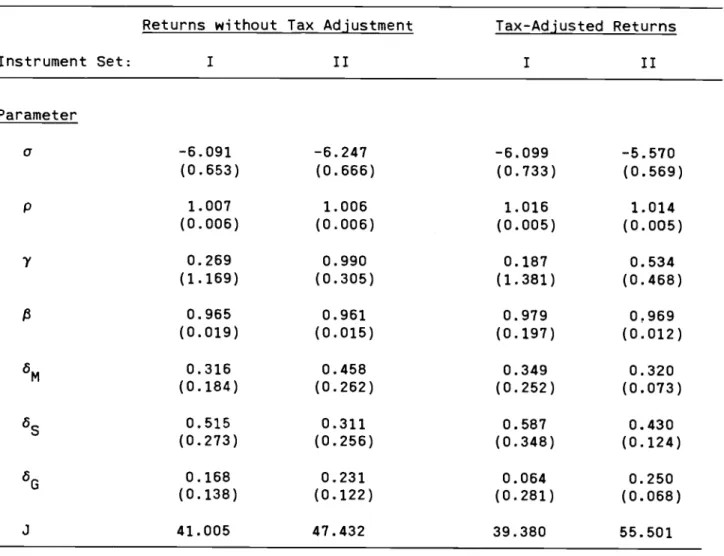
Table 1 shows the results of estimating our systems of Euler equations for the case of time-additive preferences. We report four sets of estimates, corresponding to each of the two instrument sets using both pre-tax and
post—tax returns. The estimates are remarkably stable across specifications. All J—statistics are well within the ninety—five percent confidence bounds, so we can never reject the validity of our over-identifying restrictions.
The results provide strong support for the view that liquidity is a direct
source of utility. We estimate ,
the
share of expenditure which is devoted toconsumption, to be between .951 and .979. In three of the four equations we reject the hypothesis that =1 at the .05 confidence level. This null
hypothesis corresponds to our included assets yielding no utility.
Our estimate of y, the exponent in our CES liquidity aggregator function, is .27 when we use our preferred instrument set and pre-tax returns, and .19 with post—tax returns. These estimates imply an elasticity of substitution between assets, 1/(y—1), larger than that in Husted and Rush (1984) but smaller than that in Chetty (1969). These point estimates argue against linear
aggregation of our three assets. However, y=1, the case in which linear
aggregation is appropriate, cannot be rejected. When we use Instrument Set II, the estimates of y increase and make the y=1 case more plausible.
Within our monetary aggregator, the coefficients on the various assets are estimated with relatively large asymptotic standard errors)-5 The general pattern which emerges from the point estimates -is >
> 1ÔS&M•
If all
—12-Table 1: Estimates of Utility Function Parameters
Instrument
Set:
Returns without Tax Adjustment Tax-Adjusted Returns
I
II
I
II
Parameter
c
-6.091
(0.653)
—6.247(0.666)
-6.099
(0.733)
-5.570
(0.569)
p1.007
(0.006)
1.006
(0.006)
1.016
(0.005)
1.014
(0.005)
y 0.269 (1.169) 0.990 (0.305) 0.187 (1.381) 0.534 (0.468) 0.965 (0.019) 0.961 (0.015) 0.979 (0.197) 0.969 (0.012) 5M0.316
(0.184)
0.458
(0.262)
0.349
(0.252)
0.320
(0.073)
s
0.515
(0.273)
(0.256)
0.311
0.587
(0.348)
0.430
(0.124)
60 0.168 (0.138) 0.231 (0.122) 0.064 (0.281) 0.250 (0.068)J
41.005
47.432
39.380
55.501
Notes: Estimates correspond to the utility function Vt =
pTUt+T where Ut+T
is defined by (7) and (8) in the text. The estimation period
is 1955:1
to
1982:1 (109 observations) in each case. Standard errors are shown in parentheses. The .95 critical value of the J-statistic, which is—13—
real asset stocks were of equal size, this would imply that the marginal utility associated with another dollar of time deposits would exceed that from another dollar of demand deposits or currency. However, it is essential to recognize that at current asset levels, with time deposits five times
larger than demand deposits and currency, rather different conclusions emerge. In 1981:4 our estimates from Column 1 imply that the marginal utility of money is twice that of savings accounts and four times that of government securities. The estimates in Column 3 imply even larger differences.
Although we have allowed government securities to provide liquidity
services, our estimates do not suggest a major liquidity role for these assets. When we reestimate our system imposing the constraint that =
16M'
the value of our objective function deteriorates very little. Thus we cannot reject thehypothesis that Treasury bills are not a direct source of utility. Yet, Mehra and Prescott (1985) show that the riskiness of equities is not sufficient to explain their high expected rate of return relative to T-bills. They use a utility function like (7), imposing =1 so liquidity services play no role. There are two ways of reconciling Mehra and Prescott's findings with ours.
First, it may be impossible to capture the rate of return dominance of equit+es over 1—bills in our utility-based framework. For example, the correct model for the utility services from T-bills may be different from (7). Second, the
rate-of-return dominance puzzle may only have arisen because they misspecificied the aggregate utility function by excluding liquidity services.
Our results also provide estimates of the intertemporal elasticity of substitution, a, which has been the focus of many previous studies in the representative consumer framework. Earlier estimates range between -.8 and -6.0. Our estimates are at the edge of this range; they vary between -6.2 and
-14--5.6. Moreover, they are estimated quite precisely with standard errors of
about .60.16 Our estimates of the discount factor, p. all exceed unity. This is a feature common to many empirical papers of this type.17
Table 2 reports four sets of estimates corresponding to preferences which incorporate costs of adjusting asset stocks. To allow us to perform hypothesis tests these estimates are obtained using the same estimates of the residual covariance matrix as in Table 1. The differences between the J-statistics
2(3) under the null hypothesis reported here and in Table 1 are distributed x
that adjustment costs are unimportant. The pattern of coefficients does not change significantly when adjustment costs are
introduced. More importantly, however, we can never reject at the 95 level the joint null hypothesis that all of the adjustment cost parameters are zero.
More generally our results show a very small role for dynamics since lagged variables appear uncorrelated with our residuals.18 This lack of dynamics is puzzling in light of the pervasive differencing and quasidifferencing which is typical in other studies of asset demand. It is possible that these lags in others' studies capture expectations of returns and future consumption which enter independently in our formulation.
IV. Comparative Statics
Our parameter estimates can be used to study the effects of changes in interest rates and inflation on consumption and asset holdings. To fully
characterize the consumer's responses to random shocks, we would need to find a closed form solution to the stochastic control problem posed in Section I. Since such solutions remain intractable, we concentrate on the effects of various changes in deterministic environments, asking how the representative consumer would respond to these changes if he maximized (1).
—15—
Table 2: Estimates of Cost-of-Asset-Adjustment Models
Returns without Tax Adjustment
Instrument Set: I II Tax-Adjusted Returns I II Parameter a —6.109 -6.469 -6.066 -5.617 (0.583) (0.659) (0.710) (0.584) p 1.007 1.007 1.016 1.014 (0.006) (0.006) (0.006) (0.005) y 0.604 0.050 0.253 0.470 (0.802) (1.429) (0.857) (0.509) 0.962 0.961 0.977 0.969 (0.016) (0.014) (0.017) (0.127) öM 0.366 0.309 0.383 0.307 (0.138) (0.252) (0.188) (0.079) 0.408 0.509 0.546 0.451 (0.184) (0.321) (0.225) (0.136) 0.225 0.182 0.071 0.241 (0.985) (0.127) (0.199) (0.074) —0.011 -0.032 -0.003 -0.010 (0.017) (0.057) (0.011) (0.013) 0.513 0.649 0.070 0.231 (0.472) (0.296) (0.192) (0.450) —0.001 -0.002 —0.005 -0.001 (0.005) (0.006) (0.007) (0.003) J
39.768
42.560
39.106
54.722
3 (Table 2) 1.237 4.872 0.274 0.779 — 3 (Table 1)Notes: Estimates correspond to the lifetime utility function defined in (9), with U given by (7) and (8). Standard errors are shown in parentheses. All equations are estimated for 1955:1 -
1982:1
(109 observations). The 3—statistic on the the penultimate line is distributed as x2(51) under the null hypothesis, with .95 critical value of 69.0. The statistic on the final line is distributed as x2(3), with a .95 critical value of 7.8.-16-We consider both "short-run" and "long-run" comparative statics. The short run responses are the responses of asset demands at t to changes in interest rates from t to t+1. We analyze them by neglecting the effect of these changes on choices after t+1. We also study how the vector of returns is affected by changes in the supply of assets. Although these are equivalent exercises, the
latter is more useful for policy analysis. Our short run effects are similar in spirit to those analyzed by Mankiw, Rotemberg, and Summers (1985). Their
neglect of the effect of changes in interest rates at t on decisions at t+1 is necessarily incorrect. However, it is likely to be a good approximation since
the changes in subsequent periods are mediated through changes in future wealth. For consumers with long horizons future wealth is essentially unaffected by changes -in current decision variables. The long-run responses are derived by considering steady states with different interest rates. Across different steady states consumption and asset holdings for a given level of wealth are different. We study these differences holding lifetime wealth constant.
A. Short-Run Responses
We compute two types of short run responses. The first fixes consumption at t, as well as all future choices.19 This is very much in the spirit of money demand studies which hold the transactions variable fixed when computing
interest elasticities. The second short-run calculation allows consumption at t to vary optimally, while fixing all choices in future periods. The implied consumption responses are similar to those studied by Hansen and Singleton
(1982). However, intertemporal consumption decisions now depend on nominal as well as real rates since nominal rates affect asset choices which affect the marginal utility of consumption.
For a given path of consumption, the demand for the three assets we
—17—
return on the utility—bearing assets. These return differentials are denoted UM =
rEP/P+l.
U5 =(rE-rS)P/P+l,
and UG =(rE-rG)P/P+l.
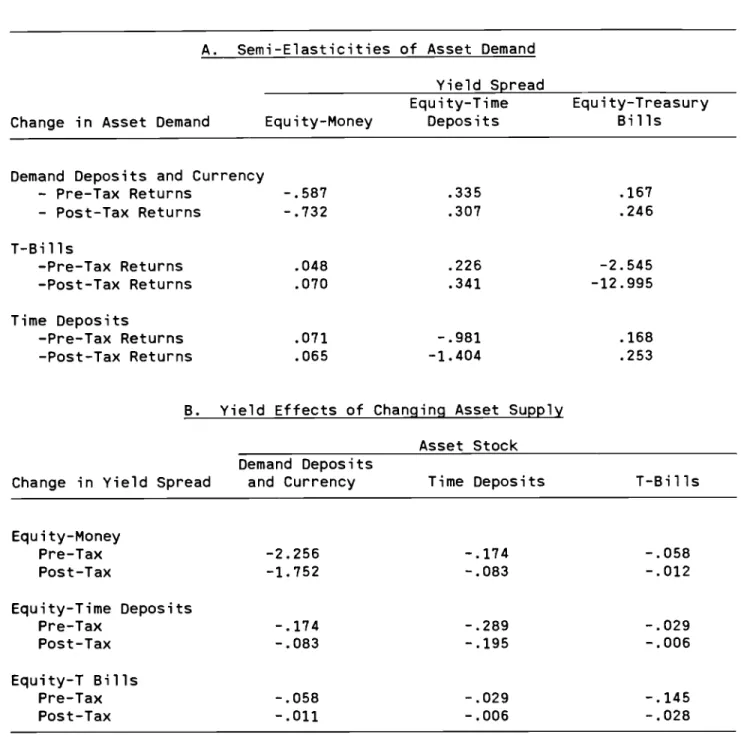
In the short run we allow M, S and G to change in response to the U'S; we calculate the effects by differentiating (M), (S) and (G).Table 3 (Part A) presents the results of this differentiation for our esti-mates obtained in the specification without costs of adjustment using our first set of instruments. We report the percent change in the assets held in the fourth quarter of 1981 when the u's increase by one hundred basis points holding constant asset stocks and consumption for the first quarter of 1982.20 The first column can be interpreted as the effect of inflation in a world in which the Fisher effect describes the behavior of all interest rates. Thus
(l+rE)P/P+l, (1+r5)P/P+1, and (l+r0)P/P1 are unaffected by inflation,
while rEP/P+l increases by approximately the increase in the inflation rate. Such an increase in inflation reduces money holdings and promotes the use of other liquid assets. Nonetheless, total liquidity falls substantially.
The response of money to UM is the closest analogue in our model to "the's interest elasticity of money demand since, if all nominal interest rates rise by the same amount, only UM is affected. Indeed we find that our semielasticities are between .6 and .8. Mankiw and Summers (1984) find similar values using con-sumption as the transactions variable in an aggregate money demand equation. The second and third columns of Table 3 (Part A) give the responses to changes in the return premia of time deposits and 1-bills. As we move from money to time deposits to T-bills, i.e. towards assets that yield less marginal liquidity services, the own semielasticity with respect to the return premium increases.
In some sense, these assets are increasingly good substitutes for equity. Table 3 (Part B) shows the effect of changes in assets supplied to the
-18-Table 3: Short-Run Linkages Between Returns and Asset Stocks
A. Semi-Elasticities of Asset Demand Yield Spread
Equity-Time Equity-Treasury Change in Asset Demand Equity-Money Deposits Bills
Demand Deposits and Currency
— Pre—Tax Returns -.587 .335 .167 — Post—Tax Returns -.732 .307 .246 T-Bills —Pre—Tax Returns .048 .226 -2.545 —Post-Tax Returns .070 .341 -12.995 Time Deposits —Pre—Tax Returns .071
- .981
.168 —Post—Tax Returns .065 -1.404 .253B. Yield Effects of Changing Asset Supply Asset Stock Demand Deposits
Change in Yield Spread and Currency Time Deposits T-Bills
Equity-Money Pre-Tax -2.256 -.174 -.058 Post—Tax —1.752 -.083 -.012 Equity-Time Deposits Pre-Tax -.174
- .289
- .029
Post-Tax -.083
- .195
- .006
Equity—T Bills Pre-Tax -.058
- .029
-. 145
Post—Tax -.011
- .006
- .028
Notes: Each entry in Part A shows the percentage change in asset demand which results from a one hundred basis point change in the yield spread. The calculations in Part B show the change in the yield spread which results from a one thousand (1972) dollar increase in per capita asset stocks. Calculations are based on parameter estimates using Instrument Set 1, pre-tax and post-tax returns, as reported in Table 1. The calculations are described in the text.
-19-household sector on yield spreads. An increase in liquid asset supplies raises their yields relative to that on equity. The biggest effect is on the own yield spread; for example, an increase in money has the biggest depressing effect on
As a result, increases in household money which the government finances by buying back government bonds tend to depress UM and therefore nominal rates even if money is exchanged for bonds on a one-to-one basis. In practice the money multiplier exceeds one so the effect is even larger.
Alternative measures of households' short-run responses to rate of return movements can be obtained by letting consumption at t vary as well. These can be obtained by differentiating all four first order conditions with respect to decisions at t and returns from t to t+1. The results of this differentiation are given in Table 4. The liquid assets respond to the nominal yield spreads in much the same way they do when consumption is held constant. A one hundred basis point increase in the real rate has only a mild depressing effect on consumption due to our high estimate for the coefficient of relative risk aversion. In turn, precisely because this coefficient is so large, the reduction in consumption depresses instantaneous utility and raises
substantially the marginal utility provided by the Cobb-Douglas consumption-liquidity aggregator. This, -in turn, raises the marginal utility of consumption-liquidity and thus promotes a slight increase in liquid assets. Similarly, reductions in liquid assets which are prompted by increases in the yield spreads lower
instantaneous utility, increasing the marginal utility of consumption. Savings therefore rise when nominal yield spreads shrink or when inflation falls. This finding suggests that anti-inflationary policies promote savings.
B. Long—Run Effects
-20-Table 4: Short-Run Return Semi-Elasticities of Consumption and Asset Holdings
Equity-Money Equity-Time Deposits Equity-I Bill Equity
Yield Spread Yield Spread Yield Spread Return Percent Change In
Demand Deposits and Currency - Pre—Tax -.602 .256 .110 .008 -
Post-Tax
-.751 .218 .165 .009 Time Deposits -Pre—Tax .055 —1.067 .106 .009 -Post-lax .047 —1.496 .170 .009 T-Bills —Pre-Tax .032 .146 —2.60 .009 -Post-Tax .045 .24]. -13.087 .010 Consumption —Pre-Tax .325 1.680 1.215 -.179 -Post—Tax .342 1.682 1.536 -.169Notes: Calculations based on parameter estimates using Instrument Set 1, pre-tax and post-pre-tax returns, reported in Table 1. The calculations are describe in the text.
—21-changes in steady-state asset holdings and consumption. Long run elasticities are computed by holding constant steady state real financial wealth, W/P. We ignore all assets and liabilities other than money, savings deposits,
government securities, and equities. Wealth is therefore defined as W = +
St
+ Gt +Mt.
Dividing by +1 in equation (2) one obtains:W1 W P(l+rEl) (rS—rE)P S (rG_rE)P Gt rEP Mt
=+1
++1
++1
Pt41—
C1
+"t+1
(16)To find the long-run elasticities we differentiate (M), (G), (S), and (16). Table 5 reports the results of this differentiation for our data. We
assume that the consumption and asset holdings of the fourth quarter of 1981 are
steady state values, and that (l+rE)P/Pl remains at 1/p forever. However,
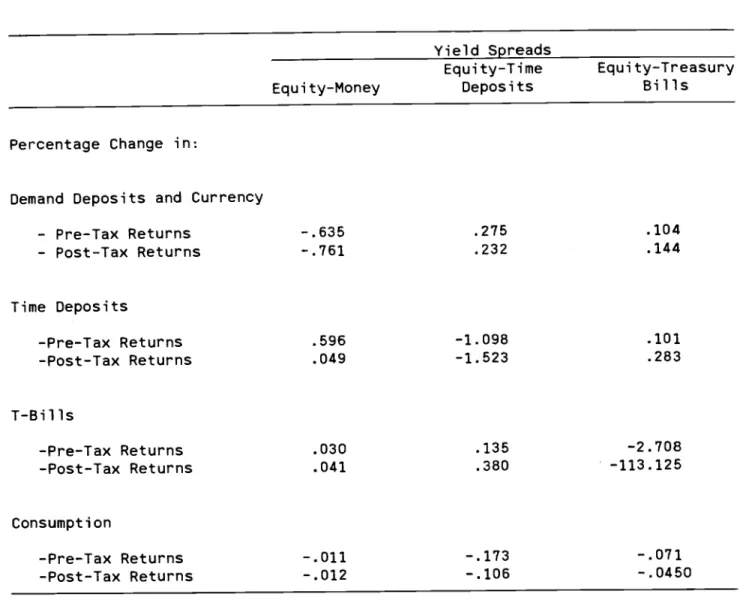
we let the u's jump to new steady state values and we consider the percent change in C, M, S, and G as a result of a change in u by one hundred basis points. The calculations show that consumption itself is relatively unaffected by changes in yield spreads. The results also show that the responses of asset holdings are basically the same as those in Table 3. Because consumption is relatively unaffected by changes in yield spreads, there is little difference between the marginal utility of asset holdings in Tables 3 and 5. Moreover, the future variation in consumption and asset holdings is of relatively minor conse-quence. These changes affect the current holdings only to the extent that they affect the product of the yield spread and the future marginal utility of
consumption. Since the yield spreads are small, even relatively large changes in the future marginal utility of consumption have only small current effects.
We can use the first column of Table 5 to compute a measure of the welfare costs of inflation. This column gives the response of C, S. I and G to
-22-Table 5: Steady-State Return Semi-Elasticities of Asset Demand
Yield Spreads Equity-Money Equity-Time Deposits Equity-Treasury Bills
Percentage Change in:
Demand Deposits and Currency
- Pre—Tax Returns — Post—Tax Returns -.635 —.761 .275 .232 .104 .144 Time Deposits -Pre-Tax Returns —Post-Tax Returns .596 .049 -1.095 —1.523 .101 .283 T—Bills —Pre—Tax Returns -Post—Tax Returns .030 .041 .135 .380 —2.708 —113.125 Consumption —Pre—Tax Returns -Post—Tax Returns
- .011
-.012
—.173 -.106 — .071 -.0450Note: All estimates are based on parameters estimated using Instrument Set 1, reported in Table 1. See text for further discussion of the elasticity calculations.
—23—
these variables we obtain an estimate of the instantaneous loss in utility. We then translate this loss in utility into the fall in consumption which would have produced the same loss. A one hundred basis point increase in inflation would lower utility by the same amount as a 0.4 percent fall in consumption. This estimate is insensitive to our choice of pre- or post-tax data.
V. Conclusions
We have presented a method of estimating consistent systems of asset demand equations which permits analysis of a variety of government interventions in asset markets. While reduced form evidence suggests that these interventions change aggregate output, it does not clarify the mechanism by which they work. The need for empirical measures of the effects of open market operations was the original motivation for the estimation of structural money demand functions, which were supposed to capture the aggregate LM curve. However, in the presence of many assets which are imperfect substitutes, more complete modelling of the financial sector is needed. Our paper takes a step in that direction.
Our analysis suffers from several shortcomings. These are primarily limi-tations of our particular implementation of the assets—in—the—utility function approach, and not difficulties with the approach in general. First, it is dif-ficult to maintain that the marginal utility of one liquidity-producing asset is independent of the holdings of other such assets. Yet, if many assets yield these services in substitutable forms, the exclusion of some assets from the analysis may bias conclusions about the importance of other assets.
Eventually,
our approach should therefore be extended to incorporate a broader range of assets. This will present measurement problems with respect to both asset stocks and rates of return especially for long term nominal assets, such as
-24-corporate bonds, with various maturities and risk characteristics.
A second, and related issue, is that the menu of important assets changes over time. Financial innovations, like the recent improvements in money-market mutual funds, allow assets to be repackaged to yield different liquidity
services. Although our approach can in principle address these issues, this has been left for future research. An important policy issue which our pre-1982 data probably cannot address is the extent to which the new popularity of money market mutual funds has changed the power of open market operations.
A third direction for future work concerns the utility flows which assets provide. We have modelled assets' utility flows as a simple function of
the asset level. While this is similar to the traditional approach to modelling the demand for consumer durables, recent studies have focused attention on the actual service flows yielded by these durables. For example, air-conditioners provide two services: they cool one's house, and they also yield the pleasure of knowing one's house need never be hot. The former, at least, is subject to measurement (Hausman, 1979). Similarly, the service flow from a liquid asset depends on the transactions it simplifies, as well as the help it might have provided had more transactions taken place. The former might be measurable. This line of inquiry could potentially reconcile the view that these assets are held because they give utility with transactions-based models.
-25-Footnotes
1. Theoretical work in monetary economics often uses this approach. The
Sidrauski (1967) model is part of most economists' standard tool kit; it has been extended by Fischer (1979), Calvo (1979), and Obstfeld (1984,1985).
2. An alternative, much less explicit set of transactions cost models is
quite similar to the assets-in-the-utility function approach. These models assume that liquid asset stocks reduce the amount of leisure spent transacting [see Saving (1971)]. Models of this type do not fully capture the structure of financial transactions costs since they neglect the discrete character of these transactions.
3. This problem has also arisen in previous attempts to construct Divisia
monetary aggregates [see Barnett (1980, 1983)]. With standard nondurable goods, the rate of growth of a Divisia quantity aggregate equals the inner product of current expenditure shares and quantity growth rates. The expenditure on liquidity services (and other durables), however, is unknown at the time the services are purchased. This raises difficulties for Divisia aggregation which should be addressed in future work.
4. If all assets give utility directly, one could redefine Preferences to
exclude the asset which gives the least utility and attribute its utility to future consumption.
5. If r0 and are known at t and there are no other errors, then (EC),
(M), (S) and (G) may be combined to obtain two nonstochastic equations:
au
— (1+r5.)
—
au= r
—
au and—
au- (l+rG)
au au—
= r
---which
can bet t t t t t
combined to yield
-—]rG
=-
The first of these equations requires that a consumer cannot raise his utility by reducing his holdings of money by (l+rGt) dollars in period t, raising his holdings of Treasury bills by one dollar to ensure that the original plan is still feasible, and consuming the difference (r0) today. The second equation requires that a similar set of asset swaps, performed this time with time deposits and money, cannot raise utility. In practice, only is known over short periods of time.6. Assuming that the theoretical concept of money corresponds to our measure
of liquidity, our utility function is identical to the one used in Fischer (1979), Calvo (1979), and Obstfeld (1984, 1985).
7. Chetty (1969) uses a more general functional form in which each asset is
allowed its own y. Since he focuses only on the instantaneous utility function, he cannot identify the exponent of this CES aggregate.
8. This may well be the implicit justification for the inclusion of
quasi-differences of assets in Barnett's (1980) utility function.
9. If it is a matter of physically adjusting one's asset stock the nominal and
not the real magnitude is relevant. However, a better specification would recognize the automatic changes in money caused by consumption expenditures.
-26-10. With costs of adjustment it is difficult to follow the two-step budgeting procedure used by Barnett (1980), because the marginal rate of substitution bet-ween two assets at t depends on the expected levels on assets at t+1 which, in turn, depend on assets at t.
11. The data for G are drawn from unpublished Federal Reserve Board tabulations which are not available after 1982:2. We experimented with another measure of short-term debt, computed as the sum of Treasury bill holdings, open market paper, and money market mutual fund accounts, and found results similar to those reported below.
12. We assume perfect loss-offset in the taxation of capital gains. Assuming that the losses on equity could not have been offset against other taxable income would induce only minor changes in our rate of return series.
13. Previous calculations of weighted-average marginal tax rates yield different tax rates on dividends and interest income. In the spirit of the representative consumer model, we recognize that for any taxpayer the two tax rates must be equal. We therefore apply the dividend tax rate to all interest and dividend income.
14. We use the commercial bank savings deposit rate to measure the rate of return on time deposits.
15. These standard errors overstate the imprecision of our estimates because they do not recognize that the 5's must lie between 0 and 1.
16. In Obstfeld (1985), a < 0 impies that anticipated disinflation leads to the kind of capital inflows that have been experienced in the Southern cone, rather than to capital outflows. In Obstfeld (1984), uniqueness of the
economy's rational expectations equilibrium requires that (1-a) <
/(1-).
This condition is always satisfied by our estimates.17. The paper by Mankiw, Rotemberg, and Summers (1985) is one example.
18. Durbin-Watson statistics calculated from our residuals ranged between 1.15 and 1.9. Their statistical properties in our estimation procedure are unknown, but they may provide some evidence of dynamic misspecification.
19. If one estimates a static system of demand equations based on total expenditure on liquid assets [as in Barnett (1980)], then one can only obtain
responses to interest rates holding these expenditures on liquidity constant. This is a less appealing approximation to the consumer's action at t.
20. To actually differentiate these equations we must first modify them to make them hold without error. To do this we compute the value of the u's which make
(II), (G) and (S) hold exactly. These can be interpreted as the expected returns which rationalize actual subsequent consumption and asset holdings. Then we use these u's instead of the actual u's.
—27-Ref erences
Barnett, William A., "Economic Monetary Aggregates: An Application of Index Number and Aggregation Theory," Journal qf Econometrics 14 (1980), 11—48. Barnett, William A., "The Optimal Level of Monetary Aggregation," Journal of
Money, Credit, and Banking 14 (1982), 687—710.
Barnett, William A., Consumer Demand and Labor Supply: Goods, Monetary Assets, and Time (New York: North Holland, 1981).
Baumol, William J., "The Transactions Demand for Cash: An Inventory Theoretic Approach," Quarterly Journal of Economics 66 (1952), 545-556.
Calvo, G.A., "On Models of Money and Perfect Foresight," International Economic Review 20 (1979), 83-103.
Chetty, V. Karuppan, "On Measuring the Nearness of Near-Moneys," American Economic Review 59 (1969), 270-281.
Ewis, Nabil and Douglas Fisher, "The Translog Utility Function and the Demand for Money in the United States," Journal of Money, Credit, and Banking 16
(1984), 34-53.
Feige, E. and 0. Pierce, "The Substitutability of Money and Near Monies:
A Survey of the Time Series Evidence," Journal of Economic Literature 15, (1977), 439—469.
Feldstein, Martin S., Louis Dicks—Mireaux and James M. Poterba, "The Effective Tax Rate and the Pretax Rate of Return," Journal of Public Economics 21 (1983), 129—158.
Fischer, Stanley, "Capital Accumulation on the Transition Path in a Monetary Optimizing Economy," Econometrica 47 (1979), 1433-1439.
Goldfeld, Stephen M., "The Demand for Money Revisited," Brookings Papers on Economic Activity 3 (1973), 577—638.
Grossman, Sanford J. and Laurence Weiss, "A Transactions Based Model of the Monetary Transmission Mechanism," American Economic Review 73 (1983), 871-880.
Hansen, Lars Peter, and Kenneth Singleton, "Generalized Instrumental Variables Estimation of Nonlinear Rational Expectations Models," Econometrica 50 (1982), 1269—1286.
Hausman, Jerry A., "Individual Discount Rates and the Purchase and Utilization of Energy-Using Durables," Bell Journal of Economics 10 (1979), 33-54. Husted, Steven and Mark Rush, "On Measuring the Nearness of Near Monies:
-28-Jovanovic, Boyan, "Inflation and Welfare in the Steady State," Journal of Political Economy 90 (1982), 561-577.
Mankiw, N. Gregory, Julio J. Rotemberg, and Lawrence H. Summers, "Intertemporal Substitution in Macroeconomics," Quarterly Journal of Economics 100
(1985), 225—251.
Mankiw, N. Gregory and Lawrence H. Summers, "Are Tax Cuts Really Expansionary?", NBER Working Paper No. 1443, Cambridge, Mass., September 1984.
Mehra, Rajnish and Edward C. Prescott, "The Equity Premium: A Puzzle", Journal of Monetary Economics 15, 145-162.
Obstfeld, Maurice, "Multiple Stable Equilibria in an Optimizing Perfect-Foresight Model," Econometrica 52 (1984), 223—228.
Obstfeld, Maurice, "The Capital Inflows Problem Revisited: A Stylized Model of Southern Cone Disinflation," Review of Economic Studies 52 (1985), 605—624. Romer, David, "A Simple General Equilibrium Version of the Baumol-Tobin Model,"
M.I.T. mimeo, September 1984.
Rotemberg, Julio J., "A Monetary Equilibrium Model with Transaction Costs," Journal of Political Economy 92(1984), 40-58.
Saving, Thomas R., "Transactions Costs and the Demand for Money," American Economic Review 61 (1971), 407-420.
Sidrauski, Miguel, "Inflation and Economic Growth," Journal of Political Economy 75 (1967), 796—810.
Tobin, James, "The Interest-Elasticity of Transactions Demand for Cash," Review of Economics and Statistics 38 (1956), 241—247.
Tobin, James and William Brainard, "Pitfalls in Financial Model Building," American Economic Review 58 (1968), 99-122.