https://doi.org/10.30585/icabml-cp.v2i1.253
© 2018 the Authors. Production and hosting by Avicenna FZ LLC. on behalf of Dubai Business School, University of Dubai – United Arab Emirates. This is an open access article under the CC BY-NC license.
Page | 120 ICABML, Vol 2., ISSN: 2523-6547
Available online at:
http://publications.ud.ac.ae/index.php/ICABML -CP
CONSUMER DISPUTE RESOLUTION IN CYBERSPACE
–
TRENDS
AND DEVELOPMENTS
Ayyappan Palanissamy
a*, Dr R. Kesava Moorthy
b.
aPh.D. scholar in VIT University, currently working as Faculty, Modern College of Business & Science, Muscat, Sultanate of Oman. E Mail: [email protected].
bResearch Guide, Assistant Professor (Senior) & Programme Chair, VIT School of Law, VIT University, Chennai. *Corresponding author.
Received: 15 October 2018, accepted: 18 October 2018 , published: 3 Marc 2019
ABSTRACT
Developments and advancements in the ICT environment has led to high increase in electronic commerce. Cyber contractual disputes also emerge rapidly and this challenge the traditional consumer protection systems in terms of redressal and remedies. To protect consumers rights and interests, ADR mechanisms can be used which can overcome the difficulties confronted in the traditional litigation process. Dispute resolution in internet contracts can take place online either entirely or partly. There are various mechanisms available to resolve disputes which can protect disputants’ interests and rights absolutely. As the cyber environment usage continues to expand, it is utmost important to design effective mechanisms for resolving online commercial disputes because traditional adjudicatory process can be time consuming, expensive and may raise jurisdictional problems. Though the current trends and practice in the field of online dispute resolution exists, it appears that there are various aspects relating to which are yet to be clarified. This article aims to present a national and international scientific literature review on the models of Dispute Resolution mechanisms, discusses the use of Alternative dispute resolution systems (including ODR), types of procedure and mechanisms adapted for dealing with commercial disputes in India. It also looks into the international frameworks available with redressal systems and its effectiveness in dealing with cross border disputes.
Keywords: Alternative Dispute Resolution, Business to consumer, Online dispute resolution
1. INTRODUCTION
Alternative dispute resolution originated in the field of trade in 1920s, the aim of it was to provide commercial bodies with alternatives to adjudicate their disputes in the court. Because of ADR, many barriers have been overcome, however by time it became expensive and time-consuming which made it hard to litigate in the courtroom. Since there was an increase in cross border transactions it was necessary to find a mechanism that would solve disputes that originate from such transactions. Nowadays, technology is known to have the ability to make the business processes more effective and efficient. Therefore, based on successful cases, the Internet made it clear that it has the capacity to facilitate the resolution of disputes faster and at a lower cost, but a strategical pathway has not yet been clearly demonstrated. In ODR, technology is used to handle disputes and conflicts where a third party will be involved in dealing with the issue.
Page | 121
According to Arthur M. Monty Ahalt, online dispute resolution (ODR) provides two or more disputants the ability to deal with the issue through the internet medium. In fact, ODR has all of the advantages of other forms of ADR—and it is faster and more cost-effective. The benefit of using ODR is that it overcomes jurisdictional issues as it is one of the preliminary requirement looked into in the courts to take up a case on file. This article seeks to give a general introduction about ADR systems and ODR. This includes: (a) the definition of ADR and its types (b) failure of traditional litigation process and the use of ADR/ODR with commercial disputes, (c) procedures and mechanisms, (d) advantages of online arbitration over litigation process and (e) legal framework and regulations regarding ADR/ODR.
2. ADR
–
Definition and types
ADR has various mechanisms which helps disputants to resolve their disputes with the assistance of a neutral third party through procedures like arbitration, negotiation, mediation and conciliation. Negotiation is the least form of ADR, as it can happen only between two parties, i.e. disputants. The parties to the dispute may on their own interest may come forward to resolve their dispute between themselves so as to make a deal without prolonging the matter further. This process is highly voluntary as either party can terminate the process if they could feel that no solution will be arrived at. The essence of this process is bargaining which may result in a fair agreement which can preserve and further enhance the relationship between parties. When negotiation fails, mediation may come into play to remove the deadlock between the disputants. This process requires at least three parties, the disputants and the mediator. The whole process is highly voluntary until a final settlement is arrived at between the disputants and the mediator. The major role played by the mediator is to act a neutral third party, being a facilitator of the entire process, has to improve communication between parties and promote or encourage parties to go for voluntary decision making. Mediation process purely depends on a TALK strategy by which win-win solution is possible which is beneficial for both the disputants where they can mend the relationship. Mediation is a process or system widely accepted in the international arena and it is the right alternative to litigation process to carry out informally, where parties can come forward to resolve their disputes out of the court by way of mutual compromises efficiently facilitated through the process by the mediator. Any settlement reached through the mediation process is not binding until signed by both the parties. In other words, the parties to the dispute have every right to leave the process if they could see that it will not be beneficial or likely to affect their interests and rights. Arbitration is a process by which disputants have a freedom to choose or nominate their arbitrator. This is a less formal process having legal recognition from its beginning. The arbitrator should act as an impartial neutral third party, giving sufficient opportunity for parties to present their case, complying with the principles of natural justice, should issue an award based on the merits of the case where the award has the legal effect as a civil court judgment. There are a lot of advantages for using arbitration when compared to litigation process. Though both the processes are adjudicatory in nature, arbitral procedure can be carried out less formally with no much rules of evidence with the consent of the parties concerned. The main advantage of arbitration is confidentiality. Anything which goes on in the process can be kept highly confidential and is between parties and the arbitrator. It is not subjected to public knowledge. But in the case of litigation process, courts are public forums and the entire process carried out will be subjected to publication which may affect the reputation or goodwill of the parties concerned in the society. Arbitration has other advantages like flexibility, speedier in getting a solution etc. The result of the arbitration will have a binding nature between the parties and can be subjected to enforcement internationally. Disputants can choose arbitration process to resolve their matter by way of a mutual agreement between them. It can happen either before or after their dispute arises. Once parties to the dispute opt for arbitration for dealing with their problem, they can be compelled to go for arbitration and cannot choose the court as an appropriate forum for dispute resolution.
3. FAILURE OF TRADITIONAL SYSTEMS AND USE OF ADR/ODR DEALING WITH COMMERCIAL DISPUTES
Normally, the most common forum to resolve a dispute and to seek a remedy is by consumer forums and courts. Before ODR, litigation and traditional ADR are the most common used methods. The application of ICT in ecommerce has led people to buy products staying at home whatever they need in the form of national or cross border online transactions.Page | 122
Consumers can get in touch with products all over the world. There are hundreds of millions of cross-border transactions each year leads to disputes to be redressed (Sree Krishna Bharadwaj, 2017).
In the case of traditional dispute resolution mechanisms, it requires parties’ attendance and appropriate claims
applications for national or cross-border commercial transactions irrespective of the claim amount. This process and procedure is burdensome, and it brings real challenges to consumers.
Some of the challenges confronted by consumers dealing with the traditional mechanisms are: transactions involving low value, complexity of dispute resolution process which requires travel, energy and money to complete corresponding procedures, enforcement of the results. In the case of litigation process, jurisdiction is the major issue, where in all the online commercial transactions, the seller, consumer and market place may not be in the same city, state or country. Due to these reasons, it is evident that it is the failure of traditional systems which makes ADR/ODR necessary and important.
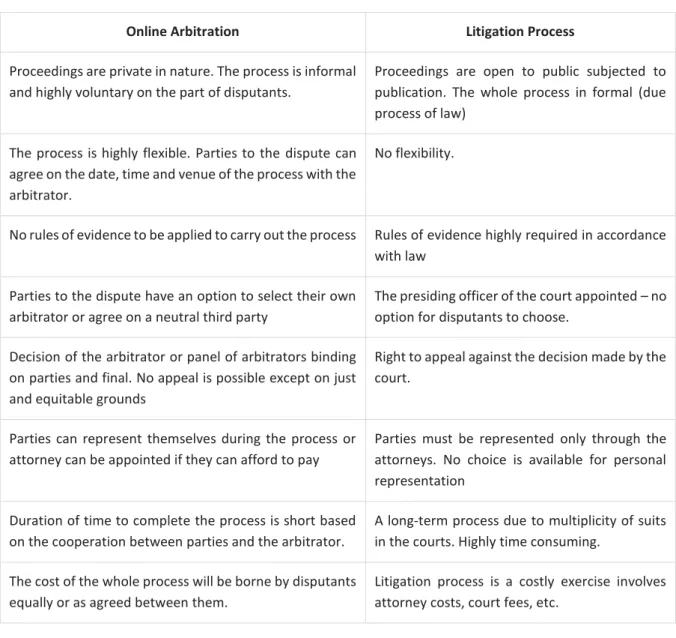
Online Arbitration Litigation Process
Proceedings are private in nature. The process is informal and highly voluntary on the part of disputants.
Proceedings are open to public subjected to publication. The whole process in formal (due process of law)
The process is highly flexible. Parties to the dispute can agree on the date, time and venue of the process with the arbitrator.
No flexibility.
No rules of evidence to be applied to carry out the process Rules of evidence highly required in accordance with law
Parties to the dispute have an option to select their own arbitrator or agree on a neutral third party
The presiding officer of the court appointed – no option for disputants to choose.
Decision of the arbitrator or panel of arbitrators binding on parties and final. No appeal is possible except on just and equitable grounds
Right to appeal against the decision made by the court.
Parties can represent themselves during the process or attorney can be appointed if they can afford to pay
Parties must be represented only through the attorneys. No choice is available for personal representation
Duration of time to complete the process is short based on the cooperation between parties and the arbitrator.
A long-term process due to multiplicity of suits in the courts. Highly time consuming.
The cost of the whole process will be borne by disputants equally or as agreed between them.
Litigation process is a costly exercise involves attorney costs, court fees, etc.
Table 1: Advantages of Online Arbitration over Litigation
It can be observed that, courts process in terms of resolving disputes leads to higher costs involved and it takes years together to get a case decided. The reason behind is the backlog of huge number of cases because of the multiplicity of suits filed in the civil courts. The parties receiving a verdict from the court after much difficulties have an option to appeal
Page | 123
the judgment and gain the proceedings continues. To overcome this long-term process, ADR/ODR mechanism paves way for quicker and speedier resolution of disputes and the award issued becomes final having a binding effect on the parties which is not appealable other than exceptional cases. Another major advantage of ADR/ODR is certainty in terms of decision making; the parties to the dispute depending on the subject matter of the dispute have an option to choose an expert in that field where the adjudicator can employ his subjective knowledge while hearing the case and decide the matter put forward objectively, where in the case of traditional litigation process, the court allocate a judicial officer to hear the case. The Judicial officers of the court are qualified and experienced in the field of law but not subject experts
in all fields of law. It can be claimed that the judges’ role is to adjudge the case brought before them by exercising fairness and due process and not required to use subjective knowledge as the judicial system is adversary in nature. But nowadays, in the contemporary modernised social environment, where traders in the market place expand their businesses and compete in the global market, technical knowledge to resolve the dispute is must and mandatory on the part of adjudicatory authority.
Whereas in recent times a lot rely on ADR methods, which are being supported by ICT tools. The use of technology to resolve disputes will make communication much easier between disputants. In particular, the development of these methods helped consumers get appropriate access to justice.
Under ODR framework, disputes can be classified into three different categories such as Business to Business (B2B) dispute where the parties to the dispute are two commercial enterprises having an issue over a transaction which have to be resolved; Business to Consumer (B2C) dispute where the parties to the dispute are an enterprise and an online consumer intending to resolve the conflict and to get their rights protected and to seek appropriate remedies; Consumer to Consumer (C2C) dispute where the disputants are consumers having conflict to be redressed to ascertain their rights. These are online contracts happening in the cyber space with majority business like e-bay, amazon, etc.
The principles that support any ODR process comprise due process, transparency, accountability and fairness. E-commerce disputes are non-personal; therefore, ODR gives the best and effective dispute resolutions because there are no direct interactions.
1. ONLINE DISPUTE RESOLUTION (ODR) - PROCEDURE AND MECHANISMS
Fig.1: Real Time ADR Procedure
ODR process can well be employed for various business/consumer disputes which originate from business to business (B2B)/ business to consumer (B2C) transactions. This process is highly advantageous and beneficial to deal with cross border disputes which arises from online contracts. In various jurisdictions, private entities act as ODR provider where they set appropriate standards and rules to ascertain fairness/transparency in dealing with disputes.
ADR & ICT
ONLINE
NEGOTIATION
ONLINE
ARBITRATION
ONLINE
MEDIATION
Page | 124
Dispute resolution can be opted by the disputants through the ODR mechanism which can be effectuated through the service provider, where the process is carried out absolutely online involves different stages includes negotiation, mediation and arbitration (Enas, 2017).
Online negotiation is the first stage in the process, one of the basic mode of interaction, where disputants can directly make a real attempt to strike a deal without any interference of a third party. In other words, this stage can be better described as computer mediated communication to resolve conflict.
Online mediation will come into play as the second stage of the process, if negotiation process fails, where the mediation process will be facilitated by a neutral/impartial third party to reach a compromise agreement out of mutual understanding. It can be described as online negotiation carried out between disputants with the assistance of a third person to reach an amicable/friendly settlement (negotiated settlement) between parties.
If there is no solution arrived at between disputants out of the voluntary process in the first two stages, the third stage will arise where Online arbitration will be employed, and parties will have a binding nature over the decision made by the impartial third party. This cyber arbitration is otherwise known as electronic arbitration or e-version of offline arbitration.
2. LEGAL FRAMEWORK OF ADR/ODR IN INDIA
Since time immemorial, dispute settlement through a third party is prevalent in India. The government has enacted comprehensive legislations in line with the UNCITRAL model law. The law has given absolute legal recognition to arbitration and conciliation making arbitration less formal and with less technicalities and it is in practice incorporating the modern concepts and act as an effective and beneficial mode of settling disputes.
Recently the apex court in India, recognized the validity of multi-layered dispute resolution clauses in a case Centro-trade Mineral and Metals Inc. v Hindustan Copper Ltd. (2018). The multi-layered dispute resolution clause includes two-tier resolution clauses which are: pre-arbitration clause comprising of different methods of ADR such as negotiation, conciliation and mediation and post-arbitration clause which is otherwise known as arbitration clause.
The ADR mechanism has proven to be one of the effective systems to resolve disputes through amendments made to the law as it is required from time to time. A draft proposal (Bill) to amend the existing arbitration law has been approved by the Parliament in the lower house in March 2018. The Minister of Law has observed that ‘this law will be momentous and important legislation” and with the law into force India will act as a ‘hub of domestic and International Arbitration”.
The main features of the Bill were to establish an Arbitration Council of India, as an independent body which will undertake various functions includes, framing policies governing the grading of arbitral institutions, promoting the use of ADR, to make recommendations on measures for resolution of disputes etc.
Regarding ODR in India, the law has not still looked into the use of ICT absolutely for dispute resolution and is not in practice to deal with disputes. There are various provisions available in the legislations which paves way for encouraging ADR and incorporating ICT into the legal process.
Page | 125
Fig.2: Recognition of ADR/ODR in India 3. POSITION OF ADR/ODR IN THE EUROPEAN UNION (EU) AND CHINA
The EU Alternative Dispute Resolution (ADR) Directive and ODR regulation has been published and enforced since 2016. The main aim of the regulation is to increase the usage of out of court settlement procedures by consumers in the EU to settle disputes with traders rather stepping into the courts for challenging their rights.
The ODR platform provided under the regulation will act as an interactive website absolutely free of charge. Disputes pertaining to any sort of purchases made domestically or across EU borders can be dealt with by this interactive website. This initiative imposes an obligation on the part of traders to give clear and sufficient information to consumers regarding the possibility of dealing with the disputes out of court.
A report published by EU on the functioning of ODR platform in 2017 has revealed that the mechanism and the ODR framework was well received by consumers to deal with their traders challenging their rights and the initiative has achieved a great success.
In China, ADR is well employed in dealing with disputes. One of the famous and successful method in practice is Med-Arb method of resolution of civil matters. The combination of mediation with arbitration is said to be Med-Arb method. The procedures of this method are set out in their Arbitration law which highlights the power conferred to arbitrator to carry out mediation process if necessary as to how and when to be carried out during the course of arbitral proceedings (Shahla F Ali, 2016).
Regarding ODR, courts have started incorporating ICT into the adjudicatory machineries. The Supreme People’s court in
China has launched the first Online court in the year 2015 to hear internet related cases. Case hearings were attended by the disputants through video link provided by the court and decisions of the case delivered online.
4. CONCLUSION & SUGGESTIONS
The rapid increase of electronic contracting in the online environment and cross border transactions happening in the borderless cyberspace requires an effective and speedier mechanism to resolve disputes. ADR is recognised and well accepted to deal with international commerce. The ecommerce market in India is large and the Judiciary highly support to deal with cases constituting more courts, the government is in the process of creating new laws and provisions to overcome the difficulties confronted with regard to disposing of cases in a speedier manner reducing the backlog of cases and encouraging/ recommending litigant public to use ADR mechanism to resolve dispute. At this point of time, traditional ADR or litigation process are not suitable. Use of online ADR has major advantages especially dealing online
Civil Procedure Code, 1908
Civil Procedure Code (Amendment) Act, 1999 Sec. 89 - use of out of court settlement methods..
Arbitration & Conciliation
Act, 1996
Based on UNCITRAL Model Law
Provides provision for parties to initiate conciliation, arbitration Binding and enforceeable
Information Technolgy
Act, 2000
Page | 126
commercial and contractual disputes as it can overcome the jurisdictional issues which is one of the major legal issue to resolve online commercial claims. Though private institutions have already emerged as ODR providers in both India and China, the usage on the part of disputants to choose them as an appropriate forum to resolve their matters are less because of the regulation and lack of trust. These institutions are not under the strict scrutiny of the government. To create absolute confidence on the ODR processes, government initiatives and regulations or government led ODR is utmost important as it was well established in the European Union recently.
REFERENCES
AJ Schmitz, “Drive-Thru Arbitration in the Digital Age: Empowering Consumers through Binding ODR,” Baylor L. Rev. 62, no. 10 (2010): 178.
B Baumann, “Electronic Dispute Resolution (EDR) and the Development of Internet Activities,” Syracuse L. Rev. 52 (2002): 1227. B.F Dusty, “A New Automated Class of Online Dispute Resolution: Changing the Meaning of Computer Mediated Communication.,”
Faulkner Law Review, 2011.
Cortés P. (2010): Online Dispute Resolution for Consumers in the European Union. Routledge.
Eisen J.B. (2001): Are We Ready for Mediation in Cyberspace? "Brigham Young University Law Review", 1305. E. Katsh & J. Rifkin, Online Dispute Resolution: Resolving Conflicts in Cyberspace (John Wiley & Sons Inc., 2001). Enas Qutieshat, Online Dispute Resolution, British Journal of Humanities and Social Sciences December 2017, Vol. 18 (2)
Ethan Katsh, "Online Dispute Resolution: Some Implications for the Emergence of Law in Cyberspace1," International Review of Law, Computers & Technology 21, no. 2 (2007): 97-107, doi:10.1080/13600860701492096
Europe's New Online Dispute Resolution Platform: What Do You Need To Do?, Disputes, January, 2016, available at
http://www.osborneclarke.com/connected-insights/blog/europes-new-online-dispute-resolutionplatform-what-do-you-need-do/.
Feliksas Petrauskas, Eglė Kybartien, “Online Dispute Resolution in Consumer Disputes,” 18(3) Jurisprudence 921–941(2011)
Friedman GH, Alternative dispute resolution and emerging online technologies: challenges and opportunities. (19) Hastings Comm. & Ent. LJ. 695. (1997)
Goodman J.W. (2005): The Pros and Cons of Online Dispute Resolution: An Assessment of Cyber-Mediation Websites. "Duke L. & Tech. Rev.", 0004.
Hornle J., Cross-border internet dispute resolution. United Kingdom: Cambridge University Press (2009).
Hornle J., Online dispute resolution –the emperor’s new clothes? Benefits and pitfalls of online dispute resolution and its application to commercial arbitration; 17th BILETA Annual Conference (2002).
HA Haloush and BH Malkawi, “Internet Characteristics and Online Alternative Dispute Resolution,” Harv. Negot. L. Rev. 13 (2008): 327– 49
Jerome Orji Uchenna, “Technology Mediated Dispute Resolution: Challenges and Opportunities for Dispute Resolution,” Computer and Telecommunication Law Review 18, no. 5 (2012): 126
Johansson B, Cyber courts the future of governmental online dispute resolution? ADR Bulletin Berkeley Electronic Press: 8 (7):163-168; (2006).
Kerr IR (2001). “Ensuring the success of contract formation in agent-mediated electronic commerce”, Electronic Commerce Research, 183-202, (2001).
Leah Wing, "Ethical Principles for Online Dispute Resolution," International Journal on Online Dispute Resolution 3, no. 1 (2016): 12-29, doi:10.5553/ijodr/235250022016003001004
Page | 127
Louis F. Del Duca, Colin Rule, and Zbynek Loebl, "Facilitating Expansion of Cross-Border E-Commerce-Developing a Global Online Dispute Resolution System (Lessons Derived from Existing ODR Systems - Work of the United Nations Commission on International Trade Law)," SSRN Electronic Journal, 2011, 42-45, doi:10.2139/ssrn.1970613
Lipsky, D. B. & Avgar, A. C., Online dispute resolution through the lens of bargaining and negotiation theory: Toward an integrated model [Electronic version]; University of Toledo Law Review, 38(1), 101-142, (2007).
Mohamad AM, Prospects and challenges facing e-court system in Malaysia”, European Journal of Law and Economics (2011).
Professor Fred Galves, Virtual Justice as Reality: Making the Resolution of E-commerce Disputes More Convenient, Legitimate, Efficient, and Secure‟ Journal of Law, Technology & Policy 1(2009)
Rule Colin, Technology and the Future of Dispute Resolution: Dispute Resolution Magazine; Washington 4-7, (Winter 2015).
Shahla F Ali (2016), The Legal Framework for Med-Arb Developments in China: Recent Cases, Institutional Rules and Opportunities, Dispute Resolution international, Vol 10 No 2 October 2016.
Sree Krishna Bharadwaj H., A Comparative Analysis of Online Dispute Resolution Platforms. American Journal of Operations Management and Information Systems. Vol. 2, No. 3, 2017, pp. 81-85
Schmitz, Amy, 'Drive-Thru' Arbitration in the Digital Age: Empowering Consumers through Regulated ODR, Baylor Law Review, Vol. 62, p. 178, at 230-233, (2010).
The Legal and Institutional Framework of Online Dispute Resolution (ODR), The Arbitration Hub, April 29, 2016, available at http://thearbitrationhub.com/online-dispute-resolution-framework.
Uchenna, “Technology Mediated Dispute Resolution: Challenges and Opportunities for Dispute Resolution.” ww.uncitral.org/pdf/english/texts/odr/V1700382_English_Technical_Notes_on_ODR.pdf http://files.ali-aba.org/thumbs/datastorage/lacidoirep/articles/PLIT0903_Ahalt_thumb.pdf www.elevenjournals.com/tijdschrift/ijodr/2014/1/IJODR_2014_001_001_004.pdf www.mediate.com/pdf/cortes.pdf http://www.justice.gc.ca/eng/rp-pr/csj-sjc/dprs-sprd/res/drrg-mrrc/10.html https://www.icann.org/resources/pages/odr-standards-of-practice-2012-02-25-en http://www.oecd.org/internet/consumer/1878940.pdf http://www.sciencedirect.com/science/article/pii/S2351667415000074 http://lk-k.com/wp-content/uploads/Online-Dispute-Resolution-and-Its-Significance-for-International-Commercial-Arbitration.pdf https://www.elevenjournals.com/tijdschrift/ijodr/2014/1/IJODR_2014_001_001_002 https://ec.europa.eu/info/sites/info/files/first_report_on_the_functioning_of_the_odr_platform.pdf https://www.mondaq.com https://www.internationallawoffice.com/Newsletters/Arbitration-ADR/India/Khaitan-Co/Two-tier-arbitration-clauses