Sovereign Debt Without Default Penalties
∗
Alexander Guembel
Saïd Business School,
University of Oxford
and
Toulouse School of Economics
Oren Sussman
Saïd Business School,
University of Oxford
15 October, 2008
Abstract
We develop a theory of sovereign borrowing where default penal-ties are not implementable. We show that when debt is held by both domestic and foreign agents, the median voter might have an interest in serving it. Our theory has important practical implications regarding a) the role of financial intermediaries in sovereign lending; b) the effect of capitalflows on price volatility including the possible over-valuation of debt to the point that the median voter is priced out of the market; and c) debt restructur-ing where creditors are highly dispersed.
Keywords: Sovereign debt, orderflow, median voter JEL Classifications: D72, F32, G15, H63
∗We would like to thank conference and seminar participants at the AEA Annual Meetings
(2007), FIRS conference Shanghai (2006), The Oxford Finance Summer Symposium (2006), ESSFM Gerzensee, the Bank for International Settlements, the Federal Reserve Bank of Philadelphia, the IMF, Max Planck Institute (Bonn), Toulouse University, University of Amsterdam, University of Warwick, the Wharton School and the Market-Microstructure workshop jointly organized by the Central Banks of Canada and Norway for helpful comments. We also benefited from discussions with Moez Bennouri, Patrick Bolton, Philip Bond, Alvaro Cartea, Christophe Chamley, Erik Feijen, Issam Hallak, Martin Hellwig, Thomas Mariotti, Marcus Miller and Alan Morrison. We would also like to thank the editor (Bruno Biais) and two anonymous referees for their helpful comments. All remaining errors are ours.
Correspondence address: Alexander Guembel, Lincoln College, Oxford, OX1 3DR, UK, Tel.: +44 1865 288 914, e-mail: [email protected]
1. INTRODUCTION
Sovereign-debt theory is driven by one fundamental question: since it is virtually im-possible to enforce property rights against a sovereign borrower, why do sovereigns ever repay their debt? The common answer is that they do so in order to avoid penal-ties, such as trade sanctions or cessation of lending relationships, which the creditor can implement in case of default; see Eaton and Gersovitz (1981) or Bulow and Rogoff
(1989) for classic references.1 There is, however, a growing unease with this explana-tion, mainly because actual penalties are hard to identify empirically. For example, Eichengreen (1987) finds no evidence for a negative relationship between pre World War II default and post-war lending across borrowing nations.2 Hence, Bulow and Rogoff (1989) admit that “there are many uncertainties surrounding the actual dam-age which a lender can inflict on an LDC”. At a more theoretical level, it is argued that penalties are hard to coordinate and pre-commit to, and that their magnitude is insufficient in order to support the level of activity that is observed in the market; see Tirole (2002).
In this paper we develop a theory of sovereign debt where penalties do not play any role, neither on, nor offthe equilibrium path. We start with the observation that the source of the theoretical difficulty above is not just the absent property rights but also the representative-agent assumption that has dominated the literature so far. By definition, the repayment of sovereign debt is a transfer of resources from the domestic economy to the rest of the world. Hence, once the domestic population is aggregated into a representative agent, and in the absence of penalties, default is the best option. We argue, however, that this aggregation ignores important conflicts of interests within the debtor country. Once these conflicts are properly specified, one is forced to explore the political process that is used in order to resolve them. That highlights an important, though largely ignored fact: that the decision to repay sovereign debt isfirst and foremost a political one.
Conflicts of interest arise because some agents, presumably those who are better off, are invested in their own country’s sovereign bonds, while poor agents have no such positions. While the former benefit from debt repayment that preserves the value of their investments, the latter internalize only thefiscal cost of debt repayment. Assuming that decisions are taken by majority voting, we analyze the volume and prices of sovereign debt, as well as repayment, default and renegotiation outcomes. We
1The most common penalty in corporate debt is, of course, collateral foreclosure. This, however,
plays a negligible role in sovereign debt. According to Zettelmeyer (2003) only 6.2% of outstanding emerging-market debt is collateralized.
2The debate about the evidence is yet unresolved. Rose (2005) finds a long-term decrease in
bilateral trade following default. Martinez and Sandleris (2004) dispute thefindings and argue that both the default and the trade reduction may result from a common real factor. For historical evidence identifying penalties, see Conklin (1998).
show that sovereign debt is viable provided that two critical conditions are satisfied:
first, that the sovereign cannot discriminate effectively across classes of creditors, which would allow it to coordinate a collusion against the foreigners. Second, that the amount of debt outstanding is sufficiently low so that the interests of the median voter are aligned more with the foreign creditors than with the poor domestic tax payers.
Though accurate data is hard to find,3 we believe that domestic positions in sov-ereign debt are quantitatively significant. Roubini (2002) conjectures that a large fraction of foreign-currency-denominated government debt is actually held by domes-tic banks. A recent IMF report mentions that the share of “locals” in emerging-markets debt had reached 40% by the late 1990’s.4 Some anecdotal evidence further supports our theory. For example, after the Russian government decided in May 1999 to pay $333m interest on five out of seven tranches of bonds outstanding, The Economist
commented that since “a big chunk of ex-Soviet debt ... is held not by the original banks, but by hedge funds and other individuals” the repayment was actually “to the benefit of wealthy Russian individuals and institutions”.5 Cline (2002) conjectures that the primary subscribers to Argentina’s “megaswap” of June 2001 were domestic pension funds.
Apart from providing an alternative enforcement mechanism, our model suggests new perspectives on some of the more applied issues in sovereign-debt theory. First, some authors are puzzled by the high level of sovereign default, what Reinhart et. al. (2003) call “serial default.”6 Presumably, the authors expect a lower default rate because, by definition, penalties are ex-post inefficient. Hence, the parties should structure the relationship so as to lower their incidence. Clearly, the problem does not arise in our model since default carries no penalty. Rather, we assume (realistically) that the borrower isfinancially constrained and thus attempts to utilize its borrowing capacity to the limit; the incidence of default is immaterial. Since payments are not contingent, the volume of debt is determined by the state of nature with the highest credible repayment, implying default in other states.7
Second, partial-default is easy to derive in our model. Under certain plausible conditions, the median-voter’s consumption is concave in the default rate and has an interior maximum. At the same time, our model generates no creditors run, a problem that typically results from the combination of penalties and poor coordination.
3Debt is often held by custodians who will not reveal the identity of the ultimate creditor even
during “renegotiations”; see Gray, 2003.
4See IMF (2003, Figure 4.15). The data are provided by PIMCO, a leadingfixed-income firm. 5SeeThe Economist, 3 June 1999.
6Some historicalfigures are indeed staggering: a recent IDB report documents that between 1825
and 1940 Mexico and Venezuela were in default 57% and 45% of the time, respectively; see Borensztein et. al., (2006).
7Penalties-based models are able to overcome this problem if penalties can remain largely offthe
In such settings, upon default, any dissenting minority of creditors might threaten to release the penalty unless it is fully paid, resulting in an equilibrium run. It is tempting to utilize these results in order to explain a few puzzling episodes where debt was “renegotiated” against thousands of bondholders; see Roubini (2002) and IMF (2001) for more details on the recent experience of the Ukraine, Pakistan, Ecuador, and Russia. We suggest that these “exchange offers” were actually unilateral write offs, down to the level that best suited the interest of the median voter, which the creditors had no better option than to accept.8 To the best of our knowledge, no such phenomenon was ever observed in the corporate debt market.
Third, a few authors have recently conjectured that in sovereign, as opposed to corporate financing, banks do not have a strong comparative advantage over bond markets. For example, Beers and Chambers (2003) point out that historically, banks have largely abstained from sovereign lending. They entered the market during the 1960s, only to suffer the effect of the 1980s debt crisis. Interestingly, in quite a few cases sovereign debtors defaulted on their bank debt, but continued to service their bonds.9 Perhaps in response to that experience, banks are currently moving away from traditional lending towards underwriting, so that most of the debt is widely dispersed (see IMF, 2003). That is consistent with our theory, for which it is necessary to assume that the debt is anonymously traded so that foreign creditors can avoid discrimination by “hiding behind” domestic lenders. Clearly, if part of the debt is separated into a special non-transferable tranche that is held only by foreign banks, the locals would vote unanimously to default on that tranche alone.
Since non-tradability is associated with just one form of collusion, and since our enforcement mechanism hinges on the inability to discriminate, the last result calls for a more careful analysis. Crucially, there are other ways to discriminate. For example, the sovereign can default on the entire outstanding debt, but institute a redistribution scheme that would compensate the domestic losers. It follows that a necessary con-dition for the well functioning of our enforcement mechanism is that the tax system in the borrowing country is crude and does not allow perfect discrimination across income groups. To check for the robustness of this argument, we analyze how our en-forcement mechanism is affected if the domestic tax system becomes more refined and income sensitive. Surprisingly, sovereign borrowing capacity may increase or decrease as a result, depending on model parameters. A more refined tax system may allow the median voter to shift the burden of debt repayment towards poor voters. This increases debt capacity. On the other hand, a more refined tax system is a step closer
8It is important, however, to qualify the last statement in that our model provides no motive for
exchange offers, as both debtor and creditors are indifferent between partial payment on the existing debt and full repayment on the exchanged debt. Yet, if an exchange offer is made, it will raise no coordination issues.
to a tax system that allows perfect discrimination. This reduces debt capacity. Fourth, Reinhart et. al. (2003) conjecture that sometimes, sovereign defaults are caused by “lending booms” in the developed world, an idea that is related to Calvo’s “sudden stop”.10 We offer a simple interpretation of this observation: while the asset position of the median voter is crucially important, it is unrealistic to assume that it is common knowledge. More plausibly, the market is “opaque” and traders form expectations about the median voter’s position on the basis of noisy signals. We model this process using a Kyle (1985) framework, where a market maker observes an
order-flow that aggregates domestic and foreign demands, then updates his beliefs and prices the bond. In a perfect-information world, demand by the foreigners has no effect on pricing as it carries no information about the position of the median voter. But when the market is opaque, high foreign demand increases prices as it cannot be distinguished from a strong median-voter demand. As a result, foreign demand for bonds can “price the median voter out of the market,” and thus increase the probability of default. We show further that these pricing errors have an adverse effect on the sovereign’s borrowing capacity. This is because more volatile foreign-capitalflows make the order
flow less informative, and the median voter is then priced out of the market with higher probability.
The remainder of the paper is organized as follows. Section 2 reviews the related literature. The model is set up in section 3. Results on existence of equilibrium and debt capacity in a benchmark with full information and no uncertainty are presented in section 4. We then analyze the issue of the sovereign’s inability to discriminate against foreigners in section 5 by making the tax system more income sensitive. In section 6 we introduce growth uncertainty and demonstrate equilibrium partial default. In section 7 we introduce asymmetric information about the composition of demand to demonstrate how capital flows affect the likelihood of default. Section 8 concludes. All proofs are in the Appendix.
2. RELATED LITERATURE
As noted above, the most widely known approach to sovereign debt considers the in-centives for a domestic representative agent to default on foreigners when the latter can repudiate by denying the country access to capital markets (e.g., Eaton and Gersovitz (1981), Bulow and Rogoff(1989), Cole and Kehoe (1998), Kletzer and Wright (2000) among others). Within the literature using a representative agent approach the paper closest to ours is Kremer and Mehta (2000) who also allow for the possibility of debt being held by the domestic population. The amount of repayment can be controlled
10Calvo (1998) conjectures that some of the disturbances in emerging markets during the late 1990’s
were caused by strong and unanticipated shifts in the patterns of capital exports in the developed world rather than “fundamental” problems in the target economies.
by the government through its choice of (costly) inflation, which depends optimally on the fraction of debt held domestically.
Our paper deviates from that body of work, but shares ideas with two other sources. First is the political-economy literature on closed-economy national debt.11 Tabellini (1991) points out that repayment may not be credible, if a large fraction of agents at the time of voting belongs to a young generation who does not hold bonds, but who is taxed if repayment occurs. Tabellini also shows that when the young generation cares about their parents’ welfare then the children of the rich may vote in favor of repayment, which can tip the voting balance and render repayment credible. In Dixit and Londregan (2000) repayment of domestic debt may be time inconsistent, if a political minority were to choose to hold bonds. This problem is mitigated if those agents who have an interest in holding bonds are also agents with a lot of political clout. Dixit and Londregan’s model generates this correlation under a plausible set of assumptions. Aghion and Bolton (1990) argue that domestic public debt can play an important strategic role in electoral competition. This is because parties cater to constituencies who have different preferences over repayment. One party can then use public debt strategically so as to reduce the chances of its competitor being elected in the future. Exploring agent heterogeneity in foreign debt allows us to derive new results regarding security design and debt restructuring in the context of sovereign debt. Moreover, the inclusion of a market microstructure mechanism to price sovereign debt is novel to our model. This enables us to derive further results from the interaction between the voting and the pricing mechanisms.12
Second, a few recent papers have borrowed ideas from the corporate-finance lit-erature in order to analyze the sovereign-debt market. Sandleris (2005) provides a two-period setting where a sovereign might repay its debt in order to avoid the ad-verse signaling effect of default. Bolton and Jeanne (2007) present a contractual model of sovereign debt with a focus on the design of a restructuring mechanism. The analy-sis is driven by externalities that arise across several classes of sovereign creditors, where each class has a private incentive to make its own debt harder to restructure so as to “deflect” restructuring towards the other class. As a result, in equilibrium
11Our paper relates to another important political economy question: how does securities
alloca-tion and trading prior to an elecalloca-tion affect the median voter’s preferences and therefore the voting outcome? Biais and Perotti (2002) explore the impact of share allocations in privatizations on voting outcomes, while Musto and Yilmaz (2003) allow trade of a security whose payoffis directly contingent on the identity of the winning party.
12A small number of papers introduce political-economy considerations into penalty-based models
of sovereign debt. Amador (2003) shows that the Bulow-Rogoffcritique of the reputational cost model may lose its bite, if due to political competition the sovereign ends up spending the surplus generated by default. Gonzalez-Eiras (2003) explores an overlapping-generations setting where insurance con-siderations are linked to intergenerational transfers and default decisions. Drazen (1996) analyzes the composition of government debt in a model where the sovereign can perfectly discriminate between domestic and foreign creditors at different penalties.
sovereign debt is “excessively hard to restructure”. A carefully designed debt restruc-turing mechanism in the spirit of Krueger (2002) would make lending ex ante more efficient by facilitating debt restructuring. Another two papers of particular interest are Broner, Martin and Ventura (2007, 2008) which highlight the importance of a sec-ondary market in sovereign debt. If the sovereign defaults on the foreigners, the latter can obtain servicing by selling the bonds to domestic agents who will redeem them at par. Competition would push secondary-market prices up to redemption values so that the foreigners can be paid fully. Their paper thus helps to motivate our assumption that the sovereign cannot discriminate across classes of creditors.
3. THE MODEL
There are two periods, t = 0,1. In period zero, the domestic sovereign issues B units of one-period-maturity bonds, each with a face value of one unit of a consumption good, which is used as a numeraire. These bonds are purchased and held by both domestic and foreign agents. The domestic population is of measure one and is “small” in relation to the foreign population. Hence, domestic borrowing has no effect on the international riskless rate, which we normalize to zero. At the beginning of period one, elections are held and domestic agents determine through majority voting whether to repay the debt or to default, fully or partially. There is no production so that nature determines income endowments in both periods; income distribution in period zero plays a central role in the analysis.
The domestic population is divided into three groups,low,middle andhigh income agents. An agent is indexed by i ∈ [0,1] and low, middle and high income groups correspond to the following subsets of [0,1], respectively: L = [0, µL], M= (µL, µH), andH= [µH,1], where0< µL<1/2< µH <1. Low income agents have zero income endowment at the initial date. The period-zero income for the middle and high income agents are determined by a state of the worldω∈{b, g}with probabilitiesγ and1−γ, respectively. We denote the state contingent period-zero income of the two groups by
wω
M andwωH. In state ω =g the endowments of both groups are the same and given byW. In state ω =bthe high income agents receive a larger period-zero endowment than the middle income group, in particularwb
H≥W > wMb .
Throughout the analysis we assume that ω is already realized prior to any action by any player. Up until section 7 we assume that the realization of ω is common knowledge; in section 7 we relax that assumption and investigate how the realization of ω is incorporated into market prices.
The discussion of some results below is facilitated by reference to the special case where states b and g differ only by income distribution. That happens when wb
(1−µL)W−(µH−µL)wMb
1−µH so that the aggregate (and per-capita) income,
wω = (µH−µL)wMω + (1−µH)wHω, (1) remains exactly the same across the two realizations of ω. Relative to stateg, state b
redistributes some income from the middle to the high income group and in this sense features higher income inequality.
All agents get the same yet uncertain income ys in period one, so that s ∈ {l, h}
is the realization of a productivity shock: s = l with probability π and s = h with complementary probability. We assume that yl
≤yh.
Domestic agents care only about consumption in period one. To make things simple, we assume that sovereign bonds are their only store of value so that savings arewω
i.
Due to the small-economy and the zero-riskless rate assumptions, the price of the bond is just its fair value. Denote the fraction of a bond’s face value that the sovereign repays by α∈[0,1]; then price equals the expected repayment rate:
P =E(α). (2)
In line with the literature, e.g., Persson and Tabellini (2002), we assume two po-litical parties, each of which chooses an electoral platform that maximizes their prob-ability of winning the election. As we shall see below, the standard assumptions of the Median-voter Theorem may not apply in our setting, which will undermine the generic existence of equilibrium. To resolve the problem we expand the definition of electoral platforms to allow for mixed strategies, i.e., a menu of actual policies and a probability of their implementation. Technically, we define a platform as a triplet
(α, α, q) of repayment levels α ≤ α and a probability q that α is implemented. We also assume that a party is committed to implementing its platform if elected. We shall say that mixed-strategy platforms are “extreme” when α = 0 and α = 1 and “moderate” otherwise. Notice that the special case when q = 1 takes us back to the standard non-random electoral platform. Hence, unlike standard formulations, but perhaps more realistically, we allow political platforms to be “ambiguous” in the sense that, once in power, parties randomize over the level of default.
As noted above, if the sovereign had perfect information about the position of each individual, and was unconstrained in its ability to tax/redistribute over agents, it could coordinate the domestic population to collude against the foreigners. Moreover, our simplifying assumptions imply a perfect correlation between an agent’s period zero income and his bond holdings. We therefore assume that the sovereign’s only instrument of redistribution is a linear consumption tax. We denote its rate byτ ≤1. Later on, in section 5, we shall assume that the tax system has an additional degree of freedom in the form of lump-sum taxes and transfers (still consistent with the
assumption that the sovereign has no information about individual income). Given the decision on α, the government’s budget constraint is
τ µ ys+αw ω P ¶ =αB, (3)
from which we solve
τ = αB
ys+αwω P
. (4)
As a result, agent iends up with period-one consumption of
ci = ³ ys+αwi P ´ µ 1− αB ys+αwω P ¶ . (5)
Using (5) we can determine the preferred level of α for each type of voter. We denote this by
b
αi = arg max α∈[0,1]ci
Notice that αbi need not be unique.
Definition 1 A rational-expectations equilibrium is a bond price P = E(α) and a political platform that wins a majority vote against any alternative platform.
We do not explicitly model the expenditure side of the government’s budget, namely the use to which the revenue from selling the bonds, R =B·P, is put. Implicitly, we assume that the funds are invested in a development project that carries a high social rate of return, so that the sovereign’s objective is to maximize R. Notice that in our set-up, default is part of the normal functioning of the sovereign-debt market, so that, in common with any corporate borrower, minimizing the default rate is not a sensible objective for the sovereign. Yet, in case several values of B yield the same revenue,
R, the sovereign selects the number of bonds that would yield the lowest probability of default.
4. EXISTENCE OF EQUILIBRIUM AND DEBT CAPACITY IN THE BENCHMARK CASE
In order to develop intuition, we solve in this section a “benchmark model” where there is no uncertainty about period-one productivity. Hence, ys is chosen by nature in period zero (and publicly observable) before the sovereign decides how many bonds to issue. In the first half of the section we explore equilibrium prices for a given level of B, and in the second half we look for the level of B that exhausts the economy’s debt capacity. Throughout this section we simplify notation by omitting the ω ands
The analysis of voting requires a characterization of consumption for each income group over the entire set of feasible αs. We thus calculate
dci dα = wi P (1−τ)− dτ dα ³ y+αwi P ´ , (6) d2ci dα2 = −2 dτ dα wi P − d2τ dα2 ³ y+αwi P ´ , and, given (4), dτ dα = By ¡ y+αwP¢2, (7) d2τ dα2 = −2 dτ dα · w P y+αw P .
As already hinted above, the Median-voter Theorem cannot be applied straightfor-wardly in our set-up. As is well known, the Theorem requires that the preferences of all income groups be single peaked in the policy variable,α. A closer inspection of (6) reveals that this condition may not be satisfied for the middle-income group. More precisely:
Lemma 1 cL and cH are single-peaked in α. A sufficient condition for cM to be single-peaked inα is that wM > w.
The first step in restoring a voting equilibrium is the following technical condition: Lemma 2 Suppose wH > wM. Then, for any α such that dcM/dα≥ 0⇒dcH/dα >
0.
Essentially, the lemma assures that the median voter is a member of theMincome group. In the case wherewM> w, namely when cM is concave inαand the standard Median-voter Theorem is applicable, cM peaks (weakly) to the left of cH (for both a corner and an internal solution). Otherwise, when wM ≤ w, if cM peaks (locally) at
α= 1, cH has a (global) peak at the same point. Hence, even when convexity pushes theMincome group towards a corner solution, it will never vote for a higher level of servicing than the H income group.
We can now proceed to an existence result. The idea is a standard one: that mixed strategies can be used to convexify the feasible sets from which agents choose strategies.
Proposition 1 For a given B, when wM > w, there exists a unique pure-strategy equilibrium such that
P =α = ( 1, if B ≤ wM(y+w)2 y(y+wM)+wM(y+w) 1 B wM(y+w)2 y(y+wM)+wM(y+w) otherwise . (8)
When wM ≤w, there exists a unique equilibrium such that P = ⎧ ⎨ ⎩ α= 1 in pure strategies if B ≤ wM(y+w) (y+wM) , E(α) = wM B · t (y−B)2+4By w wM+y−B
2y with extreme mixed strategies otherwise . (9) Proposition 1 shows that an equilibrium exists in which sovereign debt is (partially) repaid, even though default results in no penalty. That is because the majority of domestic agents hold some bonds and thus draw some benefit from repayment. At the same time, tax incidence is not proportional to their bond position: for example, low-income agents pay taxes towards debt repayment but draw no benefits whatsoever. By implication, middle and high income agents’ share in the benefits of debt repayment exceeds their share in the cost implied by the resulting tax. Hence, for relatively low levels of B and for the majority of domestic agents, debt repayment privately dominates default.
As B increases, the gains from expropriating the foreigners increase. Beyond a certain point, full repayment is no longer enforceable. Obviously, the issue price, P, falls with the repayment rate α. Since the sovereign’s objective is to maximize the revenue from selling the issue, R = BP, we need to explore further what happens to revenue as B increases and P falls, which we can do by exploiting the pricing results above. Notice again that although avoiding default is not an objective of either the sovereign or creditors, there is no reason to suppose that the sovereign would default if it can reach capacity without doing so.
Proposition 2 WhenwM ≥w, debt capacity is
K = wM(y+w)
2
y(y+wM) +wM(y+w). (10)
It is reached at B =K with a zero probability of default.
WhenwM < w, debt capacity is reached asymptotically asB → ∞, wherelimB→∞BP = w.
Several properties of the expressions above deserve some elaboration. In the case where wM < w, the market value of the issue, BP, falls short of the local supply of funds,w. It follows that the economy has no capacity of borrowing abroad. This is in spite of the fact that, fundamentally, the economy is in great need of foreign investment: its resources are limited by the period-zero income endowment, but the social rate of return on the sovereign’s project is high and non-diminishing at any conceivable level of investment. Nevertheless, the economy would actually export capital to the rest of the world, provided that some foreigners are willing to take a short position on its sovereign debt. Since the rate of return on the sovereign’s project does not appear
explicitly in our calculations, we can make it arbitrarily high without affecting this result. Even if the return on the project affects positively future income,y, borrowing capacity is not restored. Moreover, since R is increasing in B, the sovereign has an incentive to issue more and more bonds in an attempt to exploit its borrowing capacity. But in doing so, it becomes a “serial defaulter”.
Clearly, the wM > w case is more interesting. Consider the ratio between full-capacity revenue, K, and the local supply of funds w,
K w = wM w ¡y w + 1 ¢2 y w ¡y w + wM w ¢ + wM w ¡y w + 1 ¢. K/wexceeds one when wM
w >1, which implies that some external debt capacity always exists. The ratio is affected by two factors: income inequality (wM
w ) and productivity growth (wy), both of which nicely illustrate the working of our model.
To better understand the relevance of income inequality, consider the case where states bandg differ by income distribution only. Since per-capita income is the same across both realizations ofω, the local supply of fundswis also constant across states. Yet, the greater inequality in stateblowers the economy’s borrowing capacity relative to state g. Borrowing capacity is reduced because with lower period-zero income, the median-voter’s bond position is smaller, which makes him less willing to vote for debt repayment.13 At the same time, debt capacity is increasing in productivity growth
y
w. A higher per-capita growth rate shifts the burden of taxation from the high and middle income groups to the low income group, while leaving intact the position of the median voter. As a result, a majority of domestic agents will become more inclined towards debt repayment.
Our model is highly stylized. Nevertheless, it generates interesting quantitative predictions. Notice that wM
w cannot exceed two. It follows immediately that in a stationary economy (wy = 1), externally funded debt can be only 14% of period-zero GNP. That would increase to 29% if output were to double over the period of our analysis: that is if wy = 2. While these numbers are only suggestive, they are surprisingly realistic. Reinhart et. al (2003) argue that the “safe threshold” for many emerging markets’ external debt is “perhaps as low as 15 to 20 percent of GNP”, while “fully half of all defaults or restructuring since 1970 took place in countries with ratios of external debt to GNP below 60 percent” (pp. 1 and 3 respectively).14
The above discussion emphasizes not only that external debt capacity is low, but also that a substantial fraction of the debt needs to be held by the domestic population.
13Thisfinding is reminiscient of Biais and Perotti (2002), where higher income inequality reduces
the government’s ability to ellicit the median voter’s support for market oriented policies via priva-tizations.
14Notice, however, that our simulated numbers are affected by the structural assumptions that we
made so far. Thus, for example, we can show that with lump-sum taxes (and no consumption tax) external debt may increase to 50% of GNP.
At this point, an interesting similarity between corporate and sovereign debt arises: in both cases borrowers need tofinance “internally” before they can access the “external” capital market, to use Myers’ (1984) pecking-order terminology. It is only by “taking a stake” in the “project” that the insider(s) can make repayment “incentive compatible”. In spite of the many differences in structure and incentives between sovereign and corporate debt, this fundamental property of borrowing survives. We believe that it can be developed in future work so as to explain some other important questions in international finance, like the reason why economic development is so restricted by domestic savings, and why domestic risks are not better diversified internationally.
Finally, it is worth pointing out that although income inequality plays a pivotal role in our model, there does not exist a monotonic relationship between income inequality and borrowing capacity. Consider, again, the case where statesbandgdiffer by income distribution alone, but for both realizations of ω, per-capita income is given by (1) as
w = (1−µL)W. Then wwM = wM/W
(1−µL), and since wM ≤ W, external debt capacity is zero for µL = 0: although all domestic agents are bondholders in this case, the median voter cannot shift the tax burden from repayment to other domestic agents and therefore benefits from expropriating foreigners. External debt can therefore not be supported in equilibrium. Then, on ¡0,12¢, wM
w is increasing in µL and so is debt capacity. Here, our enforcement mechanism is in operation: with more low-income agents, who pay taxes but have no share in the benefits of debt repayment, borrowing capacity is increasing. But then, borrowing capacity vanishes once the thresholdµL =
1/2 is crossed (hence we rule this case out in the assumptions above). For then, the median voter would become a member of the low-income group. As such, he bears the cost of debt repayment but has no share in the benefits and would always vote for default.
5. DISCRIMINATION AGAINST FOREIGNERS, POTENTIAL COLLUSION AND BANK DEBT
Since the repayment of sovereign debt is a net transfer from the domestic economy to the rest of the world, it is tempting to argue that there should exist a default-cum-redistribution “deal”, where the “winners” from default compensate the “losers”, Pareto improving over the entire domestic population. Moreover, the government has a strong incentive to coordinate the domestic population into such “collusion” against the foreigners. To put it differently, repayment is not renegotiation proof for the domestic population.
There are two reasons why this argument, compelling as it may seem, is somewhat misleading. First, public policy is determined through a political process. By its very nature such a process enables the politically powerful to exploit the less powerful,
sometimes at the cost of economic efficiency. Once we assume that a certain decision is taken through a political process, it makes little sense to impose a benevolent dictator who coordinates some renegotiations to achieve a Pareto-improving “deal”. We should recognize that contractual and political mechanisms differ, and that arguments, such as renegotiation proofness, that apply to the former may not apply to the latter.
Second, the transfers and “side-payments” that support any deal are implemented via the sovereign’s fiscal system. In most emerging markets, tax systems are crude. Lacking the capacity to discriminate perfectly across types, the sovereign may not be able to deliver the transfers that are necessary in order to implement the deal. In other words, through a crude tax system a sovereign may be able to pre-commit not to coordinate the locals into collusion (whether that collusion is agreed upon unanimously, by majority rule or by any other mechanism). While it is clear that a sovereign with a perfectly discriminating tax system has no debt capacity, it is not clear that a “more refined” tax system decreases capacity monotonically. In this section we show that no such monotonic relationship exists generically. Indeed, with majority voting and linear consumption taxes, a more discriminating tax system may actually increase borrowing capacity.
Before we turn to the formal analysis of this proposition, it is worth noting one case of great practical importance, where the sovereign can perfectly discriminate against the foreign creditors. That happens when the debt is split into several tranches, some of which are held exclusively and nontransferably by foreign creditors. Clearly, that was typically the situation when banks engaged with sovereign lending. Provided that individual taxation is weakly increasing in total government spending, the domestic population will always collude against the foreign banks under any political decision rule. As already noted above, under our enforcement mechanism foreigners obtain repayment by “hiding behind” domestic creditors and free-riding on the enforcement that only they can provide. Once certain tranches of the debt are earmarked “to for-eigners only”, enforcement collapses. Moreover, given that creditors cannot establish any property rights on either assets or cash flows, there is no point in appointing a delegate who will monitor performance and exercise the creditor’s legal rights. Hence, it is questionable whether banks have any comparative advantage in sovereign lending relative to bond markets.
Staying within the benchmark model we model greater “refinement” as an addi-tional degree of freedom in the tax system: a lump-sum tax, T on top of the relative consumption tax, τ. Assume that the lump-sum component of the tax system is technologically restricted to T ≤ T < y. Formally, per capita spending on the con-sumption good is given by y−T +αPw, which is taxed at rate τ. The government’s
budget constraint can thus be written as T +τ µ y−T +αw P ¶ =αB.
For any level of the lump-sum taxT, the consumption tax therefore needs to be set at
τ = αB−T
y−T +αwP , (11)
so that agent i’s consumption is given by
ci = ³ y−T +αwi P ´ (1−τ). (12) We restrict attention to the more interestingwM> w case. Assume that the lump-sum taxT and the repayment decisionαare chosen simultaneously by a majority vote after bond positions have been established. Subsequently, the consumption tax rate
τ is set as a function of T and α according to (11). An equilibrium is now defined as (i) an electoral platform (α, α, q, T), that wins a majority vote against any other proposal, (ii) a consumption tax rate given by (11), and (iii) a fair price P =E(α).
We calculate dci dα = wi P (1−τ)− ³ y−T +αwi P ´dτ dα, (13) dτ dα = B(y−T) +TwP ¡ y−T +αwP¢2 , (14) dci dT = −(1−τ)− ³ y−T +αwi P ´ dτ dT, (15) dτ dT = − y+αwP −αB ¡ y−T +αwP¢2 =− (1−τ) ¡ y−T +αwP¢. (16)
Lemma 3 There exists a unique equilibrium with T =T and
P = min ( 1, 1 B wM(y+w)2−T £wM(y+w) +¡y−T +wM¢w¤ [y(y+wM) +wM(y+w)]−T£¡y−T +wM¢+ (y+wM)¤ ) . (17) Moreover, it is straightforward to verify that cM is concave in α if wM > w and
y ≥ T ≥ 0 so that preferences are single peaked. The equilibrium platform is thus given by arg maxcM when T =T. Using (13) and (14) yields the relevant first-order condition. Solving it at the equilibrium pointP =αyields, after some transformations, the unique (and positive) solution given by the expression in (17).
The result in lemma 3 has an intuitive interpretation. Generically, lump-sum taxes are regressive while linear consumption taxes are neutral. Hence, a higher lump-sum tax, which substitutes for the linear consumption tax, shifts the tax burden away
from the above-average income groups (MandH) towards the below-average income group. Since the median voter has above-average income, such substitution of taxes will always gain a majority, which will push the lump-sum tax to its technological limit, T.
The interesting question now is whether this more refined tax system actually undermines borrowing capacity. The next proposition demonstrates that it need not: Proposition 3 Allowing for a lump-sum tax decreases debt capacity ifwMw > y¡y−T¢,
and increases it otherwise.
Hence, in some cases, allowing the M-H income groups to expropriate the low income group more effectively can actually increase their incentive to repay the debt. Debt capacity, however, may be undermined whenT is high. Since the lump-sum tax will always be pushed to its upper limitT, agents’ interests regarding debt repayment are largely driven by their period-zero wealth whenT is close toy: in that case most of the period-one income is taken by the lump-sum tax. But then the linear consumption tax implies that a change in the debt burden has no significant redistributional effects and local interest becomes aligned against the foreigners. This reduces debt capacity. To conclude, with majority voting and depending on the model’s parameters, a more flexible tax system may even strengthen our mechanism. The better-off voters may use that flexibility in order to decrease their tax burden at the expense of the lower-income group. That will increase their incentive to repay the foreign debt even further.
6. PRODUCTIVITY SHOCKS AND EQUILIBRIUM DEFAULT
We have emphasized above that default is an integral part of the borrowing process for sovereigns as much as it is for corporates. But so far we have not generated a genuine motive for pure-strategy default equilibria: in the case where wM < w default could be an equilibrium outcome but that required the sovereign to play mixed strategies and to have no external debt capacity. In the more interesting case where wM > w, pure-strategy default equilibria could be generated at high levels of borrowing (see proposition 2), but borrowing capacity could be exhausted at lower levels of debt with zero probability of default.
Intuitively, however, it should be clear that this result changes once we depart from the benchmark model to consider the more realistic case where the uncertainty in y
is unresolved at the time the debt is issued. Since borrowing capacity is increasing in y (in the wM > w case), the sovereign should borrow as long as it can fully repay in the high-productivity state, which implies partial default in the low-productivity state. The argument applies to both ω ∈ {b, g} states (so that the superscript ω is
still omitted in this section), as long as wωM > w. To simplify the analysis we revert back to the case of only a linear consumption tax, i.e., T ≡0.
We apply lemmas 1 and 2 to conclude the existence of a unique equilibrium with price
P =παblM+ (1−π)αbhM, (18) whereαblMandαbhMare the states∈{l, h}contingent repayment choices that maximize the median voter’s wealth at the equilibrium priceP. Since the Median-voter Theorem holds it is clear that αblM andαbhM gain a majority vote.
As before, the sovereign’s objective is to exhaust borrowing capacity. The question now is whether this objective entails issuing amounts of debt that would induce default in equilibrium at least in some states. The following proposition shows that this is indeed the case.
Proposition 4 Debt capacity is
Kyh=
wM[E(y) +w]2
E(y) [E(y) +wM] +wM[E(y) +w],
and it is achieved at a level of debt Ey(hy)Kyh.
The sovereign defaults (partially) when productivity is low (s =l) and serves the debt fully when productivity is high (s=h).
It follows from proposition 4 that the sovereign exhausts its borrowing capacity by issuing debt up to a point where it fully repays when productivity growth is high, and partially defaults when productivity growth is low. The partial default in the latter case is fully anticipated by the creditors and is priced accordingly. Any attempt by the sovereign to cut down on the amount of debt issued so that full repayment wins a majority vote in both states would result in underutilized borrowing capacity, and hence in under-investment in the development project.
This argument suggests an interpretation of the few recent cases where debt was successfully “renegotiated” against thousands of bondholders as partial defaults; namely unilateral take-it-or-leave-it offers, tailored to the best interest of the median voter and leaving the foreign creditors with no other choice than to accept. It is partic-ularly important to emphasize that in our model, and in contrast to penalty-based models, creditors cannot undermine an exchange offer by holding-up or running on the debtor.15 At the same time our model leaves some features of sovereign debt rene-gotiation unexplained. In particular, we cannot account for the existence of exchange
15Indeed, hold-up problems were not observed in some recent cases; c.f. Ecuador’s 2000
restruc-turing (see IMF, 2001). There, the debt had no collective-action clauses and did have a sovereign immunity waiver, which under the penalty model would make it particularly vulnerable to a hold-up problem. Yet, at the same time that the creditors agreed to the write-down they also were asked to agree to discard the sovereign immunity waiver, ‘coercing’ them to accept the write-down.
offers, in the sense that partial repayment of the original bonds and full repayment of new bonds exchanged for old ones (at a ratio smaller than 1:1) are equivalent in equilibrium. We leave the refinement of these points for future work.
7. MARKET OPACITY
In this section we relax the assumption that the realization of ω, and thus the po-sition of the median voter, is publicly observable at the time that the debt is issued and priced. In the presence of this “market opacity” debt is priced according to ex-pectations, which are formed on the basis of the overall demand for sovereign bonds, both domestic and foreign. There are several reasons for departing from the complete-information assumption. First, it is unrealistic for any market, let alone the sovereign-debt market where the bulk of the positions are held indirectly via custodians. Second, as emphasized in section 5, our enforcement mechanism depends crucially on the sov-ereign’s inability to discriminate against foreigners, which is achieved when the claims are traded anonymously. This description does not fit well with the previous assump-tion that the aggregate posiassump-tion of each income group is perfectly observable. Third, and most importantly, opacity generates a result that is related to an important con-jecture: sovereign default is more likely following a lending boom in the creditors’ home market: see Reinhart et. al. (2003) and Calvo (1998). For the sake of completeness we analyze the effect of market opacity on borrowing capacity towards the end of the section.
As the modeling becomes quite involved with incomplete information, we simplify the basic set-up. We eliminate the linear consumption tax (i.e., τ ≡ 0) and limit ourselves to lump-sum taxes. We assume that there is no period-one productivity uncertainty, so that yh = yl. Moreover, we assume that the high-income group has the same income over both realizations of ω, namely wgH = wbH = W, while for the middle-income group wMg =W > wMb ≡δW. Domestic demand is thus
lω = (µH−µL)wMω + (1−µH)W,
which implies that the two realizations of ω differ by both aggregate and income distribution. This assumption is necessary because otherwise the orderflow cannot be used as a noisy signal for the realization ofω.
We assume that foreign demand feis random, denominated in units of the nu-meraire, with density functionh(f), which is common knowledge. Crucially, while the realizations of the two components of demand are not publicly observable, their sum,
d =fe+lω,
Information is incorporated into market prices in a setting based on Kyle (1985). A risk-neutral market maker observes total demand, d. Given his a priory knowledge of the probability distribution of feandlω, he sets a fair price P =E(α
|d) for the bond, and absorbs all of the slack between supply and demand. The literature’s common justification for the fair-price assumption applies: the market maker is a representation of a competitive industry (or, equivalently, an oligopolistic industry with Bertrand competition). If the market maker is a domestic agent, his weight within the voting population is still of measure zero. Without loss of generality, and more realistically, we may interpret the market maker as a foreign investment bank.
As before, voting takes place in period one, by which time the realization of ω is common knowledge. Since there is only a lump-sum tax, consumption in period one is given by
ci =y−T +α wi
P , (19)
and the government’s budget constraint reduces to
T =αB.
It follows that the preference of each income group is monotonic inα. Agenti favors full repayment if
wi
P > B, (20)
and full default if the inequality is reversed. In case of equality, an agent is indifferent over all levels ofα.In principle, we could again allow political parties to stand on mixed-strategy platforms. However, the linear objective function (19) implies that agents are indifferent between all platforms that promise the same E(α). For expositional simplicity we therefore restrict attention to pure strategy platforms. We write αω for the equilibrium amount of repayment, conditional on the realization of the state ω.
We define ϕ(d) to be the market maker’s update of the probability that ω = g, conditional on the observed order flow, d. To derive ϕ(d), remember that for ω =g, domestic demand is
lg =W(1−µL),
and for ω=bdomestic demand is
lb =W[1−µH +δ(µH−µL)]. So applying Bayes’ rule, we get
ϕ(d) = (1−γ)h(d−l
g)
(1−γ)h(d−lg) +γh(d−lb). (21) We can now prove the following.
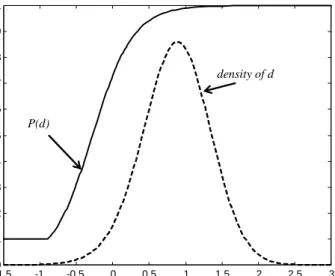
-1.50 -1 -0.5 0 0.5 1 1.5 2 2.5 3 0.1 0.2 0.3 0.4 0.5 0.6 0.7 0.8 0.9 1 d P P(d) density of d
Figure 1: Shows the price of the the bond as a function of the orderflow (solid line) and the density of the order flow (dashed line). Parameter values areW = 1, σ2 = 0.2, γ = 0.05,
δ = 0.1, µL = 0.1, and µH = 0.9, which implies that V ar(l) = 0.1296. Price volatility
itself is a function of the orderflow.
Proposition 5 There exists a unique pure strategy equilibrium as follows:
If B ≤δW, then P = 1 and αg =αb = 1so that the debt is fully served,
uncondi-tionally. If B > δW, then P = ⎧ ⎪ ⎨ ⎪ ⎩ δW B , if ϕ(d)< δW
B , with service strategies α b
∈(0,1) and αg = 1
ϕ(d) if δWB ≤ϕ(d)≤ WB, with service strategies αb = 0 and αg = 1
W
B, if ϕ(d)> W
B, with service strategies α
b = 0 and αg
∈(0,1)
.
(22) In order to derive more concrete results, we now assume thatf is normally distrib-uted with zero mean and varianceσ2. A special case of this equilibrium withB =W is
illustrated in Figure 1. The break in the pricing function reflects the two equilibrium regimes identified in proposition 5: for a weak order flow ϕ(d) < δ the price drops to the flat segment with P = δ, and for stronger order flows, price is increasing in the order flow according to P = ϕ(d). The price thus changes sharply in response tod in the region where the uncertainty about the median voter’s position is highest. For higher levels of d, where it is fairly certain that the median voter’s bond holdings are sufficiently high to guarantee repayment, the bond price is much more stable as a function of changes in demand.
Evidently, this equilibrium is only partially revealing: the most important “funda-mental” of the economy, namely the position of the median voter, cannot be inferred
with certainty from either the order flow or from the market price.16 Crucially, this informational inefficiency has a real effect: the price determines the allocation of bonds to the median voter and thus the incentive to vote for debt repayment. To see this point more clearly, consider an economy with a ω = b realization. If the market maker could observe the domestic demand he would price the debt atδ (still assuming
B = W), which would leave the voters with a (weak) incentive to repay a fraction δ
of the debt. But then, suppose the market maker does not observe domestic demand, but rather infers it from the order flow. When the order flow is low, and as long as
ϕ(d)< δ, the market maker sets the price to itsδ floor. The repayment condition (20) holds with equality so that voters still have an incentive to repay a fraction δ of the debt. But then, as f increases, there comes a point whereϕ(d) > δ and the market maker raises the price above the δ floor. Clearly, now the repayment condition (20) no longer holds and the voters have a strong incentive to write down the debt — fully. Essentially, a lending boom abroad has raised the price of the debt, priced the median voter out of the market and undermined our enforcement mechanism.
We are not aware of systematic evidence of the operation of the relationship iden-tified by Reinhart et. al. (2003). We thus state more formally an econometric test. Suppose that the domestic-foreign components of the order flow are not observable when the debt is issued, but national-accounting information is revealed later on. Now, an econometrician can test whether default is correlated with a high level of foreign demand:
Proposition 6 Conditional on a full default having occurred, the expected demand by foreigners is higher than their unconditional expected demand, i.e., E(f|α = 0) > E(f).
The essence of the last two propositions is that default may result from a statistical error that is incorporated into the bond price. It thus follows that the precision of the market maker’s information should affect the sovereign’s borrowing capacity. To analyze this idea one needs to be more precise about period-one tax capacity. Suppose the upper bound on the implementable lump-sum tax is T ≤ W. It is clear from the equilibrium price that debt capacity is reached by setting B to its upper bound, which is then given by the constraint B ≤ T. Suppose also that δ and T are such that δW
T <1 and therefore default may occur when the maximum amount of bonds is issued. In that case the following is true.
Proposition 7 Debt capacity is decreasing in the volatility of foreign demand.
16Although rational-expectations models usually derive partial revelation by jamming two
contin-uous shocks, a product of one continocontin-uous shock and another binomial is sufficient in order to derive the result (see also Germain and Dridi, 2004).
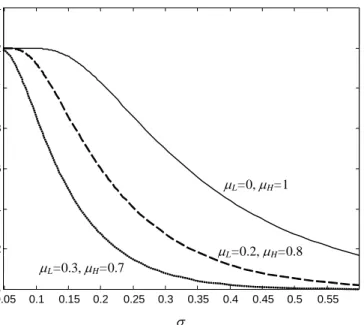
0.05 0.1 0.15 0.2 0.25 0.3 0.35 0.4 0.45 0.5 0.55 0.6 0.62 0.64 0.66 0.68 0.7 0.72 0.74 E(P) σ µL=0,µH=1 µL=0.2,µH=0.8 µL=0.3,µH=0.7
Figure 2: Shows the expected bond price and debt capacity as a function ofσ, the standard deviation of f. Parameter values are γ = 0.4, δ = 0.3 and W = 1. The solid, dashed and dotted line have the following values for (µl, µh), respectively: (0,1), (0.2,0.8), and
(0.3,0.7), which imply a standard deviation forl of 0.34, 0.21 and 0.14, respectively.
Figure 2 shows simulated results. With σ = 0, the model degenerates back to the full-information case. It is clear from the figure that capital-flow volatility has a significant effect on borrowing capacity. At the same time, changes in µL and µH can be interpreted as changes in the volatility of the domestic demand. Hence, the standard rational-expectations intuition is retained: debt capacity is affected by the
relative volatility of the two signals from which the market draws its inference. 8. CONCLUSIONS
In this paper we address a basic question in the theory of sovereign debt, which is why it is ever repaid, even when the penalty for default is non-existent. The answer is simple: where the debt is held by both locals and foreigners, the median voter might have an interest in servicing the debt.
However, the main purpose of the analysis is practical: how should sovereigns, particularly emerging markets, structure their debt so as to utilize their borrowing capacity to the full. Although we have used a conceptual framework inspired by cor-poratefinance, our analysis leads us to the conclusion that in many respects, corporate and sovereign debt are mirror images one of the other. Some of the most sound recom-mendations in corporate borrowing, e.g., the use offinancial intermediaries or avoiding uncoordinated dispersion, are reversed when it comes to sovereign debt. The analysis
also highlights important factors that determine the sovereign’s borrowing capacity, namely income distribution.
We would like to mention two potential directions of future research that follow from our current work. First, our theory implies that a sovereign can borrow abroad only if domestic agents hold a substantial position in the debt. That restricts the econ-omy’s ability to benefit from international diversification. Moreover, domestic shocks might be amplified as they trigger sovereign default and a reduction in borrowing ca-pacity. Since the state often plays an important role as a financial intermediary, the debt crisis might spill over into the domestic banking system, as observed in so many emerging markets. It would be interesting to develop a model that integrates a domes-ticfinancial system with a political mechanism for sovereign debt, so as to understand better the interaction between sovereign debt default and a domesticfinancial crisis.
Second, sovereign debt can be viewed as an extreme case of a security that has no legal enforcement mechanism. Less extreme examples are financial instruments (debt or equity) issued in times and places with a weak or underdeveloped rule of law. Nevertheless, such instruments were often traded in large volumes, with significant economic consequences. Possibly, their actual enforcement relies on localized political institutions, where elections play a role next to lobbying, bribing and other less legiti-mate forms of “persuasion”. We believe our model can be extended to allow for other types of securities and political structures so as to shed some light on this important phenomenon.
9. APPENDIX
Proof of Lemma 1. Using (6) and (7) one can show that ci is concave in α iff w P wi P < y+α w P y+αwi P ,
which can be simplified to
wi > w.
It follows that cH is concave and thus single-peaked in α, possibly at a corner. cL is convex but decreasing in α, and thus peaks at α= 0. cM is single peaked only when median income exceeds average income.
Proof of Lemma 2. Substituting (7) in (6) yields
dci dα = wi P µ 1− αB y+αwP ¶ − ¡ By y+αwP¢2 · ³ y+αwi P ´ . (23) Moreover, d2ci dαdwi = 1 P "µ 1− αB y+αwP ¶ − ¡ αBy y+αw¢2 # .
Clearly, whenever dci
dα ≥0it follows that d2c
i dαdwi >0.
Proof of Proposition 1. In the case where wM > w, mixed-strategy equilibria can be ruled out. Since consumption of H and M agents is concave in α, they will always vote down a mixed-strategy platform in favour of a pure strategy with the same
E(α). Since the standard Median-voter Theorem is applicable, the winning platform at any price P is just given by bαM(P), which can be calculated by maximizing (5) with respect to α. We complete this part of the proof by imposing the rational-expectations condition P = αbM(P) and solving for P. That solution is unique and given by (8). Finally, note that from (4), the constraintτ ≤1is satisfied in equilibrium if αB ≤y+w. From (8) it is clear that this always holds.
The case where wM ≤w, so that cM is convex inα, has two sub-cases. The first one is where B ≤ wM(y+w)
(y+wM) .From (5) we can see that this implies that the M income
group strictly prefers full repayment, α = 1, over full default, α = 0, at any price
P ∈[0,1]. From convexity ofcM it follows thatαbM = 1, and from lemma 2 it follows that αbH = 1. In this case a pure-strategy platform of α = 1 will win a majority vote against any other platform (pure or mixed) through the support of the M and H income groups. Given these preferences, the equilibrium is unique with a bond price of 1. Moreover, it is easy to verifyτ ≤1.
The remainder of the proof deals with the other, more complicated, sub-case where
B > wM(y+w)
(y+wM) . There exists a unique bond price P∗ such that cM forα = 0 equalscM
for α= 1. Using (5) we calculate
P∗ = wM B · q (y−B)2+ 4Byww M +y−B 2y ;
by convexity of cM, it follows that αbM = {0,1}. We show next that this price and the extreme platform (0,1, P∗) is an equilibrium. It should be clear, however, that if it exists, it is also the unique equilibrium. Due to the convexity ofcM any other price would push period-one voting to a pure strategy equilibrium withαeither zero or one. Then P should also be either zero or one in equilibrium. However, if P = 0 then cM
is strictly larger forα= 1 than for α= 0. Conversely, whenP = 1 then cM is strictly larger for α = 0 than for α = 1 and therefore neither P = 0 nor P = 1 can be an equilibrium.
To show that the bond price P∗ and the extreme platform(0,1, P∗) is an equilib-rium we need to demonstrate that it beats any competing platform, at least weakly. Consider, first, a competing extreme platform. It cannot dominate (0,1, P∗) because a platform with q < P∗ (q > P∗) leaves the M income group indifferent, but will be voted down by the H (L) income group.
Consider next a competing,strictly moderate platform, namely(α0, α0, q0)such that
α0 >0, orα0 <1 (or both). Since c
Mincome group; it will thus need the support ofboth theHand theL income groups in order to beat(0,1, P∗). We show that this is impossible.
As a preliminary technical step, we substitute (4) into (5); it follows from the definition of P∗ and the convexity ofc
M that ³ y+αwM P∗ ´ µ 1− αB y+α w P∗ ¶ −y ( = 0 forα ∈{0,1} <0 for α∈(0,1) .
Using this relationship, we derive
cH(α) ( =y+Av(α) forα ∈{0,1} < y+Av(α) for α∈(0,1) , and cL(α) ( =y−v(α) for α∈{0,1} < y−v(α) for α∈(0,1) , where A≡ wH wM −1, andv(α)≡y wM P∗ µ α y+αwM P∗ ¶ .
Now, we show that if (α0, α0, q0) is weakly supported by the H income group, it cannot be supported by theLincome group. Express the weak preference of(α0, α0, q0) over (0,1, P∗)by the H income group as:
(1−q0)cH(α0) +q0cH(α0)≥(1−P∗)cH(0) +P∗cH(1) =y+AP∗v(1). Since (α0, α0, q0) is strictly moderate, we know that
(1−q0)cH(α0) +q0cH(α0)< y+A[(1−q0)v(α0) +q0v(α0)].
Hence, it is not supported by the L income group:
(1−q0)cL(α0) +q0cL(α0) < y−[(1−q0)v(α0) +q0v(α0)] < y−[(1−q 0)c H(α0) +q0cH(α0)]−y A ≤ y−[y+AP ∗v(1)]−y A = (1−P∗)cL(0) +P∗cL(1).
We complete the proof of existence by checking that τ ≤ 1. Using (4) and (9) we conclude thatτ ≤1if
BP∗³1− y
B
´ ≤w. Using (9) it follows that this is always true.
Proof of Proposition 2. WhenwM > w, revenue is increasing inB up to the point where B =K since in that region P = 1. Moreover, forB > K, the price is falling in
B and from (8) it is clear that revenue remains constant.
WhenwM < w, revenue is increasing inB (andP is constant at1) up to the point wM(y+w)
(y+wM) . Beyond that point, revenue iswM t
(y−B)2+4Byww
M+y−B
2y , which is increasing in B and smaller thanw. To complete the proof, apply l’Hopital’s rule to the expression for revenue to compute
lim B→∞wM q¡y B−1 ¢2 + 4B1yww M + y B−1 2yB1 =w.
Finally, for wM = w we have K = wM(y+w)
(y+wM) , and thus P = 1 for B < K, with
revenue increasing in B. For B ≥ K, revenue is given by wM
t
(y−B)2+4Byww
M+y−B
2y ,
which is just w.
Proof of Lemma 3. Using (15) and (16) we derive
dci dT =−(1−τ) ∙ 1−y−T +α wi P y−T +αwP ¸ . (24)
Obviously, for wM > w it follows that dcdTM >0. The M-H income groups thus prefer an ever-higher lump-sum tax, for any level of α. It follows directly that T = T wins a majority against any other proposal with the same repayment strategy. Hence, any equilibrium will featureT =T.
Proof of Proposition 3. Following the same steps as in the proof of proposition 2 we calculate the economy’s debt capacity for the lump-sum-tax case as
KT =
wM(y+w)2−T£wM(y+w) +¡y−T +wM¢w¤
[y(y+wM) +wM(y+w)]−T £¡y−T +wM¢+ (y+wM)¤.
Using the above and (10) we can check whenKT < K. Solving the resulting inequality yields
y(wM−w)£wMw−y¡y−T¢¤>0.
Proof of Proposition 4. Consider first the median voter’s preferred repayment decision in state s by calculating thefirst-order condition:
dcM dα = α2£wM P w P ¡w P −B ¢¤ +α£2ys wM P ¡w P −B ¢¤ + (ys)2¡wM P −B ¢ ¡ ys+αw P ¢2 .
Clearly, wM
P < B cannot be an equilibrium since it implies dcM
dα < 0 and thus the sovereign would default in all states. As a result P → 0, which is a contradiction. Hence, setting dcM
dα = 0 and solving for α within the relevant range
¡w P, wM P ¢ we get b αsM = min{1, ys·Z}, Z ≡ q BP(wM−w) wM(BP−w) −1 w P .
Hence, in period zero (i.e., before s is realized) there are three equilibrium confi gura-tions, depending on the amount B of debt issued:
yl·Z ≥ 1, P = 1, with no default in any state,
yl·Z < 1≤ yh·Z, P <1 with partial default in thel state,
yh·Z < 1, P <1 with partial default in the both states.
Using the definition of Z it is easy to see that the first configuration applies for
B ≤ wM ¡ yl+w¢2 yl(yl+w M) +wM(yl+w) .
Since the price in this region equals one, the revenue is increasing in the number of bonds issued. Using (18) and Z we can see that the third configuration applies for
B > y h E(y)Khy,
with P = Kyh
B . Obviously, the revenue here is greater than in the first region, but it is not increasing within it. Now consider the second region, i.e.,
wM¡yl+w¢2 yl(yl+w M) +wM(yl+w) < B ≤ y h E(y)Khy
where the relevant price is P = πylZ + (1
−π). Defining revenue by R ≡ BP and substituting P = RB into the pricing equation and the expression forZ yields
¡ w+πyl¢ πyl − (1−π)w πyl B R − s R(wM−w) wM(R−w) = 0, (25)
which implicitly defines the function R(B). Applying the implicit function theorem to (25) yields, after some calculations, dR/dB > 0. It follows that debt capacity is achieved whereyh
·Z = 1.
Proof of Proposition 5. The first part of the proposition is obvious: if B ≤ δW
theM income group votes for repayment unconditionally, so thatP = 1.
If B > δW, the equilibrium must have one of the following configurations: either δW =B, αb
∈[0,1),αg = 1 andP =ϕ(d) + (1