166
The Urgency of the Regulation of Certification as an
Attempt to Optimize the Human Resources in Developing
,QGRQHVLD¶V 6KDULD ,QVXUDQFH
Lastuti Abu Bakar
a, Tri Handayani
ba
Law Faculty, Universitas Padjadjaran,Dipati Ukur 35, 40132, Bandung, Indonesia. b
Law Faculty, Universitas Padjadjaran, Dipati Ukur 35, 40132, Bandung, Indonesia
Abstract
Objectives - The development of Islamic insurance in Indonesia contributed to economic growth in 2014. The principle of mutual cooperation and tabarru contract is a characteristic of Islamic insurance. The Opportunity to increase the role of Islamic insurance as an economic entity is done by utilizing various aspects of human resource readiness. Human Resource are required to have a comprehensive understanding of Islamic insurance in order to create compliance with Islamic principles for product and services offered.It can provide legal protection against the Takaful participants. Issues to be examined is how the readiness of the relevant regulatory certification and how Regulatory model certification appropriate human resources in order to develop Islamic insurance in Indonesia.
Methods -The method used is a normative juridical that through the efforts of an inventory of rules and descriptive analytical. To obtain the appropriate regulatory models, a legal comparison method is employed.
Results - Based on the research results, the regulation of certification is required and should include the human resources, starting from a selling agent to the management as a decision maker. This regulation will push the entire human resources involved in the Islamic insurance industry to has the capacity and capability in providing services to the public, and to ensure and guarantee that the services offered comply with Islamic principles. Association of Islamic Insurance Indonesia was initiated concerning certification provisions, but has not been followed by a strong regulations readiness as a legal basis.
Conclusion -Therefore we need a comprehensive regulation and it must be issued by Indonesian Financial Services Authority.
167 Abstrak
Tujuan - Perkembangan asuransi syariah di Indonesia memberikan kontribusi terhadap pertumbuhan ekonomi pada tahun 2014. Prinsip mutual cooperation dan penggunaan akad WDEDUUX¶merupakan ciri dari asuransi syariah. Peluang meningkatkan peran asuransi syariah sebagai entitas ekonomi dilakukan dengan cara memanfaatkan berbagai aspek diantaaranya kesiapan sumber daya manusia. Diperlukan sumber daya manusia yang memiliki pemahaman secara komprehensif tentang asuransi syariah agar tercipta kepatuhan terhadap prinsip syariah untuk produk jasa yang ditawarkan.Hal ini dapat memberikan perlindungan hukum terhadap peserta asuransi syariah. Permasalahan yang akan dikaji adalah bagaimana kesiapan regulasi terkait sertifikasi dan bagaimana model regulasi sertifikasi sumber daya manusia yang tepat dalam rangka mengembangkan asuransi syariah di Indonesia.
Metode - Metode penelitian yang digunakan adalah yuridis normative yaitu melalui upaya inventarisasi aturan dan bersifat deskriptif analitis. Untuk memperoleh model regulasi yang tepat, digunakan pula metode perbandingan hukum.
Hasil - Berdasarkan hasil penelitian diperoleh hasil bahwa Regulasi sertifikasi diperlukan dan harus mencakup sumber daya manusia di mulai dari agen penjual sampai pada manajemen perusahaan sebagai pengambil keputusan. Regulasi ini akan mendorong seluruh sumber daya manusia yang terlibat dalam industri asuransi syariah memiliki kapasitas dan kemampuan dalam memberikan pelayanan kepada masyarakat, serta memastikan dan menjamin bahwa jasa yang ditawarkan patuh pada prinsip syariah. Asosiasi Asuransi Syariah Indonesia sedang menggagas mengenai ketentuan sertifikasi, namun belum diiikuti oleh kesiapan regulasi yang kokoh sebagai landasan hukum.
Kesimpulan - Oleh karena itu diperlukan regulasi yang komprehensif dan dikeluarkan oleh Otoritas Jasa Keuangan Indonesia.
168
1.Introduction
7KH FKDQJH RI ZRUOG¶V HFRQRPLF RUGHU DV WKH LPSDFW RI JOREDO HFRQRPLF FULVLV ZKLFK LV
predictably caused by the excessive financing practices (lending and borrowing), the issuance of non-transparent financial securities and the failure of governance at the level of both institution and system (Myers, DIFSS 2012) have greatly influenced the regional and national economic orders of many countries in the world including Indonesia. The change of the global economy is signified by the growth of Islamic financial institutions that is believed to be able to act as an alternative solution from the global economic crisis. These last few years, the financial institutions and Islamic banking in the world have substantially grown by 10-15% per year managing assets of not less than US$2 trillion which in 1985 were only US$ 10 billion. There are now 500 financial institutions and Islamic bankings operating worldwide. The Islamic financial institutions have been growing side by side with conventional financial institutions that are previously well established in certain countries. In Malaysia, the Islamic financial institutions and bankings are planned to achieve 25% market shares in 2015. Indonesia, one of the countries that is included in the Islamic Finance Emerging Market along with North Africa
and Turkey, will certainly take advantage of this growth momentum (Asaria, DIFSS2013). The Islamic financial industries here refer to banking, insurance, capital markets, money markets, investment management sector and other financial institution services (Ghani & Hussainn, 2009; 9-10).
As a part of Islamic financial institutions, Islamic insurance industry at the global level is growing with the contribution of US$12.4 billion through 143 sharia insurance companies (179 companies including sharia insurance units) (Asaria: 2013). In Indonesia, the growth of sharia insurance companies also demonstrates the increasing trend. In 2014, there are 45 sharia insurance companies and sharia units offering sharia insurance products and contributing around 15-20% of all sharia financial institutions and banking, which was previously recorded only
169
4.8% contribution in 2012.1 The data indicate that the sharia insurance industry has developed although it has not been optimum yet. The industry is expected to be a part of the Indonesian economy in the future. The development of the sharia financial institutions In Indonesia, including sharia insurance, gives implications to at least two things as the supporting factors for sharia economic business. Those are the availability of qualified human resources recognizing sharia principles and the strong regulation as a legal basis for the activities of sharia insurance industry. The regulation of sharia insurance, particularly related to the certification of human resources, is urgently needeG FRQVLGHULQJ WKDW WKH V\VWHP RI ,QGRQHVLD¶V SRVLWLYH ODZ KDV
changed due to the development of sharia economy in Indonesia. Because of the enactment of sharia system and institution in Indonesia, it can be said that there has been dualistic legal economy, which means that there are more than one legal system regulating the same object: the well established conventional economic legal system and the Islamic economic legal system. The dualistic legal economy has juridical implication to the regulatory development, for example in banking activity both of the Act No: 10 of 1998 on the Amendment Act No: 7 of 1992 on Banking and the Act No: 21 of 2008 on Sharia Banking are enacted. By analogy to banking, in addition to the Act No: 40 of 2014 on Insurance, the possibilities that there will be another regulation on sharia insurance or a regulation used as a legal umbrella for sharia economic activities, particularly for non-banking sharia financial industry. Both of the legal systems run simultaneously.
Human resources are one of the significant capitals to ensure that the insurance activities comply with the principles of sharia. In context of Indonesia, the availability of qualified human resources that comprehend sharia economic, more specifically sharia insurance, is one of the obstacles confronted by both industry and the Financial Services Authority (OJK). Sharia Non-Bank Financial Industries Division (INKB) of OJK admitted the lack of competent human resources to control non-bank financial institutions including sharia insurance and it
170
caused poor supervision.2 On the contrary, The Association of Indonesian Sharia Insurance (AASI), an association that supervises industries, has not facilitated the mechanism of the availability of human resources that understand sharia comprehensively.
The lack of human resources in the field of sharia economy has a close relationship to the role of education in Indonesia. Nowadays, most universities particularly faculties of economics have included courses on sharia economics. In fact, the knowledge of sharia economics is not needed only by the students in faculties of economics, but also the students in faculties of law. I find this based on my experience as one of the lecturers in a faculty of law. Courses on banking law, capital market law, financial law, investment law and selected topics
RQ DJUHHPHQW ODZ DUH QRW HQRXJK WR IXOILOO WKH VWXGHQWV¶ GHPDQG RQ WKH FRPSUHKHQVLYH
knowledge if the courses are given only from the conventional law perspectives. The course contents of economic law still refer to economic law developed in the system of common law. On the other side, the need of graduates mastering the law of sharia economy is increasing along with the development of sharia financial institutions and bankings.
The problem in education is one of the difficulties to develop the human resources. In
WKH $VVRFLDWLRQ RI ,VODPLF (FRQRPLVWV ,$(, VWDWHG ³WKH QXPEHU RI KXPDQ UHVRXUFHV in sharia bankings and finances from sharia economic department remains small. Most of them were graduated from conventional economic departments. It shows a mismatch between the
knowledge learned and the profession in practice (Abubakar, ´
To change educational system supporting the development of sharia economy in Indonesia, a strong political will is required from the government. Recognizing the principles of sharia is urgently needed considering the significance of sharia insurance industries to ensure that their sharia mechanisms, products and contracts have to comply with the principles of sharia (sharia compliance). In practice, companies engaged in sharia insurances are in the form
of Limited Liability Company (LLC). Therefore, the compliance with sharia principles is obligatory for every sharia insurance company, considering the Act No: 40 of 2007 on Limited
171
Liability Company as lex generalis in which the company is required to elaborate the principles
of good corporate governance. The good corporate governance is based on transparency,
accountability, responsibility, independency and fairness. Furthermore, to ensure that the
principles of sharia are implemented, Article 109 of the Act on Limited Liability Company regulates the existence of Sharia Supervisory Board (DPS), assigned to supervise companies that run sharia principle-based business. The DPS is assigned to supervise LLC business activitiesto assure that they follow the principles of sharia. The governance of sharia insurance corporate should be run transparently, so public expectation of sharia-based products can be achieved. Technically, the assurance that the human resources are competent can be certified through the mechanism which is applied for all human resources engaged in sharia insurance business, mainly the management and insurance agents. In addition, it is necessary for society to get transparent information related to the offered products, mechanisms and contracts as a basis for legal relation between insurance companies and insured participants.
The society absolutely need to get the information assuring that the sharia insurance products, mechanisms and contracts are free from the prohibited riba, masyir and gharar. On
the contrary, the conventional insurance is assumed to fully contain such prohibited things, particularly gharar or uncertainty (Ali, 2008:7-17). There are several things to notice relating
to the conventional insurance. Firstly, the insurance companies will carry out the obligation to
FRPSHQVDWH ORVVHV H[SHULHQFHG E\ WKH LQVXUHG SDUWLFLSDQWV LI ³XQFHUWDLQ HYHQWV´ RFFXU ,I WKH
uncertain events do not occur, the premium will be the rights of the companies. Secondly, the legal position of the paid premium will be transferred to the related companies as their asset, which can be used in the interests of the companies. Commonly, the funds are invested, including an investment with interest-based income. Therefore, it can be concluded that the mechanisms of conventional insurances are notably different from sharia insurance. Sharia insurance is based on the principles of mutual cooperation between the insurance companies and the insured participants (Abubakar, 2013; 604-613).
172
The mutual cooperation must be stated in a contract as a legal basis for the relationship between both parties. Consequently, it has to be assured that the prohibited items in sharia economy are accommodated in the contract and executed well.
2.Methods
2.1.Approaches and Research Specification
The study is a Normative Legal research with analytic description. The purpose of the normative legal research is to identify law in concreto,that is a research purposed to find a
regulation for resolving certain matters and to find where the legal regulation is (Hanitijo, 1988 : 22). Additionally, the comparison method is employed to compare the law in Indonesia and the law in another country, which already has such regulations. The research also employs an analytic descriptive method, which means that the purpose of the study is to describe secondary data that is supported by primary data relating to the urgency of the certification regulation for human resources in sharia insurance business.
2.2. The Research Steps and Data Collection Techniques
The study is a combination between library research and field research. The library research is purposed to study, examine and search the secondary data in the forms of primary legal sources, secondary legal sources and tertiary legal sources.
The primary legal sources are as follows:
x The 1945 Constitution
x Act No: 21 of 2011 on Financial Services Authority
x Act No. 40 of 2014 on Insurance Business
x Government Regulation No: 39 of 2008 on the Second Amendment to Government
Regulation No: 73 of 1992 on Insurance Business Management as the last amendment by the Government Regulation No: 81 of 2008.
173
x Regulation of the Minister of Finance No: 18/PMK.010/2010 on the
Implementation of Basic Operating Principles of Insurance and Reinsurance Business with Sharia Principles.
x Regulation of the Minister of Finance No: 11 /PMK.010/ 2011 on Financial Health of Insurance and Reinsurance Business with Sharia Principles.
x Fatwa DSN No:21/DSN-MUI/X/ 2001 concerning the General Guidelines for Sharia Insurance
x Fatwa DSN No: 50 /DSN-MUI/III/2006 concerning Mudharabah Musytarakah Contract.
x Fatwa DSN No: 51/DSN-MUI/III/2006 concerning Mudharabah Musytarakah
Contract of Sharia Insurance.
x Fatwa DSN No: 52/DSN-MUI/III/2006 concerning Wakal bil Ujrah Contract on Sharia Insurance and Reinsurance
x Fatwa DSN No: 53/DSN-MUI/III/2006 concerning Tabarru Contract on Sharia Insurance.
x Fatwa DSN No: 81 /DSN-MUI/III/2011 concerning Tabarru Refund of Insurance Participants Terminated before Agreement Period Ended
The literature study includes the secondary legal sources such as literature, previous research findings and workshop related to the issue of the research. In addition, tertiary legal sources such as dictionaries and articles in newspapers and magazines related to the object of the research are included. To support the literature study, the field research is conducted by interviewing respondents considered to be competent and relevant with the research.
3.Results and Discussions
3.1.The Dualism of Insurance Legal System in Indonesia
The establishment of PT Syarikat Takaful Indonesia in 24 February 1994 signified the development of Sharia Insurance in Indonesia on the initiative of the Establishment Team of
174
Indonesia Takaful Insurance (TEPATI) with the support of Indonesia Muslim Scholars Association (ICMI) as the beginning of sharia based insurance business. Along with regulatory changes in insurance business, the sharia insurance grows alongside the conventional insurance, which was previously the only one model of insurance business. The demand on an insurance
VHUYLFHV DOWHUQDWLYH LV SHUFHLYHG DV D QHFHVVLW\ EHFDXVH WKH PDMRULW\ RI ,QGRQHVLD¶V SRSXODWLRQ LV
Muslim. Therefore, the availability of Islamic (sharia)-based business and entity is important to accommodate. Since the regulatory changes which allow the conventional insurance companies to offer sharia insurance services, sharia insurance has grown and developed alongside the conventional insurance business3. The issuance of Decree of the Minister of Finance No: 268/KMK.06/2002 dated 7 November 2002 allows conventional insurance companies to run sharia insurance services through three kinds of mechanism:
x Entirely Direct conversion from conventional insurance to sharia insurance;
x Directly establishing sharia insurance institutions;
x Opening branch office/division for sharia insurance
Furthermore, the growth of sharia insurance in Indonesia is driven by the regulation providing easiness of capital, which requires a minimum capital of only Rp50 billion for the establishment of a sharia insurance company. The amount of minimum capital is much smaller
WKDQ D FRQYHQWLRQDO LQVXUDQFH¶V PLQLPXP FDSLWDO WKDW LV 5S ELOOLRQ4. Beside the easiness in capital aspect, sharia insurance business is also supported by Bapepam-LK, as an authority of Financial Services5, issuing two regulations: Regulation No: PER-06/BL/20116 and Regulation No: PER-07/BL/20117 as the mandate of Article 4 Paragraph (3), Article 45 Paragraph (4) Regulation of Minister of Finance No: 11/PMK.010/2010 on the Financial Health of Insurance
3 See Article 6 paragraph (2) of the PP No .39/2008 on the Second Amendment PP No. 73 of 1992 about The business insurance system
4
Article 6 paragraph ( 2 ) of Government Regulation No: 39 of 2008 concerning Second Amendment to Government Regulation No: 73 of 1992 on Insurance Business Conduct.
5 Since Published Act No. 21 of 2011 on the financial services are under the FSA (Otoritas Jasa Keuangan)
6A Decree of Bapepam LK regulates the shape and structure of the finansial statements and the announcement of insurance ƒ•† ”‡‹••—”ƒ•…‡ „—•‹•‡•• ˜‡„–—”‡ ™‹–Š •Šƒ”‹ïƒ ’”‹•…‹’Ž‡•
7 A Decree Bapepam LK is set on guidelines for the calculation of the amount of funds required to anticipate the risk of loss
î–ƒ„ƒ””—•† •ƒnagement, and the calculation of the amount of funds to be provided by the company to anticipate the tisk of loss that may arise in the administration of insurance and reinsurance business with the Sharia principles
175
and Reinsurance Business with Sharia Principles. Both of the regulations are expected not only to maintain the compliance of companies with transparent principle, but also to provide highest protection for sharia insurance participants.
The implication of changes in regulations to the system of positive law regulating insurance industry in Indonesia is dualism in insurance legal system. In the history of
,QGRQHVLD¶V SRVLWLYH ODZ GXDOLVP RI OHJDO V\VWHP KDV ORQJ EHHQ LQIOXHQFLQJ ,QGRQHVLDn law politics. The dualism of law indicates that there are more than one legal system enacted to regulate the same matter. Since the independence of Indonesia, Article II of the Transitional Provisions of the 1945 Constitution regulates that all of the existing remain in effect as long as new legislation is not created. The Transitional Provision strengthens the existence of legislation enacted in the Dutch colonial period. Therefore, dualism in the field of civil law had occurred before the independence, with the enactment of Civil Code (KUHPerdata) and Commercial Code (KUHD) based on Staatblad 1847:23 which until now remain to be the positive law in the
ILHOG RI FLYLO ODZ DV ZHOO DV WKH OHJDO EDVLV IRU ,QGRQHVLD¶V HFRQRPLF DFWLYLWLHV ,Q DGGLWLRQ WR
legal system enacted in the colonial period, Customary Law remains in effect to indigenous people of Indonesia in some areas particularly laws of family and inheritance; the Islamic Law applies to those who agree to use it. Due to the development of the politics of law, which expects that there will be as much legislation as possible codified, Indonesian legal system moves to the unification of law, that is the enactment of one legal system for all Indonesian citizen. The process of the unification of law is undertaken by considering sensitivity and neutrality of the field of study. A jurist from Universitas Padjadjaran, Mochtar Kusumaatmadja, reminded that the process of the unification of law should be done by considering the areas to be regulated.
The areas RI ODZ FORVHO\ UHODWHG WR LQGLYLGXDO¶V VSLULWXDOLW\ RU WKRVH WKDW DUH QRW QHXWUDO
should not be unified, but the existing laws should remain in effect instead. The existing laws are Western civil law, customary law and religious law. The non-neutral areas of law are inheritance and family laws. (Hazairin,1982) once argued that even though marriage law has
176
been unified by the enactment of Law No: 1 of 1974 on Marriage, the unification is considered unique because the validity of a marriage is still determined by the embraced religious law (Hazairin, 1982). On the contrary, the neutral areas of law such as economic law, contract law and property law can be unified. Furthermore, they may adapt and adopt legal system of other countries as long as it is in accordance with the contexts of Indonesia (Kusumaatmadja, 2002). For example, it can be seen from the legislation governing the field of economics. Although the legal system of Indonesia adheres to civil law system applied in Continental European countries, due to the influence of Dutch colonialism, the area of economic law of Indonesia adapts and adopts more provisions from Anglo-6D[RQ FRXQWULHV¶ FRPPRQ ODZ V\VWHP 9DULRXV
kinds of legislation such as law of banking, capital markets, insurance, consumer protection and investment refer more to the laws in force in Anglo-Saxon countries
Dualism of Indonesian legal system, including insurance law, is relevant to determine the policy and regulation for sharia insurance in the legal system of Indonesia in the future. The legal basis governing the field of insurance all this time refers to Civil Code (KUHPerdata), Commercial Code (KUHD), Law No: 2 of 1992 on Insurance Business and Insurance Agreement. Meanwhile, the practice of sharia insurance in Indonesia refers to Fatwa of the National Sharia Council-MUI and Law Compilation of Islamic Economics and contracts used by sharia insurance companies. Law No: 2 of 1992 on Insurance Business as lex generalis, however, remains in effect as long as new regulation has not been determined and it complies with sharia principles. Based on the above explanation, it can be concluded that the positive laws governing insurance business in Indonesia are the laws of conventional insurance and sharia principles-based insurance. The dualistic legal system will determine regulatory model in the future, whether sharia insurance will be regulated separately from conventional insurance or it will refer to Insurance Act as the main legal norms.
177
3.2.The Difference between Sharia Insurance and Conventional Insurance
The difference between sharia insurance and conventional one is fundamental knowledge that should be possessed by human resources involved in sharia business, especially the front line such as selling agents. The primary expectation of society deciding to choose sharia insurance is a guarantee that the products offered comply with sharia principles, in other words they do not contain any prohibited elements specified by sharia principles. Therefore, recognizing comprehensively the concept of sharia and conventional insurance is essentially relevant. The principal difference between conventional and sharia insurance lies in the underlying philosophy and purpose.
The norms governing the conventional insurance are based on the idea of how to anticipate and transfer risk of future events and its final purpose is to avoid economic loss. Here, insurance is intended to be one of the means to avoid loss that is not necessarily the case. In practice, the risk of loss is transferred to the insurance companies by premium payments. Some view that the legal basis of conventional insurance is selling and buying policy.
Unlike conventional insurance, the norms of sharia insurance are based on the idea that every human has a responsibility to anticipate and plan the future. The National Sharia Council makes the idea as the basis to issue Fatwa DSN No : 21/DSN-MUI/X/2001 concerning General Guidelines for Sharia Insurance. Based on the Fatwa, the definition of Takaful/ WD¶PLQ RU
tadamun (sharia insurance) is:
³HIIRUWV WR SURWHFW DQG KHOS HDFK RWKHUV DPRQJ WKH QXPEHU RI SHRSOH SDUWLHV WKURXJK
investment in the form of assets and/or tabarru that gives the pattern of returns to
encounter certain risks through contract (engagement) in accordance with sharia
SULQFLSOHV´
As a comparison, there are several concepts, proposed by some internationally recognized organizations such as AAOIFI (Accounting and Auditing Organizationfor Islamic Financial Institutions), The Islamic Financial Services Board (IFSB) and International Association of Insurance Supervisors (IAIS), and usually used as a reference by many countries
178
to regulate the practice of sharia economics, including Indonesia which use them in formulating sharia economic regulation.
$$2,),¶VSharia Standard 26(2) 2007 :
³,VODPLF LQVXUDQFH LV DQ DJUHHPHQW EHWZHHQ SHUVRQV ZKR H[SRVHG WR ULVNV WR SURWHFW
themselves against harms arising from the risks by paying contributions on the basis of
³ commitment to donate´ iltizambi al tabarru). Following from that, the insurance
fund established and is treated as a separate legal entity (VKDNVL\\DK L¶WLEDUL\\DK) which has independent financial liability. The fund will cover the compensation against harmsthat befall any of participants due to the occurance of the insured risks (perils) in
DFFRUGDQFH ZLWK WKH WHUPV RI WKH SROLF\´ WKH EROG SULQWHG ZRUGV DUH ZULWHU¶V UHYLVLRQ
The Islamic Financial Services Board (IFSB) and International Association of
Insurance Supervisors (IAIS) :
³WDNDIXO LV WKH ,VODPLc counterpart of conventional insurance, and exists in both life
RU´IDPLO\´ DQG JHQHUDO IRUPV ,W LV EDVHG RQ FRQFHSWV RI PXWXDO VROLGDULW\ DQG D
typical Takaful undertaking will consist of a two tier structure that is a hybrid of a
mutual and commerciaO IRUP RI FRPSDQ\´8(IAIS, 2006: 4)
Referring to the several definitions of sharia insurance (takaful), it can be concluded that
the elements of sharia insurance are the following:
x The purpose of sharia insurance is to provide protection to customers or participants against losses incurred in the future based on the principle of mutual solidarity.
x Funds under the management of sharia insurance companies are used to compensate losses encountered by customers or participants as a donation or voluntary
contribution (El Gamal, 2006: 147).
x Contract underlying the legal relationship in sharia insurace is a combination (hybrid) between non-commercial (WDEDUUX¶) and commercial (tijarah) contract.
8International Association of Insurance Supervisors, Regulation and Supervision of Takaful (Islamic Insurance), Agustus,
179
The issuance of Fatwa DSN No: 21/DSN-MUI/X/2001 concerning the General Guidelines of Sharia Insurance brings debate on the position of insurance in the islamic economic business and the skeptical view about whether or not insurance is allowed in sharia business to an end. There are some legal bases for the existence of insurance in Islamic stance employed by DSN:
x Surah (Al-Hasyr [59]: 18) invokes every God-fearing human being to notice what it will be tomorrow. It emphasizes that sharia accepts insurance observing the principles of sharia as a way to anticipate the future.
x Surah (Al-Baqarah [2]: 275 and 278) legalizes selling and buying activities and forbids usury. In other words, sharia insurance must be totally free from usury.
x Surah (Al-Maidah [5]: 2) invokes every human being to help each others in virtue, righteousness and piety;and prohibits them to help each others in committing sin and transgression.
*URXQGHG RQ +DGLWK DQG 4XU¶DQLF YHUVHV DV WKH OHJDO EDVHV VKDULD LQVXUDQFH LV RQH RI WKH PHDQV
to anticipate the risk of contingent that complies with sharia principles. The basic principle of sharia insurance is mutual cooperation among participant in order to share the risk of a loss encountered by one of the participants and the insurance is grounded on sharia principles, which strictly disallow any business activities based on usury (riba), uncertainty (gharar) and
gambling (masyir). There are several differences between sharia and conventional insurance
related to risk management; the legal position of premium in conventional insurance and donation in sharia insurance; and contract stated in the insurance policy as the legal relationship. The differences are concluded from various regulations governing sharia insurance in Indonesia:
x Risk management: conventional insurance employs the method of transferring the risk of a loss from customers to insurance companies (risk transfer) in which the companies have a responsibility to compensate the loss based on the agreement. Unlike conventional insurance, sharia insurance does not use the method of
180
transferring the risk of loss. All participants agree to donate a regular fund for any fellow participants suffering a defined loss (risk sharing).
x The status of fund operators: the premium paid by customers of conventional insurance belongs to the companies and the customers have the right to get compensation of a defined loss. Meanwhile, in sharia insurance funds collected from participants as donation or contribution are managed separately from
FRPSDQLHV¶ DVVHWV DQG PD\ EH LQYHVWHG WR DQ\ LQYHVWPHQW SURGXFWV REVHUYLQJ VKDULD
principles. The funds, donation aimed to meet the principle of mutual cooperation among participants, will be deposited in a particular account for compensating the risks of loss.
x Types of contracts: the clarity of contract is an essential element in the practice of
mu¶amalah because it determines the validity. In conventional insurance, the
relationship between insurance companies and participants is signed by a sale and purchase agreement (tabaduli) in which participants are charged certain amount of
money, called as premium, while companies will compensate in the case of loss which has not been certain to happen yet. The payment of the premium is determined by the age of participants, which is impossible to predict (in the case of life insurance). As the result, the insurance surely contains the element of gharar.
Meanwhile, in the case of sharia insurance, the contract known as tabarru is based
on mutual cooperation, so it does not depend on something that is not certain. The principle of mutual cooperation (help one another in virtue) in the mechanism of sharia insurance (takaful) is closely related to the implementation of tabarru
contract when participants agree to donate a certain amount of fund to takaful funds.
The principle, however, does not preclude takaful operators or sharia insurance
companies to make profit. Their profits are earned by tijarah contract (commercial)
181
earned must comply with the sharia principle, which means that it is not derived from usury, but from the activities of takaful fund investment and management
through fee based income and profit sharing.
x The reimbursement of fund: in conventional insurance, which does not involve any elements of saving, if participants of insurance do not claim or discontinue to pay premium/terminate insurance agreement. The paid premium is not refundable or forfeit and considered to be the profit of the insurance companies. In sharia insurance, there is no forfeited fund in the case when participants terminate the contract before its due date. Based on Fatwa DSN No: 81/DSN-MUI/III/2011, a part of tabarru fundwill be reimbursed to participants if they discontinue the
contract before its due date.
The differences between sharia and conventional insurance is depend on policy clauses. AASI had taken several concrete steps on May, 2014 by issuing the guideline of sharia insurance policy for life as well as general insurance. The guideline is expected to be implemented on January, 2015. In addition to the policy, AASI and OJK have proposed a standard policy that can be used by sharia insurance companies. The use of the standard policy is intended to become a method to ensure that the rights and obligations of the involved parties are in accordance with sharia principles (sharia compliance). Furthermore, the standard policy is expected to be able to minimize errors conducted by insurance agents in perceiving the products to society.
3.3. The Urgency of Certification for the Development of Sharia Insurance
In the activities of business world, certification is beneficial to provide guarantee to the consumers either in relation to the quality of business actors or the quality of products and services offered. The certification is usually awarded by an institution whose having the
182
human resources is carried by AASI, an association that controls sharia insurance companies, in cooperation with several relevant institutions.
The certification of human resources is simply a part of the demand on institutional certification including the entire institution, mechanism and management (of human resources). Consequently, it can be concluded that the certification of human resources has an important role for the development of sharia insurance if it is supported by some legal infrastructures such as regulatory, supervisory and legal enforcement. The legal regulatory is related to the readiness of legal framework as a legal basis for requiring human resources certification in every sharia insurance activity in Indonesia. Meanwhile, the supervisory is related to process and institutions having authority to control and ensure the compliance of the companies to sharia principles. And the legal enforcement here would be a means of accountability of the authorities to public and the legal protection for sharia insurance industry.
The legal issue here is that the requirement of certification for sharia insurance companies has not been explicitly and comprehensively regulated either under the provisions of legislation or the regulations of Financial Services Authority, so it is still perceived as a voluntary requirement. It can be seen from the practice of human resources certification related to the liability of company registration to the Financial Services Authority (OJK). In the conditions of registration, it is stated that all insurance companies offering sharia insurance products must be registered as the member of association, in terms of the member of AASI.
The conditions are based on the systematic ideas that AASI was established by sharia insurance industries in the missions of socializing sharia insurance as well as building its members to improve their production capacities and sharia-based service standards. Besides, AASI is an association grounded on Islamic sharia by adhering to the principles of friendship, solidarity, openness, honesty, fairness, trust, professionalism and welfare. Based on the missions, principles, and purposes of the establishment of AASI, every insurance company offering sharia products should have certainly observed the sharia principle. It can also be concluded that the liability of certification is still in the formal level and administrative
183
obligation to meet the requirements to obtain a permit from the authority. Founded on the result of the research, at this time the regulation related to certification is partial and simply a part of administrative requirements explicitly stated in Fatwa DSN No: 21/DSN-MUI/X/2001
concerning the Guidelines of Sharia Insurance.
Referring to legal perspectives, the regulation of human resources certification in the
VKDULD HFRQRPLF DFWLYLW\ LV VWLOO LQ WKH OHYHO RI ³YROXQWDU\ UXOHV´ ZKLOH WKH UHTXLUHPHQW RI WKH
certification is considered to be an assurance of the sharia-principle compliance. The regulation of human resources certification that is compulsory, in the substantial sense that it is a must to observe and its law enforcement is determined if such obligation fails to be done, is urgently needed. In addition to the obligatory rules, the regulation that assures the supervision of certification mechanism and legal enforcement is also necessary. Therefore, the regulatory model of certification that is substantial and comprehensive seems to be relevant as one of the factors to support the growth of sharia insurance industry in Indonesia. The future certification regulatory must be stated in the legislation products that will legally bind industries with elements that include the designated institutions, mechanisms, supervisions and law enforcement.
Based on the observation to the practice of sharia insurance, AASI and IIS argue that the certification for sharia insurance agents is an urgent requirement considering a few things such as:9
x Selling sharia insurance products is different from the conventional ones.
x The requirement in the level of marketing to have enough capability and competency in selling sharia insurance products is really necessary.
x The certification is an effort to support the sale of sharia insurance products.
The existing regulation of human resources certification has not significantly influenced insurance companies. Recently the qualified human resources, as an expert of sharia insurance,
9 This article is in the news and events that are mounted in the official site Insurance Association Shari'a Indonesia, AASI, http//:
184
have not supported companies. In practice, some insurance companies that violate the principle of sharia are still found. Sharia Non Financial Industries Division in OJK reported that there are 10% of sharia insurance companies managing investment funds on investment products that is not in accordance with investment products governed in the Regulation of Minister of Finance No: 11 /PMK.010/ 201110. The absence of regulation governing the liability of certification is potentially detrimental to the customers considering the weakness of legal enforcement.
Industries and associations are interested in the liability of certification for the purpose to increase public trustworthiness to sharia insurance products. In addition to the certification program for sharia insurance agents, AASI in cooperation with DSN, IIS and related associations have designed a guideline of standard policy to ensure that the contract between an insurer and insured comply with the principle of sharia (sharia compliance). AASI have
recommended some programs in terms of standardization carried by both the Ministry of Law
DQG WKH $$6,¶V /HJLVODWLRQ DQG 6WDQGDUGL]DWLRQ ,Q SULQFLSOH WKH SURJUDPV DUH FORVHO\ UHODWHG WR
the certification for sharia insurance institutions, including their human resources.
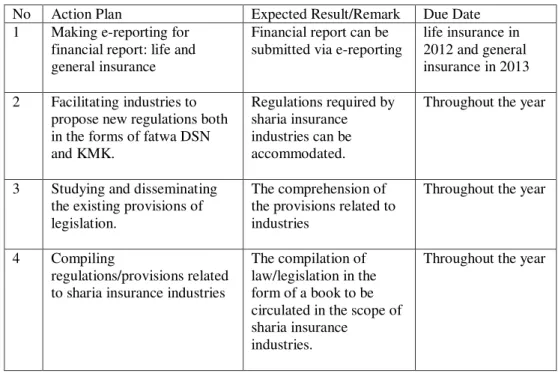
The work programs of AASI, including the human resources certification, are as follow: Table 1 The Work Programs of AASI 2011-2014
No Action Plan Expected Result/Remark Due Date 1 Making e-reporting for
financial report: life and general insurance
Financial report can be submitted via e-reporting
life insurance in 2012 and general insurance in 2013 2 Facilitating industries to
propose new regulations both in the forms of fatwa DSN and KMK.
Regulations required by sharia insurance industries can be accommodated.
Throughout the year
3 Studying and disseminating the existing provisions of legislation.
The comprehension of the provisions related to industries
Throughout the year
4 Compiling
regulations/provisions related to sharia insurance industries
The compilation of law/legislation in the form of a book to be circulated in the scope of sharia insurance
industries.
Throughout the year
185 5 Standardizing code of etics for
sharia insurance marketing
The guideline of code of ethics for sharia
insurance marketing
Second Quarter of 2013
6 Licensing agency of sharia insurance (life and general ins.) in cooperation with AAJI and AAUI
Insurance agents possess a license to sell sharia insurance products
Both life and general insurance in the second quarter of 2012
7 Implementing the standard policy of sharia insurance
3.2.1.1.The enactment of the standard policy for both life and general insurance
Life insurance in the second quarter of 2012, general insurance in the fourth quarter of 2012
Source: The Work Programs of AASI 2011-2014
3.3.The Regulation and Institutions Conducted Certification
There is no particular requirement for an insurance company to be certified. There are, however, some administrative requirements for an insurance company offering sharia insurance products:
x A company must be a member of AASI;
x A company must have a business license and operating license from authorized institutions and must be domiciled in Indonesia
x A company is stated pass by the association, which organizes the certification. The institution that organizes the certification is AASI, in cooperation with other association The certification carried by AASI is considered appropriate because it is important for a business actor to fulfill the requirements determined by the regulator. Furthermore, AASI is an organization created to accommodate industrial demands, including to provide human resources that meet global standard. In designing curriculum and syllabus for the certification, AASI is cooperated with IIS (Islamic Insurance Society) and other related associations.
In addition to OJK and the National Sharia Council (DSN), other
LQVWLWXWLRQV DVVRFLDWLRQV WKDW DUH $$6,¶V SDUWQHUV LQ WKH SURFHVV RI FHUWLILFDWLRQ DUH ,QGRQHVLDQ
Insurance Council (DAI), the Association of Indonesian Life Insurance (AAJI), the Association of Indonesian General Insurance (AAUI), the Association of Indonesian Social Security Insurance (AAJSI), the Association of Indonesian Insurance and Reinsurance Brokers
186
(APPARINDO), Indonesian Insurance Mediation Board (BMAI), the National Sharia Board of Arbitration (BASYARNAS), the Experts Association of Indonesia Insurance and Insurance Management (APARI), the Experts Association of Indonesian Insurance and Reinsurance Brokers (APARI), the Association of Indonesia Insurance Adjusters (APKAI), the Experts Association of Indonesian Security and Healthcare Management (PAMJAKI), Indonesia Senior Executive Association (ISEA) and Islamic Insurance Society (IIS). Cooperated with the associations and regulators, AASI provide a darft of certification and standardization required, along with the curriculum, code of ethics and its guideline.
Based on Financial Services Authority Act And The Guidelines from Association (AASI) the scope of Certification of Human Resources regarding sharia insurance companies includes:
x Experts: they must be certified as one of the requirements for units or sharia insurance companies to obtain a permit from the authority. In relation to this, there is no limitation on the number of experts in a sharia insurance company, but at least three personnel in the company must be certified as an expert of sharia insurance. The certification for the experts is carried by the Association of Experts on Sharia Insurance and Sharia Insurance Management (AAMAI) as a partner of AASI.
x Insurance and Reinsurance brokers: those who are involved in the filed of sharia insurance are also obliged to be certified. The certification here is carried by the Association of Indonesian Insurance and Reinsurance Brokers (APARI)
x Adjuster: they are certified by the Association of Indonesian Insurance Adjusters (APKAI).
AASI in cooperation with AAJI now hold a certification program for insurance agents/salesperson marketing sharia insurance products, which was launched in 2013. The program is initiated by grandfathering program, that is an introduction to the standard syllabus
187
June to December 2013. The validity period of the program is one year. In addition, AASI provide CPD (continuing professional development) consisting of one module at minimum,
which are aimed to extend the grandfathering license of the agents. Then, an integrated
examination carried by AAJI for new agents began in 2014. Every life insurance company is expected to send their agents to participate in this sharia certification in order to support the target of achieving 500,000 certified agents. Based on the result of the research, it is found that the certification program that has been conducted by the association is purposedtomake sharia industries comply with the principles of transparency and responsibility to public in order to meet good corporate governance.
As a comparison, the regulation and practice of certification in Malaysia are organized by an association in cooperation with a regulator and the certification is conducted via online. The certification for insurance agents in Malaysia is organized by Malaysia Takaful Association(MTA) in cooperation with Islamic banking and Finance Institute Malaysia (IBFIM) in holding Takaful Basic Exam. The certification is only required so far for insurance agents
which operators are a member of Malaysia Takaful Association. The management of insurance companies was limited by the regulation stated in Malaysia Takaful Act of 1984, but now it is declared invalid since the enactment of Islamic Financial Services Act (IFSA) 2013 which certify that a company must comply with sharia principle and set punishments against administrative violations conducted by companies. In Indonesia, OJK requires that companies must be a member of the association and possess sharia insurance experts. Therefore, it can be concluded that in Malaysia, the certification is an obligatory rule for every Takaful operator.
Based on the result of the observation on the practice of the certification of sharia insurance human resources carried by the association, AASI, it is found that the weakness in sharia industries is the limited knowledge of the human resources. AASI is still dominated by the board from industries instead of the human resources that are particularly assigned to manage and run the planned agenda. It makes the association less optimal. Furthermore, the curriculum and the process of certification are still cooperated with many diverse educational
188
institutions. In fact, the development of curriculum is one of the significant factors in optimizing the certification. Malaysia have previously established system in relation to the certification of agency and its curriculum. In addition to legal support requiring every Takaful operator to observe sharia principle as well as legal enforcement, Malaysia appoint MTA and IBFIM to regularly hold certification and issue license for agents under a takaful operator.
Based on the comparative method, we are mapping the result of the research taken in Indonesia and Malaysia concerning the urgency of the certification as one of the means to assure the compliance of a company with sharia principles (sharia compliance). The compliance
ZLWK VKDULD SULQFLSOH LV EHOLHYHG WR KDYH FDSDELOLW\ RI LQFUHDVLQJ FXVWRPHUV¶ FRQILGHQFH WR WKH
company.
Table 2. The Comparison of the Practice of Certification for Sharia Insurance Human Resources in Indonesia and Malaysia
No The Elements of Comparison
Indonesia Malaysia
1 The legal Basis POJK No: 1/2013;
Permenkeu 11/2011; Fatwa DSN:
21/DSN-MUI/X/2001.
Regulated by the Islamic Finance Services Acts 2013, and the Guideline issued by
Malaysia Takaful Association (MTA).
2 The object of
certification
1. Sharia insurance experts 2. Sharia insurance agents
1. Managements Agents/brokers 3 The requirement of certification There is no particular requirement. An agent must be a member of a takaful operator registered in the Bank of Malaysia 4 The certification mechanism Certification is only administrative requirement and there have not been any obligatory rules.
Passing TBE (The Basic Exam) is an obligatory. 5 The Institutions organizing certification Conducted by the association (AASI) in cooperation with educational institutions. Cooperation between Malaysia Takaful Association (MTA) and IBFIM (Institute Banking and Finance Institute Malaysia)
6 The standard policy Issued on the beginning of 2014 and disseminated on April, 2014.
Conducted by takaful operators under the supervision of
3.3.1.1.SAC (Sharia Advisory Council)
189 7
The Model of contract
Wakalah and Mudharabah Pure Cooperative, Wakalah and Mudharabah Model. 8
The law enforcement Written warning A fine Source: Created by the research team
3.4.The Regulatory Model of Human Resources Certification in Sharia Insurance Business
Based on the analysis drawn from the data of the research, it is found that the regulatory
RI KXPDQ UHVRXUFHV FHUWLILFDWLRQ LQ ,QGRQHVLD¶V VKDULD LQVXUDQFH EXVLQHVV KDV QRW EHHQ RSWLPXP
It can be observed from the characteristics of regulation:
x The certification of human resources in sharia insurance business can be explicitely concluded from some different regulations. Those are Fatwa from the National Sharia Council (DSN), Regulation from the Financial Services Authority (OJK) and the Policy from the Association.
x The certification is regarded as the need to meet the administrative requirement, so it is still voluntary rules instead of obligatory rules.
x The systems of supervision and legal enforcement still find difficulty because of the limitation of the human resources based on report from internal sharia insurance companies, the Sharia Supervisory Council.
The future regulatory model should be more comprehensive, in the sense of including a solid legal basis, transparent and accountable mechanisms and consistent legal enforcement if there is an insurance company that does not follow the certification. It is regarded necessary in the purpose of increasing public confidence in sharia insurance and improving sharia insurance
FRPSDQLHV¶ FRPSOLDQFH ZLWK WKH SULQFLSOH RI VKDULD DQG JRRG FRUSRUDWH JRYHUQDQFH
Based on a solid legal basis, sharia insurance industry ideally employs a regulatory model of sharia banking, which is set in the legislation itself and followed by the regulations issued by Bank of Indonesia and OJK, using the legal sources that have been established by the National Sharia Council. However, considering the difficulty of initiating legislation, a comprehensive regulation should be issued by the Finacial Services Auhtority (OJK) by using
190
the legal sources that have been established by the National Sharia Coucil (DSN). The difficulty of initiating legistaltion cannot be separated from the existing policy, in which a company may create a unit of sharia as a part of conventional sharia insurance. Meanwhile, the idea of initiating legislation can only be proposed if the minimum number of independent sharia insurance companies is10. Based on the result of the research, it is found that the tendency to choose the form of unit is due to the consideration of cost efficiency and the availability of human resources. This is different from the regulation of sharia insurance in Malaysia in which sharia insurance companies are disallowed to create units of sharia.
4.Conclusion and recommendation
4.1.Conclusion
Based on the result of the research, it can be concluded that:
x Certification is one of the means to provide assurance and legal protection for customers, particularly to assure that the insurance company complies with the principle of sharia. Consequently, the certification of human resources gives contribution to the development of sharia insurance in Indonesia. Now, Indonesia has not regulated the obligation of certification in legislation explicitly yet. The legal bases of the certification are still based on Fatwa issued by DSN and the demand from industries, which have to be elaborated in legislation. The situation is different from Malaysia which has possessed an umbrella regulation, that is Finance Services Act 2013 (IFSA 2013). Under Act No: 40 of 2014 on
Insurance, which was legalized and enacted on 17 October 2014 and the repeal of Act No: 2 of 1992 on Insurance, Sharia (Takaful) and conventional insurance isset simultaneously.
x The regulation of human resources certification in Indonesia is still partial and voluntary rules. The certification is simply regarded as an administrative requirement for a company/unit of insurance company to run sharia insurance services. Therefore, the model of human resources certification in the future should be based on a solid legal
191
basis, in the form of Regulation issued by the Financial Sercives Authority at minimum, and be comprehensive, covering institutional aspects, certification mechanisms and legal enforcement. This means that the regulation of certification should be obligatory rules.
4.2.Recommendation
x In the future, the regulation of sharia insurance should be separated from the regulation of conventional insurance as legal umbrella, considering there are substantially different principles underlying the regulation.
x The association should be managed professionally in order to facilitate the demands of industries, including certification.
x Continuous cooperation between government, industries and universities is strongly needed to develop curriculum as well as the implementation of the certification.
References
Ghani, Badlisyah Abdul & Hussainn, Shamsun A (2009) The Key Driver of Islamic Finance-
Demand and Supply, CIMB Islamic, Islamic Finance Review.
Engku Ali, Engku Rabiah Adawiah et.al (2008) Essential Guide To Takaful (Islamic Insurance),
Centre For Research And Training, Kuala Lumpur
Hazairin,(1982) Hukum Kewarisan Bilateral menurut Quran dan Hadith, Tirtamas, Jakarta.
Asaria, Iqbal (2013), Innovation and Developments in Takaful and Retakaful , Durham Islamic
Finance Summer School, Durham-UK 2013
Abubakar, Lastuti (2013), AnalisLV WHUKDGDS 3HQHUDSDQ 3ULQVLS ³0XWXDO &RRSHUDWLRQ´ GDODP
mekanisme Takaful (Asuransi Syariah)-Peran Hukum Dalam Pembangunan di
Indonesia, PT Remaja Rosdakarya, Bandung,
Abubakar, Lastuti (2010) Implikasi Aktivitas Ekonomi Syariah Terhadap Perkembangan
Hukum EKonomi Di Indonesia, Jurnal Legal Review, Volume 1. No.2, 2010
192
Kusumaatmadja, Mochtar (2002) Konsep-konsep Hukum Dalam Pembangunan (Kumpulan
Karya Tulis), Alumni, Bandung.
Soemitro, Ronny Hanitijo (1988) Metodologi Penelitian Hukum dan Jurimetri, Ghalia
Indonesia, Jakarta,
Myers, Thomas A. (2012) From Enron to Subprime Mortgages to Greece : How Islamic
Finance Principles Might Have Avoided the Recent financial Crises, Durham Islamic
Finance Summer School 2012, Durham Islamic Finance Programme, Durham University.
Fatwa DSN No : 21/DSN-MUI/X/2001 concerning General Guidelines for Sharia Insurance.
Regulation of Minister of Finance No : 11 /PMK.010/ 2011
Financial Services Authority (OJK) Act, Number 21 of 2011
Finance Services Act 2013 (IFSA 2013) malaysia
Under Act No: 40 of 2014 on Insurance
International Association of Insurance Supervisors, Regulation and Supervision of Takaful