University of South Florida
Scholar Commons
College of Education Publications College of Education
2-16-2003
Education Policy Analysis Archives 11/07
Arizona State University
University of South Florida
Follow this and additional works at:http://scholarcommons.usf.edu/coedu_pub Part of theEducation Commons
This Article is brought to you for free and open access by the College of Education at Scholar Commons. It has been accepted for inclusion in College of Education Publications by an authorized administrator of Scholar Commons. For more information, please [email protected].
Scholar Commons Citation
Arizona State University and University of South Florida, "Education Policy Analysis Archives 11/07 " (2003).College of Education Publications.Paper 419.
Education Policy Analysis Archives
Volume 11 Number 7 February 16, 2003 ISSN 1068-2341
A peer-reviewed scholarly journal
Editor: Gene V Glass
College of Education Arizona State University
Copyright 2003, the EDUCATION POLICY ANALYSIS ARCHIVES.
Permission is hereby granted to copy any article if EPAA is credited and copies are not sold. EPAA is a project of the
Education Policy Studies Laboratory.
Articles appearing in EPAA are abstracted in the Current Index to Journals in Education by the ERIC Clearinghouse on Assessment and Evaluation and are permanently archived in Resources in Education.
The Impact of Minnesota's "Profile of Learning" on
Teaching and Learning in English and Social Studies Classrooms
Patricia G. Avery
Richard Beach
Jodiann Coler
University of Minnesota
Citation: Avery, P. G., Beach, R., & Coler, J. (2003, February 16). The impact of Minnesota's "Profile of Learning" on teaching and learning in English and social studies classrooms, Education Policy Analysis Archives, 11(7). Retrieved [Date] from http://epaa.asu.edu/epaa/v11n7/.
Abstract
In 1990, the Minnesota State Board of Education declared its intention to develop a "results-oriented graduation requirement" based on student achievement as opposed to the usual credit/course completion
requirement. In addition to a traditional test of basic skills, the state began developing the Profile of Learning, a set of performance-based standards grounded in a constructivist educational philosophy, an approach that differs from the content-based standards found in many
states. The Profile was controversial from its inception. Conservatives characterized the Profile as too process- oriented and as lacking subject-matter content; teachers reported that the Profile required a significant amount of additional teacher preparation time; and parents, who were not adequately informed about the Profile, questioned the purpose of the Profile. Teachers were frustrated with the confusing and sometimes contradictory directions they received from the Minnesota Department of Children, Families, and Learning charged with
implementing the Profile. In 2000-2001, we surveyed and interviewed selected secondary English and social studies teachers in the state about their perceptions of the Profile’s impact on teaching and learning.
Among the positive perceptions was an increase in students’ higher order thinking, students’ understanding of criteria for quality work, and
teachers conversations with one another about instructional issues. Increased teacher preparation time and decreased enjoyment of teaching were among the negative perceptions. Teachers also experienced
difficulty adopting performance assessment techniques. When teachers believed they received effective preparation and adequate resources for working with the Profile, they were much more likely to report beneficial effects in terms of teaching and learning. The majority of teachers, however, rated their preparation and resources as "fair" or "poor." Results are discussed in terms of school and instructional change.
At the beginning of the year 2000, 49 of 50 states had adopted standards that describe what students should "know and be able to do." Many of the standards documents were created to set high academic expectations for all students, and to add "rigor" to
purportedly watered-down curricula. Most states have developed or are developing assessments to determine whether students "meet the standards"—hence the term
"standards-based assessments." Thirty-seven of the states' assessments reflect yet another recent development in education—a trend toward the use of nontraditional assessments (Education Week, 2000). The nontraditional assessments range from constructed response items (short answer) to demonstrations of performance, such as conducting a science experiment or giving a persuasive speech. In contrast to the use of
multiple-choice tests, the use of performance assessments is thought to challenge students in ways that allow for individual strengths and diversity in thinking (Eisner, 1999; Wiggins, 1998).
We are thus witnessing two major changes in education: standards-based assessment and performance-based assessment—both of which are being conducted in many states for high stakes. Evaluation and research studies on the implementation and effects of state standards-based assessments are just now beginning to accumulate. Some of the state standards documents are perceived by teachers and the public as confusing and overly burdensome (McDonnell & Choisser, 1997; Schomaker & Marzano, 1999). Many reports suggest that teachers are ill prepared to use nontraditional assessments (Bateson, 1994; Black & Wiliam, 1998; Firestone, Roseblum, & Bader, 1992; Plake & Impara, 1997). When teachers are comfortable with nontraditional assessments, studies find that the format requires an enormous amount of teacher time in addition to the costs of scoring (Koretz, Stecher, Klein, & McCaffrey, 1994). Some states, including Arizona, California, Kentucky, and most recently Maryland, have pulled back from the idea of using high stakes performance-based assessments because of concerns about time, cost,
and questionable psychometric properties. A few studies report teachers perceive positive changes in their instruction when they use performance assessments, but the same teachers question whether the costs make the change worthwhile (Herman, 1997; Koretz et al., 1994; Madaus & Kellaghan, 1993).
Underlying the development of performance assessments is a constructivist philosophy toward teaching and learning. Although there are various interpretations of
constructivism among scholars, most agree that it implies that students "construct" meaning by engaging in activities that require them to manipulate and synthesize data, rather than reproduce information. Teachers in states adopting constructivist-oriented standards often have difficulty switching to authentic or performance-based assessment of students' demonstration of learning. Missouri teachers experienced considerable difficulty implementing performance assessments, mostly due to lack of training (Jackson, 2000). An analysis of high school teachers in three suburban Illinois schools indicated that only a small number of these teachers were actually using authentic assessments (Meisenheimer, 1996). Those teachers who did employ performance assessments were more likely to be receiving in-service training, were actively involved in professional organizations and in their schools, and had a strong philosophical
understanding of the purpose and value of authentic assessment. It was also the case that these teachers were working in schools that supported their efforts by encouraging their experimentation and providing them with in-service training.
In this report, we describe the state assessment system developed in Minnesota, a state that has long had a reputation for being innovative and progressive in the area of
education. We briefly relate significant events in the "story" of the Minnesota standards, and then present the quantitative results of a survey of English and social studies
teachers on their perceptions of the impact of the standards. We also identify themes and issues that emerge from the qualitative survey data, as well as interviews conducted with selected teachers. Together, survey and interview data provide insights into the promise and challenge of standards-based reform, particularly as it relates to
constructivist-oriented, performance-based assessment.
The Development of Minnesota's Graduation Requirements
The current national focus on standards-based assessment is often traced back to the publication of A Nation at Risk in 1983, a report from then Secretary of Education Terrell Bell (National Commission on Excellence in Education, 1983). The report characterized the public education system as a "rising tide of mediocrity" that no longer prepares young people for adult work and responsibilities. According to the report, watered-down content, low expectations for students, and poorly prepared teachers had contributed to a weak and deteriorating educational system. A Nation at Risk prompted a wave of educational reports from national and state commissions, "Blue Ribbon" panels, and community leaders, each designed to give us a picture of the "status of education," either in a particular area (e.g., teacher education programs, middle schools), for a specific group (e.g., low-income students, special needs students), or for a certain locale (e.g., state, region).
Minnesota business and community leaders, concerned that too many high school graduates did not have basic math and literacy skills, joined the call for educational reforms that would better prepare young people for the workforce. The notion that "seat
time" should not qualify students for a high school diploma shifted attention toward "what students know and can do" as the criteria for graduation. In 1987, the Minnesota legislature directed the State Board of Education to identify "core learner outcomes" for each curriculum area, i.e., what should students know and be able to do in mathematics? in social studies? in English? The first set of Essential Learner Outcomes was adopted by the State Board of Education in 1988.
At the national level in 1989, President George H. Bush convened an education summit with the nation's governors in Virginia. The group agreed on six education goals to be achieved by the year 2000; these goals were collectively referred to as "America 2000." President Bill Clinton later added two goals, and renamed the list "Goals 2000." The first goal, and the one most often cited, states that "All children will start school ready to learn." It is the third goal, however, that bears directly on the standards-based assessment movement:
American students will leave grades four, eight, and twelve having
demonstrated competency in challenging subject matter including English, mathematics, science, history and geography. (America 2000, 1991, p. 9) This particular goal is consistent with the trajectory Minnesota followed in terms of educational reform.
In 1990 the Minnesota State Board of Education declared its intention to develop a "results-oriented graduation requirement" based on student achievement as opposed to the current credit/course completion requirement. A Graduation Standards Executive Committee, composed of business, education and citizen groups, was appointed to review the process of moving toward this "results-oriented" system. It was about this time that a group of education scholars conducted an in-depth study of the assessment reforms underway in six states, among them Minnesota. Their observations were published in the Teachers College Record in 1992 (Firestone et al., 1992). The authors suggested that Minnesota's plans for reform (along with Arizona's plans, the ASAP test) were notable because they held the potential to increase students' higher-level thinking. The Minnesota Department of Children, Families and Learning (CFL) sought to develop two sets of standards, one focusing on basic skills in math, reading and writing, and another designed to set high, rigorous expectations for students. The former would be assessed through the Minnesota Basic Skills Test, and the latter through
performance-based assessments called the Minnesota High Standards (formerly called, and most commonly still referred to as the Profile of Learning). Both the basic and high standards are purportedly guided by five Comprehensive Goals—that students who graduate from the Minnesota public schools be:
Purposeful Thinkers; Effective Communicators; Self-Directed Learners;
Productive Group Participants; and Responsible Citizens.
The Basic Skills Test. In order to graduate, all public school students in Minnesota, beginning with the high school graduating class of 2000, were required to pass the Basic Skills Tests in reading and math. These tests are written in the traditional
multiple-choice format. The Basic Skills tests are initially given to students in the eighth grade, and students who do not pass the test can take it annually through the twelfth grade. The Basic Skills Test in writing composition is given in the tenth grade, and similar to the reading and math tests, students who fail the writing test can re-take it through the twelfth grade. The class of 2001 was required to pass the writing test (in addition to the reading and math tests) as a condition for graduation. All of the basic skills tests are "high stakes tests"—students who do not pass these tests are not to receive a high school diploma.
The basic skills tests generated little controversy in Minnesota until the summer of 2000, when it was discovered that a data entry error had incorrectly scored one form of the math basic skills test. Approximately 8,000 students were told they had failed the test, when in fact they had passed the test. Of these students, approximately 300 were seniors who were not permitted to graduate with their class in the spring (Welsh, 2001).
Special legislative sessions were convened during the summer to determine how such an error could have occurred. The situation prompted many Minnesotans to question the wisdom of using the score from one test to determine whether a student should graduate. At present, however, the major change in the system has been the implementation of a range of safeguards to lessen the likelihood that such an error will occur again.
The Profile of Learning. The Profile of Learning has generated the most controversy in the state of Minnesota. Not surprisingly, it also represents a significant deviation from traditional schooling and testing. Whereas the Basic Skills Tests set a minimum level of knowledge for students to attain, the Profile required students to demonstrate a higher level of understanding through performance-based assessments. Similarly, while the Basic Skills Tests focuses on traditional subject areas (reading, writing and math), the
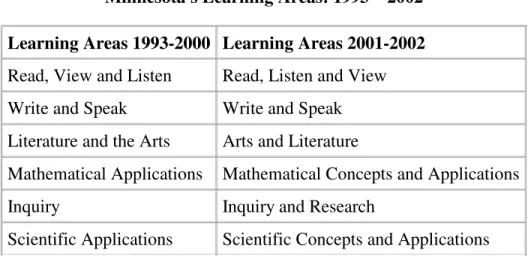
Profile was originally based on interdisciplinary "learning areas" that characterize a "well-rounded" education. The 110 Essential Learner Outcomes identified by CFL in the early 1990s were reworked to form a list of 25, then 15, and finally, 10 areas of learning. Table 1 shows the changes in the learning areas between 1993 and 2002. The learning areas that were most often used between 1993 and 2000 reflected an effort to move toward major interdisciplinary concepts (e.g., people and cultures, decision making) and toward more active, practical learning (e.g., mathematical applications). The current learning areas include the names of more traditional subject areas, such as social studies, physical education and economics.
Table 1
Minnesota's Learning Areas: 1993 – 2002 Learning Areas 1993-2000 Learning Areas 2001-2002
Read, View and Listen Read, Listen and View
Write and Speak Write and Speak
Literature and the Arts Arts and Literature
Mathematical Applications Mathematical Concepts and Applications
Inquiry Inquiry and Research
People and Cultures Social Studies
Decision Making Physical Education and Lifetime Fitness
Resource Management Economics and Business
World Languages (optional) World Languages (optional)
Note: There have been many changes in the Learning Areas in the past decade; however, these were the dominant areas for the time periods shown.
Each learning area encompasses two or more content standards. For example, in 2000, a middle grades content standard associated with the "Read, View and Listen" learning area was as follows:
Literature and Arts Analysis and Interpretation.
A student shall demonstrate the ability to interpret and evaluate complex works of music, dance, theater, visual arts, literature, or media arts by doing the following:
describing the elements and structure of the art form; the artistic intent; and the historical, cultural, and social background of the selected art works;
A.
applying specific critical criteria to interpret and analyze the selected art works;
B.
describing how particular effects are produced by the artist's use of the elements of the art form; and
C.
communicating an informed interpretation using the vocabulary of the art form.
D.
A high school content standard often associated with the social studies under the learning area "Inquiry" was as follows:
Issue Analysis.
A student shall research an issue and evaluate proposed positions or solutions by:
gathering information on past or contemporary issues; A.
identifying relevant questions or a range of points of view; B.
summarizing relevant background information; C.
examining information from each source for bias and intended audience;
D.
identifying areas of conflict, compromise, or agreement among various groups concerning the issue; and
E.
evaluating multiple positions and proposed solutions for the issue, including analyzing conclusions, arguments, and supporting evidence; identifying motives of groups or individuals; analyzing feasibility and practicality; identifying impact on policies; comparing alternative solutions; and projecting consequences.
F.
In order to graduate, students were to complete 24 standards in grades 9 – 12. Students would receive credit for attempting a standard, even if their work was unsatisfactory.
Scores were to be recorded on student transcripts. Students in grades 1-8 were to
complete "preparatory standards," the "building blocks" for the high school standards. In essence, the Profile created a "spiral performance assessment system" around 10 major themes; the performances became increasingly complex within a given theme or "area of learning" as students progressed through school (Minnesota Department of Children, Families, and Learning, 1998).
To foster implementation of the Profile, CFL relied primarily on a "train-the-trainer" model. Training workshops on the Profile were organized throughout the state for selected teachers and administrators. These representatives then returned to their own districts to provide teachers with training at the local level. Districts also designated certain curriculum coordinators as responsible for overseeing the Profile
implementation. Teachers met in local districts to discuss ways of aligning their own curriculums to the standards, meetings that sometimes involved extensive rethinking of their teaching.
One problem with relying primarily on a "train-the-trainer" model was that, other than basic information on the CFL Website and the packages, there were few alternative sources of information—printed materials, videos, or curriculum frameworks for teachers, administrators, and parents. (One rationale for the lack of print materials was that because the Profile was continually changing, CFL was reluctant to print materials that would become outdated or outmoded. Materials and handouts from CFL rarely indicated dates or authors. It was therefore difficult to ascertain whether particular policies had been superceded by other policies, adding to teacher confusion over policy). This "train-the-trainer" model effectively served those teachers who were willing to attend workshops and actively participate in the training process, especially in districts that were providing high levels of support. However, a sizable number of teachers who were less enthusiastic about the Profile often received only minimal training from individuals who, through no fault of their own, were not always familiar with the most recent changes in the Profile. At workshops it was not unusual to have teachers sharing conflicting information they had received from people who should have been "in the know." As a result, these reluctant teachers, as well as parents and the public, often had little understanding of the Profile.
In workshops across the state, teachers were told that students should demonstrate they had "met the standard" through high-quality "performance packages." A "performance package" is defined as a set of interrelated performance tasks that give students the opportunity to demonstrate mastery of a standard. The "performance packages" were to be "embedded" into the curriculum.
A CFL handout entitled "The A, B, C's of Performance Tasks," stipulated that the performance tasks in the packages should be authentic, unbiased, and constructivist. CFL developed "performance packages" to serve as models for teachers, and eventually, most of the standards were accompanied by "performance packages." In the
"performance package" designed to meet the "Issues Analysis" standard previously cited, for example, students were required to research an issue of importance to them, identify key stakeholders and interest groups related to the issue, prepare a position paper stating their own beliefs about the issue, develop a consensus position among a small group of peers, and present their findings to a community group involved in the decision-making processes that affect the issue.
Many aspects of the "performance packages" were consistent with the characteristics of "effective instruction," as well as major principles of learning and motivation. For example, at various points in most of the "performance packages" were checklists of tasks the students were to complete. The checklists, in addition to specifying the criteria by which the work would eventually be evaluated, required students to self-assess, and teachers to monitor students' progress. The checklists assured that students would receive feedback throughout their work.
The students were often required to be active participants in "constructing their own meaning" by collecting or manipulating data, posing hypotheses and making
generalizations. Successful completion of a "performance package" frequently required students to work in cooperative groups, or to interact with community members outside the classroom. Theodore Sizer might call many of the students' work products
"exhibitions" (Sizer, 1997); the Teaching for Understanding group at Harvard University might call the students' work "performances of understanding" (Wiske, 1998); and Fred Newmann and his colleagues of the former Center on Organization and Restructuring of Schools (CORS) at the University of Wisconsin might label the
students' work examples of "authentic student performance" (Newmann, Secada, & Wehlage, 1995). Although these scholars would undoubtedly make changes in the "performance packages," they would probably be supportive of the philosophy upon which the packages were based.
When students completed a "performance package," their work associated with meeting a particular standard was evaluated by their teacher on criteria specified by a state rubric, and awarded a holistic score of 4 (exemplary), 3 (proficient), 2 (novice) or 1 (beginning). Students could meet five of the six criteria listed under "4", but if the sixth criteria merited a "2", students would be awarded a "2." In other words, all parts of the listed criteria needed to be met for a specific score to be given.
Although many teachers found some merit in specific aspects of the "performance packages," the packages became a focal point for a barrage of criticism from teachers, parents, and community members. Schomaker and Marzano (1999) note that "most of the state assessment-based standards documents have contributed to the problem they were designed to address. Documents are way too long, and full of educational jargon." Unfortunately, the Profile, and more specifically its accompanying performance
packages, are subject to their critique. The packages used terminology unfamiliar even to veteran teachers (e.g., "content standard," "element," "task management skills"). They required teachers to use skills with which many were unfamiliar, such as using checklists or scoring rubrics. Some of the performance packages required content knowledge that teachers simply had not acquired. The sheer length of the packages (one was 65 pages!) was overwhelming to students and teachers alike. Many teachers complained that the performance packages were becoming the de facto curriculum. Moreover, the quality of the performance packages developed by the state was uneven.
Although the CFL developed the performance packages to serve as models, many districts either assumed the packages were state-mandated, or because the development of a package was so time intensive, mandated the use of the state packages within their district. And while CFL insisted that districts could develop their own performance packages, the Department also wanted some kind of "quality control" to assure that all students were expected to demonstrate the same level of academic rigor. Initially, CFL
wanted to monitor the quality of the performance packages. Then, because of vehement cries for local control, individual school districts gained the authority to give their "stamp of approval" to performance packages developed within the district. Most recently, CFL declared that separate performance assessments, instead of performance
packages, can be used to meet parts of a standard. The significance of this is that while the completion of a performance package was often burdensome and overwhelming for a one-quarter civics class, for example, completion of short performance assessments could more easily be interwoven into an existing course.
Aside from their concerns about the performance packages, teachers grew frustrated with the constant changes in the standards requirements. Similarly, it was not unusual to get contradictory information from CFL representatives. CFL wanted to be attentive to teachers' feedback about the Profile, but in doing so, this often meant making changes that further frustrated teachers.
In 1993, the Minnesota State Legislature envisioned that both the Basic Skills Tests and the Profile of Learning would be required of students entering ninth grade during the 1996-97 school year. The Basic Skills Tests in reading and mathematics were in place for ninth graders in 1996-97 (the class scheduled to graduate in 2000); the Basic Skills Writing Test was deferred until the following year. Beginning with the ninth grade class of 1998, students were to have completed the Profile in order to graduate.
The Profile of Learning was the subject of intense debate in the 1998, 1999 and 2000 legislative sessions. In 1998, the legislature created a Standards Advisory Panel, composed of 11 leaders from business and education, to make recommendations to the 1999 legislature on the implementation of the Profile of Learning. Among their
recommendations, the Advisory Panel suggested that the number of "learning areas" be reduced from 10 to 5; that the reference to state performance packages in the Graduation Rule be eliminated, and that the language used in the Graduation Rule be "clear and understandable to teachers, parents and students."
During the 1999 legislative session, the House voted to eliminate the Profile in favor of more traditional coursework. The Senate voted to retain the Profile, but with some of the modifications suggested by the Standards Advisory Panel. The session ended without any action taken on the Profile. House conferees refused to consider modifications to the
Profile; had the Legislature adopted the modifications, it was thought that the
widespread opposition to the Profile would have decreased substantially. The goal of the staunch opponents to the Profile was to eliminate it, not to modify it.
In early 2000, a poll released by the state teachers' union, Education Minnesota, indicated that 39% of the 608 teachers surveyed wanted to eliminate the Profile
altogether; another 51% wanted significant changes; and only 9% of the teachers believed the Profile should remain in its current form (Draper, 2000). Education Minnesota co-presidents called for a major overhaul of the Profile. At about the same time, Education Week published a report entitled Quality Counts in which they graded states on their assessment programs. States received a grade based on the types of assessments used, and the number of subject areas assessed. Minnesota, ranked in the bottom 10 states, was given a grade of C- (Education Week, 2000).
In the 2000 legislative session, the Profile narrowly escaped elimination. The House of Representatives voted 97 – 34 to delay indefinitely the implementation of the Profile as
a graduation requirement. Conservatives proposed the North Star Standard, a plan that focuses on the "basics" in core subject area courses, as an alternative to the Profile. The North Star Standard would focus on content over process, and would use the traditional A-F grading system as opposed to the 4-3-2-1 scores mandated by the Profile.
The Senate was generally more supportive of the Profile, and in a conference committee convened in May 2000, a compromise was reached whereby local school boards would be allowed to choose between the Profile and the North Star Standard, the
back-to-basics alternative inspired by the House. Profile supporters believed that the only bill that would pass both the House and the Senate needed to include the Profile
and the North Star Standard. However, Profile supporters, together with the CFL Commissioner, insisted that students in both Profile and North Star Standard districts take the Minnesota Comprehensive Assessments, standardized tests for school accountability based on Profile-related goals. At the last minute, the North Star
Standards supporters refused to sign the compromise bill, ostensibly because it required assessments that did not match the goals of their back-to-basics standards. The Senate passed a "Profile-only" bill, 82 – 44 at 3:20 a.m. on May 18th. An hour and one-half later, members of the House cast the last vote of the longest legislative session in Minnesota history, and passed the "Profile-only" bill 99-27.
The bill approved by the House and Senate gave districts much more control over the way in which the Profile was (or was not) to be implemented. Each district's teachers, administrators and school board members were to vote on how many, if any, standards from the Profile students would need to complete. The bill encourages districts to work toward implementation of all 24 standards, but no timeline is mentioned. Slightly over half (53%) of the state's 332 districts voted to require all 24 standards. A few districts voted not to require their students to complete any standards. Local districts could decide whether to use the familiar letter grades as opposed to the 4-3-2-1 system. Significantly, the statute also stated that "districts...may use one or more assessment methods to measure students' performance on one or more content standards. The commissioner [of the Department of Children, Families and Learning] shall not mandate in rule or
otherwise the assessment methods that local sites must use to meet the requirements under this section."
Opponents of the Profile vowed to renew the fight to eliminate the Profile in the 2001 legislative session. Lawmakers, however, seemed weary of the Profile debate in 2001. School funding formulas and early childhood education were the focus of attention in terms of educational issues. A state budget crisis dominates the legislative agenda in 2002. Until April 19, 2002, there had been little discussion of the Profile. But on that date, the House Majority Leader introduced an amendment to repeal the Profile. The amendment won bi-partisan support, and passed 109 – 22 (Bakst, 2002). The vote in the Senate was tied, 33 – 33. Although Governor Jesse Ventura had supported the Profile,
and thus would most likely veto a proposal to eliminate it, the "near-death" experience of the Profile jarred many of its supporters (Lonetree, 2002). In the annual Quality Counts report published in Education Week in early 2002, Minnesota's "grade" for
"Standards and Accountability" dropped to a D- (Education Week, 2002). Tim Pawlenty, a Republican, was elected to serve as Minnesota's governor in the November 2002 election; a major part of his campaign platform was a promise to eliminate the Profile.
Thus, at the time of this writing, the future of the Profile is tenuous at best. Over the past five years, several studies have examined the implementation of the
Table 2
Characteristics of Survey Respondents and their Schools
(N = 658) Gender Female 50% Male 50% Highest Degree Bachelor of Arts 37% Masters 59% Specialist Certificate 3% Other 1% School Setting Rural 45%
Profile. A 1998 survey administered to a sample of 1600 teachers from 100 Minnesota public schools asked teachers to assess their knowledge and understanding of the
Profile. Over 80% of the teachers indicated they knew enough about the Profile to integrate the standards into their teaching (Human Capital Research Corporation, 1998). A later study based on focus groups with teachers across the state examined the degree to which the standards are being implemented in the schools (Minnesota Department of Children, Families & Learning, 2000). Almost two-thirds of the 2500 teachers who participated in the focus groups believed the standards had been integrated into their curriculum, but only half felt the standards were "aligned" with instruction, assessment and curriculum. One of the more significant themes of the focus groups was that
teachers believed they were talking with one another more often about curricular issues. Notably absent have been studies of how the Profile is affecting school and classroom practice. In the present study, we begin to shift the focus of research and evaluation away from teacher knowledge and implementation issues, and toward the impact of the Profile
on teaching and learning in the classroom. We begin by asking teachers their perceptions of the Profile's impact on teaching and learning.
Methods
The respondents. All 292 English/language arts teachers who are members of the
Minnesota Council of Teachers of English (MCTE) were surveyed; 171 or 59% returned completed questionnaires. Similarly, the 945 secondary social studies teachers who are members of the Minnesota Council for the Social Studies (MCSS) were surveyed; 487 or 52% of the teachers completed the questionnaire. Table 2 provides demographic information about the teachers. The typical respondent was a mid-career
European-American with a Masters degree who taught outside the inner city. Follow-up interviews were conducted with 51 English teachers and 89 social studies teachers.
The questionnaire. A questionnaire was designed to assess secondary English and social studies teachers' perceptions of the ways in with the Profile may be affecting teaching and learning in their classrooms. Eight items focus on how the Profile may have impacted student learning (e.g., students' higher level thinking, students' interest in social studies) and 10 items focus on how the Profile may have affected teaching (e.g., teachers' preparation time, teachers' enjoyment of teaching). For each item, teachers were asked to respond on a 7-point scale (decreased a lot, decreased moderately, decreased slightly, no impact, increased slightly, increased moderately, increased a lot). Items were primarily chosen because they represent (1) goals associated with the study of English and social studies (e.g., students' interest in English/social studies); (2) characteristics of "authentic
Suburban 44%
Urban 11%
Length of Class Periods
30-55 minutes 71%
Over 55 minutes 29%
Years of Teaching Experience
Range: 0-39 years
Mean: 17 years
Size of Social Studies Department
Range: 1-25 teachers
Mean: 8 teachers
pedagogy"(Note 1) (e.g., students'
interactions with one another about social studies content); (3) characteristics of professional community (Note 2) (e.g., teachers' conversations with colleagues in their school about English/social studies instruction and assessment); and (4) stated goals of CFL (e.g., the degree to which students are prepared for "life after graduation"). These categories are not mutually exclusive. For example, increasing students' higher level thinking is not only a goal of the English/social studies and CFL, but is also a characteristic of authentic pedagogy. Finally, standard demographic information was collected (e.g., years of teaching experience, school setting, most advanced degree), and teachers were asked about the quality of their preparation for working with the Profile (e.g., teacher/inservice workshops).
The first draft of the questionnaire was reviewed by two expert social studies teachers, both of whom have earned National Board Certification, one curriculum coordinator for an urban district, a Minnesota state curriculum coordinator, and an English education professor with expertise in the state standards movement. The questionnaire was revised several times based on reviewers' comments and suggestions.
The interviews. Interviews were conducted with a selected number of teachers completing the questionnaire. Teachers were asked to elaborate on their written
comments on the questionnaire (regarding positive and negative aspects of the Profile), and to describe their work with standards packages/assignments. In some cases, we deviated from the interview schedule to ask follow-up questions. Transcripts of interviews were analyzed in terms of references to various topics.
Data collection procedures.Questionnaires were mailed the second week in September 2000 to all MCTE and MCSS secondary teachers. A postcard reminding teachers to return the questionnaire was mailed one week later, and two weeks after the postcard mailing, a second copy of the questionnaire was mailed to teachers who had not yet responded to the survey. On the questionnaire, teachers indicated whether they would be willing to be interviewed about their responses. Phone or e-mail interviews were
conducted in February and March of 2001 with those teachers who indicated a willingness to be interviewed.
Data analysis. For the questionnaire items, a simple frequency of responses was calculated. NVIVO, a qualitative data analysis software package, was used to code the interview data. All three researchers initially read 25% of the transcripts to create a set of closed codes to use in the analysis of the interview data. Through an iterative process, agreement was reached on coding categories. Each investigator then coded one-third of the data, after which the coded data were then reviewed for emergent themes and frequency of responses in coding categories.
Results
In this section, we report the results of the quantitative analysis, and offer excerpts from the interview data to explain some of the quantitative findings. Thus, we weave together questionnaire and interview data to present a picture of how teachers perceive the Profile
is impacting teaching and learning in their classrooms. The interview data also suggested teacher observations and concerns not directly related to the questionnaire items. In an effort to give voice to these teachers, the themes and patterns in these data are also described.
Impact on student learning. Table 3 shows teachers' perceptions of the impact of the
Profile on students' learning. The percentage of teachers who believe the Profile has had a positive impact on student learning ranges from 22% (increased student interest in English/social studies) to 51% (increased students' higher level thinking). In many, though not a majority of classrooms, teachers perceive the Profile to be having a positive impact on student learning.
Table 3
Respondents' Perceptions of the Impact of the
Profile of Learning on Student Learning
(N = 658) Decreased (%) No Impact (%) Increased (%)
Students' higher level thinking 6% 43% 51%
Students' interest in English/social studies
28 50 22
Students' interaction with one another 9 54 37
Students' understanding of grading criteria*
22 33 45
Teacher communication with students about work quality
7 46 47
Students' interaction with community outside school
4 65 31
Quality of students' work on assignment 11 55 34
Students' preparation for "life" after school
9 62 29
*English teachers were significantly more likely to perceive increases in students' understanding of grading criteria than were social studies teachers.
In the interviews, teachers noted that constructivist instruction requires students to take responsibility for their own learning, apply their own knowledge, and work together collaboratively. They also noted the value of having students demonstrate proficiency through "hands-on" learning associated with higher levels of student involvement in the classroom. One teacher cited a specific example from a class simulation of the Treaty of
Versailles she created to meet a content standard:
I can remember one young man two years ago who got into being part of the Turkish delegation at the Treaty of Versailles, and came up with original pieces of documentation that he just loved. And it turned him onto history. That's the payback. When you see the light bulb turn on and history
becomes more than a textbook or a dry set of facts.
For teachers such as this one, the Profile offered an opportunity to set high expectations for students and to assess their learning in a constructivist manner.
Some teachers noted that the Profile's focus on authentic, "hands-on" assessment was already consistent with their own previous constructivist instruction. One teacher noted that the Profile is "fine because I've done a lot of hands-on activities in my classroom. And I believe in that—show me what you learned, not just tell me on a sheet of paper." Teachers who already used constructivist strategies in their classrooms agreed with the theory behind the Profile, yet also saw it as redundant for their instructional practices.
Impact on teaching. Table 4 documents teachers' perceptions of the impact of the Profile
on aspects of their teaching. Similar to teachers' perceptions of the impact of the Profile
on student learning, many teachers perceive the Profile to be having a positive impact on various aspects of their teaching. Slightly more than one-third believe the Profile has helped to increase the coordination of content across grade levels, the range of teachers' instructional methods and materials (among them computer technology), and the use of nontraditional assessments. Teachers reported that rather than focus on their own instruction, they had to focus on student learning because the Profile required them to explain their learning expectations to students and parents, clarify criteria for evaluation, share these criteria with colleagues, and display student work. Most educational
reformers would view these developments as potentially positive.
Table 4
Teachers' Perceptions of the Impact of the
Profile of Learning on Teaching
(N = 658) Item Decreased (%) No Impact (%) Increased (%)
Teachers' preparation time for classes 7% 11% 82%
Use of a wider range of teaching materials 9 44 47
Use of nontraditional assessments 10 55 35
Conversations with school colleagues about social studies teaching and assessment
3 31 66
Interaction with colleagues outside school 3 56 41
Interest in subject area 17 67 16
Enjoyment of teaching* 53 35 12
Use of computer technology 5 61 34
Use of different teaching approaches 6 58 36
*Social studies teachers were significantly more likely to indicate a decrease in their enjoyment of teaching than were English teachers.
Perhaps most striking is the teachers' report that the Profile prompted more discussion about English/social studies instruction and assessment with their colleagues. As one teacher noted, teachers were more likely to discuss issues of curriculum development given the mandate of standards implementation:
We have talked more, had more opportunities to connect....the Profile is a good "equalizer" for staff in various curricular areas—more
understanding/integrating. Even staff who have disliked/discounted standards/profiles have a greater sense of purpose as professionals.
In reflecting on both local and state-wide training, the opportunity to have positive professional discussions with colleagues was seen as a positive outcome.
The school culture has traditionally isolated most teachers from one another in terms of substantive conversations about their work. Although many of their conversations might have been based on complaints about the Profile, it is quite likely that the discussions increased teachers' sense of collegiality, as well as their understanding of one another's views on high quality instruction and assessment.
Although the Profile appears to have had a positive impact in many classrooms, teachers perceive at least two very strong negative aspects to the Profile: More than four-fifths of the teachers believe the Profile has increased their preparation time, and over one-half report that working with the Profile has decreased their enjoyment of teaching.
By far the most frequently mentioned issue for teachers in regards to implementation in our interviews was the "huge amount of time invested." More time was spent in the preparation of the packages, pre-teaching in class, completing the performance assessments in class, grading the performance assessments, and record-keeping and documentation.
In the interviews, teachers reported that conscientious teachers devoted considerable time to learning how to the implement the standards:
The pressure to prove to someone that they were doing a good job put unnecessary pressure on those teachers, took time away from other areas to go to training sessions and create whatever for their districts...just additional time away from other classroom activities or work days when they were planning or preparing for the next quarter.
In many cases not only did teachers see the additional time as an issue, but also felt that the loss of time may have been equally well spent on other areas of curriculum,
instruction, and assessment.
Rather than relying solely on textbooks, teachers often had to devise their own
One teacher described the preparation involved:
I've done the time capsule, where they, students are supposed to select 10 items or 10 events or people that really influenced the United States from 1900 to 2000. And then they're supposed to come up with ideas on [that item.] They write a description of it, and then they write another paragraph justifying it. And getting all the materials ready, getting the library time to do that, when they're so limited. I mean, the state asked us to do this, but they don't give us any money to have bigger IMCs [media centers] where we could all get in, or bigger computer labs, or money to photocopy these things.
Gathering curriculum materials, conducting research, and organizing the materials and technology students needed to be successful all contributed to time spent by teachers on
Profile implementation.
Teachers indicated that adopting a performance assessment approach also represented a major increase in the amount of time devoted to evaluation and grading. In having to spend more time in monitoring and evaluating individual student work in class, teachers had less opportunity for large group discussion or lecture. Grading time in the evenings and on the weekends also increased, as they worked to consistently grade large numbers of performance assessments. One social studies teacher reported, "Each ["Create a Nation"] project takes between 45 and 90 minutes to fully evaluate." In devising performance assessment tasks, they needed to develop self-evaluation checklists for students to complete, as well as provide their own evaluation on the same checklists. As one teacher noted, "I can't write out a checklist for every learning task for every student and still maintain the quality of instruction." Many teachers used the phrase "too much time" in discussing the time they devoted to evaluation and grading, noting in particular that they felt it decreased the time they could spend with students.
The teachers were most critical of what they perceived to be excessive record-keeping associated with performance-based evaluation and CFL reporting requirements. One teacher described this as involving completing "other checklists that have to be filled out and there are additional numbers that have to be recorded...the numbers, it's the
incredible numbers, it's a hassle in terms of recording the numbers." Another explained: Either way it equals extra hours of work at the end of the school year when we are swamped with work anyway. This extra time the teachers need to put in does not improve the students' education in any way. I see it as busywork, paper work, unnecessary bureaucratic requirements.
In order to keep track of students' completion of various standards necessary for
graduation, teachers were required to monitor whether each student was completing each standard and registering for courses that assured completion of all standards. One
teacher described the process:
We now take what was formerly a parent teacher conference day and have turned it into a registration day for next year's classes. We hope that with the parent, teacher, and student present, we won't accidentally let a kid go through grade 12 and find out that he/she is missing a graduation package that will prevent graduation. We teachers have to learn about registration
and prepare materials for the conference as well as call parents and make appointments for their conferences.
Not only does record-keeping take more time, but teachers were asked to take on additional duties for record-keeping that they had not previously been responsible for. The increased teacher time required of the Profile seems directly related to the finding that 53% of the teachers reported a loss in enjoyment of teaching. Teachers who had reported this were asked to explain why during the interview process. For most teachers, a primary reason for decreased enjoyment of teaching was the dramatic increase in time spent on administering and assessing the Profile, efforts they did not necessarily feel benefited students or themselves.
Teachers who reported a "loss of enjoyment in teaching" on the questionnaire also often explained that the loss of favorite content or projects during Profile implementation was partly to blame. One teacher said, "I saw myself cutting activities that students enjoy to be replaced by CFL activities that neither I nor my students enjoy." Another commented:
I've had units that I really love teaching and really enjoy and I've had to throw those out because they didn't meet the grad standard in my class. As far as I can see the grad standard drives curriculum...The important thing in the course is to cover the grad standard and the other stuff is secondary. In these cases, the loss of curriculum or change in curricular focus was perceived negatively by teachers.
Many teachers cited specific examples of lost content; entire chapters or units that had been cut in order to have enough class time for students to complete performance packages. Time spent in class on performance packages varied in the interview data from one to six weeks, with content being cut in order to complete the packages in all cases. One social studies teacher noted:
We have had to cut out units on the executive branch and judicial branch so that we could fit in the packages. The executive and judicial branch are what these kids should be learning, how to make a difference in their communities through the three branches of government rather than a weak attempt to try to change something that they feel content with in the first place.
In cases such as this, teachers were not only dismayed over the loss of content but also concerned about the usefulness of the time spent instead on performance packages.
The impact of teacher preparation and resources. Two factors appear to have a strong influence on teachers' perceptions of the Profile: The perceived quality of their
preparation for working with the Profile, and the perceived quality of the resources (human and material) available to assist them. (Note 3) Table 5 shows how teachers rated their preparation and resources. Tables 6 through 9 suggest a strong pattern: When teachers describe their preparation as "excellent" or "good," or when they report that the resources available to them were "excellent" or "good", they are more likely to see the
Profile as having a positive impact on student learning and teacher instruction. However, the percentage of teachers reporting high quality ("excellent" or "good") preparation and
resources is relatively low, 30% and 25% respectively.
Table 5
Teachers' Perceptions of their Preparation and Resources for Working with the Profile (N = 658)
Rating Preparation for Working with the Profile (%)
Resources (Human & Material) for Working with Profile (%)
Excellent 8% 5%
Good 22 20
Fair 35 37
Poor 32 37
Table 6
Respondents' Perceptions of the Impact of the
Profile of Learning on Student Learning by
Quality of Teacher Preparation Teachers noting increases in... Preparation
Fair/Poor (%)
(Note 4)
Preparation
Excellent/Good (%)
(Note 5)
Students' higher level thinking 47%
(Note 6)
64%
(Note 7)
Students' interest in English/social studies
19 31
Students' interaction with one another 35 44
Students' understanding of grading criteria
44 51
Teacher communication with students about work quality
45 59
Students' interaction with community outside school
29 40
Quality of students' work on assignments
31 44
Students' preparation for "life" after school
26 41
Table 7
Respondents' Perceptions of the Impact of the
Profile of Learning on Teaching by
Quality of Teacher Preparation
Fair/Poor (%) (Note 8) Excellent/Good (%) (Note 9)
Teachers' preparation time for classes 80%
(Note 10)
87%
(Note 11)
Use of a wider range of teaching materials 45 53
Use of nontraditional assessments 34 39
Conversations with school colleagues about social studies teaching and assessment
64 71
Interaction with colleagues outside school 37 51
Interest in subject area 14 25
Enjoyment of teaching 10 18
Coordination across grade levels 37 46
Use of computer technology 32 41
Use of different teaching approaches 35 41
Table 8
Respondents' Perceptions of the Impact of the
Profile of Learning on Student Learning by
Quality of Resources Available to Teachers Teachers noting increases in... Resources
Fair/Poor (%) (Note 12)
Resources
Excellent/Good (%) (Note 13)
Students' higher level thinking 45 (Note 14) 69 (Note 15)
Students' interest in English/social studies
19 31
Students' interaction with one another 32 52
Students' understanding of grading criteria
40 60
Teacher communication with students about work quality
43 60
Students' interaction with community outside school
26 48
Quality of students' work on assignments
28 52
Students' preparation for "life" after school
22 52
Respondents' Perceptions of the Impact of the
Profile of Learning on Teaching by
Quality of Resources Available to Teachers
Item Resources Fair/Poor (%) (Note 16) Resources Excellent/Good (%) (Note 17)
Teachers' preparation time for classes 82% (Note 18) 81% (Note 19)
Use of a wider range of teaching materials 44 55
Use of nontraditional assessments 33 42
Conversations with school colleagues about social studies teaching and assessment
61 79
Interaction with colleagues outside school 34 60
Interest in subject area 12 28
Enjoyment of teaching 9 20
Coordination across grade levels 33 55
Use of computer technology 31 43
Use of different teaching approaches 32 50
In the interviews, teachers noted that the most useful training consisted of helping them think about the relationships between standards and their own instruction in terms of the degree to which the instruction addressed specific standards. One teacher recalled a specific incident in which a trainer challenged the teachers to compare standards and packages:
You would look at a package and you would say, this is unbelievable, you cannot do this in a classroom. Like you had to give speeches to authentic audiences, a variety of speeches to authentic audiences, in the package. And she would look right in it and say, does it say that in the standard? And then you'd go back and say, no. Well then does it, you know, address the
standard first and then you can adapt the package. So it was her coming in and pointing out little things like that.
Other teachers believed that the success of the training depended on teachers' openness and willingness to change, as opposed to the quality of the training. Having praised the quality of the training sessions she attended, one teacher then noted that "my education about the standards came because I sought out chances to learn more, not because anyone came out to the school to present workshops." Another teacher reported that because training sessions were not required or made mandatory, teachers often did not attend: "Most of the teachers I've worked with never attended a single standards workshop."
Teachers perceived their school districts as assuming an important role in the Profile's
and staff development support. Consistent with the survey findings, the level of variability in the quality of district training and support was perhaps one of the most important factors shaping the level and quality of standards implementation. One teacher praised her district for the "terrific job of in-service for the Profile. These included teaching strategies as well as meetings dedicated to informing teachers where the district stood and the process we were going through." Districts who were initially involved as pilot demonstration sites or who consistently provided support and leadership were more likely to be perceived by teachers as being successful in standards implementation. A teacher noted the important role of district leadership:
We were very actively involved because our assistant superintendent was very involved. To be truthful, he pushed a great deal of this onto the staff and the district, but now we are ahead of the game. Whenever I would go to the spring social studies conventions..., I always came back aware of just how far ahead our district was.
Teachers also noted the key support roles provided by curriculum coordinators in providing training, updating staff on changes, and providing resources. One of these district coordinators was praised for the amount of time she devoted to her work:
I'm sure she was working 80 hours a week for probably about two years. And she had such a command of facts and such a big picture and she could kind of put it all in place, all these different parts and things like that. She was really kind of the glue that held it all together.
Teachers also valued the work of local curriculum coordinators who often interpreted the Profile in ways that were consistent with a district's own local needs, serving as a mediating bridge between state-wide accountability and local control was also praised. One teacher stated that a curriculum coordinator was sensitive to teachers' needs:
She said, no, all you have to do then is identify those assignments that meet the standard and you keep track of those for the rubric score. Well, that's a whole different way of looking at things...her interpretation has been much better for teachers.
Often, teachers who were positive about their local curriculum coordinators were also more positive about the process of implementing the Profile and its impact on their own students.
On the other hand, some teachers were critical of school districts' lack of support or rigid interpretations of CFL directives. They often perceived their district leadership as more interested in pleasing CFL than in serving their own needs in terms of providing quality training. As one teacher noted, "since its inception, our district has been trying to please the state department, but not having enough direction themselves. Often times when we were being trained, they couldn't answer the questions that were being asked." Teachers pointed to this lack of clarity and leadership as a factor that limited their ability to implement the Profile effectively.
Another teacher perceived the district training workshops as not helping them understand ways to implement the Profile:
Most of the staff came away not really feeling adequately prepped, or not feeling that they had a grasp, a full grasp of what in the world it was that these people wanted us to do. And after a number of years I still think the same thing is true.
Curriculum coordinators were often described by teachers as ineffective: "My district has one person, paid more than myself, who doesn't communicate. I've requested the goals for my grade levels and get the run-around." Another teacher commented: "Those individuals who were to direct us were confused and that led to confusion and frustration on my part." Not surprisingly, those teachers who expressed frustration with the
information they received from their districts were also less positive about the implementation of the Profile.
Teachers also suggested that the train-the-trainer model in which district representatives attended statewide training workshops and then returned to provide district-wide training was problematic in that these representatives were often from subject matter areas
different from social studies or English. As one teacher noted: "These individuals are not social studies people...they didn't know what our curriculum was, what we can add or what we can do to keep the rigor up." The lack of subject matter specificity frequently was mentioned as a significant limitation to the training teachers received.
Many of the interviewees were also critical of the lack of resources provided by districts required for standards implementation. One teacher noted the lack of funding for
purchase of necessary materials "and even the money to go to another district, in order to get a sub, or even writing time...was just not available." Another teacher noted the lack of support for computer technology associated with using the Internet for
research—"you have classes of 30 students and you have like 7 or 8 computers to use to access the Internet...for each student to do his or her research it takes a little longer than 5 or 10 minutes. And so you're taking days." Resource availability, like district
personnel, had a significant impact on teachers' ability to implement the Profile
effectively.
Additional teacher observations and concerns. Throughout the interviews, a number of teacher observations and concerns not directly tied to the questionnaire items emerged. Overall, interviewees were far more likely to make negative comments about the Profile
than positive comments. Some teachers liked the idea of adopting a constructivist-based curriculum approach in theory or they strongly supported the notion of "High Standards" for all students. However, actually implementing the constructivist agenda of the Profile
proved difficult given what teachers perceived as inconsistent direction from CFL, lack of local support and resources, public misunderstanding of the Profile, conservative political attacks on the Profile, and resistance to change. Following are some of the consistent themes that emerged.
Perceptions of the underlying philosophy of the Profile. In our interviews, teachers noted both positive and negative aspects of the educational philosophy reflected in the Profile. Very few interviewees were overwhelmingly negative toward the constructivist
orientation of the Profile; most commonly teachers recognized some positives in the idea of high standards, consistency, and constructivist teaching, but had strong reservations about the "politicizing" of the standards since implementation began, or about the process of implementation. A clear disparity between the ideals of
constructivist-based high standards and the realities faced by classroom teachers during implementation of the Profile was evident in the data.
Equity in applying high student expectations. Teachers noted the value of creating a set of high, uniform, consistent expectations that all students across the state were expected to meet. One teacher noted the need to create challenging expectations because "many teachers [are] not pushing their kids to think and be creative."
Teachers also commented that by defining standards in a consistent, uniform manner, the Profile provides parents and the public with some understanding of the school's specific expectations for students. They perceived the Profile as serving to legitimatize constructivist teacher practices for the teachers and for their students or parents who may be resisting such instruction. As one teacher noted, "With the Profile, we don't have to fight student and parents with comments such as ‘this isn't English class' as we did in the past." Several other teachers commented that they felt that because the performance assessments were mandated by the state, and required for graduation, they were
empowered to require higher quality work from students, and students were more highly motivated in completing the tasks.
At the same time, teachers acknowledged the difficulty in achieving equity across the state given the wide disparities in resources and support across different districts. They challenged the fairness of attempting to achieve the same uniform expectations
throughout the state when teachers and students in poorer districts lacked the resources of richer districts. The issue of fairness was addressed multiple times by teachers
reflecting on their students' access to transportation outside of the school day, computers outside of school, and parental time and assistance. Teachers in districts with a
substantial number of English Language Learners (ELL) also suggested that while high standards were a good idea, the usefulness of additional high-stakes performance assessments for their students was questionable.
Many teachers suggested that the Profile was difficult for lower achieving students, students who are "have nots"—those who lack Internet access and/or supportive parents at home, and students who see the standards as one more "obstacle" before graduation. In particular, the number of required packages was seen as a concern in these instances. One English teacher described the difficulty of completing one of the literacy analysis standards for some of her students:
The second paper was good for the advanced students, but almost
impossible for the rest of our students. The teachers had to provide lists of novels that could be used for comparisons and practically outline the paper for the students. It was clearly beyond their abilities.
Teachers also suggested that if a standard was beyond students' abilities, there was not enough time to scaffold the assignment for students who required more learning time. Teachers expressed concern about students who were not able to complete the standards, asking where the time and money would be to help these students in remedial courses. One teacher drew a connection to his experience with OBE (Outcome Based Education) in Minnesota, commenting:
This will be the same question that ultimately doomed OBE... Great plan, great thinking behind it, all sorts of great logic behind it, but the problem,