Modeling Shared Resource Contention Using a
Hybrid Simulation/Analytical Approach
Alex Bobrek
Joshua J. Pieper
Jeffrey E. Nelson
JoAnn M. Paul
Donald E. Thomas
Electrical and Computer Engineering Department
Carnegie Mellon University
{
abobrek, jpieper, jnelson, jpaul, thomas
}
@ece.cmu.edu
Abstract
Future Systems-on-Chips will include multiple heteroge-neous processing units, with complex data-dependent shared resource access patterns dictating the performance of a de-sign. Currently, the most accurate methods of simulating the interactions between these components operate at the cycle-accurate level, which can be very slow to execute for large systems. Analytical models sacrifice accuracy for speed, and cannot cope with dynamic data-dependent behavior well. We propose a hybrid approach combining simulation with piecewise evaluation of analytical models that apply time penalties to simulated regions. Our experimental results show that for representative heterogeneous multiprocessor applications, simulation time can be decreased by 100 times over cycle-accurate models, while the error can be reduced by 60% to 80% over traditional analytical models to within 18% of an ISS simulation.
1. Introduction
To take advantage of billion transistor chips expected within the next five years, most current views of Systems-on-Chips (SoCs) involve multiple processing units, shared resources, and networks-on-chip. The challenge posed to the designers of such systems is to effectively juggle these SoC design elements, producing systems with high performance, but low power consumption, size, and cost. In these Pro-grammable Heterogeneous Multiprocessor (PHM) systems, complex interactions between processing elements, schedul-ing strategies, memory access times, and communication system latencies will emphasize the design and programma-bility of the system as a whole, not just as a collection of individual programmable units. Due to the importance of these data-dependent element interactions, modeling them in a complete system at a high level will play an important role. This modeling will enable early system performance estimation and efficient traversal of the design space, both to optimize the performance of a programmable design and to optimize an architecture for a given fixed performance.
Perhaps the most important characteristic of PHMs is the system reliance on shared resources. Shared memory, the in-terconnect between processing elements, and I/O interfaces are all accessed by multiple processing elements, making
the contention for shared resources a significant influence on the overall system performance and an important modeling consideration. However, most simulation of shared resource interaction is done at a cycle-accurate level. While the detail of such models leads to accurate simulation, they suffer from slow simulation speed as well as extensive up-front develop-ment time. At a higher level, analytical models decrease the model detail significantly by estimating performance based on statistical interactions and average behaviors. But, these average-based models do not perform well with applications exhibiting irregular shared resource access behavior, incor-rectly estimating the amount of contention and making the analytical model of limited utility [2]. In general, while lowering the model detail improves simulation speed, it be-comes increasingly difficult to generate accurate models of shared resource interaction.
We present an extension to the MESH [9] simulation framework for modeling shared resource contention that is faster and more abstract than a cycle-accurate simulation, yet of higher utility to the designer than purely analytical models. As such, this model is uniquely suited to be the first timed model the designer considers immediately after the system specification, thus enabling discovery of perfor-mance at high level. This paper’s major contribution is a simulation kernel implementing a novel hybrid shared re-source model. The hybrid model applies analytic contention models to groups of shared resource accesses derived from system simulation. Thus, our approach combines the ability of simulations to capture dynamic, data-dependent system behavior with the superior speed of analytical approaches.
2. Prior Work
Historically, shared resource contention models fall into either the simulation or analytical categories. Traditional simulation approaches operate at the cycle-accurate level, employing detailed contention models of shared resources at the cost of execution time [4] [5]. On the other hand, the an-alytical models, based on averages or statistical properties, abstract away much of the detail in a system in exchange for quick evaluation times [2].
There have been other attempts at modeling embedded systems higher than the instruction set level, but at a level lower than purely analytical approaches. Ptolemy [7] is one
such simulation framework, focusing on simulating systems comprised of heterogeneous models of computation. Real-time models [11] attempt to find worst case execution Real-times or verify software timing. Unlike these approaches, we look to capture data-dependent concurrent performance of soft-ware executing on hardsoft-ware within PHM systems. Discrete event simulations have been applied to PHM systems as well [13], with all times described directly as physical numbers, in contrast to our approach as described in Section 3.
Our system simulation method draws upon many tech-niques from single processor software timing estimation to determine the physical timing of software. The object-based approach of [1] is similar to our technique for simulation above the instruction set level, but has several differences. In our approach, the annotations represent an abstract mea-sure of computational complexity rather than physical times. Also, we allow annotations to be spaced arbitrarily far apart, instead of at the assembly or source code line level.
The work that most closely resembles the method de-scribed in this paper for combining a simulation and ana-lytical approach is [3]. They develop a model of shared net-work lines for estimating large scale Internet performance at a transfer level, rather than a packet level. However, their approach is more limited since it is applicable only to net-work topologies and specifies only one very simple method of resolving contention. We consider the general case of any shared resource, while allowing analytical models to be interchanged for each individual shared resource within the simulation.
3. Simulation Methodology
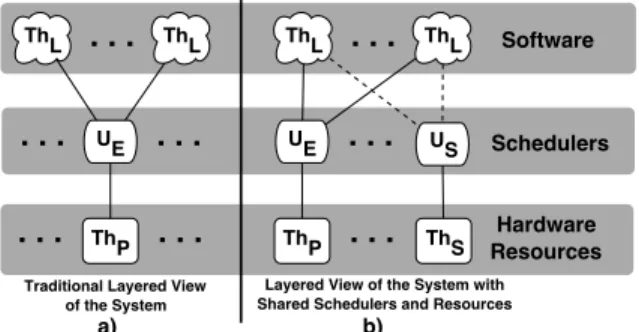
The MESH simulation framework is based on a layered model composed of a theoretically unlimited number of dy-namic logical threads (T hL) running on top of a scheduling
layer (UE) that interfaces with a physical thread layer (T hP) as seen in Figure 1a. Logical and physical threads both con-sist of an event set; in physical threads this set is totally or-dered, in logical threads it is only partially ordered [10] [8]. These event orderings make logical threads uniquely suited for modeling of software (e.g. instructions may be executed out of order) where the physical threads are more suitable for hardware models (e.g. it is not possible to reorder gates within a chip). The scheduling layer resolves the partial or-dering of events in logical threads to physical time. It also models system-state-aware scheduling algorithms that can affect the performance of a PHM system [9].
Logical threads are expressed by annotating arbitrary C code with consume calls, creating annotation regions, and thus indicating the computational complexity of software within that region. Values associated with consume calls can be derived from techniques such as profiling, designer expe-rience, or software libraries. Consume call values are meant to indicate software computational complexity, not physical timing, and should not be confused with physical timing an-notations such as Verilog’s “# delay”. Like the # delay, code that lies in annotation regions between consume calls is ex-ecuted in zero virtual time. Unlike the # delay or the general
ThP ThL ThL UE
. . .
. . .
Software Schedulers Hardware Resources. . .
U S ThS ThP ThL ThL UE. . .
. . .
. . .
. . .
. . .
Traditional Layered View of the System
Layered View of the System with Shared Schedulers and Resources
a) b)
Figure 1. Adjustments to the Layered View
discrete event approach, after the code within the annotation region is executed, our simulation determines the physical timing of the region using the computational complexity val-ues passed through the consume calls. Thus, the annotations dictate the finest unit of timing resolution available. Because of this, the spacing of annotations is the primary determinant of simulation accuracy and run-time.
Physical threads are described by a computational power (computation per unit time). The scheduling layer can use this power to determine when and where logical threads should execute, and the resulting advance in simulation time. Modeling the scheduling layer separately captures its impor-tance to the system as a whole. By regulating the access of software threads to hardware resources, it provides a global system control flow across resources. Thus, using the lay-ered model described above, the MESH simulator can model the behavior of heterogeneous processors executing parallel software threads.
Significantly, this model can be seen as equivalent to lower levels of modeling according to how annotations are placed. For example, an ISS simulation is approached if annotations occur after each assembly instruction. While it is possible to use such a relatively low-level modeling paradigm, MESH is designed to model PHM systems at a much higher level and is most suited to quick and early model development and design space exploration.
4. Shared Resource Modeling
Our proposed framework incorporates aspects of both simulation and analytical modeling methodologies, result-ing in the ability to decrease simulation time with mini-mum impact on accuracy. It simulates parallel threads for a period of physical time determined by software annota-tions, temporarily ignoring contention for shared resources. All accesses to any shared resources encountered during these regions of time are grouped and sent to an analyti-cal model which assigns time penalties to each competing logical thread. Simulation continues, with future logical to physical timing resolution including these penalties. The time penalties shift the execution time of any logical threads running on the penalized physical resource to a later phys-ical time, effectively modifying the system state trajectory (performance over time) and modeling the degraded
perfor-1 while (active ThL remain) { //main kernel loop
2 for each available ThP {
3 invoke UE to schedule a ThL to run
4 execute this region (R) until annotation 5 resolve logical to physical timing for region R 6 insert region R into priority queue sorted by
physical end times 7 }
8 grab annotation region Rtop from top of priority
queue (has lowest end time ti)
9 while (Rtop has unapplied penalty) {
10 add penalty to Rtop end time ti, zero out
penalty, and re-insert Rtop into queue
11 grab new Rtop
12 }
13 remove Rtop from queue
14 advance system time to ti from region Rtop
15 apply analytical model(s) for each shared resource from ti−1 to ti
16 assign penalties according to analytical model 17 if ( Rtop received a penalty)
18 add penalty to Rtop end time ti, zero out
penalty, and re-insert Rtop into queue
19 else mark Rtop’s resource as available
20 }
Figure 2. Simulation kernel operation with shared resource modeling
mance due to a contended shared resource. We describe our approach in detail later in this section.
4.1
Layering
We extend our layered view from Figure 1a to include shared resources and models for contention resolution. In Figure 1b we introduce shared resource threads (T hS) to
contrast their behavior from the existing execution resource threads (T hP). The function of eachT hP is to resolve the
logical ordering of events in software (T hL) into physical time based on the amount of computation the physical re-source can perform in a given unit time. In contrast, the function of each shared resource thread (T hS) is to apply
time penalties to eachT hLthat has accessed theT hS. This is done through the application of an analytical model(s) as-sociated with each shared resource thread. This fundamen-tal difference between execution and shared resource types leads to their separation in Figure 1b.
To model access contention within shared resources we make changes to our scheduling model as well. The shared resources are managed by a new type of scheduler, the shared resource scheduler (US). Each annotation may now
be a tuple, containing a value to pass to its UEand possibly
multiple additional values, one for each US; this is a major
break from the discrete event approach. The shared resource schedulers are responsible for allocating these shared access requests onto shared resources much like execution sched-ulers allocate software thread computation onto physical re-sources. The key difference between the execution sched-ulers and shared resource schedsched-ulers is that the former ar-bitrates between the logical threads prior to resource access where the latter applies penalties after the resource access is completed; this permits us to consider annotation regions in groups across shared resources.
Time Resource 1 Resource 2 t0 t1 t2 t3 t4 Resource 3 Timeslice Annotated Regions A1 B1 C1 B2 B3 A2 Penalties Added t5
Hatched Regions Contain Shared Resource Accesses
t6
Figure 3. Timeline illustration of kernel operation
Since there is no entity that provides arbitration prior to the access for a shared resource (as does the execution scheduler), contention causes queueing delays within log-ical threads waiting for service. Shared resource sched-ulers implement post-access arbitration by applying penal-ties to logical threads exhibiting shared resource access con-tention. The amount of contention penalty is determined by an analytic contention resolution function provided by each shared resource model. Note that even though a logi-cal thread can only be associated with one execution sched-uler, the same thread can be associated with multiple shared resource schedulers, representing that a thread can access more than one type of shared resource (memory, communi-cation medium, I/O devices, etc.).
4.2
Simulation Kernel Algorithm
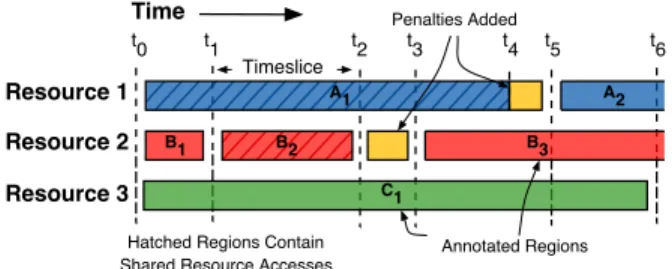
The pseudocode in Figure 2 illustrates the simulation ker-nel with shared resource modeling included and Figure 3 depicts a sample run of the algorithm graphically over time. The kernel picks an available resource, invokes the appro-priate UE to schedule an eligible thread on it (line 3), and
executes the thread until a user inserted annotation is en-countered (line 4). The figure shows three threads named A, B, and C running on three resources with any thread eligible to run on any of the resources. In this simplified case threads do not switch resources, however, in general UEschedulers
can handle arbitrary scheduling schemes. At t0all resources
are available and the scheduler maps the A thread onto Re-source 1, the B thread onto ReRe-source 2, and the C thread onto Resource 3. Computational complexity, specified by the annotations in the logical threads, is resolved to physical time by means of the computational power of each physical resource (line 5). For example, in Figure 3, the first annota-tion region of the B thread (B1) executes from t0until t1in
virtual physical time.
The physical end time of the executed annotated region of each logical thread (t4 for A, t1 for B, and t6 for C) is
then pushed onto a priority queue. The priority queue en-sures that the earliest physical end time is always available on the top of the queue (line 6). We leave the explanation of lines 8 through 12 until later in the section. The earliest annotation is committed in line 13 by removing the annota-tion end time from the top of the queue and advancing the global simulation time to that point (line 14). In the fig-ure, B1’s annotation region ends the earliest in physical time
is retrieved and committed first. Shared resource accesses are analyzed in line 15, but since only thread A accessed the shared resource between t0and t1, there is no contention
and no penalties are applied in line 16. Since no penalty was applied, the resource is marked available in line 19.
The simulation time is now at t1and Resource 2 is
avail-able and eligible to execute a thread. During the next itera-tion of the kernel loop, B2is scheduled, executed, retrieved
from the priority queue, and time advanced to t2. Since
annotation regions on different resources need not align in physical time, the simulator performs timeslicing, that is it considers only the time period between adjacent annota-tions’ end times. The timeslice end times are represented by the dashed lines associated with physical time locations. If an annotation region with multiple shared resource ac-cesses is broken into multiple timeslices, the shared resource accesses are proportionately divided among the timeslices. Once the quantity of shared accesses per timeslice per thread is known, this information is passed to the analytical model of each shared resource.
In the current iteration (slice t1-t2), both thread A1and
B2 contend for the shared resource. The analytical model
assigns some queueing delay penalty to both contending threads (line 15) , resulting in the actual physical time for B2being extended as well as that for A1. The assigned
de-lay can vary for each contending thread. For instance, if a priority arbitration scheme is being modeled, the high prior-ity thread may receive a lower average penalty. Here, since B2 had a penalty applied, its resource is not marked
avail-able, and its physical end time is immediately re-inserted into the priority queue (line 18). The other end times are not updated instantly, instead penalties are accumulated un-til the next end time is encountered. This behavior will be illustrated when t4is reached.
After the penalties are assigned, the main kernel loop ex-ecutes again. However, this time no resources are available so execution skips to line 8. Here the first region removed from the priority queue is B2at t3, and it has no penalties
remaining (they have been zeroed out once they have been added to region end time in line 18). Thus this region is com-mitted, and shared resource analysis is performed. Since all of the region B2’s shared resource accesses were considered
during time slice t1 to t2, the penalty time assigned to B2
has no additional shared accesses contained within. There-fore there is no contention in timeslice t2-t3, so no penalties
are applied.
The loop repeats, schedules B3, executes it, then looks
for the nearest physical end time. The nearest end time is thread A at t4. Line 9 notes that this thread has unapplied
penalty (assigned during t1 to t2timeslice), applies it, and
reinserts the end time (line 10 - 11). Notice that application of a penalty does not create a new timeslice at t4as was the
case in thet1tot2timeslice. Line 9 then grabs the new
near-est time, which happens to again be thread A, but now at t5.
Region A1 is committed, and shared resource access
anal-ysis is performed over t3-t5, with no further contention or
penalties being applied. Note that the physical time penalties effectively shift the execution of any threads on that
physi-cal resource later in time by the amount of the penalty. In Figure 3, penalties accrued during timeslice t1-t2are added
after regions A1 and B2. Therefore, the timing of a
soft-ware region is not only dependent on the resolution of com-putational complexity into physical timing, but on penalties applied by the shared resource contention model as well.
4.3
Additional Features
For systems with numerous threads and resources, phys-ical time misalignments of annotation regions can create a large number of small timeslices, increasing the runtime of the simulation. We combat this problem by introducing a parameter limiting the minimum timeslice size to a de-signer specified minimum. The algorithm avoids creation of timeslices smaller than the minimum by accumulating shared resource accesses of undersized slices and perform-ing the analysis together with the next large timeslice. By moving the analysis of small timeslice shared resource ac-cesses to a later time, the designer can choose to trade off small amounts of accuracy to keep the number of timeslices down.
In addition to the ability to limit the timeslice size, we provide the designer a full set of synchronization primitives commonly found in threaded programming libraries (mu-texes, semaphores, condition variables). These allow the inter-thread data dependencies to be observed. If a syn-chronization primitive is encountered that requires block-ing, the executing annotation region is shelved and the source marked available until synchronization can be re-solved. Since a blocked logical thread frees up the resource, the scheduler is capable of scheduling other tasks onto the resource. Once the event that a blocked thread is waiting on occurs, the shelved annotation region is allowed to con-tinue. Since the simulator only knows the annotation region that the unblocking event occurred in, the restarted region is placed at the end of the unblocking event region’s phys-ical time. This is a pessimistic assumption and can cause errors with coarsely annotated threads requiring continuous synchronization. How to avoid fine grained annotation, or when to relax our assumptions in this case, is an area of fu-ture work.
5. Example
We explore the validity of MESH’s hybrid simula-tion/analytical approach by considering two examples. In the first example, we will compare our approach to an an-alytical model used to estimate bus contention on a tradi-tional homogeneous multiprocessor running an FFT appli-cation. This example will show our model’s ability to adjust to changing program behavior over time while running sig-nificantly faster than cycle-accurate simulations. In the sec-ond example, we will apply our approach to a scenario more suitable to a SoC: a heterogeneous system executing various kernels from the MiBench [6] embedded benchmark suite. This example will show how execution of multiple programs across heterogeneous architectures necessitates the use of piecewise analytical models as opposed to traditional ones.
FFT, 512KB Cache 0.00% 10.00% 20.00% 30.00% 40.00% 50.00% 60.00% 0 4 8 12 16 20 24 28 32 36 # of Processors Queuing Cycles Analytical MESH ISS FFT, 8KB Cache 0.00% 10.00% 20.00% 30.00% 40.00% 50.00% 60.00% 0 4 8 12 16 20 24 28 32 36 # of Processors Queuing Cycles Analytical MESH ISS
Figure 4. Modeling of SPLASH-2 FFT Benchmark
5.1
SPLASH-2 FFT
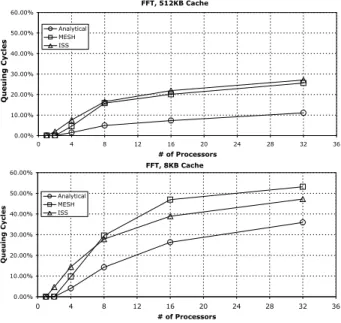
In the first example, we compare our hybrid approach to an analytical model developed by Chen and Lin in [2] when applied to the SPLASH-2 [12] FFT benchmark. The FFT application was chosen because it exhibited irregular shared bus behavior over time, causing the analytical model to have a large queuing cycle (number of cycles spent waiting due to bus contention) estimation error. In the other SPLASH-2 benchmarks the Chen-Lin model performs well, as does the corresponding MESH model. To focus on the benefits of our hybrid model, we used the same Chen-Lin model within our simulation kernel to apply penalties to timeslices. Thus, the only difference between the traditional Chen-Lin model (re-ferred to as “analytical” in the figures) and the MESH hybrid model is that the MESH simulation performs a piecewise evaluation of the Chen-Lin model over periods of execution time where the traditional Chen-Lin model is applied in one step across the whole runtime of the program.
We placed annotations at every synchronization point (barrier statement) in the original SPLASH-2 FFT algo-rithm. This level of granularity is sufficient to capture the irregular behavior of shared resource accesses in this appli-cation and greatly improves the performance of the purely analytical model. In Figure 4 we compare the percentage of queuing cycles estimated by the purely analytical and MESH hybrid approaches to the baseline case, the cycle-accurate ISS simulation. As can be seen in the figure, the piecewise application of the Chen-Lin model through the MESH framework decreases the percent error of predicted queuing cycles for the 512KB cache case from an average of about 70% for a purely analytical model to an average of 14.5% for the hybrid MESH model. The 8KB cache average percent error is also decreased from 44% to 18%. Note that even though the MESH hybrid model raises the level of ac-curacy compared to the fully analytical model, the runtime
# of FFT 512KB FFT 8KB Procs. MESH ISS MESH ISS
32 0.12 12.29 0.13 13.08 16 0.09 10.32 0.08 11.16 8 0.06 9.95 0.07 10.43 4 0.07 10.77 0.07 10.32 2 0.08 12.03 0.08 10.93
Table 1. Simulation runtimes (in seconds) for the SPLASH-2 FFT Benchmark
of the MESH simulation is at least 100 times faster than a corresponding instruction set accurate simulation (Table 1). The MESH performance advantage would especially be ev-ident with large and more complex models where the pro-hibitively large ISS simulation and model generation times would hamper rapid design exploration.
5.2
PHM SoC
Piecewise application of analytical models is especially useful when architectures or workloads are heterogeneous. Interleaving of applications on PHM systems generates ir-regular regions of high or low contention for shared re-sources depending on which applications are currently exe-cuting. Additionally, data dependencies or user interactions may result in available regions between execution of appli-cations on SoCs, further unbalancing the usage of system-wide shared resources. Due to these reasons, purely analyt-ical approaches, which are good at estimating performance of homogeneous multiprocessor systems running balanced workloads, are not well suited for PHM SoCs.
To demonstrate our approach’s utility for PHM applica-tions, we developed a PHM ISS for a shared bus 2 sor system [9], using the ARM and Renesas M32R proces-sor simulators freely available in the GNU GDB distribu-tion. To provide applications representative of future SoC workloads, we extracted several application kernels from the MiBench [6] benchmark suite. Results from the ISS were compared with our MESH model and with the purely ana-lytical model as the bus access time was varied. We used the same Chen-Lin model from the first example, modified to work with 2 processors. Within the MiBench suite, we extracted several kernels from GSM encoding (telecomm), blowfish encryption (security), and mp3 encoding (multi-media) that are representative of their respective applica-tions’ behaviors. Unlike the SPLASH-2 FFT application used earlier, all these kernels have uniform levels of shared resource accesses across their runtimes, making purely an-alytical approaches accurate when considering each kernel individually. However, when these kernels are sporadically executed in a random fashion on two heterogeneous proces-sors mimicking data-dependent behavior, the resulting con-tention patterns are irregular and unpredictable.
To illustrate decreasing performance of purely analytical models with unbalanced shared resource access loads, we kept the first processor busy (only 6% idle) while applying a light load to the second processor (90% idle). The idle periods here are used to introduce an extreme case of un-balance, or burstiness in shared resource accesses. Similar
0.00% 1.00% 2.00% 3.00% 4.00% 5.00% 1 2 3 4 5 6 7 8
Bus Delay (cycles)
Queuing Cycles
MESH ISS Analytical
Figure 5. Queuing cycles predicted for various bus delays with second processor idle 90% of the time.
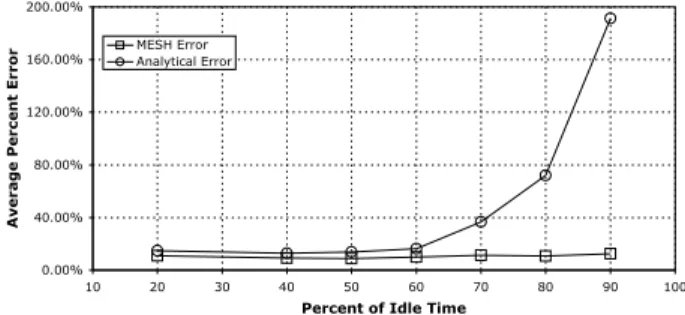
results can be gained with one application exhibiting much lower shared resource access rate than another application on the system. Figure 5 shows the percentage of queuing cycles given by each of the models as bus access time is varied. Because the analytical model is unable to recognize unbalanced workloads, it greatly overestimates the number of queuing cycles. To further quantify this behavior, Figure 6 shows the average error experienced by the MESH and the pure analytical models as the load on the second proces-sor is varied. As can be seen, when application interactions exhibit relatively uniform shared resource access behavior, pure analytical models are acceptable. However, as one of the processors exhibits over 60% less shared resource ac-cesses than the other, the purely analytical approach breaks down and is outperformed by the MESH hybrid model.
6. Conclusions
We present a hybrid approach for estimation of shared resource accesses in PHM SoC systems, combining ele-ments of simulation and purely analytical modeling tech-niques. The MESH kernel implements this hybrid approach, evaluating analytical models in a piecewise fashion across the simulation runtime and applying time penalties to sim-ulated regions. Through our examples, we show that the piecewise application of analytical models is superior when faced with systems exhibiting irregular shared accesses pat-terns, behavior commonly found in PHM systems. For these cases, simulation speed increased 100x versus instruction set simulation, with accuracy up to 80% better than the corre-sponding purely analytical models. The piecewise applica-tion presented in this paper is especially useful when ana-lytical models assuming constant steady state system behav-ior are applied to systems with several distinct and unique modes of operation. The MESH kernel and the hybrid mod-eling technique present a first step towards a general method for abstractly but accurately modeling the shared resource contention within a PHM SoC.
7. Acknowledgments
This work was supported in part by ST Microelectron-ics, General Motors Collaborative Research Lab at Carnegie Mellon University, an NSF Graduate Research Fellowship,
0.00% 40.00% 80.00% 120.00% 160.00% 200.00% 10 20 30 40 50 60 70 80 90 100
Percent of Idle Time
Average Percent Error
MESH Error Analytical Error
Figure 6. Degradation of the purely analytical model as shared resource access unbalance increases.
and the National Science Foundation under Grant 0103706. Any opinions, findings, and conclusions or recommenda-tions expressed in this material are those of the authors and do not necessarily reflect the views of the NSF.
References
[1] J. Bammi, W. Kruijtzer, L. Lavagno, E. Harcourt, and M. Lazarescu. Software performance estimation strategies in a system-level design tool. CODES, 2000.
[2] C. Chen and F. Lin. An Easy-to-Use Approach for Practical Bus-Based System Design. IEEE Transactions on Comput-ers, August 1999.
[3] S. Gadde, J. Chase, and A. Vahadat. Coarse-grained network simulation for wide-area distributed systems. Communica-tion Networks and Distributed Systems Modeling and Simu-lation Conference, 2002.
[4] S. Goldschmidt and H. Davis. Multiprocessor simulation and tracing using Tango. Proceedings of the 1991 International Conference on Parallel Processing, August 1991.
[5] R. Gupta and S. Liao. Using a programming language for digital system design. IEEE Design and Test of Computers, April-June 1997.
[6] M. Guthaus, J. Ringenberg, D. Ernst, T. Austin, T. Mudge, and R. Brown. MiBench: A free, commerically representa-tive embedded benchmark suite. IEEE 4th Annual Workshop on Workload Characterization, December 2001.
[7] J. Davis II, M. Goel, C. Hylands, B. Kienhuis, E. Lee, et al. Overview of the Ptolemy Project. ERL Technical Report UCB/ERL No. M99/37, dept EECS, Berkeley, July 1999. [8] E. Lee and A. Sangiovanni-Vincentelli. A Framework for
Comparing Models of Computation. IEEE Transactions on CAD, Vol 17, pp. 1217-1229, December 1998.
[9] J. Paul, A. Bobrek, J. Nelson, J. Pieper, and D. Thomas. Schedulers as model-based design elements in pro-grammable heterogeneous multiprocessors. Design Automa-tion Conference, 2003.
[10] J. Paul and D. Thomas. A layered, codesign virtual machine approach to modeling computer sytems. DATE, 2002. [11] K. Richter, M. Jersak, and R. Ernst. A Formal Approach to
MpSoC Performance Verification. IEEE Computer, Volume 36, Number: 4, April 2003.
[12] S. Woo, M. Ohara, E. Torrie, J. Sing, and A. Gupta. The SPLASH-2 Programs: Characterization and Methodological Considerations. International Symposium on Computer Ar-chitecture, June 1995.
[13] B. Zeigler, H. Praehofer, and T. Kim. Theory of Modeling and Simulation. Academic Press, 2000.