Cr op En er gi es A G I A nn ua l R ep or t 2 01 2/ 13
HigHligHts 2012/13
CropEnErgiEs group
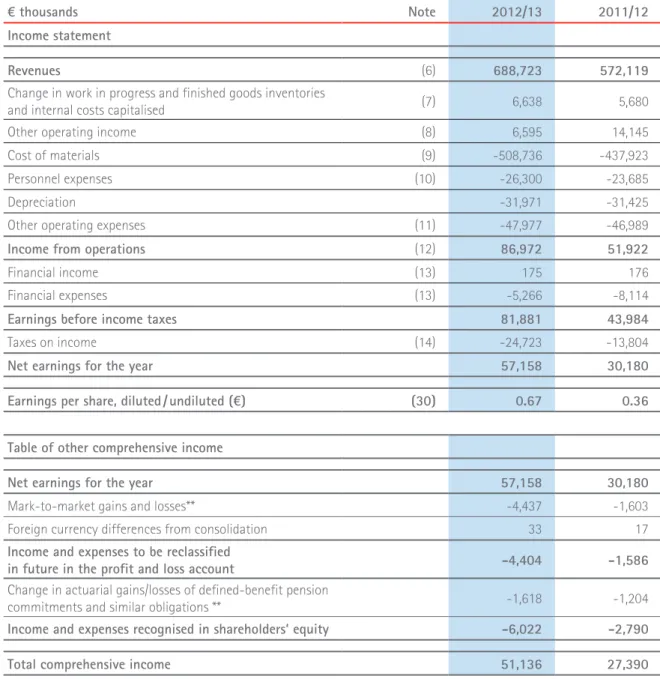
• Revenues up 20% to € 688.7 (572.1) million• Bioethanol production rises to 808,000 (692,000) m³ • EBITDA grows to € 119.0 (84.3) million
• Operating profit up 64% to € 87.0 (53.0) million • Net earnings increase to € 57.2 (30.2) million • Cash flow reaches € 98.2 (64.0) million
• Net financial debt is reduced to € 83 (158) million • Dividend proposal: In addition to the dividend increase to
€ 0.20 (0.18), a further € 0.06, i. e., a total of € 0.26 (0.18) per share, is to be distributed in the light of the particularly good earnings situation in the 2012/13 financial year. • Outlook for 2013/14: Revenues are expected to be close to
the previous year. After the more than proportional increase in the previous year, operating profit is expected to return to normal and continue to guarantee above-average return on capital within a range of € 50 to 60 million.
Financial calendar
1st quarterly report 2013/14 9 July 2013
Annual general meeting 2013 30 July 2013
2nd quarterly report 2013/14 9 October 2013
3rd quarterly report 2013/14 9 January 2014
Annual report press and analysts’ conference financial year 2013/14 13 May 2014
Contact
CropEnergies AG Gottlieb-Daimler-Strasse 12 68165 Mannheim Heike Baumbach Investor Relations Tel.: +49 (621) 714190-30 Fax: +49 (621) 714190-03 [email protected] Nadine DejungPublic Relations / Marketing Tel.: +49 (621) 714190-65 Fax: +49 (621) 714190-03 [email protected] www.cropenergies.com
Commercial Register Mannheim: HRB 700509
ANNuAl REPORT 2012/13
the annual report is also available in german. this English translation is provided for convenience only and should not be relied upon exclusively. the german version of the annual report is definitive and takes precedence over this translation.
Cr op En er gi es A G I A nn ua l R ep or t 2 01 2/ 13
HigHligHts 2012/13
CropEnErgiEs group
• Revenues up 20% to € 688.7 (572.1) million• Bioethanol production rises to 808,000 (692,000) m³ • EBITDA grows to € 119.0 (84.3) million
• Operating profit up 64% to € 87.0 (53.0) million • Net earnings increase to € 57.2 (30.2) million • Cash flow reaches € 98.2 (64.0) million
• Net financial debt is reduced to € 83 (158) million • Dividend proposal: In addition to the dividend increase to
€ 0.20 (0.18), a further € 0.06, i. e., a total of € 0.26 (0.18) per share, is to be distributed in the light of the particularly good earnings situation in the 2012/13 financial year. • Outlook for 2013/14: Revenues are expected to be close to
the previous year. After the more than proportional increase in the previous year, operating profit is expected to return to normal and continue to guarantee above-average return on capital within a range of € 50 to 60 million.
Financial calendar
1st quarterly report 2013/14 9 July 2013
Annual general meeting 2013 30 July 2013
2nd quarterly report 2013/14 9 October 2013
3rd quarterly report 2013/14 9 January 2014
Annual report press and analysts’ conference financial year 2013/14 13 May 2014
Contact
CropEnergies AG Gottlieb-Daimler-Strasse 12 68165 Mannheim Heike Baumbach Investor Relations Tel.: +49 (621) 714190-30 Fax: +49 (621) 714190-03 [email protected] Nadine DejungPublic Relations / Marketing Tel.: +49 (621) 714190-65 Fax: +49 (621) 714190-03 [email protected] www.cropenergies.com
Commercial Register Mannheim: HRB 700509
ANNuAl REPORT 2012/13
the annual report is also available in german. this English translation is provided for convenience only and should not be relied upon exclusively. the german version of the annual report is definitive and takes precedence over this translation.
iFrs/iAs 2012/13 2011/12 2010/11 2009/10 2008/09 result
revenues € thousands 688,723 572,119 472,755 374,149 328,434
EBitDA € thousands 118,957 84,314 76,300 33,093 28,602
in % of revenues % 17.3 14.7 16.1 8.8 8.7
operating profit € thousands 86,986 53,008 45,933 11,917 18,193
in % of revenues % 12.6 9.3 9.7 3.2 5.5
income from operations € thousands 86,972 51,922 46,765 9,434 7,134
Net earnings € thousands 57,158 30,180 28,341 4,415 5,854
in % of revenues % 8.3 5.3 6.0 1.2 1.8
Cash flow and capital expenditures
Cash flow € thousands 98,238 63,986 63,294 17,848 10,096
in % of revenues % 14.3 11.2 13.4 4.8 3.1
Capital expenditures in property,
plant and equipment* € thousands 11,104 14,415 21,631 33,843 170,110
Balance sheet
Total assets € thousands 598,933 623,444 638,537 608,863 572,539
Net financial debt € thousands -82,907 -158,383 -195,027 -215,434 -167,867
Equity € thousands 389,765 353,929 339,289 311,686 308,619
in % of total liabilities and
shareholders' equity % 65.1 56.8 53.1 51.2 53.9
performance
Property, plant and equipment* € thousands 437,344 458,624 477,434 487,712 477,109
Goodwill € thousands 5,595 5,595 4,346 4,346 4,358
Working capital € thousands 64,173 60,287 52,249 37,154 7,571
Capital employed € thousands 507,112 524,506 534,029 529,212 489,038
ROCE % 17.2 10.1 8.6 2.3 3.7
shares
Market capitalization € million 499 450 529 317 221
Total shares issued of 28/29 February million 85 85 85 85 85
Closing price on 28/29 February € 5.87 5.30 6.22 3.73 2.60
Earnings per share € 0.67 0.36 0.33 0.05 0.07
Dividend per € 1 share € 0.26** 0.18 0.15 0.05 0.00
Yield as of 28/29 February % 4.4 3.4 2.4 1.3 0.0
production
Bioethanol 1,000 m³ 808 692 687 603 436
Employees
Employees (average during the year) 321 310 303 302 272
* Including intangible assets
** Proposed including 0.06 € additional dividend
CropEnErgiEs –
CROPENERGIES AG MANNHEIM
Group Annual Report for 2012/2013
1 March 2012 to 28 February 2013
Bioethanol made by CropEnergies is in great demand as
a component of various products. It is mainly used as
a fuel, but it also serves as a basis for numerous other
applications. Whether be it beverages, cosmetics,
pharma-ceutical products or as a cleaning agent – this versatility
requires high quality. Because only if we perfectly fulfil
our customers’ needs do we meet our own standards.
CropEnergies –
Your partner for the highest quality.
2 I Corporate strategy and guiding principles
The CropEnergies Group’s mission is to work in concert with its partners to shape the future responsibly and to develop solutions today for the social and corporate challenges of tomorrow. The focus is on the production and marketing of bioethanol – the world’s No. 1 biofuel. As one of the leading European bioethanol producers, we combine business success with social responsibility and environmental protection. Our aim is to grow profitably, to create value on a long-term basis and to meet the expectations of our shareholders, customers, suppliers and the people within the company, through sustainable and responsible business activity.
With our products, we improve the quality of life for the present generation while safeguarding that of future generations. As a regenerative substitute for petrol, the bioethanol we produce from renewable raw materials is proven to reduce greenhouse gases, conserves the world’s limited fossil resources, and thus furthers future mobility. As the European market leader in the production of food and animal feed products from the residues of bioethanol production, we improve Europe’s supply of vegetable proteins and, in this way, honour our responsibility to society. CropEnergies fully exploits all of the raw materials it uses – to provide food, feed and fuel.
We achieve our goals through operational excellence and innovation. Here, we rely on our core competences – the large-scale processing of agricultural raw materials into high-grade products and their marketing. We possess extensive know-how across the entire bioethanol production value chain – from crop growing and production through to transport, marketing and consumer counselling. With our innovative production facilities, we set standards in terms of technology, efficiency, flexibility and greenhouse gas reductions, and set ourselves apart from the competition. An optimised sourcing management and a logistics network that is unique in Europe assure our cost leadership, as well as technology leadership, in Europe. Our marketing and logistics expertise makes us a reliable partner, too. With innovations, we secure a competi-tive edge in our existing activities, tap new markets and contribute towards developing solutions for the challenges of the future.
Key to our company’s success are the knowledge, experience, social skills, satisfaction and dedication of our employees. Continuous training and personnel development therefore always take centre stage. We place great value on our trans-parent reporting and open communication with all capital market participants. The contact with investors and capital markets is also important for funding further growth.
We intend to seize upon growth opportunities that arise. In developing the company, we always consider our core competences as well as the given framework conditions. Driven by our flexibility, we see structural change as an opportunity for further development. The growing demand for energy and food calls for the efficient use of available agricultural resources. This presents further opportunities for CropEnergies to develop attractive new areas of business and to continue growing profitably.
We operate sustainably in the interest of the company’s successful development and a future worth living.
Contents
The numbers in brackets in this annual report relate to the previous year.
Group figures overview fold-out page
Company profile 4
to our shareholders 6
Letter to shareholders 6
Supervisory board and executive board 8
Supervisory board report 12
CropEnergies share and capital market 16
Group management report 22
Report on business operations 22
Results of operations, financial position, assets and liabilities 31
Group revenues and earnings 31
Statement of changes in financial position 32
Balance sheet structure 33
Economic value added, capital structure and dividend 34
Employees 37
Investments 39
Research and development 42
Corporate governance 46
Sustainability 54
Disclosures on share capital and obstacles to a takeover
pursuant to § 315 (4) HGB 56
Opportunities and risk report 60
Events after the reporting period 65
Outlook 66
Consolidated financial statements 70
Statement of comprehensive income 70
Cash flow statement 71
Balance sheet 72
Development of shareholders’ equity 73
Notes to the consolidated financial statements 74
Responsibility statement 121 Independent auditors‘ report 122
Glossary 124
4 I Company profile
Cropenergies AG
Mannheim (Germany)
• One of the leading producers and distributors of bioethanol in Europe
• Production sites in Germany, Belgium and France and trading offices in the USA and Brazil • Germany’s and Belgium’s largest bioethanol producer
• Bioethanol plants have been certified as sustainable with at least 35 percent greenhouse gas savings
• Annual total capacity: approx. 800,000 m3 of bioethanol; > 500,000 tonnes of food and animal feed products;
100,000 tonnes of liquefied CO2
• Technological leader in Europe with innovative plant concepts
• Know-how in the industrial processing of agricultural raw materials into high-quality products and their marketing accumulated over many years
• Market capitalisation at the end of business year 2012/13: € 499 million
• Our aim: To ensure sustainable and renewable mobility for today and in the future
CropEnergies produces high-quality products used as food, fuel, and feed. In addition to bioethanol, which primarily replaces petrol, the raw materials for manufacturing bioethanol are also used to produce valuable food and animal feed.
the products
Bioethanol
as a fuelBioethanol
for traditional and technical applicationsZeitz, Germany
Annual capacity (per annum)360,000 m³ of bioethanol 260,000 t ProtiGrain® (DDGS) 100,000 t liquified CO2
Raw materials Grain and sugar syrups
the production sites
Wanze, Belgium
Annual capacity (per annum)Up to 300,000 m³ of bioethanol Approx. 55,000 t of gluten
Over 200,000 t of ProtiWanze® (CDS) Raw materials
Wheat and sugar syrups
Loon-Plage, France
Annual capacity (per annum)100,000 m³ bioethanol for fuel applications
80,000 m³ bioethanol for traditional and technical applications
Raw material Raw alcohol
Gluten
high-quality protein for the baking industry and as a special feed
Liquefied
carbon dioxide
in food quality, e. g. for beveragesProtiWanze®
liquid protein animal feed for cattle and pigsProtiGrain®
dried and pelletised protein animal feed for cattle, pigs and poultry
dear shareholders,
The 2012/13 financial year was particularly successful for CropEnergies. We again far exceeded the record result from the previous year, continuing our growth trajectory despite a difficult context. The sector suffered from bioethanol imports from the USA and high grain prices. CropEnergies, on the other hand, benefited from effective risk manage-ment, flexibility in respect of raw material processing, a 17% increase in bioethanol production to 808,000 m³ and attractive returns for the high-grade food and animal feed products. This made it possible to achieve record levels in terms of revenue and operating profit. Group revenues, for example, grew by 20% to € 689 million. We increased operating profit by as much as 64% to € 87 million, a higher-than-expected rise. We would like you, dear sharehold-ers, to share in this special earnings growth. We will therefore propose to the annual general meeting on 30 July 2013 not only that the dividend be increased to € 0.20 (0.18), but that an additional € 0.06, i. e., a total of € 0.26 (0.18) per share, be distributed.
Things became quieter in Germany on the E10 front in the 2012/13 financial year. Many car drivers, however, are still sceptical and are hesitating to fill up with E10 due to technical reservations. The ADAC, the German Automobile Asso-ciation, for one, again recently confirmed that such doubts are unfounded. By turning to the E10 fuel pump, car drivers can directly reduce greenhouse gas emissions and also save money. We therefore expect E10's share of the market in Germany, which has now risen to 15%, to continue to grow and E10 to become the standard petrol fuel at EU level, as it is in the USA.
At the political level, the European Commission has sent the wrong signal with the draft amendment of the "Renew-able Energies Directive" and the "Fuel Quality Directive". The draft provides for only half of the target of 10% of renewable energies in the transport sector, defined for 2020, being met by biofuels from grain, sugar and oilseed. The remainder is to be covered by biofuels from wastes and residues, which are to be counted several times towards the biofuel quota. This type of virtual blending would result in a reduction in the actual share of biofuels and an increase in the consumption of fossil fuels. CropEnergies rejects this proposal, as it would result in higher greenhouse gas emis-sions, additional costs for consumers and rising oil imports. Biofuels from arable crops are currently the only available option for reducing greenhouse gases cost effectively without restricting mobility. The proposed directive represents an irresponsible U-turn in European biofuel policy, putting at risk billions of investments in an innovative sector as well as tens of thousands of direct and indirect jobs. A study carried out by WifOR, an independent research institute in Darmstadt, shows, for example, that more than 2,400 gainfully employed people in Germany directly and indirectly depend on our production facility in Zeitz.
The European Commission's draft amendment requires the consent of the European Parliament and the European Council. We expect numerous changes to be made in the course of discussions. Even today, various options that pro-vide for a higher proportion of bioethanol from agricultural raw materials are being discussed in the European Council. These discussions had been preceded by critical comments from several member states, including Poland and Spain, regarding the draft directive. The German Bundesrat likewise emphasised that biofuels from arable crops would also be required beyond 2020 to decarbonise the transport sector.
to ouR shAReholdeRs
6 I to our shareholdersLetter to shareholders
In the 2012/13 financial year, we forged further ahead with the expansion of business operations. Our aim is to develop profitable solutions for the major challenges of the future. Our strategy is based on four pillars: First, we are continually optimising our existing production facilities in terms of capacity, greenhouse gas savings, value creation and efficiency. This will enable us to secure CropEnergies' earnings power. Second, we will develop our global trading operations at suitable locations. Third, we will further diversify our product range. Our aim is to produce bioethanol for a wide range of applications. We also attach great importance to an integrated production concept, making full use of the agri-cultural raw materials and producing other high-grade products for the food and animal feed industry in addition to bioethanol. Fourth, we will not lose sight of the expansion of our production capacities. However, as a capital-intensive sector, we require planning security for this. The most recent political discussion in Europe serves as an encouragement to us to pursue a broader approach, in future, in terms of region, technology and products.
CropEnergies has got off to the planned start in the 2013/14 financial year. Owing to the year-on-year increase in grain prices and decrease in bioethanol prices, we expect the company's position and earnings situation to return to normal following the particularly successful financial year in 2012/13. We thus expect revenues to be close to the previous year's record level. Operating profit is expected to range between € 50 and € 60 million. With a return on capital employed (ROCE) of more than 10%, we will again set the standards in the sector. From the cash flow generated, we will make dividend payments, investments and further debt repayments.
In the 2013/14 financial year, we will take the next step in the further development of CropEnergies and invest € 27 million, at Zeitz, in the construction of a processing facility for producing high-quality food-grade neutral alcohol. We are already operating in these markets through Ryssen Alcools and have the necessary market expertise. Commis-sioning of the plant with a capacity of 60,000 m³ of neutral alcohol per year is planned for 2015.
With expertise, commitment and passion, our employees have made a significant contribution to the excellent result of the past financial year. We would like to express our sincere thanks to them for this.
We would also like to thank you, dear shareholders, for your trust and your support during the public debate about biofuels in general and bioethanol in particular, a discussion that was often lacking in objectivity. We hope you will continue to support us as we go forward.
With kind regards,
Dr. Marten Keil Joachim Lutz
supeRvIsoRy boARd And exeCutIve boARd
Supervisory board
Dr. Theo SpettmannChairman (until 17 July 2012) Ludwigshafen
Former spokesman of the executive board of Südzucker Aktiengesellschaft Mannheim/Ochsenfurt
Prof. Dr. Markwart Kunz
Chairman
(from 17 July 2012, previously Deputy Chairman) Worms
Member of the executive board of
Südzucker Aktiengesellschaft Mannheim/Ochsenfurt
Dr. Lutz Guderjahn
Deputy Chairman (from 17 July 2012) Offstein
Member of the executive board of
Südzucker Aktiengesellschaft Mannheim/Ochsenfurt
Dr. Hans-Jörg Gebhard Eppingen
Chairman of the Association Süddeutsche Zuckerrübenanbauer e. V.
Thomas Kölbl Speyer
Member of the executive board of
Südzucker Aktiengesellschaft Mannheim/Ochsenfurt
Franz-Josef Möllenberg Rellingen
Chairman of the Gewerkschaft Nahrung-Genuss- Gaststätten (Union)
Norbert Schindler Bobenheim am Berg Member of the Bundestag
(Lower house of German Parliament)
8 I to our shareholders
Executive board
Dr. Lutz Guderjahn (until 17 July 2012)
Chief Operating Officer (COO) Offstein
Production, procurement, sales, marketing,
public affairs, public relations, business development and personnel
Dr. Marten Keil (from 17 July 2012)
Chief Operating Officer (COO) Heidelberg
Production, procurement, sales, marketing,
public affairs, public relations, business development and personnel
Joachim Lutz
Chief Financial Officer (CFO) Mannheim
Finance, accounting, investor relations, controlling, risk management, compliance and administration
A list of mandates held can be found on page 114 onwards of the annual report.
From left: Dr. Marten Keil, Joachim Lutz
combustion characteristics are ideal for running engines. When developing new engines, tests are carried out using higher bioethanol blends. CropEnergies supplies bioethanol of the highest quality to secure the mobility of the future.
CropEnergies – Your partner for precise performance.
Dear Shareholders,
CropEnergies looks back on a successful 2012/13 financial year. Despite the difficult political and economic environ-ment, CropEnergies achieved new records in terms of revenues and earnings. Apart from effective risk management and adjustment of the raw materials mix, the crucial factors here were efficiency gains in the production facili-ties, which resulted in higher bioethanol production. The integrated production concept proved its worth once again. Through a balanced product portfolio of bioethanol as well as food and animal feed, which is produced from domestic agricultural raw materials, CropEnergies provides food, feed and fuel in a sustainable manner and also secures its earn-ings power. In view of CropEnergies' very pleasing earnearn-ings performance, the supervisory board endorses the proposal that the dividend per share be raised to € 0.20 and that the shareholders should participate in the special earnings increase through an additional distribution of € 0.06.
The supervisory board again concerned itself closely with the business development, the financial position and the prospects of the CropEnergies Group in the reporting period. The supervisory board continued the trustful and goal-oriented cooperation with the executive board in the 2012/13 financial year, thereby performing the duties incumbent upon it according to the law, the articles of association and the rules of procedure in supervising and advising the executive board in the management of the company's affairs.
Cooperation between the supervisory board and the executive board I The supervisory board was directly involved in all decisions of fundamental importance relating to the CropEnergies Group and was kept continuously informed in a timely and comprehensive manner about the corporate planning and the course of business, the position and the devel-opment of the CropEnergies Group, including the risk situation, risk management and compliance. The executive board determined the strategic orientation of CropEnergies in consultation with the supervisory board. The business trans-actions that are important for the company were discussed in detail on the basis of the reports of the executive board. The supervisory board had regular contact with the executive board between the supervisory board meetings and kept itself regularly informed about all events of major importance and the current development of the company’s position. The executive board also reported on corporate policy, profitability, risk management, and the corporate, financial, investment, research and personnel planning related to CropEnergies AG and the CropEnergies Group.
Supervisory board meetings and resolutions I Five ordinary meetings of the supervisory board, each of which was attended by the executive board, took place in the 2012/13 financial year. One extraordinary meeting was also held. The focus of the deliberations at the supervisory board meetings were the developments on the raw materials and sales markets, the hedging of market price risks, the political framework conditions for biofuels, the progress of production and investments, and the current earnings situation. Following thorough review and discussion, the supervisory board agreed to all the resolution proposals of the executive board.
In its extraordinary meeting, a conference call on 30 March 2012, which the executive board did not attend, the supervisory board passed a resolution to amend the supervisory board's rules of procedure and added one member to each of the committees.
At its annual account meeting on 7 May 2012, the supervisory board devoted its attention to the annual financial state-ments and management reports of CropEnergies AG and the consolidated group for 2011/12, issued with an unqualified opinion by the independent auditor. The independent auditor reported on the focus and results of the audit, which also included the accounting-related internal control system. After detailed discussion, the supervisory board adopted the
supeRvIsoRy boARd RepoRt
12 I to our shareholdersannual financial statements and approved the consolidated financial statements. At this meeting, it also discussed the agenda and the proposals for the 2012 annual general meeting (including the proposed candidates for election to the supervisory board). It also approved the short-term and medium-term investment planning. The supervisory board appointed Dr. Marten Keil as executive board member for five years with effect from the end of the annual general meet-ing (17 July 2012). He succeeds Dr. Lutz Guderjahn, who resigned from the executive board at the same time.
The focus of the supervisory board meeting on 17 July 2012 was the medium-term planning. The meeting also clari-fied a process step in respect of the variable executive board compensation. At the meeting subsequent to the annual general meeting on 17 July 2012, the supervisory board reconstituted itself. The chairman of the supervisory board and his deputy were elected and membership of the committees was renewed.
At the meeting on 12 November 2012, the supervisory board discussed the earnings forecast for the current financial year. As in previous years, the focus of the meeting was on corporate governance matters. After conducting the review of the efficiency of its activities, the supervisory board approved the declaration of conformity for 2012 and confirmed the diversity objectives for its composition. It also approved a capital injection.
At the meeting on 14 January 2013, the earnings projection for the current 2012/13 financial year was presented and an investment project approved. The regular review and adjustment of executive board compensation was also carried out. All the meetings were attended by all members of the supervisory board and the executive board, with the exception of Dr. Theo Spettmann who, for reasons of ill health, attended less than half of the meetings. To the extent that the super-visory board chairman was prevented from performing his duties, these duties were performed by the deputy chairman. Supervisory board committees I In order to carry out its duties more efficiently, the supervisory board has formed an audit committee and a nomination committee.
The audit committee, to which the supervisory board members Thomas Kölbl (Chairman), Prof. Dr. Markwart Kunz, Franz-Josef Möllenberg (from 30 March 2012), Dr. Theo Spettmann (until 17 July 2012) and Dr. Lutz Guderjahn (from 17 July 2012) belong, convened five times in the 2012/13 financial year. In accordance with the recommendations of the German Corporate Governance Code, the chairman of the audit committee is not at the same time chairman of the supervisory board.
At its meeting on 3 May 2012, the audit committee closely studied the annual financial statements of CropEnergies AG and the consolidated financial statements in the presence of the independent auditor. It prepared the annual account meeting of the supervisory board during which the supervisory board, after being briefed by the chairman of the audit committee, accepted the recommendations of the audit committee. Furthermore, the audit committee submitted a recommendation to the supervisory board for its proposal to the annual general meeting concerning the election of the independent auditor. The latter’s independence had been examined beforehand.
At the meeting on 17 July 2012, the mandate was issued to the independent auditor and the focus of the 2012/13 annual audit was defined.
On 8 October 2012, the audit committee discussed the six-month report and, at the supervisory board’s instruc-tion, also the monitoring of the financial reporting process, the effectiveness of the internal control system, the risk management system and the internal auditing system.
The meetings on 6 July 2012 and on 7 January 2013 were devoted to a discussion of the Q1 and Q3 quarterly reports. The nomination committee, to which the supervisory board members Thomas Kölbl (Chairman), Prof. Dr. Markwart Kunz, Franz-Josef Möllenberg (from 30 March 2012), Dr. Theo Spettmann (until 17 July 2012) and Dr. Lutz Guderjahn (from 17 July 2012) belong, convened on 3 May 2012 to prepare the list of candidates for election to the supervisory board for the annual general meeting on 17 July 2012.
All the committee meetings were attended by all the members, with the exception of Dr. Theo Spettmann who, for reasons of ill health, attended less than half of the meetings.
The chairman of the respective committees reported on the content and results of the committee meetings at the next supervisory board meeting.
Review of the supervisory board’s efficiency I The supervisory board again reviewed the efficiency of its activities in accordance with the recommendation pursuant to paragraph 5.6 of the German Corporate Governance Code. This is performed each year on the basis of a questionnaire without external support. The questionnaire is adapted in each case to the changes in the Code. The evaluation of the questionnaires, the discussion of the results and the delibera-tions on proposed improvements took place at the meeting on 12 November 2012. The objective is the continuous improvement of the activities of the supervisory board and its committees.
Corporate governance I Comprehensive information on corporate governance at CropEnergies, including the wording of the supervisory board’s diversity objectives for its future composition, and the declaration of conformity for 2012 issued jointly by the executive board and supervisory board can be found in the declaration on corporate man-agement/corporate governance report on pages 46 – 53 of this annual report. Additionally, all the relevant information is available on the CropEnergies website at www.cropenergies.com on the Investor Relations pages.
The executive board fulfilled the duties to inform the supervisory board assigned to it by law and the rules of proce-dure in an exhaustive and timely manner. The supervisory board also assured itself of the due and proper conduct of the company’s affairs and the effectiveness of the company’s organisation and discussed these matters at length in talks with the independent auditor. The same applies with regard to the effectiveness of the CropEnergies Group’s risk management system.
The supervisory board was not notified in the reporting period by any of its members of a conflict of interest – especially no conflict of interest that could arise as a result of an advisory function or position on a board or committee at customers, suppliers, creditors, or other business partners.
Annual financial statements I PricewaterhouseCoopers Aktiengesellschaft Wirtschaftsprüfungsgesellschaft (PwC), Frankfurt am Main, which was elected by the annual general meeting at the proposal of the supervisory board, has audited the annual financial statements and management report of CropEnergies AG for the 2012/13 financial year, the proposal of the executive board on the use of the unappropriated profit, and the consolidated financial statements and the group management report for 2012/13, and has issued an unqualified audit opinion in each case. Further, the auditor has confirmed that the executive board has suitably complied with the measures that were incumbent upon it pursuant to § 91 (2) AktG. In particular, it has created an appropriate information and monitoring system in line with company requirements that appears suited to its purpose of identifying in good time developments that could be a threat to the company’s existence.
14 I to our shareholders
In light of the notice given by Süddeutsche Zuckerrüben-Verwertungs-Genossenschaft eG (SZVG) that, including the 71% shareholding held by Südzucker AG, it directly and indirectly holds a total of 78% of the voting rights, the execu-tive board has drawn up a report pursuant to § 312 AktG. The independent auditor has reviewed this report, has pro-vided a written report on the results of its review and confirmed that the actual facts set out in the report are correct, payments by the company in connection with legal transactions referred to in the report were not unreasonably high, and no circumstances indicate any materially different assessment than that given by the executive board.
The documents to be examined and the auditor’s reports were distributed in good time to each supervisory board member. The independent auditor was present at the audit committee’s meeting on 2 May 2013 and at the supervisory board’s annual account meeting on 6 May 2013, and reported in detail on the procedures and findings of its audit. After detailed discussions, the supervisory board noted and agreed with the auditor’s reports. The findings of the audit com-mittee’s prior review and the findings of the supervisory board’s own review are fully consistent with the findings of the independent audit. The supervisory board raised no objections to the financial statements presented. It approved the annual financial statements of CropEnergies AG prepared by the executive board as well as the consolidated financial statements of the CropEnergies Group at its meeting on 6 May 2013.
With this approval, the annual financial statements of CropEnergies AG have been adopted. The supervisory board has agreed with the executive board’s proposal on the use of CropEnergies AG’s unappropriated profit, with the distribution of a dividend totalling € 0.26 per share.
The supervisory board noted and agreed with the result of the independent auditor’s examination. Following the conclusive results of its own examination – the auditor was present at the deliberations – the supervisory board raised no objections to the executive board’s statement at the end of the report.
Personalia I Dr. Lutz Guderjahn resigned from the executive board on 17 July 2012. Dr. Marten Keil was appointed as an ordinary member of the executive board at the same time for a period of five years.
The term of office of all supervisory board members ended upon adjournment of the annual general meeting on 17 July 2012. The term of office of the new supervisory board elected by the annual general meeting on 17 July 2012 runs until adjournment of the annual general meeting that decides on its approval for the 2016/17 financial year (i. e., until the ordinary annual general meeting in 2017). The election of the new supervisory board resulted in a change. Dr. Theo Spettmann resigned from the supervisory board on adjournment of the annual general meeting on 17 July 2012. Dr. Lutz Guderjahn was newly elected to the supervisory board. The supervisory board thanks Dr. Spettmann for his commitment for the benefit of the company.
At the constitutive meeting of the supervisory board on 17 July 2012, Prof Dr. Markwart Kunz was elected as chairman and Dr. Lutz Guderjahn as deputy chairman of the supervisory board.
Mannheim, 6 May 2013
On behalf of the supervisory board
Prof. Dr. Markwart Kunz Chairman
a successfully implemented rescue package for Spanish banks ensured increasing share prices. At the beginning of 2013, international share indices were also trading at a high level. If liquidity remains persistently high, con-tinued development is likely to depend, in particular, on whether the USA can successfully implement its budget restructuring and the economy in the euro zone receives a cyclical boost.
The German share index DAX® rose by 13% to 7,742 points in the reporting period (1 March 2012 to 28 February 2013). The MDAX®, which rose by 28%, was also trading significantly above the level of the previous year, while the TecDAX® improved by 19%. The US Dow Jones Index rose over the same period by 9% to 14,054 points.
Performance of the CropEnergies share
The CropEnergies share began the 2012/13 financial year on 1 March 2012 at a price of € 5.25. The release
CRopeneRGIes shARe And CApItAl MARket
Capital market environment
At the beginning of 2012, hope of a solution to the national debt crisis in Europe and the announcement by the Federal Reserve that it would keep its key lend-ing rate at a low level until 2014 improved the mood on the equity markets. In mid-March 2012, the DAX® broke above the 7,000-point level as a result of the Greek debt haircut involving private creditors and the improvement in key economic indicators. In the 2nd quarter of 2012,
however, the international equity markets came under pressure as a result of weakening growth not only in the euro zone, but also in the USA. The election results in France and Greece reinforced this trend. ECB President Draghi's announcement in July 2012 that he intended to launch an unlimited bond-buying programme in the euro zone had a positive impact. The European equity markets, in particular, remained stable in the 2nd half of the year
despite weak economic data. The strengthening political cohesion in the euro zone, the confirmation of the le-gality of the European Stability Mechanism (ESM) and
16 I to our shareholders
CropEnergies share and capital market
Performance of the CropEnergies share since the initial public offering on 29 September 2006 until 28 February 2013 (XETRA® closing prices)
€ 8.50 8.00 7.50 7.00 6.50 6.00 5.50 5.00 4.50 4.00 3.50 3.00 2.50 2.00 2009 2010 2011 2012 2013 2008 2007
Stock exchange listing and
shareholder structure
The CropEnergies AG share (ISIN DE000A0LAUP1) is listed in the Regulated Market (Prime Standard) on the Frankfurt Stock Exchange. The share is also traded in the XETRA® electronic trading system and in the over-the-counter market at the stock exchanges in Frank-furt, Stuttgart, Düsseldorf, Hamburg, Munich and Berlin. Südzucker AG continues to hold 71% and Süddeutsche Zuckerrüben-Verwertungs-Genossenschaft eG (SZVG) 7% of the shares of CropEnergies AG. No other signifi-cant shareholdings have been reported. At the time of the annual general meeting in 2012, CropEnergies shares were located in approximately 15,000 – mainly private – deposit accounts.
As of 31 January 2013, CropEnergies conducted a survey into the number of shareholders and their sociologi-cal structure. This revealed that 78% of the shares are in non-free-float holdings held domestically. 6% of the of positive company results and the proposed dividend
increase in May 2012 initially had no tangible effect on the share price. In the summer of 2012, the benefits of biofuels were again called into question. As a result of emotional public discussion, the CropEnergies share also came under pressure, reaching its low for the year at € 4.16 in mid-September. Shortly afterwards, CropEnergies published advance business figures for the particularly successful 2nd quarter of 2012/13 in an ad-hoc release
and increased the forecast. This led to a rise in the share price. After the 3rd quarter also saw CropEnergies
ben-efit to a particular extent from the foresighted hedging of raw materials and increased its forecast again in De-cember 2012, the price rose sharply, reaching its high at € 6.24 in mid-January 2013. The CropEnergies share closed the 2012/13 financial year on 28 February 2013 at € 5.87. This meant that, with a price increase of 11% (allowing for the dividend of € 0.18 per share), it again clearly outperformed its benchmark, the Deutsche Börse DAXsubsector Renewable Energies Index, which fell by 37% over the same period.
CropEnergies share and capital market
Performance of the CropEnergies share versus the DAXsubsector Renewable Energies performance index from 1 March 2012 to 28 February 2013 120% 110% 100% 90% 80% 70% 60% 50% Index Cropenergies January 2013
March 2012 May 2012 July 2012 September 2012 November 2012 March 2013
shares are held by funds (4% of which are abroad) and 10% by other shareholders (1% of which are abroad). The survey was unable to identify about 6% of the share-holdings.
Annual general meeting 2012
About 850 shareholders attended the annual general meeting held on 17 July 2012 in the Rosengarten Con-gress Centre in Mannheim. They represented 83% of the capital. The shareholders were particularly interested in CropEnergies' strategic orientation and growth, its in-tegrated concept for producing food and animal feed products from bioethanol production, the outlook for the current financial year and developments on the bioetha-nol market. After discussing the items on the agenda, the annual general meeting approved the proposed 20% in-crease in the dividend to € 0.18 per share. This resulted in a total dividend distribution of € 15.3 million. All agenda items, including the election of the supervisory board, were passed in each case by a majority of over 99%.
Dividend proposal 2013
The executive board and supervisory board propose to the annual general meeting on 30 July 2013 that the dividend be increased to € 0.20 (0.18) and, in view of the particularly good earnings situation in the 2012/13 financial year, a further € 0.06, i. e., a total of € 0.26 (0.18) per share, be distributed. Based on an unchanged 85.0 million shares, that is equivalent to a total dividend payout of € 22.1 (15.3) million.
Market capitalisation and turnover
CropEnergies had a market capitalisation of € 499 mil-lion as of the reporting date on 28 February 2013. The volume of all CropEnergies' shares traded on all the German stock exchanges in the past financial year amounted to 12 (17) million shares. That corresponds to an average daily turnover of approximately 47 (65) thousand shares.*
Investor Relations
CropEnergies offers all interested parties up-to-date and transparent information and a continuous dialogue on the company’s business development and financial situation. The website where you can find financial re-ports, press releases, the financial calendar and the latest capital market presentation, among other things, is the central medium of the extensive information service. Also available on the website is a share chart, which visitors can use to carry out a wide range of analyses related to the CropEnergies share, including press and ad-hoc announcements. Also downloadable is the bioethanol report, which contains all the main facts on the renew-able and climate-friendly fuel bioethanol and the food and animal feed products that are produced at the same time. Interested investors can also receive this informa-tion by e-mail or post upon request.
In addition, CropEnergies provides information in the form of interviews and technical papers, and by attendance at presentations, discussion forums and conferences. The quarterly results were reported on regularly through conference calls. The Investor Relations department is available for an exchange of information by phone CropEnergies successfully continued its Investor Rela-tions activities in the past financial year. In addition to the contacts with private investors, CropEnergies again presented itself directly at the regular analyst and capi-tal market conferences in the main financial centres. The company’s business development and corporate strategy were outlined to a larger audience for instance in Frank-furt, New York, Munich and Geneva. The investor relations activities were supplemented by numerous roadshows at home and abroad as well as by face-to-face meetings with investors in Mannheim.
* Source: Deutsche Börse Stock Report 18 I to our shareholders
Details
Cropenergies AG
ISIN DE000A0LAUP1
WKN A0LAUP
Symbol CE2
Class of share No-par-value bearer ordinary shares
Prime sector Industrial
Industry group Renewables
Transparency level Prime Standard
Market segment Regulated Market
Stock exchanges XETRA®, Frankfurt
Over-the-counter market: Stuttgart, Düsseldorf, Hamburg, Munich, Berlin
Number of shares 85,000,000
Subscribed capital (€) 85,000,000
Authorized capital (€) 85,000,000
First listed / IPO 29 September 2006
Shareholder structure Südzucker AG (71%), Süddeutsche Zuckerrüben- Verwer tungs-Genossenschaft eG (7%), free float (22%)
Key figures
2012/13 2011/12
Financial year-end closing price (€) 5.87 (28/02/2013) 5.30 (29/02/2012)
High (€) 6.24 (23/01/2013) 6.59 (01/03/2011)
Low (€) 4.16 (13/09/2012) 4.51 (08/08/2011)
Market capitalisation at financial year-end
(in € million) 499 450
Average daily turnover (number of shares) 46,799 65,121
Earnings per share according to IAS 33 (€) 0.67 0.36
Dividend per share (€) 0.26* 0.18
* Proposal including € 0.06 additional dividend Source: Deutsche Börse AG, XETRA® data
Alcohol which is colourless and has a neutral odour is the basis for many cosmetics. Because the end product takes centre stage. Our alcohol meets the highest standards of our customers, whose creations can then come into their own.
CropEnergies – your partner for the highest standards.
22 I Group management report
Report on business operations
Developments on the world market
for bioethanol
Ethanol production I In 2012, world production of bioethanol decreased by 0.9% year over year to 101.9 (102.9) million m3, thereby declining for the second year
in succession. The reason for this development was a marked drop in production in the USA due to drought-induced failure of the maize harvest and the resulting increase in the raw material costs for the bioethanol production. As in the previous years, the bioethanol was mostly produced for applications in the fuel sector. In all, the fuel sector accounted for 82.6 (84.4) million m3 and
hence 81% (82%) of total bioethanol production. First estimates for 2013 expect worldwide bioethanol pro-duction to rise to 105.4 million m3. An increase is also
expected in Brazil and in the EU, among others.
In the USA, bioethanol production in 2012 declined com-pared with the previous year for the first time since 1996. While production still stood at 54.2 million m3 in 2011,
initial estimates put it at only 52.4 million m3 in 2012.
Current estimates by market observers expect bioethanol production to drop to as low as 51.8 million m3.
Etha-nol exports in 2012 therefore declined by 36% to 3.2 (5.0) million m3. Exports of bioethanol to the EU declined
by as much as 55% to 661,000 m3. The cessation of
sub-sidies in the USA and a new customs framework in the EU contributed to this. Owing to continuing low margins, market observers do not expect there to be any signifi-cant growth in production in the USA in 2013, either. In Brazil, the sugar cane harvest in the 2012/13 sugar year was again expected to be poor, so there had also been initial expectations of a 2.1% drop in bioethanol production to 22.4 (22.8) million m3. When, however, it
became possible to harvest more sugar cane, particularly in the main growing area in Brazil, bioethanol production in Brazil rose again by 4.2% to 23.7 million m3 in 2012.
As a result, bioethanol exports increased as well. Market observers expect Brazilian net exports of bioethanol in the 2012/13 sugar year to increase to 3.3 (0.6) million m3.
Ethanol production in the EU, at 6.4 (6.5) million m3, was
2.3% below the previous year's level, with fuel ethanol accounting for 4.2 (4.3) million m3 or 66%. In the first
half of 2012, high bioethanol imports from the USA put pressure on the European market, with the result that numerous bioethanol producers had to reduce the level of their plants' capacity utilisation or discontinue produc-tion. In the second half of 2012, a significant increase in raw material costs had a negative impact on European bioethanol production. Market observers expect total bioethanol production in the EU to increase by 6% to around 6.7 million m3 in 2013, with the production of fuel
ethanol rising by 9% to 4.6 million m3. The positive
out-look is due to the (re-)commissioning of two large pro-duction plants in Great Britain. In view of the persistently high raw material costs, however, it remains to be seen whether these expectations will be met as 2013 unfolds. Owing to higher blending rates, the consumption of fuel ethanol in the EU rose to 5.6 (5.4) million m3 in 2012.
Ger-many continues to be the largest market for bioethanol in the EU, with an increase of 1.4% to 1.6 million m³ in 2012. Approximately 87%, or 1.4 million m3, of the bioethanol
consumed was blended directly with petrol. The 3.5% growth in direct blending was due, in particular, to the increase in the market share of E10 petrol fuel with a bioethanol content of up to 10 vol.-%. While sales of E10 stood at 1.8 million tonnes in 2011, they rose by 42.9% to 2.6 million tonnes in 2012. This enabled E10 to achieve a 14.2% share of the petrol fuel market in 2012. Produc-tion of the octane booster ETBE accounted for 179,000 (204,000) m3 over the same period. The relatively high
prices of petrol boosted sales of the much cheaper E85 fuel, which were up 8.1% year over year.
Ethanol prices I Ethanol prices in Brazil were trading at US$ 735/m3 FOB Santos at the end of February 2013
and hence 5% above the level achieved at the begin-ning of March 2012, when the rate was US$ 700/m3 FOB
Santos. The price of ethanol in the 2012/13 financial year fluctuated between US$ 620/m3 and US$ 805/m3.
This high price volatility was due, in particular, to
Report on business operations
uncertainties about the sugar cane harvest in Brazil and to exchange rate fluctuations. Low petrol prices meant that there was little change in demand for bioethanol in Brazil in the 2012/13 sugar year, at 19.7 million m3, even
though the number of flexible fuel vehicles (FFVs) contin-ued to increase, with about 3.2 (2.8) million new vehicle registrations. In 2012, the ratio of FFVs to new registra-tions increased to 87% (83%).
On the Chicago Board of Trade (CBOT), the one-month futures contract for ethanol cost US$ 2.26/gallon* at the beginning of March and rose to US$ 2.70/gallon by the end of July 2012 on the back of higher raw material costs. Although domestic demand for fuel ethanol in the USA increased by 3.0% to 50.2 million m3 in 2012, prices
declined to US$ 2.40/gallon by the end of February 2013 in the face of increased ethanol stocks. Unsatisfactory margins forced numerous ethanol producers to cut back on production or even discontinue it altogether. In the second half of 2012, 15 to 20% of the installed produc-tion capacities in the USA therefore remained unused. There was also wide fluctuation in ethanol prices in Eu-rope. While ethanol was still trading at around € 570/m3
FOB Rotterdam at the beginning of March 2012, prices had risen sharply to around € 770/m3 by mid-September
2012 in response to high raw material costs. At the end of February 2013, however, following a drop in raw material costs, among other things, bioethanol was again trading appreciably below this level, at € 637/m3 FOB Rotterdam.
In addition, the increase in the value of the euro over the last few months of the reporting period and a drop in de-mand for petrol in the EU had a price-dampening effect.
Developments on the raw material
and animal feed markets
Grain markets I Owing to a persistent drought and con-comitant failures of both the maize harvest in the USA and the wheat harvest in Eastern Europe and the Black Sea region, the forecast published by the US Department of Agriculture (USDA) on 10 April 2013 for the 2012/13 grain year is for world grain production, at 1,780 million tonnes, to be 3.8% below that of the previous year. Given a 2.3% decline in world grain consumption to 1,808 mil-lion tonnes, world grain stocks are expected to amount to 336 million tonnes at the end of the grain year, which is 7.8% less than in the previous year.
For the EU, the European Commission expects the grain harvest in the 2012/13 grain year to decline by 4.7% to 272 million tonnes. Grain production will thus almost be the same as total consumption of 271 million tonnes. At 163 million tonnes, 60%, of the grain harvest was used as animal feed, while the production of bioethanol accounts for only 3.5% or 9.5 million tonnes of grain.
During the course of the year, the decline in global stock levels at times caused a sharp rise in the price of the one-month futures contract for milling wheat on the NYSE Liffe in Paris. After wheat prices had still been trad-ing at € 217/tonne in March 2012, they rose to around € 280/tonne by mid-November 2012. At the end of Febru-ary 2013, they were trading at around € 248/tonne. After the global wheat harvest, at 656 (696) million tonnes, produced much less wheat in the 2012/13 grain year than in the previous year, the International Grain Council expects the wheat-growing area to increase by 3.0% to 222.3 million hectares in the 2013/14 grain year. Wheat-growing areas are expected to increase in the EU, Russia, the Ukraine and Canada, in particular. Assuming normal weather conditions, world wheat production in 2013/14 is therefore expected to rise by 4% to 683 mil-lion tonnes. In the case of maize, the International Grain Council initially estimates that the global growing area
will increase by 0.2% to 173.5 million hectares in the 2013/14 grain year. Given the decline in stock levels and high market prices, a 2% increase in the maize-growing area to 40 million hectares is expected in the USA, in particular. The maize-growing area in the EU and the Ukraine, at 9.5 million hectares and 4.4 million hectares, respectively, is expected to be at the level of the previous year. A record value of 927 million tonnes and hence an 11% increase in comparison with the five-year average is expected for the global maize harvest.
For the 2013/14 grain year, the European Commission ex-pects the EU to have an above-average grain harvest of 291 million tonnes, which will again exceed consump-tion, at 275 million tonnes. With a share of more than 60%, the majority of grain is again used as animal feed. 9.9 million tonnes and hence only 3.4% of the grain har-vest in the EU are expected to be used for the production of bioethanol.
Sugar markets I Market analysts expect world sugar pro-duction to rise to 183.1 (175.3) million tonnes in the 2012/13 sugar year. At the same time, world sugar consumption is expected to increase to 168.7 (165.5) million tonnes. Sugar stocks are expected to rise to 78.5 (68.5) million tonnes. Equivalent to 46.5% (41.4%) of annual consumption, they are, however, still at a low level.
Sugar prices were subject to great fluctuations in the past financial year. Starting at US$ 650/tonnes or € 490/tonnes in March 2012, world market prices for white sugar declined, falling to about US$ 550/tonnes or € 430/tonnes in May 2012. In July 2012, they rose back again to around US$ 660/tonnes or € 540/tonnes. World market prices for white sugar have since ranged between US$ 500 and 600/tonnes. At the end of February 2013, the world market price for white sugar was quoted at US$ 520/tonnes or € 396/tonnes.
Following the European Commission's assumption in the 2011/12 sugar year that imports from preferred countries would not suffice to satisfy the market need, it author-ised the release of non-quota sugar for marketing in the European food market and imports at reduced duties.
Contrary to original expectations, these extraordinary measures enabled the EU to increase sugar stocks as of 30 September 2012. Imports from preferred nations are also expected to rise in the 2012/13 sugar year due to new free trade agreements. In addition, the European Commission has decided to allow further imports at re-duced duties as well as a further release of non-quota sugar.
Given stable quota sugar production, the European Com-mission expects the EU to have a total sugar production of 17.6 (18.7) million tonnes in the 2012/13 sugar year. Animal feed markets I After the one-month soy bean fu-tures contract on CBOT was still trading at US$ 13.20/bushel at the beginning of March 2012, it rose sharply in the course of the year following drought-related harvest shortfalls in the USA, reaching a high of US$ 17.70/bushel in September 2012. According to a forecast by the USDA published on 10 April 2013, however, total soybean pro-duction in 2012/13 should increase by 12.5% to 270 mil-lion tonnes due to favourable weather conditions in South America and a larger growing area in the USA. Following this forecast, soybean prices fell again to US$ 14.74/bushel by the end of February 2013. Soy meal prices in Europe largely followed the trends in the USA. Soy meal initially increased in price from € 317/tonne at the beginning of March 2012 to € 550/tonne at the end of July 2012. At the end of February 2013, soy meal was again trading at around € 390/tonne. Prices for rapeseed meal under-went a similar development, likewise increasing to € 293 (204)/tonne from the beginning of March 2012 to the end of February 2013. In July 2012, an interim high of around € 320/tonne had been achieved. Besides the trend in soy-bean prices, the continuing high price level also reflects the tight supply situation for rapeseed in the EU, where the quantity harvested, at 19.3 (19.1) million tonnes, was slightly higher than in the previous year.
Developments in the political environment
Statutory framework in the EU I With the passing of the “Renewable Energies Directive” and the revi-sion of the “Fuel Quality Directive”, the EU created the24 I Group management report
statutory framework for promoting the use of renewable energies in the transport sector and thus laid the foun-dations for improved climate protection and security of energy supply within the EU. The focus is the man-datory blending target of 10% for renewable energies in this sector for the year 2020. Another important element of the "Renewable Energies Directive" is the sustainability criteria. These criteria stipulate that bio-fuels, among other things, must reduce greenhouse gas emissions by at least 35 wt.-%, and by as much as 50 wt.-% from 2017, in comparison with fossil fuels. For biofuels from plants that were constructed after 1 January 2017, greenhouse gas reductions of at least 60 wt.-% apply from 2018 onwards. Apart from this, biofuels must meet additional environmental and social standards. This also includes raw materials for biofuel production not being allowed to be grown on areas with high levels of carbon, e. g., forests and/or areas with high biodiversity.
The European Commission has now approved 13 EU-wide certification systems, which can be used to verify that the production of biofuels is sustainable. Since July 2012, this has also included the European version of the REDcert certification system.
With the amendment of the “Fuel Quality Directive”, the EU established the technical prerequisite for the introduction of E10 fuel, i. e., the blending of 10 vol.-% of bioethanol in petrol, throughout Europe. Thereupon, in January 2013, the European Committee for Stand-ardisation (CEN) published an amendment of the Eu-ropean fuel standard for petrol fuels (EN 228), which takes blending of 10 vol.-% of bioethanol into account. The revised fuel standard needs to be implemented in the member states within six months and will thus en-able E10 to be introduced to additional markets. Up to now, E10 has been available only in Germany, France and Finland. In Germany, E10 achieved a market share of 15% at the end of 2012.
European Commission's proposed directive amendment I The European Commission submitted a draft amend-ment of the "Renewable Energies Directive" and the "Fuel
Quality Directive" to the European Parliament and the European Council on 17 October 2012. According to this draft amendment, the contribution that biofuels from grain, sugar and oilseed make to the target of using renewable sources to cover 10% of energy in the transport sector by 2020 is to be limited to 5%. Furthermore, the European Commission recommends that promotion of biofuels from crops that could be used as food and animal feed be ceased after the year 2020. In addition to the already envisaged double counting of biofuels from a number of residues (e. g., used cook-ing oil and animal fats), particular wastes and residues (e. g., raw glycerine, bagasse and straw) will in future count quadruple towards the 10% target in the trans-port sector. Furthermore, a retrans-porting duty for so-called iLUC factors, designed to determine the green-house gas emissions associated with theoretically possible land use changes in third countries, is to be introduced. Bioethanol from grain and other starch- containing plants or sugars, which has an iLUC factor of 12 or 13 g CO2eq./MJ, fares much better here than
biodiesel from oil plants such as rapeseed, soybean and oil palms, for which an iLUC value of 55 g CO2eq./MJ is
assumed. The iLUC factors are to be taken into account, after the year 2020, in any calculation of the specific greenhouse gas potential of biofuels. For biofuels from plants that start operating after 1 July 2014, it is also envisaged that evidence of greenhouse gas reductions of at least 60 wt.-% will need to be provided.
The European bioethanol industry considers the draft directive to be a step backwards for European energy and climate protection policy. One consequence would be that more fossil fuels would again be used and the greenhouse gas reductions actually obtainable would fall. Even the arguments in favour of the proposed limita-tion of biofuels from arable crops are not warranted for European bioethanol from grain and industrial beet owing to the integrated production of biofuels and pro-tein-rich food and animal feed products prevailing here. Rather, the implementation of the proposed directive would result in much less protein animal feed being pro-duced. The multiple counting of biofuels from wastes and residues for which provision is made in the draft directive
is likewise not without its problems. It might provide significant false incentives for "producing" wastes and lead to global "waste tourism".
The German Bundesrat criticised the European Commis-sion's proposal in a statement on 14 December 2012. In an orientation debate in the European Council on 22 February 2013, several member states, including Poland and Spain, were also critical of the proposed directive. The statements expressed the opinion that a higher pro-portion of biofuels from arable crops and their use even beyond the year 2020 would be necessary to reach the climate protection objectives in the transport sector. The Bundesrat also fears that the planned measures will cause lasting damage to the investment climate for biofuels and calls for more continuity in the European biofuel policy. The proposed directive will be discussed in the European Parliament and Council over the next few months. An ad-hoc working group in the European Council met for the first time on 8 January 2013. The decisions of the Europe-an Parliament Europe-and Council, which both need to consent to an amendment of a directive, can be expected at the end of 2013 or beginning of 2014. Over the coming months, CropEnergies will continue to campaign, directly and via the relevant associations at both national and European levels, against an ill-founded U-turn in European energy and climate protection policy.
Trade policy measures contribute to fair competi-tive conditions I On 25 November 2011, the European Commission instituted anti-dumping and anti-subsidy proceedings into imports of bioethanol from the USA. In the anti-subsidy proceedings, the European Commis-sion confirmed the view of ePURE, the European bioetha-nol industry association, that the surge in bioethabioetha-nol imports from the USA was benefiting from government support and giving rise to significant economic dis-advantages for the European bioethanol industry. De-spite the harm that had been established, the European Council refrained, in the light of changes to legislation in the USA, from applying compensatory tariffs and announced, in the Official Journal of the European Un-ion on 21 December 2012, that it was terminating the proceedings and the registration of bioethanol imports
from the USA. In the anti-dumping proceedings, the European Commission found, on 6 December 2012, that the European bio ethanol industry was being harmed by US exporters' dumping behaviour. By way of compen-sation for this anti-competitive practice, the European Council announced, on 22 February 2013 in the Official Journal of the European Union, that an additional anti-dumping duty of around € 49/m3 would be imposed on
bioethanol imports from the USA with immediate effect for a period of five years.
The European Commission had already contributed to the restoration of fair competition in March 2012 by clarify-ing that petrol blends with a bioethanol content of at least 70% must be classified as denatured ethyl alcohol and were therefore subject to a tariff rate of € 102/m3. In
the past, most of the imports of bioethanol from the USA had been imported into the EU as so-called E90 (i. e., an ethanol/petrol blend with 90% ethanol content). It was classified as a chemical product and a lower tariff rate was accordingly imposed on it. A further reclassification for the purpose of harmonisation of the customs treat-ment of bioethanol imports was carried out on 26 Janu-ary 2013, when the European Commission decided that blends of bioethanol and ETBE with a bioethanol content of at least 90% are likewise to be classified as denatured ethyl alcohol.
Germany I The German government’s action plan pro-vides for the EU target of 10% renewable energies in the transport sector in 2020 to be achieved with the existing legislation. According to this, there is a mandatory overall blending rate for biofuels of 6.25% until the year 2014, with it being possible to count particular biofuels from wastes and residues double towards this blending target. In view of the increasing evidence that raw materials for biofuel production have been incorrectly declared as waste or residue, the German government, on 26 Novem-ber 2012, issued an amendment of the 36th Ordinance for
the Implementation of the Federal Immisions Control Act (Ordinance for the Implementation of the Regulations on the Biofuel Quota), thereby tightening the prerequisites for double counting and the monitoring measures aimed at preventing abuses.
26 I Group management report
From 2015 onwards, the biofuel quotas are to be meas-ured no longer on the basis of calorific value but on the basis of greenhouse gas reduction targets. The green-house gas reductions in the fuel sector are to be raised from 3 wt.-% in 2015 to 7 wt.-% in 2020.
Belgium I In Belgium, the applicable biofuel regulation was extended for a period of six years. The tax conces-sions for the production licences for bioethanol awarded in 2006 that have not yet been utilised by 30 Septem-ber 2013 are therefore to retain their validity until 30 September 2019. The minimum blending of bioethanol required as a precondition for the tax concession is to be raised from the current 7 vol.-% to 10 vol.-%. The amendment to the law was published in the Belgian law gazette on 28 December 2012. In addition to the consent of the European Commission, the national implementa-tion of the new European fuel standard EN 228 is a fur-ther precondition for the amendment to the law to take effect. This will allow up to 10 vol.-% of bioethanol to be blended and hence E10 to be launched on the Belgian market.
Developments within the CropEnergies Group
CropEnergies AG owns, directly or indirectly, 100% of the following German and foreign subsidiary companies: • CropEnergies Beteiligungs GmbH, Mannheim • CropEnergies Bioethanol GmbH, Zeitz • BioWanze SA, Brussels (Belgium)• Compagnie Financière de l’Artois SA, Paris (France) • Ryssen Alcools SAS, Loon-Plage (France)
• CropEnergies Inc., Houston (USA)
In addition, CropEnergies AG indirectly owns 50% of • CT Biocarbonic GmbH, Zeit