Legitimacy Dynamics of Accounting
Standards Setting: The Case of
Indonesia
Thesis submitted in accordance with requirements of the
University of Reading for the degree of Doctor in Philosophy
By
Aviandi Okta Maulana
Business Informatics, Systems, and Accounting Henley Business School
Abstract
“The continuing acceptance of accounting standard setting is a matter of managing legitimacy of the process of standard-setting in addition to, or perhaps, independently
of, the technical characteristics of those standards” (Richardson and Eberlein, 2011, p.217)
Legitimacy is imperative for any organisational existence, particularly for any standards-setter as accounting standards are inherently subjective. They are neither right or wrong but generally agreed upon. Therefore, legitimacy is a prerequisite for acceptance in accounting standards rule-making. This research builds upon the works of Suchman (1995) on legitimacy to explore and compare legitimacy dynamics between conventional and Islamic accounting standards, particularly in cognitive biases embedded in accounting professional expertise and in religious beliefs in the development of accounting standards. The reason for adopting Suchman’s (1995) work on legitimacy is his emphasis on the co-existence and inter-dependence of the evaluative and cognitive aspects of legitimation. Indonesia is selected as case study due to its unique accounting standards infrastructure, with the existence of dual and parallel standards setter for conventional and Islamic accounting standards development subordinated by the Indonesia Institute of Chartered Accountants (IAI), namely the Financial Accounting Standards Board (DSAK) and the Sharia Accounting Standards Board (DSAS). Conducting 34 semi-structure interviews and utilising thematic analysis, this research identifies three inter-linked bases for legitimacy, all of which are drawn from the interviewees’ perceptions: i) the historical factors including the political and legal context; ii) due process and procedure; and iii) biases embedded in accounting profession and in religious beliefs. This research contends that cognitive biases based on religious considerations are stronger than biases based on professional considerations, that is beliefs based on divine laws and the trust to Islamic actors are stronger than the trust to accounting profession in accounting standards development.
Keywords: legitimacy, cognitive biases, accounting profession, religious considerations, conventional standards, Islamic standards
Acknowledgement
I would like to show my gratitude to anyone who helps me complete this piece of work. Alhamdulillah the most important thanks to Allah the most-glorified, the most-high for giving His guidance, help, and love during my doctoral journey. Blessing may always be given to Prophet Muhammad SAW for his sacrifice and love towards mankind.
I would like to give my special thanks to my supervisor Dr Renata Stenka for accepting me as her doctoral student, professionally guiding and helping me during my PhD journey until the completion of this work.
I would like to thank both of my parents Mama and Papa, Bapak dan Ibu for their prayers and support for me to pursue my study in the UK. My thankfulness for my brother Raudi and sister Nudia.
My gratitude, especially to my lovely wife Erina, for her love, patience and support. My son Tsaqif and my daughter Anya as the source of joy and love.
I would like to express my gratitude to the government of Republic of Indonesia on the behalf of the Indonesia Endowment Fund for Education, Ministry of Finance for this PhD opportunity in the UK. Many thanks are also given to the Dean of Faculty of Economics and Business, Universitas Gadjah Mada Dr Eko Suwardi, my lecturer Dr Sumiyana, Prof. Mahfud Sholihin, Prof. Slamet Sugiri, Pak Taufikurrahman and more for their supports and advices.
Finally, my extent gratitude to my Indonesian fellow at Reading (Pak Habiddin, Pak Dedi and family, Pak Pray and family, and many more) and, last but not least, towards my colleagues in BISA (Salah, Emri, Budhi, Sarah, Asha, Laila, Abeer, Omar, Ashkan, Lei, Michael, Biao, Xi and many more) for being good friends and creating memorable moments at Henley Business School, University of Reading.
Declaration of ownership and copyright
“Declaration: I confirm that this is my own work and the use of all material from other sources has been properly and fully acknowledged.”
Copyright in the text of this thesis rest with the author. Copies (by any process) either in full, or of texts may be made according to University of Reading Library. The ownership of any intellectual property right which may described in this thesis is conferred in the University of Reading. Subject to any prior agreement in the contrary and may not be made available for use by third parties without the written permission of the University and further information on the conditions and permission for the third party may take place from the Head of Accounting Division of Business Informatics, Systems, and Accounting, Henley Business School.
Contents
Abstract ... i
List of figures and tables ... vii
List of Abbreviations ... ix
Glossary ... xi
Chapter 1. Introduction ... 1
1.1. Introduction ... 1
1.2. Theoretical foundation and objective of the study ... 2
1.3. Scope and methodology of the study ... 4
1.4. Motivation and the potential implication of the study ... 5
1.5. Structure of the study ... 7
1.6. Conclusion ... 8
Chapter 2. Background to the study: The case of Indonesia ... 10
2.1. Introduction ... 10
2.2. Historical context of accounting development ... 10
2.3. Development of the accounting profession ... 12
2.4. Development of Islamic accounting standards ... 16
2.4. The duality of infrastructure in accounting standards-setting ... 22
2.5. Conclusion ... 32
3. Literature review – accounting standards-setting process as social practices ... 35
3.1. Introduction ... 35
3.2. Literature on conventional accounting standards-setting process ... 35
3.2.1. Political aspect of accounting standards setting ... 35
3.2.2. Legitimacy building and management in accounting standards setting ... 38
3.3. Literature on Islamic accounting ... 41
Chapter 4. Theoretical foundation of the study ... 62
4.1. Introduction ... 62
4.2. Legitimacy theory as proposed by Suchman (1995) ... 62
4.3. Evaluative and cognitive aspect as applied to accounting expertise ... 64
4.4. Evaluative and cognitive aspect as applied to religious background ... 69
4.5. Theoretical proposition ... 76
4.6. Conclusions ... 79
Chapter 5. Methodology and data ... 81
5.1. Introduction ... 81
5.2. Research philosophy: Interpretivism ... 81
5.3. Research methodology: Qualitative interview ... 83
5.3.1. Research method: Semi-structured interview ... 84
5.3.2. Research sampling: Mixed purposive sampling ... 84
5.4. Research data ... 85
5.4.1. Thematic analysis and coding ... 88
5.4.2. Research validity ... 89
5.5. Research conclusions ... 92
Chapter 6. Analysis and discussion ... 93
6.1. Introduction ... 93
6.2. Historical, political and legal contexts of accounting standards ... 96
6.2.1. Translation and convergence of international standards ... 96
6.2.1.1. Translating US, GAAP and IAS standards ... 96
6.2.1.2. IFRS convergence ... 100
6.2.2. Political influence of G20 and IFAC ... 104
6.2.3. Perceptions of legal support in accounting standards development ... 108
6.3. Due process and procedure ... 114
6.3.1. Moral evaluations of due process ... 114
6.3.1.1. Moral evaluation for following international due process ... 119
6.4.1. Legitimacy based on professional considerations ... 121
6.4.1.1. The evaluation of IAI infrastructure ... 121
6.4.1.2. The rationale of accounting profession ... 126
6.4.2. Legitimacy based on religious beliefs ... 139
6.4.2.1. The role Islamic principle and fatwa ... 139
6.4.2.2.1. Fatwa as the foundation of sharia standards ... 144
6.4.2.2.2. Fatwa as procedural acceptance ... 146
6.4.2.2. The role of Islamic actors ... 150
6.4.3. Cognitive biases due to professional considerations ... 162
6.4.4. Cognitive biases due to religious beliefs ... 164
6.5. Discussion ... 168
6.5.1. Legitimacy dynamics in conventional and Islamic accounting standards-setting ... 168
6.5.1.1. Legitimacy dynamics difference between conventional and Islamic accounting standards-setting ... 183
6.5.2. Cognitive biases due to professional considerations and religious beliefs in conventional and Islamic accounting standards ... 186
6.6. Conclusions ... 188
Chapter 7. Conclusions ... 190
7.1. Introduction ... 190
7.2. Summary ... 190
7.3. Contributions and limitations ... 197
7.4. Avenues for future research ... 199
Bibliography ... 200
Appendixes ... 214
List of figures and tables
Figure 2.1. Transformation accounting standards setter from 1973-2009
in Indonesia ………..………..…… 19
Figure 2.2. Structure of accounting standards setting in Indonesia ….……….. 23
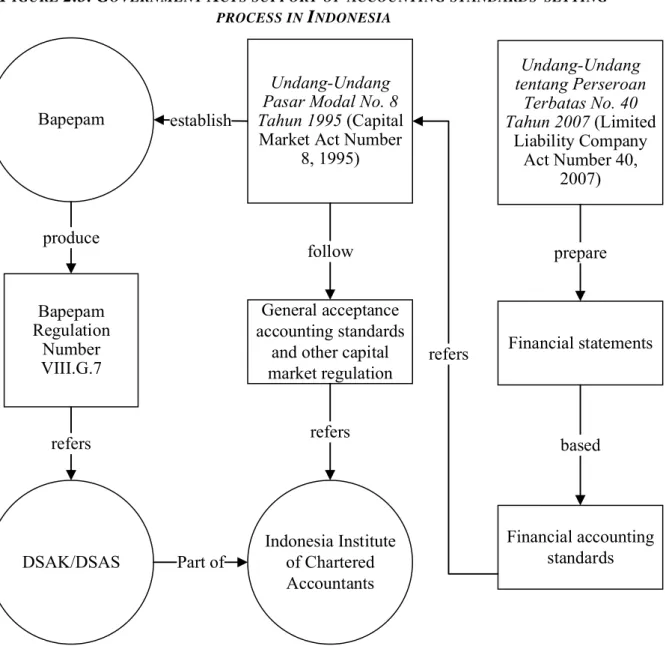
Figure 2.3. Government Acts endorsement of accounting standards-setting process in Indonesia ...……….……….. 31
Figure 5.1. Sampling Selection Justification .………...………. 85
Figure 5.2. Interview criterion selection ……… 86
Figure 5.3. Example of coding and themes selection ……… 89
Figure 5.4. Example of source triangulation ………. 91
Figure 6.1 The construction of legitimacy dynamics of accounting standards-setting in Indonesia ………...………... 95
Figure 6.2. The relationship between DSAS and DSN-MUI in the sharia accounting standards-setting process ………...……….. 162
Table 2.1. List of regulations regarding accounting profession ………... 14
Table 2.2. List of Islamic accounting standards ……… 17
Table 2.3. The application of Islamic accounting standards by counties and jurisdiction ………. 20
Table 2.4. Accounting standards setter comparation between G20 countries ……….. 24
Table 2.5. List of regulations regarding accounting standards ……….. 32
Table 3.1. Difference characteristics of conventional and Islamic accounting ..……... 44
Table 3.2. Major research in conventional of accounting standards-setting ………... 50
Table 3.3. Major research in Islamic accounting ………... 57
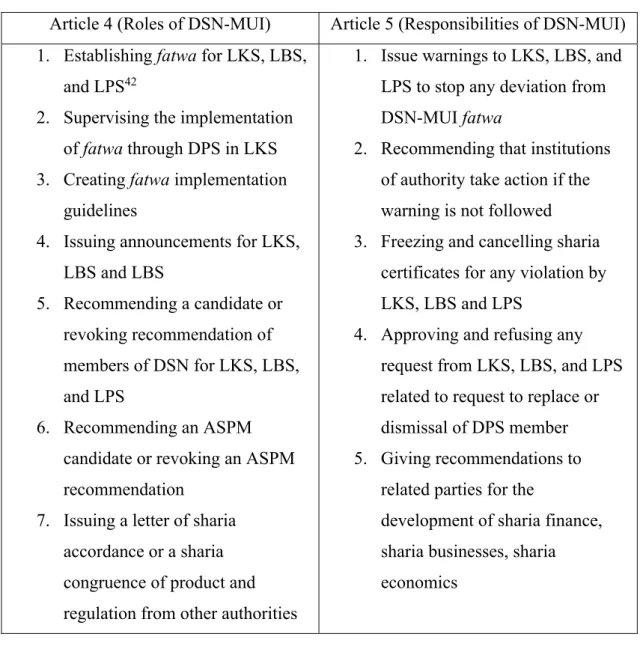
Table 4.1. Description of roles and authorities of DSN MUI ……...………. 75
Table 5.1. The difference between post positivism, critical theory, and interpretivism ...……… 82
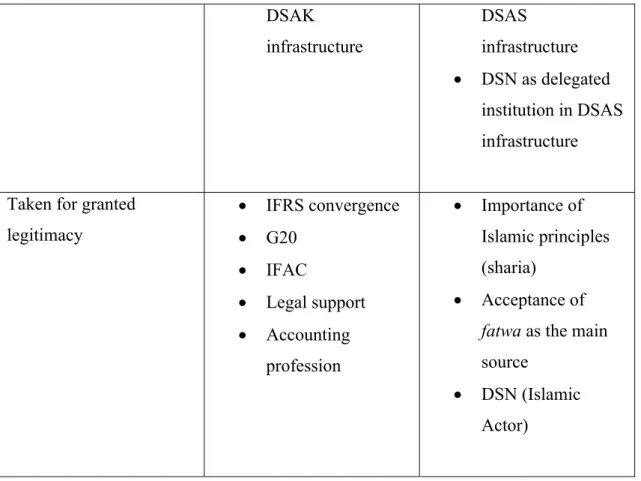
Table 6.2. Legitimacy dynamics difference between conventional and Islamic
List of Abbreviations
AAAJ : Accounting, Auditing and Accountability Journal AAOIFI : Auditing Organisation for Islamic Financial Institution AcSB : Canadian Accounting Standards Boards
AICPA : American Institute of Certified Public Accountants ASPM : Ahli Syariah Pasar Modal / Sharia Capital Market Expert
ASR : Accounting Series Release
BAPEPAM : Badan Pengawas Pasar Modal / Capital Market Supervisory Agency CICA : Canadian Institute of Chartered Accountants
CL : Comment Letter
CLERP : Corporate Law Economic Reform Program
CPA : Certified Public Accountants
DIFC : Dubai International Financial Centre
DPS : Dewan Pengawas Syariah / Sharia Supervisory Board
DSAK : Dewan Standar Akuntansi Keuangan / Financial Accounting Standards Board
DSAS : Dewan Standar Akuntansi Syariah / Sharia Accounting Standards Board
DSN : Dewan Shariah Nasional / National Sharia Board
DSN-MUI : Dewan Shariah Nasional – Majelis Ulama Indonesia / Sharia National Board – Indonesian Council of Ulema)
EFRAG : European Financial Reporting Advisory Group
FAOIBFI : Financial Accounting Organisation for Islamic Banks and Financial Institution
FRS : Financial Reporting Standards
IAB : India Accounting Board
IAI : Ikatan Akuntan Indonesia / Indonesia Institute of Chartered Accountants
IAS : International Accounting Standards IASB : International Accounting Standards Board IASC : International Accounting Standards Committee ICAI : Institute of Chartered Accountants of India
IFAC : International Federation of Accountants IFI : Islamic Financial Institution
IFRIC : Interpretational Financial Reporting Interpretations Committee IFRS : International Financial Reporting Standards
KPAI : Komite Prinsip Akuntansi Indonesia / Indonesian Accounting Principle Committee
LBS : Lembaga Bisnis Syariah / Sharia Business Institutions LKS : Lembaga Keuangan Syariah / Sharia Financial Institution LPS : Lembaga Perekonomian Syariah / Sharia Economic Institutions MUI : Majelis Ulema Indonesia / (Indonesian Council of Indonesian Ulama) NHM : Netherlandshe Handel-maatschappij / Netherland Trading Society
NU : Nahdlatul Ulama
OJK : Otoritas Jasa Keuangan / Financial Services Authority
PAI : Prinsip Akuntansi Indonesia / Accounting Principle Indonesia PROLEGNAS : Program Legislasi Nasional / National Program of Legislation PSAK : Pernyataan Standar Akuntansi Keuangan / Statement of Financial
Accounting Standards
PSAKS : Pernyataan Standar Akuntansi Keuangan Syariah (Statement of Financial Accounting Standards
SAK : Standar Akuntansi Keuangan / Financial Accounting Standards
SAS : Standar Akuntansi Keuangan Syariah / Sharia Accounting Standards
SEC : Security and Exchange Commission
SIC : Standing Interpretation Committee
UAE : United Arab Emirates
UK : United Kingdom
US GAAP : United States Generally Accepted Accounting Principles
US : United States of America
USSR : The Union of Soviet Socialist Republics
Glossary
Al-khulafa’ al-rashidun : Rightly guided caliph
Dasar Negara : National Principle
Fatwa : Islamic legal opinion by Islamic clergy
Fiqh : Law
Ghara : Gamble
Hadith : Tradition of Prophet Muhammad PBUH
Iman : Belief
Kalam : Theology
Maisir / Qimar : Uncertainty
Pancasila : Five National Principles
Profit-sharing : Method of financing instead of using a fixed interest
rate, applies based on mutual-agreement among parties (lender and borrower) regarding financial activities
Qardh : Financial activities without any mandatory profit-sharing
value besides the principal amount agreed by the parties regardless the application of lump sum or instalment payment
Riba’ : Interest
Shadaqah : Islamic term regarding voluntary charity
Shari’ah Islami’iah : Islamic teaching
Siyasa : Politics
Syirkah temporer : Investment activities conducted by Islamic bank
Tafsir : Exegesis
Waqf : The transfer of wealth owned by a Muslim person primarily for community buildings such as schools, dormitories, orphanages and mosques
Zakat / zakah : 2.5 percent annual compulsory tax imposed on all
Chapter 1. Introduction
1.1. Introduction
Accounting standards have profound societal impacts, and therefore standard setting process is worthy of critical examination (Burchell et al., 1985; Robson and Young, 2009). Accounting information has a major impact on human behaviour and economic decision-making of members of society. Consequently, accounting standards used to prescribe how this information is prepared affects the distribution of wealth among various members of society and, thus, has an impact on their welfare. As accounting standards have far-reaching economic and social consequences, many stakeholders and economic interests are formally or informally involved in the regulatory processes through which accounting standards are set (Mouck, 2004; Young, 1994). At the same time, the process through which stakeholders become involved in the regulatory process is inherently subjective, relating to one’s own personal perception, in particular, the perception of being affected by the standards. As a consequence, accounting standards are neither right or wrong but generally agreed (Mouck, 2004) by those who are affected. Accordingly, the agreement is based upon the perception or assumption that accounting standards fulfil socially desirable criteria (Bengtsson, 2011; Kwok and Sharp, 2005). Thus, it is based on acceptance, and legitimacy is a prerequisite for the success of any regulatory body.
The present study seeks to expand the literature of legitimacy of the accounting standards-setting process, building upon the work of Suchman (1995) on complex evaluative and cognitive legitimacy dynamics, with a view to investigating the legitimation of accounting standards in both conventional and Islamic accounting contexts. This research uses Indonesia as a case study as it provides a unique opportunity to explore and contrast legitimation dynamics in these two contexts. This is because Indonesia has the unique duality of an accounting standards regime, where the Indonesian Institute of Chartered Accountants (IAI) consists of dual and equal standard boards, namely the Financial Accounting Standards Board (DSAK) and the Sharia Accounting Standards Board (DSAS). The reason for using Suchman's (1995) legitimacy theory is to consider both conscious evaluation dynamics as well as pre-reflexive dynamics i.e. cognitive legitimacy dynamics. Therefore, his words allow us to understand the stronger reason for acceptance
as well as the cognitive biases present in legitimacy in the context of conventional and Islamic accounting regulations.
The introduction chapter is organised as follows. Section 1.2 discusses the theoretical foundation and objective of the study; section 1.3 describes the research scope and methodology employed; section 1.4 presents the research motivation and potential implications of this research for accounting standards; section 1.5 identifies the structure of the current study; and the final section concludes the chapter.
1.2. Theoretical foundation and objective of the study
The primary purpose of this study is to explore and contrast legitimacy dynamics of accounting standards setting between the conventional and Islamic standards-setting process. Accounting standards development are considered as crucial aspects not only to regulate the accountability of business institutions but also as affecting wealth distribution and the behaviour of society. Due to the vast array of implications for accounting standards, legitimacy becomes a most interesting subject to investigate the rationality of acceptance by its followers in the development of accounting standards.
This research used Indonesia as a case study because Indonesia has dual, equal and parallel accounting standards regimes, namely a sharia accounting standards board (DSAS) and a financial accounting standards board (DSAK). These two boards are subordinated by a single private accounting profession, namely the Indonesia Institute of Chartered Accountants (IAI). The financial accounting standards board (DSAK) is responsible for the development of conventional accounting standards, while the sharia accounting standards board (DSAS) is responsible for the development of the sharia1 accounting standard. In Indonesia, IAI is the only accounting professional institution recognised both for organising accounting profession as well as regulating the development of accounting standards. Therefore, due to the unique structure of standards-setting in Indonesia, it provides an interesting insight of how legitimacy is perceived differently between the two standards-setters.
This research draws upon Suchman's (1995) legitimacy theory to investigate legitimacy dynamics, both legitimacy based on evaluative and cognitive aspects in both conventional
1 This research applies the words “sharia accounting” and “Islamic accounting” interchangeably. The words
in this thesis have a similar meaning presenting accounting standards based on Islam or accounting standards based on sharia.
and sharia accounting standards development. Suchman (1995, p. 574) described legitimacy as “a generalised perception or assumption that the actions of an entity are desirable, proper, or appropriate within some socially constructed system of norms, values, belief, and definitions.” Suchman’s (1995) work on legitimacy theory provides a comprehensive perspective of legitimacy by providing different types of legitimacy through evaluation and pre-reflexive reason that is cognitive legitimacy. Thus, applying Suchman (1995) legitimacy theory, this research aims to unveil the dynamic relationship of legitimacy with the development of accounting standards setting in Indonesia.
This paper also seeks to compare the cognitive biases due to professional and religious reasons for both standards-setting processes. The study seeks to understand the role of the accounting profession in the development of accounting standards. Accordingly, the accounting profession is pre-reflexively accepted and taken for granted as being perceived as a trustworthy and knowledgeable institution with regard to their (accountants) professional status (e.g. Burns and Haga, 1977; Preston et al., 1995; Sikka et al., 1989). By combining both roles as accounting profession and regulator in accounting standards development, the Indonesia Institute of Chartered Accountants is perceived as an important actor, demonstrating a greater degree of taken-for-granted legitimacy in the accounting standards setting-process, which allows us to confirm the existence of cognitive biases due to professional considerations.
In contrast to conventional standards, Islamic accounting standards are developed based on an Islamic perspective rather than a secular one. Although conventional accounting standards takes into account ethical considerations, in Islamic accounting standards, religious background becomes the main source of sharia accounting standards (e.g. Baydoun and Willet, 2000; Hamid et al., 1993; Tomkins and Karim, 1987). Correspondingly, the development of sharia accounting standards arguably relies heavily on the presentation of religious considerations to support the development of accounting standards. Consequently, cognitive biases due to religious reasons are present in the development of accounting standards. Thus, the impact of religion and professionalism creates a unique perspective of how the legitimate building blocks of accounting standards-setting are affected by these two elements/factors.
To explore and compare the evaluative and cognitive aspects of legitimation dynamics in conventional and Islamic accounting standards-setting. In particular, to explore and compare cognitive biases that are embedded in professional expertise and religious beliefs.
1.3. Scope and methodology of the study
This research explores and contrasts legitimation dynamics of accounting standards development between conventional and Islamic accounting standards-setting. This research focuses on Indonesia standards-setting process due to the character of dual, equal and parallel standards-setting boards, namely the financial accounting standards board and the sharia accounting standards boards which represent conventional and sharia accounting standards, controlled respectively by the private accounting profession. Contextually, conventional accounting arguably presents the value of secularism in comparison to religious background in Islamic accounting. Thus, this thesis examines two research questions which refer to legitimacy dynamics and cognitive biases embedded in professional accounting expertise and religious beliefs. The research questions are:
1. What are the main drivers of evaluative and cognitive aspects of legitimation dynamics in conventional and Islamic accounting standards-setting in Indonesia? What are the differences?
2. How different are cognitive biases embedded in professional expertise and religious beliefs and how do they influence the legitimation process in accounting standards-setting?
In order to answer the research questions of the study, a semi-structured interview method was employed. The three main interview questions constructed to obtain and understanding of both cognitive and evaluative aspects of legitimate dynamics of accounting standard setting:
1. What are the main factors/key players/institutional influences that you believe to have impacted (explicitly as well as implicitly) the development of accounting standards in Indonesia?
2. Could you elaborate further on the nature and sources of those influences, i.e. the official as well as unofficial authority that these factors have on the development of accounting standards?
3. How do you think conventional and Islamic regulatory process differ? What are, in your opinion, the underlying reasons for the differences?
The interviewees were selected using a mixed purposive sampling: convenient, snowball and criterion sampling (Patton, 2002, pp.243-244). A total of 34 interviews were conducted. Those interviewees represented six different groups: Academics (AC), Government Institution and Regulators (G), Preparers (P), and Audit Institutions (AU), Sharia Accounting Scholars (SAS) and Sharia Institutions (SI).
This research applies thematic analysis and the abductive approach by adopting Suchman (1995) legitimacy theory as a theoretical proposition. Suchman (1995) legitimacy theory is applied to identify the themes and the issues regarding legitimacy dynamics of accounting standard-settings as well as to identify the cognitive biases of professionalism and religious embedded in the standards-setting process.
1.4. Motivation and the potential implication of the study
The motivation for this study is to compare legitimacy dynamics in the accounting standard-setting process, in particular contrasting the legitimacy between the conventional and Islamic accounting standards-setting process. Accounting standards are considered as political aspects with far-reaching social and economic implications. Therefore, via legitimacy, the evaluation and pre-reflexive behaviour which is cognitive legitimacy provides the understanding of subjectivity of acceptance in accounting standards development.
As a result of the significant implication for accounting standards setting, the previous literature has comprehensively investigated political motives in accounting standards development. Previous research has identified the logic behind corporate participation due to future economic consequences (Larson, 1997; Puro, 1984; Watts and Zimmerman, 1978). In contrast, constituent background and diversity participation presents in previous studies such as: the diversity of actors involved based on certain standards-setting stages (Jorissen et al., 2012); the domination of academics from Anglo-Saxon countries in the development of international standards (Larson and Herz, 2011); the role of the accounting profession in presenting their status in the development of accounting regulation (Brown and Tarca, 2001; Harding and Mckinnon, 1997). In addition, previous research has also examined the effect of culture in the development of accounting
standards such as: social values in relation to accounting standards (Gray, 1988); the association between accounting standards in developing countries and the types of accounting standards applies (Bing, 1998; Chow et al., 1995; Zhang and Andrew, 2015); the role of government and international funding agencies (Nurunnabi, 2015; Perera, 1989); and the effect of religion in the development of accounting standards (Hamid et al., 1993).
In addition to political context, legitimacy is fundamental to meet social expectation through acceptance in accounting standards development. Accordingly, previous research has investigated how legitimacy is perceived in accounting standards-setting such as: legitimacy due to geographic bias (Jorissen et al., 2013); standards setter action to proactively seeking input and response in accounting regulatory arena (Durocher and Fortin, 2010); integrated model of defining user perception in the standards setting process (Durocher et al., 2007); institutional legitimacy and authority challenges (Johnson and Solomons, 1984); the role of regulation in causing legitimacy (Schmidt, 2002); and legitimacy in the context of international standards-setting (Bamber and McMeeking, 2016; Larson, 2007; Pelger and Spieß, 2016; Richardson and Eberlein, 2011). Despite the fact that previous studies provide detail and that the vast range of literature in accounting standards-setting includes the importance of legitimacy perceived in the standards-setting process, the literature does not provide enough evidence to explore the difference in legitimacy between conventional and Islamic accounting standards-setting.
However, since the objective of this research is to compare legitimacy between Islamic and conventional accountings standards, this research also presents previous literature in Islamic accounting development. Islamic accounting standards arguably emerges as an alternative to conventional accounting standards. Islamic accounting emerges to accommodate the need for financial reporting for Islamic financial institution and Islamic transactions. Previous literature in Islamic accounting mainly focussed on the development of the theoretical foundations of Islamic accounting (Abdel-Magid, 1981; Mirza and Baydoun, 1999; Haniffa and Hudaib, 2002), ethics and social responsibility (Haniffa and Hudaib, 2007; Kamla et. al, 2006), an international regulator for Islamic financial institutions (Abdel Karim, 1995), and a historical perspective of Islamic accounting standards development (Napier, 2009). Due to the significant gap in research concerning the social aspect of Islamic accounting development, this research takes the lead in exploring the difference in legitimacy between conventional and Islamic
accounting standards development. Furthermore, conventional accounting is developed based on the capitalist system; in contrast, Islamic accounting is developed based on the Islamic background. Contrasting between the two, this research applies Suchman’s (1995) work on legitimacy theory since it presents detail the different types of legitimacy, namely pragmatic, moral, and cognitive legitimacy.
By using Indonesia as a case study, this research evaluates and compares legitimacy dynamics between conventional and Islamic accounting standards development. In Indonesia, IAI is the only organisation responsible for the development of accounting standards through its dual and parallel standards setter (DSAK and DSAS). Subsequently, as an authorised institution in accounting standards development, the acceptance and recognition of the accounting profession as a trustworthy institution is highly significant in the development of accounting standards. However, Islamic accounting standards are established based on different foundations compared to conventional standards, namely the religious background. By exploring and constrasting the legitimacy between Islamic and conventional standards, this research presents the the dynamics between evaluation and cognitive aspects in the two accounting regimes and, in addition, how religious and professional backgounds affect cognitive acceptance in the development of accounting standards development. Despite accounting standards development in Indonesia being the responsibility of the accounting profession, Islamic accounting standards development relies more on sharia considerations, in contrast to the accounting profession which relies more on conventional considerations.
Accordingly, using qualitative interviews approach and conducting thematic analysis, this research identifies three main themes of legitimacy in accounting standard settings, and contrasts legitimacy between sharia and conventional accounting standards-setting process. As a legitimate institution, the role of IAI as an accounting profession and Islamic considerations provide insights into how these two factors/elements affect the legitimacy of accounting standards-setting in Indonesia.
1.5. Structure of the study
The present study is structured as follows. This chapter is an introductory section which mainly presents the theoretical foundation, research scope and the implication of this research for accounting standards development. Chapter 2 presents the research
background to the case study of Indonesia. Chapter 3 presents the literature review section that discusses the accounting standards setting as social practices both in conventional and Islamic accounting standards-setting. Chapter 4 presents the theoretical foundation of this research based on Suchman’s (1995) legitimacy theory, which is linked to professional reasons and religious considerations. Chapter 5 discusses the research methodology and data collection process. Chapter 6 presents the empirical findings of this research, analysis and discussion of legitimacy. Lastly, Chapter 7 concludes the thesis by summarising the thesis, presenting the research contributions, avenues for future research and research limitations.
1.6. Conclusion
This chapter has delivered an outline of the research undertaken in the current study in the context of legitimacy dynamics and cognitive biases of the accounting standards-setting process. The main objective of this research is to explore and compare the evaluative and cognitive aspects of legitimation dynamics in conventional and Islamic accounting standard settings, particularly to explore and compare cognitive biases embedded in accounting professional expertise and religious beliefs. This study uses Indonesia as a case study, since it provides a unique position of a dual, equal and parallel accounting standards regime, namely DSAK and DSAS subordinate of Indonesia Institute of Chartered Accountants.
The study intends to fill the gap by comparing legitimacy dynamics between conventional and Islamic accounting standards-setting. This research follows Gillis et al.'s (2014, p. 586) call for more research into the accounting standards-setting process “that answer and explain of what happened of accounting standards-setting process”, particularly in the context of Islamic accounting development (Napier, 2009). In addition, this research also investigate the role of religious considerations in the development of accounting regulations (Hamid et al., 1993). Applying the work of Suchman’s (1995) legitimacy theory, this research focuses on 1) the main drivers and differences of legitimacy in conventional and Islamic accounting standard setting in Indonesia, and 2) comparing the influence of cognitive biases based on professional expertise and religious beliefs. Conducting 34 semi-structured interviews, the interviewees are divided into six groups: Academics (AC), Government Institution and Regulators (G), Preparers (P), Audit
Institutions (AU), Sharia Accounting Scholars (SAS) and Sharia Institutions (SI). To analyse interview data, this research applies thematic analysis to identify the legitimacy dynamics of standards-setting process.
Chapter 2. Background to the study: The case of Indonesia
2.1. Introduction
Chapter 2 presents an overview of the background on the accounting standard-settings in Indonesia. Section 2.1 provides a brief discussion of the chapter. Section 2.2 discusses the historical context of accounting standards-setting in Indonesia. Section 2.3 presents the development of accounting profession initiated in 1954 and continued until today. Section 2.4 explains that the structure of accounting standards in Indonesia includes actors who are responsible for the development of accounting standards and regulations which support the development of accounting standards. The last is Section 2.5 concludes the chapter.
2.2. Historical context of accounting development
In general, Indonesia is secular country even though the majority of the population is Muslim. Indonesia adopts five principles: i) the belief in One Supreme God; ii) a just and civilised humanity; iii) Indonesian unity; iv) popular democracy led by wisdom and implemented through deliberation and representation; and v) social justice for all Indonesians (Azra, 2013, p. 68). The five principles are named as Dasar Negara (national principles) or Pancasila (abbreviation of five national principles). Pancasila is accepted by all citizens, regardless of their religious and cultural backgrounds.
In the 13th century, Islam started to spread across the archipelago and Muslims (predominantly from the Middle-East and other South-Asian countries) began settling across coastal areas of Indonesia. Islam spread across the country through business interactions and assimilation between the indigenous people and Muslim traders. It is said that the spread of Islam in Indonesian archipelago was one of the most important events in Indonesian history (Sukoharsono, 1998).
According to Sukoharsono (1993b), the emergence of accounting in Indonesia during early Islamic civilisation (prior to Dutch colonisation2) was related to accounting for trading activities. The accounting approaches in this period were mainly to assist the
2 According to Ricklefs (2001, p.32) Dutch initially came under VOC, in 1605 VOC began to occupied
Moluccas Islands in East of Indonesia and starting their influenced across archipelago. In 1800, the VOC dissolved by Dutch government and all VOC possession become the property of the Dutch government (Ricklefs, 2001, p.144)
administration and help harbourmasters to organise taxes. During the Islamic period, Sukoharsono (1993b) described that tax collection was recorded periodically and collected for the royal court as revenue. Moreover, the financial calculations during Islamic period also applied for measuring Islamic charity or shadaqah3 and zakat4 (Sukoharsono, 1998).
Following the Islamic period, most of the Indonesian archipelago was under a Dutch company namely Verenigde Oostindische Compagnie (VOC) or the Dutch East Indies Company whose main purpose was to monopolise trading and maintain political authority (Sukoharsono and Gaffikin, 1993b). Subsequently, during Dutch colonisation, the role of monopoly and the standardising currency system in the Indonesian archipelago affected the establishment of new accounting techniques (ibid). In terms of commercial activities, VOC also provided calculation system matching between revenue and expense (ibid). Interestingly, according to Sukoharsono and Gaffikin (1993a) even though accounting regulations had existed since 1609, the application of these regulations was just for business controlling activities adopting dual-entry booking system (Sukoharsono and Gaffikin, 1993b).
The most interesting collection of documents relating to accounting regulation during colonial period is the colonial regulation of financial institutions in the early 1800s. As a result of this regulation, two major financial institutions namely Netherlandshe
Handel-maatschappij (Netherland Trading Society / NHM) and the Javache Bank were
established (Sukoharsono and Gaffikin, 1993a). In the 20th century, the rise of accounting and financial reporting was initiated by the application of accounting and the establishment of the state audit agency by the Dutch colonial government. The establishment of this institution aimed to help the colonial government control the operationalisation of Dutch corporations in Indonesia. Accordingly, the establishment of a governmental audit institution in the colony showed the emergence of greater financial complexity and the need for accounting instructors for controlling purposes (ibid). The rise of accounting during the colonial period was also caused by the establishment of Dutch capital market. Sukoharsono and Gaffikin (1993a) identify the establishment of the
3Shadaqah is an Islamic term regarding voluntarily charity
4Zakat/zakah is a 2.5 percent annual compulsory tax impose on all Muslim who are identified as not poor
(Abdel-Magid, 1981). The calculation of zakat is wealth that exceed the amount of necessary to satisfy the basic human needs is subject to 2.5 percent annual zakat regardless of whether the excess wealth is invested (Abdel-Magid, 1981).
capital market as due to the rise of foreign capital and the banking industry. The foreign capital came to establish new industries in the country through manufacture and agriculture. During the colonisation period Indonesia experienced an increase in industrialisation, thus creating the demand for accounting expertise. However, during 1910-1920, there was a lack of accounting knowledge in formal education (Sukoharsono and Gaffikin, 1993a). To overcome this disadvantage and fulfil the demand for accountants, foreign accountants from the UK and the Netherlands were sent to Indonesia (ibid).
Following the Netherlands’ colonial rule, Japan occupied the Indonesia archipelago for three years (1942-1945). During this occupation, the Japanese allowed for reformation of Indonesian society by allowing society to serve in public services, including the reorganisation of qualified professions such as accounting (Irmawan, 2010).
2.3. Development of the accounting profession
Following Indonesia’s proclamation of independence on August 17, 1945, an Indonesian government was established, and the heads of government and ministers were selected to maintain public order. With regard to the economic succession after the Dutch and Japan colonisation, most Dutch companies were nationalised by the government in order to claim the economic benefits (Sukoharsono and Gaffikin, 1993a).
Subsequently, the government enacted Government Act Number 34, 1954 to regulate corporations and to maintain the role of accountability in business activities. The enactment of Act Number 34, 1954 established a higher education system to promote the accounting profession, namely the ‘accountant’. Therefore, this regulation marked the professional status of accountants in the nation and recognised an accountant as a professional institution.
Act Number 34, 1954 acknowledged the importance of education for accountants and as the underlying reason for the construction of an accounting profession. According to Ministry of Education, Teaching and Culture (1954) in Undang-Undang Republik Indonesia Nomor 34 Tahun 1954 Tentang Pemakaian Gelar ‘Akuntan’ (1954) (Indonesian Act Number 34, 1954 regarding the use of the title “Accountant”), an accounting degree is awarded by state universities or other higher institutions established or recognised by the government. This Act ensures that those who wish to pursue an
accounting degree and become a professional in accountancy should be educated in Indonesia’s higher education institutions. The explanation section of Act Number 34, 1954 explained the need for this regulation to be implemented in society, the hope is that this profession will help society to resolve their financial problems and assist business institutions that are facing increased competition. Act Number 34, 1954 becomes the first recognition for accountants as professional institutions in Indonesia and later acts as the legal reason for the establishment of Indonesia Institute of Chartered Accountants in 1957.
In 2014, the Ministry of Finance and the Ministry of Education and Culture worked together to further support, and provide a legal endorsement, for IAI through the Ministry of Finance Regulation Republic of Indonesia Number 25/PMK.01/2014 regarding National Accountant Register (Peraturan Menteri Keuangan Republik Indonesia Nomor
25/PMK.01/2014 Tentang Akuntan Beregister Negara)5. The PMK 25/PMK.01/2014
Regarding National Accountant Register was enacted not only to endorse and support previous regulations (Act Number 34, 1954), the PMK (25/PMK.01/2014), it also replaced another regulation, the Decision of Ministry of Finance, Republic of Indonesia, Number 331/KMK.017/1999 Regarding the Registration Organisation of Accountants for the National Register (Keputusan Menteri Keuangan Nomor 331/KMK.017/1999 Tentang Penyelenggaraan Pendaftaran Akuntan Pada Register Negara). The replacement of the previous regulation (331/KMK.017/1999) was to assist the development of the accounting profession to face the globalisation challenges which lay ahead (Ministry of Finance, 2014b). In addition, this regulation regulates and ensures that all accountants are registered by the Ministry of Finance.
Following the PMK 25/PMK.01/2014 Regarding National Accountant Register, on 17 June 2014 the Minister of Finance issued a decision to support PMK 25/PMK.01/2014 named as Decision of the Ministry of Finance, Republic of Indonesia, Number 263/KMK.01/2014 regarding the Indonesian Institute of Chartered Accountants as a Professional Accountant Association (Keputusan Menteri Keuangan Republik Indonesia Nomor 263/KMK.01/2014 Tentang Penetapan Ikatan Akuntan Indonesia Sebagai
Asosiasi Profesi Akuntan).6 The KMK 263/KMK.01/2014 states that the Minister of
Finance should promote and provide legal endorsement for one association from the
5 In order to simplify the name of this regulation, the name is written as PMK 25/PMK.01/2014.
accounting profession; this association is the Indonesian Institute of Chartered Accountants. The reason for this is that IAI has all the necessary requirements to be enacted as a single professional institution in Indonesia (Ministry of Finance, 2014a). Besides the Ministry of Finance, the Ministry of Education and Culture also provides a legal endorsement of IAI, namely Ministry of Education and Culture, Regulation Number 153, 2014 regarding the organisation of the Educational Programme for the Accounting Profession (Peraturan Menteri Pendidikan dan Kebudayaan Republik Indonesia Nomor 153 Tahun 2014 Tentang Penyelenggaraan Pendidikan Program Profesi Akuntan). This ministry recognised IAI’s educational programme and enacted specific regulation relating to the accounting profession education programme. The regulation describes an accountant’s professional education as an education post-bachelor degree focused on the accounting field (Ministry of Education and Culture, 2014). This regulation legitimised IAI as the sole institution able to hold and organise professional education for accountants. Although higher education institutions in Indonesia are capable of providing professional education, the regulation has the power to take away their authorisation in the event of non-cooperation with IAI.7
Below is a list of government regulations regarding the accounting profession in Indonesia:
TABLE 2.1.LIST OF REGULATIONS REGARDING ACCOUNTING PROFESSION
Number Name Year Issuer Topic
1. Indonesian Act, Number
34, 1954 regarding the application of an Accounting degree (Undang-Undang Republik Indonesia Nomor 34 Tahun 1954 Tentang Pemakaian Gelar ‘Akuntan’, 1954) 1954 Ministry of Education, Teaching and Culture, Republic of Indonesia Recognition of “accountant” as professional title and regulation of accounting education
7 For higher education to organise accounting profession education, should be cooperate with IAI.
2. Ministry of Finance Regulation, Republic of Indonesia, Number 25/PMK.01/2014 regarding the National Accountant Register (Peraturan Menteri Keuangan Republik Indonesia Nomor 25/PMK.01/2014 Tentang Akuntan Beregister Negara) 2014 Ministry of Finance Government legal support for the
accounting profession and the use of national registered accountant(s)
3. Decision of the Ministry of Finance, Republic of Indonesia, Number 263/KMK.01/2014 regarding the Indonesian Institute of Chartered Accountants as a professional accounting association (Keputusan Menteri Keuangan Republik Indonesia Nomor 263/KMK.01/2014 Tentang Penetapan Ikatan Akuntan Indonesia Sebagai Asosiasi Profesi Akuntan) 2014 Ministry of Finance Government legal
support for the Indonesia Institute of Chartered Accountants as an accounting profession recognised by the government
4. Ministry of Education and Culture, Regulation Number 153, 2014 regarding the organisation of a Professional Accountant Educational Programme (Peraturan Menteri Pendidikan dan Kebudayaan Republik Indonesia Nomor 153 Tahun 2014 Tentang Penyelenggaraan Pendidikan Program Profesi Akuntan) 2014 Ministry of Education and Culture Government legal support for IAI professional education
2.4. Development of Islamic accounting standards
The development of Islamic accounting standards in Indonesia can be traced back to when Indonesia first allowed and recognised the adoption of a profit-sharing8 system in the banking industry through Banking Act. No. 7, 19929 (Suandi, 2013). The enactment of the profit-sharing banking system initiated the establishment of Islamic Banking operation in Indonesia. The adoption of an Islamic banking system shows a growing global trend in the Islamic world, including Indonesia, because of the awareness of the prohibition of riba (interest). Following this regulation (Banking Act No. 7, 1992), the first profit-sharing bank established was Muamalat Indonesia, which was opened in 1991 (Suandi, 2013).
In 2008, the new Islamic banking regulation was enacted and named as Act Number 21, 2008 regarding Sharia Banking (Undang-Undang Republik Indonesia Nomor 21 Tahun
8 Profit-sharing banking system was initiated as alternative banking system in Indonesia compare to
conventional banking system that based on interest. Profit-sharing is method of financing instead of using interest on fixed rate, applies based on mutual agreement among parties (lender and lendee) regarding financial activities. The money should be returned according based on specific time framed with specific amount of profit-sharing value.
9 Act of Republic of Indonesia number 7, 1992 regarding banking later replaced by Act of Republic of
2008 Tentang Perbankan Syariah). This regulation regulates the development of the sharia banking system which is notably different to the conventional banking system. This regulation replaced previous regulation, namely Banking Act. No. 7, 1992. Therefore, the new act’s (Act Number 21, 2008 regarding Sharia Banking) clear purpose is to regulate the sharia banking system.
In terms of the accountability of the sharia banking system, Sharia Banking Act. No. 21, 2008 specifies that sharia banks and Unit-Usaha Syariah (sharia business units) should report their financial statement according to the “general accounting principle” and “other periodic reporting principles” (Ministry of Law and Human Rights, 2008). The meaning of “general accounting principle” is defined as accounting standards promulgated by an authorised institution (ibid).
1. In terms of Islamic accounting standards, DSAK developed PSAK 59 accounting for sharia banking in 2002. The PSAK 59 provides assistance for Islamic banks in Indonesia to report their financial statements based on the Islamic perspective. Before PSAK 59 was issued by DSAK, the financial reporting system of Islamic banks did not directly report accounting standards based on Islamic perspectives. Instead, Islamic banks applied conventional accounting standards such as the Financial Accounting Standards Number 31 (PSAK No. 31) which applies to conventional banking industry (Suandi, 2013). Since 2002, there have been 13 sharia accounting standards developed by standards setter in Indonesia. Below are the details of these sharia accounting standards:
TABLE 2.2LISTS OF ISLAMIC ACCOUNTING STANDARDS
Accounting standards code
Accounting standards name Notes
PSAK 59 Accounting for Sharia Banking
PSAK 101 Presentation of Sharia Financial
Reporting
PSAK 102 Accounting for Murabahah Sales mark-up contract
PSAK 103 Accounting for Salam Salam is a forward financing
PSAK 104 Accounting for Istishna Contract of future manufacturing product
PSAK 105 Accounting for Mudharabah Profit sharing contract in
which one party provides the resources (funds) and the other acts as the management
PSAK 106 Accounting for Musyarakah Partnership between parties
PSAK 107 Accounting for Ijarah Leasing agreement between
parties; this requires the lessee to used asset own by the lessor in a certain time and for agreed upon price between parties
PSAK 108 Accounting for Syariah
Insurance Transaction
PSAK 109 Accounting for Zakah/ Shadaqa Islamic charity
PSAK 110 Accounting for Sukuk Islamic financial certificate
PSAK 111 Accounting for Wa’d Promise of future transaction
PSAK 112 Accounting for Wakaf Endowment (particularly
land) for the social benefit
(religious, orphanage,
school)
Over time, as the standards setter of sharia accounting standards, DSAK has transformed its infrastructure to accommodate the rise of sharia transactions. In 2005, DSAK established a sharia committee within DSAK as part of a regulatory body in IAI to regulate Islamic banking which has developed rapidly (Suandi, 2013). By 2009, Dewan Pengurus Nasional IAI (National Management Board of IAI) established Dewan Standar Akuntansi Syariah (DSAS/Sharia Accounting Standards Board) as separate from DSAK (Kartikahadi et al., 2012, pp.18-19). The creation of DSAS was caused by the complexity of sharia transactions and the rise of responsibility of DSAK in accounting standards development.
FIGURE 2.1.TRANSFORMATION ACCOUNTING STANDARDS-SETTER FROM 1973-2009 IN INDONESIA
The membership of DSAS is comprised of a similar representation as DSAK, with additional representation from Islamic scholar through Sharia National Board (Dewan Syariah Nasional / DSN). Furthermore, in terms of sharia accounting standards, DSAS relies heavily on DSN, and each accounting regulation from the DSAS should be approved by the DSN10 (National Sharia Board) in order to be labelled in accordance to Islamic principles (Suandi, 2013).
Although there is an international accounting standards setter for Islamic financial institution, namely the Accounting and Auditing Organization for Islamic Financial Institutions (AAOIFI)11, DSAS prefers to develop its Islamic accounting standards on its own. DSAS Islamic accounting standards is focused on regulating sharia transactions, while AAOIFI’s objective is to regulate Islamic Financial Institution (Suandi, 2013). In terms of Islamic accounting standards infrastructure, Suandi (2013) summarises the
10 The role of DSN in accounting standards development discuss in Chapter 4 theoretical foundation 11 AAOIFI, established in 1991, is Bahraini based non-profit accounting standards-setter objectively for
the development of accounting standards for Islamic Financial Institutions (IFIs) world wide 1973 Komite Prinsip Akuntansi Indonesia (Indonesian Accounting Principle Committee) 1994 Dewan Standar Akuntansi Keuangan (Financial Accounting Standards Board) 2009 Dewan Standar Akuntansi Keuangan (Financial Accounting Standards Board) Dewan Standar Akuntansi Syariah (Sharia Accounting Standards Board)
different between Islamic accounting standards in Indonesia compared to other countries from the Asian-Oceanian Standard-Setters Group (AOSSG) (2011):
TABLE 2.3.THE APPLICATION OF ISLAMIC ACCOUNTING STANDARDS BY COUNTIES AND JURISDICTION
Country Q1 Q2 Q3 Q4 Q5 Q6
Dubai IFRS Yes Yes Yes AAOIFI
standards We may need review some of requirement of Islamic accounting standards Indonesia National standards
based on IFRS
Yes Yes Yes National standards not based from AAOIFI We will retain our Islamic accounting standards Malaysia National standards
based on IFRS
Yes No No
Pakistan IFRS Yes No Yes National Islamic
standards adopted from AAOIFI standards We will retain our Islamic accounting standards Saudi Arabia
Banks and other Insurance
follow IFRS; other entities follow SOCPA12 Yes No No National standards not based on AAOIFI standards and other (No separate standards for
Islamic accounting) South
Africa
IFRS Yes No Yes AAOIFI
standards We may need review some of requirement of Islamic accounting standards
Syria IFRS Yes Yes Yes AAOIFI
standards We may need review some of requirement of Islamic accounting standards
a. Q1: What financial reporting standards are generally applied in entities in your country? b. Q2: Does your jurisdiction have a policy of convergence, or adopting the IFRS?
c. Q3: Do you consider applying different financial reporting standards for entities engaged in Islamic finance to be compatible with IFRS convergence/adoption?
d. Q4: Do special financial reporting standards apply to entities engaged in Islamic finance in your jurisdiction?
e. Q5: What type of Islamic accounting standard applies in your jurisdiction?
f. Q6: More and more countries are converging with or adoption IFRS. How does this affect your policy on Islamic accounting standards?
Source: Suandi (2013)
In addition, the user of Islamic accounting standards differs in comparison to conventional accounting standards. According to the conceptual framework of sharia accounting standards (Pernyataan Standar Akuntansi Keuangan Syariah) / PSAKS), Dewan Standar Akuntansi Syariah (2013) describes the users of sharia accounting standards: investors, both current and potential; the owner of the fund (qardh)13; the owner of syirkah temporer14 investment fund, the owner of deposit fund, payer and recipient of zakat, Islamic charity, waqf;15 shariah supervisory; employees; supplier; customer, government institutions; and society. On the other hand, the definition of the user according to conventional accounting standards in Indonesia includes the following:
13Qardh means financial activities without any mandatory profit-sharing value besides the principal
amount agreed by the parties regardless of lump sum or instalment (Bank of Indonesia, 2005).
14Syirkah temporer refers to investment activities conducted by Islamic bank.
15 The transfer of wealth owned by a Muslim person is primarily for community building such as a school,
current investor and future investor; employees; lender; supplier and creditor; buyer; government institution; and society (Dewan Standar Akuntansi Keuangan, 2014). As an authorised institution, DSAK and DSAS have similar roles for the the development of accounting standards. According to Dewan Pengurus Nasional Ikatan Akuntan Indonesia (2013) of IAI organisational rules (Peraturan Organisasi Ikatan Akuntan Indonesia Tahun 2013), the tasks and roles of DSAK and DSAS consist of formulation, development and endorsements of: (i) a conceptual framework for financial statements; (ii) statements of financial accounting standards; (iii) interpretation of accounting standards; (iv) statements of revocation of accounting standards, technical bulletins, and other products of accounting standards. The differences between the two are that DSAK mainly focuses on conventional businesses, whereas DSAS focuses on sharia transactions (Syariah, 2011).16 Another difference between DSAK and DSAS is that DSAK is also responsible for developing accounting standards for non-public ownership enterprises.
2.4. The duality of infrastructure in accounting standards-setting
IAI is well known as a professional association for accounting profession in Indonesia. It is the oldest accounting profession in Indonesia and the only one acknowledged by the government. IAI was established on 23 December 1957 with the objective to guide the development of accounting and to increase the quality of accounting education as well as to enhance accounting employability (Ikatan Akuntan Indonesia, 2016)
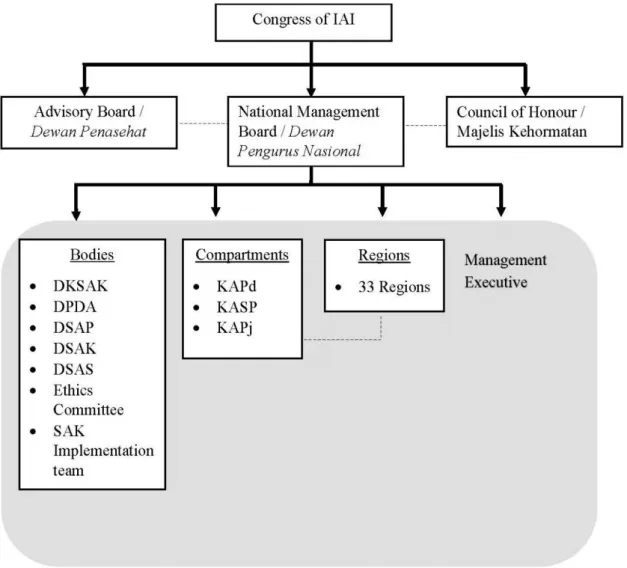
Interestngly, in addition to being responsible for the development of accounting profession, IAI is also responsible for accounting standards development. According to Dewan Pengurus Nasional Ikatan Akuntan Indonesia (2013) of IAI rules of the organisation in 2013 article number 29 describes that DSAK and DSAS should periodically report their activities to National Executive Board of IAI. For accounting standards development, IAI also hosts dual and equal standards setter, namely DSAK and DSAS. Therefore, through its infrastructure of accounting standards setting, it depicts that IAI controls every aspect regarding accounting practices in Indonesia.
16 By 2011, DSAS issued PSAK 101 presentations of sharia financial statements, this regulation replaced
the similar PSAK 101 issued on 2007. According to PSAK 101, the implementation of PSAK Syariah is for financial statements of sharia entity involving sharia transaction in their activity.
Figure 2.2 below presents IAI infrastructure of accounting standards setting, including DSAK and DSAS.
FIGURE 2.2.STRUCTURE OF ACCOUNTING STANDARDS-SETTING IN INDONESIA
Source: Ikatan Akuntan Indonesia (2018a)
In addition, the structure of standards-setting in Indonesia is unique compared to other countries. Below Table 2.3 presents a standards setter comparison between G20 countries.
TABLE 2.4.STANDARDS-SETTER COMPARATION BETWEEN G20 COUNTRIES FOR ACCOUNTING-STANDARDS SETTING
Countries Standards-setting board Types of Institution
Argentina The Argentinean Accounting and
Auditing Standards Board (CENCyA)
Part of the Argentinean Federation of Professional Organisations of Economic Sciences
Australia The Australia Accounting
Standards Board (AcSB)
Part of a government agency
Brazil The Brazilian Accounting
Pronouncements Committee (CPC)
Independent accounting profession
Canada The Accounting Standards Board
Canada (AcSB)
Independent institution and supervised by the Chartered Professional Accountants of Canada
China Accounting Regulatory
Department, Ministry of Finance, People’s Republic of China
Part of a government agency
European Union European Financial Reporting Advisory Group (EFRAG)
Independent institution representing the EU in IFRS standards development
France The Accounting Standards
Authority (ANC)
Supervised by the French government
Germany The Accounting Standards
Committee of Germany (ASCG)
Independent institution and acknowledged by law
India Accounting Standards Board of
India
Part of the Institute of Chartered Accountants of India
Indonesia Financial Accounting Standards
Board (DSAK) and Sharia Accounting Standards Board)
Part of Indonesia Institute of Chartered accountants
Italy Italian Accounting Organisation (OIA)
Independent institution
Japan The Accounting Standards Board
of Japan (ASBJ)
Private institution and part of Financial Accounting
Standards Foundation and supported by government institution
Mexico The Mexican Financial Reporting
Standards Board (CINIF)
Independent profession
Russia The Ministry of Finance of the
Russian Federation (MoF)
Part of a government agency Saudi Arabia Saudi Organization for Certified
Public Accountants (SOCPA)
Independent accounting profession
South Africa The Financial Reporting
Standards Council (FRSC) (part of government institution)
Part of a government agency
South Korea Korea Accounting Standards Board (KASB) (appointed by the Financial Service Commission)
Independent institution
Turkey Public Oversight, Accounting and
Auditing Standards Authority (KGK) (a governmental and non-profit regulator)
Part of a government agency
United Kingdom Financial Reporting Council (established by law)
Independent institution and established by law
United States Financial Accounting Standards Board
Independent institution that is recognised and supervised by Security and Exchange Commission
The position of DSAK and DSAS is unique due to their structure, as is presented in Table 2.4, compared to other countries. Accordingly, the Indonesia Institute of Chartered Accountants host two accounting standards boards, namely DSAK and DSAS.
In general, accounting standards in Indonesia can be divided into four primary parts based on transaction characteristics and the subject of the preparer, namely the financial accounting standards for: (i) public entities, (ii) private entities (iii) sharia transactions and (iv) governmental institutions. Financial accounting standards for private and public companies are promulgated by the Financial Accounting Standard Board and the Sharia Accounting Standard Board of which both are under the IAI (Kartikahadi et al., 2012, p. 8). Accounting for government institution is developed by the Ministry of Finance, while IAI is responsible for accounting standards development for non-government institutions. Indonesia’s accounting standards emerged in 1973 after IAI formed a body with the purpose of creating accounting standards, namely the Indonesian Accounting Principle Committee (IAPC) (Kusuma, 2005, p. 356). Prior to this, Indonesia did not have any official regulation or commitment to abide to any particular accounting standards. However, the accounting profession in Indonesia at that time followed both foreign accounting standards such as the U.S or Netherlands accounting standards (Kartikahadi et al., 2012, p. 4). According to Kusuma (2005, p. 356), since the 1960s Indonesia has been using international standards from other countries. Authority organisation specialising in accounting standard process had not yet been established (prior to 1973) by the IAI, and the standards that were adopted lacked a conceptual framework. After the establishment of IAPC, accounting standards which were based on foreign standards were revised according to the Indonesian context. In general, although the standards issued were translated from foreign standards, mostly US ones, they placed emphasis on local Indonesian values. In 1972, Radius Prawiro, as IAI chairman, collaborated with the capital market authority and created a committee to collect materials for the development accounting standards and auditing principles (Kartikahadi et al., 2012, p. 14). The establishment of IAPC subsequently created Indonesia’s Principles of Accounting (Prinsip Akuntansi Indonesia / PAI). The standards are collected and referenced from various sources, namely: accounting principles from the national directory, statements and opinions of accounting principle boards, research bulletins, Australian and Dutch accounting standards and U.S. accounting standards (Kartikahadi et al., 2012, p. 14-15; Kusuma, 2005, p. 356).
For two decades from 1973, the development of accounting standards in Indonesia was translated from United States Generally Accepted Accounting Principles (US GAAP) (Kusuma, p. 356). In 1994, IAI was committed to harmonising the PSAK into the