342
Natalina Premastuti Brataningrum & L. Saptono FKIP Universitas Sanata Dharma
email: [email protected]
Abstract: This study investigates the influence of the degree of effectiveness of the learning process of accounting cycles on student learning achievements using mediating effects of self-efficacy and teacher learning motivation variables. The research population was class XII social students in Sleman Regency, Special Region of Yogyakarta who had learned the basic competences in practicing accounting cycles at service companies based on 2013 Curriculum. The samples were 238 students selected using stratified random sampling technique. Data were collected through questionnaires and documentations and then analyzed using descriptive statistics and Partial Least Squares SEM. The results of the research reveal that: 1) the degree of effectiveness of accounting learning process has positive influence on learning motivation; 2) the degree of effectiveness of accounting learning process has positive and significant influence on self-efficacy; 3) the degree of effectiveness of accounting learning process has positive and significant influence on learning achievements; 4) learning motivation has positive and significant influence on learning achievements; 5) self-efficacy has positive and significant influence on learning motivation; 6) self-efficacy has positive and significant influence on learning achievements.
Keywords: accounting learning, self-efficacy, learning motivation, learning achievement
PENGARUH KEEFEKTIFAN PROSES PEMBELAJARAN AKUNTANSI PADA PRESTASI BELAJAR SISWA
Abstrak: Penelitian ini bertujuan untuk mengetahui pengaruh derajat keefektifan proses pembelajaran akuntansi terhadap prestasi belajar dengan variabel mediasi efikasi diri dan motivasi belajar siswa. Jenis penelitian adalah penelitian eksploratori. Populasi penelitian adalah siswa kelas XII SMA Jurusan IPS di Kabupaten Sleman yang telah mendapatkan pembelajaran pada kompetensi dasar mempratikkan siklus akutansi perusahaan jasa berdasarkan Kurikulum 2013. Jumlah sampel penelitian ini sebanyak 238 siswa. Teknik sampling yang digunakan adalah stratified random sampling. Teknik pengumpulan data dalam penelitian ini adalah kuesioner dan dokumentasi. Data kemudian dianalisis dengan menggunakan statistik deskriptif dan Partial Least Squares SEM. Hasil penelitian ini menunjukkan bahwa: 1) derajat keefektifan proses pembelajaran akuntansi berpengaruh positif dan signifikan terhadap motivasi belajar siswa; 2) derajat keefektifan proses pembelajaran akuntansi berpengaruh positif dan signifikan terhadap efikasi diri siswa; 3) derajat keefektifan proses pembelajaran akuntansi berpengaruh positif dan signifikan terhadap prestasi belajar siswa; 4) motivasi belajar berpengaruh positif dan signifikan terhadap prestasi belajar siswa; 5) efikasi diri berpengaruh positif dan signifikan terhadap motivasi belajar siswa; 6) efikasi diri berpengaruh positif dan signifikan terhadap prestasi belajar siswa.
Kata kunci: pembelajaran akuntansi, efikasi diri, motivasi belajar, prestasi belajar
INTRODUCTION
Accounting has been taught in schools throughout Indonesia. Nevertheless, various research results show that student learning outcomes for accounting learning have not been as expected. There are several possibilities as to why it does, such as: students wrongly conceive that accounting is nothing more than recording, teachers inaccurately perceive students’ abililties (Warsono, 2010); students tend to be passive (less involved in the learning process); accounting learning puts little emphasis on the exploration of attitudes and values; and students have not been directed in higher-order thinking. Therefore, the development of accounting learning methods needs to be done so that students are more motivated to develop deeper and wider knowledge. This development is needed to replace the conventional learning which was only seen to deliver standards and/or best practices in real world. Learning method developments need to consider some factors, namely students’ characteristics, conformity of methods and its learning materials, and learning objectives.
The development of accounting learning methods is urge to be done considering the difficulties that high-school students often encountered. This situation is worsened by uninteresting ways of teaching accounting. Teachers, therefore, are challenged to be able to design proper learning which is compatible with the learning material and context. Teachers need to have learning techniques and strategies so that students are not only interested in learning the subjects, but also interested in mastering learning
materials which someday will challenge them to contribute positively to society (Dawood, 2006).
Former researchers have recommended the changes in accounting learning. Mohamed and Lashine (2003), David, Maccracken, & Reckers (2003); Goldwater & Fogarty (2007) suggested that learning needed to follow the technology transformation and globalization. Meanwhile, other researchers suggested the needs to put aside conventional learning methods since those hindered an accounting learner to develop real competences needed in real accounting practices (Rankin, Silvester, Vallely, & Wyatt, 2003; Harnett, Romcke, & Yap, 2004), such as critical thinking (Saudagaran, 1996; Springer & Borthick, 2004).
Many educators today agree that students learn more in an active learning environment than they do in a passive learning environment (Bell & Kahrhoff, 2006; Brickner & Etter, 2008). An active learning is a pedagogical approach to engage students in obtaining knowledge (Brickner & Etter, 2008). Some advantages of active learning gained by students are: being more interested in learning materials, improving learning motivation intrinsically, improving students’ understanding as a result of their refusal towards learning materials, developing students’ lifelong passion and abilities, improving communication, improving interpersonal relationship, solving problems, analyzing critically, and having high-level thinking abilities. Those advantages are actually in line with the learning proposed by 2013 Curriculum. Based on of the Minister
Cakrawala Pendidikan, Oktober 2017, Th. XXXVI, No. 3 of Education and Culture
(Permendikbud) No. 103 Year 2014, learning process is expected to give direct effects to students’ knowledge and abilities (instructional effects) and indirect effects (nurturing effects) which relate to spiritual and social aspects. Both direct and indirect learning are expected to be integrated and inseparable.
According to Watkins, Carnell, Lodge, Wagner, & Whalley (2002), effective learning is to direct effective students. Effective students are those who are active along the learning process. Teachers, therefore, are expected to continue learning in order to develop objectives or series of objectives, to arrange and develop strategic learning plans, and to be able to execute those plans in line with learning contexts. Rosenholtz (1991) stated that if teachers have greater opportunities to continue learning on their way of teaching, students will tend to be interested in learning. Consequenly, this will encourage students to achieve better in their own learning.
Self-efficacy is one’s belief in one’s ability to organize and accomplish a task in order to achieve a specific result (Bandura, 1997). Self-efficacy influences one’s behavior; the higher one’s self efficacy, the more positive the result to be achieved. A student with lower self-efficacy might not put some effort to study because he does not believe that studying will help him to finish his tasks (Bandura, 1997). It shows that students’ self-efficacy is influenced by the effectiveness degree of learning process; the more effective a learning process, the better the student’s self-efficacy. The students’ self-efficacy evidently
affects their learning achievement (Schunk & Hanson, 1985).
Some research showed that self-efficacy also affects students’ learning motivation (Schunk, 1991, 1992; Pajares, 2003; Lackey, 2013; Husain, 2014). Motivation is what gives some energy, directs and sustains behaviors. Motivation will drive students to certain direction and make them keep going (Ormrod, 2008). Self-confidence will determine one’s efforts and persistence to achieve the set goals. Students with high self-confidence will be involved in any activities they feel competent at (Kumar & Lal, 2006).
In addition to its positive effects on students’ learning motivation, effective learning will improve students’ learning motivation. As Watkins et al (2002) argue, effective learning is to direct effective students. Effective students are those who are active along the learning process. Therefore, learning plans and implementation should develop students’ skills in order that they can cooperate and discuss with others to construct knowledge. Schools that promote effective learning generally emphasize intrinsic learning motivation, social relationship to learning, and learning culture as a whole (Watkins et al, 2002). Many previous studies showed that if students were motivated in learning, it would affect their learning achievements positively.
This piece of research was aimed to investigate the effectiveness degree of accounting learning at high schools, especially on basic competences of accounting cycle’s practices at service companies, on students’ learning achievements both
directly or indirectly using students’ self-efficacy and learning motivation. Concretely, the research behaved as preliminary study to develop accounting learning at high schools. It was a survey research on class XII social science high-school students who had learned basic competences to practice accounting cycles at service companies based on 2013 Curriculum.
METHODS
This was exploratory research. The population of the research was class XII social students who had learned basic competences to practice accounting cycles at service companies based on 2013 Curriculum in Sleman Regency, Special Region of Yogyakarta. Of 2,432 as the research populations, 332 students were taken as the research sample. Stratified random sampling was used as the sampling technique.
The variables of this research were the effectiveness degree of accounting learning on basic competences to practice accounting cycles at service companies, self-efficacy, students’ learning motivation, and students’ learning achievements. The variable of the effectiveness degree on basic competences to practice accounting cycles at service companies showed the perception of the students joining the class on how effective the learning process was. The measurement of the variable was carried out to develop indicators proposed by Watkins et al (2002). The research instruments contained 25 item which were presented in five-point Likert scales. The variable of self-efficacy was students’ self confidence of their own skills and
abilities to manage and conduct series of actions in order to achieve certain objectives. The measurement of the variable was conducted to adapt instruments developed by Muris (2001, 2002).
The instrument consisted of 24 questions and each question was described in five-point Likerts scale. The variable of learning motivation showed the extent to which the motivation drives students to learn to achieve learning objectives. The measurement of learning motivation measurement in this research was adapted from Motivated Strategies for Learning Questionnaire (MSLQ) (Pintrich, Smith, Garcia, & McKeachie, 1993; Lackey, 2013). That research instrument was summarized into 25 questions and each instrument was defined in five-point Likerts scale. The variable of students’ learning achievement showed the measure of learning achievement after students completed their learning. The measurement of students’ learning achievement was based on the average of daily test results on basic competences to practice accounting cycles at service companies.
Before being used to gather the data, the three research instruments were validated to 60 students of Class XII at SMA Stella Duce I Yogyakarta. The validity of research instruments was examined by item analysis method with correlation technique of Karl Pearson Product Moment. The result of validity test showed that the corrected item–total correlation value on each statement of 8 item instruments of the effectiveness degree of accounting learning on basic competences to practice accounting cycles of service
Cakrawala Pendidikan, Oktober 2017, Th. XXXVI, No. 3 companies was not valid, 6 items of
self-efficacy were not valid, and 13 items of students’ learning motivation were not valid as well. Meanwhile, the reliability test showed that Cronbach’s Alpha value was .896 for the instruments of the effectiveness degree of accounting learning on basic competences to practice accounting cycles at service companies; while the instruments of self-efficacy variable was .926; and the instrument of learning motivation was .876. These three instruments showed that the values were greater than .60 and it implied that these research instruments were considered reliable (Nunnaly, 1978 as quoted in Gozhali, 2001).
The Data collection techniques in this research were questionnaire and documentation. The quesionnary was aimed to collect the data of the effectiveness degree of accounting learning on basic competences to practice accounting cycles at service companies, students’ self-efficacy, and students’ learning motivation. Meanwhile, the documentation was done to collect the data on students’ learning achievements. The collected data were analyzed using descriptive statistics and Partial Least Squares SEM (SEM – PLS).
RESULTS AND DISCUSSION
Result
The research participants were Class XII social science high-school students who had learned basic competences to practice accounting cycles at service companies based on 2013 Curriculum in Sleman Regency, Special Region of Yogyakarta. There were 228 copies of the questionnaires which were fully completed by the respondents dan hence they were appropriate as the data source. The next section is going to describe the research result, data analysis, and discussion of data analysis results.
Most research respondents were female and from public schools (Table 1). The data description for effectiveness degree variable of learning process on accounting cycles at service companies showed that the average value was 66.768 and categorized as good; data description for self-efficacy variable showed that the average value was 69.912 and categorized as good; data description for learning motivation variable showed that the average value was 51.114 and categorized as very good; and data for students’ learning achievement variable showed that the average value was 74.760 and categorized as good (Table 2).
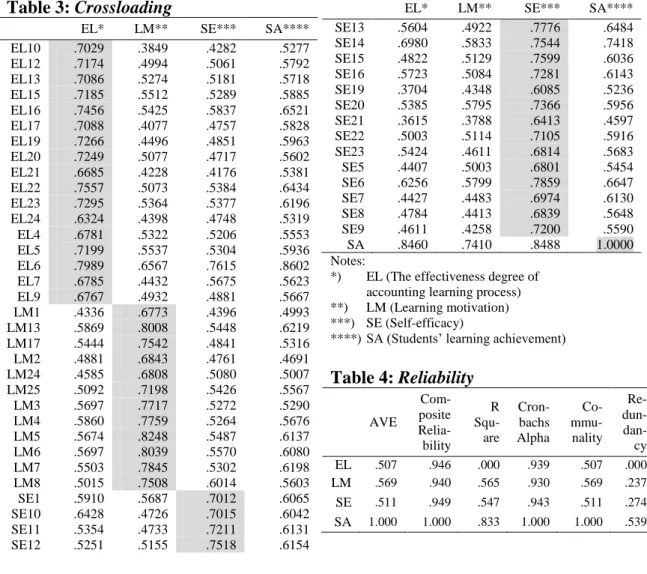
Before the hypothesis testing was done, the researcher tested the research model. The purpose was to verify the indicators and latent variables. The test results showed that the crossloading on each research indicator variable and its relationship with other variables were as follows: 1) loading factor for each research variable was more than .6 and AVE value for each variable
showed that it was more than .5 (Table 4). According to Abdillah & Jogianto (2015), if the loading factor value was between .5 to .7, the researcher would not remove indicators with AVE value which was more than .5; 2) discriminant validity value for each indicator with its construction was higher than that of other indicators with its construction of other variables (Table
3); 3) the composite reliability value and Cronbach Alpha value was more than .7, which meant that the measurement results for these
research variables had high consistency of answer to measure the same phenomenon with the same measuring instrument (Table 4). Table 1: Participants’ characteristics Characteristic Frequency (%) Sex Male Female 89 (39.03%) 139 (60.97%) School Public Private 144 (63.16%) 84 (36.84%) Source: Primary data
Table 2: Description of Research Data Research variables Average Standard devia- tion Theo-retical range Actual range The effec-tiveness degree of accounting learning process 66.768 10.358 17–85 30–84 Self-effica-cy 69.912 10.304 18–90 34–90 Learning motivation 51.114 6.910 12–60 25–60 Students’ under-standing 74.760 12.515 0–100 31-100
Source: Primary data
Table 3: Crossloading
EL* LM** SE*** SA**** EL10 .7029 .3849 .4282 .5277 EL12 .7174 .4994 .5061 .5792 EL13 .7086 .5274 .5181 .5718 EL15 .7185 .5512 .5289 .5885 EL16 .7456 .5425 .5837 .6521 EL17 .7088 .4077 .4757 .5828 EL19 .7266 .4496 .4851 .5963 EL20 .7249 .5077 .4717 .5602 EL21 .6685 .4228 .4176 .5381 EL22 .7557 .5073 .5384 .6434 EL23 .7295 .5364 .5377 .6196 EL24 .6324 .4398 .4748 .5319 EL4 .6781 .5322 .5206 .5553 EL5 .7199 .5537 .5304 .5936 EL6 .7989 .6567 .7615 .8602 EL7 .6785 .4432 .5675 .5623 EL9 .6767 .4932 .4881 .5667 LM1 .4336 .6773 .4396 .4993 LM13 .5869 .8008 .5448 .6219 LM17 .5444 .7542 .4841 .5316 LM2 .4881 .6843 .4761 .4691 LM24 .4585 .6808 .5080 .5007 LM25 .5092 .7198 .5426 .5567 LM3 .5697 .7717 .5272 .5290 LM4 .5860 .7759 .5264 .5676 LM5 .5674 .8248 .5487 .6137 LM6 .5697 .8039 .5570 .6080 LM7 .5503 .7845 .5302 .6198 LM8 .5015 .7508 .6014 .5603 SE1 .5910 .5687 .7012 .6065 SE10 .6428 .4726 .7015 .6042 SE11 .5354 .4733 .7211 .6131 SE12 .5251 .5155 .7518 .6154
EL* LM** SE*** SA**** SE13 .5604 .4922 .7776 .6484 SE14 .6980 .5833 .7544 .7418 SE15 .4822 .5129 .7599 .6036 SE16 .5723 .5084 .7281 .6143 SE19 .3704 .4348 .6085 .5236 SE20 .5385 .5795 .7366 .5956 SE21 .3615 .3788 .6413 .4597 SE22 .5003 .5114 .7105 .5916 SE23 .5424 .4611 .6814 .5683 SE5 .4407 .5003 .6801 .5454 SE6 .6256 .5799 .7859 .6647 SE7 .4427 .4483 .6974 .6130 SE8 .4784 .4413 .6839 .5648 SE9 .4611 .4258 .7200 .5590 SA .8460 .7410 .8488 1.0000 Notes:
*) EL (The effectiveness degree of accounting learning process) **) LM (Learning motivation) ***) SE (Self-efficacy)
****) SA (Students’ learning achievement) Table 4: Reliability AVE Com- posite Relia- bility R Squ- are Cron- bachs Alpha Co- mmu-nality Re- dun- dan-cy EL .507 .946 .000 .939 .507 .000 LM .569 .940 .565 .930 .569 .237 SE .511 .949 .547 .943 .511 .274 SA 1.000 1.000 .833 1.000 1.000 .539
Cakrawala Pendidikan, Oktober 2017, Th. XXXVI, No. 3 The inner model showed the
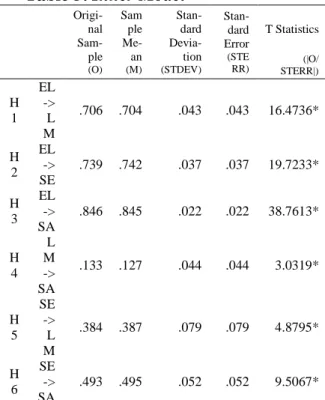
coefficient values of inner path for research variables relationship (Table 5). These values were the results of research model test as well as the results of hypothesis testing. T statistic value for the influence of the effectiveness degree of learning process on basic competences of accounting cycles at service companies on students’ learning motivation was significant (t = 16.4736 > t = 1.960); the influence of the effectiveness degree of learning process on basic competences of accounting cycles at service companies on students’ self-efficacy
was significant (t = 19.7233 > t = 1.960); the influence of the effectiveness degree of learning process on basic competences of accounting cycles at service companies on students’ learning achievement was significant (t = 38.7613 > t = 1.960); the influence of learning motivation on students’ learning achievement was 3.0319; the influence of self-efficacy on students’ learning motivation was significant (t = 4.8795 > t = 1.960); and the influence of self-efficacy on students’ learning achievement was significant (t = 9.5067 > t = 1.960).
Table 5: Inner Model
Origi- nal Sam- ple (O) Sam ple Me- an (M) Stan- dard Devia- tion (STDEV) Stan-dard Error (STE RR) T Statistics (|O/ STERR|) H 1 EL -> L M .706 .704 .043 .043 16.4736* H 2 EL -> SE .739 .742 .037 .037 19.7233* H 3 EL -> SA .846 .845 .022 .022 38.7613* H 4 L M -> SA .133 .127 .044 .044 3.0319* H 5 SE -> L M .384 .387 .079 .079 4.8795* H 6 SE -> SA .493 .495 .052 .052 9.5067*
Note: *) significant .05 (t statistics > 1.960)
Discussion
The result of the first hypothesis testing showed that the effectiveness degree of learning process on basic competences of accounting cycles at service companies had positive and significant influence on students’
learning motivation. According to Watkins et al (2002), an effective learning was to direct effective students. Students were effective if they were actively engaged in the learning process. In order to have active students, teachers are
encouraged to be able to develop learning objectives by which they arranged and developed learning plans in line with the objectives and/or series of objectives being set. Teachers were the “drivers” who drove the “passengers” to the learning objectives (Lie, 2013). At the planning level, teachers needed to select and set appropriate strategic plans so that students could participate actively in learning process. Teachers needed to have courage, intelligence, moral responsibility, and skills to drive the learning process using uncommon ways (Susila, 2013).
Learning plans and implementation should enable the development of students’ skills to work together and discuss in order to construct knowledge with others. Learning design and implementation, therefore, should be flexible based on actual learning context (Watkins et al, 2002). Schools that promoted effective learning generally emphasized students’ intrinsic motivation, social relationship for learning, and learning culture as a whole. Senge McCabe, & Lucas (2000) mentioned that school was a learning organization, in which it created a lot of connections inside and outside the boundaries. It anticipated future problems and conducted continuous learning process study. As a consequence, the higher the effectiveness degree of learning process (including accounting learning), the higher students’ motivation to learn.
The second hypothesis testing showed that the effectiveness degree of learning process on basic competences of accounting cycles at service companies had positive and significant influence on students’
self-efficacy. Self-efficacy is the result of cognitive processes in the form of decisions, beliefs, and expectations in which individuals estimate their own abilities to perform tasks or certain acts needed to achieve some certain goals (Bandura, 1997). At the beginning of performing acts, individuals had different self-efficacy. Their acts were the function of previous experiences; those were the same or similar acts and their individual qualities, such as skills and behaviours (Schunk, 1995). One’s self-efficacy was also influenced by the encouragement type from important figures around their circumstances, such as parents and teachers. Both parents and teachers encouraged individuals to develop their skills, facilitate resource accesses (i.e. materials and facilities) which were needed to study, and teach them to manage independently strategies to improve the output and skills enhancement (Ericsson, Krampe, & Tesch-Romer, 1993). Learning strategy was generally seen as a tool to learn; however, it could affect one’s self-efficacy and motivation (Corno & Mandinach, 1983). With a belief that learning strategy could improve learning process, it could instill students’ control to the result of learning achievement, improve self-efficacy, and direct students to be diligent (Corno, 1989; Schunk, 1989b). Hence, it was clear that an effective learning process would boots students’ self confidence in performing their tasks or certain needed acts in order to achieve certain goals.
The third hypothesis testing showed that the effectiveness degree of learning process on basic
Cakrawala Pendidikan, Oktober 2017, Th. XXXVI, No. 3 competences of accounting cycles at
service companies had positive and significant influence on students’ learning achievement. In an effective learning, teachers saw their fellow teachers as their peers. The colleagues or fellow teachers were resources, from whom teachers could continuously learning about new teaching ideas or creative solutions to their learning problems. According to Watkins et al (2002), if those were done, teachers would become leaders in learning who were able to make learning an important activity in their lives, openly speak of their tasks, promote inquiries while learning takes place, exchange learning ideas and discussions, organize learning, be willing to respect and support learning services, be ready to always question the ongoing learning, and encourage others to do the same as they do. In short, teachers should be aware of their call as educators, aware of things that limited creativity and struggle to properly educate, and aware of their responsibilities (Susila, 2013). Rosenholtz (1991) stated that when teachers had big opportunities to study, there were students who would tend to study. Then, the students would obtain better learning achievements in school. Therefore, if teachers were able to manage learning effectively, it would positively influence students’ learning achievements.
The fourth hypothesis testing showed that learning motivation influenced students’ learning achievement positively and significantly. Motivation is what gives some energy, directs and sustains behaviors. Motivation will drive students to certain direction and make them keep going (Ormrod,
2008). Students’ motivation was reflected in their personalities and being engaged cognitively, emotionally, and behaviors in any school activities (Fredricks, Blumenfeld, & Paris, 2004; Reeve, 2006). Generally, motivation was classified into extrinsic motivation and intrinsic motivation (Ormrod, 2008). Extrinsic motivation came from external factors of one’s self and it is not related to tasks being done. Meanwhile, intrinsic motivation stemmed from internal factors of one’s self and it is embedded in tasks being done. Students were generally motivated intrinsically to be engaged in acertain activity when gave them enjoyment, helped and developed the important skills or things that were considered ethically and morally right. Some students with high intrinsic motivation became very focused on their own activities. As a result, they would feel the time was gradually diminishing and they often ignored other given tasks (Cikszentmihalyi, 1996; Schweinle, Turner, & Meyer, 2006). Students were often simultaneously motivated by intrinsic and extrinsic factors (Covington, 2000; Lepper, Corpus, & Iyengar, 2005). An effective learning certainly would encourage students to be involved in learning process. Their involvement in learning gave them enjoyment and helped them to develop their knowledge, skills, and behavior. Therefore, an effective learning would facilitate students’ better learning achievement.
The fifth hypothesis testing showed that self-efficacy influenced students’ learning motivation positively and significantly. Schunk (1995) stated that students’
self-efficacy was about their abilities to cognitively process academic materials which influenced their motivation in learning. Schunk (1995) postulated that students who believed that they found it difficult to comprehend learning materials tended to feel such a failure to learn. On the contrary, those who did not find it difficult tended to feel more successful. When they performed their tasks, they were informed how well they learned. Their perception of understanding the next material would improve their motivation. This finding was in line with Schunk (1995), Pajares (2003), and Husain (2014)’s findings. Self-efficacy would build individuals’ feeling and understanding towards their actions. The way of thinking and high self-confidence would facilitate cognitive process and work in any settings, including the quality of making decision that is in line with academic purpose and achievement (Kumar & Lal, 2006). Self-efficacy would define their efforts and diligence in pursuing their goals and being engaged in any activities they think they were competent enough. They would participate in any activities with deeper interests and recover quickly if facing difficulties. Self-confidence would motivate students to learn through their self-management process in order to make choices in defining goals. That self-management showed one’s ability to change following the situations (Bandura, 1986; Zimmerman & Martinez-Pons (1990).
The sixth hypothesis testing showed that self-efficacy positively and significantly influenced students’ learning achievements. Self-efficacy is closely related to certain
achievement (Bandura, 1997). Meece, Blumenfeld, & Hoyle (1998)’s finding revealed that student who had a goal to master a certain task showed more active cognitive engagement in materials being learned as well as the competences which were considered as related positively to motivation and task completion. Schunk & Swartz (1993) also found that students’ strategies in learning process and its feedback of their improvement would enhance task orientation and decrease their ego orientation; and that self-efficacy correlated positively with task orientation and correlated negatively with ego orientation. Ego orientation is linked with better performance goal than others and impression of being competent. Ego-oriented person thinks that studying is important as a tool to see how competent one is, to improve skills, and to believe that the efforts done would improve their performance at a certain level. An ego-oriented person tends to compare their appearance to others to decide where they should stand.
This finding was in line with Schunk’s (1995), which showed the significant and positive correlation between self-efficacy and performance as well as between self-efficacy and cognitive learning skills (measured before instruction) and next motivation tasks (Schunk & Hanson, 1985; Schunk, 1987), self-efficacy for learning also has positive correlation with self-efficacy and skills that were measured after instruction (Schunk, 1989a). Significant correlation had been found consistently between self-efficacy and performance which were measured after instruction (Schunk, 1989a). Collins (1982)
Cakrawala Pendidikan, Oktober 2017, Th. XXXVI, No. 3 showed that self-efficacy predicted
motivation and achievement at any skill levels. Students who were identified as having high, average, or low mathematical skills are classified as having high or low self-efficacy to solve problems in language. Students were given problems (some were solved) and were able to re-do any missed things. Students with low and average skills but with high self-efficacy underwent longer problems compared to those with lower self-efficacy. Despite their skills, students with higher self-efficacy were able to solve more problems than those with lower self-efficacy.
CONCLUSIONS
The findings of this research revealed that: (a) the effectiveness degree of learning process on basic competences of accounting cycles at service companies on students’ learning motivation was significant; (b) the effectiveness degree of learning process on basic competences of accounting cycles at service companies on students’ self-efficacy was significant; (c) the effectiveness degree of learning process on basic competences of accounting cycles at service companies on students’ learning achievement was significant; (d) the influence of learning motivation on students’ learning achievement was significant; (e) the influence of self-efficacy on students’ learning motivation was significant; (f) the influence of self-efficacy on students’ learning achievement was significant.
Based on these research findings, the researcher suggests that accounting teachers need to be aware of their call as educators, aware of things that limit their creativity as
well as struggles to appropriately teach, and aware of their responsibilities. They need to continuously learn, to develop the objectives and/or series of learning objectives, and to select strategic plans for learning process in order to obtain learning objectives. They should not hesitate to try new teaching techniques so that learning processes in class run actively, innovatively, effectively, and pleasantly for students. To reach those goals, the principals and supervisory teachers need to facilitate the teachers to create effective learning. Teachers should not be given many administrative responsibilities which to date have been burdening them.
ACKNOWLEDGEMENTS
The researcher would like to thank the Institute for Research and Community Service, Sanata Dharma University, and especially Directorate General for Research and Development, Directorate General of Research and Development through Directorate of Research and Community Service, Ministry of Research, Technology, and Higher Education which funded the research.
REFERENCES
Abdillah, W., & Jogiyanto HM. 2015. Partial Least Square (PLS): Alternatif Structural
Equation Modeling (SEM)
dalam Penelitian Bisnis.
Yogyakarta: Penerbit Andi. Bandura, A. 1986. Social
Foundations of Thought and Action. Englewood Cliffs, NJ: Prentice-Hall.
Bandura, A. 1997. Self-efficacy: The
Exercise of Control. New
York: Freeman and Company. Bell, D., & Kahrhoff, J. 2006. Active
Learning Handbook. Louis,
Missouri: Copyright Webster University.
Brickner, D.R., & Etter, E.R. 2008. ”Strategies for Promoting Active Learning in Principles of Accounting Course”.
Academy of Educational
Leadership Journal. Vol. 12 (2), 87-93.
Collins, J. 1982. “Self-efficacy and Ability in Achievement Behavior”. Paper presented at the meeting of the American Educational Research Association, New York.
Corno, L., Mandinach, E.B. 1983. “The Role of Cognitive Engagement in Classroom Learning and Motivation”.
Educational Psychologist, Vol. 18,88-108.
Corno, L. 1989. “Self-regulated Learning: A Volitional Analysis”. In B.J. Zimmerman & D.H. Schunk (Eds.).
Self-regulated Learning and
Academic Achievement:
Theory, Research, and
Practice. New York: Springer-Verlag.
Covington, M.V. 2000 “Intrinsic Versus Extrinsic Motivation in Schools: A Reconciliation”.
Current Directions in
Psychological Science. Vol. 9 (1), 22-25
David, J.S., Maccracken, H., & Reckers, P.M. 2003. “Integrating Technology and Business Process Analysis into Introductory Accounting Courses”. Issues in Accounting Education. Vol. 18 (4), 417-425.
Dawood, R. 2006. “Using Instructional Games to Increase Student Learning and Enjoyment in a High School Government Class”. A Masters
Project for ED 7999.
Submitted to the Office of Graduate Studies, Graduate Division of Wayne State University, Detroit, Michigan in fulfillment of the requirements for the degree of Master of Arts in Teaching. Duff, A., & McKinstry, S. 2007.
“Students’ Aproaches to Learning”. Issues in Accounting Education. Vol. 22 (2), 183-214.
Ericsson, K.A., Krampe, R.T., & Tesch-Romer, C. 1993. “The Role of Deliberate Practice in The Acquisition of Expert Performance”. Psychological Review, Vol. 100, 363-406. Fredricks, J.A., Blumenfeld, P.C., &
Paris, A.H. 2004. “School Engagement: Potential of The Concept, State of The Evidence”. Review of Educational Research, Vol.74, 59–109.
Goldwater, P.M., & Fogarty, T.J. 2007. “Protecting The Solution: A ‘high-tech’ Method to Guarantee
Cakrawala Pendidikan, Oktober 2017, Th. XXXVI, No. 3 Individual Effort in
Accounting Classes”.
Accounting Education. Vol. 16 (2), 129-143.
Gozhali, I. 2001. Analisis
Multivariate. Semarang:
Universitas Diponegoro. Harnett, N., Romcke., J., & Yap, C.
2004. “Student Performance in Tertiary-Level Accounting: An International Student Focus”.
Accounting and Finance. Vol. 44 (2), 163-185.
Husain, U.K. 2014. “Relationship Between Self-efficacy and Academic Motivation”.
International Conference on
Economics, Education and
Humanities (ICEEH'14). Dec. 10-11, 2014 Bali (Indonesia). Tersedia di http://dx. doi.org/10.15242/ICEHM.ED1 214132
Kementerian Pendidikan dan Kebudayaan. 2014. Peraturan
Menteri Pendidikan dan
Kebudayaan No. 103 Tahun 2014 tentang Pembelajaran Pada Pendidikan Dasar dan Menengah. Jakarta.
Kumar, R. & Lal, R. 2006. “The Role of Self-efficacy and Gender Difference among the Adolescents”. Journal of the Indian Academy of Applied Psychology. Vol. 32 (3), 249-254.
Lackey, C. 2013. “Relationships Between Motivation, Self-efficacy, Mindsets, Attributions, and Learning Strategies: An Exploratory
Study”. Theses and
Dissertations. Paper 77.
Tersedia di
http://ir.library.illinois state.edu/etd
Lepper, M.R., Corpus, J.H., & Iyengar, S.S. 2005. “Intrinsic and Extrinsic Motivational Orientations in The Classroom: Age Differences and Academic Correlates”.
Journal of Educational
Psychology. Vol. 97, 184-196. Meece, J.L., Blumenfeld, P C., &
Hoyle, R.H. 1988. “Students' Goal Orientations and Cognitive Engagement in Classroom Activities”. Journal of Educational Psychology, Vol. 80, 514-523.
Mohamed, E.K.A., & Lashine, S.H. 2003. “Accounting Knowledge and Skills and The Challenges of a Global Business Enviroment”. Managerial Finance. Vol. 29 (7), 3-16. Muris, P. 2001. “A Brief
Questionnaire for Measuring Self-efficacy in Youths”.
Journal of Psychopathology and Behavioral Assessment, Vol. 23, 145-149.
Muris, P. 2002. “Relationships Between Self-efficacy and Symptoms of Anxiety Disorders and Depression in A Normal Adolescent Sample”.
Personality and Individual
Differences, Vol. 32, 337-348. Ormrod, J.E. 2008. Educational
Learners. Upper Saddle River, NJ: Pearson/Prentice Hall. Pajares, F. 2003. “Self-efficacy
Beliefs, Motivation, and Achievement in Writing: A Review of The Literature”.
Reading & Writing Quarterly. Vol. 19, 139-158.
Peraturan Menteri Pendidikan dan Kebudayaan Republik Indonesia Nomor 103 Tahun 2014 tentang Pembelajaran pada Pendidikan Dasar dan
Pendidikan Menengah.
Jakarta.
Pintrich, P., Smith, D., Garcia, T., & McKeachie, W. 1993. “Reliability and Predictive Validity of The Motivated Strategies for Learning Questionnaire (MSLQ)”.
Educational and Psychological Measurement. Vol. 53, 801-813.
Rankin, M., Silvester., M., Vallely., M., & Wyatt, A. 2003. “An Analysis of The Implications of Diversity for Students’ First
Level Accounting
Performance”. Accounting and Finance. Vol. 43, 365-393. Reeve, J. 2006. “Teachers as
Facilitators: What Autonomy-supportive Teachers Do and Why Their Students Benefit”.
Elementary School Journal. Vol. 106, 225–236.
Rosenholtz, S.J. 1991. Teachers'
Workplace: The Social
Organization of Schools. New York: Teachers College Press.
Saudagaran, S.M. 1996. “The First Course in Accounting: An Innovative Approach”. Issues in Accounting Education. Vol. 11 (1), 83-94.
Schunk, D.H., & Hanson, A.R. 1985. “Peer Models: Influence on Children's Self-efficacy and Achievement”. Journal of Educational Psychology. Vol. 77, 313-322.
Schunk, D.H. 1987. “Peer Models and Children's Behavioral Change”. Review of
Educational Research. Vol.
57, 149-174.
Schunk, D.H. 1989a. “Self-efficacy and Achievement Behaviors”.
Educational Psychology
Review. Vol. 1, 173-208. Schunk, D.H. 1989b. “Self-efficacy
and Cognitive Skill Learning”. In C. Ames & R. Ames (Eds.),
Research on Motivation in Education: Vol. 3. Goals and
cognitions. San Diego:
Academic.
Schunk, D.H. 1991. “Self-efficacy and Academic Motivation”.
Educational Psychologist. Vol. 26, 207-231.
Schunk, D.H., & Swartz, C.W. 1993. “Writing Strategy Instruction with Gifted Students: Effects of Goals and Feedback on Self-efficacy and Skills”.
Roeper Review. Vol. 15, 225-230.
Schunk, D.H. 1995. “Self-efficacy, Motivation, and Performance”.
Cakrawala Pendidikan, Oktober 2017, Th. XXXVI, No. 3
Psychology. Vol. 7(2), 112-137.
Schweinle, A., Turner, J.C., & Meyer, D.K. 2006. “Striking The Right Balance: Students' Motivation and Affect in
Upper Elementary
Mathematics Classes”. Journal of Educational Research. Vol. 99(5), 271–293.
Senge, P.M., McCabe, N.H.C., & Lucas, T. 2000. Schools That Learn: A Fifth Discipline
Fieldbook for Educators,
Parents, and Everyone Who Cares About Education. New York: Doubleday.
Springer, C.W., & Borthick, A.F. 2004. “Business Simulation to Stage Critical Thinking in Introductory Accounting: Rasionale, Design, And Implementation”. Issues in Accounting Education. Vol. 19 (3), 277-303.
Susila, Sidharta. 2013. “Guru Mbeling”. Tersedia di Harian
Kompas, 7 Maret 2013
Warsono, Sony. 2010. Reformasi
Akuntansi: Membongkar
Bounded Rasionality
Pengembangan Akuntansi.
Yogyakarta: Asgard Chapter Watkins, C., Carnell, E., Lodge, C.,
Wagner, P., & Whalley, C. 2002. “Effective Learning”.
National School Improvement
Network (NSIN) Research
Matter. No. 17, Summer.
Institute of Education, University of London
Zimmerman, B.J., & Martinez-Pons, M. 1990. “Student Differences in Self-regulated Learning: Relating Grade, Sex, and Giftedness to Self-efficacy and Strategy Use”. Journal of Educational Psychology. Vol. 82, 51-59.