Flowing Valued Information: A Complex Systems Approach to Information Sharing
Kevin Huggins, Department of Electrical Engineering and Computer Science, United States Military
Academy, West Point, NY, 10996
Frank Mabry, Department of Electrical Engineering and Computer Science, United States Military
Academy, West Point, NY, 10996
Christopher Miller, Department of Electrical Engineering and Computer Science, United States Military
Academy, West Point, NY, 10996
John James, Department of Electrical Engineering and Computer Science, United States Military
Academy, West Point, NY, 10996
Abstract –The Flowing Valued Information (FVI) project seeks to enhance the effectiveness of a commander to accomplish his/her mission by anticipating what, where and when information is needed in accordance with the commander’s stated intent and providing support for commander’s decisions to share information with non-traditional parties (e.g. local mayors, police chiefs, and non-government organizations). At present existing military messaging systems make no provision for supporting a commander’s decision to share information with such non-traditional parties or in dynamic situations such as Humanitarian Assistance and Disaster Relief (HADR) operations. In this work, we provide an overview of the FVI architecture.
Additionally, we present recent results including both a formal extension to the Bell-LaPadula security model and a cloud solution that implements the extension.
I. Introduction:Networked, complex, and dynamic operational environments have become the norm for the US military. Where once traditional military messages were designed to support conventional military operations within the Army, present operations require more than just a flexible form for the content. Individuals and
organizations that Army units must communicate with have changed greatly. These non-traditional parties engaged in communication may be coalition members, Non-government Organizations (NGO), or even local civilian leaders. The environment that the Army now operates in introduces new challenges that include (1) communicating with non-traditional parties (2) via non-military channels and (3) providing those portions of available information that they need and they are approved to have.
To illustrate our approach, let a notional current situation be represented as a complex system of related elements categorized by Political, Military, Economic, Social, Infrastructure and Information (PMESII) data elements. Let the way a commander can affect this system be categorized by Diplomatic, Informational, Military and/ Economic (DIME) decision elements.
Figure 1. Feedback loop control for a complex system
Within the terms of the feedback loop of a controlled complex system as indicated in Figure 1, the controller is the commander and the system is the situation in which the commander is operating. The goal state of the system is to achieve the intent of the commander for the current mission. As the FVI solution seeks to improve the commander’s ability to ‘see’ and understand the current situation via enhanced information flow, we seek to use an
implementation of the FVI Need-To-Share node architecture as an initial sensor to better enable the commander to select alternative DIME decisions in order to guide the system to the goal state within the PMESII context. Next, we present research that is related to our work. In section III we present our approach, and then we describe our initial results in section IV. Section V will discuss our future work and we will conclude in section VI. II. Related work: In [1], the authors present a taxonomy of influences on intelligence information sharing that includes consideration of technical, legal and social elements. Our work is focused on addressing the technical barriers that they described. In [2], the authors present a group-centric approach to information sharing which they differentiate from dissemination-centric. The former brings users and information into groups based on needs to share, whereas the latter is focused on tagging information with attributes as it is disseminated. Only consumers authorized to access the tagged information can review it. Our solution aligns more to the distribution model where suppliers of information determine consumers they need to share information with. Several models assume or require a more permanent network architecture, e.g. [3], [4] and [5]. Our approach is specifically designed for ad hoc, non-permanent networks. In addition, our approach enables fine-grained sharing of information in accordance with information sharing policy decisions made by the owners of the information (i.e. for military operations, unit commanders are the “owners” of information describing details of unit operations).
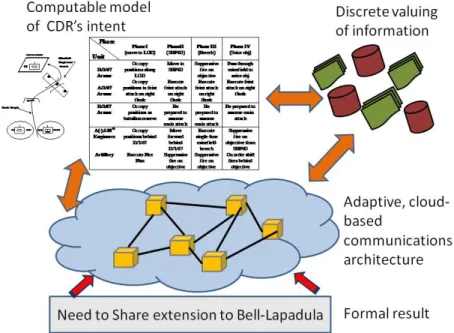
III. Approach: We propose a three-component design shown in Figure 2 below that includes a supporting adaptive communications architecture that enables the commander to manage information flow for his/her unit. The other two components leverage this communications architecture. In particular, we seek to implement a computable model of the commander’s intent which will be used in conjunction with automatically value information, the third component of our solution.
Our approach has been to work from the bottom-up, addressing the foundational communications architecture first. We saw this aspect to FVI crucial to the success of the other features. As there was very little science to support a security model that accounted for the dynamic need to share information that is prevalent in many situations that the military finds itself, we started there. As we will describe in the next section, we based our formal results on an extension of the Bell-LaPadula security model [6]. We then developed an adaptive, node-based cloud
communications architecture as an implementation of our formal results.
IV. Recent results: One of the biggest challenges with developing communications architecture to support the flowing of valued information is the issue of security. Overcoming security boundaries is at the heart of the issue. Our first results centered on a formal result that extended the Bell-LaPadula security model. The second result is an implementation based on the initial formal results.
a. Extensions to the Bell-LaPadula Model -One of the first results our group achieved was a set of extensions to the Bell-LaPadula model. We summarize our results here, but a complete discussion is found in [6]. Many of the available solutions for sharing information have successfully created multi-level secure systems (networks of systems) which follow access control rules (many based on the Bell-La Padula security model) in which access to information is granted to a given level of classified information once confirmation is achieved that a given subject has the required clearance (mandatory access control). However, the current implementation of mandatory access controls and role-based access controls does not support mission success for those missions that require sharing information on an ad hoc basis, especially at the lowest tactical level for operations which require social and cultural awareness of local populations and NGOs as well as local support in achieving mission success. Hence, we extended the Bell-LaPadula model to include continuous and discrete system states as is done for current general system theory for control of complex, distributed systems. We also extended the Bell-LaPadula definitions for "security" and "compromise" to include a definition of a “need-to-share” and a “failure to share”. A basic result concerning security in computer systems, using the precise notions for "security", "compromise", “sharing”, “need-to-know”, and “need-to-share” was then provided.
These extensions laid the groundwork for building more accurate models of the complex operational environments of today and tomorrow. Additionally, they provided the foundation for providing automation support for a commander’s decision to share information while simultaneously maintaining the security of information which must not be compromised. We then applied general systems theory to prove that a computer system with its data protected under a “need-to-know” policy could securely coexist with data managed with a “need-to-share” policy.
b. Flowing Valued Information – Need To Share (FVI-NTS) – The FVI-NTS solution is an implementation of the formal results described in section IV a., above. It is an approach to provide automation support for a commander’s decision to share information with other organizations that may not be on the secure military network. The FVI NTS solution does not alter any existing information security controls based on
established “need to know” policies for maintaining information security. It should be noted that this architecture is specifically designed for information sharing in ad hoc networks.
The FVI NTS cloud architecture has the following design philosophy:
(1) It makes no assumptions about the process results in a decision to share information by a local organization.
(2) Trust between the authorities that are the representatives for their respective organizations on the NTS group is the basis for sharing. No assumption about the actual distribution of information at the other end of a need to share relationship is ‘enforced’ by this software.
(3) How and with whom a receiving authority chooses to share contents from another organization is also not dictated by the system’s design. Agreement between authorities may result in ways of designating the parties in the receiving organization information is intended for [additional files might be provided in the set of files being transmitted].
(4) The authenticity of the sending organization’s authority is established by the design. Any attempt by an outside party to tamper with data contents while in transit will be detected by the SSH tunnel software.
Any complete replacement of the set of files associated with an individual transaction will be detected by the failure to decrypt the individual authority key for the ZIP file or the signature value also included with the encrypted symmetric key will not match the locally computed signature for the ZIP file.
The NTS design is not intended as a support for systems that require a “dynamic” response relationship. The nature of the file sets being exchanged is static. A session-based communications protocol, such as the Common Object Request Broker Architecture (CORBA), would not be appropriate in this design. Because the parties involved often do not have continuous, predictable network support, the design provides for allowing graceful operation and the ability to “catch-up” with operational results that occurred when a system experienced some network interruption. Only the ‘local’ authority for each node accesses a node. Between the nodes, regular RSYNC executions occur that keep each sending-nodes’ locally generated content files available on the other nodes. The actual transmission of content from the ‘sending’ node to the other nodes is controlled by the execution of RSYNC from a ‘receiving’ node.
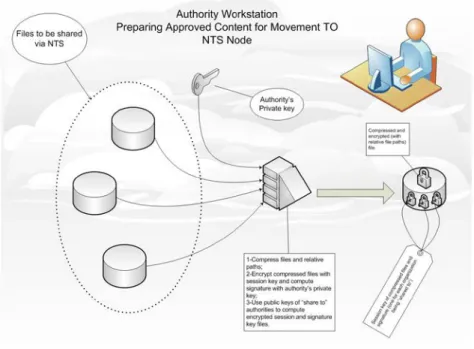
When an outgoing set of files has been reviewed and accepted for sharing by the ‘sending’ organization’s authority, the following occurs on the authority workstation of ‘sending’ organization:
(1) The set of files to be sent are compressed (including any relative sub-paths) into a ZIP file. (2) The ZIP file is encrypted with a randomly generated symmetric key.
(3) For each node that files are being shared with, the symmetric key (2) and the digest signature for the encrypted ZIP file is encrypted with the public key for the receiving authority and the file is saved with the encrypted ZIP file (from step 2). The name of the encrypted key file is that of the node being “shared to.” An encrypted key file is also generated for sending node (with its name).
(4) For each node that is not being shared with, an encrypted key file is written but the symmetric key value used is zero (which never occurs otherwise).
(5) The set of encrypted key files and the ZIP files are saved to a directory named initially
“Txxxxxxxxxxxxx” where xxxxxxxxxxxxx is replaced with the millisecond accurate clock on the administrator’s workstation.
(6) After all the files have been copied to the local node, the directory is renamed with the initial “T” removed. [Note: only new directories without an initial ‘T’ are processed by receiving NTS authority workstations. Should an RSYNC capture a directory that has not been ‘finalized’ it will not be processed until a subsequent RSYNC occurs and renames the directory.]
Figure 3: Authority workstation preparing documents to share
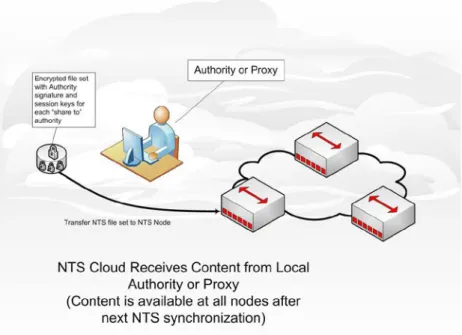
Each local node will have a directory of directories that include the sets of sets1 of files to be shared with other members of the NTS group of organizations. RSYNC will only copy new content to other nodes. All content on each node is encrypted. Each node has the needed keys to run RSYNC (within a SSH tunnel session) on each of the other nodes. No authority’s private or public keys are ever stored on a node. Should a node’s file contents ever become accessible to anyone outside the group of authorities participating in the ‘need to share’ group the content will remain ‘secure’ from inappropriate access.
1
This is not a typographical error. We refer to sets of files within other files such as folders within
Figure 4: Authority moves prepared documents to NTS cloud for distribution
Central to this design is the existence of a party acting as the Master Basic Trust Certifier (MBTC) that provides the access certificates on each node for the other nodes (thus allowing SSH-RSYNCH based communication). The MBTC also communicates the public keys of the authorities to each of the other authorities. The individual authorities for each organization can use OPENSSL software to generate their public and private keys. (Initially we will provide the private key for our collaborators.) Note: the MBTC does need to know the public or private keys of any of the authority workstations. What encrypted content the members choose to move is obscured from the view of the MBTC. A specific MBTC can provide the management of the NTS group of nodes without ever being a party to actual content being transmitted.
V. Future work: Having extensively tested the FVI-NTS locally, our next step is to apply it in an operational environment using mission related data to demonstrate its capability to be used as a cross domain solution for information sharing. The domain we have chosen to pursue is the Afghanistan region exploiting a previously established relationship between the US Military Academy (USMA) and the National Military Academy of Afghanistan (NMAA). We intend to use the FVI-NTS to move sensitive but unclassified data between USMA and NMAA. To this end, we are in the midst of obtaining an interim authority to test (IATT) which would allow the FVI-NTS to operate at the unclassified level over the Defense Research and Engineering Network (DREN). Additionally, we are exploring ways to further develop network edge devices as a proof of concept for the FVI-NTS information sharing capabilities. Our initial thrust is with Android phones. Other devices being considered are tactical robots and unmanned aerial vehicles (UAVs).
FVI is designed as a solution for ad hoc networks. Its problem domain does not include fixed, static networks. As such, we plan to investigate potential models for these ad hoc networks in order to better predict their behavior. In particular we are interested in studying possible biological models for ad hoc networks.
VI. Conclusion: In this work, we have presented an overview of the Flowing Valued Information project and the problem domain it addresses. Additionally, we discussed our approach and described the FVI system architecture. Finally, we described recent advances, both formal and applied.
[1] Treglia, J. and Park, J., “Towards Trusted Information Sharing”, Proceedings from the 15th ACM SIGKDD Conference on Knowledge Discovery and Data Mining, Paris, France, 28 June – 1 July 2009, pp. 45-52. [2] Krishnan, R., Sandhu, R., Ni, J. and Winsborough, W., “Foundations For Group-Centric
Secure Information Sharing Models”, Proceedings of the 14th ACM symposium on Access control models and technologies, Stresa, Italy, June 3-5, 2009, pp. 115 – 124.
[3] Sandhu, R., Raganathan, K., and Zhang, X., “Secure information sharing enabled by Trusted Computing and PEI models”, Proceedings of the 2006 ACM Symposium on Information, computer and communications security, Taipei, Taiwan — March 21 - 23, 2006, pp. 2 – 12.
[4] Vatrapu, R. and Suthers, D., “Cultural Influences in Collaborative Information Sharing and Organization”, Proceedings of the 3rd ACM International Conference on Intercultural Collaboration, August 19–20, 2010, Copenhagen, Denmark, pp. 161 – 170.
[5] Pardo, T. and Jiang, Y., “Electronic governance and organizational transformation”, Proceedings of the 1st international conference on Theory and practice of electronic governance, Macao SAR, China, December 10 - 13, 2007, pp. 99 – 107.
[6] James, J. R., Mabry, F., Huggins, K., Miller, M., Cook, T., Tamang, F., et al. (2009). Secure Computer Systems: