GUIDELINES AND CONSIDERATIONS FOR CONSTRUCTION CONTRACTORS
USING COMMODITY FUTURES AS HEDGING TOOLS FOR MITIGATING
CONSTRUCTION MATERIAL PRICING RISK
By Ian Ivanoff, BS
A Project Submitted in Partial Fulfillment of the Requirements for the Degree of
MASTER OF SCIENCE in
Project Management
University of Alaska Anchorage May 2017
APPROVED:
Roger Hull, PMP, CISSP, CISM, CRISC, Committee Chair Mike Fisher, MBA, MSPM, PMP, Committee Member Bruce Davison, J.D. MS, PE, Committee Member
LuAnn Piccard, MS PMP, Chair/Director
Department of Engineering Science & Project Management Fredrick Barlow, Ph.D, Dean
3 Table of Contents Page Title Page ... 1 Table of Contents ... 3 List of Exhibits ... 4 List of Appendices ... 5 Abstract ... 6 Introduction ... 7 Literature Review ... 8 Research Methodology ... 12 Analysis ... 14 Results ... 23
Hedging Guidelines & Considerations ... 24
Conclusions ... 26
Recommendations for Further Research ... 27
Acknowledgements ... 27
References ... 28
4 List of Exhibits
Page
Exhibit 1 - Commodity Futures Contract Specifications ... 10
Exhibit 2 - 2017 Crude Oil Futures Contract Pricing ... 111
Exhibit 3 - Commodity Futures Liquidity Matrix ... 133
Exhibit 4 - Copper Wire Vs. Copper Future /LBS ... 155
Exhibit 5 - Lumber Vs. Lumber Futures /LBS ... 155
Exhibit 6 - Asphalt vs. Copper Future /HG ... 166
Exhibit 7 - Steel vs. Copper Futures /HG ... 16
Exhibit 8 - Concrete vs. Copper Future /HG ... 167
Exhibit 9 - Regression Analysis Results ... 177
Exhibit 10 - Significance Test Results ... 188
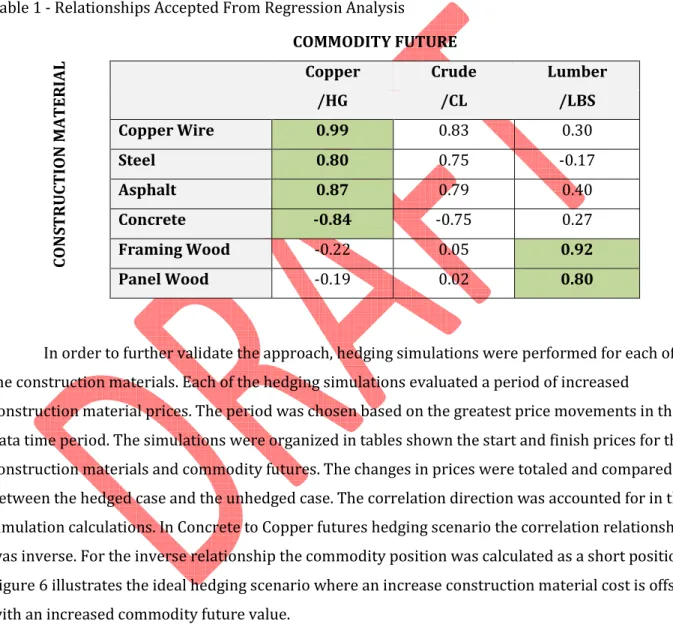
Exhibit 11 - Relationships Accepted From Regression Analysis ... 189
Exhibit 12 – Price Comparison Asphalt versus Copper ... 20
Exhibit 13 - Sample Hedging Simulation Copper Wire Hedged with Copper Future ... 20
Exhibit 14 - Results of Hedging Simulations ... 22
Exhibit 15 - Relationship Between Correlation Value and Hedge Performance ... 22
5
List Of Appendices
Page
Appendix 1 – Simulation Results Study………..30
Appendix 2 – Simulation Calculations………32
Appendix 3 – Regression Analysis and Significance Test Results……….38
Appendix 4 – Data……….…..…39
Appendix 5 – Article Submission……….…………...41
Appendix 6 – Correlation Tool………....………55
6 Abstract
Many would argue that risk management is the single most important element of a construction contractor's business enterprise. A significant risk to a contractor’s profitability is increased costs of construction materials. In many cases construction materials are the largest single component of a construction project budget. Contractors generally utilize contingency funds or contractual price
adjustments clauses to address the risk associated with changes in construction material pricing. However, the use of contingency and contractual mechanisms comes at a cost. The additional costs are especially detrimental in construction markets that are competitively bid, because higher bid prices result in winning fewer jobs. An alternative risk mitigation is the use of commodity futures to hedge the risk of increasing construction material prices. A hedge is strategy for limiting losses by holding a portfolio of non-correlated assets. The research of this study evaluates the application of commodity futures for hedging material pricing risk in the construction industry. Through statistical analysis and simulation studies this research concludes that utilizing commodity futures as a hedging strategy is effective risk mitigation against increased construction material costs. In addition, through a literature review this study explains the fundamentals of the commodity future market, and presents the mechanics of trading commodity futures. A guideline for using commodity futures as a hedging tool is included in this study.
Key Words: Construction Contractor, Commodity Future, Construction Material, Price Risk, Volatility, Hedging
7
GUIDELINES AND CONSIDERATIONS FOR CONSTRUCTION CONTRACTORS USING COMMODITY FUTURES AS HEDGING TOOLS FOR MITIGATING
CONSTRUCTION MATERIAL PRICING RISK.
Introduction
This study provides an empirically validated approach to a specific risk to construction contractors engaged in building material intensive projects. In most cases large construction projects require a great deal of construction material. Some examples include new power plants, road projects, marine
infrastructure, and buildings. This study does not set out to justify the need to mitigate construction material price risk or introduce commodity futures as a new risk mitigation method. Both concepts have been covered in numerous studies. In addition, the strategy of using commodity futures is evident in financial statements issued by publically traded construction companies [Flour, 2016]. In a study
conducted by Al-Zarrad the justifications for addressing construction material pricing risk was thoroughly examined and supported [Al-Zarrad, 2015]. In the Al-Zarrad study commodity futures were evaluated as a hedging strategy, but the examples provided in the study do not specifically addresses construction material risk. Additionally, the Al-Zarrad study does not address fundamental trading guidelines and no empirical evidence is provided to validate the use of commodity futures as a hedge. The research contained herein builds upon the existing published studies by providing empirical validation in support of hedging construction material pricing risk with commodity futures. In addition, this research aims to apply fundamental trading concepts and strategies to the proposed hedging approach, and outline those concepts as a guideline. To achieve these objectives this research took the following steps.
1. Thorough literature review on the topics of construction risk, hedging, commodity futures, and commodity markets.
2. Construction material and commodity futures pricing data sets were recorded and tabulated for analysis.
3. The data were compared graphically for evaluation of trends.
4. The data were checked for correlation using regression analysis, and the regression results were confirmed with statistical significance testing.
5. The most correlated data were further examined by simulating hedging trades during periods of construction material prices increases.
6. The results of the simulations studies were examined for trends and conclusions were drawn for using commodity futures as a hedging strategy.
8
Literature Review
This Literature Review evaluates the risk of material price increases to construction contractors,
investigates the mechanics of commodity futures, and investigates some of the considerations of trading commodity futures. The construction business is risky, construction contractors are 16% more likely to fail than other types of business [McIntyre, 2007]. A wide range of anticipated risks can be categorized as contributing factors to unanticipated cost increases. Some of these risk factors include incorrect bid pricing, force majeure events, procurement problems, differing site conditions, delays, production inefficiencies, and project politics [Thomas, 1995]. Unanticipated cost increases to construction project budgets are one of the predominant risks to a construction contractor’s profitability [Thomas, 1995]. The importance of addressing construction material cost risk is evident, because construction projects are material dependent. According to a study performed by the Exxon Research and Engineering Company, the cost of materials for energy projects ranged from 28% to 50% of the total construction cost of the project [Hendrickson, 2008]. The risk of escalated material costs is because material costs are not static, and costs are impacted by numerous factors. To address the risk construction contractors cost may include contingency funds in the project budget [Gunhan, 2007]. However, contingency funds add to total cost of the construction budget. The additional contingency costs have a negative impact on companies
competitively bidding on projects, because higher bid costs decrease the likelihood of winning bids. Another example of risk mitigation for material pricing increases is price adjustment clauses. Price adjustment clauses are intended to reduce costs by alleviating the risk to the construction contractor associated with material price changes [Ilbeigi, 2016]. Price adjustment clauses are a contracting
mechanism that allows the contracting groups to reconcile costs of materials based on the actual pricing at the time of purchase. Normally the reconciliation price is based on agreed price indices. However, a recent study found that including price adjustment clauses in contracts did not statistically correlate to decreasing bid prices [Ilbeigi, 2016]. The findings of Ilbeigi raise doubts on the value of using price adjustment clauses, and provide justification for exploring other means of risk mitigation.
An alternative approach used address the risk associated with changes in construction material prices is to utilize a hedge. A hedge is a strategy where an action is taken to offset losses from a different area of the business by holding uncorrelated assets [Smirnova, 2016]. An everyday example of a hedge is car insurance. A driver pays a premium to the insurance company to cover the cost of an unplanned event, such as an accident. In the event that an accident occurs the costs of the accident will be incurred,
however the driver is protected against the costs with the money provided by the insurance company. It is important to note that a hedge does not eliminate the unexpected costs, but offsets lose from the
9
futures are utilized. A review of financials statements from large construction contractors revealed
examples of hedging with all companies [Fluor, 2016]. However, limited data of hedging with commodity futures to address material cost risk were found.
An important concept for understanding a hedge is to understand the concept of assets being long or short. For the intent of this study a position is considered any financial asset or business arrangement an entity enters. The terminology of long or short explains how the changes of the position financially affect the entity. A long position increases in value if the asset price increases, and a short position increases in value if the asset price decreases [Hayes, 2016]. For example, a home owner has a long position in the real estate market. If the real estate market improves and prices go up the home owner will gain by owning a more valuable house. Conversely, the home owner has the risk of losing home value if the real estate market deteriorates. A short position is opposite of long position in that money will be gained if the price of the position decreases [Hayes, 2016]. In the real estate market example a home buyer would be in the short position, because the buyer benefits from lower home prices. In summary, a hedge works by offsetting price movements in either long or short positions. A hedging tool used by numerous industries is the commodity future.
Commodity futures have several characteristics that make them effective tools for hedging. Commodity futures are a contract between two parties for a specified type, quantity, and quality of commodity
material [Heakal, 2016]. Assets represented by commodity futures cover multiple markets and millions of commodity futures contracts are traded daily [Heakal, 2016]. Examples of commodity futures include crude oil, lumber, metals, grains, treasuries, and currencies. Commodity futures were originally created as tool for hedging, and a significant portion of trading of commodity futures continues to be for the purpose of hedging [CME Group, 2013]. A specific example is the use of hedges by airlines to protect against price escalation in jet fuel [AL-Zarrad, 2015]. To conduct their business airlines must purchase jet fuel, which puts the airlines in short jet fuel positions. If fuel prices decrease the airlines will profit from lower operating costs. To mitigate the risks of losing money from high fuel costs airlines hedge the short position by entering into long fuel positions by buying jet fuel commodity futures products. In the event that jet fuel costs increase the corresponding long commodity future position increases in value. The net result for the airlines is that the loss from the high fuel cost is offset by the money gained from the more valuable commodity future.
Understanding the mechanics of commodity futures is the initial step to using them as a hedge. Commodity futures are fungible contracts that are traded on open markets. The details outlining the specifics of the commodity futures underlying asset are contained the “specification.” The specification details all of the particulars of the commodity future from the material represented to the pricing
10
mechanisms [Heakal, 2016]. Commodity futures are represented by a symbol, which is a forward slash followed by numbers and letters. For example, the commodity future for Crude Oil is represented by the symbol /CL. Each commodity future represents a quantity of a specific grade of an underlying product.
Symbol Underlying Expiration
Margin
Requirement Pricing Tick Size
/CL 1,000 Barrels of Crude Oil
Jan, Feb, Mar, Apr, May, Jun, Jul, Aug, Sep, Oct, Nov, Dec
$2,900 USD per
Barrel $.01 =$10.0
/HG 25,000 lbs. of Copper
Jan, Feb, Mar, Apr, May, Jun, Jul, Aug, Sep, Oct, Nov, Dec
$3,100 USD per Pound $0.0005 = $12.5 /LBS 110,000 nominal board ft.
Jan, Mar, May, Jul,
Sep, Nov $1,650
USD per
Board Foot $0.1 = $11
/HRC 20 Short Tons of Steel
Jan, Feb, Mar, Apr, May, Jun, Jul, Aug, Sep, Oct, Nov, Dec
$600 USD per
Pound $1.0 = $1.0 CME Group 2017
Exhibit 1 - Commodity Futures Contract Specifications
In the Crude Oil example the futures contract represent 1,000 barrels of West Texas Intermediate Grade crude oil. The pricing of commodity futures is dependent upon the contract and is different for each product. Generally, the pricing is US dollars per a unit of measure for the underlying product. For example, the pricing of a Crude Oil future is listed by the price per barrel, and is priced in one cent increments. The pricing will move in magnitude depending on the tick size. In the Crude Oil example, the contract will move 10 dollars for each one cent the price changes [CME Group, 2017]. One of the biggest advantages of commodity futures is the capital efficiency of using the product, because a large quantity of product can be held at a low cost. The cost to hold the futures contract is the margin requirement, which is the amount of capital that is required to hold a position in a brokerage account. For example, a copper future contract representing 25,000 pounds of copper can be held for $3,100. Another important specification is that commodity futures contracts have a set date for execution, which is called the expiration date [Heakal, 2016]. Each commodity future contract has a specified expiration date, and on this date the contract expires, and the position will be cash settled at the price at expiration. A crucial understanding with commodity futures is the function of contract expiration and the pricing relationship
11
between different expirations. At any time there are multiple contracts available for any commodity future, and each of the contracts will list a unique price. Commodity future contracts with different expirations are not priced the same, because the price represents what the market expects the price will be at expiration. Exhibit 2 shows the contract prices for the different contract prices in 2017, note that the price of an May 2017 contract is nearly 3.5% lower than a December 2017 Crude Oil contract.
Month Last Day High Day Low Data Date Updated
May-17 50.27 50.34 50.22 3-Apr-17 19:40:29 CT Jun-17 50.74 50.82 50.68 3-Apr-17 19:39:20 CT Jul-17 51.12 51.17 51.09 3-Apr-17 19:29:46 CT Aug-17 51.37 51.4 51.37 3-Apr-17 19:10:42 CT Sep-17 51.58 51.58 51.58 3-Apr-17 19:15:00 CT Oct-17 51.75 51.8 51.73 3-Apr-17 19:09:55 CT Nov-17 - - - 3-Apr-17 19:03:59 CT Dec-17 52.01 52.01 51.93 3-Apr-17 19:09:55 CT CME Group 2017
Exhibit 2 - 2017 Crude Oil Futures Contract Pricing
The pricing difference in the two crude oil contracts represents the markets expectation that the price of oil will be higher in September. Conversely, if crude oil prices are expected to decrease then the price of a contract with an expiration further in the future would be lower.
An important characteristic of commodity futures is the effect of liquidity. Liquidity is defined by the ability to easily sell or buy an asset [CME Group, 2013]. Financial instruments that are sold and bought in large volumes are considered to have high liquidity. High liquidity is a desirable characteristic when dealing with financial instruments [Farley, 2015]. High liquidity allows the financial instrument to be sold and purchased quickly, and decreases the price spread between the seller’s asking price and the buyers offer price. In markets with few buyers the party needing to sell the commodity future generally will be forced to lower the selling price to find a buyer. In the commodity futures market liquidity can be identified by the volume of contracts trading, and the difference between the ask and bid price [Sosnoff, 2014]. An example of a liquid commodity future is Crude Oil, which will normally have 1 million contracts change hands daily, and a very tight bid to ask spread.
The relationship between commodity pricing and the realities of commodity production is an important aspect of trading commodity futures. Unlike stocks there is no sustainable scenario where price of a commodity is zero or extremely low. A publicly traded company can go bankrupt and the stock would be
12
deemed worthless. Conversely, commodities always have an intrinsic value and the cost to produce commodities is a natural stop for continuous decreasing prices. In the commodities market, producers generally react to low prices by scaling back production. In normal scenarios the decreased supplies coming out of production eventually supports prices increases. On the other hand very high prices encourage producers to increase production. Consequently the increased supply normally causes prices to come under pressure and eventually decrease. The term used to describe imbalances between supply, demand and pricing is call pricing equilibrium. The realities of the commodity market pricing should be recognized, especially in the cases of historic price extremes. In the case of historic lows anyone trading commodities should recognize that the price has a much easier path the price increases. For the intent of using commodity futures for hedging pricing at historic highs or lows must be viewed with caution.
Research Methodology
The goal of this research is to empirically validate use of commodity futures as a hedge for construction contractors seeking to mitigate material price risk. This research utilizes regression analysis, significance testing and interpretations of trends to support conclusions of the study. The first step of the analysis was to select typical materials used in construction project. The selection of construction materials was based on material used across a range of project types. Six construction materials were selected for this research, which were copper wire, steel, asphalt, concrete cement, framing wood and panel wood. These construction materials were selected because they are typical construction materials to a wide range of construction projects. Four commodity futures were selected as possible hedges for construction materials. The selection of suitable commodity futures contracts considered liquidity criteria, and were based on finding commodity futures that had acceptable liquidity. The data for the initial commodity futures selection was collected from retail financial market trading software. The section of the commodity futures focused on two liquidity requirements.
1. The number of open positions for each commodity future was evaluated as an indication liquidity, and for the intent of this research a floor of 3,000 open contracts was considered the minimum. 2. The bid to ask spread at peak trading time was examined, and for the intent of this research only
commodity futures with bid to ask spreads below 1% of the futures price were considered. The allowable spread amount was based on an assumed acceptable loss for simply opening and closing a position.
The results of the liquidity evaluation determined three of the four had sufficient liquidity, which are Crude Oil, Copper, and Random Length Lumber. The steel future was rejected due to the low number of contracts traded and the unacceptable high bid to ask spread.
13 Symbol Open Contracts
Long and Short
Bid Price Ask Price spread Spread as % of price Accept/Reject /CL 2,191,158 53.10 53.11 0.01 0.02% Accept /HG 291,924 2.7115 2.7120 0.0005 0.02% Accept /LBS 4,437 367.5 368.2 0.7 0.19% Accept /HRC - 600.0 620.0 20 3.33% Reject TDAmeritrade 2017
Exhibit 3 - Commodity Futures Liquidity Matrix
Data were collected to perform a regression analysis of the construction materials and the commodity futures. The data were collected for a period of time going back several years, in order to have a sufficient data set for statistical significance. Data for construction material pricing were collected from government agency and industry group sources. Commodity futures pricing information was collected from the retail trading platform. TD Ameritrade’s ThinkorSwim trading platform was chosen based on functionality and ease of use. All futures prices were recorded from the beginning of the month at the closing of the market. The data were matched between the construction material and commodity future at beginning each month. Initial review of relationships between construction materials and commodity futures was performed by examination of charts of construction material price graphed against the futures price. Analysis of the graphical comparison was focused on identifying trends in pricing, and comparing the rate of change in pricing of the data sets. Pricing trends evaluated the magnitude of price changes and the duration of the price changes. The evaluation was not determinative of correlation, but only a subjective check for correlation between the construction material and the commodity future.
Statistical analysis was used to find the relationship between the construction materials and commodity futures. A regression analysis was used to determine the correlation strength between the commodity future and the construction material. The specific function was the Pearson Correlation Coefficient r. The Pearson Correlation Coefficient provides a measure of the strength of linear association between data sets, with a value between -1 and 1 representing the linear dependence between two variables [Brase, 2011]. The further from zero the coefficient the stronger the correlation is between the two variables, with a value of 1 being a perfect correlation. A value of -1 one would indicate a perfect inverse correlation.
= ∑ − ∑ ∑
14
To determine the statistical significance of r, a statistical test of p, the population correlation coefficient was conducted [Brase 2011]. The null hypothesis of the statistical significance test assumes that no linear correlation exists.
The null hypothesis: : = 0 The alternate hypothesis : ≠ 0 Sample test statistic = √ !
√ ! " #$ ℎ &. (. = − 2
P-values are one tailed, depending on – or + value, student’s t-distribution using α = .005 From the results of the p-test the values found to be statistically significant were sorted by correlation rank. The relationships between construction material and commodity futures with the highest correlation were accepted for simulation testing. Hedging simulations were performed for each of the construction materials using the most correlated commodity future as the hedge. The purpose of the simulation study was to demonstrate that using a correlated commodity future as a hedge help minimize losses from increased material prices. The simulation was performed by choosing a period with exceptional price increases in each of the construction materials pricing. The simulation calculated the value of both the construction material and commodity future at the beginning and end of the period. The sizing of the construction amount was a hypothetical value based on a size comparable to the notional value of a single commodity future contract. Three simulations were run for each of the construction material. The multiple simulation results were used to determine if the correlated construction materials and commodity futures were experiencing similar price movements. Lastly, the results of the simulation study were tabulated for final analysis. Final analysis included examining the quartile results of the different correlation ranking.
Analysis
The analysis included interpretation of the graphical comparison, regression analysis, and hedging simulation study. Beginning with the graphical comparison, two futures products show a strong graphical correlation to the respective construction materials. The stronger of the two was Copper wire and copper, which had price movements that where nearly identical between the construction material and the commodity future. Similarly, the framing wood and panel wood showed strong trend similarities with lumber futures. The comparisons with copper to asphalt and copper to steel showed some general similarities in price trends, but did not track closely. The graphical comparison between copper futures and concrete show a near perfect inverse relationship. A clear observation from the data was that rate of
15
change in pricing can be rapid and random. For example, in a seven month period the price of steel increased by 27 percent.
Exhibit 4 - Copper Wire vs. Copper Future /LBS
Exhibit 5 - Lumber vs. Lumber Futures /LBS
$1.5 $2.0 $2.5 $3.0 $3.5 $4.0 $4.5 $5.0 $400 $405 $410 $415 $420 $425 $430 $435 $440 $445 $450 C o p p e r F u tu re s C op p er Wi re Copper Wire Copper Future /HG $100 $150 $200 $250 $300 $350 $400 $450 $500 $550 L u m b er P rod u ct s an d F u tu re s Framing Composite Panel Composite Lumber Future /LBS
16
Exhibit 6 - Asphalt vs. Copper Future /HG
Exhibit 7 - Steel vs. Copper Futures /HG
$0.0 $0.5 $1.0 $1.5 $2.0 $2.5 $3.0 $3.5 $4.0 $4.5 $5.0 $250 $300 $350 $400 $450 $500 $550 $600 C op p er F u tu re s A sp h al t Asphalt Copper Future /HG $0.0 $10.0 $20.0 $30.0 $40.0 $50.0 $60.0 $1.5 $2.0 $2.5 $3.0 $3.5 $4.0 $4.5 $5.0 S te el C op p er F u tu re s Copper Futures /HG Steel
17
Exhibit 8 - Concrete vs. Copper Future /HG
Regression analyses were performed across all construction material data sets against each different commodity future. The cross examination approach was used to determine if any unexpected relationships existed between the construction materials and the commodity futures. The three futures products each show a strong correlation to certain construction materials. The correlations were not consistently positive or negative. Each construction material had at least one commodity future with a correlation of 0.80, which in general 0.75 is considered a statistically significant value. The magnitude of the correlation number is much more important than if the correlation is negative or positive. The correlation sign can be addressed by holding the appropriate long or short hedge.
Exhibit 9 - Regression Analysis Results
$0.0 $0.5 $1.0 $1.5 $2.0 $2.5 $3.0 $3.5 $4.0 $4.5 $5.0 200 210 220 230 240 250 260 C o p p er F u tu re C o n cr et e Concrete Copper Futures /HG
18
The results of the correlation study were evaluated with a statistical significance test. The statistical significance test is used to determine if the data set is sufficient to provide a usable result, and provides a result that is to either accept or reject the correlation. The null hypothesis was that no correlation existed, and by rejecting the null hypothesis the correlation value is accepted. As shown in exhibit 10, the results of the statistical significance test found that 7 correlations be not statistically significant. Conversely, the remaining 11 correlation results were not rejected, and suitable for further analysis. For the intent of this research the highest correlation value between the construction material and commodity future is used for evaluation with simulation testing. Exhibit 11 highlights the he correlations that were chosen for further evaluation. Note that the highest correlation values are not strictly based on the underlying physical relationship. For example, asphalt has a higher correlation to copper future than to crude oil future. The correlation is unexpected because asphalt is a derivative of crude oil.
COMMODITY FUTURE C O N S T R U C T IO N M A T E R IA L
Copper Crude Lumber
/HG /CL /LBS
Copper Wire Reject H0 Accept Correlation Reject H0 Accept Correlation Reject H0 Accept Correlation Steel Reject H0 Accept Correlation Reject H0 Accept Correlation Do Not Reject H0 Reject Correlation Asphalt Reject H0 Accept Correlation Reject H0 Accept Correlation Do Not Reject H0 Reject Correlation Concrete Reject H0 Accept Correlation Reject H0 Accept Correlation Do Not Reject H0 Reject Correlation Framing Wood Do Not Reject H0 Reject Correlation
Do Not Reject H0 Reject
Correlation Reject H0 Accept Correlation Panel Wood Do Not Reject H0 Reject Correlation
Do Not Reject H0 Reject
Correlation
Reject H0
Accept Correlation
19 C O N S T R U C T IO N M A T E R IA L COMMODITY FUTURE
Copper Crude Lumber
/HG /CL /LBS Copper Wire 0.99 0.83 0.30 Steel 0.80 0.75 -0.17 Asphalt 0.87 0.79 0.40 Concrete -0.84 -0.75 0.27 Framing Wood -0.22 0.05 0.92 Panel Wood -0.19 0.02 0.80
Exhibit 11 - Relationships Accepted From Regression Analysis
To further validate the approach hedging simulations were performed for each of the construction materials. Each of the hedging simulations evaluated a period of increased construction material prices. The period was chosen based on the greatest price movements in the data time period. The simulations were organized in tables shown the start and finish prices for the construction materials and commodity futures. The changes in prices were totaled and compared between the hedged case and the unhedged case. The correlation direction was accounted for in the simulation calculations. In the concrete to Copper futures hedging scenario the correlation relationship was inverse. As the price of concrete increased the price of copper decreased. To account for the inverse relationship the commodity position was calculated as a short position. Exhibit 12 illustrates the ideal hedging scenario where an increase construction material cost is offset with an increased commodity future value.
20
Exhibit 12 – Price Comparison Asphalt versus Copper Copper Wire Hedged with Copper Futures Contract
Simulation Period July 1st, 2010 to February 1st, 2011
Construction Material
Copper Wire Cost per Pound Total Underlying
Start $/lb $ 3.21 $ 80,250 Finish $/lb $ 4.74 $ 118,500 Total Price Increase $ 1.53 $ 38,250
Hedge
1 Copper Future Contract Cost per Pound Total Underlying Start $/lb $ 2.90 $ 72,438 Finish $/lb $ 4.56 $ 114,000 Total Price Increase $ 1.66 $ 41,563
Loss or Gain Amount % of Initial Estimate
Unhedged Loss $ [-38,250] -48% Hedged Small gain $ 3,312 4%
Exhibit 13 - Sample Hedging Simulation Copper Wire Hedged with Copper Future $2.0 $2.5 $3.0 $3.5 $4.0 $4.5 $5.0 $350 $370 $390 $410 $430 $450 $470 $490 $510 $530 $550 C op p er F u tu re s A sp h al t Asphalt $/ton Copper /HG Cost of Asphalt Construction
Value of Commodity Future Hedge increasing
21
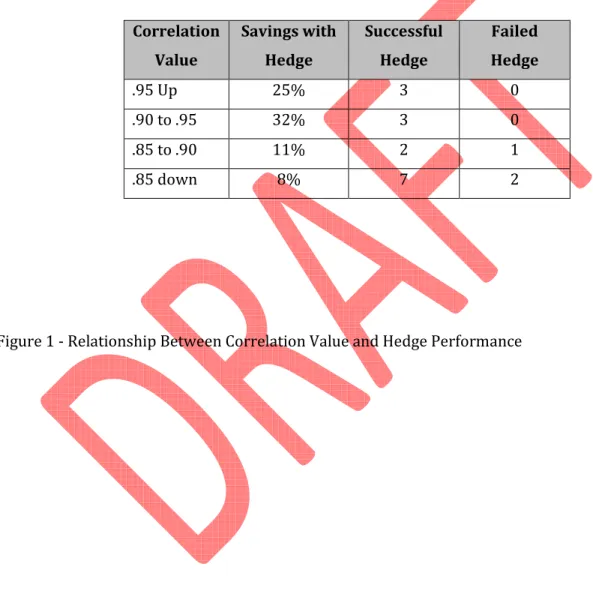
The results of the simulation are shown in Exhibit 14. The gains and losses of the hedge were calculated as both the nominal value and as a percentage of starting value. For further evaluation the total value of all 18 simulations was summarized in order to determine the overall performance of the hedge. Cases where the hedge did not work and created losses are highlighted. The largest risk mitigation was a 62% cost savings of the original material value for a price escalation in framing lumber. Where the hedging strategy did not work the largest loss occurred in two cases each losing 5% of the original material value. The simulation results demonstrated that hedging scenarios with higher correlation value had a higher rate of success and better performance. For simulations with a correlation above 0.9 the success rate was 100%, while the success rate for simulations below 0.9 was 75%. The results were summarized in quartile groupings as shown in exhibit 15. In addition the quartile results are shown in graph form in Exhibit 16.
22
Exhibit 24 - Results of Hedging Simulations Correlation
Value
Percent Savings with Hedge
Successful
Hedge Failed Hedge
.95 Up 25% 3 0
.90 to .95 32% 3 0
.85 to .90 11% 2 1
.85 down 8% 7 2
23
Exhibit 16 - Relationship between Correlation Value and Percent Savings Results
The results of the correlation study showed several instances of strong relationship between the construction materials and commodity futures. The analysis found 10 of the 18 regression analysis demonstrated a correlation outside of a range of -0.75, 0.75, which is a significant value of correlation. The strongest correlation value was 0.99 between copper wire and copper futures. On the other hand, the lowest correlation was between panel wood and Crude Oil Futures at 0.02. Many of the correlations were anticipated, such as wood products being strongly correlated to the lumber futures. However, the
strongest correlations between construction materials and commodity futures were not always as
expected. Most surprisingly, the correlation between asphalt prices and copper futures prices was stronger than that of asphalt prices and crude oil prices. For the asphalt example, asphalt is largely made up of the crude oil derivative bitumen. Initially the assumption was that the base commodity for the construction material would have the highest correlation. However, the correlation between asphalt and copper prices proved to have the highest correlation strength. The pricing forces creating the strong correlation between
0% 5% 10% 15% 20% 25% 30% 35% .95 Up .90 to .95 .85 to .90 .85 down A ve rage P er ce n t S avi n gs B y H ed ge Correlation Range
24
asphalt and copper were not examined as part of this study, but are discussed in the recommendations for further research section. The statistical significant test of the correlation study validated 11 out of 18 regression analysis results as significant. The results of the statistical significance test allowed for further study of the 11 relationships. However, only the relationships with the highest correlation values were examined with simulations. Hedging simulations were used to compare the pricing movement between the construction materials and commodity futures. A hedging simulation that provided positive cost savings was considered a successful hedge. The results of hedging simulations showed that using a commodity future as a hedge was successful in 83% of the cases. In the remaining the hedge was
unsuccessful and the strategy compounded the loss. Averaged over the entire simulation study, the losses in the unhedged scenario was 23.4% of the original value of the construction material. Overall a loss was shown despite having the hedge strategy in place. However, the losses were much lower than the
unhedged scenarios, by reducing the loss to only 9.8% of the original value of the construction material. The hedging simulations resulted in three scenarios where the hedge contributed to a greater loss. The largest impact of an unsuccessful hedge was a 5% greater loss than an unhedged result. Conversely, the most successful hedging simulation showed a 62% cost saving. The results of the hedging simulations demonstrated that the correlation value had an impact on the success of the hedge. In two quartiles where the correlation was greater than 0.90 (copper and framing wood) the hedge provide a 30% cost savings. In the case where the correlation was below 0.90 the cost savings was only 13%.
Hedging Guidelines & Considerations
The results of the study support the use of commodity futures as risk mitigation for construction material pricing escalation. To replicate the risk mitigations demonstrated in this study construction contractors must follow several guidelines to successfully implement a hedge using commodity futures.
1. Understand the Risk of Hedging with Commodity Futures – The results of the simulations demonstrated a significant improvement in cost performance using commodity futures as hedges against price increases of construction materials. Commodity future hedging was shown to be a valid risk mitigation strategy in both the frequency of success and scale of savings. However, in most cases a loss was still observed even with a commodity future hedge in place. In a small number of cases the hedge was unsuccessful, and contributed to greater loses. For these reasons construction contractors must understand and acknowledge the risks involved with utilizing commodity futures as hedges.
2. Determine Appropriate Commodity Future for Hedge – A successful hedge must utilize a highly correlated commodity future the results of the simulations studies show that a higher correlation resulted in a more successful hedge. Regardless of the physical relationship between the
25
construction material and the commodity future, the most highly correlated commodity future should be used as the hedge. Before entering a hedge a correlation study through regression analysis should be conducted between the construction material and commodity future.
3. Determine the Correct Direction of the Hedge - The correlation relationship should be noted if it is positive or negative, and factored into the implementation of the hedge. A construction contractor buying material for a project is taking a short position in the material. The short position is demonstrated by the fact that the contractor will lose money as price of the material increases, and will make money as the price of the material decreases. An effective hedge should neutralize the losses of gains from the price movement of the construction material. For example, a long commodity future position would be used to hedge a positively correlated relationship. Conversely, if the construction material and commodity future is negatively correlated a short position should be taken in the commodity future.
4. Determine the Size of the Hedge - The size of the hedge should be determined by the value of the construction material that has been budgeted by the construction contractor. The number of commodity futures contracts should be calculated by matching the value of the construction material to the underlying value of the commodity future. When implementing a commodity futures hedge two scenarios should be avoided. The position should not be grossly under-hedged, which could results in the hedge not fully protecting against construction material price increases. On the other hand, the position should not be grossly over-hedged, which would result in losses if prices drop.
5. Market Awareness – A construction contractor using commodity futures as a hedge must be aware of extremes in commodity pricing. Extremes in commodity pricing are referred to as disequilibrium, and historically result in pricing corrections. In cases of extreme price lows, historically commodity producers respond by curtailing supplies eventually resulting in price increases. Conversely, extreme price highs historically lead to increases in commodity production and subsequent price corrections. These market realities should be considered when
implementing a commodity futures hedging strategy. Historic price highs could provide the construction contractor evidence to not implement a commodity futures hedge, and utilize a different risk mitigation. Conversely, extreme price lows should be viewed with caution as the risk lies to the price upside, which justifies the utilization of a commodity futures hedge.
6. Open the Hedge Position – The hedging strategy should be implemented to correspond to the start and finish of the construction material procurement cycle. The commodity future position should be opened at the same time as the construction material is budgeted for. Delays in opening the commodity future could result in prices increases of the construction material that would not be hedged. Price increase with unhedged construction materials would result in a loss. When
26
opening a commodity future position as a hedge, attention must be given to the contract date of the contract. The commodity futures contract should have an expiration as close to the expected purchase date of the construction material as possible. In addition, the liquidity of the commodity futures contract must be considered, and should take precedence. It is important to remember that commodity futures contracts with poor liquidity result in poor pricing and immediate losses if the contract must be exited.
7. Monitor the Hedge Position – The commodity futures hedge position should be monitored and restructured if required. Attention must be given to the date of expiration of the contract. As discussed above, in some cases the contract expiration dates may not align with the construction material purchase dates. If the contract expiration date is before the construction material purchase date the contract will have to be closed and a new contract opened with an expiration further in the future. The process of closing and reopening contract should be maintained through the life of the hedge.
8. Close Hedge Position – The commodity futures hedge should be closed to correspond to the purchase date of the construction material. Similar to coordinating the opening of the commodity futures hedge, losses could be incurred with unhedged positions if either the commodity future position or construction material position is closed early.
Conclusions
The results of this study support the use of commodity futures as a hedge for construction material pricing increases. The success of using commodity futures as hedge was demonstrated in both the frequency and scale of successfully mitigating risk. In the instances where the hedge was unsuccessful, the magnitude of the hedging losses was acceptable when compared against the frequency and scale of success.
Implementing a successful hedge is dependent upon the correlation between the construction material and commodity future. More highly correlated relationships provided better hedging results. In addition the findings of the study provide information that supports the importance of following general trading guidelines of using liquid contracts and maintaining an awareness on the market. These guidelines should be considered by construction contractor choosing to use commodity futures as hedging tools. The business of construction contractors is typically associated with profit margins which are sensitive to unexpected cost escalation. The results of this study demonstrate an approach that should be considered as a mitigation for construction contractors seeking address construction material price risk.
27
Recommendations for Further Research
The efforts and conclusions of this study exposed several items for further investigation. The research made several assumptions in order to remain within the constraints of the study, and the results of study could be strengthened with additional analysis. In this study the construction materials examined were limited to a small set of materials commonly utilized in the construction industry. Future study should examine additional material further down supply change, such as steel pipe, rebar, precast concrete, finished cable, prefabricated structural wood members. This study utilized a monthly pricing frequency. Future investigation should examine pricing on a greater frequency. Construction materials and
commodity futures historically have shown the capacity to swing drastically in periods less than a month. Although a more frequent pricing period would strengthen the study, the results of this study have been proven statistically significant. The pricing data for the commodity futures only considered the pricing of the current month contract. Futures research should evaluated the pricing of the active contract at the time of the hedge, and consider the roll. The study revealed several instances of correlations that were not expected. As discussed above, the correlation between asphalt and copper futures was greater than the correlation between asphalt and crude oil futures. Most would assume that by the physical relationship between asphalt and crude oil would create a stronger relationship than other commodities. The pricing forces creating the strong correlation between asphalt and copper were not examined as part of this study. However, it is suspected that because copper and asphalt are primarily used as building materials they may be subject to the same swings in construction activity. Conversely, crude oil is subject to different market forces such as the refining industry, consumption by drivers, and financial market speculation. An investigation of the dynamics driving the unexpected price correlation between certain construction materials and commodity futures could further validate using commodity futures as a hedge for construction materials.
Acknowledgements
I thank my wife Megan and children Julian and Kayla for tolerating my mental absenteeism while completing this project. The members of my project committee Roger Hull, Mike Fisher, and Bruce Davison have provided immense support and guidance through this effort. I would also like to thank John Coleman for volunteering as my project sponsor. The support and guidance from administrative staff at the UAA Project Management Department was a significant help in completing this project. Fellow classmate Katura Willingham provided guidance through lessons learned which was very helpful and greatly appreciated.
28 References
Al-Zarrad, G.,( 2015, April) Application of Hedging Principle to Materials Price Risk Mitigation in Construction Projects, International Journal of Construction Engineering and Management [Electronic Version] Retrieved on February 20, 2017 From http://article.sapub.org/10.5923.j.ijcem.20150405.03.html Brase, C. & Brase, C. (2011 ed.) Understandable Statistics: Concepts and Methods.Independence, KY, Cengage Learning
CME Group. (2017) Crude Oil Futures Contract Specs. Retrieved on March 1, 2017, from
http://www.cmegroup.com/trading/energy/crude-oil/light-sweet-crude_contract_specifications.html CME Group. (2013) Navigating Risk. A Brief Guide to the Derivatives Marketplace and its Role in Enabling Economic Growth Retrieved February 16, 2017, from
http://futuresfundamentals.cmegroup.com/content/themes/futures-fundamentals-responsive/assets_imported_from_prototype/pdf/Navigating_Risk_Book.pdf
Farley, A. (2015, September) Analyzing the 5 Most Liquid Commodity Futures WTI, ZC. Retrieved on March 17, 2017, from http://www.investopedia.com/articles/active-trading/090215/analyzing-5-most-liquid-commodity-futures.asp
Flour Corporation. (2016) Annual Report Retrieved on March 17, 2017 from
http://media.corporate-ir.net/media_files/IROL/12/124955/Fluor/HTML/pdf/Fluor2016.pdf
Gunhan, S., & Arditi, D. (2007, July). Budgeting Owner’s Construction Contingency [Electronic Version]. Journal of Construction Engineering and Management, 133(7), 492. Retrieved on March 17, 2017 from doi: http://dx.doi.org/10.1061/(ASCE)0733-9364(2007)133:7(492)#sthash.o6dmnBVR.dpuf Hayes, A. (2016). Stocks Basics: Trading Stocks and Order types. Retrieved on March 24, 2017 from http://www.investopedia.com/university/stocks/stocks4.asp
Heakal, R. (2016). Futures Fundamentals. Retrieved on March 24, 2017 from http://www.investopedia.com/university/futures/
Hendrickson, C. (2008). Project Management for Construction Fundamental Concepts for Owners, Engineers, Architects and Builders Retrieved on February 23, 2017 from
http://pmbook.ce.cmu.edu/01_The_Owners'_Perspective.html#top
Ilbeigi, M., Ashuri, B., & Shayegh, S. (2016, May). Price Adjustment Clauses and Submitted Bid Prices for Major Asphalt Line Items in Highway Projects. Journal of Construction Engineering and
29
Management, [Electronic Version] Retrieved February 20, 2017, from doi: http://dx.doi.org/10.1061/(ASCE)CO.1943-7862.0001097
Mcintyre, M. (2017, May). Why Do Contractors Fail? Retrieved February 19, 2017, from
http://www.constructionbusinessowner.com/topics/insurance/construction-insurance/why-do-contractors-fail
Smirnova, E. (2016). Use of gold in financial risk hedge. Quarterly Journal of Finance and Accounting, 54(1), 69-100. Retrieved from
http://search.proquest.com.proxy.consortiumlibrary.org/docview/1837157486?accountid=14473 Sosnoff, T, Liquidity. (2014). Retrieved February 16, 2017, from https://www.tastytrade.com/tt/ learn/liquidity
Thompson, P. & Perry, J. (2013 ed) Engineering Construction Risks: a guide to project risk analysis and assessment implication for project clients and project managers. Reston VA: Thomas Telford Publishing.
Appendix 1 - Simulation Results Summary Correlation Material Original Material Value ($) Unhedged Change ($) Hedged Change ($) Difference Between Hedged and Unhedged ($) Saving or Loss as % of Orginal Value 0.99 Copper Wire $ 86,000 $ (17,250) $ (1,625) $ 15,625 18% 0.99 Copper Wire $ 84,000 $ (10,375) $ (6,200) $ 4,175 5% 0.99 Copper Wire $ 80,250 $ (38,250) $ 3,312 $ 41,563 52% 0.92 Framing Wood $ 32,900 $ (7,400) $ (2,703) $ 4,697 14% 0.92 Framing Wood $ 25,700 $ (8,100) $ (4) $ 8,096 32% 0.92 Framing Wood $ 19,800 $ (15,900) $ (3,668) $ 12,232 62% 0.87 Asphalt Binder $ 97,000 $ (19,334) $ (23,847) $ (4,513) -5% 0.87 Asphalt Binder $ 89,666 $ (16,500) $ (900) $ 15,600 17% 0.87 Asphalt Binder $ 73,666 $ (26,500) $ (7,663) $ 18,838 26% 0.84 Concrete $ 120,350 $ (2,700) $ 3,950 $ 6,650 6% 0.84 Concrete $ 111,300 $ (5,900) $ (513) $ 5,388 5% 0.84 Concrete $ 107,700 $ (6,150) $ (7,112) $ (962) -1% 0.8 Steel $ 97,500 $ (42,500) $ (23,038) $ 19,463 20% 0.8 Steel $ 88,250 $ (20,500) $ (24,550) $ (4,050) -5% 0.8 Steel $ 57,750 $ (25,750) $ (23,588) $ 2,163 4% 0.8 Panel Wood $ 37,300 $ (13,300) $ (4,357) $ 8,943 24% 0.8 Panel Wood $ 36,700 $ (2,500) $ 3,385 $ 5,885 16% 0.8 Panel Wood $ 25,800 $ (18,800) $ (6,293) $ 12,507 48% Total $ 1,271,632 $ (297,709) $ (125,411) $ 172,298 Average Savings with Hedge 14%
Correlation Value
Savings with Hedge
Successful
Hedge Failed Hedge
.95 Up 25% 3 0
.90 to .95 32% 3 0
.85 to .90 11% 2 1
.85 down 8% 7 2
Appendix 1 - Simulation Results Summary y = -0.07x + 0.36 0% 5% 10% 15% 20% 25% 30% 35% .95 Up .90 to .95 .85 to .90 .85 down A v e ra g e P e rc e n t S a v in g s B y H e d g e Correlation Range
Savings with Hedge Linear (Savings with Hedge)
Appendix 2 - Simulation Calculations
Simulation Period July 1st, 2010 to February 1st, 2011 Construction Material
Copper Wire Cost Total Underlying
Start $ $ 3.21 $ 80,250 Finish $ $ 4.74 $ 118,500 Total Price Change $ 1.53 $ 38,250 Hedge
1 Copper Future Contract Cost Total Underlying
Start $ $ 2.90 $ 72,438 Finish $ $ 4.56 $ 114,000 Total Price Change $ 1.66 $ 41,563
Loss or Gain Amount % of Initial Value
(38,250)
$ -48% 3,312
$ 4%
Simulation Period October 1st, 2011 to May, 1st 2012 Construction Material
Copper Wire Cost Total Underlying
Start $ $ 3.44 $ 86,000 Finish $ $ 4.13 $ 103,250 Total Price Change $ 0.69 $ 17,250 Hedge
1 Copper Future Contract Cost Total Underlying
Start $ $ 3.11 $ 77,788 Finish $ $ 3.74 $ 93,413 Total Price Change $ 0.63 $ 15,625
Loss or Gain Amount % of Initial Value
(17,250)
$ -20% (1,625)
$ -2%
Simulation Period July 1st, 2013 to January 1st, 2014 Construction Material
Copper Wire Cost Total Underlying
Start $ $ 3.36 $ 84,000 Finish $ $ 3.78 $ 94,375 Total Price Change $ 0.42 $ 10,375 Hedge
1 Copper Future Contract Cost Total Underlying
Start $ $ 3.17 $ 79,300 Finish $ $ 3.34 $ 83,475 Total Price Change $ 0.17 $ 4,175
Loss or Gain Amount % of Initial Value
(10,375) $ -12% (6,200) $ -7% Unhedged Hedged Unhedged Hedged Unhedged Hedged Copper Wire Hedged With Copper Future
Copper Wire Hedged With Copper Future Copper Wire Hedged With Copper Future
Appendix 2 - Simulation Calculations
Simulation Period September 1st, 2010 to May 1st, 2011 Construction Material
Steel Cost Total Underlying
Start $ $ 39.00 $ 97,500 Finish $ $ 56.00 $ 140,000 Total Price Change $ 17.00 $ 42,500 Hedge
1 Copper Future Contract Cost Total Underlying
Start $ $ 3.47 $ 86,750 Finish $ $ 4.25 $ 106,213 Total Price Change $ 0.78 $ 19,463
Loss or Gain Amount % of Initial Value
(42,500)
$ -44% (23,038)
$ -24%
Simulation Period January 1st, 2016 to July 1st, 2016 Construction Material
Steel Cost Total Underlying
Start $ $ 35.30 $ 88,250 Finish $ $ 43.50 $ 108,750 Total Price Change $ (8.20) $ (20,500) Hedge
1 Copper Future Contract Cost Total Underlying
Start $ $ 3.17 $ 79,163 Finish $ $ 3.00 $ 75,113 Total Price Change $ (0.16) $ (4,050)
Loss or Gain Amount % of Initial Value
(20,500)
$ -23% (24,550)
$ -28%
Simulation Period August 1st 2013 to October 1st, 2014 Construction Material
Steel Cost Total Underlying
Start $ $ 23.10 $ 57,750 Finish $ $ 33.40 $ 83,500 Total Price Change $ (10.30) $ (25,750) Hedge
1 Copper Future Contract Cost Total Underlying
Start $ $ 2.14 $ 53,375 Finish $ $ 2.22 $ 55,538 Total Price Change $ 0.09 $ 2,163
Loss or Gain Amount % of Initial Value
(25,750) $ -45% (23,588) $ -41% Unhedged Hedged Unhedged Hedged Unhedged Hedged Steel Hedged with Copper Future
Steel Hedged with Copper Future Steel Hedged with Copper Future
Appendix 2 - Simulation Calculations
Simulation Period October 1st, 2010 to July 1st, 2011 Construction Material
Asphalt Binder Cost Total Underlying
Start $ $ 448.33 $ 89,666 Finish $ $ 530.83 $ 106,166 Total Price Change $ 82.50 $ 16,500 Hedge
1 Copper Future Contract Cost Total Underlying
Start $ $ 3.69 $ 92,250 Finish $ $ 4.31 $ 107,850 Total Price Change $ 0.62 $ 15,600
Loss or Gain Amount % of Initial Value
(16,500)
$ -18% (900)
$ -1%
Simulation Period November 1st, 2011 to July 1st, 2012 Construction Material
Asphalt Binder Cost Total Underlying
Start $ $ 485.00 $ 97,000 Finish $ $ 581.67 $ 116,334 Total Price Change $ (96.67) $ (19,334) Hedge
1 Copper Future Contract Cost Total Underlying
Start $ $ 3.51 $ 87,775 Finish $ $ 3.33 $ 83,263 Total Price Change $ (0.18) $ (4,513)
Loss or Gain Amount % of Initial Value
(19,334)
$ -20% (23,847)
$ -25%
Simulation Period October 1st, 2009 to March 1st, 2010 Construction Material
Asphalt Binder Cost Total Underlying
Start $ $ 368.33 $ 73,666 Finish $ $ 500.83 $ 100,166 Total Price Change $ (132.50) $ (26,500) Hedge
1 Copper Future Contract Cost Total Underlying
Start $ $ 2.68 $ 67,038 Finish $ $ 3.44 $ 85,875 Total Price Change $ 0.75 $ 18,838
Loss or Gain Amount % of Initial Value
(26,500) $ -36% (7,663) $ -10% Unhedged Hedged Unhedged Hedged Unhedged Hedged Asphalt Binder Hedged with Copper Future
Asphalt Binder Hedged with Copper Future
Asphalt Binder Hedged with Copper Future
Appendix 2 - Simulation Calculations
Simulation Period October 1st, 2014 to May 1st, 2015 Construction Material
Concrete Cost Total Underlying
Start $ $ 215.40 $ 107,700 Finish $ $ 227.70 $ 113,850 Total Price Change $ (12.30) $ (6,150) Hedge - Short
1 Copper Future Contract Cost Total Underlying
Start $ $ 3.74 $ 93,413 Finish $ $ 3.78 $ 94,375 Total Price Change $ 0.04 $ (962)
Loss or Gain Amount % of Initial Value
(6,150)
$ -6% (7,112)
$ -7%
Simulation Period April 1st, 2013 to March 1st, 2010 Construction Material
Concrete Cost Total Underlying
Start $ $ 222.60 $ 111,300 Finish $ $ 234.40 $ 117,200 Total Price Change $ (11.80) $ (5,900) Hedge - Short
1 Copper Future Contract Cost Total Underlying
Start $ $ 3.37 $ 84,325 Finish $ $ 3.16 $ 78,938 Total Price Change $ (0.22) $ 5,388
Loss or Gain Amount % of Initial Value
(5,900)
$ -5% (513)
$ 0%
Simulation Period February 1st, 2015 to November 1st, 2015 Construction Material
Concrete Cost Total Underlying
Start $ $ 240.70 $ 120,350 Finish $ $ 246.10 $ 123,050 Total Price Change $ (5.40) $ (2,700) Hedge - Short
1 Copper Future Contract Cost Total Underlying
Start $ $ 2.58 $ 64,438 Finish $ $ 2.31 $ 57,788 Total Price Change $ (0.27) $ 6,650
Loss or Gain Amount % of Initial Value
(2,700) $ -2% 3,950 $ 3% Unhedged Unhedged Concrete Hedged with Copper Future
Hedged Unhedged Hedged Concrete Hedged with Copper Future
Hedged Concrete Hedged with Copper Future
Appendix 2 - Simulation Calculations
Simulation Period May 1st, 2009 to April 1st, 2010 Construction Material
Framing Wood Cost Total Underlying
Start $ $ 198.00 $ 19,800 Finish $ $ 357.00 $ 35,700 Total Price Change $ (159.00) $ (15,900) Hedge
1 Lumber Future Contract Cost Total Underlying
Start $ $ 175.00 $ 19,250 Finish $ $ 286.20 $ 31,482 Total Price Change $ 111.20 $ 12,232
Loss or Gain Amount % of Initial Value
(15,900)
$ -80% (3,668)
$ -19%
Simulation Period November 1st, 2011 to August 1st, 2012 Construction Material
Framing Wood Cost Total Underlying
Start $ $ 257.00 $ 25,700 Finish $ $ 338.00 $ 33,800 Total Price Change $ (81.00) $ (8,100) Hedge
1 Lumber Future Contract Cost Total Underlying
Start $ $ 213.00 $ 23,430 Finish $ $ 286.60 $ 31,526 Total Price Change $ 73.60 $ 8,096
Loss or Gain Amount % of Initial Value
(8,100)
$ -32% (4)
$ 0%
Simulation Period June 1st, 2013 to Sept 1st, 2014 Construction Material
Framing Wood Cost Total Underlying
Start $ $ 329.00 $ 32,900 Finish $ $ 403.00 $ 40,300 Total Price Change $ (74.00) $ (7,400) Hedge
1 Lumber Future Contract Cost Total Underlying
Start $ $ 306.90 $ 33,759 Finish $ $ 349.60 $ 38,456 Total Price Change $ 42.70 $ 4,697
Loss or Gain Amount % of Initial Value
(7,400) $ -22% (2,703) $ -8% Unhedged Hedged Unhedged Hedged Unhedged Hedged Framing Wood Framing Wood Framing Wood 36
Appendix 2 - Simulation Calculations
Simulation Period October 1st, 2009 to April 1st, 2010 Construction Material
Panel Wood Cost Total Underlying
Start $ $ 258.00 $ 25,800 Finish $ $ 446.00 $ 44,600 Total Price Change $ (188.00) $ (18,800) Hedge
1 Lumber Future Contract Cost Total Underlying
Start $ $ 172.50 $ 18,975 Finish $ $ 286.20 $ 31,482 Total Price Change $ 113.70 $ 12,507
Loss or Gain Amount % of Initial Value
(18,800)
$ -73% (6,293)
$ -24%
Simulation Period June 1st, 2012 to February 1st, 2013 Construction Material
Panel Wood Cost Total Underlying
Start $ $ 373.00 $ 37,300 Finish $ $ 506.00 $ 50,600 Total Price Change $ (133.00) $ (13,300) Hedge
1 Lumber Future Contract Cost Total Underlying
Start $ $ 281.40 $ 30,954 Finish $ $ 362.70 $ 39,897 Total Price Change $ 81.30 $ 8,943
Loss or Gain Amount % of Initial Value
(13,300)
$ -36% (4,357)
$ -12%
Simulation Period November 1st, 2015 to July 1st, 2016 Construction Material
Panel Wood Cost Total Underlying
Start $ $ 367.00 $ 36,700 Finish $ $ 392.00 $ 39,200 Total Price Change $ (25.00) $ (2,500) Hedge
1 Lumber Future Contract Cost Total Underlying
Start $ $ 254.50 $ 27,995 Finish $ $ 308.00 $ 33,880 Total Price Change $ 53.50 $ 5,885
Loss or Gain Amount % of Initial Value
(2,500) $ -7% 3,385 $ 9% Hedged Hedged Unhedged Panel Wood Unhedged Hedged Unhedged Panel Wood Panel Wood 37
Appendix 3 - Regression Analysis and Significance Test Results
Regression Analysis Results t Calculation Right or Left Side Test
Copper Crude Lumber Copper Crude Lumber Copper Crude Lumber
/HG /CL /LBS /HG /CL /LBS /HG /CL /LBS Copper Wire 0.99 0.83 0.30 Copper Wire 93.9 13.7 3.1 Copper Wire Right Side Test Right Side Test Right Side Test
Steel 0.80 0.75 -0.17 Steel 12.0 10.3 -1.6 Steel
Right Side Test Right Side Test left Side Test Asphalt 0.87 0.79 0.40 Asphalt 10.5 7.6 2.6 Asphalt Right Side Test Right Side Test Right Side Test
Concrete -0.84 -0.75 0.27 Concrete -14.5 -10.5 2.597 Concrete
Left Side Test Left Side Test Right Side Test Framing Wood -0.22 0.05 0.92 Framing Wood -2.2 0.5 23.2 Framing Wood Left Side Test Right Side Test Right Side Test
Panel Wood -0.19 0.02 0.80 Panel Wood -1.9 0.2 13.0 Panel Wood
Left Side Test Right Side Test Right Side Test
Degrees of Freedom α= 0.005 Student t-Distribution Value Significance Test Result
97 89 96 Copper Crude Lumber Copper Crude Lumber
/HG /CL /LBS /HG /CL /LBS /HG /CL /LBS 97 Copper Wire 95 87 94 Copper Wire 2.629 2.634 2.629 Copper Wire
Reject H0 Reject H0 Reject H0
84 Steel 82 82 82 Steel 2.637 2.637 -2.637 Steel Reject H0 Reject H0 Do Not Reject H0 36 Asphalt 34 34 34 Asphalt 2.728 2.728 2.728 Asphalt Reject H0 Reject H0 Do Not Reject H0 89 Concrete 87 87 87 Concrete -2.634 -2.634 2.634 Concrete Reject H0 Reject H0 Do Not Reject H0 96 Framing Wood 94 87 94 Framing Wood -2.629 2.634 2.629 Framing Wood Do Not Reject H0 Do Not Reject H0 Reject H0 96 Panel Wood 94 87 94 Panel Wood -2.629 2.634 2.629 Panel Wood Do Not Reject H0 Do Not Reject H0 Reject H0 = − 2 1 − 38
Appendix 4 - Data Year Copper Wire $/lb /HG $/lb Ohio Binder $/ton NC asphalt $/ton Concrete Steel $/CWT $/barrel /CL Framing Composite Panel Composite /LBS
12/1/2008 1.88 1.60 No Data No Data No Data No Data No Data No Data No Data No Data
1/1/2009 1.66 1.41 No Data No Data No Data No Data No Data 198.00 251.00 187.00
2/1/2009 1.73 1.43 No Data No Data No Data No Data No Data 199.00 257.00 162.00
3/1/2009 1.79 1.69 No Data No Data No Data No Data No Data 195.00 247.00 168.00
4/1/2009 2.10 1.85 No Data No Data No Data No Data No Data 208.00 242.00 176.20
5/1/2009 2.32 2.10 No Data No Data No Data No Data No Data 198.00 242.00 175.50
6/1/2009 2.47 2.30 No Data No Data No Data No Data No Data 222.00 248.00 196.30
7/1/2009 2.53 2.31 No Data No Data No Data No Data No Data 238.00 263.00 208.40
8/1/2009 2.89 2.74 390.00 No Data 216.50 No Data 69.45 239.00 281.00 198.00 9/1/2009 3.08 2.83 377.50 No Data 216.20 No Data 68.05 236.00 278.00 179.10 10/1/2009 3.07 2.68 368.33 No Data 214.50 No Data 70.82 235.00 258.00 172.50 11/1/2009 3.22 2.96 388.33 No Data 214.10 No Data 78.12 245.00 270.00 213.70 12/1/2009 3.42 3.25 448.33 No Data 214.80 No Data 79.04 251.00 275.00 239.00 1/1/2010 3.60 3.41 486.67 No Data 214.60 33.50 79.28 268.00 282.00 234.00 2/1/2010 3.32 3.08 492.50 No Data 214.20 36.50 74.43 312.00 308.00 263.20 3/1/2010 3.54 3.44 500.83 No Data 214.40 36.50 78.70 314.00 347.00 265.50 4/1/2010 3.82 3.58 498.33 No Data 212.70 41.00 84.87 357.00 446.00 286.20 5/1/2010 3.61 3.37 494.17 No Data 212.20 44.00 86.22 333.00 429.00 307.80 6/1/2010 3.37 3.04 481.67 No Data 212.30 44.00 71.90 263.00 333.00 223.50 7/1/2010 3.21 2.90 460.83 No Data 212.40 44.00 72.64 252.00 323.00 222.40 8/1/2010 3.58 3.39 452.50 No Data 211.40 41.00 81.46 245.00 294.00 208.00 9/1/2010 3.63 3.47 448.33 No Data 211.10 39.00 73.95 250.00 285.00 208.70 10/1/2010 3.92 3.70 448.33 No Data 211.20 39.00 81.73 255.00 277.00 222.30 11/1/2010 4.01 3.83 450.83 No Data 212.10 38.50 82.94 275.00 277.00 281.60 12/1/2010 4.10 3.97 455.00 No Data 212.20 38.50 86.81 282.00 284.00 251.50 1/1/2011 4.64 4.43 455.00 No Data 212.30 40.00 91.04 304.00 304.00 321.00 2/1/2011 4.74 4.56 471.67 No Data 211.40 43.75 90.50 296.00 295.00 319.00 3/1/2011 4.77 4.50 474.16 No Data 211.40 49.20 100.58 292.00 298.00 286.50 4/1/2011 4.59 4.26 495.83 No Data 210.30 52.90 108.31 272.00 291.00 298.50 5/1/2011 4.46 4.25 531.67 No Data 210.60 56.00 112.98 259.00 278.00 241.00 6/1/2011 4.46 4.10 533.33 No Data 210.90 56.00 99.72 262.00 278.00 237.50 7/1/2011 4.56 4.31 530.83 No Data 211.00 54.00 94.75 270.00 278.00 246.00 8/1/2011 4.76 4.34 519.16 No Data 210.60 51.90 94.96 265.00 288.00 238.50 9/1/2011 4.48 4.12 505.00 No Data 211.00 51.90 88.75 262.00 296.00 245.00 10/1/2011 3.44 3.11 489.16 No Data 211.00 50.11 78.75 260.00 297.00 213.00 11/1/2011 3.92 3.51 485.00 No Data 212.60 50.12 91.58 257.00 292.00 221.10 12/1/2011 3.85 3.54 485.00 No Data 213.20 47.30 99.99 267.00 303.00 224.60 1/1/2012 3.72 3.43 523.33 No Data 214.60 46.05 99.06 280.00 326.00 247.80 2/1/2012 4.09 3.91 548.33 No Data 215.20 46.74 97.17 285.00 321.00 252.70 3/1/2012 4.17 3.91 570.00 No Data 216.00 46.63 108.60 298.00 347.00 273.80 4/1/2012 4.12 3.89 570.00 No Data 215.60 46.50 102.93 303.00 344.00 262.10 5/1/2012 4.13 3.74 580.83 No Data 215.40 46.50 105.97 339.00 359.00 288.00 6/1/2012 3.66 3.33 581.67 No Data 215.40 45.52 86.50 330.00 373.00 281.40 7/1/2012 3.79 3.47 576.67 No Data 215.90 45.00 84.87 321.00 367.00 273.50 8/1/2012 3.72 3.36 566.67 No Data 216.00 42.54 88.88 338.00 436.00 284.60 9/1/2012 3.75 3.46 555.00 No Data 216.20 39.00 96.56 332.00 442.00 289.00 10/1/2012 4.07 3.72 552.50 No Data 216.40 38.63 92.38 321.00 403.00 284.50 11/1/2012 3.82 3.55 552.50 No Data 217.70 36.80 86.82 351.00 434.00 330.20 12/1/2012 3.93 3.65 552.50 No Data 218.70 34.50 88.94 370.00 449.00 336.20 1/1/2013 3.94 3.72 552.50 No Data 219.90 36.39 91.79 393.00 483.00 374.00 2/1/2013 4.03 3.78 533.33 No Data 220.30 36.95 97.61 409.00 506.00 362.70 3/1/2013 3.84 3.52 533.33 No Data 220.40 35.73 91.02 436.00 513.00 396.00 4/1/2013 3.71 3.37 532.50 No Data 222.60 33.81 96.97 437.00 509.00 388.00 5/1/2013 3.50 3.11 532.50 No Data 222.00 36.86 90.92 372.00 456.00 338.00 6/1/2013 3.61 3.34 534.17 No Data 222.40 36.59 91.62 329.00 391.00 306.90 7/1/2013 3.36 3.17 534.17 No Data 223.60 35.58 98.02 340.00 383.00 295.00 8/1/2013 3.43 3.17 535.83 No Data 223.30 35.30 107.81 353.00 386.00 311.00 9/1/2013 3.54 3.31 535.83 No Data 223.70 36.00 107.76 368.00 375.00 320.00 39