CHAPTER 1
INTRODUCTION
1.1 Project Background
Based on World Health Organization (WHO) data and direct correspondence with national administrations, the World Energy Outlook (WEO) estimated around 2.5 billion people, or 52% of the populations in developing countries depend on biomass as their primary fuel for cooking (WEO, 2006). In many countries, these resources account for over 90% of the households’ energy consumption. In the absence of new policies on biomass consumption, the number of people relying on biomass will increase to over 2.6 billion by 2015 and to 2.7 billion by 2030 because of the population growth.
Table 1.1: People relying on traditional biomass (in million) (WEO, 2006)
The use of biomass is not in itself a concern. However, when resources are harvested unsustainably and energy conversion technologies are inefficient, there are serious adverse consequences for health, the environment and economic development. The WHO estimates that 1.5 million premature deaths per year are directly attributable to indoor planning from the use of solid fuel. Those are more than 4000 deaths per day, more than half of them children under five years of age. More than 85% of these deaths are due to biomass use and the rest due to coal. This means that indoor pollution associated with biomass use is directly responsible for more deaths than malaria and
almost as tuberculosis and almost half as many as HIV. Women and children suffer most from indoor air pollution because they are traditionally responsible for cooking and other household chores, which involve spending hours by the cooking fire exposed to smoke. Therefore, investigating the gasifier based cook stove is important in order to produce more efficient and smoke-free cook stove that will reduce the annual deaths.
Figure 1.1: Annual deaths worldwide by cause (WEO, 2006)
In addition, Inefficient and unsustainable cooking practices can also have serious implications for the environment, such as land degradation and local and regional air pollution.
1.2 Problem Statement
Most developing countries are heavily dependent on biomass to meet their households cooking requirements. However, insufficient used in households result in wastage, indoor air pollutant, related respiratory and other health problem (WEO, 2006). Therefore, study and improving cook stove technologies is a must in order to reduce their effect.
The price of gas will become higher, people even in developed countries may opt for this kind of cook stove, particularly if the fuel source is highly available and easy to handle.
1.3 Objective
The objective of this project is to study the performance of various type of biomass in a biomass gasifier based cook stove. The result of the different performance of the biomass will be compared in order to assess the best type of biomass sources which provide more environmentally friendly energy.
1.4 Scope of Study
The feasibility of using various type of biomasses for gasification were studied by performing thermo chemical characterizations. Three types of test which are ultimate analysis, proximate analysis and calorific value test were used. Water boiling test were used in the evaluation of thermal performance of the cook stove.
CHAPTER 2
LITERATURE REVIEW AND THEORY
2.1 Biomass
Biomass is a renewable energy resource and is widely considered as an important potential energy source of the future. The common usage of biomass is in low capacity boilers or furnaces, local household cooking or farm heating, which are simplest and cheapest way but inefficient for extensive energy production. Currently, there are at least 7 types’ biomass sources, which are a great source of energy that can be used for various applications such as wood and waste wood, leaves of the plants, broken branches and twigs of the trees, agricultural waste, waste paper, garbage and h
Wood is the most commonly used type of biomass. Since the earliest days the fuel being used for cooking and heating is the wood. Even at present wood as the biomass material is major source of energy in a number of developing countries. Wood as a biomass can be used in various forms like large wooden blocks obtained from the trees, wooden chips, and saw dust. The wasted wood and wooden scrap are also the source of biomass. For leaves of the plants, lots of leaves fall from the trees. These can be dried, powdered and converted into small pieces, which can be used as the biomass fuel to generate heat used usually for cooking food. No part of the plant goes wasted when it leaves the main body of the tree. Large and small branches and even all the small twigs also are the source of biomass energy.
Lots of waste materials obtained from the farms are a great source of biomass materials. Livestock waste can also be used to generate methane gas. Tons of waste paper is produced every day. These can be burnt to produce lots of heat. The paper is manufactured from the plants, so it is considered to be biomass material. The garbage, also called as municipal solid waste is another source of biomass. The garbage can be in the form of food scrap, lawn clippings, waste paper, fallen leaves etc all mixed together or collected individually. Last but not least, the human wastes are also considered to the
source of biomass. These can used to generate methane gas which is the major component of natural gas.
The chemical composition of these biomass sources influences the constituents in the product gas, and the gasification design and product gas cleanup method must be matched to the intended use. Some of them may prove more costly or challenging to gasify and clean if the product gas must be very pure. For example, a forest waste feedstock such as woods, leaves and etc with a high alkali content in term of sodium and potassium content must have the alkali cleaned from the product gas. In general, all good biomass sources should have a high carbon to nitrogen ratio, relatively little sulfur, and moisture content of less than 50 percent.
The moisture content of a solid is expressed as a quantity of water per unit mass of the dry solid. Ash content of woody biomass without bark is general below 1%. In contrast, fast growing biomass has ash content up to 20% (Renew, 2004). High moisture content will also put load on cooling and filtering equipment by increasing the pressure drop across these units because of the condensing liquid. All of the gasifier fuels produced dust and the higher dust produced, the more load is put on filters (Anil, 2006).
2.2 Gasification
Gasification is a process of converting solid fuels such as woods, agricultural residues and coal into a combustible gas. It is a very efficient method range between 22%-37% for extracting energy from many different types of organic materials, and also has application as a clean waste disposal technique. Gasification offers some advantages over direct combustion based on its efficiency. The efficiency is twice compared to direct combustion due to direct burning process which leads to low the emission rates of particulate matter and greenhouse gases. Other advantage is that the gasification systems can also be combined with fuel cell systems, which convert hydrogen gas to electricity and heat. Biomass gasification means incomplete combustion of biomass resulting in production of combustible gasses consisting of Carbon Monoxide (CO), Hydrogen (H2), and traces of Methane (CH4). This mixture were called as producer gas or also known as syngas. The production of producer gas called gasification is partially combustion of
solid fuel (biomass) and takes place of temperature of about 1000oC. The incomplete combustion of biomass will also produce non-useful products like tar and dust besides producer gas. The production of these gases is by reaction of the water vapor and carbon dioxide (Anil, 2006). Gasifier fuel can be classified as good or bad according to the parameters stated in Table 2.1.
Table 2.1: Gasifier classification parameters Energy Content of the fuel Bulk Density Moisture Content Dust Content
Tar Content Ash and Slagging Characteristics
In small-scale gasifiers, solid fuels are gasified in a fixed bed which can be divided into three type’s updraft, downdraft and cross-draft reactor (Bhattacharya). Types of gasifier where classified according to the way air and oxygen introduce in it. As for updraft gasifier, air has been passing through the biomass from bottom and the combustible gases come out from the top of gasifier (Anil, 2006). Figure 2.1 illustrates three types of gasifier.
Figure 2.1: Three types of gasifier (Anil, 2006)
Usually, there are four zone processes in a gasification process which are drying of fuel, pyrolisis, combustion and reduction. Though there is a considerable overlap of the
process, each can be assumed to occupy a separate zone where fundamentally different chemical and thermal reactions take place (Anil, 2006).
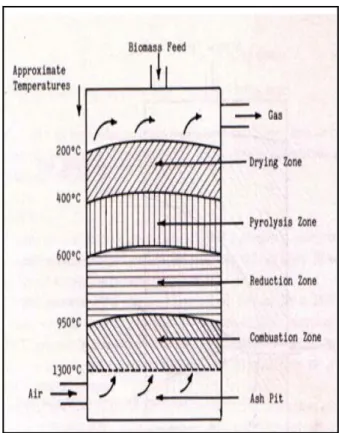
Drying zone is where the biomass fuels consist of moisture ranging from 5 to 35%. At the temperature above 100oC, the water is removed and converted into steam. In the drying process zone, fuels do not experience any kind of decomposition (Chandrakant, 2002). Pyrolisis process is where tar and other volatiles are driven off. All processes were shown in figure 2.2.
‘
Figure 2.2: Various zone in updraft gasifier (Anil, 2006)
Tar is an unpleasant constituent of the gas as it tends to cause sticking and troublesome to the operation. The physical properties of tar is depends upon temperature and heat rate and the appearance ranges from brown and watery (60% water) to balck and highly viscous (7% water). In the other hand, ash is a mineral content in the fuel that remains in oxidizes form.
Ash basically interfere with gasification process in two ways which is in fuses together to form slag or it shelters the points in fuel where ignition is initiated and thus lowers the fuels reaction response. Slagging can be overcome by two types of operation which are by using low temperature operation that keeps the temperature well below the flow of ash or using high temperature operations that keep the temperature above the melting point of ash (Anil, 2006).
2.3 Cook stove
For many households, switching away from traditional biomass is not feasible in a short term but improving the way biomass is supplied and used for cooking is. It harmful effects of biomass can be reduced either through transformation of biomass into less polluting forms or through improved stoves and better ventilation.
Gasifier stoves which are basically compact gasifier- gas burner devices have been tried since mid-nineties for cooking applications. Nowadays, there are a number of gasification based cooking systems which are more efficient than traditional stoves and are almost smoke-free, have been developed and demonstrate recently to highlight the potential benefits of introducing them in developing countries. This system was based on two approaches which are gasifier stove and central gas production with producer gas supply network. Gasifier based cooking systems have attractive features which are high efficiency, smoke-free clean combustion, uniform and steady flame, ease of flame control and possible attention-free operation over extended duration (Bhattacharya, 2008). The diagram of a typical gasifier cookstove is shown Figure 2.3.
Figure 2.3: Diagram of gasifier cook stove
Basically fuels where put into the chamber in the middle of the stove and it will be ignited at the top or below with few drops of kerosene oil as shown in Figure 2.3. The required air flow will be control and flame established because of the free convection of air from the bottom. The temperature inside the stove shall be increase with time and pyrolisis zone will be established. The existing volatile matter release from biomass and at the later stage charcoal will be left. The combustible gas will be burn at the top end of the stove where the cooking utensil is placed (Panwar, 2009).
CHAPTER 3
METHODOLOGY
3.1 Project Activities and Milestone
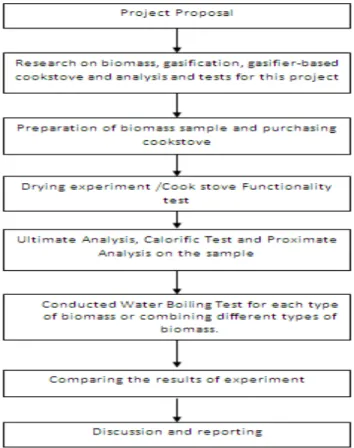
Project activities performed is shown in Figure 3.1.
Figure 3.1: Process flow of project
3.1.1 Sample Preparation and Project Analysis
For this project, there are seven types of samples was prepared. The samples are oil palm fronds, wood sticks, coconut shells, sawdust, pressed sugarcane, dry leaves and charcoal. The reason of selecting this type of biomass is because it easy to collect, cheap and nowadays it only throw away as wastage. During the sample preparation, all the seven types of sample were collected in range of 1.5 - 3kg. The sample will undergo drying
procedure before undergo all the analysis. Sample preparation was done according to the ASTM D 2013-86 (Standard Method of Preparing Coal Sample for Analysis). The sample was dried in an oven at 40oC for a period of 24 hours until the loss in weight is not more than 0.1%/h. This process was done in order to ensure the moisture content in the sample is completely eliminated. Figure 2.2 show the equipment used for drying process.
Figure 3.2: Oven used for drying process, CARBOLITE 450
The dried sample was undergone the first stage of grinding to prepare it in powder form using a Granulator as shown in Figure 3.3. The granulated samples were turned into powdery form using a Rock Lab Grinder by setting the grinding time 3 minutes per load. The preparation of the samples take quite sometimes because of rock lab grinder as Figure 3.4 can only grind small potion of sample in each run.
Figure 3.4: ROCKLABS Bench Top Ring Mill
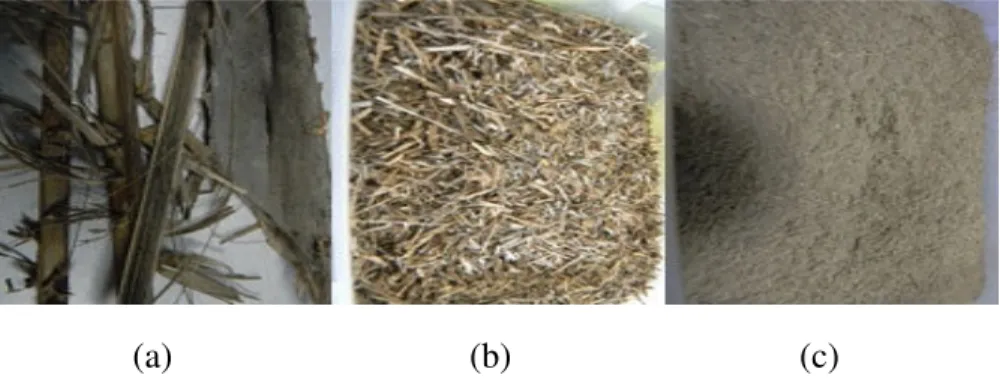
Figure 3.5 until 3.11 presented all seven types of biomass samples that already turned into powdery form.
(a) (b) (c)
Figure 3.5: Oil palm fronds: (a) raw, (b) granulated and (c) powder form
(a) (b) (c)
(a) (b) (c)
Figure 3.7: Charcoal: (a) raw, (b) granulated and (c) powder form
(a) (b) (c)
Figure 3.8: Pressed Sugarcane: (a) raw, (b) granulated and (c) powder form
(a) (b) (c)
Figure 3.9: Wood Sticks: (a) raw, (b) granulated and (c) powder form
(a) (b)
(a) (b) Figure 3.11: Sawdust: (a) raw and (b) powder form
Chemical analysis is necessary to be done in order to justify the feasibility of using all the samples in a gasification system. Chemical analysis where include the ultimate analysis, proximate analysis and calorific value test. In the other hand, water boiling test will be used to measure the efficiency of the cook stove.
3.1.2 Ultimate Analysis
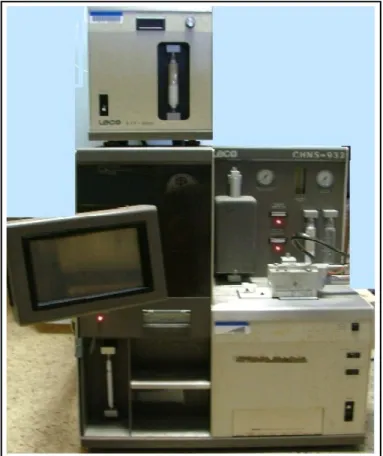
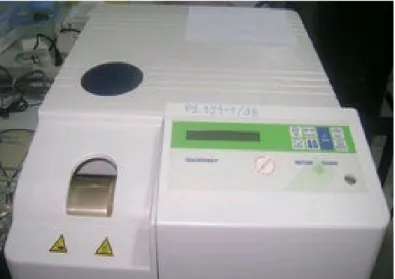
The ultimate analysis will be performing by using Leco-932 CHNS machine. The purpose of this analysis is to analyze the chemical composition of the sample which is by reporting the amount of carbon, hydrogen, nitrogen and sulphur. High hydrogen carbon content will be indicating that the sample is suitable to become a fuel source for the gasification process. Where as, the low content of carbon shows that the sample has a potential as an environmental friendly. Usually, it was performed in the dry basis because otherwise the moisture will be indicated as additional hydrogen and oxygen. For fast growing biomass material like straw, the determination of chlorine is important because it represents pollution and corrosive agent is gasification and combustion system. CHNS machine work based on the principle that high combustion is used as the means of removing the elements from the materials. The parameters for ultimate analysis will be set according to ASTM D-3176-89 (Balamohan, 2008). The CHNS machine used is shown in Figure 3.12.
Figure 3.12: CHNS machine LECO 932 (LECO, 2005) 3.1.3 Proximate Analysis
Proximate test generally classifies the fuel in term of its moisture, volatile matter, fixed carbon and ash. The thermal behavior was studied by measuring the rate of weight loss of the sample as a function of time and temperature. Changes in mass indicate moisture loss and phase changes which occur at set temperature. This analysis will be done by using TGA machine shown in Figure 3.13. For this analysis, the parameters will set based on ASTM D5142-90.
Fuels with moisture content above about 30% makes the ignition difficult and reduce the calorific value of the product gas due to the need to evaporate the additional moisture before combustion or gasification occurs (Balamohan, 2008).
Figure 3.13: TGA Machine for proximate analysis 3.1.4 Calorific Value Test
The objective of calorific test is to determine the amount of energy stored in the sample. This experiment will be using LECO AC -350 Bomb Calorimeter as shown in Figure 3.14. The Gross Calorific value of the specimen is the heat produce by a complete combustion of a unit quantity sample at a constant volume in an oxygen bomb calorimeter under standard condition.
The test would be judging parameter on the suitability or potential of the sample as a biomass feed by means of comparing the value of data obtained against the predetermined existing data of various biomass resources. (Balamohan, 2008) All the parameters will be set according to ASTM D 5865-00.
3.1.5 Water Boiling Test
This test is the laboratory based test. Water boiling test is a short and simple simulation of a standard cooking procedure. A water boiling test was accepted to measure accurately the fuel consumed and time required for simulated cooking tasks.
A known quantity of water was heated on a cook stove in water boiling test. The quantity of water evaporated after complete burning of the fuel was determined to calculate the efficiency by using the following formula (Bhakta, 2007).
(3.1) Where in the equation, Mwi is the mass of water initially in cooking vessel measured in
kg, Cpw is specific heat of water in kJ/kgoC, Mw,evap is mass of water evaporated in kg, Mf
is the mass of fuel burned measured in kg, Te is temperature of boiling water in Celsius
(oC), Ti is initial temperature of water in pot also in Celsius (oC), Hi is latent heat if
evaporation at 100oC and 105kPa, kJ/kg and last but not least Hf is calorific value of the
fuel measured in kJ/kg. During water boiling test experiments, the other criteria will be observed as form below.
3.1.6 Cook Stove used for water boiling test
Specific gasification cook stove is needed in order to accomplish this project. Unluckily, these cook stove was not available in Malaysia since there is no potential usage here. Based on the survey done by the author, the cook stoves were mostly available at the developing country such as India, Indonesia, South Africa and etc. There are varieties of the biomass cook stove which is available thru internet business online. The author managed to buy one of these items after considering the time frame and prices limit. The cook-stove as sold by Chemaco Indonesia at Rp300, 000 equivalents to RM120.00.
There are few challenges faced manual
enquiry since they only sell for commercial purpose only. Based on the catalog mention via the internet, this stove where suitable to use with various type of biomass such as wood stick, oil palm fronds and straw. The other information provide is by using 1.5kg wood as a fuel the stove will be light up around 1 to 2 hours.
As there is no enough information provided by the seller, the objective of using this stove is to find the
stove. This project may help the user how to maximize the usage of the biomass. The author also hopes by doing this project, it also may encourage others to use this stove by providing the
The weight of this cook stove was about 23kg and details d 3
cone and smaller chamber.
for each types but for oil palm fronds, wood stick, charcoal and pressed sugarcane the length were in range
diameter of the chamber was 13cm and high was There are few challenges faced
manual and information of the stove. In addition, the seller also doesn’t entertain any enquiry since they only sell for commercial purpose only. Based on the catalog mention via the internet, this stove where suitable to use with various type of biomass such as wood stick, oil palm fronds and straw. The other information provide is by using 1.5kg wood as a fuel the stove will be light up around 1 to 2 hours.
As there is no enough information provided by the seller, the objective of using this stove is to find the
stove. This project may help the user how to maximize the usage of the biomass. The author also hopes by doing this project, it also may encourage others to use this stove by providing the
The weight of this cook stove was about 23kg and details d 3.16. There are five main
cone and smaller chamber.
for each types but for oil palm fronds, wood stick, charcoal and pressed sugarcane the length were in range
diameter of the chamber was 13cm and high was There are few challenges faced
and information of the stove. In addition, the seller also doesn’t entertain any enquiry since they only sell for commercial purpose only. Based on the catalog mention via the internet, this stove where suitable to use with various type of biomass such as wood stick, oil palm fronds and straw. The other information provide is by using 1.5kg wood as a fuel the stove will be light up around 1 to 2 hours.
As there is no enough information provided by the seller, the objective of using this stove is to find the best type or combination of biomass that can be used by this cook stove. This project may help the user how to maximize the usage of the biomass. The author also hopes by doing this project, it also may encourage others to use this stove by providing the information regarding the best fuels that can be used.
Figure
The weight of this cook stove was about 23kg and details d . There are five main
cone and smaller chamber.
for each types but for oil palm fronds, wood stick, charcoal and pressed sugarcane the length were in range
diameter of the chamber was 13cm and high was
There are few challenges faced by the author because they did not provide details and information of the stove. In addition, the seller also doesn’t entertain any enquiry since they only sell for commercial purpose only. Based on the catalog mention via the internet, this stove where suitable to use with various type of biomass such as wood stick, oil palm fronds and straw. The other information provide is by using 1.5kg wood as a fuel the stove will be light up around 1 to 2 hours.
As there is no enough information provided by the seller, the objective of using this best type or combination of biomass that can be used by this cook stove. This project may help the user how to maximize the usage of the biomass. The author also hopes by doing this project, it also may encourage others to use this stove by
information regarding the best fuels that can be used.
Figure 3.15: Chemaco biomass cook stove The weight of this cook stove was about 23kg and details d
. There are five main components which are ash drawer, fuel chamber, grate plat, cone and smaller chamber. During water boiling test, the size of biomass used were vary for each types but for oil palm fronds, wood stick, charcoal and pressed sugarcane the length were in range between 10
diameter of the chamber was 13cm and high was
by the author because they did not provide details and information of the stove. In addition, the seller also doesn’t entertain any enquiry since they only sell for commercial purpose only. Based on the catalog mention via the internet, this stove where suitable to use with various type of biomass such as wood stick, oil palm fronds and straw. The other information provide is by using 1.5kg wood as a fuel the stove will be light up around 1 to 2 hours.
As there is no enough information provided by the seller, the objective of using this best type or combination of biomass that can be used by this cook stove. This project may help the user how to maximize the usage of the biomass. The author also hopes by doing this project, it also may encourage others to use this stove by
information regarding the best fuels that can be used.
: Chemaco biomass cook stove The weight of this cook stove was about 23kg and details d
components which are ash drawer, fuel chamber, grate plat, During water boiling test, the size of biomass used were vary for each types but for oil palm fronds, wood stick, charcoal and pressed sugarcane the 10cm-25cm in order to fit in the fuel chamber. The diameter of the chamber was 13cm and high was
by the author because they did not provide details and information of the stove. In addition, the seller also doesn’t entertain any enquiry since they only sell for commercial purpose only. Based on the catalog mention via the internet, this stove where suitable to use with various type of biomass such as wood stick, oil palm fronds and straw. The other information provide is by using 1.5kg wood as a fuel the stove will be light up around 1 to 2 hours.
As there is no enough information provided by the seller, the objective of using this best type or combination of biomass that can be used by this cook stove. This project may help the user how to maximize the usage of the biomass. The author also hopes by doing this project, it also may encourage others to use this stove by
information regarding the best fuels that can be used.
: Chemaco biomass cook stove
The weight of this cook stove was about 23kg and details dimension were state in Figure components which are ash drawer, fuel chamber, grate plat, During water boiling test, the size of biomass used were vary for each types but for oil palm fronds, wood stick, charcoal and pressed sugarcane the cm in order to fit in the fuel chamber. The diameter of the chamber was 13cm and high was 86cm. Weight of biomass used during by the author because they did not provide details and information of the stove. In addition, the seller also doesn’t entertain any enquiry since they only sell for commercial purpose only. Based on the catalog mention via the internet, this stove where suitable to use with various type of biomass such as wood stick, oil palm fronds and straw. The other information provide is by using 1.5kg wood as a fuel the stove will be light up around 1 to 2 hours.
As there is no enough information provided by the seller, the objective of using this best type or combination of biomass that can be used by this cook stove. This project may help the user how to maximize the usage of the biomass. The author also hopes by doing this project, it also may encourage others to use this stove by
information regarding the best fuels that can be used.
: Chemaco biomass cook stove
imension were state in Figure components which are ash drawer, fuel chamber, grate plat, During water boiling test, the size of biomass used were vary for each types but for oil palm fronds, wood stick, charcoal and pressed sugarcane the cm in order to fit in the fuel chamber. The 86cm. Weight of biomass used during by the author because they did not provide details and information of the stove. In addition, the seller also doesn’t entertain any enquiry since they only sell for commercial purpose only. Based on the catalog mention via the internet, this stove where suitable to use with various type of biomass such as wood stick, oil palm fronds and straw. The other information provide is by using 1.5kg
As there is no enough information provided by the seller, the objective of using this best type or combination of biomass that can be used by this cook stove. This project may help the user how to maximize the usage of the biomass. The author also hopes by doing this project, it also may encourage others to use this stove by
imension were state in Figure components which are ash drawer, fuel chamber, grate plat, During water boiling test, the size of biomass used were vary for each types but for oil palm fronds, wood stick, charcoal and pressed sugarcane the cm in order to fit in the fuel chamber. The 86cm. Weight of biomass used during by the author because they did not provide details and information of the stove. In addition, the seller also doesn’t entertain any enquiry since they only sell for commercial purpose only. Based on the catalog mention via the internet, this stove where suitable to use with various type of biomass such as wood stick, oil palm fronds and straw. The other information provide is by using 1.5kg
As there is no enough information provided by the seller, the objective of using this best type or combination of biomass that can be used by this cook stove. This project may help the user how to maximize the usage of the biomass. The author also hopes by doing this project, it also may encourage others to use this stove by
imension were state in Figure components which are ash drawer, fuel chamber, grate plat, During water boiling test, the size of biomass used were vary for each types but for oil palm fronds, wood stick, charcoal and pressed sugarcane the cm in order to fit in the fuel chamber. The 86cm. Weight of biomass used during
the experiment were set at 1.5kg for each type however the maximum capacity can be load into this chamber was approximately around 3.0kg.
Figure 3.16: Schematic diagram of chemaco gasifier cook stove 3.2 Project Planning
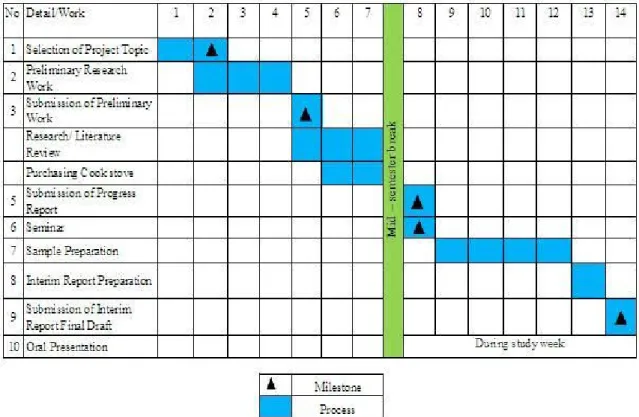
The performance of biomass gasification would be investigated by means of chemical and physical analysis. Prior to the investigation by conducting experiments, the basic analysis method and procedures involved are studied by means of literature review. For the first half of the semester the chemical analysis of the oil palm fronds would be investigated by means of Ultimate Analysis and Calorific Test. The second half of the studes were further investigate by performing Proximate Analysis. The physicals characteristic were observed during water boiling test which were performed in the second semester.
Figure 3.17: Project planning for semester 1
CHAPTER 4
RESULT AND DISCUSSIONS
4.1 Ultimate Analysis
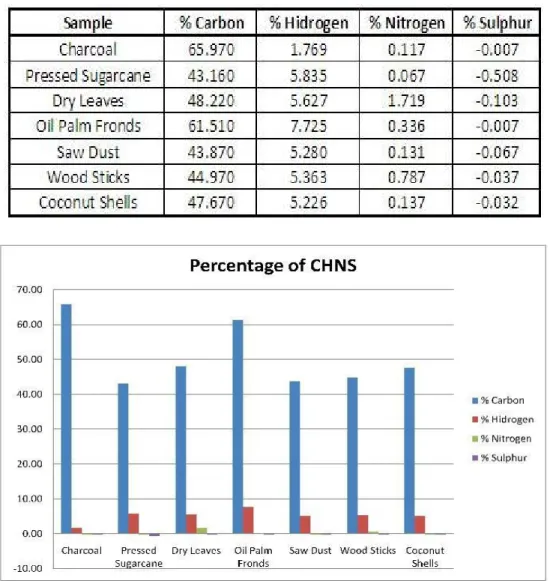
Ultimate analysis was performed using the LecoCHNS-932 machine and parameter was set according to ASTM D3176 -89, standard practice for ultimate analysis of coal and coke. The result of the analysis is as shown in Table 4.1 and Figure 4.2:
Table 4.1: Experimental Result on CHNS Test
As shown in the Table 4.1 and illustrated in Figure 4.1, composition of carbon is higher compare to carbon, hydrogen, nitrogen, and sulphur. In this experiment, consideration of carbon content is important because it indicate either the biomass has possibility to be used as a fuel for gasification or not.
Figure 4.2: Comparison of carbon content in the samples
As shown in Figure 4.2, charcoal has highest carbon content (65.97%), followed by oil palm fronds (61.51%), dry leaves (48.22%), coconut shells (47.67%), wood sticks (44.97), saw dust (43.16%), and the lowest was pressed sugarcane (43.16%).Besides carbon content, there are few criteria should be consider and will be explain later in the other experiment result.
4.2 Calorific Value Test
Biomass calorific value is important in the selection of fuel for gasification. This is because calorific value provides information of energy content per kg that might be release by the biomass during the process. The parameters of this analysis were set as per ASTM D 5865 – 00, standard test method for gross calorific value of coal and coke. The result from the calorific value test done is shown in Table 4.2 below:
Table 4.2: Experimental Result on Calorific Value Test
The result from this experiment did not give huge differences between all types of biomasses except charcoal. The calorific value obtained for other types of biomasses are ranging between 16737 J/g to 19472 J/g and charcoal gave a reading with 30319 J/g energy content.
Figure 4.3: Comparison of calorific value in the samples
As shown in Figure 4.3, charcoal has the highest calorific value (30319 J/g) and pressed sugarcane has the lowest value (16821 J/g). The others biomasses calorific values are
coconut shells (19472 J/g), dried leaves (19237 J/g), oil palm fronds (17787 J/g), wood sticks (17521 J/g) and saw dust (16737 J/g).
4.3 Proximate Analysis
Proximate analysis was done to analyze the composition of moisture content, volatile matter, fixed carbon and ashes in the biomass sample. Parameters for TGA analysis were set based on ASTM D 5142-90, standard test methods for proximate analysis sample of coal and coke by instrumental procedures and the results obtained are presented in Table 4.3 below:
Table 4.3: Experimental Result on Proximate Analysis
The comparison for all seven type of biomasses are illustrated in Figure 4.4 and will be explain in detail by each type of the content.
The moisture content of the most biomass fuel depends on the type of fuel, it´s origin and treatment before it is used for gasification. Moisture content of the fuel is usually referred to inherent moisture plus surface moisture. The moisture content below 15% by weight is desirable for trouble free and economical operation of the gasifier. Higher moisture contents reduce the thermal efficiency of gasifier and results in low gas heating values. Igniting the fuel with higher moisture content becomes increasingly difficult, and the gas quality and the yield are also poor (Turare, 1997). As per statement taken above, biomass with the lowest moisture content is desired and should be choose for gasification process.
Figure 4.5: Comparison of moisture content in the samples
Figure 4.5 shown charcoals (3.6%) and oil palm fronds (3.7%) have the lowest percentage of moisture content compared to pressed sugarcane (6.0%), saw dust (9.5%), wood sticks (9.8%), dried leaves (9.9%) and coconut shells (10.4%).
Figure 4.6: Comparison of volatile matter in the samples
Fuel with high volatile matter content produces more tar, causing problems to internal combustion engine (Turare, 1997). As shown in Figure 4.6 above, charcoal (9.8%) contains least percentage of volatile matter compared to other biomass samples (pressed sugarcane (72.8%), dried leaves (58.2%), oil palm fronds (50.7%), saw dust (67.3%), wood sticks (72.5%), and coconut shells (67.7%)).
In figure 4.7 above, charcoal contains the highest percentage of fixed carbon (85.5%) followed by oil palm fronds (40.1%), dried leaves (26.7%), saw dust (22.6%), coconut shells (18.3%), wood sticks (17.2%) and the lowest percentage is pressed sugarcane with 14.9%.
Ash is minerals content of fuel which remains in oxidized form after combustion of fuel or also known as unburned fuel (Turare, 1997). Composition of ash determines either the slagging or tar could be form or not. In general, no slagging is observed with fuels having ash contents below 5-6% and severe slagging can be expected for fuels having ash content below 12% and above (FAO, 1986).
Figure 4.8: Comparison of ash content in the samples
Results obtained for ash content were presented in Figure 4.8 above. Wood sticks gave the lowest value with 0.5% and followed by saw dust (0.6%), charcoal (1.1%), coconuts shells (3.6%), and dried leaves (5.2%). While pressed sugarcane and oil palm fronds have the same value which is 6.3%.
4.4 Water Boiling Test
Basically, water boiling test is a test that used to measure the cook stove performance. In this experiment, 2.5kg water was boiled in a pan without lid and the time will be taken. The starting amount of fuel to be use was 1.5kg and after the test conducted the remaining fuel should be weight again. Besides, other parameters recorded during the experiment were as Table 4.4 below:
Table 4.4: Experimental result on water boiling test
Figure 4.9: Time taken to boil 2.5kg water
Based on Figure 4.9, time taken to boil 2.5 kg of water were in range between 17 to 32 minutes. Charcoal with the least time 17 minutes and followed by the rest oil palm fronds (19min), wood sticks (21min), coconut shells (22min), saw dust (25min), pressed sugarcane (30 min) and dried leaves (32min).
From the results gathered, the author has concluded that the time taken to boil 2.5kg of water was depending heavily on carbon content and calorific value. Lesser time taken for water to be boiled when the carbon content and calorific value contained in the biomass is high.
Figure 4.10: Weight of Fuel Consumed to Boil 2.5kg Water
Weight of fuel consumed while conducted water boiling test is also an important aspect that need to consider. The lowest amount of fuel consumed was charcoal (0.5kg) and oil palm fronds (0.55kg). The highest amount of fuel consumed is dried leaves with 1.34kg fuel used. The other values are wood stick (0.68kg), coconut shells (0.75kg), pressed sugarcane (0.9kg) and saw dust (0.81kg).
After all the data gathered from water boiling test, efficiency of cook stove by using different fuels can be calculated using equation below:
Table 4.5 below shown all the properties and value used for efficiency calculation. Table 4.5: Table for efficiency calculation
Figure 4.11: Cook stove efficiency based on water boiling test
Based on efficiency presented in Figure 4.11, using oil palm fronds as a fuel gave the highest efficiency with 18.95% and the lowest percentage are using dried leaves as a fuel with efficiency value is 11.08%. Others are wood sticks (17.28%), coconut shells (14.65%), pressed sugarcane (17.81%), charcoal (11.33%) and saw dust (16.96%). So far the thermal efficiency of these improved stoves has approached 25 to 35 percent, compared to 6 to 10 percent for traditional stoves (Grover P.D). In this experiment the highest efficiency obtained were only 18.95% which is lower than 25% .However, all the efficiency still higher than the efficiency of traditional cook stove.
4.5 Result Comparison
From all the analysis done and data gathered, comparison has to be made to determine the best fuel suitable for this cook stove. Few important aspect that will be consider in this comparison are fuel must have high carbon content, high calorific value or energy content, low moisture, ash and volatile matter content, least time to boil water, least fuel consumed and last but not least higher cook stove thermal efficiency. The summarization of the comparison was shown in the Table 4.6 below to make it simpler and more understanding:
Table 4.6: All data comparison
From all the criteria discussed, the fuels were given rate from 1 to seven. The most preferable will be rated 1and vice versa. Therefore, sample with least score will have highest possibility to use as a fuel for this Chemaco gasifier cook stove.
Charcoal and oil palm fronds are two samples that are most preferable to be use for this kind of cook stove. Other samples which in an average range are wood stick, coconut shells, saw dust and dried leaves. Where else, pressed sugarcane has the lowest score in this analysis.
CHAPTER 5
CONCLUSION AND RECOMMENDATION
5.1 Conclusions
Biomass has great potential as a renewable and relatively clean feedstock for producing modern energy carriers. In order to compete with fossil energy sources an optimal utilization of biomass resources is desired. A wide range of biomass sources, such as traditional agricultural crops, residues from agriculture and foresting can be gasified. This is generally regarded as a real advantage, because it means that the best available and usually economically most attractive feedstock can be selected. From the result obtained, charcoal gave a tremendous result in term of few aspects such as carbon content, calorific value, moisture content and etc. Since this kind of source is mainly used as a fuel in many countries, the best substitute source can be awarded to the oil palm fronds. The outcome of this study has added some value to the oil palm fronds to become an alternative fuel in the future.
5.2 Recommendations
Based on the present research obtained, there are several biomass samples that are suitable to use as a fuel for biomass gasifier cook stove. For future works, the biomass samples can be further investigate and can be produce in briquettes or pallet form to maximize the fuel energy usage. It’s also recommended that in the future, the energy density of each biomass sample to be calculated in unit MJ/m2 in order to study the quantity of energy contained in each biomass sample if each of the sources were transport in a large quantity.
REFERENCES
Ale B.B, Bhattarai N, Gautam J, Chapagain P, Pushpa K.C, A sustainable prospect for institutional cooking, Tribhuvan University
Anderson P.S, 2009, Proposal for an Urban Biomass Cookstove Project, Ph.D. for the Biomass Energy Foundation
Anderson P.S, Reed T.B and Wever P.W, Micro Gasification: what it is and how it works
ASTM (2000) Annual Book of ASTM Standard
Balamohan S, 2008, Feasibility of Oil Palm Fronds for Biomass Gassification, Universiti Teknologi PETRONAS
Barnes D.F, Openshaw K, Smith K.R, and Robert Van Der Plas, 1994, What Makes
People Cook with Improved Biomass Stoves, The Wolrd Bank, Washington D. C
Bhattacharya S.C and Leon M.A, 2008, Prospects for Biomass Gasifiers for Cooking Applications in Asia, Thailand, Asian Institue of Technology
Grover P.D, Cost Estimate for ‘Dream Stove’ for Asia, http://stoves.bioenergylists.org/stovesdoc/Grover/paper-grover.htm
Joseph St, 2005, CHN-900/CHNS-932 Carbon, Hydrogen, Nitrogen, Sulphur and Oxygen Determination, Leco Corporation
Livingston W.R, 2007, Biomass ash characteristic and behavior in combustion,
gasification and pyrolysis systems, Doosan Babcock Energy
Panwar N.L, 2009, Design and performance evaluation of energy efficient biomass gasifier based cookstove on multi fuels, 14:627-633
Rajvanshi A.K, 2006, Biomass Gasification, India, Nimbkar Agriculture Research Institute
Reed T.B and Larson R, 1996, A wood-gas Stove for Developing Countries, http://www.bioenergylists.org/stovesdoc/Reed/T1.htm
Renew, Forschungszentzrum K.G, 2004, Definition of a standard biomass
Samson R, Stohl D, Elepano A. and De Maio A, 2001, Enhancing Household Biomass
Energy Use in The Philippines, REAP Canada and Laguna Philippines
Still D, Bentson S, Thompson R and Leslie M, 2010, Charcoal Stove for Haiti, Aprovecho Research Center, Oregon USA
Turare C, 2002, Biomass Gasification Technology and Utilisation, ARTES Institute Glucksburg (Germany)
Turare C, 1997, Biomass Gasification Technology and Utilisation, ARTES Institute Glucksburg (Germany) http://cturare.tripod.com/bio.htm
Wereko C.Y and Hagen B.E, 1996, Biomass Conversion and Technology, England, John Wiley & Sons
2006, World Energy Outlook, Chapter 15 Energy for Cooking in Developing Countries 2009, Wood Energy, Institute of wood Science and Technology, Bangalore, India http://iwst.icfre.gov.in/divisions/we/weindex.html
APPENDICES
APPENDIX 1: Chemaco cook stove manual
Below are usage procedures for Chemaco cook stove;
i. First of all, the fuel chamber located at the center of the cook stove will be filling up with a small size of wood chips.
ii. Next, put in a small amount of the oil palm kernel at the secondary chamber, suit for the usage. Excessive quantity of the oil palm kernel will result massive flame with smoky conditions.
iii. Then, open the ash drawer located at the bottom side of the cook stove. The main purpose is for the air ventilation of the cook stove itself.
iv. Ignite the fuel chamber, which has wood chips inside.
v. Wait for the complete combustion process occurred inside the fuel chamber. Resulting from this activity, the changeability of the oil palm kernel into an oily state and burn entirely can be observed.
vi. After that, place up suitable cooking utensil at the corresponding place upside the cook stove.
vii. If the biomass resources is not enough for the current process, repeat steps 1 until 2 thoroughly.
viii. For safety reasons, keep the cook stove in a good environment if not in used to avoid any bad circumstances from occurred.
APPENDIX 2: Schematic diagram of cook stove parts
Figure of the smaller chamber
APPENDIX 3: Summarize standard used in the project
SUMMARIZE STANDARD USED FOR CALORIFIC VALUE TEST
(ASTM D 5865 – 00 Standard Test Method for Gross Calorific Value of Coal and Coke) References:
No ASTM Code Title
1. D 2013 Standard Method of Preparing Coal Samples for Analysis 2. D 388 Classification of Coals by Rank
3. D 3173 Standard Test Method for Moisture Analysis Sample of Coke and Coal
4. D 3177 Test method for total sulfur in the analysis sample of coal and coke
5. D 3180 Practice for Calculating Coal and Coke analyses from As-Determined to different Bases
*Sample must be preparing as D2013 and obtain the analysis sample by pulverizing the material to a fineness to pass the 250- m Sieve
Procedure for Coke and Coal Samples;
1. Weigh 0.8 to 1.2g of sample into a sample holder. Record the weight nearest to 0.0001g
2. Follow Procedure for Preparation of bomb, Preparation of calorimeter and Temperature observations Automated/ calorimeters
*Preparation of Bomb
o Rinse with water to wet internal seals and surface areas of the bomb or precondition the calorimeter according manufacturer’s instructions.
o Add 1.0mL of water to the bomb before assembly
o Connect the measured fuse in accordance manufacturer’s guidelines
o Assemble the bomb. Admit oxygen to the bomb to a consistent pressure between 2 and 3 MPa (20 and 30 atm)
o Control oxygen flow to the bomb so as not to blow material from the sample holder.
o If the pressure exceeds the specified pressure, detach the filling connection and exhaust the bomb. Discard the sample
*Preparation of Calorimeter
o Fill the calorimeter vessel with water at a temperature not more than 2oC below room temperature and place the assembled bomb in the calorimeter.
o Check that’s no oxygen bubbles are leaking from the bomb.
o With the calorimeter vessel positioned in the jacket, start the stirrers. *Temperature Observations Automated Calorimeter
o The calorimeter vessel’s temperature should be remain stable over a period of 30s before firing. The stability shall be +0.001oC for an adiabatic calorimeters and +0.001oC/s or less for isoperibol calorimeter
3. Carry out moisture determination D3173. 4. Conduct sulfur analysis accordance D 3177
SUMMARIZE STANDARD USED FOR PROXIMATE ANALYSIS
(ASTM D 5142-90 Standard Test Methods for Proximate Analysis Sample of Coal and Coke by Instrumental Procedures)
References:
No ASTM Code Title
1. D 2013 Standard Method of Preparing Coal Samples for Analysis
2. D 3173 Standard Test Method for Moisture Analysis Sample of Coke and Coal
3. D 3174 Standard Test Method for Ash in the Analysis Sample of Coal and Coke from Coal
4. D 3175 Test Method for Volatile Matter in the analysis sample of Coal and Coke
5. D 3177 Test method for total sulfur in the analysis sample of coal and coke
6. D 3180 Practice for Calculating Coal and Coke analyses from As-Determined to different Bases
7. D 3302 Test Method for Total Moisture in Coal
In these test methods, moisture, volatile matter, and ash may be determined sequentially in a single instrumental procedure.
Procedure;
*Sample must be preparing as D2013 and obtain the analysis sample by pulverizing the material to a fineness to pass the 250- m Sieve
1. Heat the crucibles and covers for use in the test method. Cool before use. For each test weigh a prepared crucible.
2. Add approximately 1g coal or coke to the crucible and then weigh the crucible with the specimen. Make all the weighing to the nearest 0.1mg
(Transfer the specimen from the sample bottle quickly to minimize the exposure of the specimen to the atmosphere before the weighing process. Use the covers to protect the specimen before and after the moisture determination)
3. Use the crucible cover during the determination of the volatile matter. Weigh the cover with the crucible and specimen for this test.
4. Moisture Determination
o Heat the weighed samples in crucibles without the covers in the drying oven at 104 to 110oC.
o Automated instruments with an internal balance that can weigh the specimen repeatedly during the determination can be programmed to terminate the test when reached a constant weigh
5. Volatile Matter Determination
o May be made using the specimens from the moisture determinations
o An alternative methods is to weigh 1g (to the nearest 0.1mg) of analysis sample in the preweighed crucible with self-sealing cover.
o Place the crucibles in the furnace which is heated at the rate of 50oC/min to 950 + 20oC and hold at this temperature for 7 min.
6. Ash Determination
o Transfer approximately 1g (weighted to the nearest 0.1mg) of the sample to a weighted capsule and cover quickly (Alternative way: used dried coal from the moisture determination D3173)
o After removing the covers, place the capsule containing the sample in a cold furnace and heat gradually at such a rate that the temperature reaches 450oC to 500oC in 1 hour
o Heat coal sample so that a final temperature of 700oC to 750oC is reached by the end of the second hour.
o Remove the capsule from the furnace and place the cover on. Cool under condition to minimize moisture pickup, and weigh
SUMMARIZE STANDARD USED FOR ULTIMATE ANALYSIS
(ASTM D3176 -89: Standard Practice for Ultimate analysis of coal and coke) References:
No ASTM Code Title
1 D 2234 Standard Practice for Collection of a Gross Sample of Coal 2 D 2013 Standard Method of Preparing Coal Samples for Analysis 3 D 5373 Test methods For Instrumental Determination of carbon,
hydrogen and nitrogen in laboratory samples of Coal and Coke
4 D 3177 Test method for total sulfur in the analysis sample of coal and coke
5 D 3174 Standard Test Method for Ash in the Analysis Sample of Coal and Coke from Coal
6 D 3173 Standard Test Method for Moisture Analysis Sample of Coke and Cole
General Requirements:
1. Coal sample collection 2. Sample Preparation
*Air drying oven shall be capable of maintaining a temperature of 10 to 15oC above room temperature and maximum oven temperature of 40oC unless ambient temperature is above 40oC in which case ambient temperature should be used. *Drying pans is a noncorroding metal pans of sufficient size so that the sample may be spread to a depth of not more than 25mm with sides not more than 38mm high.
* A balance with of sufficient capacity to weight the sample and container with sensitivity of 0.5g in 1000g.
o Air Drying for laboratory sample: Weigh the sample, plus pan, plus container, if one is used
o Spread the sample in the pan to a depth not to exceed 25mm.
o Place it in the oven along with the container and air dry until the loss in weight is not more than 0.1%/h.
o Avoid excessive drying.
o If an oven is not available, the sample may be air-dried in a room free from dust an excessive air currents
o Stirring in the intervals will lessen air-drying time Specific Requirements:
1. Carbon, Nitrogen and Hydrogen Determination
*calibrate instrument according to the manufacturer’s instructions. *all the analysis should be done with ‘dry basis’ sample
o Procedure: analyze the specimen of the analysis sample in accordance to the manufacturer’s instructions.
2. Sulfur Determination 3. Ash Determination
*Ash as determined in this method is the residue remaining after burning the coal and coke.
*Apparatus: Electric Muffle Furnace capable of having its temperature regulated at 700oC to 750oC, Porcelain Capsule about 22mm depth and 44mm diameter, balance sensitivity to 0.1mg and Crucible cover aluminum, porcelain or similar covers.
o Transfer approximately 1g (weighted to the nearest 0.1mg) of the sample to a weighted capsule and cover quickly
o (Alternative way: used dried coal from the moisture determination D3173) o After removing the covers, place the capsule containing the sample in a cold
furnace and heat gradually at such a rate that the temperature reaches 450oC to 500oC in 1 hour
o Heat coal sample so that a final temperature of 700oC to 750oC is reached by the end of the second hour.
o Remove the capsule from the furnace and place the cover on. Cool under condition to minimize moisture pickup, and weigh
4. Oxygen Determination
*No satisfactory ASTM test method
o Subtracting from 100 the sum of the other components of the ultimate analysis.
Oxygen (weight %) = 100 – A – C – H – N – S 5. Moisture Determination
*Moisture is determined by establishing the loss in weight of the sample when heated under rigidly controlled conditions of temperature, time and atmosphere, sample weight and equipment specifications.
*Apparatus: Drying Oven: oven capable of temperature regulation between the limits of 104oC and 110oC, capsules with covers.
*Procedure for sample passing a 250- m Sieve;
o Heat the empty capsules under the condition at which the sample to be dried, place the cover on the capsule, cool over desiccant for 15 to 30 min and weigh
o Dip out the spatula from the sample bottle approximately 1g of the sample. Put quickly into the capsule, close and weigh at once to the nearest + 0.1mg o After removing the covers, quickly place the capsules in a preheated oven
(104 to 110oC) through which passes a current of dry air. o Close the oven at once and heat for 1h
o Open the oven, cover the capsules quickly, cool in a desiccator over desiccant, weigh as soon as the capsules have reached room temperature o Calculate the percentage of moisture
Moisture in analysis sample, % = [(A – B)/A] X 100 Where;
A = grams of sample used