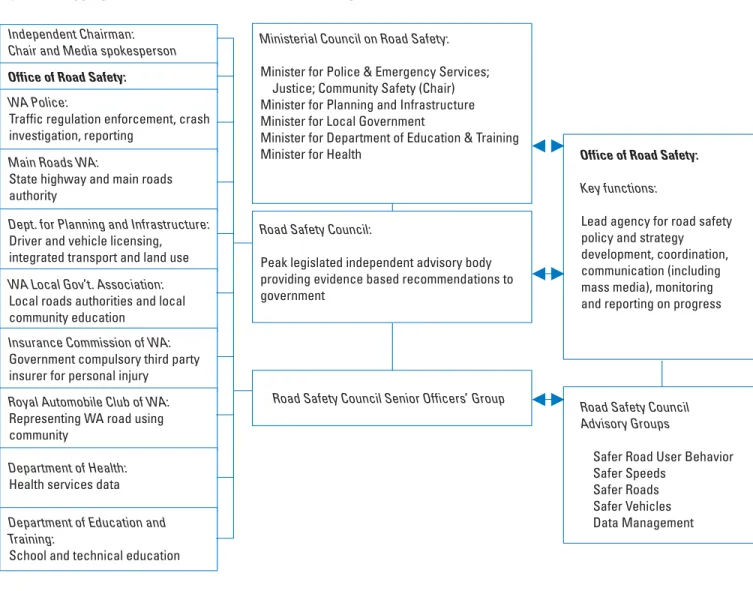
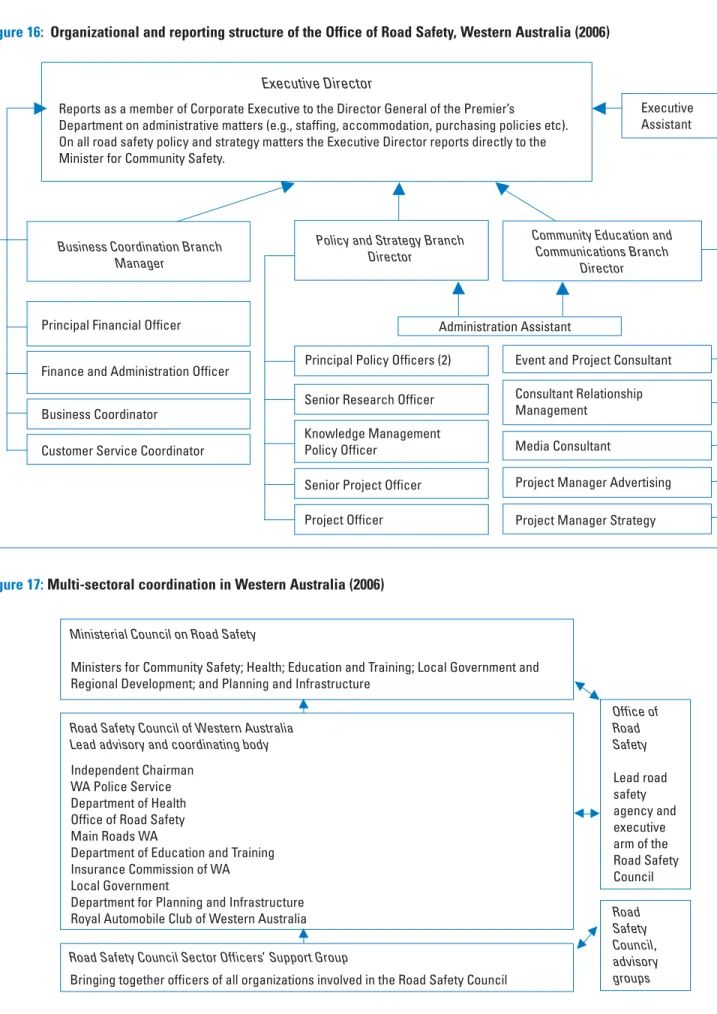
A variety of lead agency models can be effective in road safety management and countries must create a lead agency appropri-ate to their own circumstances. Successful practice under-scores the need for the agency to be a governmental body and for its leadership role to be accepted and fully supported by the rest of government to ensure the development of appropriate funding and capacity.
The lead agency may take the form of a designated, stand-alone entity with a coordinating committee or cabinet representing part-ner government agencies. It may also be part of a larger transport organization or be part of a Premier’s department. The agency might undertake much of the work itself or it might delegate as-pects of work to other organizations, including provincial and local governments, research institutes or professional associations. Examples of four different types of governmental lead agency structures in several good practice jurisdictions are presented in this Annex. These jurisdictions have been active in road safety over a long period of time and exemplify effective delivery of all seven institutional management functions summarized in sec-tion 3.1.1 of the main report and detailed in Annex 2. They illus-trate how governmental lead agencies and their coordination arrangements can vary to achieve desired results. In some cases the main institutional arrangements have evolved gradu-ally over many years. In others they are relatively recent. All agencies presented have complex organizational structures and processes and many partners and stakeholders.
The different forms of lead agency arrangements are outlined with the aim of showing how their structures and processes
re-flect their contribution to institutional management functions and their relationships with other partners and stakeholders. For each lead agency type a summary of the lead agency delivery of management functions is presented, using material from the case studies presented in Annex 4. The aggregate structure for governmental road safety arrangements is outlined, together with the role assumed by the lead agency and its relationship with governmental delivery partners. A summary of the related organizational structures and processes is then provided to illus-trate the nature of the institutional capacity required to carry out the lead agency role in practice. In using the information in this Annex it should be noted that structures and management pro-cesses of particular organizations develop over a period of time and are, typically, in the process of continual change. Therefore, the Annex can only provide snapshots of organizations at a par-ticular stage of their evolution. Wherever possible dates have been assigned to good practice examples and a brief note is pro-vided of major subsequent developments.
Two important conclusions from good practice are drawn with re-gard to lead agency forms and related structures and processes. First, no one lead organizational arrangement is prescribed as being best, given the diversity of country conditions which road safety managers have to meet. However, a central road safety of-fice with adequate human, technical and financial resources is essential. Second, effective coordination arrangements are sub-ordinate to the leadership role. Without adequate funding, techni-cal resources and an authoritative lead agency support, coordi-nating the shared responsibility for achieving road safety results has little chance of success.
Introduction
As outlined in Annex 2, the lead agency plays a key role in
all of the seven institutional management functions
iden-tified as underpinning the road safety management
sys-tem (see section 3.1.1 in the main report for a summary
of these). The lead agency takes responsibility for what it
is solely accountable for as well as prompting,
encourag-ing and assistencourag-ing activities on the part of other key road
safety partners and stakeholders. Effective delivery of the
lead agency role to achieve desired results requires
sup-porting organizational structures and processes.
The
World Report on Road Traffic Injury Prevention
1ob-serves that a variety of lead agency models can be
effec-tive in road safety and that each country must create a
lead agency appropriate to its own circumstances. The
agency might take the form of a designated, stand-alone
entity with a coordinating committee or cabinet
repre-senting partner government agencies. It might also be
part of a larger transport organization or be part of the
Premier’s department. The agency might undertake
much of the work itself or it might delegate tasks to other
organizations, including provincial and local
govern-ments, research institutes or professional associations.
Successful practice underscores the need for the agency
to be a governmental body and for its leadership role to be
accepted and fully supported by the rest of government to
ensure the development of appropriate funding and
ca-pacity. A review of road safety management in thirteen
countries concluded that the main factor influencing the
success or otherwise of different organizational
arrange-ments was adequate human and financial resources.
2Coordination of multi-sectoral activities is a complex task
and is closely related to the leadership function. In some
low and middle-income countries, national road safety
councils have been established as coordinating bodies
with a leadership function, but without a lead road safety
agency to support them. Without adequate funding,
tech-nical resources and an authoritative lead agency in
sup-port, this coordinating model has little chance of success.
This Annex builds on the descriptions presented in
An-nex 2 and drawing on material from AnAn-nex 4 examines
the overarching organizational structures and processes
which allow the lead agency to carry out its role effectively.
Examples of four different types of governmental lead
agency forms in several good practice jurisdictions are
pre-sented, from New Zealand, Great Britain, the Netherlands,
Sweden, and the Australian States of Victoria and Western
Australia. These good practice jurisdictions demonstrate a
mix of organizational approaches at the national and state
levels with differing road safety performance and differing
strengths or levels of sophistication in their delivery of the
identified institutional management functions. In some
ex-amples the relationships between these functions and
or-ganizational structures and processes are more
transpar-ent than in others and it remains a challenge to provide
comparable information for each example presented.
The different forms of lead agency arrangements are
ex-amined to see how their structures and processes reflect
their contribution to institutional management functions
and relationships with other partners and stakeholders.
A summary of the lead agency delivery of management
functions is presented. The aggregate structure for
gov-ernmental road safety arrangements is outlined, together
with the role assumed by the lead agency and its
relation-ship with governmental delivery partners. A summary of
the related organizational structures and processes is then
provided to illustrate the nature of the institutional
capac-ity required to carry out the lead agency role in practice.
Further information on the functions, structures and
processes of each of these good practice countries is
pro-vided in the detailed case studies in Annex 4.
The main lead agency types in good
practice countries
Four broad types of governmental lead agency structures
are evident in good practice jurisdictions. Examples of
these are presented in Table 1 and organizational
struc-tures and processes in a selection of them are then
exam-ined in more detail.
Table 1:
Different forms of governmental lead agency for
road safety in selected countries, 2004
Stand-alone lead agencies
• Land Transport Safety Authority, New Zealand, • National Highway Traffic Administration, USA Transport Ministry as lead department • Department for Transport, Great Britain
• Ministry of Transport, Public Works and Water Management, the Netherlands
Road authority as lead agency
• Swedish Road Administration, Sweden • VicRoads, State of Victoria, Australia
• New South Wales Traffic Authority, State of New South Wales, Australia
Stand-alone lead agency in Head of State’s Department • Office of Road Safety, State of Western Australia, Australia
The stand-alone lead agency
Examples of stand-alone lead agencies are limited, but as
noted in the
World Report
assigning responsibility for
re-sults to a stand-alone agency is likely to increase the
pri-ority given to road safety. However, experience shows that
strong political support and actions from other partner
agencies are essential to bring about sustained and
sub-stantial improvements in road safety performance, as
il-lustrated in the example from New Zealand.
Land Transport Safety Authority, New Zealand
3,4,5,6,7,8,9The Land Transport Safety Authority (LTSA) was set up as
a stand-alone agency in 1993 and was responsible for the
implementation of road safety in New Zealand for over a
decade.
The Land Transport Act 1998 set out LTSA’s principal
ob-jective to ‘undertake activities that promote safety in land
transport at reasonable cost,’ where reasonable cost was
defined as the benefits of any safety activity promoted
ex-ceeding their cost. The LTSA’s role and activities were
mandated in annual performance agreements with the
Minister of Transport.
1A summary of the institutional management functions
carried out by the LTSA is presented in Box 1. A more
de-tailed review is presented in the in-depth case study in
Annex 4.
The aggregate structure of the LTSA located in the broader
context of other agencies to which it provided strategic
di-rection is set out in Figure 1.
With more than 90% of direct road safety funding in New
Zealand being allocated to its key partners in the road
controlling authorities and the police, the organizational
priority of the LTSA from the outset was focused on
en-suring the effectiveness and efficiency of its partnerships
with these agencies. The LTSA provided administrative
and technical support to the National Road Safety
Com-mittee (NRSC) and its working groups which comprised
the main road safety governmental partners, as well as
working with other partners and stakeholders
through-out the country.
The LTSA’s organizational structure is outlined in Figure 2.
It employed 656 staff as at 30th June 2004, of which 451
(68%) were employees in the Operations Division, 33 in
the Strategy Division (5%), 52 in the Policy Division (8%),
26 in Communications and Education Division (4%), and
39 in Information Systems and Technology (6%).
The
Strategy Division
conducted the target-setting work
and provided road safety research, statistics, performance
monitoring and economic analysis, which aimed to
en-sure that safety interventions achieved improvements in
road trauma levels. It provided strategic direction for road
safety and managed the New Zealand Road Safety
Pro-gram (or Safety (Administration) ProPro-gram) which funded
police and community road safety outputs. It also
man-aged the national Crash Analysis System, directed the
na-tional research effort and provided the secretariat
sup-port to the National Road Safety Committee, the National
Road Safety Working Group, the National Road Safety
Ad-visory Group and the Industry Consultative Committee.
The
Policy Division
carried out policy analysis, research
and development for road safety interventions such as
the development of standards and rules relating to the
design and operation of the road network and the
condi-tions of entry and exit for vehicles, operators and users.
The
Operations Division
promoted compliance with
standards and rules by means of community education,
enforcement (including auditing of LTSA agents) and
per-formance assessment. The Vehicle Certification Unit
con-ducted audits of motor vehicle certification agents and
commercial license transport operators in each region to
ensure vehicle compliance standards were maintained. It
also carried out investigations of heavy vehicle crashes
where mechanical defects had been identified. Many
ac-tivities were contracted out to companies and
individu-als. The Regional Offices monitored and reviewed
per-formance on local networks, coordinated interventions
Results focus: The Land Transport Safety Authority (LTSA) was the lead agency for road safety in New Zealand from 1993 to the end of 2004. The LTSA had the main responsibility for managing the country results focus and ensuring that system-wide inter-ventions were agreed and implemented by the responsible au-thorities across government and wider society. It established a framework for assessing safety performance and the potential for achievable results in the medium term and led the develop-ment and delivery of national safety strategies and the work pro-gram agreed by the National Road Safety Committee (NSRC), the high-level coordinating body. The latest strategy includes targets for final and intermediate outcomes as well as institutional out-puts. The LTSA’s responsibility for the achievement of national targets was underpinned by a performance agreement with the Minister of Transport. It also established Memoranda of Under-standing with its partners to guide the road safety effort and funded key police enforcement outputs to achieve results and underscore accountability for their delivery.
Coordination: The LTSA established and managed multi-sectoral coordination to engage all major partners and stakeholders in a decision making hierarchy of committees and chaired and pro-vided the secretariat of the NRSC and supporting committees. It established road safety partnerships with each of the other six governmental members of the NRSC to deliver agreed targets. The LTSA built tools and programs for use by regional and local authorities and developed and supported community programs and partnerships at the local level.
Legislation: The LTSA established in-house capacity in its Policy Division to set, ensure compliance with and monitor road safety standards for vehicles, roads and people, as well as to provide policy advice. It established a small in-house rules team to work with the Ministry of Transport in developing and consolidating major primary legislation. The LTSA used the coordination hier-archy to find legislative slots for road safety and for consultation on proposals for legislative change.
Funding and resource allocation: The LTSA ensured a dedicated funding source for road safety from the National Road Fund and managed the New Zealand Road Safety Program to largely fi-nance road safety outputs from NZ Police and also fifi-nance some aspects of the LTSA program of education, promotion and
strat-egy development. The LTSA provided in-house capacity in its safety economics section to evaluate safety costs and benefits, estimate program funding needs and prepare related business cases. It periodically reviewed the value of preventing road traf-fic deaths and serious injuries to sustain a strong business case for expenditure on road safety. The LTSA also provided advice on grants management and managed the Road Safety Trust. Promotion: The LTSA promoted the shared responsibility for de-livery of the road safety strategy and its Ministers played a key role in launching and promoting the strategy. It coordinated multi-sectoral promotion and contracted out targeted road safety advertising in support of the major themes of the safety strategy. The LTSA provided in-house lead agency capacity for promotion through its Communications and Education Division, supported and promoted the Australasian New Car Assessment Programme (ANCAP) and developed community road safety pro-grams to promote the national strategy at the local level. Monitoring and evaluation: Monitoring and evaluation of the road safety strategy was LTSA’s responsibility in association with the NRSC. The LTSA established surveys and databases to identify and monitor final and intermediate outcomes and out-puts against targets and established and published the socio-economic costs of road traffic injuries on an annual basis. It managed the vehicle and driver registries, developed and main-tained the Crash Analysis System and participated in the ANCAP safety rating program to assist monitoring of vehicle fleet safety. The LTSA reviewed the progress of the national road safety strategy in-house on a quarterly basis and funded an indepen-dent review of its performance in 2004.
Research and development and knowledge transfer: The LTSA’s coordination role for road safety research was established in legislation. It built in-house capacity to manage its research strategy and program and supported external research focused on supporting the safety strategy, including demonstration proj-ects. The LTSA secured funding for road safety research and knowledge transfer in its own budget and supported attendance of its staff at international road safety meetings, seminars, workshops and study tours to good practice countries. It also developed and disseminated good practice guidelines on road safety.
Figure 1:
Aggregate structure of the Land Transport Safety Authority (LTSA) in New Zealand (1993–2004)
Figure 2:
Organizational structure of the Land Transport Safety Authority (LTSA) in New Zealand (1993–2004)
Privatized AgenciesVehicle Testing New Zealand Ltd. Vehicle Inspection New Zealand Ltd.
Ministry of Transport—Policy and Ministerial advice
Transfund—Roads funding
Transit—State Highway authority
Local Goverment New Zealand— Local highway authorities
New Zealand Police—Traffic regulation enforcement, crash reporting
National Road Safety Committee (NRSC) and working groups
Accident Compensation Corporation—Third party insurer Land Transport Safety Authority (LTSA)
Lead agency for road safety
7 Regional Offices Transport Registry Vehicle Certification Unit
Information Systems & Technology Regional Offices Vehicle Certification Unit Transport Registry Centre Communications and Education Corporate Services Operations Policy Strategy of 5 governmentally appointed members Board
of Land Transport Safety Director
The
Corporate Services Division
provided information
services, human resources, financial contract and facilities
management, and reprographic and legal support for
core LTSA activities. It also undertook the organization’s
corporate planning, including annual business planning
and budgeting activities.
The
Communications and Education Division
provided
the communication and information support for core
ac-tivities. It also became engaged in education to encourage
compliance with standards and rules and managed the
road safety advertising program.
The
Information Systems and Technology Division
pro-vided the tools and support for systems and technology
which delivered the LTSA services. It managed the
provi-sion of information, data and systems that allowed staff
and agents to carry out their work effectively.
The organizational structure of LTSA and the structure of
the related coordination and decision-making hierarchy
set out in Figure 3 provided for the delivery of all seven
institutional management functions at country level,
un-der LTSA’s leaun-dership and direction.
The LTSA chaired the NRSC and provided a dedicated
sec-retariat to support it and three other management
com-mittees, the National Road Safety Working Group, the
Na-tional Road Safety Advisory Group and the Industry
Consultative Group, and it established road safety
part-nerships with each of the member agencies of the NRSC
to achieve agreed targets.
National Road Safety Committee (NRSC). Chaired by the
LTSA to 2004, the NRSC brings together the Chief
Execu-tives of the main government partners of the
Road Safety
to 2010
strategy and is the Minister of Transport’s
highest-level road safety advisory group. Its role is in
communicat-ing, coordinating and agreeing top level strategy between
agencies on road safety issues and over-sighting progress
towards the achievement of national targets. Operational
matters are managed by the National Road Safety
Work-ing Group and the Road Safety Program Review Group.
The terms of reference for the NRSC and the agreement
reached on the way in which the members work together
in matters related to road safety are set out in a
Memoran-dum of Understanding. Meetings are held quarterly and a
planning workshop is held annually. A Ministerial
debrief-ing is held after each NSRC meetdebrief-ing. Followdebrief-ing an
inde-Figure 3:
Multi-sectoral structures for road safety coordination in New Zealand (2004)
National Road Safety Committee (NRSC) National Road Safety Committee (NRSC)
National Road Safety Working Group (NRSWG) Ministry of Transport NZ Police Local Govt NZ Land Transport Safety Authority Accident Compensation Corporation Transfund Transit— State highways
New Zealand Road Safety Programme Management Review Group (NZRSP) National Road Safety Advisory Group (NRSAG)
The Industry Consultative Group (ICG)
pendent review of road safety in New Zealand, the
De-partments of Health, Justice and Labour DeDe-partments
joined this coordinating body as Associate Members.
National Road Safety Working Group (NRSWG). Chaired
by the LTSA to 2004, the National Road Safety Working
Group (NRSWG) reports to the NSRC, and leads on
oper-ational matters. It comprises senior representatives of the
NRSC organizations and is responsible for detailed policy
preparation and coordination between the member
or-ganizations, the preparation of quarterly NRSC meetings
and the setting up of working groups on specific issues.
National Road Safety Advisory Group (NRSAG).
Chaired
by the LTSA to 2004, the NRSAG provides a forum for a
wide range of agencies involved in road safety to express
their views on road safety issues and to provide a base
from which joint projects can be initiated. In 2004 it
com-prised 19 members predominantly from the public sector
including the Accident Compensation Corporation (ACC),
the Alcohol Advisory Council of New Zealand, the Crime
Prevention Unit of the Ministry of Justice, Local
Govern-ment New Zealand, the Ministries of Health, Justice, Pacific
Island Affairs, Transport and Youth Affairs, the New
Zea-land School Trustees Association, the New ZeaZea-land
Auto-mobile Association (AA), the New Zealand Police, Transit
New Zealand, Transfund New Zealand, Te Puni Kokiri,
Road Safety Coordinators Association, Road Safety
Coordi-nators, the Energy, Efficiency and Conservation Authority
and Cycle Support NZ.
New Zealand Road Safety Programme Management
Re-view Group (NZRSP).
This group works to improve the
efficiency and effectiveness of the New Zealand Road
Safety Programme and comprises the LTSA, New Zealand
Police and the Ministry of Transport.
The Industry Consultative Group (ICG).
This group was
established by the LTSA to create a forum for the land
transport industry to liaise with the LTSA. It provides a
strategic overview of commercial vehicle safety issues in
the land transport sector, operates in an advisory
capac-ity and reports to the National Road Safety Council
Work-ing Group. Its membership comprises: the New Zealand
Automobile Association (AA), the Bus and Coach
Asso-ciation, the Contractors Federation, Federated Farmers,
the Imported Motor Vehicles Dealers Association,
Lo-cal Government New Zealand, the Motor Industry
Asso-ciation, the Motor Trade AssoAsso-ciation, the Motor Vehicle
Dealers Institute, the Owner Carriers Association of New
Zealand, the New Zealand Road Transport Forum and the
Taxi Federation.
The lead Transport Ministry
The typical form of lead agency in European countries is a
well-established road safety department within the
govern-ment transport ministry. While there are similarities to the
stand-alone lead agency previously discussed there are
also major differences. These can be seen in greater
decen-tralized responsibilities for some agencies (e.g., in traffic
policing) the lack of a decision-making coordination body
outside of the Cabinet, the structures and processes for
co-ordination and consultation, and in funding mechanisms.
Examples from Great Britain and The Netherlands are
presented.
Example A
Roads and Vehicles and Standards Directorate,
Department for Transport, Great Britain
10,11,12,13The Department for Transport’s (DfT) Roads and Vehicles
and Standards Directorate is the lead agency for road
safety in Great Britain.
Road safety is a shared responsibility at governmental
level between the European Union (which has had key
re-sponsibilities in areas such as vehicle safety and driver
li-censing standards) and national and local government.
Several agencies which carry out driver and vehicle
licens-ing, testing and vehicle certification also come under the
umbrella of the Department, as does the agency
responsi-ble for national roads. The DfT commits to Public Service
Agreement targets for road casualty reduction which are
the national road safety strategy targets and it works with
a wide range of partners to achieve them. Road safety
engineering and police enforcement activities are highly
decentralized.
A summary of the institutional management functions
carried out by the DfT is presented in Box 2. A more
de-tailed review is presented in the in-depth case study in
Annex 4.
The aggregate and organizational structures of the lead
agency for road safety in Great Britain in 2005 are set
out in Figures 4 and 5. Great Britain does not have a
national coordination and decision-making body
out-side Cabinet. It works with bilateral and trilateral
agree-ments with other government partners and a national
con-sultative Road Safety Advisory Panel comprising a broad
range of governmental and non-governmental partners
and stakeholders. A range of DfT agencies are engaged in
aspects of road safety management—Highways Agency,
Vehicle Certification Agency, Vehicle Inspection Agency,
Driver and Vehicle Licensing Agency, Driving Standards
Agency, and Vehicle and Operator Services Agency (see
Figure 4).
2Over 80 staff are actively engaged in road safety work in
the Lead Directorate of the DfT (see Figure 5).
Road Safety Strategy
manages the country focus on
re-sults. In 2005 this unit focused on the development and
monitoring of strategies and targets, aided by external
ex-pert advisory groups—the Safety Targets and Accident
Reduction Steering Group and, later, the Road Safety
Ad-visory Panel set up and managed by the Department. It
is also focused on vulnerable road user safety including
motorcycling, local authority liaison, demonstration
proj-ects and research. External advisory groups have been
es-tablished for the annual road and vehicle safety research
program.
Driver Safety
worked on policy and promotion associated
with vehicle speed, impairment, driver training and
test-ing, seatbelts, mobile phones, fatigue, work-related road
safety and other driver-related issues.
Transport Technology and Standards (TTS)
is
responsi-ble for setting and ensuring compliance with national
ve-hicle policies and construction standards to reduce the
likelihood of road crashes and lessen their impact,
work-ing closely with the EU, the United Nations Economic
Commission for Europe and many UK bodies. TTS
man-ages a wide-ranging research program into existing and
promising technology, particularly the improvement of
vehicle dynamic safety standards and the analysis of costs,
benefits and effectiveness.
Traffic Management
is responsible for policy on traffic
reg-ulation and management, street works regreg-ulations traffic
signs, cycling and walking.
2An inter-governmental Road Safety Delivery Board was established in
2008 to encourage and monitor strategy implementation and progress towards targets. Its Terms of Reference states that it is not a decision-making body for policy or strategy.
Results focus: The Department for Transport’s (DfT) Roads and Vehicles and Standards Directorate is the lead organization for road safety in Great Britain. The DfT is responsible for managing the country results focus and ensuring that system-wide inter-ventions are agreed and implemented by the responsible author-ities. It has established a results management framework for ap-praising performance and identifying what can be achieved in the medium term. The DfT leads the development and delivery of national safety strategies and the current strategy includes tar-gets for final outcomes to 2010. DfT accountability for tartar-gets is underpinned by an annual performance agreement. It has estab-lished Memoranda of Understanding and local agreements with its partners to implement the safety strategy.
Coordination: There is no national coordinating decision-making body outside the Cabinet. The DfT establishes bilateral and trilat-eral agreements with other government partners (e.g., police, Home Office, Department of Health and the Health and Safety Commission) to implement interventions. It encourages the local adoption of national targets, requires annual progress reports and encourages local multi-sectoral partnerships. It set up and consults with an inter-governmental Road Safety Delivery Board and a Road Safety Advisory Panel of partners and stakeholders (including the NGO and business sector) which monitor progress towards targets. The DfT engages with Parliamentary Commit-tees and groups. European Union safety coordination is pursued within the European’s Commission’s High Level Group on Road Safety and other committees.
Legislation: The DfT has established in-house capacity to set, ensure compliance with, and monitor safety standards for vehi-cles, roads and people, some of which are agreed at EU level, and to provide related policy advice. Inspection and compliance are carried out by DfT agencies and the police. The DfT estab-lishes small in-house rules teams of policy and legal experts to develop and consolidate major legislation and carries out impact assessments and consults widely on draft proposals. It uses a variety of means to find parliamentary slots, when necessary, for safety legislation.
Funding and resource allocation: The DfT ensures sustainable annual safety funding from general tax revenues which it dis-tributes to its agencies through annual agreements and local transport plans. Other funding sources include a cost-recovery system for safety cameras, small grants and private sector
fund-the value of preventing road deaths and serious injuries to allow a strong business case to be made for road safety expenditure. It provides in-house lead agency capacity to evaluate safety costs and benefits, estimate program funding needs and prepare related business cases.
Promotion: Road safety in Great Britain is not driven by a long-term vision and the DfT promotes the shared responsibility for delivery of the road safety strategy as well as specific strategic themes nationally and locally under the umbrella of theTHINK! campaign. The Prime Minister and DfT Ministers played a key role in launching and promoting the strategy. The DfT contracts out targeted road safety advertising and monitoring in support of the major themes of the national road safety strategy. It played a major role in establishing safety rating programs which promote various aspects of the strategy and it supports community part-nerships at local level to achieve results.
Monitoring and evaluation: The DfT monitors the safety strategy assisted by external research organizations, the Road Safety Ad-visory Panel and the Road Safety Delivery Board which was es-tablished in 2008. Reviews are carried out and published every three years. The DfT has set up databases to identify and moni-tor final outcomes against targets and carries out surveys of travel patterns, vehicle use and intermediate outcomes. It has statistical units and committees which manage the national crash data system and carries out linkage studies of health and police date to establish under-reporting. DfT agencies manage computerized vehicle and driver registries. The DfT played a major role in establishing the European New Car Assessment Programme to assist monitoring of vehicle fleet safety. Its High-way Agency is a member of the European Road Assessment Pro-gramme which monitors aspects of road network quality. The DfT supports in-depth study of crashes to monitor vehicle safety performance. It also monitors local authority safety performance indicators.
Research and development and knowledge transfer: The DfT has established in-house capacity to manage its research program and coordinates and funds external research in support of the safety strategy. It secures funding for research and knowledge transfer in its own budget and has engaged other funding part-ners in major research. The DfT has an annual safety research program and external advisory bodies assist in identifying prior-ities. It supports staff attendance at international road safety
Example B
Ministry of Transport, Public Works and Water
Management, The Netherlands
The Ministry of Transport, Public Works and Water
Man-agement is the lead agency for road safety in the
lands. Road safety is highly decentralized in the
Nether-lands and is a shared responsibility between the European
Union (which has had key responsibilities in areas such as
vehicle safety and driver licensing) and national, regional
and local governments.
Traffic safety is one of five areas of responsibility of the
Ministry which employs 13,000 people, has four
Direc-torates, ten regional Departments, several specialist
ser-vices and other support units. The Roads and Traffic Safety
Department (RTSD) was set up in 1970 and sits within the
Directorate for Passenger Transport. In 2005 RTSD
com-piled 24 staff members including an international
coordi-nator. There is also a small section in the Directorate
Gen-eral for Freight Transport which deals with road safety in
relation to freight transport (including small transport
vans and addressing issues such as safety culture in
trans-port companies). The RTSD takes the leadership role.
Figure 4:
Aggregate structure of the Lead Directorate in the Department for Transport in Great Britain (2005)
Figure 5:
Organizational structure of the Lead Directorate in the Department for Transport in Great Britain (2005)
European New Car Assessment and Road Assessment Programmes—vehicle fleet and road network safety monitoringEuropean Union, UN ECE—standards Dept of Health—trauma care, data Dept of Education and Skills—education Local authorities—local road safety
Treasury—finance and hypothecation Home Office, Scottish and Welsh Assembly Govts—policing, courts
Association of Chief Police Officers—policing, crash investigation
Health and Safety Executive—work-related road safety
Roads and Vehicle Safety and Standards Directorate, Department for Transport (DfT)
Lead Directorate responsible for road safety results, interventions and implementation
Road Safety Advisory Panel—national
High Level Group on Road Safety—European Union European Conference of Ministers of Transport—43 European countries
Agencies within the Department
Consultation and coordination bodies Highways Agency
Vehicle Certification Agency Vehicle Inspection Agency
Driver and Vehicle Licensing Agency Driving Standards Agency
Vehicle and Operator Services Agency
Road Safety Strategy (18 staff) Driver Safety (25 staff)
Transport Technology and Standards (26 of 36 staff work on road safety-related issues) Traffic Management (13–27 staff work on road safety-related issues)
Director
Results focus: The Ministry of Transport, Public Works and Water Management (MoT) is the lead agency for road safety in the Netherlands. The MoT’s Roads and Traffic Safety Depart-ment (RTSD) has the central responsibility for the developDepart-ment and coordination of road safety targets at national level. It man-ages the country results focus and ensures that system-wide in-terventions are agreed and implemented to achieve related tar-gets by the responsible authorities across government and wider society. The MoT has established capacity for appraising per-formance and identifying what could be achieved in the me-dium term. It pursues the long-term vision ofSustainable Safety (adopted in legislation) and has established road safety outcome targets in its Mobility Policy Document (2005) as well as regional road safety outcome targets. It has also signed up to European targets to reduce deaths by 50% in EU (by 2010) and ECMT (now ITF) countries (2012), and has established contractual agree-ments with its partners to achieve results.
Coordination: Outside Cabinet there is no national multi-sectoral governmental body set up specifically to take decisions on road safety. The MoT provides in-house capacity for coordination and consultation and has set up contractual delivery partnerships with several stakeholders to cement delivery of aspects of the national road safety strategy. The MoT established, managed and funded a system of multi-sectoral consultation at the national level to engage all key players with governmental responsibilities in road safety as well as other key players in achieving road safety results. It engages with parliament, the non-governmental and business sectors in road safety activity. It also engages ac-tively in international coordination.
Legislation: The MoT has established in-house capacity to set and update vehicle, roads and road user rules and standards, some of which are agreed at EU level, with inspection and com-pliance carried out by departmental agencies and the police. It establishes small in-house rules teams engaging policy and legal experts in developing and consolidating major primary legisla-tion. The MoT consults widely on proposals for legislative change at an early stage.
Funding and resource allocation: The MoT ensures a sustainable annual funding source for road safety from general tax revenues. Until 2005 it specifically allocated resources to the Regional
Road Safety Agencies (in addition to their own sources of fund-ing sources) via a road safety fund of around€20 million. The MoT periodically reviews the value of preventing road traffic deaths and serious injuries to allow a strong business case to be made for expenditure on road safety. It provides in-house capac-ity to evaluate safety costs and benefits, estimate program fund-ing needs and prepare related business cases.
Promotion: The MoT promotes the shared responsibility for road safety called for by theSustainable Safety strategy which lead agency ministers and parliamentarians played a key role in launching and promoting. The MoT coordinates multi-sectoral promotion and contracts out targeted road safety publicity in support of major road safety interventions. It helped set up and supports the European New Car Assessment Programme which promotes vehicle safety. It also promotes and encourages the achievement of road safety results to regional and local levels of government.
Monitoring and evaluation: The MoT has ensured a comprehen-sive framework for the monitoring and evaluation of road safety outcomes which is delivered by its agencies and assisted by a wide range of organizations. It publishes road safety results annually and reports these to parliament. Its research arm—the AVV (now DVS)—manages crash injury databases, collects and publishes road safety data, together with the Central Bureau of Statistics (comprising final and intermediate outcome data) and it carries out periodic monitoring of road safety targets. MoT agencies manage the vehicle and driver registries. The MoT es-tablishes and publishes the socio-economic cost of road traffic injuries periodically. It also participates in the European New Car Assessment Programme to assist monitoring of vehicle fleet safety.
Research and development and knowledge transfer: The MoT has established both in-house capacity and external capacity for research and development and knowledge transfer aimed at achieving road safety results. It secures funding for road safety research and knowledge transfer in its own budget. The MoT supports attendance of its staff at international road safety meetings for professional development, and supports and dis-seminates good practice guidelines on road safety and dem-onstration projects to assist regional and local activities.
Figure 6:
Aggregate structure of the Road and Traffic Safety Department in Ministry of Transport, Public Works and
Management, The Netherlands (1992–2004)
Figure 7:
Organizational structure of the Road and Traffic Safety Department in Ministry of Transport, Public Works and
Management, The Netherlands (2005)
Ministry of Transport, Public Works and Water Management Roads and Traffic Safety Department within the
Directorate-General for Passenger Transport has the main responsibility for road safety management.
Other departments with road safety responsibilities within the Ministry include:
• Directorate-General of Publics and Water Management— national road authority
• Directorate-General for Freight Transport—freight safety • Directorate-General of Public Works and Water
Management and 10 regional Departments—Policy implementation
• Transport and Water Management Inspectorate— Compliance with legislation
• AVV Transport Research Centre* • Central Bureau for Driving Licences
• Central Office for Road Traffic—vehicle registry
Consultation and coordination bodies
OVV Organization for road safety consultation (until 2004) High Level Group on Road Safety—European Union European Conference of Ministers of Transport—43 European countries
Association of Dutch Municipalities (VNG) Inter-Provincial Co-operation Organization (IPO)
Ministry of Health, Welfare and Sport (VWS)
Ministry of Justice, Public Prosecution
Department (OM)—legislation, penalties, courts Ministry of Housing, Spatial Planning and Env. (VROM)—safety planning
European New Car Assessment and Road Assessment Programmes—consumer information
European Union, UN ECE—vehicle standards, EU—driver licensing and other legislation, source of research funding etc.
Ministry of the Interior (BZK)—all regional and national (KLPD) police forces, crash reporting and investigation and traffic law enforcement
Director
Road and Traffic Safety Department
Strategies, programs and coordination
General road safety approaches, Sustainable Safety, relations between central government and regional/local government Policy on vehicle safety
Vehicle policy (including intelligent speed adaptation, daytime running lights, Euro NCAP etc.) Policy on users and behavior
Alcohol and drugs
Driving licences, Campaigns, enforcement
* In 2008, AVV merged with another governmental research group to form the DVS Centre for Transport and Navigation in the Department of Traffic and Ship-ping, Ministry of Transport, Public Works and Water Management
consultation on road safety as one component. The
coor-dination body (past and present) brings together all key
partners and stakeholders, including the private sector. Its
statutory role is as a platform for mandatory national
con-sultation on the intended policies of the Minister of
Trans-port in relation to organizational matters and transTrans-port
and traffic-safety related subjects that are primarily the
sponsibility of other Ministries. The 19 regions are
re-quired by law to subscribe to national targets and have
in-corporated road safety into their organizations. In 2005, it
was agreed that the regions were to be autonomous in
de-cisions about how to reach targets.
Until 2004–05 each of the 19 provinces had a Provincial
Safety Board (ROV) in which all parties involved in traffic
safety coordinated their individual activities at provincial
and municipal level. A legal requirement provided for
these bodies to be subsidized by central government.
Each province provided the secretariats of the ROV and
encouraged activity by municipal authorities. The Boards
comprised representatives from regional and local
au-thorities, the Ministry of Transport region and the police
and Ministry of Justice.
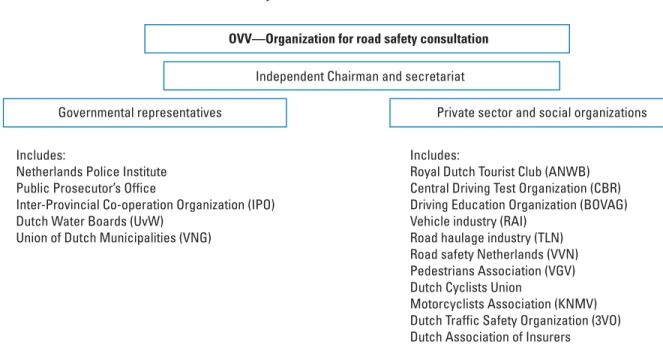
Figure 8:
Multi-sectoral structures for road safety coordination in the Netherlands (1992–2004)
Includes:
Royal Dutch Tourist Club (ANWB) Central Driving Test Organization (CBR) Driving Education Organization (BOVAG) Vehicle industry (RAI)
Road haulage industry (TLN) Road safety Netherlands (VVN) Pedestrians Association (VGV) Dutch Cyclists Union
Motorcyclists Association (KNMV) Dutch Traffic Safety Organization (3VO) Dutch Association of Insurers Includes:
Netherlands Police Institute Public Prosecutor’s Office
Inter-Provincial Co-operation Organization (IPO) Dutch Water Boards (UvW)
Union of Dutch Municipalities (VNG)
OVV—Organization for road safety consultation Independent Chairman and secretariat
The road authority as lead agency
A third lead agency model is the road authority, where
powers for day to day road safety management have been
delegated by a government Ministry.
Examples from Sweden and Australia are presented.
Example A
Swedish Road Administration
14,15,16,17While the Ministry of Industry, Employment and
Commu-nications has legal responsibility for road safety in
Swe-den, the Swedish Road Administration (SRA) is the
na-tional authority assigned the overall sectoral responsibility
for the entire road transport system, and the SRA is the
lead agency for road safety management.
Road safety in Sweden is a shared responsibility at the
gov-ernmental level between the European Union (which has
had key responsibilities in areas such as vehicle safety and
driver licensing) and national and local governments. Road
safety is pursued within a total transport context
character-ized by the demand for integrated service delivery that
meets the multiple goals of sustainable development.
A summary of the institutional management functions
car-ried out by the SRA is presented in Box 4.
3A more detailed
review is presented in the in-depth case study in Annex 4.
The aggregate and organizational structures of the lead
agency for road safety in Sweden, as well as its
coordina-tion structure, are set out in Figures 9–11.
Since road safety is integrated into road transport policy,
Swedish organization is complex. The overall
responsibil-ity for road safety rests within the Journeys by Citizens
De-partment which is one of two main horizontal
Depart-ments of the Swedish Road Administration. A Traffic Safety
Director who has the central controlling function for all
road safety work is a key member of the
Director-Gen-eral’s senior management team. Road safety expertise is
located mainly within the Society and Traffic Department
of the Administration. The operational activity is mostly
conducted by the seven regional offices.
SRA’s road safety responsibilities are set out in a 1998
pol-icy statement (see Box 5).
The Cabinet supported by the Ministry of Industry,
Em-ployment and Communications and SRA is at the top of
the national decision-making hierarchy.
Three organizational entities deal with the coordination
of interventions, each having their own small secretariat
situated within the SRA. These are:
• the SRA’s Director General’s
Advisory Council on Road
Safety
which is a high level group of 7 governmental
and non-governmental partners and stakeholders which
meets twice a year. It was set up as an advisory group
to the Director-General with members invited on an
in-dividual basis;
• the
National Coordination Assembly
(NCA) has eight
members (Ministry of Enterprise, Energy and
Commu-nications, Swedish Association of Local Authorities and
Regions, National Society for Road Safety, National
Po-lice Board, Swedish Work Environment Authority,
Folk-sam, Toyota Sweden AB, Swedish Road Administration).
It brings together 15–20 people and meets 6 times a
year. The aim is ‘to share knowledge and coordinate the
activities of key players with the intention of making
Vi-sion Zero
a reality.’ A NCA steering group acts as a
ref-erence group for proposals for the new interim target;
• the
National Road Safety Assembly
(started in 2002
at the instruction of the Ministry of Industry,
Employ-ment and Communications) brings together a very
broad group of partners and stakeholders (about 40
members with road user and transport industry
stake-holders being prominent) at national (three meetings a
year) and regional levels. The Assembly works in
spe-cific areas—speed, drinking and driving, seat belt use,
children and young people in traffic and two-wheeled
motor vehicle crashes—and reports over 3000
individ-ual activities.
There is also coordination with European partners as
Sweden is a member of the European Union and UN ECE
which determine international vehicle safety standards. At
EU level, the SRA, as an agent of the Ministry, contributes
to the European Commission’s
High Level Working Group
on Road Safety
and its sub-groups and
the Motor Vehicles
3Some of the SRA’s institutional management functions are being
trans-ferred to a new Swedish Transport Agency which was established in Janu-ary 2009. In late 2008, a new road safety strategy department comprising 20 people was established in the Society and Traffic Department.
Results focus: The Swedish Road Administration (SRA) is the accountable lead agency for road safety in Sweden. It has the main responsibility in Sweden for managing the country results focus, reviewing performance, proposing goals and targets and carrying out interventions in the road network. The SRA developed and leadsVision Zero and is responsible for the achievement of national targets underpinned by a performance agreement with the Ministry of Industry, Employment and Communications. Coordination: The SRA established, chairs, manages and pro-vides a dedicated in-house secretariat for each of the three con-sultative bodies which engage governmental partners in road safety as well as other key stakeholders in addressingVision Zero and national targets. These bodies aim to share knowledge, discuss interventions and stimulate stakeholder contributions rather than act as decision-making bodies at the national level. The SRA also ensures that there is vertical coordination between governmental bodies and funds tools for use by regional and local authorities, as well as specific road safety outputs. In recent years it has expanded its external partnership capacity to deliver the challengingVision Zero concept and has developed effective road safety partnerships individually and through its consulta-tion bodies with a wide range of professional, research, non-governmental, user and industry groups. It seeks to ensure stake-holder accountability through its OLA process which involves the use of Declarations of Intent.
Legislation: The SRA has established a comprehensive legisla-tive framework which has evolved over the years. It proposes vehicle, roads and road user rules and standards, some of which are identified and agreed at EU level, with inspection and com-pliance carried out by departmental agencies and the police. The SRA has established in-house capacity to propose, ensure compliance with and monitor road safety standards for vehicles, roads and people as well as to provide policy advice. It estab-lishes Commissions of Enquiry when developing and consolidat-ing major primary legislation.
Funding and resource allocation: The SRA ensures sustainable annual funding for road safety from general tax revenues which it allocates to its agencies through annual agreements and trans-port plans in suptrans-port ofVision Zero interventions. It has used ring-fenced funding on a regional basis to encourage local road safety engineering activity andVision Zero demonstration projects as well as directly funding some police outputs to achieve results.
Procedures are established for cost-benefit analysis to identify priorities for infrastructure road safety spending. However, esti-mates of the value of preventing death and serious injury are not made annually, nor is cost-benefit or cost-effectiveness analysis used widely in resource allocation for safety work in the public sector.
Promotion: The SRA promotes the shared responsibility for road safety called for by theVision Zero strategy. Ministers and Par-liamentarians played a key role in launching and promoting Vi-sion Zero. The SRA coordinates multi-sectoral promotion and contracts out the dissemination of targeted road safety informa-tion which recently has been directed more to organizainforma-tional partners and stakeholders than the general public. It helped to set up, chairs and supports the European New Car Assessment Programme which promotes vehicle safety. The SRA also pro-motes the need to achieve road safety results to local and re-gional levels of government.
Monitoring and evaluation: Sweden has a long tradition in the monitoring and evaluation of road safety. This is carried out com-prehensively by the lead agency (at national and regional levels), the Swedish Institute for Transport and Communications Analy-sis (SIKA), the Road Traffic Inspectorate (since 2003), research organizations, the municipalities and independent national and international experts. The SRA and its partners have established databases to identify and monitor final and intermediate out-comes against targets and the results are published annually. Safety rating programs are used to monitor aspects of vehicle fleet and road network safety respectively. The SRA established the Road Traffic Inspectorate to help monitor road safety per-formance and the effectiveness of partner and stakeholder activity. In 2007–8 the SRA commissioned and published an independent road safety management capacity review using the World Bank’s assessment framework.
Research and development and knowledge transfer: Sweden has a long and internationally recognized tradition in road safety research which has had a major impact on policy and results. The SRA has ensured secured funding and capacity for road safety research and knowledge transfer. It supports attendance of its personnel at international road safety meetings, seminars, workshops and field visits. The SRA and its partners have devel-oped and disseminated good practice guidelines on road safety. The SRA also fundsVision Zero demonstration projects.
Figure 10:
Organizational structure and processes of the Society and Traffic Department of the Swedish Road
Administration (2006)
Design and road and streets
Road technology Systems development (2) Road users
Society and Traffic Department Market
Society Technology Information technology Traffic
Intelligent Transport Systems
Transport and market analyses
Bridge and tunnel technology
Basic information
Public and commercial road
Societal processes Operations and
environment
Basic platform
Common tools Road traffic
Traffic and driver licenses
Basis for planning Vehicle technology System development (1)
Figure 9:
Aggregate structure of the lead agency for road safety in Sweden (2005)
Swedish Road Administration (SRA)
Lead Directorate responsible for road safety management Director of Traffic Safety
Journeys by Citizens Department Society and Traffic Department 7 Regional Offices
Road Traffic Inspectorate is a Division of SRA but independent of the rest of the SRA organization.
Fee-financed traffic registry and driving test centres. Roadside vehicle and driver checks are contracted out to police and vehicle inspectors
Ministry of Industry, Employment and Communications
Ministry of Justice, National Police Board Local and regional authorities—local roads Swedish Motor Vehicle Inspection Company—periodic vehicle inspection Road Traffic Injuries Commission— crash data
National Road Safety Assembly— stakeholder partnerships
Ministry of Education, National Agency for Education—schools
Office of the Prosecutor General—courts
European Union, UN ECE—e.g., vehicle standards
European New Car and Road Assessment Programmes—consumer information Inter-governmental coordination
National Coordination Assembly—national National Road Safety Assembly—national High Level Group on Road Safety—European Union
European Conference of Ministers of Transport—43 European countries
Figure 11:
Multi-sectoral coordination arrangements for road safety in Sweden (2008)
17Ministry of Industry, Employment and Communications
National Road Safety Assembly
Broad range of stakeholders Also regional and local assemblies Chaired by SRA with an SRA secretariat
National Coordination Assembly (NCA) Ministry of Enterprise, Energy and
Communications
Swedish Association of Local Authorities and Regions
National Society for Road Safety National Police Board
Swedish Work Environment Authority Folksam
Toyota Sweden AB
Swedish Road Administration
European coordination
European Union—High-Level Group on Road Safety and sub-groups, Motor Vehicle Working Group
UN ECE Working groups (e.g., WP 29 on vehicle standards)
Euro NCAP and EuroRAP ECMT (now ITF) Swedish Road Administration
SRA’s Director General’sAdvisory Council on Road Safety
• ‘The Swedish Road Administration has been commissioned with the overall responsibility for road safety within the road transport system. Every head of division is responsible for the effect his/her area of responsibility has on road safety. Road safety endeavors shall be conducted as an integral part of other operations.
• In its capacity as the central administrative agency responsible for the entire road transport system, the Swedish Road Admin-istration has been commissioned with the overall responsibility for road safety within the road transport system and shall mon-itor and actively promote developments within this area. This also means an obligation to endeavour to improve the transport system as a whole as required by road safety considerations. • In its capacity as road manager the Swedish Road
Administra-tion is responsible for road safety on the state road network. Included in this responsibility is that the construction and main-tenance works contracted by the Swedish National Road Ad-ministration shall be subjected to stringent environmental de-mands and that the Administration shall encourage contractors
• The Director-General is ultimately responsible to the Board of Directors for ensuring that road safety is taken into consid-eration within all areas of opconsid-eration at the Swedish Road Administration.
• Every head of division is to ensure that road safety is taken into consideration within his/her area of responsibility. He/she shall also endeavour to ensure that fellow colleagues increase their awareness and knowledge about the impact of their own ac-tivities and that of the entire road transport system on road safety. It is also incumbent on him/her to set the style and through his/her leadership strive to increase road safety awareness. This obligation also includes ensuring adherence to this policy.
• Every employee at the Swedish Road Administration shall be familiar with the road safety policy and work according to its intentions.
• All employees are expected to set a good example through re-specting traffic rules and otherwise exhibiting good conduct in traffic, both during and outside working hours.
Results focus: VicRoads (the Victoria Road Corporation) is the lead agency for road safety in the State of Victoria. It leads the management of the state’s focus on achieving road safety re-sults and works to ensure that system-wide interventions are agreed and implemented by the responsible authorities across government and wider society. VicRoads works with aSafe Sys-tem approach adopted by government. It has established a re-sults management framework for appraising performance and identifying what could be achieved in the medium term, and leads the development and delivery of safety strategies and ac-tion plans agreed within its high level coordinating body. This strategy includes interim targets for deaths and serious injuries as well as institutional outputs for policing activity. VicRoads’ re-sponsibility for the achievement of state road safety targets is underpinned by a performance agreement with the Minister of Transport. It is also annually accountable for a range of out-puts associated with the safe planning, construction, and opera-tion of state roads. Accountability is established by the main governmental partners who, at the highest level, sign up to a published strategy with quantitative targets. VicRoads has es-tablished appropriate in-house capacity for road safety strategy development and its coordination.
Coordination: VicRoads manages a system of multi-sectoral coor-dination to engage all key players with governmental responsibil-ities in road safety as well as other key players in the state road safety strategy. It has established strong delivery partnerships for the strategy and key interventions with Victoria Police, the Trans-port Accident Commission (the government insurance organiza-tion) and the Department of Justice. VicRoads provides in-house capacity for the secretariat of the coordination hierarchy and its committees. It establishes tools and programs for use by regional and local authorities and develops and supports community pro-grams and partnerships (Saferoads) at the local level. VicRoads engages actively with the Parliamentary Road Safety Committee and the research, business and non-governmental sectors. Legislation: VicRoads has built in-house capacity to help set, en-sure compliance with, and monitor road safety standards for ve-hicles, roads and people, as well as to provide policy advice. Its road safety department plays a major role in developing and con-solidating primary road safety legislation. VicRoads provides a Business Impact Assessment for legislative proposals to
Cabi-net, and Regulatory Impact Statements (published for comment) are required for new regulations. It also uses its coordination hi-erarchy to find legislative slots for road safety and for consulta-tion on proposals for legislative change.
Funding and resource allocation: The principal sources of fund-ing for road safety in Victoria are state government fundfund-ing, some national government funding, and revenues raised from the compulsory state injury reduction insurance scheme admin-istered by the TAC and from speed and red light cameras. A road safety levy was originally set at 3% of the injury insurance pre-mium and the current level is 10%. VicRoads reviews periodically the value of preventing road traffic deaths and serious injuries to allow a strong business case to be made for expenditure on road safety. It provides in-house lead agency capacity to evaluate safety costs and benefits, estimate program funding needs and prepare related business cases.
Monitoring and evaluation: Monitoring of the road safety strat-egy is VicRoads responsibility and performance reviews are dis-cussed within the coordination hierarchy. VicRoads and other governmental partners have established roads authority, insur-ance and health sector databases to identify and monitor final and intermediate outcomes and outputs against targets. VicRoads establishes and publishes the socio-economic cost of road traffic injuries on a periodic basis. It manages the vehicle and driver registries, carries out travel surveys and participates in the Australasian New Car Assessment Programme to assist the monitoring of vehicle fleet safety. VicRoads reports annually on road safety performance to parliament.
Research and development and knowledge transfer: VicRoads has ensured the establishment of a comprehensive state-wide capacity for road safety research and knowledge transfer and, with its partners, assigns annual budgets for road safety exter-nal research. It ensures in-house capacity for road safety re-search management. VicRoads and its partners align rere-search provision to strategy needs. VicRoads makes provision for train-ing and professional exchange programs. It also supports the production and dissemination of good practice guidelines, as well as demonstration projects. VicRoads plays a role in interna-tional development responses and runs an internainterna-tional road safety training course.
Box 6:
Summary of VicRoads delivery of institutional management functions, Victoria
Example B
VicRoad
18,19,20,21,22,23VicRoads (the Victoria Road Corporation) is the lead agency
for road safety in the State of Victoria, Australia. VicRoads
was formed in 1989 during a period of corporatization
of government services. Road safety is one of its four
core businesses and VicRoads has responsibility for leading
the preparation and delivery of the State road safety
pro-gram, and final outcome targets. Its Chief Executive has
road crash death and injury as a formal criterion in the
performance-driven employment remuneration package.
A summary of the institutional management functions
car-ried out by VicRoads is presented in Box 6. A more detailed
review is presented in the in-depth case study in Annex 4.
VicRoads works closely in a tri-partite partnership with the
Transport Accident Commission, Victoria Police
(Depart-ment of Justice), who play a major role and whose
Minis-ters have also signed up to the national road safety strategy.
The aggregate and organizational structures of the lead
agency for road safety in Victoria, as well as its
coordina-tion structure, are set out in Figures 12–14.
VicRoads has a dedicated road safety department with 55
staff. The department comprises a broad range of policy
units covering the safety of different elements of the road
traffic system (see Figure 13). The size of the strategy and
programs unit reflects the substantial program
develop-ment role of VicRoads as well as its multi-sectoral
coordi-nation role.
Figure 12:
Aggregate structure of the lead agency for road safety in Victoria, Australia (2005)
Agency of the State Department of InfrastructureTransport Accident Commission (TAC)— State insurer, funding, data, promotion Victoria Police—enforcement, crash reporting and investigation, community
Department of Justice—for legislation, courts, policing policy
Federal Government—national road safety strategy and vehicle standards
Department of Education—road user education Department for Human Services—trauma care Local and regional authories—roads
Australian New Car and Road Assessment
Programmes—vehicle and network safety monitoring Coordination and decision-making hierarchy
Victoria has a structured decision-making hierarchy of multi-sectoral Committees and working groups to deliver the national road safety strategy
VicRoads
Lead agency responsible for road safety management Road safety is one of 4 core businesses:
Road system management Traffic and transport integration Road safety
Registration and licensing
Figure 13:
Organizational structure of VicRoads’ road safety department (2005)
Vehicle safety marketingStrategic Communications
Vehicle standards
Vehicle roadworthiness
Coordination and Information management Communication and community programs Vehicle safety
Vulnerable road users Road user behavior
Figure 14:
Multi-sectoral structures for road safety coordination in Victoria, Australia (2005)
Ministerial Council for Road Safety Ministers responsible for Transport, Police and the Transport Accident Commission
Parliamentary Road Safety Committee
Reporting Direction, endorsement
Traffic Safety Education Group
Senior managers from the key agencies, Department of Education, Employment and Training and representative bodies
Road Safety Executive Group Chief Executives of VicRoads, TAC and Assistant Commissioner (Traffic) Victoria Police
National Issues
National road safety strategy and action plan
National Injury Prevention Strategy
Road Safety Reference Group Key agencies, other relevant government departments, agencies, professional and representative bodies
Local Government Authorities
23 Community Road Safety Councils
Saferoads partnership Road Safety Management Group
Representatives of VicRoads, TAC, Victoria Police, Depts. of Justice, Education and Training and Human Services group Trauma and Emergency
Services
Members of the relevant government departments and healthcare professionals responsible for the State Trauma System
䊴
䊴
The organizational structure of VicRoads and the related
coordination and decision-making hierarchy set out in
Figure 14 provided for the delivery of all seven
institu-tional management functions, under VicRoads leadership
and direction.
The
Ministerial Road Safety Council
was established in
1999 and comprises the Minister for Transport, Minister
for Police and Emergency Services and the Minister for
the Transport Accident Commission. The Council meets
four times each year and ensures the achievement of a
coordinated approach to road safety in Victoria. It has
provided a powerful voice in Cabinet for the pursuit of
road safety policies and has been critical in achieving
support across government for funding of new initiatives
as well as legislation. The Chair of that group rotates at
each meeting. The group has signed off on the five year
Arrive Alive! road safety strategy 2002–2007.
The
Road Safety Executive Group
comprises the chief
executive officers and senior road safety representatives
of these organizations which report to, support and
re-ceive direction from the Ministerial Road Safety Council.
The Group determines strategic directions, monitors
and reports progress to the government through the
Ministerial Road Safety Council. The Group meets
ap-proximately four times each year and the chair rotates
between agencies.
The
Road Safety Management Group
with
representa-tion from senior road safety officers from the four key
partners and the Departments of Education and Training
and Human Services meets monthly and the chair is
ro-tated. There are many specialist groups engaged with the
Road Safety Management Group including Education,
Local Government and Community Road Safety Councils.
There is a link to national road safety activity through a
national forum which meets twice yearly. With VicRoads
as the key focal point, the group coordinates
implemen-tation of the road safety strategy, develops and
imple-ments programs and interventions to give effect to the
strategy, reviews identified programs, identifies and
ac-tions research priorities, maintains links with the National
Road Safety Strategy, promotes a coordinated state-wide
prog