Investigating the Impact of Digital
Technologies on the Performance of
Learning in Higher Education
A thesis submitted in fulfilment of the requirements for the degree of
Doctor of Philosophy
Aaron Bere
Master of Technology: Information Technology
Cape Peninsula University of Technology
Master of Education
University of the Western Cape
School of Business Information Technology and Logistics
College of Business
RMIT University, Melbourne, Australia
October 2019
Declaration
I certify that except where due acknowledgement has been made, the work is that of the author alone; the work has not been submitted previously, in whole or in part, to qualify for any other academic award; the content of the project is the result of work which has been carried out since the official commencement date of the approved research program; any editorial work, paid or unpaid, carried out by a third party is acknowledged; and, ethics procedures and guidelines have been followed.
I acknowledge the support I have received for my research through the provision of an Australian Government Research Training Program Scholarship.
Aaron Bere 15 October 2019
I would like to express my utmost gratitude and appreciation to everyone who has contributed to the completion of this thesis. In particular, I would like to sincerely acknowledge the following people for their support and encouragement during my preparation of this thesis.
I am greatly indebted to my primary supervisor, Professor Hepu Deng for his ability to motivate, provide invaluable and timely feedback, and for being honest and constructive. Professor Deng, your help is much appreciated.
My secondary supervisor, Associate Professor Richard Tay for his ability to guide me on data analysis. Professor Tay, your support throughout the thesis is amazing.
Last but not least, my family particularly my daughter Tanya and son Taku for being my sources of motivation. Tanya and Taku, your presence keeps me going. This thesis, therefore, is dedicated to both of you.
Declaration ... i
Acknowledgement ... ii
Table of Contents ... iii
List of Publications ... vii
List of Abbreviations ... xii
List of Tables ... xiii
List of Figures ... xvii
Abstract ... xviii
Chapter 1 Introduction ... 1
1.1 Research Background ... 1
1.2 Motivation for the Research ... 4
1.3 Research Objectives and Research Questions ... 5
1.4 Research Methodologies ... 6
1.5 Structure of the Thesis ... 11
Chapter 2 Literature Review ... 15
2.1 Introduction ... 15
2.2 An Overview of Digital Learning ... 17
2.3 Digital Learning Developments in Higher Education in South Africa ... 39
2.4 Adoption of LMS and IM in Digital Learning ... 44
3.1 Introduction ... 65
3.2 Research Hypotheses ... 66
3.3 Concluding Remarks ... 84
Chapter 4 Research Methodology ... 85
4.1 Introduction ... 85
4.2 Research Paradigms ... 87
4.3 Research Methodologies ... 93
4.4 Research Design ... 95
4.5 Data Analysis Techniques ... 116
4.6 Concluding Remarks ... 123
Chapter 5 Instrument Development and Validation ... 124
5.1 Introduction ... 124
5.2 Development of the Research Instrument ... 126
5.3 Instrument Validation ... 135
5.4 Concluding Remarks ... 143
Chapter 6 Impact of LMS on Teaching and Learning ... 144
6.1 Introduction ... 144
6.2 Data Analysis ... 146
6.3 Research Findings and Discussion ... 170
7.1 Introduction ... 178
7.2 Data Analysis ... 180
7.3 Findings and Discussion ... 202
7.4 Concluding Remarks ... 209
Chapter 8 A Comparative Analysis ... 210
8.1 Introduction ... 210
8.2 Data Analysis ... 212
8.3 Findings and Discussion ... 227
8.4 Concluding Remarks ... 233
Chapter 9 Conclusion ... 235
9.1 Introduction ... 235
9.2 Summary of the Research Findings ... 236
9.3 Research Contributions and Implications ... 246
9.4 Limitations and Future Research ... 249
References ... 252 Appendices ... 272 Appendix 1 ... 272 Appendix 2 ... 279 Appendix 3 ... 281 Appendix 4 ... 282
International Conferences
Bere A and Mckay E (2017). Investigating the Impact of ICT Tutorial Strategies to Promote Improved Database Knowledge Acquisition. Proceedings of the 28th Australasian Conference on Information Systems, 4-6 December 2017. Hobart, Australia.
Bere A and Mckay E (2018). An Investigation of the Impact of ICT Tutorials in Transforming South African Higher Education: Application of the Rasch Model. Proceedings of the 7th International Conference on Probabilistic Models for Measurement, 17-19 January 2018. Perth, Australia.
Bere A, Deng H and Tay R (2018). Investigating the Impact of eLearning Using LMS on the Performance of Teaching and Learning in Higher Education. Proceedings of the IEEE Conference on Learning, Management and e-Services, 21 – 22 November 2018. Langkawi, Malaysia.
Bere A, Deng H and Tay R (2018). Assessing the Impact of Using Instant Messaging in eLearning on the Performance of Teaching and Learning in Higher Education. Proceedings of the 29th Australasian Conference on Information Systems, 3-5 December 2018. Sydney, Australia.
Contribution
Bere A and Mckay E (2017). Investigating the Impact of ICT Tutorial Strategies to Promote Improved Database Knowledge Acquisition. Proceedings of the 28th Australasian Conference on Information Systems, 4-6 December 2017. Hobart, Australia.
Nature of the Candidate’s Contribution Including the Percentage of the Total
The candidate has involved in designing the research through conducting a review of the related literature, designing the research instrument, collecting the data and analysing the data and writing up the paper for publication. The percentage of the total contribution is at 70%
Nature of the Co-Authors’ Contribution Including the Percentage of the Total
The co-author is my supervisor. Her contribution is on guiding the implementation of the research through discussion and rewriting the draft in preparing the paper for publication. Their percentage contribution is at 30%.
Candidate’s Declaration
I declare that the publication above meets the requirements to be included in the thesis as outlined in the Research Higher Degree Thesis Policy and Procedure.
15-10-2019
Contribution
Bere A and Mckay E (2018). An Investigation of the Impact of ICT Tutorials in Transforming South African Higher Education: Application of the Rasch Model. Proceedings of the 7th International Conference on Probabilistic Models for Measurement, 17-19 January 2018. Perth, Australia.
Nature of the Candidate’s Contribution Including the Percentage of the Total
The candidate has involved in designing the research through conducting a review of the related literature, designing the research instrument, collecting the data and analysing the data and writing up the paper for publication. The percentage of the total contribution is at 70%
Nature of the Co-Authors’ Contribution Including the Percentage of the Total
The co-author is my supervisor. Her contribution is on guiding the implementation of the research through discussion and rewriting the draft in preparing the paper for publication. Their percentage contribution is at 30%.
Candidate’s Declaration
I declare that the publication above meets the requirements to be included in the thesis as outlined in the Research Higher Degree Thesis Policy and Procedure.
15-10-2019
Contribution
Bere A, Deng H and Tay R (2018). Investigating the Impact of eLearning Using LMS on the Performance of Teaching and Learning in Higher Education. Proceedings of the IEEE Conference on Learning, Management and e-Services, 21 – 22 November 2018. Langkawi, Malaysia.
Nature of the Candidate’s Contribution Including the Percentage of the Total
The candidate has involved in designing the research through conducting a review of the related literature, designing the research instrument, collecting the data and analysing the data and writing up the paper for publication. The percentage of the total contribution is at 60%
Nature of the Co-Authors’ Contribution Including the Percentage of the Total
The two co-authors are my supervisors. Their contribution is on guiding the implementation of the research through discussion and rewriting the draft in preparing the paper for publication. Their percentage contribution is at 40%.
Candidate’s Declaration
I declare that the publication above meets the requirements to be included in the thesis as outlined in the Research Higher Degree Thesis Policy and Procedure.
15-10-2019
Contribution
Bere A, Deng, H and Tay R (2018). Assessing the Impact of Using Instant Messaging in eLearning on the Performance of Teaching and Learning in Higher Education. Proceedings of the 29th Australasian Conference on Information Systems, 3-5 December 2018. Sydney, Australia.
Nature of the Candidate’s Contribution Including the Percentage of the Total
The candidate has involved in designing the research through conducting a review of the related literature, designing the research instrument, collecting the data and analysing the data and writing up the paper for publication. The percentage of the total contribution is at 60%
Nature of the Co-Authors’ Contribution Including the Percentage of the Total
The two co-authors are my supervisors. Their contribution is on guiding the implementation of the research through discussion and rewriting the draft in preparing the paper for publication. Their percentage contribution is at 40%.
Candidate’s Declaration
I declare that the publication above meets the requirements to be included in the thesis as outlined in the Research Higher Degree Thesis Policy and Procedure.
15-10-2019
ANOVA Analysis of variance
BI Behavioural intentions
CPUT Cape Peninsula University of Technology CUT Central University of Technology
CSA Cognitive skills analysis
F2F Face-to-face
GDP Gross domestic products
HTML HyperText Markup language
IRT Rasch item response
ICT Information communications technologies
IM Instant messaging
IT Information technology
LMS Learner management system
Obs Observation
PEOU Perceived ease of use
PU Perceived usefulness
SEM Structural equation modelling
SN Social norm
SQL Structured query language
TELI Technology-enhanced learning investigation
TV Television
TABLE 2.1 AN OVERVIEW OF DIGITAL LEARNING ... 20
TABLE 2.2 AN OVERVIEW OF THE BENEFITS AND CHALLENGES OF DIGITAL LEARNING ... 23
TABLE 2.3 ACOMPARATIVE ANALYSIS BETWEEN WEB 1.0 AND WEB 2.0 ... 31
TABLE 2.4 ASUMMARY OF DIGITAL LEARNING DEVELOPMENT ... 34
Table 2. 5 ASUMMARY OF LMS AND IMCOMPARISON ... 39
TABLE 2.6 AN OVERVIEW OF THE STUDIES FROM THE USER PERCEPTION ... 39
TABLE 2.7 AN OVERVIEW OF THE STUDIES FROM THE DIGITAL TECHNOLOGY AFFORDANCE PERSPECTIVES ... 39
TABLE 2.8 AN OVERVIEW OF THE STUDIES FROM THE TEACHING AND LEARNING AFFORDANCE PERSPECTIVE ... 39
TABLE 2.9 AN OVERVIEW OF THE STUDIES FROM THE TEACHING AND LEARNING PERFORMANCE PERSPECTIVE ... 39
TABLE 2.10 AN OVERVIEW OF THE STUDIES FROM THE PERFORMANCE OF TEACHING AND IN SOUTH AFRICA ... 39
TABLE 4.1 AN OVERVIEW OF RESEARCH PARADIGMS ... 92
TABLE 4.2 STATISTIC GROUP COMPARISON EXPERIMENT DESIGN ... 97
TABLE 4.3 CONTROL GROUP PRE-TEST POST-TEST EXPERIMENT DESIGN ... 98
TABLE 4.4 SOLOMON FOUR-GROUP EXPERIMENT DESIGN ... 99
TABLE 4.5 QUASI-EXPERIMENT DESIGN ... 99
TABLE 4.6 FACTORIAL EXPERIMENT DESIGN ... 100
TABLE 4.9 RACE DISTRIBUTION OF PARTICIPANTS ... 113
TABLE 4.10 LANGUAGE DISTRIBUTION OF PARTICIPANTS... 114
TABLE 4.11 AGE DISTRIBUTION OF PARTICIPANTS... 115
TABLE 5.1 INSTRUCTIONAL MATRIX FOR A TASK ... 132
TABLE 5.2 A REWORDED DICHOTOMOUS TEST-ITEM ... 134
TABLE 5.3 PILOT STUDY PARTICIPANT POPULATION DISTRIBUTION ... 136
TABLE 5.4 ITEM ANALYSIS RESULTS FOR PRE-TEST TEST-ITEM 9 ... 138
TABLE 5.5 ITEM ANALYSIS RESULTS FOR PRE-TEST TEST-ITEM 33 ... 139
TABLE 5.6 PILOT STUDY PRE-TEST VALIDATION RESULTS ... 140
TABLE 5.7 ITEM ANALYSIS RESULTS FOR PRE-TEST TEST-ITEM 9 ... 138
TABLE 5.8 PILOT STUDY POST-TEST VALIDATION ... 138
TABLE 6.1 MEASURE OF CENTRAL TENDENCY FOR LMSGROUP... 1488
TABLE 6.2 MEASURE OF THE VARIABILITY IN LMSGROUP ... 149
TABLE 6.3 PAIRED SAMPLES T-TEST IN LMSGROUP ... 150
TABLE 6.4 MEAN OF LMSGROUP SCORES BY GENDER ... 151
TABLE 6.5 STANDARD DEVIATIONS OF LMSGROUP SCORES BY GENDER ... 153
TABLE 6.6 REGRESSION OF LMSGROUP SCORES BY GENDER ... 154
TABLE 6.7 MEAN OF LMSGROUP SCORES BY LANGUAGE ... 156
TABLE 6.8 STANDARD DEVIATIONS OF LMSGROUP SCORES BY LANGUAGE .... 159
TABLE 6.9 REGRESSION OF LMSGROUP SCORES BY LANGUAGE ... 160
TABLE 6.10 MEAN OF LMSGROUP SCORES BY RACE ... 161
TABLE 6.11 STANDARD DEVIATIONS OF LMSGROUP SCORES BY RACE ... 164
TABLE 6.15 REGRESSION OF LMSGROUP SCORES BY AGE ... 1700
TABLE 7.1 MEAN OF IMGROUP SCORES ... 180
TABLE 7.2 STANDARD DEVIATION OF IMGROUP SCORES ... 181
TABLE 7.3 CORRELATION BETWEEN IMPRE-TEST AND POST-TEST SCORES ... 182
TABLE 7.4 MEAN OF IMGROUP SCORES BY GENDER ... 183
TABLE 7.5 STANDARD DEVIATIONS OF IMGROUP SCORES BY GENDER ... 185
TABLE 7.6 REGRESSION OF IMGROUP SCORES BY GENDER ... 185
TABLE 7.7 MEAN OF IMGROUP SCORES BY LANGUAGE ... 187
TABLE 7.8 STANDARD DEVIATIONS OF IMGROUP SCORES BY LANGUAGE ... 190
TABLE 7.9 REGRESSION OF IMGROUP SCORES BY LANGUAGE ... 191
TABLE 7.10 MEAN OF IMGROUP SCORES BY RACE ... 1922
TABLE 7.11 STANDARD DEVIATIONS OF IMGROUP SCORES BY RACE ... 195
TABLE 7.12 REGRESSION OF IMGROUP SCORES BY RACE ... 196
TABLE 7.13 MEAN OF IMGROUP SCORES BY AGE ... 197
TABLE 7.14 STANDARD DEVIATIONS OF IMGROUP SCORES BY AGE ... 200
TABLE 7.15 REGRESSION OF IMGROUP SCORES BY AGE ... 201
TABLE 8.1 MEAN OF SCORES BY GROUPS ... 213
TABLE 8.2 STANDARD DEVIATION OF SCORES BY GROUPS ... 215
TABLE 8.3 CORRELATION BETWEEN PRE-TEST AND POST-TEST SCORES ... 215
TABLE 8.4 TEST SCORES FOR LMS AND F2F ... 219
TABLE 8.5 COMPARATIVE ANALYSIS BETWEEN LMS AND F2F ... 220
TABLE 8.6 SUMMARY STATISTICS OF IM AND F2F... 222
FIGURE 1.1 AN OVERVIEW OF THE RESEARCH PROCESS ... 10
FIGURE 1.2 AN OVERVIEW OF THE THESIS ... 12
Figure 2. 1 An Overview of Digital Learning Development ... 24
FIGURE 4.1 AN OVERVIEW OF THE CSA QUADRANTS ... 102
FIGURE 4.2 AN OVERVIEW OF THE RESEARCH PROCEDURE ... 105
FIGURE 5.1 THE SURVEY INSTRUMENT DEVELOPMENT CYCLE ... 127
FIGURE 5.2 TASK ANALYSIS FOR SQLQUERY DEVELOPMENT ... 129
FIGURE 5.3 LEARNING HIERARCHY FOR SQLDEVELOPMENT SKILLS ... 130
FIGURE 5.4 ITEM FIT MAP FOR PILOT STUDY PRE-TEST RUN-1 ... 137
The central theme of blended learning is to draw from the best practices of digital learning and face-to-face (F2F) learning to create a cohesive learning experience for improving the performance of learning. Blended learning is becoming increasingly popular across the world because of the benefits it can bring including easy and quick access to learning resources, timely feedback to students, better collaboration, and improved flexible and personalised learning. As a result, many higher education institutions across the world have introduced blended learning.
Following the global trend, South Africa has been actively pursuing the development of blended learning in higher education. This leads to the passing of the e-Education policy with specific objectives for improving the development of digital learning in higher education. Despite these efforts, the adoption of digital technologies in higher education in South Africa is unsatisfactory. The performance of individual students in teaching and learning in higher education is deteriorating. This shows the need for better understanding the impact of specific digital technologies in blended learning on the performance of learning in South African higher education.
The objective of this research is to investigate the adoption of specific digital technologies in South African higher education for better understanding the effectiveness of these technologies on the performance of learning. Specifically, this research aims to (a) investigate the impact of learning management system (LMS) on the performance of learning, (b) explore the impact of using instant messaging (IM)
IM on the performance of learning in higher education in South Africa.
A quantitative research methodology is adopted in this study. It employs a pre-test and post-test method for assessing the performance of learning. The study uses a ‘treatment’ group of LMS + F2F and IM + F2F and a comparison group of F2F design for investigating the relationship between the use of specific digital technologies and the performance of learning in higher education. The data is collected in higher education in South Africa using paper-based surveys. Various statistical analysis techniques including descriptive statistics, t-test, and regression analysis have been used for analysing the data in the study.
The study shows that the adoption of LMS and IM has a positive impact on the performance of learning in higher education. The comparative analysis study shows that (a) digital learning using LMS and F2F teaching is more effective than traditional F2F teaching, (b) digital learning using IM and F2F is more effective than traditional F2F teaching, and (c) digital learning using LMS is slightly more effective than blended digital learning using IM on the performance of learning in higher education. Such findings can help to better understand the adoption of specific digital technologies in higher education in South Africa.
This study contributes to the digital learning research from both theoretical and practical perspectives. Theoretically, this study (a) explores the impact of specific digital technologies including LMS and IM on the performance of learning, (b) investigates the effect of student characteristics on the performance of learning using
technologies in blended learning on the performance of learning in higher education. This study is the first of its kind that conducts a comparative analysis of specific digital technologies on the performance of learning in higher education.
Practically, this study provides empirical evidence on the effectiveness of LMS and IM for improving learning. Based on the results of this study, existing policies to encourage the adoption of digital technologies should be supported and strengthened. This study can thus (a) help government departments develop specific policies and strategies for adopting specific digital technologies in order to improve the performance of learning, (b) provide South African higher education institutions with guidelines for facilitating the adoption of digital technologies, and (c) challenges LMS and IM instructional developers and software developers for the continuous development of effective digital technologies for teaching and learning.
Chapter 1
Introduction
1.1
Research Background
Advancements in digital technologies have been transforming education and training from the traditional model to the electronic mode in higher education across the world (Dias et al., 2014, Sek et al., 2016). This is due to the benefits that digital technologies can bring to teaching and learning, including the provision of opportunities to support easy and quick access to learning resources, the availability of timely feedback to students, the support of anywhere and anytime learning, and the enhancement of students’ participation in teaching and learning through improved interaction (Sridharan et al., 2011, Sridharan and Deng, 2014, Carter et al., 2017, Mokiwa, 2017). As a result, digital learning is becoming increasingly popular across the world (Niemi and Multisilta, 2016, Pombo et al., 2016).
There are many countries that have invested a large amount of money on digital learning through the integration of digital technologies into their education systems (Karunasena et al., 2013a, Bai et al., 2016). The Turkish government, for instance, has spent 11.7% of the national education budget on the development of various digital learning programs in higher education (Bai et al., 2016). The countries in the Gulf Cooperation Council, including Saudi Arabia, United Arab Emirates, and Qatar, have
channelled an unprecedented amount of financial resources into developing world-class digital learning systems in their higher education. In 2013, the Saudi Arabian government committed US$54 billion in the development of digital learning in higher education (UAE Government News, 2013). In the same year, the United Arab Emirates spent almost 20% of its entire budget in digital learning development in higher education. Qatar spent over US$6 billion on education, more than double its education spending between 2007 and 2012 (UAE Government News, 2013). Such investments have demonstrated the commitment of individual countries across the world at the development of digital learning in their respective higher education sectors.
In line with the global trend, the South African government has invested tremendous efforts in the development of digital learning in higher education through the implementation of specific strategies and policies (Bere et al., 2018a; 2018b). Such strategies and policies were formulated as early as in 1995 in South Africa (Vandeyar, 2015). It was followed by the adoption of the National Information communications technologies Strategy in 2001. This leads to the passing of the e-Education policy with the specific objective for improving the development of digital learning in higher education including ensuring the digital competence of all course facilitators and students by 2013 and enhancing the learning outcome of individual students through the utilisation of digital learning (Department of Education, 2004, Vandeyar, 2015, Bere et al., 2018a).
The adoption of the e-Education policy in higher education in South Africa has fundamentally transformed teaching and learning in the sector. This results in the high
proliferation of digital learning technologies and the implementation of various initiatives for the acquisition of specific skills in utilising ICT in higher education in South Africa. As a result, each public university in the country has adopted specific digital learning programs for improving their teaching and learning under various circumstances (Bagarukayo and Kalema, 2015). University staffs have been trained through attending various workshops and training courses for better integrating digital learning into teaching and learning. University curriculums have been revised for improving the adoption of digital learning in higher education (Mostert and Quinn, 2009).
Despite the widespread adoption of digital learning and the optimism about its potential for improving teaching and learning in higher education, the effectiveness of adopting digital technologies through the implementation of the e-Education policy is not impressive (Bagarukayo and Kalema, 2015, Ng'ambi et al., 2016). High rates of dropouts and failures are still common in higher education in South Africa (Council on Higher Education, 2013a, Department of Higher Education and Training, 2013). There are some studies that recognise the reasons for such poor performance, including the lack of skills in many academics in the use of digital technologies and the presence of resistance to the adoption of digital learning technologies in higher education (Awidi and Cooper, 2015, Bagarukayo and Kalema, 2015). Furthermore, there is a lack of comprehensive studies on the effectiveness of adopting digital learning technologies in higher education in South Africa (Ng'ambi et al., 2016).
The availability of emerging technologies, including mobile technologies and mobile broadband access, has further complicated the process of adopting digital technologies in higher education in South Africa. There are specific alternatives in digital learning, including learning management systems (LMS) and instant messaging (IM), that make the development of digital learning more challenging and complicated (Kim et al., 2014, Yoon et al., 2015, Bere et al., 2018a). Specific questions have been raised about
the use of these technologies in digital learning in the context of higher education in
South Africa, including which technologies are more effective for improving the performance of learning in higher education. To adequately address these concerns,
this study aims to investigate the adoption of specific digital learning technologies in
higher education in South Africa for better understanding the effectiveness of these technologies on the performance of learning.
1.2
Motivation for the Research
The motivation to undertake this research is due to three reasons. Firstly, there is a lack of studies that investigate the effectiveness of digital technologies on the performance of learning in higher education (Islam, 2016). Existing studies try to address this issue primarily from the perspective of user perceptions through behavioural intentions to accept and use digital learning technologies in higher education (Sridharan et al., 2010, Alsabawy et al., 2016, Sek et al., 2016, Yakubu and Dasuki, 2018b). These studies explore various user perceptions that influence student behavioural intentions with respect to specific theoretical backgrounds under various circumstances. The effectiveness of digital technologies on the performance of learning has been ignored.
Secondly, there is a lack of comparative studies in investigating the impact of specific digital technologies, including LMS and IM, on the performance of learning in higher education. Existing studies attempt to explore the performance of learning by investigating the effectiveness of a single digital learning technology under specific situations (Parkes et al., 2013, Hwang et al., 2015). Such studies do not provide sufficient understanding of the effectiveness of alternative digital learning technologies in teaching and learning in higher education.
Thirdly, there is a lack of studies focusing on the effectiveness of specific digital technologies including LMS and IM in higher education in South Africa (Ng'ambi et al., 2016). Existing studies investigate the effectiveness of digital learning in general rather than focusing on specific technologies (Huang et al., 2011, Mohammadi, 2015). Since digital learning is evolving, studies that attempt to address the opportunities associated with the use of specific technologies should be encouraged (Ng'ambi et al., 2016).
1.3
Research Objectives and Research Questions
The objective of this research is to investigate the adoption of specific digital technologies in higher education in South Africa for better understanding the effectiveness of these technologies on the performance of learning. Specifically, the research aims to (a) investigate the impact of LMS on the performance of learning, (b) explore the impact of IM on the performance of learning, and (c) examine the relative
effectiveness of LMS and IM on the performance of learning in higher education in South Africa.
To achieve these research objectives, the main research question for the study is formulated as follows:
How effective are specific digital technologies including LMS and IM on the performance of learning in higher education in South Africa?
To answer this research question, several subsidiary questions are developed as follows:
(a) How effective is LMS on the performance of learning in higher education in South Africa?
(b) How effective is IM on the performance of learning in higher education in South Africa? and
(c) What is the relative effectiveness of LMS and IM on the performance of learning in higher education in South Africa?
1.4
Research Methodologies
The objective of this research is to investigate the impact of digital technologies including LMS and IM on the performance of learning in higher education in South Africa. To achieve the objective of the study, a quantitative research methodology is adopted (Williamson and Johanson, 2013, Leedy and Ormrod, 2015, Chen et al.,
2019). A quantitative research methodology is usually used for examining a research problem by deductively forming specific hypotheses based on relevant theories in a given situation. Such hypotheses are then tested and validated for answering the research question (Creswell and Creswell, 2017, Leedy and Ormrod, 2019). Specifically, a quantitative research methodology helps to determine whether a specific hypothesis should be rejected or not based on the numeric data collected (Deng et al., 2018; Cui et al., 2019).
A quantitative research methodology is suitable for meeting the objective of this research due to three reasons. First, each step for collecting and analysing data in the adoption of a quantitative methodology in a study is standardised. Such standardisation reduces bias in a study (Leavy, 2017). Second, the findings obtained from the use of a quantitative research methodology can be generalised to a large population (AlKalbani et al., 2016, Creswell and Creswell, 2017). Third, the adoption of a quantitative research methodology allows the relationship between various variables to be examined in a quantitative manner. This facilitates determining the cause and effect relationship between these variables in the study. Such relationships can then be used to make predictions on the impact of specific digital technologies including LMS and IM on the performance of learning in higher education.
A quantitative research methodology for this study employs a pre-test and post-test ‘treatment’ and comparison group true experimental design. True experimental design is suitable for investigating the cause and effect relationship between the use of specific digital technologies and the performance of learning in higher education
(Williamson and Johanson, 2013). This is because a pre-test and post-test ‘treatment’ and comparison group true-experimental design can help determine whether an improvement in the performance of learning has taken place or not due to the adoption of specific digital technologies including LMS and IM. Such an experimental design can control confounding variables. As a result, there is a reasonable basis for drawing a conclusion about the cause and effect relationship in this study (Leedy and Ormrod, 2019).
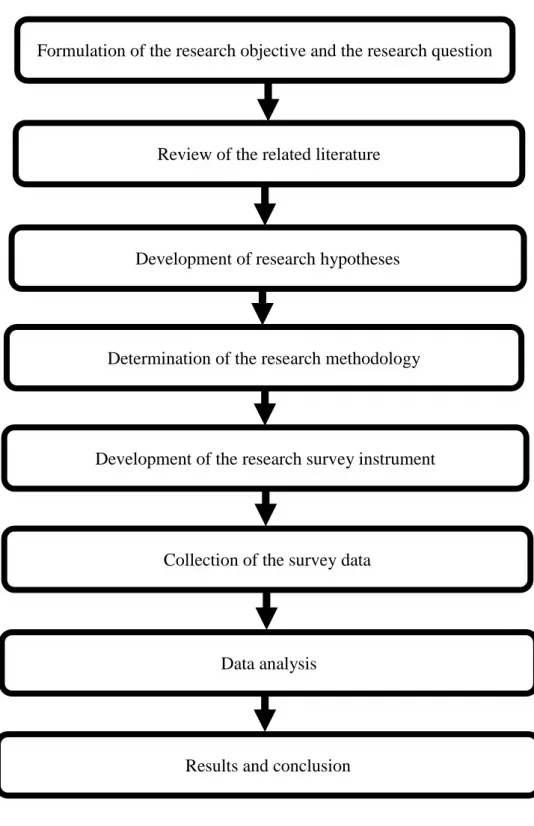
As shown in Figure 1.1, this study follows eight stages to fulfil the objective of the study using a quantitative research methodology. The study commences with the formulation of the research objective and the research question in the first stage. This is followed by a review of the related literature in stage two, leading to a better understanding of the relevant study in exploring the performance of learning using specific digital technologies including LMS and IM. Such understanding leads to the development of the research hypotheses for the study in stage three.
During the fourth stage, the research methodology for the research is presented. In this stage, a quantitative methodology is selected for investigating the impact of specific digital technologies on the performance of learning in higher education. This leads to the implementation of the pre-test and post-test ‘treatment’ and comparison group true experimental design in the research study.
In the fifth stage, the research survey instruments including pre-test and post-test are developed and validated for facilitating the collection of data from undergraduate
students in higher education in South Africa in the database management course. This is followed by the collection of data in stage six. The data for the study is collected from undergraduate students in South African higher education in the database management course using the developed research survey instrument.
The seventh stage presents four data analysis techniques adopted for addressing the research question in this study. First, descriptive statistics for examining whether there is an improvement in the performance of learning or not in higher education through (a) the adoption of LMS, (b) the adoption of IM, and (c) the impact of specific attributes of participants including gender, language, race, and age. This is achieved using two measures including the measure of central tendency and the measure of dispersion. Such descriptive statistics provide the initial findings with regards to the impact of specific digital technologies including LMS and IM on the performance of learning in higher education. Second, a t-test is applied for examining individual hypotheses for exploring whether the adoption of specific digital technologies including LMS and IM influences the performance of learning in higher education. The t-test is adopted because it provides a more reliable indication of the impact of specific digital technologies including LMS and IM on the performance of learning. Specifically, the paired-sample t-test is adopted. It examines the pre-test and post-test for determining the impact of specific digital technologies. Third, regression analysis is conducted for examining the impact of specific attributes of individual participants including gender, language, race, and age on the performance of learning using specific digital technologies. Fourth, the independent-sample t-test is carried out for conducting the comparative analysis in the study. Finally, the results of the data
analysis are interpreted for drawing specific conclusions in order to adequately answer the research question in stage eight.
Figure 1.1 An Overview of the Research Process
Formulation of the research objective and the research question
Review of the related literature
Development of research hypotheses
Determination of the research methodology
Development of the research survey instrument
Collection of the survey data
Data analysis
1.5
Structure of the Thesis
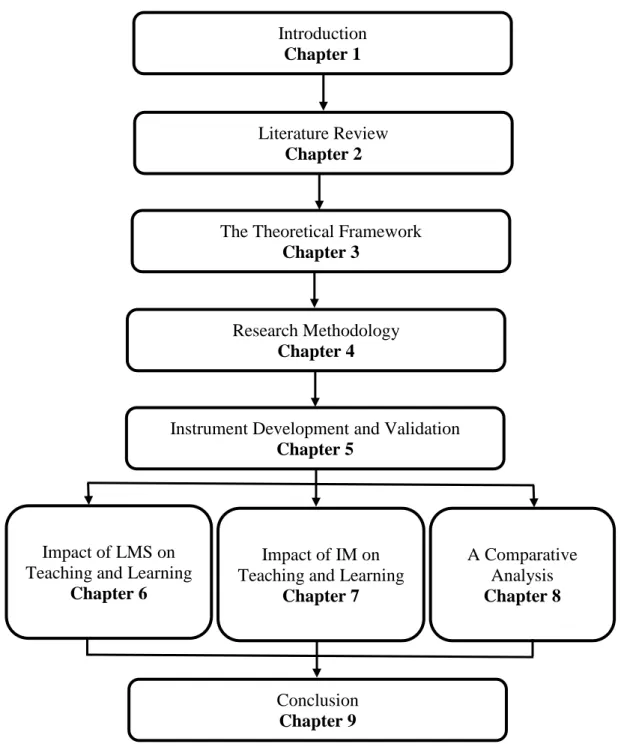
There are nine chapters in this thesis shown as in Figure 1.2. Chapter 1 presents an introduction to the study. This introduction covers various aspects including the background of the study, the motivation of the research, the research objective, the research question, and the research methodology. This provides the basis for the presentation of the entire thesis.
Chapter 2 presents a comprehensive review of the literature. Such literature is related to the development of various aspects including digital technologies in education, existing literature on digital technologies in higher education, existing literature on the performance of learning using digital technologies, the development of digital learning in South African higher education, and the adoption of specific digital technologies including LMS and IM in higher education. This leads to the identification of the limitation of existing research. As a result, the review of the related literature justifies the need for this research.
Chapter 3 provides the theoretical framework of the study. The hypotheses for investigating the impact of specific digital technologies including LMS and IM on the performance of learning in higher education in South Africa are formulated in this chapter. The formulated hypotheses pave the way for the development of the survey instrument in examining the impact of digital technologies on the performance of learning in higher education.
Figure 1.2 An Overview of the Thesis
Introduction
Chapter 1
Literature Review
Chapter 2
The Theoretical Framework
Chapter 3
Research Methodology
Chapter 4
Instrument Development and Validation
Chapter 5
Impact of IM on Teaching and Learning
Chapter 7
Impact of LMS on Teaching and Learning
Chapter 6 A Comparative Analysis Chapter 8 Conclusion Chapter 9
Chapter 4 provides a description of the research methodology that this study adopts. An outline of different research methodologies under various research paradigms is presented. How suitable a research methodology for meeting the objective of this research project is discussed. This leads to the presentation of the various quantitative data analysis techniques adopted in this research. The implementation of the data analysis process is explained. The demographics of the participant in this research is addressed in this chapter.
Chapter 5 describes the research instruments that the study develops. How these research instruments are designed to meet the objective of this study using the selected experimental design is explained. In particular, the development of the pre-test and post-test survey instruments, the process of collecting data, and the procedures for enhancing the reliability and the validity of the research instruments are explained in this chapter.
Chapter 6 presents the results from the surveys for investigating the impact of LMS on the performance of learning in higher education in South Africa. The chapter reveals how the data is analysed using descriptive statistics, regression analysis, and paired-sample t-test to better understand the impact of LMS on the performance of learning in higher education. The discussion of the research findings with regards to the impact of LMS on the performance of learning is provided.
Chapter 7 presents the results from the surveys for investigating the impact of IM on the performance of learning in higher education in South Africa. The chapter reveals
how the data is analysed using descriptive statistics, regression analysis, and paired-sample t-test is to better understand the impact of IM on the performance of learning in higher education. The discussion of the research findings with respect to the impact of IM on the performance of learning is provided.
Chapter 8 presents the results of a comparative study. Three comparative analyses for investigating the impact of LMS and IM on the performance of learning in higher education in South Africa are conducted in this chapter. Such a comparative analysis is conducted using two data analysis statistics including the descriptive statistics and the independent-sample t-test statistics.
Chapter 9 provides a conclusion for this study. It revisits the research question to confirm what has been achieved in the study. The chapter presents a summary of the research findings and the contribution of the research. It discusses the limitation of the research. Furthermore, the chapter presents some suggestions for further research in the related area.
Chapter 2
Literature Review
2.1
Introduction
The rapid development of information communications technology (ICT) is transforming the delivery of teaching and learning through the adoption of digital learning in higher education (Sridharan et al., 2010, Bhuasiri et al., 2012, Sek et al., 2015, Sek et al., 2016). This is due to the numerous benefits that digital learning offers including acquired lifelong skills, improved knowledge creation abilities, enhanced collaboration skills, improved independent learning capabilities, increased geographical reach, and reduced costs in the delivery of teaching and learning (Hu and Hui, 2012, Al-Gahtani, 2016, Niemi and Multisilta, 2016). As a result, the adoption of digital learning in higher education worldwide has been becoming increasingly popular (Sridharan et al., 2009, Bhuasiri et al., 2012, Al-Gahtani, 2016, Sek et al., 2018).
South Africa is no exception to the global trend in the rapid adoption of digital learning in higher education (Bere et al., 2018a). The South African government initiated the implementation of digital learning in higher education two decades ago. The implemented digital learning facilities at higher education institutions in South Africa,
however, are underutilised (Ng'ambi and Rambe, 2008, Bagarukayo and Kalema, 2015, Ramoroka, 2019). As a result, digital learning has failed to meet the expectation of transforming higher education through the provision of better teaching and learning (Ng'ambi et al., 2016, Ramoroka, 2019). This shows the need for better understanding the impact of digital learning in higher education in South Africa.
There is lack of empirical research in Africa for better understanding the impact of digital technologies in teaching and learning in higher education (Ng'ambi et al., 2016, Yakubu and Dasuki, 2018b). This is because the adoption of digital technologies for teaching and learning in higher education is at its infancy stage in Africa including South Africa (Yakubu and Dasuki, 2018a). Most African countries embrace traditional F2F teaching due to numerous factors including the paucity of financial resources, the shortage of trained higher education practitioners in the use of digital technologies for improving learning outcomes, the resistance to changes among higher education stakeholders including academics, campus managers, and instructional designers, and the existence of institutional barriers preventing broader uptake of digital technologies for teaching and learning (Ng'ambi et al., 2016, Yakubu and Dasuki, 2018b). As a result, there is lack of knowledge in higher education in Africa about the impact of digital technologies on the performance of learning (Bere et al., 2018a, Yakubu and Dasuki, 2018b). This study responds to this need for more digital learning-based research in developing countries including South Africa by investigating the impact of specific digital technologies including LMS and IM on the performance of learning in higher education in South Africa.
This chapter presents a comprehensive review of the related literature with respect to the development of digital learning in South Africa. Existing research on the use of digital technologies in higher education is critically examined. The effect of digital technologies on the performance of learning has been deliberated. This justifies the need for undertaking this research and leads to the development of specific hypotheses for investigating the impact of LMS and IM on the performance of learning in higher education in South Africa.
To achieve this objective, the rest of the Chapter is organised as follows. Section 2.2 presents an overview of digital learning and its developments. Section 2.3 provides a comprehensive review of digital learning developments in South African higher education. This is followed by a discussion of specific digital learning technology adoption in Section 2.4. Section 2.5 offers concluding remarks for this Chapter.
2.2 An Overview of Digital Learning
Digital learning is a complex phenomenon that has no single agreed definition in the literature (Nicholson, 2007, Sridharan et al., 2009, Hung and Zhang, 2012, Sek et al., 2016). It can be approached from different viewpoints including the educational paradigm, the delivery system, and the technology (Lee et al., 2009, Aparicio et al., 2016). Educational philosophers view digital learning as a self-regulated knowledge acquisition practice through various active learning processes including interaction and individual experiences using digital technologies (Lee and Lee, 2008). The delivery system-orientation view considers digital learning as the distribution of
teaching and learning materials in various formats including documents, texts, audios, and videos through the application of ICT (Lee et al., 2009, Sek et al., 2016). The technology-oriented view accepts that digital learning is the application of various digital technologies including Internet, data storage and management facilities like the cloud and database systems, data access technologies such handheld devices, laptops, and personal computers for providing a wide range of solutions that improve knowledge acquisition, leading to better performance in teaching and learning (Hung and Zhang, 2012, Abdullah and Ward, 2016). The common theme across these views is that digital learning is about the use of ICT for improving resource sharing to enhance the performance of learning with the emphasis on students playing an active role (Hung and Zhang, 2012, Sek et al., 2014).
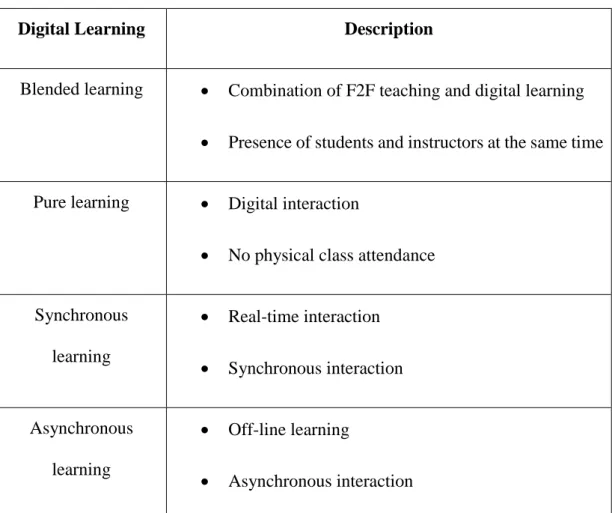
Digital learning can be classified in various ways based on how it is offered (Waththage, 2015). It, for example, can be classified as blended learning and pure learning (Sridharan et al., 2010). Digital learning can also be categorized as asynchronous learning and synchronous learning (Waththage, 2015, Perveen, 2016, Hadullo et al., 2018). Blended learning combines digital learning and F2F teaching to creating a cohesive learning experience (Tshabalala et al., 2014). It is the most popular digital learning modality in higher education. This is because blended learning utilises the benefits of both F2F teaching and digital learning for improving the performance of learning in higher education (Olivier, 2013, Tshabalala et al., 2014).
Pure learning is the delivery of teaching and learning using digital technologies only (Waththage, 2015). It is commonly used in distance-based education. The adoption of
pure learning in higher education has been becoming increasingly popular. This is because the adoption of pure learning increases learning opportunities for students who cannot attend F2F offerings, improves knowledge sharing between geographically dispersed students, and assembles and disseminates teaching and learning content in a cost-effective manner (Tuckman, 2007, Iqbal et al., 2011).
Digital learning can be classified as asynchronous learning and synchronous learning (Perveen, 2016). Asynchronous learning is the delivery of teaching and learning without a simultaneous online presence of facilitators and students. It encourages self-pacing in teaching and learning. This is because students can engage with learning resources at their convenience (Waththage, 2015, Perveen, 2016). Synchronous learning is the delivery of teaching and learning in real-time. It involves a simultaneous online presence of facilitators and students. Synchronous learning encourages collaborative interaction between and among students and facilitators, leading to the development of a community of enquiry (Perveen, 2016, Hadullo et al., 2018). Table 2.1 presents a summary of the discussion above.
There are numerous benefits that digital learning can offer in higher education (Karunasena et al., 2013a, Schoonenboom, 2014, Sek et al., 2016). Digital learning, for example, provides flexibility with respect to teaching and learning content, place and time of learning, and pace (Donnelly and Benson, 2008, Dlodlo, 2009, Njenga and Fourie, 2011, Murphy and Stewart, 2017). The teaching and learning content is easy to update. Such content can be transformed into different formats easily and quickly (Donnelly and Benson, 2008, Njenga and Fourie, 2011). The content can be translated
using electronic translators into different languages (Donnelly and Benson, 2008). The content can be accessed and distributed at low costs. It can be available to the intended audience electronically without undue delays (Njenga and Fourie, 2011).
Table 2:1 An Overview of Digital Learning
Digital Learning Description
Blended learning • Combination of F2F teaching and digital learning
• Presence of students and instructors at the same time
Pure learning • Digital interaction
• No physical class attendance
Synchronous learning • Real-time interaction • Synchronous interaction Asynchronous learning • Off-line learning • Asynchronous interaction
The use of digital technologies in teaching and learning enables better management of student learning progresses (Hamuy and Galaz, 2010, Njenga and Fourie, 2011). This is because students can access their course grades and evaluate their performance in a timely manner. They can tell the status of teaching and learning content (Hamuy and Galaz, 2010). Course facilitators can easily identify low performing students and provide them with appropriate support (Hamuy and Galaz, 2010, Njenga and Fourie,
2011). As a result, course facilitators can administer extra and frequent assessments to underperforming students. Such students can improve their understanding and build their confidence through constantly revisiting teaching and learning content (Hamuy and Galaz, 2010, Njenga and Fourie, 2011). This shows that digital learning can improve the performance of learning in higher education.
The adoption of digital learning can help create a community of practice (Boven, 2014, Bere and Rambe, 2016). Such a community can help students to interact with their peers and facilitators in a stimulating learning environment. As a result, students can develop numerous skills including communication, problem-solving, critical thinking, and teamwork (Kim et al., 2014, Amara et al., 2016).
The pervasiveness of digital learning benefits students who cannot constantly attend classes due to various reasons (Sridharan et al., 2010, Bere, 2012, Waththage, 2015). Such students can conveniently access teaching and learning materials anywhere and at anytime (Waththage, 2015) This shows that digital learning provides the flexibility required in teaching and learning in higher education.
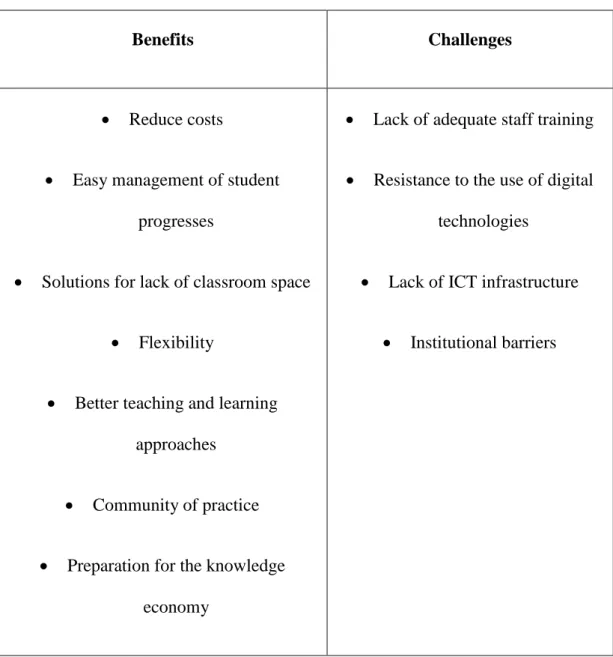
There are other benefits of digital learning including reducing costs, providing solutions for lack of classroom space, connectedness, better teaching and learning approaches, and assisting students to acquire skills and preparing students for the knowledge economy (Dlodlo, 2009, Njenga and Fourie, 2011, Murphy and Stewart,
2017). As a result, the adoption of digital learning in higher education worldwide has been becoming increasingly popular (Bhuasiri et al., 2012, Al-Gahtani, 2016).
There are many challenges to designing and implementing digital learning in teaching and learning in higher education (Waththage, 2015, Ng'ambi et al., 2016). Such challenges include lack of adequate training of higher education practitioners in the appropriate use of digital technologies for enhancing the performance of learning, the availability of institutional barriers to a broader uptake of digital technologies in teaching and learning, the increasing need for more effective practices to encourage the persistent resistance to change from F2F teaching to digital learning of higher
education practitioners, and the lack of ICT infrastructure to support digital learning
(Waththage, 2015, Ng'ambi et al., 2016).
There are various digital learning hindrances including the cost of digital learning application licenses, the presence of rigid institutional policies, and the adoption of nonuniform digital technologies (Sanchez-Franco, 2010, Wang et al., 2012). Some digital learning technologies require costly licenses. Some institutions may not afford or maintain using these technologies in the long term. Various higher education institutions offer different digital learning technologies. As a result, a student has to learn how to use the new digital learning technology when this student moves from one institution to another (Sanchez-Franco, 2010, Wang et al., 2012). A summary of the benefits and challenges of digital learning is presented in Table 2.2.
Table 2:2 An Overview of the Benefits and Challenges of Digital Learning
Benefits Challenges
• Reduce costs
• Easy management of student progresses
• Solutions for lack of classroom space
• Flexibility
• Better teaching and learning approaches
• Community of practice
• Preparation for the knowledge economy
• Lack of adequate staff training
• Resistance to the use of digital technologies
• Lack of ICT infrastructure
• Institutional barriers
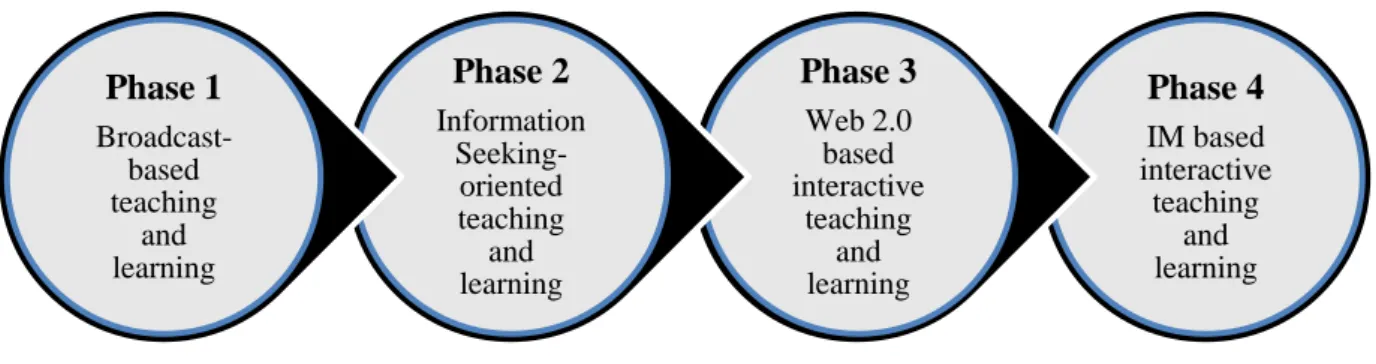
There are four phases in the development of digital learning as shown in Figure 2.1. The first phase involves the broadcasting of teaching and learning using radio and television (TV). The second phase is related to the use of information seeking based teaching and learning. The third phase focuses on interactive learning through contributing and sharing of teaching and learning resources using Web 2.0 digital technologies including social media. The fourth phase is the use of IM digital technologies for facilitating interactive teaching and learning.
Phase 4 IM based interactive teaching and learning Phase 3 Web 2.0 based interactive teaching and learning Phase 2 Information Seeking-oriented teaching and learning Phase 1 Broadcast-based teaching and learning
Figure 2. 1 An Overview of Digital Learning Development
Broadcasting-based teaching and learning
The earliest digital learning technique involves broadcasting using digital technologies including radio and TV (Duby, 1990, Forsslund, 1991, Kwape, 2000). It is about the use of radio and TV programmes for distributing learning resources to a dispersed audience (Duby, 1990, Cruse, 2006, The Canadian Encyclopedia, 2013). Its purpose is to enlighten, inform, and provide intellectual stimulation to its audience (The Canadian Encyclopedia, 2013). It emerged in the 1920s as a convenient teaching and learning technique. Such a technique facilitates the receiving of learning resources both in homes and in classrooms (The Canadian Encyclopedia, 2013). As a result, the adoption of radio and TV broadcasting in higher education has transformed teaching and learning worldwide (Duby, 1990, Kwape, 2000, Cruse, 2006).
Radio broadcasting has been increasingly becoming popular in formal and informal teaching and learning (Duby, 1990, Kenyaplex, 2017). This is because of the benefits it offers including improving the listening skill of students, provoking the imagination capacity of students, encouraging the engagement between instructors and students,
improving the access to teaching and learning resources, and providing students with quality teaching and learning resources (Duby, 1990, Kenyaplex, 2017).
The proliferation of TV has transformed digital learning from radio broadcasting to TV broadcasting (Cruse, 2006). The adoption of TV in teaching and learning has led to numerous benefits in higher education. The combination of visuals and audio in teaching and learning, for example, reinforces student learning. It improves student comprehension. This provides mass teaching and learning opportunities in higher education. It further reduces the dependency of the delivery of teaching and learning on verbal teaching and learning. This stimulates teaching and learning enthusiasm in higher education (Cruse, 2006, Leado, 2016). Overall TV broadcasting in higher education has a positive impact on the performance of learning.
There are several challenges for delivering teaching and learning using radio and TV broadcasting. These digital technologies involve one-way communication (Cruse, 2006). The content is developed by subject experts including instructors and instructional designers without the involvement of students (Cruse, 2006). Students cannot interact with other users using these digital technologies. This shows that teaching and learning using broadcasting encourages passive learning (Cruse, 2006).
Teaching and learning resources in radio and TV broadcasting based higher education can be recorded and replayed (Duby, 1990, Cruse, 2006). Sharing such recorded teaching and learning materials among students and instructors, however, is inflexible. As a result, students and higher education staff prefer the use of Internet digital
technologies over radio and TV broadcasting in teaching and learning. This is because the use of the Internet including Web 1.0 allows the storage of teaching and learning resources in one location for facilitating their ease access. This means that the use of Internet digital technologies offers flexible sharing of teaching and learning resources from a central repository.
Information seeking oriented teaching and learning
Web 1.0 is the first generation of the World Wide Web (Cormode and Krishnamurthy, 2008, Greenhow et al., 2009, Aghaei et al., 2012). It was invented in 1991 by Tim Berners-Lee (Wu and Ackland, 2014). Its core protocols are the Hypertext Transfer Protocol, the HyperText Markup Language (HTML) and the Uniform Resource identifier (Aghaei et al., 2012). Web 1.0 is made up of statistic mono-directional web pages connected by hyperlinks (Robson and Freeman, 2005, Greenhow et al., 2009, Aghaei et al., 2012). The content of Web 1.0 is defined by individuals with programming or web design technical skills. Most users are consumers of the content (Cormode and Krishnamurthy, 2008, Brown, 2012). As a result, Web 1.0 is characterised by centralised one-way communication (Cifuentes et al., 2011).
There are various characteristics of Web 1.0 including static pages, website content stored in files, presence of content and web page layout in tables, proprietary HTML tags, guestbooks, and emailing of forms (Robson and Freeman, 2005, Website Builders, 2019). Static pages contain fixed content. Each page is coded in HTML. It displays the same content each time it is loaded (Website Builders, 2019). Web 1.0
does not allow interaction between users (Aghaei et al., 2012). Users of websites are information seekers who cannot make any contributions to the content (Aghaei et al., 2012, Brown, 2012). The goal of websites is to establish an online presence through delivering information anywhere and at anytime (Aghaei et al., 2012).
Web 1.0 technologies store website content in files, unlike modern websites which stores website content in databases (Website Builders, 2019). The use of file systems in websites creates numerous challenges including data redundancy, data inconsistency, data isolation, dependence on application programs, and data security (Coronel and Morris, 2016). Web 1.0 digital technologies combine the content and webpage layout in the web page markup using HTML elements including tables (Website Builders, 2019). The best practice for web design encourages the separation of webpage markup and styling using external style sheets. Such styles determine the look and layout of the webpages (Coronel and Morris, 2016, Website Builders, 2019).
The use of proprietary tags in Web 1.0 creates significant incompatibility problems between websites and users using unsupported browsers (Website Builders, 2019). As a result, the efficiency of Web 1.0 is reduced due to the use of proprietary tags. In Web 1.0, the comments of users are added to the guestbook. The use of guestbook allows the loading of a page with a long list of user comments without slowing down the performance of a website particularly when a dial-up Internet connection is used (Robson and Freeman, 2005, Website Builders, 2019). The website hosting severs for Web 1.0 does not support server-side scripting. Server-side scripting allows a web server to submit a form in a website. When a submit button is clicked in Web 1.0, the
user’s email is launched to allow him/her to email the form to an email address provided on the website (Website Builders, 2019).
The adoption of Web 1.0 in higher education has transformed the teaching and learning practices in the 1990s. This is because of the benefits that Web 1.0 offers including better sharing of teaching and learning resources, increasing access to education, and better self-paced learning opportunities. As a result, the adoption of Web 1.0 in teaching and learning has been increasingly popular globally.
Web 2.0 based interactive teaching and learning
Web 2.0 emerged in 2003 as a solution for moving beyond content delivery to individual publishing in teaching and learning in higher education while trying to improving the easiness of use, customisation, collaboration, interactivity, and sharing of information (Sigala and learning, 2007). Users with no technical skills can update content. This allows users to focus on specific information and collaborative tasks in the delivery of teaching and learning (Sigala and learning, 2007). As a result, Web 2.0 technologies improve the delivery of teaching and learning in higher education.
Web 2.0 is a user-generated, read-write, social, and interactive web (AlJeraisy et al., 2015). It is a user-centric and participative web. Such a web allows gathering and managing large crowds of people with a common interest in social interaction (Aghaei et al., 2012). Web 2.0 technologies are bi-directional. Users can access information on websites and participate in content development (Sigala and learning, 2007, Aghaei et
al., 2012, AlJeraisy et al., 2015). As a result, the adoption of Web 2.0 in business, health, agriculture and education has been becoming increasingly popular (Allen et al., 2010, Berthon et al., 2012, Rambe, 2012, Moorhead et al., 2013).
The use of Web 2.0 in higher education allows students to seek, contribute and share information in teaching and learning (Sigala and learning, 2007). Consequently, students are co-producers of teaching and learning content rather than passive information consumers. The characteristics of Web 2.0 support for both synchronous and asynchronous communication (Sigala and learning, 2007, Su et al., 2010). Such characteristics provide students with more opportunities for accessing, sharing, and interacting with peers and facilitators (Su et al., 2010). As a result, teaching and learning using Web 2.0 has become highly autonomous, informal, self-motivated. It forms an integral part of the higher education experience of students (Su et al., 2010, Dabbagh and Kitsantas, 2012).
There are various social media applications that are Web 2.0 enabled (Sigala and learning, 2007). The development of Web 2.0 has facilitated the integration of social media into LMS for improving the performance of formal and informal teaching and learning in higher education (Sigala and learning, 2007, Dabbagh and Kitsantas, 2012). This is because various types of social media including Twitter, Facebook, YouTube, wikis, and blogging offers numerous benefits to teaching and learning. Such benefits include advanced collaboration among students and course facilitators, improved social presence, capacity to offer student-centred personalised learning, ability to learn from user-generated content leading to collective wisdom (Sigala and learning, 2007,
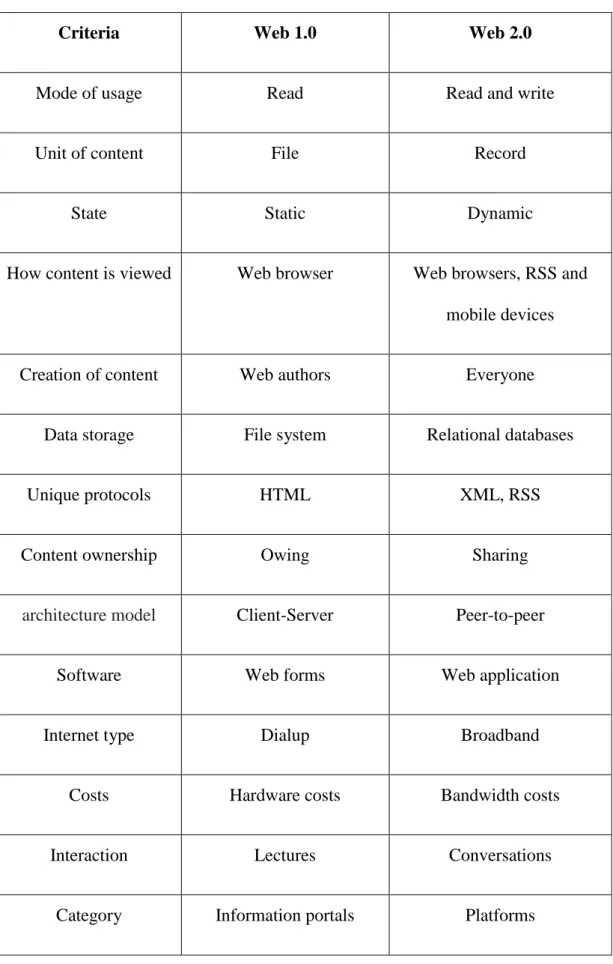
Dabbagh and Kitsantas, 2012). As a result, the adoption of Web 2.0 empowers students to take charge of their own learning, facilitates knowledge creation, enhances critical thinking, improves motivation to learn, and promotes active learning (Dabbagh and Kitsantas, 2012). This shows that Web 2.0 affords the development of student-focused teaching and learning contexts consisting of socially engaging tasks that encourage students to take an active role in the creation and application of knowledge rather than simply memorising it (Sigala and learning, 2007). A comparative analysis of web 1.0 and web 2.0 is presented in Table 2.3.
Table 2.3 A Comparative Analysis between Web 1.0 and Web 2.0
Criteria Web 1.0 Web 2.0
Mode of usage Read Read and write
Unit of content File Record
State Static Dynamic
How content is viewed Web browser Web browsers, RSS and mobile devices
Creation of content Web authors Everyone
Data storage File system Relational databases
Unique protocols HTML XML, RSS
Content ownership Owing Sharing
architecture model Client-Server Peer-to-peer
Software Web forms Web application
Internet type Dialup Broadband
Costs Hardware costs Bandwidth costs
Interaction Lectures Conversations
IM based interactive teaching and learning
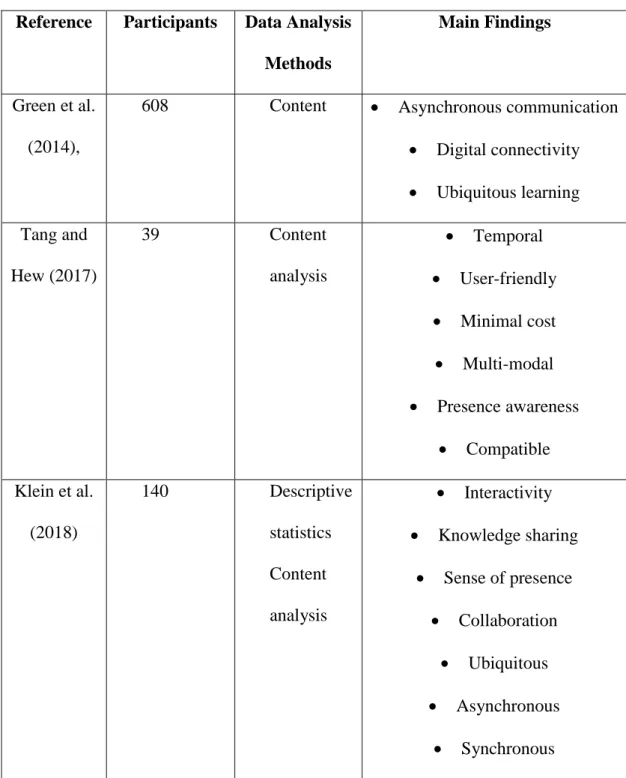
IM is a free downloadable cross-platform online chat application that offers real-time text transmission over the Internet (Hsieh and Tseng, 2017). It runs on various devices including smartphones, tablets, iPads, and desktops (Tang and Hew, 2017). There are many IM applications including WhatsApp, Facebook massager, WeChat, Snapchat, and Viber (Hsieh and Tseng, 2017, Tang and Hew, 2017). WhatsApp is the most popular IM worldwide with approximately 1.5 billion users by February 2018 (Tang and Hew, 2017, Investopedia, 2019)
There are numerous benefits for communicating using IM including cross-platform accessibility, multi-modality, easy formation of group chats, and free charge. IM shares a variety of media including text, audio, video, graphics, documents, location, and emoticons either in groups or individually at very low costs (Hsieh and Tseng, 2017, Tang and Hew, 2017). The device’s built-in camera can be used to capture real-time events which can be shared immediately in IM (Tang and Hew, 2017). As a result, the adoption of IM has been becoming increasingly popular.
The adoption of IM in higher education has been becoming increasingly popular (So, 2016, Tang and Hew, 2017). This because of the numerous benefits IM can offer to teaching and learning. The adoption of IM promotes active learning in higher education (Rambe and Bere, 2013, So, 2016, Nkhoma et al., 2018). Students can contribute to the development of teaching and learning resources. They can share teaching and learning content and receive timely feedback from peers and facilitators
(Rambe and Bere, 2013, So, 2016, Nkhoma et al., 2018). The use of IM in teaching and learning is common particularly in resource-constrained environments like higher education in South Africa (Rambe and Bere, 2013, Murire and Cilliers, 2017). This is because interaction using IM is less costly compared to the cost of communicating using other digital technologies (Rambe and Bere, 2013, So, 2016).
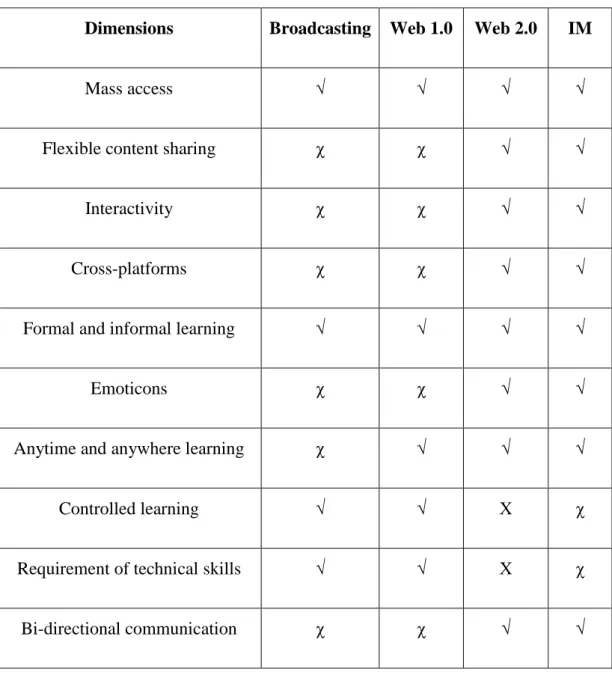
The development of digital learning is complex and challenging (Tarus et al., 2015, Sek et al., 2016). Such complexity and challenges in the development of digital learning come from various perspectives including (a) the performance of learning perspective, (b) the technological perspective, and (c) the user perspective (Bagarukayo and Kalema, 2015, Tarus et al., 2015, Yakubu and Dasuki, 2018a). Better understanding such complexity and challenges has a fundamental impact on the development of digital learning across the world (Bagarukayo and Kalema, 2015, Tarus et al., 2015, Yakubu and Dasuki, 2018a). As a result, how to adequately address such complexity and challenges is becoming critical for the effective development of digital learning in individual countries (Bagarukayo and Kalema, 2015, Bere et al., 2018b). Table 2.4 presents a summary of digital learning development.
Table 2:4 A Summary of Digital Learning Development
Dimensions Broadcasting Web 1.0 Web 2.0 IM
Mass access √ √ √ √
Flexible content sharing χ χ √ √
Interactivity χ χ √ √
Cross-platforms χ χ √ √
Formal and informal learning √ √ √ √
Emoticons χ χ √ √
Anytime and anywhere learning χ √ √ √
Controlled learning √ √ Χ χ
Requirement of technical skills √ √ Χ χ
Bi-directional communication χ χ √ √
Use of specific digital technologies in teaching and learning
Most LMS applications in higher education including popular platforms such as Blackboard and Moodle run on Web 1.0 (Sclater, 2008, VetED, 2019). Web 1.0 enabled LMS has a low impact with respect to the performance of learning (Sclater, 2008, VetED, 2019). This is because these digital technologies promote a culture of dependency rather than the autonomy of students. A Web 1.0 enabled LMS providesa structured environment in which the facilitator decide on how, when, and what students