EFFECTS OF COACH-DELIVERED PROMPTING AND PERFORMANCE FEEDBACK ON TEACHER USE OF EVIDENCE-BASED
CLASSROOM MANAGEMENT PRACTICES AND STUDENT BEHAVIOR OUTCOMES
by
MICHELLE MARIAN MASSAR
A DISSERTATION
Presented to the Department of Special Education and Clinical Sciences and the Graduate School of the University of Oregon
in partial fulfillment of the requirements for the degree of
Doctor of Philosophy September 2017
DISSERTATION APPROVAL PAGE Student: Michelle Marian Massar
Title: Effects of Coach-delivered Prompting and Performance Feedback on Teacher Use of Evidence-based Classroom Management Practices and Student Behavior Outcomes
This dissertation has been accepted and approved in partial fulfillment of the
requirements for the Doctor of Philosophy degree in the Department of Special Education and Clinical Sciences by:
Robert Horner Chairperson
Erin Chaparro Core Member
K. Brigid Flannery Core Member
Michael Bullis Institutional Representative and
Sara D. Hodges Interim Vice Provost and Dean of the Graduate School Original approval signatures are on file with the University of Oregon Graduate School. Degree awarded September 2017
© 2017 Michelle Marian Massar
DISSERTATION ABSTRACT Michelle Marian Massar
Doctor of Philosophy
Department of Special Education and Clinical Sciences September 2017
Title: Effects of Coach-delivered Prompting and Performance Feedback on Teacher Use of Evidence-based Classroom Management Practices and Student Behavior Outcomes
Schools across the country are dedicating significant resources to the selection, adoption, and durable implementation of evidence-based practices (EBPs); however, the research-to-practice gap remains a significant challenge facing education today (DuFour & Mattos, 2013). Coaching is one of the implementation variables most consistently cited for improving the high-fidelity adoption of new practices.
This study used two concurrent multiple baseline, single-case designs across participants with counterbalanced intervention phases to examine the effects of coaching on teachers’ use of evidence-based, class-wide behavior management practices.
Specifically, the study examined the extent to which a functional relation exists between (a) coach-delivered prompting, (b) coach-delivered performance feedback, and (c) the interaction effects of coach-delivered prompting with performance feedback and an increase in teachers’ use of evidence-based classroom management practices and a decrease in class-wide disruptive behavior.
Results indicate that coach-delivered prompting and performance feedback is functionally related to an increase in teacher use of evidence-based classroom
effects were observed when prompting and performance feedback were delivered
together. Potential contributions of the study are discussed in terms of establishing a more nuanced understanding of the active ingredients of effective coaching to support the selection, training, evaluation, and ongoing support of coaches in K-12 educational settings.
CURRICULUM VITAE NAME OF AUTHOR: Michelle Marian Massar
GRADUATE AND UNDERGRADUATE SCHOOLS ATTENDED: University of Oregon, Eugene, Oregon
Arizona State University, Tempe, Arizona Portland State University, Portland, Oregon
DEGREES AWARDED:
Doctor of Philosophy, Special Education, 2017, University of Oregon Master of Education, Special Education, 2011, Arizona State University Bachelor of Arts, English, 2006, Texas A&M University
AREAS OF SPECIAL INTEREST:
School-wide Positive Behavioral Interventions and Supports Implementation Science
Juvenile Justice and Disability Administrative Systems in Education
PROFESSIONAL EXPERIENCE:
University Supervisor, Secondary Dual Educator Program (SDEP), Portland State University, Portland, Oregon, 2015-2016
Behavior TOSA, Portland Public Schools, Portland, Oregon, 2015 Instructional Coach, Roosevelt School District, Phoenix, AZ, 2012-2013 K-8 Self-contained Teacher for Students with Emotional and Behavioral
Disorders, Amy Houston Academy, Phoenix, AZ, 2009-2012
GRANTS, AWARDS, AND HONORS:
WING Institute Research Grant, WING Institute, Oakland, CA Summa cum Laude, Portland State University, 2009
PUBLICATIONS:
Massar, M., McIntosh, K., Mercer, S. & Hoselton, R. (In Press). Factor Validation of a Fidelity of Implementation Measure for Social Behavioral Systems. Remedial and Special Education.
Trader, B. , Stonemeier, J., Berg, T., Knowles, C., Massar, M., Monzalve, M., Pinkelman, S., Nese, R., Ruppert, T., Horner, R. (2017). "Promoting Inclusion Through Evidence-based Alternatives to Restraint and Seclusion. Research and Practice for Persons with Severe Disabilities, 42, 75-88.
Knowles, C., Massar, M., Raulston, T., & Machalichek, W. (2017). Telehealth
consultation in a self-contained classroom for behavior: A pilot study. Preventing School Failure, 61, 28-38.
McIntosh, K., Massar, M., Swain-Bradway, J., Algozzine, R. F., Horner, R. H., & Lewis, T. J. (2017). Technical Adequacy of the SWPBIS Tiered Fidelity Inventory. Journal of Positive Behavior Interventions, 19, 3-13.
Nese, R., Massar, M., & McIntosh, K. (2015, October). Alternatives to Suspension: Strategies for School Principals. Principal Leadership, 16, 52-56.
Massar, M., McIntosh, K., & Eliason, B. M. (2015, May). Do out-of-school suspensions prevent future exclusionary discipline? PBIS evaluation brief. Eugene, OR: OSEP National Technical Assistance Center on Positive Behavioral Interventions and Supports.
ACKNOWLEDGMENTS
They say it takes a village to raise a Ph.D. student (okay, maybe they don’t say that – but they should) and this dissertation would not have been possible without the support from my committee, colleagues, friends, and family. I would like to start by thanking my committee members for their invaluable insight and feedback: Dr. Robert Horner, Dr. Brigid Flannery, Dr. Erin Chaparro, and Dr. Mike Bullis. I am incredibly grateful to my other mentors and friends at the Educational and Community Supports (ECS) office, including Dr. Kent McIntosh, Anne Todd, and Rhonda Nese. I would not have been able to stay on top of anything without Marty Hurst, Dana Gorman, and Kim Ledbetter… you are the real MVPs.
Next, I would like to thank everyone who helped with my dissertation and supported me in countless ways throughout the program, including soon-to-be Drs. Angus Kittelman and Katie Conley, the data collectors, and the participating teachers in my study. Although I cannot thank everyone from my UO support system here, I would like to extend a special thank you to Dr. Allison Blakely, Dr. Christen Knowles, and Dr. Manuel Monzalve for being incredible colleagues and friends over the past four years.
I would like to express my sincere gratitude for the wonderful friends that have always listened, given advice, and been my biggest cheerleaders. Special thanks to Cris Lewis, Emily Zurow, Steve Christensen, and Steve Osborne – you are the best friends anyone could ever ask for and I love you all. Thank you also to my incredible Amy Houston family in Phoenix, AZ. I would not have stayed in special education without my Houston role models. A big thank you to Maria Lopez, who taught me everything I know about managing a classroom and loving every student for their individuality and spunk.
Thanks to my mom for always believing in me through everything, even when I didn’t believe in myself. I love you so much! Thanks to my other Massar and Smythe family members for always supporting my dreams. I would also like to thank Jordan Fry for being my rock through the dissertation process. I cannot thank you enough for everything you have done for me. Thanks for sharing the Fry/Looney/Anderson/Benson family with me, who has shown me love and support while I worked on my dissertation (including sending this hungry grad student home with countless home-cooked meals and not kicking me out when I broke the egg dish).
Finally, I would like to thank all of my students – past and future – for teaching me more than I ever expected and being the next great entrepreneurs, innovators, and leaders of our world.
TABLE OF CONTENTS Chapter Page I. INTRODUCTION ... 1 Statement of Purpose ... 1 Literature Review... 3 Implementation Science ... 4
Coaching Within Implementation Science ... 8
Research on Coaching... 11
Research on Coaching in Educational Settings ... 12
Toward an Operational Definition of Coaching ... 14
Prompting ... 17
Fluency Building ... 18
Performance Feedback ... 20
Adaptation ... 22
A Program of Coaching Research ... 24
Initial Descriptive Research on the Coaching Logic Model ... 28
Class-wide Positive Behavioral Interventions and Supports (CW-PBIS) ... 33
Study Purpose, Research Questions, and Potential Contributions ... 34
II. METHODS... 36
Participants ... 36
Teacher Participants ... 36
Coaches ... 41
Chapter Page
Setting ... 42
Dependent Measures ... 42
Direct Observation Data ... 42
Teacher Implementation of Classroom Management Practices ... 44
Classroom Behavior ... 46
Social Validity ... 48
Design and Procedures ... 49
Phase I: Training and Initial Assessment ... 49
Phase II: Baseline ... 50
Phase III: Intervention... 51
Performance Feedback Phase (B) ... 52
Prompting Phase (C) ... 52
Prompting and Performance Feedback Phase (BC) ... 53
Intervention Fidelity... 54
Interobserver Agreement ... 54
Data Interpretation and Analysis ... 56
III. RESULTS ... 58
Direct Observation Data ... 58
Teacher Implementation of Classroom Management Practices ... 60
Study 1 ... 60
Teacher 1: Coached Dependent Variable ... 60
Chapter Page
Teacher 3: Coached Dependent Variable ... 62
Teacher 4: Coached Dependent Variable ... 62
Teacher 1: Uncoached Dependent Variable ... 63
Teacher 2: Uncoached Dependent Variable ... 63
Teacher 3: Uncoached Dependent Variable ... 64
Teacher 4: Uncoached Dependent Variable ... 65
Overall …………... 65
Study 2 ... 66
Teacher 5: Coached Dependent Variable ... 66
Teacher 6: Coached Dependent Variable ... 68
Teacher 7: Coached Dependent Variable ... 68
Teacher 5: Uncoached Dependent Variable ... 69
Teacher 6: Uncoached Dependent Variable ... 69
Teacher 7: Uncoached Dependent Variable ... 70
Overall …………... 71 Classroom Behavior ... 71 Study 1 ... 71 Teacher 1 ... 72 Teacher 2 .. ... 72 Teacher 3 .. ... 73 Teacher 4 .. ... 74 Overall …... 74
Chapter Page Study 2 ... 75 Teacher 5 ... 75 Teacher 6 .. ... 76 Teacher 7 .. ... 77 Overall …... 77
Statistical Analysis of Direct Observation Data ... 77
Study 1 ... 79
Teacher Implementation of Classroom Management Practices ... 79
Classroom Behavior ... 79
Study 2 ... 80
Teacher Implementation of Classroom Management Practices ... 80
Classroom Behavior ... 80
Social Validity ... 81
IV. DISCUSSION ... 83
General Discussion ... 83
Coach-delivered Prompting ... 85
Coach-delivered Performance Feedback ... 85
Interaction Effects on Teacher Behavior ... 87
Specificity of Effect on Teacher Behavior ... 88
Cascading Effects on Classroom Behavior ... 88
Implications for Practice ... 89
Chapter Page
Coaching Across All Levels of Support ... 91
Train Once, Coach Twice ... 91
Future Research ... 92
Limitations ….. ... 95
Conclusion ………... 97
APPENDICES ... 99
A. COACHING APPROACHES AND PERSPECTIVES ... 99
B. UNIVERSITY OF OREGON IRB APPROVAL ... 103
C. CLASSROOM MANAGEMENT TRAINING ... 105
D. CLASSROOM MANAGEMENT TRAINING QUIZ ... 110
E. CLASSROOM MANAGEMENT SELF-ASSESSMENT ... 112
F. COACHING FOR EFFECTIVE OUTCOMES CURRICULUM ... 114
G. SAMPLE ANTECEDENT-BEHAVIOR-CONSEQUENCE ... 184
H. DATA COLLECTOR TRAINING MATERIALS ... 185
I. SAMPLE DIRECT OBSERVATION DATA COLLECTION FORM ... 193
J. TEACHER EVALUATION INVENTORY FOR INTERVENTION ... 195
K. COACHING FIDELITY CHECKLIST (PERFORMANCE FEEDBACK) .... 197
L. COACHING FIDELITY CHECKLIST (PROMPTING) ... 199
LIST OF FIGURES
Figure Page
1. Implementation drivers ... 7
2. Mechanisms of coaching logic model... 26
3. A program of research to evaluate the mechanisms of effective coaching. ... 28
4. Results for Participant 1 from Coaching Pilot Study. ... 31
5. Results for Participant 2 from Coaching Pilot Study. ... 32
6. Percentage of 10-second intervals with teacher use of targeted classroom management EBP observed during 15-minute observation sessions in Study 1... 61
7. Percentage of 10-second intervals with teacher use of uncoached classroom management EBP observed during 15-minute observation sessions in Study 1... 64
8. Percentage of 10-second intervals with teacher use of targeted classroom management EBP observed during 15-minute observation sessions in Study 2... 67
9. Percentage of 10-second intervals with teacher use of uncoached classroom management EBP observed during 15-minute observation sessions in Study 2... 70
10. Percentage of 10-second intervals with student academic engagement and classroom disruption observed during 15-minute observation sessions in Study 1... 73
11. Percentage of 10-second intervals with student academic engagement and classroom disruption observed during 15-minute observation sessions in Study 2 ... 76
LIST OF TABLES
Table Page
1. Implementation phases... 6
2. Results from the initial classroom observations using the Classroom Management Self-Assessment (adapted) ... 38
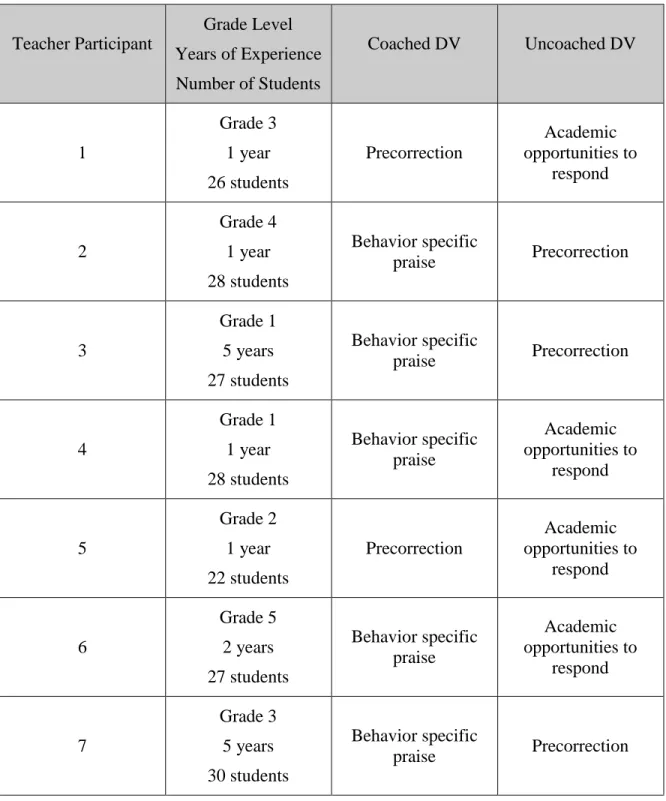
3. Teacher demographic information and measured dependent variables. ... 40
4. Functional behavioral assessment results with most common problem behaviors and presumed function ... 43
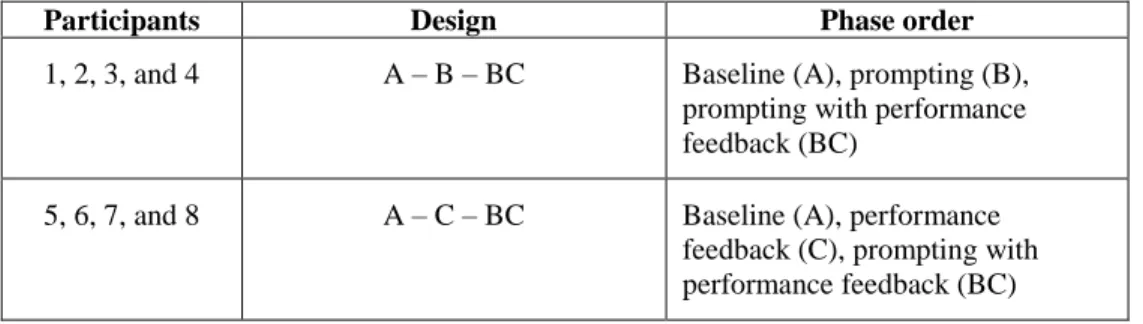
5. Counterbalanced single-case research design. ... 49
6. Coaching intervention fidelity results ... 54
7. Cohen’s Kappa for each teacher participant and dependent variable ... 56
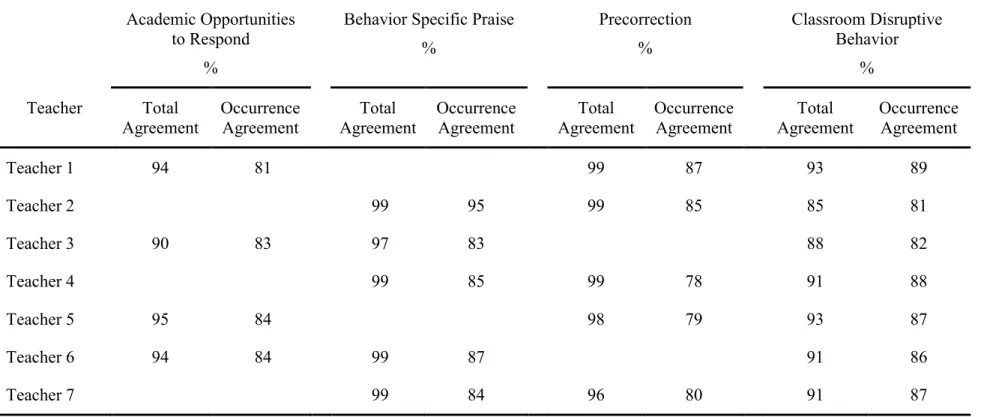
8. Interobserver agreement for teacher and classroom behavior dependent variables in Study 1 and Study 2 ... 57
9. Average percentage of intervals in baseline and intervention phases for teacher use of coached and uncoached classroom management EBPs and classroom disruption ... 79
10. Participant responses (n = 5) to the Teacher Evaluation Inventory for Coaching Intervention survey ... 81
11. Open-ended participant responses to the Teacher Evaluation Inventory for Coaching Intervention survey ... 82
CHAPTER I INTRODUCTION
Statement of Purpose
The purpose of the present study is to examine the effects of coach-delivered prompting and performance feedback on teacher implementation of evidence-based classroom management practices and classroom disruption. An emerging body of research supports the use of coaching as a bridge between initial training and
implementation of evidence-based practices (EBPs) in natural settings (e.g., Cantrell & Hughes, 2008; Pas et al., 2015; Reinke, Stormont, Herman, & Newcomer, 2014). The importance of coaches and the coaching process is cited in numerous and disparate literature bases, including business (e.g., Baron, Morin, & Morin, 2011; Kumata, 2002; Utrilla, Torraleja, Nunez-Cacho Utrilla, & Grande Torraleja, 2013), healthcare (e.g., Cassatly, 2010; Rowan, 2008), leadership (e.g., Ely et al., 2010; Fiddy, 2015; Wise & Hammack, 2011), sports psychology (e.g., Miller, Ogilvie, Adams, & Diedrich, 2000; Stebbings, Taylor, Spray, & Ntoumanis, 2012), and project management (e.g., Berg & Karlsen, 2007; Mulec & Roth, 2005). Within the educational research base, coaching has been considered a critical feature of staff development for decades, beginning with the seminal works on peer coaching by Joyce and Showers (1980; 1981; 1982) and supported by Knight’s research on instructional coaching (2000; 2004, 2007).
Coaching is considered a key driver to support teachers’ implementation of effective classroom practices and interventions. Educational policies such as the Individuals with Disabilities Education Act (IDEA) of 2004 and the Every Student Succeeds Act (ESSA) of 2015 mandate the use of EBPs in all general and special
education settings. Despite federal policy regulations, the failure to implement EBPs in schools is a serious challenge currently facing researchers and practitioners (Coburn & Penuel, 2016; Cook & Cook, 2013; DuFour & Mattos, 2013; Klingner, Boardman, & McMaster, 2013; Weston & Bain, 2015). Known as the research-to-practice gap, the difficulty in translating empirically validated interventions and programs into embedded practices within K-12 classrooms has been the focus of numerous research programs and technical assistance centers in the United States. Developing a thorough understanding of the components related to the effective and durable implementation of EBPs is critical to supporting educators and promoting positive outcomes for students.
Coaching is one strategy within the implementation science framework that serves to promote and sustain behavior change in the “beginning stages of implementation and throughout the life of evidence-based practices” (Fixsen, Blase, Naoom, & Duda, 2015, p. 12). While research supports the use of coaching within the implementation
framework, little is known about the mechanism(s) by which coaching is effective. Currently, most coaching evaluation is based on a binary measure of delivery (i.e., did you receive coaching?) as opposed to the form, quality and competence of coaching received (i.e., what/how many/how much of the effective elements of coaching were delivered and received?). This study will experimentally examine two purported functions of high-quality coaching – prompting and performance feedback – and the individual and combined effects of these functions on teacher use of class-wide behavior management practices and classroom disruption.
Literature Review
An abundance of credible research exists documenting effective educational practices (Cook, Tankersley, & Landrum, 2013); yet, translating research findings into practice remains an ongoing challenge in both general and special education settings (Carnine, 1997; Cook & Schirmer, 2006). General and special education policy has adopted scientific evidence as a required basis for selecting appropriate and effective teaching practices (Odom et al., 2005) and important efforts have been made toward identifying empirically supported interventions (Cook, Tankersley, & Landrum, 2009). Despite these advances, implementation of EBPs in the intended settings (i.e., schools, classrooms) remains a significant challenge (Sweigart, Landrum, & Pennington, 2015).
Researchers often refer to this phenomenon as the research-to-practice gap or the implementation gap, highlighting the challenge in translating research into effective practices (Chaparro, Smolkowski, Baker, Hanson, & Ryan-Jackson, 2012; Chaparro, Jackson, Baker, & Smolkowski, 2012; Cook & Odom, 2013; Gresham, 2009). Even when empirically supported practices are adopted, the lack of durable implementation of EBPs in K-12 classrooms captures the inherent challenge in translating research to practice over time. The research-to-practice gap has highlighted the need for increased focus on the science of implementation to ensure that EBPs are successfully adopted and sustained in schools across the country.
To support the uptake of EBPs in the natural educational context, systemic supports – including targeted professional development, ongoing feedback, collaboration with other educators, and student outcome data measuring implementation effectiveness – are required (Cook, Tankersley, Cook, & Landrum, 2015). There are multiple
implementation frameworks that elucidate the ways in which systemic supports work independently and together to support durable and sustained implementation of EBPs in real-world settings.
Implementation Science
Eccles and Mittman (2006) define implementation science as “the scientific study of methods to promote the systematic uptake of research findings and other evidence-based practices into routine practice” (p. 1). Fixsen, Blase, Naoom and Wallace (2009) state that the ever-growinginterest in implementation science and research is due to the failure of better science to produce better service. Cook & Odom (2013) explain that implementation is the “critical link between research and practice” and put forth that “in the absence of implementation, even the most effective intervention will not yield desired outcomes” (p. 138). Consequently, developing an understanding of the framework for implementation, as well as the critical mechanisms within that framework, is essential to ensuring that effective educational practices and interventions are delivered to K-12 students in every classroom in the United States.
Some of the most commonly cited implementation frameworks within the field of educational research are the Active Implementation Frameworks developed by the
National Implementation Research Network (NIRN). The current study is based on NIRN’s implementation science framework because it is a promising approach to establishing the systems-level supports required to address the research-to-practice gap (Fixsen et al., 2005). The NIRN framework emphasizes the importance of (a) teams, (b) stages, (c) drivers and (d) cycles.
Implementation Teams. Implementation teams are comprised of individuals who support the active implementation framework and its various components (i.e.,
implementation stages, implementation drivers, and implementation cycles). Teams include individuals with expertise in specialized programs or practices, implementation science, and systems change (Arden, Gandhi, Zumeta Edmonds, & Danielson, 2017). Implementation teams may be developed at a variety of levels within the implementation context (e.g., schools, districts, states) or outside of the implementation context (e.g., organizations that support schools implementing a program or curriculum). The
important component of implementation teams is that they are comprised of members at the implementation level. It is important to build internal capacity by allowing
implementation teams to do the work associated with both initial implementation and sustained support in the local implementation context.
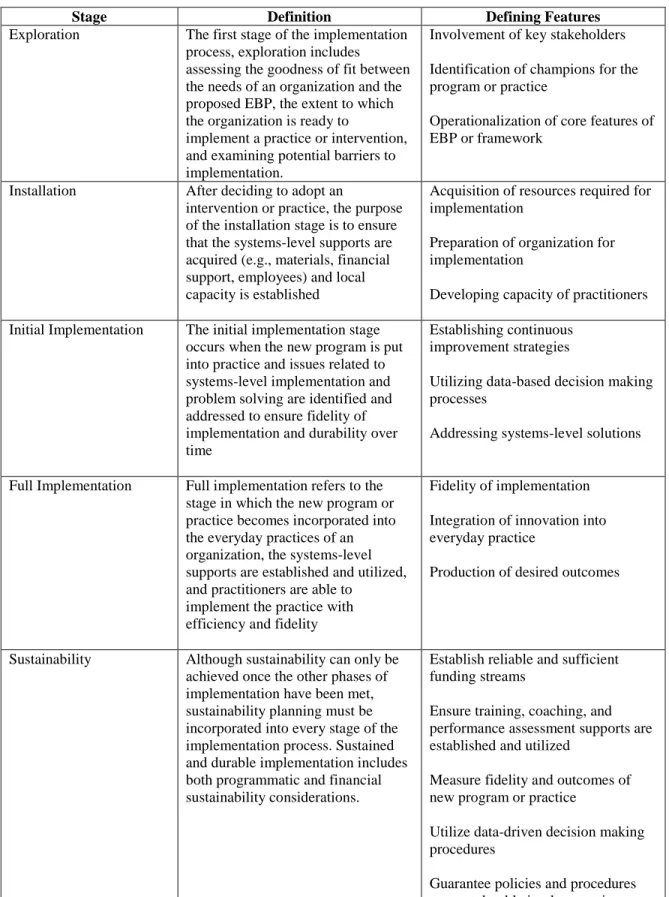
Implementation Stages. After conducting a synthesis on the implementation literature base, Fixsen and colleagues (2005) identified five stages of implementation: (a) exploration, (b) installation, (c) initial implementation, (d) full implementation, and (e) sustainability. Identifying the stage in which an organization is operating is important for matching supports to the distinct implementation needs associated with each stage. Table 1 identifies the phases of implementation and the defining features of each phase based on research conducted by NIRN and Metz and Bartley’s (2012) article on the active implementation framework.
Implementation Drivers. According to NIRN, there are three core components of successful implementation. Commonly known as implementation drivers (Metz & Bartley, 2012), these components serve to increase competency and self-efficacy in
Table 1. Implementation phases.
Stage Definition Defining Features
Exploration The first stage of the implementation process, exploration includes assessing the goodness of fit between the needs of an organization and the proposed EBP, the extent to which the organization is ready to
implement a practice or intervention, and examining potential barriers to implementation.
Involvement of key stakeholders Identification of champions for the program or practice
Operationalization of core features of EBP or framework
Installation After deciding to adopt an
intervention or practice, the purpose of the installation stage is to ensure that the systems-level supports are acquired (e.g., materials, financial support, employees) and local capacity is established
Acquisition of resources required for implementation
Preparation of organization for implementation
Developing capacity of practitioners Initial Implementation The initial implementation stage
occurs when the new program is put into practice and issues related to systems-level implementation and problem solving are identified and addressed to ensure fidelity of implementation and durability over time
Establishing continuous improvement strategies
Utilizing data-based decision making processes
Addressing systems-level solutions
Full Implementation Full implementation refers to the stage in which the new program or practice becomes incorporated into the everyday practices of an organization, the systems-level supports are established and utilized, and practitioners are able to
implement the practice with efficiency and fidelity
Fidelity of implementation Integration of innovation into everyday practice
Production of desired outcomes
Sustainability Although sustainability can only be achieved once the other phases of implementation have been met, sustainability planning must be incorporated into every stage of the implementation process. Sustained and durable implementation includes both programmatic and financial sustainability considerations.
Establish reliable and sufficient funding streams
Ensure training, coaching, and performance assessment supports are established and utilized
Measure fidelity and outcomes of new program or practice
Utilize data-driven decision making procedures
Guarantee policies and procedures support durable implementation
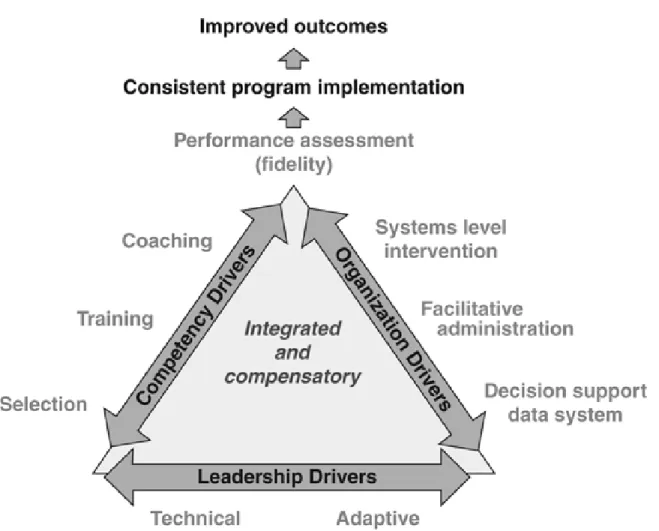
persons responsible for implementation of EBPs and include: (a) competency drivers, (b) organization drivers, and (c) leadership drivers. Figure 1 provides an overview of the implementation drivers that serve as the core components of the implementation process.
Figure 1. Implementation drivers (Fixsen & Blase, 2008).
Note: Implementation Drivers Image © Fixsen & Blase, 2006-2012
Further, nine core drivers of successful implementation have been identified: (a) selection, (b) training, (c) coaching, (d) systems intervention, (e) facilitative
administration, (f) decision support data systems, (g) technical leadership, (h) adaptive leadership, and (i) performance assessment (Bertram, Blase, & Fixsen, 2014).
revisited for many reasons, including to improve cultural adaptation, address changes to service needs, funding, or policies, and to increase efficiency. To support the change process in a systematic manner, three improvement cycles can be considered: (a) the plan-do-study-act (PDSA) cycle (Shewhart, 1931; Varkey, Rellar, & Resar, 2007); (b) usability testing; and (c) practice-policy communication loops. The PDSA cycle is utilized by many organizations when planning to implement a change. The approach is used to study the change by developing a plan to make a modification (plan),
implementing the plan (do), measuring outcomes (study), and using the results to guide next steps (act) (Lyder et al., 2001). Usability testing helps teams determine the extent to which a product, process, or intervention is easy to use and implement. Finally, practice-policy communication loops refer to the “reflective interface between practice and practice-policy, where feedback regarding information sent out (policies that enable change in practices) returns into the component from which it originated (practices that inform policies” (Fixsen, Blase, Metz, Van Dyke, 2013, p. 224).
Coaching within Implementation Science
Selection, training, and coaching are the primary processes for obtaining personnel with the knowledge and skill to support behavioral change at the individual level within the natural implementation context (de Vries & Manfred, 2005; Joyce & Showers, 2002; Sholomskas et al., 2005). Within the implementation science framework, selection, training, and coaching are considered components of the competency driver. Freeman, Miller, and Newcomer (2015) define competency drivers as the “activities, mechanisms, and resources that are needed to improve the necessary knowledge and skills” of individuals responsible for implementation (p. 64).
Joyce and Showers (2002) postulate training and coaching are ongoing strategies for achieving adoption of EBPs. The provision of coaching support to guide
implementation is recommended not only in the beginning stages of the implementation process but also “throughout the life of evidence-based practices and programs” (Fixsen et al., 2009, p. 534). Although the discrimination between training and coaching is necessary because the processes are based on different procedures, and serve different functions, this distinction is often ignored in educational research. When training and coaching are confounded or are not adequately operationalized as independent variables, it is difficult to examine the effects of each process on the dependent variable(s) being studied. Implementation drivers are integrated and compensatory (Van Meter & Van Horn, 1975); however, developing a thorough understanding of individual drivers to increase the efficiency and effectiveness of implementation is of particular importance in K-12 educational settings.
Training. Training is the process by which new skills and knowledge are
acquired. The core features of effective training have been examined in numerous studies. Training typically consists of (a) providing background knowledge and the theoretical framework underpinning the practices being trained, (b) lecture and discussion regarding new knowledge, (c) modeling of new skills, and (d) behavioral rehearsal with feedback (e.g., Kealey, Peterson, Gaul, & Dinh, 2000; Sheridan, Edwards, Marvin, & Knoche, 2009). While training is a critical step to support initial acquisition of new knowledge and skills, it is insufficient for supporting sustained implementation in natural contexts.
Coaching. Coaching is the process by which new skills come under stimulus control in the natural context. Coaching highlights the natural stimuli that should control
a newly learned skill (e.g., recognizing and acknowledging appropriate student behavior), shapes the performance of the new skill (e.g., rewarding successive approximations), acknowledges or rewards performance of the new skill (e.g., providing reinforcing feedback), and guides improved precision and fluency of the new skill (e.g., increasing the speed, accuracy, and ease of new skill use). Research indicates that when individuals are trained in new practices or skills without embedded support or follow-up,
implementation in the natural context is unlikely to occur (Odom, Duda, Kucharczyk, Cox, & Stabel, 2014). Without support for establishing stimulus control, existing stimuli in the natural context are likely to continue to control previous responses.While decades of research have highlighted the role of coaching as a bridge between training and implementation (e.g., Bergan, 1977; Fullan, 1987; Fullan & Knight, 2011; Knight, 2007; Noell, Witt, Slider, Connell et al., 2005; Reinke, Lewis-Palmer, & Merrell, 2008; Reinke, Stormont, Webster-Stratton, Newcomer, & Herman, 2012; Shalaway, 1985), little is known about the critical elements and mechanisms that make coaching effective.
In a brief report on consultation and coaching, NIRN authors write “at this point, we know that coaching is important but we do not know (experimentally) what a coach should do or say with a practitioner to be most effective” (n.d., p. 3). For the purpose of this study, coaching is defined as the supportive activities conducted after initial training to help individuals implement new skills in the natural environment (Horner, 2015; Massar & Horner, 2015). Coaching increases the likelihood of durable implementation of EBPs by increasing the precision, fluency, and efficiency with which skills are used in the natural context.
Research on Coaching
The field of coaching has been influenced and shaped by various fields of research and practice, including management, education, philosophy, psychology, and social science (Cox, Bachkirova, & Clutterbuck, 2010). Within these fields, myriad traditions, ontological beliefs, and conceptual frameworks influence the ways in which coaching is defined, identified, and measured. To highlight these differences, Appendix A summarizes eleven coaching approaches and perspectives that Cox, Bachkirova, and Clutterback (2014) identify in their comprehensive handbook on coaching. While numerous coaching models and approaches have been developed, few have been empirically validated (Kauffman, 2006; Koortzen & Oosthuizen, 2010; Van Zyl & Stander, 2013). Because research requires phenomena that can be measured and
observed, the lack of experimental research on coaching may be due to the complexities associated with operationally defining coaching, parsing out the active ingredients of the coaching process, and/or distinguishing coaching from other phenomena (i.e., training).
One of the first published studies examining the effects of coaching on valued outcomes was conducted in the manufacturing sector nearly eight decades ago (Gorby, 1937). Although the study identified coaching as an effective process for producing desired behavior change, coaching remained relatively underutilized in both practice and research until the 1990s (Kampa-Kokesch & Anderson, 2001). Today, coaching is employed in numerous fields and a significant amount of resources are being allocated to support coaching efforts in businesses, clinics, and educational settings.
There are a large number of literature reviews that examine the role of coaching in producing desired outcomes. The literature tends to focus more on the attributes of
successful coaches and less on the activities and behaviors of successful coaching. For example, in an extensive review of the coaching literature from 1937 to 2009, Passmore and Fillery-Travis (2011) included only three paragraphs specifically discussing coaching behavior (e.g., what effective coaches do). The authors agree with other contemporary literature regarding the attributes of effective coaches, including self-awareness, coaching competency, and an understanding of the ethics and management of a coaching
relationship (e.g., Dingman, 2004; Kilburg, 1996); however, the processes by which coaching is effective in producing behavior change are left unaddressed.
When evaluated in an empirical manner, coaching tends to be delivered from a specific model or approach (Biswas-Diener & Dean, 2007). Understanding the
components of effective coaching is an important advancement for the field of coaching research. As noted in Table 2, the majority of the literature on coaching has focused on coaching models and the desired qualities of coaches (e.g., knowledgeable, approachable, trustworthy, kind). Despite the increased focus on coaching research, there is a paucity of information on the mechanisms by which coaching is effective in general, and the
mechanisms by which it produces positive outcomes in educational contexts in particular. Developing a coaching logic model that evaluates effective coaching rather than effective coaches is the first step in developing a more nuanced understanding of the coaching process.
Research on Coaching in Educational Settings
There have been numerous studies conducted in educational settings related to the effects of coaching on valued outcomes, including teacher fidelity of implementation (e.g., Kretlow, Cooke, & Wood, 2012; Kretlow, Wood, & Cooke, 2009), teacher use of
evidence-based academic practices (e.g., Jager, Reezigt, & Creemers, 2002; Kohler, Crilley, Shearer, & Good, 1997; Stitcher, Lewis, Richter, Johnson, & Bradley, 2006), teacher use of evidence-based behavior supports (e.g., DiGennaro, Martens, & Kleinmann, 2007; Filcheck, McNeil, Greco, & Bernard, 2004), and student variables (e.g., Duchaine, Jolivette, & Fredrick, 2011; Peck, Killen, & Baumgart, 1989). Research supports the use of coaching as a bridge between training and implementation; however, there is limited research examining the active ingredients of successful coaching.
Stormont and colleagues (2015) conducted a structured literature review on the effects of social behavioral interventions that included a coaching component on teacher and student outcomes. The authors defined coaching as “a non-evaluative, ongoing process (e.g., occurring over a period of time), in which one individual observes and provides feedback to another individual targeting an intervention, supports or other variables the individual wants to increase in the classroom” (p. 70).
Twenty-nine studies met the authors’ inclusion criteria. Of these studies, only nine measured coaching fidelity and the authors noted a dearth of information related to the “details of the coaching process, including how much time was spent on different activities and how often coaching occurred” (p. 78). Studies included various coach-delivered components such as performance feedback, modeling, practice, team teaching, role playing, and goal setting. Eighty-six percent of the studies found that coaching supported desired teacher behavior change. The authors note that although the research provides strong evidence of coaching effectiveness, the actual procedures of effective coaching are more assumed than stipulated.
Research on the use of coaching, which provides a transparent look at the coaching process, the training and supervision needed for the coach to be successful, and outcomes specifically associated with the use of coaching (e.g., improved teacher skills and efficacy, increased teacher adherence and quality of implementation) are needed (p. 79).
It is common to find research studies that (a) limit coaching to performance feedback, (b) confound training and coaching, (c) do not operationally define coaching, (d) omit the components of coaching being implemented, or (e) evaluate coaching as an auxiliary component of a larger intervention. Even when studies directly evaluate the link between coaching and valued outcome variables, the coaching intervention is typically a model or packaged coaching intervention and the research is often exploratory and “lacking the rigor of true scientific development” (Cornett & Knight, 2009, p. 209). The paucity of empirical evidence on the mechanisms by which coaching is effective highlight the need for research that operationalizes coaching and evaluates the purported mechanisms that produce behavioral change and promote implementation and sustained use of EBPs in natural contexts. As Linley stated, “In thinking about how coaching works, we are really trying to identify the active ingredients of the process that engender a successful outcome, so that we can do more of those and less of the things we do not need to do, in the quest for ever greater efficiency and efficacy” (2006, p. 5).
Toward An Operational Definition of Coaching
Within the coaching research literature, there is a lack of consensus regarding what defines coaching and the active ingredients that make it an effective practice (Hershfeldt, Pell, Sechrest, Pas, & Bradshaw, 2012). Not only are there variations in the
conceptualization of coaching, there are often competing definitions within the same fields. In their cross-cultural study of empirical findings on managerial coaching
effectiveness, Hamlin, Ellinger, and Beattie (2006) noted 37 definitions of coaching. The
authors analyzed the results of studies across three countries and noted “sameness and congruence of meaning” among the coaching skills that emerged (p. 325). For example, the authors noted similarities across interpersonal and cognitive perspectives, wherein studies described the importance of “stepping into other to shift perspectives” (Ellinger, 1997), “caring” (Beattie, 2004), and “genuine concern for people” (Hamlin, 2004) as being critical behaviors of effective coaches (p. 325). Despite the “remarkably similar” results of the coaching skills analyzed, there is a lack of agreement on the definition of coaching and limited discussion of the functions of effective coaches (p. 326).
Due to both the lack of a consistent definition of coaching and limited research on the core coaching features from which to build upon, it is important to establish a
definition of coaching based on a conceptual and theoretical framework that identifies the observable, measurable behaviors that are essential to coaching effectiveness in the promotion of behavioral change. Currently, coaching for evidence-based practices in academics and behavior (e.g., math, literacy, science, behavior, SWPBIS) is typically measured by a binary index of adherence or receipt (i.e., received or not received). Adherence is a limited, prescriptive method for measuring the fidelity of implementation of an intervention or program. It does not allow researchers to evaluate the nuanced components of complex interventions and interactions. Viewing the measurement and evaluation of coaching beyond adherence “…may be helpful in delineating critical
dimensions of an intervention and assuring those components remain when the intervention is put into practice” (Schulte, Easton, & Parker, 2009).
It is critical to define coaching before measuring its effect on desired outcomes. The coaching logic model from which the current study is based was developed from a behavioral conceptualization of coaching. A recent concept paper on multi-tiered systems of support (MTSS) also defined coaching from a behavioral lens. The authors propose that coaching is the delivery of on-site antecedent and consequence manipulation to increase the likelihood of successful implementation and sustainability (Freeman, Sugai, Simonsen, & Everett, 2017). The researchers purport that antecedents such as coach-delivered prompting and cueing and consequences like coach-coach-delivered corrective and reinforcing performance feedback can increase the likelihood that implementation is successful in the natural context.
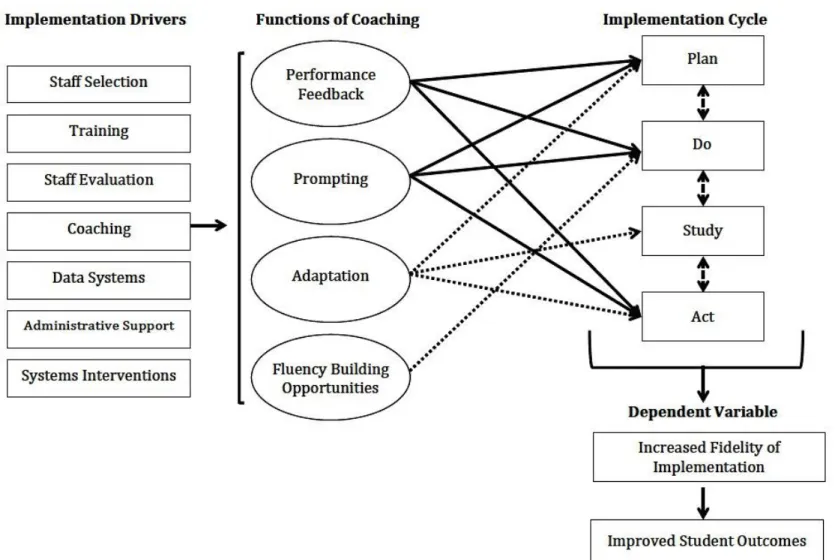
This study defines coaching as the supportive activities conducted after initial training that increase the speed and precision with which practices are implemented under typical conditions (Massar & Horner, 2015). The logic model describing the strategies and mechanisms by which coaching changes behavior posits four functions of coaching that should be trained and measured: (a) prompting, (b) fluency building, (c) performance feedback, and (d) adaptation. Similar to the aforementioned behavioral coaching model put forth by Freeman and her colleagues, the coaching model in this study is based on the delivery of antecedents and consequences; however, the model also posits that the
provision of fluency building opportunities and supporting with adaptation will increase the likelihood that coaching is successful.
Prompting. Prompts are antecedent events added to a natural environment that increase the likelihood of a target behavior (Kazdin, 1975). Promptingis the delivery of
an antecedent visual, auditory, or physical cue that increases the likelihood of a targeted
response (Joseph, Alber-Morgan, & Neef, 2016). Within coaching, the delivery and fading of prompts serves the function of bringing new skills or behaviors under the control of natural stimuli. Prompting typically emphasizes when a new skill is used.
Prompting has been studied within in the context of human behavior for decades, but mostly in the context of teacher-delivered prompts to increase student behavior (e.g., Risley & Wolf, 1967; Rosenbaum & Breiling, 1976). Research has studied numerous methods of prompting, including the use of (a) physical prompts (e.g., Thompson,
McKerchar, & Dancho, 2004); (b) tactile prompts such as vibrating pagers (e.g., Petscher & Bailey, 2006; Taylor, Hughes, Richard, Hoch, & Coello, 2004) and other electronic devices like the MotivAider (e.g., Amato-Zech, Doepke, & Hoff, 2006; Mowery, Miltenberger, & Weil, 2010); (c) gestural and visual prompts such as pointing to picture cards (e.g., Trahan, Donaldson, McNabney, & Kahng, 2014), posters (e.g., Bekker et al., 2010) and in-app touchscreen cues (e.g., Hiniker et al., 2015); and (d) verbal prompts from adults (e.g., Yakubova & Taber-Doughty, 2013) and peer verbal prompting (e.g., Flood, Wilder, Flood, & Masuda, 2002). Research has also explored the effects of
prompting on numerous dependent variables, including academic outcomes (e.g., Gibson & Schuster, 1992; Knapczyk & Livingston, 1974; Muth, 1987) and behavioral outcomes (e.g., Faul, Stepensky, & Simonsen, 2012; Wilder, Atwell, & Wine, 2006). Research indicates that prompts are more effective when they are frequent (Lancioni, O’Reilly, &
Basili, 2001) and specific (Hunsaker, 1983). Typically, research evaluates prompting paired with other effective practices such as positive reinforcement.
Prompting is an important part of establishing stimulus control and is therefore considered a function of both effective training and effective coaching. The purpose of delivering prompts during training is to support fewer errors in learning during
acquisition and to “over-determine correct… responses during acquisition” (McDowell, 1982, p. 1103). While prompting is an important component of training, when an individual learns a skill in the training context it can be difficult to implement the skill under naturally occurring conditions.
When behavior is differentially controlled by antecedent stimuli and is more likely to occur in the presence of the discriminative stimulus then the behavior is
considered to be under stimulus control (Terrace, 1963; Touchette, 1971). The purpose of delivering prompts during coaching is to bring the desired behavior under stimulus control in the natural context. Prompts are typically stimuli that already control a desired behavior and are presented with natural stimuli in an effort to (a) elicit the target behavior and (b) occasion reinforcement of that behavior (Touchette & Howard, 1984). In
coaching, stimulus control transfers away from the prompt to naturally occurring stimuli by gradually removing the prompt. Coach-delivered prompts such as reminders,
modeling, or direct help establish stimulus control of newly trained skills in the classroom environment.
Fluency Building. Fluency is a term used to describe the accuracy and speed of behavioral responding (Binder, 1988, 1996; Howell & Lorson-Howell, 1990). Fluency building is the process by which multiple and sufficient opportunities for practicing
newly acquired skills are provided in order to increase the likelihood of using skills correctly and quickly in naturally occurring conditions (Horner, 2015). Building fluency is necessary for a newly acquired skill to be functional and easy to use. There is an
increased likelihood that new skills will generate naturally-occurring reinforcers when the skills are developed with the necessary fluency to be easy and effective (Fabrizio & Moors, 2003; Weiss, Pearson, Foley, & Pahl, 2010). Building fluency reduces response effort and increases the likelihood that the use of a new skill will contact reinforcement in the natural environment (Billington, Skinner, & Cruchon, 2004; McCallum, Skinner, Turner, & Lee, 2006).
Numerous studies indicate positive outcomes associated with establishing behavioral fluency, including retention, endurance, and application (Beck & Clement, 1991; Haughton, 1972; Kubina & Morrison, 2000). Binder (1996) defined retention as the ability to recall and use information after a period of time without the opportunity for practice. Various studies have documented a relation between fluency and increased retention (e.g., Berens, Boyce, Berens, Doney, & Kenzer, 2003; Péladeau, Forget, & Gagné, 2003). Endurance is defined as the ability “to perform [a] skill for a long period of time without fatigue and despite distractions” (Bucklin, Dickinson, & Brethower, 2000, p. 143). Research has indicated that increasing behavioral fluency results in an increase in endurance (e.g, Binder, Haughton, & Van Eyk, 1990; Kim, Carr, Templeton, & Bird, 2001). Finally, application is defined as the ability to transfer component
behaviors to composite behaviors (Kubina & Wolfe, 2005). Building fluency in component skills is related to an increase in performance of composite skills (Barrett,
1979; Kubina, Young, & Kilwein, 2004; Lin & Kubina, 2005; McDowell, McIntyre, Bones, & Keenan, 2002; Smyth & Keenan, 2002) and increases response efficiency.
Coaching to support fluency building is necessary when a skill has been
accurately established in an individual’s behavioral repertoire during training but (a) an individual has not developed efficient and effective use of a skill or (b) the skill is not used enough to be sustained by natural reinforcers. Coaching can support an individual to use a new skill with the requisite ease and efficiency to be sustained by natural
consequences. Methods of building fluency include allocating time to practicing skills, identifying skills for development, and providing frequent opportunities for practice within the natural environment. Fluency building within the coaching framework may increase the endurance and application of newly trained behavior and increase the
likelihood of using newly trained skills accurately and quickly in the natural context.
Further, using skills accurately and efficiently reduces response effort and increases the likelihood that the skills will be reinforced.
Performance Feedback. Performance feedback is direct and specific feedback
provided about the form, context, accuracy or frequency of an individual’s behavior. Performance feedback can be used to change the likelihood of a new skill being used (e.g., reinforcement or punishment) or to improve the precision with which a new skill is used (e.g., shaping). Performance feedback is arguably the most widely recognized and researched coaching component (Knight, 2007; Sprick, Knight, Reinke, Skyles, & Barnes, 2010); however, the definition, behavioral principles that underlie its
effectiveness, and the extent to which feedback is related to specific positive outcomes remain contested (Alvero, Bucklin, & Austin, 2001; Cavanaugh, 2013). Mortenson and
Witt (1998) state that performance feedback supports “the transfer or maintenance of knowledge and behaviors” (p. 614). For the purposes of this study, performance feedback is defined as coach-delivered consequences associated with the occurrence of targeted teacher behaviors.
A large body of research exists documenting the relation between performance feedback in professional development efforts and an increase in teachers’ implementation of academic and behavioral interventions (e.g., Codding, Feinberg, Dunn, & Pace, 2005; DiGennaro, Martens, & McIntyre, 2005; Mortenson & Witt, 1998; Noell et al., 2000; Noell, Witt, Slider, & Connell, 2005; Sterling-Turner, Watson, & Moore, 2002; Wickstrom, Jones, LaFleur, & Witt, 1998). Fallon and colleagues (2015) conducted a systematic review and evaluation of single case research related to performance feedback and found strong evidence to support its designation as an evidence-based practice according to What Works Clearinghouse standards (WWC; Kratochwill & Levin, 2010).
Solomon, Klein, and Politylo (2012) conducted a meta-analysis examining the relation between performance feedback and treatment integrity and identified three key characteristics of performance feedback: (a) target behavior, (b) setting, and (c)
immediacy of delivery. Although these characteristics varied across the studies, the authors found that performance feedback “resulted in significant behavioral change… regardless of setting, dependent variable, delay of feedback, or type of intervention” (p. 170). Akalin and Sucuoglu (2015) identified three characteristics of performance feedback based on the work of Van Houten (1980): content, frequency, and source. The content of the performance feedback is related to the extent to which the feedback is “corrective, general, positive, or descriptive, in addition to the way in which it is offered”
(p. 741). The frequency and timing of performance feedback delivery is another core feature of feedback. Typically, weekly performance feedback is preferable to more frequent schedules of delivery (e.g., daily) unless extra support is needed to support teacher improvement or performance. The final characteristic of performance feedback is the source, or individual(s) who is delivering the feedback (e.g., coach, peer, principal).
Coaches may deliver feedback that is reinforcing or corrective, contingent upon the observation of performance in the natural context. Coaching may consist of verbal, written, or video feedback and may be delivered immediately after an observation or on a delayed schedule. The frequency of performance feedback delivery may also vary, from daily feedback to yearly feedback. Coach-delivered performance feedback may increase the precision and frequency of desired behavior(s) and support maintenance of trained skill(s) over time.
Adaptation. Adaptation is the process by which the features of a program, intervention, or curriculum are aligned with the skills, resources, administrative support, and values of the local environment (e.g., school staff, students, families, and
community) (Carr, 2007; Fallon, O'Keeffe, & Sugai, 2012; McIntosh, Moniz, Craft, Golby, & Steinwand-Deschambeault, 2014; Sugai & Horner, 2002). Much of the research on adaptation of EBPs and evidence-based interventions (EBIs) derives from the
literature base on health and prevention science (e.g., Castro, Barrera, & Martinez, 2004). The diffusion of intervention theory (Rogers, 2002) claims that changes to an
intervention are inevitable when translating from research to practice (Miller, Sorenson, Selzer, & Bringham, 2006; Tabak, Khoong, Chambers, & Brownson, 2012).
ensure that during the process of systematic adaptation the core features, active
ingredients, or “kernels” (Embry, 2004) of an intervention are implemented with fidelity (Freire, Perkinson, Morrel-Samuels, & Zimmerman, 2015; McKleroy, Galbraith,
Cummings, & Jones, 2006; Solomon, Card, & Malow, 2006; Wingood & DiClemente, 2006).
There is also a growing expectation that educational innovations be culturally responsive. Cultural responsiveness requires sustained used of the core features of an intervention but with modifications that allow these features to be realized within a local cultural context. Coaches should be able to support teams through the adaptation process, while ensuring that the core features of the intervention are implemented with fidelity.
Adaptation may be the least well-understood component of coaching because its necessity is contingent upon the specific events and contexts within which a coach works and the stage of implementation for the school or teacher. For example, adaptation may be necessary during the installation or initial implementation stages to support increasing contextual fit of a program or intervention. Within this process, the coach supports the team in assessing and identifying practices or procedures that can be adapted to increase alignment with the skills, resources, administrative support, and values of the local environment. Adaptation may also be necessary during later stages of implementation when specific barriers arise and threaten the fidelity of implementation of the program or change factors related to contextual fit. For example, when a school encounters
administrator turnover or loss of district-level implementation support while in the full implementation stage, a coach can support the team to adapt certain practices to ensure
that implementation can continue, while the core features of the practice or intervention remain in place.
A Program of Coaching Research
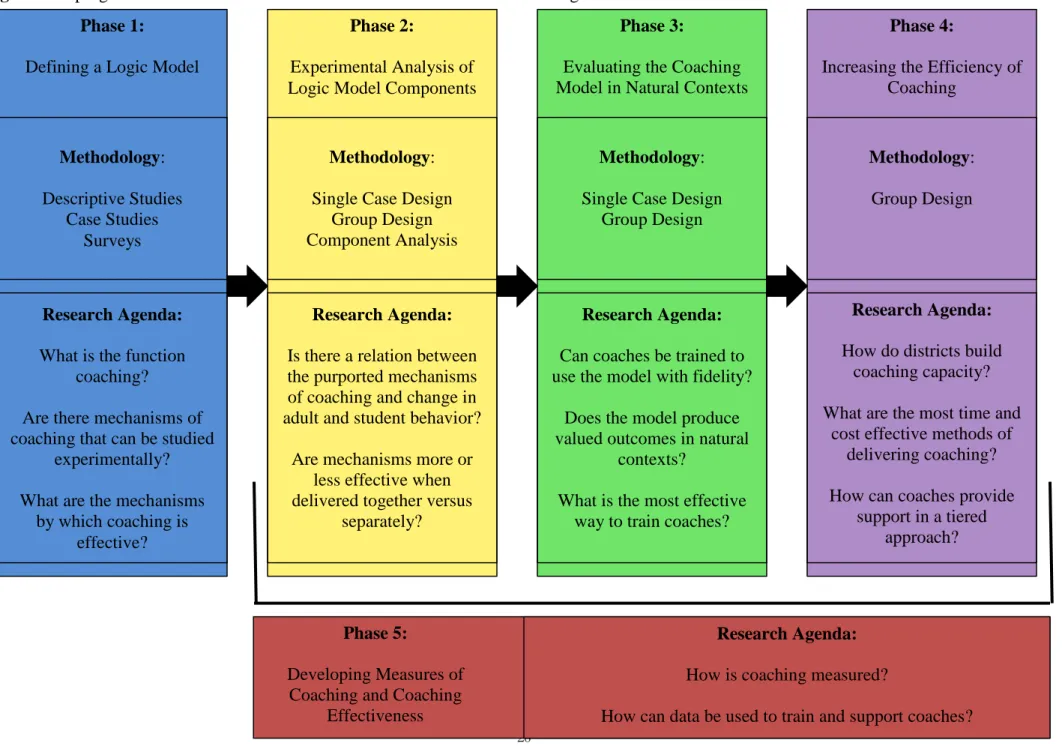
A program of research (see Figure 3) based on the coaching logic model (see Figure 2) allows for the development of a thorough and fine-tuned analysis of the mechanisms by which coaching is effective at producing behavioral change.
Experimental analysis and evaluation are necessary in order to build consensus about the mechanisms of coaching and to design effective coaching support and interventions. Measurement and evaluation of coaching through a specified conceptual framework is essential for valid and reliable assessment of impact. When evaluating the role and impact of coaching, it is imperative to measurethe same operationalized concept across studies in order to ensure validity of results.
Currently, coaching to support the implementation and sustained use of EBPs is typically measured by adherence (e.g., was coaching received?) and as an auxiliary component of a larger intervention. Adherence is a limited, prescriptive method for measuring the fidelity of implementation of an intervention or program. It does not allow for researchers to evaluate the nuanced components of complex interventions and
interactions. Viewing the measurement and evaluation of coaching beyond adherence “…may be helpful in delineating critical dimensions of an intervention and assuring those components remain when the intervention is put into practice” (Schulte, Easton, &
Parker, 2009).
The first phase of the coaching research program is intended to define the coaching logic model with operational precision. Within this phase of research, the research agenda
centers on (a) defining the functions of coaching, (b) determining the functions of coaching that can be analyzed experimentally, and (c) assessing the mechanisms and extent to which the purported functions of coaching are effective at producing desired change. Research methodologies that support this agenda include descriptive, case study, and survey research.
The second phase of coaching research is designed to experimentally evaluate the coaching mechanisms and functions defined within Phase 1. The research agenda consists of (a) determining the contexts and extent to which a relation exists between the functions of the coaching logic model and desired change in adult and student behavior and (b) whether the functions of coaching are more or less effective when delivered together. Single case design (SCD), group design, and component analysis research methodologies support the research agenda within Phase 2.
The third phase evaluates the effectiveness of the refined coaching model within natural contexts such as schools. The research agenda examines the extent to which (a) coaches can be trained to use the coaching model with fidelity, (b) the coaching model produces valued outcomes within natural settings, and (c) training can be designed and delivered in an efficient and effective manner. Single case and group design research methodologies can support the research agenda outlined in the third phase of the research program.
The fourth phase of the proposed program of research is designed to increase the efficiency of coaching delivery and scaling-up of coaching supports. Group design studies that examine (a) the methods by which districts can build coaching capacity, (b) the most time- and cost-efficient methods for delivering coaching, and (c) the ways in
which coaches can provide tiered approach based on a continuum of teacher support needs.
Although labeled as the fifth phase in the program of research, developing measures of coaching and coaching effectiveness will occur in an ongoing, iterative development process. The goal of this phase is to develop methods for coaching evaluation that move beyond adherence and focus on the quality and frequency with which effective coaching practices are delivered. An important component of the research agenda within this phase is to understand how to use data collected from coaching
measures to better train and support coaches.
Initial Descriptive Research on the Coaching Logic Model
To develop this study, the primary investigator conducted two initial descriptive coaching studies. The purpose of these descriptive studies was to develop a logic model for coaching. Neither study establishes any causal claims related to coaching; however, the research does provide initial data supporting the coaching logic model used in the experimental dissertation study.
Mechanisms of Effective Coaching (MECA) Survey. The first study was
developed from a one-year research grant funded by the WING Institute. The purpose of the MECA study was to evaluate the mechanisms of effective coaching within the context of implementing school-wide positive behavior interventions and support
(SWPBIS; Horner & Sugai, 2000; Horner, Sugai, Todd, & Lewis-Palmer, 2005; Sugai & Horner, 2009). Specifically, this study aimed to descriptively analyze a conceptual model of coaching that included four mechanisms: (a) prompting, (b) fluency building, (c) performance feedback, and (d) adaptation.
Figure 3. A program of research to evaluate the mechanisms of effective coaching. Methodology: Descriptive Studies Case Studies Surveys Research Agenda:
How do districts build coaching capacity? What are the most time and
cost effective methods of delivering coaching? How can coaches provide
support in a tiered approach?
Phase 1:
Defining a Logic Model
Methodology:
Single Case Design Group Design Component Analysis
Research Agenda:
Can coaches be trained to use the model with fidelity?
Does the model produce valued outcomes in natural
contexts?
What is the most effective way to train coaches?
Phase 2:
Experimental Analysis of Logic Model Components
Methodology:
Group Design
Research Agenda:
What is the function coaching? Are there mechanisms of coaching that can be studied
experimentally? What are the mechanisms
by which coaching is effective?
Phase 3:
Evaluating the Coaching Model in Natural Contexts
Research Agenda:
Is there a relation between the purported mechanisms of coaching and change in adult and student behavior?
Are mechanisms more or less effective when delivered together versus
separately?
Methodology:
Single Case Design Group Design
Phase 4:
Increasing the Efficiency of Coaching
Phase 5:
Developing Measures of
Research Agenda:
The study was conducted with experienced external coaches supporting SWPBIS implementation in elementary and middle school settings. The perceptions of both school team members and coaches were assessed to determine if the four coaching functions were used and experienced, and if the process was associated with improved implementation of SWPBIS. The study examined the following research questions:
a. Did school teams receiving direct coaching improve their implementation of SWPBIS?
b. Did coaches perceive themselves as delivering the four coaching functions? c. Did teams perceive themselves as receiving each of the coaching functions? d. Were there specific coaching activities that were critical to improving SWPBIS
implementation, as perceived by coaches and team representatives?
The coaches and team representatives were asked to evaluate (a) how often, (b) in what way, and (c) with what effect in relation to SWPBIS implementation each
mechanism of coaching was delivered or received. Results from the study indicate that coaches and SWPBIS team members consider all four mechanisms to be important components of effective coaching. Further, coaches reported delivering and team representatives reported receiving the mechanisms of prompting, fluency building, and performance feedback often. They did not report “adaptation” being delivered or
received. Teams receiving coaching after initial training sustained or improved their level of implementation of SWPBIS.
Coaching Pilot Study (CPS). The coaching pilot study (CPS) was conducted
to determine the feasibility, effectiveness, and usability of the research design, data collection instruments, and data collection procedures that are being proposed for the full
dissertation study. The study was conducted with two Kindergarten teachers with one and eight years of teaching experience. Participating teachers had requested support from the district-level coaches related to classroom management and class-wide PBIS systems implementation. The pilot study evaluated the following research questions:
a. Is coach-delivered prompting related to an increase in teacher use of evidence-based classroom management practices?
b. Is coach-delivered performance feedback related to an increase in teacher use of evidence-based classroom management practices?
c. Is coach-delivered prompting with performance feedback related to an increase in teacher use of evidence-based classroom management practices?
d. Are the (a) research design, (b) data collection materials, and (c) data collection procedures appropriate for an experimental analysis?
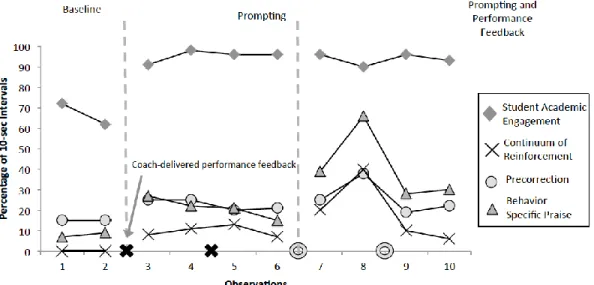
Results from the pilot study indicated that delivered prompting and coach-delivered performance feedback were measureable and associated with increased use of targeted class-wide PBIS practices. The results for Participant 1 are included in Figure 4. The results for Participant 2 are shown in Figure 5. Participant 1 was a first year female Kindergarten teacher with 19 students. Based on initial observation data, her two target areas for coaching support were increasing academic opportunities to respond (OTRs) and increasing the delivery of prompts or precorrection. The asterisk for academic OTRs indicates a change made to the data collection materials during the first intervention phase. In baseline, all OTRs (academic and non-academic) were included in the 10-second interval recording procedures. In the prompting and prompting with performance
feedback phases only academic OTRs were recorded. It is important to note that although there is an increasing trend in baseline phase for rates of OTRs, the rates of academic OTRs did increase in the intervention phases. Student academic engagement was
Figure 4. Results for Participant 1 from Coaching Pilot Study.
recorded using a composite measure of all students in the classroom. A student was randomly selected every minute of the 20-minute observation session. Student behavior was recorded using a 10-second whole interval time sampling procedure. Data was collected on the delivery of behavior specific praise statements (BSPS); however, this EBP was not coached. The level, trend, and variability of teacher-delivered BSPS remained steady through the entire study for Participant 1. The average amount of transition time from moving to the carpet to beginning instruction was also calculated using latency recording. In baseline, the average time between moving to the carpet and beginning instruction was eight minutes and 25 seconds (506 seconds total) for
Figure 5. Results for Participant 2 from Coaching Pilot Study.
Participant 2 was a female Kindergarten teacher with eight years of teaching experience and 29 students in her classroom. Based on the results of the initial observation, the two target areas for coaching were utilizing a continuum of
reinforcement (e.g., verbal praise, reward system, and individual, small group, and whole group reinforcers) and increasing delivery of behavior specific praise statements (BSPS). Student academic engagement data was recorded using a composite measure of all students in the classroom. Data on the delivery of prompting and precorrection was collected but the EBP was not coached. The level, trend, and variability of teacher-delivered prompting remained steady across baseline and intervention phases for Participant 2.
The CPS study informed changes to the full dissertation study related to the data collection materials and data collection procedures. The initial proposal identified student problem behavior from a small group of students (three to five) as the secondary
determined that a composite measure of student academic engagement based on a random sample of students would be a more appropriate measure of the cascading logic model. The students with the most frequent problem behavior may require more intensive supports (i.e., targeted or intensive) and may not respond to class-wide interventions in the same way as a composite of all students would be expected to respond.
Coaching was also be delivered on a weekly basis rather than multiple times per week. Performance feedback was provided in person and prompting was delivered via email on the same day each week. Data collection tools were refined and observation times were reduced from 30-minute sessions to 15-minute sessions. The initial research studies helped establish the logic model, processes, and procedures for implementing a full experimental analysis of the coaching mechanisms within classrooms.
Class-wide Positive Behavioral Interventions and Supports (CW-PBIS)
The study evaluated the effects of coaching on teacher implementation of class-wide positive behavioral interventions and supports (CW-PBIS). CW-PBIS refers to the evidence-based practices implemented in the classroom at the universal tier of SWPBIS. CW-PBIS practices include (a) maximizing structure, (b) actively engaging students during instruction, (c) establishing and teaching positively stated expectations, (d) implementing a continuum of strategies to reinforce appropriate behavior, and (e)
implementing a continuum of strategies to respond to inappropriate behavior (Simonsen, Fairbanks, Briesch, Myers, & Sugai, 2008; Simonsen et al., 2014). Research has
indicated that these classroom management practices are related to numerous positive student outcomes (Brophy, 2006; Haydon et al., 2010; Malone & Tietjens, 2000; Rusby, Crowley, Sprague, & Biglan, 2011).