Procedia Computer Science 00 (2018) 000–000
www.elsevier.com/locate/procedia
SEMANTiCS 2018 – 14th International Conference on Semantic Systems
Value-driven partner search for
Energy from Waste
projects
Aba-Sah Dadzie
a, Victoria Uren
b,∗, Tim Miller
c, Al-Amin Abba-Dabo
caKMi, The Open University, Milton Keynes MK7 6AA, United Kingdom
bAston University, Aston Triangle, Birmingham B4 7ET, United Kingdom
cEuropean Bioenergy Research Institute, Aston Triangle, Birmingham B4 7ET, United Kingdom
Abstract
Energy from Waste (EfW) projects require complex value chains to operate effectively. To identify business partners, plant operators
need to network with organisations whose strategic objectives are aligned with their own. Supplier organisations need to work out where they fit in the value chain. Our aim is to support people in identifying potential business partners, based on their organisation’s interpretation of value. Value for an organisation should reflect its strategy and may be interpreted using key priorities and KPIs (key performance indicators). KPIs may comprise any or all of knowledge, operational, economic, social and convenience indicators. This paper presents an ontology for modelling and prioritising connections within the business environment, and in the process provides means for defining value and mapping these to corresponding KPIs. The ontology is used to guide the design of a visual representation of the environment to aid partner search.
c
2018 The Authors. Published by Elsevier B.V.
This is an open access article under the CC BY-NC-ND license (https://creativecommons.org/licenses/by-nc-nd/4.0/)
Peer-review under responsibility of the scientific committee of the SEMANTiCS 2018 – 14th International Conference on Semantic Systems.
Keywords: Value chains; Ontologies; Business networks; Triple bottom line; KPIs
1. Introduction & motivation
Our problem domain concernsEnergy from Wastevalue chains. Energy from Waste projects take waste products,
such as agricultural, food or municipal solid waste (MSW), and use them to generate energy and other valuable by-products. If well designed and run, a waste to energy system is an economic and environmental win-win, with waste producers finding beneficial solutions to their waste disposal problems and plant operators producing useful outputs.
However such projects are complex. At the planning stage, operators need to prove compliance with relevant en-vironmental legislation, and gain community support to get planning consent. The underlying processes are relatively novel and technologically complex; setting a plant up requires engineering partners to build and run it properly. In op-eration, the plant must be matched to a consistent supply of wastes over a long period to achieve return on investment. Identifying a value network which provides all the required competencies is therefore essential and a potential barrier. The European Bioenergy Research Institute (EBRI) at Aston University, UK, has identified more than thirty
types of partners which may be required in an Energy from Waste (EfW) value network [1,2]. These include technical
∗
Corresponding author. [email protected]
1877-0509 c2018 The Authors. Published by Elsevier B.V.
This is an open access article under the CC BY-NC-ND license (https://creativecommons.org/licenses/by-nc-nd/4.0/)
services, such as engineers, plant operators, construction, safety systems suppliers and lab services. Ancillary services include finance, accounting, legal services, accreditation consultants and IT. Logistical support is required to transport waste, and collection and concentration services are needed to accumulate and safely store waste until it is needed.
Arguably, the most crucial link in the value network for Energy from Waste projects is matching feedstock suppliers to plants. Both parties have specific needs which must be met for them to extract value from the partnership. In general,
the plant requires a consistent supply of the right kinds of feedstocks at an affordable cost. The waste producer needs a
convenient disposal method, ideally one in which the plant pays, or does not charge, to remove the waste. Geographical location may therefore play a significant role in the design of value networks, in order to minimise transportation costs.
Section1.1provides a couple of examples that show how these relationships might play out.
1.1. Use cases
A relatively simple type of plant is an on-farm anaerobic digester (AD) [35]. This is a system in which bacteria
are fed on shredded agricultural waste products, mixed in water, to produce biogas (methane) and heat. ADs need a start-up phase during which the bacteria responsible for the digestion stabilise. After this the digester has to be fed steadily, at the rate it can consume the waste, and with a “diet” of the right mix, of e.g., manure and dry wastes such as straw. Therefore, to keep a digester running for all twelve months of the year a farmer may need to partner with
neighbours whose crops and livestock produce wastes in different seasons. Technical advice will be needed on the
most appropriate type of digester, the mix and the feedrate required to be efficient. The supply chain, delivering from
feedstock producers, needs to match the technical requirements for the plant.
If the complexity of this small-scale scheme seems daunting, consider how much more difficult the situation might
be for a partnership between a hospital and a tri-generation (combined cooling, heat and power, or CCHP) combustion
plant [12]. Here MSW is the feedstock, the setting is urban, the combustion process has a historically poor reputation
for polluting, and the regulatory framework is tight in a healthcare setting. The hospital, sited in a city, needs to be partnered with a combustion plant, which, as a potential polluter, is likely to be in an area with low population density,
in order to get planning consent. This will not meet the hospital’s heat/cooling needs since the plant will be too far
from the hospital site to efficiently pipe hot water to it. Therefore the plant needs to ensure other consistent demand
for its outputs, e.g. a partner with a need for heat and/or cooling, located near by. An efficient logistics network will
also be required to move hospital waste to the plant at an affordable cost. For a more detailed consideration of the full
value network we direct the interested reader to, e.g. [1,35].
At the planning stage, potential partners need to identify each other and assess the fit between their strategic
objectives, in order to ensure mutually beneficial relationships [33]. Continuous awareness of other organisations in
the network is also required to ensure that value can continue to be extracted from relationships over the long term. A typical example is that EfWplants whose business models rely heavily on gate fees (charges per load arriving at the
plant) can suffer rapid drops in feedstock supply if competitors with lower or no gate fees join the market. EBRI is
facilitating the networking of potential Energy from Waste project partners in the West Midlands region of the UK,
taking a Digital Business Ecosystems (DBE) approach [36]. DBEs can be defined as “evolutionary, self-organising
systems which create an on-line, digital market place to seamlessly connect organisations, companies and individuals
that do business with each other” [40].
This paper reports the design and prototyping of a semantic information system to help organisations identify strategic partners within a DBE. The assumption was made that partner selection is based on value they can deliver. The foundation of the prototype is an ontology derived from user-centred design sessions undertaken by the authors in collaboration with researchers at EBRI. The ontological model bridges the general business concept of value, modelled as KPIs, to the specific application domain of Energy from Waste projects in order to support the visual exploration
of different kinds of value.
2. Value chains & value networks
DBEs conceive of information and communication technologies (ICTs) as facilitating and supporting mechanisms for companies facing the challenges posed by the 21st century business environment. The challenges of increasing scarcity and cost of resources, and rising transaction costs encourage collaboration within networks of organisations, to
pool (core) competencies, physical, knowledge and other resources; capitalise on shared synergies; share and therefore
defuse risk and reduce uncertainty; increase agility, sometimes simply to survive [3,33]. The overriding goal is to
trigger innovation through diversity and increase competitiveness, to generate value above that each actor could in
isolation, for both (internal) stakeholders and (external) customers [9].
Gereffiand Fernandez-Stark[23] highlight the importance ofglobalvalue chains, to allow smaller, more
disadvan-taged players – communities and organisations – to access resources. They consider the entire length of the (value) chain, from input of raw material to final goods and services delivered, to identify where and how value is added. We consider chains on a smaller, local level; however the factors that play into global chains still have impact, albeit on a
lower scale. For instance,Abreu and Camarinha-Matos[3] posit imbalance of power within supply chains as a driver
in buyer or supplier advantage. An example in our case is the hospital; as a year-round, mid- to large-sized feedstock supplier it has substantial control over cost. On the other hand, smaller community plants, with much lower (political and economic) power and reach, have correspondingly lower bargaining power in sourcing feedstock, complicated further by a limited range (geographical distance and supply cycle) beyond which cost may exceed gains. In such cases, mutual gains are often achieved by uplifting waste (feedstock) from multiple, smaller, local suppliers, such as
offices, schools and small-to-medium enterprises (SMEs), at low to no cost, in order to achieve the scale needed to
break even or make a profit. The reverse also applies, where smaller waste-generating organisations in a locality may drive down transaction costs while increasing service levels for waste disposal with a shared contract.
The value chain in this case evolves to resemble more of a network, with greater inter-dependency between
organi-sations, working together to create value shared across contributors [29]. Fig.1aillustrates where value may be added
along the Energy from Waste process, highlighting also where mutual gains can be found.
Stakeholders Systems & processes Organisations Supply chain Transport & logistics Feedstock
Heat & power
(Green) finance Customer engagement Marketing Knowledge resources Technological innovation
Value
(a)PREFIX so: <http://schema.org/>
PREFIX geo: <http://www.geonames.org/ontology#> PREFIX efw: <http://www.ebri.org/efw#> PREFIX kpionto: <http://kdmg.dii.univpm.it/kpionto#>
SELECT DISTINCT ?organisationUri ?organisationName ?value ?valueType ? performanceIndicator ?businessObjective ?metric
WHERE {
?organisationUri so:legalName ?organisationName ; efw:hasValue ?value .
?value efw:relatesTo ?businessObjective ; # defined by organisation efw:type ?valueType ; # e.g., Operational, Economic, Convenience, ELSI efw:hasMetric ?performanceIndicator .
?performanceIndicator efw:isA ?kpi .
?performanceIndicator rdf:type ?metric # Social/BusinessMediaMetric
} GROUP BY ?valueType
ORDER BY ?organisationName?performanceIndicator ?businessObjective
(b) Formalising value using an ontology (see Fig.6) supports organisations in cap-turing and aligning values across a single and multiple organisations, to identify where mutual gains may exist, across organisations and between stakeholders. Fig. 1. The value network for small-scale, local Energy from Waste plants, showing the role of different stakeholders in creating and sharing value.
To reap fully the benefits in a value chain requires unambiguous definition and alignment of the values of the
sometimes disparate organisations that must work together and trust that value is fairly distributed [7,33].Abreu and
Camarinha-Matos[3],Grac¸a and Camarinha-Matos[26] find that value alignment has the benefit of simplifying the
derivation of Key Performance Indicators (KPIs) that may be used to measure added value sought by each organisation
and that gained by the group as a whole. As in our model (see section 4 and Fig.6), value seen may vary from
increasing economic return to more qualitative assessment of reputation, by considering social and ethical factors in
business operations. Fig.1billustrates how formalisation of different values against business objectives aids alignment,
and therefore, querying data about the network to determine (relative) similarity across organisations.
The definition of value for an organisation may change with external context. While economic and social value
may be correlated, in some cases explicit tradeoffs may be required between (immediate) economic and social return.
This is typically seen where community support is critical to business operations and the regulatory environment, or where action is required to build social capital to repair negative reputations in an organisation or industry. Here, reducing waste and pollution serves as ethical and social capital, contributing to value.
3. Partner selection
The creation of partnerships in such value networks has been operationalised variously as supply chain design, supplier selection or as Partner Search and Selection (PSS). Supply chain design concerns the siting and capacity
of plants and the selection of suppliers [34]. Green supplier selection includes consideration of potential partners’
environmental performance [25]. PSS is a special case of supply chain design deployed in Collaborative Networks to
identify logistics partners for Virtual Organisations (VOs). A VO is a specific kind of business ecosystem in which an alliance of business entities, often small or medium-sized enterprises, come together for a period of time and pool their capabilities in order to take advantage of a particular business opportunity.
A wide range of methods have been researched for these partner selection techniques. These do not necessarily mention value, per se, but they are typically framed by identifying the criteria which an organisation desires its supply
chain partners to meet. Chai et al.[8] review decision making techniques for supplier selection, classifying them
broadly as multi-criteria decision making, mathematical programming and artificial intelligence methods.Govindan
et al.[25] review the literature in green supplier selection in particular. They identify the use of quantitative processes,
such as the Analytical Hierarchy process, Data Envelopment Analysis and fuzzy set theory. They draw attention to the need for methods to reflect “the organisation’s specific requirements” and conclude that, in green supply chains, selection decisions can be socially sensitive.
The problems associated with turning “soft” criteria into quantifiable metrics has been identified by commentators on the Triple Bottom Line (TBL) approach to organisational reporting. TBL was introduced by Elkington in the 1990s
as a framework for businesses to assess their performance against economic, social and environmental criteria [18].
Although metrics have been proposed for all three parts of the TBL, e.g., [38], critics have argued that it would be
“impossible to formulate a sound and relatively uncontroversial methodology to calculate a social bottom line” [37].
Ahi and Searcy[4] have noted that most of the metrics published in the literature on sustainable supply chains were
only used once, implying there is little consensus on how to measure performance in this area. Further,Hassini et al.
[27] identified the difficulty associated with developing reliable metrics for performance in sustainable supply chains.
Based on these reported issues with quantifying metrics, we argue that, in the DBE context, it is not reasonable to
ask organisations to undertake a standardised reporting process simply to network with potential suppliers/partners and
monitor the competitive environment. Therefore a design decision was made to develop a methodology which could handle multiple selection criteria, without relying on quantitative methods. An ontology would be used to capture this multi-criteria, value-driven ecosystem, and to model and prioritise connections within the business environment, to guide the design of a visual representation of the environment to aid partner search.
4. Ontology
The proposed ontology will provide the backbone for the system in the form of a model of the business environ-ment. This will support the description of projects, stakeholders, timelines, service providers, connections between organisations, types of waste material and so forth. The core purpose of the ontology is to model value, as it relates to
key business objectives, through these different components. This is to support users in identifying potential partners
who can deliver value against their desired objectives. We make the assumption that value for a particular organisation,
while it will be of different types (economic, social, environmental etc.) can be described using KPIs. Therefore, we
explore relevant work on modelling value via KPIs, which informed the design of the ontology, considering first the business literature, and then literature published by the ontology community.
The business literature proposes a number of theoretical frameworks for performance metrics. These higher level categorisations help to make sense of the multitude of indicators, and can be used strategically for business
perfor-mance monitoring. One such is the Triple Bottom Line [18] discussed in section3. Another isKaplan and Norton’s
well-known Balanced Scorecard [30], with its four perspectives of financial, customer, internal business processes,
and learning and growth measures. Environmental frameworks include the Sustainable Balanced Scorecard proposed
byHubbard[28], which adds social and environmental performance measures toKaplan and Norton’s original four
perspectives, and the Natural Resource Based View of the firm, with its framework of pollution prevention, product
stewardship, and sustainable development [e.g.24,17]. These high level models reflect the diverse kinds of value that
As seen, partner selection involves the setting of criteria, operationalised as KPIs or other measures, which reflect organisations’ objectives for value creation. Such KPIs need to be understood by both parties; a number of supporting
frameworks have been proposed. Krathu et al. [32] address this need with their framework and ontology, aimed
at measuring high level KPIs to evaluate inter-organisational relationships. Their framework deploys the Balanced
Scorecard methodology [31], an approach also employed byGrac¸a and Camarinha-Matos[26].Correia Alves and
Rabelo[10] give an example of competency-based selection of logistics partners using a model based on fifteen
pre-defined KPIs.Baldo et al.[6] propose an ontology-based method for cataloguing performance indicators, which they
state may differ in subtle ways because they are supplied by different companies, to provide a searchable index.
For information exchange in established supply chains, standard definitions of common metrics are published by
professional organisations and standards bodies, [e.g.5,19]. Within these, the widely used Supply Chain Operations
Reference model (SCOR) [11] includes definitions of KPIs.Grac¸a and Camarinha-Matos[26] propose the definition
of indicators that extend traditional supply chain management to consider also (environmental) sustainability, an in-creasingly important and in some cases a regulatory necessity, in business operations in the modern era. By ontological standards, some of these are informal definitions; however, they provide a basis for formal conceptualisation.
Several schemas have been proposed to define, measure and evaluate KPIs. At the process level, integration of
performance indicators with the Business Process Modelling Notation (BPMN) is proposed byFriedenstab et al.[22]
to support process monitoring. The PPI (Process Performance Indicators) Ontology [13] also defines performance
indicators which can be linked to BPMN process models. ScoreML [21] was developed as a language for specifying
indicators, which integrates with the MEMO languages for organisation mapping [20].
As a basis for the KPI model in this ontology, we reuse thekpiontoschema proposed byDiamantini et al.[14,15].
The kpionto:Indicator class supports rigorous representation of dimensions, formulae, units of measurement,
business objectives and aggregation functions. It was designed to support uses including search and comparison of indicators, and was demonstrated in a data exploration tool aimed at facilitating data exchange between organisations
in Virtual Enterprises [16]. Hence it is a good fit for the partner selection task.
4.1. Ontology Structure
The EnergyFromWasteontology (EfW) captures the environment in which EBRI, as a hub, serves as a knowledge
broker and aconnectorbetween (potential) business partners. The ontology must serve two purposes: (1) provide a
structured approach that supports automatic annotation and enrichment of scenarios and relevant documents; (2) sup-port human-readable representation, to allow reuse by domain experts who are not technology experts, to define value
for their organisation and, therefore, their networking requirements. Fig.2shows the top level of EfW, structured to
capture a set of core concepts, each detailed in a sub-ontology (see also DOI:10.6084/m9.figshare.c.4172009).
TopLevelOntology
so: Organization ServiceProvider
FeedStock isA Material isA supplies demands Digestate Value hasValue Stakeholder seesValue foaf: Agent isA isA KPI hasMetric Network linksTo kpionto:Indicator isA JPublic isA isA Customer isA Communication broadcasts broadcastOn
Fig. 2. Top level EfW ontology
org:Organization to aid classification (see Fig.3), and therefore partner selection, to feed into building a:
Network of organisations within the ecosystem, which may contain sub-networks focusing on the requirements of
ServiceProviders may be PlantOperators,FeedstockSuppliers or AncillaryServiceProviders. Some
Customers are alsoServiceProviders, e.g., a hospital that providesFeedstockfor aPlantand also feeds
offthe energy generated. TheLevelOrGradeof theServiceProvideris in this case determined based on the
quantity and frequency of itsFeedstocksupply, along with distance from aPlant.
Feedstock is generated from a variety ofFuelCrops and different types ofWaste(see Fig.4), depending on the
ConversionTechnologyin use at aPlant.
isPrimaryContact StateOrganisation foaf:Agent Corporation SME NotForProfit Startup org:Site geo:Location gumo:Location sameAs org:hasSite foaf:based_near org:Organization org:hasPrimarySite skos:Concept org:classification inServiceSector rdf:Resource EssentialOrFundamental LevelOrGrade Ancillary rdf:Resource hasLevelOrGrade CouncilServiceProvider EducationalInstitution linksTo isContact FeedStock supplies demands ServiceProvider type rdf:type isA isA Network hasContact BusinessNetwork CustomerNetwork PublicNetwork isA linksTo rdf:value hasSupplierCategory so:Organization sameAs seeksLinkTo ServiceSector hasPrimaryServiceSector rdf:value SupplierCategory isA hasWasteManagementProcess Waste consumes isA WasteManagementProcess
Fig. 3. Sub-ontology showing how differentorg:Organization
types link to differentServiceProviders in business, customer and/or public networks.
FeedStock skos:Concept rdf:type AgriculturalWaste FoodWaste FuelCrop AnimalWaste BiologicalWaste isA PlantWaste isA EnergyContent hasProperty Sustainability ConversionTechnology consumes Thermal ThermoChemical Combustion Biological skos:Concept rdf:type isA Abundance HandlingEase Cost Variability OtherWaste NonBiologicalWaste MixedWaste Viability AnaerobicDigestion Torrefaction Gasification isA isA Recycling isA Waste isA Plant has
Fig. 4. TheFeedstocksub-ontology illustrates the impact of aPlant’s
ConversionTechnologyon suitability of inputFuelCrops and type of
Waste.
KPIs provide a means to measureValue, using both qualitative (e.g., ELSI – Ethical, Legal, Social Issues, as part of
CSR – Corporate Social Responsibility) and quantitative metrics, e.g., distance–quantity–frequency weightings
to calculate relative cost of Feedstockfor a range ofServiceProviders. In this scenario we classify
fur-ther metrics based on whefur-ther they focus on economic return (BusinessMetric) orsocial capital[3,26,23]
(SocialMediaMetrics).
Communications sent across the Network are contained in different kinds of Messages. Depending on the
source, Messagetype and target(s) (ContactType), a specific Action may be triggered. For example, an
Operational message broadcast to solicit Feedstockfor an anaerobic digester should trigger anAction
fromServiceProviders, organisations generating waste on the scale required, to satisfy the request.
AProjectOrScheme must be defined, as shown in Fig.5, followingResearchto make a business case that ensures
legal, financial and societal/community requirements are met for a new Plant. The scheme also considers
whichStakeholders may pose aDevelopmentBarrier, in order to identify what measures may be required
to remove these. The overall aim is to ensure thePlantOperatoris able to optimise theNetworkto create
partnerships in line with its BusinessObjectives, to sustain operation throughout itsLifeCyclealong its
(pre-defined), optimalProjectTimeLine, and returnValueto allStakeholders.
Value, which captures an organisation’s strategy, is expressed usingBusinessObjectives. Value cycles and/or
chains are created in the process of convertingWastetoValue, as illustrated in Fig.6. In line with the
multi-faceted approach in the Triple Bottom Line, we define multiple facets that an organisation may consider in
measuringValueto itsStakeholders, beyond economic return and including social and convenience factors,
ProjectOrScheme LifeCycle foaf:Agent hasStakeholder follows hasContractOrAgreementWith Stakeholder Cost Resource Time isA requiresResource PlanningAndLegal Contractor FeedstockSupplier Customer FinanceProvider hasOwner isA isA Lender isA Investor NetworkOperator DistrictNetworkOperator isA RegionalNetworkOperator PowerPurchaser isA EndUser OAndMContractor isA EPCContractor Operator isA Engineer DevelopmentBarrier posesA TRL hasScope org:Site geo:Location foaf:based_near foaf:based_near ConversionTechnology follows Sensitivity CostSensitivity MarketSensitivity Environment causes isA Product generates Value hasValue atTrlLevel atTrlLevel FeedStock consumes supplies demands hasTargetSite tl: TimeLine lowers
Fig. 5. Sub-ontology illustrating the path followed to develop a new project/scheme, legal, regulatory and financial factors that impact success, and barriers that may be faced during planning and operation.
Value Waste Economic ELSI Convenience LegalCompliance CSR ?degrades? type hasValue satisfies Operational generates ConversionProcess feedsInto
(a) Sub-ontology for the waste–value chain.
KPI Value hasMetric kpionto:Indicator
rdfs:label isA UnitOfMeasure kpionto:Formula rdf:Resource hasUnitOfMeasure kpionto:hasFormula BusinessObjective relatesTo rdf:Resource hasValue rdfs:Literal rdf:value rdfs:range rdf:Resource rdf:value time:Instant validUntil SocialMediaMetric BusinessMetric isA
(b) Sub-ontology showing, at a high level, how KPIs may be used to measure value, using qualitative and quantitative metrics.
Fig. 6. TheValue(6a) andKPI(6b) sub-ontologies illustrate the multiple facets that feed into measuring value for organisations and stakeholders.
5. Application
Modeling the business ecosystem using EfW provides a structure on which to build an online space for the hub and
other organisations to carry out partner selection, based on their strategic objectives and shared values. We describe
the outcomes of the participatory design process (section5.1), carried out with domain experts, and the resulting
inter-active, knowledge visualisation prototype (section5.2). Working in tandem with domain experts supports a process of
iterative evaluation, to ensure the design, working prototypes and the DBE delivered to end users meet their require-ments for knowledge acquisition, translation of organisational values to measurable, shareable KPIs, and therefore, optimal partner selection and maximisation of value gained.
5.1. The design process
Macedo and Camarinha-Matos[33], among others, define a relatively fixed lifecycle with specified stages through
which business networks are formed, to ensure collaboration persists such that each organisation, and the group as
a whole, see added value in the long term. We consider identification of potential partners where different kinds of
partners are needed at the differentLifeCyclestages, from commissioning, construction and operation to
decom-missioning. Therefore, we take a different approach, proposing instead an ecosystem in which organisations may dip
in and out, whatGrac¸a and Camarinha-Matos[26] describe as “goal-oriented . . . ad-hoc collaboration”, to form
al-liances of varied strength and duration within an ecosystem that complements business acumen with knowledge and
social capital [9]. These are in essence more compact, sometimes rolling,LifeCycles that evolve with actors’
et al.[9] aptly call an “anchor tenant” – within a digital value network, through which connections are identified and
followed, and which doubles as a knowledge and resource broker (EbriHub, centre, Fig.7a). The design sketches in
Fig.7reflect the business model captured in EfW to illustrate support for classification of organisations, and hence,
placement within the network to satisfy emerging business needs.
(a) Sketch illustrating the start of the classification and net-work population processes, for thePlantregistered with EbriHub(centre).
(b) Bringing additional actors into the network; progress is mapped on theProjectTimeLine(bottom).
Fig. 7. Design sketches illustrating, from theStakeholderperspective, population of the business network to optimise partner selection.
To support differences in perspective and technological expertise we allow each organisation to define Value
guided, but not imposed, by the structure in EfW. We require quantitative assessment only where standard definitions
exist that cross industry and organisation (e.g., in defining profit margins). We are currently defining qualitative models to provide custom support for mapping end users’ definitions of value to more formal representations. We expect
these to evolve as our database grows and different organisation types contribute perspectives on value, based on
their specific needs and those of their sector. The design sketches in Fig.8 illustrate two examplars for qualitative
assessment by a single organisation against others within a sub-network, based on shared KPIs.
(a) An aster plot used to weight three KPIs – Heat & Power (H&P),Wasteand reduction in pollution – against each other.
(b) Assessing loss vs. gain in value for the indicators in8ausing parallel coordinates.
Fig. 8. Exploration of qualitative value assessment models during the design phase, to provide sup-port for organisations within the network in defin-ing core and cross-network values, and map these to corresponding KPIs.
8a weights relative generation of (H&P) against
Wasteinput and reduction in pollution for a
se-lectedServiceProvider, to show how all three contribute to a composite representation of value.
8buses a different perspective, a parallel coordi-nates plot, to compare the contribution of each from a cost perspective, looking at loss and gain in value.
5.2. Interactive visual exploration of strategic partner fit
We use the hospital scenario described in section1.1to illustrate howValueis added through support for partner
selection within the business ecosystem. While based on real data, for privacy reasons the snapshots that follow use a
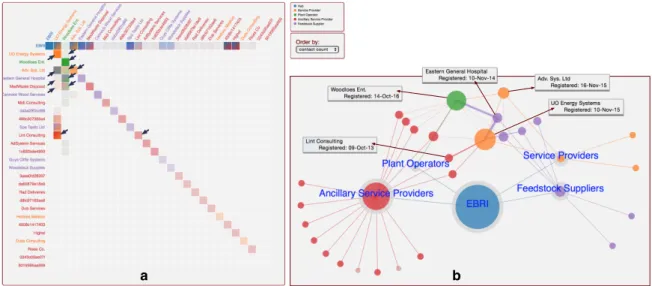
dummy dataset. Fig.9visualises a scenario in which 26 organisations have expressed interest in joining the business
connected to virtual “parent” nodes corresponding to theOrganizationtypes defined in EfW. Each parent is
colour-coded by type (see legend, top, centre), with relative size mapping to total number ofOrganizations of each type.
Parents, distinguished by a light grey border, link to child/instance nodes. Contact count for eachOrganization
instance, a measure of social capital [26], maps to relative node size.
Sub-networks comprising differentStakeholdertypes typically form around keyServiceProviders (orange),
e.g., the energy consultancyUO Energy Systems, the most highly connected organisation in the ecosystem. Such
or-ganisations often serve themselves as a (direct or indirect) connector to other services and providers, by providing, e.g., knowledge resources that help other organisations identify where and how to obtain value through their own
pro-cesses and from theirStakeholders (partners, suppliers and customers). The default perspective of the value network
in Fig.1ais an Energy from WastePlant, the onlyOrganizationthat has direct connections to allOrganization
types in the ecosystem. These (green) nodes should therefore see high connectivity, with different Stakeholders
making and breaking connections through the differentLifeCyclestages of eachProjectOrScheme, as they
pro-vide (value-added) services to or source value from each other. The ecosystem (in Fig.9) includes onePlant, which
forms a sub-network including the Eastern General Hospitaland a secondFeedstocksupplier (purple) It is also
connected to fourAncillaryServiceProviders (red) and the (large)ServiceProviderUO Energy Systems.
Organisations fully registered with EbriHub gainValue from additional services, among others, (1) business
operations and technology support, including testing and technical services, identification of market opportunities and emerging technologies; (2) economic feasibility studies and risk assessment; and (3) (relevant) educational
and informational events [1, 39, 40]. The corresponding components Systems & processes, Technological
inno-vation and Knowledge resources in Fig. 1a all show two-way Value flows within the value network, between
ServiceProviders and otherOrganizationtypes. Two organisations (bothAncillaryServiceProviders) are
yet to formalise a link with the hub – distinguished by faded fill and a thin border in the network view. While such organisations may register to benefit from new knowledge about the sector and for push information from others, they cannot broadcast services to other organisations within the ecosystem, and may have limited access to services provided by third parties.
b a
Fig. 9. Visual representation, using a matrix coupled with a network view to illustrate how relationships between node pairs change with perspective on value. Sub-networks generally cluster around eachparentnode; however, the strength of additional relationships pull different organisations away from their parents and into (temporary) business/operational sub-networks, as seen for thePlant(green, top, b)
Considering the value network in Fig.1afrom the perspective of a hospital, while they provide a year-round supply
of MSW, even large hospitals are unlikely to generate enoughWaste to power their own Plants. They therefore
typically form cooperatives with otherFeedstocksuppliers to feed largerPlants [12]. Such cooperatives provide
the scale to negotiate more cost- and time-efficient contracts with transportation & logistics businesses that uplift and
preprocessFeedstock. Both processes indirectly feedValueinto the ecosystem, through the Energy from Waste
the value network. Such collaboration is especially beneficial for smaller businesses, who otherwise may struggle to
enter the marketplace [1]. An additional benefit is the savings gained by upliftingWastemore regularly from smaller
businesses [39], lowering the need for, and therefore cost of, storage facilities. Finally, the heat and energy generated
byPlants is fed back toCustomers.Valueseen here varies byStakeholder, dependent on the grade of the power
generated and distance from aPlant. Hospitals, for instance, require heating at a minimum of 80-90% [12]; this level
of quality both increases cost of production and requires proximity to the grid, to limit degradation as the heat travels through the distribution network. Environmental and health & safety requirements however typically restrict location
of large Energy from WastePlants, especially within built-up areas. Except where distance from the national grid is
significant, or geographical location isolates institutions from the grid, lower reliability ofPlants increases further
cost to value. Smaller business and domesticCustomers may therefore see relatively higherValuereturns than large,
complexOrganizations such as hospitals (see also Fig.10). The two-wayValueflow betweenOrganizations
and otherStakeholders and theValueconcept at the centre of Fig.1ais visualised with a double-headed arrow.
Fig.9(a – left) shows an asymmetric matrix used for pairwise comparison between organisations. This view, as
does the network (9(b)), uses directional, weighted links, from the (source)Organizationinitiating the connection,
on the left axis (L), to itstarget(top axis, T). Links in the network are colour-coded based on the source node, while
matrix cells uses a gradient from T–L to B–R. Opacity in the matrix and link length and thickness in the network
map toconnectednessorsimilaritybetween organisations; the shorter and thicker the link and the less transparent the
cell, the stronger the connection betweenOrganizations. ThePlant, for instance, is the target of ten businesses
(colour-coded by type), with connections of varied strength. In the matrix, reading from source–target (L–T), down the
column for thePlant,Woodloes Ent., cells corresponding to these businesses are filled. The strongest (most opaque)
link is to theEastern General; this correlates with the visibly stronger (relatively thicker) link between the two nodes
in the network, shorter also than that for the otherFeedstocksupplier. Other key links to thePlantincludeAdv.
Sys. Ltd, which provides logistics and transportation services, itself directly linked to aFeedstocksupplier. The
AncillaryServiceProviderLint Consultingstands out with its very strong connection to the energy consultancy
UO Energy Systems. While not (currently) connected to any other nodes, thisEnergy-from-Waste (EfW) brokerage
service is an example of a smaller organisation that seeks to maximiseValuethrough the business network.
Axes may be (re-)ordered based on pre-specified criteria, with default (Fig.9(a)) bycontact count. This places
EbriHub top, left. Cells along the diagonal map a node to itself; opacity here maps to total contact count for each
Organization, therefore fading progressively to the bottom, right. The blank tiles for the bottom two confirm that
they remain to register fully and link to other organisations. At this early stage in building the ecosystem we see the
hub initiating links withOrganizations, mostly through marketing and informational sessions. (Weighted) links
from the hub to each registered node can therefore be seen along the top row. As the ecosystem grows we expect to
see links moving in the opposite direction, withOrganizations seeking to join the network, based on information
broadcast on the public network, the ecosystem reputation and via connections with existing members.
As discussed, cost and value derived from the network will vary based on a service, the organisation providing it
and physical criteria such as distance, location and logistics services available between businesses, e.g., aPlantand
its suppliers. Fig.10illustrates how these relationships change with KPI. KPIs may measure a singleValue, such as
delivery cycles or gate fees. More complex KPIs may be defined to measure, e.g., shared values (see Fig.8), and
there-fore potential for collaboration. Fig.10borders, for the selectedPlantoperator (top left), best fit for feedstock supply,
by consideringWastetype and relative cost, delivery cycles and amounts required for optimal operation. Non-matches
(faded out) are ordered first by next best fit for all otherFeedstocksuppliers. Other organisation types are ordered
by network strength, mapping here to potential to link to other suitable suppliers. Examples of other KPIs include the
assessment of barriers, such as societal and environmental concerns, to the development of a newProjectOrScheme,
and the cost to remove these (a set of snapshots may be found at DOI:10.6084/m9.figshare.c.4172009).
6. Discussion
Partner and supplier selection plays an important role throughout the lifecycle of a plant, as the ability to extract value, aligned with an organisation’s strategic objectives, relies on ongoing long-term relationships which may need to adapt to changing market conditions. This paper describes the design of an innovative semantic application for the task of understanding the value network in a DBE and identifying potential partners. The backbone of the design is an
PREFIX so: <http://schema.org/>
PREFIX geo: <http://www.geonames.org/ontology#> PREFIX efw: <http://www.ebri.org/efw#>
SELECT DISTINCT ?organisationUri ?organisationName ?location ?feedstock ? feedstockType ?feedstockSource ?gateFee
WHERE {
?organisationUri so:legalName ?organisationName ; geo:Location ?geoLocationUri .
?geoLocationUri geo:name ?location . # search within specified radius
?organisationUri efw:supplies ?feedstock .
?feedstock rdf:type ?feedstockType . # FuelCrop or Waste
?feedstockType efw:isA ?feedstockSource . # e.g., MSW, FoodWaste, Recycling
?feedstock efw:hasProperty ?cost .
?cost efw:isA ?gateFee # set by type, may vary by location
} GROUP BY ?location
ORDER BY?gateFee ?organisationName LIMIT 25
(a) Query to extract gate fees, a component of cost in sourcing feedstock; with supply chain charges, this feeds into calculating relative cost between suppliers.
(b) From top, left – best match for feedstock suppliers (type, delivery cycle and quantity) for the plant operator selected. Fig. 10. Relative value gained through, e.g., collaboration, supply and cost optimisation, may be compared by reordering the matrix –c.f.Fig9(a).
ontology that models different kinds of value as KPIs in the specific context of Energy from Waste value chains. This
exemplifies how formal modelling can bridge different perspectives to create shared design artefacts.
We have demonstrated an ontology that structures knowledge about organisational values and guides human-accessible visual analysis. Our argument is that, for identifying potential partners, the performance criteria required for quantitative supplier selection methods are likely to be unobtainable or estimated. Hence methods where matches are presented using visual cues and metaphors better support application of business acumen to rate potential partners. The ontology, the initial designs and the prototype were developed in collaboration with and assessed by domain experts, in a sequence of face to face design sessions over one month. In these sessions, various design sketches, conceptual maps, building up to the ontology itself, and low fidelity prototypes (some of which are reproduced in this paper) were used to facilitate discussion with the experts and build a shared understanding of the Energy from Waste domain and application requirements. The resulting prototype addresses a recognised need in the Energy from Waste business sector, with potential to support networking and a range of business services provided by EBRI. The next steps will test the existing prototype with domain experts and users, in order to further refine it into a viable system.
7. Acknowledgements
The authors gratefully acknowledge the financial support of the Aston Academy for Research in Management (AARM) Visiting Scholar Scheme. Aba-Sah Dadzie is also supported by the EU project HUB4NGI (EC no. 732569).
References
[1] Al-Amin Abba-Dabo. 2018.Energy from Waste (EfW) market review. Technical Report. European Bioenergy Research Institute (EBRI). [2] Al-Amin Abba-Dabo and Tim Miller. 2017. Anaerobic digestion value chain. Personal communication. (2017).
[3] A. Abreu and L.M. Camarinha-Matos. 2008. On the role of value systems to promote the sustainability of collaborative environments.
International Journal of Production Research46, 5 (2008), 1207–1229.
[4] Payman Ahi and Cory Searcy. 2015. An analysis of metrics used to measure performance in green and sustainable supply chains.Journal of
Cleaner Production86 (2015), 360–377.
[5] Human Resources Management Association. 2014. HR metrics standards & glossary, version 7.3. (2014).
[6] Fabiano Baldo, Ricardo J. Rabelo, and Rolando V. Vallejos. 2007. An ontology-based approach for selecting performance indicators for partners suggestion. InEstablishing the Foundation of Collaborative Networks. Springer, Boston, MA, 187–196.
[7] Luis M. Camarinha-Matos and Hamideh Afsarmanesh. 2006. Collaborative networks. InKnowledge Enterprise: Intelligent Strategies in
Product Design, Manufacturing, and Management, Kesheng Wang et al. (Eds.). 26–40.
[8] Junyi Chai, James N.K. Liu, and Eric W.T. Ngai. 2013. Application of decision-making techniques in supplier selection: A systematic review of literature.Expert Systems with Applications40, 10 (2013), 3872–3885.
[9] Bart Clarysse, Mike Wright, Johan Bruneel, and Aarti Mahajan. 2014. Creating value in ecosystems: Crossing the chasm between knowledge and business ecosystems.Research Policy43, 7 (2014), 1164–1176.
[10] Omir Correia Alves and Ricardo J. Rabelo. 2013. A KPI model for logistics partners’ search and suggestion to create virtual organisations.
International Journal of Networking and Virtual Organisations12, 2 (2013), 149–177.
[11] Supply Chain Council. 2008. Supply chain operations reference model. (2008). https://www.apics.org/apics-for-business/ frameworks/scor
[12] Kathryn Dapr´e. 2018. NHS waste to energy challenges. Personal communication. (2018).
[13] Adela del R´ıo-Ortega, Manuel Resinas, and Antonio Ruiz-Cort´es. 2010. Defining process performance indicators: An ontological approach.
InOn the Move to Meaningful Internet Systems (OTM2010). 555–572.
[14] Claudia Diamantini, Laura Genga, Domenico Potena, and Emanuele Storti. 2014. Collaborative building of an ontology of Key Performance Indicators. InOn the Move to Meaningful Internet Systems (OTM2014), Robert Meersman et al. (Eds.). 148–165.
[15] Claudia Diamantini, Domenico Potena, and Emanuele Storti. 2016. SemPI: A semantic framework for the collaborative construction and maintenance of a shared dictionary of performance indicators.Future Generation Computer Systems54 (2016), 352–365.
[16] Claudia Diamantini, Domenico Potena, Emanuele Storti, and Haotian Zhang. 2014. An ontology-based data exploration tool for Key Perfor-mance Indicators. InOn the Move to Meaningful Internet Systems (OTM2014), Robert Meersman et al. (Eds.). 727–744.
[17] Glen Dowell and Stuart Hart. 2011. A natural-resource-based view of the firm: Fifteen years after. Journal of Management37, 5 (2011), 1464–1479.
[18] John Elkington. 1994. Towards the sustainable corporation: Win-win-win business strategies for sustainable development. California
Man-agement Review36, 2 (1994), 90–100.
[19] International Organization for Standardization. 2014. Automation systems and integration - Key Performance Indicators (KPIs) for manufac-turing operations management – Part 2: definitions and descriptions. (2014).
[20] Ulrich Frank. 2002. Multi-perspective enterprise modeling (MEMO) conceptual framework and modeling languages. In35th Annual IEEE
Hawaii International Conference on System Sciences (HICSS 2002). 1258–1267.
[21] Ulrich Frank, David Heise, and Heiko Kattenstroth. 2009. Use of a domain specific modeling language for realizing versatile dashboards. In
9th OOPSLA workshop on Domain-Specific Modeling (DSM). 4.
[22] Jan-Philipp Friedenstab, Christian Janiesch, Martin Matzner, and Oliver Muller. 2012. Extending BPMN for business activity monitoring. In
45th IEEE Hawaii International Conference on System Science (HICSS 2012). 4158–4167.
[23] Gary Gereffiand Karina Fernandez-Stark. 2016.Global value chain analysis: A primer. Technical Report. Center on Globalization, Governance & Competitiveness, Duke University.https://dukespace.lib.duke.edu/dspace/bitstream/handle/10161/12488/2016-07-28_ GVC%20Primer%202016_2nd%20edition.pdf
[24] Susan L. Golicic and Carlo D. Smith. 2013. A meta-analysis of environmentally sustainable supply chain management practices and firm performance.Journal of Supply Chain Management49, 2 (2013), 78–95.
[25] Kannan Govindan, Sivakumar Rajendran, Joseph Sarkis, and Parasurama Murugesan. 2015. Multi criteria decision making approaches for green supplier evaluation and selection: a literature review.Journal of Cleaner Production98 (2015), 66–83.
[26] Paula Grac¸a and Lu´ıs M. Camarinha-Matos. 2017. Performance indicators for collaborative business ecosystems – literature review and trends.
Technological Forecasting and Social Change116 (2017), 237–255.
[27] Elkafi Hassini, Chirag Surti, and Cory Searcy. 2012. A literature review and a case study of sustainable supply chains with a focus on metrics.
International Journal of Production Economics140, 1 (2012), 69–82.
[28] Graham Hubbard. 2009. Measuring organizational performance: beyond the triple bottom line. Business Strategy and the Environment18, 3 (2009), 177–191.
[29] Jan Jonker. 2012. New business models: An exploratory study of changing transactions creating multiple value(s). Technical Re-port. Nijmegen School of Management, Radboud University Nijmegen, The Netherlands. Working Paper, available at:https://www. nieuwebusinessmodellen.nl/dl/pdf/database-instructies/WPNBMJonkerENG.
[30] Robert S Kaplan and David P Norton. 1995. Putting the balanced scorecard to work.Performance Measurement, Management, and Appraisal
Sourcebook66, 17511 (1995), 68.
[31] Robert S Kaplan and David P Norton. 1996.The balanced scorecard: translating strategy into action. Harvard Business Press.
[32] Worarat Krathu, Christian Pichler, Marco Zapletal, and Hannes Werthner. 2012. Semantic inter-organizational performance analysis using the balanced scorecard methodology. In35th IEEE International Convention on Information and Communication Technology, Electronics and
Microelectronics (MIPRO 2012). 1589–1594.
[33] Patricia Macedo and Luis Camarinha-Matos. 2017. Value systems alignment analysis in collaborative networked organizations management.
Applied Sciences7, 12 (2017), 1231.
[34] Mary J. Meixell and Vidyaranya B. Gargeya. 2005. Global supply chain design: A literature review and critique.Transportation Research Part
E: Logistics and Transportation Review41, 6 (2005), 531–550.
[35] Methanogen Ltd. 2010.A toolbox guide for assessing the feasibility of an anaerobic digestion project developed for the benefit of a community
or for a single farm. Technical Report. Sustainable Development Fund and East Midlands Development Agency.
[36] Francesco Nachira, Paolo Dini, and Andrea Nicolai. 2007. A network of Digital Business Ecosystems for Europe: roots, processes and perspectives. InDigital Business Ecosystems, Francesco Nachira et al. (Eds.). European Commission, 1–20.
[37] Wayne Norman and Chris MacDonald. 2004. Getting to the bottom of “triple bottom line”.Business Ethics Quarterly14, 2 (2004), 243–262. [38] Timothy F. Slaper and Tanya J Hall. 2011. The triple bottom line: what is it and how does it work?Indiana Business Review86, 1 (2011), 4. [39] Ian Stevens. 2018. Summative assessment and evaluation of EBRI project ”Business Investment in Research” (interim evaluation report).
Technical Report. European Bioenergy Research Institute (EBRI).