Pacific Asia Conference on Information Systems
(PACIS)
PACIS 2009 Proceedings
Association for Information Systems Year 2009
CONSTRUCTING A SITUATION
SENSITIVE METHODOLOGY FOR
BUSINESS PROCESS MANAGEMENT
SYSTEMS IMPLEMENTATION
Pascal Ravesteyn
∗Johan Versendaal
†∗Utrecht University, [email protected] †Utrecht University, [email protected]
This paper is posted at AIS Electronic Library (AISeL). http://aisel.aisnet.org/pacis2009/70
CONSTRUCTING A SITUATION SENSITIVE METHODOLOGY
FOR BUSINESS PROCESS MANAGEMENT SYSTEMS
IMPLEMENTATION
Pascal Ravesteyn
Associate Professor of Process Innovation Utrecht University for Applied Sciences
Nijenoord 1, 3552 AS Utrecht, The Netherlands
[email protected] Johan Versendaal
Assistant Professor of Organisation and Information Utrecht University
Utrecht, The Netherlands
Abstract
For the implementation of different types of Information Systems in general and Business Process Management Systems in particular many approaches are available. However most of the existing methods, frameworks, roadmaps etc. take a one-size fits all view on the implementation project and do not consider the specific situation at hand. In our opinion the context strongly determines the success of an implementation project. In this paper a method is provided for the implementation of Business Process Management Systems that is based on critical success factors that are known to influence the implementation success. The provided method should improve the chance of a successful implementation project, as the project team can create a situation specific methodology to implement a business process management system.
Keywords: Implementation, Business Process Management Systems, Critical Success Factors, Situational.
1
IMPLEMENTING BPM SYSTEMS
Recently Business Process Management (BPM) has gained much attention by management and IT departments of organizations as a means to increase agility and flexibility. To realize this goal it is important to have a flexible information system in support of processes. The most promising approach to achieve this is service oriented architecture (Krafzig et al. 2005). However, implementation of business process management systems, that support the integrated BPM and SOA paradigms, is very complex. During each implementation project situational factors must be considered and as a result the used approach may need to be adopted.
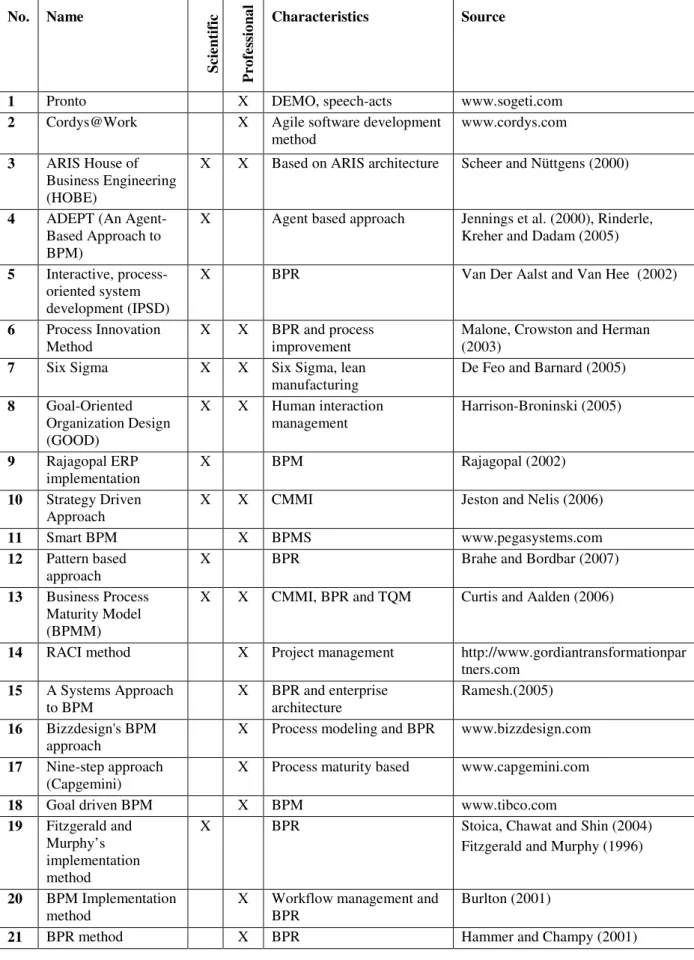
There are many frameworks, roadmaps, methodologies and such available for implementing information systems like Business Process Management Systems, Enterprise Resource Planning, Business Intelligence, Customer Relationship Management, and others. Both researchers and practitioners have developed overarching frameworks based on existing methods and this is no exception for the BPM domain. Multiple efforts have been made in constructing overall methods for BPM implementation. Kettinger et al. (1997) have developed a business process reengineering (BPR) implementation framework based on different BPR implementation methodologies. Table 1 gives an overview of 22 different implementation methods for Business Process Management. The list is constructed based on an assignment to 47 master students that followed a business process management course in a Master program at Utrecht University. Each individual student had to independently search for 3 BPM (-related) implementation methods. This resulted in 141 methods of which 21 could be uniquely identified as an independent method. Still this table is not exclusive as there are hundreds of methods available, although many are variations on the methods listed here. An analysis of the methods in this table shows that many implementation methods do not take into account the situation in which they are used. Also the scientific rigour and the practical relevance are quite different between the approaches while both are important.. From the shown methods there are 4 methods that are based on scientific research (Jennings & Faratin et al. 2000, Rinderle & Kreher & Dadam 2005, Van der Aalst & Van Hee 2002, Brahe & Bordbar 2007, Stoica & Chawat & Shin 2004, Fitzgerald & Murphy 1996) yet they are rarely applied in practice. Nine are based on professional best practices while they are not or only in a minor way supported by scientific research and validation and finally 8 methodologies are actively used in practice while at the same time supported by an extensive body of scientific research. Although most of the methods are developed for the implementation of BPM related projects some methods are based on process maturity models, project management methods or software development methods.
Although each of the 21 methods mentioned are in their own right unique, commonalities can be extracted easily. Basically, all BPM implementation methods consist of two phases. The first can be labelled the ‘design’ phase, in this phase the organization is analyzed and processes designed (often by the means of process models of the as-is and to-be situations). The second phase is the
‘implementation phase’ and this is when the organization actually has to change and work with the optimized processes. Also many of the newer BPM methods regard the implementation of BPM as a series of small projects that work towards a common goal. The reasoning behind this approach is that in most cases an organization that wants to implement BPMS will already have a developed
organization structure with running processes, which will be the starting point (“as is”) for the implementation, and to radically change the entire organization is a big risk that can be limited by changing through several smaller projects. One of the key factors in many of the mentioned
approaches is the availability of sufficient information about processes that are going to be modelled in the form of key performance indicators. If this is not the case, a project should start by constructing the needed metrics to make sure baseline information is available.
No. Name S ci en ti fi c P ro fe ss io n a l Characteristics Source
1 Pronto X DEMO, speech-acts www.sogeti.com
2 Cordys@Work X Agile software development method
www.cordys.com
3 ARIS House of Business Engineering (HOBE)
X X Based on ARIS architecture Scheer and Nüttgens (2000)
4 ADEPT (An Agent-Based Approach to BPM)
X Agent based approach Jennings et al. (2000), Rinderle, Kreher and Dadam (2005)
5 Interactive, process-oriented system development (IPSD)
X BPR Van Der Aalst and Van Hee (2002)
6 Process Innovation Method
X X BPR and process improvement
Malone, Crowston and Herman (2003)
7 Six Sigma X X Six Sigma, lean manufacturing
De Feo and Barnard (2005)
8 Goal-Oriented Organization Design (GOOD) X X Human interaction management Harrison-Broninski (2005) 9 Rajagopal ERP implementation X BPM Rajagopal (2002) 10 Strategy Driven Approach
X X CMMI Jeston and Nelis (2006)
11 Smart BPM X BPMS www.pegasystems.com
12 Pattern based approach
X BPR Brahe and Bordbar (2007)
13 Business Process Maturity Model (BPMM)
X X CMMI, BPR and TQM Curtis and Aalden (2006)
14 RACI method X Project management http://www.gordiantransformationpar tners.com 15 A Systems Approach to BPM X BPR and enterprise architecture Ramesh.(2005) 16 Bizzdesign's BPM approach
X Process modeling and BPR www.bizzdesign.com
17 Nine-step approach (Capgemini)
X Process maturity based www.capgemini.com
18 Goal driven BPM X BPM www.tibco.com
19 Fitzgerald and Murphy’s implementation method
X BPR Stoica, Chawat and Shin (2004) Fitzgerald and Murphy (1996)
20 BPM Implementation method
X Workflow management and BPR
Burlton (2001)
21 BPR method X BPR Hammer and Champy (2001)
Table 1. Different BPM Related Implementation Methods
None of the methods in table 1 are specifically developed to take into account the specific situation of the organization in which business process management and supporting information systems or
software applications are to be implemented. Although many providers of implementation methods and tools do acknowledge the need to custom tailor their methodology to the situation at hand, they do not provide techniques to support this. In general one can state that this is the domain of the
consultants; they are the professionals that should decide in which way a methodology should be used and this is mostly done without any scientific underpinning. To a large extent this is the cause of many mistakes as it cannot be expected that consultants have the experience and knowledge to be able to tackle every situation. For this reason we argue that implementation methodologies should be made more situation-dependent. In practice this means that an implementation method should provide activities and steps that cater for many different situations. In addition, analyses tools should be provided that help tailor the implementation methodology. So the underlying research question for this paper is: ‘How can implementation methodologies for business process management systems support situational dependency?’ In answering this research question, the scientific contribution of our research would be the definition of a situational BPM implementation method with the identification of situational factors, while the practical contribution would be the application of a specific approach for a BPM implementation in a certain situation, as defined by the values of the situational factors. As mentioned, an aspect in relation to BPM is the state-of-the-art business process management systems that are used increasingly to support BPM and SOA implementation. This trend causes some organizations to think of BPM as an IT project instead of the implementation of a management strategy. Therefore the use of a BPM system implies deep and enterprise-wide process analyses, and the inclusion of process performance measurement for continuous process (quality) monitoring and improvement. Current contributions to academic and professional journals are more focused on what the BPM concepts is, and why organizations start BPM-projects (Van der Aalst et al. 2003, Fremantle et al. 2002, Weske et al. 2004, Karagiannis, 1995, Ravesteyn & Versendaal, 2007). And while there is research on the BPM maturity of organizations (Harmon 2004, Rosemann & de Bruin 2005, Lee & Lee & Kang 2007, Hammer 2007), the question how a BPM-system can be implemented, and what business value it can bring, continues to be a gray area. Especially if during the implementation project an organizations specific situation is taken into account.
Figure 1 shows the different levels of the generic implementation methodology concept (cf. Weske 2007) that is used to clarify the importance of context. At the meta-level the language/ontology that is used to describe the implementation method is described. For instance, the implementation method can be described using different concepts such as the terminology used by the ISO–standard, a process modelling language such as Petri nets or plain English text could be used without any
reference to existing models or methods. On the meta-level, method engineering is a proven technique to develop a model (Brinkkemper, 1996). At the second level the implementation methodology itself is described. All the phases, activities, roles, deliverables etcetera that are part of the method are explained in relation to each other. Often the methodology consists of tutorials, training material, decisions sheets and several templates that can be used to record information that is needed during the project or that is a deliverable. The third level is the actual implementation (project) in an
organization. Often analyses of the specific organizational circumstances determine the best way to approach the implementation.
META IMPLEMENTATION METHOD IMPLEMENTATION METHOD IMPLEMENTATION INSTANTIATION
Figure 1. Three levels of an implementation methodology
The remainder of this paper describes the development of a business process management systems implementation methodology that is situational dependent. The following section describes the research approach that we used, section 3 provides an example of an implementation fragment (a fragment being a coherent set of activities related to one BPMS implementation success factor); in
section 4 the fragment is validated and finally sections 5 and 6 give conclusions regarding this research and an overview of the work that still has to be done.
2
RESEARCH APPROACH
As a starting point in the development of a situational dependent BPMS implementation methodology we chose the Information System Research Framework of Hevner, March, Park and Ram (2004) as shown in figure 2: Hevner et al. (2004) propagate that studies in the IT as well as the IS research domain are both about descriptive and prescriptive research. They are actually two sides of the same coin and thus inseparable. The descriptive part of the research (knowledge-producing activity) aims to understand, explain and predict why certain phenomena in the IT are occurring, while the prescriptive approach (knowledge-using activity) aims at improving performance to meet the business need (March & Smith, 1995; Hevner et al., 2004). Although the framework of Hevner et al. primarily focuses on based design, the model can also be used for other practices than technology-design approaches. This holistic approach with its clear boundaries and guidelines makes the framework extremely valuable to serve as a basis for this research.
The research consisted of four major activities related to the framework. First we collected critical success factors of BPM-systems implementation from existing research. Following Ward & Peppard (2002) we define critical success factors as those areas where ‘things have to go right’ for a BPMS implementation to succeed. The list of factors is a first indication towards the situation in which an organization is starting its BPM project. The list of critical success factors (table 2) is based on research by Ravesteyn and Versendaal (2007) who compiled a list of 337 success factors based on a literature study of 104 articles and books. The factors were categorized based on the domains of the literature such as total quality management (TQM), business process reengineering (BPR), business process management (BPM), workflow management (WFM), enterprise application integration (EAI), business activity monitoring (BAM) and business process management systems (BPMS). In their research Ravesteyn and Versendaal reduced the total number of factors to 55 unique success factors of which 14 were identified as critical success factors and are mentioned in the table below.
Critical Success Factors
1 Know-how and experience with Project Management 2 Experience with Change Management
3 Understanding the Business Process Management concept 4 A well organized design phase (modeling)
5 Understanding the processes of the company 6 Using the ‘best’ modeling standards and techniques
7 Understanding interdependencies and integration of data sources 8 Well organized maintenance and (quality) control of the process models 9 Understanding how processes and data are linked together
10 Understanding how to use web services 11 Involving the right people in the project
12 Having a set of key performance indicators and measuring the change (improvement) 13 Ensuring that the BPM project is part of a continuous optimization effort
14 Creating a culture of attention to quality within the organization
Table 2. Critical Success Factors When Implementing BPM
Secondly, a list of situational factors is composed. These factors are derived from scientific literature by the 47 master students as part of the BPM course. A situational Factor can be any factor, such as an environmental factor that contributes to the set of conditions to which an organization acts or reacts. Situational factors can be very basic for instance the size of the organization in employees or revenue. A factor such as the number of employees gives an indication of the amount of different roles and responsibilities that are related to the organizations processes. Besides this, factors can also be more BPM specific. For example the level of knowledge and experience the developers (or the IT
department) have with service oriented development. The use of web services in creating a service oriented architecture in support of the organizations processes is important for the agility and flexibility of these processes. When the IT department has little or no knowledge of how to correctly develop web services this should be taken into account before the implementation. As a third step we built a repository of implementation activities. An implementation activity is a task or series of tasks that have to be executed by actors to realize the goal of a successfully implemented BPM-system. The different activities are based on an analysis of the activities that are part of the implementation
methodologies listed in table 1. To construct implementation fragments that are situational sensitive, the collected activities are associated to one or more of the critical success factors. Accordingly per critical success factor the activities are linked to situational factors. Finally the constructed
implementation fragments are validated by several case studies. Two case studies in which one specific implementation fragment is validated are discussed in detail in section 4.
We use Situational Method Engineering techniques for the development of our BPM situational implementation method. Situational Method Engineering is a dedicated technique that is used to construct new methods for every software development situation by reusing parts of existing methods (Brinkkemper, 1996; Ralyté, Deneckère & Rolland, 2003). We have used this approach to construct the implementation fragments in our method.
3
BUSINESS PROCESS MANAGEMENT IMPLEMENTATION
FRAGMENTS
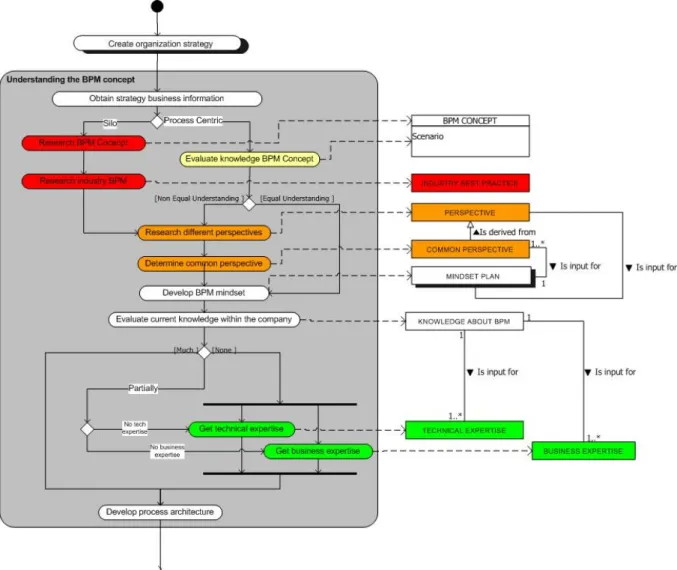
As an example we take the critical success factor ‘Understanding the business process management concept’ to explain how implementation fragments are developed based on the collected activities and situational factors. First we take the situational factors that can occur at a specific organization and that have an effect on the implementation activities that are related to this critical success factor. A situational factor we identified that influences the organizations ability to understand the BPM concept, is related to the organizational structure and behaviour. The factor, derived from Jeston & Nelis (2006), is formulated as ‘Which kind of mindset about the business architecture is present in the organisation?’ The factor concentrates on the manner in which organizations look at the structure and functions within the organizational boundaries. Basically, there are two means of looking at the organizations functions: silo oriented or process centric. When employees are already process-minded and understand the cross-departmental nature of processes it is easier to recognize the value of BPM. When organizational departments work like independent silos more effort is needed before people will comprehend and embrace BPM (Jeston & Nelis, 2006). In the implementation method fragment this situational factor influences the activities that are taken to implement BPM. In a silo oriented organization one must first gain understanding of the concept of ‘processes’ and process ownership. Also searching for industry standards or best practices is an activity that is to be undertaken. In a process oriented organization on the other hand, BPM will be much easier understood. Process ownership will already be (partially) in place or at least the importance of processes is recognized by management. This means that the activities in the implementation fragment (see figure 2, first decision point) are different depending on the situation at hand.
A second situational factor that is identified by Jeston & Nelis is whether there is ‘a common understanding of the BPM concept’; here the emphasis should be on common. Although the mindset of an organization can be process centric, it is not necessarily implemented throughout the
organization. There are many different definitions and opinions on BPM and although these partially overlap a commonly shared view is currently omitted (Jeston and Nelis, 2006, Ravesteyn, Batenburg, De Waal, 2008). While there is not one “best” definition of business process management, it is important that everyone within an organization has a common way of thinking before implementing BPM. This is supported by Weske (2007), who states that having a common understanding of BPM (concepts) is important. Jeston and Nelis (2006) state that when there is a common language, most issues within processes can be resolved within “a fraction of time”. When common understanding is missing the in the organization an important implementation activity is to compare the different
perspectives and develop a common language regarding BPM. If this is already present within an organization it is possible to skip these steps (see figure 2, second decision point).
The third situational factor in our example fragment is ‘the level of knowledge about the business and technology sides of BPM in the organization’. It is possible to distinct different levels of knowledge within an organization. In this research we defined the following three levels: low, medium and high. When the level is low, the organization has no employees with knowledge or former experiences on either the business or technology aspect of BPM implementations. A medium level organization has employees that have knowledge and experience with one of the two aspects (business or technology) of BPM implementation and a high level means that the organization has experienced employees in both the business and technology aspects of BPM implementations. In figure 2 the third decision point determines which implementation activities are relevant.
In figure 2 a product deliverable diagram (Brinkkemper, Saeki & Harmsen, 2001) of the critical success factor ‘understanding the BPM concept’ with the three situational factors integrated, is shown. The situational factors have been made visible in the diagram through decision-boxes from which different routes can be taken based on the different situations. The method consists of ten main activities which contain multiple sub-activities and concepts. Only the activities related to this critical success factor are shown in detail, furthermore the rest of the model is based on the implementation framework of Jeston and Nelis (2006).
Figure 2. BPM implementation fragment for the CSF ‘Understanding the BPM concept’
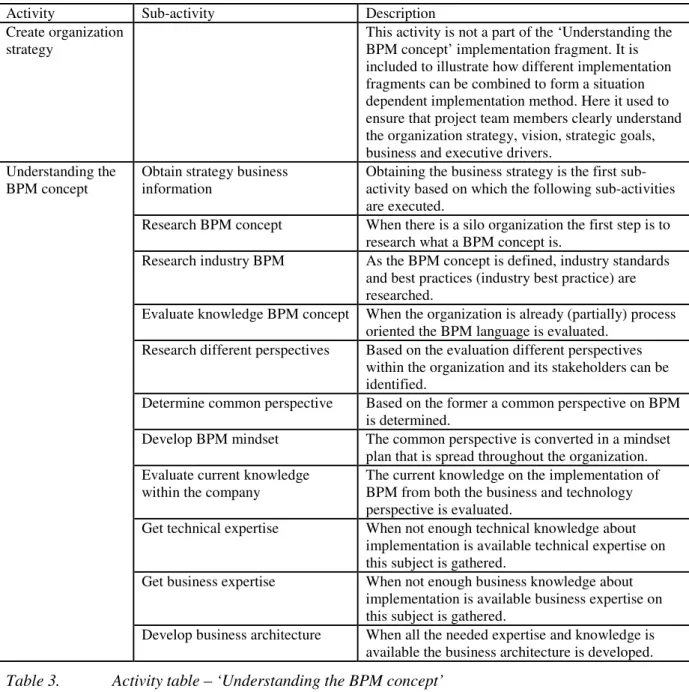
Below the activity (3) and concept (4) tables that are related to figure 2 are shown. These tables provide a detailed description of the different implementation activities in figure 2 and the deliverables (concepts) during the project.
Activity Sub-activity Description Create organization
strategy
This activity is not a part of the ‘Understanding the BPM concept’ implementation fragment. It is included to illustrate how different implementation fragments can be combined to form a situation dependent implementation method. Here it used to ensure that project team members clearly understand the organization strategy, vision, strategic goals, business and executive drivers.
Obtain strategy business information
Obtaining the business strategy is the first sub-activity based on which the following sub-activities are executed.
Research BPM concept When there is a silo organization the first step is to research what a BPM concept is.
Research industry BPM As the BPM concept is defined, industry standards and best practices (industry best practice) are researched.
Evaluate knowledge BPM concept When the organization is already (partially) process oriented the BPM language is evaluated.
Research different perspectives Based on the evaluation different perspectives within the organization and its stakeholders can be identified.
Determine common perspective Based on the former a common perspective on BPM is determined.
Develop BPM mindset The common perspective is converted in a mindset plan that is spread throughout the organization. Evaluate current knowledge
within the company
The current knowledge on the implementation of BPM from both the business and technology perspective is evaluated.
Get technical expertise When not enough technical knowledge about implementation is available technical expertise on this subject is gathered.
Get business expertise When not enough business knowledge about implementation is available business expertise on this subject is gathered.
Understanding the BPM concept
Develop business architecture When all the needed expertise and knowledge is available the business architecture is developed.
Table 3. Activity table – ‘Understanding the BPM concept’
Concept Description
BPM concept A document that describes the best BPM scenario for the organization. For instance based on the four scenario’s as described by Jeston and Nelis (2006). industry best practice An industry best practice describes success stories for the implementation of
BPM.
Perspective A perspective is a view that can be from the governance, customer, product, IT, organization and management side.
Common perspective A general perspective that has been chosen and documented.
Mindset plan The mindset plan is a change management strategy that contains the chosen mindset towards business process management. This document also describes how to create common understanding between the employees.
technical expertise Technical expertise is the knowledge and experience on a specific technical matter which is usually gained from experts for instance by hiring an external party and/or training your own employees.
business expertise Business expertise is the knowledge and experience on a specific business matter which usually gained from experts.
In the same way as above implementation fragments for the other thirteen critical success factors have been developed (for another example see Ravesteyn & Slinger, 2009). The complete set of
implementation fragments is available from the authors on request. Together the fragments form the basis for a situation sensitive business process management implementation methodology. The next section describes how the implementation fragments are validated.
4
VALIDATION
To validate the developed implementation fragments we did case studies at customers of Cordys (a BPM-systems developer) that are implementing a BPMS. In the following subsections we elaborate on the two cases that were used in validating the implementation fragment that was developed in relation to the critical success factor ‘Understanding the BPM concept’. We refer to these cases as ‘International Financial Services Company’ (IFSC) and ‘Car Services Company’ (CSC).
4.1 Case: International Financial Services Company
IFSC is an international financial services provider active in the fields of banking and insurance. The company offers its customers a comprehensive package of products and services through its own distribution channels, in cooperation with intermediaries and through other distribution partners. A subsidiary of IFSC is the Local Insurance Company (LIC). LIC is a leading provider of disability income insurance, health insurance and pension plans in the Netherlands. They employ over 600 people and run their financial insurance products through a national network of financial advisors in the Netherlands. To improve the management of its integrated product offering and process chains LIC decided to implement the Cordys BPMS application. The BPMS implementation has to provide improvement of both BPM and Business Activity Monitoring (BAM) capabilities that already exist, as well as the flexibility and agility the organization needs to effectively manage its response to new legislative changes.
In a first project the implementation of Cordys has already showcased its value; the required
processing time for a new participant in a pension scheme was reduced from a thirteen minute process involving 70 – 80 data input screens, to a two minute process involving a single intuitive interface. In a second project LIC will be using the platform to manage the complex process of changing the status of thousands of pension policies to ensure compliance with the latest financial legislation in the Netherlands. The company also plans to leverage Cordys technology to better manage third party organizations, such as employers, by integrating business processes with web services and portals. The company is planning a number of other projects that will see the creation of composite applications that combine existing and new functionality to improve various business processes. For this case study three interviews were held. All interviewees had roles as either project manager or department manager and were involved in the BPMS projects. Each respondent was briefly explained the research project and then asked to relate the activities in the implementation fragment (of figure 2) to there role in the two projects. The respondents were asked to remember decisions made during the project that were related to implementation activities that were needed to promote understanding of BPM.
The interviewees noticed that the activities in the second project should be different than those in the first project. The situation at the second project was different. Although the organization was already process-oriented (also during the first project) and it had already developed a common understanding / language regarding the BPM domain, it had gained the necessary skills in both business and
technological issues during the first project that were needed for this BPMS implementation.
Therefore during this project the company could start developing the process architecture immediately based on the existing strategy and BPM mindset. Because the process participants in the second project are not necessarily the same as in the first project it might be necessary to do some on the job training. However, the core of the BPM project team already attained the critical knowledge and
experience needed for the project so in this part of the implementation fragment no further activities are proposed.
4.2 Case: Car Services Company
Since its founding, over 30 years ago, CSC has grown into the largest European car-service chain: it has 2,300 service points and 11,000 employees. In the Netherlands all its activities, in over 180 locations, are managed from the central office. The company has branches in the United Kingdom, Germany and France. Customers can stop for maintenance as well as new products for their car. The combination of garage and retail activities requires a dynamic environment in which new services can be quickly developed and introduced.
For this case study no interviews were conducted with employees of CSC, instead information was made available by Cordys (both written information as an open interview with a consultant). Although CSC has had a long history of using IT to support functions within the organization, historically it has always been very silo oriented. In regard to the ‘Understanding the BPM concept’ implementation fragment this means that before implementing BPMS the company (more specifically its
management) should research the BPM paradigm and understand how it is different from the more traditional and hierarchical organizational model. There are a lot of standards available for the car industry (for instance product numbering) that are also used by CSC. However the company did not have any knowledge on BPM standards and best practices within their sector and therefore had to explore them before continuing with the BPM initiative. Due to the silo-orientation CSC had very little experience with BPM let alone a common language. In this case it was decided to adapt the definitions from the partners that were selected during the BPM exploration phase. Although the company had extensive knowledge on the legacy applications that were in use they did not have the needed knowledge on web services development and BPMS. During the implementation this
knowledge was attained by training employees of CSC in both BPM business and technology issues. For instance people were trained in how to continuously improve processes by defining key
performance indicators to measure performance and determine improvement alternatives. Also the maintenance of the BPMS system and developed applications were part of the training program for part of the employees. These different implementation activities correspond with the developed implementation fragment and the route it suggests within this situation.
This section described the validation of the BPMS implementation fragment that is related to the critical success factor ‘Understanding the BPM concept’. This implementation fragment is the first to be validated and currently the other implementation fragments are also being validated. The validation outcomes suggest that the different activities and routes in this implementation fragment make a situation dependent implementation for business process management systems possible. However many more activities and situations should be added to the fragment.
5
CONCLUSIONS
In this paper we have shown that there are many different implementation methods available for business process management (systems). However most of these methods do not provide a situational approach to the implementation project and can be considered a one-size fits all. Because
organizations operate in different contexts they also need different ways of implementing business process management. Therefore we propose a situation sensitive BPM(S) implementation
methodology that is based on critical success factors situational factors for BPM projects. Both the critical success factors as the implementation activities used in this research are based on earlier research and existing implementation methods. The situational factors are derived from literature and are commonly known differences between organizations.
In total 14 business process management systems implementation fragments have been developed. Each fragment takes into account several situational factors and thereby enables the development and use of a tailor made BPM(S) implementation methodology for a specific organization. This paper
described the process of development of implementation fragments and illustrated the results by an example based on the critical success factor ‘Understanding the BPM concept’.
The validation suggests that the fragment is able to foresee in different situations. However the set of activities and situations should be expanded to provide more guidelines for BPMS implementation.
6
DISCUSSION AND FUTURE RESEARCH
The objective of this research is to develop a situation dependent implementation methodology for BPM(S). Currently the proposed method contains 14 implementation fragments. However this is just the groundwork. Although the critical success factors on which the method is based guarantee that the most important implementation activities are included in the method, the method still needs to be extended. Especially the number of implementation activities and situational factors related to the critical success factors should be extended. In addition to the method a means for analyzing organizations to determine the relative importance of success and situational factors is needed to decide which implementation fragments should be included in a specific BPM(S) project. Currently this is lacking and therefore there is a risk that the current method will also be used as a one-size fits all.
Besides adding more content to the methodology the current implementation fragments need more validation. Each fragment should be tested in several projects before it can be considered completely validated and usable. Furthermore the fragments are developed using method engineering but because several people were involved in the research project the quality of the fragments differ. Extra effort is needed to control all fragments and if necessary update them to maintain a consistent level of quality.
References
Aalst van der, W. and Ter Hofstede, A.. and Weske, M. (2003). "Business Process Management a Survey", In: Aalst van der, W. and Ter Hofstede, A. and Weske, M. (Eds.) Business Process Management. Springer, Eindhoven. The Netherlands.
Aalst van der, W and Hee van, K.(2002). "Workflow Management Models, Methods, and Systems", The MIT Press, Cambridge.
Brahe, S. and Bordbar, B. (2007). "A Pattern-based Approach to Business Process Modeling and Implementation in Web Services", Danske Bank & IT University of Copenhagen, Denmark. Brinkkemper, S. (1996). "Method engineering: engineering of information systems development methods and tools", Information & Software Technology, 38(4), 275-280.
Brinkkemper, S. and Saeki and Harmsen, F. (2001). "A Method Engineering Language for the Description of Systems Development Methods", Lecture Notes in Computer Science, 2068. pp. 473-476.
Burlton, R.T. (2001). "Business process management: profiting from process". Sams publishing, Indianapolis.
Curtis, B. and Aalden, J. (2006). "Business Process Improvement Guided by BPMM", BPTrends Column.
http://www.capabilitymeasurement.com/downloads/11-06-COL-BPM&OrganizatonalMaturity-Curtis-Alden-Final.pdf
Fitzgerald, B and Murphy, C. (1996). "Business Process Reengineering, The Creation and
Implementation of a Methodology", The Canadian Journal of Information Systems and Operational Research.
Fremantle, P. and Weerawarana, S and Khalaf, R (2002). "Enterprise Services: examining the emerging field of web services and how it is integrated into existing enterprise infrastructures",
Communication of the ACM, 45 (10), 77-82.
Hammer, M. (2007). "The Process Audit". Harvard Business Review, 85 (4), 111–123.
Hammer, M. and Champy, J. (2001). "Reengineering the Corporation: A Manifesto for Business Revolution, updated and revised". Harper Business, New York.
Harrison-Broninski, K. (2005). "Human Interactions: The Heart and Soul of Business Process Management". Meghan-Kiffer Press (www.mkpress.com).
Harmon, P. (2004). "Evaluating an Organisation's Business Process Maturity", Business Process Trends.
Hevner, A.R., and March, S.T., and Park, J. and Ram, S. (2004). "Design Science in Information Systems Research", MIS Quarterly, 28.
Jennings, N.R. and Faratin, P. and Norman, T.J. and O’Brien, P. and Odgers, B. and Alty, J.L. (2000). "Implementing a Business Process Management System Using ADEPT: A Real-world Case Study",
Applied Artificial Intelligence, 14, 421-461.
Jeston, J. and Nelis, J. (2006). "Business Process Management: Practical Guidelines to Successful Implementations".
Joseph A. and De Feo and Barnard, W. (2005). "JURAN Institute's Six Sigma Breakthrough and Beyond - Quality Performance Breakthrough Methods", Tata McGraw-Hill Publishing Company Limited.
Karagiannis, D. (1995). "BPMS: business process management systems", SIGIOS Bull, 16 (1), 10-3. Kettinger, J.W. and Teng, J.T.C. and Guha, S. (1997). "Business process change: a study of
methodologies, techniques, and tools", MIS Quarterly, 21, 55-80.
Krafzig, D. and Banke, K. and Slama, D. (2005). "Enterprise SOA : service-oriented architecture best practices". Prentice Hall Professional Technical Reference, Indianapolis, IN.
Lee, J. and Lee, D. and Kang, S (2007). "An Overview of the Business Process Maturity Model (BPMM)", APWeb/WAIM 2007 Ws, LNCS 4537, 384-395.
Malone, T.W. and Crowston,K. and Herman, G.A.(2003). "Organizing Business Knowledge: The MIT Process Handbook", MIT Press.
March, S.T. and Smith, G.F. (1995). "Design and natural science research on information technology", Decision Support Systems, 15. pp. 251-266.
Rajagopal, P. (2002). "An innovation-diffusion view of implementation of enterprise resource planning (ERP) systems and development of a research model", Information & Management 40(2), pp. 87-114.
Ralyté, J. and Deneckère, R. and Rolland, C. (2003). “Towards a Generic Model for Situational Method Engineering", Lecture Notes in Computer Science, 2681.
Ramesh, B. and Jain, R., and Nissen, M. and Xu, P. (2005). "Managing context in business process management systems", Requirements Engineering, 10, 223-237.
Ravesteyn, P. and Batenburg, R. and De Waal, B. (2008). "In Search of Competencies Needed in BPM Projects", Communications of the IIMA, 8 (2), 23-30.
Ravesteyn, P. and Slinger, J. (2009). "A Situational Implementation Method for Business Process Management Systems", to be published in Proceedings of the American Conference on Information Systems 2009, San Francisco, United States.
Ravesteyn, P. and Versendaal, J. (2007). "Success Factors of Business Process Management Systems Implementation", In Proceedings of the Australasian Conference on Information System (Toleman, M. Ed.), p. 396-406. Toowoomba, Australia, University of Southern Queensland.
Rinderle, S. and Kreher, U. and Dadam, P. (2005). "Adaptive Process Management with ADEPT2",
Proceeding of the 21st International Conference on Data Engineering.
Rosemann, M. and de Bruin, T. (2005). "Towards a Business Process Management Maturity Model",
Proceedings of the 13th European Conference on Information Systems (ECIS 2005). Regensburg, Germany.
Scheer, A.W. and Nüttgens, M. (2000). "ARIS Architecture and Reference Models for Business Process Management", Lecture Notes in Computer Science, 1806, 301-304.
https://www.myuu.nl/http://www.springerlink.com/content/fnlv8ngne0w0fgl4/fulltext.pdf
Stoica M. and Chawat, N. and Shin, N. (2004). "An Investigation of the Methodologies of Business Process Reengineering".
Ward, J. and Peppard, J. (2002). "Strategic Planning for Information Systems", 3rd edition, John Wiley & Sons, Chichester, England.
Weske, M. and Van der Aalst, W. and Verbeek, H. (2004). "Advances in business process management", Data & Knowledge Engineering, 50, 1-8.
Weske, M. (2007). "Business Process Management: Concepts, Languages, Architectures". Springer-Verlag, New York.