East Tennessee State University
Digital Commons @ East
Tennessee State University
Electronic Theses and Dissertations Student Works
8-2016
Interpreting Differences of Self-Efficacy of Gifted or
Talented Students with Grouping Practices in
Middle School Mathematics
Amanda G. WaitsEast Tennessee State University
Follow this and additional works at:https://dc.etsu.edu/etd
Part of theCurriculum and Instruction Commons,Educational Methods Commons, and the Gifted Education Commons
This Dissertation - Open Access is brought to you for free and open access by the Student Works at Digital Commons @ East Tennessee State University. It has been accepted for inclusion in Electronic Theses and Dissertations by an authorized administrator of Digital Commons @ East Tennessee State University. For more information, please [email protected].
Recommended Citation
Waits, Amanda G., "Interpreting Differences of Self-Efficacy of Gifted or Talented Students with Grouping Practices in Middle School Mathematics" (2016).Electronic Theses and Dissertations.Paper 3078. https://dc.etsu.edu/etd/3078
Interpreting Differences of Self-Efficacy of Gifted or Talented Students with Grouping Practices in Middle School Mathematics
_____________________ A dissertation
presented to
the faculty of the Department of Educational Policy and Leadership Analysis East Tennessee State University
in partial fulfillment of the requirements for the degree Doctor of Education in Educational Leadership
_____________________
by Amanda Waits
August 2016
_____________________
Dr. James Lampley, Chair Dr. Cecil Blankenship
Dr. Don Good Dr. Pamela Scott
Keywords: Grouping, Acceleration, Gifted Education, Mathematics Self-Efficacy, Classroom Environment
ABSTRACT
Interpreting Differences of Self-Efficacy of Gifted or Talented Students with Grouping Practices in Middle School Mathematics
by
Amanda Waits
The purpose of this study was to determine if there was a significant difference in total scores on the Mathematical Self-Efficacy Scale, the mathematics task self-efficacy portion of the scale, and the math-related school subjects self-efficacy portion of the scale for middle school students between students assigned to a homogeneously grouped accelerated math class and students assigned to a heterogeneously grouped math class.
The instrument used to gather information for thus study on student self-efficacy was the
Mathematics Self-Efficacy Scale (MSES). The MSES measures 2 domains of
mathematics-related behaviors and capabilities. The Mathematics Task Self-Efficacy scale is designed to measure the level of confidence the student would have when successfully completing the given task. The Math-Related School Subjects Self-Efficacy scale is designed to measure the level of confidence the student would have when successfully completing a college level course with a final grade of an A or B. The 2 parts of the MSES may be individually scored or holistically scored to obtain a total score representing overall mathematical self-efficacy.
Descriptive and inferential statistics were used to analyze the data for the 9 research questions. Participants in the study were randomly assigned to the heterogeneous or homogeneous groups by their schools and were not controlled by the researcher. Students within the groups were chosen as participants based on their math ability and scores on the seventh grade TCAP test. At
the time of the survey these students attended either a K-8 elementary school or a middle school in Northeast Tennessee. The population consisted of 357 gifted or talented eighth grade math students in 6 school districts in Northeast Tennessee.
The results of this study does not support or discourage the practice of acceleration by retaining 7 of the 9 null hypotheses that there are no significant difference in self-efficacy scores between homogeneous grouped eighth grade math students who were placed in accelerated coursework by taking Algebra I and those students who were heterogeneously grouped in a regular eighth grade math class.
DEDICATION
I dedicate this project to my son Owen. I waited so long and had given up hope for such a joy to enter my life. I never truly understood God’s unconditional love until I held you.
I dedicate this work to my students. I believe that being an educator is a calling just like being in the mission field or a call to preach. It is the dedication of one’s life to service for the betterment of society and the future. I am thankful that none of my teachers ever looked at me and said I would never be anything because I was just a poor farm girl. To each of the students I have taught or will be blessed to teach in the future my message and my model is to go after life at full speed. Dream and achieve what you desire. Self-efficacy is your belief that you can accomplish a complex task and I can think of no greater task than life itself.
Finally, I dedicate this work to my friends and family. You have all stuck by me for many years through the complaints, frustrations, and often hopelessness that this would ever happen for me. You have carried me, laughed with me, and helped me keep pushing forward with calls, text messages, and e-mail messages. You even cleaned my house. I did not want to get to the top of the mountain and discover that I was there alone. I am blessed to have a network of family and friends all across Tennessee. My parents instilled in me an ethic of hard work and love. These are priceless to me and are the sole reason that I have been able to fulfill God’s plan for my life. Each person I have met in life has been part of my work and my success.
ACKNOWLEDGEMENTS
I would like to acknowledge the work and support of my dissertation committee and my chair Dr. Lampley. He has worked many weekends helping me refine my research skills and providing feedback. His honesty and evaluation of my work were a catalyst to keep me on track. It has been a slow journey but I have arrived only through the help and support of each person.
I would like to acknowledge my colleagues Melanie Smith, Lamar Smith, Cindy Robinson, Ginger Christian, and so many others who constantly provided encouragement and supported my own self-efficacy that this could be completed.
I would like to acknowledge my parents and coworkers for helping me stuff and mail the envelopes for the surveys used to collect my data. You have endured my craziness and taken on part of my workload so that I can succeed. I have always said that we are smarter together than we are alone and they have proved to me that we can work faster that way as well.
I would like to acknowledge the help of the teachers in six school districts for distributing and collecting surveys from students. Even in a time where standardized tests and new
curriculum provide extra pressure, you still took your time to help me. My research would not be possible without your support.
TABLE OF CONTENTS Page ABSTRACT ... 2 DEDICATION ... 5 ACKNOWLEDGEMENTS ... 6 LIST OF FIGURES ... 10 Chapter 1. INTRODUCTION ... 11 Statement of Purpose ... 15 Research Questions ... 16
Significance of the Study ... 18
Definition of Terms... 19
Limitations and Delimitations ... 21
Overview of the Study ... 22
2. REVIEW OF THE LITERATURE ... 23
Theories of Giftedness and Talent ... 23
Policy and Program Decisions ... 29
Opposition to Grouping Practices ... 37
Proponents of Grouping Practices ... 40
Types of Grouping and Acceleration ... 40
Tracking ... 40
Flexible Ability Grouping ... 43
Cluster Grouping ... 44
Between Class Grouping... 46
Student Self-Efficacy ... 54
Self-Efficacy in Mathematics ... 54
Gender and Mathematics Self-Efficacy ... 57
3. RESEARCH METHODOLOGY... 59
Research Questions and Null Hypotheses ... 60
Instrumentation ... 64 Population ... 65 Data Collection ... 66 Data Analysis ... 68 Chapter Summary ... 69 4. FINDINGS ... 70 Results of Analysis ... 72 Research Question 1 ... 72 Research Question 2 ... 73 Research Question 3 ... 74 Research Question 4 ... 75 Research Question 5 ... 76 Research Question 6 ... 77 Research Question 7 ... 78 Research Question 8 ... 79 Research Question 9 ... 80 Chapter Summary ... 81
5. SUMMARY, CONCLUSION, AND RECOMMENDATIONS ... 82
Summary of Findings ... 82
Research Question 1 ... 82
Research Question 2 ... 82
Research Question 4 ... 83 Research Question 5 ... 83 Research Question 6 ... 84 Research Question 7 ... 84 Research Question 8 ... 84 Research Question 9 ... 85 Conclusion ... 85
Recommendations for Practice ... 88
Recommendations for Further Research ... 90
REFERENCES ... 92
APPENDICES ... 103
Appendix A: Gifted Assessment Flowchart ... 103
Appendix B: Mathematics Self-Efficacy Survey Data ... 104
Appendix C: IRB Approval ... 105
Appendix D: Director of Schools Permission to Conduct Research ... 107
Appendix E: Parental Permission to Conduct Research ... 108
Appendix F: Student Assent Form ... 110
Appendix G: Mathematics Self-Efficacy Survey ... 111
LIST OF FIGURES
Figure Page
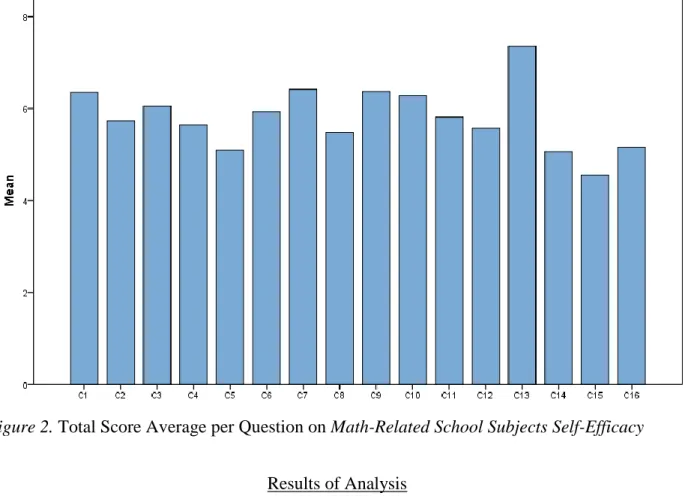
1. Total Score Average per Item on Mathematics Task Self-Efficacy. ... 72 2. Total Score Average per Question on Math-Related School Subjects
CHAPTER 1 INTRODUCTION
Public and private educational institutions in the United States are as diverse as the population of students served. Furthermore, the pedagogy implemented complicates the
divergent nature of theoretical and practical education. It should be important to any institution engaged in the act of providing a solid educational foundation to a student to examine research-based best practices that are established as having a positive effect on student achievement, development of conceptual understanding, and support student self-efficacy. Mathematics
achievement is often viewed as a measurement of the success, or status, of a nation. Results from the National Assessment of Educational Progress (NAEP) and the Trends in International
Mathematics and Science Study (TIMSS) are both used by legislators to make decisions
regarding the progress made in United States schools. These results directly influence policy and programming decisions made at the federal, state, and district levels. The National Assessment of Educational Progress (NAEP) began in 1990 and is given nationally to represent a common assessment of what students in the United States know and can do in various subject areas (National Center for Education Statistics, 2014). Administered every 2 years, comparisons of achievement can be made between years to determine if growth is significant. Results of the 2013 NAEP Assessment of fourth grade mathematics showed that 42% of students in the United States performed at or above proficient as compared to the 40% performing at or above
proficient in 2011. Similarly, on the 2013 NAEP Assessment for eighth grade mathematics, 35% of students in the United States performed at or above proficient, which remains unchanged since the administration of the assessment in 2011 (National Center for Education Statistics, 2014). The NAEP results presented a case for increased rigor and importance of mathematics
instruction. The data from NAEP also included performance of the highest achieving students in mathematics. The student performance in mathematics at the advanced level is evidence of a need to provide students who are gifted or talented in mathematics with access to higher levels of mathematics and problem solving opportunities. On the 2013 NAEP Assessment 8% of fourth grade students and 9% of eighth grade students performed at the advanced level.
In our globalized society where students will be seeking job opportunities and experience high levels of career competition with other nations, it is important that they have been prepared with the skills and thinking abilities in mathematics that will enable them to be successful. While the NAEP measures student performance on a national scale, the United States is also compared internationally on the Trends in International Mathematics and Science Study (TIMSS). The TIMSS study provides data on the mathematics and science achievement of students in the United States compared to that of students in other countries (National Center for Education Statistics, 2011).
The TIMSS study was administered five times since 1995 at grades 4, 8, and 12 and included over 20,000 students attending public schools in the United States and 500,000
worldwide. In grade 4, student scores were 12 points higher than when administered in 2011; in grade 8, student scores were 17 points higher than when administered in 2011. In a comparison of the average scores of participating countries, the United States ranked ninth in fourth and eighth grade mathematics. Students in Singapore, Republic of Korea, and China achieved
average scores above 600, as compared to students in the United States whose average score was 541 for fourth grade and 509 for eighth grade mathematics (National Center for Education Statistics, 2011).
The data for students reaching the international benchmark for advanced on the TIMSS study compares top performing students to their peers in other countries with what skills and knowledge a student should demonstrate at the advanced level. In fourth grade only 13% of United States students met the international benchmark for the advanced level indicating a rank of ninth internationally. In comparison, Singapore, Republic of Korea, Hong Kong, Chinese Taipei, and Japan had 30% or more of their students meet the international benchmark for the
advanced level. Similarly in eighth grade, 7% of students in the United States met the
international benchmark for the advanced level, indicating a ranking of twelfth internationally, whereas Singapore, Chinese Taipei, Republic of Korea, and Hong Kong had 30% or more of their eighth grade students meet the international benchmark for the advanced level, with the highest being Chinese Taipei at 49% (National Center for Education Statistics, 2011).
The Templeton National Report on Acceleration included an in-depth examination of educational practices that directly impacted the educational success of gifted or talented students (Colangelo, Assouline, & Gross, 2004). Ten years after this report was first published the
research it contains and the questions it presents to the field of education were still relevant. According to the NAEP and TIMSS studies, students in the United States do not perform at high levels of achievement when compared to other industrialized countries. It is important to
examine practices that inhibit or enhance student achievement in mathematics, specifically for students identified as gifted or talented. Mathematics instruction has received varying levels of attention over the past century.
As one-room school houses were being phased out because of the standardization of the educational system, students were gradually offered minimal opportunities for advancement at their own pace. Schools became institutions of equity and fairness, although this was not always
exhibited between various ethnic and socioeconomic groups. The Rehabilitation Act of 1973 began an examination of practices in United States schools for students with disabilities. Section 504 regulations required school districts “to provide a ‘free appropriate public education’
(FAPE) to each qualified person with a disability who is in the school district’s jurisdiction, regardless of the nature or severity of the person’s disability” (US Department of Education, 2010, para. 3). Over the 40+ years since this Act was implemented it has been updated and reissued periodically and is now titled the Individuals with Disabilities Education Act of 2004. In examining what constitutes a free and appropriate public education, the question of what is appropriate must be answered through substantial research and effective best practices, which can lead to generalizable and practical implementation for the populations found in an
educational setting. Several national publications have created an awareness of the need for quality mathematics instruction (Colangelo et al., 2004; No Child Left Behind Act of 2001 (NCLB), 2002; O’Connell-Ross, 1993). Individuals in the gifted education networks advocate for high quality math instruction for the brightest students. A wealth of research, information, theoretical constructs, and applicable models for gifted education exist and the body of research is continually growing to support these students.
Theorists offer the most prominent and empirical work in the field (Feldman, 1994, 2003, 2008; Gagné, 1985, 1999, 2004; Gardner, 1983, 1999, 2006, 2011; Renzulli, 1978, 2002, 2011; Tomlinson et al., 2002). Regarding mathematics instruction, it is important to examine issues such as practices that lead to advanced levels of achievement, what systems and structures should be in place to ensure student success, and how students view themselves as
mathematicians in the various constructs. Acceleration is a grouping practice that is backed by decades of empirical evidence regarding its effectiveness to meet the needs of gifted and talented
students (Brody & Reis, 2004; Chval & Davis, 2008; Colangelo et al., 2004; Feldman, 2008; Hoogeveen, van Hell, & Verhoeven, 2009; Miller, 2008; Neihart, 2007; Sowell, 1993). Many forms of acceleration are present in public and private education. Colangelo et al. (2004) reported that more than 18 types of acceleration are currently in practice. A memo from the Tennessee Department of Education (TN DOE, 2014a) states,
Students who are capable of rigorous mathematical coursework must be provided access to accelerated courses of study fully accompanied by a variety of proper supports to ensure their success. Decisions regarding appropriate placement should be made in the best interest of each individual student using appropriate data. (p. 1)
The TN DOE also acknowledges that each district retains the authority to set local policy and procedures regarding acceleration practices offered to students. The memo offered six models for acceleration of students in mathematics.
Statement of Purpose
Self-efficacy is defined as a person’s perception of his or her ability to do a defined task or fill a specific role. Burke and Stets (2009) examined what gives individuals their specific perception of self in a variety of roles found in life. They defined self-efficacy as an individual’s belief in the ability to accomplish a task. Individuals with a higher self-efficacy participated in tasks or behaviors that were unfamiliar, challenging, or difficult due to their perceived ability of accomplishment (Burke & Stets, 2009). Mindset toward a certain subject, field, or situation has had a great effect on outcomes produced by the individual.
There are several empirical studies showing how high self-efficacy in math is positively correlated with other domains in mathematics such as achievement, college success, degree attainment in Science, Technology, Engineering, and Mathematics (STEM) careers, and overall problem solving abilities (Fast et al., 2010; Hoogeveen et al., 2009; Louis & Mistele, 2012; Neihart, 2007; Schunk, 1991). Liu and Koirala (2009) presented research findings at the
Northeastern Educational Research Association (NERA) Annual Conference that examined the relationship between mathematics achievement and self-efficacy. A correlation between
mathematical self-efficacy and mathematical achievement prediction was examined among 10th grade students to determine that mathematics self-efficacy substantially predicted mathematics achievement (Liu & Koirala, 2009).
The purpose of this study was to determine if there was a significant difference in the total mathematical self-efficacy scale scores, the mathematical task self-efficacy scale score, and the math-related school subjects self-efficacy scale score for middle school students between students assigned to a homogeneously grouped accelerated math class and students assigned to a heterogeneously grouped regular math class.
Research Questions
Nine research questions were used to guide this quantitative study.
RQ1. Is there a significant difference in mathematical self-efficacy scale scores of gifted or talented middle school students between those assigned to a homogeneously grouped accelerated math class and those assigned to a heterogeneously grouped math class? RQ2. Is there a significant difference in mathematical self-efficacy scale scores of gifted or
talented middle school female students between those assigned to a homogeneously grouped accelerated math class and those assigned to a heterogeneously grouped math class?
RQ3. Is there a significant difference in mathematical self-efficacy scale scores of gifted or talented middle school male students between those assigned to a homogeneously grouped accelerated math class and those assigned to a heterogeneously grouped math class?
RQ4. Is there a significant difference in mathematical task self-efficacy scale scores of gifted or talented middle school students between those assigned to a homogeneously grouped accelerated math class and those assigned to a heterogeneously grouped math class? RQ5. Is there a significant difference in mathematical task self-efficacy scale scores of gifted or
talented middle school female students between those assigned to a homogeneously grouped accelerated math class and those assigned to a heterogeneously grouped math class?
RQ6. Is there a significant difference in mathematical task self-efficacy scale scores of gifted or talented middle school male students between those assigned to a homogeneously
grouped accelerated math class and those assigned to a heterogeneously grouped math class?
RQ7. Is there a significant difference in mathematical school subjects self-efficacy scale scores of gifted or talented middle school students between those assigned to a homogeneously grouped accelerated math class and those assigned to a heterogeneously grouped math class?
RQ8. Is there a significant difference in mathematical school subjects self-efficacy scale scores of gifted or talented middle school female students between those assigned to a
homogeneously grouped accelerated math class and those assigned to a heterogeneously grouped math class?
RQ9. Is there a significant difference in mathematical school subjects self-efficacy scale scores of gifted or talented middle school male students between those assigned to a
homogeneously grouped accelerated math class and those assigned to a heterogeneously grouped math class?
Significance of the Study
Educational research serves the purpose of providing practitioners with empirical
evidence to validate programs, determine factors of success or failure, provide explicit empirical evidence to support implicit theories, and to guide the professional body of educators to a mindset of continuous improvement. The National Research Council’s (NRC) report, Scientific Research in Education (Lauer, 2004), contends that quality educational research follows the same principles of scientific inquiry in any field. The principles guide researchers and readers in determining if educational research is of high quality and has a significant contribution to the field of education. These recommended principles have been considered in the design of this study as well as in determining the significance of examining what impacts the grouping practice of acceleration has on a student’s mathematical self-efficacy and if it differs from the student’s peers who are heterogeneously grouped.
This study will help fill a gap in research and knowledge about the relationship between mathematical self-efficacy and acceleration practices in general and examine if gender is a contributing factor. Current research on the relationship between self-efficacy and mathematics achievement in general examines the gender factor but rarely examines same gender differences between groups.
Theorists in the field of gifted education contend that being classified as gifted or talented is not determined solely by Intelligence Quotient (IQ) and general achievement. Motivation, creativity, task commitment, and possessing a type of intelligence outside the normal curve are all components of a gifted or talented individual. There exists no delineated definition of
giftedness. Rather, giftedness theory is distinguished by a weaving of common characteristics or traits that describe an individual with high aptitude. Several cocognitive factors have been
identified to describe gifted individuals, including optimism, courage, passion for a discipline, empathy, physical and mental endurance, and visionary leadership. These factors work in tandem with environmental influences and opportunities presented to an individual to work on the
development of gifted characteristics (Renzulli, 2009).
Definition of Terms
The terms below signify those found frequently in this study and in the review of literature.
Ability Grouping – The grouping of students in an academic setting with same age peers that are of the same relative academic ability (Brody & Reis, 2004).
Acceleration – The practice of students in an academic setting with unlike aged peers so that students have access to an advanced level curriculum (Brody & Reis, 2004).
Differentiated Instruction – A pedagogical theory that addresses the needs of students with a variety of backgrounds, knowledge, cultural influences, and interests. In mathematics the specific forms of differentiated instruction are assessing and advancing questions, using a model, bridging, contextualizing, developing metacognition skills, and building schema
(Institute for Learning, 2014).
Gender Bias in Education – A known or subconsciously hidden prejudice toward males or females causing a deterioration of accuracy in the research being explored (Skelton, Francis, & Smulyan, 2006).
Gifted or Talented – A designation given to a student who exhibits superior performance or talent in a particular area. The term is generally applied in academic and nonacademic settings such as sports, music, and artistic endeavors. For this study a gifted or talented
student is one who performs at or above the 90th percentile in mathematics as compared to his or her same aged peers (NAGC, 2010).
Heterogeneous Grouping – The grouping of students with peers of mixed intellect, interest, or talent. This form of grouping is most often used to include students of various
instructional levels within a classroom (Marzano, Pickering, & Pollock, 2001).
Homogeneous Grouping – The grouping of students with peers of similar intellect, interest, or talent. This form of grouping is most often used to group students of a like instructional level and provide them with an appropriate curriculum to meet their needs (Marzano et al., 2001).
Mathematical Self-Efficacy – The perception of one’s ability to perform a specific mathematical task that is dependent on the difficulty of the task (Bandura, 1997).
Mathematics Self-Efficacy Scale – A 52-item survey instrument designed to measure a student’s
level of mathematics self-efficacy (Pajares & Miller, 1997).
Self-Efficacy – The perception of one’s ability to demonstrate the behavior necessary to obtain a desired outcome that is directly dependent on willingness, persistence, and motivation (Bandura, 1997).
Tennessee Comprehensive Achievement Program (TCAP) – a test that,
…uses multiple choice questions that provide a measure of knowledge and application of skills in various subject areas for grades Kindergarten (K) – 8. The results of the TCAP Achievement Test provide valuable information regarding student’s progress in
Tennessee based on TN curriculum standards. (Tennessee Education Association, 2014, para. 4)
Tracking – A form of homogeneous grouping that is not flexible. Students are placed in groups based on ability and remain there for an entire year or more often for every year they are in school with the same group (Hallinan, 1994).
Limitations and Delimitations
The delimiting restrictions placed on this study by the researcher limit the extent of the study. Participants were selected using a criterion-based, convenience sample. Generalizability was limited because of the lack of a randomized experimental design. Students chosen for the study were delimited to eighth grade students during the 2015-2016 academic school year in more than one school system in Northeast Tennessee. Students chosen took the TCAP test as seventh graders during the 2014-2015 year and scored at or above the 90th percentile in all RCPI
categories for mathematics.
Limitations to this study address weaknesses or problems within the study that may restrict the methodology and results. There were five limitations in this study.
1. It was not possible to establish if classroom grouping or climate were the only variables influencing mathematics self-efficacy. Most notably are other confounding variables that were not controlled for such as tutoring outside the normal classroom, participation in a mathematics enrichment program outside the normal classroom, self-esteem counseling, mathematics anxiety, and the socioeconomic status of the student.
2. Given that the Mathematics Self-Efficacy Scale is administered to students identified as gifted or talented, it may include students who have a naturally high mathematics self-efficacy due to high mathematics achievement.
3. The survey instruments provide a limitation of the study because of using a 10-value Lickert-type scale for participants to respond. The survey has been tested for validity; however, the reliability of self-reporting surveys using a Lickert-type scale is limited by the authenticity of the respondent, labeling of the gradation, and participant perception of the question (Betz & Hackett, 1993).
4. The region of Northeast Tennessee where the surveys were administered contains both rural and urban areas. Because of greater resources, it is typical in urban districts in this area to offer more pathways for gifted or talented students. This restricts the available sample size of eighth grader students grouped in an accelerated Algebra I class.
5. Teacher effectiveness in the classrooms of students sampled presented the possibility for influencing the classroom environment and quality of teaching and the participant’s mathematical self-efficacy.
Efforts made to mitigate method limitations are presented in Chapter 3. These were designed to strengthen the research design and findings of the study.
Overview of the Study
This quantitative study is organized into five chapters. Chapter 1 contains the
introduction to the study, statement of purpose, research questions, significance of the study, definition of terms, limitations and delimitations, and an overview of the study. Chapter 2 presents a review of relevant literature to explore the foundations of gifted education,
investigates types of grouping practices, and broadly explores self-efficacy with an emphasis on mathematics self-efficacy as observed with gifted or talented students. Chapter 3 includes the research methodology and presents the research design, presentation of the population and rationale behind the groups chosen, instrumentation, data collection procedures, and the methods used to analyze data. Chapter 4 details the analysis of data and reports results of the study. Chapter 5 includes an interpretation of the results, conclusion of the study, a summary of the findings, implications for current grouping practices, and recommendations for further investigation.
CHAPTER 2
REVIEW OF THE LITERATURE
A variety of definitions and conceptions exist on what qualifies a student to be considered gifted or talented. The terms are frequently used interchangeably in the literature and research, presenting an ambiguity that can be problematic when examining research in gifted education (Gagné, 1985). It is therefore necessary to establish the working definition of a student identified as gifted or talented for the purpose of this research. A review of the literature indicated that a consensus among leading theorists does not exist and a continuum from conservative to liberal definitions and concepts of giftedness are influenced by implicit and explicit theories (Gardner, 2011; Renzulli, 2011; Sternberg & Zhang, 1995). These theories directly impact identification of gifted or talented students by their guidance on the definition of giftedness at the federal, state, and district level for the development of criteria of admission to special programs or services.
Theories of Giftedness and Talent
The concept of intelligence has been closely examined and valued by society since theories of education became important to the sustentation of a civilization. Grinder (1985) examined the historical aspect of gifted education as being in three time periods influenced by scientific research, views, and values of society at the time, including giftedness as identified by divinity from a theological perspective, neuroses as a metaphysical aspect, and mental tests as supported by an empirical approach. Mental tests and concepts of giftedness based on an
identifiable intelligence quotient (IQ) have greatly influenced the past century of theoretical and practical studies of giftedness (Weber, 1999). One of the earliest tests of intelligence in children – the Binet-Simon – was developed in France as a means of identifying students who would experience difficulty learning in school (Binet & Simon, 1916). This measure of intelligence was
soon modified and used by Terman, a Stanford University psychologist. Terman was highly interested in intelligence and the factors that contribute to the success of some individuals in society. Terman and his associates adapted the test developed by Binet and modified it to better determine general intelligence. Their redesign included translation, adaptation to school content in the United States, determining sets of age norms, and most importantly developing a
standardized distribution of scores that set the mean or average intelligence at 100 (Leslie, 2000). Terman’s modification of the test became known as the Stanford-Binet test for intelligence, which is the most widely used cognitive ability assessment for identification of exceptional individuals, and is currently in its fifth edition (Roid, 2003). The adaptation and standardization of the test by Terman was through a longitudinal study of 1,500 high-IQ participants in
California in the early 1920s (Robinson & Clickenbeard, 2008). It was Terman’s desire to psychometrically measure general intelligence that prompted the study that lead to his use of the term intelligence quotient and the widespread use of intelligence testing in the 20th century educational system.
It is generally accepted in the cognitive psychology and education fields that IQ is not the most relevant indicator of giftedness. Although it is accepted that giftedness does include factors of IQ, a multifaceted approach that includes personality, environment, and cocognitive aspects of intelligence that are used to describe many of the current theories and approaches to defining giftedness (Gagné, 1985, 1999, 2004; Gallagher, 1964; Gardner, 1983, 1999, 2006, 2011; Renzulli, 2011; Sternberg, 2004; Subotnik, Olszewski-Kubilius, & Worrell, 2011; VanTassel-Baska & Stambaugh, 2005; Wallace, 2008). The societal and philosophical definition of giftedness directly affects research in the field for the time being examined. Neuroscience and
cognitive psychology developments continue to mold and change the models and practices in place to better serve the brightest individuals.
The concept and study of giftedness has bifurcated into implicit and explicit theories to provide empirical research. In examining the concepts regarding giftedness, Miller (2008) differentiated explicit and implicit theories of giftedness. Explicit theories are, “directed mainly toward questions to provide empirical validation of the theory” (Miller, 2008, p. 109), whereas implicit theories, “deals mainly with description and comparisons in order to look for patterns within and among groups” (Miller, 2008, p. 110). Implicit theoretical research is still a
moderately new area and sparse research exists to support group belief differences. While recognizing the continued need for implicit research to provide the structure of concepts of giftedness, theories and beliefs must be validated explicitly to provide content embedded in the concepts. In examining the empirical support for both theories, five major scholars in the fields of giftedness, intelligence, and creativity have extensively shaped the leadership, research, and practices in gifted education. In reviewing the work of several researchers, similarities and generalizations can be established in the identification, cognitive characteristics, and appropriate services offered to students identified as gifted or talented (Feldman, 1994, 2008; Gagné, 1985, 1999, 2004; Gardner, 1983, 1999, 2006, 2011; Plucker & Callahan, 2008; Renzulli, 2002, 2009, 2011; Sternberg, 1986; Sternberg, 2004; Sternberg & Davidson, 2005; Sternberg & Zhang, 1995).
Regarding implicit theories, Sternberg and Zhang (1995) approached the definition of giftedness as having the five fundamental characteristics of excellence, rarity, productivity, demonstrability, and value attached to the skills and products of the individual. Sternberg and Zhang (1995) presented explicit data to support the implicit theory and its implications for gifted
education. Sternberg and Zhang’s (1995) Pentagonal Implicit Theory of Giftedness does not examine or attempt to define giftedness, but rather examines perceptions and beliefs about giftedness in general as having five interconnected yet independent characteristics. The judgment by society of seeing one as a gifted individual is based on five criteria: excellence, rarity,
productivity, demonstrability, and value. An implicit interpretation of various definitions of gifted and talented groups them together. However, the authors point out that all implicit theories are shaped by place, time, and culture. Existing implicit theories may hold no value or relativity in other cultures or eras in which context is different from the present. It is implicit theories of society and individuals that provide a means for explicit theories to be formed and provide a framework for empirical evidence to be gathered.
Explicit theories provide a content given description of giftedness. Theorists agree that creativity has its established part as a component of giftedness. However, there are several explicit theories on what creativity is, how it functions in an individual’s life, and the types and depths of creativity that exist. Feldman (2003) examined the progression of development in the theory of multiple intelligences, the role creativity plays, and how it is dynamic in relation to an individual’s development. Feldman related creativity and its importance to the identification and development of gifted individuals when he wrote about creativity having its own linear
progression as compared to other cognitive developmental transitions as set forth by Piaget (Feldman, 2003). Feldman’s theory of creativity involved a process in which individuals undergo a reorganization of creativity within domains like language, arts, mathematics, and physics (Miller, 2008). Creativity can be characterized as a fluid or static quality of an individual. While Feldman’s theory supported the fluidity of creativity, other theorists only addressed its role and importance as a component of giftedness (Gagné, 1999; Sternberg & Zhang, 1995). Viewing
creativity with a growth mindset influences many aspects of empirical research in the field such as the type of measurement instrument used to collect levels of creativity, the types that exist, norm scales to determine growth, and how creativity may influence general intelligence and overall intellectual ability.
Gardner (1983) is distinguished in the field of education and gifted research as being the originator of the theory of Multiple Intelligences (MI). The MI theory has influenced educational pedagogy and provided a lens into differentiated instruction. Gardener has defined eight types of intelligence that exist including linguistic, logical-mathematical, spatial, bodily-kinesthetic, musical, interpersonal, intrapersonal, and naturalist. The MI theory does not explicitly contain a creativity domain but rather imbeds creativity within each of the eight intelligences. Each individual possesses different aspects of the eight intelligences and these differences account for learning styles, preferences in career choice, and how we view the world in general. According to MI theory children can be seen as intellectually gifted because they possess a high level of precociousness in one of the eight domains. Gardner (1995) pointed out that,
Those individuals who combine high psychometric intelligence in childhood with diligent practice in (and out of) school are more likely to become expert thinkers or scholars than those who can only practice (so-called overachievers) or those who do not practice at all (so-called underachievers). (p. 802)
Similarly, Sternberg (1986), Renzulli (1978, 2002, 2009, 2011), and Gardner (1983, 1995, 1999, 2006, 2011) took a liberal approach to the definition of giftedness with attention to the inclusion of other factors that contribute to the giftedness of an individual beyond just IQ. The literature is increasing in the research that personal commitment, motivation, and ethics play in eminence and the success of gifted individuals who produce social capital.
Throughout his career Renzulli theorized key components that were essential to the appraisal of prodigious intellectual ability including testing sequential, judgmental, and logical
task functionality in stress-inducing environments and quantifying motivational rationality. These factors encompassed the exceptional student’s ability and separated it from that of talent. Motivation must be considered as a factor for there is a distinct difference between consumers of information who retain and recapitulate gained knowledge as compared to producers of creativity who innovate, invent, challenge philosophy, and engage in divergent thinking to contribute in socially productive ways (Renzulli, 1978). This type of motivation requires persistent
concentration of cocognitive factors such as optimism, courage, passion for a discipline, empathy, physical and metal endurance, and visionary leadership to enhance personality and interact with environmental factors that help fully develop human talent (Renzulli & Reis, 1997; Renzulli & Systema-Reed, 2008).
Conversely, Gagné (1985) asserted that there was a difference between giftedness and talent and engendered a difference between the effects research, identification, and services offered to gifted or talented students. Gagné’s (1999) theory for giftedness contained a separation of the domains of ability, giftedness, performance, and talent. He referred to giftedness as being that of human ability while talents were human accomplishments (Gagné, 1985). Gagné (2004) put the terms and their definitions under further scrutiny by postulating that giftedness was based largely in part on genetic endowment and that it directly affected talent development in the form of systematically developed abilities. Genetic predispositions are certainly influenced by one’s environment while also guiding factors that contribute to greatness in life – specifically that of perspicacity for learning and establishing a maximum and minimum development within a domain. Gifted abilities are those that are natural abilities of behavior including empathy,
leadership, reasoning, judgment, originality, endurance, and concentration, whereas talent can be described in relation to an occupation or noncognitive aspect (Gardner, 1999). This was a more
conservative view of giftedness and talent as normative concepts; it was not as prominent in the field as the multifaceted view necessary to be examined in order to explore implications to this research both theoretically and practically (Borthwick, Dow, Lévesque, & Banks, 1980; Fleming & Hollinger, 1981; Gagné, 1999).
Policy and Program Decisions
Definitions and concepts of giftedness indirectly affect gifted students through policy and program decisions. Federal and state definitions of giftedness vary based on the philosophy the state has chosen to characterize a student as being intellectually gifted or talented. The federal definition of giftedness stated:
Pursuant to section 9101(22) of the Elementary and Secondary Education Act of 1965, as amended by the No Child Left Behind Act of 2001 (ESEA), for purposes of the Jacob K. Javits Gifted and Talented Students Education Program, gifted and talented students are students who give evidence of high achievement capability in areas such as intellectual, creative, artistic, or leadership capacity, or in specific academic fields, and who need services or activities not ordinarily provided by the school in order to fully develop those capabilities. (US Department of Education, 2008, p. 21330)
The federal definition included intellectually gifted or talented students in a specific area and was very broad in allowing state and local education agencies to develop and refine a
definition for their own purposes. Allowing such open interpretation by agencies permits them to narrow a definition of giftedness to one that often addresses only academic performance. The National Society for the Gifted and Talented pointed out the comparative nature of the definition where achievement is at or above that of a student’s peers. Additionally, the National
Association for Gifted Children (NAGC) provided a much more specific definition of giftedness. Gifted individuals are those who demonstrate outstanding levels of aptitude (defined as an exceptional ability to reason and learn) or competence (documented performance or achievement in top 10% or rarer) in one or more domains. Domains include any structured area of activity with its own symbol system (e.g., mathematics, music,
language) and/or set of sensorimotor skills (e.g., painting, dance, sports). (NAGC, 2010, para. 1)
The education of students is a power reserved to the states and is not directly controlled by the federal government, allowing each state to have autonomy in developing policy and mandates that best fit the needs of the students in the state. There exists no mandate at the federal level on the specific educational needs of gifted students. It is the choice of the leadership and legislative bodies in a state to determine a mandate, set forth policy, and identify structures and supports for gifted programs.
Functions and accountability aspects of each institution of education have changed in the past 20 years. States, districts, and building level administrators face more pressure from the public and private sector to graduate high school students who are college or career ready. The No Child Left Behind Act of 2001 (NCLB, 2002) called for state accountability with federal funding to strive in creating support for effective teaching that ensured the achievement of each child receiving a public education. This accountability takes the form of high stakes testing as a means to determine if achievement gaps between various subgroups are addressed in an
appropriate manner with steps in place to support students. NCLB, through the Access to Higher Standards Act, supported high achieving students by encouraging them to take an Advanced Placement Exam when taking higher level courses by offering district grants to cover the student’s testing fees (NCLB, 2002). However, the small grant that covered testing fees was never adequate to support the needs of the gifted or talented students often left out of programs or classes designed to increase student achievement.
The purpose of this title is to ensure that all children have a fair, equal, and significant opportunity to obtain a high-quality education and reach, at a minimum, proficiency on challenging State academic achievement standards and state academic assessments. (NCLB, 2002, SEC. 1001. Statement of Purpose, p. 1439)
It is clear that the primary function of NCLB was to hold states to accountability measures that required all students to reach proficiency. However, it left out the brightest and
highest achieving students. Without grants, federal funds, or other sources of monetary support, districts often cut programs designed to serve gifted or talented students to a minimum, if services are even offered. It is necessary to examine alternative, low cost ways to implement systems and models that are proven to continue to grow high achieving students. Evidence-based studies are one method of determining the success and validity of a program or process designed to serve the needs of gifted and talented students. The results of the NAEP and TIMSS study are evidence that as a country students in the United States are underperforming in mathematics (National Center for Education Statistics, 2011, 2014).
Researchers in the Center for Gifted Education at the College of William and Mary conducted a five-state analysis of how educational policy affects identification, programming decisions, and services offered to gifted students. Results of the study revealed,
[U]nevenness in gifted-education policy at the present time, emphasizing identification procedures over program development and personnel preparation concerns. The study also revealed an absence of connectivity to related state education policies affecting gifted learners and the field such as content standards, No Child Left Behind, and secondary programming options, such as AP, IB, and dual enrollment. (Brown, Avery, VanTassel-Baska, Worley, & Stambaugh, 2006, p. 22)
This was not just true for the five states in the study; across the 50 states no two state policies on gifted education look the same. While individual state autonomy with educational policy
decisions is required, a complex and unsupported policy for gifted education services exists after filtering the state level policies or mandates down to the district and school level. In a United States Department of Education report (1993), gifted students were in a heterogeneously grouped classroom the bulk of their day without receiving accommodations to the curriculum such as modifications, compacting, acceleration, or differentiated instruction despite having already mastered up to 50% of the material presented in the classroom. Regardless of the broad or narrow state level definition of giftedness, rarely do state and local district policies recognize
grouping practices supported by research in order to meet the educational needs of gifted and talented students and provide them a Free and Appropriate Public Education (FAPE). According to Wright and Wright (2007) FAPE requires an education designed to meet the needs of a student with disabilities so the student can access instruction without barriers to learning. Seldom do districts offer instruction specifically designed for the gifted student, which allows him or her to benefit from the instruction while emphasizing that equity does not equate to sameness in the general student population. Servicing gifted education students under the state’s definition of giftedness falls to the district and schools to determine whether or not special education services will be offered that support students in their public education and of what form and delivery method is most appropriate to meet those needs.
The Tennessee Department of Education (2014b) follows the guidelines and procedures set forth in the Special Education Framework and contains the definition, services, and programs available for gifted and talented students.
Intellectually Gifted means a child whose intellectual abilities and potential for
achievement are so outstanding the child’s educational performance is adversely affected. Adverse affect means the general curriculum alone is inadequate to appropriately meet the student’s educational needs. (Tennessee Department of Education, 2014b, p. 48) Similarly to many states, Tennessee has a conservative definition of giftedness as compared to that of the Federal Government in that they specifically address the intellectual abilities as associated with achievement. All students in Tennessee are universally screened in grades 1 through 4, as required by the Special Education Framework (Tennessee Department of Education, 2014b). Many districts choose to complete this screening in fourth grade based on achievement data from a standardized group criterion-referenced test such as the Tennessee Comprehensive Assessment Program (TCAP). Although several referral paths exist, the most common one involves students identified with a minimum of one academic area at or above the
95% percentile or two academic areas at or above the 90% percentile on the TCAP test; students meeting these requirements are then recommended to be reviewed by a school screening team to determine if the student should be recommended for an individual screening. Further
documentation and observations are conducted and the school screening team may consent to recommend the student for a comprehensive evaluation. The Gifted Assessment Flowchart of referral screening (see Appendix A) and evaluation process options are defined by the Tennessee State Plan for the Education of Intellectually Gifted Students. This model provides several pathways for students to be identified as intellectually gifted through an individual screening and a comprehensive evaluation; however it focuses on an inclusive definition of academic and general ability.
The first step in the gifted assessment process is called Child Find. The Child Find mandate is part of the Individuals with Disabilities Education Act (IDEA) and calls for states to implement a process for locating, identifying, and servicing children with disabilities from birth through age 21 (Wright & Wright, 2007). The Child Find program is a collaborative effort between state and local agencies, professional, and special interest groups to provide information to the public on the availability of service for intellectually gifted students. The Tennessee state plan (Tennessee Department of Education, 2001) states:
Child Find is an extensive effort to locate all children who are potentially gifted by informing all stakeholders (parents, students, teachers, community) of the characteristics of children who are gifted and the availability of services for children identified as gifted. (p. 9)
In searching for students who may qualify for special education services, local agencies are encouraged to be especially diligent in seeking out students who are from culturally diverse backgrounds, economically disadvantaged, or have a disability in addition to being intellectually gifted. Students identified through Child Find are given a referral that can take three different
pathways. Two of the pathways involve screening the individual for gifted behaviors and traits and the other pathway is a direct comprehensive evaluation to determine if an individual qualifies to be identified as intellectually gifted.
State policy and procedures for the identification of gifted students directly affects the program decisions that are made in servicing the student’s needs to meet the federal requirements of FAPE. Colangelo and Assouline, (2009) conducted extensive research that directly supported acceleration as an appropriate academic intervention to accommodate a variety of gifted traits and needs. Despite the depth of research to show that acceleration is the most effective
curriculum intervention, Colangelo and Assouline found that, “the degree of disparity between the research-based evidence for acceleration and the application of the intervention is
unparalleled” (2009, p. 1085). Further support for the use of acceleration with gifted students is found in A Nation Deceived: How Schools Hold Back America’s Brightest Students (Colangelo et al., 2004), a meta-analysis on acceleration practices that determined the quantitative effect on student achievement. The meta-analysis showed a statistically significant difference in the academic achievement of students who were offered some form of acceleration and the median effect size was .80, signifying a statistically significant growth rate compared to nonaccelerate. This longitudinal research, spanning more than 50 years, supported the position that no other form of intervention for gifted students works as well as acceleration.
A district or school level decision to accelerate students can take a variety of forms service levels based on availability of resources, teacher training, and student readiness. Distinguishing which types of programs are appropriate for students showed that there are at least five dimensions to acceleration that must be considered. Southern and Jones (2004) identified the five dimensions as pacing, salience, peers, access, and timing. In using the
dimensions to determine the best type of educational services for a student, it is important that policy and program decisions not be limited to a few types of acceleration. Constraining the types of acceleration offered in a district prevents the five dimensions from being examined in depth to truly provide an appropriate educational environment for the student.
Development of a state or district policy that supports acceleration as a best practice should be developed based on current research from development to operational implementation. The Institute for Research and Policy on Acceleration (IRPA), the National Association for Gifted Children (NAGC), and the Council of State Directors of Programs for the Gifted (CSDPG) coauthored a set of guidelines for the development of an acceleration policy at the state and district level. According to a survey in the guidelines, only eight states have a
comprehensive acceleration policy that addresses the needs, structure, and nature of acceleration practices. Ohio and Minnesota have exemplar acceleration policies that also require districts to submit detailed policies on how students will be assessed, the types of services offered through acceleration, and curriculum modifications within the different forms of acceleration (National Association for Gifted Children, 2009). Tennessee’s position on acceleration of gifted or talented students in mathematics was established in the memorandum Making Decisions about
Mathematical Course Sequences and Accelerating Students (Tennessee Department of Education, 2014a). This document serves as a support guide for discussion on local decisions made for acceleration options available in the Common Core State Standards. Model pathways for compacting in the middle school and accelerated high school are included that allow a student to take a higher level mathematics course such as precalculus or calculus. Tennessee’s position on acceleration options is that students who have demonstrated the ability to succeed in rigorous mathematical coursework must be provided with the opportunity for accelerated
coursework in addition to appropriate structures of support for them to be successful (Tennessee Department of Education, 2014a). This document is a tool for districts to foster rich discussions about a myriad of considerations that guide the development of a quality district level
acceleration policy. As well as providing sound recommendations for accelerative options, it cautions districts about accelerating students who are truly not ready for engaging in rigorous mathematics. Cooney and Bottoms (2002) offered research that played a critical role in deciding to offer accelerative options to middle school students. The research followed 3,100 ninth grade students with similar demographics and mathematical ability. Approximately half of the students were enrolled in a higher level math course considered a college preparatory pathway. The remaining students were enrolled in a lower level math course that was a part of the normal high school curriculum but did not encourage rigorous mathematics. The results showed that for ninth grade students those who completed the higher level college preparatory mathematics had a higher success rate than those enrolled in lower level mathematics (Cooney & Bottoms, 2002). This is important to emphasize for districts considering mathematics acceleration as an option in the middle grades. Rigorous mathematical learning with accelerative options should be available for students who excel in the subject to ensure success in high school and secondary settings.
While policy and programming decisions for acceleration in mathematics vary across countries, states, and districts, options available to students are further impacted by the multifaceted decisions that must be made in the student’s best interest. Although each state is required by the federal government to actively seek out students with high potential though Child Find, there are no federal mandates on how those students are to be provided with an appropriate education nor is it specified as to the nature of the delivery of services deemed appropriate. Tennessee’s broad definition and concept of giftedness allows for individual district
interpretation of how students identified as gifted or talented are to be served in the general education setting. When identified, the student must rely on a district to have a documented and operationalized plan of programming to meet the needs even though acceleration may not be one of the options. Research supports the use of acceleration in mathematics as a best practice to meet the needs of students identified as gifted or talented (Colangelo & Assouline, 2009; Cooney & Bottoms, 2002; Kulik, 2004; Southern & Jones, 2004).
Opposition to Grouping Practices
The theories and philosophies in education are as varied as the classrooms that exist and the instructors delivering the curriculum. Grouping practices regarding academic ability is not the exception. It is therefore necessary to examine different viewpoints in order to form robust background knowledge of research and practice for making policy and programming decisions at the district, school, and classroom level. The most prevalent argument discounting the practice of grouping is that it widens the achievement gap between high and low performing students and increases educational inequality in terms of services offered, academic expectations, and opportunities given to students in lower tracks or groups (Chmielewski, Dumont, & Trautwein, 2013).
Oakes (1986) explored ability grouping tracking in regards to secondary students and presented two underlying assumptions that guided most administrators and teachers to track students. The first assumption is that by tracking students, equality and excellence are delivered in a way that meets the academic needs of all students and enhances student achievement. Placing students in groups with peers of a similar background, ability, and level of achievement is seen as a way to provide differentiated instruction to best meet the needs of students. The second assumption claimed that the self-efficacy of lower-achieving students would be adversely
affected when in constant interaction and competition with high-achieving students. It is assumed that students in lower tracks will be taught with the same high expectations, levels of rigor, and highly effective teachers available to students placed in higher tracks. This is not the reality that students in lower tracks face (Oakes, 1986). In examining the main factors that lead to inequalities in education, studies have found that a difference in the effectiveness of a teacher represents the most influential variance in student achievement as much as socioeconomic status (Hanushek, Kain, O’Brien, & Rivkin, 2005; Kahlenberg, 2000; Ramirez, Schofield, & Black, 2009; Walsh, 2007). Coupled with the fact that students in lower tracks are not typically placed with the highest quality teachers; students who have an ineffective teacher for 3 years in a row can be negatively affected in their achievement by up to 50 percentile points and students are not likely to recover the educational loss associated with this deficit (Ramirez et al., 2009). This dilemma is exacerbated by a lack of highly effective teachers and the data that support the likelihood of a student receiving a highly effective teacher 5 years in a row is 1 in 17,000 (Walsh, 2007). In examining the practice of tracking students according to academic ability, while being placed with ineffective teachers, low expectations, lack of a rigorous curriculum, and in-flexible means of advancing to higher tracks show that opponents to tracking have valid claims.
Slavin (1990) presented a best-evidence synthesis of the literature on ability grouping in secondary schools. Many forms of ability grouping were examined with concerns regarding all tracking types that were similar to those cited by Oakes (1986). Slavin’s (1990) synthesis revealed little positive academic affect for high or low achieving students when ability grouped. However, in the criteria for study inclusion, Slavin (1990) does not compare ability grouped and heterogeneously grouped classes with highly effective teachers. It is noted that the groups were
comparable without giving exact parameters on what the comparative means were. Slavin (1990) presented conclusions to the research that different forms of ability grouping including between-class ability grouping and grouping by subject or course are equally ineffective as measured by standardized tests. Slavin (1990) made a very poignant recommendation to schools and districts regarding the practice of grouping. The most important factors for accelerating student
achievement are a viable curriculum, high quality instruction, and improvement in teaching pedagogy. Kulik (1992) pointed out that a meta-analysis on curricular tracking is unsubstantiated because few true experimental studies existed on the topic. Rather, the research on tracking focused on teacher behaviors in regards to students in their assigned tracks or on student achievement without regard to curricular changes.
Moller and Stearns (2012) examined the relationship between tracking in secondary school and income in young adulthood. Moller and Stearns (2012) used data from the National Educational Longitudinal Study to determine that educational inequalities existing when students are in middle or high school are major factors that contribute to a lack of access to high paying jobs as young adults. These inequalities were explained by disparities present in most schools that used tracking to place students and claimed this path-dependent method determined a student’s academic achievement and success as a young adult (Moller & Stearns, 2012). The claim that track placement is a direct cause of the income earned later in life is similar to the claims of inequality in other areas such as race, gender, and socioeconomic status. Fewer opportunities to learn problem solving skills, low quality instruction, slowly paced curriculum, and a lack of evidence that tracking increases achievement in any of the tracked groups, are all arguments against the practice. The most widely supported negative factors associated with tracking are that tracking creates segregation, low social status, heterogeneous classes within
homogeneous tracks, and slower achievement of the students in low tracks (Brunello & Checchi, 2007; Chmielewski, 2014; Chmielewski et al., 2013; Hallinan, 1994; Oakes, 1986; Slavin, 1990). Literature examining the effectiveness and equity of ability grouping while using high quality educators, ensuring all groups receive rigorous instruction, and appropriately placing students in groups that can be supportive regardless of race, gender, and socioeconomic status is sparse due to the lack of quality programs that group students appropriately.
Proponents of Grouping Practices
Proponents to grouping practices are manifested by the number of associations and groups that advocate and support the education of gifted and talented students. The National Association for Gifted Children, Davison Institute for Talent Development, Association for the Gifted Council for Exceptional Children, National Society for the Gifted and Talented, Connie Belin and Jacqueline Blank International Center for Gifted Education and Talent Development, National Foundation for Gifted and Creative Children, and many local organizations support the education of gifted students recognizing that the academic, emotional, and social needs of most gifted and talented students goes unmet. These organizations advocate for gifted and talented students to be presented with a rigorous and challenging academic experience.
Types of Grouping and Acceleration
Several types of grouping are used to place students in classroom settings.
Tracking
Tracking refers to a type of ability grouping in which students are placed on academic pathways of learning that are limitedly flexible, therefore not allowing for individual differences in growth of academic ability. Most opponents to tracking state that the practice of tracking only
furthers the disparity between students of varying socioeconomic classes and creates low expectations for students in lower tracks. Oakes (1985) focused on the tracking form of ability grouping and found little academic achievement growth for students, especially those in lower tracks, and placement in lower tracks was predominately students with behavioral difficulties. Many forms of ability grouping exist, but tracking is the most rigid and structured of the forms. In some schools, students are placed in a track in kindergarten and remain with the same cohort of students until middle school or high school. Tracking does not make accommodations for specific academic needs such as low academic performance in mathematics with high academic performance in reading. A student is placed in a specific track with disregard to their abilities in different academic subject areas. This is compounded by the problem of students in different tracks not receiving differentiated curriculum, varying expectations, and teaching quality among the various tracks (Brunello & Checchi, 2007; Kelly, 2004; Oakes, 1985, 1990). Research has explored tracking as an overall type of ability grouping, although three different types of tracking exist. Tracking’s three forms are between-school streaming, within-school streaming, and
course-by-course tracking. Each of these three forms may be found within a country, state, or individual school system.
Between-school streaming refers to grouping students according to academic ability who attend different school buildings based on their assigned track. This type of tracking is rare in the United States, especially since the 1950s Brown vs. Board of Education ruling citing that
“separate educational facilities are inherently unequal” (Brown v. Board of Education, 1954). Germany predominantly used a three-tiered model of between-school streaming in the middle and high school grades until 2009. Germany has since combined the two lower levels of schools into one but still has the Gymnasium in middle grades and the Fachoberschule, or technical