John Carroll University
John Carroll University
Carroll Collected
Carroll Collected
2020 Faculty Bibliography
Faculty Bibliographies Community Homepage
2020
Explorations of Classroom Talk and Links to Reading
Explorations of Classroom Talk and Links to Reading
Achievement in Upper Elementary Classroo
Achievement in Upper Elementary Classroo
Amanda P. Goodwin
Sun-Joo Cho
Daniel Reynolds
Stephanie Nunn
Rebecca Silverman
Follow this and additional works at:
https://collected.jcu.edu/fac_bib_2020
Explorations of Classroom Talk and Links to Reading Achievement in
Upper Elementary Classrooms
Amanda P. Goodwin and Sun-Joo Cho
Vanderbilt University’s Peabody College
Dan Reynolds
John Carroll University
Rebecca Silverman
Stanford University
Stephanie Nunn
SRI International, Education Division, Arlington, Virginia
The current study reports on a large-scale quantitative analysis of classroom talk practices and links to different measures of reading achievement within upper elementary classrooms. Data involving 745 fourth- and fifth-grade teachers and 18,844 students from the Measures of Effective Teaching (MET) study were used. Talk was quantified via various talk-related indicators from 2 observation protocols and a student survey. Dimensionality analyses suggest these indicators represent 4 factors consisting of teacher explaining, questioning, encouraging of student talk, and big-picture communicating. Links to 2 different standardized reading achievement measures were also modeled with improved ratings of teacher explanations and questioning predicting higher standardized reading scores. Relationships varied, though, by different measures of classroom talk (i.e., observational protocols vs. student surveys) and levels of analysis (i.e., the student, class period, or school level). Students’ but not observers’ ratings of talk practices linked to standardized reading at the class period level, whereas observers’ ratings related to standardized reading performance at the school level. Interpretations, implications for future research, and connections to educational practice are conveyed.
Educational Impact and Implications Statement
The current study makes important contributions to the literature in terms of understanding the makeup of talk present in United States elementary Language Arts classrooms and links to reading performance. We consider a larger sample than previously possible (745 teachers and 18,844 students) as well as multiple ways that talk and reading are measured. Overall, we found that talk matters and different types of talk are more or less supportive of reading achievement. Specifically, teacher explanations and teacher questions seemed to improve reading performance, but student talk and big-picture communicating did not, although we emphasize quality may be more important than quantity. Also, students and observers have important lenses to consider as they noted different components of talk that linked differently to different measures of reading achievement. Student seemed to notice talk patterns that mattered to their own learning as well as the learning of those in their class. Observers noted talk patterns that linked to learning across the school. Overall, the study shows that talk matters to different types of reading achievement and also when considering large numbers of students, teachers, classrooms, districts, and even states.
Keywords:reading, teacher talk, student talk, explaining
Research highlights the relationship between language and read-ing comprehension (i.e., vocabulary, syntax, etc.; Florit & Cain, 2011; Snow & Kim, 2007), and one way of building language skills is to embed the child in a language-rich environment. As
Gámez and Lesaux (2015) write, “Language is central to reading comprehension skills . . . and . . . the curriculum is largely medi-ated by language, [so] it is important to better understand . . . [classroom] language” (p. 448). For this study, we term classroom
X Amanda P. Goodwin, Department of Teaching and Learning, Van-derbilt University’s Peabody College; Sun-Joo Cho, Department of Psy-chology and Human Development, Vanderbilt University’s Peabody Col-lege; Dan Reynolds, Department of Education and School Psychology, John Carroll University; Rebecca Silverman, Stanford Graduate School of
Education, Stanford University; Stephanie Nunn, SRI International, Edu-cation Division, Arlington, Virginia.
Correspondence concerning this article should be addressed to Amanda P. Goodwin, Department of Teaching and Learning, Vanderbilt Universi-ty’s Peabody College, PMB, 230 Appleton Place, Nashville, TN 37203. E-mail: [email protected]
language as classroom talk, which includes teacher talk and the larger discourse going on within the classroom.
In general, literature exploring classroom talk has used different definitions (i.e., discussions, exploratory talk, dialogic talk, teacher-talk, or student-talk) and frameworks (sociocognitive, so-ciocultural, ethnographic, and social-linguistic; see Applebee, Langer, Nystrand, & Gamoran, 2003 for detailed discussion). These varied lenses each provide fine-grained understandings of high quality classroom interactions that promote language skills and reading comprehension (i.e., meaning making/envisionment; see Alexander, 2008; Langer, 1995; Mercer, 2008; Mercer & Littleton, 2007; Nystrand, 1997). For example, when analyzing transcripts of 8th and 9th grade literature discussions, Nystrand (1997) used a particular lens, specifically Bakhtin’s (1981) idea of dialogic interaction, ultimately recommending that teachers strive for deeper comprehension by using authentic questions, building on student comments, and integrating students’ personal interpre-tations. Missing in the literature, though, are studies that investi-gate the relationship between classroom talk and student achieve-ment using different ways of measuring these constructs and at a large scale that can inform on average, how these relations work across many different students, classrooms, schools, districts, and states.
Our goal is to explore the general classroom talk practices that are typical in current U.S. classrooms and their links to reading achievement. As Nystrand (2006) notes, “Until recently, there have been few large-scale quantitative studies of the effect of classroom discourse on reading comprehension, and these studies have mainly focused on middle and high schools” (pp. 403– 404). The present study adds to the research base by investigating relationships between indicators of classroom talk and student achievement in a large number of upper elementary school class-rooms. To do this, we use two common observation protocols and a student survey with talk-related indicators. By using multiple measures of classroom talk as well as multiple measures of reading achievement, we are able to explore how the different ways class-room talk and student outcomes are measured influence conclu-sions at a large scale. Specifically, our study identifies talk-related practices (e.g., explaining content a different way or encouraging students to share their thoughts), groups them into meaningful constructs present within the larger classroom talk literature (i.e., teacher questioning, teacher explaining, and student talk), links these practices to different measures of reading achievement (i.e., primarily multiple choice vs. open response), and explores differ-ences in how talk is measured (i.e., observations vs. student ratings) that can reveal nuances in how classroom talk and stu-dents’ achievement are related.
Theoretical Framework
Our study is grounded in two theoretical ideas. The first, sup-ported by a plethora of reading theories is that reading is a complex process based in language (see Alvermann, Unrau, & Ruddell, 2013 for an overview) that involves different processes depending on the activity (RAND Reading Study Group, 2002). At its most basic level, the simple view of reading suggests that reading is the product of decoding and linguistic comprehension (Gough & Tun-mer, 1986; Hoover & Gough, 1990). Here, linguistic comprehen-sion, which could also be referred to as language skill, is defined
as the ability to “understand language” (Hoover & Gough, 1990, p. 131) or “the process by which, given lexical (i.e., word) informa-tion, sentences and discourses are interpreted” (Gough & Tunmer, 1986, p. 7). By upper elementary school, language skills become especially important to reading (Florit & Cain, 2011) because fewer resources are needed for word reading, allowing students to focus on using understandings of language to put the meanings of the words they read together into larger idea units that are inte-grated across the larger text (Perfetti, 1988). The way in which students read differs depending on the activity involved in their reading (i.e., the purpose or task; RAND Reading Study Group, 2002), suggesting the need to consider potentially different roles of language in different reading comprehension activities such as those involving lower level demands versus more cognitively demanding tasks. As such, we consider the role of language in two different types of reading comprehension activities.
The second theoretical lens relates to how these language skills are developed. Language skill develops through interactions with more knowledgeable others (MKOs), such as parents, teachers, and even peers, who mediate learning through linguistic and in-structional support (Vygotsky, 1978). Talk begets language devel-opment and, therefore, the more students interact with MKOs through language, the more their language skills develop. Applied to a school context, interactions with MKOs (Mercer, 1995, 2000) help children learn about the academic language of school (Bailey, 2007). Specifically, MKOs use language to transmit information to children and support their meaning-making, and students learn not just about that information but also about how language works. Here, teachers and peers facilitate language use through explana-tion and focused quesexplana-tioning, modeling the higher order thinking and processing skills involved in reading (Ninio & Bruner, 1978). Children internalize this language and use it to guide them in accomplishing new tasks on their own (Vygotsky, 1986). The context of the talk (i.e., the school and classroom culture), the histories of the speakers, and the collective thinking that is occur-ring all affect classroom talk practices and, thereby, reading suc-cesses (Nystrand, Wu, Gamoran, Zeiser, & Long, 2003).
Classroom Talk and Reading
Current research shows a consistent relationship between class-room talk and student achievement on reading-related outcomes (Applebee et al., 2003; Murphy, Wilkinson, Soter, Hennessey, & Alexander, 2009). The content of classroom talk matters to literacy learning in multiple ways (Carlisle, Kelcey, Berebitsky, & Phelps, 2011; Connor et al., 2014; Silverman et al., 2014). Teachers’ use of sophisticated vocabulary and more vocabulary instruction link to reading comprehension performance (Dickinson & Porche, 2011; Gámez & Lesaux, 2015). Also, the frequency of certain instructional practices like teaching definitions, word relations, morphosyntax, and inferential comprehension predicts better stan-dardized reading comprehension and vocabulary scores (Silver-man et al., 2014).
Beyond content, types of classroom talk (i.e., explanations, questions, or student-talk) likely matter too, and these features tend to be embedded within other general instructional practices. For example, teachers may embed clear explanations within instruction focused on eliciting problem solving and critical thinking skills. Similarly, clear explanations may be embedded within lessons
designed to teach content knowledge. Either way, teachers choose different words and approaches to deliver identical lessons on the same skill (e.g., comprehension monitoring), and these differences lead to different learning outcomes (Duffy, Roehler, & Rackliffe, 1986). Observational studies highlight these differences, although many focus on older students. In a review of research on literacy classroom talk, Nystrand (2006) stated that, “Discussion practices vary widely among classrooms, from teacher elaborations during question-and-answer recitation, or what Wells (1993) calls IRF (Initiation-Response-Followup), to debates, to open-ended sharing of ideas, including multiple turns uninterrupted by teacher test questions” (p. 395). This is highlighted in a study of 64 middle and high school classrooms and 1,111 students where Applebee et al. (2003) found “broad and important differences in approaches to teaching and learning” visible in teachers’ talk practices (p. 710). For example, while one teacher led students through a story using questions and explanations to convey her view of the text, a second used talk to direct conversation, focus on textual complexities, and develop students’ own interpretations. Findings across the 64 classrooms showed that that discussion-based approaches (as mea-sured by the Classroom Assessment Scoring System [CLASS], Hamre & Pianta, 2007) similar to the second teacher’s approach linked positively to students’ literacy performance. Similarly, Mi-chener and colleagues (2018) studied 31 upper elementary teachers and 236 students, finding that teachers’ explanations and their follow-up moves predicted increased student comprehension (Mi-chener et al., 2018). Below, we review types of classroom talk that have been identified as supporting reading comprehension.
Teacher Questioning
Questioning can be used for different purposes, including as-sessing and building understanding as well as directing attention to learning procedures and objectives. Questions tend to be classified based on the amount of talk encouraged, the level of thinking involved, or the content being assessed. The most often used questioning format follows an Initiate-Response-Evaluate (IRE) structure (Cazden, 2001; Nystrand, 2006; Sinclair & Coulthard, 1975). Here, teachers ask closed-ended questions, students re-spond, and then teachers evaluate the students’ response. To move away from this recitation-style teaching, teachers might prime the discussion with accessible open-ended questions, build on engaged student responses, and facilitate student-to-student talk (Nystrand et al., 2003). Additional types of questions include procedural, rhetorical, or discourse-management questions as well as open-discussion questions, authentic teacher questions with no specific prespecified answer, or questions with uptake that incorporate what an earlier speaker had said (Applebee et al., 2003). Although questioning varies, what is clear from the literature is that ques-tioning helps teachers determine and expand students’ understand-ing, suggesting a potential support for reading comprehension.
Teacher Explaining
Teacher explanations tend to be used to build understanding and are generally linked to direct instruction (Winograd & Chou, 1988), and have been linked with increased reading comprehen-sion in upper elementary students (Michener et al., 2018). They can also be part of responsive instruction when students need
explanations in the middle of a lesson (Roehler & Cantlon, 1997). As Roehler and Duffy (1984) write,
Teacher explanations of processes are designed to be metacognitive, not mechanistic. They make students aware of the purpose of the skill and how successful readers use it to activate, monitor, regulate, and make sense out of text, creating in students an awareness and a conscious realization of the function and utility of reading skills and the linkages between these processes and the activities of reading (p. 266).
Explanations often differ in describing procedures of learning versus larger purposes for learning. For example, when teaching how to use context to determine the meaning of a new word, one teacher described the skill focusing on terminology (e.g., context clues), a specific set of steps to use, and related it to how it would help in school (e.g., being easier than a dictionary). In contrast, another teacher focused on the process, suggested steps as part of a flexible process, and discussed how the learning would be helpful even outside of school (Duffy et al., 1986). Research suggests several characteristics of explanations that support read-ing comprehension. These include explicitness, such as directly teaching comprehension strategies (Shanahan et al., 2010); pre-sentation within the context of application in real texts (Duffy et al., 1986); structures that involve small but brisk steps with many examples (Rosenshine, 1983); and highlighting purpose via com-municating what is being learned, why it is being learned, or how to use the learning (see Winograd & Chou, 1988, for examples).
Encouraging Student Talk
Students tend to use their talk to develop and communicate thinking, potentially an avenue for increasing language skill and, therefore, reading comprehension, but teachers merely increasing percentages of student talk during instructional time does not necessarily improve reading comprehension scores (Murphy et al., 2009). Efforts to improve the quality of student talk stem from Cazden’s (2001) work exploring students’ peer-to-peer talk, which has also been called exploratory talk (Mercer, 1995). These find-ings align with Soter et al.’s (2008) elements of productive dis-cussion of text, which include setting up classroom routines where students have the floor for extended turns, using authentic and open-ended question prompts, and encouraging uptake of other students’ ideas. This supports calls to establish productive norms for class discussion to ensure that student talk is of high quality and productive for learning (Hogan & Pressley, 1997; Rex & McEachen, 1999). Similarly, Wolf, Crosson, and Resnick (2005) showed that teachers who fostered student talk moves that pre-sented evidence and explained thought processes predicted lesson rigor within elementary and middle school comprehension lessons. This links to the importance of uptake and conceptual press: pressing students to elaborate on their initial responses has positive effects on reading comprehension (Boyd & Rubin, 2006; McElhone, 2012; Michener, 2014; Nystrand & Gamoran, 1991). Student talk is rare, though: after observing 33 third to fifth grade reading or language arts classrooms three times across a year, student talk made up only 25% of classroom talk (Silverman et al., 2014). This may be because encouraging student talk is not easy. Daniel, Martin-Beltrán, Peercy, and Silverman (2015) illustrate that even within carefully designed curricula, activities and questions may
unintentionally constrict opportunities for student-to-student dis-cussion and instead encourage students to enact rote IRE se-quences with each other.
Assessing Classroom Talk
To understand features of classroom talk and potential links to reading, one must consider both the dynamic nature of talk as well as the different ways that talk might be measured within the classroom context. For example, Connor et al. (2014) analyzed 27 third grade classrooms and showed that “both global quality of the classroom learning environment and time individual students spent in specific types of literacy instruction covering specific content interacted to predict students’ comprehension and vocabulary gains, whereas neither system alone did” (p. 762). This dynamic approach considers that good teachers “routinely provide timely and detailed feedback, but not necessarily in the same ways for all students” (Porter & Brophy, 1988, p. 82). It may be that a teacher explains an idea to one student but elicits student talk with another. Alternatively, students may interpret teacher talk differently de-pending on their histories and skills resulting in one student viewing an explanation as clear whereas another student may find that same explanation vague. Furthermore, research indicates that student perceptions of their teacher are key considerations in their interactions—and that these perceptions impact their working re-lationship and their achievement (Toste, Heath, & Dallaire, 2010). As such, a student with a perceived positive teacher-student rela-tionship may interpret an explanation as more informative or helpful compared with a student with a perceived negative teacher-student relationship. Considering these individual teacher-student experi-ences related to classroom talk within the larger classroom expe-riences can deepen understanding of talk that supports reading.
Another important consideration is assessment. Both general (i.e., the CLASS; Hamre & Pianta, 2007) and content-specific (i.e., the Protocol for Language Arts Teaching Observation [PLATO]; Grossman et al., 2010) classroom observation systems and student survey measures (i.e., the Tripod Student Survey; Ferguson, 2008) include indicators of teacher and student talk. These provide dif-ferent lenses through which to examine classroom talk. Whereas one measure looks at talk practices within instruction more gen-erally, another focuses on talk practices related to language arts instruction more specifically. Furthermore, observational protocols tend to reflect instruction that goes on during a single visit as interpreted by an impartial visitor. In contrast, student surveys take into account perception of talk practices that go on across a school year as interpreted by a student who is a member of that classroom (see above points regarding student perception). Studying data from multiple measures may allow researchers to better understand how different measurement systems highlight certain aspects of classroom talk and relate differentially to reading comprehension.
Assessing Reading Comprehension
To understand the relationship between classroom talk and reading, the way in which reading is assessed must be taken into account as well. While a review of reading comprehension assess-ment is beyond the scope of the current article, we highlight this because research and theory emphasize the importance of consid-ering multiple measures of comprehension—and thinking
care-fully about what those measures assess. From the perspective of content, research and theory has emphasized multiple levels of comprehension (i.e., literal, inferential, and evaluative). As Basaraba, Yovanoff, Alonzo, and Tindal (2013) write,
Each of the tasks involved in understanding a text—whether it is simply to recall what is stated in the text (literal comprehension), to interpret the authors’ meaning through connecting information that is implicit in the text (inferential comprehension), or to go beyond the text by relating what is being read to prior experiences and knowledge (evaluative comprehension)—requires a different level of cognitive processing by the reader.
Indeed, previous studies have shown that determining what predicts reading comprehension depends on which measure of reading comprehension is being used (Cutting & Scarborough, 2006). Additionally, the format of the assessment matters as re-searchers have shown that forced-choice formats induce responses and processes very different from other formats like open-response or cognitive interviews (Rupp, Ferne, & Choi, 2006). These dif-ferent content and formats evoke difdif-ferent comprehension prod-ucts that could relate differently to classroom talk. For example, emphasizing student talk might build higher level thinking that can be better showcased in evaluative questions presented within open-response environments compared with literal questions presented in forced-choice formats. While it is beyond the scope of our study to look at each type of question, we do consider potential differ-ences in the relationship between classroom talk and different comprehension products. In particular, we consider both state standardized tests (i.e., primarily multiple choice) as well as a standardized test that purposely assesses higher-level thinking via open response format.
The Current Study
Our study determines features of classroom talk as embedded within larger instruction and links between those features and different measures of reading comprehension. We build on earlier work with smaller samples that have unraveled student, classroom, and school level variables that support classroom talk (see earlier review and Applebee et al., 2003 for larger discussion). Our study instead focuses on identifying the structure of classroom talk and its relationship to different measures of reading comprehension at a scale not previously considered. This scale allows us to model on average, how these relationships work across a large number of different students, classrooms, schools, districts, and states.
To do this, we capitalize on the Measures of Effective Teach-ing’s (MET) data that includes multiple measures with talk-related indicators from a large number of classrooms across different school districts teaching varied curricula and also multiple mea-sures of reading comprehension, each purporting to measure a different type of comprehension. While working with large data sets like the MET project dataset involves challenges such as being limited to the measures collected (e.g., state standardized tests that are not exactly identical across states) and the select details of measures and procedures provided via project documentation (e.g., of which we do not have intimate knowledge), the benefits out-weigh the challenges because of the scale of the this data, which cost more than one hundred million dollars to collect and that includes a range of data related to upper elementary learning
environments and performance for thousands of students and hun-dreds of teachers. Hence, we examine (a) how do different items related to classroom talk from various instruments and surveys relate within- and across- classrooms and (b) how does talk as embedded in general instruction relate to different measures of standardized reading achievement? Answers to such questions have important theoretical and practical implications.
Method
Data
The data for this study are drawn from the Bill and Melinda Gates Foundation’s Measures of Effective Teaching Study (Bill & Melinda Gates Foundation, 2012; Gates Foundation, 2010). The larger study, conducted over 2 years in six urban school districts, involved approximately 3,000 fourth through ninth grade teachers and their students. The data include practices and quality informa-tion at the classroom, school, and district levels. For the purposes of studying elementary school classroom talk, the five school districts providing data on fourth and fifth grade language arts sections were included in our analysis. To minimize differences in data collection procedures across years, Year 1 data were ana-lyzed.
Sample
Our sample included 18,844 fourth and fifth graders (N⫽9,287
fourth graders; 9,557 fifth graders) learning within 822 class
periods of 745 language arts elementary teachers (N⫽371 fourth
grade teachers; 374 fifth grade teachers). These students and teachers learned in 129 schools within five school districts. Some
teachers taught self-contained elementary classrooms (N⫽610)
while others taught only language arts (N⫽135). Students were
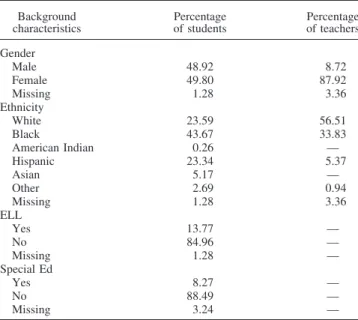
mostly from minority backgrounds (see background characteristics in Table 1); 43.7% were Black, 23.3% were Hispanic, and 13.8% were English language learners. Less than 25% were White. In contrast, of the 720 teachers reporting demographic data, most
were white (N⫽423, 56.8%) or Black (N⫽251, 33.7%) with few
identifying as Hispanic (N⫽39, 5.4%) or of other racial or ethnic
background (N⫽7, 0.97%). Less than 10% of the teachers were
male (N⫽67).
Measures
Table 2 presents descriptive information for all measures. Each member of our research team independently determined which items from the observational measures and the student survey were relevant to classroom talk. These ratings were then compared and discussed until a consensus was obtained on the final set of items included in this study.
Student Survey Ratings (Tripod; Ferguson, 2008). Students completed the Tripod survey at a single point in time, although reflecting on instructional practices across the academic year in general. The survey was completed in either paper or electronic form, as preferred by their classroom teacher. The Tripod consists of items within seven domains: Care, Control, Clarify, Challenge, Captivate, Confer, and Consolidate. As mentioned previously, from the full survey, the research team independently rated the
individual items’ relevancy to classroom talk, coming to consensus on 17 items that were relevant to classroom talk practices. These items tend to focus on features of classroom talk (i.e., explana-tions, questioning, etc.) embedded within different content areas and goals. As such, this data provide students’ impressions on classroom talk as embedded within instruction. A list of these items can be found in Table 2. Students rated items on a scale of
1–5. Reliability was found to be␣ ⫽.865 for the 17 items.
Rater Classroom Observations (CLASS and PLATO).
Ratings of classroom quality stemmed from an average of two trained raters’ scoring of up to four videoed lessons submitted by participating teachers using two measures of classroom quality adapted for the study: the CLASS and PLATOPrime. Videos were recorded between February and June and the teachers were the ones who did the video-recording. Training and special cameras were used. Each setup included two cameras with one focused on the board and the other showing a 360 degree view of the class-room. A microphone for the teacher and another designed to capture student voices was also used.
These observation protocols were used to capture the general classroom experience because observers were trained to consider the experience of the average student, so they would link small groups or pairs and whole class instruction to the scoring rubrics. Adaptations included limiting observations to the first 30 –35 min of the lesson and including fewer items from the original PLATO
tool (N ⫽ 6) based on prior studies that showed reliability and
strong associations between these elements and student outcomes (Grossman, Cohen, Ronfeldt, & Brown, 2014). Before coding, raters received 17–25 hr of self-directed training on the proce-dures, how to eliminate bias, and the various protocols. They had to score a 70% match (on the 4-point PLATO scale) with master-coded video segments and reliability was reestablished multiple Table 1
Descriptive Statistics of Students (N⫽18,844) and Teacher Background Characteristics (N⫽745) Background characteristics Percentage of students Percentage of teachers Gender Male 48.92 8.72 Female 49.80 87.92 Missing 1.28 3.36 Ethnicity White 23.59 56.51 Black 43.67 33.83 American Indian 0.26 — Hispanic 23.34 5.37 Asian 5.17 — Other 2.69 0.94 Missing 1.28 3.36 ELL Yes 13.77 — No 84.96 — Missing 1.28 — Special Ed Yes 8.27 — No 88.49 — Missing 3.24 —
Note. ELL⫽English language learner. Em dash (—) indicates demo-graphics not applicable to the teacher participants.
times during a rater’s viewing of video segments. The project used multiple protocols to assure reliability including raters beginning each shift with the scoring of calibration videos, then scoring 5% of videos as validity videos where true scores were available to compare the performance of the rater with ideal performance (these were unknown to the rater), and then a scoring leader also scored one video per shift to confirm that raters were scoring accurately. Overall, while the MET project does not provide in-terrater reliability, less than 10% in the variance in scores was because of rater effects (MET project user guide). While designed to assess general quality, we identified a subset of talk-related items on these measures to use in our analyses. More information is below for each specific observational measure.
Classroom assessment scoring system (CLASS; Hamre & Pi-anta, 2007). Data for five of the 11 domains of the CLASS tool were identified as containing scoring criteria relating to classroom talk. As part of the MET project scoring, each domain was rated on a scale of 1–7. Scoring rubrics highlighted quantity with low scores of 1 or 2 tending to be awarded for no occasions of that behavior, mid scores of 3, 4, or 5 awarded for occasional or limited transfer opportunities, and high scores of 6 or 7 awarded for extended or consistent occasions of the coded behavior. Phrases
like “no opportunities” and “not encouraged” link to scores of 1 or 2, words and phrases like “occasionally” or “opportunities in familiar contexts” link to scores of 3, 4, or 5, and words like “consistently, novel, or independent” link to scores of 6 or 7. See https://www.icpsr.umich.edu/icpsrweb/METLDB/holdings/ documentation for additional information on scoring rubrics.
Within each of those domains, the research team identified talk practices within the rubric such that the score of the domain could be
representative of classroom talk. For example, within theAnalysis and
Problem Solving domain, talk that supported higher-level thinking and problem solving was included within the rubric. Here, coders had looked for students explaining their thinking as well as developing arguments, providing explanations, constructing alternatives, and so forth. As such, the MET project score from the rater evaluating Analysis and Problem solving was used to represent classroom talk that involved students explaining thinking, providing explanations,
constructing alternative, and so forth. Overall, withinContent
Under-standing, communication of concepts and procedures was included.
Within Instructional Dialogue, frequent conversations, open-ended
questions, advanced language, and student engagement were
in-cluded. Within Quality of Feedback, scaffolding, feedback loops,
prompting thought processes, providing information, encouragement, Table 2
Descriptive Information for Measures
System Item/measure M SD Missingness (%)
Measures of classroom talk practices CLASS (average scores)
ratings 1–7
C1: Analysis and problem solving 2.87 0.49 39.05
C2: Content understanding 4.11 0.46 39.05
C3: Instructional dialogue 3.63 0.56 39.05
C4: Quality of feedback 3.84 0.55 39.05
C5: Regard for students perspective 3.41 0.55 39.05
PLATO ratings 1–7 P1: Classroom discourse (seg 1) 2.31 0.42 31.16
P2: Classroom discourse (seg 2) 2.41 0.48 31.16
Tripod ratings 1–5 S1: T nice when ask I ask q’s 4.31 0.94 14.34
S2: T explains another way 4.31 0.91 14.28
S3: T several ways of explaining 4.20 0.92 16.06
S4: T explains difficult things clearly 4.28 0.93 15.49
S5: T explains in orderly way 4.13 1.00 16.25
S6: T marks papers to show S how to improve 3.79 1.23 16.16
S7: T wants S to explain answers 4.20 0.95 16.42
S8: We learn to correct mistakes 4.47 0.80 15.37
S9: T asks whether we understand 4.36 0.92 15.52
S10: T tells us what we are learning and why 4.25 0.96 15.76
S11: T asks q’s to make sure S follows along 4.44 0.84 15.77
S12: T checks to make sure S understands 4.43 0.85 15.9
S13: T wants S to share ideas 3.88 1.12 15.94
S14: T summarizes what is learned each day 3.75 1.20 16.68
S15a: S don’t share ideas, just listen to T 2.64 1.30 17.10
S16: S speak up and share ideas 3.69 1.15 16.46
S17: T gives S time to explain ideas 4.14 0.95 15.62
Measures of reading achievement
State test ELApre: State standardized ELA test 0.10 0.95 10.25
State test ELApost: State standardized ELA test 0.09 0.96 4.59
Open-response SAT: Stanford achievement ninth edition
open-ended reading test
608.2 37.4 13.10
Note. CLASS ⫽ classroom assessment scoring system; PLATO ⫽ protocol for language arts teaching observation; EFA⫽exploratory factor analysis; ELA⫽English language arts assessment; SAT⫽Stanford 9 Open-Ended Reading Assessment.
aS15 was not used because of negative wording that resulted in a negative discrimination value with the recoded
and affirmation were included. Lastly, within Regard for Student Perspectives, supports of student expression were included. Scores for Positive Climate, Negative Climate, Teacher Sensitivity, Behavior Management,Productivity, andInstructional Learning Formatswere not used because they were not directly linked to classroom talk practices. Scores were averaged from two raters. Reliability across topics and throughout the school year has been shown for the CLASS (La Paro, Pianta, & Stuhlman, 2004). For our study, reliability was
␣ ⫽.917 for the five items used.1
Protocol for language arts teaching observation
(PLATOPrime; Grossman et al., 2010). Although the
PLATOPrime contained six domains, only a single domain titled Classroom Discourseincluded classroom talk practices in the rubric, again rated on a scale of 1–7. Scoring criteria for Classroom Dis-course focused on the opportunities students have for conversations with the teacher and among peers. This domain looks at uptake, or the extent to which the teacher engages students’ ideas and prompts them to clarify and specify their understandings. The remaining five
do-mains—Modeling,Strategy Use and Instruction, Intellectual
Chal-lenge, Time Management, and Behavior Management—were not used in the current study because there was no mention of talk in their
scoring rubrics. Reliability (i.e., Cronbach’s ␣) of the two items
(across two raters) was found to be␣ ⫽.763.2
State standardized English language arts assessment (ELA).
Scores from the state standardized language arts exams were used
from the Spring before the study as the ELA pretest (ELApre) and
from the Spring of the study year as the ELA posttest (ELApost).
Although the tests varied by the state in which the students learned, we compared the test blueprints and aligned the assessed con-structs using the technical manuals for each state to determine comparability of the state tests (New York State Testing Program, 2010; Technical Report for 2010 FCAT Test Administrations, 2010; Technical Report for the 2010 PISA, 2010; Technical Report
TCAP, 2010).3Our review suggests the states have similar
con-ceptualizations and ways of assessing reading. For example, all assessments included passages with comprehension questions cap-turing literal and inferential comprehension of both literary and informational texts assessed via mostly multiple-choice responses and some open-ended responses that were scored via rubrics. As such, we determined that there was evidence of content compara-bility across state assessments.
Because different tests were used, no single reliability was provided, although technical manuals from the states show high internal consistency for the states’ tests across Grades 4 and 5: 0.83– 0.86 in New York (New York State Testing Program, 2010), 0.90 – 0.91 in Pennsylvania (Technical Report for the 2010 PISA, 2010), 0.89 – 0.92 in Florida (Technical Report for 2010 FCAT Test Administrations, 2010), and 0.92 in Tennessee (Technical Report TCAP, 2010). Each state’s test reports also include exten-sive documentation of how they constructed their tests, including detailed item development processes, which suggests the validity of the comprehension measure. Additionally, these tests are prac-tically valid, as these were the tests that states and districts were using to make high-stakes decisions that link to retention and tracking decisions. No item-level data were available in the data-set. To standardize scores across measures, each student’s
rank-basedzscore was used.
Stanford 9 Open-Ended Reading Assessment (SAT). The Stanford 9 Open-Ended Reading Assessment is a nationally normed
achievement test (National Research Council, 1999) that involved student-constructed responses to reading. Because the SAT 9 scores are nationally normed, scores from different states are comparable. This assessment was chosen as a contrast to the multiple choice, basic skill nature of state tests and instead represents “cognitively demand-ing test content [that] presented students with constructed response items” (MET user guide, Inter-University Consortium for Political and Social Research, p. 26). According to the MET project user guide, “The assessment presented students with one extended reading pas-sage [narrative] and then asked them to respond to nine, open-ended tasks (which required students to provide short, written responses to comprehension questions).” The nine tasks involved higher-order thinking responses describing, summarizing, analyzing, and evaluat-ing the passages and then explainevaluat-ing their thinkevaluat-ing behind each
response. For interpretation, scale scores (M⫽608.2, SD⫽37.4)
were used. Extensive research work documents the SAT-9s reliability and validity (Harcourt Brace & Company, 1997), with reliability coefficients reported between .94 and .96 for Grades 2 through 11 (Rogosa, 1999). The MET project selected the SAT-9 as a comple-ment to state tests because they “included cognitively demanding content, they were reasonably well-aligned with the curriculum in the six states, had high levels of reliability, and had evidence of fairness to members of different groups of students.” (Gates Foundation, 2010, p. 11).
Data Analysis
Our methodological choices were guided by our research ques-tions, precedent from the literature, and the constraints of the MET project data and the models we used. First, our sample was limited to teachers for whom we had some data on classroom talk and
student outcomes (ELApre, ELApost, and SAT). As most intraclass
correlations (ICCs) were above 0.05, multilevel modeling was used to deal with clustering of students nested within class sections
nested within schools (see Appendix A for ICC values).4
To examine our first research question regarding how differ-ent measures of classroom talk relate, multilevel exploratory
1In the MET project, reliability for raters was low for the full CLASS
measure with 8% of the total variance in scores because of main rater effects (Bill & Melinda Gates Foundation, 2012, p. 35). We took this into account via our modeling framework. As will be described later, we extracted two factors (“rater observation of teachers” and “student obser-vation of teachers”) using all 23 Tripod, CLASS, and PLATO items at the section level. The two factors from the multilevel EFA are assumed to be measurement-error-free variables and were used in the multivariate multi-level model. The multimulti-level composite reliability (Geldhof et al., 2014) for the two factors was 0.863 and 0.979, respectively, suggesting good reli-ability.
2Reliability for raters was found to be low (10% of the total variance in
scores because of main rater effects, Bill & Melinda Gates Foundation, 2012, p. 35), which again was taken into account via our modeling framework (i.e., multilevel EFA assumed to be measurement-error-free variables and which together with the CLASS items resulted in a factor with 0.863 multilevel composite reliability (Geldhof et al., 2014).
3States include Florida, Tennessee, New York, and Pennsylvania, see
http://www.metproject.org/downloads/Student_Assessments_92110.pdf for details. Note that a concern by the education research community with these tests is that such state assessments often measure mostly basic skills.
4Because a teacher taught one or two sections (4% of teachers taught
two sections), clustering because of sections was chosen instead of teachers because section clustering is the lower level than teacher clustering. Also, district clustering was found to be ignorable and, therefore, not considered.
factor analysis (EFA) of the 23 indicators of classroom talk (16 Tripod, 5 CLASS, and 2 PLATO) was used to establish a
measurement model for classroom talk.5EFA was chosen as our
close review of the literature indicated no clear theoretical guidance in terms of the makeup of classroom talk. As such, methodological guidelines indicated EFA would be preferable to confirmatory factor analysis (CFA; Asparouhov & Muthén, 2009; Browne, 2001). Because school-level clustering can be
ignored for the Tripod indicators (ICC for schools ⫽ 0.039
compared with nonignorable section-level clustering ICC ⫽
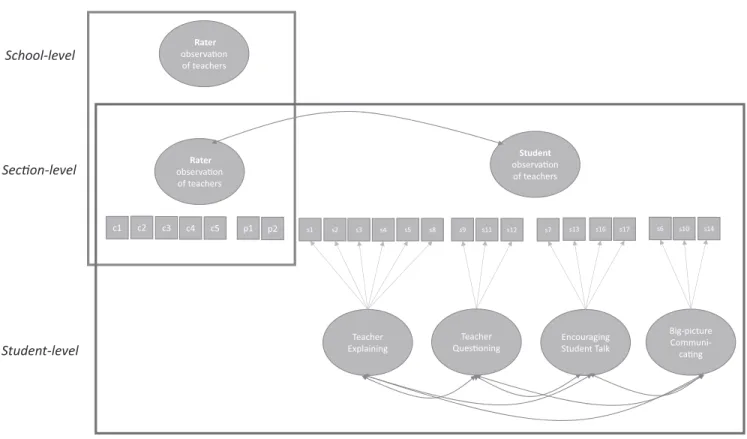
0.183 as shown in Appendix A) and three-level EFA is not feasible in currently available software, two different two-level EFAs were run: (a) students nested within sections and (b) sections nested within schools. In addition, because the CLASS and PLATO are section-level observations and, thus, there were no student-level data in the rater observations of teachers, these measures were specified at the section level only. To summarize our multilevel structure, the student-level data (Level 1; the student-level Tripod scores) are nested within the section-level data (Level 2; the section-level Tripod, CLASS, and PLATO scores), and the section-level data are nested within the school-level data (Level 3; the school-school-level CLASS and PLATO scores; see Figure 1). To determine the best fitting model, both theory and results for fit indices were used. Fit guidelines included root mean square error of approximation index (RMSEA; Steiger & Lind, 1980) less than .06, the root mean square residual (RMSR) less than .08, and comparative fit index (CFI; Bentler, 1990) and Tucker-Lewis index (TLI; Tucker & Lewis, 1973) larger than .95. The robust weighted least squares estimator using a diagonal weight matrix (Asparouhov & Muthén, 2007) with GEOMIN
rotation were used to fit multilevel EFAs in Mplus Version 7
(Muthén & Muthén, 1998 –2012). Multilevel composite reliabili-ties for each factor were calculated (Geldhof, Preacher, & Zyphur, 2014).
To explore our second research question, multivariate mul-tilevel modeling was used. In the model, latent variables mod-eled via the measurement model from the first research question were used to predict the two measures of standardized reading performance at the student, section, and school levels. We used standardized observed outcomes as no item-level data was available for each measure and because our research question examined potential different relations between classroom talk and the different measures of standardized reading achieve-ment, hence no creation of a latent variable from the two standardized reading outcomes (i.e., SAT and ELA). Also, variability in student background characteristics and prior skills were controlled for by entering dummy-coded demographic variables and prior scores on the state standardized ELA test as
covariates.6 The multivariate multilevel model is described in
Appendix B and was fit using Mpluswith the Bayes estimator.
Any participants with missing data on any student-level cova-riates were deleted using listwise deletion. This left 16,588
students learning within 822 class periods within 129 schools.7
Significant coefficients for factors within the classroom talk measurement model were explored and interpreted based on 95% credible interval (CI) from the Bayes estimator. The ex-plained variance of ELA and SAT outcomes by covariates was calculated by comparing results of the model with covariates with those of the model without covariates.
Results
Structure of Classroom Talk (RQ1)
Table 3 presents fit indices for 12 candidate models regarding the number of student-level and section-level factors using 23 indicators (16 Tripod, five CLASS, and two PLATO). Results for the single model regarding the number of section-level and school-level factors using seven indicators (five CLASS and two PLATO) are also shown. Combining the results of fit indices and factor loading interpretability (i.e., statistics and theory), the best fitting model included four factors at the student level, two factors at the section level, and one factor at the school level. Table 4 shows the factor loadings of the model and Table 5 details the structure. In Table 4, factor loadings are bolded to show the factor model in which they were ultimately assigned in the subsequent structural (see Figures 1 and 2) to answer Research Question 2. It is impor-tant to note that we used a combination of statistics and theory to identify the final model. When fit indices showed similarly good fit for multiple models and when factor loadings showed a simi-larly good fit for items across constructs, we considered theory and stability of items within latent constructs. For example, in the case of item S7 where students evaluated the statement “My teacher wants me to explain my answers,” theory was used to decide which of the two factor loadings made more theoretical sense (i.e., the
5One Tripod item (S15) was not used because of negative wording that
resulted in a negative discrimination value with the recoded S15.
6While measurement error can be a concern with observed versus latent
variables, we followed the precedence of most large-scale studies (i.e., Applebee et al., 2003; Carlisle et al., 2011), which model relationships with observed, standardized reading outcomes, which would be expected to have less error than researcher measures. Also, it would have been ideal to have additional controls of student-level reading predictors like vocabulary performance, but the MET project lacked such data, and again we followed other studies by using an autoregressor (i.e., pre-test scores) to control for other factors like vocabulary or general reading achievement that might contribute to these relationships. Income differences were not controlled for because of missing data present for an entire school district related to free and reduced lunch status. Teacher background characteristics were not included as covariates because of methodological challenges and because they were not the focus of our study. As our interest included differences in classroom talk across class periods, not just teachers, the Level 2 variable was class period, not teacher. Including teacher demographics, therefore, was not possible because the data could be repetitive for some class periods taught by the same teacher. Furthermore, no school level demographics were included because such variables were not available in the MET Study database, and again, this was not the focus of our study. At the student level, White served as the reference group for all race/ethnicity dummy variables.
7The listwise deletion requires missing completely at random (MCAR)
assumption. When MCAR assumption does not hold, parameter estimates can be biased (e.g., Enders, 2010). Comparisons of students with missing data in student-level covariates with students with no missing data in the student-level covariates revealed no psychometric differences between the groups. Specifically, we assessed MCAR using a series of t tests to compare missing subgroups (i.e., students with missing data in a student-level covariate vs. students with no missing data in a student-student-level cova-riate; Dixon, 1988). The series of thettest suggested that the group means are equivalent for student-level covariates we considered. This result supports for the MCAR assumption. In addition, to account for correlations among student-level covariates, we implemented a multivariate version of thettest that evaluates mean differences on every variable simultaneously across subgroups having the same missing data pattern (Little, 1988). Little’s test also supports for the MCAR assumption.
factor loading for the latent variable F2 Teacher Questioning of
0.237,p⬍.05 vs. 0.324,p⬍.05 for the latent variable F3 Student
Talk). In this case, because the content of the question related to student talk, in subsequent models (i.e., CFA and structural models in the multivariate multilevel model), S7 was assigned to F3. Overall, the four factors at the student level represent ratings of teacher explaining, teacher questioning, encouraging student talk, and big-picture communicating. For example, questions related to how a teacher explained classroom concepts loaded highest on the first factor, items related to teachers’ questions loaded highest on the second factor, items supporting student talk loaded highest on the third factor, and items related to big-picture communicating like summarizing learning and providing a purpose for learning loaded highest on the fourth factor. The multilevel composite reliability (Geldhof et al., 2014) for each of these factors was 0.933, 0.892, 0.889, and 0.786, respectively. These factors were correlated between 0.560 and 0.701 with correlations lowest be-tween the encouraging student talk factor and the others.
At the section level, student ratings and observer ratings repre-sent the two factors. Ratings of classroom talk by independent observers, who were reflecting on a single lesson segment and reflecting on talk features as embedded in different instructional goals, load best on the first factor (rater observations) whereas student ratings, which consider classroom talk across content and across the year, load best on the second factor (student observa-tions). The multilevel composite reliability (Geldhof et al., 2014)
for each was 0.863 and 0.979, respectively. These factors are
slightly yet significantly correlated (r⫽.210). At the school level,
there is no significant variance to model for the student ratings, so the observer ratings represent the single factor at the school level. It is important to note that for the second multilevel EFA (sections nested in schools), which used the seven teacher-level indicators (five CLASS and two PLATO), only one model having a factor at each of the section and the school levels converged without an estimation problem. This may be because of the small number of section-level indicators. Even though other models having more than one factor were not obtained because of convergence prob-lems, there is evidence supporting the model having a single factor. First, as shown in Table 4, the patterns of the factor loadings at the section level are similar between the multilevel EFA analysis using 23 indicators (16 Tripod, five CLASS, and two PLATO) and the multilevel EFA analysis using seven section-level indicators (five CLASS and two PLATO). Second, in the multilevel EFA analysis using seven section-level indicators, the between-level (i.e., school-level) fit index indicates evidence of a
good fit (SRMS⫽0.062 as shown in Table 3).
After the two multilevel EFA (the multilevel EFA for the student- and section-levels and the multilevel EFA for the section- and school-level) results were merged, the final mea-surement model for classroom talk practice includes four fac-tors at the student level, two facfac-tors at the section level, and one factor at the school level (see Figure 1). At the student level,
Rater observaon of teachers Student observaon of teachers Teacher Explaining Encouraging Student Talk Big-picture Communi-cang s1 s2 s3 s4 s5 s8 s9 s11 s12 s7 s13 s16 s17 s6 s10 s14 c1 c2 c3 c4 c5 p1 p2 Rater observaon of teachers Teacher Quesoning School-level Secon-level Student-level
Figure 1. Multilevel measurement model compiled from two multilevel EFAs. There was no variance in Rater measures at the Student Level (teacher-level variables). Also, school level variance can be ignored for Student Observations (s1–s17; ICC⫽.04). Based on initial results, convergence problems related to three-level CFA, and the structure of our data, we resorted to running two EFAs (see box outlines).
this structure indicates that students perceive different yet re-lated patterns in talk regarding how teachers explain, question, encourage student talk, and communicate the big-picture related to learning. At the section level, results suggest student and independent observers rate classroom talk practices differently. At the school level, the lack of significant school level variance
in student ratings (ICC ⫽ 0.039) suggests that independent
observers witness differences in talk practices among schools, yet students do not. For example, observers would likely note differences between school cultures that emphasize accountable talk versus behavior management (where silent, independent learning is encouraged), whereas students did not seem to note such differences in school foci. Such findings confirm the need for different lenses to examine talk.
Investigating the Effects of Classroom Talk Practices
on Reading (RQ2)
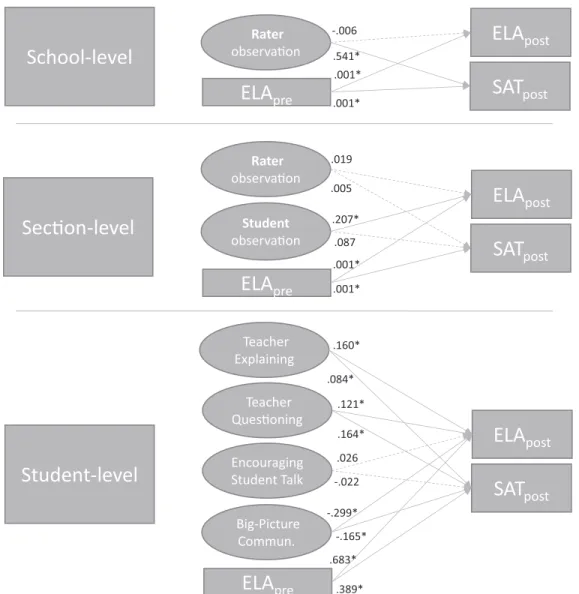
To explore links between the talk practices described above and standardized reading performance, the final measurement model found in RQ1 is used to explain the standardized reading outcomes controlling for prior test scores and student demographics. Results of the structural model are presented in Table 6. At the student level, results suggest that how students rate teacher explaining and
teacher questioning significantly predicts both ELApostand SAT
(␥ˆ1.E⫽0.312, 95% CI [0.188, 0.449] and␥ˆ1.S⫽5.957, 95% CI
[0.113, 12.078] for teacher explaining; ␥ˆ2.E ⫽ 0.199, 95% CI
[0.071, 0.341];␥ˆ2.S⫽9.828, 95% CI [3.711, 15.394] for teacher
questioning) such that higher ratings predict higher standardized test scores. In contrast, how students rated teacher big-picture
communicating was negatively related to both ELApostand SAT
(␥ˆ4.E⫽ ⫺0.411, 95% CI [⫺0.570,⫺0.267];␥ˆ4.S⫽ ⫺8.261, 95%
CI [⫺14.651,⫺1.396]). Also, how students rated teachers’
en-couraging of student talk did not significantly relate to either outcome (␥ˆ3.E⫽0.045, 95% CI [⫺0.074, 0.173];␥ˆ3.S⫽ ⫺1.328,
95% CI [⫺6.565, 4.240]). At the section level, controlling for prior
test performance, students’ overall ratings of classroom talk but not raters’ observations predicted performance on the state
stan-dardized English Language Arts test (␦ˆ2.E⫽0.188, 95% CI [0.079,
0.302];␦ˆ1.E⫽0.008, 95% CI [⫺0.046, 0.062]), although neither
predicted performance on the open-response standardized reading test (␦ˆ2.S⫽5.301, 95% CI [⫺2.023, 12.517];␦ˆ1.S⫽0.131, 95% CI
[⫺3.137, 3.251]) when controlling for prior test scores. At the
school level, there was not significant variance to model in student ratings, so student ratings were not included in the school level of the model. Observer ratings of talk-related indicators of classroom
talk, though, predicted performance on the SAT (ˆ1.S⫽ 60.922,
95% CI [17.858, 313.364]) but not ELApost(ˆ1.E⫽ ⫺0.005, 95%
CI [⫺0.508, 0.766]) controlling for prior test scores (ELApre).
Note that at the student and section level, the two reading
stan-dardized tests (ELApost and SAT) were significantly related,
al-Table 3
Fit Indices for Two-Level (Students Nested Within Sections) EFA Using 23 Indicators (5 CLASS⫹2 PLATO⫹16 Tripod) and Two-Level (Sections Nested Within Schools) EFA Using Seven Indicators (5 CLASS⫹2 PLATO)
Number of factors Fit indices
Student level Section level RMSEA
SRMS
CFI TLI
Within Between
Two-level EFA with 23 indicators
1 1 0.027 0.034 0.335 0.930 0.922 2 1 0.024 0.029 0.335 0.947 0.938 3 1 0.021 0.026 0.335 0.959 0.950 4 1 0.021 0.024 0.336 0.963 0.953 1 2 0.023 0.025 0.076 0.951 0.942 2 2 0.019 0.017 0.078 0.968 0.960 3 2 0.015 0.011 0.076 0.980 0.974 4 2 0.014 0.008 0.075 0.984 0.977 1 3 0.022 0.025 0.057 0.958 0.947 2 3 0.018 0.017 0.049 0.975 0.966 3 3 0.014 0.011 0.049 0.986 0.979 4 3 0.012 0.008 0.049 0.989 0.984 SRMS
Section level School level RMSEA Within Between CFI TLI
Two-level EFA with seven indicators
1 1 0.121 0.079 0.062 0.893 0.839
Note. CLASS ⫽ classroom assessment scoring system; PLATO ⫽ protocol for language arts teaching observation; EFA⫽exploratory factor analysis; RMSEA⫽root mean square error of approximation; SRMS⫽ standardized root mean square residual; CFI⫽comparative fit index; TLI⫽Tucker-Lewis index. Results of the sections nested within schools EFA (seven teacher-level indicators: five CLASS and two PLATO) converged without an estimation problem only for the model having a single factor at the section and school level. The number of factors we interpreted is in bold.
though not at the school level. Overall, including the covariates in the model explained 63.8% of variance in performance on the state standardized English Language Arts test and 33.5% of variance in performance on the open-response standardized reading assessment.
Discussion
Classroom talk has been hypothesized to support literacy learn-ing. The ways teachers and students express their ideas likely impacts reading comprehension. Much has been written unraveling specifics related to classroom talk, but what is less understood is how measurement affects the picture of classroom talk and its link to reading across a large number of upper elementary English Language Arts classrooms. Our study fills this gap.
Elementary Language Arts Classroom Talk
Findings indicate that students noticed patterns in their teachers’ talk, and those patterns are similar to those found in the literature on discussions. Ratings of items assessing teachers’ explanations were related, yet different from items assessing the quality of questions, encouragement of student talk, and communication of big-picture learning. Three of these categories of talk (teachers’ quality of expla-nations, quality of questions, and encouraging student talk) have been explored in previous literature (e.g., Soter et al., 2008). However, there has been less attention in the literature to teachers’ communi-cation of big-picture ideas related to learning, which includes feed-back on how to improve written work, statements on what was being learned and why, and summaries of what was learned by day. Though Table 4
Factor Loadings and Factor Correlations for Multilevel EFAs
System Item/measure
Two-level (students nested within sections) EFA
Two-level (sections nested within schools)
EFA
Level 1 (student) Level 2 (section)
Level 1 (section) Level 2 (school) F1 teacher explaining F2 teacher questioning F3 student talk F4 big-picture commun. F1 rater obser. F2 student obser. F1 rater obser. F1 student obser. Factor loading CLASS C1 - - - - 0.828a ⫺0.016 0.805a 0.838a C2 - - - - 0.748a 0.058 0.747a 0.732a C3 - - - - 0.920a 0.035 0.922a 0.916a C4 - - - - 0.907a ⫺0.046 0.888a 0.867a C5 - - - - 0.792a 0.021 0.789a 0.741a PLATO P1 - - - - 0.510a ⫺0.029 0.485a 0.513a P2 - - - - 0.499a ⫺0.008 0.473a 0.578a Tripod S1 0.537a ⫺0.102a 0.106a 0.000 0.385a 0.448a – – S2 0.461a 0.095a 0.002 ⫺0.004 0.007 0.890a – – S3 0.424a 0.029 0.009 0.226a 0.054 0.963a – – S4 0.590a 0.066a ⫺0.044a ⫺0.005 0.070 0.928a – – S5 0.233a 0.044a 0.064a 0.265a ⫺0.161a 0.939a – – S6 0.024 0.174a 0.078a 0.288a 0.026 0.734a – – S7 ⫺0.032a 0.273a 0.324a 0.029 0.211a 0.695a – – S8 0.263a 0.185a 0.047a 0.059a 0.061 0.818a – – S9 0.195a 0.417a 0.015 ⫺0.014 ⫺0.156a 0.865a – – S10 0.122a 0.237a ⫺0.016 0.298a ⫺0.141a 0.989a – – S11 ⫺0.016 0.575a 0.039a 0.012 ⫺0.191a 0.936a – – S12 0.136a 0.505a 0.013 0.055a ⫺0.076 0.968a – – S13 0.043a 0.019 0.628a ⫺0.021 0.403a 0.556a – – S14 ⫺0.013 ⫺0.004 0.020 0.632a ⫺0.252 0.880a – – S16 0.017 0.014 0.432a 0.131a 0.276a 0.714a – – S17 0.317a 0.014 0.233a 0.149a 0.216a 0.868a – – Factor correlations F1 F2 F3 F4 F1 F2 F1 1 1 F2 0.698a 1 0.210a 1 F3 0.572a 0.560a 1 – – F4 0.625a 0.701a 0.687a 1 – –
Note. CLASS⫽classroom assessment scoring system; PLATO⫽protocol for language arts teaching observation; EFA⫽exploratory factor analysis; RMSEA⫽root mean square error of approximation; big-picture commun.⫽teacher big-picture communicating; -⫽not modeled because CLASS and PLATO were measured at the section level; –⫽not modeled because of small intraclass correlation (ICC) on Tripod items for schools (ICC⫽.039) and software limitation.
Table 5 Description of Factor Structure of Classroom Talk Level Factor structure School level (one factor, seven CLASS and PLATO items) No student ratings: No school level variance in these indicators Observer ratings C1–5, P1–2 Section level (2 factors, 23 Tripod, CLASS, and PLATO items) Student ratings S1, S2, S3, S4, S5, S6, S7, S8, S9, S10, S11, S12, S13, S14, S16, S17 Observer ratings C1: Analysis and problem solving C2: Content understanding C3: Instructional dialogue C4: Quality of feedback C5: Regard for Stud. perspect P1: Classroom discourse (seg 1) P2: Classroom discourse (seg 2) Student-level (four factors, 16 Tripod items) Teacher explaining Teacher questioning Teacher encouraging student talk Teacher big-picture communicating S1: My teacher is nice to me when I ask questions S2: If you don’t understand something, my teacher explains it another S3: My teacher has several good ways to explain each topic that we cover in this class S4: My teacher explains difficult things clearly S5: My teacher explains things in very orderly ways S8: In this class, we learn to correct our mistakes S9: When he/she is teaching us, my teacher asks us whether we understand S11: My teacher asks questions to be sure we are following along when he/she is teaching S12: My teacher checks to make sure we understand what he/she is teaching us S7: My teacher wants me to explain my answers—why I think what I think S13: My teacher wants us to share our thoughts S16: Students speak up and share their ideas about class work S17: My teachers gives us time to explain our ideas S6: When my teacher marks my work, he/she writes on my papers to help me understand how to do better S10: My teacher tells us what we are learning and why S14: My teacher takes the time to summarize what we learn each day Note . CLASS ⫽ classroom assessment scoring system; PLATO ⫽ protocol for language arts teaching observation.
these aspects of teacher talk have been considered aspects of expla-nation in the past (Winograd & Chou, 1988), they were different from the features of explanations (i.e., clarity, order, and multiple options) in this study. This finding suggests that in the upper elementary English Language Arts context, broader ideas related to what is being learned and why it is being learned may be different from more specific aspects of explanations. This finding adds to the theoretical literature as it indicates the makeup of the interactions that are going on with more knowledgeable others that are mediating learning via linguistic supports (Vygotsky, 1978).
Findings also contrasted observers’ and students’ perceptions of talk, which provides additional evidence that multiple lenses ex-ploring talk are valuable and confirms the importance of consid-ering how classroom talk is measured. What students noticed related to classroom talk across the year and across content goals was different from what raters noticed in a segment of a lesson focused upon talk as related to different aspects of quality reading
instruction. One possible explanation is that teachers may vary their talk somewhat across lessons and content areas such that what students were conveying was their perspective of the broad average of the classroom talk rather than the classroom talk oc-curring within a specific lesson or related to a specific content or context. For example, on a certain day an observer might see a lesson focused on vocabulary, which may highlight explanations of word meanings or questions regarding personal connections to words, yet involve less of a broad summary of learning. On a different day, an observer might rate a lesson teaching metacog-nitive reading strategies, which may involve discussions of why strategies may be important to the broader reading process. In contrast, a student would have experienced both of these lessons such that his or her ratings would average these experiences across the school year. Another explanation may involve individual ver-sus globalized focus on talk (e.g., Connor et al., 2014). It may be that a student is interpreting both their individual and collective Rater observaon Student observaon
Secon-level
Student-level
School-level
Rater observaonELA
preELA
pre Teacher Explaining Teacher Quesoning Encouraging Student Talk Big-Picture Commun.ELA
preELA
postSAT
postELA
postSAT
postELA
postSAT
post .160* .084* .121* .164* .026 -.022 -.299* -.165* .683* .001* .001* .087 .207* .005 .019 .001* .001* .541* -.006Figure 2. Results of a structural model in the multivariate multilevel model. All values are standardized. All models control for demographics. ELA⫽English language arts assessment; SAT⫽Stanford 9 Open-Ended Reading Assessment.ⴱp⬍.05.
experience with classroom talk whereas observers are more likely to pay attention to the collective experience of the class as a whole. Additionally, students may be communicating their perceptions of their relationships with teachers (i.e., their working alliance, Toste et al., 2010), which has been shown to relate to student perfor-mance. Overall, the method differences noted (e.g., different set of questions, different informants) show that multiple lenses provide meaningfully different data on classroom talk.
Link Between Classroom Talk and Reading
Findings from our study also suggest a clear relationship be-tween classroom talk and standardized reading outcomes even when controlling for prior test scores and student demographics. And this relationship exists for more than 18,000 fourth and fifth graders learning from 745 teachers—a far larger sample than other quantitative studies of talk and comprehension (e.g., Applebee et al., 2003; Michener et al., 2018; Murphy et al., 2009). In other words, general classroom talk practices embedded within larger instruction and measured in different ways connected with end of
the year reading performance on two different types of standard-ized reading assessments for a large sample of students. This indicates that general classroom talk practices (e.g., explanations and questions) matter in English Language Arts instruction.
Specifically, higher ratings of teacher explanations and questioning predicted higher scores on both of the standardized reading assess-ments. Theoretically, these findings suggest important nuances in the ways that more knowledgeable others support meaning making more broadly (Vygotsky, 1978) and also connections to reading compre-hension (Alvermann et al., 2013; Gough & Tunmer, 1986). For example, these structures— explanations and questions—seem to pro-vide the space for more knowledgeable others to model and scaffold effective language including content-specific vocabulary and complex syntactical structures as well as thinking that students can then emu-late in their own meaning-making endeavors.
Michener and colleagues (2018), who also found that teacher explanations predicted upper elementary students’ reading compre-hension, hypothesized that, “explanations acted as linguistic exposure necessary for supporting students’ linguistic comprehension for read-Table 6
Results for the Multivariate Multilevel Model
ELA SAT
Effects EST CI (LB, UB) EST CI (LB, UB)
Fixed effects 0.137a [0.102, 0.169] 612.333a [609.191, 165.421] Intercept Student-level [␥...] “Teacher explaining” [␥1..] 0.312 [0.160] a [0.188, 0.449] 5.957 [0.084]a [0.113, 12.078] “Teacher questioning” [␥2..] 0.199 [0.121]a [0.071, 0.341] 9.828 [0.164]a [3.711, 15.394]
“Encouraging student talk” [␥3..] 0.045 [0.026] [⫺0.074, 0.172] ⫺1.360 [⫺0.022] [⫺6.565, 4.244]
“Teacher big-picture communicating” [␥4..] ⫺0.411 [⫺0.299]a [⫺0.570,⫺0.267] ⫺8.261 [⫺0.165]a [⫺14.651,⫺1.396]
ELA pretest scores [␥5..] 0.687 [0.683]
a [0.676, 0.698] 14.292 [0.389]a [13.721, 14.850] Gender (male) [␥6..] ⫺0.055 [⫺0.034]a [⫺0.073,⫺0.038] ⫺8.522 [⫺0.143]a [⫺9.407,⫺7.643) African American [␥7..] ⫺0.148 [⫺0.090] a [⫺0.180,