NAVAL
POSTGRADUATE
SCHOOL
MONTEREY, CALIFORNIA
THESIS
Approved for public release; distribution is unlimited. COMPARISON OF THE NAVY WORKING CAPITAL FUND AND MISSION FUNDING
AS APPLIED TO NAVY SHIPYARDS by
Andrew M. Cain June 2006
Thesis Co-Advisors: Jerry L. McCaffery
REPORT DOCUMENTATION PAGE Form Approved OMB No. 0704-0188 Public reporting burden for this collection of information is estimated to average 1 hour per response, including the time for reviewing instruction, searching existing data sources, gathering and maintaining the data needed, and completing and reviewing the collection of information. Send comments regarding this burden estimate or any other aspect of this collection of information, including suggestions for reducing this burden, to Washington headquarters Services, Directorate for Information Operations and Reports, 1215 Jefferson Davis Highway, Suite 1204, Arlington, VA 22202-4302, and to the Office of Management and Budget, Paperwork Reduction Project (0704-0188) Washington DC 20503.
1. AGENCY USE ONLY (Leave blank) 2. REPORT DATE
June 2006
3. REPORT TYPE AND DATES COVERED Master’s Thesis
4. TITLE AND SUBTITLE
Comparison of the Navy Working Capital Fund and Mission Funding as Applied to Navy Shipyards
6. AUTHOR(S) Andrew M. Cain
5. FUNDING NUMBERS
7. PERFORMING ORGANIZATION NAME(S) AND ADDRESS(ES) Naval Postgraduate School
Monterey, CA 93943-5000
8. PERFORMING ORGANIZATION REPORT NUMBER
9. SPONSORING /MONITORING AGENCY NAME(S) AND ADDRESS(ES) N/A
10. SPONSORING/MONITORING AGENCY REPORT NUMBER
11. SUPPLEMENTARY NOTES The views expressed in this thesis are those of the author and do not reflect the official policy or position of the Department of Defense or the U.S. Government.
12a. DISTRIBUTION / AVAILABILITY STATEMENT Approved for public release: distribution is unlimited
12b. DISTRIBUTION CODE A
13. ABSTRACT (maximum 200 words)
The dramatic political and economic events, both globally and within the United States, during the early 1990s led to significant changes to the Navy shipyard organizational structure. As part of the Navy maintenance regionalization and consolidation program, the financial management system used to manage these commands has been changed. Specifically, the Navy has shifted two of its four shipyards, with authorization to shift the other two in FY07, from the Navy Working Capital Fund to mission funding through direct congressional appropriations.
This funding shift has raised questions about the advantages and disadvantages each financial system provides shipyards, the operating differences that occur due to the funding change, and the future financial consequences of funding Navy shipyards using direct appropriations.
This thesis identifies the advantages and disadvantages of the Navy Working Capital Fund and the mission funding model in the context of a Navy shipyard environment and determines whether the change in financial structure provides an overall benefit that should be pursued for all shipyards.
15. NUMBER OF PAGES
77 14. SUBJECT TERMS
Navy Working Capital Fund, Mission Funding, Direct Appropriations, Depot Maintenance, Intermediate Maintenance, Navy Shipyards
16. PRICE CODE 17. SECURITY CLASSIFICATION OF REPORT Unclassified 18. SECURITY CLASSIFICATION OF THIS PAGE Unclassified 19. SECURITY CLASSIFICATION OF ABSTRACT Unclassified 20. LIMITATION OF ABSTRACT UL
NSN 7540-01-280-5500 Standard Form 298 (Rev. 2-89) Prescribed by ANSI Std. 239-18
Approved for public release; distribution is unlimited
COMPARISON OF THE NAVY WORKING CAPITAL FUND AND MISSION FUNDING
AS APPLIED TO NAVY SHIPYARDS Andrew M. Cain
Lieutenant, United States Navy
B.S., Rose-Hulman Institute of Technology, 1999
Submitted in partial fulfillment of the requirements for the degree of
MASTER OF BUSINESS ADMINISTRATION
from the
NAVAL POSTGRADUATE SCHOOL June 2006
Author: Andrew M. Cain
Approved by: Jerry L. McCaffery Co-Advisor
John E. Mutty Co-Advisor
Robert N. Beck
ABSTRACT
The dramatic political and economic events, both globally and within the United States, during the early 1990s led to significant changes to the Navy shipyard organizational structure. As part of the Navy maintenance regionalization and consolidation program, the financial management system used to manage these commands has been changed. Specifically, the Navy has shifted two of its four shipyards, with authorization to shift the other two in fiscal year 2007, from the Navy Working Capital Fund to mission funding through direct congressional appropriations.
This funding shift has raised questions about the advantages and disadvantages each financial system provides shipyards, the operating differences that occur due to the funding change, and the future financial consequences of funding Navy shipyards using direct appropriations.
This thesis identifies the advantages and disadvantages of the Navy Working Capital Fund and the mission funding model in the context of a Navy shipyard environment and determines whether the change in financial structure provides an overall benefit that should be pursued for all shipyards.
TABLE OF CONTENTS
I. INTRODUCTION...1 A. OBJECTIVES ...1 B. SCOPE ...2 C. METHODOLOGY ...2 D. ORGANIZATION ...3 II. BACKGROUND ...5A. DEPARTMENT OF THE NAVY MAINTENANCE ORGANIZATION ...5
1. Maintenance Echelons ...6
a. Organizational-Level Maintenance...6
b. Intermediate-Level Maintenance ...7
c. Depot-Level Maintenance...8
2. Maintenance Policy and Procedures ...9
a. Preventative Maintenance ...10
b. Corrective Maintenance...11
B. NAVY MAINTENANCE CHANGE...12
C. CHANGE IMPLEMENTATION...13
III. MISSION FUNDING...17
A. ORIGINS OF DIRECT APPROPRIATIONS ...17
B. CONGRESSIONAL BUDGET PROCESS ...18
1. Authorization and Appropriation ...19
2. Congressional Appropriations Subdivisions ...20
C. DEFENSE BUDGET PREPARATION...21
D. DIRECT APPROPRIATION RESTRICTIONS ...25
1. Purpose Restrictions ...25
2. Time Period Restrictions...26
3. Obligation Amount Restrictions...27
E. BUDGET EXECUTION FOR MISSION FUNDED ORGANIZATIONS ...28
F. INTERMEDIATE MAINTENANCE FACILITY OPERATIONS ...29
IV. NAVY WORKING CAPITAL FUND ...31
A. THE FORMATION OF THE DWCF...31
B. NWCF OBJECTIVES ...32
C. NWCF OPERATION ...34
1. Cost Accounting for the NWCF...35
a. Full Cost Recovery ...36
D. NWCF BUDGET PROCESS ...36
E. NWCF MANAGEMENT ...38
F. WORKING CAPITAL FUND RESTRICTIONS...38
1. Cash Management Restrictions ...39
V. MISSION FUNDING VS. WORKING CAPITAL FUNDING ...41
A. PUGET SOUND PROTOTYPE...43
B. PROBLEMS WITH USING SHIPYARD DATA...44
C. ANALYSIS OF OPERATIONAL AND FINANCIAL FLEXIBILITY ...45
1. Personnel Flexibility ...45
a. Personnel Cost...45
b. Workforce Utilization...46
2. Financial Flexibility ...46
a. Fiscal Year Flexibility...46
b. Maintenance Costs Exceed Appropriations ...47
3. Decision Making Authority...48
D. ANALYSIS OF COST VISIBILITY...49
1. Customer/ Provider Relationship...49
2. Private Business Practices...50
a. Cost Accounting ...50
b. Depreciation Expense ...51
3. Cost Visibility for Senior Officials...51
VI. CONCLUSIONS ...53
A. COST VISIBILITY ...53
1. Cost Reporting ...53
2. Business Practices ...55
B. OPERATIONAL AND FINANCIAL FLEXIBILITY ...55
1. Operational Flexibility...55
2. Financial Flexibility ...56
C. FINAL RESULTS...57
D. RECOMMENDATIONS FOR FURTHER STUDY ...58
1. Naval Aviation Depots ...58
2. East Coast Shipyard Funding Shifts ...58
3. One Shipyard...58
LIST OF REFERENCES ...59
LIST OF FIGURES
Figure 1. Congressional Budget Functions ...19
Figure 2. 2006 Defense Appropriations Act Language...21
Figure 3. DoD Budget Preparation Process for PHNS & NIMF...24
Figure 4. Mission Funding Budget Execution...30
Figure 5. MF vs. NWCF Organizational Relationships ...33
Figure 6. Unit Cost Calculation...35
LIST OF ACRONYMS
3M Maintenance and Material Management
2M Miniature and Micro-Miniature
APN Aircraft Procurement Navy
ABC Activity Based Costing
AOR Accumulated Operating Result
AOB Annual Operating Budget
ASN (FM&C) Assistant Secretary of the Navy (Financial Management and Comptroller)
BES Budget Estimate Submission
BRAC Base Realignment and Closure
BSO Budget Submitting Office
BUMED Bureau of Medicine and Surgery
CBM Condition Based Maintenance
CBO Congressional Budget Office
COMPACFLT Commander Pacific Fleet
COMSUBLANT Commander Submarine Force, U.S. Atlantic Fleet COMSUBPAC Commander Submarine Force, U.S. Pacific Fleet
CNI Naval Installations Command
CNO Chief of Naval Operations
CRA Continuing Resolution Authority
CSMP Current Ship’s Maintenance Plan
CSMP Consolidated Ship’s Maintenance Plan
DBOF Defense Business Operations Fund
DDMC Defense Depot Maintenance Council
DLH Direct Labor Hour
DoD Department of Defense
DoN Department of the Navy
DWCF Defense Working Capital Fund
FAA Fund Administrating Activity
FMA Fleet Maintenance Activity
FMB Office of Budget
FMR Financial Management Regulations
FY Fiscal Year
GAO Government Accountability Office (formerly General Accounting Office)
IDTC Inter-Deployment Training Cycle
IG Inspector General
IMF Intermediate Maintenance Facility
JCN Job Control Number
JCS Joint Chiefs of Staff
MCN Military Construction Navy
MF Mission Funding
MILCON Military Construction
MILPERS Military Personnel
MIP Maintenance Index Page
MJC Master Job Catalog
MPN Military Personnel Navy
MRC Maintenance Requirement Card
MRMS Maintenance Resource Management System
NAVFAC Naval Engineering Facilities Command
NAVSEA Naval Sea Systems Command
NETC Naval Education and Training Command
NNS Norfolk Naval Shipyard
NOR Net Operating Result
NPC Naval Personnel Command
NSY Naval Shipyard
NWCF Navy Working Capital Fund
OMN Operation and Maintenance Navy
OMB Office of Management and Budget
OPN Other Procurement Navy
OPTAR Operating Target
OSD Office of the Secretary of Defense
PBD Program Budget Decision
PHNS Pearl Harbor Naval Shipyard
PMS Preventative Maintenance Schedule
PNS Portsmouth Naval Shipyard
POM Program Objectives Memorandum
PPBE Planning, Programming, Budgeting and Execution System
PSNS Puget Sound Naval Shipyard
RCM Reliability Centered Maintenance
RDT&E Research, Development, Testing and Evaluation
RMC Regional Maintenance Center
RMP Regional Maintenance Program
SCN Shipbuilding and Conversion Navy
SECNAV Secretary of the Navy
SIMA Shore Intermediate Maintenance Activity
SYMIS Shipyard Management Information System
TRF Trident Refit Facility
USD(C) Under Secretary of Defense (Comptroller)
I. INTRODUCTION
The rapid change in the national defense environment during the early 1990s, a function of the collapse of the Soviet Union, resulted in widespread initiatives designed to improve the efficiency and cost effectiveness of the Department of Defense (DoD). One target of this initiative has been the Navy’s shipyard maintenance structure.
In 1994, the Chief of Naval Operations introduced the Regional Maintenance Plan (RMP) for Navy shipyards, a consolidation of facilities aimed at reducing excess infrastructure, improving maintenance processes, and combining supply and maintenance functions across all levels of maintenance (GAO 1997, p.5). A byproduct of this regionalization effort has been the consolidation of the financial management systems used to govern these commands. Specifically, the Navy has shifted two of its four shipyards from a working capital method of funding to a more direct mission funding platform, and plans to restructure all of its shipyards in this fashion in the near future.
This change has raised questions about the advantages and disadvantages each funding structure provides the shipyard, the operating differences that occur due to funding changes, and the future financial consequences of mission funding.
This thesis will identify the advantages and disadvantages of the Navy Working Capital Fund (NWCF) and the Mission Funding (MF) model for Navy shipyards and determine whether the change in financial structure provides an overall benefit that should be pursued for all shipyards.
A. OBJECTIVES
This thesis examines the differences between the Navy Working Capital Fund and Mission Funding within the Navy shipyard maintenance environment. The goal of this work is to determine how these two funding methods constrain shipyard managers, as well as the aspects of each method that provide shipyard managers with opportunities unavailable under the other method.
B. SCOPE
The purpose of this research is to:
• Describe the reasons behind the Navy’s shipyard restructuring plans.
• Explain the operations of both funding methods.
• Identify the inherent differences between both funding methods and show how these differences manifest themselves in Navy shipyard operations.
• Suggest which funding method best serves the Navy shipyards.
C. METHODOLOGY
In researching this topic, the following were conducted:
• A literature review of the historical background and basis behind the Navy’s decision to regionalize and consolidate its shipyards, as well as the decision to favor Mission Funding over the Navy Working Capital Fund.
• Research into the Navy’s maintenance organizational structure and processes.
• A literature review of the Federal budget process, from the perspective of the Navy, the Department of Defense and Congress. Additionally, a review of the budget execution process for Navy shipyards under each funding model was conducted.
• A review of government reports from the Congressional Budget Office, the Congressional Research Service, the General Accountability Office, The Center for Naval Analysis, the DoD Comptroller and the DoD Inspector General was conducted during the progress of this research. Additionally, DoD directives and DoD and DoN Financial Management Circulars and instructions were perused, as was the GAO Red Book for authorities on Fiscal Law and procedures. Standard sources on governmental accounting and periodical literature were consulted, including publications of the U. S. Naval Institute.
• A study of the performance and cost reporting requirements for organizations under each funding method and the information contained therein.
• Personal interviews with Navy Material and Logistics Offices (N4) at COMSUBPAC and COMSUBLANT were conducted to verify processes and identify how each funding method affects everyday operations, including numerous follow-up phone conversations.
D. ORGANIZATION
This thesis is organized in the following manner:
• Chapter I is the Introduction.
• Chapter II describes the Navy maintenance processes and the factors that led to the change in the Navy shipyard maintenance organizational structure.
• Chapter III describes Mission Funding regulations, budgeting and execution, restrictions and shipyard operation under this model.
• Chapter IV describes the Navy Working Capital Fund and its regulations, budgeting and execution, restrictions and shipyard operation under this model.
• Chapter V compares the two funding methods in the context of Navy shipyard operations.
II. BACKGROUND
There is wide variety of subject matter to absorb before the issues concerning a depot maintenance funding shift can be appreciated. This chapter provides an explanation of the Navy’s maintenance organization, creating a foundation to apply to the structural changes that have taken place within the realm of shipyard maintenance. Second, this chapter describes the political inertia behind the changes this thesis examines and provides an introduction to the Department of Defense and Navy policies that govern how their shipyards were reorganized in the face of this transformation.
A. DEPARTMENT OF THE NAVY MAINTENANCE ORGANIZATION
The Navy’s maintenance program defines and manages the required configuration of each class of ship, along with the material condition of each individual ship. This program encompasses servicing, repair, modification, modernization, overhaul, conversion, rebuild, test, reclamation inspection and the determination of material condition. Its purpose is threefold: To maintain the highest achievable level of material readiness while supporting the ship’s mission and sustaining operational availability, to maintain ships in a safe material condition, and to meet the highest possible shipboard habitability standards possible for its sailors (OPNAVINST 4700.7K 2003, p.4).
Maintenance procedures and schedules for Navy ships and related equipment are developed and performed using a methodology the Navy refers to as Condition-Based Maintenance (CBM). CBM attempts to balance operational readiness, safety, and equipment reliability with cost effectiveness, by conducting maintenance only when there is objective evidence of actual or predictable failure of a ship’s installed systems or components. It relies on the principles of Reliability Centered Maintenance (RCM) to obtain this balance (OPNAVINST 4700.7K 2003, p.5).
Reliability-Centered Maintenance identifies maintenance tasks that are both applicable and effective in maintaining the inherent reliability of systems or equipment at an optimal cost. RCM principles determine what constitutes objective evidence of need for maintenance, while also ensuring that a maintenance task is both applicable to the
need and effective in restoring the system. RCM-applicable methodology identifies the maintenance tasks that are able to maintain or restore system or equipment reliability. RCM-effective methodology optimizes variables such as system or equipment failure consequences, safety of personnel, environmental impact, mission capability hindrance, and minimal life cycle cost to ensure that maintenance tasks “pay for themselves” (OPNAVINST 4700.7K 2003, Encl 7, p.7).
1. Maintenance Echelons
As one would expect for systems and equipment as sophisticated and physically imposing as a Navy vessel, the maintenance performed to ensure mission capability consists of actions as simple as visual inspections and minor testing, as well as covering such manpower and equipment intensive evolutions as nuclear refueling. To ensure all work is performed at locations, and by personnel, best suited for proper accomplishment, OPNAV Instruction 4700.7K separates ship maintenance into three echelons: organizational, intermediate, and depot level. Each respective level provides a greater degree of capability. It is the policy of the Navy to ensure all maintenance is done at the correct echelon by qualified personnel.
a. Organizational-Level Maintenance
Organizational-level maintenance represents the lowest echelon and consists of all preventative and corrective maintenance actions within the capacity of each individual ship’s operational forces. Each ship is expected to be self-sufficient to the maximum extent possible, fostering a “do it yourself” attitude and maximizing the mission capability of each ship (OPNAVINST 4700.7K 2003, p.8).
Typical organizational-level maintenance actions include:
• Facilities maintenance, such as cleaning and preservation.
• Routine systems and component preventive maintenance, such as inspections, systems operability tests and diagnostics, lubrication, calibration, and cleaning.
• Corrective maintenance, such as hull, mechanical, electrical, and electronic troubleshooting down to the lowest replaceable unit level, miniature and micro-miniature (2M) electronic repair, and minor repairs to components to restore operation.
• Assistance to higher level maintenance activities.
• Verification and quality assurance of maintenance accomplished by other activities.
• Documentation of all deferred and completed maintenance actions, whether accomplished by ship's force or by other activities (OPNAVINST 4700.7K 2003, Encl 1, p.1).
b. Intermediate-Level Maintenance
Intermediate-level maintenance requires a higher skill, capability or capacity than can be supported by ship’s force on an organizational level. Intermediate-level work includes the following:
• Preventive maintenance.
• Corrective maintenance.
• Tests and inspections.
• Provision of services such as electrical power, water, gas and air replenishment, and tool issue.
• Installation of alterations.
• Work on electronic miniature/ micro-miniature printed circuit boards, components, modules, subassemblies, and other equipment coded for intermediate-level repair.
• Calibration and repair services for electrical and electronic test and monitoring equipment; pressure, vacuum, and temperature measuring devices; and mechanical measuring instruments.
• Technical assistance to ship's force in diagnosing system or equipment problems and assistance in repairs, as necessary.
• Assistance in the emergency repair and manufacture of unavailable replacement parts or assemblies (OPNAVINST 4700.7K 2003, Encl 2, p.1).
This maintenance is performed primarily by Navy Fleet Maintenance Activity (FMA) personnel, and can be accomplished at Intermediate Maintenance Facilities (IMF), Shore Intermediate Maintenance Activities (SIMA), Trident Refit Facilities (TRF), tenders, repair ships, aircraft carriers and Fleet support bases. These facilities are equipped with space, machinery and diagnostic equipment not available to ship’s force. Intermediate maintenance is conducted during upkeep periods, known as availabilities, which typically span about one month in duration. (Ibid)
c. Depot-Level Maintenance
Depot-level maintenance exceeds the capabilities of both organizational- and intermediate-level activities. It typically takes much longer, often twelve months or more, than intermediate availabilities. Activities performed at the Depot-level include:
• Preventative maintenance.
• Corrective maintenance.
• Test and inspections.
• Provision of services such as electrical power, water, gas and air replenishment, and tool issue.
• Installation of alterations.
• Modernization, conversion, overhaul, and reclamation or rebuild of parts, assemblies, sub-assemblies, components, equipment and weapons systems.
• Manufacture of critical non-available parts.
• Providing technical assistance to IMAs (OPNAVINST 3120.32C 1994, Encl 1, p.9-8).
This maintenance is typically conducted in fixed shore facilities, Navy shipyards (NSY), private shipyards and by depot field teams. There are four NSYs designated for depot-level maintenance: Norfolk Naval Shipyard (NNS) and Portsmouth Naval Shipyard (PNS) which serve the Atlantic Fleet, and Pearl Harbor Naval Shipyard (PHNS) and Puget Sound Naval Shipyard (PSNS) which serve the Pacific Fleet. Additionally, six private shipyards also provide depot-level capability, as well as performing all new ship construction: Avondale Operation (New Orleans, Louisiana), Ingalls Operation (Gulfport, Mississippi), Newport News Shipyard (Newport News, Virginia), Bath Iron Works (Bath, Maine), Electric Boat (Groton, Connecticut) and the National Steel and Shipbuilding Company (San Diego, California). Avondale, Ingalls and Newport News are owned by Northrup Grumman Ship Systems, while Bath Iron Works, Electric Boat and the National Steel and Shipbuilding Company are owned by General Dynamics.
2. Maintenance Policy and Procedures
The Navy requires each class of ship to adhere to its own specific maintenance program. Each program delineates all preventive maintenance actions for all maintenance echelons, including their required periodicities. To improve the readiness capability of each ship, each maintenance program also coordinates evolutions requiring significant time in port, such as depot-level availabilities, with the ships’ Inter-Deployment Training Cycle (IDTC) schedule. It includes the required frequency of intermediate–level availabilities, as well as any special maintenance, maintenance support, or infrastructure requirements. Each program is approved through the applicable CNO Ship’s Resource Sponsor for that class of ship, and is developed and executed by the Naval Sea Systems Command (NAVSEASYSCOM) (OPNAVINST 4700.7K 2003, p.7).
The management of maintenance and maintenance support is governed by the Navy Ships’ Maintenance and Material Management System (3-M). The 3-M System provides managers with the ability to access standardized data to aid in planning and controlling manpower and resources requirements in conducting preventative and corrective maintenance, as well as a channel to provide feedback and evaluation of procedures and resource requirements. It is designed to optimize the performance of current and future maintenance efforts by requiring uniform maintenance standards and criteria, documenting and analyzing maintenance and maintenance support actions, and providing a means to schedule, plan, manage and track maintenance actions. To further improve efficiency in accurately maintaining the status of all ships, the 3-M System is separated into two categories, preventative maintenance and corrective maintenance (OPNAVINST 4790.4D 2004, p.2).
a. Preventative Maintenance
Preventive maintenance actions are defined as those actions intended to prevent or discover functional failures (OPNAVINST 4700.7K 2003, Encl 7, p.7). These maintenance items are designed to prevent costly corrective repairs by preemptively performing minor tests and inspections designed to restore optimal operation and to discover parts in need of replacement prior to failure. Preventative maintenance is controlled by the Planned Maintenance System (PMS), a subset of the 3-M System that provides a standard means for planning, scheduling, controlling, and performing planned maintenance on all equipment (OPNAVINST 3120.32C 1994, Encl 1 p.9-3). The PMS System is divided into two levels, organizational and intermediate/ depot-level.
(1) Organizational Level Preventative Maintenance. All non-nuclear1 organizational-level PMS actions are contained on Maintenance Requirement Cards (MRC). MRCs provide detailed procedures for how preventive maintenance is to be conducted, as well as information regarding resource requirements, man-hours expected, and the periodicity for each action. Once an organization completes a PMS
1 All nuclear preventative maintenance is governed by NAVSEAINST C9210.30A, Nuclear Reactor Plant Preventive Maintenance and Tender Nuclear Support Facilities Preventive Maintenance on Ships.
item according to the MRC, it is documented on a Maintenance Index Page (MIP). MIPs are maintained onboard the ship as a reference for verification that all required maintenance has been completed, as well a reminder of maintenance that is due but has been deferred and remains outstanding (OPNAVINST 4700.7K 2003, Encl 4 p.2).
(2) Intermediate- / Depot-Level Preventative Maintenance The maintenance process is the same for shipboard preventative maintenance performed by intermediate or depot level organizations, however the documentation is slightly different. Intermediate and depot level organizations utilize the Maintenance Resource Management System (MRMS) instead of the PMS System. Detailed maintenance descriptions, resource requirements and periodicities are maintained within the Master Job Catalog (MJC) as MJC items. MJC item completion and outstanding maintenance are also maintained within the MJC(Ibid).
b. Corrective Maintenance
Corrective maintenance consists of actions intended to return or restore equipment to acceptable performance levels. Decisions made about corrective maintenance actions are made in accordance with the RCM principles described previously, in an attempt to optimize reliability and cost considerations. The decision to perform corrective maintenance is based solely on equipment condition(OPNAVINST 4700.7K 2003, p.6).
The subset of the 3-M System used to manage shipboard corrective maintenance is the Maintenance Data System (MDS). This system allows personnel onboard each ship, at any time, to input any changes to the status of their equipment. Whenever an item is determined to need corrective maintenance, shipboard personnel designate a Job Control Number (JCN) for identification, along with a description of the problem, parts required to fix the problem, any accompanying technical data, priority and availability type required to complete the maintenance (depot, intermediate, additional technical assistance, organizational).
The compilation of all JCNs, and their accompanying data, is known as the Current Ship’s Maintenance Plan (CSMP). These data can be easily transmitted from the ship to its shore-based command, where further review of the problem and final approval of the corrective action takes place. Work packages are created and intermediate- and depot-level availabilities are coordinated around the contents of the ship’s CSMP. A current, accurate CSMP provides the gauge for each ship’s material condition (Ibid).
B. NAVY MAINTENANCE CHANGE
The change in the funding structure for Navy shipyard depots to be examined by this thesis was a byproduct of a larger decision to streamline the maintenance process and to reduce the shipyard infrastructure, thus improving the efficiency and effectiveness of shipyard operations. The driving force behind this decision was the end of the Cold War, which caused a paradigm shift in how the nation prepared for war and how the nation’s resources would be allocated to support national defense.
The U.S. military policy during the Cold war resulted in tremendous capability, and as a byproduct, infrastructure to support its forces afloat. A lynchpin of President Reagan’s strategy was the creation of a 600 ship Navy. In 1987, the Navy had reached 568 ships (O’Rourke 2002, p.2).
The prevailing view of the country’s strategic capability requirements began to shift beginning with the fall of the Berlin Wall and the collapse of Communism throughout Eastern Europe in 1989. Then in 1990, the idea of a new type of war against a regional threat manifested itself when Iraq invaded Kuwait. This new war was not against an ideological superpower, but rather against rogue leaders aimed toward regional domination and in pursuit of nuclear, biological, and chemical weapons. How Desert Storm was fought began a dramatic change in how our forces were structured (Aspen 1993). By 1991, the Navy ship inventory had dropped to 526, with planning estimates placing the 1995 number at 451 (GAO 1992, p.3).
more flexible, regionally oriented strategy. This change aimed to allow the United States the opportunity to meet threats at lower costs, without a large mobilization of forces (GAO 1992, p.20). Immediately upon entering office, President Clinton began the Bottom Up Review. The goal of this study was to identify how the changes in the military should affect force structure, modernization and infrastructure. It also identified the lack of a strong economy as an economic danger to national security. Subsequent to the release of the report on the Bottom Up Review, President Clinton proposed a $60 billion cut to the Defense budget over the next six years in an effort to reduce the 1992 $425 billion operating deficit (Larson, et al. 2001, p.41-44).
In addition to essentially halting shipbuilding, the country’s ship support infrastructure was quickly identified as an area that could be significantly reduced. In 1992, the Joint Chiefs of Staff Depot Consolidation Study estimated a 25-50% excess capacity within the depot maintenance system. Subsequent testimony before the Armed Forces congressional committee found the JCS study to be conservative (GAO 1993, p.1). During the 1991, 1993 and 1995 Base Realignment and Closure (BRAC) Commissions, the number of depot-level shipyards was cut in half, eliminating shipyards in Philadelphia, Pa., Long Beach, Ca., Mare Island, Ca., and Charleston, SC. The Subic Bay, Philippines facility was also closed, leaving only two remaining overseas ship repair facilities. Without the Navy’s shipbuilding business, the private sector was forced to make significant changes in its operations as well. Fourteen private shipyards possessed the capability to construct warships in 1990. By 2003, there were only six (Truver 2004).
C. CHANGE IMPLEMENTATION
Whereas increased cost effectiveness was the goal of the shipyard infrastructure reduction, an ever shrinking budget, even for the shipyards that remained in operation, necessitated a shift toward improved operational efficiency as well. In 1990, the Office of the Secretary of Defense (OSD) issued a memorandum titled, Strengthening Depot Maintenance Activities, which directed each Service to seek cost savings through improved efficiency of operations. Later that same year, OSD established the Defense Depot Maintenance Council (DDMC) to review DoD maintenance policies, systems,
programs and activities, to advise OSD on cost reduction initiatives within depot maintenance, and to provide a forum for maintenance commands to exchange information and ideas (DoD Directive 5128.32).
Defense Management Report Decision (DMRD) 908, issued on 17 November 1990, was the first product of the new council. In it, the council targeted savings of $3.9 billion by FY 1995 through improved short- and long-term depot operations. The following year, the DDMC outlined how this would be accomplished in its Corporate Business Plan for FY 91-95. The council identified increased contract competitions, further closures, workload realignment and inter-Service transfers as the mechanism by which the savings could be achieved (Bachmann 1995, p.23).
To meet the requirements established by the Department of Defense, the Chief of Naval Operations (CNO) developed a Regional Maintenance Plan (RMP). The objectives of the RMP were to:
• Emphasize process improvement while maintaining customer
responsiveness and Fleet readiness.
• Eliminate excess infrastructure capacity and capability.
• Better integrate supply support and maintenance requirements.
• Provide management visibility of all maintenance-related costs.
• Provide compatible Automatic Data Processing management across all levels of maintenance.
• Preserve the requirement for positive technical control.
• Reflect DoD and Navy Core Competencies Policy (CNO 1994).
The CNO’s message also identified three phases for RMP implementation:
• Phase One – Optimize intermediate-level interoperability by minimizing redundant capacity and capability through process improvements and
resource sharing, and develop prototype centers of excellence, called Regional Repair Centers.
• Phase Two – Integrate intermediate- and depot-level activities and establish Regional Maintenance Centers (RMC), consisting of a confederation of Regional Repair Centers.
• Phase Three – Conduct Fleet maintenance using single maintenance process supported by common business and production practices. (Ibid)
The RMP began to come to fruition in 1995, when the Pearl Harbor Shore Intermediate Maintenance Activity consolidated with the Submarine Base Pearl Harbor Intermediate Maintenance Activity, and later with a similar consolidation of the two Puget Sound intermediate maintenance facilities. As part of these consolidations, the Navy’s funding mechanism for its shipyards shifted from the NWCF to that of mission funding. Chapters III and IV describe in detail the workings of these two financing mechanisms and how they operate in the shipyard context.
III. MISSION
FUNDING
Mission funding is the term commonly used to describe the process of financing all aspects of a Navy maintenance organization through a direct congressional appropriation. This is the process used to fund the IMFs at the Pearl Harbor and Puget Sound shipyards, as well as the process chosen to fund the entire shipyards once depot and intermediate-level maintenance were combined under a single command. This chapter describes the mission funding process, as well as its evolution and its impact on Navy shipyards. It will also explain the intricacies of mission funded programs, to allow a comparison with working capital funds (described in Chapter IV).
A. ORIGINS OF DIRECT APPROPRIATIONS
All forms of government spending originate with a legislative appropriation. This responsibility is articulated in Article 1, Section 9 of the Constitution:
No Money shall be drawn from the Treasury, but in Consequence of Appropriations made by Law; and a regular Statement and Account of the Receipts and Expenditures of all public Money shall be published from time to time.
The scope of this responsibility has changed dramatically since the penning of the Constitution. Whereas early Congresses had no formal budget and were able to disperse appropriations as individual line items, the growth of the country, both physically and politically, has added significant complexity to the process of spending money.
The Budget and Accounting Act of 1921 established the framework for the current budget process. This act gave the President the responsibility of establishing central oversight for the nation’s spending priorities, requiring the President to submit a consolidated budget request to the Congress each February. In addition, this act created two government agencies to assist in the budget process: the Bureau of the Budget (restructured in 1970 as the Office of Management and Budget [OMB]) was formed to assist the President in this responsibility, and the General Accounting Office (now Government Accountability Office [GAO]) was created to assist Congress as the principle auditing agency of the federal government (Saturno 1996).
In 1974, the budget process evolved further with the passage of the Congressional Budget and Impoundment Control Act. This legislation created the House and Senate budget committees and provided for an annual concurrent budget resolution between the two houses as a mechanism for facilitating a joint budgetary decision. This Act also established the Congressional Budget Office (CBO) to support the budget committees with independent budgetary information and expertise (Ibid). The combined result of these two pieces of legislation essentially codified how the process works today.
B. CONGRESSIONAL BUDGET PROCESS
Once the President has submitted his budget request, the House and Senate budget committees hold hearings with analysts, staff, industry and the President’s administration to better understand the proposal. The budget committees then submit their budgetary estimates and overall opinion of how the budget should be constructed in a report, known as a resolution, to be debated within their respective house of Congress.
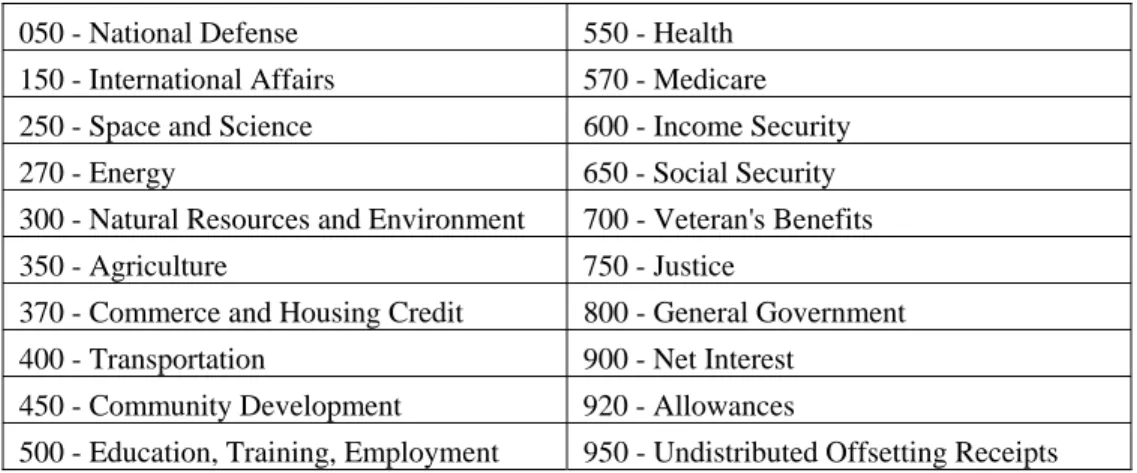
After the entire House and Senate have had the chance to voice their opinions and provide feedback to their respective budget committee, a budget resolution is drafted. House and Senate conference committees then meet to resolve any differences, which results in a composite budget resolution. This resolution is then returned to both houses for an up or down vote. Upon being passed by both houses of Congress, this concurrent resolution then establishes a ceiling for the respective appropriations committees in structuring their appropriations. Although the resolution is not law, it acts as an internal control for the rest of the budget process and can be enforced by a member of Congress if attempted to be breached (Tyszkiewicz and Daggett 1998, p.31-32). The concurrent resolution breaks the budget down into twenty budget functions (see Figure 1).
050 - National Defense 550 - Health 150 - International Affairs 570 - Medicare 250 - Space and Science 600 - Income Security 270 - Energy 650 - Social Security 300 - Natural Resources and Environment 700 - Veteran's Benefits 350 - Agriculture 750 - Justice
370 - Commerce and Housing Credit 800 - General Government 400 - Transportation 900 - Net Interest
450 - Community Development 920 - Allowances
500 - Education, Training, Employment 950 - Undistributed Offsetting Receipts Figure 1. Congressional Budget Functions
(From Author)
1. Authorization and Appropriation
National Defense spending authority is typically granted by Congress through two acts: The Defense Authorization Act and the Defense Appropriations Act. The Authorization Act is used to set policy and authorize programs. This act provides the legal authority for DoD to create, continue, change or abolish programs, activities and entire agencies, as well as setting the conditions under which these functions can operate (Ibid, p.34). The House and Senate Armed Services committees maintain jurisdiction over the Defense Authorization Act, including the portion of the Defense Appropriation to be allocated to Navy shipyard maintenance. The process of creating the Defense Authorization Act is similar to the budget resolution process, except it is signed into law.
While the Authorization Act, in addition to determining which programs will be executed, may also recommend spending levels for programs and activities, the sole purpose of the Defense Appropriations Act is to provide funding for the authorized agencies, programs, and activities. The annual appropriations process provides funding for discretionary2 programs through eleven appropriations acts covering the budget functions identified in Figure 1. The congressional appropriations process is similar to that of the budget resolution and the authorization process. Both, the Defense
2
There are two types of government spending, Discretionary and Mandatory. Discretionary spending requires an annual spending bill for its continued funding; whereas mandatory spending is spending that has been provided for by permanent law (e.g. Social Security and Medicare) and requires no additional legislation for its continued existence
Authorization Act and the Defense Appropriations Act, are passed in both houses of Congress and are signed into law by the President.
2. Congressional Appropriations Subdivisions
Congressional appropriations for the Department of Defense are divided into seven major subdivisions, each specifically appropriated for the individual Services. The following shows these subdivisions and the major activities the Navy funds under each:
• Military Personnel (MPN) – Includes pay and allowances for officers, enlisted personnel and midshipmen, enlisted personnel subsistence, permanent change of duty station travel and other personnel costs.
• Operations and Maintenance (OMN) – Includes maintenance for operational forces, mobilization, training, recruiting, administration and service wide support.
• Procurement – Includes Aircraft (APN), Weapons (WPN), Shipbuilding and Conversion (SCN), Other (OPN) and ammunition procurement.
• Research, Development, Test and Evaluation (RDT&E) – Includes basic and applied research, technology development, demonstration and validation, engineering and manufacturing, RDT&E management support and operational systems development.
• Revolving and Management Funds – Includes Supply Management, Depot Maintenance, Naval Warfare Centers, Naval Research Laboratory, Transportation, Public Work Centers and Naval Facilities Engineering Commands.
• Military Construction3 (MCN) – Includes major and minor construction, planning and support activities, and historical projects (Candreva 2005, p.75, DoD Appropriations Act 2006).
An example of the language of an appropriation can be seen in Figure 2.
Figure 2. 2006 Defense Appropriations Act Language (From DoD Appropriations Act 2006)
C. DEFENSE BUDGET PREPARATION
The creation of a budget request for submittal to the President is part of the biennial4 Planning, Programming, Budgeting and Execution (PPBE) System. The entire process is utilized by DoD to convert the President’s National Security Strategy into the programs required to support that strategy and the budget plan to execute those programs. The Planning phase produces the documents that provide strategic military guidance which support the President’s policies. The Programming phase defines the hardware, manpower, training, support and other needs that will best carry out this strategic guidance. The output of the Programming phase is the Program Objectives Memorandum (POM). This document is a six year resource allocation plan that serves as the backbone of the budget process (Candreva 2005, p.35).
3
Military Construction is a congress appropriation of its own. All other appropriations are found in the language of the Defense Appropriations Act.
4
Although Congress requires a Presidential budget request annually, the PPBE process is a biennial process. In off-years, Program Reviews are conducted to incorporate any fact-of-life changes. Services can request off-year changes to DoD via Program Change Proposals or Budget Change Proposals.
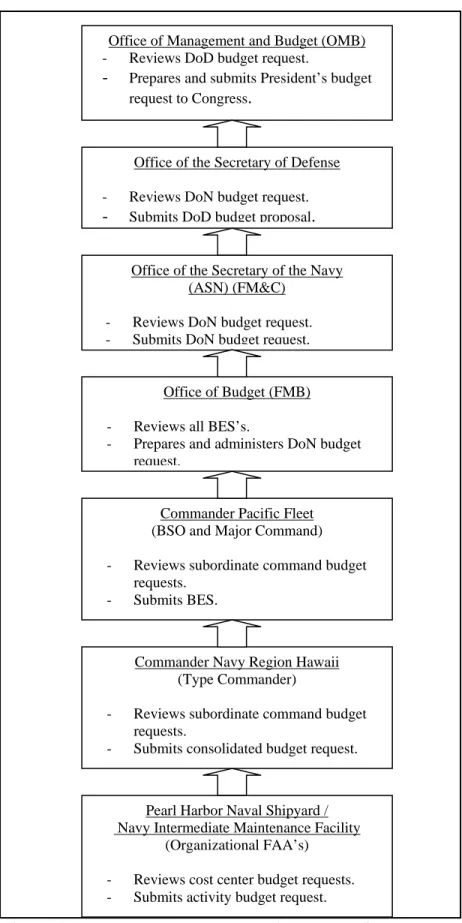
Budgets are built from the ground up at the Service level. The process begins at the cost center level. A cost center is one of any number of departments within an organization. It identifies its costs and provides this input to its organization’s Fund Administrating Activity (FAA).
The FAA is responsible for the management of its cost centers’ resources. FAAs evaluate and incorporate their unit’s budget requests into a consolidated organizational budget request to submit to their assigned Type Commander, the next step in the Navy’s operational command structure.
The budget is reviewed and refined as it is forwarded up the chain of command, to the Budget Submitting Office (BSO), where all of a BSO’s subordinate budget requests are consolidated into one Budget Estimate Submission (BES). This BES is then forwarded to the Navy Office of Budget (FMB) where it is incorporated with all other Navy BES’s into one consolidated budget request. It is approved by the Assistant Secretary of the Navy (Financial Management & Comptroller), as well as the Secretary of the Navy (SECNAV). Once the Navy completes its review, the budget request is sent to the Office of the Secretary of Defense (OSD), where it undergoes another review and is consolidated with the budgets of the other Services, becoming the DoD budget request. Finally, the DoD budget request is sent to the Office of Management and Budget (OMB) and is incorporated into the President’s budget (Ibid, p.49-54). Figure 3 provides an example of the budget submission process for the mission funded Pearl Harbor Naval Shipyard & Intermediate Maintenance Facility (PHNS & IMF).
Important to note about how the Navy prepares its budget is that, while its cost centers provide ground level, accurate cost information, their budgets do not include the entire cost of their organizations. In the same way Congress separates its defense appropriation into subdivisions, the Navy also divides the responsibility for building its budget. For example, a large portion of the government’s cost at PHNS & IMF is its military personnel. However, this cost is not included in its budget request. Instead, military personnel costs are budgeted on a Navy-wide level, by the BSOs that manage the Navy’s personnel, such as the Naval Education and Training Command (NETC), the
Similarly, regardless of where a building is constructed, all Navy construction is budgeted by the Naval Engineering Facilities Command (NAVFAC) and the Naval Installations Command (CNI) (Candreva 2005, p.37).
Figure 3. DoD Budget Preparation Process for PHNS & NIMF Pearl Harbor Naval Shipyard /
Navy Intermediate Maintenance Facility (Organizational FAA’s)
- Reviews cost center budget requests. - Submits activity budget request.
Commander Navy Region Hawaii (Type Commander)
- Reviews subordinate command budget requests.
- Submits consolidated budget request. Commander Pacific Fleet (BSO and Major Command) - Reviews subordinate command budget
requests. - Submits BES.
Office of the Secretary of the Navy (ASN) (FM&C)
- Reviews DoN budget request. - Submits DoN budget request.
Office of Budget (FMB) - Reviews all BES’s.
- Prepares and administers DoN budget request.
Office of the Secretary of Defense - Reviews DoN budget request. - Submits DoD budget proposal.
Office of Management and Budget (OMB) - Reviews DoD budget request.
- Prepares and submits President’s budget request to Congress.
D. DIRECT APPROPRIATION RESTRICTIONS
When the Defense Appropriations Act is signed into law by the President, the contents of the act represent obligational authority in the amounts appropriated. Obligational authority is the ability to enter into an agreement which will require the government to make a payment, now or sometime in the future. For example, Figure 2 shows obligational authority for the Navy to spend $29,995,383,000 in government money for OMN expenses. Congress does not issue this money to the Navy, but does allow the Navy to incur expenses of this amount to be paid by the U.S. Treasury.
The obligational authority Congress grants the Navy is accompanied by rules regarding its execution, specifically: the purpose of the expenditure, the time period in which it is incurred and the amount available for obligation.
1. Purpose Restrictions
The purpose of an appropriation can be as specific as a line item within the Appropriations or Authorization Act. It can also be as broad as a lump sum amount for a category like OMN. Two requirements must be met to ensure money is being obligated for its designated purpose:
• If the purpose is included in the BES and is not otherwise prohibited by law, it is legally available even if it is not specifically mentioned in an appropriation.
• Likewise, if an item is otherwise prohibited by law, even if it is included in the BES and appropriations are made available without mentioning the item, the appropriation is not available to be obligated for that item.
To avoid requiring every minor expenditure item to be included in the BES, agencies are given discretion concerning the purpose of their obligations under the Necessary Expense Doctrine. If an expenditure is logically related to an appropriation, is not prohibited by law and is not covered under a separate appropriation, it can legally be obligated (Candreva 2005, p.73-74).
2. Time Period Restrictions
When Congress appropriates funds for the execution of a program, it is not just permission, it is a legal requirement. As such, appropriated funds are made available for a set duration of time to ensure their timely execution and to prevent a stockpiling of available funds by executive agencies.
The first period of time in the life of an appropriation is the obligation availability period. For the duration of this period, funds are available to incur obligations. In other words, the agencies who receive these appropriations may enter into contracts that will require the payment of their allotted funds. This period varies for different appropriation types. For example, due to the long term nature of a procurement account, they have three to five year obligation availabilities, and are termed three (five) year accounts. OMN accounts are one year accounts, which makes sense given the shorter time horizon in funding periodic maintenance as well as the need to annually revisit the cost of funding operational forces in light of changing world situations. Once the obligation availability period is over, the account is considered expired and no further contracts can be incurred under that appropriation (Ibid, p.72).
An additional requirement of an obligation availability period is that all obligations must be used to meet a need that exists during that period. For example, if an agency finds itself with an excess of OMN funds at the end of the fiscal year5, it is not allowed to enter into a contract for a good or service that it does not currently need, but it anticipates it will need during the next fiscal year. This is referred to as the Bona Fide Needs Rule. Appropriations are available only to meet the bona fide needs of their respective obligation availability period (Ibid, p.77).
The expiration of an appropriation’s obligation availability period does not mark the end of its life. Although contracts must be entered into during the obligation availability period to meet the needs arising in that period, the delivery of the goods and services contracted does not have to be crunched into that time as well. Immediately following the expiration of an obligation availability period begins an appropriation’s
5
expenditure availability period. This period is five years in duration for all appropriation types, and during this period the obligations incurred in the obligation availability period are liquidated as the contracted goods and services are received (Ibid, p.72).
The end of the expenditure availability period marks the end of an open appropriation. No further claims can be charged to its account and all outstanding obligations are cancelled.
3. Obligation Amount Restrictions
In addition to the congress restrictions placed on the use of funds and the periods in which they are to be obligated and expended, there are also fiscal restrictions placed on the amount of money available in an appropriation. The statute governing the over-obligation of an appropriation is referred to as the Anti-Deficiency Act. Its first key provision disallows obligations or expenditures from exceeding the amount available in an appropriation. The second prevents the obligation of funds prior to an appropriation being written into law (Ibid, p.79-80).
This may seem intuitively obvious, given the fact that a budget implies a limitation on funds available to spend. However, when accompanied with time and purpose restrictions, meeting this requirement can become tricky. If an obligation is initially incorrectly charged to one account, in the process of correcting accounting records it could be found that the correct account does not have the funds still available to cover the expense of the obligation. In this example, a problem in determining the proper purpose of an appropriation would result in the over-obligation of an appropriation, creating an Anti-Deficiency Act violation. Problems can also occur if an obligation is made and delivery occurs in a subsequent fiscal year, then it is determined that it was not a bona fide need of the fiscal year in which it was obligated. In this example, the correct funding would be from the next year’s appropriation. However, since there were no appropriations yet authorized for the following fiscal year, the contract would be in violation of the Anti-Deficiency Act, as it would have obligated funds prior to them being legally available.
The previous scenario also displays how budgetary limitations on how long funds are available for obligation can cause problems transitioning from one fiscal year to the next. While the congressional budget cycle attempts to write the next fiscal year’s Appropriations Acts prior to the end of the current fiscal year, often political differences lead to delays. This can cause a period of time for mission funded activities where the previous obligation availability period has expired, but no funds have been made available for new obligations. As has been shown, managers are not allowed to enter into contracts in the expectation of eventual funding. To combat this problem, Congress can pass what is called a Continuing Resolution Authority (CRA). CRAs authorize organizations to enter into new obligations at a designated spending rate until a new Appropriations Act has been passed. Under a CRA, only programs that have previously been authorized are allowed obligations. In other words, organizations are not allowed to circumvent congressional review by starting new programs during a CRA period.
E. BUDGET EXECUTION FOR MISSION FUNDED ORGANIZATIONS
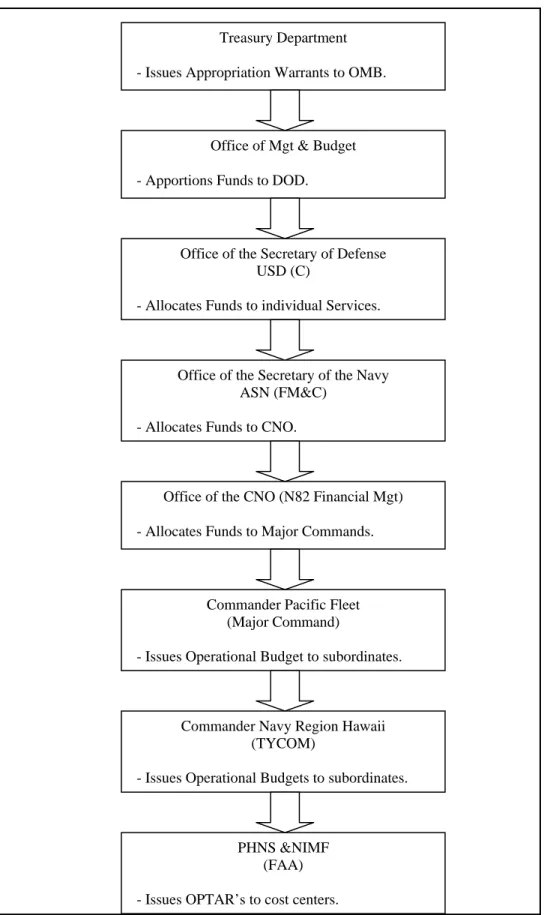
Once the Defense Appropriations Act is signed into law by the President, the flow of funds follows a similar path as the budget request in the opposite direction. The treasury first opens accounts for each appropriation in order to allow proper tracking of the obligation made against them. It then passes this information to OMB in the form of treasury warrants. The challenge for OMB is to then spend the funds in their entirety, for the correct purpose, without overspending. To ensure deficiencies do not occur due to overspending an account, Federal law requires OMB to regulate spending by distributing funds in apportionments. In this format, spending authority is distributed incrementally, typically quarterly. The objective is to ensure organizations have the funds necessary to meet the full intent of the appropriation without running out of funds prior to the end of the fiscal year.
OMB apportions funds to OSD, who then allocates funds to each Service. Services distribute funds amongst their Major Commands. These funds are also apportioned quarterly. The Major Commands issue spending plans, called allowances or
Operating Targets (OPTAR), to their subordinate commands. These FAAs are then responsible for the execution of these plans according to their budget requests. This process is shown in Figure 4.
F. INTERMEDIATE MAINTENANCE FACILITY OPERATIONS
The two separate Intermediate Maintenance Facilities at Pearl Harbor operated as mission funded organizations under the Pacific Fleet Command (COMPACFLT) prior to the consolidation efforts at the PHNS. In submitting their budget proposals, the vast majority of their costs centered on OMN expenses, which covered the costs associated with maintaining their facilities, providing the materials and services necessary to support the submarines and surface vessels they maintained, and paid their civilian salaries. All military salaries were covered by the MILPERS budget requests, all new construction requests were covered by the MILCON appropriation, and any capital expenditures were submitted within various Procurement budget requests.
As primarily OMN budgets, IMFs utilized one year funds allotted quarterly by their respective chain of command. Since the appropriations covering IMFs were paid for directly through congressional appropriations, the beneficiaries of IMF work received a free product. In other words, the applicable authorizations and appropriations designated that the funds provided were to be used to perform a certain amount of maintenance on ships under the supervision of the Pacific Fleet. COMPACFLT determined the maintenance schedules and priorities, and this maintenance was conducted to the maximum extent of their appropriations.
The financial operation of a shipyard under the NWCF varies significantly to one receiving direct appropriations. Chapter IV explains the NWCF and its application to Navy shipyards.
Figure 4. Mission Funding Budget Execution Commander Navy Region Hawaii
(TYCOM)
- Issues Operational Budgets to subordinates.
PHNS &NIMF (FAA) - Issues OPTAR’s to cost centers.
Treasury Department - Issues Appropriation Warrants to OMB.
Office of Mgt & Budget - Apportions Funds to DOD.
Office of the Secretary of Defense USD (C)
- Allocates Funds to individual Services.
Office of the CNO (N82 Financial Mgt) - Allocates Funds to Major Commands.
Commander Pacific Fleet (Major Command)
- Issues Operational Budget to subordinates. Office of the Secretary of the Navy
ASN (FM&C) - Allocates Funds to CNO.
IV.
NAVY WORKING CAPITAL FUND
Essentially all of the funding the Navy receives originates from the direct appropriations, or mission funding (MF), written to support its mission. A unique form of management used by specific organizations to execute this mission is the Defense Working Capital Fund (DWCF). The DWCF is a revolving fund, it finances its own operations by charging for the services it provides to the customers it supports. For the organizations that utilize this financial strategy, it creates a pseudo-entity, which attempts to adopt private business practices in meeting the needs of its customers.
A. THE FORMATION OF THE DWCF
The Navy has managed various forms of revolving funds since the 1800s, beginning with a General Account of Advances used to more effectively obtain and distribute inventoried supplies to its sailors. Revolving funds were formally recognized by Congress as part of the National Security Act Amendment of 1949. Prior to the formal establishment of a DWCF, the Navy, along with the other services, maintained separate revolving accounts in the form of stock funds and industrial funds. Stock funds managed the procurement and distribution of inventory items and industrial funds managed services and materials such as depot-level shipyard maintenance (Candreva 2005, p.91).
The renewed focus on the country’s economic well-being, which spurred the defense changes discussed in Chapter II, also affected these revolving funds. In 1991, Congress established the Defense Business Operations Fund (DBOF) to bring a business approach to the operation of the Services’ revolving funds. The DBOF consolidated stock funds and industrial funds from each service into a central Department of Defense (DoD) level account. The purpose of the DBOF was to reduce the costs of operation for the revolving fund activities by establishing increased cost visibility, thus allowing managers to improve the quality of the products and services they provided, while also providing those services in the most efficient and effective manner. It also allowed the overall cash cushion to finance operations to be reduced, since the individual funds were now part of a larger pool. Included in the DBOF were transportation, supply management, finance and
accounting and depot maintenance accounts. As a result of the reduction in cash levels, problems arose in managing the cash flow for all the separate entities included in the fund. In FY96, DoD again restructured its revolving funds to better manage the cash flow within its account. It was divided into separate Defense Working Capital Funds (DWCF): Navy, Army, Air Force, Defense-Wide, Defense Commissary and Other Defense. In addition to easing the central DBOF’s cash flow management problems, this restructuring also returned the responsibility to effectively manage these funds to the Services. The current Navy Working Capital Fund (NWCF) is subdivided into five activity groups: supply management, research and development, transportation, base support and depot maintenance (OSD Comptroller iCenter).
B. NWCF OBJECTIVES
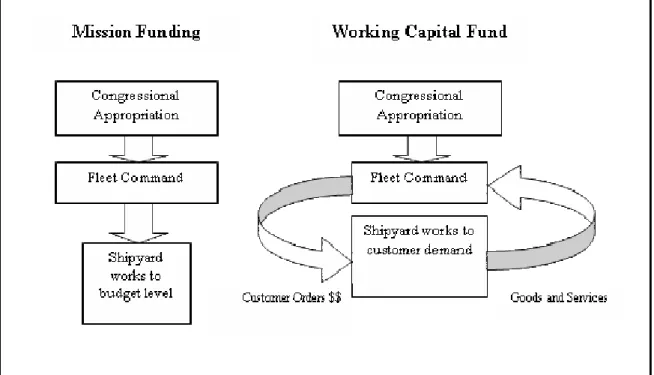
The NWCF is not a congressional funding method, but a financial management strategy for organizations that serve congressionally funded programs. Under mission funding, a maintenance depot is run directly by the Fleet it serves. In contrast, shipyards that operate under the NWCF are their own entities. In short, a working capital fund changes the flow of resources and decision making for the activity utilizing its financial structure. In the case of a Navy shipyard, without a working capital fund, the shipyard receives funding from the appropriations process via the Fleet Command it serves. Shipyard managers then provide maintenance to the Fleet at the level this funding can support. From the Fleet’s perspective, once it has allocated obligation authority to the shipyard, the maintenance it requests is prepaid. Under the NWCF, the funds from the appropriation process are provided directly to the Fleet. The shipyard and the Fleet then enter into a buyer/ seller relationship rather than a subordinate/ command relationship (See Figure 5). The shipyard determines the total cost of doing business, including direct costs, indirect costs, overhead and general and administrative expenses, and then bills the Fleet for every job it performs (OSC Comptroller iCenter).
Figure 5. MF vs. NWCF Organizational Relationships
(After: DOE 2003, p.4)
The goal of a NWCF within an organization is to streamline operations and maximize resources. By establishing clear customer/provider relationships, adopting private-sector techniques for resource management, consolidating key functions, and using activity-based accounting policies to display full costs, NWCFs provide managers with the cost and performance data required to make effective and efficient decisions. Its total-cost awareness facilitates business-like processes and budget choices that are responsive, unbiased, and mission-driven (OSD Comptroller iCenter). The NWCF provides the following benefits:
• Identifies the total cost of DoD goods and services to Congress, military users (buyers), and those who provide goods and services (sellers).
• Promotes more efficient and effective allocation and use of resources.
• Underlines the cost consequences of choices and allows purchases to be made in anticipation of future funded orders.
• Provides managers with the financial authority and flexibility to procure and use manpower, materials, and other resources more effectively.
• Improves cost estimates and cost control through comparison of estimates and actual costs.
• Places customers in the position of critically evaluating purchase prices and the quality of goods and services ordered.
• Allows for greater flexibility and security in decision making as there are no fiscal year limitations.
• Establishes standard prices or stabilized rates and unit prices for goods and services furnished by NWCF Business Areas, enabling customers to plan and budget more confidently (Ibid).
C. NWCF OPERATION
The term revolving fund is derived from the cyclical nature in which cash revolves into and out of the account. Customers replenish the fund by purchasing goods and services, while at the same time cash outflows finance the expenses necessary to produce the desired goods and services. A key to effectively managing these accounts is in accurately determining the total costs incurred in providing services and in forecasting the level at which these services will be demanded. To be considered for management using a NWCF, four criteria must be met:
• There must be identifiable goods and services provided.
• Customers requiring those outputs must also be identifiable.
• An approved accounting system must be utilized.
• An evaluation of the advantages and disadvantages of establishing a buyer/ seller relationship must be conducted (Candreva 2005, p.93).
Once an activity group (e.g., Navy depot maintenance) is established under NWCF management, a one-time appropriation or a transfer of funds from related appropriations, which will be supported by the new NWCF account, are used to create the initial pool of capital for the activity group. This capital is called a corpus. After funding