Developing the Navy Reserve's
Language and Culture Pilot Program
Michael J. Moskowitz • Peggy A. Golfin • Zachary T. Miller
Christopher M. Duquette • Diana S. Lien
with
David Gregory • Erin M. Rebhan • James L. Gasch
CRM D0021646.A2/Final January 2010
This document represents the best opinion of CNA at the time of issue. It does not necessarily represent the opinion of the Department of the Navy.
Approved for Public Release; Distribution Unlimited. Specific authority: N00014-05-D-0500.
Copies of this document can be obtained through the Defense Technical Information Center at www.dtic.mil or contact CNA Document Control and Distribution Section at 703-824-2123.
Approved for distribution: January 2010
Henry S. Griffis, Director Defense Workforce Analyses Resource Analysis Division
Contents
Executive summary . . . 1 Pilot parameters. . . 1 Alternatives . . . 2 Metrics. . . 3 Recommendations . . . 3 Introduction . . . 5 Background . . . 7Developing the LREC strategy . . . 7
Identifying the requirements. . . 10
Measuring the inventory . . . 12
Defining LREC skills . . . 13
How the pilot fits in . . . 14
Pilot parameters. . . 15
Goals . . . 15
Eligible classes . . . 16
Eligible languages and regions . . . 17
Eligible disciplines . . . 19
Eligible participants . . . 22
Bonus parameters . . . 25
Levels of bonus . . . 25
Other recommendations. . . 32
Alternatives for the pilot program . . . 37
Alternative incentives . . . 37
Alternative methods . . . 40
Loosen restrictions on types of classes eligible for the pilot . . . 40
Use language learning software . . . 41
Consider study abroad and immersion programs . . . 42
Contract with schools to offer other programs, flexible courses . . . 42
Metrics . . . 45
Data . . . 45
Metrics to show whether the pilot is working . . . 46
Metrics to determine whether pilot program adjustments are needed . . . 48
The way ahead. . . 55
Appendix A: Proficiency levels . . . 57
Interagency Language Roundtable (ILR) language skill level descriptions . . . 57
Listening . . . 57
Reading . . . 61
Speaking. . . 65
Writing . . . 68
Regional proficiency levels. . . 71
ACE crosswalk . . . 75
Appendix B: Education benefits . . . 79
GI Bill and Reserve Education Assistance Program (REAP) . . . 79
Tuition Assistance (TA) . . . 82
Public institution tuition benefits . . . 83
Appendix C: Discussion groups. . . 85
Overview . . . 85
Participants . . . 87
Findings. . . 89
Incentive. . . 90
Alternatives . . . 93
Languages and regions . . . 96
Appendix D: Difference-in-difference methodology . . . 99
Data issues . . . 100
References. . . 103
List of figures . . . 107
Executive summary
In the FY 2009 National Defense Authorization Act (NDAA), Con-gress authorized the Office of the Secretary of Defense (OSD) to create a pilot program that provides a bonus to develop language pro-ficiency and regional expertise in the Reserves. In April 2009, OSD authorized the Navy to execute the pilot by the end of FY 2009. The Office of the Chief of Navy Reserve (OCNR) asked CNA to help develop the program, which, like other Navy initiatives, is aimed at developing language skills, regional expertise, and cultural awareness (LREC).
Pilot parameters
Before CNA was brought on to the project, the Navy had already made some key determinations regarding the program structure. The incentive would be a one-time lump-sum bonus paid at the com-pletion of the course, and the bonus would only be available for courses taken for academic credit at Institutions of Higher Learning (IHLs). CNA helped build the program from that framework.
We encountered several challenges related to defining, developing, and measuring LREC requirements. However, despite these chal-lenges, we were able to construct a number of parameters for the pilot. We based these on (1) discussions with stakeholders, including the Navy's Foreign Language Office (N13F) and Reserve Forces com-mand (RESFOR), (2) data gathered during discussion groups with targeted reservists, and (3) our own research. We note that these parameters are not set in stone and that the Navy can and should adapt the pilot program as information becomes available.
The main focus of our research was to develop the incentive structure for the pilot. However, before doing that, we had to determine what types of courses would be eligible and who the program would target.
Based on the Navy's strategic documentation and with guidance from our sponsor, we created a list of targeted languages and cultures, and a list of academic disciplines. In terms of participants, the Navy wanted to focus on those personnel that would interact with locals while mobilized. OCNR provided a list of ratings and designators that would be eligible for the initial run of the pilot. It was also decided that the pilot would be run nationwide and that participants must have 2 years of remaining service obligation.
Using these parameters, we conducted an informal survey of tuition costs and course availability at various colleges, universities, and com-munity colleges. We also spoke with some of the targeted reservists about the amount of bonus that would be required to get them to take a course.
From this research, we established the following four bonus levels, with the same amount offered to enlisted and officers at each level:
•
$1,250 for a lower division culture course•
$1,500 for an upper division culture course•
$2,000 for a lower division language course•
$2,500 for an upper division language course.Alternatives
Our research also provided insight into other ways of doing business, both with regard to the structure of the incentive and the methods the Navy can use to develop LREC skills. For example, if the Navy con-cludes that the costs of courses and the availability of financial assis-tance vary significantly, they might consider a two-tiered bonus, with the first tier consisting of tuition reimbursement and the second tier a "pure" bonus. This would ensure that all reservists would receive an equivalent bonus amount.
Metrics
Finally, we provide some insight into how the Navy can assess the pilot program, with specific attention paid to the reporting requirements laid out by OSD. In the report to OSD, the Navy must include the
number of participants and the languages and regions studied. In addition to these metrics, we also suggest looking at other outcomes that may be related to participation, such as continuation, promo-tion, and mobilization.
Furthermore, we investigate metrics to help the Navy determine if the pilot program needs to be adapted. We consider several scenarios that the Navy may face, such as too much or too little participation, participation that trends toward certain languages or regions, etc. We note that, in each case, the Navy must look at whether the problem is driven by a lack of information about the program, by a lack of com-mand support, or by an insufficient incentive.
Recommendations
First, it is critical that the Navy, and the Department of Defense (DOD) as a whole, develop definitions, requirements, and metrics related to cultural awareness, regional expertise, and cultural compe-tence. This will help the Navy define goals for the pilot program and help frame any other LREC programs that are developed.
Second, the Navy needs to be able to track the skills and capabilities that programs such as this pilot are meant to develop, so that reserv-ists with these skills can be easily identified and mobilized to the right geographic location if and when such a requirement is identified. We follow other guidance in recommending a secondary occupational code or special experience identifier for general purpose forces with LREC skills. These identifiers should be used by commanders for making assignments.
Similarly, the Navy should also consider policies that aim to utilize these LREC skills during mobilization. This does not mean the Navy should necessarily target LREC-skilled reservists for mobilization, but skills should be matched to mobilization, i.e. a reservist with regional expertise in Southeast Asia should go to the Philippines rather than to the Caribbean.
Introduction
The FY 2009 National Defense Authorization Act (NDAA) contains a provision that requires the Secretary of Defense to create a pilot pro-gram that provides a monetary award for reservists who participate in an “education or training program to acquire proficiency in a critical foreign language or expertise in foreign cultural studies” [1]. The legislation requires that the pilot begin in FY 2009 and end 31 Decem-ber 2013. It further requires the Secretary of Defense to submit a report on the success of the pilot by 31March 2012.
In an April 2009 memo [2], the Under Secretary of Defense (Person-nel & Readiness) (USD(P&R)) requested that the Navy execute this program before the end of FY 2009. As a result, the timeline for devel-oping the program was abbreviated. In addition, the memo requests a report from the Navy by November 2011.
The Office of the Chief of Navy Reserve (OCNR) led the effort to develop the pilot and made several decisions regarding the frame-work of the program. OCNR contracted CNA to assist with the devel-opment of some of the pilot parameters, focusing specifically on determining the incentive structure for the bonus.
This research memorandum documents CNA’s efforts in developing the program parameters, including the incentive structure. We also detail the decisions made along the way and describe how they helped shape the pilot program. We begin our discussion with some background information about Navy and Department of Defense (DOD) language and culture programs, and then we describe the process followed for developing the pilot program. We also describe metrics that can be used to satisfy the reporting requirements for the pilot program, as well as metrics that can identify how successful the incentive is in achieving participation. Finally, we include some other options for the incentive as well as alternatives for developing the skills that the pilot program aims to achieve.
Background
Given the current international security challenges facing the nation, DOD and the Services have recognized the need for increased lan-guage skills, regional expertise, and cultural awareness (LREC). The Navy’s focus on being expeditionary, including expanding humani-tarian and civic assistance missions, adds further motivation to devel-oping these capabilities.
Over the past several years, the Services have worked to define their strategy for increasing these skills and have published several docu-ments defining the way forward, e.g., [3, 4, 5, 6]. This section summa-rizes these documents, focusing on the Navy’s strategies for developing this LREC capacity. This section also discusses some of the challenges that still exist and how they affect the development of the pilot program.
Developing the LREC strategy
Beginning in 2002, DOD began reviewing its language and culture requirements and programs, and created authorities, including Senior Language Authorities (SLAs) and a Defense Foreign Lan-guage Steering Committee (DFLSC), to help transform the lanLan-guage and culture program. In 2005, after reviewing requirements and studying language functions, DOD released its “Language Transfor-mation Roadmap” [3]. The roadmap laid out the four main goals contained in the Strategic Planning Guidance for FY 2006–2011 and the steps necessary to achieve them. The four goals were:
1. Create foundational language and cultural expertise in the officer, civilian, and enlisted ranks for both Active and Reserve Components.
2. Create the capacity to surge language and cultural resources beyond these foundational and in-house capabilities.
3. Establish a cadre of language specialists possessing a level 3/3/ 3 ability (reading/listening/speaking ability).1
4. Establish a process to track the accession, separation, and pro-motion rates of language professionals and Foreign Area Offic-ers (FAOs).
The roadmap designates 43 tasks to different stakeholders in order to achieve the goals. The tasks include establishing language offices, developing an annual strategic language list, and performing a one-time screening to identify language skills already resident in the force. Further, the roadmap aims to create strategic strongholds of low-density language expertise and a cadre of service members with language capabilities for tasks requiring basic language skills.
In October 2005, DOD updated its directive on the Defense Lan-guage Program (DLP) [4]. The directive states that it is DOD policy that “foreign language and regional expertise be considered critical competencies essential to the DOD mission” and calls for the provi-sion of special pay and time for individuals to enhance their language skills, including continuing education programs.
In 2007, DOD published an instruction for managing the language and regional proficiency capabilities [5]. This instruction declares that “foreign language and regional proficiency [...] shall be consid-ered critical to the continuum of professional military education and training” and tasks DOD with developing these capabilities by “pro-viding training, education, and experience.”
As the Navy moved forward with implementing the tasks laid out in the roadmap and other DOD directives, they published their own LREC strategy in 2008 [6]. The Navy’s LREC strategy states that “suc-cess in achieving the nation’s Maritime Strategy depends in large part on the Navy’s ability to communicate with and comprehend potential adversaries.” It notes that competencies in LREC skills are essential in every phase of war. The purpose of the LREC strategy document is to
1. These ability levels are measured on the Interagency Language Round-table (ILR) scale. See appendix A for information on what an ability of 3/3/3 entails.
provide guidance for the “development, alignment, management, and transformation of LREC capability and capacity in the force.”
The Navy’s LREC strategy describes one measure of the desired end-state as having “sufficient LREC capacity that meets Navy’s known mission needs, with appropriate levels of expertise, and [as being] able to surge for emergent requirements.” This includes a “total force that appreciates and respects cultural differences,” a “cadre of career language professionals,” “other language-skilled Sailors and civilians with sufficient proficiency to interact with foreign nationals at the working level,” and a “reserve capacity of organic foreign language skill and cultural expertise that can be called upon for contingencies” [6].
Both the roadmap and the LREC strategy call for the use of incentives to reward servicemembers for learning and maintaining critical for-eign language skills. One incentive that already existed was the For-eign Language Proficiency Bonus (FLPB). FLPB is a monthly incentive paid to active and reserve servicemembers for achieving and maintaining proficiency in one or more strategic languages. Monthly incentive awards vary by language and level of proficiency, with a maximum monthly award of $500 for one language and $1,000 for proficiency in more than one language. Following roadmap guid-ance, the Navy provides the same FLPB for the Reserves as for active duty servicemembers. Receipt of the FLPB typically requires annual certification of language skills through the Defense Language Profi-ciency Test (DLPT), which measures profiProfi-ciency against the Inter-agency Language Roundtable (ILR) scale [7]. In appendix A, we provide a description of the proficiency levels, as well as a crosswalk between levels of language proficiency and the American Council on Education (ACE) recommendations for college credit.
Unlike language skills, there are currently no specific bonuses for regional expertise, and there are no DOD tests for regional profi-ciency. However, [5] includes an enclosure that provides definitions for regional proficiency skill levels, similar to those used by the ILR to define language proficiency levels. Appendix A provides a descrip-tion of the regional proficiency levels and discusses how the ACE crosswalk mentioned above could be used as a guide for determining
the number of college credits required in regional study to achieve the proficiency levels.
Though the Navy and the other Services have progressed in imple-menting the roadmap’s tasks, there have been some issues along the way. Two reports, one by the Government Accountability Office (GAO) and the other by the House Armed Services Committee (HASC), have analyzed the progress made by DOD [8, 9]. They both note that there are issues with the requirements determination pro-cess, as well as with identifying the inventory of language skills and regional capabilities present in the force. We note a third challenge to the LREC program—defining the terminology used to describe these LREC skills.
Identifying the requirements
The DOD roadmap calls for combatant commanders (COCOMs) to “identify linguistic and translator requirements as part of their con-tingency and deliberate planning processes for operations and plans.” Further, it tasks DOD to “build a capabilities-based language requirement determination process,” which would identify and vali-date DOD’s language and regional expertise requirements [3]. To accomplish the third goal of establishing a cadre of language profes-sionals, the roadmap calls for DOD components to identify tasks and missions that require language proficiency and tasks that require basic language skills rather than full proficiency.
Much of what DOD hopes to accomplish with its language and regional strategies relies on the proper identification of these requirements. However, as GAO found, the Services have not been able to properly identify these requirements [8].
The Chairman of the Joint Chiefs of Staff Instruction (CJCSI) for Language and Regional Expertise Planning provides guidance for determining requirements, and it describes the process to identify necessary capabilities and calls on the COCOMs to specify their requirements for foreign languages and regional expertise capability support [10]. However, the GAO report notes that the requirements submitted varied widely, as some included low-level language and
regional proficiency requirements associated with general purpose forces while others did not.
The HASC report notes that “the Department has not yet adopted and implemented an agreed upon process for documenting combat-ant commands’ language, regional expertise, and cultural awareness requirements. Nor has it settled on a process for determining require-ments that may emerge in 10 to 15 years. Without the processes to know and project what requirements or capabilities are or will be needed, the Department cannot state with any degree of precision the outcome it is attempting to achieve” [9]. The report also brings up perceived differences in DOD and Service goals, noting that the Services have placed more emphasis on cultural awareness than lan-guage skills. These differences may also impact the determination of the mix of skills required to perform Service missions.
The Navy’s LREC strategy recognizes that gaps still exist in identifying requirements, and it includes an objective to “accurately define the Navy’s LREC requirements and articulate specific competencies, degrees of expertise, and capacities needed by the force” [6].
Though the transformation process has been ongoing for 4-plus years, requirements are still largely undefined. The lack of validated requirements makes it difficult to set goals for developing the LREC capabilities. As the HASC report notes, “without identification of those requirements, the Services’ ability to build and provide the force with the proper mix of capabilities becomes far more difficult, if not impossible” [9]. But the Services are working to define require-ments, and DOD is working on capabilities-based assessments for both language and regional expertise.
One of the difficulties in developing requirements is the forward-looking nature of language and cultural skills attainment. DOD’s stra-tegic language list aims to project anticipated language priorities for the next 10 years [11]. Emerging requirements will continue to change the scope of desired LREC capabilities.
Measuring the inventory
Another issue in developing LREC capabilities is in identifying the level of capabilities already present in the force. The Services have language experts that have well-defined skills, but identifying LREC skills in the general purpose forces is more difficult.
The DOD roadmap tasked all of the Services with performing a one-time self-assessment of language skills that was mandatory for all ser-vicemembers, both active and reserve, and voluntary for civilians. The assessment was required by December 2005, but the Army has not yet reported its results due to the large number of personnel deployed. The HASC report notes that 217,200 personnel reported some for-eign language ability but the bulk of the ability was in languages such as Spanish, French, and German, which are considered “dominant in the force” [9].
The Navy’s one-time self-assessment yielded 138,390 assessments in 274 languages. Of these assessments, 15,628 came from the Reserves. Overall, the Navy “identified expectedly large populations with skill in Spanish, French, Tagalog, German, Italian, and Japanese.” The self-assessment did uncover capacity in less commonly taught lan-guages as well, including Farsi and Hindi [12].
One issue regarding the self-assessment is that, for the most part, those who self-reported a language skill were not tested to validate the assessment. Respondents were asked to identify their proficiency level following the ILR scale; however, because many assessments indicated the highest level of proficiency across listening, speaking, reading, and writing, it is likely that many of these self-assessments are not accurate.
The HASC report also questions the applicability of the DLPT for measuring the skills of the general purpose forces. According to the report, “the Department’s tests are not suitable because they are structured to measure the more advanced proficiency of the lan-guage professionals” [9].
While there are some concerns about the validity of the language self-assessment, there is even less data available on the current state of
regional expertise or cultural awareness in the Services. The GAO report notes that, for regional proficiency, “DOD does not have an inventory of the skills of servicemembers or DOD civilians because it lacks a mechanism to assess and validate these skills.” The report continues,
While DOD policy provides regional proficiency skill level guidelines intended to be benchmarks for assessing regional proficiency, these guidelines do not provide mea-surable definitions, and DOD does not have a way to test or otherwise evaluate the skills of servicemembers or DOD civilians in accordance with these guidelines [...]. Further-more, DOD has not established milestones for developing the ability to evaluate regional proficiency skills. [8]
Defining LREC skills
While not a focus in any of the language and culture documentation, we noticed a third issue in our research. The terminology used to dis-cuss LREC capabilities varies from document to document, and a common terminology is necessary to clearly define goals for the Services.
Beyond language proficiency, which has relatively well-defined and testable measures, the documents refer to rather vague notions of cul-tural awareness, regional expertise, cross-culcul-tural competence, and similar terms. The HASC report also notes that early in the transfor-mation process, DOD “used terms interchangeably, or considered cultural awareness to be a subset of regional expertise,” but now these are considered two distinct capabilities [9].
The problem of terminology for regional and cultural skills is very much tied to the lack of metrics and tests for measuring these capa-bilities. Without a formal, agreed-upon definition of cross-cultural competence, for example, it is hard to get a clear picture of the skills needed to gain that competency. It is necessary to understand these skills in order to develop tests or metrics for measuring proficiency. DOD is working on developing standardized definitions for these LREC terms, but they do not currently exist. Until DOD has clear def-initions, it will be difficult to develop meaningful metrics and identify requirements for those skills.
How the pilot fits in
While challenges remain, the congressionally authorized pilot pro-gram is another step in building the desired capabilities. As [9] notes, “even without a validated process for establishing detailed combatant command requirements, the Services are building the approaches needed to develop forces with at least some capabilities.”
Despite the problems with identifying specific requirements, DOD and the Services understand that they need some increased capacity, even if it is unspecified. However, it takes time and resources to develop LREC proficiency, and significant resources to gain the pro-ficiency required of a language professional.
For example, the Army’s Special Forces Q-course includes 4 to 6 months of language training with the expectation to achieve at least a 0+/0+ (listening/reading) proficiency, with a goal of 1/1 profi-ciency2 [13]. Further, the Defense Language Institute’s Foreign Lan-guage Center provides up to 64 weeks of instruction for its most difficult languages, with the goal of achieving 2/2/1+ (listening/ reading/speaking) proficiency in the basic program [14]. The pilot program provides a way to begin to develop some LREC capacity, using a minimal amount of resources compared to the full-time train-ing programs described above. As we will discuss, the pilot program parameters define who can participate and which courses they can take, but there is flexibility to adapt the program as requirements are defined and as needs change.
In the next section, we discuss how the pilot parameters were established.
2. These scores represent measures on the ILR scale, which is described in detail in appendix A.
Pilot parameters
As noted earlier, some decisions on the pilot’s parameters were made before CNA was brought onto the project. The Navy determined that it would offer a one-time lump-sum bonus after the completion of a qualifying course and that only courses taken for credit at an accred-ited institution of higher learning (IHL) would be eligible for the bonus.
Aside from these decisions, CNA was actively involved in shaping sev-eral parameters of the pilot program, especially those that focused on defining the appropriate level and structure of the incentive. Through research into available options, discussions with Navy stake-holders, and discussion groups with targeted reservists,3 we helped the Navy decide on the eligible languages and regions, eligible coursework, targeted participants, and the size and shape of the incentive. It is important to note that while these parameters were informed by our research and discussions, they are by no means set in stone, and the pilot program should be adaptable as information regarding the appropriateness of these parameters is received.
Goals
Before we could perform our analysis to help frame the pilot pro-gram, we had to understand the goals of the program. The NDAA [1] calls for increased language proficiency and regional expertise. Testi-mony by RADM Holloway to the HASC [15] notes the need for cul-tural awareness for all Navy servicemembers. So, what is the Navy trying to accomplish with this pilot program?
3. Given the abbreviated timeline of the study, we could not administer a survey, so we held discussion groups with reservists. See appendix C for a summary of these discussion groups.
The lack of validated requirements and the unclear picture of the inventory makes it difficult to set specific goals for the pilot program. While the Navy would like Sailors with more language and cultural skills, there’s currently no way for it to precisely articulate these needs. In turn, we can’t set goals for the pilot because it isn’t clear what an appropriate goal would be. Ultimately, the Navy must be able to state their specific requirements for language and cultural skills. Until they can do this, participation goals will be arbitrary and difficult to justify.
Instead of setting goals during the pilot phase, we recommend run-ning the program for a semester, collecting data on who is taking what classes and where, then analyzing the numbers to see what changes the Navy might want to make.
CNA has considered potential issues regarding participation, and we analyze possible scenarios and offer solutions in a later section. In addition, this early run of the pilot program will provide insight into the population of Navy reservists who are interested in developing LREC capabilities, and it will allow us to examine whether the higher education system can fulfill the Navy’s demand for language and regional skills.
Eligible classes
Though the Navy decided to limit the eligible courses to for-credit courses at IHLs, this still includes a variety of institutions, from com-munity colleges to private universities. Given this variation in the insti-tutions, we had to assess some issues regarding what types of classes were eligible. In particular, we had to define rules for grades, credit hours, and course content that would determine which classes are eli-gible. It is important to develop clear policy, even on these relatively small issues, in order to avoid confusion among participants and administrators about whether the course is eligible for a bonus.
The Navy decided that reservists would be required to successfully complete the course to receive the bonus. This means a reservist must earn a final grade of at least a “C” on the traditional grading scale. The problem with this rule is that not all eligible schools use the tradi-tional grading scale. Reservists can take classes at schools that don’t give letter grades, but they must ask the school to give them a letter
grade for the sake of the program. If the school can’t comply, then the class won’t be eligible for the bonus.
A class is only eligible if the school awards at least three credit hours for completing the course. Our research shows that there are courses that are only one or two credits. However, we believe that such classes won’t give the reservist enough exposure to the subject matter, whether it be a language or regional topic. A related point is that not all eligible schools use the credit-hour system. Again, reservists can take a class at a school that doesn’t use the credit-hour system, but the school must assign the reservist at least three credit hours for com-pleting the class. If the school can’t do this, then the class is ineligible.
Many courses are about “global” or “international” issues. To be eligi-ble for the program, courses must focus on a specific region of the world with the goal of developing regional expertise. The caveat to this rule is general religion courses. We decided that general religion classes would be accepted, as our search of courses at institutions found very few religion classes that focused on a specific regional area.
We discuss the eligible languages and regions in the next section and the eligible academic disciplines later in this section.
Eligible languages and regions
Closely related to the eligible class parameters was the question of which languages and regions reservists could study. To address this question, we consulted with the Navy’s Foreign Language Office, N13F, and reviewed DOD and Navy strategic guidance to create a list of eligible languages and regions. After developing the list, we did an extensive search for relevant language classes at two-year and four-year schools to see where reservists could participate in the U.S.
N13F manages programs that train Sailors in needed languages. Their knowledge of the Navy’s language requirements helped us craft the list of eligible languages. In particular, they suggested we exclude languages that are strategically important, such as Korean and Rus-sian, but that are already prevalent in the Navy. They also made
suggestions about language and region eligibility based on where reservists would likely operate in the coming years. We identify which reservists are eligible in a later section.
DOD and Navy literature clearly define languages and regions that are strategically important to national security. We reviewed key doc-uments, specifically [11], to inform our talks with N13F. The combi-nation of expertise from N13F and information from official guidance, led us to the following list of eligible languages and regions as shown in tables 1 and 2, respectively.
Table 1. Eligible languages
Arabic dialects Malay
Cambodian / Khmer Pashto (Pashtu)
Chinese Persian-Dari
Hausa Persian-Farsi
Hindi Philippine Languagesa
a. Tagalog is prevalent in the Navy and not included in the grouping of Philippine languages.
Ibo / Igbo Serbo-Croatian
Indonesian Somali
Japanese Thai
Kurdish Turkish
Swahili Vietnamese
Urdu Yoruba
Table 2. Eligible regions
Caribbean South America
Central America South Asia
Central Asia Southeast Asia
East Asia Sub-Saharan Africa
Eastern Europe West Africa Middle East North Africa (MENA)
Our next step was to search for language and regional studies classes at two-year and four-year schools. We wanted to know how many schools teach the eligible languages and where they are located in the U.S. We identified two major trends. First, urban areas have more schools that offer classes in the eligible languages. This isn’t surpris-ing and bodes well for those reservists who live in or near cities. For example, Los Angeles has a large Iranian community. So Persian is widely available in the two-year community colleges in that area. Sec-ond, Arabic, Chinese, and Japanese classes are common throughout the country. However, several of the eligible languages, such as Malay and Somali, aren’t prevalent, and few, if any schools teach them.
The pilot program doesn’t try to address the issue of class availability. Less common languages are still eligible, and if a reservist happens to live near a school that teaches one, then he or she can take a class. In future iterations of the program, it may be necessary for the Navy to offer training in these rare languages in other formats. We discuss potential alternatives in a later section.
This class research should also help the Navy advertise the pilot. We will submit our school data to the Navy so they can post it on the inter-net for reservists to consult. We assume that making it easier for a reservist to find an eligible class would increase pilot participation. Using our search results to help reservists locate and enroll in classes should enhance the Navy’s strategic communication efforts.
Eligible disciplines
There was some debate about which types of regional courses should be eligible for the program. There was concern that reservists would take courses that aren’t as relevant to the Navy as political science, for example. In contrast, making foreign language classes eligible was a simple process. Foreign language departments exist in almost every two-year and four-year school. If the foreign language department offers a class in one of the eligible languages, then that class is eligible for the bonus.4 To gain language skills, one can enroll in a language class; with languages, there is a clear connection between the skill and specific education required to attain that skill.
The question of which disciplines were eligible for regional study is more difficult. What should a person study to understand a region of the world? DOD is still debating this, and an exact definition of regional “proficiency” or “expertise” is not available (see, for exam-ple, [5], [9], and [10]). Instead of trying to tackle this broad prob-lem, we came up with a solution that gives the pilot clear, reasonable guidelines for eligible disciplines related to regional study.
We approached this question in two ways. First, we looked at DOD instructions and papers that attempt to define “regional proficiency” and what a person should know to claim regional proficiency. Sec-ond, we analyzed regional studies curricula from 11 colleges and uni-versities. We concentrated on where DOD and academia overlapped in terms of suggested knowledge and disciplines. Our assumption was that we should recommend eligible disciplines based on what DOD needs its personnel to know, as well as how academia structures its regional degree programs.
DOD defines six levels of regional proficiency in [5]. The general guidance in the introduction of the instruction’s enclosure states that,
The skill levels represent an individual’s awareness and understanding of the historical, political, cultural (includ-ing l(includ-inguistic and religious), sociological (includ(includ-ing demo-graphic), economic, and geographic factors of a foreign country or specific global region [5].
The passage tells us the knowledge that DOD considers critical to having regional proficiency. Almost all of the areas listed in the quote are themselves academic disciplines. Using this set of disciplines as a starting point, we expanded our research to include other relevant instructions.
A Chairman of the Joint Chiefs of Staff instruction from 2008 offers a similar definition for regional expertise [10]. According to the Joint Staff, regional expertise
4. As mentioned earlier, only courses conferring at least three credits are eligible for the bonus.
[i]ncludes an understanding of geographic, social, and eco-nomic issues of a region and many [sic] include unique expertise in one or more countries in a region. This exper-tise may include diverse elements such as knowledge of nat-ural resources, military strategy, impact on US interests, religion, language, customs, perceptions, assumptions, and biases. [10]
Again we see the mention of geography, economics, religion, and the social and cultural issues that sociology and anthropology typically cover. With an idea about what regional knowledge DOD wants per-sonnel to have, we turned to academia to see what the two had in common regarding what people should know about a region.
We collected information about Middle East Studies curricula at col-leges and universities. To get a healthy mix of perspectives, we included public universities, private universities, military academies, and community colleges. Our analysis consisted of a matrix that showed disciplines and schools. When a school’s Middle East studies curriculum contained a discipline, we made note in the correspond-ing cell in the matrix. After addcorrespond-ing up the totals for each discipline, we could tell which were the most common.
The following disciplines topped the list: history, political science, anthropology, religion, literature, economics, and sociology. Although literature was prevalent in our survey of academia, it is not included in the pilot. DOD documents don’t specifically say that studying literature would help a person become a regional expert. N13F felt that the arts weren’t as critical for reservists to know as the other disciplines. However, geography was listed frequently in the DOD literature as a component of regional expertise. We replaced lit-erature with geography on the final disciplines list to align the pilot with DOD’s specific needs.
Because there was clear common ground between DOD and aca-demia, our recommendations for eligible disciplines were relatively easy to make. A reservist can pursue the following disciplines when taking a regional course:
•
Foreign language•
Political science•
Religion•
Economics•
Geography•
Anthropology/Sociology.Eligible participants
Pilot programs typically don’t target an entire population for partici-pation. Given that funding is limited, and the program is in the pilot phase, we had to consider who should be eligible and why.
The first main eligibility criteria is that only Selected Reserve (SEL-RES) members would be eligible for the pilot. Second, OCNR sug-gested that only SELRES members in ratings and designators that are likely to interact with locals overseas should be eligible. Finally, only reservists with at least 24 months remaining on their contract at the time of bonus payment can participate in the program.
With the goal of achieving the most return on investment from the pilot program, OCNR suggested that the eligible pool consist of rat-ings and designators that are most likely to interact with foreign pop-ulations when deployed, and therefore the most likely to benefit from additional LREC skills. OCNR provided a list of these ratings and des-ignators that would be targeted by the pilot program.5
Tables 3 and 4 list the ratings and designators that are eligible to par-ticipate in the pilot program, and they give a count of how many SELRES reservists hold that rating or designator as of June 2009. These data are in the Inactive Enlisted Master File (IEMF) and Inac-tive Officer Master File (IOMF), which are both stored in the InacInac-tive Manpower and Personnel Management Information System (IMAP-MIS).
5. Later in this section, we discuss our recommendation to include less fre-quently deployed ratings and designators in the eligible participant group.
The pilot program aims to increase language proficiency and regional expertise in the Reserves, but the Navy not only needs to develop this capacity, but also retain those reservists with these skills. In order to benefit from paying reservists a bonus to take language and culture classes, the Navy needs the reservists to stay in the force and to use these acquired skills while they are serving.6
Table 3. Eligible enlisted ratings
Rating
Number of SELRES reservists
Builder (BU) 2418
Construction Electrician (CE) 1201
Construction Mechanic (CM) 1579
Engineering Aide (EA) 255
Equipment Operator (EO) 1999
Hospital Corpsman (HM) 4633
Mass Communications Specialist (MC) 231
Master-at-Arms (MA) 3970
Steelworker (SW) 799
Utilitiesman (UT) 821
Table 4. Eligible officer designators
Designator Number of SELRES reservists CE/Seabee (510X) 542 Chaplain (410X) 218 Medical (210X) 535 Dental (220X) 240 Nurse (290X) 1118 PAO (165X) 195 JAG (250X) 432 Supply (310X) 683
6. We add that, when mobilized, reservists should be sent to regions related to their competencies in order to maximize the benefit.
Many incentive programs in the Navy require additional obligated service for those who participate as a way of ensuring some return on the Navy’s investment. This option was not preferable for this pilot program as it would likely be a large disincentive to participation. Instead, the option of requiring participants to have remaining obli-gated service in order to be eligible for the program allows for the Navy to receive the return on investment without the additional obli-gation requirement. The Navy has selected to impose a two-year remaining obligated service requirement for participants in this pilot program.
Further, while all reservists have an obligation to remain in the Reserve for a specific amount of time, many do not have a specific requirement to remain in SELRES for the duration of their contract. In other words, some reservists are able to transition between SELRES and the Individual Ready Reserve (IRR). For a number of reasons, including differences in laws and policies, it is more difficult to mobi-lize members of the IRR than members of SELRES. As a conse-quence, we recommended that the Navy specify that the obligated service be in SELRES specifically.
The eligibility criteria lead to the following totals. These are estimates from the IEMF and IOMF in the IMAPMIS, as of June 2009.
•
There are about 55,000 total SELRES reservists, including both officer and enlisted.•
About 22,000 SELRES reservists (18,000 enlisted and 4,000 officers) are from the eligible ratings / designators.•
Between 12,500–16,500 SELRES reservists, including both officer and enlisted, are from eligible ratings or designators and have at least 30 months left on their contract as of June 2009. This estimate includes about 12,500 SELRES reservists from eligible enlisted ratings.77. We do not have dates for when officers will leave the Reserves. The range of numbers includes the 4,000 SELRES officers from eligible des-ignators.
With the general structure of the pilot in place, we had to determine what amount of money would incentivize reservists to participate in the pilot program. The next section explains how we approached the incentive question, and it recommends pay levels based on our research and analysis.
Bonus parameters
One of our main tasks was to determine the level of bonus the Navy should offer reservists for each course, and whether it should be the same for all courses and all reservists. In order to derive a reasonable value for the inauguration of the pilot, we conducted research on a number of factors, such as the costs and availability of different types of courses, and we conducted discussion groups with reservists in sev-eral Navy Operational Support Centers (NOSCs). Our recommenda-tions are based on the premise that the initial bonus amounts and parameters are intended to be a starting point only, and that ongoing analysis of pilot data will provide guidance as to how the incentive structure should be modified to achieve any specific goals. We describe metrics that will help to determine the effectiveness of the bonus in a later section.
We turn now to a discussion of our recommendations regarding the levels of bonus and how we arrived at these values.
Levels of bonus
We began our research by conducting searches of a random selection of public two-year and four-year colleges to determine (1) the avail-ability of various foreign language courses at IHLs, (2) the number of credit hours conferred for language and culture courses, and (3) the tuition and fees charged at different types of institutions. We eventu-ally restricted our search to public institutions because tuition and fees at private colleges are far greater than those charged by public IHLs, and thus we concluded that a majority of reservists who partic-ipate in the pilot will most likely select a public IHL. This is a reason-able assumption since a majority of college students attend public institutions; 96 percent of college students enrolled in a two-year col-lege and 62 percent of colcol-lege students enrolled in a four-year colcol-lege in the fall of 2007 were enrolled in public institutions [16].
Our research yielded several insights. First, we found that two-year colleges offer fewer of the languages included in the pilot than what are offered at four-year colleges. Even so, many of the two-year col-leges we surveyed offered at least introductory courses in either Ara-bic, Chinese, and/or Japanese. We found relatively few two-year colleges in the south, however, that offered any eligible foreign lan-guages. And because of their mission, two-year colleges offer predom-inantly classes at the first- or second-year college level (generally referred to as lower division classes, with course numbers in the 100’s and 200’s respectively), while upper division classes (third- and fourth-year college classes, numbering in the 300’s and 400’s, respec-tively) are the exclusive domain of four-year institutions.
Secondly, we found that culture courses generally confer three cred-its,8 regardless of the discipline, while foreign language courses typi-cally confer four or five credits, with some institutions offering language courses for six credits.
Our third major finding was that two-year colleges have the lowest tuition and fees per credit hour. For instance, according to the Amer-ican Association of Community Colleges, the average annual tuition and fees for full-time attendance in public community colleges is $2,402, while it is $6,585 for public four-year colleges9 [17]. We also found a wide variation in tuition and fees charged at public institu-tions across states; figure 1 summarizes the range of tuition costs per credit hour that we found.10
8. While not all IHLs are on a semester or credit hour system, the majority of public institutions do conform to these conventions. To simplify our discussion, we refer to semesters and credit hours only, but the findings pertain to all courses that are similar in nature.
9. Data are derived from the most recent available information as of Janu-ary 2009.
10. Note that some colleges include fees as part of tuition, while others list fees separately. We did not include separate fees in our calculations. We report averages for in-district community college tuition only, and note that the costs for out-of-district community colleges are sometimes sig-nificantly higher.
Next we conducted research into the availability of Veterans’ educa-tion benefits that reservists might be able to use to offset the costs of taking a course at an IHL. There are two basic types of education ben-efits available to servicemembers: (1) GI Bill benben-efits, which vary depending on when servicemembers first entered the service; and (2) Tuition Assistance (TA). We provide details regarding these benefits in appendix B. However, it is worth noting here that the intended purpose of both GI Bill and TA benefits are the pursuit of a degree, and the one-time classes for this pilot program do not meet this intention.
We conclude from our research that, for the purposes of this pilot, only those reservists who have not previously earned a Bachelor’s degree—which excludes all officers and some enlisted—and who are matriculated11 in a degree program with some remaining electives or foreign language requirement to fulfill, might be able to use GI Bill benefits to offset the costs of courses taken as part of the pilot. In
Figure 1. Average tuition per credit houra
a. Source: U.S. Department of Education Integrated Postsecondary Education Data System (IPEDS) for the 2007–2008 school year
11. A matriculated student is someone who has been granted admission to a college or university as a degree-seeking student. Students generally do not have to have a declared major to be classified as “matriculated.”
$201 $355 $84 $75 $180 $23 $0 $50 $100 $150 $200 $250 $300 $350 $400 Ave rage Hig hest - P A Low est NV Avg in d istr ict Hig hest - V T Low est - CA T u it ion pe r c re d it ho u r
addition, the Navy does not offer TA to reservists who are not on active duty for the duration of the course. Hence, we conclude that very few reservists will be able to offset the costs of a course with Vet-eran’s educational benefits.
In summary, then, we found that language courses generally confer more credits than culture courses, so they would also cost more for reservists enrolled less than full-time.12 In addition, reservists may be able to take many lower division courses at both two- and four-year colleges, but upper division classes can be taken only at four-year col-leges. On average then, upper division classes will cost more than lower division classes. These findings led us to recommend that the bonus vary based on the discipline (i.e., language versus culture) and the level of the course (lower versus upper division).
We also recommend that the level of bonus be the same for officers and enlisted taking the same type of course. Both enlisted and offic-ers will incur identical tuition costs for each type of course. While officers typically earn more and may therefore require a higher incentive to produce equivalent participation rates, officers already have undergraduate degrees and have already either studied a for-eign language in high school or college,13 and/or taken one or more courses in their undergraduate program that would have introduced them to at least one of the cultures or regions included in this pilot. If the goal is simply to develop some general LREC skills in as many reservists as possible, relatively fewer officers than enlisted reservists would need to take a course to satisfy this objective.
Ultimately, some differential in bonus rates may be required to achieve specific enlisted and officer goals. Absent these goals at the
12. Colleges generally charge per credit hour for students enrolled less than full-time (typically 12 or more credits per semester).
13. According to the U.S. Department of Education, approximately 50 per-cent of the high school graduating class of 2004 who immediately enrolled in a four-year college after graduation had completed more than 2 years of study in a foreign language in high school [18]. We acknowledge that the majority of these students did not study a lan-guage included in this pilot, but their curriculum most likely intro-duced them to aspects of a culture other than their own.
beginning of the pilot, however, and lacking information regarding the percentage of both enlisted and officers who have previously taken a college course that is in the spirit of this pilot, we concluded that the simplest strategy was to offer identical bonus amounts to enlisted and officers, and to modify levels as more information regard-ing goals and participation rates emerged.
Methodology for estimating bonus levels
Using average tuition costs and the number of credits conferred by IHLs for culture and language courses, we constructed a method for calculating the level of bonus for each of the four categories of classes: (1) lower division language, (2) upper division language, (3) lower division culture, and (4) upper division culture.
The first step in our calculation was to estimate the average cost of each type of course. For simplicity, we used only the average tuition costs cited above for each type of IHL, ignoring additional costs, such as fees, books, transportation, childcare, and so on. We also did not account for any differentials in the availability of education benefits or financial aid to offset the cost of courses. We expect that information gathered from the pilot will help the Navy determine whether addi-tional costs are significant, whether they are disproportionately borne by certain types of reservists (such as single parents), and whether a disproportionate number of reservists participating in the pilot receive GI Bill benefits or other types of financial aid. This type of information may help inform modifications to the structure of the incentive; we discuss a number of alternatives later.
We then calculated the number of hours that a student would likely spend on each type of course, using the following assumptions: (1) the number of credits a course confers is also a measure of the number of hours the course convenes each week, (2) a semester consists of 15 weeks, (3) students will spend approximately 1 hour each week out-side of class for each hour in class on homework and studying.14
14. We acknowledge that 1 hour outside of class is a low average and that stu-dents who wish to earn a high grade will likely spend more time. Con-versely, some reservists may already have a background in the discipline or language, some may be taking a refresher course, and some reservists may be satisfied to receive a “C” grade. A 1-hour average then suffices for our purposes.
Finally, CNA conducted discussion groups in four NOSCs in August 2009 to determine the level of bonus that would be necessary to incen-tivize reservists to enroll in courses, and what other types of incentives might also be effective in obtaining similar types of outcomes. Details regarding these discussion groups are provided in appendix C.
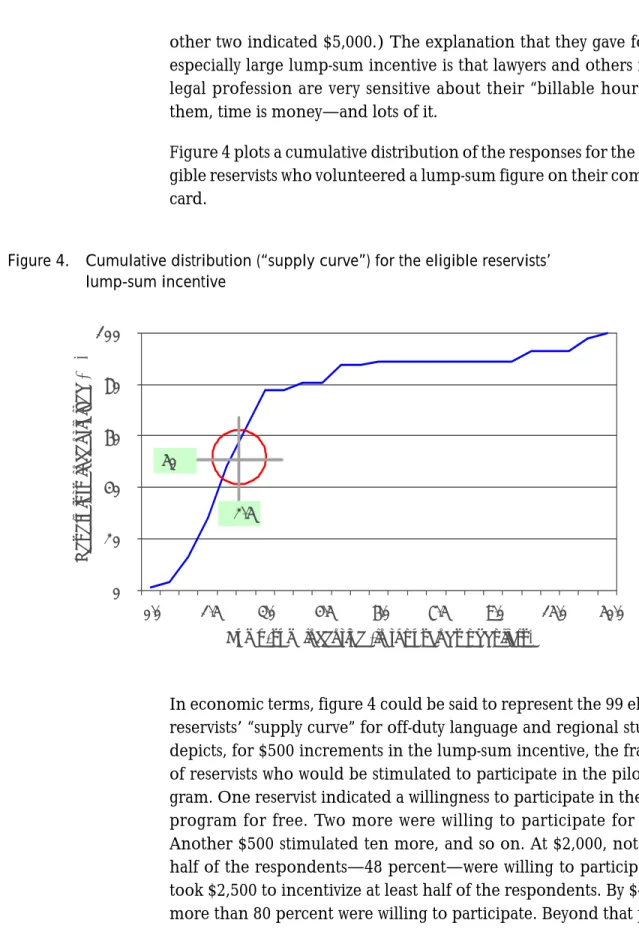
The discussion groups generated 200 completed comment cards from reservists, 58 percent of whom were in the ratings (96 enlisted) and designators (20 officers) targeted for the pilot. One of the questions we asked the reservists was what level of bonus would they require to take a course. We asked them to assume that the cost of a course was between $800 and $1,000 to normalize their responses. The median level of bonus—the amount required to incentivize 50 percent of reservists to participate in the pilot—was $2,500 ($2,000 for enlisted and $5,000 for officers). We used this value as a starting point, and we then adjusted the level up or down based on whether it was a language or culture course, or upper versus lower division course.
Table 5 below describes the assumptions regarding each type of class, the recommended level of bonus, and the average hourly compensa-tion that would result for each type of class given our assumpcompensa-tions. So, for instance, we assume that all foreign language courses will confer four credits and all culture courses will confer three credits, and that the average tuition per credit hour at two-year and four-year colleges is $100 and $300, respectively.15
The last column of table 5 is an estimate of the hourly bonus each reservist would receive after paying tuition. So, for instance, we esti-mate that the average reservist who takes a lower division language course will take it for four credits, study an additional 4 hours each week for 15 weeks, and receive a net bonus of $1,600, after paying tuition. This translates to roughly $13.00 per hour spent on attending the class and studying/homework.
15. We use averages for simplicity. In a later section, we discuss an alternative to this type of bonus that takes into account not only the variation in the costs of different types of institutions and courses, but also the fact that some reservists may have some or all of the costs covered by GI Bill ben-efits or other types of financial aid.
The net hourly compensation estimate can be thought of as a metric by which reservists may consider alternative uses for their time (some-thing economists refer to as “opportunity costs”). Referring to appen-dix C, many reservists noted their opportunity costs in their discussions of the level of bonus necessary to incentivize them to take a course, stating for instance, that the incentive, in addition to cover-ing the monetary costs for the course, would need to compensate them for their time away from families and jobs.
Reservists who are hourly employees may require compensation that is similar to what they would receive if they spent the time working overtime or in a second job instead of in class and studying. Salaried employees may have fewer opportunities to earn additional income during non-work hours, but they may compare the perceived value of their free time to this estimate. For both types of reservists, however, the benefits of taking a course for the pilot may include more than the bonus the Navy offers. In addition to the benefits that may accrue if they are mobilized to a country for which their course was relevant, their college course may benefit them in their civilian job or in their interactions with their community at large.
The bonus is structured so that the first courses (i.e., lower division) taken in a language or culture receive higher net hourly
Table 5. Recommended bonus amounts and assumptions used
Number of credits Total cost of course Bonus Bonus minus cost of course Number of hours in class/study per coursea Average net bonus per hour of class/study Lower division language 4 $400 $2,000 $1,600 120 $13.33 Upper division language 4 $1,200 $2,500 $1,300 120 $10.83 Lower division culture 3 $300 $1,250 $950 90 $10.56 Upper division culture 3 $900 $1,500 $600 90 $6.67
a. A semester typically consists of 15 weeks of classes. The number of credits per course is also the number of hours of class convening each week. We assume an additional hour outside of class each week for studying/ homework for each hour of class convening. For instance, a four-credit class would meet 4 hours each week, with an additional 4 hours of study/homework each week, for a total of 8 hours each week for 15 weeks.
compensation than higher-level courses. We construct the bonus this way because the incentive is designed to encourage reservists, partic-ularly those who have never studied a foreign language or culture, to gain some knowledge and awareness by taking courses for credit. This implies that most will be taking a lower division course, at least at first. Those who have never taken a course in the particular discipline, or perhaps any college course, may need additional incentive to encour-age them to attempt even a basic introductory course.
We also construct the bonus so that language courses have a higher net hourly bonus. We do this for a number of reasons. First, there is far less uniformity in the number of credits conferred for a language course than for a culture course; reservists taking a language course may be enrolled in five or even six credit hours, which would incur both greater expense and greater time commitment. Secondly, two-year colleges offer a narrower range of languages, which means that even for lower division language courses, a significant number of reservists may be required to attend public four-year institutions.
Given the lack of specific goals for the pilot program, we recommend offering the same bonus regardless of language or region studied. In the future, if detailed requirements are established, the pilot pro-gram can easily be adapted to offer different levels of bonus depend-ing on the curriculum.
Other recommendations
In designing the pilot program, we worked closely with the sponsor and other stakeholders. We made several recommendations on the different parameters and then worked to obtain consensus. This sec-tion presents some other recommendasec-tions we made that the Navy either adapted or did not include in the program at all. For each, we describe the recommendation and the course of action the Navy has chosen.
Pre-approval
We recommended a pre-approval process. Because of the ambiguity in the types of relevant culture courses, we were concerned that reservists may unintentionally take courses that do not satisfy the
intent of the pilot. To minimize the Navy paying for irrelevant courses, or worse, denying payment to reservists who took courses in good faith, we recommended that each NOSC approve courses before the reservist enrolls, or at least prior to the course withdrawal period.
Another benefit of pre-approval is the provision of timely information regarding how many and which reservists are participating in the pilot. Specifically, we recommended that part of the pre-approval pro-cess include the requirement that each NOSC forward relevant infor-mation about reservists granted approval to the appropriate Navy personnel in charge of the pilot. This would allow the Navy enough time to analyze the data and determine whether the incentive needs to be modified in time for reservists to register for classes for the second semester of the pilot. In addition, having data on those who registered would provide insight into whether participants were reg-istering but not successfully completing their course of study.
Rather than a pre-approval process, the Navy opted to require that each reservist participating in the pilot submit to their NOSC Educa-tional Services Officer (ESO) a bonus application form and a copy of the course description from the school’s course catalog within 60 days of registering for the course. This notification process should still provide the benefit of timely data.
Yearly cap
Given limited funds, the Navy can either choose to fund fewer reserv-ists to take many classes, or fund more reservreserv-ists to take fewer classes. We concluded that the goal of the pilot was to do the latter; maximize the number of reservists who take a limited number of courses to expose them to other cultures and/or languages. Hence, we recom-mended that the Navy cap the incentive to no more than two classes per reservist per year. Instead, the Navy has capped the incentive at $5,000 per year, which will cover up to 2 to 3 classes at the full bonus amount, depending on the type and level of class, and some partial bonus for one additional class.
SELRES-specific obligation
As we noted before, the Navy chose to require participants to have 24 months of remaining service obligation in order to be eligible for the pilot. This was done in lieu of requiring an additional obligated ser-vice for receiving the bonus, which we felt would be too much of a dis-incentive given the size of the bonus. However, the Navy has not yet adopted a SELRES-specific remaining obligation which would ensure that participants are active members of the SELRES and eligible to mobilize to use their acquired LREC skills, for 24 months after they receive the bonus. If participants are allowed to transition to the IRR, the Navy will not be able to achieve the full return on its investment.
FLPB restrictions
OCNR has stated one goal of the pilot is to incentivize reservists to expand linguistic skills, regional knowledge, and cultural awareness in order to improve effective interaction with foreign nationals. This seems to imply an introductory to intermediate level of proficiency in either a language or culture, or both. The FLPB, on the other hand, incentivizes servicemembers to obtain a greater level of proficiency; servicemembers must test at least at a level 2 proficiency in both lis-tening and reading on the DLPT.16 Therefore, a reservist who is already receiving the FLPB in a language does not require this pilot incentive to develop his or her LREC skills. Hence, we recommend that this bonus not be offered to reservists taking classes in a language for which they are already receiving the FLPB. This would not pro-hibit them, however, from receiving the bonus for a course in another language or a relevant culture course. The Navy has not yet included any restrictions on FLPB recipients in the provisions of the pilot program.
Goaling NOSCs
We suggested that the Navy assign goals to each NOSC, requiring that at least 2 percent of the total number of reservists in the included rat-ings/designators participate in the program. If the total is less than
16. See appendix A for a discussion of language proficiency levels and the ACE guidelines on how DLPT scores equate to course credit.
100, they should be goaled for one reservist. Experience with an experiment to recruit pre-trained Hospital Corpsmen (HMs) into the Active Component supports the notion that goals are useful in achiev-ing certain desirable outcomes. The HM experiment is documented in [19]. Briefly, in February 1996, Commander Navy Recruiting Com-mand (CNRC) goaled six of the 31 Navy Recruiting Districts (NRDs) to recruit 50 radiographers and 25 clinical lab technicians. The remaining NRDs were also asked to participate, but without specific goals. In the first 8 months of the experiment, 21 HMs were recruited, for an average of 2.6 pre-trained recruits per month. The goaled NRDs accounted for almost two-thirds of these recruits. In FY 1997, the Navy dropped the experiment label and the six NRDs were no longer goaled. In the next 12 months, just eight pre-trained HMs were recruited, for an average of about 0.7 recruits per month, a decrease of 75 percent in monthly new recruits.
Establishing goals, as with the HM experiment, ensures that both par-ties, in this case, reservists and NOSC Commanding Officers (COs), are fully engaged in achieving the Navy’s objectives. The bonus, cou-pled with other personnel goals accomplished by taking a relevant course, incentivize the reservist to participate. Many reservists, how-ever, may not be familiar with local postsecondary institutions or spe-cific requirements for enrolling in courses if they are not matriculated, and some reservists may be reluctant to take a college course if they have never done so in the past. Goals could incentivize NOSC COs to provide time during a weekend drill for a local college representative to present information regarding how to register for a class, which courses would be relevant for the pilot, and perhaps even help reservists to register for a course.
Similar to the HM experiment, we recommend that no penalty should be imposed if the NOSC misses its goal, but it would be useful if the CO provided feedback as to why they did not meet the goal. It would also be useful if the NOSC COs gave recommendations as to how to make the incentive attractive to more reservists. The Navy has not yet set any goals for participation from the NOSCs.
Include non-deploying ratings and designators in eligible participant group
One concern raised during the course of our research was that reserv-ists may perceive that their chances of being mobilized would increase if they participated in the pilot. This hypothesis could be tested by including in the pilot ratings and designators with the full range of mobilization rates. We could then determine whether partic-ipation rates vary with rates of mobilization, holding all other factors constant. This is especially important if the Navy wants to ensure that a certain minimum percentage of reservists in all ratings and designa-tors have the necessary proficiency envisioned by the pilot.
So, for instance, if it was found that reservists in ratings/designators with the lowest rates of mobilization had the highest level of partici-pation, this would indicate that the bonus level may need to be corre-lated with the rate of mobilization.
Ultimately, however, the Navy selected only those ratings and designa-tors with a high rate of mobilization, which will make it difficult to dis-cern the effect of perceived mobilization on the rate of participation.
Reimburse participants if mobilized
Some state institutions have policies to reimburse reservists who are mobilized after they have begun a course and after the period to with-draw without penalty has ended. These institutions may reimburse servicemembers for tuition and fees under these circumstances, but books and other supplies are often not reimbursed. Reservists who are unable to complete the course due to mobilization will have incurred other types of expenses as well, such as travel and perhaps child care. If reservists agree to take a course with the understanding that these types of expenses are covered in the “net bonus” amount, yet they receive no bonus because they were involuntarily mobilized, they may refuse to participate in the future. The experiences of these reservists may also make other reservists less likely to participate. If so, higher bonuses would be required to achieve the same level of partic-ipation than if they were reimbursed. Therefore, we recommend that reservists who are involuntarily mobilized be reimbursed for any out-of-pocket expense that is not otherwise reimbursed by the institution. However, OCNR did not include any provisions for reimbursing mobilized reservists.
Alternatives for the pilot program
Before CNA was brought on to help develop the pilot, the Navy had made several decisions regarding both the method of developing the desired LREC skills and the shape of the incentive. First, the Navy determined that only courses taken for credit at IHLs would be eligi-ble for the pilot program. Second, the Navy decided that the bonus would be structured as a one-time lump-sum cash bonus paid after successful completion of an eligible course. However, there are alter-natives to both the method and the incentive, and we discuss some of these here. It was beyond the scope of the study to fully develop the alternatives presented here. However, we offer these for consider-ation in the future as the Navy develops more specific LREC strategies and goals.
Alternative incentives
The Navy offers many different incentives for different programs. Some incentives are paid on a monthly basis rather than as a one-time bonus. Some incentives are offered tax-free as allowances rather than bonuses. For the pilot program, we consider some options for the incentive that the Navy should consider when evaluating the success of the current bonus.
Not all incentives should necessarily target the same populations (i.e., officer and enlisted individuals already in SELRES); not all reservists (or potential reservists) will deem each incentive to be equally attrac-tive. Variation in current and potential reservists’ interests, abilities, and perceived benef